
Tag: Conrad Viedt

The Man Who Laughs (1928)

The Man Who Laughs (1928)

Gothic romance, wrongly remembered as a proto-horror, also has a dark sexual undercurrent

Director: Paul Leni

Cast: Conrad Veidt (Gwynplaine), Mary Philbin (Dea), Olga Baclanova (Duchess Josiana), Josephine Cowell (Queen Anne), George Siegmann (Dr Hardquanonne), Brandon Hurst (Barkilphedro), Sam De Grasse (James II), Stuart Holmes (Lord Dirry-Moir), Cesare Gravina (Ursus)

The Man Who Laughs often gets remembered as a horror film, which seems a bit odd when you actually watch this Victor Hugo adaptation. It’s really a sort of melodrama romance with a touch of conspiracy-tinged action. What possibly cements it as a comedy is the Glasgow-smile of its lead character Gwynplaine, played by that legend of silent cinema monsters Conrad Viedt. (It went on to inspire the look of The Joker, further cementing the film as horror in minds). But, far from a monster, Gwynplaine is a sweet-vulnerable figure who has find himself at the centre of an atmospheric drama with lashes of shadow and Gothic German expressionism from its director Paul Leni.

Gwynplaine has his twisted smile after his face was mutilated as a child, a punishment for his executed father, stripped of his lordship by order of James II (Sam De Grasse). Years later, in the reign of Queen Anne (Josephine Cowell), Gwynplaine is the leading figure of a travelling band of players, famous as the Man Who Smiles. He’s in love with the blind Dea (Mary Philbin) but disgusted and ashamed of his own appearance, which prevents him declaring his love. But his ancestry is discovered, as his (unwanted) claim to the title now held by the nymphomaniac Duchess Josiana (Olga Baclanova), and he becomes the centre of a scheme for power by the sinister Barkilphedro (Brandon Hurst).

The Man Who Laughs main focus is the gentle romance between Gwynplaine and Bea, which becomes absorbed into a tragic story of creeping gothic power. Gwynplaine wants nothing more than to be left alone. He hates being the centre of his attention, only really comfortable when disguised under theatrical make-up or with the blind Dea. Even then, Gwynplaine refuses to let her touch his face so terrified is he that she will reject the twisted facial features that she will find below her hands. This is told with a gentle, sympathetic sweetness by Leni, who dials down the misty misery and darkness that casts its shadow over the rest of the film, to allow this romance to spread hope.

It’s far different from the gloomy, gothic foreboding that covers the rest of the film in its frequently shadow and mist filled frame. From its opening in the bedroom of King James – lined with stony carvings that look like they’ve been peeled off the wall of an ancient Minster – it throws us into a grizzly execution for Gwynplaine’s father, locked into a spike-lined Iron Lady with a stoic look on his face. The banishment of Gwynplaine, along with the bizarre cult who deformed him, on a rickity ship passes through a frozen coast-line, where the young boy is cast aside the moment the going gets tough. From there, we see streets filled with hints of violence under the mists. Brandon Hurst’s darkly twisted Barkilphedro is the sort of man who thinks nothing of dispatching a witness to the torture chamber or dragging a victim in the middle of the night to who-knows-where. Hurst is an unsettling stand-out here, playing a man with no sense of loyalty or honour, happy to lie and manipulate as well as slimly ingratiate himself to anyone in power.

The gloomy sense of danger that this world is filled with is captured superbly in Leni’s film, which is stuffed with atmospheric compositions that only stress the unsettling sense of peril lurking around every corner. It’s also a world filled with perverse sexual longing. It’s hard to imagine The Man Who Laughs having a whisper of existing a few years later under the Hays Code, such is the dark sexual current flowing beneath it. Frequently sexual desire rears its head, from the coded glances Queen Anne gives the missing chair of the Duchess, to the base desires that drag Gwynplaine from his bed one night to explore a beguiling offer from the Duchess.

The Duchess is the heart of the sexual darkness in the film, an allusive seductress we are introduced to lazing practically naked on a bed, attempting to seduce Barkilphedro to follow her whims with him perching at the end of her bed and allowed a peek of her (possibly non-existent) underwear. Not until Basic Instinct would another villainous of such rampant, unabashed sexuality hit the screen. The Duchess is as sexually excited by the thought of men fighting over her on the street (and its implied would be more than happy to satisfy any number of winners) as she is hornily fascinated by Gwynplaine’s unusual features. She is able to puppet along Stuart Holmes’ clueless Lord, who can barely tear his eyes from her even while he knows she is treating him like dirt. Her sensuality even runs the risk of seducing our hero, and her unabashed revelling in her sexuality feels light years ahead of its time.

But the lasting impact of The Man Who Laughs comes from its lead character, wonderfully embodied by Conrad Veidt in one of the legendary silent performances. Labouring under the facial disfigurement make-up – which left his face and mouth sore and exhausted – Veidt belays the restrictive nature of his make-up to offer a parade of expressions, variations on the same smile. Devotion, shame, joy, excitement, fear and hope play across his face so clearly that, even with the lower part of his mouth rigidly fixed, it’s always certain exactly what he is feeling. Presented to the House of Lords at the film’s end, Veidt is given a marvellous set-piece of moral force, berating the crowing bewigged courtiers who turn on him and vigorously asserting his right to choose. It’s a crowning moment of a subtle and moving performance.

And it makes Gwynplaine so sympathetic, it’s even more unusual that it’s been remembered as a horror, for all the film ends in a gothic chase and the brutally bloody intervention of a loyal but fierce wolf hound. Because The Man Who Laughs is, in the end, a hopeful and undeniably romantic testimony to how love can in fact conquer all, which for all its gothic gloom, leaves us sailing into a sunset relieved that the future promises all the best for our heroes.

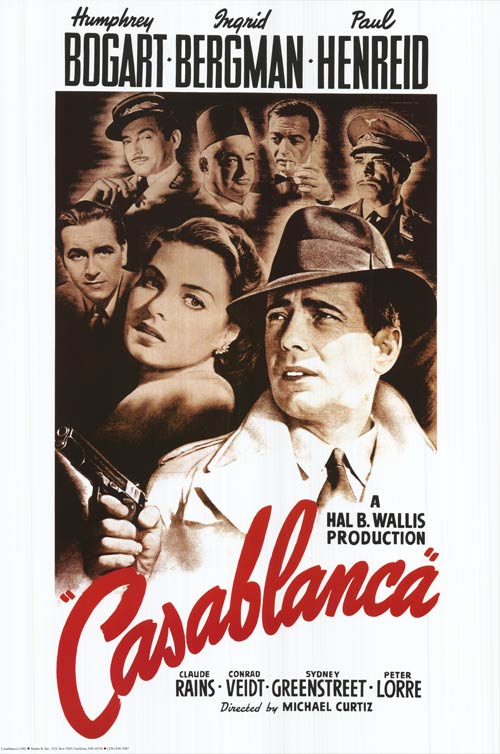
Casablanca (1943)

Casablanca (1943)

Bogart and Bergman are a love story for the ages in the ever-young Casablanca

Director: Michael Curtiz

Cast: Humphrey Bogart (Rick Blaine), Ingrid Bergman (Ilsa Lund), Paul Henreid (Victor Laszlo), Claude Rains (Captain Louis Renault), Conrad Viedt (Major Henrich Strasser), Sydney Greenstreet (Signor Ferrari), Peter Lorre (Signor Ugarte), Dooley Wilson (Sam), Madeline Lebeau (Yvonne), Curt Bois (Pickpocker), SZ Sakall (Carl), Leonid Kinsky (Sascha), Marcel Dalio (Emil), Joy Page (Anna)

For today, for tomorrow and for the rest of your life. That’s the sort of lifespan Casablanca has: to see it is to fall in love with it. That’s what people have been doing for nearly 80 years. There isn’t a more popular “great” movie. This is vintage, top-notch, prime Hollywood product, made by a group of people at the top of their game that has such impact you’ll know most of its highlights without having ever seen the film. No wonder people have been saying since it was released “Play it again” (famously, a phrase you will never actually hear in the film itself).

Casablanca, December 1941. Corrupt Vichy France officials rule the roost, with the city clinging to neutrality. European refugees and American ex-Pats mix with Nazi officers – everyone trying to get those all-important “letters of transit” you need to climb onto a plane and get out of the warzone. Letters like this will cause a world of trouble for American ex-Pat Rick Blaine (Humphrey Bogart), keeping Rick’s Café going as a place where politics are never discussed. But Rick may be forced to choose sides when his lost love Ilsa Lund (Ingrid Bergman) lands back in his life, on the run from the Nazis with her husband Czech freedom-fighter Victor Laszlo (Paul Henreid). Just before the fall of Paris, Rick and Ilsa had a love affair (she thought Victor was dead at the time) and neither of them has got over it. Will Rick take a stand and help Victor flee to continue the fight against the Nazis? Or is this a chance for Ilsa and he finally to be together?

Like many hugely beloved films, Casablanca combines a host of genres into one superbly digestible, hugely enjoyable, package. This is a star-crossed romance in the middle of a war film, with lashings of everything from espionage to gangsters to comedy of manners. In short, there would have to be something wrong with you not to find something to tick your boxes in Casablanca and it’s all brilliantly packaged together by Michael Curtiz into possibly one of the most purely entertaining and crowd-pleasing films ever made.

Casablanca is a superbly written pinnacle of the hard-edged but strangely romantic dialogue of Hollywood at the time, all delivered with more than a dash of humour. There isn’t a scene that doesn’t have a quotable line in it: and all of them delivered by a brilliant actor. Each scene is a master-class in Hollywood professionalism and skill. From our introduction to the streets of Casablanca – capped with the shooting of a Free-French fighter, who collapses to his death underneath a poster of Petain – to the beautifully evocative set (wonderfully shot by Arthur Edeson) for Rick’s café, where we will spend so much of the movie. In swift economy we see how ruthless Rick can be – not lifting a finger to help to petty crook and friend Ugarte (a wonderful cameo from Peter Lorre) – before understanding fully why he’s like that when he responds with something between shock, horror and desperate longing by the arrival of Ingrid Bergman’s Ilsa.

It’s also a film where the stakes are expertly set out. There are jokes about the cold ruthlessness of the Germans, but we are left in no doubt about their danger. (Conrad Viedt is grimly imperious as head Nazi Stasser). The scar on Victor’s face is a constant reminder of the horrors he escaped in the concentration camp (although, as per the time, the film understands these as jails rather than the hell they were). The refugees are putting on a brave face, but there is desperate practising of English and a willingness to trade anything (including their bodies) for letters of transit speaks volumes.

Nearly all of those actors (and Curtiz) are of course refugees and migrants themselves (only Bogart, Wilson and minor-player Page were American). The film gains a sub-conscious depth from this being more than just a story for so many of them. Fleeing from German advance in Europe (or escaping from Nazi persecution) was no theoretical for Henreid, Veidt or the host of great European actors in small roles. You can see that emotion when Victor cajoles the café’s clientele to sing La Marseillaise. The scene never fails to move because of the genuine power of watching real refugees, playing refugees, defiantly singing in the face of the Nazis who ruined their lives (the shots of Madeline Lebeau genuinely tear-stained face or the increasingly moved Spanish guitar player are beyond memorable). You can’t watch this sequence without a lump in your throat.

Mind you can’t watch most of it without that lump. Bogart and Bergman cemented themselves as icons with this passionate love story. It’s grounded, like so many truly affecting romances, on loss and pain rather than joy. Aside from a brief flashback to their time together in Paris – before Ilsa jilts Rick at the train station, rain washing the ink from her note (the sky shedding the tears Rick cannot) – these are two people essentially at loggerheads, because it’s the only way to keep their hands off each other. Rick deeply resents Ilsa, Ilsa can’t even begin to allow herself to think about her lost love for Rick because she fears it will take control of her. Particularly as, in Bergman’s beautifully judged performance, she clearly has a sort of spiritual (as opposed to romantic) love for the noble Laszlo.

It all helped to make Bogart such an icon for generations to come. Bogart is effortlessly cool here, but he’s also incredibly relatable – who, after all, hasn’t had their heart-broken? Watch him sadly starring in the middle distance, befuddled by drink and demanding Sam play As Times Goes By over and over, and it’s no surprise that he’s so torn for so much of the film about what to do. Paul Henreid could never compete with the mix of vulnerability and misanthropic cynicism Bogart effortlessly brings to the part (one of the all-time great performances in the movies).

Bogart is also a perfect encapsulation of what America wanted (and still wants) to be. Minding his own business, but tread on him and he’ll bite back. Not only that, he’ll pick the right side and always make sure he does the right thing. It’s hinted to us that, for all his shady past, Rick has sided with anti-Fascists in Spain and Ethiopia. We even know he had to flee Paris because there was a price on his head. He might “stick his head out for nobody”, but the genius of Bogart is we don’t quite believe him, even while we see him do just that.

The chemistry between him and Bergman – who claimed never to quite understand why the film had such impact – is breath-takingly good. Helped by some of the wittiest and hard-edged dialogue in the movies, they become Hollywood’s own Lancelot and Guinevere. Bergman’s deceptively soft-edged performance, carries inner grit masking her own pain – she also brilliantly manages to show how she could be in love with two men (in different ways) at once. These two characters go through a long dance of denial before finally confessing all: and the iconic ending has the perfect combination of heartfelt longing and sacrifice they both know needs to be made.

But it’s not the only romance in the movie: having almost as much impact is the chemistry between Bogart and a never-better Claude Rains as jovially corrupt Vichy inspector Renault (merrily trading letters of transit for sexual favours and ticking the boxes of his duty while lining his own pockets). Casablanca also has in it one of the greatest love-hate friendships in the movies, between two people who can’t help liking each other, even when they barely have a single interest combined. Sounds like the beginning of a beautiful friendship.

Critical discussion has often revolved around whether Casablanca can be considered a piece of “high art”. It’s hard to imagine Ingrid Bergman’s famous Swedish compatriot directing it. To be completely honest, Casablanca is one of the finest packaged pieces of Hollywood Hokum ever made. And there is nothing wrong with that. It’s a master craftsman of glorious stand-up-and-applaud films in Curtiz, delivering his masterpiece. Casablanca doesn’t have the revelatory flair of something like Citizen Kane. But no other film in existence so brilliantly exploited the Hollywood formula. And it shows how much power, emotion and joy you mine from Hollywood’s narrative and filmic tropes when they were worked with as much skill and passion as you get here.

It’s a film that not only perfectly encapsulates a whole period of Hollywood professionalism, it also establishes the sort of golden rules – a brittle semi-anti-hero, sacrifice, moral complexities and open-endings – that would increasingly dominate Hollywood in the decades to come. Casablanca is a genuine turning point in Hollywood, a perfect summation of the noirs, love stories and adventures that preceded it, but repackaging them with influential insight. It’s also, above and beyond everything else, a bloody brilliant film that, as Nora Ephon said, you can never see enough.