Tag: Daniel Day-Lewis

There Will Be Blood (2007)

There Will Be Blood (2007)

Daniel Day-Lewis triumphs in this incomparable masterpiece from Paul Thomas Anderson

Director: Paul Thomas Anderson

Cast: Daniel Day-Lewis (Daniel Plainview), Paul Dano (Eli Sunday/Paul Sunday), Kevin J. O’Connor (Henry), Ciarán Hinds (Fletcher Hamilton), Dillon Fraser (HW Plainview), Russell Harvard (Adult HW Plainview), David Willis (Able Sunday), Hans Howes (William Brandy), Paul F. Tompkins (Prescott)

Citizen Kane’s original title was “American”. David Thomson observed perhaps there hasn’t been another film so deserving of that title until There Will Be Blood. This is one of those once-in-a-decade films, possibly the greatest American film of the twenty-first century and Anderson’s career-defining masterpiece. It’s a gripping exploration of what makes America tick, captured within the self-destructive greed and hunger for power of one man. It’s a stunning piece of work, a cast-iron masterpiece, that takes a stack of influences and reinvents them into something fresh, daring, bold and above all unrepeatably unique.

Adapted very loosely from Upton Sinclair’s novel Oil, the film follows thirty years in the life of Daniel Plainview (Daniel Day-Lewis), a misanthropic and fiercely ambitious empire-building oil man. Running a ‘family business’ with his adopted son HW (Dillon Fraser) – the boy’s father having been killed in a drilling accident – Plainview takes up a sea of leases across California. The film focuses on his exploitation of a rich seam under the community of Little Boston. A very religious community – dominated by the strong-willed Eli Sunday (Paul Dano), almost a mirror image of Plainview’s monomania – Little Boston becomes the setting for Plainview’s struggles with men and land, in a growing cacophony of drama that inevitably (as the title promises) builds towards an explosion.

Watching it you can see the inspirations. It reflects The Treasure of the Sierra Madre (which Anderson watched endlessly in preparation) in its chilling exploration of the impact of greed and Plainview is the grandfather of Charles Foster Kane. It’s set in a Fordian west, but filtered through the unique vision of Kubrick. But it’s not a slave to these: it’s a truly original work, an off-kilter epic, shot with a stunning beauty that’s half poetry, half gothic horror by Robert Elswit. It sounds like no film ever made, a deeply unsettling score that mixes discordant rhythm and baroque-inspired strings by Johnny Greenwood.

And it has two geniuses at its centre. Anderson, a director best known for large-scale ensemble pieces, inverts his style to focus on one single misanthropic force of nature, a man who sees people as only tools or rivals. His film hits every note from near silent-cinema expressionism, to Grand Guignol fever-dream intensity. It’s shot with an all-consuming urgency, long-takes of fluid camera movement, mixed with interrogative still shots. The film digs itself into your soul, takes hold and doesn’t let go. It’s at times as darkly funny, as it is horrifyingly bleak. No one else could have made it.

And no one else could have played Plainview. If There Will Be Blood cemented Anderson as one of the leading directors of the early 21st century, it confirmed Day-Lewis as the era’s greatest actor. Day-Lewis is beyond superb here: this is the sort of, epoch defining performance you see only a few times in your life. Hunched forward, like a man constantly on the move, dark eyes gleaming and his voice a malevolently rolling John-Huston inspired baritone, Day-Lewis makes Plainview a misanthropic monster. He’s articulate, instinctive and destructive. Achieving his dreams only makes him even more inhuman and bitter. And Day-Lewis makes clear the stunted, half-grown creature under the skin of the confident businessman.
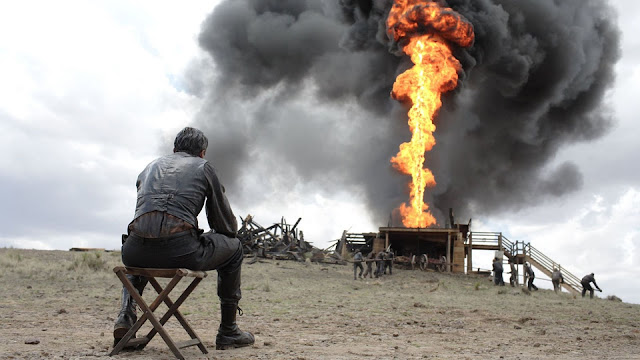
It’s clear he’s desperately lonely, but seemingly only has enough humanity in him for one relationship at a time – even then, people still must serve a purpose. HW – and later Henry, the man who arrives on his land claiming to be his brother (a wonderful inscrutable performance from Kevin J O’Connor) – become props in the family business. Plainview reaches out to them for emotional connection, but it’s all one way. When an accident robs the young HW of his hearing, Plainview is incapable of caring for him – he treats the deafness like a betrayal. He banishes HW, just as he will banish and punish all those who he sees as betraying him, including Henry. There isn’t a scene that doesn’t have a piece of performative magic from Day-Lewis.

Alongside this genius, Anderson’s subject is America. It’s a stunning exploration of how capitalism, greed and an insatiable hunger for more – be it money, land, power or anything else worth a jot of value – has shaped the country. Plainview is the dark soul of pioneering American entrepreneurial spirit, obsessed to the elimination of anything else, with accumulation. Oil is the life blood of the country, God’s own gift of power wrapped in a dangerous black liquid. It’s pumping through the country’s soil, and to control it is to control the country’s circulation. It’s Plainview’s faith – and it’s the faith of all these men forging an empire out of the ground, motivated by the desire for more. It’s partly why the film is so focused on men – because it’s always grasping men like this, titans of industry, who shape the dark soul of our civilisation.

Nothing will please Plainview until he controls all around him, confessing in a quiet moment (there are no words for how brilliantly unrepentant, yet also strangely regretful Day-Lewis is in this underplayed scene) that he has “a competition within him. I want no one else to succeed. I hate most people.” Like the country itself, he has forged himself from nothing through naught but will-power and a determination to never know failure. There Will Be Blood argues that, much as we might want to think otherwise, America is built on the backs of men like Plainview – monsters with the vision and determination to turn a desert into a city.

God himself has no place in these calculations. Anderson contrasts the obsessive sweat of Plainview with the dogmatic and vainglorious Christianity of Eli Sunday (a brilliantly weasly Paul Dano). Eli’s church is a haven of evangelistic worship and showmanship, which Plainview immediately finds disgusting (does he recognise another expert peddler of bullshit?). Eli has a moral arrogance and as much as a desire to control as Plainview, and the battle that grows between these two for dominance not only shows the ruthlessness of both men, but also reflects the struggle between religious obligation and Mammon that has run through America’s history.

The rivalry between the two men revolves around three crucial confrontations. Having effectively robbed valuable land from Eli’s family for a pittance, Plainview then humiliates Eli, forcing him head first into the mud, refusing to allow him any influence over his dig. Eli’s revenge comes in spades: controlling a vital piece of land for Plainview’s pipeline, he demands Plainview comes to his church to be rebaptised. The resulting scene sees him goad, provoke and demean Plainview for his sins, forcing Plainview into a series of humiliating confessions (both actors are earth-shakingly brilliant).
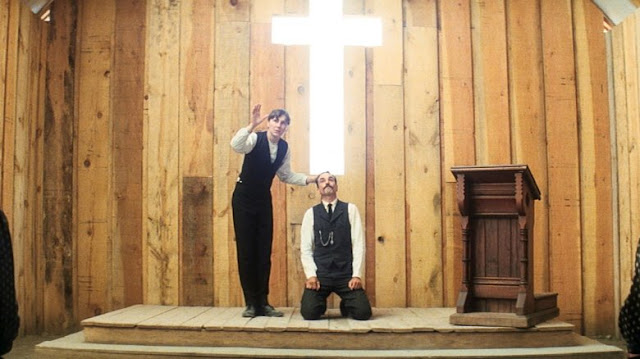
Their final reckoning closes the film – and is both its most controversial and overblown sequence. Jumping forward fifteen years, to Plainview’s sprawling mansion (where Day-Lewis has become a dishevelled hermit, his misanthropy unchecked and his victories only confirming his loathing of humanity) it’s the famous ‘milkshake’ scene, played with the sort of OTT intensity only Day-Lewis could risk and which the film has carefully built us towards accepting. Blood-dripped in a Kubrickian setting of a bowling alley, it’s the final expression of two men’s mutual hatred and views of a world – Eli’s that it owes him something for his faith, Plainview’s that he controls it through will alone.

Only a film that has built on such firm grounding of escalating tension and excess could make such a scene a success. This is a film that starts with a near-silent 15 minutes, of Plainview hammering with a pickaxe obsessively in the belly of the country’s soil. It ends – after a long journey that has seen Plainview wheedle, steal, bully and grasp – with him entombed again, this time in his mausoleum of a home, no daylight allowed and the air filled with Plainview’s hate-filled rants. Along the way, we’ve seen the plains of California as a place of dreamy beauty, marshalled to the will of one man to control all around him, scenes of striking beauty and haunting intensity.

There Will Be Blood is a masterpiece, an inspired parable for American history, a showcase for one of the greatest actors of his generation to redefine his craft and a marvel of character study, epic vision and haunting lyricism from its director. There is not a false note in it and it stands towering as a landmark in American film history. The greatest American film of the 2000s? Possibly yes.
Lincoln (2012)

Daniel Day-Lewis gives on the great transformative performances as Lincoln

Director: Steven Spielberg

Cast: Daniel Day-Lewis (Abraham Lincoln), Sally Field (Mary Todd Lincoln), Tommy Lee Jones (Thaddeus Stevens), David Strathairn (William Seward), Joseph Gordon-Levitt (Robert Lincoln), James Spader (WN Bilbo), Hal Holbrook (Preston Blair), John Hawkes (Robert Latham), Jackie Earle Haley (Alexander Stephens), Bruce McGill (Edwin Stanton), Tim Blake Nelson (Richard Schell), Joseph Cross (John Hay), Jared Harris (Ulysses S Grant), Lee Pace (Fernando Wood), Peter McRobbie (George Pendleton), Gloria Reuben (Elizabeth Keckley), Jeremy Strong (John Nicolay), Michael Stuhlbarg (George Yeaman), David Costible (James Ashley), Boris McGiver (Alexander Coffroth)

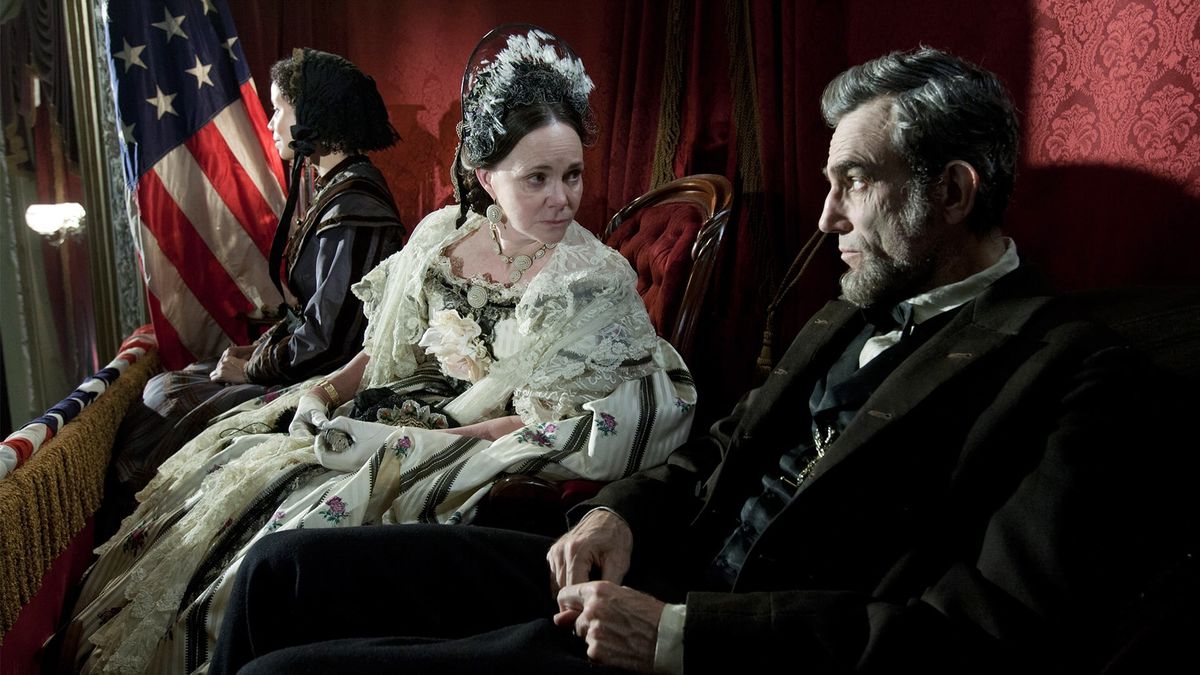
It took me three viewings until I felt I got Lincoln. Previously – in the cinema and the first time at home – I respected it. I admired the skill with which it was assembled. But I had found it hard to see it as much more than a critically acclaimed civics lesson, Spielberg at his most prestige. Returning to it the third time with the pressure well and truly off, suddenly I discovered a film I’d never seen before, an intensely dramatic telling of the perilous struggle to pass the Thirteenth Amendment to abolish slavery. A vibrant, beautiful and surprisingly intense story of how close Congress came to vetoing it. What had seemed a stuffy museum piece, instead came to life as a dramatic piece of cinema. It goes to show you should never be afraid to give something another go. Or two.

This biopic of Lincoln goes down a very modern route of avoiding covering the Great Man’s entire life. Instead it zeroes in on little more than a crucial month. It’s January 1865 – in what we know are the final months of the President’s life – and Abraham Lincoln (Daniel Day-Lewis) confronts a terrible choice. Civil war has torn America apart for year and peace may be on the horizon. But Lincoln fears a reformed America, with all its Southern slave states back in the fold, will find a way to end his Emancipation Proclamation and restore slavery to its height. To prevent this, Congress must ratify the Thirteenth Amendment to the Constitution ending slavery. But, with many in Congress worried that such an Amendment will end any chance of peace, Lincoln is in a terrible position. Should he sacrifice peace for abolition? Or vice versa? Either way, it will be a no-holds barred fight on the floors of Congress.

Spielberg’s film is near perfect in its shooting and editing, while its historical detail is brilliantly on-point. You couldn’t fault a moment of its making. However, what makes the film a success is the director’s skilful ability to combine graceful (even stately) old-fashioned film-making expertise, with a truly compelling sense of the passions and dangers we face when democracy is in action. And the overwhelming tension when the stakes are high and we have no guarantees of the end result. Another film – the stately civics lesson I once took the film for – would have shown the passage of the bill as a Whiggish inevitability, a progress filled march to a better world.

Lincoln isn’t like that. This is a film that shows politics then and politics now ain’t that different. For every principled man, there a dozen looking out for the main chance, marking time or who are too scared to worry about right and wrong. The Amendment is delivered not by impassioned oratory from the President. It’s carried by skilled floor management and the employment of a trio of political lobbyists with briefcases stuffed with cushy job offers in the rebuilt America.

Votes are brow-beaten out of people, threats and persuasion are used in equal measure. There is no winning people over with poetic oratory. At one point, Lincoln makes a simple and heartfelt plea for one congressmen to do the right thing: the guy votes against him. One of the film’s moments of triumph sees fervent abolitionist Thaddeus Stevens refuse to be provoked into expressing his true views on the floor, instead offering a statement that he does not believe in equality “in all things”, knowing any other answer will be used to build opposition against the bill. Is there any other film in American politics where one of the biggest cheer moments is one of our heroes compromising and spinning his true views into something far less threatening?

It’s all part of the film’s demystification of American history as not being something made from marble, but instead being real and true. If anything though, this sense of realism – of danger and the very real possibility of defeat – makes the final vote (a long sequence that almost plays out a congress vote in real time) both far more dramatic and also surprisingly moving. Because we appreciate every step of the backroom handshakes, fights, compromises and (let’s be honest) corruption and shady deals that got us here. And, more than anything, the film has made clear Lincoln is willing for this brutal war (the horrors of which, both in battle and bloody aftermath, intrude at key points in the film) to go on for as long as it takes, to ensure this Amendment.

Lincoln is the heart of the film: and it’s almost impossible to state how central Daniel Day-Lewis is to the film’s success. This is an extraordinary performance. I don’t think you can understate how venerated Lincoln is in the American memory. With his distinctive features and a permanent memory of him sitting like a marble God in the centre of Washington, it’s hard for many to imagine that this was ever a real man. But Day-Lewis has turned in a performance here that transforms Lincoln into a living, breathing man but never once compromises his greatness.

From the voice (a wispy lightness, a million miles from the deep, Shakespearean accent you would expect – and entirely accurate) to the ambling walk, to the film’s embracing of Lincoln’s eccentric monologing, his love of whimsy and jokes, his autodidact passion for language, his warmth and love for his family – and his righteous anger when frustrated by those who cannot see the big picture – this is extraordinary. Day-Lewis is compelling in a way few actors can be. His Lincoln is superbly human. Every moment is beautifully observed, but this is so much more than an actor’s tricks. His Lincoln is someone you can come out of the film convinced that he was talking to you, that you understand him as a human being not a cipher. I felt I knew and understood Lincoln more from watching this film than I ever had from a history book. It’s breathtaking.

Of course it inspires everyone else in the cast to give their best. The at times difficult marriage between Lincoln and his wife gives some wonderful material for Sally Field (easily her finest performance in decades). Mary Todd Lincoln is aware she will always be a disappointment for her husband as a partner, but equally feels that her public mourning for this lost child speaks of a deeper humanity than her husband. Loyal if questioning, she’s also abrupt and clumsy enough at times to be a liability.

Tommy Lee Jones is exceptional as Thaddeus Stevens, prickly, difficult but also morally pure (the film has helped rediscover the unjustly overlooked Stevens). Previous Lincoln performers Strathairn and Holbrook give very good support. James Spader is great fun as colourful lobbyist. Joseph Gordon-Levitt is all restricted ambition as Lincoln’s son. Jared Harris shines in a few scenes as Grant. Gloria Reuben has a few beautiful moments as Mary’s confidante Elizabeth Keckley.

Lincoln is a film shot with all the prestige of an American Merchant-Ivory, in love with the power of democracy. But it’s also open-eyed on how a system like America’s works, and how perilous delivering “the right thing” can be. Emotional and engrossing, it’s powered above all by a towering sublime performance by Daniel Day-Lewis who might as well be the 16th President reborn. It took me three viewings to see the richness here – but I am so glad I stuck it out.

The Bounty (1984)

The Bounty (1984)

Hopkins and Gibson present a more historically-accurate Bounty movie that’s serious but solid

Director: Roger Donaldson

Cast: Mel Gibson (Fletcher Christian), Anthony Hopkins (Lt William Bligh), Laurence Olivier (Admiral Hood), Edward Fox (Captain Greetham), Daniel Day-Lewis (John Fryer), Bernard Hill (William Cole), Phil Davis (Edward Young), Liam Neeson (Charles Churchill), Wi Kuku Kaa (King Tynah), Tevaite Vernette (Mauatua), Philip Martin Brown (John Adams), Simon Chandler (David Nelson)

The story of the mutiny on The Bounty has intrigued for centuries. It’s been made into plays, novels and no fewer than three films. Most versions have been inspired by a 1932 novel that painted Bligh as an ogre and Christian as a matinee idol. That image was cemented by the classic Best Picture winning Laughton/Gable version. The real story is far more intriguing – and operates much more in shades of grey – and this 1984 film tries to find a middle ground, with mixed success.

In real life, Bligh was a prickly, difficult but fundamentally decent man, who had worked his way up the naval ranks through merit. He was a superb sailor – as seen by his feat of navigating a small open boat of loyalists over hundreds of miles back to a British port. Cleared of any guilt for the mutiny, he had a successful career and retired as Vice Admiral. Fletcher Christian, on the other hand, was an entitled young man who owed everything to his rich family, rather than merit. The truth has been lost in fictionalised versions who were devil and saint. The truth was far more complex.

This film was a long-standing dream of David Lean, who planned the film for many years, before pulling out at the last moment. The script was written by long-time collaborator Robert Bolt (although ill health meant it was finished by an uncredited Melvyn Bragg). Producer Dino de Laurentis – not wanting to write off the money invested – bought in Australian Roger Donaldson to direct. The final product is a competent, if uninspired, middle-brow history film with a slight air of stodge, and a haunting – if incredibly 80s – electronic score from Vangelis. Where the film really lucked out is the superb cast of actors assembled, with Gibson on the cusp of mega stardom and the cast stuffed with future Oscar winners and nominees.

Anthony Hopkins had been attached to the film for almost seven years, and his carefully researched performance as Bligh is what really gives makes the film work. He gets closer to the personality of the real Bligh than anyone else ever has. Awkward, shy, uneasy with men under his command, insecure at his poor background and the West Country burr to his accent, Hopkins’ Bligh is a world away from a bad man. But he is a demanding and rigid leader, who inspires fear but not respect. He’s far from cruel, but he’s short-tempered, inflexible and has trouble empathising. All too often, he relies on his position alone to ensure obedience, rather than building respect. You sympathise with him, at the same time becoming deeply frustrated at his intransigence. You can understand why many would find him an extremely difficult man to work with (let alone work for).

Fletcher Christian is young, naïve and impetuous, a man whose experiences in Tahiti lead him to become surly and impatient with the confines of a naval life. Gibson later said he felt the film didn’t go far enough to depict Christian as selfish and motivated by a desire for the ‘good life’, and the film does try to show him standing up for the crew against Bligh’s demands for perfection. But Gibson is willing to embrace Christian’s darkness. He hurls himself into the (historically attested) near mental collapse, consumed with violent and unpredictable emotion, that Christian demonstrated during the mutiny, losing all control of himself in an explosion of self-pity and frustration.

The film’s highpoints revolve invariably around these actors. Hopkins’ demanding Bligh sets the tone on the ship. The roots of the mutiny can be seen in Bligh’s public bawling out (and demotion) of his first officer Mr Fryer (a disdainful Daniel Day-Lewis) in front of the entire ship, setting a precedent for disrespect. Every action he intends to build spirit and health in the crew has the exact opposite effect (from pushing them to excel, to enforced dancing sessions for exercise). Hopkins is perfect as man believing he is acting for the best but constantly getting the tone wrong, either too distant and reserved to inspire affection, or too enraged to inspire loyalty. Similarly Gibson, in the less intriguing part, really sells the growing self-absorption of Christian, especially his feckless weakness, easily manipulated into actions that go a step beyond his desires (Phil Davis is very good as a darkly Iago-ish Ned Young, using Christian’s popularity to his own ends).

However, the film itself is a little too traditional. Using Bligh’s trial (all captains who lost their ship were placed on trial to judge their responsibility) as a framing device brings us slightly too many interjections of the “and then you did this” variety – even if it allows actors as impressive as Olivier and Edward Fox to narrate us through the film. This stodgy structure carries us into a narrative that is professionally handled but lacks inspiration, ticking off events but not giving them a force outside of the performances of the actors. The film is competently but not inspiringly made, and never quite captures the sense of the epic that the location and scale should bring.

Perhaps this is because a true-to-life version of the mutiny is a little less traditionally dramatic. Despite some truly impressive performances from the leads (and the rest of the superbly chosen cast), it never quite shakes off the feeling of being a history lesson.

A Room with a View (1985)

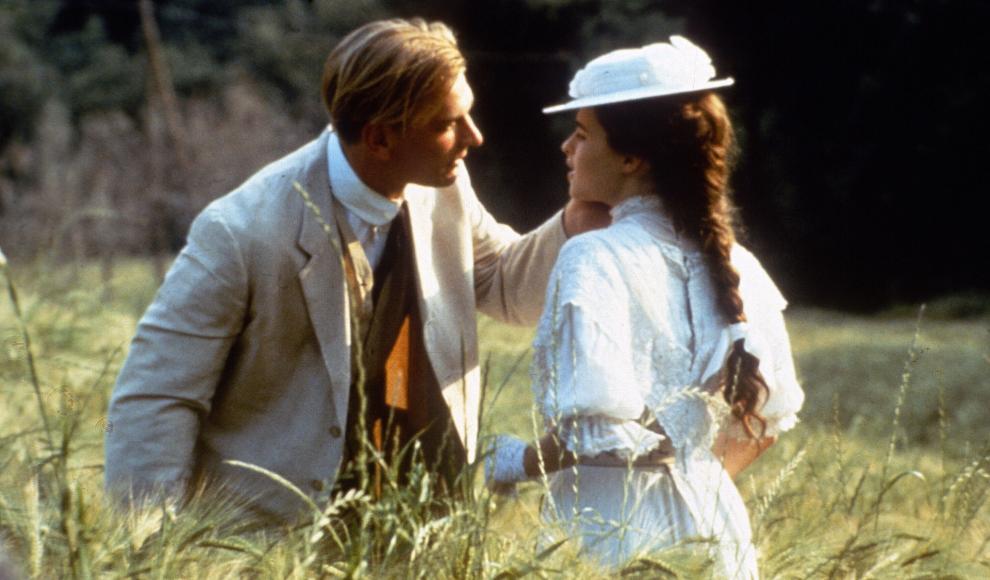
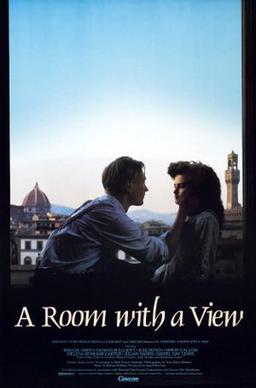
Julian Sands and Helena Bonham Carter find romance from A Room with a View

Director: James Ivory

Cast: Helena Bonham Carter (Lucy Honeychurch), Julian Sands (George Emerson), Maggie Smith (Charlotte Bartlett), Denholm Elliott (Mr Emerson), Daniel Day-Lewis (Cecil Vyse), Simon Callow (Reverend Beebe), Rosemary Leach (Mrs Honeychurch), Rupert Graves (Freddy Honeychurch), Patrick Godfrey (Reverend Eager), Judi Dench (Eleanor Lavish), Fabia Drake (Miss Catherine Alan), Joan Henley (Miss Teresa Allan), Amanda Walker (Cockey Signora)

Merchant-Ivory are the gold standard, practically synonymous with costume drama in the 80s and 90s. This really began with A Room with a View, their first true sensation, a box-office smash that won the BAFTA for Best Film and three Oscars. It practically defined what to expect from a Merchant-Ivory production: a classily made slice of English literature, with a wonderful cast of top British talent, tastefully directed with a sly observational wit for the foibles of the British class system. No one does such things better than Merchant-Ivory, and maybe only Howards End and The Remains of the Day did Merchant-Ivory better than A Room with a View.

Based on EM Forster’s novel (and that novel, largely thanks to this film, is probably now his best loved work), the film is set in Italy and England during the early 1910s. Holidaying in Florence, Miss Lucy Honeychurch (Helena Bonham Carter) and her chaperone cousin Charlotte Bartlett (Maggie Smith) are given poor rooms in their hotel – and accept an offer to swap (for the eponymous room!) with Mr Emerson (Denholm Elliott) and his romantic son George (Julian Sands). George, a free spirit, finds himself romantically drawn towards Lucy (and she to him), but something about the free Italian air frightens Lucy, and she withdraws and returns to England where she becomes engaged to the prig’s prig Cecil Vyse (Daniel Day-Lewis). However, when the Emersons rent a house near her home in Surrey she finds herself slowly drawn back once again towards George.

A Room with a View is the perfect expression of delicate, well-judged film-making, with James Ivory marshalling his precise judgement to create a luscious and involving reconstruction of the novel, which carefully layers its social and emotional observation with a dry wit. Ivory is a master of allowing the novel – and the film – to speak for itself, not intruding with flourishes but allowing the camera to hold moments. He captures wonderful moments of slightness: who can forget the camera holding on a rejected Cecil as he takes a moment to calm himself, then sits and begins to systematically retie his shoe laces? It’s a gentle, unforced moment of direction but it’s what makes the film work. 

And the careful grace and stateliness of much of A Room with a View is part of the film’s point. All this taste and manners, all this finery and wonderful design, is of course a trap. It’s precisely this pristineness and neatness that inhibits people from following their hearts, from actually having a bit of carpe diem. It’s telling that one of the film’s most striking moments involves George, Lucy’s brother Freddy and churchmen Mr Beebe going skinny-dipping (with long-shot full frontal nudity). There is something joyous for these men to literally cast off (for a few minutes) the shackles of society to just muck around in the all-together. And it’s a sort of exuberant liberal freedom you just don’t see in other parts of the film.

The film’s main theme is to see if Lucy will discover – and accept – enough about herself to follow the sort of romantic longings she feels within herself or if she is going to knuckle down and conform. Italy is a perfect sign of this – it’s hot, temperamental, the people wear their passionate hearts on their sleeves (whether that’s making-out in a carriage in front of uptight churchmen or stabbing each other in the piazza) – and it’s all that energy and lust for life that Lucy seems unsure about, but which George is chasing after. And it’s difficult to cast aside the rules you have grown up with – and scary – to find something a bit freer. Although I think you could criticise Ivory’s neat competence for failing to really visually get a contrast in look between Italy and England.

The film is blessed with a superb cast of British character actors. Helena Bonham Carter is excellent (in only her second film role) as a young woman who knows her mind but doesn’t want to follow it to its logical ends, part independent and free-thinking but also putting a constant block on her own instincts. Julian Sands as George does a decent job, although already the film (by far and away the best part he ever got) exposes his studied woodenness and flat, uninteresting voice and he often seems straining for a sort of depth and Byronic passion that is slightly beyond his range.

Maggie Smith and Denholm Elliott were both Oscar nominated, and both bring their A-game to the roles. Smith is perfect as a spinster who slowly reveals she has more sense of life’s lost opportunities than expected (even if the part is one she could play standing on her head), while Elliott gets lot of scene-stealing mileage from a sweetly eccentric Mr Emerson. Simon Callow, also in his second film role, probably gives his best (and most intriguing performance) as Mr Beebe the affable but subtly sleazy clergyman.

The film is however stolen by Daniel Day-Lewis as Cecil Vyse (originally offered his choice of parts between George and Cecil). A Room with a View opened the same day as My Beautiful Laundrette in the States and audiences were amazed that the same actor could play a self-important prig and a gay, punk fascist. Day-Lewis is the embodiment of fastidious preciseness, a man so studied in every second that each movement seems planned, with no touch of spontaneity. He even kisses Lucy with a carefully placed precision. He’s arrogantly certain of his place in the world and every moment of his life has been planned in advance with careful exactitude.

It’s the jewel in the crown of this perfect costume drama. Merchant and Ivory had longed to film the works of EM Forster for decades, and had to wait until King’s College, Cambridge (the rights holders) had someone in place who actually liked films until it was considered. They expected the main interest to be around Howards End (don’t worry its time would come!) and A Passage to India. But in A Room with a View, Merchant Ivory felt there was an unappreciated gem. They were right.

The Age of Innocence (1993)

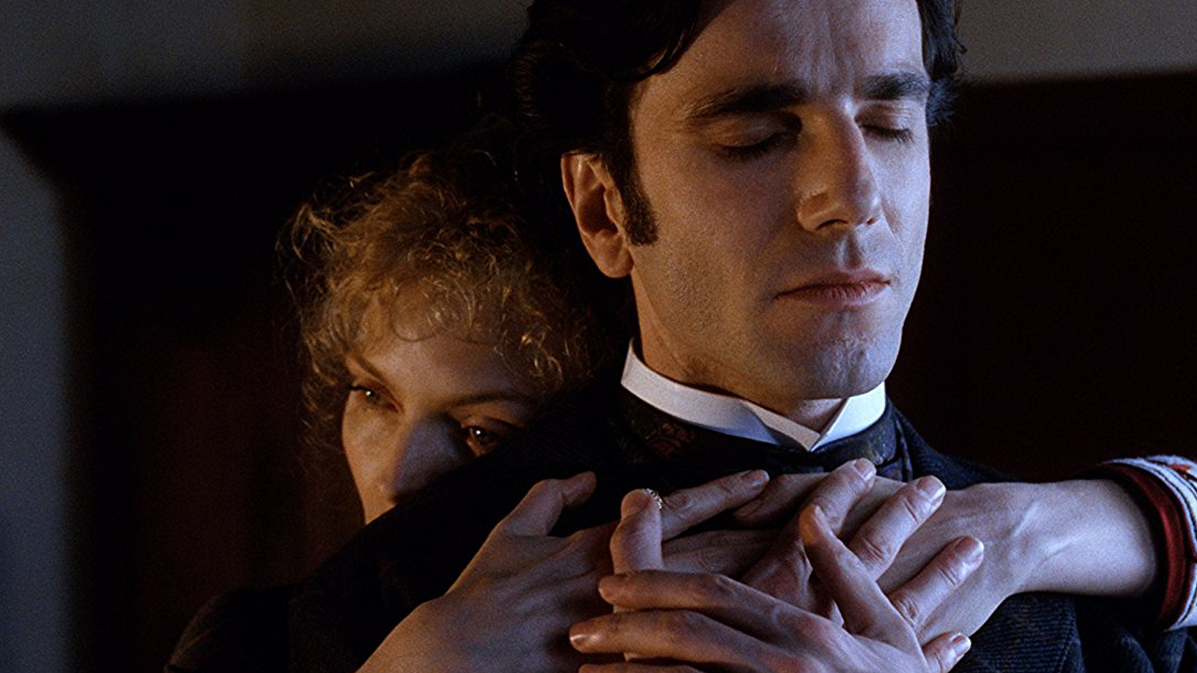
Daniel Day-Lewis and Michelle Pfeiffer have a love that cannot survive the morals of society in The Age of Innocence

Director: Martin Scorsese

Cast: Daniel Day-Lewis (Newland Archer), Michelle Pfeiffer (Countess Ellen Olenska), Winona Ryder (May Welland), Miriam Margolyes (Mrs Mingott), Geraldine Chaplin (Mrs Welland), Michael Gough (Henry van der Luyden), Richard E. Grant (Larry Lefferts), Mary Beth Hurt (Regina Beaufort), Robert Sean Leonard (Ted Archer), Norman Lloyd (Mr Letterblair), Alec McCowen (Sillerton Jackson), Sian Phillips (Mrs Archer), Jonathan Pryce (Rivière), Alexis Smith (Louisa van der Luyden), Stuart Wilson (Julius Beaufort), Joanne Woodward (Narrator), Carolyn Farina (Janey Archer)

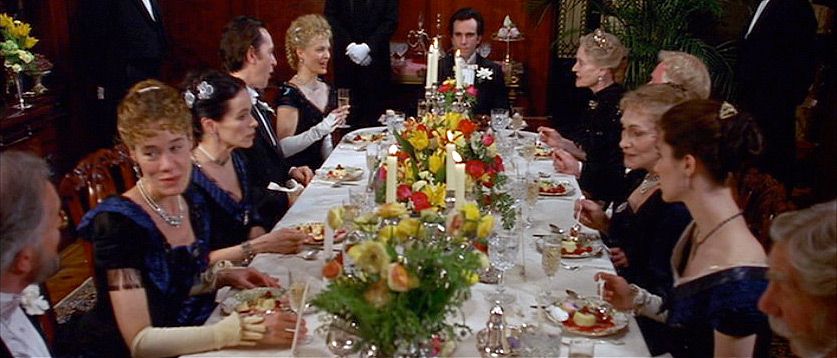
In 1870’s New York, Newland Archer (Daniel Day-Lewis), is a fastidious connoisseur of the arts, part of the super-rich elite of New York society. He’s engaged to be married to young May Welland (Winona Ryder), but finds his world view and values turned upside down when he meets May’s cousin, the Countess Ellen Olenska (Michelle Pfeiffer). Ellen is a scandalous figure, a woman separated from her philandering European husband, trying to make her way in New York society. Newland and Ellen are irresistibly drawn together, but do they have a chance to be together in the oppressive society of the New York upper classes?

That’s one question. The one more people were asking was: how would Scorsese follow up Goodfellas? Probably very few people would have bet on an adaptation of Edith Wharton’s The Age of Innocence. In fact, in 1993, there was more than a little annoyance among some viewers at the idea of the master of gangster movies, the guy who directed Raging Bull and Taxi Driver, turning his hand to the realm of Merchant Ivory. The film bombed at the box office – but did it deserve that reaction? Was Scorsese a director out-of-place?

Well the reaction is slightly unfair, because The Age of Innocence is a marvellously filmed, exact, brilliantly constructed piece of film-making, that so lays on the opulence and wealth of New York society that it turns everything in the film into feeling like a gilded cage. That’s a cage carefully controlled and monitored by the inmates, with their strict, inflexible rules about every single social interaction, unbreakable rules of decorum and etiquette covering everything, with any deviation from these rules met with instant expulsion. Put it like that, and this doesn’t sound a million miles away from the gangster families Scorsese is more associated with.

Inspired by the films of Powell and Pressburger in its intricate construction, and flashes of artifice in filming and editing, as well as its rich colour palette, with touches of everyone from Visconte, Ophüls, Truffaut to name but a few, this is a film-maker’s love letter to cinematic classics. A beautiful sequence of Newland watching Ellen from behind and a distance on a jetty, yearning for her to turn around before a boat passes a lighthouse, using that landmark as the point when he will stop looking and accept something is not to be. The scene is bathed in a Jack Cardiff-ish red, with the objects in the light given a sharp definition in contrast to the colours. It’s a beautiful image, and one of several that run through the film. Inspired by paintings of the era, Scorsese also layers in Viscontish scenes of opulence, with The Leopard very much in mind as every detail of the vast wealth, and huge accumulation of objects in every room of these people’s houses, seems to crush and entrap the people in them. The rooms themselves become metaphors of the oppressive, rule-bound society the characters are trapped in, like the people have been designed to fit into the rooms rather than vice versa. The one exception is Ellen’s rooms, which have a sense of personality to them.

This marvellous construction – with its beautiful photography, inspiring design and costumes – contains a storyline of frustrated love, a love triangle between three people where the man has to make a choice between what he wants and what is expected of him. Newland Archer clearly loves Ellen in a way he can never love May – indeed, he is dismissively cruel in his thoughts towards May, who he clearly considers nothing more than an extension of the mindless gilded objects of beauty around him, a woman he sees as lacking an imagination or daring. In Ellen, he sees far more opportunities for a world of change, of difference, or being something he does not expect. She is far more of a free-spirit, a more bohemian figure, confident in herself and something far more modern than May, who is very much a product of her time and place.

The film, carefully demonstrates the growing unease and unsettlement of Archer as he begins to feel things he has never done before, to start to react and aim for a style of living he would never previously consider. All his life before now is a careful studying and collection of moments, or savouring experiences in the way that a collector would place them in a glass box. From seeing only the moments of plays he wishes to see, to carefully collecting shipments of books from London and reading the choice moments, Archer is a coldly controlling figure who believes he guides and directs his own life. Ellen not only demonstrates to him that in many ways he is as conventional as anyone else, but also that there are other options in his life. Archer struggles to build the emotional language that he needs in order to express these feelings bubbling in him – key moments indeed seem reminiscent of the operas that this New York society spends so much time watching, and it is only late in the film in little, genuine moments of affection can he find something real.

Scorsese’s film artfully and carefully shows this developing affection between the two, a love that the two of them speak of surprisingly early, but fail to find a genuine way of expressing it. The film captures the attempt by New York society at the time to be more British than the British, and the hidebound restrictions this brings. Scorsese uses cinematic tricks to show Archer’s striving to escape. Spotlights zero in on Archer and Ellen in the middle of society, as if to drain out all other moments. Letters from his respective love interests are delivered with the actors addressing the camera, as if speaking to Archer direct. Flashes of screen colour cover key cuts, as if all this colour was just on the edges of his life but he is unable to access them. He is a man who feels himself trapped and committed to one form of life, but who still feels the longing for another.

The Age of Innocence is a beautifully made film, but there is a coldness to it. Perhaps this is why it doesn’t quite capture the heart in the way of other films. So much as Scorsese captured the cold and restrictive world of this society, that it seems to permeate the film and make the whole thing somehow colder and more restrictive. There is such artistry and effort in the film-making, that the film seems a coldly detailed piece of art. Perhaps this is why the use of narration – beautifully spoken by Joanne Woodward – becomes overbearing here in the way it doesn’t in other Scorsese films. It’s another distance from the entire experience, as if the film is keeping the audience at arm’s length as much as society is. 

Daniel Day-Lewis’ performance is expertly assembled, a masterful, brilliantly observed, intricately detailed masterclass in micro-expression, of layered frustrations and repression. But it’s such a marvellously constructed, detailed and well observed performance that it feels a masterful piece of art to be admired rather than loved. For all the film centres Archer in the story, he is a hard man to care for or invest in. Pfeiffer gives a wonderful performance as the far freer, intelligent and daring Ellen – but there is a slight lack of spark between them, for all the brilliance of both actors the feeling of an overpowering, obsessive love just doesn’t quite come out of the picture.

This coldness of the construction, carries through every frame. It is perhaps an easier film to admire than love, for all its brilliant construction. It is perhaps too successful in establishing the sharp rules of its society, and does not invest enough time in looking at the raw passions that bubble under the surface of its characters. It never quite explores the inner life of its characters, and they remain slightly distant objects from us. To be fair, this works very well in some cases: Winona Ryder as May carefully plays her hand throughout the film, so that it is a shock in the final scenes where she reveals depths of determination, strength of character and manipulation that far dwarf anything Archer is capable of. Where he is a man with a wistful longing for what he wants, but lacks the will to take it, she knows what she wants and is determined to take it.

The film uses its mostly British cast very well, their understanding of period and these sort of society rules crucial to its success. Margolyes, Wilson and McCowen in particular are very impressive as very different types of society bigwigs. Scorsese’s film contains many other things to admire, but it’s such a wonderfully made piece of film-making, so overburdened with intelligent interpretation of the novel that it fails to make a real emotional connection with the viewer. You will respect and enjoy scenes from it, but perhaps find its running time as overbearing as the characters find the society they are in, and eventually find yourself needing to come up for air.

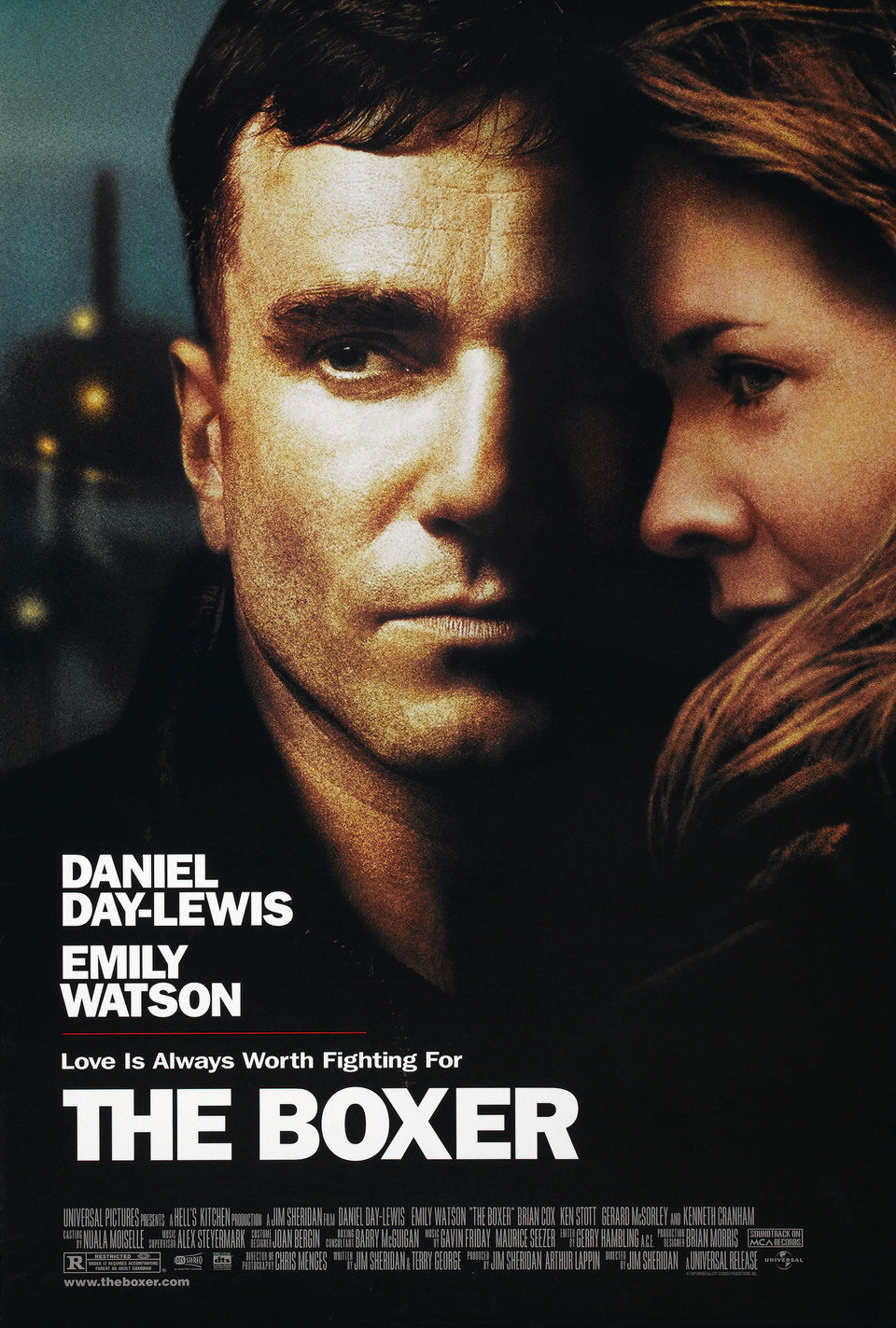
The Boxer (1997)

Daniel Day-Lewis returns from 14 years in prison in this passionate but obvious film about the Troubles in Ireland, The Boxer

Director: Jim Sheridan

Cast: Daniel Day-Lewis (Danny Flynn), Emily Watson (Maggie), Brian Cox (Joe Hamill), Ken Stott (Ike Weir), Gerard McSorley (Harry), David Hayman (Hamill’s aide), Ciaran Fitzgerald (Liam)

Daniel Day-Lewis and Jim Sheridan collaborated before this on the stirring, passionate and angry In the Name of the Father, a film that acutely analysed the impact of the Troubles on ordinary people. That film was about a miscarriage of justice that ruined lives. This film tries to cover similar ground, but somehow the force of the narrative never really comes together as much as it should.

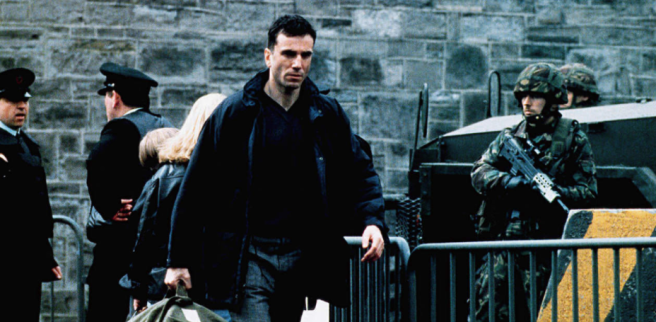
The Boxer himself Danny Flynn (Daniel Day-Lewis) is released from prison after 14 years, due to his peripheral involvement with the IRA. He’s guilty for sure, but has played the game inside and refused to name names. He comes out still in love with Maggie (Emily Watson) – but she is married to another man currently in prison (putting her out of bounds by the code pushed by the IRA). Making things more complex, her father Joe (Brian Cox) is a leading IRA man currently part of negotiations with the British government. Danny and his former trainer Ike (Ken Stott), now a struggling alcoholic, decide to reopen the local boxing gym, making it a denomination free facility for all the community. But their efforts to try and build bridges are not welcomed by all – not least local IRA enforcer Harry (Gerard McSorley) who makes it his mission to destroy Danny.

Why does The Boxer not work as well it should do? It’s got nothing to do with the commitment of the cast, all of whom offer excellent performances. Day-Lewis, inevitably, spent almost three years in preparation learning to be a boxer. It’s just a shame that the script doesn’t really give anyone here something interesting to play with. Instead it makes fairly familiar points about the dangers when we let hatred govern our lives, and carefully sorts and packages most of its characters into goodies and baddies, while making sure in every single scene we are always told exactly what we should be thinking and feeling.

It’s a flaw that I’ve often found in other of Sheridan’s films. He’s a passionate but rather blunt director, full of righteous anger and a determination to make films that carry a social message. But he often makes these points without subtlety or imagination. Here we get an Ireland shot almost completely in a washed-out blue, with the tensions of a community increasingly simplified down into rotten apples playing on the fears and resentments of different groups to continue the spiral of hate.

In the middle of this, Sheridan places a love story between Day-Lewis and Watson’s character that both of them play with a tender commitment and an emotional vulnerability, but which never really invests the audience. It always feels too heavily built on cinematic contrivance – with its long separation, new relationships and social obstacles put in the way. Much as Day-Lewis and Watson give it their all, they never manage to make it feel anything other than it is – a rather tired “movie” love story, that moves it characters through familiar beats.

More interesting than this by far are the real tensions in a community that is tired of violence and wants to move on, but keeps on getting dragged back into old ways because there is simply too much history to overcome. The most interesting character by far is Brian Cox’s IRA bigwig, a man carrying a burden of blood from the past but has an actual desire to see the country change. A film about a man like this, trying to walk a tightrope between negotiations with the British and keeping his own furious foot-soldiers in line (when all they want to do is to bomb something) would have carried real impact. Sadly, it’s too often relegated to the margins of the story while the film follows the immediate social impact of Danny trying to find a third way between war and surrender.

Peaceful co-operation is what Danny wants, and the gym for all people in the Belfast community is how he intends to go about it. Boxing itself is peripheral to the film – what really matters is that idea of bringing people together, of giving them something they can all own and feel some pride in. It’s an idea that Ike believes in above all things, and the prospect of recreating it with Danny’s release from prison gives his life real meaning (Ken Stott is very good as a character who is something of a cliché but still carries a real emotional wallop). Ike and Danny’s vision offers the community a possibility of moving on – something some are not ready to take on.

Not least Harry, played by a quietly fuming Gerard McSorley, prowling scenes like a man who can’t wait to hit someone. The film does at time suggest that there are “good” IRA and “bad” IRA chaps (with Harry firmly in the bad), but it does at least show that these extremists are a danger to everyone, not least the people they claim to protect. Harry’s prejudice towards Danny is motivated above all by his fear of Ireland’s way of life changing, and in that way it forms a decent expression of the film’s core message about the difficulty – but essentialness – of moving on.

Sheridan’s film is a cry for hope and opportunity at a difficult time – and its alarming watching it now to remember what a ghastly place Northern Ireland was at this time, when it’s so well known today as the Game of Thrones backlot. It’s just a shame that the story feels like such a – well – story. The film feels like a slightly over-cooked melodrama, and as the character clashes you expect and the twists you can see coming start to work their way into the narrative, it feels like the central story of a man wanting to make a better life for himself and his neighbourhood gets lost in the mix.

And it does. That’s the basic weakness of The Boxer in the end. For all of Day-Lewis’ skill and Watson’s emotional truth, their story just ends up feeling not that important, you feel that the more interesting things are happening on the margins: Cox’s IRA man feels more worthy of a film, while Stott gets some of the most electric moments of emoting. Sheridan’s film has fire in it, but it ends up burning up his main narrative, while the story relies too heavily on melodrama and cliché. Eventually it fizzles out and you end up not feeling as outraged as you should. Where the true story of In the Name of the Father helped control Sheridan’s spoon-feeding tendencies, here the fictional story allows full reign for the sort of narrative twists that end up feeling a little too tired and obvious.

Phantom Thread (2017)


Vicky Krieps and Daniel Day-Lewis play dangerous games in Paul Thomas Anderson’s fascinating film about control, Phantom Thread

Director: Paul Thomas Anderson

Cast: Daniel Day-Lewis (Reynolds Woodcock), Vicky Krieps (Alma Elson), Lelsey Manville (Cyril Woodcock), Camilla Rutherford (Johanna), Gina McKee (Countess Henrietta Harding), Brian Gleeson (Dr Robert Hardy), Harriet Sansom Harris (Barbara Rose), Lujza Richter (Princess Mona Braganza), Judy Davis (Lady Balitmore), Philip Franks (Peter Martin)

The last time Paul Thomas Anderson and Daniel Day-Lewis worked together, we got a true masterpiece in There Will Be Blood. Phantom Thread couldn’t be much more different. In place of rolling plains, oil, and Day-Lewis as a monstrously larger-than-life alpha male, we get confined rooms, handsome dresses and Day-Lewis as a pernickety, obsessive, creepy dressmaker. But Phantom Thread may also be just as intriguing, thought-provoking and memorable in its way as There Will Be Blood.

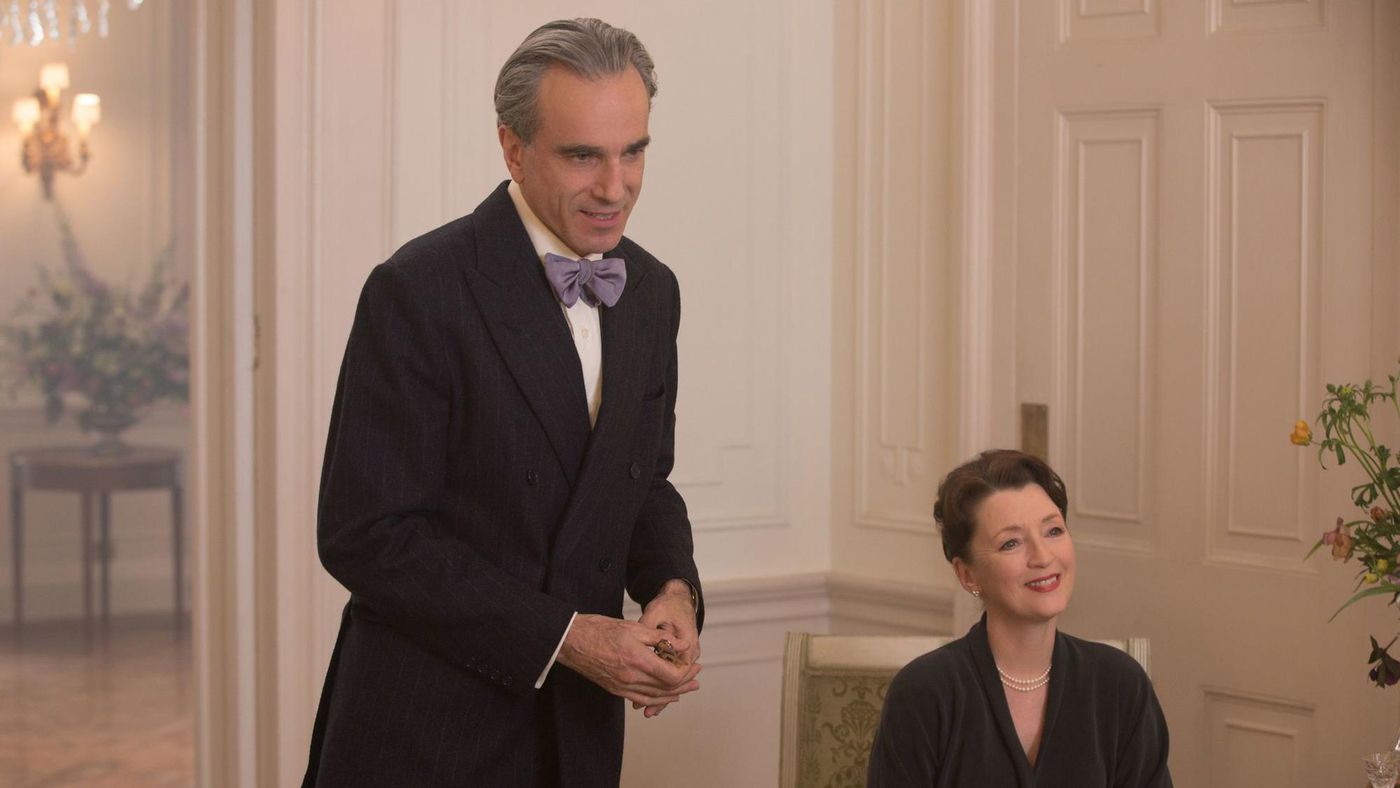
Reynolds Woodcock (Daniel Day-Lewis) is a leading couturier in 1950s London, whose fashions are highly sought after by the rich and famous. He lives and works with his sister Cyril (Lesley Manville), who dominates his life – and dispatches his various muses as their use comes to an end. On a break near the coast, Reynolds meets Alma (Vicky Krieps), a hotel waitress whom he takes back to London as his latest muse. At first Alma seems to be merely the tool of this fashion Svengali – but Alma has her own desires that quickly spark conflict in the House of Woodcock.

Paul Thomas Anderson’s film has lashings of Daphne du Maurier, Powell and Pressburger (it’s more than a little reminiscent of The Red Shoes) and a slickly inverted Pygmalion. It’s a film that slowly emerges as being about control and the way power relationships can shift and transform. Reynolds at first seems a twisted Henry Higgins: his muses come and go (and, it’s implied, fail to live up to his mother) – he becomes tired of them, and his sister, business partner, factotum and part-time mother-figure Cyril dismisses them when they have served their purpose. 

Reynolds and Alma’s first meeting is one of creepy control. He asks her to memorise his order, wipes her lipstick away so he can “see her” and, in a late night “living mannequin” sequence, dresses her in a series of fabrics and clothes, and offers dispassionate comment about her body. What’s interesting in this sequence though, is that Alma only becomes uncomfortable when Cyril arrives and joins Reynolds in the process. It’s a hint of the developments that will emerge over the course of the film: Alma doesn’t want to share Reynolds.

That’s the tension the film explores from thereon: Reynolds seems to have all the power, but Alma pushes against this to forge her own position as something more than a muse. The film has an acute understanding of the psychology of power in human relationships, which is more than reminiscent of Rebecca: the exact motivations of the characters remain unclear (sometimes even to themselves) until late in the film. The film veers into My Cousin Rachel territory – while giving us a totally unexpected series of emotional developments that spin out of this, which shock but make perfect sense.

That’s because Paul Thomas Anderson has made a sharply observant film about human fallibility and our desire to understand our place in the hierarchies around us, and the unusual paths to contentment that we can find. Like The Red Shoes, it also feels like a film that really understands the psychology of Svengali figures, and adds a Freudian bent to it. Reynolds is looking for a mother to take the place of his own and he is drawn to muses who remind him of her, but who constantly fail to replace her. It’s in the weakness that Reynolds’ perfectionism drives him away from, that he is capable of finding love and happiness.

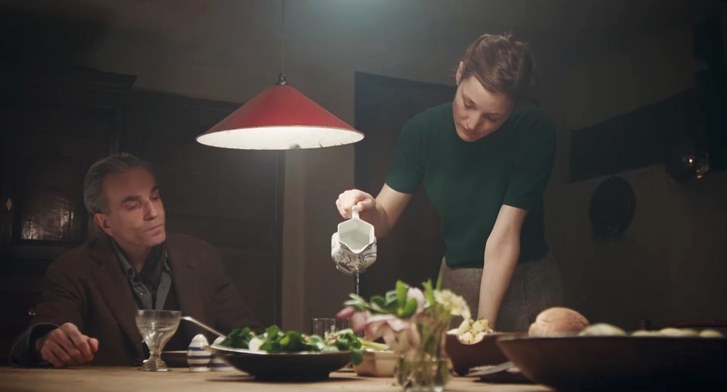
So the film becomes a series of wonderfully low-key power shifts, many of them revolving around meals. It’s established early that Reynolds demands very precise conditions for his breakfasts – most importantly silence; in every breakfast scene that follows, everything from the loudness of the crunching to the amount of scrapping of jam on toast tells you who is in control. 

Because just as Reynolds wants to craft Alma to take on the perfect muse position for his dressmaking – so Alma wants to craft Reynolds into the perfect combination of high-achieving genius whose success she can vicariously enjoy, and a man who needs her emotionally. Anderson’s brilliant, bitter and waspy screenplay shows the different steps both characters dance through to achieve this. Alma’s solution, and its psychological impact, is brilliantly du Maurier; it’s out there, but makes perfect sense.

Visually the film is beautifully crafted. Anderson shoots a lot of the film with a combination of slow prowling shots, and cameras held at close-up or medium shots that regularly place the actors close to the camera. It means that we always feel like we are right in the middle of the action – looking over the shoulders of actors, or seeing their faces loom into the camera. It obviously creates a claustrophobic feeling, but also one of real intimacy – it’s like the camera is dressing the characters, the same way Reynolds does. But Anderson’s choices pull you closer into the action, and get you really thinking about the psychology of the characters you are watching.

And Anderson wants you to get into the psychology here, because he has cast three actors at the top of their game in this tight-character study. Day-Lewis is of course superb, as a character unnervingly precise and cool – his voice is a perfect combination of icy preciseness, and trembling emotional confusion. Reynolds is in many ways a child – his every whim must be followed, he explodes in foul-mouthed (hilarious) fury at any deviation from his procedures. But he’s also an emotionally stunted man who has never got over the loss of his mother, capable of strong sexual feelings and a yearning for closeness. It’s a subtle, controlled, low-key performance.

But Day-Lewis’ retirement has stolen a lot of the attention from Vicky Krieps, who is sensational as Alma. In many ways, she is the real protagonist of the story. Alma is at first our entry into the story – but we quickly learn we know or understand very little about her. She comes from somewhere in Europe, she may well be Jewish, but Krieps makes her hard to define. Unusual and impossible to understand, Krieps makes her a fascinating character. She emerges as a determined, strong-willed, manipulative figure, looking to have a firm place in her partner’s life – she’s both a toy that bites back, and a woman who will settle for no compromise in what she wants. It’s a fascinating performance. 

Lesley Manville rounds out the cast as the waspish Cyril, deliciously spitting out some cruel lines. Manville is terrific, and Cyril sits in an unusual place in the Woodcock house, partly catering to Reynolds’ demands, partly controlling and positioning him. This makes a perfect foil both for Reynolds’ demanding requirements for a mother, and for Alma’s desire to bring Reynolds under her own influence.

Anderson’s film is a beautiful, fantastically scored, wonderfully acted, intriguing character study, and an insightful exploration of emotional and sexual control and the traps we built for ourselves and for others. It’s a film where every scene is open to interpretation, where both the past and the future seem to haunt events and every resolution leaves questions. It’s a brilliant psychological study that rewards endless thinking, analysis – and I’m sure repeat viewings. I think this one could run and run.

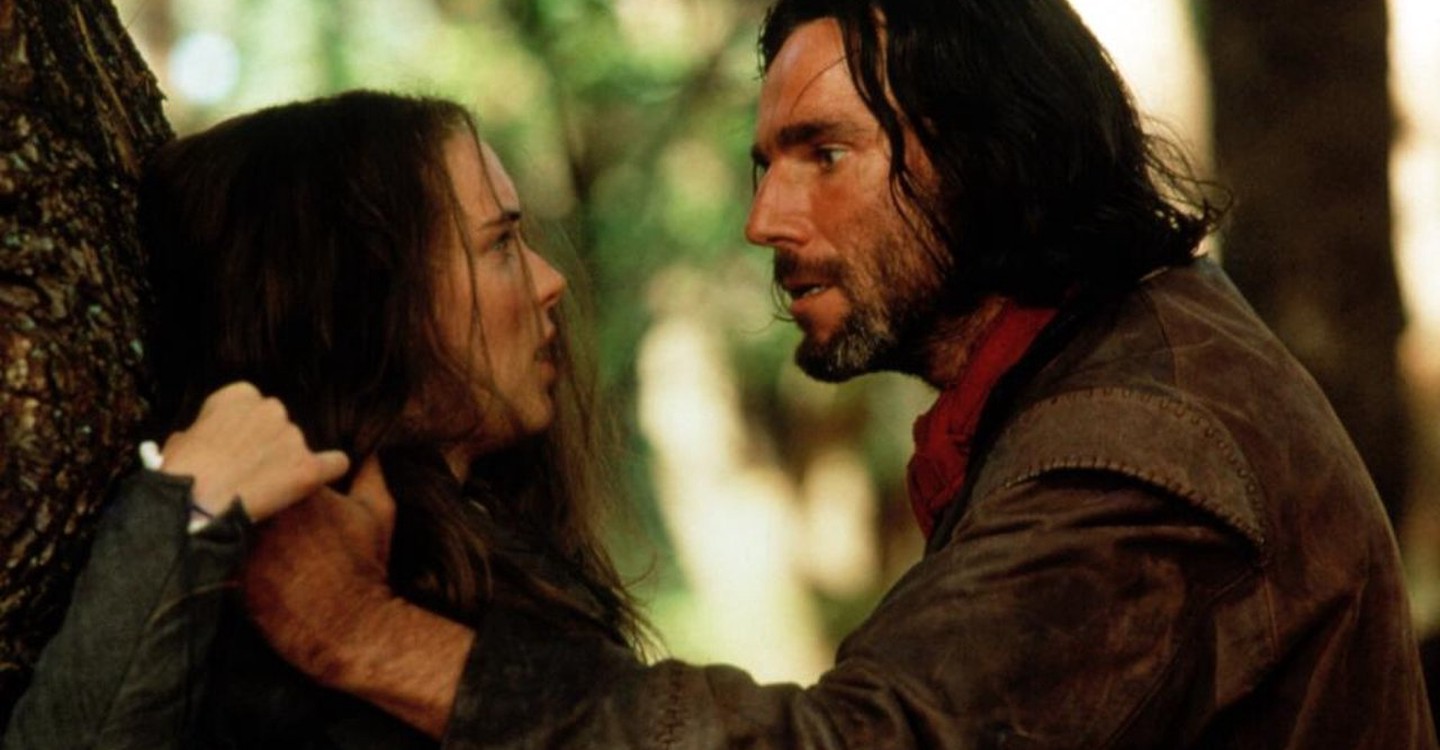
The Crucible (1996)

Winona Ryder and Daniel Day-Lewis are swept up in the heated emotions of small-town Salem in The Crucible

Director: Nicholas Hytner

Cast: Daniel Day-Lewis (John Proctor), Winona Ryder (Abigail Williams), Paul Scofield (Judge Thomas Danforth), Joan Allen (Elizabeth Proctor), Bruce Davison (Reverend Samuel Parris), Rob Campbell (Reverend John Hale), Jeffrey Jones (Thomas Putnam), Peter Vaughan (Giles Corey), Karron Graves (Mary Warren), Charlayne Woodard (Tituba), Frances Conroy (Ann Putnam), Elizabeth Lawrence (Rebecca Nurse), George Gaynes (Jude Samuel Sewell), Mary Pat Gleason (Martha Corey)

The Crucible is now so well-known, it’s virtually a shared cultural reference point. Surely we have all studied it at some point at school, or seen it on stage (or both). The play helped “witch trial” become a common short-hand for an increasingly vicious campaign conducted by society against a group within it. The Crucible works so effectively as a play because it is both simultaneously a brilliant recreation of the time it is staging, and a play of universal themes which is for all time.

In Salem, Massachusetts in 1692, the young girls of the village are caught dancing around a fire in the woods late at night by Reverend Paris (Bruce Davison). The next day, some of the girls will not awaken from fits, and rumours of witchcraft spread. Terrified of the blame being pinned on her, the girls’ ring-leader Abigail Willams (Winona Ryder) “confesses” to being tempted by the devil and swiftly accuses other people in the village (often at the prompting of senior villagers keen to remove rivals and resolve old feuds). However, Abigail’s real target is Elizabeth Proctor (Joan Allen), the wife of Abigail’s former lover John Proctor (Daniel Day-Lewis). The accusations quickly spiral into a series of trials based on the girl’s “evidence”, conducted by Judge Thomas Danforth (Paul Scofield).

The Crucible may be one of the finest adaptations of a play ever made. With the script adapted for the film by Arthur Miller itself, the play is effectively opened out and subtly restructured (the original is essentially four acts, each a single scene in a single location) to allow different character interactions, earlier introductions, and to show us things only implied in the original play. Many will complain about the film showing us rather than allowing our imaginations to work, but the film never loses the ideas and themes of the original play and gives it a real emotional force. What the film might sacrifice in the claustrophobia of small rooms, it more than makes up for in getting across a real sense of a community consumed by hysteria.

Nicholas Hytner – in only his second movie – directs with great skill, using a number of low-angle lenses to make ceilings loom over the scene. He mixes this with sweeping shots (beautifully filmed) of the Massachusetts countryside, which looks increasingly windswept and bleak. He really understands how to play the film “straight” – to let its universality speak by grounding it in the Salem countryside, without tipping the hat. His theatrical experience works wonders for the set-piece scenes, which sizzle with tension and brilliance, with Hytner allowing moments where you can almost convince yourself everything is going to be OK.

Miller’s expanded screenplay also allows an even greater sense of the hidden corruption of the trials, and how they are misappropriated by certain members of the village. Far more than even in the play, you get a real sense of old scores being settled, and of odd-balls and eccentrics being targeted. Frances Conroy (pre-Six Feet Under fame) is excellent as Ann Putnam, using accusations to alleviate her own bitterness at the loss of her children, while her husband is a spittle-mouthed bully, shamelessly using the trial as a landgrab (well played by Jeffrey Jones, awkward as it is to see him in a movie – google it).

In this nightmare village of suspicion and accusation, Abigail Williams is the only person who really understands the opportunities and dangers fully. Winona Ryder is often overlooked in this film, but her brilliant expressiveness is perfect for Abigail. She really adds depth and shade to the character – yes she is bitter and angry and ruthless and shameless, but she’s also scared and genuinely in love with John, and you get flashes of doubt and even regret over what she is doing.

The object of her obsession is John Proctor. Daniel Day-Lewis – Miller’s son-in-law – takes on the role and he is of course as excellent as you might expect. Day-Lewis’ key roles are such larger-than-life landmarks in cinema, it’s easy to overlook him playing a role taken on by so many other actors. At first, you almost feel it might be a waste – but he gives it a growing emotional commitment and force. He may be the one sane man in the storm of hysteria, but Day-Lewis doesn’t lose track of Proctor’s inner cowardliness, his corruption, his bitterness. Day-Lewis’ performance repositions the role as a man who has to learn to stand for something. It’s a superb performance.

He’s equally matched by Joan Allen, whose performance as Elizabeth Proctor throbs with dignity, but also a puritan strength of faith that makes it easy to imagine that Proctor would feel overwhelmed by a sense of being weighed in the balance and found wanting. She and Day-Lewis have a beautifully played, hugely emotional scene late on in a windswept field which (like so many other scenes in this production) briefly suggests a hope for the future.

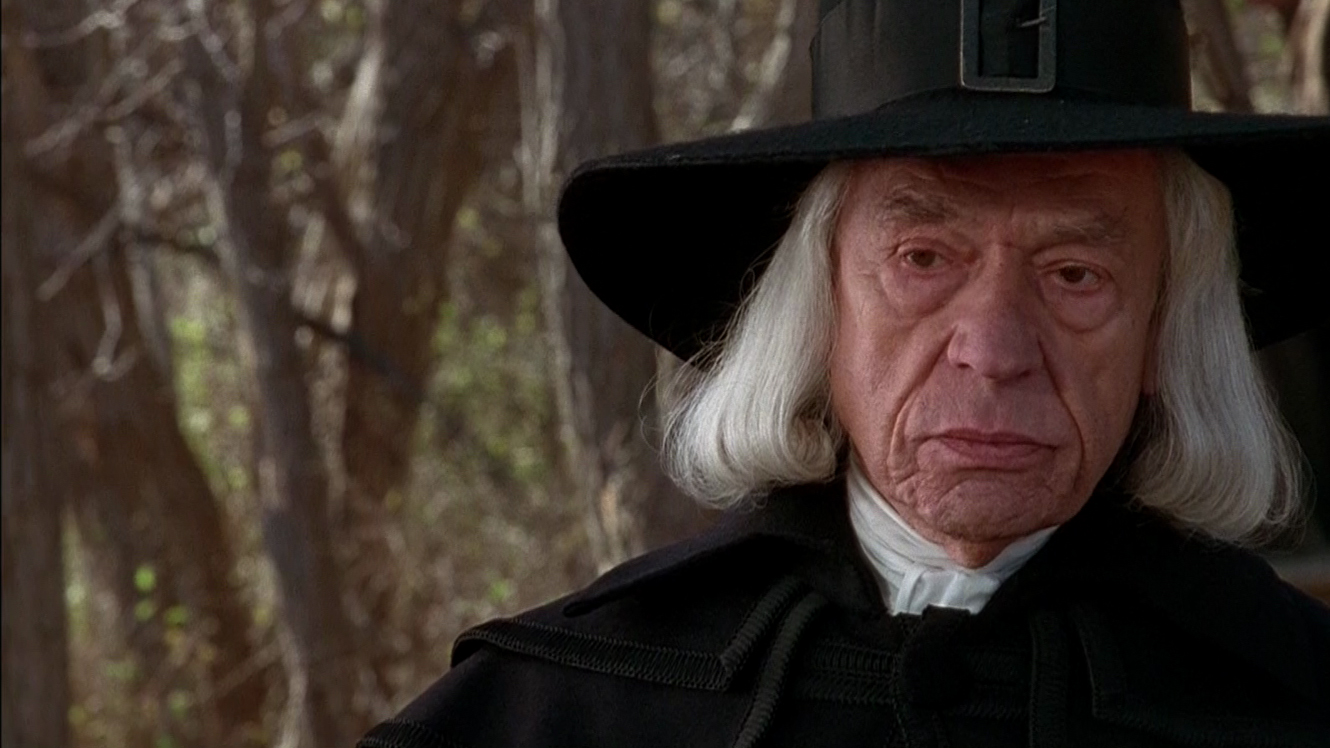
Paul Scofield did so few films that each of his rare performances is to be treasured (this was his last film performance). His Danforth is simply superb, probably close to the definitive performance. It trades a lot on an inversion of Scofield’s most famous performance as Thomas More. Scofield plays Danforth as a man filled with certainty without a trace of doubt, who is married to the word of the law but has no understanding of the spirit of it. In Scofield’s masterful performance, flashes of arrogance and pride intermix with a genuine sense of faith and morality. His Danforth is convinced everything he does is right – a position that allows him to commit many wrongs.

The film is rounded out by several other excellent roles: Bruce Davison is outstandingly weaselly as Samuel Paris, Peter Vaughan has a wily shrewdness as Giles Corey, Rob Campbell is increasingly filled with doubt and anger as Hale, Karron Graves is wonderful as a desperate and scared Mary Warren. Mary Pat Gleason is perfect as the proud Martha Corey, while George Gaynes subtly suggests a man consumed with doubt as Judge Sewell.

“Anybody seeing The Cruciblenow would never dream that it had been a play” said Arthur Miller on this adaptation. He’s right. This must be one of the best stage-to-screen adaptations there has ever been, with all involved totally understanding what made the play great while expanding and deepening the content for film. It’s a marvellous film.