Tag: Emily Blunt

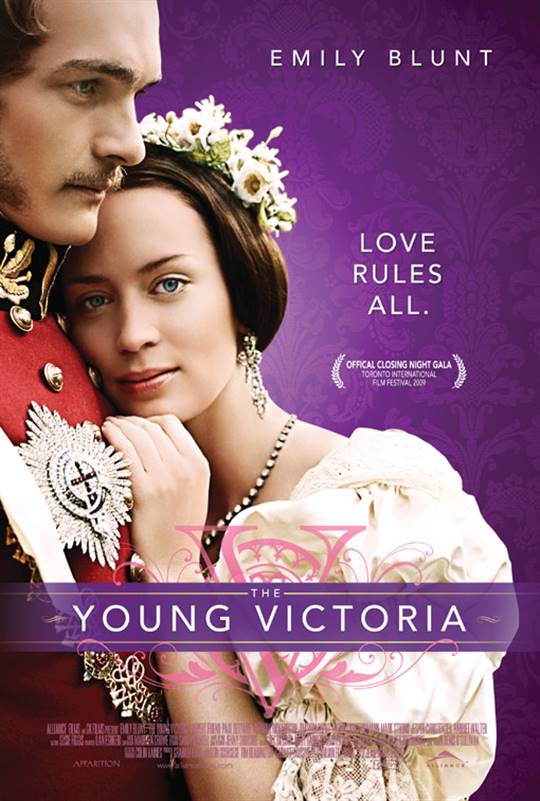
The Young Victoria (2009)

Emily Blunt and Rupert Friend play the royal couple in the cozy The Young Victoria

Director: Jean-Marc Vallée

Cast: Emily Blunt (Queen Victoria), Rupert Friend (Prince Albert), Paul Bettany (Lord Melbourne), Miranda Richardson (Duchess of Kent), Mark Strong (Sir John Conroy), Jim Broadbent (King William IV), Harriet Walter (Queen Adelaide), Thomas Kretschmann (King Leopold), Jesper Christensen (Baron Stockmar), Jeanette Hain (Baroness Lehzen), Julian Glover (Lord Wellington), Michael Maloney (Sir Robert Peel), Michel Huisman (Prince Ernest), Rachael Stirling (Duchess of Sutherland)
Now ITV’s Victoria exists, it’s a bit strange to go back and watch The Young Victoria. With the love today of long-form drama, and the time it can invest in things, it’s funny to see what the drama took almost 8 hours to do being crammed into an hour and a half here. But saying that, The Young Victoria is still an entertaining, luscious viewing experience which, while it has some strange ideas about certain events, is the sort of relaxing Sunday afternoon viewing that will take you out of yourself.

After the death of William IV (a slightly overripe Jim Broadbent), Victoria (Emily Blunt) is elevated to the throne. Finally able to shed the control of her mother’s (Miranda Richardson) domineering secretary Sir John Conway (Mark Strong), Victoria is determined to steer her own course. But she is surrounded by competing influences, not least from the charming arch-politician Lord Melbourne (Paul Bettany). King Leopold of Belgium (Thomas Kretschmann) dispatches his nephew Prince Albert (Rupert Friend) to England with the express interest of marrying Victoria and controlling her – but Albert and Victoria find themselves as kindred spirits, supporting each other to rule.

The Young Victoria is the epitome of prestige costume dramas. It looks fantastic, the cinematography is ravishing, the production and costume design exquisite. It’s pretty clear what the producers thought would sell the picture abroad. The royal regalia is pushed very much to the fore, and we get some wonderfully sweeping scenes, not least an impressively large-scale coronation. The soundtrack brilliantly riffs on Handel, and Julian Fellowes’ script mixes period regal style with a sweeping feeling of romance between Victoria and Albert.

The film actually does a very good job of repositioning Victoria as a young woman, and gives her a strong quality of self-determination and a desire to be herself in a man’s world. It’s really helped in this by the combination of imperial strength, girlish wilfulness and sharp intelligence Emily Blunt brings to the role. Blunt and the film also aren’t afraid to show that, however much Victoria had guts and determination, she was also quite a headstrong woman not above making emotionally led mistaken decisions. In fact, much of the drama spins out of Victoria learning to try and put these youthful crushes and prejudices aside.

Having said that, it’s interesting that the successful conclusion of the film centres on Victoria accepting that she needs the help of Albert to run the kingdom, and that she needs to remove competing influences for her affection – Melbourne and Lehzen – to focus her affection and loyalty on him. The film frames this as a winning romance and a successful partnership (which it was) – but it’s also vaguely creepy if you think about it. Mind you, since all the affectionate influences on Victoria are implied by the script to be at least partly motivated by self-interest, with the possible exception (eventually) of Albert, it manages to suggest this was for the best.

Albert’s background gets some interesting exploration here. He’s very much presented at first as the tool of Leopold as a means of controlling British politics. But he is far too independent, smart and noble to ever be the means of manipulation. Friend is very good here – his performance is quiet, authoritative but also heartfelt. Fellowes guilds the lily a bit to show his devotion by having Albert shot by a would-be assassin late-on in the film. Historically the assassin’s pistol wasn’t loaded, and Albert didn’t get shot (though Fellowes protests Albert didput himself in front of Victoria and that this intent is what’s important, not whether he was shot or not) but the moment does work – it gives the drama a boost and it’s undeniably moving.

While Albert is presented overwhelmingly sympathetically, interestingly Lord Melbourne gets quite a kicking. Paul Bettany is presented far more as a rival love interest than the sort of father-figure Melbourne was in real life (Bettany is probably 20 years younger than the real Prime Minister). Melbourne is shown as cynical, controlling, manipulative and overwhelmingly motivated by self-interest (a few more pushes and he would virtually become the film’s villain). He’s constantly contrasted negatively with Michael Maloney’s upright, honest Sir Robert Peel (one of my favourite statesmen of the 19th century so at least I’m pleased) – and his relationship with Victoria is one of self-promotion, which seems odd seeing as historically the two of them were so close. 

The film introduces other villains for us to hiss at. Kretschmann and Christensen do a good job as arch political schemers. Our real villain though is Mark Strong, who does a great job of scowling, controlling nastiness as the failed-bully Sir John Conroy. Strong’s performance works so well because he makes it clear that Conroy feels that his “Kensington System” (an attempt to manipulate and cow Princess Victoria into being a submissive puppet) is genuinely in her best interest, and that he genuinely cares for her. His partnership with Miranda Richardson as Victoria’s near-love-struck mother works very well.

The Young Victoriathrows in enough interesting character beats like this for it to really work as an enjoyable afternoon period-drama. With some great performances – Emily Blunt carries the movie brilliantly – and while some of the historical characterisation is a bit off, and other moments feel a little too chocolate box it’s a very entertaining, undemanding view., it’s great fun. The hardcore Victorian costume-drama fans will probably prefer Victoriafor the same story in more depth – but this film does it with great sweep (and doesn’t cram in Victoria’s stupid below-stairs plotlines!).


The Girl on the Train (2016)


Emily Blunt on a commute into danger in the underwhelming Girl on the Train

Director: Tate Taylor

Cast: Emily Blunt (Rachel Watson), Rebecca Ferguson (Ann Watson), Haley Bennett (Megan Hipwell), Justin Theroux (Tom Watson), Luke Evans (Scott Hipwell), Allison Janney (DS Riley), Edgar Ramirez (Dr Kamal Abdic), Lisa Kudrow (Martha), Laura Prepon (Cathy)

Rachel Watson (Emily Blunt) is a lonely, divorced alcoholic who takes the train into New York every day to spy on her husband (Justin Theroux) and his new wife (Rebecca Ferguson), whose house the train passes. However, she also becomes obsessed with the seemingly happy marriage of her ex’s neighbours (Luke Evans and Haley Bennett), who live an apparently Instagram-perfect life of coffee on the balcony and candlelit sex in their perfect living room (with the curtains conveniently left open – everyone leaves their curtains open in this film, no matter what they are doing). When the picture-perfect wife goes missing, she inveigles her way into their lives to try and help.

This is not a good film. It’s not a terrible film, but it’s a flat and lifeless one – a plot-boiler that simmers along without ever really getting exciting.  The story feels like it’s been pulled together from crumbs swept from the table of Gillian Flynn. It’s a hotchpotch mess, tangled, unclear and not that interesting. I can’t be the only person un-intrigued by the mystery of who shags who among the middle classes. Even a murder doesn’t spice it up. The small cast makes many mysteries obvious – when one character is found to be pregnant, but two of the three male characters we’ve been introduced to have been ruled out, you don’t need to be Poirot to work out who the father might be. Even the title is a call back to better thrillers, with its Girl with the Dragon Tattoo styled title.

The story drifts on and on, never really getting anyway or explaining anything properly. It doesn’t help that it’s mediocrely filmed. Look at the lean, compelling and sharp film David Fincher made of (the much better) Gone Girl. Then look at the murky, plodding, dull execution here. Particularly damningly it’s a shock to find out this is less than 2 hours, because it feels a hell of a lot longer.

The story has been switched from the book’s original London to somewhere outside Manhattan, which doesn’t help either. There is something quite small scale and domestic about the story that the sweeping vistas and huge houses of wealthy American suburbia don’t match up with. The very concept of the film – seeing into houses from commuter trains paused at signals – doesn’t even work removed from London’s architecture (the train in this film stops regularly on a huge expanse of track due to rail works that go on for ever and ever). Edgar Ramirez’s psychiatrist keeps the name Kamal Abdic (with its suggestion of middle Eastern roots) but now seems to be Mexican. Everyone in the film looks like a fashion model. Lots of other small moments just don’t make sense in the way they would have done in the original setting.

Emily Blunt is pretty good in the lead role, much better than the film deserves. Okay the drop-dead gorgeous Blunt doesn’t even remotely look like the overweight, sweaty alcoholic described in the book. But she nails her drunk acting, and carries the emotional heft of the film rather well, with an engaging vulnerability. She is, perhaps, even a little too engaging – the book’s original version of her character is apparently pretty unlikeable. The script trims away her needy obsessiveness, and creepy stalker tendencies. But Blunt is a little too likeable, and a little too sophisticated (despite prosthetic eyebags), to really convince as the pathetic Rachel. The switch to America doesn’t help here either – basically Brits make better losers than Americans tend to.

The rest of the cast are okay, but there is hardly a stand out among them. I have to admit I found Haley Bennett and Rebecca Ferguson (with their identikit blond hair dyes) hard to tell apart at times (this may be due to staying up all night watching the 2017 British election the night before).

By the end, when the killer is revealed (with a graphically suggestive flashback) you’ll find it hard to really care. In fact the final reveal is so clumsily put together all the implications aren’t clear at all. It’s a load of fuss about nothing. Taylor is trying to turn a pulpy novel into an arty thriller – but he doesn’t have the cinematic know-how to do it. He’s far too bland and middlebrow. Maybe that makes him a suitable match – a derivative director for a derivative book – but it hardly helps make this a good film. If he’d gone for a more B-movie approach, playing up the dark satire you could find in the story, then we could have had something interesting here. But he didn’t and we don’t.

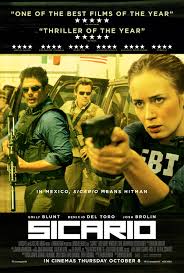
Sicario (2015)


Emily Blunt goes to war with the Cartels, not realising she’s just a pawn.

Director: Denis Villeneuve

Cast: Emily Blunt (Kate Macer), Benicio del Toro (Alejandro Gillick), Josh Brolin (Matt Graver), Daniel Kaluuya (Reggie Wayne), Maximiliano Hernández (Silvio), Victor Garber (Dave Jennings), Jon Bernthal (Ted), Jeffrey Donovan (Steve Forsing), Raoul Trujillo (Rafael), Julio Cedillo (Fausto Alarcón)

The War on Drugs. Smack a military title on it and it helps people think that there is some sort of system to it, that it carries some sort of rules of engagement. Whereas the truth is that it is a nebulous non-conflict where the sides are completely unclear and the collaborators are legion.

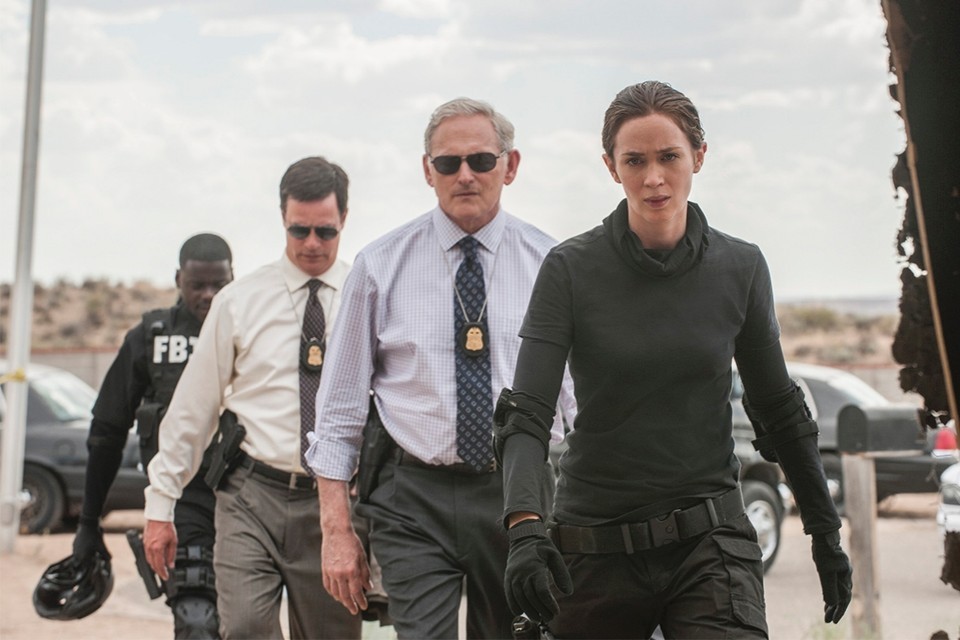
Sicario follows a shady covert operation, run by a combination of the FBI, the CIA, Columbian and Mexican law enforcement and, well, other interested parties. Kate Macer (Emily Blunt) is recruited to the task force because someone with her experience is needed, and finds herself working for maverick, almost pathologically unconcerned, CIA man Matt Graver (Josh Brolin). Graver, in turn, is working closely with a South American freelance operative (Del Toro) whose background and goals remain a mystery to Kate. Far from a clear targeted operation, Kate slowly realises the operation is effectively an off-the-books black op, which she has almost no control or influence over.

Villeneuve has directed here an accomplished, if rather cold, thriller. It denies its audience the release of action, the reassurance of justice or the satisfaction of integrity being rewarded. Instead the film takes place in a hazy never-world, never fully explained to either the viewer or Kate (our surrogate), where it gradually becomes almost impossible to tell who is working for whom and for what reasons – and there is a feeling that those in the film don’t know either.

The whole film has a sense of Alice in Wonderland about it (at the end of the film our heroine literally goes down a tunnel into a strange new land). Emily Blunt’s Kate seems at first to be on the ball, but events throughout the film demonstrate time and again that she is hopelessly out of her depth and little more than a fig leaf to enable her new bosses to bend laws to breaking point. Instead the world she finds herself in is dark, unsettling, confusing and lacks any sense of clear moral “sides”.

In fact, that is one of the most interesting things about this movie. It presents a female lead who is constantly manipulated and defeated throughout the film. Kate is in fact totally ineffective throughout and serves no real narrative purpose to the events of the film other than allowing those events to take place. At the same time, she’s strong-willed, she’s determined and she’s fiercely principled, as well as being an engaging character (helped immensely by Emily Blunt’s empathetic and intelligent performance).

This works so well because Kate represents what we would normally expect in a film – we keep waiting for that moment where she makes a successful stand, or blows the scandal open, or brings someone to justice – this never happens. Instead the film is a clear indication of the powerlessness of the liberal and the just in a world of violence, aggression and corruption – that people like Kate will always be steamrollered by people who are willing to smilingly do anything to achieve their goals and don’t play by any semblance of rules that we would recognise. In a more traditional film, she would end the film arresting some (or all) of the other characters with a defiant one-liner. Instead, she never lays a glove on anyone.

The flip side of her naïve optimism here is Benecio Del Toro’s nihilistic, dead-behind-the-eyes mysterious freelance operative. Del Toro is magnetic here, his character a dark mirror image of the role he played in Traffic, as if that character witnessed every kid he watched playing baseball in that film gunned down before him. He’s like a dark growly end-justifying-the-means shark, who conveys just enough of a flicker of paternal interest in Kate (does he see her as a reminder of what he used to be like?) to show there is someone still human in there. He prowls the edges of scenes before seizing the movie by the scruff of the neck in the final quarter with horrifying brutality.

Del Toro’s rumpled smoothness is a perfect match for the ink jet blacks and bright desert shine of this wonderfully photographed film. Roger Deakin’s cinematography is beautiful to look at and also rich with variation and imagination – from bleached out, hazy mornings to red dawns, from subterranean tunnels to neon lit nightclubs, Deakins presents images in striking new ways. The use of sound is also brilliant in the film – lingering, unsettling silences throughout slowly give way to Jóhann Jóhannsson’s beautiful spare score. There are fine supporting performances from Maximiliano Hernández as a doomed cop, sleepwalking through a corrupt life, Daniel Kaluuya, who is very good as an even more idealistic FBI agent who thinks he understands the world better than he does, as well as from Josh Brolin and Victor Garber.

Sicario offers no comfortable answers. In fact, it offers almost no answers at all. The world it shows us is one where there is no conventional right or wrong, only attempts to control the chaos. Our expectations as a viewer are so persistently subverted that it almost demands to be seen twice to truly understand what sort of story it is actually trying to tell. This helps to make it a cold and distancing film – but it lives in a cold, distant world where sometimes you reach the final frame and only then begin to understand who the baddies might have been and how you’ve only helped funnel the badness towards a controlled point rather than slow down or stop it.