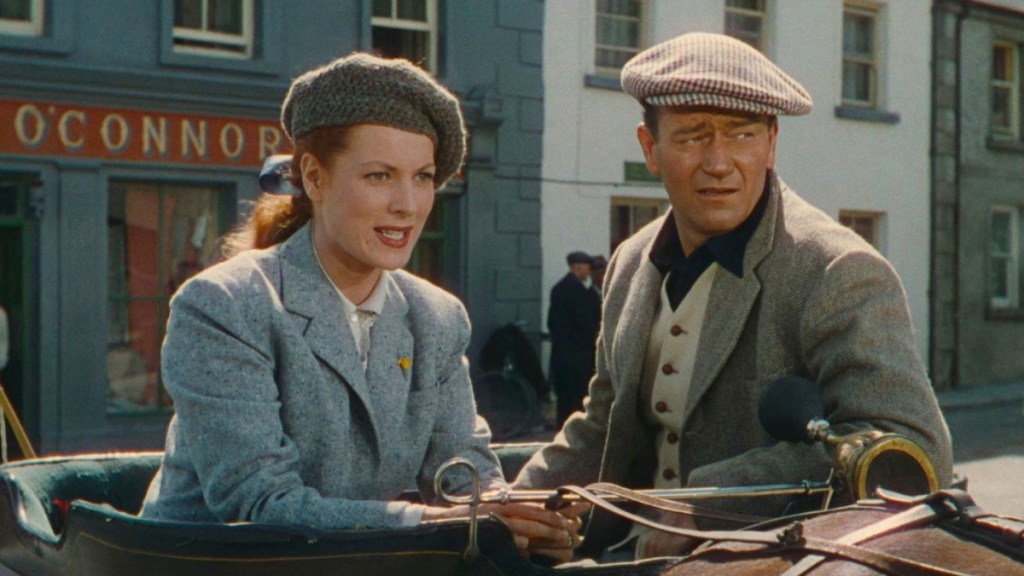
Tag: Francis Ford

Stagecoach (1939)

Stagecoach (1939)

Iconic action adventure, a very exciting chase film with a strong script and characters

Director: John Ford

Cast: Claire Trevor (Dallas), John Wayne (The Ringo Kid), Andy Devine (Buck Rickabaugh), John Carradine (Hatfield), Thomas Mitchell (Dr Josiah Boone), Louise Platt (Lucy Mallory), George Bancroft (Sheriff Curly Wilcox), Donald Meek (Samuel Peacock), Berton Churchill (Gatewood), Tim Holt (Lt Blanchard), Tom Tyler (Luke Plummer), Chris-Pin Martin (Chris), Francis Ford (Billy Pickett)

It might be the greatest star entrance of all time. Before Stagecoach, John Wayne was a minor leading man from a never-ending stream of oats-and-saddles B-movies. But, after one shot – a superb fast-paced zoom (so fast, the focus slips at one point) into the stoic face of Wayne, Winchester rifle twirling – that wasn’t going to be the case anymore. Stagecoach was Ford’s return to the Western – and he was bringing a friend along for the ride. After it, both director and star would become synonymous with the genre and Wayne would remain Hollywood’s Mayor-in-all-but-name.

Of course, that shot alone didn’t make Wayne a star (but, as you can imagine Andy Devine’s Buck wheezing “it sure helped, didn’t it”). What cemented the deal was what the hugely entertaining thrill ride Stagecoach is, a rollicking journey through Monument valley, crammed with just about anything you could want, from gun-battles and stunts to class commentary and arch dialogue. Like some sort of JB Priestley play, a regular smorgasbord of folks climb into a stagecoach to travel from Tonto to Lordsburg, facing a parade of dangers from Geronimo’s Apaches along the way – not to mention their own personality clashes and business to take care off in Lordsburg. All aboard!

We’ve got prostitute Dallas (Claire Trevor), run out of town by ‘blessed civilisation’ – much like drunken surgeon Dr Boone (Thomas Mitchell) – hoping for a new life. Army wife Lucy Mallory (Lucy Platt) trying to find her missing husband, escorted by Southern gent turned gambler Hatfield (John Carradine); both are more than a little uncomfortable sharing a carriage with a lady of the night. They probably wish the carriage had more people like bank manager Gatewood (Benton Churchill), although they might change their mind if they knew he was an embezzler. Sheriff Curly Wilcox (George Bancroft) is trying to catch escaped prisoner The Ringo Kid (John Wayne), who is himself keen to get to Lordsburg to take down the Plummer gang who killed his father and brother.

All of these well-drawn characters – including the timid whisky salesman (whose name no-one can remember) Peacock (well played by the suitably named Donald Meek) – are bought vividly to life by a strong bunch of actors working with a well-constructed script by Dandy Nichols, crammed with sharp lines and wit. It’s packaged together by Ford into a film that’s lean, plays out at a whipper-cracker pace and juggles several plots, threats and character motivations all at once.

You can see Ford’s mastery of story-telling throughout Stagecoach. The opening fifteen minutes is a superbly efficient piece of lean scene-setting which, in a series of tightly-focused, engaging scenes, brilliantly introduces the principle characters, their motivations and the twin dangers of the Indians on the road and the Plummers in Lordsburg all in perfectly digestible chunks. In addition, Ford carefully introduces the class commentary that greases Stagecoach’s wheels: from the unconcealed loathing and disdain Dallas is treated with by the town’s worthies (including the appalled revulsion of Hatfield and the marginally less strident disdain shown by Lucy) to the unquestioned bluster of blowhard fat-cat Gatewood, whose blatantly transparent lies and increasing nervousness draws no where near the level of suspicion it should do.
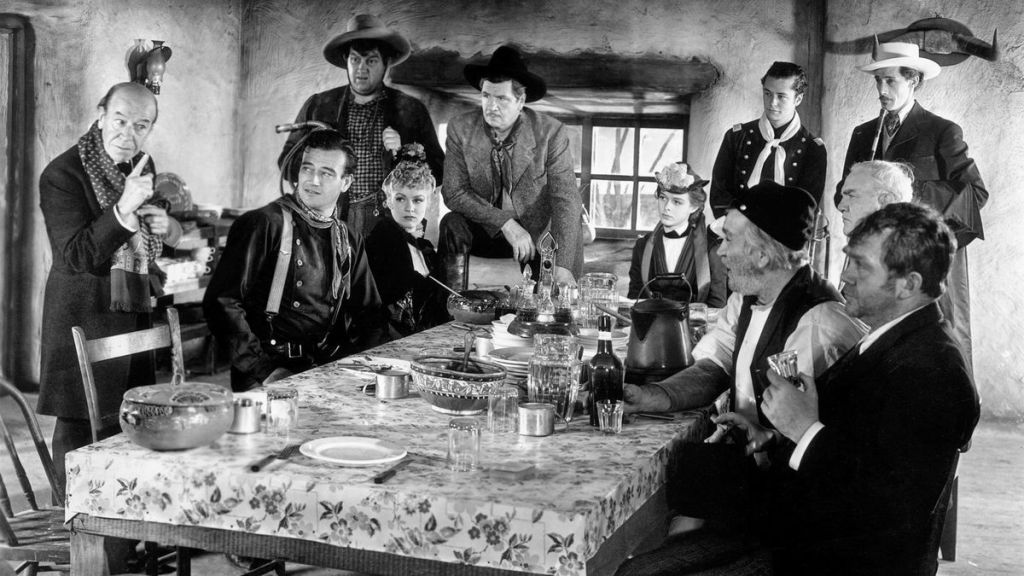
But then most people are too worried about catching sin-by-touch from Dallas. Stagecoach never outright states her profession, but only the naïve Ringo Kid seems unaware she’s on-the-game. At the first stop on the journey, Ford orchestrates a perfectly constructed scene of micro-aggressions and class structure, where Ringo guiltily utterly misreads as snobbery about his own jailbird past. (Hatfield is so committed to keeping the distance between himself and Dallas, he won’t even let her borrow his water glass as he does Lucy, tossing Dallas the canteen to drink straight from instead). Similar disdain also meets Dr Boone, whose utter refusal to even slightly moderate his drinking (he spends the first day getting sozzled) disgusts the elite passengers, right up until his skills are needed during a medical emergency. (At this point Hatfield starts treating him as the fount of wisdom).

Ford’s sympathies are, like so often, with the tough little-guys out in the West, who judge people by who they are and what they do rather than where they come from. Claire Trevor is perfectly cast as Dallas, never a victim but always full of patient defiance, all-to-used to the snubs from others. But we respect Dallas because it’s clear – from the start – she’s kind, considerate and decent. When the chips are down for Laura, it’s Dallas and Boone (not self-appointed guardian Hatfield) who step-up to save her, and never once does it cross their mind to hold Lucy to account first.
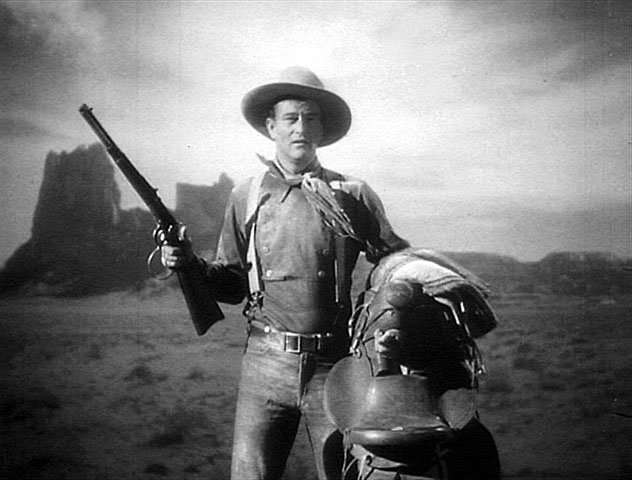
Just the same is, of course, The Ringo Kid. Stagecoach was possibly the last time Wayne could plausibly be called ‘the Kid’ – he looks older than his 32 years already – and he fills the part with a sincere honesty, courtesy and straight-forwardness that would become integral to Ford’s films, while still making the Kid the rough-and-tumble hero you want to be. The Ringo Kid may be a jailbird, but treats people according to their personal merits, sticks to his word, unhesitatingly protects people (that iconic introduction is him warning the coach of danger ahead) and won’t do anything he isn’t unwilling to do himself. It’s people like that – and Thomas Mitchell’s Oscar winning (Mitchell had key roles in half the best picture nominees that year, so had to win for something!) Doc Boone who turns himself into a master surgeon by force-of-will alone – who form the backbone of Ford’s West.

This all sits alongside some truly sensational action-adventure. Most of Stagecoach is a long build-up to its two action sequences that end the film: the running attack across the wide-open desert sands from the Apache and Ringo’s fateful duel with the Plummers. The eight-and-a-half minute chase would be the highlight of any film, a dynamic, pulsating masterclass of tight editing and tracking shots that fills the screen with electric pace and energy. It also has some of the most iconic stunts of all time, executed by Yakima Canutt Wayne’s long-term stunt consultant. From Canutt-as-Ringo jumping from pair-of-horses to pair-of-horses in front of the coach galloping at full-speed, to Canutt-as-Apache leaping from horse, to coach horses to falling and bring dragged under the coach (a stunt homage by Raiders of the Lost Ark’s truck chase) their visceral thrill is made even more exciting by Ford’s camera speeds making them look like they took place at even faster pace than the 45-miles-an-hour the horses were galloping at.

Ringo’s final duel with the Plummers gets a different approach, a long, steadily paced build-up that culminates in a very low camera watching a ready-for-action Wayne move towards us like a striding mountain. Stagecoach is also a masterclass in visual imagery and camera-use – so much so Orson Welles literally used it as such in prep for Citizen Kane, screening it over 40 times. Not just in action and editing, but also the brilliance of placement. Stagecoach’s low-ceilinged sets and striking shadows are a clear influence on Kane. A superb shot of Dallas from down a corridor, framed in light strewn from an open doorway, is a wonderful piece of visual poetry and there are gorgeous visual flourishes throughout, from the black cat that crosses the Plummer’s path to the wonderful vistas from Ford’s first trip to Monument valley.

All of this comes together into a film that is a wonderfully entertaining character study, wrapped up with a series of knock-out set-pieces, with romance, comedy and social commentary thrown in on top. It’s perhaps one of the most purely ‘entertaining’ Westerns ever made and one of Ford’s finest fusions of artistic brilliance and popcorn chewing thrill-rides.
The Quiet Man (1952)

The Quiet Man (1952)

Ford’s sweet and funny Irish fable is possibly his most purely enjoyable film

Director: John Ford

Cast: John Wayne (Sean Thornton), Maureen O’Hara (Mary Kate Danaher), Barry Fitzgerald (Michaleen Oge Flyyn), Ward Bond (Father Peter Lonergan), Victor McLaglen (Squire Will Danaher), Mildred Natwick (The Widow Sarah Tillane), Francis Ford (Dan Tobin), Eileen Crowe (Mrs Elizabeth Playfair), Arthur Shields (Reverend Cyril Playfair), Charles B Fitzsimmons (Hugh Forbes), James O’Hara (Father Paul), Jack MacGowran (Ignatius Feeney), Sean McClory (Owen Glynn)

John Ford wasn’t born in Ireland, but he loved the place in the way only the child of ex-pats could. The Quiet Man is a loving, romantic, almost fairy-tale view of Ireland, an affectionate feelgood fantasy that transcends any possibility of patronising its subject through its warmth and charm. It’s an unashamedly feel-good film, a delightful fable full of luscious scenery and tenderly sketched characters that plays out like a warm end-of-term treat where we are all invited to the party. It’s possibly Ford’s most purely enjoyable and heart-warming film.

Set in 1920s Ireland, Sean Thornton (John Wayne) returns to his childhood home of Inisfree after growing up and becoming a boxer in Pittsburgh. Sean loves his home country, but with his American upbringing is out-of-step with the customs and traditions of Ireland – something that becomes very clear when he falls in love with Mary Kate (Maureen O’Hara), sister of local squire Will Danaher (Victor McLaglen). Their rules-bound courtship – overseen by matchmaker Michaleen Oge Flynn (Barry Fitzgerald) – eventually leads to marriage, but via tricking Will, who withholds Mary Kate’s dowry, the sign of her independence. Mary Kate wants Sean to fight for it – but the former boxer is haunted by the accidental killing of an opponent in the ring and wants to live-and-let-live. Problem is everyone, from Mary Kate down, sees that as cowardice.

Ford was desperate to make The Quiet Man, the rights for which he had paid $10 for in 1933 when the short story was published by Maurice Walsh (Ford ensured Walsh received another $5k when the film was finally made). B-movie studio Republic Pictures was the only one willing to take a punt on it. But, alarmed by Ford’s insistence to shoot in colour and (even more expensively!) on location, they were convinced they had a box office bomb on their hands. They insisted Ford and his cast made a western first – the literally for-the-money Rio Grande – to cover the expected losses. They even demanded Ford couldn’t make it longer than 2 hours. Ford screened the final 2 hours and 9 minutes cut to them, stopping the film on exactly the two hour mark and asking them what they’d cut. They released the film unchanged. The film was an Oscar-nominated smash-hit.

It’s not a surprise why, because the film is a whimsical delight. Ford isn’t often remembered for his sense of fun, but The Quiet Man is unarguably funny. It’s crammed with sight gags – from sly double takes (there is a delightful one from the railway station workers, who watch first a determined Sean then a horse walk straight past them), to Sean and Will grimacing in pain but smiling as they exchange a brutal handshake, to Mary Kate jumping over obstacles as Sean drags her back to the village to have it out with her brother. It famously ends with an extended comic set-piece as Sean and Will launch a mano-a-mano “Queensbury Rules” fistfight that takes most of a day, moves across the whole village, and is interrupted only by a break for a pint.

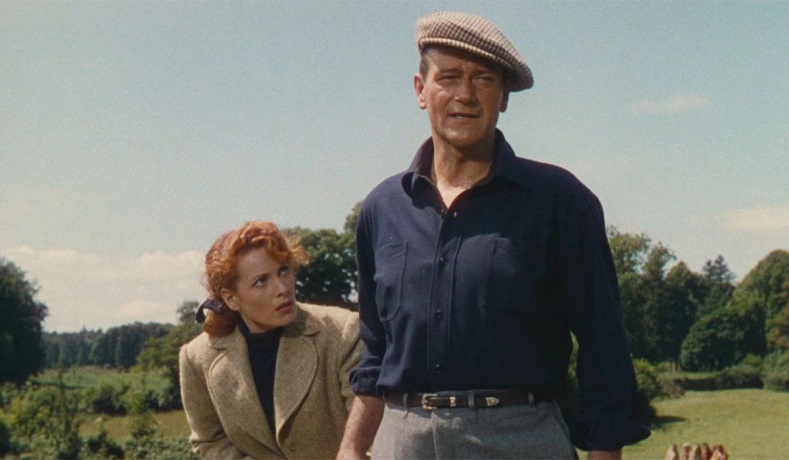
All of this takes place in an Ireland that, while it never feels entirely real, is drawn with such loving affection and cast with such careful exactitude that it hardly matters. Ford’s insistence on shooting all the exteriors on location paid off in spades. The country has never looked more ravishing than through Winton C Hoch’s technicolour lens. Rolling vistas, gentle brooks, quaint villages, perfect beaches. You totally understand why Sean, on arrival, simply stands on a stone bridge and stares across the valley of Inisfree, lost in memories and his emotions.

Sure, it’s a romantic vision. And 1920s Ireland wasn’t the sort of haven depicted here, where Catholic and Protestant lived in perfect harmony, politics never reared its head and the local IRA man is a jolly joker in the pub. If The Quiet Man had not been so well-meaning, you can imagine people taking offence at a picture of the country full of roguish charm, horse-drawn carriages, drinking and fighting. (You could say The Quiet Man shaped many Americans’ perceptions of what the country is like.) But Ford never makes any of this a subject of humour. In fact, it’s a subject of love. The joke is never on the Irish. Inisfree is in fact a haven of community spirit, a supportive village where its people are wise, caring and decent, tradition is respected and what people say and do matters.

It’s why so many are shocked by Sean’s seeming cowardice at not raising his fists earlier. That’s not what “men” do. John Wayne is very effective as the easy-going Sean, a guy who just wants to settle down to marriage. It’s a decent playing-against-type by Wayne, that balances his quiet sense of dignity with the sort of manly determination we know will eventually come through. It’s easy to see why he and Mary Kate fall in love. Also, why she is both swept up in his masculinity and also enraged that he doesn’t behave enough like a man, by refusing to take a stand to defend her honour and secure that dowry that will make her a true wife.

O’Hara is marvellous in a challenging role as Mary Kate. This is a feisty and determined woman, who knows what she wants but denies to herself what that is. She and Wayne share a striking, windswept early kiss – her mood in it going form surprise, to fascination, to irritation, to surrendering to her own desires. While you could suggest the film’s comic set-piece of Sean dragging her (sometimes literally) back to the village so she can watch him fight her brother the way she’s demanded from the start feels uncomfortable today, but it’s also Sean not only delivering what she has wanted him to do from the start, but also strangely the thing that finally bonds them together.

A bond is what they have, both of them straining against the confines of the courtship rules of Ireland. Together they flee the chaperoned carriage ride Michaeleen (a delighful Barry Fitzgerald) takes them on to ride a tandem through the streets. Mary Kate constantly, bashfully, tries to go after what she wants – and a large part of that is the lurking “bad boy” tendency that she detects under the surface of the quiet Sean. Something her less-bright brother Will can’t see.

Victor McLaglen (Oscar-nominated) swaggers, slurs and puffs himself up as this rough-and-tough, punch-first-think-later bruiser, who constantly thinks he’s being cheated. He and Wayne throw themselves into the long dust-up that ends the film with the same comic energy and enthusiasm they did exchanging handshakes. Part of The Quiet Man’s success comes from the comfort and familiarity the cast felt for each other. The trip to Ireland was like a friends-and-family holiday: old mates like Ward Bond, Ford’s brother, O’Hara’s brother, Wayne’s children – they all round out the cast. It helps build even more the family and community feeling that makes the film a delight.

Above all, The Quiet Man leaves you with a smile on your face. With expertly filmed set-pieces – a horse race, Sean and Mary Kate’s long walk back to Inisfree and the epic punch-up – combined with luscious shooting (also done with wit – a sexually frustrated Sean pounds through the countryside, tossing heavily puffed cigarettes aside, after Mary Kate withdraws favours) – it’s also fast-paced, witty and warm. The cast even effectively take bows as Ward Bond’s (his finest hour) priest delivers a final voiceover. Full of affection and charm, it’s a delight and is perhaps the only foreign “Irish” film that has been embraced by the Irish.

The Ox Bow Incident (1943)

Henry Fonda tries to change the fate of a lynching, in gripping social-issue drama The Ox Bow Incident

Director: William A Wellman

Cast: Henry Fonda (Gil Carter), Dana Andrews (Donald Martin), Harry Morgan (Art Croft), Frank Conroy (Major Tetley), Harry Davenport (Davies), Anthony Quinn (Juan Martinez), Francis Ford (Alva Hardwicke), William Eythe (Gerald Tetley), Mary Beth Hughes (Rose Swanson), Jane Darwell (Ma Grier), Marc Lawrence (Jeff Farnley), Paul Hurst (Monty Smith)

Spoilers: Can’t quite believe I am saying this about a film that is over 60 years old – but I’m going to give away the whole plot here. Because you can’t really talk about the film without it. It’s a film that’s well worth watching not knowing what is going to happen, so you are warned!

We all like to believe that, when push comes to shove, we live in a civilised world. That when the chips are down, we would behave nobly and stand for what was right. The Ox Bow Incident is a challenging western, because it defiantly says the opposite. The world is a cruel and judgemental place – and sometimes good people are ineffective, regular people panic and lash out and decent people pay the price.

Gil Carter (Henry Fonda) and Art Croft (Harry Morgan) ride into town. Cattle rustlers are plaguing the town and a popular rancher has been gunned down outside his home. With the sheriff absent and the judge ineffective, the townspeople take justice into their own hands. Led by a faux-Civil War major Tetley (Frank Conroy) and aggrieved friend of the dead rancher Jeff Farnley (Marc Lawrence), they form a posse and ride out to lynch the three suspects (Dana Andrews, Anthony Quinn and Francis Ford). Carter and Croft follow, reluctant, but worried that if they protest too much suspicion will fall on them.

The Ox Bow Incident is a film you keep expecting to make a veering turn towards positivity – you keep expecting it to suddenly draw breath and for everything to turn out okay. Instead, it’s a grim insight into how mob mentality can drive people into sudden and cruel actions. It’s equally a testimony to how ineffective protest and principles can be in the face of anger and revenge. It’s a Western that feels years ahead of its time – there is no romanticism here, just grim everyday life.

In many ways it’s a po-faced and serious morality tale, and revolves around one long scene where the lynch victims are tried by mob justice, plead for their lives, are given a brief respite to say their prayers, protests from a few men are swept aside, and then they are strung up. Every time the viewer starts to think righteousness will slow things down, the certainty of the mob stops decency from taking hold. It’s a slippery slope towards the deaths of men we find out almost immediately afterwards were completely innocent.

The Ox Bow Incident is a film that preaches – and it feels very stagy, a feeling increased by the obviousness of its sets and the intense chamber feeling of the limited locations and scenes. But it works, because it’s so brilliantly put together and so grippingly involving. Wellman’s film is trimmed to the bone, the writing is very strong with Lamar Trotti’s script bristling with moral outrage at humanity’s weakness and fear. It’s a story of injustice and mob rage – and it works because it manages to tell a compelling story while also dealing with universal themes.

Henry Fonda listed this as one of his few early performances he felt was good. Fonda is often remembered as the archetype of American justice, so it’s fascinating here to see how ineffective and compromised Carter is. Carter knows what they are doing is wrong – but he lacks the decisiveness, strength of will or character to persuade people. In fact, his main contributions are quiet comments, or sniping from the wings of the action. 

It’s an inversion almost of Twelve Angry Men’s juror #7 – Carter can’t lead us to justice, because he’s a bit too afraid, a bit too weak, a bit too compromised. At the end, as he reads Martin’s final heartfelt and forgiving letter (beautifully filmed by Wellman with Croft’s hat obscuring Carter’s eyes while he reads, a shot that has multiple symbolic meanings), he projects not moral force but the shame and guilt of a man who, when it came down to it, didn’t have the determination to do what was right. It’s a perfect comment on what a writer may have felt was happening all over in 1943.

The real advocate of justice is Harry Davenport’s humane shop-keeper – but he can’t persuade anyone (Davenport is excellent). Instead, all the big personalities are leading the lynch mob, from Frank Conroy’s bullying Major, who just wants to see the action and stamp his domination on others, to Jan Darwell’s vile honking old woman excited by the killing, to Marc Lawrence’s just plain angry Farnley. Everyone who knows what they are doing is wrong – like Tetley’s weak-willed son (well played by William Eythe) – are just too weak, scared or uncharismatic to do much more than vainly protest. Their regular joe victims (all three actors are excellent as in turn, decent, old and confused and suspiciously alien) don’t stand a chance.

The Ox Bow Incident is a perfect little morality tale, crammed with brilliant performances and moments. It even has the guts (for the time) to reference that most lynchings didn’t have white victims, and introduces a sympathetic black honorary padre who is equally powerless. It’s a film that really feels like it came from an era when the world was going to hell in a handbasket, but it speaks to all ages. Because our fear and readiness to attack – and punish – those people we see as different hasn’t gone away. It’s chilling to think that the world hasn’t changed and this story could just as easily be transposed – with no changes – to half a dozen locations around our world today.