Tag: Fredric March

Les Misérables (1935)

Les Misérables (1935)

Odd choices are made in this Hugo adaptation, despite good photography and performances

Director: Richard Boleslawski

Cast: Fredric March (Jean Valjean), Charles Laughton (Inspector Javert), Cedric Hardwicke (Bishop Myriel), Rochelle Hudson (Cosette), Marilyn Knowlden (Young Cosette), Florence Eldridge (Fantine), John Beal (Marius), Frances Drake (Éponine), John Carradine (Enjolras)
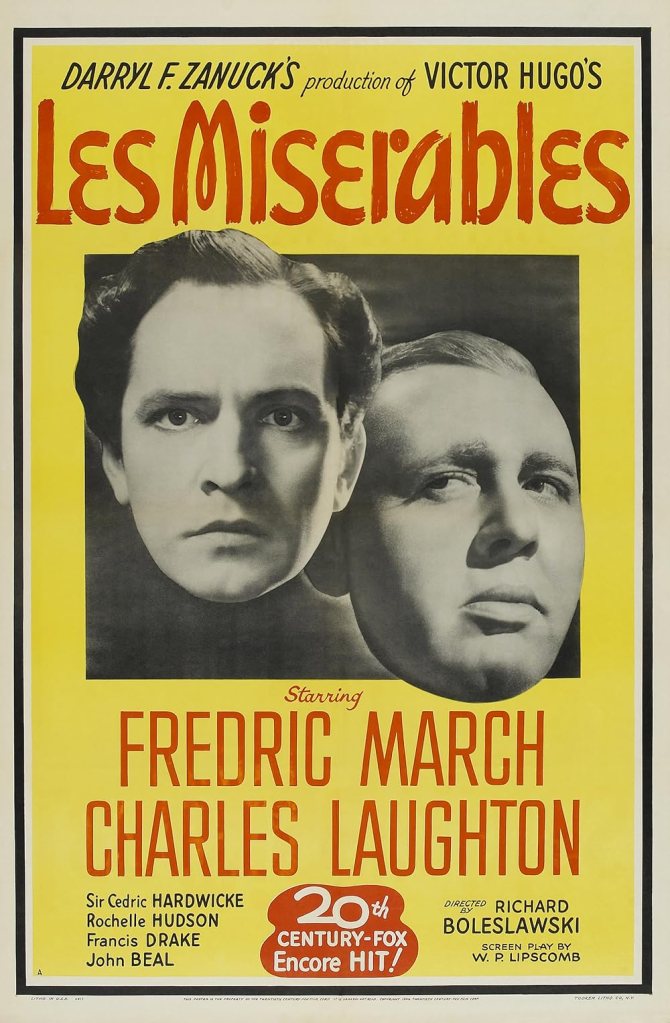
There isn’t a more famous loaf of bread in literature, than that stolen by Jean Valjean to feed his starving family. There’s something quite sweet about the fact that Richard Boleslawski’s film of Hugo’s doorstop gives that loaf its moment in the sun, as its half-eaten remains are produced as evidence in Valjean’s trial. It’s an unintentionally funny moment, but feels right in a sometimes blunt film, that at times makes odd decisions for those of us so familiar now with the plot’s ins-and-outs and the moral up-righteousness of its lead character after forty years of the musical. Boleslawski’s version is an odd mix, part psychological drama, part atmospheric thriller, part thuddingly obvious soap where a loaf of bread needs to be literally seen. Parts of it work extremely well, other parts weigh the film down like the chains on its galley slaves.

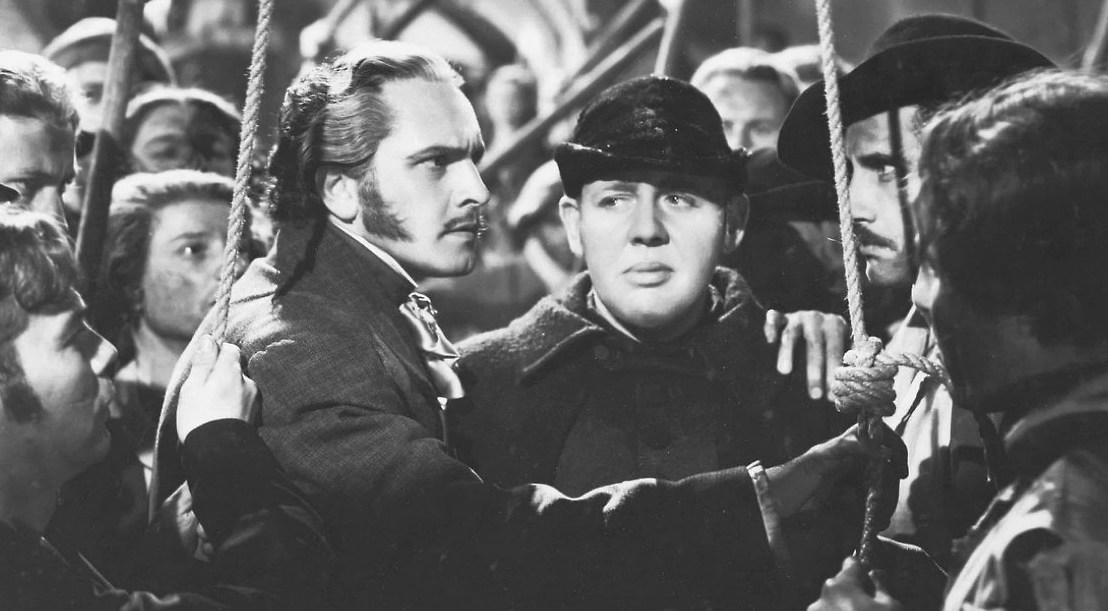
The film is overwhelmingly focused on the clash between Valjean (Fredric March) and Javert (Charles Laughton). One a good man who wrestles with temptation, but follows the sprit of justice. The other a rigid fanatic, who sees the letter of the law as gospel and the rights and wrongs of a situation an irrelevance. First meeting when Valjean serves a decade as a slave at the oars in the galleys, their paths recross after a released Valjean has a road-to-Damascus moment after the intervention of a noble priest (Cedric Hardwicke). Reinventing himself as ‘Monsieur Madeleine”, he becomes mayor of a small town and protector of Fantine (Florence Eldredge) and her daughter Cosette (Rochelle Hudson). But he cannot escape the pursuit of Javert which carries him into hiding for years in Paris, where a now grown-up Cosette falls in love with reforming student Marius (John Beal), leaving Valjean with one last dangerous choice.

Les Misérables restructures the novel into three acts, each presenting Valjean with a moral quandary. As such, Fredric March’s impressive performance must be unique among Valjean’s: this version is forever tempted with greed, anger and his own desires, constantly struggling to overcome his baser feelings. March is very good at bringing to life this conflict, just as he sells the sense of awakening purpose Valjean feels washing over him after the Bishop’s intervention prevents him from being returned to prison. It’s a muscular, agonised performance of a man constantly striving, even in the face of his resentment, to live up to his adopted moral principles. So, much as Valjean would like to let another man be accidentally condemned for his crimes, or to keep Cosette to himself or pull a trigger on Javert (March’s skilfully communicating the deep internal conflict each time) he’ll still (however reluctantly) find himself doing the right thing.

He contrasts excellently, with Laughton’s rigid, well-spoken, self-loathing Javert who has absorbed his moral code so completely, its left no room for any other form of principle or emotional judgement. Introduced, lips quivering, as he explains being denied promotion due to his convict father, Laughton’s Javert has channelled that resentment to worshipping the penal code as God. As he repeats, several times, good or bad is irrelevant, it’s just about the law. Of course, Laughton’s performance bubbles with repressed frustration, his pursuit of Valjean clearly motivated by far more personal feelings of anger and envy than he is willing to admit. Valjean is a spoke in his wheel of justice, a factor that makes no sense to him.

Boleslawski’s film is at its best when these two face off. It’s also at its most stylistic for these sequences. Les Misérables is awash with Gregg Toland’s atmospheric, mist-filled photography and expertly uses his expressionistic shadows. It’s depiction of a Parisian uprising, just like it’s introduction of a fast-paced horse chase between Valjean and Javert, are snappily edited and throw in a parade of dynamic Dutch and high angles. At the end of each act, Christian imagery is well used (in two cases, shrines to Mary and Jesus) to add emotional heft. A pursuit through grime and mist-filled sewers near the film’s close has a Fritz Lang atmospheric strength (did Carol Reed watch this before The Third Man?) as well as the film’s most effective use of music to build atmosphere as Valjean desperately submerges himself and Marius to hide.

There is effective stuff in Les Misérables. So, you try your best to forgive the fact it’s full of extremely on-the-nose, obvious touches. The introduction of the bread at the trial is not an end of its obviousness: for starters, the galley’s were prison hulks, not actual ships rowed around by convicts (where do they imagine these enormous hulks are going?). Truncating so much of the book down – and focusing overwhelmingly on its two leads – means many other parts of the story are short-changed or make little impact or sense (the hilariously watered down Parisian revolutionaries don’t turn up until the final 40 minutes). Florence Eldridge’s Fantine (all references to her prostitution are of course cut) does almost nothing but die – although not before the film gives her a (unique) ludicrously sentimental reunion scene with her daughter (played by a highly irritating precocious film-school brat before she grows up into Rochelle Hudson). Clearly the actual tragedy here (a mother never sees her daughter again) was considered too much.

Then there are the strange mis-readings and mis-interpretations. I can understand why Marius and his law students are re-imagined, by conservative Hollywood, into legal reformers rather than idealisitic revolutionaries (Marius even denounces the very idea of overthrowing the government as terrible). Here they want only penal reform – although of course, while ensuring the guilty are harshly punished – and chat like champagne socialists. It’s a bit of a mystery why this call for slow-paced, moderate social reform erupts into throwing up barricades, but clearly audiences at the time couldn’t be expected to get on board with anti-Monarchist cells. They’d probably agree with Eponine (interpreted here as a sort of femme fatale and Marius’ secretary) that it’s all a silly, slightly disreputable, waste of time.

However, even more strange, is the inexplicable interpretation of Valjean’s desire to keep Cosette to himself not due to being a protective father-figure investing everything in his life into his daughter, but instead an unpleasant sexual desire to make Cosette his wife. Even leaving aside this utter perversion of the novel, since we’ve seen Valjean raise her from the age of about 6 it’s hard not to feel a bit of bile forming in your throat at the stench of grooming this gives the relationship. It’s almost as if Hollywood could only imagine a man going to great lengths to protect a woman if he wanted to eventually get in her pants.

It’s odd reinventions like this that don’t quite work even within the world presented by the adaptation, let alone compared to the original source, that weighs the film down too much. They are blotches in the streamlining of a huge novel. But when the film focuses on an increasingly personal clash between two men, both well played by March and Fredric, and its atmospheric visuals, it works much better.
Alexander the Great (1956)

Alexander the Great (1956)

An odd epic, which both loathes its subject and also presents him as a golden-boy

Director: Robert Rossen

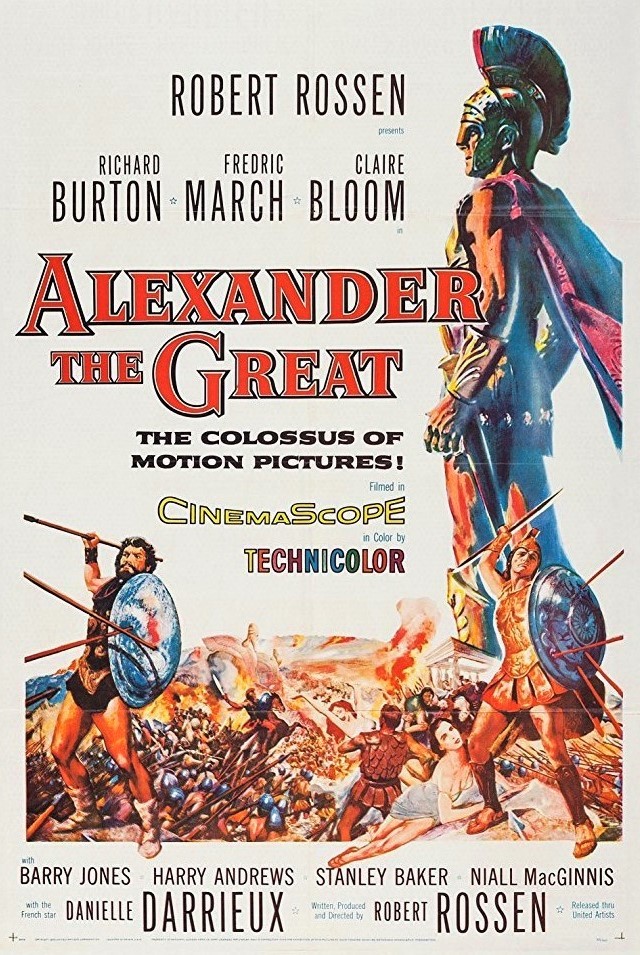
Cast: Richard Burton (Alexander the Great), Fredric March (Philip II), Claire Bloom (Barsine), Danielle Darrieux (Olympias), Barry Jones (Aristotle), Harry Andrews (Darius), Stanley Baker (Attalus), Niall MacGinnis (Parmenion), Peter Cushing (Memnon), Michael Hordern (Demosthenes), Marisa de Leza (Eurydice), Gustavo Rojo (Cleitus the Black), Peter Wyngarde (Pausanias), William Squire (Aeschenes)

No one in history achieved so much, so young as Alexander the Great. He conquered most of the known world before he was thirty and left a legend that generations of would-be emperors found almost impossible to live up to. He did all this, while remaining a fascinatingly enigmatic figure: either a visionary nation-builder or a drunken man of violence, depending on who you talk to. Alexander the Great, in its truncated two hours and twenty minutes (sliced down from Robert Rossen’s original three-hour plus) can only scratch the surface of his story and that’s all it does.

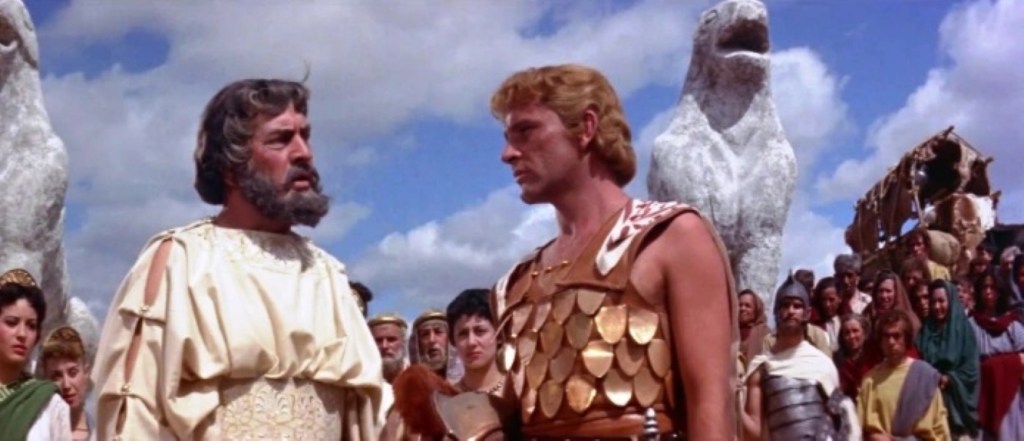
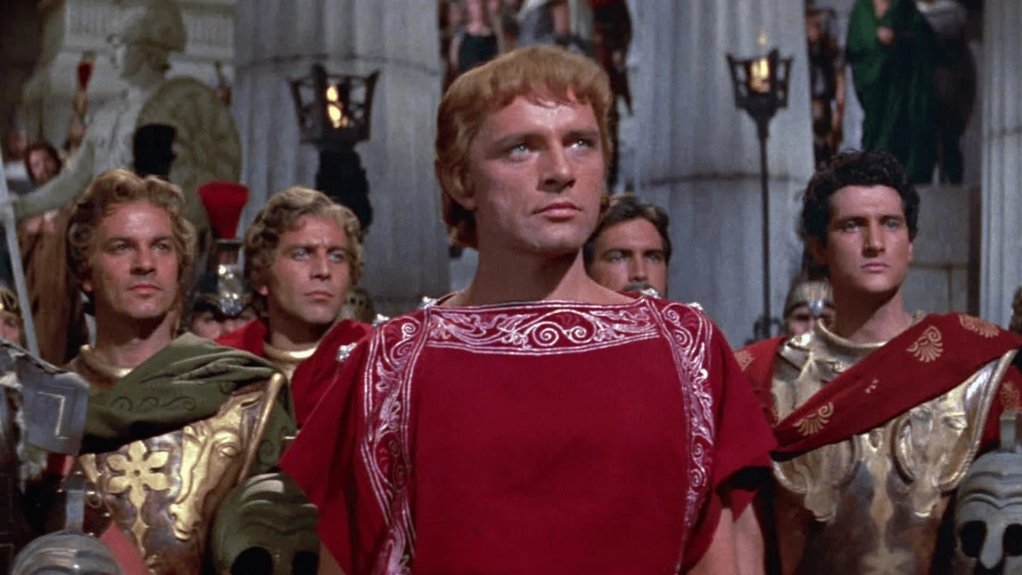
As the great man, Richard Burton flexes his mighty voice in a film that splits its focus roughly equally between the early days of Alexander and his troubled relationship with both his father Philip II (Fredric March) and his mother Olympias (Danielle Darrieux) and his own kingship and conquest of the known world until his early death. Surprisingly, perhaps because the world is so vast, it’s the first half of the film that’s the most interesting – perhaps because showing up the internecine dynastic squabbles between petulant royals are more up director and writer Rossen’s alley than global dominance.

Perhaps as well because it feels pretty clear Rossen doesn’t particularly seem to like Alexander. Over the course of the film, the pouting monarch will prove to have a monstrous ego (even as a teenager fighting Philip’s wars, he cockily re-names a sacked city after himself), ruthlessly slaughters opponents after battles, is prone to fits of rage, informs his followers with wild-eyes that he’s God himself, leads his army into the dried out hell of the deserts of the Middle East and turns (at best) a blind eye to his mother’s plans to assassinate his father and then murder his father’s second wife and baby son.

The film culminates in a shamed Alexander kicking the bucket more concerned with maintaining his legend for future generations than assuring any kind of future for his kingdom. But the sense of hubris destroying the great man is never quite captured. This is partly because the grand figure we are watching lacks any personal feelings or fear. He can’t seem to experience loss or grief and only understands negative events in terms of their impact on his reputation. And he never seems to truly learn from this – even when he harms friends, his regrets are based around the impact such action will have on how those around him see him. At the same time, Rossen can’t quite follow his heart and make a real iconoclastic epic meaning he instead leaves titbits here and there for the cinema-goer to hopefully pick up among the spectacle.

As such, Alexander is still pretty persistently framed as we expect a hero to be, with a rousing score backdropping Burton’s speeches and poses, even while the film seems deeply divided about whether this guy who conquered most of the known world and lay waste to Babylon was a good or bad thing. While acting half the time like a egomaniac tyrant, the film still carefully partially shifts blame for his character flaws onto his mother’s Lady Macbethesque influence (Darrieux does a good line in whispering insinuation) or Philip’s bombastic egotism (March, growling with impressive vigour).

Rossen has far more admiration for people like the fiercely principled Memnon (a fine Peter Cushing) who refuses to compromise only to be rewarded by a post-battle one-sided butchering from Alexander after his offer to surrender and spare the lives of his men is turned down. Even Michael Hordern’s Demosthenes comes across as a man of principle, certainly when compared to Alexander’s Athenian-of-choice Aristotle, interpretated here as a pompous windbag cheer-leader for dictators. Oddly even Harry Andrews (possibly, along with Niall MacGinnis’ wily Parmenion, the films finest performance) as Darius comes across as a man of surprising human doubt under his regal exterior. But, perhaps because of choppy-editing cutting down a complex story into just over two hours, Alexander the Great can’t resist framing its hero as a sun-kissed golden-boy, towering above everyone else in the film.

Watching Alexander the Great you get the feeling the film has effectively entombed him as a marble statue, so devoid is he of fundamental humanity. Perhaps this was Rossen’s solution to shooting a film about someone he seemed so devoid of human interest and sympathy for. There is a reason why Charlton Heston – the first choice for the role (can you imagine!) – called Alexander the Great “the easiest kind of picture to make badly”. Frequently Alexander the Great tips into a sort of sword-and-sandles camp made worse by how highly serious it takes itself. Not helped by Burton’s all-too-clear boredom with the part and contempt for the material, Alexander strikes poses and delivers speeches as if he’s been ripped straight out of Plutarch or a bust display in a museum.

Apart from rare moments – usually in the first half as he processes his complex feelings of love and loathing for his overbearing father – he is almost never allowed to be human. His friends – most notably his famed best-friend (and lover) Hephaestion – are reduced to a gang of largely wordless extras and only Claire Bloom’s Barsine is given any scope to talk to him as if he’s a man rather than just a myth. It gets a bit wearing after a while as you long for something human about the man you can cling onto.

It’s also a shame that Rossen seems uncomfortable with shooting the battle sequences. The battles of Granicus and a combined Issus-Gaugamela look rather like damp scuffles over shallow streams than some of the mightiest clashes of the Ancient world. Rossen communicates no visual sense of either strategy or scale (despite the bumper budget). Similarly, the grand sets look too theatrical and never quite as impressive as they should do, despite some fine painterly compositions. Rossen can never quite find a way to make his hundreds of extra seem like thousands and he falls back in the second half to communicating Alexander’s success through a tired combination of map montages, voiceover and repeated shots of men marching left to right and burning cities.

Alexander the Great is a deeply flawed epic. It’s neither swashbuckling fun that bowls you along, or a breath-taking piece of historical spectacle. Nor is it psychologically adept or insightful enough to show you something truly different about its hero. Instead, it tries to straddle both ways of thinking and ends up collapsing in the middle. If only Rossen had found his own Alexanderian solution to cutting this Gordian knot. Instead, the film just ends up a cut-about mess that fades from memory all too soon.

A Star is Born (1937)

A Star is Born (1937)

One of the first iterations of the tale, and with two winning performances one of the best

Director: William A Wellman

Cast: Janet Gaynor (Esther Blodgett/Vicki Lester), Fredric March (Norman Maine), Adolphe Menjou (Oliver Niles), May Robson (Lettie Blodgett), Andy Devine (Danny McGuire), Lionel Stander (Matt Libby), Owen Moore (Casey Burke), Peggy Wood (Miss Phillips), Elizabeth Jenns (Anita Regis), Edgar Kennedy (Pop Randall)

A Star is Born wasn’t the first time this story was told and it certainly wasn’t the last. Each generation in Hollywood has produced its own version of the story, not to mention a gallery of other culture creating their own unofficial and otherwise remakes. What Price Hollywood had even effectively told the same story five years earlier, and the entire concept has the air of a medieval ‘fortune’s wheel’ – two souls bound together, one goes up as the other goes down. There may in fact not be nothing new about A Star is Born at all but gave such a bright new polish to the familiar, that we’ve been inspired to come back to it again and again.

In the farmyard sticks, Esther Blodgett (Janet Gaynor) has a dream:  to become one of those stars of Hollywood’s silver screen. With grandma’s (May Robson) money in her pocket (‘What have I got to spend it on?’) she heads to Los Angeles, only to find the city is awash with similarly starry-eyed dreamers desperate for a big break. Esther gets hers in an unusual manner: serving drinks at a Hollywood party she strikes up conversation with famous star Norman Maine (Fredric March). Norman is very taken with Esther – in fact he’s almost immediately in love with her – and arranges a screen test. Soon Esther has a new career, a new name – Vicki Lester – and a new marriage to Norman. Problem is, as her star rises and she becomes the next big thing, Norman stops letting “his acting get in the way of his drinking” and his career slides into oblivion.

It’s high romance, very effectively filmed by Wellman, that requires – and gets – two very strong, highly relatable performances from its leads. Wellman’s film carefully gives both of them the space to grow a relationship that begins shyly and becomes deep and tender. Gaynor is bright, naïve and gentle with just enough ambition and determination to impress. She’s eager to please, but also firm and knows her own mind, far from a pushover in this town of press releases and media spin. Gaynor never lets us forget that under ‘Vicki Lester’ there’s that ordinary Esther Blodgett (could there be a more grounded, less starry name than Blodgett?), a woman with principles in a world of fakes.

Perhaps even better though is Fredric March (it’s the first indication, borne out by nearly all the remakes, that Norman is the better part). March is charismatic, engaging, funny, down-to-earth and everything you would want from a star – while also being a mean drunk with anger management issues. He’s introduced getting into a drunken scuffle at the Hollywood Bowl, and his love of booze makes him just as likely to laugh and flirt with Esther as it can make him take a slug at a guy who looks at him the wrong way. March’s drunk acting is very effectively restrained and he captures extremely well the self-disgust behind Norman at his weakness. March makes him a star who burns away his career through appalling choices, who fervently believes he can stay on the wagon until he can’t. In his hands it becomes a classic tragic piece, a Greek hero destroyed by his fatal flaw, his inability to escape the bottle.

This rich romantic tragedy builds wonderfully, Wellman keeping us deeply invested in this couple. The good times are really endearing: it’s hard not to grin along as they laugh and joke in a camper van after their elopement, or as they cover each other with encouragement and support for their careers. It makes the bad times unbearably painful: Norman’s drunken crashing of Esther’s Oscar win, a shambling monologue of self-pity and resentment, both heartbreaking and excruciatingly embarrassing. Norman’s fateful final decision is full of romantic imagery, as he smiling walks towards a sun-kissed beach, a beautifully staged inversion of a romantic ending.

A Star is Born’s other most interesting feature is its inside glimpse at Hollywood: or at least the version Hollywood was willing to present of itself to people. It even has a meta-theatrical element to it, the film book-marked by images of the shooting script describing the action immediately following or preceding it. Here Hollywood is a ruthless machine, chewing up the dreams of wannabes. An agent bluntly shows Esther the vast numbers of phone calls of wannabe extras they receive every day. Esther struggles just as much as assistant director Danny (Andy Devine) to find regular work. Careers are made and broken by chance, whims or the reaction of the audience to your face on screen. Names in lights one month and being pasted over the next.

Hollywood loves to be cynical about itself. A Star is Born delightedly shows its spin operation as ruthless, cut throat and controlling, planting stories about stars, covering up their misdemeanours (a regular requirement for the drunken Norman) and repackaging their lives into saleable commodities. Lionel Stander, as a heartlessly controlling press agent, is the heart of this, and the film doesn’t hold back on showing the dark powers of these studio fixers in action. But this is just a version of Hollywood: its telling that in A Star is Born while the middle management are condemned, the studio heads are absolved completely. Adolphe Menjou’s Selznick-like producer is an avuncular, uncle-like figure, endlessly caring and supportive of his stars who wouldn’t dream of any funny games to earn some money. This is a portrait of Hollywood where the top man is an affectionate saint – exposure only goes so far.

A Star is Born is also an interesting time capsule. Esther stares in admiration at a host of Hollywood Avenue stars of people must of the viewing public today would struggle to name (Norman Cantor anyone?). Seeking to impress while serving at a dinner party she’ll do impersonations of Garbo, Hepburn, Crawford and Mae West (the last even named). It’s a world where the continual production of content is even more on-going than on Netflix and the studios can start or end careers instantly. It’s a fascinating extra piece of interest in a highly effective, well-staged film. Even with its slightly murky early colour photography (it looks like a colourised black and white film), it’s a well-staged, effective romance with two very winning performances from its leads. Possibly one of the best versions of the story.

The Best Years of Our Lives (1946)

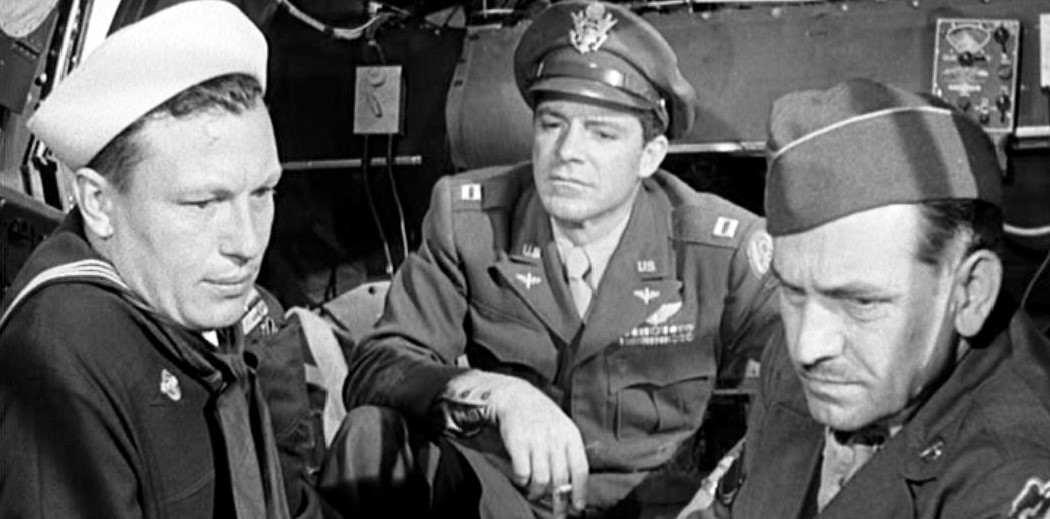
Harold Rusell, Dana Andrews and Fredric March find coming home can be as tough as war in The Best Years of Our Lives

Director: William Wyler

Cast: Myrna Loy (Milly Stephenson), Fredric March (Sgt Al Stephenson), Dana Andrews (Captain Fred Derry), Teresa Wright (Peggy Stephenson), Virginia Mayo (Marie Derry), Cathy O’Donnell (Wilma Cameron), Harold Russell (PO Homer Parish), Hoagy Carmichael (Butch Eagle), Gladys George (Hortense Derry), Roman Bohnen (Pat Derry), Ray Collins (Mr Milton)

Three men return from the Second World War. They’ve changed, but everything around them seems the same. How do they even begin to adjust when no one really understands what they’ve been through? The Best Years of Our Lives was a sensation when it was released, speaking to a whole country reeling from the shock of war. Many films focus on the gruelling experience of war, but few take on the struggle to find a place for veterans and help them reintegrate into normal life.

Our three veterans all meet at the airport, trying to home to the same small (fictional) city in the Midwest. Normally they would probably have never met: but war has given them a shared bond they will find hard to replicate back home. Al Stephenson (Fredric March) is a banker, who has developed something of a drinking problem to the surprise of his wife Milly (Myrna). Fred Derry (Dana Andrews) was a café worker who became an Air Force Captain – but finds that doesn’t interest employers back home. He also now has nothing in common with the flighty, flirty wife Marie (Virginia Mayo) he married before shipping out – and far more in common with Al’s thoughtful daughter Peggy (Teresa Wright). Homer Parish (Harold Russell) lost both his hands, replaced with mechanical hooks. Can he overcome the adjustments – and allow himself to be loved by Wilma (Cathy O’Donnell)?

What The Best Years of Our Lives explores brilliantly is how quick we are to praise heroes, but how slow we can be to offer them practical help and support. These problems aren’t just restricted to an unlucky one or two – the film goes out of its way to demonstrate the problem is universal. Our three leads are from different services, and radically different walks of life: an important businessman who served as a sergeant, a wash-out who found a purpose in the air force and an athletic sailor who returns without his hands. Rich or poor, it’s tough to find your place whoever you are.

Wyler shoots all this with a documentary realism, with extensive use of deep focus photography. It helps make this a frequently moving film. It sometimes feels like Wyler just captured real events. Flying home our heroes see “people playing golf like nothing happened”. They are all so nervous going home that both Al and Homer both suggest going for a drink rather than leave the cab they are sharing. Everyday problems about going to the office or looking for a job seem more affecting because we know they’ve come back from the war and don’t deserve knock-backs like this.

The heart of this film is Fred’s struggles to find some sort of purpose on civvie street. War offered more opportunities to him more than anyone else. He is a nobody who became a respected somebody. Now he can’t get a job in a department store. As a potential employer tells him, his CV is stuffed with irrelevant experience and his years out of the job market mean he’s fallen behind the rest. This is how a man with a chest full of medals, winds up serving ice cream and busting a gut trying to flog perfume to housewives who let their children run wild around his stand.

Dana Andrews is the heart of this film, giving a marvellous performance of great depth and sadness. Haunted by nightmares, Fred’s optimism drips away the longer he fails to find proper work. Perhaps most heart-breakingly of all, he increasingly makes himself the target of his dry wit. By the time he has surrounded to the indignity of taking back his old soda jerk job (and reporting to the spotty kid who used to be his assistant), Fred is disparagingly belittling his own wartime accomplishments.

If someone as matinee idol handsome, with a wonderful war record, as Fred can’t get ahead, what chance does anyone have? Fred’s wife (Virginia Mayo, marvellously smackable as this shallow girl) isn’t even interested in him, only the idea of him – begging him to wear his uniform (medals and all) for as long as possible so she can show him off like a new handbag. Fred is knocked back so many times, he comes to believe he deserves it. In a beautiful scene, late in the film, he walks through a field covered in old air force bombers. It’s a striking visual metaphor – one Fred is all too aware of – that he’s as much on the scrap heap as them.

The Best Years of Our Lives shows time and again how quick we are to forget. Al is hauled over the coals for offering a loan to a collateral-free GI who wants to start a farm. But Al feels a loyalty to men like this – and he recognises, unlike his superiors, there are qualities you just won’t find in a bank account. Homer is confronted at Fred’s workplace by an arrogant anti-Commie, who suggests the entire war was a waste of time, spent fighting the wrong foes. Calling Homer “a sucker” for losing his hands in the wrong war leads to a fight – and Fred losing his job for punching the guy out. Where is the sense of debt to these people?

Homer not only has to deal with disability – but also the metallic claws which get him all the wrong attention. The army trained him how to use the claws – but as Al observes, watching Homer’s awkward homecoming “couldn’t train him to put his arms round his girl”. They can solve the practical problem, but there is no support for actually coming to terms with the emotional impact.

Homer is played by real-life veteran paraplegic (and non-actor) Harold Russell, in a poignantly sincere, unstudied performance. It becomes even more heart-breaking, as his torment clearly rooted in Russell’s own experiences. When Homer demonstrates to Wilma how vulnerable he is without his hands –  if a door shuts, he’s trapped in a room, he can’t dress himself– it’s almost unbearably sad (O’Donnell is equally good in this scene). Russell’s simple, matter-of-factness is more moving than any histrionics.

The only plot that doesn’t get fully explored is Al’s implied drinking problem. He gets pissed the first night home (and his wife comments several times on his growing reliance). Everything to Al feels a little different – his kids are older, his bankwork seems stuffier. Today the film would dive more into Al’s probable survivor guilt. But Al makes a stand when others won’t to help his veterans – and March has a superb, low-key speech at a banquet in his honour where he vows to invest small loans into returning GIs. The film also gently probes – and in some ways leaves open – the ongoing problems he and Milly (warmly played by Myrna Loy) have had in their marriage, problems which Al’s absence and drinking have not helped solve.

Wyler pulls these threads together in a restrained style that largely avoids melodrama (though Hugo Freidhofer’s score is frequently overblown – Wyler apparently hated it). Instead, dilemmas are grounded in reality. Al might like Fred, but the last thing he wants is for Fred to get his daughter Peggy (Teresa Wright in a gentle, touching performance) caught up in a divorce. In a perfect example of Wyler’s restrained, documentary style, Al and Fred have a quiet man-to-man discussion, before Fred calls Peggy to see he can’t see her anymore. He does this in the back corner of the frame while the foreground shows Al listening to Homer and his uncle play the piano. It’s a perfect example of the way Wyler uses deep focus to give the film a fly-on-the-wall quality.

There is something extraordinarily modern about The Best Years of Our Lives. It feels calm and un-histrionic – and of course many veterans still struggle today. The camera feels observational and unobtrusive and the characters respond to situations in a very natural way. It’s also helped by the wonderfully natural acting. It all comes together in a film that is important without feeling like it’s trying to be important. An observant, sensitive exploration of the experience of veterans (made by a veteran), that never feels false and looks at our world with affection but realism.

Seven Days in May (1964)

Burt Lancaster and Kirk Douglas find themselves on opposite sides of a military coup in Seven Days in May

Director: John Frankenheimer

Cast: Burt Lancaster (General James Mattoon Scott), Kirk Douglas (Colonel Jiggs Casey), Fredric March (President Jordan Lyman), Ava Gardner (Eleanor Holbrook), Edmond O’Brien (Senator Ray Clark), Martin Balsam (Paul Girard), Andrew Duggan (Colonel Mutt Henderson), George Macready (Secretary of the Treasury), Whit Bissell (Senator Fred Prentice), John Houseman (Admiral Barnswell)

President Jordan Lynman (Fredric March) has completed his signature policy: a nuclear disarmament treatment with the USSR. Some are thrilled, others are horrified. In the latter camp are the Joint Chiefs of Staff, none more so than chairman General James Mattoon Scott (Burt Lancaster). General Scott has a plan: a coup to be launched in seven days time, during a training op. But word leaks to his assistant Colonel Casey (Kirk Douglas) who, however much he admires Scott, won’t be party to treason. Casey warns the President – and a race against time begins to stop the coup.

Seven Days in May opens with documentary style footage of clashing crowds outside the White House (one pushing for peace, the other for war) and then carefully balances that style with an unsettling sense of paranoia throughout. People suddenly disappear (once from frame to frame), most of the action takes place in confined spaces. When characters do head outside, they constantly seem to be looking over their shoulder, with the camera watching like a distant observer. The lack of music all adds the eerie feeling that this could just happen.

And, of course you, feel it could. Because we’ve not lost a tingling sense of unease at an over-powerful military. It’s a shame therefore that Seven Days in May doesn’t grip quite as much as it should. I think a large part of that is because the plot is exposed very early – and when Casey goes to the authorities with his suspicions, they are instantly acted on. Thrillers like this often work best with a “one man stands alone” vibe – it’s missing here, and instead we get the President and the cabinet laboriously investigating different elements of this conspiracy looking to turn up enough evidence to prevent the coup before it starts.

The drop in tension could have been counter-balanced if the film had more successfully explored the conflicts and contradictions in America. This is after all a country priding itself as being the home of freedom and democracy – but since George Washington, has had a fondness for installing military men in a job role pointedly called “Commander-in-Chief”. This is a film that could have explored how different parts of American society might admire either an Adlai-Stevenson-style intellectual or a blood-and-guts ‘simple’ soldier. But the film dodges this – and works hard to stress both men act within what they define as honour and the needs of the country. The film is to nervous about any suggestion that Scott’s coup could lead to a proto-dictator vetoing the electorate.

There is also a naivety about the film. A long subplot (not particularly interesting) features Casey being side-lined into uncovering evidence of Scott’s long-term affair. Ava Gardner does her best with a largely thankless part as the woman in question, but there is a touching faith that evidence of this will be enough to destroy Scott. It’s a faith in the system: while the public might be shaken slightly in their belief that Scott is like King Arthur reborn, finding out he’s actually Lancelot is hardly going to weaken his hold over many of his followers – or his military machine.  For a conspiracy film, Seven Days believes conspiracies are a relatively simple matter to defeat.

What’s best about the film – not surprisingly since it’s largely a chamber piece – is the strength of the acting. Produced by Douglas (who generously cast himself in the most thankless role as the decent-but-dull Casey), a cast of stars was assembled. Lancaster was perhaps the only choice as the holier-than-thou Scott, arrogant, morally-superior, cold, distant but capable of inspiring immense loyalty – it’s the perfect role for him and he plays it to the hilt.

The film’s finest sequence is a late confrontation between Scott – Lancaster oozing moral superiority and unhidden contempt – and Fredric March’s intellectual President. March is brilliant, a born negotiator and compromiser – all the skills you need to be a successful politician – with just the right edge of irritation, arrogance and pride for you to know that, even if he is right, he’s no saint. March also gives Lyman an old-school sense of honour and moral principle that makes him unable to cross lines Scott can leave behind him, while still be jittery and waspish to colleagues and friends.

Filling out the cast, O’Brien gives a wonderful (Oscar-nominated) turn as a hard-drinking, good-old-boy Senator who turns out to have principles of iron and the guts to match. Martin Balsam delivers one of his patented put-upon functionaries, struggling to keep stress at bay. Macready is great value as a bombastic cabinet member while Houseman glides above it all as an Admiral to smart to say anything certain either way.

Acting is eventually what powers Seven Days in May and if it never becomes the white-knuckle conspiracy thriller or the insightful political commentary it should be, it just about has enough entertaining scenes to keep you watching.

Inherit the Wind (1960)

Spencer Tracy and Fredric March go toe-to-toe in Stanley Kramer’s liberalism-on-trial movie Inherit the Wind

Director: Stanley Kramer

Cast: Spencer Tracy (Henry Drummond), Fredric March (Matthew Harrison Brady), Gene Kelly (EK Hornbeck), Florence Eldridge (Sara Brady), Dick York (Bertram T Cates), Donna Anderson (Rachel Brown), Harry Morgan (Judge Merle Coffey), Claude Atkins (Reverend Jeremiah Brown), Elliott Reid (Prosecutor Tom Davenport), Paul Hartman (Deputy Horace Meeker)

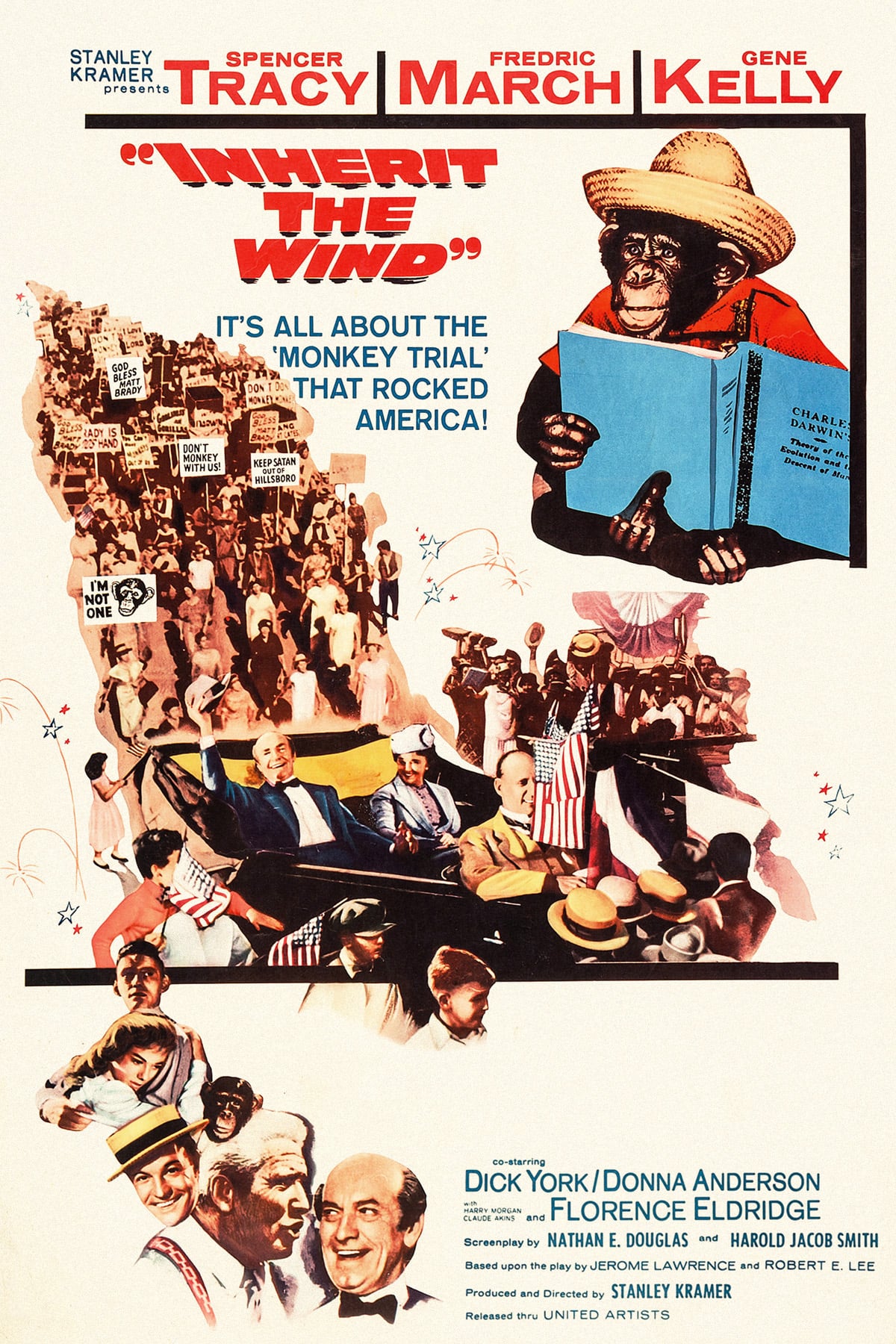
In 1960, Inherit the Wind was a parable. The teaching of Darwinism being illegal in a small town that defined itself by its faith couldn’t really happen today could it? So, the film used the concept as an angle to criticise the restrictions placed on free speech during the McCarthy years. The wheel has come full circle now: it’s no longer unlikely at all to imagine something like this happening. Indeed, versions of it have already taken place in America this century. This change does actually help the film look increasingly more prescient as time goes by.

A fictionalised version of the famous Scopes monkey trial (with most of the names changed, but many of the court room events fundamentally the same) a local schoolteacher, Bertram Cates (Dick Young), in a small Southern town is placed on trial for teaching Darwinism in his school. Staunch Christian and former Presidential candidate Matthew Harrison Brady (Fredric March) volunteers to put the case for the prosecution. Cates’ defence will be handled by the renowned liberal lawyer Henry Drummond (Spencer Tracy). Sparks fly in a courtroom and around the town, where many people are instinctively opposed to anything that can be seen to draw doubt on intelligent design.

Kramer’s films are often both praised and criticised for their rather heavy-handed liberalism. Inherit the Wind is no different. You’d be hard pressed to miss the message here about the dangers of intrusive laws designed to govern what we think and believe. Kramer’s film edges away from making criticism of fundamentalism too overt. Sure, the local preacher (a lip-smacking Claude Atkins) is a tongue-frothing “burn ‘em all!” maniac, only happy when stirring up an outraged mob. But on the other hand, Drummond is revealed to be a man of (liberal) faith – and, in an agonisingly heavy-handed final note, the film ends with him literally weighing The Bible and On the Origin of the Species in his hands then clasping them both together. You see – science and faith can work together!

While it’s easy to smile at Inherit the Wind’s striving for inoffensive liberalism, it means well and actually produces some effective court-room set-pieces. While its overlong – the sections outside of the court could do with trimming down and a rather shoe-horned plot with Cates dating the local preacher’s daughter (not helped by the blandness of both actors) promises much but delivers very little. What the film really works at is a chance for two seasoned performers to go at each other hammer and tongs in the court. Chances they both seize.

Spencer Tracy sets a template of sensible, liberal reasonableness mixed with a well-defined sense of right and wrong that would serve him well in a further three collaborations with Kramer. He brings Drummond a rumbled worldliness, a shrewd intelligence and a patient forbearance but never once lets us forget his righteous fury that this case is even happening in the first place. His courtroom performance hinge on a winning reasonableness that can turn on a sixpence into ingenious traps for witnesses. He’s a rock of decency in a shifting world and Tracy effectively underplays several scenes, making Drummond seem even more humane.

It also means that Tracy makes a lovely performing contrast with Fredric March’s firey passion as Brady. Sweating in the heat of the court, March’s Brady is overflowing with moral certainty and fury. March’s performance is big, but the character himself has a court-personae that depends on him appearing like an embodiment of God’s fury. It works because March gives Brady a quiet air of sadness. This is a man raging against the dying of the light – this case is his last hurrah. Brady is becoming yesterday’s news, but can’t seem to consciously accept this. In quieter moments, he is clearly a man of reflection and reasonableness – but (in a surprisingly modern touch) is all to aware that a raging public personae is what “sells”.

Kramer’s film is at its strongest when it lets these two actors go toe-to-toe. These moments aren’t just in the fireworks for court. Private scenes between the two show a great deal of mutual respect and even admiration. The two men are old friends. Drummond is very fond of Brady’s wife Sara (played excellently by Fredric March’s real life wife Florence Eldridge), who also regards him as a man of decency. They can sit on a bench at night and reflect on the good times. Brady may be a type of demagogue but he’s not a rabble rouser like the Reverend Brown (who he publicly denounces) even while he enjoys the attention of crowds. Drummond isn’t adverse to whipping up a bit of popular support – or enjoying the attention. It’s a fine contrast of two men who both similar and very different.

Aside from this, Kramer sometimes trips too often into rather obvious and heavy-handed social commentary. Gene Kelly is on good form in an over-written part as a cynical journalist – he sort of cares about justice, but only if its a good story and has only scorn for anyone else who believes anything. The film closes with a rather heavy-handed denunciation of his lack in belief in anything, compared to Brady’s faith. The script is at times a little too weak – Tracy and March sell the hell out of a vital confrontation near the end, playing “gotcha” moments that the script largely fails to deliver – but there is still lots of meat in there. Some of the staging and performances – including the extended pro-religion protests that pad out the run time – are a little too obvious.

But at heart, there is a very true and increasingly more-and-more relevant message in this film – and when its acted as well as this, it’s hard not to enjoy it.