

Tag: Gail Strickland

Bound for Glory (1976)

Bound for Glory (1976)

Beautifully filmed but psychologically and politically un-insightful film, easier to admire than enjoy

Director: Hal Ashby

Cast: David Carradine (Woody Guthrie), Ronny Cox (Ozark Bule), Melinda Dillon (Mary Jennings Guthrie), Gail Strickland (Pauline), Randy Quaid (Luther Johnson), John Lehine (Locke), Ji-Tu Cumbuka (Slim Snedeger), Elizabeth Macey (Liz Johnson), Mary Kay Place (Sue Ann), M. Emmet Walsh (Trailer Driver)
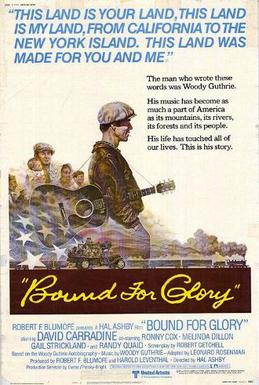
Woody Guthrie was a sort of poet of American folk music, his music influencing a generation of artists, from Bob Dylan onwards. His music spun a vision of the enduring strength of the working man and their rights to a share of the American Dream. It’s mythic stuff, so feels perfectly positioned to be spun into a modern fable in Ashby’s Bound for Glory. Coated in period detail, a sort of Grapes of Wrath by way of Barry Lyndon, it’s a lyrical piece of historical memory making with a nominal grounding in social and political issues. Is it a complete success? Perhaps it’s a film easier to admire than love.

It takes the title from Guthrie’s (David Carradine) biography, and follows his journey from Dust Bowl Texas in the 1930s to the hopes of employment in California, where he joins a mass of not-particularly-welcomed economic migrants. He discovers there an audience for his politically tinged folk music, but steadfastly refuses to compromise his principles. Actually, aside from these broad sketches and Guthrie himself, almost everything in this is essentially fictional. It’s a myth being spun, building a legend of a sort of John the Baptist of American folk music, a nostalgic vision of 30s America which makes little room for Guthrie’s actual politics.

Actually, that’s one of the most fascinating things in Bound for Glory. So keen is this to create a nostalgic view of an America from yesteryear, celebrating the perseverance of blue-collar America, it avoids talking in detail about anything Guthrie actually believed in. Although possibly not a card-carrying member of the Communist party, Guthrie was certainly at least a fellow-traveller. He had sharply left-wing, pro-worker, anti-capitalist views. His music echoed this – ‘This land is your land’ is actually about land ownership. But most traces of this have been carefully rinsed out of Bound for Glory.

That isn’t to say that it doesn’t take a deepe dive into Depression era America than any film since The Grapes of Wrath. Guthrie’s pilgrimage – and there is something distinctly Saintly about how he is presented here, making him more comfortable a figure than a left-wing radical – features plenty of dwelling on injustice and poverty. It opens in the ramshackle poverty of Dust Bowl Texas, where winning a dollar in a bet is potentially life changing. Migrants to California are at hurled from goods trains, then risk being shot (as one of Guthrie’s friends is) when attempting to jump on them as they puff past. They are barred entry on the road to California (in cars weighted down with their few possessions) if they can’t produce $50. The migrant camps are run-down, overcrowded and run by baton-wielding work-bosses who have complete power to decide who works and who doesn’t and don’t hesitate to wield their weapons to enforce their will.

Bound for Glory however avoids saying anything too firm against all this. It can carry sympathy for the plight faced by the working man but, much like The Grapes of Wrath, it’s terrified about saying or doing anything that could possibly be seen as promoting left-wing politics. Guthrie sometimes mumbles vague statements about the working man finding his slice of the American dream, but never anything too pointed about the fact that unfairness and having-and-have-noting is built into the system, like a spine in a body. The bravest shot the film takes is at a complacent priest, who smugly turns a hungry Guthrie away from his large church because he only hands out soup to people who have worked that day. Otherwise, the furthest it allows Guthrie to go is asking his wealthy lover (Gail Strickland in a thankless part) if she feels guilty having so much when others have so little. It’s the washed down, simplistic politics of the playschool.

And, to be honest, it robs Bound for Glory of much of its life and blood. It fails to replace this with a fierce personal story (like The Grapes of Wrath) and it never even attempts to make anything like a political statement as Ashby’s old collaborator Warren Beatty would do five years later with the similarly luminously beautiful Reds. Quite frankly, as Bound for Glory unrolls slowly and deliberately it does so with precious little fire and guts to it and (at times) very little interest. In other words, it’s very possible to sit and watch it and (while admiring it very much) kind of wish you were watching Rocky instead (as the voters for Best Picture at the Oscars that year clearly did).

It becomes instead a triumph of style, photography and design, rather than an enlightening biopic or making a statement about the Great Depression (other than it was tough). David Carradine hasn’t quite got the charisma to bring the vague threads Ashby gives him together. (Almost every single big name actor in Hollywood turned it down, which tells you something). Guthrie remains a vague, drifting blank, whose views and beliefs are undefined and to whom events frequently seem to just happen. Of the supporting roles (several women in particular get dull, thankless parts) only Ronny Cox gets something to get his teeth into as a musician turned union activist.

The real merits of Bound for Glory is it’s Barry Lyndon like recreation of a time and period. A lot of that is due to the breathtaking photography of Haskell Wexler – not for no reason was he the first person billed on the film. Wexler’s work is extraordinary, creating a sepia-toned view of Great Depression America that feels like its been taken straight from a photo library and placed on screen. Bound for Glory also astounded viewers at the time with the first Steadicam shot captured on screen, which starts with an aerial view, glides down to Guthrie and then follows him through a crowd of hundreds of extras to fail to be picked for a work party. It was the cherry on top of the Oscar-winning cake for Wexler.

It’s just a shame that these surface delights are all that really come to life. Other than that, this is distant, reserved and (in truth) slightly empty work from Ashby that presents the basic facts in a mythologised way that you feel removes much of the core truth. It turns a fascinating man of real conviction, into an unknown enigma, an Orpheus of the Dust Bowl who goes on a Pilgrim’s Progress that leads to (if we’re honest) nowhere in particular. It’s a film that strains a bit too hard for high art at the cost of passion or entertainment.

Norma Rae (1979)

Norma Rae (1979)

Heartfelt political drama, with a powerful lead performance, which works surprisingly well

Director: Martin Ritt

Cast: Sally Field (Norma Rae Webster), Ron Leibman (Reuben Warshowsky), Beau Bridges (Sonny Webster), Pat Hingle (Vernon), Barbara Baxley (Leona), Gail Strickland (Bonnie Mae), Morgan Paull (Wayne Billings), Robert Broyles (Sam Bolen)

At their best, Trade Unions remind us we are never stronger than when we work together. That’s never needed more than ever when confronted with the crushing, soul-destroying working conditions of an unfettered industry. Norma Rae was based on the true story of Crystal Lee Sutton, a North Carolina textiles worker who fought tooth-and-nail to gain Trade Union representation for her factory. Fictionalised here as Norma Rae Webster (Sally Field), Norma Rae covers her political awakening and her channelling her inbuilt sense of justice and fairness and her quickness to anger, towards the constructive goal of changing the lives of her and her community.

Martin Ritt’s conventional but heartfelt biopic may not reinvent the wheel when it comes to telling life stories, but throws itself into all-consuming righteous indignation at the staggering unfairness of the American economic model. The factory at the heart of Norma Rae wouldn’t look out of place in a Victorian-set movie. Deafeningly loud, machines whir non-stop, the air full of cotton spores clogging up lungs, breaks sharply controlled (making an emergency personal call is a disciplinary offence), dismissal possible at the slightest whim, pay kept at rock bottom, workers with medical conditions forced to work through under threat of dismissal… the ghastly, oppressive, miserable textiles factory is like nothing more than a workhouse.

And it is a captive workforce because the workers there have no other choice. The entire community lives in the factory’s orbit, with no other opportunities in the vicinity. The town feels only a few steps up from a shanty town in the factory grounds, people living and dying in its shadow. Even the shift supervisors are only a rung or two up from those they manage. No wonder that anyone who takes a job monitoring the other workers is treated like a snitch. There are no prospects, no hope of change and nothing to look forward to: only day-after-day constantly grinding out clothing for minimal wages (that have not kept track with inflation) while the bosses get richer.

Despite this though, everything is set up to keep the status quo going. Many of these Southern workers have swallowed the management kool-aid that anyone arriving from the North talking about unions are commie, anti-American agitators. Particularly when they are New York Jews like Reuben Warshowsky (Ron Leibman). The factory owners do the absolute minimum to meet the requirements of Warshowsky’s legally-entitled inspection, or to ensure the workers rights to vote for representation. Local authorities, such as the Church, collaborate in maintaining the status quo. And Norma Rae doesn’t look-away from how the racism is used. The local preacher can’t decide if he is more at aghast at the idea of a union meeting in his church hall, or that the meeting will be non-segregated. The factory bosses shamelessly peddle the lie that a union is a tool for Black people to take control of the factory and drive white workers out.

But Ritt’s film clings to the hope that good people can change things, with reasoned argument and passion. That’s embodied in Sally Field’s Norma Rae. Previously best known for sitcom The Flying Nun (her character did exactly what the title says), Field seemed left-field casting as a trailer-trash single mother to three children from three different fathers, turned firebrand political agitator. But Field’s performance was an (Oscar-winning) revelation. She makes Norma Rae both a firecracker of perseverance and determination, but also acutely aware of her vulnerability, Field never losing track of the anxiety that makes her resolute stand-taking all the more impressive.

Martin Ritt’s film skilfully and economically sketches out her character from the start, helped by Field’s skilled playing. We are introduced to her impulsively and furiously berating both her supervisor and the factory’s tame doctor after the never-ending noise of the machine leaving her mother deaf, with no thought of her tenuous position. Later she will berate her own shallowness in sleeping with a married men – then infuriate him with accusations of selfish, ill-treatment of his wife. In a few short scenes, Field establishes a character with principles, a sense of honour and a fierce sense of justice but also prone to rash and kneejerk decisions.

Field’s performance soaks in righteous indignation but also has an emotionality under the surface. When arrested, she struggles like a wild animal to avoid putting in the car before taking on a stoic defiance in jail – only to break down in tears after being bailed. Field creates a women fiercely resilient and unshakeably resolute once she has found a purpose, with a strong sense of justice.

These are qualities recognised by Leibman’s visiting union organiser. Norma Rae draws a fascinating and extremely restrained platonic romance between these two who, despite their surface differences, are soulmates in the relentless focus, all-consuming dedication to justice. But both are spoken for: Warshowsky to a fiancé in New York, Norma to the man she has only just married, the decent-but-utterly-ineffectual Sonny (Beau Bridges). Their unspoken, subtle dedication to each other over late-night union work (which never spills out, even during a playful lake swimming session) is a restrained, very effective beat in a movie that keeps its fireworks for politics.

The film highlights the slow grinding of changing minds and energising people to fight for their own freedoms. Ritt highlights, in a series of underplayed meeting scenes, a host of characters sharing their stories, their faces showing them come to the realisation almost in that moment of how shabbily they are treated. He balances this with real moments of showmanship, that carry even more impact due to the underplayed nature of the rest of the movie.

Most famous, of course, is Norma Rae’s impassioned (literal) stand on principle as the management find a dubious reason to dismiss her. (Ritt frequently uses Field’s shorter statue to powerful effect, surrounding her with larger, overbearing men.) Standing on a table, she refuses to budge, clutching a hastily hand-written sign that just states the word ‘union’. In many ways, it’s a bread-and-butter heart-soaring moment, but Field and Ritt expertly sell emotion, from Field’s quivering, emotional determination to the workers slowly one-by-one shutting down their machines in solidarity.

Solidarity is what it’s all about, in a film that is more sympathetic and admiring of organised labour than almost any other Hollywood effort (it would make a fascinating double bill with On the Waterfront). Directed with effective restraint by Ritt with a power-house performance from Field, it’s also interesting to watch at a time when many in America are calling for a return to American industrial life like this but without any call for guarantees for the rights of workers. Norma Rae could be even more relevant in the years to come.