Tag: Gina McKee

Croupier (1999)

Croupier (1999)

Slow-burn delight in this low-key but compelling British crime and gambling drama

Director: Mike Hodges

Cast: Clive Owen (Jack Manfred), Alex Kingston (Jani de Villiers), Gina McKee (Marion Neil), Kate Hardie (Bella), Nicholas Ball (Jack Manfred Snr), Nick Reding (Giles Cremorne), Paul Reynolds (Matt)

The last thing would-be writer Jack (Clive Owen) wants is to be sucked back into the grimy underbelly of the casinos where his father (Nicholas Ball) made his living. Jack fears his addiction to the places. But his buzz is not the gambling or the chance of raking in cash himself. Nah, his particular hit is the cold voyeuristic delight of watching others lose. The greedy, the arrogant, the clueless, the desperate: he gets the same buzz from sweeping their chips away from the table in front of them. Jack knows you play, you only guarantee you will lose: but will glamourous South African Jani (Alex Kingston) persuade him to join her in another game against the casino?

Mike Hodges’ fascinating crime drama struck out of the blue to restore Hodges from yesterday’s man – the forgotten master of Get Carter – as a vibrant voice in British cinema. Typically, of course, this was only after the film had been all but ignored in Britain but became a hit in America. An Oscar campaign was planned but cancelled when it emerged a single screening on Dutch TV before its release in LA made it ineligible. Nevertheless, the film’s cold, arch mix of distance, cool and menace was a keen reminder of what a great director of mood and intention Hodges could be.

Hodges also has the perfect actor in its lead role. Clive Owen’s precision, quiet exactitude and mastery of the micro-expression is perfect for a man as distant, observant and (at times) uncaring as Jack. Only someone as effortlessly cool and striking as Owen could have made us like Jack as much as we do, a particular challenge as he is a cocky shit with an almost sociopathic coldness, viewing the creep of the voyeur who loves control. Owen captures all this perfectly, his voice rarely rising, his life lived to a sort of bizarre samurai code where he the only person he needs to impress with his superiority is himself.

Hodges film is one of mood and sensation rather than plot. Events unfurl with an increasingly dream-like logic, dictated by Jack’s noir-like voiceover as he slowly turns his life and experiences in the casino more-and-more into fiction. Sections of the film are divided into chapters in voiceover and Jack’s arch commentary exposes his views of those around him (communicated only by the most micro expressions on Owen’s face). Jack dreams of publishing a novel that will worm its way inside people: it’s the yearning not of the artist but the control freak, as excited by the sensation of knowing his words can guide people’s reactions and feelings just as a flick of his wrist at the card table or the roulette wheel can enrich them or drive them to destitution.

Jack’s control makes him a perverse stickler for rules. Jack’s professional croupier life – slicing money with a thunk down a pipe to the cashier or sweeping lost chips into a count-up oblivion (Hodges’ eye for the brutality and violence in the mechanisms of gambling is matched by his brilliance in demonstrating the businesses cold-eyed indifference to short-tern winning and losing) – is one of masterly control. His personal something else. The drama comes from wondering how far he will stick to that when offered the temptation, not of wealth but of proving he’s smarter than anyone else. There he allows himself the risks that he would never take when working.

Three women rotate around Jack. Gina McKee has the most thankless role of the three, a cop turned store detective who seems to be propping up the initially bohemian (a blonde, porkpie hatted Owen) Jack but offers the sort of dull, parental support lacking in his life. Two other women appeal to different parts of him. Kate Hardie’s Bella – a fellow croupier as chillingly professional as the DJ-suited Jack – is a sort of half-mirror image, bubbling with temptation (and very appealing to an egotist like Jack, who would like nothing better than to sleep with himself). Most striking of all is Alex Kingston’s erotic punter Jani, a mysterious South African who attempts to both seduce and bring out the protective side in Jack. Jack may never gamble his money, but risk in her personal life seems a harder dodge. He sleeps with women, gets in fights – which he engages in with a terrifying capacity for violence – and casually seems to invite dangers to drop into his path.

Spontaneously taking Jani to a weekend at the country-house of a would-be publisher, Jack mixes his buzz of voyeuristic control with the temptation of doing something wild and dangerous. He agrees to join a late-night card-game as dealer only – and promptly uses his card shark skills to deal out a series of progressively brilliant hands to the players in the final game. He then goes to bed with Jani, doesn’t touch her but quietly listens to her offer of ten grand in return for his aid in stealing from the casino. This is not the behaviour of a normal man.

If the film has a flaw, it’s the almost indifference with which Hodges wraps up most of these plots. There is a shock death, but the impact of it is almost deliberately passing and the heist of the casino is as laughable in its amateurishness as it is sudden in its resolution. Is it because we have moved from the real world to Jack’s noirish I, Croupier novel without realising it? You could imagine, as the film grows more dreamlike, that at some point we shifted from Jack’s reality to the constructed one he has formed for his novel. What better thrill for a control freak than to become ‘God’ of the narrative. After all Jack dreamed of his novel climbing inside people’s brain and infesting their thoughts.

Jack ends the film the smartest, most well-adjusted addict you could ever imagine, The short-term job at the casino is something he cannot let-go and Hodges’ shooting of this den of addiction, this theatre of destitution turns it into a mirror-lined sess-pit of human frailty, reflecting vice back into itself, presided over by a man who delights in weakness. More money is swept, triumphantly, from the table by Jack and its clear being there for him is the real triumph. Atmosphere, style and vicarious thrills. It’s these chilling things Croupier finds so thrilling, enticing and fascinating.

Phantom Thread (2017)


Vicky Krieps and Daniel Day-Lewis play dangerous games in Paul Thomas Anderson’s fascinating film about control, Phantom Thread

Director: Paul Thomas Anderson

Cast: Daniel Day-Lewis (Reynolds Woodcock), Vicky Krieps (Alma Elson), Lelsey Manville (Cyril Woodcock), Camilla Rutherford (Johanna), Gina McKee (Countess Henrietta Harding), Brian Gleeson (Dr Robert Hardy), Harriet Sansom Harris (Barbara Rose), Lujza Richter (Princess Mona Braganza), Judy Davis (Lady Balitmore), Philip Franks (Peter Martin)

The last time Paul Thomas Anderson and Daniel Day-Lewis worked together, we got a true masterpiece in There Will Be Blood. Phantom Thread couldn’t be much more different. In place of rolling plains, oil, and Day-Lewis as a monstrously larger-than-life alpha male, we get confined rooms, handsome dresses and Day-Lewis as a pernickety, obsessive, creepy dressmaker. But Phantom Thread may also be just as intriguing, thought-provoking and memorable in its way as There Will Be Blood.

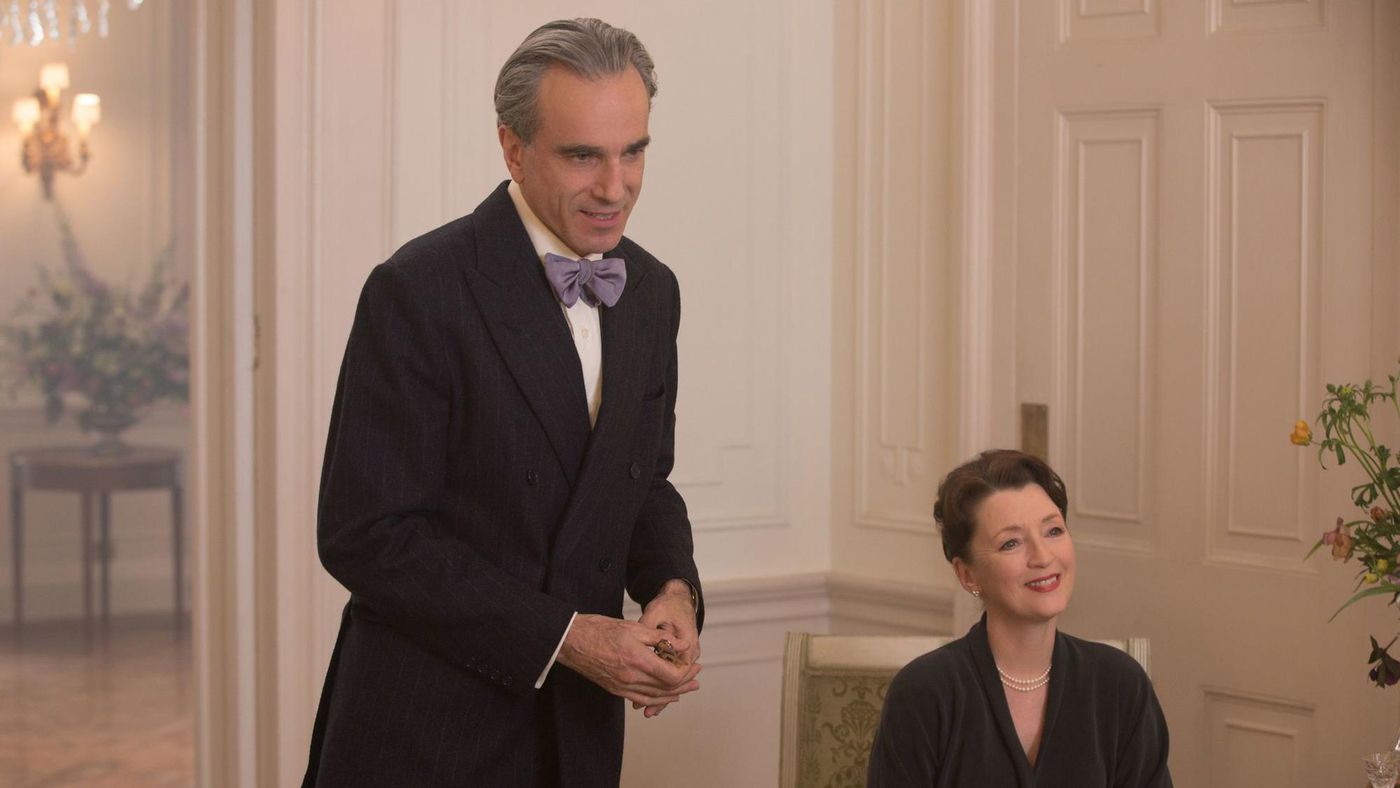
Reynolds Woodcock (Daniel Day-Lewis) is a leading couturier in 1950s London, whose fashions are highly sought after by the rich and famous. He lives and works with his sister Cyril (Lesley Manville), who dominates his life – and dispatches his various muses as their use comes to an end. On a break near the coast, Reynolds meets Alma (Vicky Krieps), a hotel waitress whom he takes back to London as his latest muse. At first Alma seems to be merely the tool of this fashion Svengali – but Alma has her own desires that quickly spark conflict in the House of Woodcock.

Paul Thomas Anderson’s film has lashings of Daphne du Maurier, Powell and Pressburger (it’s more than a little reminiscent of The Red Shoes) and a slickly inverted Pygmalion. It’s a film that slowly emerges as being about control and the way power relationships can shift and transform. Reynolds at first seems a twisted Henry Higgins: his muses come and go (and, it’s implied, fail to live up to his mother) – he becomes tired of them, and his sister, business partner, factotum and part-time mother-figure Cyril dismisses them when they have served their purpose. 

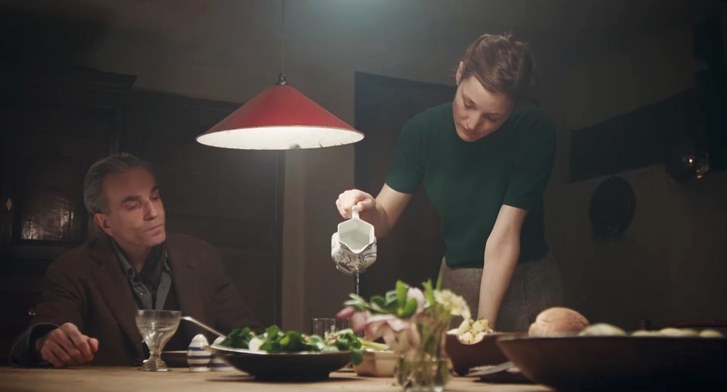
Reynolds and Alma’s first meeting is one of creepy control. He asks her to memorise his order, wipes her lipstick away so he can “see her” and, in a late night “living mannequin” sequence, dresses her in a series of fabrics and clothes, and offers dispassionate comment about her body. What’s interesting in this sequence though, is that Alma only becomes uncomfortable when Cyril arrives and joins Reynolds in the process. It’s a hint of the developments that will emerge over the course of the film: Alma doesn’t want to share Reynolds.

That’s the tension the film explores from thereon: Reynolds seems to have all the power, but Alma pushes against this to forge her own position as something more than a muse. The film has an acute understanding of the psychology of power in human relationships, which is more than reminiscent of Rebecca: the exact motivations of the characters remain unclear (sometimes even to themselves) until late in the film. The film veers into My Cousin Rachel territory – while giving us a totally unexpected series of emotional developments that spin out of this, which shock but make perfect sense.

That’s because Paul Thomas Anderson has made a sharply observant film about human fallibility and our desire to understand our place in the hierarchies around us, and the unusual paths to contentment that we can find. Like The Red Shoes, it also feels like a film that really understands the psychology of Svengali figures, and adds a Freudian bent to it. Reynolds is looking for a mother to take the place of his own and he is drawn to muses who remind him of her, but who constantly fail to replace her. It’s in the weakness that Reynolds’ perfectionism drives him away from, that he is capable of finding love and happiness.

So the film becomes a series of wonderfully low-key power shifts, many of them revolving around meals. It’s established early that Reynolds demands very precise conditions for his breakfasts – most importantly silence; in every breakfast scene that follows, everything from the loudness of the crunching to the amount of scrapping of jam on toast tells you who is in control. 

Because just as Reynolds wants to craft Alma to take on the perfect muse position for his dressmaking – so Alma wants to craft Reynolds into the perfect combination of high-achieving genius whose success she can vicariously enjoy, and a man who needs her emotionally. Anderson’s brilliant, bitter and waspy screenplay shows the different steps both characters dance through to achieve this. Alma’s solution, and its psychological impact, is brilliantly du Maurier; it’s out there, but makes perfect sense.

Visually the film is beautifully crafted. Anderson shoots a lot of the film with a combination of slow prowling shots, and cameras held at close-up or medium shots that regularly place the actors close to the camera. It means that we always feel like we are right in the middle of the action – looking over the shoulders of actors, or seeing their faces loom into the camera. It obviously creates a claustrophobic feeling, but also one of real intimacy – it’s like the camera is dressing the characters, the same way Reynolds does. But Anderson’s choices pull you closer into the action, and get you really thinking about the psychology of the characters you are watching.

And Anderson wants you to get into the psychology here, because he has cast three actors at the top of their game in this tight-character study. Day-Lewis is of course superb, as a character unnervingly precise and cool – his voice is a perfect combination of icy preciseness, and trembling emotional confusion. Reynolds is in many ways a child – his every whim must be followed, he explodes in foul-mouthed (hilarious) fury at any deviation from his procedures. But he’s also an emotionally stunted man who has never got over the loss of his mother, capable of strong sexual feelings and a yearning for closeness. It’s a subtle, controlled, low-key performance.

But Day-Lewis’ retirement has stolen a lot of the attention from Vicky Krieps, who is sensational as Alma. In many ways, she is the real protagonist of the story. Alma is at first our entry into the story – but we quickly learn we know or understand very little about her. She comes from somewhere in Europe, she may well be Jewish, but Krieps makes her hard to define. Unusual and impossible to understand, Krieps makes her a fascinating character. She emerges as a determined, strong-willed, manipulative figure, looking to have a firm place in her partner’s life – she’s both a toy that bites back, and a woman who will settle for no compromise in what she wants. It’s a fascinating performance. 

Lesley Manville rounds out the cast as the waspish Cyril, deliciously spitting out some cruel lines. Manville is terrific, and Cyril sits in an unusual place in the Woodcock house, partly catering to Reynolds’ demands, partly controlling and positioning him. This makes a perfect foil both for Reynolds’ demanding requirements for a mother, and for Alma’s desire to bring Reynolds under her own influence.

Anderson’s film is a beautiful, fantastically scored, wonderfully acted, intriguing character study, and an insightful exploration of emotional and sexual control and the traps we built for ourselves and for others. It’s a film where every scene is open to interpretation, where both the past and the future seem to haunt events and every resolution leaves questions. It’s a brilliant psychological study that rewards endless thinking, analysis – and I’m sure repeat viewings. I think this one could run and run.