
Tag: Ginger Rogers

42nd Street (1933)

42nd Street (1933)

Less a musical, more about a musical – but a delightful love letter to the joy of theatre

Director: Lloyd Bacon

Cast: Warner Baxter (Julian Marsh), Bebe Daniels (Dorothy Brock), George Brent (Pat Denning), Ruby Keeler (Peggy Sawyer), Guy Kibbee (Abner Dillon), Dick Powell (Billy Lawler), Una Merkel (Lorraine Fleming), Ginger Rogers (Anytime Annie), George E Stone (Andy Lee), Ned Sparks (Barry), Robert McWade (Jones), Allen Jenkins (MacElroy)

Jones and Barry are putting on a show! The cry lights up Broadway (in an impressively staged series of quick-cuts, cross fades and super-impositions of the excited souls). And 42nd Street is all about the creation of that show, from the signing of the contracts to the opening night and the spontaneous making of a star. If it feels, watching 42nd Street that it’s made up of nothing but theatrical cliches… then it’s because most of them became cliches from excessive re-use after 42nd Street showed they worked so well – and made such a hugely entertaining film along the way.

The show is Pretty Lady, to be directed by Julian Marsh (Warner Baxter), the finest director (and friendliest tyrant) on Broadway who needs the money after losing a packet in the Crash. He’s not the only one struggling in Depression-era America: the competition to land a job as chorus girl is fierce. So, it’s a lucky chance that debutante Peggy Sawyer (Ruby Keeler) lands a gig. The star is Dorothy Brock (Bebe Daniels), a vaudeville veteran trying to make it as a serious Broadway actor and currently the squeeze of the shows’ wealthy financier Abner Dillon (Guy Kibbee) – although she is still seeing her old partner Pat Denning (George Brent). But will Dorothy make it through the drama to opening night – or will Peggy need to step up to save the day?

It’s not a surprise that of course she does, but then Julian’s final words to her (“You’re going out a youngster, but you’ve got to come back a star!”) is the film’s most famous moment. As well as launching a thousand backstage dramas, 42nd Street is remembered as a musical. But there is actually precious little music in it. We have to wait almost 45 minutes before the first song (Dorothy’s rendition of ‘You’re Getting to Be a Habit with Me’) and the final fifteen until we see the bulk of Busby Berkeley’s choreography. Other than that, this is very entertaining soapy, backstage drama with romantic entanglements. It’s a more film about the stressful theatrical alchemy involved in making a musical, rather than a musical itself – there is no ‘putting my feelings into song’ here.

And it’s taking place in Depression-era desperation. Everyone needs a job – that’s why they are so excited about hearing there is a show in town. That plays into the family atmosphere behind the scenes. After all everyone needs the show to be a success, and if that means roping in a few gangsters to get a wayward star back into line so be it. Much like, in fact, 42nd Street itself, coming to the screen after a glut of musical flops (perhaps that’s why there is so little actual musical content in it). The film zeroes in refreshingly and lovingly on the hard work, dedication and family atmosphere that can grow up in theatre, where everyone is working towards a common goal – and why I, a veteran of more than my share of putting a show on, felt a real soft spot for it growing.

And there is support, for all the bitchy moaning behind the scenes. Julian Marsh may tyrannically insist on absolute perfection – rehearsing through the night, waking the piano player when needed – but, it’s all to service a common goal. When emergency hits, the company flocks around and support each other. When one of their number triumphs there will be more congratulations than there are jealousies: even Dorothy will lay aside any personal feelings to support the new star. 42nd Street really captures the sense that behind the curtain in the theatre a little world of its own is created, one which can be very loving in its own unique way.
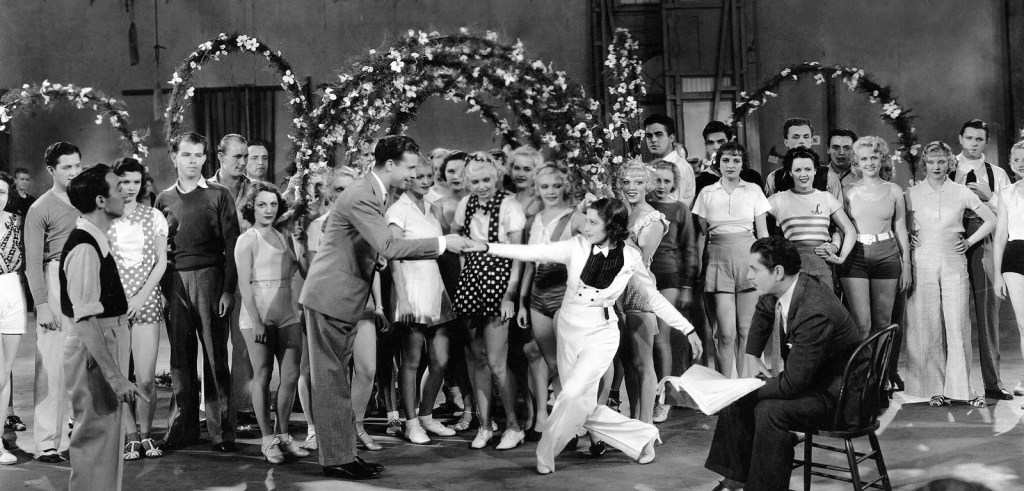
It’s also a world, with more than a few sexual escapades, something hard to overlook in a film as full of chorus girl’s legs as this (the chorus girls are largely hired on the basis of how good those legs look). Dorothy is effectively trading her favours for a career leg-up from the clueless Dillner, while sticking with true love Denning. Denning, jealous, conducts his own speculative flirtation with Peggy (in a fun sequence, her landlady throws her out for daring to bring Pat home for a coffee – while behind her another chorus girl smuggles out her lover with an illicit kiss). Anytime Annie didn’t get her nickname for her dancing, Lorraine is happy to leverage her relationship with dance director Andy Lee and Lee himself (it’s implied) is the willing subject of Julian’s attentions.

In the midst of this, poor Peggy feels rather naïve. Sure, she may be bouncing between unlooked for attentions from a young member of the company and leading young man Dick Powell, but a passing possibility of romance with George Brent’s cuckolded partner (in every sense) to Bebe Daniel’s star leaves her flustered. Brent’s intentions may well be noble, but left alone with him in his apartment, Peggy is sweetly nervous and locks her door after she is chivalrously conveyed to the spare bedroom by Brent, as if scared she may give into temptation. Hilariously they are only in his apartment, after his calling on her is mistaken for a dalliance by her landlady, who throws them both out while boasting she never misses a trick – all while, in the back of the shot, another tenant quietly ushes her beau out of the door.

All of this gives some lovely opportunity to its actors, and there are several delightful turns in 42nd Street. Not least in the chorus, where Una Merkel has a wonderfully playful flirtatiousness and Ginger Rogers gives her monocle-clad Anytime Annie a rogueish sexiness. Guy Kibbee’s moronically uncultivated sugar daddy gets several good laughs at his boorish cluelessness. If Ruby Keeler at times seem a bit unnuanced as the lead (there has long been some rather mixed feelings about her slightly heavy-footed dancing) and Dick Powell is eminently forgettable as her love interest, there is more than enough class from Baxter’s stressed out director, George Brent is very fine and Bebe Daniels invests Dorothy Brock with just enough vulnerability under the diva exterior to always leave you rooting for her (she is, after all, just as desperate for work as the meanest chorus girl).

It’s a film put together with flair – the early montage is pacily and flashily assembled – and a great deal of wit (producer Darryl F Zanuck and Berkely often gain the lion’s share of the credit for its pace, wit and zip although I feel some credit must go to experienced director-for-hire Lloyd Bacon). The final dance numbers are expertly done and very well filmed by Berkely, including a point where the camera glides under a parade of leg arches. But above all, it’s a heart-warming and witty tale that pulls back the romantic curtain of theatre to reveal – well an equally romantic view of the camaraderie and magic that brings a show to the stage. But it would be a hard heart that could not find something to smile at here.

Kitty Foyle (1940)

Kitty Foyle (1940)

Odd romantic fable, with a star-turn, that doesn’t seem to fully realise how judgemental and puritanical it is

Director: Sam Wood

Cast: Ginger Rogers (Kitty Foyle), Dennis Morgan (Wynnewood Strafford), James Craig (Dr Mark Eisen), Eduardo Ciannelli (Giono), Ernest Cossart (Pop), Gladys Cooper (Mrs Strafford), Odette Myrtil (Delphine Detaille), Mary Treen (Pat), KT Stevens (Molly)

“Ginger Rogers did everything Fred Astaire did…[but] backwards and in high heels”. So goes the famous quote about the famed dance pairing. But Ginger Rogers also did something Fred Astaire never did: she won an Oscar. That was Best Actress for Kitty Foyle, a reminder that Rogers was the girl-next-door who was a fine actor, accomplished dancer and natural comedienne. Rogers is great in Kitty Foyle, an otherwise fairly average, at times painfully dated ‘women’s picture’ where flashes of wit conceal character flaws the film is unaware of and a series of frequently depressing messages about love and women’s choices.

In the early 1930s, Kitty Foyle (Ginger Rogers) is a young Philadelphia woman enjoying the opportunities the new world of emancipation gives her. Working as a secretary for a small magazine, she and its editor Wynnewood Strafford IV (Dennis Morgan) fall in love – but he lacks the courage to propose to a woman far below his family’s social standing. Moving to New York, Kitty works in a fashionable department store and meets with Dr Mark Eisen (James Craig). The two begin a tentative relationship – until Wyn returns and proposes, which Kitty eagerly accepts.

However, since the film plays out in flashback from 1939, we already know the Wyn-Kitty marriage is doomed to divorce since Wyn is re-married (with a kid!). Indeed, we’ll learn Kitty left her marriage because she felt the social differences between her and Wyn were insurmountable, in her (secretly) divorced state becoming engaged to Dr Mark. Kitty Foyle plays out a cliffhanger question: which of these two men will Kitty choose? Of course, there is zero tension in this decision – is there any chance at all that in a Production Code film, Kitty will choose a rich married family man over a hard-working doctor who we are introduced to tending to the poor of New York gratis?

Nevertheless, Kitty Foyle is structed through a series of snow globe-inspired flashbacks, narrated by Kitty’s reflection (who objects to herself being tempted by Wyn’s offer – hammering home the implicit moral judgement the film soaks in, even Kitty’s reflection thinks she’s a hussy). These snow-globe framed flashbacks are one of the most interesting things about Kitty Foyle today – largely because, if you think of 40’s snow globe flashback films your mind immediately turns to Citizen Kane (both from RKO!). It’s hard not to wonder if Orson Welles and/or Herman J. Mankiewicz remembered the device when they put their script together?

The other most interesting thing about Kitty Foyle is that neither Kitty nor the film can even pretend to raise much interest in its Code-approved romantic figure, Dr Mark. Fair enough, since Dr Mark is a crushing prig and self-important bore. Played with a humour-free smugness by James Craig, he’s the sort of guy who enjoys sitting on buses passing superior medical opinions about those around him. On his first date with Kitty, he unilaterally cancels a dinner to sit at home and play cards – which he later reveals was a moral test for all his first dates to see whether a potential partner is a gold-digger (it’s amazing he’s single). We get very little sense he is remotely interested in the real Kitty, instead preferring an idealised version of her as a potential assistant-in-all-but-name. In nearly every sense, he’s is the sort of stuffy, self-important, worthy man most comedies of the era saw the heroine’s apologetically jilt to enjoy true love with Cary-Grant.

Of course, Wyn is no Cary Grant. Played by Dennis Morgan with a wonderful sense of shallowness, he’s far too easily-led behind his charm for that. Wyn is a weak man, who struggles to take responsibility for (or make) his own choices. That doesn’t change the fact that Kitty has a passion for him she never once raises for Dr Mark. Kitty Foyle essentially agues his weakness and social status as the scion of a banking family (he is, we are not allowed to forget, the third man to bear the name Wynnewood Stafford), could never make him an appropriate match for the reassuringly middle-class Kitty.

There is a real inverted snobbery around Kitty Foyle, where the upper-classes of Philadelphia (represented, among others, by Gladys Cooper as Wyn’s imperious mother) can only-just-about suppress their discomfort about Kitty’s lower standing. (Their suggestion, when presented with the fait accompli of Kitty-Wyn’s marriage is to suggest Kitty attends a finishing school). Saying that, the family don’t object to the marriage and (in their own way) their suggestions are based around helping Kitty. The two-way snobbery is neither they nor Kitty can imagine a middle-ground: she is just as adamant she will not change anything about herself, as they can’t imagine accommodating her middle-class interests. The film wants us to blame Wyn for his upper-class background and spreads a depressing message that the classes should never mix.

Brutal assumptions people make about each other are at the heart of Kitty Foyle – and the film has absolutely no idea about this. The film never once questions the character flaws of certainty that lead Kitty, Wyn and Mark to all reach (false) conclusions about others. Kitty brutally decides, no matter what Wyn says, that she will divorce him because she doesn’t believe he will give him his wealth. And maybe she’s right – but she never asks him and makes a series of selfish decisions about their life that he has every right to be at least involved in. Kitty Foyle sees absolutely no issue with this, which you can bet its bottom dollar it would if the shoe was on the other foot. The is probably the only romance from Hollywood’s golden age that condemns true love in favour of cold-headed pragmatism and sensible (not passionate) choices.

All of this doesn’t mean that Ginger Rogers isn’t very good, as she carries virtually single-handedly the whole film. Kitty is feisty, determined, smart, shrewd, funny and brave. It gives her opportunities for light comedy and serious emotions. She’s very funny in comedy sequences, such as Kitty’s accidental pressing of the burglar alarm rather than stock room button on her first day on the job in a New York department store (I blame the woeful design flaw in putting these poorly-labelled buttons right next to each other!). But she’s also quietly heart-breaking in the film’s final segment where she faces a series of painful events. Rogers invests these with a quietly melancholic sadness laced with real dignity. It’s a fine performance that lifts an otherwise mediocre film.

It’s also a mediocre film that opens with a jaw-droppingly anti-feminist sequence to explain why girls are working. A series of silent flashbacks play out in silent-film-style dumb-show openly mocking suffragettes and the misguided passions of women for freedom that took them away from a live of ease being looked after by doting husbands. The whole point seems to be how unwise they were to fight to be foisted into a world of hard work and not being given a seat automatically on public transportation. It left me wondering how far into this script Katherine Hepburn got before she turned it down?

Top Hat (1935)

Astaire and Rogers dance Cheek to Cheek in Top Hat

Director: Mark Sandrich

Cast: Fred Astaire (Jerry Travers), Ginger Rogers (Dale Tremont), Edward Everett Horton (Horace Hardwick), Erik Rhodes (Alberto Beddini), Helen Broderick (Madge Hardwick), Eric Blore (Bates)

It’s got the sort of plot PG Wodehouse would consider a bit far-fetched. Due to a series of misunderstandings and mistaken identities (that the script executes quite a few linguistic gymnastics to keep in place, since a few words from someone would sort it all out in seconds), Dale Tremont (Ginger Rogers) falls in love with Broadway star Jerry Travers (Fred Astaire) but believes that he is in fact West End producer Horace Hardwick (Edward Everett Horton) who is married to her best friend Madge Hardwick (Helen Broderick). So, thinking Jerry is a cad, she decides to run away to Venice with her boyfriend, Italian dress designer Alberto Beddini (Erik Rhodes) – only for a confused and infatuated Jerry to follow.

Of course the entire thing revolves around Dale having never met Madge’s husband, and Madge never for a minute questioning the description of her husband (despite the resemblance he clearly bares to Jerry in how Dale talks to him) – or when Madge later “introduces” Dale to Jerry, not saying a word that could suggest they’re not married. But that’s classic farce here, and the light comedy works an absolute charm with mistakes, confusion and jealous clashes occurring at every moment. Top Hat is a superb piece of witty light froth, with some cracking lines and some great comic set pieces. 

And of course, its main attraction is some superb dancing from Astaire and Rogers in probably the highlight of their long collaboration with each other. The grace and skill of these two has to be seen to be believed – as does the natural synchronicity with which they move together. With Sandrich’s camera calmly and carefully tracing the lines of Astaire and Rogers’ movements, the viewer is invited to sit back and enjoy some of the finest dancing you are ever going to see. With music from Irving Berlin – and the songs are endlessly catchy – it makes for a perfect combination.

This is the film where Astaire first used top hat (of course!) and cane as part of a dance number. The play-within-a-film musical number “Top Hat, White Tie and Tails” is perhaps one of the finest displays of tap dancing in the movies, in which Astaire moves from moments of stillness into explosions of energy, mixing cane taps with foot taps, ending in a superbly funny sequence where Astaire uses his cane as a “tap powered machine gun” to playfully shoot out the chorus line behind him. It’s a set-piece that makes you believe that Hardwick’s West End show really is the smash hit you keep hearing it is.

That’s then followed by a parade of no-less than three superb dances that chart the progress of Dale’s and Jerry’s relationship – from flirtation in “Isn’t it a Lovely Day”, full of side-by-side steps that lead into a growing physical looseness, to the grand ballroom “Cheek to Cheek” which uses every inch of a huge Venice hotel set to see the two lovers come back together again after confusions (and which ends with the famous slap of Astaire by Rogers for making her fall in love with him, with Astaire’s dreamingly happy “She loves me!” after she departs). Finally the two come together for a final duet dance – after of course all the confusion has been cleared up – which is yet another triumph of two dancers working in perfect partnership. You can’t help be swept up in the excitement of watching these two masterful performers push themselves to the limits.

That’s not to overlook that the film also operates because of the charm of the two leads. Astaire is a dreamy, compulsive, slightly naïve man, passionate about the things he cares about. Rogers is a bit harder-edged, but increasingly find herself both drawn to Jerry and appalled at the guilt in believing she is falling for her friend’s husband, her shame mixed with her strong emotional attachment.

But then she also interprets some of Helen’s seeming ease with the idea of her husband flirting with another woman as a (surprisingly modern) go-ahead for all the flirting that follows. Certainly Helen doesn’t seem fussed at the idea of her husband contemplating playing away (for all that she later punches Horace for not telling her truth). Perhaps that’s because she recognises her husband is as camp as Christmas, with Edward Everett Horton living in like a bickering old married couple with Erik Blore as his equally camp butler Bates. These two bicker cattily comment on everything from each other’s clothes to their manners. 

Mind you Dale’s other love interest is an equally preening – and malapropism-prone Italian dress maker (Determined that “Woman shall wear my dresses no more!” after one particular moment of stress) played with wit by Erik Rhodes. It’s possible that with a lead as un-traditionally masculine as Astaire, it was thought best to make every other man in the film even less masculine than him. Either way, the film has a surprisingly modern air of sexual freedom in it, where husband swopping seems not entirely out of the question, and the Hardwick marriage (seemingly a marriage of convenience) might as well be an open one. Don’t often get that from a 1930s musical.

Astaire was critical of the script itself at first – it’s basically an exact rewrite of The Gay Divorcee, the Astaire and Rogers film from the previous year – but everything settles into one of the most triumphantly enjoyable and funny films the pair worked on, with Astaire at his most graceful and Rogers at her most dynamic. And the dancing is a joy that will last forever.