Tag: Jack Carson

Cat on a Hot Tin Roof (1958)

Cat on a Hot Tin Roof (1958)

Excellent acting almost saves a neutered, inverted version of Williams’ powerhouse play

Director: Richard Brooks

Cast: Elizabeth Taylor (Maggie Pollitt), Paul Newman (‘Brick’ Pollitt), Burl Ives (‘Big Daddy’ Pollitt), Jack Carson (‘Gooper’ Pollitt), Judith Anderson (‘Big Mama’ Pollitt), Madeleine Sherwood (Mae Flynn ‘Sister Woman’ Pollitt), Larry Gates (Dr Baugh), Vaughn Taylor (Deacon Davies)

There is a fun little anecdote of Tennessee Williams running into a crowd of people lined around the block to catch Cat on a Hot Tin Roof at their local multiplexes and loudly begging them “Go home! This movie will set the industry back 50 years!” You can sort of see why Williams was a bit pissed. It’s a miracle really that Cat on a Hot Tin Roof works at all. The studio snapped up this Broadway mega-hit and promptly instructed Richard Brooks to remove all the content that worked with a bunch of New York Times readers, but wasn’t going to fly in a mid-West fleapit. What we end up with is a curious, mis-aligned, neutered work that arguably inverts several of Williams’ points and is reliant on its incredibly strong, charismatic acting to work.

Brick (Paul Newman) is a former College sports star, now adrift in life, trapped in an unhappy marriage with Maggie (Elizabeth Taylor) who he resents and blames for the suicide of close friend Skipper. All Maggie’s attempts to rediscover any love is met with cold, blank disinterest as Brick hits the bottle big-time. Maggie keeps up the front of wedding bliss, as she is determined they will win their share of the inheritance from Brick’s father ‘Big Daddy’ (Burl Ives) who believes he’s merely under-the-weather, but is in fact dying. This news is also being kept from his devoted (but privately barely tolerated by Big Daddy) wife Big Mama (Judith Anderson), while Brick’s brother’s Gooper (Jack Carson) and his wife Mae Flynn (Madeline Sherwood) makes aggressive pitchs to cement Big Daddy’s fortune for themselves.

This simmering Broadway adaptation of a Southern family weighted down by lies (or mendacity as they love to call it), concealments and barely disguised resentments, was a smash hit but a very mixed film. It’s weighed down by both too much respect of the theatrical nature of the play, and too little interest in its actual message. Richard Brooks’ production largely restricts itself to interspersing wider shots with some reaction shots and sticks very much to its ‘same location for each act’ set-up. It’s a surprisingly conservative and safe re-staging of a hit play.

Despite Brooks’ liberal re-writing of the dialogue (of which more later), it remains a very theatrical rather than cinematic piece, largely devoid of imaginative editing or photography. The attempts to ‘open up’ the piece introduced by Brooks feel pointless or add very little (such as witnessing the accident where Brick breaks his leg or travelling to the airport to see the arrival of Big Daddy’s plane). Compared to the inventive and dynamic use of single-location shooting in Lumet’s 12 Angry Men, Cat on a Hot Tin Roof feels considerably more stately and reserved, and is far less successful in using the tricks of cinema to successfully build tension and conflict.

What it shares however with 12 Angry Men is the electric acting. Elizabeth Taylor gives one of her finest performances, her Maggie bubbling with sexual and emotional frustration, reduced to hurling physical and verbal punches at Brick in an attempt to get any sort of emotional rise out of him. She makes Maggie, for all her desperation and confusion, surprisingly sympathetic. Taylor manages to be both selfish and domineering while also showing how broken up Maggie is with shame and guilt. It’s a detailed, intense, passionate performance.

It also works perfectly opposite Paul Newman’s brooding intensity as Brick. This is the handsome, blue-eyed legend inverting his charisma into something insular, at times merely starring in self-loathing into the middle distance as other speak at him, only rarely rising to let rip at others with contempt and fury. Newman is a force of quiet, emotional anger, even if (stripped of his character’s primary motivation) he comes across at times like a spoilt child who never really grew up rather than the tortured man trapped in a lie of a life, that Williams intended (Brooks even frames him at one point with a high-school football of himself behind him, his past literally haunting him).

Burl Ives would certainly have won an Oscar for this, if he hadn’t won that year for The Big Country. Recreating his Tony Award winning role, he’s a whirligig force of nature as Big Daddy, bullishly insistent on getting his own way, shrugging off with irritation his wife’s affection (an effectively unsettled Judith Anderson) and hiding his own fear at oncoming death in a relentless pursuit of the future. Ives also nails Big Daddy’s outstanding late speeches, investing them with a deep sense of melancholy and sadness under the bombast and strength. It’s a great performance. Jack Carson is perfectly, anonymously uninteresting as ‘other son’ Gooper and Madeline Sherwood hits the beats of shrill hostility she’s asked for as his wife Mae Flynn.

That these performances work so well is a tribute to the underlying strength of a play that has been radically, almost disastrously, lobotomised by Brooks into something that flattens, blurs and (at points) radically inverts the intention. Putting it bluntly, Williams’ original used Brick’s unspoken (perhaps even subconscious) homosexual attraction to Skipper as the root cause of his disastrous marriage and booze-laden depression. Maggie, all too-aware of her husband’s sexual orientation, fumes in frustration at his lack of interest in making the inheritance-required babies. Even Big Daddy suspects this massive unspoken secret at the heart of a family. The fact this remains unspoken to the end, that the characters carry on with the fake fiction of the Pollitt dynasty is a damning indictment of the hypocrisy of American family life.

That wasn’t going to wash in Hollywood. No hint of Brick’s homosexuality could be allowed: in fact, Newman’s heteronormative virility is repeatedly stressed (at one point he even embraces Maggie’s dressing gown in romantic longing). It weakens both characters – for all the skill of Newman and Taylor, it makes both characters shallower, two people letting sulks and pride stand between happiness, rather than two people trapped into a doomed cycle. The film resolutely associates happiness with love and duty to the family unit, emphatically not what Williams’ play suggested.

No wonder he was pissed. A daring play about Southern family hypocrisy and buried secrets, where the burden of the family is a deadweight crushing people is turned into a straight (in every sense) celebration of it. It makes the play a conservative, reassuring lie, as much as a mendacity as the characters talk about. So maybe Williams was right to berate that crowd. Still it pissed Brooks off mightily: he pithily retorted it was a bit rich of Williams to kick up such fuss over a film which made him very wealthy. I guess at least there Brooks makes a strong point.

A Star Is Born (1954)

James Mason and Judy Garland deal with ups and downs in Hollywood in A Star is Born

Director: George Cukor

Cast: Judy Garland (Esther Blodgett/Vicki Lester), James Mason (Norman Maine/Ernest Gubbins), Jack Carson (Matt Libby), Charles Bickford (Oliver Niles), Tommy Noonan (Danny McGuire)

A Star is Born’s story had effectively been told twice already in Hollywood – once under the same title in 1937 and once before that as What Price Hollywood?, directed by none other than George Cukor. But Judy Garland’s husband Sid Luft saw the project was perfect for her. Luft thought the volatile Garland needed a director who could draw the best from her – and who better than Cukor, who worked with actors perhaps better than any other director in Hollywood. Cukor had been worried about repeating himself – but the chance to direct his first musical, first technicolour epic and work with Garland was too tempting.

The story is of course familiar. Esther Blodgett (Judy Garland) is an aspiring singer who – with quick thinking and performance nerves of steel – saves drunken Hollywood star Norman Maine (James Mason) from humiliation by involving him in a musical number at a charity event. When he sobers up, Maine goes to visit Esther to thank her – and is blown away when he hears her singing. Convinced she will be a major star, Maine arranges for a screen test with studio head Oliver Niles (Charles Bickford) and later pitches heavily for her to be considered as a last-minute replacement on the studio’s big new musical when the star drops out. Esther – or Vicki Lester as the studio renames her – becomes a major star when the film is a smash hit. But as her career goes up and up, Maine’s alcoholism and unreliability start to catch up with him and his own career hits the skids.

Cukor’s A Star is Born is a big, charming, impressive film that mixes emotional desperation with moments of joyous celebration. The film was not the box-office bomb it’s often believed to be (although it did do disappointing business) but, worried about its length, the studio cut the film several times during its release. The film we have today is a slightly neutered version, with several scenes reassembled by film historian Ronald Haver using audio, the odd clip and still photographs (it adds an impressionistic section of the film which you can’t imagine Cukor would have cared for) – but Haver did locate several missing musical numbers which add to the film’s impact.

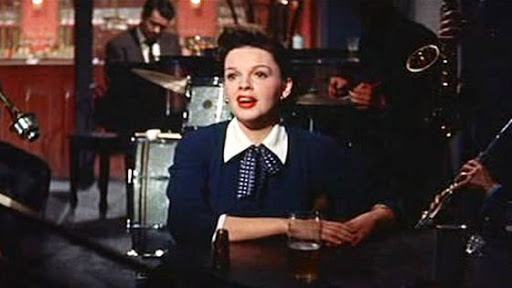
Garland sings all the numbers, and some of her best work ever is in this film. Her late night bar rendition of The Man That Got Away (the performance that wins Norman’s heart) is superb. I love the affectionate spontaneity of Someone at Last, Esther’s recreation to amuse Norman of the sequence she has spent the day filming in the studio. This scene is playful, sweet, funny and has a freshness not all the numbers have.

Some of the other numbers go on too long – and it’s hard to escape the feeling that they are in there solely because of Garland and not because they serve the plot. Because this isn’t really a musical as such, more of a romantic tragedy with the odd tune, with each number a performance. It works superbly because Cukor’s sympathetic direction draws some of her best work from Garland – and a truly superb performance from Mason. 

Cukor works particularly effectively with Garland who, in real life at this point, was far more similar to the destructive Maine (she delayed the film frequently with her absences and fluctuations in health). Garland is of course too old for the part – but it doesn’t really matter as she brings it such freshness, naturalness and emotional openness that you can persuade yourself that she’s a young ingénue at least ten years younger than she looks.

Garland was also surely helped by being paired opposite Mason. Not the first choice – that was Cary Grant – or indeed the second, Mason was hired as his professionalism and expertise could deal with Garland’s erraticism. Under Cukor’s direction he gives his finest work on screen here. His turns Maine into someone decent, charming, kind – but overwhelmingly self-destructive. His slightly slurred speech and ability to turn on a sixpence to anger makes for some of the best drunken acting you’ll ever see. But it works especially as we are desperate for Maine to kick the bottle. Because when he’s sober he’s the perfect husband and gentlemen. But Mason uses that to mine the deep tragedy of the character, his intense shame and self-loathing. The later sequences of drunken misbehaviour are heartbreaking (Maine’s drunken interjections at Esther’s Oscar-winning speech are almost unbearably painful to watch), and it’s all powered by Mason’s humanity in the role. It’s a truly great performance.

The film itself is perhaps a little slow and uneven around these performances. The musical numbers – whisper it – frequently slow the action down or grind the plot to a complete halt (none of them add anything to the story at all, and exist to showcase Garland). The film is so tightly focused on its two leads that it never develops any sub-plots to contrast with the main action. There is some light satire on Hollywood studios and their rapacious desire for more money – but not too heavy as the villain here is the odious press man (a weasly Jack Carson) while the studio head is a kindly, affectionate, fatherly figure who would never make a call based on business. The matter of fact way both stars have their names changed (the moment when Esther discovers Norman’s real name is a hilarious throwaway moment) is a neat gag. But the film takes a long time, frequently stopping for another Garland set-piece.

Perhaps the studio instincts were right that the film needed to be tighter – and some of the dialogue sequences reinserted by Haver hardly add much too the plot. Cukor’s direction is calm but assured though and the superb performances of the two leads make the film what it is. It looks fabulous with its technicolour depth, and it carries a genuine emotional force that pays off dramatically by the film’s conclusion. A Star is Born is uneven at times and overindulgent but it has more than enough going for it to reward the viewer.

Mildred Pierce (1945)

Joan Crawford sacrifices everything for a daughter who doesn’t deserve it in Mildred Pierce

Director: Michael Curtiz

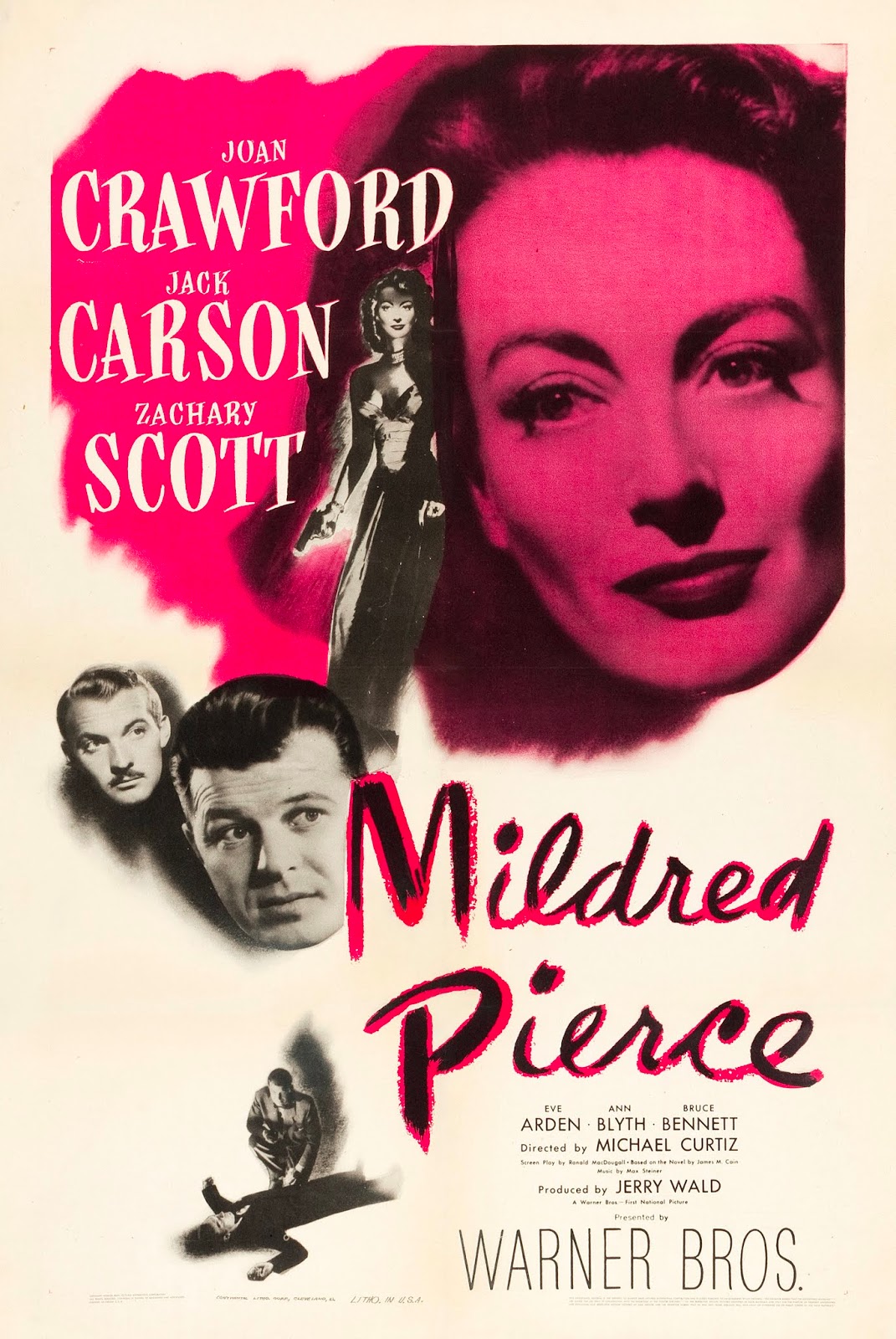
Cast: Joan Crawford (Mildred Pierce), Jack Carson (Wally Fay), Zachary Scott (Monte Beragon), Eve Arden (Ida Corwin), Ann Blyth (Veda Pierce), Bruce Bennett (Bert Pierce), Butterfly McQueen (Lottie), Lee Patrick (Mrs Maggie Biederhoff), Moroni Olsen (Inspector Peterson)

There are few things that classic Hollywood did quite as well as a melodrama. Adapted loosely from a James M Cain novel – its murder plot line is a flourish solely for the screen – this is a triumphantly entertaining picture that mixes themes of sex and class with good old-fashioned family drama. It’s got psychology and it’s also got the high-concept family feuding around the building of a restaurant business that you could find in Dynasty. Put simply, Mildred Pierce is a prime slice of entertainment.

After her second husband Monte (Zachary Scott) is shot dead, Mildred Pierce (Joan Crawford) is brought in by the police for questioning. After the collapse of her first marriage to Bert (Bruce Bennett), Mildred has expanded her home-baking business into a full restaurant chain, with the support of Bert’s old business partner Wally Fay (Jack Carson). Mildred’s goal is to provide for all the needs of her eldest child Veda (Ann Blyth), a selfish snob who despises her mother for having to work for a living. The tensions between self-sacrificing mother and demanding, unloving daughter, lead Mildred to take a series of disastrous personal and business decisions, culminating in her wastrel, upper-class, Veda-approved, second husband Monte going down in a hail of bullets. But who pulled the trigger?

The murder mystery plotline adds effective spice to this very well directed (Michael Curtiz is at the top of his game) melodrama. Full of domestic thrills and spills, it races along like a combination page-turner and soap, perfectly matching a deeply sympathetic, self-sacrificing heroine with a host of deeply unsympathetic wasters, chancers and bullies. It’s capped by giving our heroine possibly the least sympathetic child in film history, the deliberately selfish and greedy Veda. 

Sure you could argue that its psychology is either pretty lightly developed, or thrown in only for effect. It’s never clear when or why exactly Veda and Mildred’s relationship went south so completely, or where Veda’s deep resentment and ideas above her station come from. It also avoids looking at how Mildred’s complete devotion has probably completely spoiled a child who clearly needed to be told “no” a lot more, a lot sooner. But it doesn’t really matter as the film follows the logic of an event-filled plot-boiler, throwing revelations and cliff-hangers at you left, right and centre.

In the lead, Joan Crawford took on a role that many had turned down before her – stars at the time were not keen to be seen playing roles that suggested they were old enough to have mothered children as old as Ann Blyth. The decision to push for the role paid off as she netted an Oscar and it’s the finest performance of her career. A somewhat haughty actress, Crawford here demonstrates depths of vulnerability and tenderness as a much-put upon woman who, despite everything, will stop at nothing to give her daughter what she wants. Crawford dominates the film, her air of self-sacrifice never once tipping over into self-pity, even as the character so desperately seeks for the sort of love and affection that is denied her from those around her. 

Around her most of the cast – with the exception of Eve Arden’s entertaining, wise-cracking best friend (Oscar nominated) – are basically a bunch of sharks. None sharper than Ann Blyth’s (also Oscar nominated) sweet-faced but dead-inside daughter. Rarely has a display of more naked grasping, snobbish disdain ever been captured on film, matched with unapologetic greed. Veda has no compunction about the moral consequences of her actions and, like Zachary Taylor’s archly lazy Monte, is as interested in spending Mildred’s money as she is contemptuous of its source. 

Curtiz’s film constantly however plays with our judgements and expectations of people. Veda has more than her share of moments of pain and vulnerability as she shares some of the more painful travails of her mother. Similarly, Wally Fay (very well played by a roguish Jack Carson) oscillates between being a trusted confidante of Mildred, and a lascivious greedy creep. First husband Bert (a somewhat dry Bruce Bennett) starts as a love rat but may have more decency about him than anyone else (except Mildred).

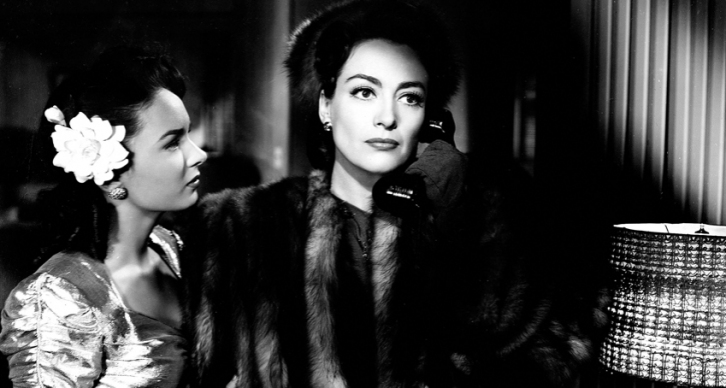
The film is wonderfully shot in luscious black-and-white by Ernest Haller, in a dynamic noirish style. Water reflections lap across ceilings. Smoke from fires and cigarettes rises up and seems to dance and swirl in the light. There are some beautiful shots of faces – the camera work in particular perfectly locates a vulnerability in Crawford’s superior features – and there is a beautiful shot late on when two people caught in an illicit kiss roll their heads back from the shadows to emerge into the light. The entire design of the film is spot-on, and it looks and sounds fabulous today.

Mildred’s struggles make this a brilliant example of the stereotypical “women’s picture”, a tale of a woman struggling against all the odds to make her way in the world, with the twist that the daughter she is straining to support is a monster and the men she chases are feckless wasters. Mildred makes chronically terrible decisions throughout but for the best of motives – and part of the film’s appeal is that you are so invested in her fundamental decency you are willing her not to make the same mistakes again and again.

Curtiz’s melodrama is brilliantly enjoyable and never lets up. It’s also a feminist icon of a sort – Mildred is never punished for having a career, indeed she’s celebrated for it (and is far more savvy about it than nearly all the men). She leaves her husband, runs her own household, pushes for her own divorce all while protecting and providing for her child (not her fault the child ain’t worth it). Mildred Pierce is ahead of its time, and still a fabulously entertaining film.