Tag: James Ivory

The Remains of the Day (1993)

The Remains of the Day (1993)

Hopkins and Thompson are marvellous in this masterful adaptation from Merchant-Ivory

Director: James Ivory

Cast: Anthony Hopkins (Mr Stevens), Emma Thompson (Miss Kenton), James Fox (Lord Darlington), Christopher Reeve (Congressman Jack Lewis), Peter Vaughan (Mr Stevens Snr), Hugh Grant (Reginald Cardinal), Michael Lonsdale (Dupont D’Ivry), Tim Pigott-Smith (Mr Benn), Ben Chaplin (Charlie), Patrick Godfrey (Spencer), Lena Headey (Lizzie), Pip Torrens (Dr Carlisle), Paul Copley (Harry Smith) Rupert Vansittart (Sir Geoffrey Wren), Peter Eyre (Lord Halifax), Wolf Kahler (Ribbentrop)
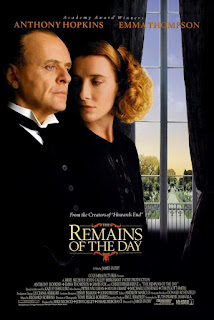
Kazou Ishiguro’s Booker-prize winning novel The Remains of the Day is one of my all-time favourites. So, it’s not a surprise I’m a huge fan of this masterful adaptation from the House of Merchant Ivory. I’m certain this is the apex of the team’s work. Mike Nichols had originally planned a film but, wisely, recognised when it came to making movies about repressed 1930s Brits, one team had a monopoly on how to do it best. Beautifully adapted by their regular screenwriter Ruth Prawer Jhabvala, The Remains of the Day is a wonderfully involving and deeply moving film.

Stevens (Anthony Hopkins) is a butler in a British country house purchased in 1956 by American Jack Lewis (Christopher Reeve). Keen to solve staffing problems (and for no other reason at all), Stevens journeys to the West Country to recruit the 1930s housekeeper, Mrs Benn nee Kenton (Emma Thompson). During the journey, he remembers his service for the previous owner, Lord Darlington (James Fox). An impeccable gentleman, Darlington dedicates himself to reconciliation between Nazi Germany and England, eventually tipping into an unwise dalliance with fascism and appeasement.

Stevens had no views on that though. In fact, he prides himself on his anonymity. The goal of his life is to maintain a dignified unobtrusiveness, ensuring the smooth operation of everything, leaving as little a mark as possible. Nothing can intrude on that: not his own feelings, the illness and death of his under-butler father (Peter Vaughan) and, above all, the unspoken romantic feelings between himself and Miss Kenton. The Remains of the Day is about duty and obsession and how a fixation on both can leave someone with little to show from a long life.

Stevens is living the lessons he learned from his father, an ageing powerhouse masterfully played by Peter Vaughan, who undergoes a physical collapse (from dripping nose to dropping trays) and bouts of forgetfulness, eventually dying on a night Stevens is too busy seeing to the sore feet of an illustrious French guest to spare a moment to visit him. It tells you everything about his character that this stiff-upper lipped commitment to duty is a source of pride to our hero.

There are few as curiously blank ‘heroes’ in literature than Stevens. The narrator of Ishiguro’s book is a dull, fussy, unbelievably cold man who has dedicated himself so fully to duty that he has let any emotional life wither and die on the vine – something he only realises far too late. It’s an immensely challenging role, bought to life masterfully by Hopkins. Hopkins astonishing skill here is to play all that repressed coldness on the surface, but also constantly let us see the emotion, longing and regret he is subconsciously crushing down play in his eyes and the corners of his mouth. Is Stevens even aware how much self-harm he is causing? It’s an astonishingly subtle performance.
So subtle in fact that the books conclusion – Steven’s tear-filled confession to a stranger late at night of all the mistakes he has made – was filmed but cut for being superfluous. Hopkins had done the lot, all the way through the movie, through acting skill. You can’t miss the struggle within him, not least the desperate, powerless longing he feels for Miss Kenton that, for oh-so-English reasons he can never admit to himself. Hopkins has the vocal and physical precision, but every gesture tremors with unspoken, barely understood longings. In fact, it’s a shock when he exclaims an angry “Blast” after dropping a bottle of wine (the real cause of his outburst being, of course, Miss Kenton’s announcement that she is getting married)

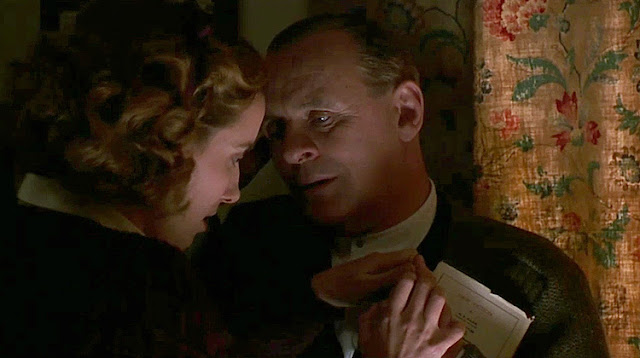
He and Miss Kenton conduct a professional relationship that blossoms into something like a friendship – but he consistently rejects her polite efforts to take it further. In the film’s most powerful scene, Miss Kenton enters his parlour and playfully tries to see the title of the novel he’s reading (a sappy romance). The playfulness tips into agonisingly awkward tenseness as Hopkins’ Stevens seems paralysed, his hand lingering inches from her hair but unable to bring himself to break decorum and fold her in an embrace – all while Miss Kenton continues her increasingly desperate semi-flirtatious banter. It of course ends with Stevens dismissing her: just as later he will take a snap of frustration as a signal to irrevocably cancel their late-night cups of cocoa together.
Emma Thompson is wonderful as a woman only marginally more in touch with her feelings and longings than Stevens is: aware that she, eventually, wants more from life, but unable to find the way of communicating the love she clearly feels for Stevens in a manner he can respond to. Instead, the two of them oscillate between a friendly, affectionate alliance and a discordant arguments (their only outlet for their passion), rooted in their inability to admit their feelings for each other. To further stress the point, both of them mentor young staffers (played by a very young Ben Chaplin and Lena Headey) who have the youthful “what the hell” to jack in all this for love.

Ivory’s wonderfully subtle film makes clear this is a turning point in history, the final hurrah for the this sort of deferential hierarchy. Stevens is the last of a generation of butlers, convinced that what their employers got up to had nothing to do with them – views not shared by Tim Piggot-Smith’s more grounded Benn, who chucks in his job working for a bullying blackshirt (who else but Rupert Vansittart?). Throughout the 1950s storyline, Stevens is constantly asked if he knew the infamous Lord Darlington (a sort of Lord Londonderry figure, hopelessly taken in by Hitler) – in fact, like Paul, he twice denies ever having known him.

And you can understand why, as the film has sympathy for Lord Darlington. As his decent, liberal god-son Reginald Cardinal (an excellent Hugh Grant) says, Darlington is a great asset for Germany precisely because he’s honest, well-meaning and motivated by a desire for peace. The fact that his leads him to consort with a host of Nazis, Blackshirts and the most appalling anti-democratic vestiges of the upper-classes (at one point, Stevens selflessly gives a performance of geopolitical ignorance so as to help demonstrate why men like him shouldn’t have the vote) is an unfortunate side-effect.

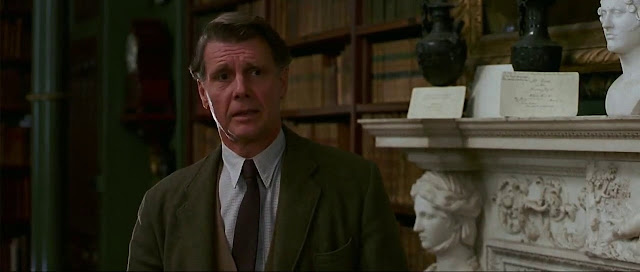
Played perfectly by James Fox, Darlington is misguided but genuine. As war approaches, he leads an increasingly hermit like life – camp-bed and paper-strewn, messy library – hosting conferences denounced by Jack Lewis (a fine Christopher Reeve) as a host of amateurs talking about a world they no longer understand. Beneath it all, Darlington is guided by fair play. So much so, it’s almost distressing to see him (under the influence of an attractive German countess) reading anti-Semitic pamphlets and sacking two refugee Jewish maids – an act he later regrets (far too late). This moment also reinforces Stevens’ compromised pig-headedness (not his place to judge!) and Miss Kenton’s fear to act (she’s horrified, but to scared of unemployment to hand in her notice).

All of this culminates in a series of scenes where emotions pour out of the actors, even while their words are banal and everyday memories and reflections. Ivory was never more confident and skilled behind the camera, and the film is a technical marvel, beautifully shot with a wonderful score from Richard Robbins. Hopkins is phenomenally good, simultaneously pitiable and smackable, Thompson is wonderful alongside him, Fox and Grant perfect – it’s a very well-acted piece. And a wonderfully perfect capturing of a classic modern British novel. No doubt: the best Merchant Ivory film.
Heat and Dust (1983)

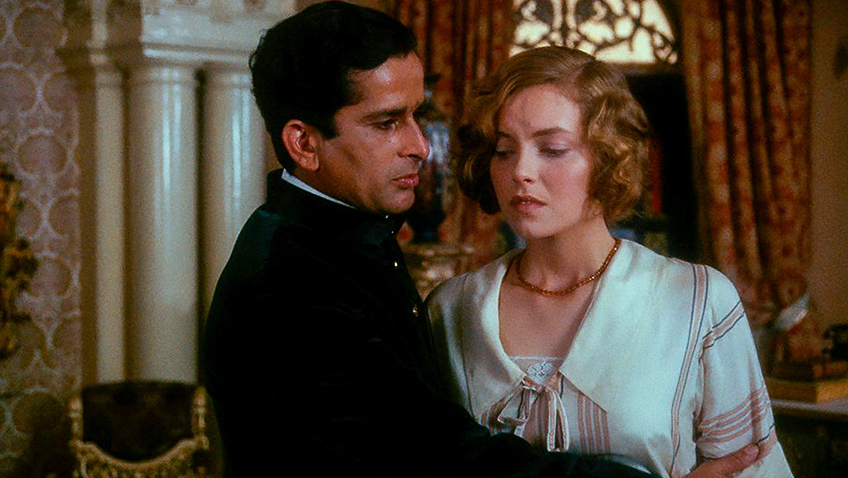
Shashi Kapoor and Greta Scacchi in a love across the divide in Heat and Dust

Director: James Ivory

Cast: Julie Christie (Anne), Greta Scacchi (Olivia Rivers), Shashi Kapoor (The Nawab), Christopher Cazenove (Douglas Rivers), Nickolas Grace (Harry Hamilton-Paul), Zakir Hussain (Inder Lal), Julian Glover (Crawford), Susan Fleetwood (Mrs Crawford), Patrick Godfrey (Dr Saunders), Jennifer Kendal (Mrs Saunders), Charles McCaughan (Chid), Madhur Jaffrey (Begum Mussarat Jahan), Barry Foster (Major Minnies)

Adapted by Ruth Prawer Jhabvala from her Booker-prize winning novel, Ivory-Merchant’s production of Heat and Dust is much like the source: precise, admirable and both faintly enigmatic and intriguingly slight. In 1982 Anne (Julie Christie) travels to India to discover more about the life of her great-aunt Olivia (Greta Scacchi). In 1923, Olivia lived in Satipur as wife to local official Douglas Rivers (Christopher Cazenove). The Nawab (Shashi Kapoor) is the local Indian prince, a charismatic man who may or may not be in league with local bandits. Enthralled by India, bored by British India but deeply in love with Douglas, Olivia still finds herself drawn to the Nawab. Scandal is round the corner.

Heat and Dust is a delicate, well-mounted adaptation, but it never quite engages as much as it should. Perhaps this is because its central plot – a white woman is fascinated by India – is a familiar trope in both novels and films of the Raj. It does take a different approach by intercutting between the present and the 1920s. This presents intriguing opportunities to show ways India has changed physically (the homes of the British Raj have become offices) but also ways it has remained the same culturally.

This carries across in the contrasting stories of two women, both of whom become intrigued by their surroundings and romantically entangled with Indian men. While Olivia is (eventually) disgraced and ostracised by her community, Anne has the freedom to make her own choices. Both women find themselves drifting into life-changes through male seduction. Perhaps this is one of the points of the film in the end – that women, no matter the timeline, are people that things (or men) happen to, rather than being the true owners of their own lives?

It seems the case with Olivia, who never feels in full control her own life, but instead moves inexorably towards a destiny she can’t really influence. Charmingly played, with a sparkle and playful innocence by Greta Scacchi in her film debut, Olivia’s motivations are almost deliberately obscured. Although Ivory uses a device at first of Olivia’s letters being dramatised by Scacchi addressing the camera, this device is swiftly dropped. The letters remain a presence, but we never hear from them. Instead most of Olivia’s actions are narrated by her friend Harry (Nickolas Grace), now an old man. It places a distance between the viewer and Olivia, making her actions harder to understand.

But then that is part of the enigma. India is a land of heat and dust, where normal rules don’t apply and people (particularly those from the West) find themselves reformed by. Olivia has no time for the stuffy, racist British population (especially the frightful woman). But she’s drawn to the Nawab partly because he’s a fusion of East and West, an Indian exotic with the charm of an English gentleman. For his part the Nawab, very well played by Shashi Kapoor, plans a seduction but his motives are as hard to read as Olivia. Is it attraction or revenge on the British for their contempt?

Perhaps it’s a film where we look for deep meaning and motivations, but it is in fact about how we don’t necessarily make grand decisions about our lives, but make a series of in-the-moment decisions. Both Anne and Olivia never seem to proactively make decisions, but instead events largely occur to them. Although this can make for a film sometimes lacking in energy, it does avoid making things obvious for the audience. Even if that can be frustrating when characters remain almost deliberately oblique.

What’s also oddly frustrating about the film is its more modern section. The commentary comparing the present and the past promises much but actually adds little. Anne is a curiously uninvolving character, played with a sweet tenderness by Julie Christie. Anne is hardly proactive and there is very little narrative drive behind her exploration of the past. Strangely the issues the more modern section deals with – including digs at Western cultural tourists – end up feeling less relevant than the issues of race and empire in the 1920s.

And its unfortunate that the 1920s plot line, although well staged and managed, seems extremely familiar – with echoes of A Passage to India and The Jewel in the Crown for starters. While it’s well acted (as well as those mentioned, Christopher Cazenove is very good) and creates an enigmatic atmosphere, you often feel you’re seeing something done better elsewhere. It starts as an investigation into the past, but becomes something more freeform, as if in the heat and dust of India, plans come to nothing. But its air of enigma and portrayal of characters buffeted by small events doesn’t come together into a compelling story or a rich insight into India.

A Room with a View (1985)

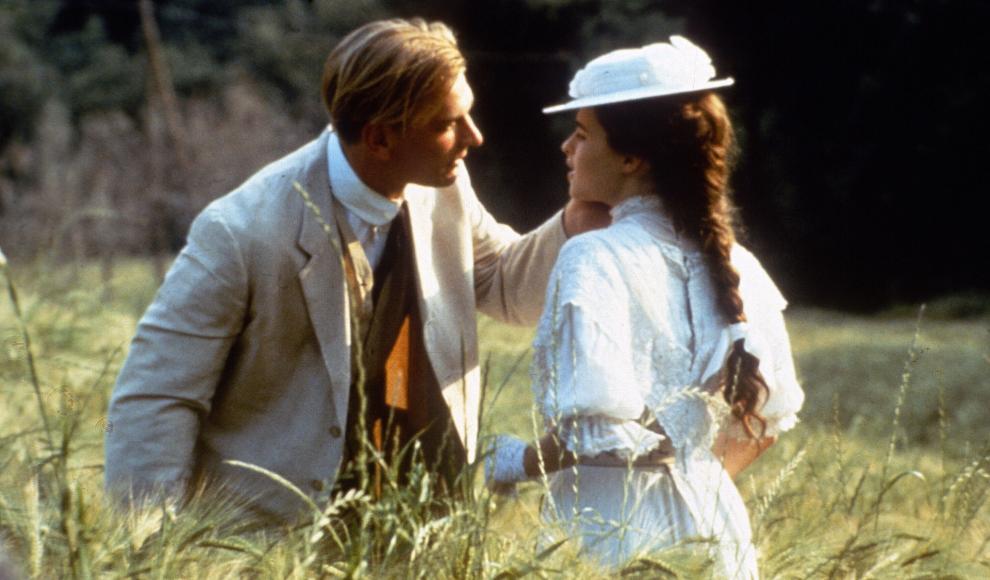
Julian Sands and Helena Bonham Carter find romance from A Room with a View

Director: James Ivory

Cast: Helena Bonham Carter (Lucy Honeychurch), Julian Sands (George Emerson), Maggie Smith (Charlotte Bartlett), Denholm Elliott (Mr Emerson), Daniel Day-Lewis (Cecil Vyse), Simon Callow (Reverend Beebe), Rosemary Leach (Mrs Honeychurch), Rupert Graves (Freddy Honeychurch), Patrick Godfrey (Reverend Eager), Judi Dench (Eleanor Lavish), Fabia Drake (Miss Catherine Alan), Joan Henley (Miss Teresa Allan), Amanda Walker (Cockey Signora)

Merchant-Ivory are the gold standard, practically synonymous with costume drama in the 80s and 90s. This really began with A Room with a View, their first true sensation, a box-office smash that won the BAFTA for Best Film and three Oscars. It practically defined what to expect from a Merchant-Ivory production: a classily made slice of English literature, with a wonderful cast of top British talent, tastefully directed with a sly observational wit for the foibles of the British class system. No one does such things better than Merchant-Ivory, and maybe only Howards End and The Remains of the Day did Merchant-Ivory better than A Room with a View.

Based on EM Forster’s novel (and that novel, largely thanks to this film, is probably now his best loved work), the film is set in Italy and England during the early 1910s. Holidaying in Florence, Miss Lucy Honeychurch (Helena Bonham Carter) and her chaperone cousin Charlotte Bartlett (Maggie Smith) are given poor rooms in their hotel – and accept an offer to swap (for the eponymous room!) with Mr Emerson (Denholm Elliott) and his romantic son George (Julian Sands). George, a free spirit, finds himself romantically drawn towards Lucy (and she to him), but something about the free Italian air frightens Lucy, and she withdraws and returns to England where she becomes engaged to the prig’s prig Cecil Vyse (Daniel Day-Lewis). However, when the Emersons rent a house near her home in Surrey she finds herself slowly drawn back once again towards George.

A Room with a View is the perfect expression of delicate, well-judged film-making, with James Ivory marshalling his precise judgement to create a luscious and involving reconstruction of the novel, which carefully layers its social and emotional observation with a dry wit. Ivory is a master of allowing the novel – and the film – to speak for itself, not intruding with flourishes but allowing the camera to hold moments. He captures wonderful moments of slightness: who can forget the camera holding on a rejected Cecil as he takes a moment to calm himself, then sits and begins to systematically retie his shoe laces? It’s a gentle, unforced moment of direction but it’s what makes the film work. 

And the careful grace and stateliness of much of A Room with a View is part of the film’s point. All this taste and manners, all this finery and wonderful design, is of course a trap. It’s precisely this pristineness and neatness that inhibits people from following their hearts, from actually having a bit of carpe diem. It’s telling that one of the film’s most striking moments involves George, Lucy’s brother Freddy and churchmen Mr Beebe going skinny-dipping (with long-shot full frontal nudity). There is something joyous for these men to literally cast off (for a few minutes) the shackles of society to just muck around in the all-together. And it’s a sort of exuberant liberal freedom you just don’t see in other parts of the film.

The film’s main theme is to see if Lucy will discover – and accept – enough about herself to follow the sort of romantic longings she feels within herself or if she is going to knuckle down and conform. Italy is a perfect sign of this – it’s hot, temperamental, the people wear their passionate hearts on their sleeves (whether that’s making-out in a carriage in front of uptight churchmen or stabbing each other in the piazza) – and it’s all that energy and lust for life that Lucy seems unsure about, but which George is chasing after. And it’s difficult to cast aside the rules you have grown up with – and scary – to find something a bit freer. Although I think you could criticise Ivory’s neat competence for failing to really visually get a contrast in look between Italy and England.

The film is blessed with a superb cast of British character actors. Helena Bonham Carter is excellent (in only her second film role) as a young woman who knows her mind but doesn’t want to follow it to its logical ends, part independent and free-thinking but also putting a constant block on her own instincts. Julian Sands as George does a decent job, although already the film (by far and away the best part he ever got) exposes his studied woodenness and flat, uninteresting voice and he often seems straining for a sort of depth and Byronic passion that is slightly beyond his range.

Maggie Smith and Denholm Elliott were both Oscar nominated, and both bring their A-game to the roles. Smith is perfect as a spinster who slowly reveals she has more sense of life’s lost opportunities than expected (even if the part is one she could play standing on her head), while Elliott gets lot of scene-stealing mileage from a sweetly eccentric Mr Emerson. Simon Callow, also in his second film role, probably gives his best (and most intriguing performance) as Mr Beebe the affable but subtly sleazy clergyman.

The film is however stolen by Daniel Day-Lewis as Cecil Vyse (originally offered his choice of parts between George and Cecil). A Room with a View opened the same day as My Beautiful Laundrette in the States and audiences were amazed that the same actor could play a self-important prig and a gay, punk fascist. Day-Lewis is the embodiment of fastidious preciseness, a man so studied in every second that each movement seems planned, with no touch of spontaneity. He even kisses Lucy with a carefully placed precision. He’s arrogantly certain of his place in the world and every moment of his life has been planned in advance with careful exactitude.

It’s the jewel in the crown of this perfect costume drama. Merchant and Ivory had longed to film the works of EM Forster for decades, and had to wait until King’s College, Cambridge (the rights holders) had someone in place who actually liked films until it was considered. They expected the main interest to be around Howards End (don’t worry its time would come!) and A Passage to India. But in A Room with a View, Merchant Ivory felt there was an unappreciated gem. They were right.

Howards End (1992)


Emma Thompson and Anthony Hopkins discover marriage is never an easy business

Director: James Ivory

Cast: Helena Bonham Carter (Helen Schlegel), Anthony Hopkins (Henry Wilcox), Vanessa Redgrave (Ruth Wilcox), Emma Thompson (Margaret Schlegel), James Wilby (Charles Wilcox), Samuel West (Leonard Bast), Nicolas Duffett (Jacky Bast), Jemma Redgrave (Evie Wilcox), Susie Lindeman (Dolly Wilcox), Prunella Scales (Aunt Juley), Joseph Bennett (Paul Wilcox), Adrian Ross Magenty (Tibby Schlegel)

From the mid-1980s to the late-1990s, Merchant-Ivory was the by-word for a certain type of film-making: intelligent and sensitive adaptations of books, with fine British actors in wonderful costumes. It was a perfect brand. And it probably reached its peak with this masterful adaptation of EM Foster’s precise, tragi-comic analysis of class in Britain.

Set in Edwardian England, the film focuses on three very different families: the Wilcoxes, grown wealthy off the back of the Empire, who have purchased large chunks of the houses and lands of the former aristocratic elite; the Schlegels, an upper middle-class family of intellectuals; and the Basts, a lower middle class couple trying to improve their lot. Ruth Wilcox (Vanessa Redgrave) befriends Margaret Schlegel (Emma Thompson) in the last few months of her life and, on impulse, leaves Howards End, her beloved family home, to Margaret when she passes away. With the agreement of his children, her husband Henry (Anthony Hopkins) destroys the note, but later falls in love with and marries Margaret. Meanwhile, Margaret’s sister Helen (Helena Bonham Carter) struggles to help improve the lot of thoughtful, well-read insurance clerk Leonard Bast (Samuel West) – with disastrous results.

The film balances these varying plot lines with great skill. It weaves in both well-judged social commentary and a shrewd and subtle analysis of the way perceptions of morality (and the consequences of people’s actions) alter dramatically depending on the class and sex of the person perpetuating the societal offence. Helped by Ruth Prawer Jhabvala’s masterful (and Oscar winning) screenplay, Ivory’s direction balances this acute scrutiny with an emotional and deeply involving story, staffed with characters whose dignities and flaws are humanly observed. Ivory and Jhabvala demonstrate a masterful understanding of the way we build stories about our own lives and create the people we want ourselves to be – and how this can be influenced by the results of our actions.

These self-images people create of themselves in the film are invariably more noble than the people they transpire to be. Of all the characters, arguably only Leonard Bast follows up on his intentions and consistently delivers on his word. It’s a tribute to Samuel West’s wonderful performance as Bast, as well as the film’s control, that Bast is both a tragic victim and also at times an almost painfully pathetic character, a striver whose every attempt to improve his lot ends in disaster (the film also sticks to Forster’s darkly comic fate for Bast).

While the Basts constantly pay a heavy price for every action, the Wilcoxes and Schlegels largely avoid paying any price for their mistakes until the end. Indeed, Henry Wilcox seems barely able to understand that his past love affair with a young woman left him with a certain moral responsibility for her fate after he broke the affair off. In a brilliant series of short scenes (with fades to black between each section of the conversation) we see him painfully confess the story to Margaret; the fades perfectly capture the mood of a broken up and difficult emotional moment for both characters.

The film perfectly understands the hypocrisy of the upper classes. Wilcox is a man of complete certainty and off-hand confidence, making sweeping statements with complete authority, who has no empathy with the lower classes: “The poor are poor. One is sorry for them, but there it is”, he blithely tells the Schlegels. His son Charles (a smackable James Wilby) is a spoilt and selfish snob with only contempt for anyone lower than him on the social ladder. Helen’s later fall from grace (in its way a manipulation of those dependent on her) is met with a condemnation Wilcox never imagines should never attach to his own actions. The whole film is a brilliant tapestry of these contrasts and flaws.

Emma Thompson won an Oscar for her work here, and she does a wonderful job as the emotional heart and conscience of the film, essentially our eyes into the events of the story. Intelligent and with a deep sense of morality, Margaret is also a woman who is willing to make compromises when she judges there is the need. Her decisions are not always correct or justifiable, but Thompson makes her struggle between her need to do the right thing and her desire to find happiness with her husband constantly understandable. In addition to this, Thompson is a radiant and engaging presence, allowing a character verging at times on being a matronly fusspot to always be someone we care deeply about.

She’s matched by a complex and thoughtful performance by Hopkins as Henry Wilcox. Hopkins has a brilliant understanding of the essential moral emptiness of Henry, based not on any malice or cruelty but on a genuine belief that some rules can be applied differently to him because his position and his own self-image reassure him that he is a good man. One of the film’s main subplots is the journey of Henry to understanding his actions have had consequences – and that these consequences reflect on him. Hopkins handles the growing awareness of this with brilliant sensitivity – his late emotional collapse is a masterclass in low-key, elegant, but deeply moving, acting. It’s also a tribute to the film’s mastery that Wilcox (despite basically being a cold, thoughtless snob) remains a character we relate to, understand and forgive.

Sex bubbles under in this Edwardian world. Henry’s sexual history is a crucial turning point. Helen’s freer attitude to love first brings the Wilcoxes and Schlegels together and then later leads to disastrous consequences with Bast. Tied directly in with the class issues in the film, Charles (James Wilby) is determined later to defend her honour, despite Helen having no wish for him to do so. There is even a hint of sexual feeling in Ruth Wilcox’s sudden friendship with Margaret. Alongside this run themes of the slow and deliberate way relationships develop: Margaret and Henry’s relationship takes the whole course of the film to reach a proper understanding, while Helen (and Helena Bonham Carter is wonderful here as a faintly skittish well meaning do-gooder) and Bast’s friendship shifts and changes throughout the course of the film without either really understanding the other.

Howards End’s complexity is of course in large part due to EM Forster’s original source novel, and his insight as a commentator on Edwardian England and its morals. But to capture so much of the air of the novel in this film, and to bring the story so richly to life, is an enormous tribute to the mastery of Ivory and Jhabvala’s work here and to the excellent work of the cast. The production values are exceptional of course and the film is told with pace, zip and feeling. If there was a high point for the costume drama this (and their follow up picture, The Remains of the Day) was it. Merchant-Ivory would never hit these heights again.