Tag: Jessica Tandy

Driving Miss Daisy (1989)

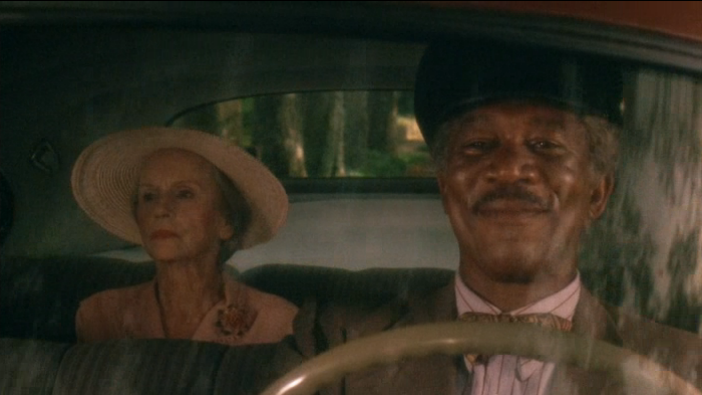
Jessica Tandy and Morgan Freeman drive through the South in Driving Miss Daisy

Director: Bruce Beresford

Cast: Morgan Freeman (Hoke Colburn), Jessica Tandy (Daisy Werthan), Dan Aykroyd (Boolie Werthan), Patti LuPone (Florine Werthan), Esther Rolle (Idella)

Retired Jewish teacher Daisy Wethan (Jessica Tandy) crashes her car while trying to drive down to the store. Her wealthy businessman son Boolie (Dan Aykroyd) decides she’s too old to drive herself, so hires black chauffeur Hoke Colburn (Morgan Freeman) for the job of Driving Miss Daisy. At first Daisy resists this new servant in her life but, doncha know it, over the next 23 years the two of them grow closer together as they deal with the ups-and-downs of life and find out that, heck, under the surface maybe we are all more alike than we think.

It’s been a recurrent theme that some films (like Shakespeare in Love or The Greatest Show on Earth) have found themselves actually diminished by the burden of being an “Oscar Winning Film”. Driving Miss Daisy joins them, an impossibly slight little puff of air film which could be blown away by the faintest breeze. It won out in a year where the most exciting movies of the year (sex, lies and videotape and most strikingly of all Do the Right Thing) failed to get nominated. It seemed a particular slap in the face that a film which looks at racial relations with such a cozy, nostalgic view as this one should triumph in the year Spike Lee made a film that exposed how close America was to racial tensions erupting into violence (worst of all this wouldn’t be the last time for Lee).

Driving Miss Daisy wants no part of that though. This is the Downton Abbey of racial dramas, a nostalgic and overwhelmingly “nice” film that uses odd-couple drama to make us feel good about ourselves. In this vision of the south, the Whites (and I am not buying the film’s pained attempts to suggest anti-Semitic mutters here and there is on a par with lynching) are mostly paternalistic masters, and the blacks forelock tugging servants hoping for a better life but grateful for the support of their betters. There isn’t a single black character (bar Hoke’s niece who appears wordlessly in the final minutes of the film) who isn’t a domestic servant, and not a single white person who isn’t genteel (bar a single racist cop 52 minutes into the film).

Not a single black character is ever angry, complains about injustice or is anything less than patient, noble and humble. It’s all part of a film designed to make us feel better about the South’s appalling record of racism and segregation by presenting it as exactly the sort of genteel Gone-with-the-Wind-good-old-cause fantasy many people remain comfortable with today, where black people needed to be looked after because (as even Daisy puts it in the film) they are basically children.

Now saying that, the film is of course light, fluffy, inoffensive and (there is no better word for it) nice. You can sit down and let the gentleness wash over you, no problem at all. I can see why it was a word-of-mouth hit in 1989, and why the Oscars gave it the big one. It’s well made and very faithful to the Pullitzer winning play it’s based on. Beresford’s genteel direction lets the dialogue and actors do the work (he didn’t get a nomination – though even he modestly said later he didn’t really feel he deserved one).

Freeman and Tandy do decent work with these incredibly simple characters. Tandy could have played this cookie-cutter “cantankerous-but-loveable-old-lady” role standing on her head. But she does it well (again, drawing those Downton parallels, this is exactly the same role Maggie Smith has in that series) and nails a little speech where she wistfully remembers visiting the sea then stops as if embarrassed by her self-indulgence. She won the Oscar.

Freeman here (and in Glory) invents a screen persona. He’s kindly, worldly-wise (but not bookly wise – he ain’t never had time to learn readin’), patient, long-suffering but full of dignity. But, with his repeated “Yassums”, his non-complaining acceptance of his position and status and his deferential nature, he’s pretty close to a sort of fantasy Uncle Tom-ish figure. Sure, Freeman can sell those quiet moments, where it’s clear Hoke has learned to bury feelings of fear (his brief confrontation with a racist cop – and his controlled fear – is the film’s most effective moment) but the whole performance feels like a carefully constructed lie.

It’s in line with the film, where the black experience has been cut down and filtered in such a way to make white people feel good about themselves. Because we can watch the film and go “oh yeah I’d be like Daisy and Boolie, they’re so sweet” and we wait 52 minutes before an unpleasant character turns up and uses the n word – and then he’s mean to Daisy as well for being Jewish and heck gosh darn it we are all the same after all, what a relief, pass the popcorn. You come out of Driving Miss Daisy and you have learned nothing.

Worse than that, you’ve been shown a cuddly fantasy world. We never see Hoke outside of the setting of his master’s homes (there is no other way of putting it) and learn nothing about his life or experiences. We see him melt the heart of an already-fundamentally-decent woman, but their relationship always has boundaries. Driving Miss Daisy would be fine as an escapist piece of fluff – but time has shown it increasingly to be a film designed to make us feel reassured that history wasn’t as distressing as it might have been. And I’m not sure that’s a good thing.

The Birds (1963)

Tippi Hedron has a bad day at the birdcage in The Birds

Director: Alfred Hitchcock

Cast: Tippi Hedron (Melanie Daniels), Rod Taylor (Mitch Brenner), Jessica Tandy (Lydia Brenner), Suzanne Pleshette (Annie Hayworth), Veronica Cartwright (Cathy Brenner), Charles McGraw (Sebastian Sholes), Lonny Chapman (Deke Carter), Joe Mantell (Cynical Businessman)

Alfred Hitchcock is often seen as the master of technique, the doyen of suspense, the master of the shock twist. Perhaps it was his love of this sort of material that led him to this radical reworking of Daphne du Maurier’s short story The Birds. After all Hitch had already directed the greatest ever du Maurier adaptation (Rebecca), so working with du Maurier was hardly new and turning this English suspense story into a sort of post-apocalyptic, tension-filled plot-boiler was right up his street. The Birds is a master-class in the director’s craft, and a curiously empty experience with barely a human heart in sight.

Melanie Daniels (Tippi Hedron), a slightly spoiled heiress, arrives in a small coastal town in California in order to play a practical trick on lawyer Mitch Brenner (Rod Taylor). Deciding to stay the night, she quickly realises that she has chosen the wrong weekend to get away as, while sparks grow between her and Rod, they also grow between humanity and the birds, as our feathered friends (enemies?) begin a series of escalating attacks on the population of the town that eventually lead to multiple deaths and destruction.

Hitchcock’s film is as masterclass in the slow-burn, deliberately the slowest film the director perhaps ever made. Hitchcock prided himself on his films in suspense being the awaiting of an event to happen. The bomb you know will go off on the bus. The plane circling Cary Grant that seems ripe to attack. The Birds takes this to the nth degree. The film’s very title all but tells you that the birds are going to attack, so Hitchcock takes it nice and slow, letting scenes play out with a breezy lack of pace, almost like a low-rent romantic comedy. But somehow this long unwinding of not a lot happening works well, because every scene somehow becomes a corkscrew as tension as every single bird in shot becomes suspicious. 

This atmosphere is increased by the wide open locations and remote locale the film is set in, with these all-American small town sites seeming to stretch on forever around the characters only serving to stress their isolation and vulnerability in the middle of all this deadly nature. Hitchcock also carefully stripped out all musical score from the film, instead providing a sound track of natural noise complemented by slightly exaggerated bird noise (created by use of a Trautonium, supervised by master composer Bernard Herrmann). The often makes the film eerily and unsettlingly quiet, with the soundtrack only punctured by the frequently (perhaps deliberately) mundane dialogue. Suddenly with this brilliant combination game, the entire film becomes a tense waiting game for the unleashing of avian attacks, every frame a tense waiting for the bang you all know is coming. It’s Hitchcock using every aspect of his reputation, and the film’s promise of violence, to create an overwhelming effect that is deeply unsettling no matter how many times you see the movie. 

Hitchcock also gives a slow build to the bird violence. Events escalate quickly, from the unsettling gathering of the birds in several places (most notably along telephone lines and outside a school playground) to subtle messages about chicken’s refusing food, to first Melanie and the other characters colliding with or being bitten by birds. It all builds to a grim reveal of a local farmer who has been attacked over-night, with Rod’s mother stumbling across the mutilated old man, Hitchcock’s camera delightedly cross cutting onto the man’s pecked out eyes. It’s the most grotesque shot of the film – and coming before we’ve seen our first mass bird attack, leaves us in no doubt as to the danger of these animals.

And when those bird effects come they have a real unsettling violence to them. In a blur of both real birds and super-imposed images (I will admit that the special effects of this film do now look a little dated, with the mixture of real, model and photo trickery birds rather jarring) the birds fly with an almost unimaginable aggression at the human beings. Flocks descend, pecking, biting and clawing, leaving human bodies maimed, blinded and bloodied. Crowds of school children are attacked while fleeing their school. A gas attendant is brutally set upon leading to a firey conflagration. Passers-by and those unable to get refuge are beaten to the ground under a flood of winged assailants.

The film changes tack in its final sequence into a tense series of sieges as Melanie, Rod and his family hole up in Rod’s house by the lake, barricading doors and windows as the birds peck relentlessly at doors and windows, slowly forcing their way in. Rooms that fall to the birds become whirlpools of deadly flying creatures, a tornado of wings and pecks that few can stand against. Hitchcock’s camera cuts rapidly from the flood of birds, to ever increasing pecks at hands and arms, to hands thrown up to protect eyes – a brilliant call back to the eye horror shown earlier in the film that immediately inspires. The birds attack in unpredictable waves, their attacks dying down at moments as the sit calmly and placidly only to expectantly burst back into violence.

It’s just a shame that Hitchcock’s film is so enamoured with its undeniable technique that it neglects to feature any heart or soul at all. The characters are a stock collection of forgettable tropes, most played by forgettable actors, or mute ciphers. The film almost deliberately throws together a truly trivial collection of stories and character motivations to pepper the centre (perhaps this bland self-interest is what pisses the birds off so much) of the film, that frankly are not that interesting. Rod Taylor is a solid but uninspiring performer, Jessica Tandy is saddled with a truly pathetically weak role. So many of the other characters such little impact that they barely warrant names. Rarely in Hitchcock films have the human characters felt so much like devices, square pegs in square holes, totally subservient to the Master’s whims. Put frankly, for all the tension of when the birds will turn, you’ll care very little for any of their victims. 

A lot of focus on the film has been on Tippi Hedron, in particular her accusations of ill-treatment (routed in frustrated sexual obsession) from Hitchcock. These stories – and Hitchcock’s subsequent description of her as little more than an attractive prop (a feeling he tended to have for lots of actors) – have drawn attention away from the fact that she is actually very effective in The Birds, and that her brightness and intelligence makes her the only person who feels real in the whole film. It makes it all the more sad that the final sequence renders her into a mute, shell-shocked victim – but Hedron’s promise (never fulfilled due to Hitchcock’s sabotage of her career) is clear here.

Hitchcock’s film finally ends on a truly nihilistic, Armageddon tinged ending that speaks volumes for the post-apocalyptic nuclear anxiety prevalent in the West in the 1960s. The birds rest, triumphant, over the chilling silence of the world as what remains of our heroes beat a retreat. It’s a chilling flourish in a film that is a stylist’s triumph but lacks any real heart. It’s a film that haunts the memory but it doesn’t win the heart. If Hitchcock really did hate actors and most people, this film makes a good case for arguing that’s a pretty honest insight.

The Desert Fox (1951)


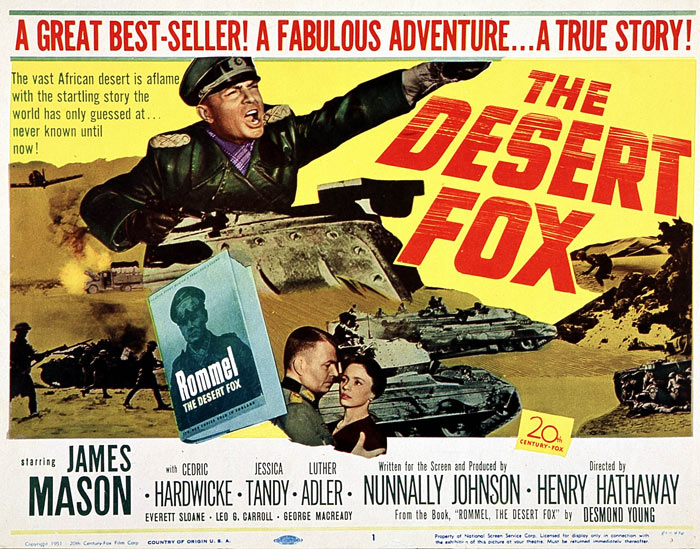
James Mason rides into action as a sympathetic Nazi

Director: Henry Hathaway

Cast: James Mason (Field Marshal Erwin Rommel), Jessica Tandy (Lucie Rommel), William Reynolds (Manfred Rommel), Cedric Hardwicke (Dr Karl Strölin), Luther Adler (Adolf Hitler), Everett Sloane (Gen. Wilhelm Burgdorf), Leo G. Carroll (Field Marshal Gerd von Rundstedt), George Macready (Gen. Fritz Bayerlein), Richard Boone (Capt. Hermann Aldinger), Eduard Franz (Col Claus von Stauffenberg)

It’s pretty astonishing when you think about it that less than six years after World War II ended, Hollywood produced a film about one of Germany’s leading generals which painted him in a largely positive light. Even more of a surprise is that this was a box-office hit. But then this film was designed to be a step towards reconciliation – especially with one eye on the Cold War and the need for Germany as an ally.

James Mason (brilliant in one of his most iconic roles) plays Rommel, with the film beginning just as the tide of war turns in Africa at El Alamein. Of course, this allows a lot of talk of Rommel being a noble fighter and brilliant general, without having to awkwardly show him chasing the Sixth Army across Africa! From his defeat to Montgomery (unseen but often referenced), Rommel slowly loses his faith in Hitler, realising the Fuhrer cares little for the lives of his soldiers. Gradually he becomes closer to the conspirators of the July 1944 bomb plot to assassinate Hitler. When it fails, he is given the choice: suicide and a hero’s funeral or execution as a traitor for him and his family.

The film is notable for opening with an exciting James Bond-style action sequence, a 1941 raid by British commandos on Rommel’s HQ (codenamed Operation Flipper), designed to grab the viewer’s attention – and to provide the action in a war film that otherwise has virtually no combat in it. It’s a terrific opening that immediately establishes the importance Rommel holds. The Desert Fox was one of the first films to use this device of an action prologue to open the story – the sort of thing James Bond has since mastered.

From there, Hathaway’s journalistic film (much of the World War II footage is reused from newsreels) is very smoothly and professionally directed, turning the last few years of Rommel’s life into a classic morality tale. Whether this is completely true or not (more recent research on Rommel suggests he was a much more enthusiastic early supporter of the Nazi party than suggested here), there seems little doubt that he was at the very least sympathetic to the July 1944 bomb plot. Rommel here is a man who sees the light too late – and pays a heavy price.

Nunnally Johnson’s well-researched and tight screenplay focuses on conversations and political manoeuvering, with Rommel presented as apolitical and straight shooting, clumsily working through debates he lacks the political sophistication to understand. Johnson’s script also provides excellent opportunities for sparkling cameos. Leo G. Carroll is particularly good as Rommel’s frustrated and cynical superior, but there are also stand-out performances from Everett Sloane as a lackey from High Command and a memorable cameo of controlled ranting extremity from Luther Adler as Hitler.

The film, though, is carried by James Mason’s subtle and sympathetic performance. Mason has the charisma, his upper class manner perfect for the military man, but he isn’t afraid to play both positive and negative. So we get his arrogance and wilful blindness, showcased in scenes where is passionate defence of Hitler is as much an attempt to persuade himself as others. But we also see his loyalty to his men and the tenderness of his relationship with his wife (played well by Jessica Tandy). Mason’s performance is compelling and soulful.

It’s not a perfect film. There are some slightly clumsy links at the start back to the source book written by Brigadier Desmond Young, who served in North Africa. Young cameos at the start in reconstructions of his meeting-at-a-distance with Rommel and his post-war research. Narration from the book is a worked into the film – and having heard the real Young speak, its mid-Atlantic tone is rather jarring. The narration often serves as a transition from event to event, but this is never completely smooth, meaning there are some odd jumps.

But it’s a very decent, very professionally done piece of film making. Its version of Rommel isn’t seen as the whole story today (there is a whole historiographical argument about the “Rommel Myth” of the man as an apolitical soldier or willing accomplice), but it’s very consistent within the film. Very well acted and scripted and very professionally directed, it’s a political film cunningly disguised as a war film, which does a very good job of creating the atmosphere of Nazi Germany and in re-creating historical events and has an excellent lead performance from James Mason.