Tag: John Wayne

Red River (1948)

John Wayne and Montgomery Clift as duelling surrogate father and son in Red River

Director: Howard Hawks

Cast: John Wayne (Thomas Dunson), Montgomery Clift (Matt Garth), Joanna Dru (Tess Millay), Walter Brennan (Groot), Coleen Gray (Fen), Harry Carey (Melville), John Ireland (Cherry Valance), Noah Beery Jnr (Buster McGee), Harry Carey Jnr (Dan Latimer), Chief Yowlachie (Quo)
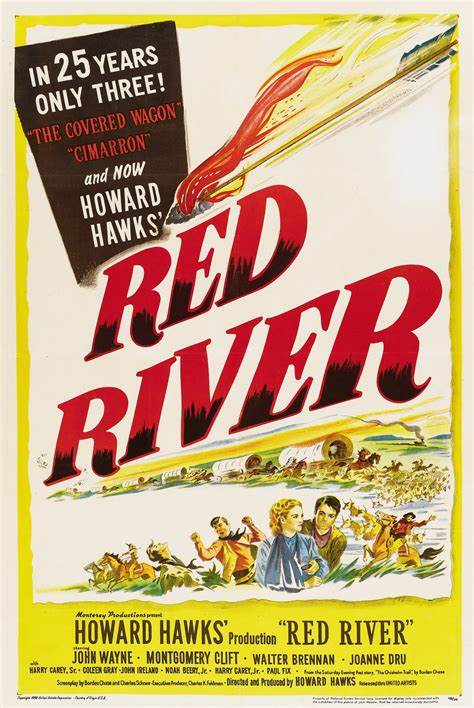
Some say Red River is, even more than Citizen Kane, the masterpiece in American film. That’s pushing it. But Red Rivercertainly is a prime slice of beefy entertainment. Hawks’ first Western (and how odd a director so associated with them didn’t turn his hand to them until late in his career – and then only made six), there is no greater compliment to make than to say you could mistake it for John Ford.

In fact, Ford was beyond impressed, famously observing of Wayne “I didn’t know the big son of a bitch could act”. Act he certainly does here as monolithic obsessive Thomas Dunson (surely a forerunner to the equally troubled – and troubling – Ethan Edwards in The Searchers). Dunson has spent almost two decades building his Texan cattle empire. Unfortunately, the Civil War means the bottom has dropped out of the Texas beef market. To make good his investment, Dunson needs to take the cattle (all 9,000 of them!) up north to Missouri (over a thousand miles) to sell at a good price. Along the way, Dunson’s ruthlessly focused ambition tips into tyranny, with Dunson (literally) judge, jury and executioner among his team. Can his more liberal adopted son, Matt Garth (Montgomery Clift), stop Dunson from destroying everything around him?

Red River covers the movement of cattle up the Chisholm Trail, a huge economic migration that saw millions of cattle moved from Texas to where their price was increased by a factor of ten. But the film has only a passing interest in the history – and the romantic, nostalgic look at it here, as a sort of boys-own adventure that goes wrong, is far more about the movies than social history. What the film is really focused on is the personal clash between two generations of men: one a relic of the first years of the new frontier, the other younger, more modern in his thinking, with a streak of humanity the other has beaten down.

Hawks’ film mixes this up with some terrific location footage. How did they wrangle all those cattle? The film is very strong in capturing the sense of excitement in the Frontier – the setting off on the trail, with its quick shot cacophony of horse-backed men whooping with joy, is full of a sense of adventure. The film is a triumph of quick-quick-slow story-telling. The 15 years of Dunson’s empire-building passes by with montage and Wayne voiceover which begins and ends with Wayne in the same position, but the actor considerably aged. Context is skilfully and swiftly given to us, but the tensions between Dunson and Matt are grow and develop naturally, simmering for a good hour-plus before erupting. Transition text between sequences bridges us from scene to scene, and is especially effective in charting Dunson’s descent into tyranny.

Tyranny is what it is all about. This is one of Wayne’s darkest – but also greatest – roles. Hawks taps into the despotic rigidity in this slab of Americana. Dunson is a man utterly and completely convinced not only of his invulnerability, but his rightness, embodying American manifest destiny. Claiming swathes of land as his own, Dunson is a man on the move, constantly striding forward (Hawks often shoots him in progressive, shark-like motion). He’ll leave behind him everything from the woman he loves (with a shocking toughness, as he looks back on the burning remains of the wagon train he left her in) to the land he claimed, to anyone who lets him down.

Dunson is also a ruthless embodiment of a time before law. No one seems to question the way he executes those who cross him. Practically the first thing he does on arrival in Texas is out-draw and kill the man sent to question his arrival. His farmstead has a full graveyard. A dark comic touch is added with his insistence in “reading the words” over graves of men he’s killed. On the trail he has those who back out, run away or question his leadership whipped or shot. Wayne’s certainty as an actor tips into a (literally) black-hatted despotism. His manly focus and ability to outdraw anyone turns him in the end into a nightmare avenger, a Western Terminator.

Opposite him is Clift (equally superb) as a more modern minded kid. Matt is the sort of man who knows that at times a bit of bend and a sympathetic ear gets better results than a beating. Hawks brilliantly builds the love-hate relationship between these two men who have very little in common, other than mutual affection. (Clift and Wayne themselves were polar opposites in acting style, social views and personalities.) There is a real love there – which makes it all the more inevitable Dunson will view Matt’s questioning of him as a betrayal nothing less than blood will redeem. The two of them, and their clash (like the clash between two sides of America) dominate the film, not letting too many other characters have a look-in.

Of the rest, Walter Brennan is a very good as Dunson’s loyal number 2, who may not always agree with the chief but largely (if reluctantly) sticks by him (for all he mutters to him “You’re wrong Mr Dunson”). John Ireland’s cocky gunslinger, who joins the trail because he admires Dunson’s no bullshit attitude, promises much at first but fails to deliver on much-hyped clashes. (Possibly because Ireland fell out with Hawks over a competition for the affections of his future wife Joanna Dru, his role later cut to ribbons in revenge.) There is however a strange, almost homoerotic, link between Clift and Ireland – mutual respect leading to an admiration love-in and much fondling of each other’s firearms during competitive rock shootings.

Red River’s ending has gained some criticism – largely because the film builds its sense of violence between the two leads so well that it feels a bit of a disappointment that they are effectively told to pull themselves together (by a woman of all things!). But, for all the film mines the clashes between two different outlooks, it never loses track of their very real affection. Sure Dunson may talk about killing Matt – but he certainly won’t in cold blood (even if he happily guns down anyone who gets in the way) and at the end of the day, he’s still the closest thing he’ll ever know as a son. Matt is emotionally mature enough to know Dunson is to-all-intents-and-purposes his father, even if he’s not above throwing a few punches at him. The clash is effectively a narrative dead-end – for all it would be exciting to see them take shots at each other, this is a family. And most families fight and make-up, not plug each other with bullets.

And it distracts from the grand entertainment of Red River, its excited love for the open country (the late act scenes inside are as disconcerting for us as they are the characters). This is a western of psychological depth successfully mixed with grand adventure. It’s hugely entertaining but also feels very true. It has two wonderful performances from Wayne and Clift. It’s not the Great American Film, but it’s directed by a superb understander of cinematic narrative and a hard film not to love.
The Searchers (1956)

Searchers header
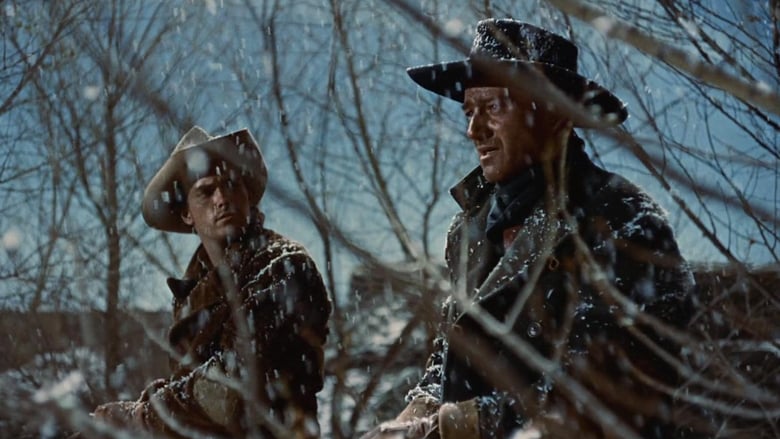
Jeffrey Hunter and John Wayne on a long search, in John Ford’s exploration of racism in the West The Searchers

Director: John Ford

Cast: John Wayne (Ethan Edwards), Jeffrey Hunter (Martin Pawley), Vera Miles (Laurie Jorgensen), Ward Bond (Reverend Captain Samuel Johnson Clayton), Natalie Wood (Debbie Edwards), John Qualen (Lars Jorgensen), Olive Carey (Mrs Jorgensen), Henry Brandon (Scar), Beulah Archuletta (Look), Ken Curtis (Charlie McCorry), Harry Carey Jnr (Brad Jorgensen), Hank Warden (Mose Harper), Dorothy Jordan (Martha Edwards), Walter Coy (Aaron Edwards), Pippa Scott (Lucy Edwards)

John Ford’s career was a long tribute to the decency of the regular American. How fascinating then that one of his greatest films is in fact a dark investigation into the dangers of obsession, vengeance and prejudice in ordinary Americans. Working with his regular leading man, John Wayne, together they created a character who shared many qualities with Ford’s other leading men – a rugged, determined, taciturn man of the wilderness – but laced him with deeply negative attitudes and a horrendously damaged psyche. The Searchers becomes a masterpiece, presenting how narrow the line between hero and villain can be while – in an admittedly very gentle way – posing questions about the claims of the settlers to moral superiority.

Ethan Edwards (John Wayne) returns to his brother’s homestead from an unspecified (though clearly morally questionable) career as a gun for hire after fighting for the confederacy (a cause he sees no reason to disavow). He’s an awkward presence, with an unspoken love for his brother Aaron’s (Walter Coy) wife Martha (Dorothy Jordan) and a racial hostility towards their adopted son Martin (Jeffrey Hunter) who is one-eighth Cherokee. Shortly after his arrival, an Indian raid draws him and most of the local men on a futile chase. While they are gone, the Edwards’ homestead is destroyed, with the family all murdered except daughter Debbie. Ethan and Martin begin what becomes a five-year quest to find her and bring her home – although as he discovers Debbie has become wife to her kidnapper, the war chief Scar (Henry Brandon), Ethan’s aim shifts from rescue to executing Debbie for racial disloyalty.

Racism is what lies at the heart of The Searchers and around discussions of the film today. Firstly, let’s acknowledge how brave the film is in presenting Ethan’s racially motivated rage without excuse. This was after all John Wayne, the straightest shooter of the lot. Here, in no doubt his greatest ever performance, Wayne’s Mount Rushmore-like qualities are inverted into a bitter, lonely man whose murderous rage against the Native Americans is extreme, even within an environment which sees the tribes as a dangerous “other”.

Edwards’ racism tips into everything and is there right from the start: “I could mistake you for a half breed” he scowls at Martin. Later he will prevent Martin drinking alcohol – a clear reference to the belief among settlers that one drop of alcohol turns Indians into savage beasts. One of his first actions on the trail is to desecrate the buried corpse of an Indian, shooting out his eyes (condemning him to walk sightless in the afterlife). In a gunfight he has to be stopped from shooting retreating Indians in the back. Later, in a crazed fury, he guns down buffalo simply to deny them as food to the tribes. That’s not to mention his disgust with every trace of indigenous culture.

What’s striking watching the film is that, even though he’s the central character and is played by John Wayne, Ethan may well actually be the villain of the piece – or at best an anti-hero wild card. Our actual hero is the kindly, decent and brave Martin Pawley, played with a slight nervousness by Jeffrey Hunter. Martin is appalled by Ethan’s violence, his anger and above all by his plan for enforcing racial harmony by exterminating the niece he sees as a race traitor. It’s not just the fact he has Cherokee blood that makes Martin appalled by the danger in Ethan. It’s the simple fact that he’s just a decent guy, who recognises that good and bad isn’t a question of race but a question of people. And his presence on the quest, it’s made clear, is as much about protecting Debbie from Ethan as it is finding and rescuing her.

You can see these attitudes quite clearly late in the film, where the pair encounter white women who have been recovered from Indian kidnappers. These women are confused and traumatised. But while Martin attempts to communicate with and comfort them, to Ethan they are worse than nothing now. “They ain’t white anymore” he scowls at a soldier. Leaving them, Ford holds the shot on Wayne who turns to look back at them with a face dripping with such disgust and loathing, it sears into the memory.

Does the film condemn these attitudes? You can argue that the film plays into a racial nightmare – white women kidnapped and violated by savage tribesmen. But Ford is, I’d suggest, presenting racism here – and going as far as he could in the 1950s to attack it. Ethan and Martin encounter an Indian settlement that has been attacked by the cavalry. The settlement is a burnt-out husk, with Indian women and children among those indiscriminately slain – visually it is immediately reminiscent of the burnt-out Edwards homestead. Another later cavalry charge against the Indians will again see panicked women and children flee in terror. Even Scar, the villain of the piece, is motivated just like Ethan by anger – his actions are a response to the murder of two of his children. And his scalping, rape and murder don’t look so different from Ethan, who shoots people in the back, plans to murder his niece and later scalps a dead man.

The Searchers takes a slightly nihilistic view that the West was a violent place – for all the beauty Ford discovers in his crisply sublime shots of monument valley – and that many of the people in it had questionable motives and principles. A ”hero” for this time might well be Ethan, a sullen and violent man under a veneer of gentlemanly politeness, clearly motivated from the start far more by a desire for revenge for the murder of the woman he loves. Ford, Wayne and Jordan establish this love between Ethan and Martha subtly but unmistakably – the opening scenes are littered with moments of the two of them sharing glances and a hesitant but unmistakeable physical intimacy.

Again, a lot of the quality of this comes back to the wonderful work Ford draws from Wayne, helping the actor to find the cracks and flaws in this marble bust of Americanism. Wayne’s Ethan is awkward, angry, distant, difficult, cruel – a natural outsider, who has grown bitter against the world. Discovering Martha’s body, Wayne also allows Ethan to crumple into the sort of grief that translates within seconds into an iron loathing for the world and everything in it. He talks of the certainty of finding Debbie – but it’s a certainty born more of his idea of his own superior (white) determination rather than any faith (for all the language could suggest that). Ethan is in fact hostile and contemptuous of faith of any sort.

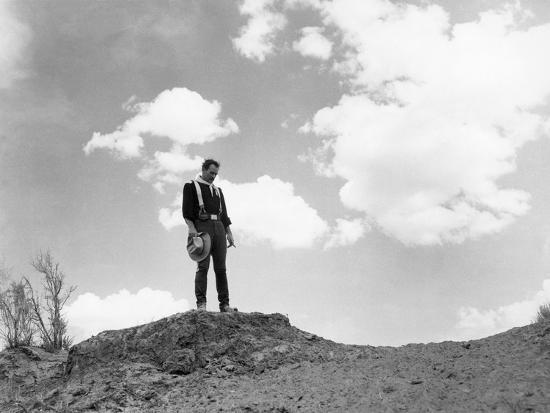
Ford frames Ethan frequently as an outsider, often framed uncomfortably in doorways, darkened walls seeming to close around him. Nowhere is this more beautifully done than in the film’s final shot which finds Ethan alone and forgotten outside the Jorgensen homestead, a man who has no place in the civilised world of family and friends, but an outsider with no place anywhere who must return to the wilderness. Wayne does this with a quiet, deflating gentleness – a beautiful suggestion of Ethan’s knowledge that the world is leaving him behind. Ford frames this beautifully in mid-shot to create one of the iconic images of cinema.

The Searchers isn’t perfect. There is a prolonged, slightly comic, sub-plot around Martin’s marriage to Laurie Jorgensen (Vera Miles in a thankless part), which culminates in the sort of fisticuff based comic stuff that looks more suited to The Quiet Man than here. The beautiful shots of monument valley are brilliantly done – but they also serve to point out the odd decision to shoot many of the exteriors on such obviously fake soundstages. While the film questions the attitudes and assumptions made about the Native American people in Hollywood films, the violent figure of Scar is the only Native American character given any real screen time (Martin’s accidental “wife” Look is treated as a joke, right up to her surprisingly tragic fate), making it easier to still see the tribes as an existential threat to civilisation, for all that Ford tries to contrast their suffering with the death of the settlers.

But Ford was trying to sneak something in here under the wire, at a time when people would only accept straight-forward stories of goodies and baddies in the West. He did this by turning Wayne for a pillar of taciturn goodness into someone who is almost a mirror image of his nemesis Scar, both men motivated by racial hatred. He parallels the violence of the Indians with the cavalry. He suggests in fact that there was good and bad on both sides. And I can’t think of another film where the viewer is convinced for a huge portion of the runtime that our hero intends to carry out an honour killing. The Searchers presents a man who holds racist views and trusts that we are smart enough to see the danger in Ethan’s extremism. Thankfully most of us are.

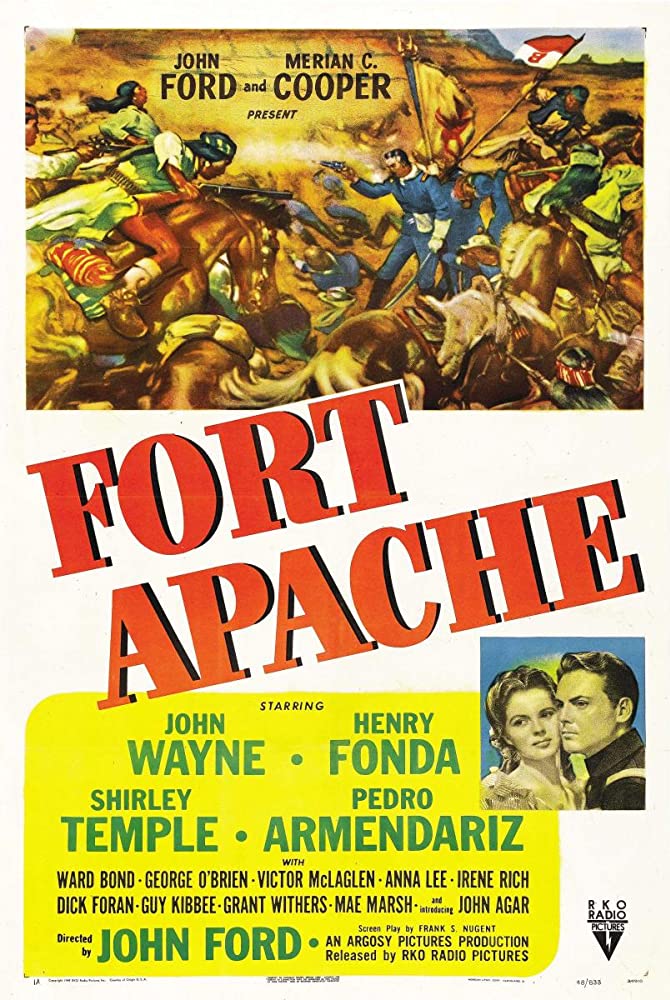
Fort Apache (1948)

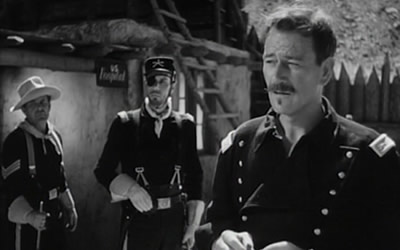
Henry Fonda and John Wayne face off in John Ford’s Fort Apache

Director: John Ford

Cast: John Wayne (Captain Kirby York), Henry Fonda (Lt Colonel Owen Thursday), Ward Bond (Sgt Major Michael O’Rourke), Shirley Temple (Miss Philadelphia Thursday), John Agar (Lt Michael O’Rourke), Dick Foran (Sgt Quincannon), Pedro Armendariz (Sgt Beaufort), Miguel Inclan (Cochise), Victor McLaglen (Sgt Festus Mulcahy), Guy Kibbee (Captain Wilkens), George O’Brien (Captain Sam Collingwood), Anna Lee (Emily Collingwood)

Fort Apache was the first of Ford’s “cavalry trilogy”, exploring problems and personality clashes of remote cavalry posts in the middle of what used to Native American territory. Contrary to what you might expect, this is a complex, intriguing film that brilliantly explores tensions between very different ways of thinking and issues of class in America, which are so often overlooked. If it sells some of the tensions of clashing ideals down the river with an ending that fully endorses the myth over the reality, the fact the film makes clear that the idea of a well-meaning army all pulling together is a myth says a lot.

John Wayne is Captain Kirby York experienced, more liberal minded acting commander of Fort Apache. Aware of the difficult balance of maintaining good relations with the Apache tribe while protecting American expansionist interests, he’s perfectly suited for keeping the peace in the West. Unfortunately he’s replaced by Lt Col Owen Thursday (Henry Fonda), an arrogant, class-conscious – if polite and honourable man – who applies the letter of the law to all his dealings, so obsessed with rules (he protests “I’m not a martinet” while bemoaning the lack of proper uniform in the dust filled heat of the West) that he sees no reason to moderate even the most corrupt of the local officials who have driven the Apache to revolt, instead demanding the Apache submit. Disaster is on the cards.

Ford’s film revolves around the personality clash between York and Thursday. While both dutifully respect the chain of command, it’s clear that York has a closer bond and understanding with both the men under them and the complex considerations to balance when dealing with the Apache. Thursday, on the other hand, is an arrogant, prickly character, bemoaning his “demotion” from a field rank of General in the Civil War, to an “obscure” fort. A posting he is determined to escape from with an honour laden victory as soon as possible. 

With Ford’s romantic regard for the ordinary soldier and regular Joe, the sort of posh New-Englandish Thursday is a clear stand-out. A stiff-backed martinet, he never listens to others (he constantly needs to be reminded about names) and has a snobbish disregard for Lt O’Rourke (a callow John Agar) whose father, far from being officer class, is an Irish Sgt Major at Fort Apache. Thursday is notably uncomfortable at such Fordesque events as a NCO ball, or when talking with the men – he even looks unsettled in the desert, wearing full uniform and avoiding a hat in favour of an army cap with a dust-sheet attached at the back (no Ford hero would be seen dead wearing such a thing). 

The character works so effectively because he is played so delicately and skilfully by Henry Fonda. Cast against type – and looking older – Fonda plays Thursday as a frustrated man, terrified of failure who simply lacks the flexibility to adjust to situations. Rules instead are there to be followed in detail, regardless of his personal feeling. Corrupt government agent Meacham he treats with contempt, but he will defend his incompetent regime in Apache land to the death. With the Apache he can’t see past his own inbred ideas of superiority, treating them with a paternal disappointment, certain that they are no match for American cavalry might (spoiler, they certainly are). Fonda however keeps Thursday human, a flawed, rigid man dropped into a role he is ill-suited to and struggling to adjust.

John Wayne offers an equally careful performance as York. Unlike Thursday, York adjusts his actions and decisions based on situations and personalities, rather than enforcement of rules. Army regulations can be respected but applied with sense. Meacham to him should be hounded out of town as the root cause of all the problems. Cochise, the Apache chief, he treats with respect and honour – abiding by deals and attempting to compromise with him to find a peaceful solution (a negotiation Thursday of course torpedoes with his arrogance and intransigence). Wayne is often thought of as the action hero, but here Ford starts to explore his elder statesman quality, as well as his underlying decency and honour as an actor.

Other sub plots interweave neatly around this. John Agar’s young O’Rourke flirts with Thursday’s more liberal daughter (played brightly by Shirley Temple) – needless to say this relationship meets with no approval from Thursday. Thursday’s old colleague Sam Collingwood – now a time-serving captain at the Fort – is paralleled with him and York, as a time-server and mediocrity, a decent family man but lacking the will to do what he knows is right. Ward Bond provides both comedy and also a warm fatherly quality as Sgt Major O’Rourke, proud of his son and re-enforcing discipline on his (mostly Irish of course!) soldiers. 

And of course the action is handled extremely well. A chase sequence with Apache, cavalry and a wagon (under-manned and out-gunned, because Thursday believes a few men and rounds of ammunition should be enough to see off the Apache) is filled with excitement. And, of course, the film builds towards the inevitable disaster Thursday’s rigid mismanagement was always heading towards: a suicide charge against a well defended Apache position, fighting to defend a corrupt agent who Thursday and York both know should be replaced.

It’s a film that quite daringly shows that American’s “mission” in the West was often founded on corrupt officials, and that the military leaders were sometimes rigid, incompetent martinets who led their men to avoidable disaster. It’s shame then that the York – and the film – chooses in a flash forward at the films end to promote the idea of Thursday’s charge being a glorious defeat, rather than an avoidable disaster. And that, this printing of the legend, is important to protect the “why we fight” idea of America. It’s the downside of Ford’s love of the past, of the mythology of the West, that even in the end of a film about incompetence, it’s still seen as noble and important to protect people from the truth and promote the legend, than tell the truth. But then for Ford, protecting the memory of the ordinary soldiers who died is the key – and if that means never questioning the how or why, well then that’s a price worth paying. It’s an idea we perhaps have far less sympathy with today.

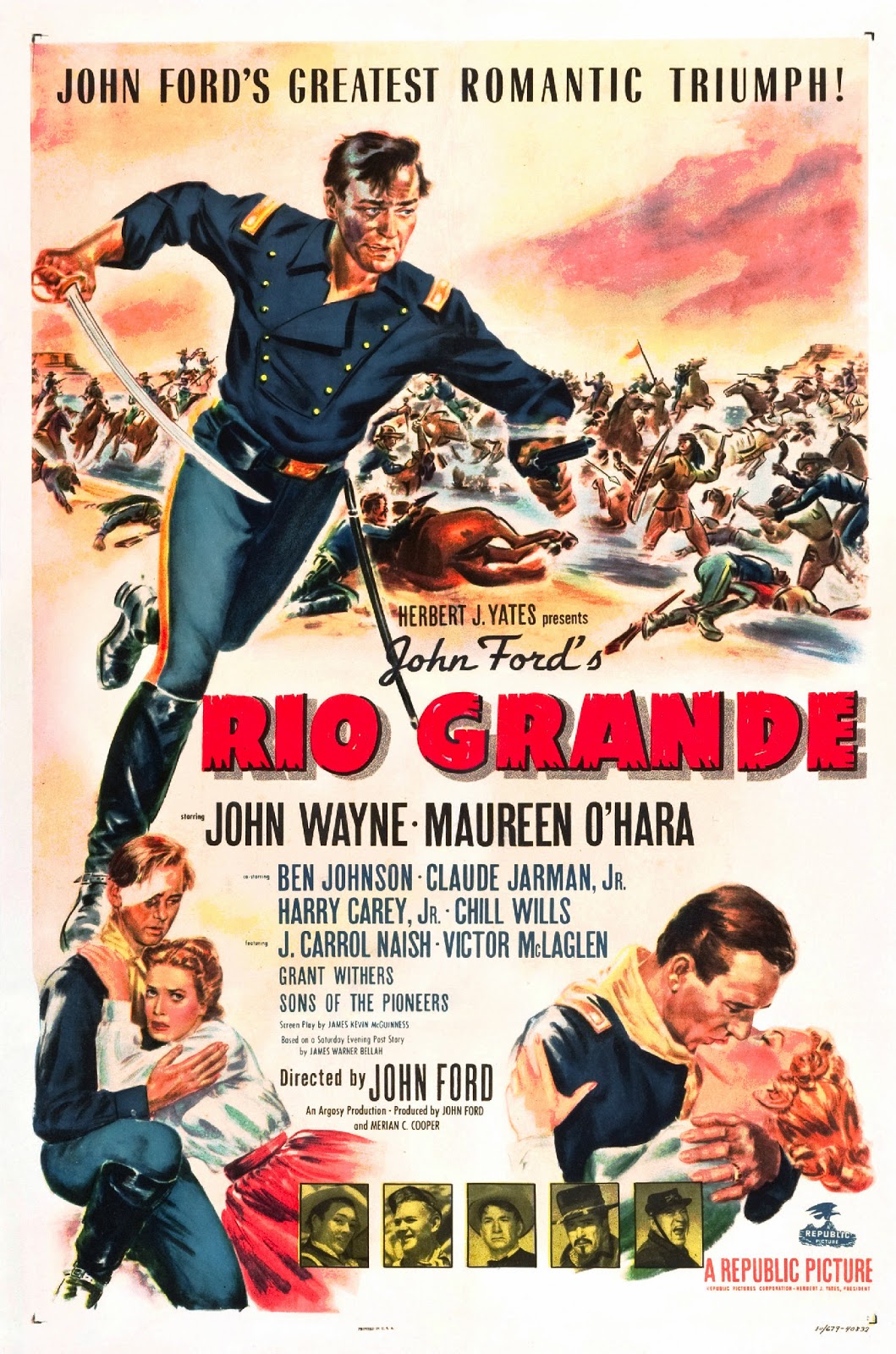
Rio Grande (1950)

John Wayne is the Colonel regretting past mistakes in Rio Grande

Director: John Ford

Cast: John Wayne (Lt Colonel Kirby Yorke), Maureen O’Hara (Kathleen Yorke), Victor McLaglen (Sergeant Major Quincannon), Ben Johnson (Trooper Travis Tyree), Claude Jarmon Jnr (Trooper Jefferson Yorke), Harry Carey Jnr (Trooper “Sandy” Boone), Chill Wills (Dr Wilkins), J. Carrol Naish (General Philip Sheridan)

John Ford’s next project was meant to be The Quiet Man, his Ireland-set passion project. However the studio, Republic Pictures, were not convinced the expensive picture could ever be a hit (it later became one of their biggest hits and only Best Picture nominee). So they told Ford he could make it on condition that he, and his proposed stars Wayne and O’Hara, first made a good old-fashioned Western. Because they sure as hell knew they could sell that. So Ford turned out the third and final picture in his “Cavalry” trilogy, three interconnected films (the others being Fort Apache and She Wore a Yellow Ribbon) with loosely connected themes and overlapping character names.

Lt Colonel Kirby Yorke (John Wayne) is posted on the Texan frontier, defending the settlers against Apache attacks. When Yorke’s son Jefferson (Claude Jarmon Jnr) – who Yorke wasn’t seen in almost eighteen years – washes out of West Point, he volunteers to join Yorke’s regiment as an ordinary Trooper.  This leads to the arrival of his mother – and Yorke’s estranged wife – Kathleen (Maureen O’Hara arriving at the Fort, eager to get her son out of an enlisted life she feels isn’t right for him. But Yorke is determined there will be no special treatment for his son, never mind how dangerous are starting to get with the Apaches. 

Rio Grande is a professionally assembled, classic Ford western that hits all the marks you could expect in terms of action, excitement and that romantic version of the West that you might expect from Ford. But it’s perhaps so professionally assembled it still feels like one for the money at times – it’s a collection of all you might expect from a Ford classic, so much so it doesn’t feel like it offers much new among the director’s other works.

It’s most interesting parts revolve around John Wayne’s complex performance as a man who has buried his emotions beneath a cover of professionalism. Yorke is now martinet, but he’s a man who has put duty above his personal relations. It’s easy to forget that in many of his iconic roles Wayne was often the veteran, and here is man nearing retirement, loaded down with regrets and secretly crying out for a chance at reconciliation. Wayne’s performance is heartfelt and tinged with sadness, the sort of man who looks at his son from a distance as he performs dangerous horse riding stunts, but then backs away into the shadows, anxious that his fatherly concern remains unseen. It’s a quiet, lonely and sad performance from Wayne, a reminder of what a soulful actor he could be.

It also helps that he has wonderful chemistry with Maureen O’Hara, equally wonderful as his wife. A caring and loving woman, O’Hara’s Kathleen is also determined and independent, sure of her own mind and with no compunction about standing her ground against her husband. The two of them make a wonderful pair, two people who fear they have turned their backs on happiness for duty but secretly desperate for reconciliation. That desire certainly drips from Wayne, whose sad eyes beneath his drooping moustache seem to be constantly searching for grasping something from his life – and Ford certainly knew how to shoot this American icon with angles that made him appear like a mournful monument.

The actual plot of the film outside of this isn’t really that strong. Any shade or depth is removed from the Apaches who are faceless, ruthless killers who move like a swarm and spend the nights dancing and drinking after a victory. Even at the time there were feelings that the film was uncomfortably slanted in its view of the Native Americans. The actual story of the battle against the Apache meanders across the screen, with discussions of crossing the Rio Grande to do battle with them largely forgotten in a final act kidnap plotline that serves as the film’s action set piece.

Honestly, most of the plot outside of whether Wayne, O’Hara and son (played with an earnest honesty by Claude Jarmon Jnr) pretty much is by the numbers stuff. There are a host of songs and musical interjections from contemporary Western group Sons of the Pioneers. Ford made a virtue of the studio’s decision to include the band – apparently they loved being in the film and led a number of impromptu sing-alongs during the late night cast sessions, which basically led to Ford putting more of them in the film. The songs do add a wistful, whimsical air to the film which actually works rather well and mirrors nicely the personal drama of a family unit which duty is keeping apart.

The action when it kicks in is enjoyable, even if Ford relies a little too heavily on over cranked cameras to adjust the speed of various falls and horse riding stunts – the sped up effect actually often makes the whole thing look a little too reminiscent at times of keystone kops silent film. The best stunt sequence is done instead in real time, as Johnson, Carey Jnr and Jarmon Jnr take it in turns to “Roman Ride” two horses at a time around a course. Johnson and Carey – skilled horsemen – spent weeks training, the effect was so good that Ford suggested Jarmon have a go.

The cast is rounded out by some solid work from Ford regulars. McLaglen is good value as a decent Sergeant, one of those comic Irish types that Ford had such fondness for. Johnson is very good as a trooper on the run from the law who can’t resist coming back to the do the right thing. But the film belongs to Wayne and O’Hara, a couple looking to seize a last chance at happiness. Rio Grande may be one for the money, but it’s still got a touch of that Ford magic.