Sentimental family drama has a slightly harder edge than you might expect
Director: Clarence Brown
Cast: Gregory Peck (Ezra ‘Penny’ Baxter), Jane Wyman (Ora Baxter), Claude Jarman Jnr (Jody), Chill Wills (Buck Forrester), Clem Bevan (Pa Forrester), Margaret Wycherly (Ma Forrester), Henry Travers (Mr Boyles), Forrest Tucker (Lem Forrester)
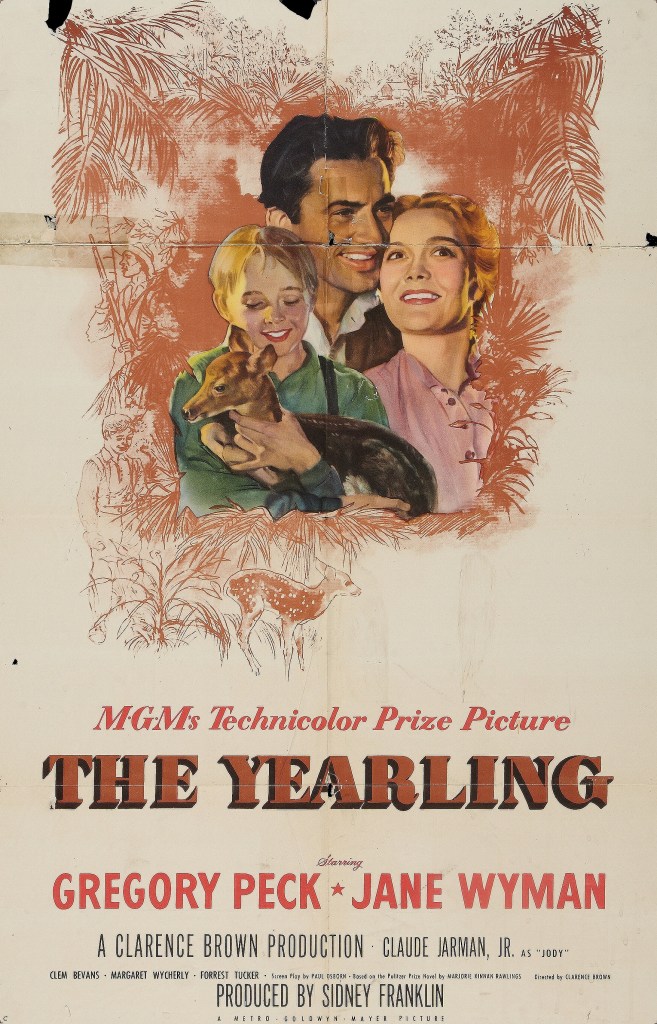
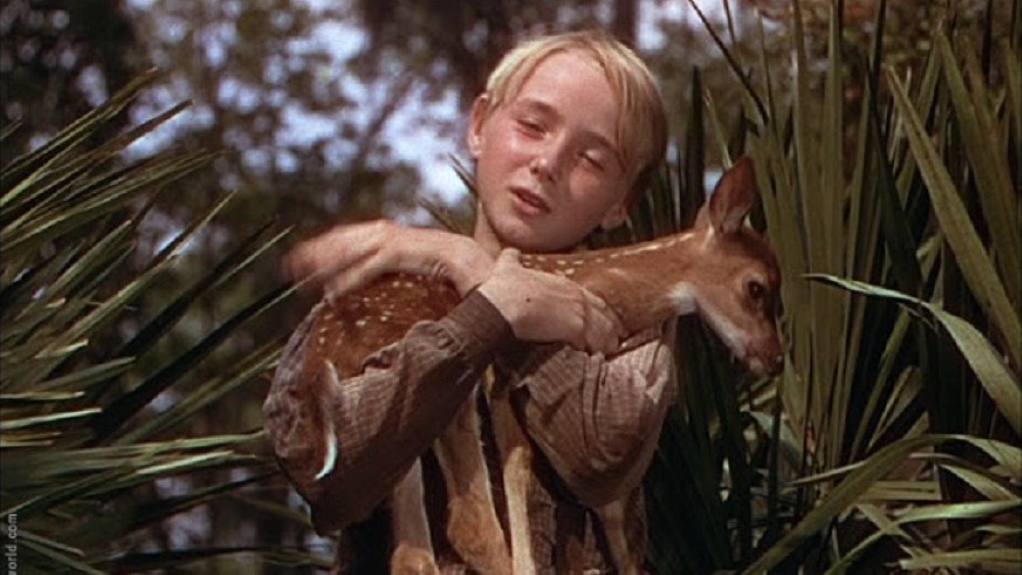
Based on a beloved best-seller, The Yearling is set in the Florida farmlands of 1878 where the Baxter family is struggling to make ends meet in tough conditions. Pa Ezra (Gregory Peck) and Ma Ora Baxter (Jane Wyman) have already buried at least two children, which has made Ma prevent herself from getting too close to their 12-year-old son Jody (Claude Jarmon Jnr). Jody has the love of his decent Pa, but his heart needs filling. He finds some of that missing love when he adopts Flag, an orphaned fawn. But a yearling isn’t the best house guest for a farm…
There is something very reassuring on the surface about The Yearling, a seemingly cosy film where the Baxter’s literally call each other Ma and Pa and are hard-working, honest Christian types. However, Clarence Brown’s film mixes sentiment with just enough bitter realism to make for a harder-edged experience than you might expect. That seeps through no matter how much the film is wrapped in gorgeous technicolour. The Oscar winning photography by Arthur Arling, Charles Rosher and Leonard Smith is full of gorgeous skylines and striking warm reddish firelight glows in huts, skilfully mixing locations and studio, all washed down with Herbert Stothart’s richly romantic score.
But it’s often the case films about children and animals are as much tragedies about an absence of love as they are about the sweetness of a child’s bond with one of God’s creatures. That’s certainly the case with The Yearling, a beloved family film that is more hard-hitting than you might expect, not least in the shocking ending of Jody and Flag’s friendship that traumatised generations. The real reason for Jody’s unbreakable love for this wild animal is knowing he’s been effectively rejected by his distant mother who has bottled up her emotions so tightly, only her husband knows how much she cares.
Jane Wyman is arguably the finest part of the film – and one of the easiest to overlook. Wyman’s Ora is beaten down by years of grinding work, relentless poverty and the never-ending blows of child-loss. She can seem humourless and sour, her contribution to a night of family storytelling being a flat, fact-filled statement. Wyman isn’t afraid to make her feel like a strict, hard-to-love mother who constantly corrects Jody. But there are hints throughout, from her quiet delight at the gift of fabric to her anxiety when Pa plans to take their son bear hunting, that lets us know this is a woman of great emotion, terrified to let it show. It’s a tough line to walk, but Wyman does it really well.
But you can still understand why young Jody is wary of her – and why he is invested in his relationship with his father. This father is of course Peck, in a role tailor-made for the most decent and unimpeachable of Hollywood’s leading men (even if the patrician Peck is not your first thought for a farmer). Manly but in touch with his feelings, doting but still a firm dad, He can talk to Jody about life but still stare into the middle distance with a mix of grandiosity and sober mannerism with grounded decency and gentleness. He even has a little touch of naughtiness, willingly misleading a bull-headed neighbour on the value of useless dog without once telling a lie about its qualities.
Arguably The Yearling would work better if both Jody’s parents were distant. It would make even clearer the emotional hole in his life that, like his sickly friend Fodderwig, he fills with creatures who are less complex than human beings. But much of the first hour focuses instead on Jody’s life on the farm, learning the ropes alongside his ever patient Pa. And there are lot of ropes: from managing feeble crops, to building fences and hunting. It’s also not exactly safe – something you realise clearly on watching the surprisingly ferocious bear-dog fight Brown stages (I was relieved, and also surprised, Animal Rights gave this the thumbs up) or Pa going to desperate measures to save himself from a snake bite.
Which all serves as a reminder that wild animals and farmland don’t go well together. Possibly because the deer was apparently such a nightmare to shoot – wild animals apparently don’t take direction – there is no attempt to anthropomorphise Flag. It’s clear from the start that, no matter how much this fawn follows Jody around, he’s a liability. One of the first thing Flag does is drink the carefully collected cows milk. As he gets older he tramples or eats crops and no matter how hard Jody slaves on fences and other means to try and stop Flag. This is the hardened realism under The Yearling’s romance.
Of course, Pa never should have allowed Jody to keep the animal in the first place. Ma certainly never would, but that’s probably why Pa does. It’s only storing up trouble for a sensitive boy. Jody is a caring boy who treats people with kindness, but also strikes out when he feels he is treated poorly (he even throws a stone at the daughter of the trading store who mocks his nervous affection). A more challenging film than The Yearling may well have pushed us to recognise the lack of human complexity in Flag is probably the main attraction to Jody, but you can still pick that up.
Claude Jarmon Jnr does a decent job as this young child, even if Clarence Brown lets him breakdown into tear-soaked blubbing once too often (even Peck later mocked the film as the one where “the kid cried too much”). But The Yearling is good at depicting the innocence of childhood, where every day is an adventure and a trusted Pa can make everything turn out well. Learning that the world is not exactly like that is the focus of The Yearling’s closing act, and while its answers are generally fairly simplistic and lean towards reassuring, they are delivered with a certain satisfying emotional heft.
It’s part of what makes it such an iconic family film. Because sometimes the ones that stick with us are the tough coming-of-age tales that start with the magic of childhood adventures and end with unbearable sacrifices on the way to cathartic emotional discoveries. The Yearling has a lot of this, probably why it’s been such a reliable crowd pleaser for decades.