Tag: Katharine Hepburn

On Golden Pond (1981)

On Golden Pond (1981)

Sentimental drama, sickly-sweet, which owes any success it is to its legendary leads

Director: Mark Rydell

Cast: Katharine Hepburn (Ethel Thayer), Henry Fonda (Norman Thayer), Jane Fonda (Chelsea Thayer), Doug McKeon (Billy Ray Jnr), Dabney Coleman (Dr Bill Ray)

The, admittedly luscious, score by Dave Grusin gives you a pretty good idea of what to expect, as Billy Williams’ camerawork drifts over a sun-kissed lake. On Golden Pond is an overwhelmingly sentimental film, just about lifted above its Hallmark Classic material by its legendary cast. Justified residual affection for them made this frequently mawkish, sickly-sweet film a massive box-office hit. Instigated by Jane Fonda, as a late bridge for a final reconciliation with her father Henry, it won him an Oscar 41 years after his last (and only previous) nomination.

Henry Fonda plays Norman Thayer, a curmudgeonly academic on the cusp of his 80th birthday, whose avuncular abruptness covers a fear of death and the slow decline of his wits. Along with his supportive, sparky wife Ethel (Katharine Hepburn) he’s spending this birthday at their summer home on the shore of New England golden lake. They are joined, unexpectantly, by their marginally estranged daughter Chelsea (Jane Fonda) with her new boyfriend Bill (Dabney Coleman) and his thirteen-year-old son Billy (Doug McKeon) in tow. Chelsea and Bill leave for a holiday in Europe, leaving Billy behind. Can Billy and Norman find common ground, and will the presence of this young man help Norman and Chelsea find reconciliation and understanding after years of tension.

If you don’t know the answer, you’ve not seen enough movies. Pretty much every development in On Golden Pond could be jotted down correctly on a pad in advance. Of course, Norman’s hostility will melt slightly as he rediscovers something of his playful youth and vigour in the kid. Of course, Billy’s contempt for the gentle pleasures of Golden Pond will wash away as he embraces the delights of fishing, reading classic novels and playing board games under the increasingly warm surrogate parental eyes of Norman and Ethel. Of course, Chelsea’s ostentatious determination to only refer to Norman by his name will eventually see her calling him ‘Dad’. Of course, Norman will finally allow himself to confess his love for his daughter.

All these inevitable emotional plot developments are hit with assured smoothness in Rydell’s straight-forward film, perfectly packaged for mass appeal. Every character is an archetype: the grouchy old guy with a heart of gold, the loving wife who devotes herself to exasperatingly caring for her husband and smoothing over those he offends, the prickly daughter whose resentment hides her desperate need for her father’s love… You could argue the film’s very predictability is the secret sauce behind its success.

It can be safely consumed as a heart-warming fable. So much so, it’s easy to miss how biased the film is in favour of the older generation. So sentimental is the eye it casts over Norman, so forgiving and sympathetic is it to his quiet raging against the dying of the light, that it effectively gives him a pass for any responsibility for the coldness between him and his daughter, partially born from his domineering expectations and demands of her.

When Chelsea complains to Esther about her father’s coldness, distance and high standards, she’s roundly told she should have seen past this to the love her father buried deep down. (Esther even slaps her for questioning it!). This is a film that firmly states the younger generation should adjust to fit in with the older. Chelsea should pull herself together, stop whining, and get over the fact her Dad never really told her how he feels: that, effectively, the problem they have is her expectations rather than his failures. It’s fitting with a film that, however charmingly it does it, also sees Billy adapting and changing to better fit in with the Thayers rather than any vice versa. God knows what it would make of something like Five Easy Pieces.

The film’s patronising, one-sided view of generational conflict and its soppy sentimentality would make it unbearable, if it wasn’t for the performers at its heart. Henry Fonda, with less than a year to live, takes a cliched character and invests Norman with a richness and depth of personality that is far more than the film deserves. Fonda’s precise diction and ability to turn those blue eyes cold is perfect for Norman’s grouching, but when those same eyes collapse into panicked fear (such as when Norman gets lost in woods he has walked all his life) it’s as moving as his attempt to shrug off his failing memory.

Fonda’s perfectly delivers both the irritation and hidden fear when he stares at photos of himself and his younger family and plaintively asks who they are.  He makes the bond with Doug McKeon’s Billy (also excellent) genuinely rather sweet, these two kindred souls shooting the breeze and catching fish like life-long buddies (Fonda fills Norman here with an almost teenage sense of naughtiness). It’s a rich, charming performance.

He’s expertly supported by Katharine Hepburn, who brings her customary spark, fierce intelligence, take-no-nonsense assurance and dry wit to Esther. Truthfully the role, for which she won a record-breaking fourth Oscar, is almost identical to Guess Who’s Coming to Dinner. Once again, she is the dutiful but loving wife, smoothing over the feathers her husband disrupts and speaking home truths to her disappointed child. Hepburn could probably do this standing on her head, but that doesn’t mean she doesn’t nail it. Jane Fonda, a far more generous performer than she gets credit for, plays Chelsea with such emotional commitment it can’t help but pull some heartstrings. Even Dabney Coleman is restrained and gentle.

Of course, a lot of this success also comes from the deeply blurred lines between truth and fiction that abound in On Golden Pond. It’s no secret to anyone watching that the Norman-Chelsea relationship has multiple parallels with that of Henry-Jane. Jane Fonda had planned the film as a tribute to her father (much to the disappointment of James Stewart who dreamed of playing it), and when the duelling father and daughter quietly reconcile, it’s impossible to not also see the real actors themselves building bridges after a lifetime of disagreements. It’s a greater emotional impact than the actual film itself and surely contributed to its success.

On Golden Pond is less successful on its own merits. An overly sentimental film, with a golden-eyed regard for the dignity and decency of the older generation, where inter-generational conflict is resolved with a few gentle words and a backflip off a diving board. Remove the actors – and the emotional truth behind its making – and you have a very slight, predictable and manipulative movie.

Summertime (1955)

Summertime (1955)

An independent woman finds romance in Venice in this luscious travelogue, one of the best of its genre

Director: David Lean

Cast: Katharine Hepburn (Jane Hudson), Rossano Brazzi (Renato de Rossi), Darren McGavin (Eddie Yaeger), Jane Rose (Mrs McIlhenny), Mari Aldon (Phyl Yaeger), Macdonald Parker (Mr McIlhenny), Gaetano Autiero (Mauro), Jeremy Spender (Vito de Rossi), Isa Miranda (Signore Fiorini)

American spinster Jane Hudson (Katharine Hepburn) has dreamed of her holiday-of-a-lifetime in Venice for as long as she can remember. So long in fact, that she wants to capture every single minute on camera and not miss a single sight in the gloriously romantic city. But there is more in this canal city than she expected, something her life of proud, self-sufficient, isolation has had little of: romance – namely from antiques dealer Renato (Rossano Brazzi), the two of them thrown together by chance, in a meeting of hearts and minds.

Summertime was, surprisingly, referred to by David Lean as his personal favourite of his films. It feels like an odd choice: the final film shot in the period between his ever-green 1940s British classics (and Summertime has echoes of Brief Encounter, from love affairs to train stations) and the super-epics that would fill the rest of his career. But, in its patient, quiet and slightly sad look at the continuous presence of regret in our lives and our feelings of loneliness, it perhaps speaks of something in the soul of this surprisingly vulnerable great director.

It won’t have hurt either that Lean himself fell in love with Venice during the shooting of the film. Summertime is very much in the genre of “romantic holiday travelogue” so beloved of the 1950s, when it was practically de rigeur to send glamourous Hollywood stars to exotic locations to conduct star-cross’d love affairs. Summertime might just be the finest of these, combining one of Hollywood’s all-time greats with a director and cameraman who made the setting truly cinematic, rather than the holiday snaps the journeymen who shot similar films reduced the locations to.

I’ll admit it helps I love Venice as well (and it’s amazing, watching this, how little the city has changed in the past 70 years). But Lean and gifted photographer Jack Hildyard shoot it with an intimate wonder. We follow Hepburn down the city’s winding streets and across its many bridges with a close intimacy that doesn’t shy away from the bustle of the city. A beautiful moment sees the camera slowly reveal the appearance of the St Mark’s Square campanile through an arched streetway. Carefully cut imagery flicks over striking features of Venetian architecture. Lean and Hildyard make the city feel like both a dream of a destination, but also a real, organic place, full of delightful nooks and crannies. It’s a masterclass in how to shoot a city both for impact and truth.

It’s a backdrop for an affecting, low-key, character study that gains hugely from the intelligent, emotionally precise performance from Hepburn. No actress in Hollywood could convince more as a woman full of enough brio and confidence to be very comfortable in her own solitude. The brilliance of Hepburn though is to play this all as a carefully maintained front shielding a loneliness she is always aware of but doesn’t want to acknowledge. It’s there from her compulsive need to make conversation with a fellow passenger (a lovely uncredited cameo from André Morell) on the train into the city, or with the people she meets at her hotel. The desire for human contact fills the easy rapport she builds with street urchin Mauro (a lovely performance from Gaetano Autiero) or the awkwardness she feels sitting alone in the bustle of St Mark’s.

It’s why romance – or perhaps the lack of it in her life – creeps up on Jane. Her first chance encounter with Renato is at a café in St Mark’s when he signals down the waiter she’s struggled to catch the eye of, leaving her discombobulated and uncomfortable, as if surprised that a man has taken even a passing interest in her, and uncertain how to respond. She retreats and sit on the canal-side, her eyes caught by a lion-headed drain that water laps in and out of. Perhaps only Hepburn could turn such a small moment into one of such profound passing reflection – and Lean shoots it with a beautiful simplicity.

The relationship slowly builds as she happens to chance on Renato’s antiques shop and he sells her an 18th-century Venetian red glass goblet. Hepburn has a beautifully sensitive, almost girlish tentativeness to her as they walk idly together the next night through the streets. After they kiss under a bridge, she impulsively mumbles she loves him and then runs, as if she was startled by her own confession. The next night she prepares to meet him with a pampering session not out of place in a teen drama, sitting waiting for him with a giddy excitement.

As her beau, Rossano Brazzi has a wonderful unknowable quality to him. There are touches of his own sensitivity and isolation. There is also the worry, as he sits with cosmopolitan ease at a café table or (possibly) flogs Jane a worthless red glass goblet (she later discovers they are ten a penny, though he swears his is a genuine antique) that he could be a heartless roué. Jane worries it as well. But does she care? After all, this is a holiday-of-a-lifetime and perhaps a love affair is just part of that. It might well be the same for Renato: like Brief Encounter, two lonely people who recognise qualities in each other come together for a brief time, to find a little comfort. Let the fireworks explode (which Lean literally does in one more-than-suggestive cross-cut late in the film).

Summertime is very romantic, but it’s also very true. Both Jane and Renato know exactly what they are getting going into this: a blissful moment in time, but not a lasting commitment. There is something very true about this: and a pleasing acknowledgement that independence isn’t a condition to be fixed, but a state that allows bursts of companionship in between voyages of self-contentment. It’s mixes this with touches of humour (Hepburn sportingly performs a pratfall into the Venetian water – although it left her with an eye infection that troubled her for the rest of her life).

It’s possibly the finest travelogue romance ever made, very well paced and gently but handsomely filmed by Lean. Hepburn gives a stunningly intelligent, gentle and wise performance and its honest look at loneliness and passing regret at that loneliness – but still being contented at the choices you have made in life – also make it perhaps one of the most realistic and true-to-life.

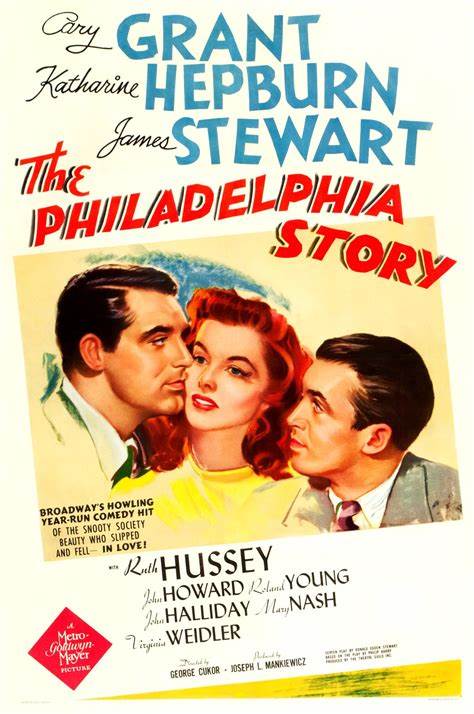
The Philadelphia Story (1940)

The Philadelphia Story (1940)

Three stars are at the top of their game in this classic screwball-style comedy

Director: George Cukor

Cast: Katharine Hepburn (Tracy Lord), Cary Grant (C.K. Dexter Haven), James Stewart (Mike Connor), Ruth Hussey (Elizabeth Imbrie), John Howard (George Kittredge), Roland Young (Uncle Willie), John Halliday (Seth Lord), Mary Nash (Margaret Lord), Virginia Weidler (Dinah Lord), Henry Daniell (Sidney Kidd)

In 1938 Katharine Hepburn’s career was over. After the flop of some now forgotten (wait, hang on…) screwball comedy called Bringing Up Baby, she took centre place on the Independent Theatre Owners list of “Box Office Poison”. Flops after flop hit Hepburn (all of them are classics today of course), and the studios did their damnedest to drop her. So, Hepburn returned to the stage, developing The Philadelphia Story with Philip Barry – and creating a lead role for herself that would play to all her strengths and help win back public affection. And which (with a little help from Howard Hughes) she would own the rights for: so, if and when they wanted to make a film, she could insist she starred. The rest is history.

The Philadelphia Story is perhaps the best example of the Code-approved genre, the “remarriage comedy” (because the code wouldn’t countenance the idea of a couple cheating). Daughter of a rich Philadelphia family, Tracy Lord (Katharine Hepburn) is to marry her dull fiancée George Kittredge (John Howard). George’s main attraction is he’s the complete opposite of her charismatic ex-husband C.K. Dexter Haven (Cary Grant). Dexter crashes the build-up to the wedding, bringing along reluctant society journalist (he’s really a renowned short-story writer) Mike Connor (James Stewart) and press photographer Elizabeth (Ruth Hussey), promising to introduce them as distant friends of the family so they can report on the wedding. But then Tracy finds herself drawn to Dexter and Mike and George as well – who will she end-up walking down the aisle with?

Perhaps the best thing about The Philadelphia Story is that you really don’t know who it will be – and the film successfully keeps the question both up-in-the-air and deeply entertaining. There even seems a chance (unlikely as it is) that Tracy really will stick with George (a tedious nouveau riche businessman with priggish middle-class morals who can’t even mount a house – imagine!). Directed with the sort of unfussy smoothness Cukor excelled in – and helped get the best out of actors – it’s a superb comic treat, with a sparkling adaptation by Donald Ogden Stewart.

At the heart of it, Hepburn is superb in a role that riffs considerably off her own public personality. Hepburn was smart enough to know most audiences saw her as far too clever by half. Her sharpness, acidity and no-nonsense unwillingness to suffer fools had made her hard to relate to. Quite correctly, she felt she needed a role where she could “fall flat on her face”. Which , by the way, is more or less the first thing she does – a hilarious prat fall while throwing Cary Grant’s Dexter out, him responding to her snapping his golf clubs by gently putting his hand on her face and pushing her off-balance (only Grant could have got away with that by the way).

Tracy Lord is a version of the Hepburn many people felt they knew. Tracy genuinely believes she’s smarter and better than anyone else, with unquestionable judgment and superior morals. The film is a gentle exercise in pricking her balloon, showing her she is as prone to mistakes, prejudice and, above all, getting giddy and silly in love, as anyone else. This is a fiercely practical woman, who sets high standards for those around her, suddenly finding herself falling in love with three men at once. It’s the exact flighty lack of commitment she spent years condemning her estranged father for.

This is all scintillatingly played by Hepburn, at her absolute best. The rat-a-tat dialogue (with its classic, Wildean comedy of errors and mis-identification) is under her complete control. She’s delightful when, under the influence, she flirts with Mike – Hepburn showing the world (clearly they missed it in Bringing Up Baby) that she could be as silly and vulnerable as the next girl. Hepburn knew people wanted to see her personae deconstructed, and for her character to learn that (in the words of another comedy) nobody’s perfect. It works a treat – and this remained one of her greatest (and funniest) performances.

It helps she had two of the greatest to riff off. Cary Grant is at his light-comedic best here, turning Dexter – a manipulative reformed alcoholic it would be easy to dislike – into the embodiment of sophistication, charm and playful wit, who we adore as much Tracy’s family does. James Stewart won an Oscar and matches Grant gag-for-gag in a comedic masterclass. He’s a master of hilarious comedic and physical reactions – and lovable enough to turn a chippy newspaperman into a sort of hilariously droll sage. His ‘drunk’ acting is also some of the funniest you’ll see on film (even Grant can be spotted cracking up just a little as Stewart hiccups his way through a scene).

Hepburn’s chemistry with both actors is sublime. Her romancing scenes – both the worst for wear for drink, but also empowered to say things they’ve clearly been burying all day – with Stewart are not hugely romantic, but also rather sexy (Cukor’s direction here is also exquisitely spot-on). It’s a masterclass in on-screen flirtation – and you can see why George gets as pissed off as he is. Hepburn and Grant meanwhile bicker and taunt each other with all the chemistry of a match and a fire.

Each scene has a bounce that teeters between heart-felt and farcical. The set-ups are frequently silly – but they work because they hinge on characters that feel immensely real. Every performer is spot on – credit also goes to a superb Ruth Hussey, one of the few grown-ups in this weekend of flirting, feuding children. Set in a sumptuously rich Philadelphian mansion, for all of Mike’s chippy criticism it’s a celebration of the smooth upper classes over hard-working, dull prigs like George. Its sole fault might be it’s too long (at just under 2 hours, a few scenes and set-ups outstay their welcome). But, as a classic Hollywood comedy, it’s pretty much the top of the class. Box-office poison no more.

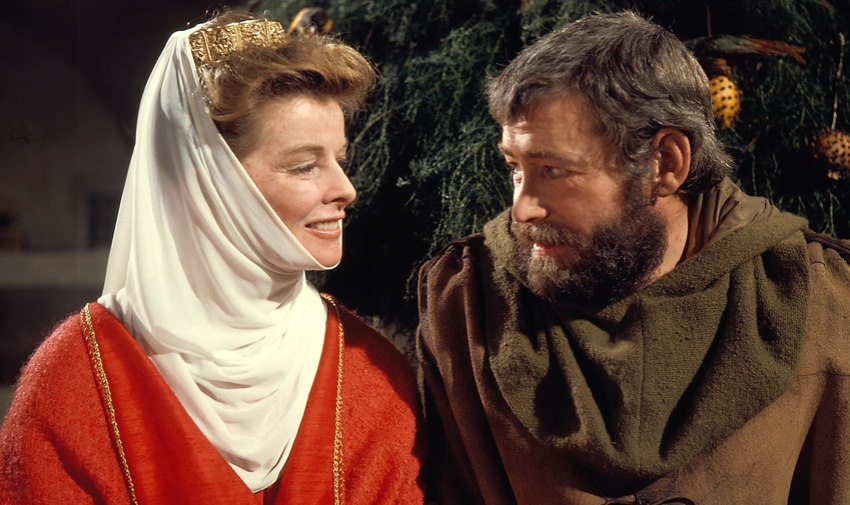
The Lion in Winter (1968)

Katharine Hepburn and Peter O’Toole are the feuding royals in The Lion in Winter

Director: Anthony Harvey

Cast: Peter O’Toole (Henry II), Katharine Hepburn (Eleanor of Aquitaine), Anthony Hopkins (Richard the Lionhard), John Castle (Prince Geoffrey), Nigel Terry (Prince John), Timothy Dalton (Philip II), Jane Merrow (Alais), Nigel Stock (Captain William Marshall)

James Goldman’s play The Lion in Winter did solid but not spectacular business on Broadway. But when it came to film, it surfed a wave of popularity for stories about British history and became one of the most financially successful films of its year, winning three Oscars (including for Goldman). Even more than that, it went on to be West Wing President Jed Bartlett’s favourite movie of all time. I think we know which prize is the most treasured.

Christmas 1183 (including an ahistorical Christmas tree and gift wrapped presents and all) and Henry II (Peter O’Toole), king of England and huge chunks of France, wants nothing more than family around him to mark the occasion. Problem is, this is possibly the more dysfunctional family ever. His Queen Eleanor of Aquitaine (Katharine Hepburn) has been under “home arrest” for ten years in her castle, and his children Richard (Anthony Hopkins), Geoffrey (John Castle) and John (Nigel Terry) seem to take it in turns to conspire against their father, their allegiances shifting faster than even they can sometimes follow. For added complexity, Henry is living with his late eldest son’s intended Alais (Jane Merrow) as husband and wife and her half-brother the new King of France Philip II (Timothy Dalton) is joining the family for Christmas. Over one night, this family will fight, feud and change pacts and allegiances until hardly anyone knows where the games end and the hate begins.

Anthony Harvey’s film is a stately, often wordy, faithful reconstruction of Goldman’s script that gives front-and-centre to the often scintillating dialogue between the family members, that leans just the right side of ahistorical (sample line: “Hush dear, Mummy’s fighting”) but frequently allows it’s top-of-the-line cast to let rip on some glorious speeches and dialogue duets crammed with ideas, wordplay, character and wit. Harvey therefore basically decides to sit back as much as possible and allow the actors do the work, using a mixture of medium shots and close-ups to bring the focus as much as possible to the Broadway-style staging or into the actor’s faces. He also uses the strength of the performers to allow for a series of long takes as they burn through pages of Goldman’s dialogue. The fact that there is hardly an interesting shot in the film, and its visual language never matches it’s verbal fire is a shame, but a price the film thinks worth paying.

And it matters little when Harvey is able to work as well with actors as he does here. All the performers are at the top of their game. Katharine Hepburn (winning her fourth Oscar, in a tie with Barbra Streisand in Funny Girl) has the perfect level of acute intelligence and imperious arrogance for Eleanor. But Harvey encourages from her a softness at crucial moments, that in-between the barn-storming speeches and verbal putdowns, Hepburn finds moments of quiet sadness and loneliness – a sense that sometimes ten years of imprisonment means she has had enough of all this – that are some of her most affecting work on screen. She’s hilarious but deeply moving – and totally believable as one of the most powerful women of the middle ages. 

She also is matched perfectly with O’Toole. Playing a 50-year old King at 35, O’Toole brings all the fire and charisma of his personality to the part, in a film where he perfectly balances the larger-than-life gusto of Henry II with his own personal disappointments, guilt and sorrow. O’Toole had already triumphed once as the charismatically brilliant king in Becket (for which he was also Oscar nominated, as he was here), but this performance is even better. Not only is his facility with the dialogue faultless, he also utterly convinces as the sort of awe-inspiring figure who dominates every room he’s in not just with force of character but the acuity and sharpness of his intellect. This might be his finest screen performance – and the one where he was most cheated of the Oscar (losing to a highly active campaign, criticised at the time, from Cliff Robertson in Charly).

To fill the cast out around these pros at the top of their game, Harvey raided British theatre to pluck some promising gems from British Theatre, more or less all of them here in their film debut. Anthony Hopkins is marvellously proud, forceful but just a few beats behind most of the others as a Richard who says what he means and sticks to it. Timothy Dalton is his polar opposite (and equally brilliant) as a Philip II who never says what he means and manipulates with a playful ease everyone he meets. John Castle (an actor who never had the career he should have had) is smugly unlikeable and coldly superior as the unliked middle-brother Geoffrey, while Nigel Terry is a snivelling punching bag as two-faced coward John. Jane Merrow is heartfelt and earnest as Alais, the only unquestionably kind and good person in this bunch.

These characters rotate sides and allegiances over the course of one evening, raging at each other like a medieval Who’s Afraid of Virginia Woolf? The brilliance of the dialogue never stops entertaining – although towards the end the film loses a bit of energy (it probably peaks with Henry’s loud double bluff of dragging the family in the middle of the night to a wedding he has no intention of seeing performed), perhaps partly because the film itself never really comes to flight as something cinematic. This is despite the decision to downplay the glamour – costumes are simple and look lived in (the cast wore them for hours off set to make them look lived in) and sets are far from pristine. It perhaps contributes to the slightly mundane feel of the filmmaking.

But the tricks are all in the dialogue and perhaps the film works best with an interval and a chance to take stock. There are several marvellous scenes, even if the constant feuding and side changing does wear you out after a while. But it’s a treat for the acting. Hepburn and O’Toole are simply at the top of their game, and the rest of the cast more than keep up with them. With an excellently imposing score from John Barry (also Oscar-winning), it’s a shame the film itself is a little too flatly and uninspiringly filmed with a murky lack of visual interest, but there are more than enough qualities for you to issue a pardon.

Adam's Rib (1949)

Spencer Tracy and Katharine Hepburn go toe-to-toe in court and marriage in Adam’s Rib

Director: George Cukor

Cast: Spencer Tracy (Adam Bonner), Katharine Hepburn (Amanda Bonner), Judy Holliday (Doris Attinger), Tom Ewell (Warren Attinger), David Wayne (Kip Lurie), Jean Hagen (Beryl Caighn), Hope Emerson (Olympia La Pere)

He’s a tough-on-crime DA. She’s a top liberal lawyer with a feminist agenda. So when Doris Attinger (Judy Holliday) is arrested for firing a gun at her philandering husband Warren (Tom Ewell) and his lover Beryl (Jean Hagen), naturally Adam (Spencer Tracy) and Amanda Bonner (Katharine Hepburn) end up on opposite sides of the court case in this witty “battle of the sexes” married life comedy.

Directed with unfussy calmness by George Cukor who, as he often does, hires the best actors, points the camera and lets them get on with it, Adam’s Rib is an enjoyable and fascinating watch, partly ahead of its time in its gender politics, partly relic of another era. It completely accepts the idea that a woman can be a successful, skilful lawyer – the idea isn’t even questioned – while still bemoaning the march of militant feminism. After all even the title is a humourous little reminder of where Eve came from.

The plot revolves around Amanda’s belief that a man firing a gun at a cheating wife would get very different treatment from a woman doing the same: that he would be seen as a man protecting his home, while the woman is a neurotic danger. Adam disagrees strongly with this – a crime is a crime – and to be honest he’s probably right (today Doris would almost certainly go down for actual bodily harm, if not attempted murder). But in the 1940s, this issue gets tied up with women starting to push against the idea that their role was just to follow the man’s lead and not threaten to shake up his existence. And that’s exactly contrary to what happens in this film.

Amanda is played by force-of-nature Katharine Hepburn at her most quick-witted and sharp, a lawyer more successful in many ways than her husband (and by being in private practice, probably the main bread winner as well, although that is never stated). Her place in the court is never questioned, which is interesting in itself in the post-war era where the idea of women in the professional world was just beginning to be seen as a possibility (although lord knows there was still decades to go until it was to be seen as completely normal).

It’s not a position that Adam questions. His main problems are more with the law being used as a tool for a very specific agenda, rather than a feeling that women are crowding into his realm. Played with brusque stuffiness and uncomfortable formality that tips over into moral outrage by Spencer Tracy (again showing his natural gift for both acting and reacting), Adam feels that his belief in the law is being damaged by Amanda’s use of Judy’s case as a political tool for women’s rights, rather than being judged on its actual merits. 

So this becomes the spring board for a series of extremely well-acted (and frequently funny) arguments between this tempestuous couple as the court case turns from a flirtatious rivalry into an increasingly bitter one. These ding-dong battles work so well on screen because of the immense chemistry between Tracy and Hepburn, a couple so devoted in real life that they convey this even when really going at each other on screen. 

Mix that in with an obvious sexual chemistry between them (and this film is remarkably open about sex, by my count the camera cuts to black to imply sex at least three times in this movie – and the couple have separate beds in their bedroom as per the Hays Code, but only one sees the sheets disturbed by sleeping!) and you’ve got an entertaining show. The courtroom antics are frequently both dynamic and entertaining, and the perspectives of both Adam and Amanda carry force – yes women are treated differently by the law, but you surely can’t deny that Doris broke that law.

There isn’t much room for the rest of the cast apart from the barnstorming Tracy-Hepburn show, with the two seasoned performers tearing through the screen. Judy Holliday comes off best in the second-string as the woman on trial, suggesting enough hypocrisy and two-facedness under the surface of her butter-wouldn’t-melt sweetness. Holliday was also helped by Hepburn’s generous insistence that she be made the focus of their scenes together – Hepburn being keen to help Holliday land the leading role in the film Born Yesterday, the play of which made Holliday’s name on Broadway (it worked and Holliday won the Oscar the next year). 

Of the rest, there is a neat, naughty little cameo from Jean Hagen as the other woman, though Tom Ewell mugs as the husband. David Wayne meanwhile plays the Bonners’ next door neighbour, a supremely irritating musician, smug and trying, but whom we’re meant to think of as a witty, eccentric “character”.

The latter half of the film starts to tip a little bit, as Adam has of course to end with the upper hand (he is after all the man!) which he does using underhand tactics and an actually rather unpleasant business with a fake gun (the sort of trick that you imagine if Tracy had pulled in real life, Hepburn would have walked out of the door and never come back). But this is still a film with plenty of top gags and a refreshing look at a marriage where both participants are professional equals and which goes quietly some way in arguing for greater rights for women, before retreating back to its more conservative resolution. Still great entertainment – and Tracy and Hepburn are both at the top of their games here.

The African Queen (1951)

Katharine Hepburn and Humphrey Bogart on a sweaty romantic river cruise in The African Queen

Director: John Huston

Cast: Humphrey Bogart (Charlie Allnut), Katharine Hepburn (Rose Sayer), Robert Morley (Reverend Samuel Sayer), Peter Bull (Captain of the Königin Luise), Theodore Bikel (First Officer of the Königin Luise), Walter Gotell (Second Officer of the Königin Luise), Peter Swanwick (First Officer of Fore Shona)

John Huston’s The African Queen is a beloved classic – so much so its odd-couple romance in tropical climes has been endlessly ripped off and riffed on practically ever since it was made. It’s a gentle, enjoyable travelogue of a movie where (truthfully) not much happens, other than we sit back and watch two masters of cinema acting go through the paces with consummate skill.

In 1914 in German East Africa, missionary brother and sister Samuel (Robert Morley) and Rose Sayer (Katharine Hepburn) plough their lonely furrow bringing God’s word to the disinterested natives, their only contact with the outside world being drunken Charlie Allnut (Humphrey Bogart), captain of the steam ship The African Queen, who delivers their supplies. Their world is turned upside down when Charlie brings news of World War One. The Sayers plan to stay, until German soldiers burn down the mission and assault Samuel who swiftly dies of fever. Charlie agrees to take Rose out of danger on his steam boat – but on the dangerous journey Rose develops a plan to use The African Queen to sink a German gun boat preventing British access to Africa, and Charlie and Rose find themselves – much to their surprise – falling in love.

Truth be told, nothing happens in The African Queen that you will find remotely surprising if you’ve ever seen a film before. Not even in 1951 could anything in this film be said to be pushing the envelope or offering something different to hundreds of studio epics past. Two people who seem to have nothing in common come together only to find, by heck and by jiminy, they actually are perfect for each other. Obstacles are put in place for them to struggle against but eventually love (and our heroes) triumph over all. Hip hip hoorah! You can see why the picture is so widely loved – it’s in many ways totally unchallenging and familiar.

John Huston seems to know this and just sits back and allows the film to almost tell itself with a professional, unfussy precision. The African Queen is an extremely well made film, sumptuous to look at, and never overstaying its welcome. It’s been boiled down to its barest necessities, and as such it works extremely well. There’s nothing extraneous in there – heck the film only really has three characters and one of them dies in Act One. Huston’s demands to film the entire thing (more or less) on location in the Congo is totally validated by the immersive filth, sweat and heat that reeks off the picture and seems to have soaked into the skin of the actors. 

Huston also understood that the real gold here was the acting – and the chemistry – of his two beloved stars. Tales of the making of the film are legendary – Bogie brought along Bacall, who helped out on catering, Hepburn refused to join the Bogart/Huston drinking sessions and became the only one to get ill from drinking the water, all four became lifelong friends. The script originally demanded Allnut to be a chippy cockney and Rose to be a prim schoolmistress type. The parts were re-written, Allnut into a “Canadian” (yeah right) while Hepburn reimagined Rose as, by her own admission, a sort of Eleanor Roosevelt in the jungle.

But it works a treat because both stars are on fire in this vehicle. Bogart perfectly mixes drunken awkwardness and defensiveness with a roguish charm, and what grows into a sprightly delight at being taken seriously for the first time in his life. Allnut is besotted with Rose from early on – even if he can’t admit it – and his whole personality seems to flourish and grow from her attentions, while never losing that slight “little boy lost” air. Mind you, Rose is as clearly attracted to Allnut early on as he is to her – but with her ideas of standards she would never allow herself to explore those feelings except in extreme circumstances.

Hepburn is such a gifted actor that you always know Rose is a far more intelligent, interesting and dynamic character than the one we are introduced to playing piano at one of her brother’s interminable sermons. Shaking off – with Allnut’s help – her shock at his death, she swiftly displays a head-girlish determination and pluck,that extends from rolling up her sleeves to steer the boat to laying out a plan to torpedo a German gun boat. Far from domineering Allnut, she flourishes and grows just as he does from her attention, and Hepburn suggests worlds of feeling and engagement opening up in Rose that she has never considered possible before.

The chemistry between them is scintillating and extremely warm, while the burgeoning romance is very sweet. I love the gentle way they switch form formal address to “Rosie” and “Dear”, the first few times each with that gentle hesitation that half expects rejection and anger. The film is also surprisingly daring about its depiction of sex (it’s pretty clear Rose and Charlie get jiggy in the boat at least twice while cruising down the river). The film mixes this touching stuff with some generally winning comedy – Rose pouring away Charlie’s huge whisky reserve after a particularly drunken display early on is a highlight – that really plays off the odd-couple combination of the two of them. It also helps play into the sweetness of the romance: Charlie impersonating a hippo to a delightedly bemused Rose is also very sweet.

It’s obvious stuff really – and Huston intersperses a few too many shots of crocodiles and hippos, as if he was keen to hammer home that they actually went on location – and there isn’t much in the film to surprise you or that you might not expect. It’s really all about the success of the two stars working together – and their natural chemistry and warmth spills out of the screen. Really it’s Bogart and Hepburn just doing their thing – but when their thing is as good as is this, you can certainly sit and watch it for ages.

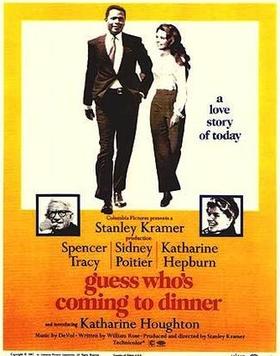
Guess Who's Coming to Dinner (1967)

Hepburn, Tracy, Poitier and one awkward meal: Guess Who’s Coming to Dinner

Director: Stanley Kramer

Cast: Spencer Tracy (Matt Drayton), Sidney Poitier (John Prentice), Katharine Heburn (Christina Drayton), Katharine Houghton (Joey Drayton), Cecil Kellaway (Monsignor Mike Ryan), Beah Richards (Mrs Prentice), Roy E Glenn (Mr Prentice), Isabel Sanford (Tillie)

Stanley Kramer’s films today are quite easy to knock. In fact, to be honest, they were pretty easy to bash back then. Kramer was a man with immense social conscience, and his films carry the same liberal agenda. They were about “Big Themes” and they had a “Message” that they very much wanted the viewer to take home with them. You can see why so many of them were littered with Oscar nominations. Guess Who’s Coming to Dinner is perhaps the most famous of his liberal films, and while we’d love to think the theme it covers today – interracial marriage – isn’t still an issue, I  think many people would say it still was.

Joey Drayton (Katharine Houghton) returns to the home of her liberal parents – Matt (Spencer Tracy) a newspaper editor and Christina (Katharine Hepburn) an art gallery owner – with Dr John Prentice (Sidney Poitier) whom she announces as her new fiancé, after a whirlwind romance in Hawaii over the past two weeks. Her parents, Matt in particular, are hit for six – and their doubts are shared by John’s parents (Beah Richards and Roy E Glenn). Can the older generation overcome their concerns to celebrate the happiness of the younger? 

Guess Who’s Coming to Dinner is a sensitive, very carefully handled film, whose liberal earnestness practically drips off the film. It’s so hand-wringingly liberal in its outlook it’s almost impossible not to mock it a little bit. Not least because John is so ridiculously overqualified – a professor of medicine, one of the world’s leading experts on tropical diseases, a nominee for the Nobel Prize – that you can’t help but wonder what he sees in her not vice versa.

This over-qualification was, by the way, an intentional move by Kramer, who was keen that the onlypossible objections to John could be the haste of the engagement and the colour of his skin. It’s the latter point that becomes the main discussion point, with some hand-wringing concerns around the attitudes of the wider world, and Matt Drayton in particular being moved to question whether he can practise the liberal agenda he preaches. It’s no real surprise to say that eventually all the characters sit down to the eponymous dinner in blissful harmony, but the film is delivering a positive message here.

You could say that it would have been more daring to make John, at the very least, a middle ranking accountant or something at least. But, let’s be honest, at the time this film was made interracial marriages were literally illegal in 17 US states (as the film name checks). Saying that though, the possibility that a BAME male may feel uncomfortably out of place in liberal White America has hardly gone away. It’s one of the reasons why I think the film still works and carries a message today – because if we want to think that these problems have gone away completely today, we are kidding ourselves.

Therefore, however right-on the film may be, it’s still relevant today and it’s still got something to teach us. The world we live in now may well have pushed some of the views and issues expressed in this film underground – we certainly don’t (I hope!) bandy around the word “Negro” as often this film does – but they are still there. So Kramer’s hopeful message of reconciliation and overcoming knee-jerk prejudice is still one that packs a punch. It’s that message that brought such an amazing cast on board, not least Spencer Tracy and Katharine Hepburn as the Drayton parents. Tracy was extremely ill at the time of the film’s production – he died 17 days after filming completed. Tracy was so fragile – as can be clearly seen at several points – that he could only film for three hours in the morning, and only on intermittent days. The film was only made with him because Kramer, Hepburn and Tracy agreed to take no up-front fee, as Tracy could not be insured to finish the film. Hepburn in particular – Tracy’s partner for over 20 years – nursed him through the film, helping with his lines and carefully watching to make sure he was not overcommitted. Not a single shot of Tracy was taken on location due to his ill-health, and a number of scenes were cleverly shot to avoid Tracy having to be on set as often as possible.

Despite all this, Tracy is magnificent. His underlying warmth and humanity work so well for the part that you constantly warm to him, even while you are as frustrated as many of the other characters  with his lukewarm reaction (bordering on hostility) to the wedding. You totally feel empathy for his situation, while at the same time wanting to give him a slap in the face. And man Tracy knows how to react – he is marvellous in a scene with Richards, where all he does is stand, half turned away from the camera and listen. But in this scene you see Drayton think and reassess everything he has considered in the last 24 hours.

But the whole film is building towards the final 10 minutes, which is nearly a complete Tracy monologue – and this is extremely emotional, not least as we are watching a great actor, aware he is dying, knowing that this is his last acting moment, talking emotionally of his love for his fictional wife, while his real life partner of 26 years sits tearfully in shot. It’s that extra level that really creates the emotional force.

Very good as Hepburn in, it’s clear in many scenes that her mind is more on Tracy than her performance – but she still has many wonderful moments, with similar emotional force. She also has one of the film’s funniest moments, where she imperiously dismisses a gallery colleague for barely hiding her racist disgust. Hepburn won the Oscar but stated she had never watched the film, finding the memory of making it far too raw.

The rest of the cast are also good – you can tell their commitment to the film – with Poitier conveying both human decency and firmness of character. Kellaway is very good as the only person in the film who expresses open-minded joy at the union. Richards has a wonderful emotional speech about the value of love, while Glenn conveys all the awkward frustration of a father who cannot understand his son. 

Guess Who’s Coming to Dinner is a very worthy film – and boy it knows it – but it’s got a sort of innocent idealistic purity about it. Its makers clearly believed that they were making a film that would contribute towards changing attitudes in society. And for all its heavy-handed liberalism, you can say it did to a certain extent – but not as much as it would like to. For that reason, there is a sort of additional poignancy to watching it, knowing that an issue the film makers clearly hoped would be gone for good in 30 years would in fact still be with us 50 years on. So for all its flaws, you can’t help but respect and even feel affection for it.