
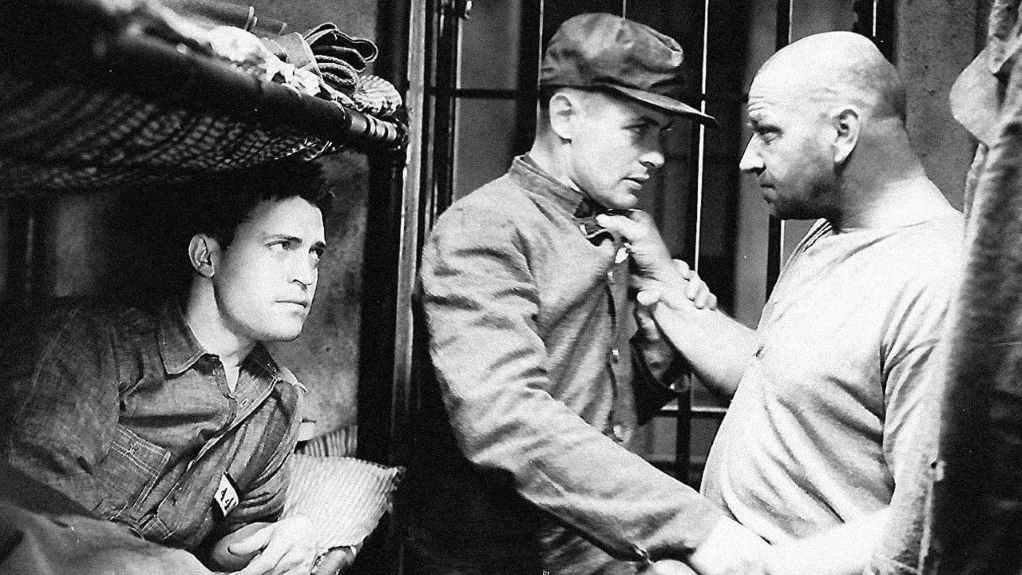
Foundational Hollywood prison film, not only establishes many genre tropes but does it with genuine style
Director: George W Hill
Cast: Chester Morris (Morgan), Wallace Beery (Butch), Lewis Stone (Warden), Robert Montgomery (Kent), Leila Hyams (Anne), George F Marion (Pop), JC Nugent (Marlowe), Karl Dane (Olsen), DeWitt Jennings (Wallace), Matthew Betz (Gopher)
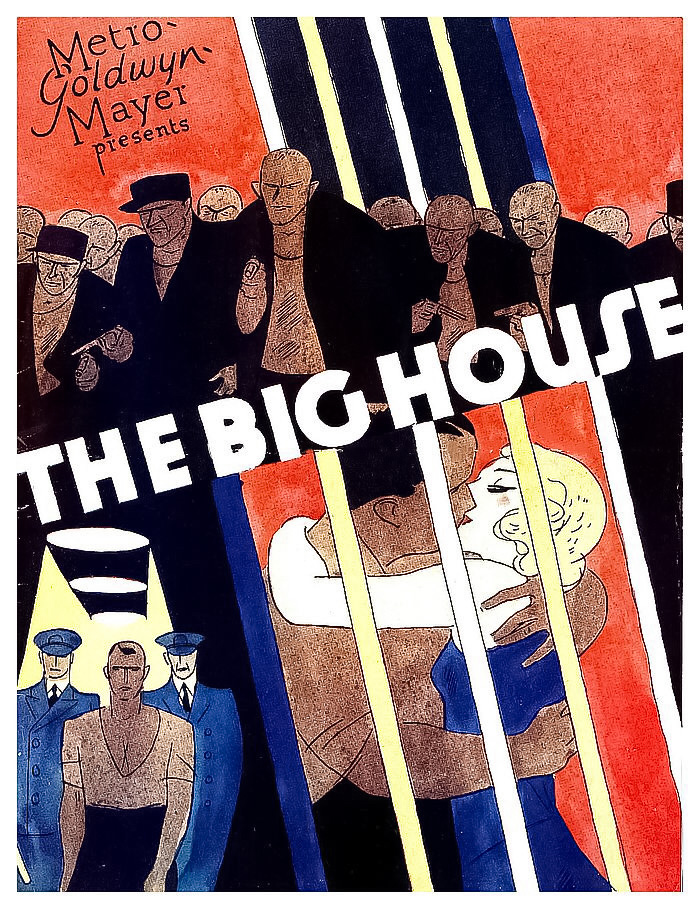
We’re all familiar with the prison movie: cell yards, newly arrived prisoners, old lags, gangs, exercise yards, tough wardens, snitches, shivs, escape plans, betting on insect races, coolers, bad food, riots… many of these now age old cliches first sprang into life in The Big House, the first major prison movie released in Hollywood. And it’s a good one, a well-paced mix of character study and morality tale with a surprisingly action packed ending.
In an overcrowded prison, where conditions are as tough as the inmates, new arrival Kent (Robert Montgomery) is nervous. He’s a rich guy struggling to adjust to spending the next seven years in the slammer after he drove the car in a fatal hit-and-run. He’s chucked into a cell with two tough inmates: Morgan (Chester Morris), a strong-and-silent type who takes no nonsense, and Butch (Wallace Beery), his best friend who swings between friendly and threatening. As mutterings about escape plans and prison feuds heat up, Kent goes to increasingly selfish attempts to save his skin, against the advice of Morgan, who is dreaming of his imminent parole.
“Prison doesn’t give a man a yellow streak, but if he has one it brings it out.” Those are the wise words of Lewis Stone’s gruff, patrician warden. It’s fair to say Kent doesn’t listen. One of the neatest tricks The Big House pulls off is the decoy protagonist. As we watch Kent’s intimidating arrival and processing, the ferrying him from room-to-room as he is reduced to another overall-clad number (48642), our natural instinct is to feel sorry for him as Robert Montgomery’s eyes widen in shock and horror. But Kent isn’t our hero. In fact, if anything, he’s the villain.
The more we see of Kent, the more we realise he’s a spoilt rich kid who, uniquely among the main prisoners, takes no responsibility for his crime (even the sociopathic Butch does that). He will betray anyone or anything to try and lesson his sentence: and as a seasoned old-timer tells him, the best material for that is snitching on other prisoners. It’s not long before Kent is nervously planting a shiv in Morgan’s bed (leading to the cancellation of Morgan’s parole), and his utter lack of any sense of principle beyond protecting himself is directly responsible for the concluding prison riot blood bath.
Instead, The Big House’s real hero is Morgan. Played with stoic firmness by Chester Morris, Morgan may well be a criminal (tellingly, of the three principles, he’s a professional thief giving him the most ‘sympathetic’ crime, with no body count) but he has a code of loyalty to his fellows. That doesn’t mean he won’t step in against bullying – he orders Butch to return the cigarettes he wrestles from Kent – but it does mean he’ll turn a dutiful blind eye to their misdemeanours. He sticks firmly to the code of the prison – don’t snitch – even while he planning to go straight. In The Big House, it’s fascinating that is the stool pigeon and snitch who is morally the lowest-of-the-low.
That’s arguably even lower than Butch, even though he’s a sociopathic murderer who wistfully talks about his crimes with slight regret only because they got him caught. But, despite this – and even though, when the riot comes, Butch proves himself absolutely, ruthlessly, without morals – Butch is strangely likeable. Perhaps because Wallace Beery (Oscar-nominated) plays him with a mix of childish innocence as well as brutish bullying. Butch, with his illiteracy and delight in games like racing insects, along with his affectionate readiness to trust (and his blinding rage when he feels betrayed) is like a big kid. He bounds around the yard like the king of the playground.
The heart of The Big House is the close friendship (and, while surely unintentional, it’s hard not to see a homoerotic undercurrent) between Butch and Morgan. These two are inseparable, trust each other completely, tell each other everything and won’t hear a word against each other from someone else. They are both familiar with the slammer, a dark corridor with several tiny, dark cells. Butch gets chucked in there after leading a dinner hall protest at the terrible food – the protest that will lead to him passing his shiv to Kent who then plants it on Morgan to gain favour with the guards. This leads to Morgan’s spell there – where, in a fixed shot of the empty corridor, Hill has us overhear the shouted conversation between the two as Morgan vows revenge and Butch naively argues he can’t believe Kent would do that.
Morgan’s rejected parole leads to his own escape. It’s a slightly forced touch of melodrama that, on escape, he of course meets and falls in love with Kent’s sister Anne (Leila Hyams) who recognises him. It’s, of course, the silver bullet that sees Morgan vowing to go straight and allowing him to tick the film’s crucial moral boxes: he forswears crime (and willingly returns to prison when caught) but without sacrificing his loyalty to the prison code of no snitching. Once again, this is contrasted with the yellow Kent, who won’t admit his guilt and has no honour at all among the thieves.
The Big House culminates in Butch’s bungled escape attempt, made infinitely worse by Kent’s cowardly actions and Butch’s capacity for violence when crossed. You have to question the competence of the prison: crowded or not, Butch and his gang manage to smuggle in several guns, and the Warden’s refusal to even consider negotiating a release of captured guards Butch is hopefully not standard practice. This is probably the only prison film you’ll see where a tank rolls in to settle the matter (one possible cliché no one picked up), but the real heart of the clash is Morgan’s attempt to both stick to his new-found determination to do the right thing, without betraying his brotherly love for Butch.
It makes for a tense, high-octane, surprisingly ruthless final act in a prison film that sets out the rules but also tells a compelling, exciting and engaging story. With very good contrasting performances from Morris, Beery and Montgomery, it’s snappily directed with real verve by Hill, whose camera soaks up the impressively grand sets and then throws in to the midst of the violence. It’s interesting to see its moral judgements on its characters: loyalty prized above all other virtues – would that still be the case today?

 Movie Musings