Tag: Leo McKern

The Omen (1976)

The Omen (1976)

Extremely silly horror with a great score, more interested in inventive deaths and genuine fear or dread

Director: Richard Donner

Cast: Gregory Peck (Robert Thorn), Lee Remick (Katherine Thorn), David Warner (Keith Jennings), Billie Whitelaw (Mrs Baylock), Patrick Troughton (Father Brennan), Leo McKern (Carl Bugenhagen), Harvey Stephens (Damien Thorn), Martin Benson (Father Spiletto), Robert Rietty (Monk), John Stride (Psychiatrist), Anthony Nicholls (Dr Becker), Holly Palance (Nanny)
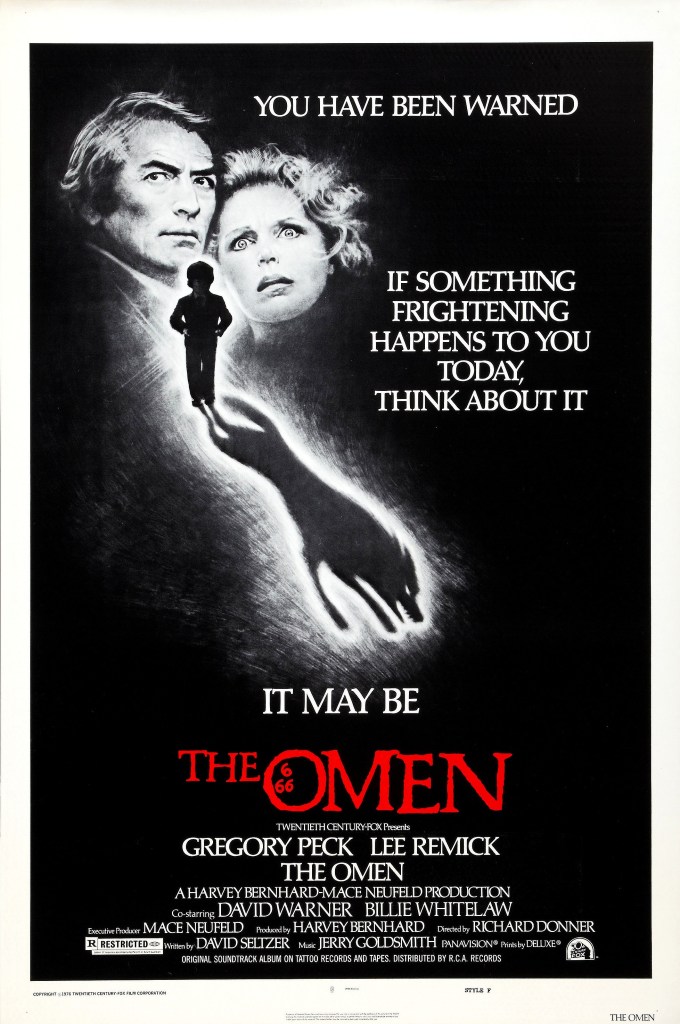
“Let him that hath understanding count the number of the beast; for it is the number of a man; and his number is 666.” One of the sweetest things about The Omen is that the number of the Beast was considered such an unknown concept to original viewers, that its painstakingly explained to us. In some ways The Omen is quite sweet, a big, silly Halloween pantomime which everyone involved takes very seriously. If The Exorcist was about tapping into primal fears, The Omen is a gory slasher (with a cracking score) that’s about making you go “Did you fucking see that!” as actors are dispatched in inventively gory ways. It’s brash, overblown and (if we’re honest) not very good.

Robert Thorn (Gregory Peck, selling every inch of his innate dignity for cold, hard lucre) is an American diplomat told one night in Rome that his pregnant wife Katherine (Lee Remick) has given birth to a stillborn child. “Not a problem” he’s told by an absurdly creepy Priest (Martin Benson) – just so happens there’s another motherless new-born child in the hospital tonight so he can have that one, no questions asked, and his wife need never know. Flash forward five years: Thorn is Ambassador to the Court of St James and young Damien (Harvey Stephens) is a creepy kid, with few words and piercing stare. In a series of tragic accidents people start dying around him. Could those people warning Thorn that his son is in fact the literal anti-Christ himself, be correct?

Want to see how powerful music can be? Check out how The Omen owes nearly all the menace it has to it imposing, Oscar-winning score from Jerry Goldsmith (wonderfullyGothic full of Latin-chanting and percussive beats). It certainly owes very little to anything else. The Omen is an exploitative, overblown mess of a film, delighting in crash-zooms, jump-cuts and extreme, multi-cut build-ups to gore. Richard Donner never misses an opportunity to signpost an approaching grisly death, by cutting between the horrified face of the victim, the object of their demise and then often back again. For the best stunts – including a famous demise at the hands of a sheet of glass – Donner delights in showing us the death multiple times from multiple angles.

This slasher delight in knocking off actors – people are hanged, impaled, crushed and decapitated in increasingly inventive manners – is what’s really at the heart of The Omen. None of this is particularly scary in itself (with the possible exception of the hypnotised madness in the eyes of Holly Palance’s nurse before her shocking suicide at Damien’s birthday party) just plugging into the sort of delight we take in watching blood and guts that would be taken in further in series like Halloween (which owed a huge debt to the nonsense here). Donner isn’t even really that good at shooting this stuff, with his afore-mentioned crude intercutting and even-at-the-time old-fashioned crash zooms.

With Goldsmith’s score providing the fear, The Omen similarly relies on its actors to make all this nonsense feel ultra serious and important. They couldn’t have picked a better actor than Gregory Peck to shoulder the burden of playing step-dad to the Devil’s spawn. Peck has such natural authority – and such an absence of anything approaching fourth-wall leaning playfulness – that he invests this silliness with a strange dignity. Of course, Atticus Finch is going to spend a fair bit of time weighing up the moral right-and-wrongs of crucifying with heavenly knives the son of Satan! Peck wades through The Omen with a gravelly bombast, managing to not betray his “for the pay cheque” motivations, and investing it with his own seriousness of purpose.

Peck’s status also probably helps lift the games of the rest of the cast. Lee Remick may have a part that requires her to do little more than scream (and fall from a great height twice) but she does manage to convey a neat sense of dread as a mother realising her son is not quite right. David Warner gives a nice degree of pluck to a sceptical photojournalist (while also bagging the best death scene). Troughton and McKern ham it up gloriously as a drunken former devil-worshipping priest and an exorcist archaeologist respectively. Best in show is Billie Whitelaw who filters her Beckettian experience into a series of chillingly dead-eyed stares as Damien’s demonic nanny.
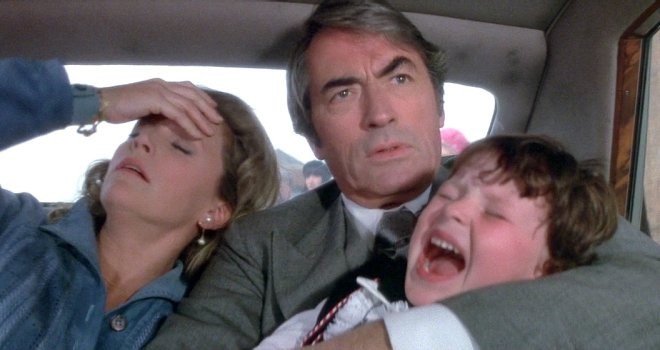
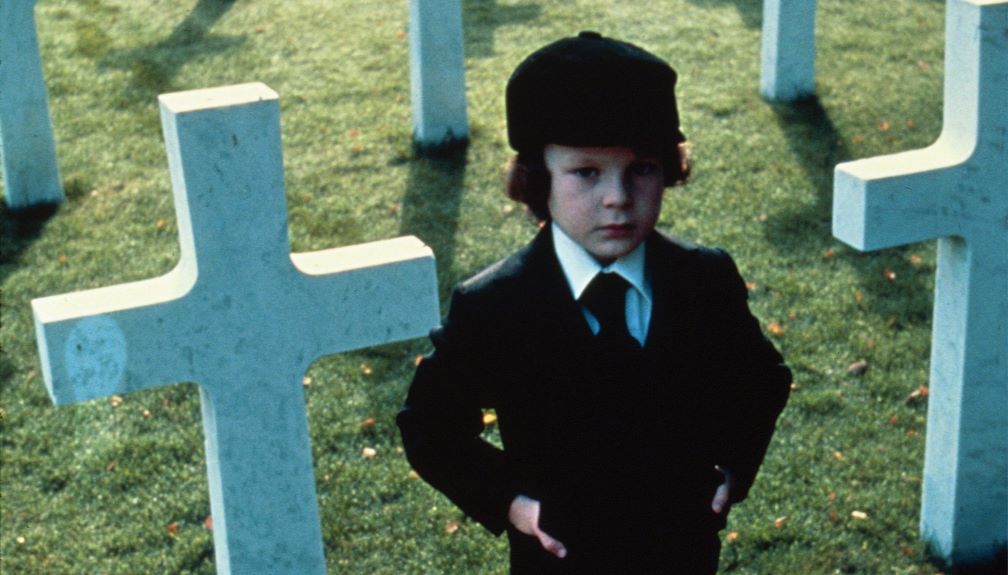
The Omen does make some good hay of its neat paedophobia. Harvey Stephens with his shaggy hair, impish smile and pale skin (not to mention darkly sombre wardrobe) looks like your worst nightmare – he’s creepy enough that the film doesn’t need to gift him a vicious rottweiler as well. Donner’s decision to never have Damien show a touch of any real emotion for most of the film also pays off, meaning even something as silly as Damien inflicting slaughter from behind the pedals of a child’s tricycle seems scary.

Of course, if Damien was savvy enough to present himself as a bright and sunny child perhaps Troughton, Warner, McKern and co would have struggled to convince Peck he was the Devil’s seed. In that sense he takes after his dad: Satan loves an over-elaborate death, and from a storm herding one victim to a fatal impalement under a tumbling church spire to popping the handbrake of a glass-bearing van for another, no trouble is too much for Satan when bumping off those who cross him. (The Omen could be trying to suggest that maybe everything is a freak accident and Thorn goes wild and crazy with grief – but that Goldsmith score discounts any possibility other than Damien is exactly what we’re repeatedly told he is.)

The Omen trundles along until its downbeat, sequel-teasing ending, via a gun-totting British policeman who sticks out like a sore thumb in a country where the cops carry truncheons not pistols. Donner balances the dialled up, tricksy, overblown scares with scenes of po-faced actors talking about prophecies and the apocalypse, all shot with placid straight-forwardness. There is a really scary film to be made here about finding out your beloved son is literally a monster, or how a depressed father could misinterpret a series of accidents as a diabolical scheme. But it ain’t The Omen – this is a bump-ride of the macabre. The Devil may have the best tunes – but he needs to talk to his Hollywood agent.

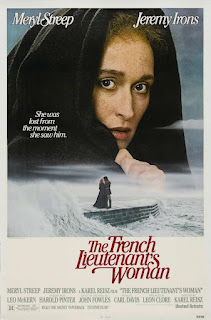
The French Lieutenant's Woman (1981)

The French Lieutenant's Woman header
Meryl Streep and Jeremy Irons play star-crossed lovers (twice!) in The French Lieutenant’s Woman

Director: Karel Reisz

Cast: Meryl Streep (Sarah/Anna), Jeremy Irons (Charles/Mike), Leo McKern (Dr Grogan), Hilton McRae (Sam), Emily Morgan (Mary), Lynsey Baxter (Ernestina), Patience Collier (Mrs Poulteney), Penelope Wilton (Sonia), Peter Vaughan (Mr Freeman), Michael Elwyn (Montague), Richard Griffiths (Sir Tom), David Warner (Murphy), Gerard Falconetti (Davide), Colin Jeavons (Vicar)

Many books have been considered unfilmable. John Fowles’ The French Lieutenant’s Woman is a key member of that list. Part pastiche, part commentary on Victorian novels, Fowles not only has a narrator who acts as an ironic commentator on events, but also offers up three possible endings to its central romance, each radically different from the one before. Not easy to bring that to film! Adapting it, Reisz and Harold Pinter came up with the concept of mirroring the novel’s central relationship with a relationship between two actors playing those characters in a film being made of the novel. Got that?

So, Meryl Streep and Jeremy Irons play both the novel’s romantically entwined couple Sarah and Charles AND also Anna and Mike, two actors playing those very roles in a film of The French Lieutenant’s Woman, also engaged in a love affair. Both affairs end in radically different ways, mirroring two of the alternative endings in Fowles’ novel. Most of the films runtime sticks with the novels’ plot, where Charles – an ambitious young scientist – is drawn away from his promising engagement to a potential business partners daughter (Lynsey Baxter), by his romantic fascination with Sarah, a woman of ill-repute in Lyme Regis, the former mistress of a French Lieutenant.

Pinter and Reisz’s adaptation is a smart idea. But I feel it misses a trick. If they really wanted to adapt the book – with its intrusive narrator and alternative endings – then the real character to focus on from a film set is not the actors but the director and producers. If our framing device had been watching the rushes in the screening room, seeing differently edited scenes play out in contrasting ways, with producers and director commenting on the action and making decisions about which ending (Happy? Sad? Open-ended?) they stick on the end of the film. Sure, that would have opened itself up to potentially on-the-nose dialogue, but it would be a better representation of the novel and its ideas, and truly translate some of the books real strength (its unique narrative style) to film.

But that’s talking about something the film doesn’t do. What it does do is offer something that is basically a 80% adaptation of the novel’s plot, mixed with 20% short interjections of the modern-day storyline. Deliberately, the film contrasts the intense romance and deeply-felt passions of the Victorian storyline – where acting on desire carries with it a huge, life-shattering cost in disgrace and social expulsion – with the shallow, off-hand flirtations of the modern era, where the stigma of a sexual affair has ceased to exist.

While this is effective in making the Victorian sections carry even more weight, it does mean the modern sections (by design) are slighter and less engaging. Their semi-regular appearance – it isn’t until the final half hour that we get anything approaching a proper sequence set in the present day, with a beautifully played garden party hosted by Mike and his wife (a magnificent putting-on-a-brave-face performance from Penelope Wilton), which is a feast of stolen glances, averted eyes and strained conversation.

But in some places the split narrative works a treat, particularly in allowing flashes of the real life, more unrestrained passion of the ‘real’ people drop into the Victorian characters. In particular, a meeting between Charles and Sarah in the woods (highly reserved), cuts to Anna and Mike rehearsing the same scene (playful and flirtatious). When the rehearsal reaches a key point – Anna/Sarah falling and being caught by Charles/Mike, the film cuts so that Anna falls but then Charles catches Sarah falling. And the scene continues. Suddenly, the Victorian couple has a burst of the same sexual freedom the modern couple has. It’s a beautiful cut. Later, Sarah falls to the ground (pushed by Charles), and suddenly bursts out laughing – and it feels like she falls as Sarah, reacts as Anna, then rises again as Sarah – either way it gives a wonderful, modern energy to the moment.

The film is wonderfully shot by Freddie Francis, with luscious forest vegetation and whipping winds and seas on the Cobb at Lyme Regis. Simmering sexual tensions are caught in lingering gazes, gestures that carry things words cannot, careful reaction shots captured by Reisz, the trapping of several characters within the ephemera of over-decorated rooms (at one point Ernestina literally can’t escape a room because of the all the knick-knacks within it).

A lot of the mood comes from the two lead actors, who give masterful performances. It’s very easy to see Streep’s performance here as overly mannered: her accent is oddly toned and highly studied, and much of her performance as Sarah is wilfully artificial and arch. But that’s deliberate: the genius here is that Streep is playing Anna playing Sarah who is in turn constructing her own fictional Sarah. With her pre-Raphaelite looks and artistic leanings, Sarah is a woman out-of-time, yearning for the sort of choices and freedom Anna takes for granted, constantly pushed into roles society can accept her in (Governess, eccentric, ‘whore’ etc.). Does she use Charles or not? Streep brilliantly captures her enigmatic, unreadable spirit, the sort of person who interjects a retelling of a possibly invented backstory, with a playful twirl around a tree. Who sometimes despises herself, at others everyone else. In contrast, Streep makes Anna assured, quiet and confident, with the power to choose risks.

Just as good is Jeremy Irons, in only his second film role and here cementing the start of a career that would see him play a parade of restrained and very British men struggling with passions they can hardly understand. Charles’ fascination with Sarah is rooted in feelings both sexual and romantic that both fascinate and terrify him. His final surrendering to being true to himself, rather than what is expected of him, carries with it both a power and strange desperate bitterness. By contrast, Mike is a far more flighty, shallow-figure – an actor who perhaps is more in love with the feelings he is playing (and the character that inspires them in his character) than he is with Anna.

Reisz pulls all this together highly effectively, and the film is at its strongest when exploring feminism and the opportunities for women in Victorian England. Those are few and far between. Women have defined roles and expectations and someone who deviates from these – like Sarah – have no place. In addition, women are held responsible for provoking dangerous erotic feelings in men (from women of poor reputation like Sarah, to the prostitutes in a London street). The ability of Sarah to make her own choices and lead the life she wants to lead is the underlying theme of her story – and her motivations. Does she want, however she might feel, a relationship that would define her again as “wife” rather than being truly herself?

These are fascinating ideas in a film full of beautiful images – their first meeting on the Cobb in particular is beautiful – scored expertly by Colin Davis (with just a tinge of suspense in the music). The framing device gives little moments of insight and reflection – even if it is only an approximation of the novel’s effect – but the Victorian set story, and it’s buried passions and social commentary is what really compels, in a way that the slighter modern story (almost deliberately) doesn’t. Either way, it has two brilliant performances, an intelligent script and handsome direction by Reisz.

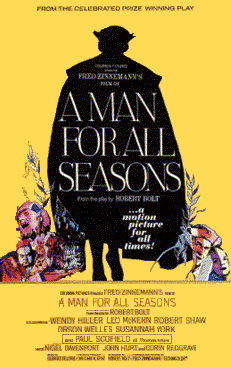
A Man For All Seasons (1966)


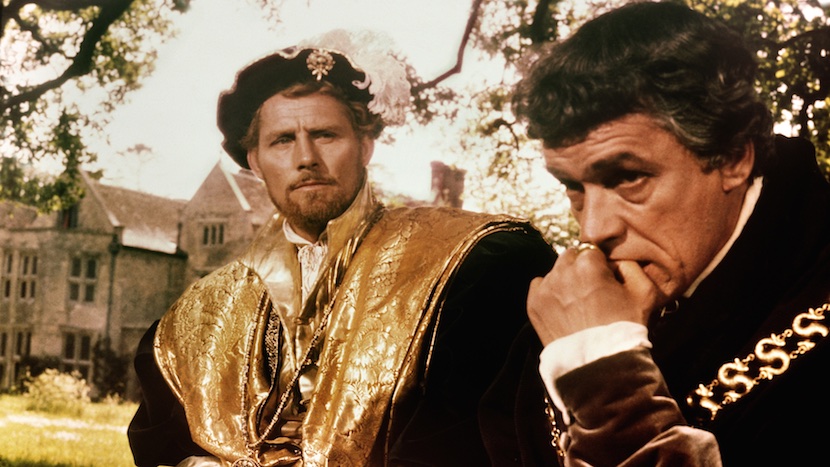
Paul Scofield ways up a difficult demand from a not-so merry monarch

Director: Fred Zinnemann

Cast: Paul Scofield (Sir Thomas More), Wendy Hiller (Alice More), Robert Shaw (Henry VIII), Orson Welles (Cardinal Wolsey), Leo McKern (Thomas Cromwell), Susannah York (Margaret More), Nigel Davenport (Duke of Norfolk), John Hurt (Richard Rich), Corin Redgrave (William Roper), Colin Blakely (Matthew)

Writing these film reviews is sometimes harder when it’s a film you know so well. I was probably in my very early teens when I first saw this and I’ve seen it dozens of times since. I know all the scenes, all the beats, and I love it. This is a brilliant film, and its depth, richness and intelligence are ingrained. It’s a wonderfully written, played and directed piece that transforms a historical event from a history lesson into an endlessly relevant and affecting parable.

Paul Scofield (simply becoming the man) is Sir Thomas More. With Queen Catherine unable to bear Henry VIII (Robert Shaw) a son, wheels are in motion to ditch the Queen and marry the king to Anne Boleyn (a split second cameo from an unpaid Vanessa Redgrave, making you believe in a moment Anne could split a kingdom). More, however, can’t agree to the divorce – his faith in the Catholic church is non-negotiable, and the church won’t recognise the marriage. So while the rest of the kingdom falls in line, More is arrested and takes refuge in his complete silence – having never spoken of his reasons, he can never be tried for them.

Re-watching this masterful film for the first time in a few years on a newly released, fully restored Blu-ray, I was immediately reminded what a thoughtful, interesting and enjoyable film it is. Having read the play again, I genuinely think (and I’m not alone) Bolt’s script is superior to the original. Several changes have been made, most notably the removal of the “Common Man”, a theatrical device whereby one actor played all the smaller working class roles, while delivering a commentary on the action. It’s a very theatrical device, which Bolt believed wouldn’t work on screen, but its removal also purifies the story, tightens the focus and allows us to focus on More. The commentary on More’s conflicted character is instead provided by Paul Scofield’s superlative performance in close-up. Bolt also removed much of the political background, making the film more of a parable of conscience rather than a “history play”.

The film is a beautiful celebration of old-fashioned Hollywood film making. Fred Zinnemann is sometimes forgotten today, extremely unfairly for a man with a hugely impressive back catalogue. A Man for All Seasons was perfect for a director whose best work saw one man stand alone against a system – be that at Pearl Harbour or the Wild West. Zinnemann was an “actor’s director”, and draws out a series of impressive performances. But his often simple set-ups never feel staged.

He and John Box (production designer) understand the power of claustrophobia, of life and death conversations in small rooms – from Wolsey’s imposing red office that seems an extension of his personality, to Cromwell’s poky office and More’s cell, the sense of being trapped builds throughout the film. By contrast, the final courtroom’s spaciousness only underlines the fact that it’s a fix. Throughout the film looks wonderful and its spare score is a beautiful Tudor-style series of compositions that carry a perfect pitched of awe and doom. It’s so beautiful (and often overlooked) I’ve put a link to the opening here.

 In fact, Zinnermann constructs the film throughout with wonderful beats and telling shots. The first appearance of Henry VIII, his head obstructing the sun, More blinking looking up, is one of the best visual impressions you’ll see of the Icarus nature of the Tudor court. A beautiful cut takes us from More (in a windswept garden, a lovely commentary on the turbulence of his life) wondering if he can find a way to sign the oath, to a shot of the view from behind his prison bars – pages and pages of story told to us in one simple cut. Later, from the same position, we’ll see a whole year pass by in a few moments – simple, unfussy, very effective. The film is packed with small, subtle moments like this that never intrude by themselves, but build to create the effect of the film wonderfully.

And this is a great film, there’s no doubt about that. The story is surprisingly simple, but Bolt and Zinnermann make it feel truly universal: the man against the state, the individual standing for what he believes is right despite all the pressure bought to bear against him. It’s a timeless parable and could be applied to virtually any time or place you could name. It’s also extremely well written: nearly every other line is memorable, the speeches are extraordinary. Every moment of reflection and observation sounds (and is) universal in its application. Its straightforwardness also helps make the story very moving, and it successfully carries out the trick of telling a movie about a saint while making him a living, breathing man we can relate to.

Of course, a large part of its success is due to Paul Scofield’s performance in the lead role. Honed after years of performing the role, it’s again almost hard to talk about individually as Scofield is so central to the film; talking about its success is in many ways to talk about Scofield’s success. Scofield’s performance is one where the actor disappears and the character remains: his More is totally real. You feel throughout not only his dignity and wisdom and his sharply defined sense of private and public morality – but also his warmness, his wit, his benevolent regard for people and those around him. He’s a caring master and friend – but not a push-over; and is adamantine in his decisions. Scofield is also able to show the contradictions of the man: a private man who cannot give up the lure of the limelight. Every beat of the performance is brilliantly observed, a list of highlights would fill a book. He carries the entire film from start to finish and never lets it slip for a second.

He’s helped by some wonderful support (and it’s a testimony to his generosity as an actor that he cedes the screen several times). Robert Shaw’s Henry VIII is a scene stealing tour-de-force. It’s up there with Robert Duvall’s Kilgore as cameos that wrench control of the movie. He’s on-screen for about 12 minutes, but he perfectly captures Henry’s charisma and his childish temper and fury. He’s intelligent (but not that intelligent – I love his sulky response when he is quickly bested by Margaret More in knowledge of Latin) and friendly but not that friendly – the sort of man who literally rips flowers from a tree to show someone how beautiful they are: destruction and excitement combined in one moment. You totally believe that this is a man who could shatter a country in a fit of pique.

Wendy Hillier also deserves notice for what might be the trickiest role in the film as Lady Alice, a woman who lives happily in the shadow of her husband. Ill-educated and lacking any understanding of her husband, it’s a part that could be almost yokel like. But Hillier brings it a world of dignity and fiery defiance, and she brings a completely convincing fury to Alice as she rails against  injustice. The final scene between her and More is a masterclass from both of simple, uncomplicated love that has held two people with very little in common together for a lifetime.

There is literally not a bad performance in this film. Every actor is perfectly cast and completely understands their roles. Nigel Davenport masterfully portrays the pride and dimness that lies under Norfolk’s bluff domineering persona. John Hurt nails Rich’s weakness, selfishness and greed and layers it with a convincing note of underlying self-loathing: a star marking performance. Orson Welles seems to have prepared his whole life for the bloated, corrupt Wolsey. Leo McKern (the only other cast member from the original production) invests Cromwell with a low viciousness and a deadly political savvy that is based exclusively on realpolitik and devoid of decency. Susannah York, Corin Redgrave and Colin Blakely all also excel.

Historically, the character of More has faced far more criticism and scepticism recently. Several historians have bought attention to More’s rigid Inquisition-like Catholicism and his willingness to execute heretics; Hilary Mantel’s equally brilliant Wolf Hall was partly written as a response to Bolt’s presentations of More and Cromwell, lauding the latter at the expense of the former.

But these controversies are not what this film is about – and it’s never trying to be a history lesson. It presents its version of the story on its own terms (very little is ever leaned about the “King’s Great Matter” or the reasons for it) – instead, like The Crucible, it turns a historical event into a deeply moving and profound parable. In doing this it transcends being a simple recounting of events, and instead becomes an independent work of art. Historical accuracy is of no relevance to the audience when viewing Henry IV Part 1: it is of no matter here either, and is something the film never claims. And it’s all the better for it. Still one of my all-time favourites.