Tag: Literary adaptations

Notes on a Scandal (2006)

Cate Blanchett and Judi Dench battle with obsession in Notes on a Scandal

Director: Richard Eyre

Cast: Judi Dench (Barbara Covett), Cate Blanchett (Sheba Hart), Bill Nighy (Richard Hart), Andrew Simpson (Steven Connolly), Phil Davis (Brian Bangs), Michael Maloney (Sandy Pabblem), Joanna Scanlan (Sue Hodge), Tom Georgeson (Ted Mawson), Shaun Parkes (Bill Rumer), Emma Williams (Linda), Julia McKenzie (Marjorie), Juno Temple (Polly Hart)
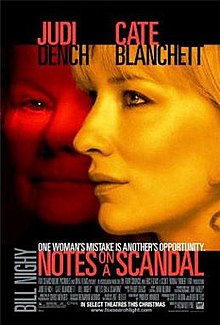
Zoe Heller’s novel Notes on a Scandal makes superb use of an increasingly unreliable narrator to reveal the complications in the affair between a female art teacher and a young male student. It’s a device that doesn’t always carry across as well to film, but Richard Eyre and screenwriter Patrick Marber have still crafted a fine story about obsession and envy in all its different ways.

In an inner-city school, bohemian art teacher Sheba Hart (Cate Blanchett) is a new arrival, struggling to learn how to control her students. It’s a skill long-since mastered by jaded and bitter history teacher Barbara Covett (Judi Dench), who soon finds herself fascinated by the attractive and engaging Sheba. This relationship is complicated when she discovers that Sheba has begun a sexual relationship with one of her 15-year old students, Steven Connolly (Andrew Simpson), a student with a difficult record who has shown a surprising interest in art. As Barbara positions herself as Sheba’s only trusted confidant, the danger of discovery begins to become ever more likely as Sheba’s behaviour becomes more and more reckless.

The real strength of Eyre’s film are the two lead performances from Dench and Blanchett, a match-up surely made in casting heaven. Dench is superb in one of her best film roles, turning Barbara Covett into exactly the sort of shrivelled up, bitter spinster you are not surprised to learn has led a life of loneliness. Dench laces the performance with a sharp nastiness, masked behind a chilly professionalism, but she also makes clear the aching loneliness, the desperation and the ability to deceive herself that Barbara has, the longing to be loved but also the possessive obsession that drives love away.

She’s equally well-matched by Blanchett, at her most glamourous and natural as Sheba. One of the film’s strengths is the way it avoids giving spurious psychological reasons for Sheba’s obsession for this basically fairly unpleasant young lout. Blanchett identifies this sense of being trapped in Sheba, this desire to rebel and taste a little bit of freedom (in every home scene she is shown undertaking most if not all the housework and childcaring duties), feelings that mutate into a sexual obsession with Connolly. Blanchett is desperate, self-deceiving and hugely tragic, unable to fully express the reasons for her feelings herself, but unable to let go of her addiction to a new wildness and danger in her life that you feel she has never really felt before.

These two performances power a film that explores obsession and envy, with Barbara obsessed (to a scarily possessive and manipulative degree) with Sheba, exploiting Sheba’s own reckless and sexual obsession with Connolly. These feelings are shown to be often beyond the understanding of other characters, and both women ret-con events and reactions from the target of their obsessions to build elaborate fantasy worlds. It’s the danger of obsession here, the way we shape the facts to meet our desired preconceptions. It doesn’t matter what reality, or what anyone else, says – you want to believe what you want to believe.

And it’s these obsessions that lead people both to take unbelievable risks and also to feel a crushing sense of envy and possession. Both Barbara and Sheba can barely tolerate the idea of their loves focusing attention elsewhere, and despite seeming to have so much control in their relationships are helpless victims. Sheba is reduced to begging tears when it feels like her relationship with Connolly is burning out. After all is revealed, Barbara’s efforts to take control of Sheba’s life are revealed to be powered by an almost desperately sad need to believe that Sheba and she are starting a new life together. So deep is Barbara’s denial about her own lesbianism (and so extreme her unhappiness about herself), it’s a romantic vision she is so deep in denial feels unable to even begin to put any sexual dimension onto.

Envy and human frailty run through the whole film. Most of the teaching staff, especially Phil Davis’ sad-sack maths teacher in love with Sheba, carry their own small obsessions and envies. Sheba’s husband himself left his first wife for Sheba when she was one of his students. The students have more than enough rivalries to deal with. 

It’s a deadly circle, with contact breeding obsession, breeding envy. To get such an effect, Marber’s adaptation needs to streamline the book. The biggest loss as a result is the book’s slow, creeping, realisation that Barbara is a deeply arrogant, bitter, unlikeable person who views most of the people around her with contempt. Here Dench’s waspish voiceover immediately makes it clear to the viewer that she is not that nice a person. It’s a shame, as it rather signposts for the viewer where the film may be heading. 

The storyline also races through the book (the film is less than 90 minutes) which means it often feels more like a melodrama. While I think it’s a strength that the film doesn’t try and give a real reason for Sheba’s decision to seduce (or be seduced) by her student, other than to hint at her own sense of bohemian freedom being lost at home, I can see how others will find the reasons for why the radiant Sheba is so drawn to such a surly kid rather hard to accept.

But it still works, because the film is so well-played. With Dench and Blanchett at their best (and excellent support from Bill Nighy, quietly superb as Sheba’s husband, a decent guy who can’t believe his luck that he is married to such a wonderful woman, and whose world falls apart in bitter recrimination), it’s a film that gives more than enough rewards. The film gives us a decent ending from the book, with more hope for Sheba – but the balance suggests that for Barbara the cycle of obsession will only continue. Heaven help anyone who sits down on a park bench next to her.

Tess (1979)

Nastassja Kinski is Thomas Hardy’s tragic heroine in Polanski’s Tess

Director: Roman Polanski

Cast: Nastassja Kinski (Tess Durbeyfield), Peter Firth (Angel Clare), Leigh Lawson (Alec Stokes-d’Urberville), John Collin (John Durbeyfield), Rosemary Martin (Mrs Durbeyfield), Carolyn Pickles (Marian), Richard Pearson (Vicar of Marlott), David Markham (Reverend Clare), Pascale de Boysson (Mrs Clare), Suzanna Hamilton (Izzy Huett), Tony Church (Parson Tringham)

At first sight it looks like a rather odd project for Roman Polanski: a faithful adaptation of a Thomas Hardy novel, shot in sumptuous period detail. But look a little closer and you’ll see it’s a neat fit for the director’s interests. A human interest story that revolves around the man’s capability for misusing, abusing and disregarding his fellows. With isolation, despair and depression thrown into the mix (what do you expect, it’s Thomas Hardy?!) and a depressing conclusion (again, it’s Hardy…) it feels less and less like an anomaly in its director’s CV. On top of this, it’s the film Polanski planned to make starring his murdered wife Sharon Tate (the film is dedicated to her memory).

Tess (Nastassja Kinski) is a young girl growing up in 1870s “Wessex” (Hardy surely the first major writer to create his own universe of interlocking stories in a fictional location). Her life is thrown into chaos when her father (John Collin) learns his family descends from the ancient lineage of d’Urbervilles. Tess is sent to find work and, maybe, fortune with her “cousin” Alec Stokes-d’Urberville (Leigh Lawson). But instead of a place at the family table, she finds herself charmed and then seduced (and perhaps raped) by Alec, leaving the house disgraced and pregnant. A few years later, she meets would-be-farmer and idealistic parson’s son Angel Clare (Peter Firth) – but their marriage cannot survive revelations of her past. As Tess’ life unravels, she is thrown into ever more desperate situations that entangle both men in her life with fatal consequences.

Polanski’s film is shot with a wonderful eye for period and makes extensive use of the “magic hour” (just after sunrise or just before sunset) to place some truly gorgeous images on the screen. Despite this, the film never compromises on the grinding lack of glamour in poverty, and few period dramas have had such an eye for mud, uncleanliness and shabby huts and bedding arrangements than this one. Polanski spent years making the film in several carefully selected locations, designed to make France look as much like Dorset as possible (for obvious legal reasons, Polanski had to rule out filming on location in England).

In this, Polanski creates a heartfelt drama of human suffering, with Tess repackaged as a sort of “every-woman” sufferer, whose entire life is shattered by a passing comment made to her father by a distant clergyman (a man whom we never see again). It’s part of Polanski’s theme of how events that we have little or no control over can shatter our lives and change the entire path of our existence. Tess frequently finds her life changed or altered by the actions of third parties (from the parson who speaks to her father, to the parish do-gooders who find the working boots she has quietly taken off to make a good impression for people she never meets and take them to a poor house – the sort of stunning moment of bleak “blow-upon-a-bruise” that the film does so well) and has no real power over what happens to her.

When she does finally take decisive actions with the two men in her life, both events rebound with tragic consequences on her – first with her rejection by Angel and then by her final escape from the influence of Alec. In between, we see her drifting gloomily from location to location, never able to find the energy, will or strength to make her life her own. Polanski’s film seizes on Hardy’s themes that we become trapped in our own fates, events spiralling constantly to leave us ever more at the mercy of factors over which we have no control. Tess is an isolated character, with few friends and confidantes, and whom society has left behind. It’s a film that follows an individual in a monolithic society with its own rules and structures, that makes no room for personal circumstances when rushing to its judgements.

Making Tess an innocent victim meant Polanski needed to cast someone who would not bring too much overt “actor” presence. Kinski, only 16 when filming started, brings a very natural innocence and gentleness to the role. She is certainly completely believable as a young woman who cannot truly understand what all these men who take such an interest in her really want, and feels unable to impose herself (just as Kinski struggles to impose herself on the film) on her life. That Kinski is not the strongest actor in the world, and that her accent erratically drifts between Dorset and Dutch, is counterbalanced by this gentle, unprocessed innocence. It matches perfectly Polanski’s idea of Tess as a victim, trapped in a perfectly constructed world.

It also allows the two men in her life a bit more scope for some domineering acting. Peter Firth does a very good job as the idealistic Angel who turns out to be nowhere near as liberal or understanding as he would like to think he is, until it is way too late. Firth walks a very neat line between sanctimonious, naïve and pompous. He also makes a great contrast with Leigh Lawson’s corrupt creepiness as the pervy Alec, all moustachio-twirling charm and caddish manner, but hiding a desire beneath to be the decent, better man.

Polanski positions Tess as the constant victim pulled between these two men, from the beautifully filmed misty forest glade where Alec forces his attentions on her, to the eccentrically furnished would-be family home (complete with lascivious elderly maid, giggling about the possibilities of the couple’s wedding night) where her marriage to Angel falls apart. It’s a film where Polanski throws in many lovely touches that ground the film in a particular time and place, from that giggling maid to the ominous sound of hedge-clippers when Angel arrives at seaside hotel in search of Tess. Every moment of the film feels realistically placed in Hardy’s Wessex, and it’s crammed with small sequences and moments that stick in the mind.

It’s a film with a masterful understanding of time and place (it rightly won Oscars for cinematography, costumes and production design) but uses that to build a story of a woman made an internal victim in a society that thinks it cares, but really doesn’t. Tess is a woman whose life is buffeted and changed by the actions of others, and who cannot escape from the dark shadows of being trapped in her own destiny. You can see why these themes appealed to Polanski – and perhaps this helps explain why the film feels like such a darkly personal one, right up to its near final image of Tess as a sacrificial victim laid out at Stonehenge.

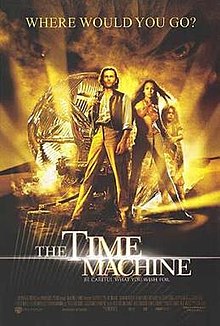
The Time Machine (2002)

Guy Pearce wastes his time in The Time Machine

Director: Simon Wells (Gore Verbinski)

Cast: Guy Pearce (Dr Alexander Hartdegen), Samantha Mumba (Mara), Orlando Jones (Vox 114), Mark Addy (David Philby), Jeremy Irons (Über-Morlock), Sienna Guillory (Emma), Phyllida Law (Mrs Watchit)

Every so often during this hysterical travesty of poor film-making, it’s worth remembering that it was was directed by HG Wells great-Grandson. If that’s not a reason for HG Wells to invent a time machine and travel into the future, in order to give his descendant a slap, I don’t know what is.

Anyway, with a plot vaguely reminiscent of some elements of the original novel, but just as inspired by a strange mixture of Hollywood blockbusters and Colin-Baker-era Doctor Who, The Time Machine stars Guy Pearce as Dr Alexander Hartdegen. In New York in 1899, Hartdegen is exactly the sort of naïve, floppy haired, genius eccentric so beloved of Hollywood movies, fascinated by time. When his fiancée Emma (Sienna Guillory) is killed in a mugging gone-wrong, obsession to prevent this leads him to invent a time machine – but he finds himself unable to prevent Emma’s death. Travelling forward into the future to find out why he eventually finds himself 800,000 years in the future where the Earth is occupied by the peace-loving Eloi and their brutal hunters, the subterranean Morlocks.

It’s hard to know where to begin with this film, but let’s try. It’s very poorly written. The dialogue clunks to the ground in a way reminiscent of the lumps of the moon that fall to the Earth in the future Hartdegen sees. There is scarcely any logic in the events we see, from the mechanisms of time travel to computers lasting hundreds of thousands of years with no identifiable power source. Characters tend to do things because the plot needs them to do it, rather than for any actual logical reason. Character development occurs with a randomness: Hartdegen starts the film as a buck toothed, shaggy haired “eccentric” and ends it as a ripped, action-hero haired heartthrob. No idea how that progression is meant to work, but you certainly won’t find the answer in the script.

It’s also poorly directed. Wells, working for the first (and only) time with live action actors has no idea at all about how to set a film’s tone or pace. The tone veers wildly from lowbrow comedy to highblown tension from tragedy to farce. Scenes that are meant to pluck the heartstrings will bring out tears of laughter. The actual comic bits will only bring out groans. Action scenes late in the film are shot with a ham-fisted bluntness that reduces them to laughable, cheesy crapness. Bright lights and wide angles frequently make a film that cost over $100 million to make, look like one that cost a tenth of that. I will cut Simon Wells some slack, as he had to stand down from the production, meaning it’s final moments were put together by Hollywood Hack Gore Verbinski, who probably just wanted to be out of there as soon as possible.

Also the whole design is so stupid. It’s a sort of steam-punk cool, but with no logic applied. The time machine never moves from its fixed geographical point, so it’s just as well no one tried to build a house on it or that the moon collapse didn’t drop a pile of moon rock on top of it. The time machine itself is a wonky contraption, full of spinning metal things and odd surfaces but of course Hartgeden doesn’t even consider installing a seat belt or any head protection. The Morlock design is equally bad, bright lighting making them look more like the bastard spawn of the Orcs from Lord of the Rings and Oscar the Grouch from Seasame Street.

At the middle of it all you have the sort of bizarre cast that could only have been assembled by some sort committee asking first “who’s cool?” and second “who needs money?”. Cool is surely the only reason Samantha Mumba (yes that Samantha Mumba) ended up in this film, as a sexy Elio lady who might just make Hartgeden forget all about that fiancée he’s spent four years obsessing about. At the other end, in one of his finest performance of cash-grabbing ham, we have Jeremy Irons. I have to admire his pluck, going through a laborious (Oscar-nominated!) make-up job (albino with a brain growing down his back), but the sort of sub-Scar speechifying the Über-Morlock delivers at the film’s climax (not to mention a bizarrely wonky final fight scene) is the work of a man already mentally spending the money on restoring his new castle in Ireland.

At the centre, Guy Pearce. I think at this time Pearce was going through some sort of career crisis. He’s handsome enough to play rugged, leading-man, action heroes like the type Hartgeden becomes. But in his heart, he’s more at home playing weirdos, outsiders and oddball (witness the happiness with which he embraces the buck-toothed oddness of early Hartgeden). So God knows what he made of this, but you can sort of tell he thinks the whole thing is crap, but doesn’t know what to do other than play it with a straight-jawed commitment (he’d soon learn, as Irons has, to meet crap with ham). Copper-bottomed crap at that, the sort of crap that would normally have you running for the hills. So Pearce sort of gets his head down and just gets through it and clearly hopes to still have a career when he comes out the other side. Which I suppose is more than Samantha Mumba managed.

Events sort of happen at this film, which seems to have some sort of confused message about moving on (“Your fiancée is dead? Man up and get over it!”) and wants us to live a life of individualism even while Hartgeden sets about giving the poor Eloi the sort of post-Victorian education that eventually led to their ancestors cracking the moon in half and wrecking the world. It’s the sort of film that ends things (literally) with a bang, Hartgeden creating some sort of time bomb out of his time machine and then running super-fast away (fortunately much faster than the allegedly super-fast Morlocks. Also the shockwave decides to stop once it’s killed all the Morlocks meaning Hartgeden is only guilty of mass genocide rather than wiping out the world). 

It’s all so far away from HG Wells cautionary tale of scientific progress gone awry that you wonder if his grandson even read his book. Did HG envision one day that a film would be made where a Morlock does a head turn double take, like some sort of Seasame Street reject, a few seconds before he blows up? That Jeremy Irons would pale up to play a character who might as well be called Gruber-Morlock? That Sienna Guillory would be saved from a mugger only to be hilariously killed off camera by a horse? That the future would be the singer of Gotta Tell Ya repopulating the planet with a bored Australian actor? If HG did make that time machine, we better tell him 2002 is a year to miss.

“Where would you go?” The poster asks. “To another film” replied the cinema audience.

Brideshead Revisited (2008)

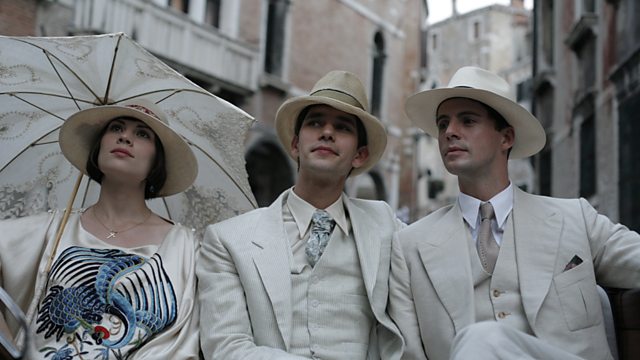
Hayley Atwell, Ben Whishaw and Matthew Goode make for a bad revisitation to Brideshead

Director: Julian Jarrold

Cast: Matthew Goode (Charles Ryder), Ben Whishaw (Lord Sebastian Flyte), Hayley Atwell (Lady Julia Flyte), Emma Thompson (Lady Marchmain), Michael Gambon (Lord Marchmain), Greta Scacchi (Cara), Patrick Malahide (Mr Ryder), Felicity Jones (Lady Cordelia Flyte), Ed Stoppard (Lord Brideshead), Jonathan Cake (Rex Mottram), Joseph Beattie (Anthony Blanche)

There are some books that have been filmed definitively and you feel just shouldn’t be touched again. Perhaps the most definitive case is Brideshead Revisited. An 11-part, almost 13-hours-long, series from the height of the mini-series era, ITV’s 1981 Brideshead Revisited dramatised literally every page and every event of the just over 300 page novel, and did it with a perfect understanding of the book’s richness and complexity. So what hope could a film have – even if it is written by that man who had such a triumph with that other definitive production, the BBC Pride and Prejudice – Andrew Davies himself?

In the 1920s in Oxford, aspiring artist Charles Ryder (Matthew Goode) falls in with the bohemian set of fellow student Lord Sebastian Flyte (Ben Whishaw). Sebastian takes Charles to his family home of Brideshead, a beautiful, entrancing family estate. But Sebastian is an unhappy man, increasingly prone to drinking, conflicted about his family’s strong Catholic faith and his own sexuality. He’s also tortured by the growing love between Charles and his sister Julia (Hayley Atwell). Their domineering mother Lady Marchmain (Emma Thompson) attempts to guide the family as she wishes, but Sebastian’s alcoholism leads to a crisis. Years later Charles and Julia restart their relationship, only to find Catholicism and fate once again intruding to complicate matters.

Brideshead Revisited is a rich, sweeping, heartfelt and profound look at so many themes it seems impossible to cover them all in a single sentence. It touches upon questions of faith, class, politics, friendship, sexuality, love – all of them sensitively and intelligently explored by Evelyn Waugh. The TV series captured all these themes with an acute, empathetic emotional intelligence. This film, forced to telescope action into two hours, simplifies and sexualises the novel to make it as boiled down and simple as possible. While this probably makes for a decent, but nothing new, film for those who don’t know the novel, for those of us who do it’s nothing less than a total travesty.

Everything is made as straight-forward and basic as possible. Subtle suggestions from the novel are turned into blunt, simplified assertions that clang out of the actors’ mouths and hit the ground. This is especially clear in the character of Charles Ryder, a fascinating observer in the novel, both a snob and a romantic, capable of great warmth and kindness and also a distant indifference. Here, he’s little more than a social climber (his lower middle class roots are stressed), constantly being asked “What do you really want?” by other characters. His attachment to Sebastian, and introduction to the Brideshead house, seems based less on a magnetic friendship and more on his unspoken desire to be part of an “in-crowd”.

Ah yes, that relationship with Sebastian. Ben Whishaw’s performance as Sebastian is, quite simply, one of the worst realisations of an iconic character you are ever going to see. The novel’s Sebastian, is an impossible glamourous, handsome, slightly effete, but magnetically charismatic figure who effortlessly wins admirers and friends everywhere – so much so, that his intensely vulnerability, sadness and self-loathing that lead to his alcoholism are spotted way too late, and then hideously mismanaged. The character Whishaw plays here is so different, he’s effectively Flyte in name only.

It all stems from the film’s longing to put the book’s suggestion of a homosexual bond between Charles and Sebastian to the forefront. So we are made perfectly aware of Flyte’s feelings, and Whishaw turns the character instead into a stereotypical, limp-wristed, effete, tragic gay man struggling with a hopelessly unrequited love for Charles that pushes him over the edge to depression. Oh yes, it has to be unrequited love because we can’t have Charles show any homosexual inclinations. Particularly as the film is desperate to reposition Charles and Julia into a “love-at-first-sight” romantic couple from the start. So of course we have Charles twice rejecting sexual advances from Sebastian (once with the cold shoulder, the second time with an angry push). 

But in sexing up the content on the surface, the film totally kills the bond between the two characters. There is, frankly, no reason for Charles and Sebastian to be friends. Sebastian is from the start a slightly pathetic figure, so you never get a sense at all why Charles is drawn towards him. This then magnifies the feeling that Charles main motivation is the house (and Julia) and that he sees Sebastian as someone he must tolerate (and whom he later feels guilty about) rather than as a friend. Sebastian himself loses all his complexity, instead becoming a slightly pathetic, tragic, overlooked figure reduced to screaming at Charles “You only wanted to be my friend because you wanted my sister!” By pumping up the subtext, the film kills the central relationship of the book – and completely undermines the tragedy of Sebastian.

But then Andrew Davies was keen – as he stated himself in interviews – to reposition the novel as a conventional great romantic novel. Now it’s true that Charles calls Sebastian in the novel the “fore runner” for his feelings for Julia (and this relationship between Julia and Charles is, I will say, one thing the TV series didn’t quite nail), but in no way was she his main focus from the start. It makes Charles’ treatment (and, let’s be honest, leading on) of Sebastian crueller, and it also crudely simplifies the novel into a “love against the odds” story that we’ve seen a thousand times before. It drains the novel of one of the factors that made it original in the start.

So we end up with a Charles who basically, rather oddly, suffers the company of Sebastian but treats him as someone he wants to shrug off. We’ve got a romantic plot line between Julia and Charles that has been reduced to the most basic, cookie-cutter, Mills and Boon romance you can imagine. And the film still struggles through to attempt to deal with the book’s (perhaps) other major theme, religion. Catholicism, guilt and the power (and domination) of faith is key to the book – but here, it’s a crude subplot that positions religion as a sort of trouble-causing piece of mummery that gets in the way of happiness. Pretty much as far as you can get from Waugh’s understanding of the complex demands of faith, denial, guilt and love.

You could say it’s unfair to continually compare the film to the book and TV series. But not only is this meant to be an adaptation, but the film chose to shoot at Castle Howard in Yorkshire, just as the TV series did. So we see scenes play out, often in the exact same location as the masterful TV series. If the film doesn’t want to try and be original and find a new location, and visually apes the TV series as much as possible, it feels fair enough to compare it – and it find it wanting.

It’s a well-made film, I’ll give it that, and I like Adrian Johnstone’s score, but it’s turned an intelligent and absorbing novel into a sub-Merchant Ivory period prestige piece, with the focus on the lovely locations and the beautiful costumes rather than anything else. Performances wise, Matthew Goode is fine (but can’t escape the shadow of Jeremy Irons), but Hayley Atwell probably comes out best as a vibrant Julia (who gets, in a way, much more to do than the book gives her). For the rest, Emma Thompson gives a far too mannered performance as the domineering Lady Marchmain (here unquestionably a villain) and Michael Gambon coasts as the dying Lord Marchmain (who here turns up literally out of the blue at the end of the film to die).

Brideshead Revisited is an irrelevant piece of celluloid that brings nothing new whatsoever to the novel or the TV series. Worse it takes the key themes of the novel and subverts, ruins or mangles them in order to try and turn the story into a straightforward heterosexual romance. In doing so, it removes everything that makes the original interesting, unique or compelling – and makes people wonder why they should bother going back to the book – surely the worst offence of all.

On Chesil Beach (2017)

Billy Howle and Saoirse Ronan share a disastrous wedding night in On Chesil Beach

Director: Dominic Cooke

Cast: Saoirse Ronan (Florence Ponting), Billy Howle (Edward Mayhew), Emily Watson (Violet Ponting), Anne-Marie Duff (Marjorie Mayhew), Samuel West (Geoffrey Ponting), Adrian Scarborough (Lionel Mayhew), Anton Lesser (Reverend Woollett), Tamara Lawrence (Molly)

There are few things sadder than the road not taken. And few novels capture the tragedy of a single moment in time shaping a whole life’s course better than Ian McEwan’s On Chesil Beach. This slim novella starts as a romance but quickly collapses into a tragedy – and this film adaptation, adapted beautifully by McEwan, hums with a constant sense of sadness and gloom.

Edward Mayhew (Billy Howle) is a middle-class boy and would-be historian who falls in love with promising violin player Florence Ponting (Saoirse Ronan) in 1962, after they both graduate from their respective universities with first class degrees. But their wedding night is a disaster – Edward is in tune with the swinging sixties and flushed with sexual desire, Florence is still living with the values of the 1950s and extremely uncomfortable with sex (possibly connected to a past relationship with her domineering father, expertly played by Samuel West). A conversation on Chesil beach leads to a ruinous split – and for Edward a life of regret.

On Chesil Beach is a film that expertly demonstrates contrasts – between the oppressive 1950s and the more bohemian 1960s (sexual freedom, socialism, nuclear disarmament), and the skilful use of the rock ‘n’ roll favoured by Edward and the classical music that is central to Florence’s life. Dominic Cooke’s low-key, carefully structured film wonderfully balances these themes, showing throughout how cultural, social and relationship clashes can cause pain and strife. 

Sex is of course the problem. At first nervous romance seems to be the theme – but it’s actually physical misunderstanding and incompatibility. Cooke’s film cuts back and forth from the wedding evening to fill in the gaps of their timeline that have brought Edward and Florence to this point, and explain their psychology going into this wedding night that will shape their lives. Edward has no understanding of Florence’s nerves and fear about sex, while Florence fails to effectively articulate these feelings in a way that Edward can understand or sympathise with.

Essentially, it’s a tragedy about a failure of communication and how hasty, ill thought out words and decisions can shatter an otherwise extremely happy relationship. Because there is no doubt – and McEwan makes it even clearer here than in the novella – of how this couple are perfectly suited together. Cooke’s film captures the halcyon dreaminess of their courtship in the giddy summer of 1962, in the beautiful Oxfordshire countryside. The film hums with their immediate attraction and strong feelings for each other – while also laying the groundwork of their failure to really and fully communicate with each other. The sexual encounter between them is agonising in its clumsiness, nerves, awkwardness, functionality and eventual total failure.

It works so well in these segments as both leads bring expressive, empathy filled performances to the screen. Howle is very good as a man struggling with his place in the world, who juggles bohemian ideals and longings with a keen desire to be seen as “a man”, to be well regarded by others. Ronan is also excellent as a young woman who in many ways is both ahead of her time and left behind it, ambitious and forward thinking but oppressed and terrified by physical contact. The tragedy is that she relaxes so much with Edward, but can’t bring herself to voice her concerns, fears and tortured history to him.

It’s that tortured history where the film leans a little too hard. The book holds dark suggestions that Florence may have been abused by her father, but in the film McEwan moves them from subtext into full-on text. Samuel West is very good as this intimidating figure, but the explanation that much of Florence’s sexual discomfort is directly related to ill-defined sexual misdemeanours from her father feels slightly pat. Far more interesting is the idea that she is simply scared of contact, and struggling to adapt the prim 1950s ideas she has been brought up with to the modern era.

But the film wants to give a deeper meaning to a drama that is more interesting when it looks at troubled psychologies at a time when the world was shifting from one generation to another. It remains a very slight story – and even at 100 minutes it feels like it is stretching the content of the novel – but also one that does carry a lot of emotional weight. The film’s coda, set in 2007, leans a little too heavily on the actors now layered under old-age pancake make-up (it’s noticeably not included in the novella, which gives no information about Florence’s future life at all) but it carries a real sense of sadness and loss for both characters, one of whom has seen their life drift into nothingness, another who has achieved but still carries a sense of sadness for a lost love. McEwan’s careful, elegant script captures a lot of this small-scale tragedy and if the film is slight and at times a little too obvious, it’s also able to induce a tear or two.

The Book Thief (2013)

Sophie Nelisse is The Book Thief in this worthy, dull adaptation

Director: Brian Percival

Cast: Geoffrey Rush (Hans Hubermann), Sophie Nélisse (Liesel Meminger), Emily Watson (Rosa Hubermann), Nico Liersch (Rudy Steiner), Ben Schnetzer (Max Vanderberg), Heike Makatsch (Liesel’s mother), Barbara Auer (Ilsa Hermann), Roger Allam (Death)

Every year you get prestigious film versions of novels that have soared up the bestseller lists. Some of these are good or even great films. Other are so lifeless, listless and lacking in spirit they leave you wondering what on earth people got so fussed about the original for. That’s the case here with The Book Thief.

In late 1930s Munich, young Liesel (Sophie Nélisse) is fostered with a local decorator Hans (Geoffrey Rush) and his wife Rosa (Emily Watson). Liesel has a fascination with books – despite not being able to read and write – and soon Hans is teaching her literacy. Liesel has a compulsion to “borrow” books – first from a burning pile of Nazi forbidden tomes, then from the library of the wife of the local mayor. But it’s dangerous to draw too much attention to the family, particularly when they are hiding a young Jewish man, Max (Ben Schnetzer). 

I’ve not read The Book Thief. I can’t say that I feel the need to dash out and do so after this bland, middle of the road picture that makes Fascist Germany seem very picturesque. The film largely fails, like so many films before it, to translate the joy of reading into a visual language so the whole “book thief” concept of the title quickly gets pushed to the margins in favour of a series of episodic events based around Nazi Germany and Second World War tropes that already feel a bit tired. 

Percival’s award-baiting film doesn’t seem like it wants to bring (or is capable of bringing) something unique or interesting to the setting, instead going through the motions as prettily as possible. And the film does look great, I will give it that. It also sounds pretty damn good, not least through a playful and rich score from John Williams (his first original score for a non-Spielberg film for decades). But it never really gets anything special from the content. In fact, that very chocolate-box beauty of the film seems to run contrary to the setting of Nazi Germany. The awards-friendly beauty envelops the film like treacle.

The book was written from the prospective of Death, but, the film seems to drop this unique aspect as soon as it possibly can. Again, it’s a sign that the film cannot reproduce what worked in the book – by stripping out its most unique and interesting point, it makes the film feel as generic as it possibly can. Roger Allam is a wonderful choice as the richly voiced narrator – but he’s so rarely used in the film that when Death talks about how fascinating he found Liesel you are simply left wondering why. 

In fact that why is a real problem with the film – it’s what you’ll be asking all the way through. Why? Why is anything really happening? Why is Death telling us how different and striking this story is when everything we see in the film feels pretty familiar? What is the point of this film or the message it is trying to give us? For a film that tackles war, fascism, persecution of the Jews, and childhood innocence, it seems empty all the time.

And that’s the problem with the film. It’s all about the pretty presentation. The characters speak with forced German accents that make it feel even more like a pretty Hollywood Golden Age film. (By the way the bad Germans, like the Nazis, they speak only in German. Make of that what you will.) The acting is pretty good, Sophie Nélisse is a great find as the heroine. But there is nothing special about it at all. It’s seemingly made entirely as a prestige product for potentially winning Oscars. Any of the depths of uniqueness of the book seems to have been shaved off in service of that, and we’ve been left with a chocolate box that feels like it’s lacking the sweet richness you’d expect to find in it.

The Talented Mr Ripley (1999)

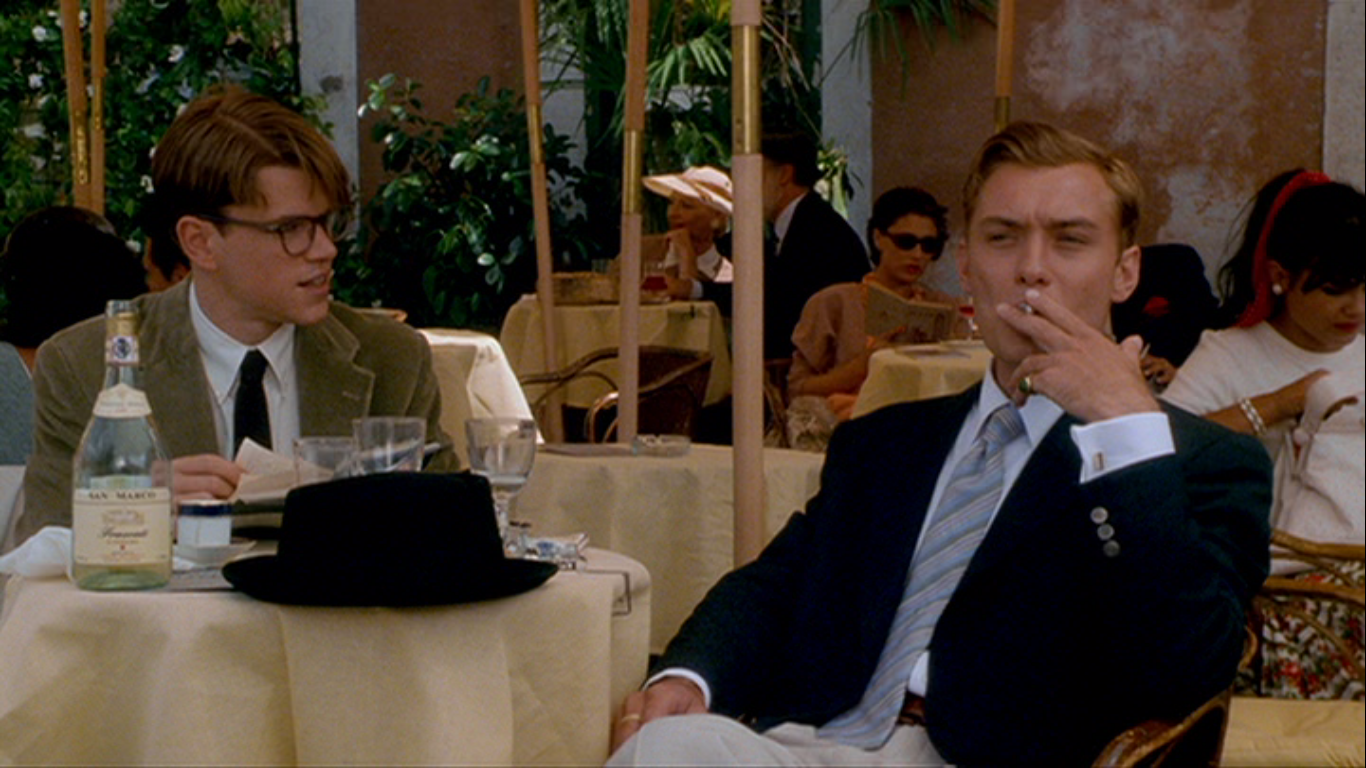
Matt Damon, Jude Law and Gwyneth Paltrow get wrapped up in murder and mayhem in The Talented Mr Ripley

Director: Anthony Minghella

Cast: Matt Damon (Tom Ripley), Gwyneth Paltrow (Marge Sherwood), Jude Law (Dickie Greenleaf), Cate Blanchett (Meredith Logue), Philip Seymour Hoffman (Freddie Miles), Jack Davenport (Peter Smith-Kingsley), James Rebhorn (Herbert Greenleaf), Sergio Rubini (Inspector Roverini), Philip Baker Hall (Alvin MacCarron), Celia Weston (Aunt Joan)

Patricia Highsmith’s Tom Ripley – sociopath, confidence trickster, human blank piece of paper and murderer – is so unknowable he’s been played on screen by actors as wildly diverse as Alain Delon, Dennis Hopper, John Malkovich, Barry Pepper and, perhaps most famously today, by Matt Damon. Ripley’s complexity – Highsmith described him as “suave, agreeable and utterly amoral” – and his general blankness and ability to adapt to different situations make him a challenging character to bring to the screen. Minghella’s film goes for a dark, Hitchcockian feeling drama that gives a lot of focus to feelings of sexual confusion and inadequacy in Ripley that motivate his actions and increasingly spiral out of control, leaving him isolated and damaged.

Tom Ripley (Matt Damon) allows himself to be mistaken by the owner of a shipping line, Herbert Greenleaf (James Rebhorn), as an old Harvard classmate of his son Dickie (Jude Law). Inveigling his way into Herbert’s trust, he is sent to Italy to persuade Dickie to return to America and take up a job in his father’s company. Happily taking the all-expenses-paid trip, Ripley finds himself besotted with the glamour and easy charm of Dickie, a handsome playboy, and soon positions himself as travelling companion to Dickie and his fiancée Marge Sherwood (Gwyneth Paltrow). But Dickie’s attention is only fleeting, and soon Ripley feels betrayed as Dickie starts to refocus elsewhere – leading eventually to Ripley murdering Dickie in a fit of jealous pique and using his faint resemblance to Dickie’s passport photo to assume his identity and live off his allowance – all the while dodging meeting Marge, friends of Dickie and the police (who are searching for the disappeared Tom Ripley).

Minghella’s film is a complex, psycho-sexual thriller, shot with a sun-kissed warmth that accentuates the glamour and style of the Italian Riviera, while subtly keeping us distant from the characters and their increasingly complex motives. The richness and lushness of these expensive lives look as appealing and seductive to us as Ripley finds them when he arrives. However, its dark undertone is never lost, and the film is edited and assembled with a certain chill and coolness while Gabriel Yared’s score mixes some fun jazz remixes with more a ominous tone as the bodies start to pile up.

I love a lot of Minghella’s work. He’s an intelligent and literate director, and the script he prepared for this film shows that he’s a master of taking complex, multi-layered pieces of fiction and turning them into something impressive and cinematic. But watching The Talented Mr Ripley, with its effective mix of period charm and sixties swing, its clever apeing of sixties filming styles, its riffing on Hitchcockian tropes and its picture book locations around Italy, part of me wonders if this film started pushing him too far down the path of being a “literary” director. His film is intelligent, and alternates between being chilling and fun, but at times it’s also wearing its “important film-making” badge a little heavily. It’s like the film is straining a little too much for prestige, as if the luscious design, complex plotting, sharp dialogue and clever visuals are aiming a little too much for matching The English Patient’s Oscar hoovering.

Maybe that’s why, despite everything that is good here, this film doesn’t have quite the same success as that film. This is, I’ll confess, an odd thing to say in a film that is generally very positive – if a little too long – but there it is. Sometimes these things are intangible in a way. Part of the film’s problem is that very complexity of plotting and motivation that he (arguably) builds on from the book. One of the film’s biggest question marks hangs over Ripley himself.

Imagined here as a slightly diffident, awkward, closeted graduate, he never really convinces as the kind of ruthless opportunist the plot demands him to be. Much as the film – and Damon’s performance – nails the sociopathic blankness of Ripley, his ability to switch smoothly from persona to persona, at the same time Ripley either seems to care too much or too little. Damon never quite convinces as a man so in love with the highlife that he is happy living off the allowance of (and pretending to be) the adored friend he bludgeons to death in a boat. 

This is where the homosexual undertone of the original has been converted into a overtone – and the film’s overplaying of Ripley’s physical, puppy-dog attraction to Dickie make him feel more dependent. The film works really hard to make him as sympathetic and vulnerable as possible, to make him a victim of his own warped circumstances and morality, and it never quite manages to make this make sense, or to carry real consistency. For all you feel Minghella wants us to think we are drilling into what makes a killer, the more we learn about Ripley the less substantial as a character he feels.

Damon, despite this, gives a good and generous performance. Generous because, playing quite a pathetic, indescribably blank man, he really manages to fade into the background of scenes. It does mean that he cedes most of the best work to his co-stars. Jude Law is radiantly cool, fiery, passionate, selfish and hugely attractive in a star-making turn as Dickie. Philip Seymour Hoffman is the epitome of a Bullingdon club bully turned young adult as Dickie’s school friend, seizing scenes with a louche aggressiveness. Cate Blanchett is equally brilliant as a warm, friendly socialite who inadvertently stirs terrible ideas in Ripley.

These actors are all highlights in a superbly mounted production, but one which doesn’t reveal or tell us as much as we might expect. Instead, Minghella gets slightly lost in his own intelligence when adapting the book, pushing the story into deeper, psycho-sexual motivations for its character that end up obscuring and fudging the actions he carries out in the film. It’s a gorgeous looking film, packed with wonderful scenes, but Damon’s Ripley seems too sensitive, too prone to the edge of tears, impossible to see as a man who could become a serial murderer. By giving a greater hinterland to Ripley, Minghella also changes the character fundamentally. It makes for an interesting development – but Ripley’s desperation, his essential weakness, his lack of control make him feel inconsistent with the setting and plot he is in.

The Hunchback of Notre Dame (1939)

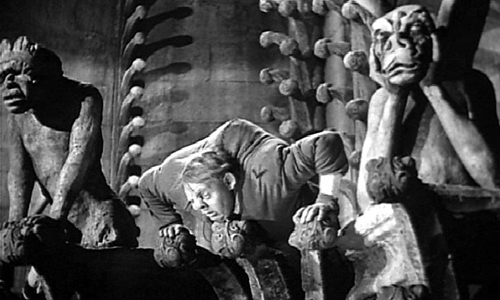
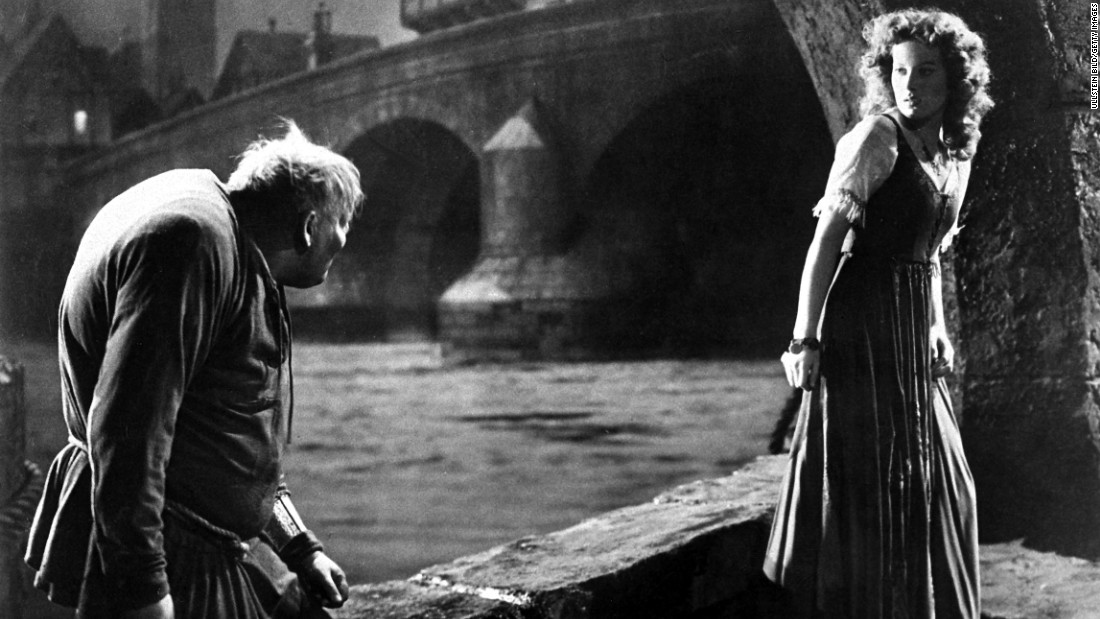
Charles Laughton looks on with longing as The Hunchback of Notre Dame

Director: William Dieterle

Cast: Charles Laughton (Quasimodo), Cedric Hardwicke (Jean Frollo), Thomas Mitchell (Clopin), Maureen O’Hara (Esmeralda), Edmond O’Brien (Pierre Gringoire), Alan Marshal (Captain Phoebus), Walter Hampden (Archbishop Claude Frollo), Harry Davenport (King Louis XI), Katherine Alexander (Madame de Lys), George Zucco (Procurator)

Victor Hugo’s gothic romance–slash-tragedy has been turned into a film so often, it’s a wonder anything that happens in it remains a surprise. But this 1939 version is perhaps the most influential, where Hollywood decided to throw money at the fable and try and make something as close as possible to the spirit of the book. But of course with a happyish ending on the end – because, you know, it’s still Hollywood!

In 1470s Paris, the city is caught between the pressures of religion and new developments such as the printing press. In the centre of the city is the Cathedral of Notre Dame – where the bells are operated by foundling Quasimodo (Charles Laughton), a deformed hunchback driven deaf by the constant ringing of the bells. His benefactor, Judge Jean Frollo (Cedric Hardwicke), is running a vicious campaign to cleanse the city of the gypsies and beggars that make up a large part of its underbelly – but he’s hit for six when he falls in love (or rather lust) with beautiful gypsy woman Esmeralda (Maureen O’Hara). But he’s not alone – equally smitten are naïve young poet Gringoire (Edmond O’Brien), arrogant Captain Phoebus (Alan Marshal), and Quasimodo himself. When Esmeralda rejects Frollo’s advances she soon finds herself in danger – and her only hope of safety comes from unexpected sources.

Dieterle’s background in German expressionism and silent cinema shines through in this visually striking and opulent studio production, with its superbly marshalled crowd scenes, brilliant use of near-impressionistic shadows and fabulous camera work that drifts over the impressive (and hugely expensive) set. Dieterle mixes this technical expertise with a real sense of emotion and character development, helped by some terrific performances from the cast. It’s a film that motors through the story of the novel, but skilfully repackages it as both a fascinating semi-romance and a sort of urban tragedy, as well as a subtle mediation on love and lust.

At the centre of it, you have Charles Laughton giving probably the definitive performance of the hunchback. Sweating under layers of make-up and an artificial hump, Laughton is nearly unrecognisable as the bell-ringer. His triumph is to make a gentle, tragic character emerge from make-up that suggests more Frankenstein’s monster than tragic hero. Nearly wordless for the first hour and a half of the film, Laughton does his magic with an expressiveness that speaks volumes of the loneliness in Quasimodo. Tenderly, he watches people knowing he can never be part of their lives – and look how excitedly he bursts out when he finally gets a chance to speak to Esmeralda one-on-one. Suffering punishment on the wheel, Laughton’s eyes convey the numb acceptance of pain as his natural state of affairs. But he also manages to bring out the gentle, childlike qualities of Quasimodo. It’s a wonderful, wordless, expressionistic performance – a triumph of physical acting and wonderfully judged emotional vulnerability.

The rest of the cast match Laughton stride-for-stride. Censor demands at the time required that Frollo be removed from his position (in the novel) as Archbishop, so the book-version of the character is split in two here. Archbishop Frollo is the sort of pious bore who can keep the Hayes committee happy. But Cedric Hardwicke gets to play the invented evil brother Judge Jean Frollo, the lecherous hypocrite from the novel. An authoritarian ascetic, Hardwicke’s Judge Frollo is lean, mean and utterly ruthless – and totally in denial about both his lustful feelings and hypocrisy. Hardwicke is virtually an archetype of the sinister authoritarian, but he manages to never chew the scenery. Incidentally, knowing the two characters are basically split from the original book, does allow moments of fun imaging the moral debates between the two as a sort of split personality discussion.

But there are plenty of other good performances as well – not least from Maureen O’Hara, who is charming and engaging enough to make you believe that the whole male cast is in love with her. Edmond O’Brian goes large at times with the passionate romance, but he does a very good job in the role. Thomas Mitchell is good value as the leader of the beggars, Clopin. There are strong performances across the whole film.

All these performances are framed within a fabulous design. The trouble and expense that has gone into the construction of the set is inspiring, the sweeping gothic arches and towers giving every shot something exquisite to look at. It also gives never-ending options for camera placement and impressionistic imagery for Dieterle. It works as well – the gloomy, imposing towers of Notre Dame are captured with real artistry, while the shadow it casts over the whole city of Paris serves as a constant reminder of the oppression the city lives in.

Dieterle also brilliantly films the crowd scenes, getting a superb sense of visceral emersion from these sequences. Whether the camera is in the mix, or flying above the crowds from the tops of Notre Dame, these scenes look equally fantastic. Dieterle handles the more action-related scenes with particular skill – Quasimodo’s rescue of Esmeralda from a death sentence is particularly well staged in its dynamism and graceful filming. 

Not every beat works. The portrayal of Louis IX as a sort of kindly old uncle seems off-piste from the very start. The early sequences sometimes get bogged down too quickly in set-up rather than getting into the action. Alan Marshal is rather wooden as Captain Phoebus, although the film goes surprisingly far in suggesting the dark desires and predatory sense of danger that comes from the character. Some of the beggar court sequences get similarly stuck in kitsch.

But these are minor beats. It’s a film that really understands emotions and makes the dramatic thrust work. It also has a dark sexual power, not least in Hardwicke’s Frollo: a seething mess of frustrated desires. It never loses sight of the sadness at the heart of its central character’s story, of his loneliness and isolation, and manages to communicate this brilliantly in every scene where the character appears – he is trapped by his muteness, his ugliness or his sadness at every turn. It’s a development that never fails to be engrossing and finally moving. It’s a film that is brilliantly assembled with real technical skill, very well acted and wonderfully directed.

The Man Who Would Be King (1975)

Caine and Connery together at last heading out to the sort of land perfect for The Man Who Would Be King

Director: John Huston

Cast: Sean Connery (Daniel Dravot), Michael Caine (Peachy Carnehan), Christopher Plummer (Rudyard Kipling), Saeed Jaffrey (Billy Fish), Shakira Caine (Roxanne), Doghmi Larbi (Oootah), Jack May (District Commissioner)

A glorious rip-roaring adventure, The Man Who Would Be King is exactly the sort of deeply enjoyable Sunday afternoon viewing you could expect to see playing out on a Bank Holiday weekend on the BBC. Which is enough to make you often overlook that this is quite a dark, even subversive film in amongst all the fun.

Adapted from Rudyard Kipling’s short story, the story follows Daniel Dravot (Sean Connery) and “Peachy” Carnahan (Michael Caine): cashiered NCOs from the British Empire, bumming their way round the Raj in the 1880s, picking pockets and scamming everyone from local rajahs to British commissioners. But their dream is to travel to the distant land of Kafiristan, a country almost unknown in the West, where they hope to help a ruler conquer the land, overthrow him, clean the country out and head back to the West. Arriving after a difficult journey, their plan goes well – but is put out of joint when Dravot is mistaken for a god…

Strange to think that John Huston had this project in development for so long that his original intended stars were Clark Gable and Humphrey Bogart. After the project faltered for so long that those two stars sadly died, Huston shopped it around to most actorly double bills around Hollywood. Finally he settled on his ideal choices for these very British scoundrels: Paul Newman and Robert Redford. Fortunately, Newman took one read of the script and essentially said “John they’ve got to be British”. Connery and Caine were suggested – the rest is history.

And just as well they were suggested, as the film’s principal delight is the gorgeous interplay between the two star actors, happily embracing the film as if they knew they’d never get to bounce off each other together on screen again. This is one of the warmest, most genuine feeling friendships between two characters captured on film, Dravot and Peachy are so clearly heterosexual life partners that they are willing (after much bickering) to forgive each other virtually anything. On top of which, the two actors play around with each other like old-school stage comedians, matching each subtle raise of an eyebrow with a wry half smile. 

Connery is of course perfect as the man succumbing to hubris, his Scots burr spot on for Dravot’s slightly pompous “front man”, while Caine excels as the more sly, fast-talking Peachy. The finest moments of the film feature these two interacting, from performing long cons, to hysterical laughter when death feels near on a snowswept mountain, to the final (emotionally stirring) moments of sacrifice and support.

Because yes, with the film opening with a decrepit Peachy recounting his story to Kipling (an engagingly plummy performance from Plummer – no pun intended) you just know this little boys’-own adventure in the East isn’t going to end well for our heroes. Huston, however, still manages to make the whole thing feel like an excellent jaunt, even though the devastation is clearly signposted from the start. 

Huston’s film is shot with a sweeping, low-key excellence – Huston was a master at putting the camera in place and then basically not getting in the way of the story. He totally identifies from the start that it’s the relationship between the two leads that is the real emotional and dramatic force of the film and never allows anything to obstruct that. He’s smart enough to also get a bit of social commentary in there, around imperialism and the entitlement that means these lower-class Brits feel that they should have their share of other people’s counties. But these themes never unbalance the picture. Instead they counterbalance it – however much we enjoy the leads cheek and charm, we can’t forget that in many ways they are immoral conmen, who represent some of the worst riches stealing excesses of the British Empire.

The slow spiralling of Dravot into the sort of man who wants to stay behind and build a dynasty in Kafiristan works extraordinarily well. Connery perfectly suggests the ego and love of attention that motivates many of the actions of this natural showman. From the first battle, when an arrow fails to kill him, we see him slowly realise and enjoy the implications of this fame. His rather touchingly childlike pleasure in dispensing justice (even if Peachy has to quietly correct his maths in the middle of one case) and spinning fantasies about sitting on equal terms of Queen Victoria don’t turn him into a monster or an egotist, but more of a kid who is running before he can walk. 

It’s the sense of fun that keeps you watching – and also what gives the final few moments their emotional force and power. It works because it never harps on the darker social commentary it contains, about the corruption of British rule, and the greed of these buccaneering adventurers. Superbly acted – as well as the leads, Saeed Jaffrey is very good as a Gurkha soldier who acts as translator for our two con-men – and extremely well filmed, with the sweep and grandeur of India coming across strongly in Huston’s careful camerawork, this is a hugely enjoyable film about friendship that has all the fun and vibrance of a con film wrapped in an epic adventure.

The Count of Monte Cristo (2002)

Guy Pearce and Jim Caviezel as friends turned foes in The Count of Monte Cristo

Director: Kevin Reynolds

Cast: Jim Caviezel (Edmond Dantès), Guy Pearce (Fernand Mondego), Dagmara Dominczyk (Mercedès Mondego), Luis Guzmán (Jacopo), Richard Harris (Abbè Faria), James Frain (JF Villefort), Michael Wincott (Armand Dorleac), Henry Cavill (Albert Mondego), Albie Woodington (Danglers), JB Blanc (Luigi Vampa), Alex Norton (Napoleon Bonaparte), Patrick Godfrey (Morrell), Freddie Jones (Colonel Villefort), Helen McCrory (Valentina Villefort)

Alexander Dumas’ novels are beasts. The Count of Monte Cristo is a real mountain of a book, a sprawling story of adventure and revenge. Kevin Reynolds’ film had a near impossible task to turn this into a film – most have gone down the route of adapting the book into a TV series – but triumphantly succeeds by locating in it a very clear, very filmic narrative.

In 1815, Edmond Dantès (Jim Caviezel) and Fernand Mondego (Guy Pearce) are young men serving on a merchant ship, who wash up on Elba where Napoleon (Alex Norton) is in exile. Tricked into taking a letter for Napoleon back to France, Dantès is betrayed by Mondego, who desires Dantès’ fiancée Mercedès (Dagmara Dominczyk) and resents his own envy for the far poorer Dantès. The corrupt magistrate Villefort (James Frain) colludes to protect his own family’s secrets, and Dantès is locked up in the dreaded Chateau d’If for 15 years, during which time he meets fellow prisoner Abbè Faria (Richard Harris) who teaches him politics, mathematics, philosophy and sword-fighting. Faria shares with Dantès the secret of the vast treasure he hid on the island of Monte Cristo – treasure Dantès dreams of using for his revenge.

This is actually a fairly nifty adaptation of a huge novel into something cinematic. Almost every change made to the original book ends up working extremely well – and adds an immediately understandable dramatic tension to it. I’d actually go so far as to say this might be a masterpiece of cinematic adaptation. The decision to make Dantès and Mondego childhood friends and rivals instantly adds a real frisson of betrayal to Mondego’s actions, as well as adding a very personal element to the revenge portion of the narrative. The simplification of the other “betrayers” also works extremely well, while the careful links throughout back to Dantès’ upbringing never let us forget the roots he has come from.

The script is also packed full of fun interjections. The idea of the chess piece, which Dantès and Mondego pass from one to the other, becomes laced with symbolism, while the changing of Jacopo into a sort of Brooklyn pirate works extremely well (Guizmán gets some of the best lines, but also gets to show a touching loyalty and concern for Dantès). On top of which, the pushing to the fore of the swashbuckling sword-fighting excitement sets us up for a cracking final sword fight between our two friends-turned-enemies. 

Reynolds also shoots the film extremely well with a host of interesting angles and framing devices showing how Dantès position and confidence change throughout the story. The film’s climactic sword fight is brilliantly staged and the film charges forward with a real momentum (there are of course no sword fights in the book!). 

Particularly well handled through is the sequence that is (in many ways) most faithful to the original book – Dantès’ time in the Chateau d’If. What I love in this sequence is that it’s a perfect combination of stuff from the book, Karate Kid style training, and some good old-fashioned warm character building. It’s also got two terrific performances from Michael Wincott as an almost comically dry sadistic guard and Richard Harris as the imprisoned Abbè Faria, the quintessential wise-old-mentor (the relationship between Faria and Dantès is beautifully judged).

The film perfectly balances its sense of fun and adventure with a very real-feeling story of a man who has to learn there is more to life than revenge. The plot that Dantès puts together probably isn’t the most complex piece of chicanery you are ever going to see, but it doesn’t really matter because the focus is the fun of the journey, and the thrill of someone being a few steps ahead of everyone else. 

Jim Caviezel is very good as Dantès, just the right blend of forthright moral strength and simmering resentment (few actors do stoic suffering better than Cavizel). There is a really nice questioning throughout the film of Dantès’ motives and whether revenge is really worth the candle, which adds a lovely depth to Cavizel’s performance.

But the film probably gets waltzed off by Guy Peace (who turned down the role of Dantès because he thought Mondego was more fun) who gets to campily simmer, sulk and fume at the edge of every scene. Mondego is brilliantly reinvented as a fearsomely proud, selfish, hedonistic aristocrat with a major inferiority complex, who takes everything from Dantès and still isn’t happy at the end of it. But Pearce has a whale of a time with his cruelty and resentment, and it’s a great reminder of how much he is (as an actor) in love with make-up, Mondego being scruffy, slightly pock-marked and increasingly bad of tooth.

He’s a villain you can scowl at and he’s a perfect counter-point for a hero whose emotional distance is designed to make him at times a difficult man to invest in. The film’s expansion of their personal relationship in its early section works really well, setting up the innate inequalities between them (wealth on one side, bravery and decency on the other) during the film’s cheeky and amusing opening sequence on Elba with Napoleon.

The Count of Monte Cristo is an extremely well structured, hugely entertaining adventure film. It’s very much like a 1930s swashbuckler, and every scene has some delightful moment that you’ll love. There are some very good performances in here as well, working with a very good conversion of this doorstop of a book into a film. Skilfully directed, interestingly shot, well acted – it’s a gem that’s far too overlooked.