
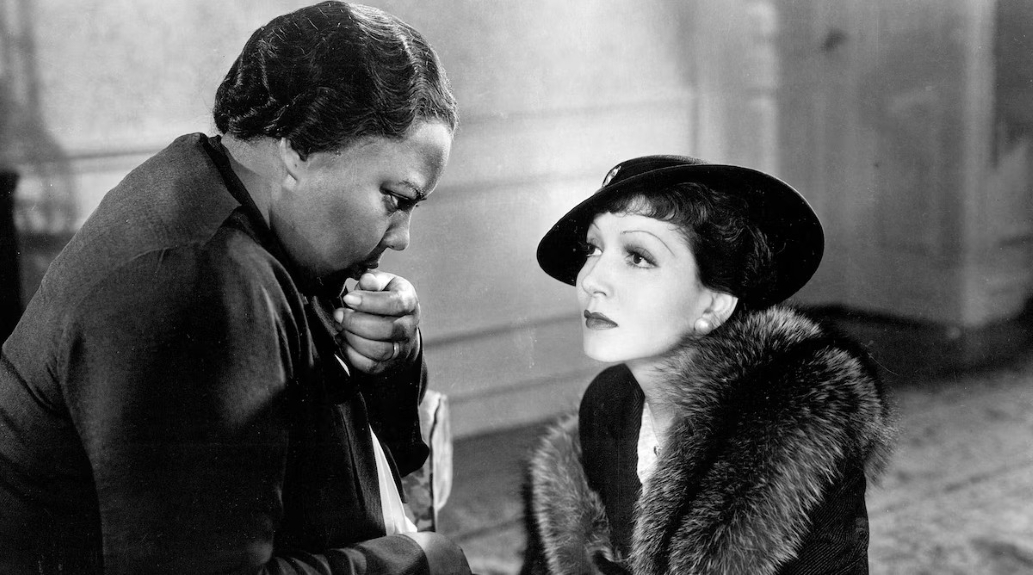
A surprisingly subversive tale on race under it’s traditional ‘woman’s picture’ exterior
Director: John M Stahl
Cast: Claudette Colbert (Beatrice Pullman), Warren William (Stephen Archer), Rochelle Hudson (Jessie Pullman), Ned Sparks (Elmer Smith), Louise Beavers (Delilah), Fredi Washington (Peola), Alan Hale (Furniture man)
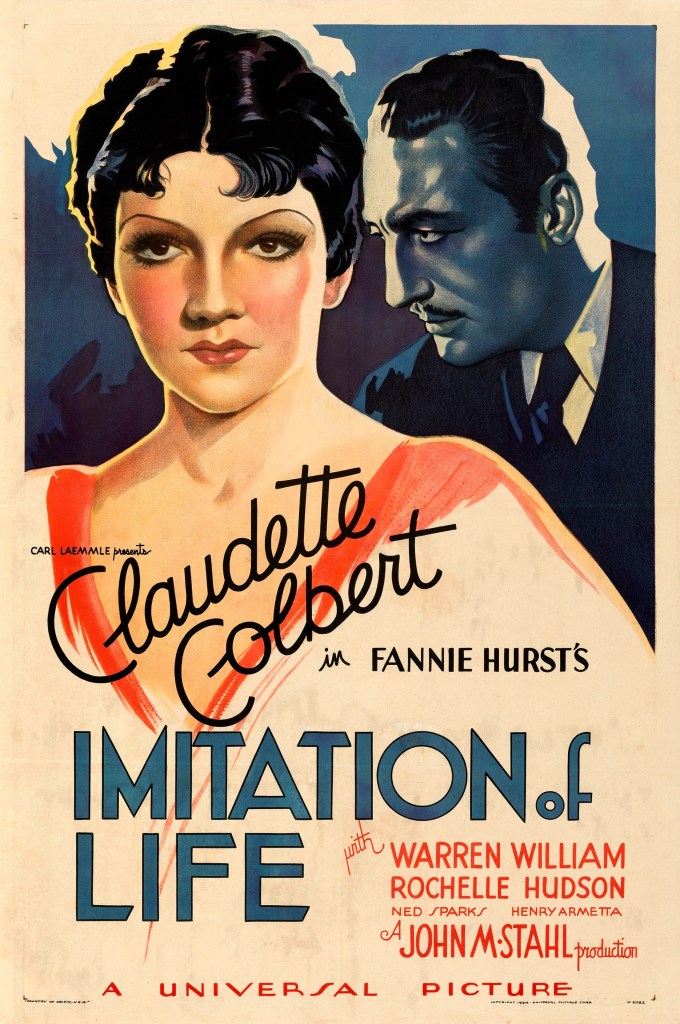
Imitation of Life sits at a fascinating juncture of American life. On the surface, its a familiar “woman’s film”. Struggling widowed mother Beatrice Pullman (Claudette Colbert) turns her life around by building a pancake bakery empire, based on the unbeatable pancake recipes of her Black maid and best friend Delilah’s (Louise Beavers). She builds a better life for her daughter Jessie (Rochelle Hudson) and navigates romantic complexity with dashing ichthyologist Stephen Archer (Warren William), who unwittingly attracts the devotion of the teenage Jessie.
Now, a film establishing it was possible for a woman to make a successful business career without the assistance of a man – and that she wouldn’t be, in some way, narratively punished for her presumption – would be radical enough. But, also in Imitation of Life is a complex, questioning look at race in America. Because humble, deferential Delilah – who sees her life’s purpose as being to serve – is openly the foundation of that success. Delilah isn’t even comfortable taking her share of the company (20% for being the face and genius of the company), an attitude Imitation of Life simultaneously encourages us to find both quaint and frustratingly servile. Instead, Delilah wants nothing more than to keep her apron on and bring Beatrice food and foot massages whenever she needs them. What this says about both of them is kept fascinatingly present all the time.
Imitation of Life presents an intriguing, under-the-surface searchingly frank depiction of a close bi-racial friendship that still drips with unspoken hierarchy. Delilah, of course, wouldn’t think of calling Beatrice anything other than Ms Bea, while Beatrice would never think of introducing her as anything other than Delilah (she doesn’t seem to have a last name). Repeated shots employing staircases – most strikingly a mid-shot that sees both women head to bed, one going upstairs the other down – stress the barriers between them. While the wealthy Bea parties upstairs, Delilah smilingly knows her place is downstairs in her comfortable but considerably less grand servants’ rooms. There is friendship, but everyone has their ‘natural’ place – and the film subtly invites us to feel awkward when we recognise this.
However, Imitation of Life gives its most dynamic plot to Delilah and her daughter Peola. Superbly played by Fredi Washington – bringing a lifetime of personal experience to her passionate portrayal – the pale-skinned Peola, unlike Delilah, can ‘pass’ as white. For a Hollywood film to even present this is daring enough: the clear-spoken Peola, who lacks Delilah’s stereotypical sing-song accent, is a living, breathing challenge to the absurdity of America’s racist segregation laws. She can work in a restaurant, where the punters would be aghast if they knew her background (as aghast as they are when Delilah walks in). She has possibilities in her life beyond the ‘Black college’ her mother wants to send her too or the career of menial drudgery even the most intelligent Black people in America were consigned to at the time.
Imitation of Life, with its romantic regard for the traditional Delilah, can (and does) stare disapprovingly at Peola’s contemptuous dismissal of her mother, whose very existence is a living, breathing reminder to people that Peola doesn’t belong upstairs but very much downstairs. An attitude cemented at childhood, when Delilah unexpectantly arrives at school to ‘expose’ Peola’s heritage to everyone. But there is enough sly commentary in Imitation of Life to suggest this is as much a generational split. That Peola is perhaps right to be frustrated that its Beatrice rather than her mother who has made a fortune from their old family pancake mix.
In fact it can feel like Peola is rebelling as much against the older generation of Black people than she is her mother. The people like her mother, whose grandparents (or even parents) were slaves and accept willingly they belong in deferential service to rich whites, gratefully receiving their parental handouts. Peola dresses and speaks like a modern young woman, and her resentment is as much at Delilah’s lack of self-worth and happy embracing of her (admittedly friendly) economic exploitation. Peola is looking at a new future – one where Black people would (rightly) no longer accept such rigid guardrails on their life.
Imitation of Life captures these ideas slightly clumsily, presented in a way white 1930s Americans were comfortable processing, but it’s there. Sure Delilah – played with a real warmth and tenderness by Louise Beavers, adding emotional depth to a ‘mammy’ character – may be, at heart, a stereotype who turns up in Bea’s life with magical serendipity to improve her life with her service. Peola may often be given the words of a stroppy ingrate who won’t accept her place. But both characters – and Beavers and Washington – are straining at presenting something more complex, smuggling it under the Hays Code radar, as a generational tale of divergent options in the Black community.
This makes Imitation more than the comforting Uncle Tom story it presents as. It’s also, certainly, a heck of a lot more interesting than Colbert’s storyline. (Colbert must have noticed this, so it’s too her credit she enthusiastically took the larger but duller part). Colbert does a fine job, her affection for Delilah measured with just enough patronising paternalism. The melodramatic romantic entanglements with Warren William (not at his most interesting) and the almost terminally flat character of Jessie (played forgettably by Rochelle Hudson) drift dully past the eyes as we wait for the camera to go back downstairs for the real story once again.
Imitation of Life resolves most of its plot lines with comforting forgiveness and with characters stepping back into accepting their more expected roles. But it carries just enough suggestion of subversion, underneath its placid acceptance of a status quo, to make you think the same people would have made an angrier, more dangerous film if they had been given the chance.

