Tag: Marlon Brando

A Dry White Season (1989)

A Dry White Season (1989)

A passionate, clear-eyed and largely unsentimental denunciation of Apartheid, the best of its kind

Director: Euzhan Palcy

Cast: Donald Sutherland (Ben du Toit), Janet Suzman (Susan du Toit), Zakes Mokae (Stanley), Jürgen Prochnow (Captain Stolz), Susan Sarandon (Melanie Bruwer), Marlon Brando (McKenzie), Winston Ntshona (Gordon), Thoko Ntshinga (Emily), Leonard Maguire (Professor Bruwer), Gerard Thoolen (Colonel Viljoen), Susannah Harker (Suzette de Toit), Andrew Whaley (Chris du Toit), John Kani (Julius), Richard Wilson (Cloete), Michael Gambon (Magistrate), Ronald Pickup (Louw)

The late 1980s saw a small wave of films denouncing the horrors of Apartheid in South Africa, a racist system founded on cruelty and injustice. Many of these films struggled with either being overly earnest or turning their (inevitably) white lead character into a saviour figure. A Dry White Season is perhaps the best of trend, perhaps because it focuses on a fictional story rather than real history (instantly gaining it the sort of dramatic latitude drained out of Cry Freedom) and directed by Euzhan Palcy, the first Black woman (then aged only 32) hired by a major studio, with a cast of the cream of Black South African actors, who knew all too well this world. A Dry White Season is also notable for its critical view of white South Africans who, bar a few exceptions, are presented as tribalist blind-eye-turners, furious at anyone who shakes their world view.

Ben du Toit (Donald Sutherland) is the epitome of smugly complacent Afrikaner (Sutherland even has a plump false belly, to hammer home his cosy self-satisfaction). A former rugby star, teaching white history in a private school, to him the system is always fair and if a Black man is arrested he must have done something wrong. That’s shaken when school gardener Gordon (Winston Ntshona) asks him for help, first after his barely-a-teenager son is beaten by police then again when the same son dies in custody after a protest. Ben’s first reaction is to shrug and say nothing can be done: the scales fall from his eyes when Gordon asks the wrong questions and is in turn murdered in custody by brutal Captain Stolz (Jürgen Prochnow). Working with campaigner Stanley (Zakes Mokae), Ben finds his entire world view falling apart as he is compelled to uncover the truth – to the fury of his wife, daughter, in-laws and colleagues who increasingly see him as a traitorous boat-rocker.

A Dry White Season doesn’t shirk on the violence of Apartheid. It says a lot that an early truncheon-wielding police assault on a township, and the scarred backside of Gordon’s son soon feels everyday. The student protest – many of its attendees literally no more than children – is met with lethal force from white soldiers carrying machine guns, indiscriminately shooting down children at point-blank range. Gordon is waterboarded and brutally tortured. Anyone who crosses the security forces faces violent assassination or fatal beatings. Palcy unflinchingly shows this horror – and frequently cuts away from atrocities to shots of the du Toit’s enjoying their wealthy, contented life of sports and garden parties. The impression is clear: underneath this contented life for the whites is a brutal, violent, repressive system supressing all rights for the many.

Palcy brings the sort of perspective perhaps only a Black film-maker could. There is no attempt in A Dry White Season to shelter the audience. Instead, we are exposed to the worst the system has to offer. Palcy adds impact with her casting of several extraordinary South African actors. Ntshona, Mokes and Kani among others had all experienced this themselves (Kani lost an eye in a police beating). Their performances are superb. Ntshona’s simple, honest bravery is deeply moving while Ntshinga is heart-breaking as his wife. Kani drips moral authority as a solicitor. Best of all Mokae’s activist Stanley is a superb portrait of warm, world-weary wit barely covering a life of fury.

What’s really refreshing is we expect the white characters to feel shame or guilt as the truth edges into their lives. This doesn’t occur: in fact, bar Sutherland’s du Toit and his young son (the same age as Gordon’s child – the film opens with the two of them playing together) all the white characters furiously protect the system. Sides are firmly picked and no blurring of the lines is tolerated. His daughter (Susannah Harker at her most Aryan looking) just wants him to shut up and stop spoiling things. Richard Wilson’s avuncular headmaster can’t hide his anger at du Toit’s ‘treason’. The police’s deference evaporates the second du Toit asks the wrong questions about the wrong people.

Even du Toit’s wife – memorably played with a raw harshness by Janet Suzman – progresses through irritation, horror to outright disgust at du Toit. Suzman – a South African who fled the country and long campaigned against Apartheid – pours all her anger into a show-stoppingly racist speech where she claims Black people are dangerous and don’t deserve any rights, that the Afrikan’s own South Africa and any violence against Black people doesn’t matter so long as the whites continue to live well. She represents a system supporting a boot stamping on Black faces for the rest of time.

It takes time for du Toit to realise there is no justice. Even after Gordon is murdered, he is convinced a trial will reveal the truth. He is of course, fantastically wrong – the trial being rigged from the start to produce a ludicrous suicide verdict. The trial is conducted by human rights lawyer McKenzie, played in a show-stopping cameo by Marlon Brando. Coming out of retirement to support the project (and working at union rate), Brando flexes his muscles one last time to deliver a charismatic, witty turn as a shambling Rumpole-like barrister who knows from the start his only result will be making the powers-that-be faintly embarrassed at their blatant injustice. If Brando’s support didn’t extend to learning his lines – he’s blatantly reading them from off cue cards or having them funnelled to him through a visible ear-piece – he’s still a stand-out in a sequence that makes abundantly clear just how complicit the whole system is in murder.

Sutherland – a fine performance of stunned, sad-eyed bemusement – makes du Toit a well-meaning men who realises he can never go back to his old life after peaking behind the curtain. It’s a nice touch in A Dry White Season that he never becomes a conventional white saviour: most of his actions lead to disaster, he’s reliant on Mokes’ Stanley and (other than his son) he fails to persuade anyone. But what chance does he have? Placy even shows many Black people have given up. At least one of Gordon’s torturers is a Black police officer and Gordon’s son and his friends open the film berating Black workers in a boozer that their apathy only props up the system. After Gordon’s death, a Black priest counsels turning the other cheek. But then the courage needed to protest is immense: Stanley smilingly states he long-ago accepted he was a dead man and it’s that which keeps him going.

A Dry White Season ends with a touch too much melodrama and a slightly too ‘Hollywood’ ending – but then it’s so relentlessly depressing that even a small victory is a relief. But, in the main, while sometimes rough and ready, it actually presents an important message with real dramatic force, stuffed with fine performances and a brutally realistic view of South Africa. It does give us some hope for the future: the only other white persuaded is du Toit’s young son: and it’s the young who are only hope for long-term change.

Mutiny on the Bounty (1962)

Mutiny on the Bounty (1962)

Epic retelling that sticks with the same melodrama and nearly destroyed Brando’s career

Director: Lewis Milestone (Carol Reed)

Cast: Marlon Brando (Lt. Fletcher Christian), Trevor Howard (Captain William Bligh), Richard Harris (John Mills), Hugh Griffith (Alexander Smith), Richard Haydn (William Brown), Tarita Teriipaia (Princess Maimiti), Matahiarii Tama (Chief Hitihiti), Percy Herbert (Matthew Quintal), Duncan Lamont (John Williams), Gordon Jackson (Edward Birkett), Chips Rafferty (Michael Byrne), Noel Purcell (William McCoy), Tim Seely (Midshipman Ned Young), Henry Daniell (Admiral)

After the success of Ben-Hur, MGM thought it had cracked the mystery of making those cash-registers go ring-a-ding: massive historical pictures, with scale and run-time dialled up to “epic”. Mutiny on the Bounty was one of the most famous stories of all time and they’d had signed up Marlon Brando, universally seen as the greatest actor alive. It couldn’t go wrong, could it? Months of shooting and a disastrous box-office release later (despite a MGM campaign that landed this a Best Picture nomination), and Mutiny on the Bounty effectively destroyed Brando’s career for the next ten years and became a by-word for star excess.

Brando played mutineer Fletcher Christian – but in a manner completely different from Clark Gable (who, Brando disparagingly stated, only played himself minus the moustache). Brando’s Christian would be British and then-some: posh, foppish, a gentleman torn between the rules of society and those of fair play. Bligh – played with a constant sneer by Trevor Howard – would follow in the footsteps of Laughton, but Brando wanted to make something more serious, more historical. Less of a blood-and-thunder naval drama and more a character study that would give a fair crack of the whip (so to speak) to the Tahitian natives the mutineers lived among.

The film we ended up with though is no more historically accurate than the 1935 Best Picture winner. Part of the film’s disastrous reception might well be that this epic tells more-or-less exactly the same salacious story of a devilish sadist scowling as he whips men to death (far from the truth of the real Bligh, a poor leader but not a monster) until his noble number two steps up (the real Christian was a spoilt weakling) but in what feels like twice the time with half the fun. If you want to watch this version of the Bounty story, why would you want to choose this one? (We’d have to wait until the 1984 version for a more fair-handed telling.)

Not that Mutiny on the Bounty is as terrible as its reputation suggests. It touches – particularly in its thoughtful post-mutiny coda on Pitcairn island – on an interesting character study of the mixed motivations of Christian, filled with regrets and self-pitying sulking. It wants to explore where the balance lies between what is right by the letter of the law and by its spirit. Nothing Bligh does in the film is wrong as such, but his relish and zeal in doing it are. Christian isn’t a conventional hero, but a smirking, foppish character prone to snide remarks and affecting an air of disconnected duty for large chunks of the film. If the film had allowed Bligh more sympathy, rather than the two-dimensional monster he’s portrayed as here, it might have made for an interesting character clash.

Instead, it tends to be slow, self-important and pompous, not helped by Brando’s indulgent performance which sacrifices drama for portentousness. For all the film offers a cartoonish villain, it’s resolutely unfun and deathly serious. Shot with a professional, disengaged widescreen flatness by Milestone (called in from decades of retirement as a “safe-pair of hands”, after the sacking of Carol Reed), it’s uninspired and mistakes size for visual interest. The ship, in particular, is shot with a wide-angled spaciousness which feels completely wrong for a location supposed to be ripe with claustrophobic tension.

The drama attempts to make up for this with its parade of lashings, keel-haulings and bodies (or obvious dummies) tumbling to their death from the rigging. Trevor Howard delivers exactly what’s asked fork here, sneering and constantly in the wrong. It’s one of the film’s failings that it leans into psychological complexity in some places, while most of its events and its second lead are presented with cartoonish silliness. Its location shooting in Tahiti looks great (although the all-too-obvious intercutting of this with scenes on sound stages, sometimes from one cut to another, jars) but a widescreen image of glistening sea would look gorgeous in even the most workmanlike hands.

Perhaps the film is, at times, a chore because it all too clearly was for many involved. Reports of Mutiny on the Bounty have regularly focused on its disastrous making, with directors fired, location shoots awash with dysentery, shooting months over schedule. Above all, Brando rewriting the film on the fly, muscling a disinterested Milestone aside to direct certain scenes. Not a surprise that the studio decided all the blame would be dropped on him not them (they were also stung by the contract they gave him, at $5k a day overtime, Brando’s perfectionism becoming one of the main factors of the film going months over schedule), leaving him virtually unemployable for a decade.

But is that fair? Brando arguably become the awkward, unlikeable, misunderstood Bligh with the cast and crew as the mutineers, all of them intent on a voyage of mutual self-destruction. Put simply, this was a clash between Brando’s immersive, deep-dive acting style and Old Hollywood. To Brando “professional” meant something very different to the “hit-your-marks-say-your-words” attitude of Milestone and the crew: it meant searching over time for the heart of a character. The sort of psychological depth Brando was aiming for was just anathema to many of those he was working with, coming across as the unprofessional self-indulgence of a spoilt star. Combine that with Brando’s stand-offish shyness and professional selfishness and you had a recipe for disaster.

Severed from any director he respected (he made it all too clear he considered Milestone a hack studio Yes-Man) and with no-one having either the power or inclination to restrain him, Brando threw every idea he had at the screen, no matter how awful. So we got Christian with a ludicrous, giggle-inducing accent, a performance stuffed with foppish eccentric touches (and awful costume choices) that aims at thoughtful re-invention but comes across as a camp, bizarre mess. The tragic thing is Brando is clearly passionate about the project, putting more thought and commitment into this performance than he ever offered in barely-bothered turns in films like Sayonara.

Brando was also working with a group of Reed-recruited actors with no sympathy for him. This group of macho British and Irish heavy-drinkers (Hugh Griffith, in a crucial role, frequently disappears for no reason as his alcoholism eventually became such a burden he was fired mid-shoot) had no sympathy for the fey Brando or his acting style. Richard Harris’ loathing of his co-star – who responded to their open dislike with petty on-set power-plays, only making the whole problem grow – in particular is all too-clear. Brando looks most comfortable working with the Tahitian actors (he had long been a passionate anti-racist campaigner) and later married Tarita Teriipaia. It’s one of the few times where he makes Christian feel fully human rather than a mixed bag of conflicting actorly tricks.

Mutiny on the Bounty has its moments: unfortunately it’s all the wrong ones. For a film that wanted to be a more serious, historical exploration of the mutiny, its best parts revolve around Howard’s lip-smacking villainy, combined with flashes of its on-location shooting. Problem is, that’s not dissimilar from what we got in the 1935 original – and really you’d just be better off watching that.

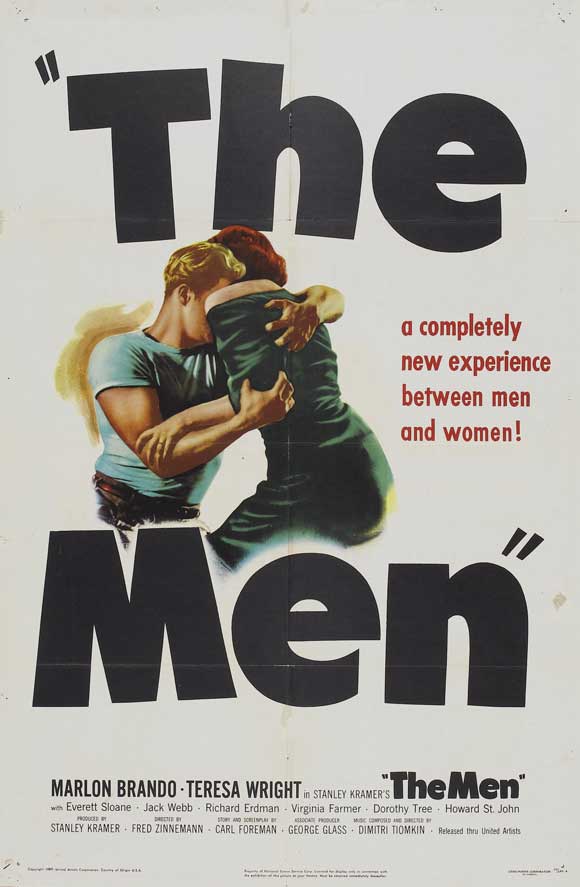
The Men (1950)

The Men (1950)

Brando makes his film debut in this earnest but realistic drama about paraplegic war veterans

Director: Fred Zinnemann

Cast: Marlon Brando (Ken Wilocek), Teresa Wright (Ellen), Everett Sloane (Dr Brock), Jack Webb (Norm), Richard Erdman (Leo), Arthur Jurado (Angel), Virginia Farmer (Nurse Robbins)

The Men opens with a thoughtful dedication to the two wars many soldiers have fought: the first with weapons, the second “with abiding faith and raw courage” against the physical and emotional consequences of the first. Fred Zinnemann’s documentary-influenced The Men takes a careful look at how the impact of that second war at a paraplegic veterans hospital. Ken Wilocek (Marlon Brando, in his film debut) is a former college sports star now confined to a wheelchair and struggling to adjust. His fiancé Ellen (Teresa Wright) is still eager to marry – but are either of them ready for the difficulties Ken will have adjusting his life?

The biggest strength of The Men – aside from its realist lack of flash – is how it avoids easy answers to big questions. Sure, Carl Foreman’s script has a tendency to lean into a mix of relationship drama and information film. But in looking at Ellen and Ken’s wedding night (and, in a neat visual metaphor of a misfiring champagne bottle, their likely sex lives), The Men is coldly realistic. Ellen might be largely presented as a picture-perfect ideal woman – but even she is freaked out by Ken’s squeaky wheelchair, twitching leg, implied impotence and the thought of what she has let herself in for.

That’s as nothing to the self-loathing fury – directed into rage at Ellen – Ken feels. This man who defined himself by machismo and physicality, who labours for weeks to stand upright so he can get married at the alter (it’s a sign of the film’s avoidance of easy solutions that, despite this, Ken still falls over at the alter) suddenly realises that he will always be partially dependent on his wife for simple tasks. He’ll never be the provider he expected to be – and he’ll never be able to fulfil some of his wife’s sexual needs. A proud man, no wonder the realisation throws him into depression.

It’s moments like this when Zinnemann’s film is at its strongest. It’s a film surprisingly frank and (for the time) daring about the emotional and physical consequences of war injury. Everett Sloane’s impassioned doctor is introduced warning wives and mothers about the consequences of paraplegia and the difficulties emotionally, physically and (he all but says) sexually they will have – but he might as well be talking direct to the camera informing the audience.

ZInnemann’s film, in a dispassionate but respectful way shows the process of rehabilitation, its strengths and its weaknesses. From physical training to the difficult emotional adjustments. The film used several real-life veterans – including Arthur Jurado in a key role as a Latino paraplegic holding onto optimism – and worked closely with hospital medical staff (some of whom appear as themselves). There is a solid sense of respectful realism about the whole thing. (You can feel the hand of producer Stanley Kramer.)

He’s also helped hugely by a powerful, committed and complex performance from Brando in the lead role. Making his first film, Brando astounded Zinnemann and the crew with his commitment. Effectively Brando “learned” to be paraplegic, forming deep friendships with the veterans (far more allegedly than with his fellow actors). His performance is a searing collection of contradictions. Ken is boyish, eager and lets excitement flash across his face when playing sports or driving an adjusted car for the first time. But he’s just as apt to be surly, resentful and bitter, to snap at those trying to help him and furious at the failings his own body have forced on him.

It comes to a head at that disastrous wedding night. Brando struggles with a growing realisation of his dependence and helplessness and his face flares with the pained recognition that this is in no way the wedding night be imagined. Throughout much of the film he is desperate to cling to any chance of recovery – from imagining sensation in his legs to furious workouts to build his upper body strength to help him pretend he still has fully functioning limbs. It’s a fabulous performance, a slice of realism and humanity, underplayed with an everyday casualness.

It does mean Teresa Wright at times looks a little more actorly as Ellen. To be fair to Wright, her part is saddled with the most conventional plot arcs and scenes, of romantic devotion mixed with sudden doubts. (It’s not helped by Dimitri Tiomkin’s overly emphatic themes for her character, that do their best to do all the work for the audience). Her scenes tend to have the air of the infomercial about them, as Ellen debates disabilities with Dr Brock and her doubting parents. Foreman’s dialogue also tends to lean a little too much into “I’ll love you Ken, no matter what” territory.

The Men is at its weakest when it looks at societal integration. For all the quality of Brando and the low-key sensitivity of Zinnemann’s direction, this ends up being a lighter, less impactful version of Wyler’s astounding The Best Years of Our Lives. Brando plays a combination of Dana Andrews’ and Harold Russell’s characters from that film, but The Men never hits the same heights of universal experience and pain as that film does. (Teresa Wright basically plays the same role here as she did opposite Dana Andrews). It’s just a little too low-key, a bit too documentary.

When away from the medical, there is a lack of inspiration and poetry from The Men. It gains a lot from Brando’s performance, but without him it would feel more like a Government infomercial. When it hits drama, for all its daring, it never manages to fully turn itself into something more than a traditional romance-against-the-odds. It has its heart in the right place, but it feels like a companion piece to better films than a classic in its own right.

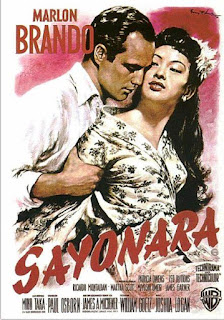
Sayonara (1957)

Sayonara (1957)

Racism gets exposed at clumsy length in this heavy-handed social issues drama

Director: Joshua Logan

Cast: Marlon Brando (Major Lloyd “Ace” Gruver), Patricia Owens (Eileen Webster), James Garner (Captain Mike Bailey), Martha Scott (Mrs Webster), Miiko Taka (Hana-Ogi), Red Buttons (Airman Joe Kelly), Miyoshi Umeki (Katsumi Kelly), Kent Smith (Lt General Mark Webster), Ricardo Montalban (Nakamura), Douglass Weston (Colonel Crawford)

It’s post-war Japan and the American occupation forces have got very strict rules about what their soldiers are allowed to do with the native population: namely not marry them. Any suggestion of American soldiers finding themselves Japanese wives is frowned on at the very highest level. Something flying ace Major “Ace” Gruber (Marlon Brando) is about to find out when he’s transferred from shooting down commies in Korea. Airman Joe Kelly (Red Buttons) is determined to marry Katsumi (Miyoshi Umeki) – and nothing commanding officer Gruber or anyone else can say will dissuade him. Meanwhile, Gruber finds himself falling in love with Japanese actress Hana-Ogi (Miiko Taka) – and facing the exact same pressures to chuck her overboard as Kelly meets.

Sayonara is very much a Hollywood message film: that being interracial marriage is a fact to celebrate not condemn, with a subsidiary message focused on rehumanising the Japanese people for American audiences still holding strong memories of the Second World War. Like a lot of message films from the era though, its also slow, stuffy, self-important and more than a little dull – something its multiple Oscars can’t hide.

Shot on location, it often come across as a sort of Japanese travelogue which, for all its efforts to make the Japanese sympathetic, can only interpret them and their culture through a selection of cliches and generic expectations. The film is a parade of kimonos, lotos blossoms, tea ceremonies and geisha girls, all shot with a laboured flatness by Joshua Logan. Logan’s direction overflows with middle-brow earnestness, pleading for a little love and understanding, while shuffling together a series of stereotypical and predictable plot events. Logan also seems to struggle with the cinemascope frame, which frequently dwarves this intimate story.

It’s all told at a very slow pace: it’s remarkable that such a slim story manages to fill almost two and a half hours. Much of this is taken up with the romantic entanglements of Ace, half-heartedly engaged to General’s daughter Eileen Webster (a saintly understanding Patricia Owens, who practically asks to be thrown over), before a chance sighting on a bridge (of course it’s a soribashi bridge) leads to him falling head over heels in love with Hana-Ogi, hanging around the bridge every day and struggling his way through a Japanese phrase book so he can ask her out on a date (the dates, when they come, are like a travelogue of the most Japanese events you could imagine).

The languid lack of drive isn’t helped by Brando’s curious performance. Sayonara is the perfect example of what a mystifying actor Brando could be: here he was in a project that clearly meant a lot to him personally (he was a long-standing social campaigner), but he drifts through it with a lazy off-the-cuffness that suggests he’s only doing the film under protest. Only Brando could act in a passion project with such surly indifference (allegedly motivated by his lack of regard for Logan’s direction). Brando uses a non-descript Southern drawl, which he uses as an excuse to dial his mumbling up to 11. He slouches and ambles through every scene, barely raising his voice or lifting a finger unless it’s essential.

Because Brando seems so disengaged and bored by the whole thing (the only spark of energy he gives is when he playfully bangs his head on a low Japanese ceiling) it makes the film drag on without the stakes ever seeming to really mount. Ace is told repeatedly that he will have to chuck Hana-Ogi, but he shrugs it off with all the indifference of a laid-back hipster. I think Brando is straining to suggest that Ace has the soul of a poet, trapped inside his father-mandated time in West Point – there is a moment where he airily mumbles something about his dreams as a young man of finding something more. But the overall effect is more of an actor drifting through a long role with minimum effort.

You can’t say the same for Red Buttons, who plays Kelly with a great deal of commitment. Winning an Oscar, this first role was also his best, with Kelly having Button’s good-natured lightness but mixing it in with a fierce defiance and a touching pain when his wife suggests surgery to try and alter her facial features to appear more Western. Umeki also won a generous Oscar for a brief performance which gives her very little scope to do much beyond playing the quiet wife (I suspect the Oscar was partly for the film’s theme and reflects a weaker year of candidates). Miiko Taka is more impressive (and given more scope) as Hana-Ogi, all too aware of the pressures on her not to get involved, torn between her feelings and what she sees as her duty.

Sayonara as a whole though remains a flat, often rather uninvolving film that holds its liberal conscience so close to its chest that it manages to squeeze any trace of life out of it. Its liberalness only goes so far: Logan casts two Japanese actresses but has no concerns about recruiting a pale-faced Ricardo Montalban to play the only Japanese male with lines. It’s exploration of mixed-race relationships is solely focused on white guys marrying who they want. A truly daring film would have thrown in a flirtation between Montalban’s Japanese actor and Patricia Owen’s patrician General’s daughter. A Japanese man marrying the daughter of one of America’s own? Now that is a vision that would have really shook up 1950s America.

It’s not to be though. Instead, this is an overlong, overly serious, pleased with itself melodrama, coated in lashings of social awareness that is cursed with a languid central performance that helps make the whole film seem to drag on forever. Logan is unable to provide either any dramatic or political fire to the film and it settles all to often for safe, picture perfect shots of Japan. While you can admire the motives behind it, there is little to admire in the film itself.

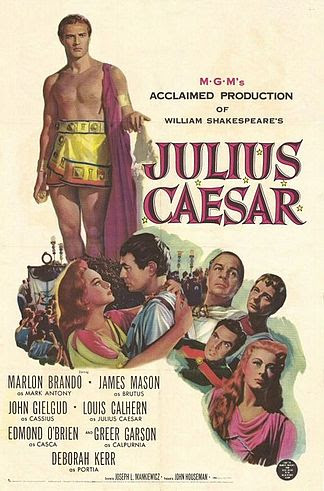
Julius Caesar (1953)

Mason and Gielgud confront Brando in Hollywood’s faithful Shakespeare adaptation Julius Caesar

Director: Joseph L Mankiewicz

Cast: Marlon Brando (Mark Antony), James Mason (Brutus), John Gielgud (Cassius), Louis Calhern (Julius Caesar), Edmond O’Brien (Casca), Greer Garson (Calpurnia), Deborah Kerr (Portia), George Macready (Marullus), Michael Pate (Flavius), John Hoyt (Decimus Brutus), Douglass Watson (Octavius)

Hollywood has always been in awe of Shakespeare. For large chunks of Hollywood’s Golden Age, it was felt the Bard’s mighty words could only be performed in a certain way by certain actors and that it somehow besmirched the Bard to put him on celluloid. It’s partly why there are few truly radical productions of Shakespeare on screen. By 1953 Orson Welles had directed inventive, challenging productions of Macbeth and Othello that reworked Shakespeare for cinematic effect, but these had been met by horror by some critics (‘how dare he change things!’). Julius Caesar fit the mould in many ways for how Hollywood felt Shakespeare should be done – traditionally, respectfully and by a cast of trained theatre actors. Then they threw in a curve ball by casting Brando as Mark Antony.

It’s hard now to really understand the hesitancy (and outright snobbery) from many about the very idea of Brando doing Shakespeare. This was the mumbling Stanislavsky-trained star of Streetcar, the earthy, T-shirt wearing slab of muscle that yelled “Stella!” – who on Earth did he think he was? Shakespeare is for plummy accents, focused on poetry. Brando took a huge risk taking this role on. But, today, his performance feels fresh, vivid and in many places strikingly modern.

Brando bought a more relaxed, natural style – and, yes he also affected a slightly plummy Brit accent – and bought a emotional realism to the most exhibitionist of Shakespeare’s great roles. (Let’s not forget, most of Antony’s part is a massive public speech). Brando creates an Antony who is passionate, loyal, committed – but also cunning, manipulative and very aware of the effect he is attempting to generate in that famous speech. He delivers the speech with aplomb, but concentrated as much on the emotion of what he was saying as the poetry of how he said it. It makes for an excellent marriage between two different styles of theatre, and Brando’s powerhouse delivery (Oscar nominated) carries real energy and dynamism.

It sits within a very traditional production, carefully shepparded to the screen by Joseph L Mankiewicz. Mankiewicz was a two-time Oscar winner for Best Director – but his reputation was largely formed on his mastery with dialogue and actors, rather than any visual sensibility. Julius Caesar is intelligently and faithfully bought to the screen – albeit with little cinematic flourish – shot with a moody black-and-white (designed to ape news-real footage and add further dramatic urgency to the action) on sets that were leftover at the studio from Quo Vadis. (Some of the busts are hilariously out of place – pretty sure Brutus has a bust of the Emperor Hadrian in his home, quite something seeing as he died 160 years before Hadrian was born.)

Mankiewicz by and large lets the play speak for itself.  What Shakespeare wrote, he largely says, and there is little in the way of message in a play that has been reversioned to almost any oppressive regime you can imagine. A few flourishes diverge from the text. He radically simplifies Acts 4 and 5 of the play (particularly the Battle of Philippi and the consecutive suicides of Brutus and Cassius), reducing these down to little more than half an hour. Wisely he focuses on the more dramatic Acts 1-3. The scheming is tense and moody, the assassination swift and brutal. The crowd scenes in Rome bustle with an immediacy and vibrancy – the camera often sits among the plebians during the speeches, encouraging us to share their feelings and reactions to the speeches. Antony is made a calculating and cunning figure – consciously waiting for certain reactions: he even, in one directorial flourish, enters bearing Caesar’s corpse during Brutus oration.

Mankiewicz’s main strength is in working with actors. Although Brando claimed the plaudits, the play is actually centred around Brutus, the intellectual of good intentions drawn into a conspiracy for the best intentions who finds principles and coups make for impossible bedfellows. The film’s finest performance is from the simply superb Mason, who was born to play tortured decent patricians like this and creates a Brutus stuffed with doubt, pride, arrogance, uncertainty and a little touch of fear. His patrician voice is perfect for this “most honourable of all the Romans”, and he sets about murder as the deeply unpleasant task it is, guided by his assumption that he-knows-best. The little moments are brilliantly done: from his petrified nerves at the assassination to his pious sermons on morality to Cassius to his tenderness and care for his wife and servants. It’s a wonderful performance.

To complement him, Mankiewicz recruited one of the greatest Shakespearean actors living as Cassius. Gielgud hadn’t done a film for over ten years (he always felt the cinema to be a minor art), and Julius Caesar was the only opportunity he had to capture one of his great Shakespearean performances on film until Prospero’s Books nearly 40 years later. It’s fascinating to watch a film where the old school (in Gielgud) and new school of acting (in Brando), both bring their own approaches to Shakespeare. This is Gielgud’s finest Shakespearean performance on camera – he must surely have learned more about acting on camera from Mason and Brando – the first time his style moved away from ‘singing the verse’ towards something more emotional, his Cassius a bitter, manipulative man who starts the film holding all the cards and ends up with none of them.

Watching these three powerhouse performers work is a treat – and also to see their styles merging and playing off each other. Mason is the perfect fusion of the realism of Brando and theatricality of Gielgud. Brando learned huge amounts from Gielgud, frequently consulting him on delivery. Gielgud surely took as much from Brando on adding greater emotion and realism into his screen performances, shirking the declamatory style that often makes him grand but unconnectable. The other actors around them offer versions of these styles: O’Brien stands out best as a shrewd and cunning Casca, Calhern tries a little too hard to be grand as Caesar, Kerr and Garson are a bit too theatrical in thankless parts as “the wives”.

Julius Caesar as a whole though is a lean, pacey and intelligent staging of the play, directed unobtrusively but professionally, very well acted by the cast. While Mankiewicz does nothing radical here – look at Orson Welles Othello and there you’ll see how the language of cinema can add a whole new perspective to Shakespeare, in a way this film never does. But while not radical, it focuses on story and character really well. The set-piece moments – the speeches, the murder, the plotting – are staged with urgency, energy and drama. Mainstream Hollywood still wasn’t ready for radical reworking of Shakespeare (this got lots of Oscar noms, Welles Othello was a flop), still seeing him as someone best cast in marble – but with Julius Caesar Hollywood took baby steps towards suggesting there could be a different future.

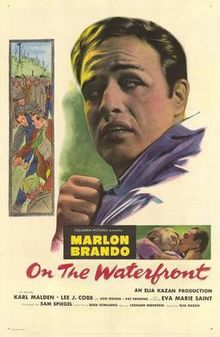
On the Waterfront (1954)

Marlon Brando reinvents film acting in On the Waterfront

Director: Elia Kazan

Cast: Marlon Brando (Terry Malloy), Karl Malden (Father Barry), Lee J. Cobb (Johnny Friendly), Rod Steiger (Charley “The Gent” Malloy), Eva Marie Saint (Edie Doyle), Pat Henning (Timothy Dugan), John F Hamilton (“Pop” Doyle), Ben Wagner (Joey Doyle), James Westerfield (Big Mac)

When’s the right time to speak out for what you know is right? It’s a question we’ve all faced at some point, and it’s the question that changes the life of Terry Malloy (Marlon Brando) after he is indirectly, and unwittingly, involved in the murder of a fellow dock worker. The killing was ordered by the corrupt, mob-connected union boss Johnny Friendly (Lee J. Cobb), who rules the workers of the shipyards of Hoboken, New Jersey with an iron fist. The victim was going to talk to the cops, and suddenly Terry finds himself in the middle of a major ethical bind: should he give evidence or play “D and D” (deaf and dumb) like the rest of the workers.

His bind grows ever tighter as the local priest Father Barry (Karl Malden) takes up breaking the power of the union as his own personal mission. Not to mention Terry’s growing closeness to the victim’s sister Edie (Eva Marie Saint), with whom he finds himself slowly falling in love. On the other side is his brother Charley (Rod Steiger), a lawyer and right-hand man of Johnny Friendly, who has been running his brother’s life forever, ruining Terry’s boxing career by ordering him to take a dive so Friendly could make a killing on the betting circuit. What will Terry do?

Elia Kazan’s multiple Oscar winner is a powerful, beautifully made, engrossing and uplifting modern morality drama that still packs a wallop today. Shot largely on location in New Jersey, with lashings of Kazan’s brilliant realism and ability to bring poetic beauty and emotional force to the most everyday of settings, On the Waterfront is sublime, a film to make you rail against the injustice of corruption and the unthinking cruelty of everyday folk when given a chance to stigmatise someone.

Kazan and screenwriter Budd Schulberg (whose script is a beautifully judged mixture of soulful dialogue and the rhythms of every day conversation) were both drawn towards the story after their engagement with McCarthyism in Hollywood. In this hunt for reds under the Hollywood bed, both Kazan and Schulberg named names. Both of them felt that they had been lied to and exploited by the communist movement in Hollywood – and also that Stalinist Russia was not a cause worth defending – but that didn’t stop many people rejecting them for breaking the rule of silence (the same rule that runs through this film). On the Waterfront is a heartfelt defence of the whistleblower (or the informer), and why that can sometimes be the only option open.

Based on a true story, Kazan’s film is a masterclass in carefully controlled, intelligent direction bringing out brilliant acting performances (always one of Kazan’s major strengths as director). Leading the way here is Marlon Brando, giving possibly the most famous, most influential acting performance in film history in the lead role. It’s not really an understatement to say it changed the face of movie acting. Brando here performs with a low-key, casual, almost tender naturalism that stands completely at odds with the more exhibitionist performers of the late 40s. And he funnels all this beautifully into Terry Malloy, a tough guy whom he inhabits with a vulnerability and gentleness that never once feels out of place with his temper and pride. There is instead an awe-inspiring transformation here, of the actor becoming the mumbling, uncertain character – not afraid for words to be lost, not worried about making eccentric or unexpected choices as a performer.

Two scenes stand out. In the first, Brando has his first long conversation with Edie Doyle, having rescued her from being set on by union men. In a single take – a carefully orchestrated willingness to let the actors explore the emotional truth of the scene from Kazan – Brando’s Terry shyly, gently, haltingly asks about her life and tries to explain his own. At one point, Edie drops her glove and Brando picks up the glove, fiddles with it and then puts it on – the sort of inspired naturalism that feels like nothing on paper, but on film carries a strange emotional force, a physical representation of the bond between them (and don’t underestimate the way Saint pulls the glove gently from his hand). The entire scene has the air of reality to it, Brando chewing gum, Saint wondering how much of herself to show to a man she isn’t sure she can trust. It’s masterful.

The other scene is of course possibly one of the most famous scenes in movies ever: I coulda been a contender. For films, this is like the To Be or Not To Be speech, a speech that has been quoted and riffed on ever since. But again, Brando resists the temptation throughout for histrionics – when Charley pulls a gun, Brando reacts not with shock or anger but sadness, almost tenderly pushing the gun aside and letting his voice fill with a world of regret for what has become of their relationship. Steiger is superb in this scene, but you can’t look at anyone except Brando here, awkward, sad, struggling to work out what to do with his life and finally confronting the broken past between the brothers with pointed regret and calm realisation rather than the anger and rage that other actors would have chosen. This is an actor who redefined his profession, at the top of his game.

The film is crammed with excellent performances. Eva Marie Saint (Oscar winning) has just the right measure of gutsy determination, fear and tender sweetness as the woman who opens Terry’s eyes to right and wrong. The film gained three Supporting Actor nominations (they all lost). Steiger is cocksure but self-loathing as Terry’s ambitious brother. Lee J. Cobb rages as only he can as the blowhard bully Friendly, demanding absolute loyalty. But on this rewatch, I loved Karl Malden’s moral certainty, courage and stubbornness as Father Barry. In any other film Barry’s speech railing against the dockers for being part of the system that oppresses them, all the time being pelted by food, would be the highlight of the film: here it’s just one of several stand-out moments.

Kazan was a superb visual stylist, this black-and-white masterpiece brilliantly shot by Boris Kaufman to create a world that feels the perfect mixture between the documentary realism and the theatrical. And working with a superb script that he felt such investment in helps to create a story that carries real emotional force, carefully investing you right from the start in Terry’s fundamental goodness and naivety, inviting you to feel rage on his behalf as he is sent to Coventry by his workmates. Topped off with a beautiful score by Leonard Bernstein – part jazzy, part wonderful orchestral stylings – this has barely aged a day in it’s over 60 years.

Apocalypse Now (1979)

Martin Sheen heads into insanity in Coppola’s epic pretentious masterpiece Apocalypse Now

Director: Francis Ford Coppola

Cast: Martin Sheen (Captain Willard), Marlon Brando (Colonel Kurtz), Robert Duvall (Lt Col Kilgore), Frederic Forrest (Chef), Albert Hall (Chief), Sam Bottoms (Lance), Laurence Fishburne (Mr Clean), Dennis Hopper (Photojournalist), GD Spradlin (Lt General Corman), Harrison Ford (Colonel Lucas), Scott Glenn (Captain Colby), Christian Marquand (Hubert de Marais), Aurore Clément (Roxanna Sarrault), Jerry Ziesmer (Mysterious Man)

During the 1970s, the director was king in Hollywood. Get a reputation as a visionary director, and Tinseltown fell at your feet. You could spare no expense to put together ambitious, thought-provoking, epic films. If you wanted to shoot on location at huge cost, or reconstruct elaborate sets for single shots, for a huge runtime that catered as much to your ideas of being an artist as it did to crowd-pleasing narrative, then Hollywood would give you keys. It didn’t last: several massive bombs (combined with the huge box office take of Star Wars) shattered the mystique of the director as an ego-mad, flawless genius who had to be indulged, and persuaded Hollywood the future was in big-budget, mass-produced action films (welcome to the 1980s, Hollywood’s nadir).

Apocalypse Now wasn’t one of those flops, like (most infamously) Heaven’s Gate. But, by golly gosh, it really could have been. In fact, in many ways it should have been. It has all the hallmarks: a huge runtime, filmed over a colossal period of time in a difficult location, a plot that mixes action, war and thrills with impenetrably pretentious musings on mankind’s dark soul. A maverick director throwing his own very personal vision at the screen, and damn the consequences. It’s a miracle Apocalypse Now wasn’t a career apocalypse for everyone. It escaped because, despite everything, it more or less gets the balance right between plot and character and pretention and faux-philosophy.

The film is famously a transposing of Joseph Conrad’s Heart of Darkness into Vietnam. Captain Willard (Martin Sheen) is ordered to head down the river to “terminate with extreme prejudice” rogue Special Forces Colonel Kurtz (Marlon Brando), who is conducting his own vigilante war. On the boat trip down the river, Willard encounters a host of increasingly bizarre and surreal scenes, from war-mad Colonel Kilgore (Robert Duvall) to a seemingly leaderless battle over a bridge, a playboy bunny show and a compound of ex-French colonials. And that’s before he even arrives at Kurtz’s compound and things get really strange.

Apocalypse Now is almost impossible to separate from the bizarre, tortuous route it took to get to the screen. Originally scheduled for a few months, the film took over a year to complete. A typhoon destroyed all the sets in the first two months. Original star Harvey Keitel was dismissed after a week (as his performance wasn’t right): his replacement, Martin Sheen, had a near-fatal heart-attack partway through filming. Marlon Brando not only turned up the size of a buffalo but refused to learn (or even speak) his lines. A year into production, the film had no ending. Coppola put his entire fortune up as collateral to complete the film. It was a nightmare.

But yet somehow what emerged has a sort of force-of-nature quality to it. Even though parts are basically pretentious rubbish, despite the fact I have twice fallen asleep in this film, despite the fact it is far from being a film that trades in complex ideas and offers profound insights, it still has a hypnotic quality about it. It’s done with a real force of commitment, a genuine labour of love, a film that doesn’t leave anything in the locker room but throws it all at the screen. The quality of what lands may sometimes be questionable, but the commitment with which it is thrown is beyond doubt.

And in a world of cookie-cutter films, it’s hard to have anything but respect and regard for a film that is so defiantly its own animal, that tells its story in its unique way. It’s perhaps one of the first “experience” films: no film could of course communicate what it was like to serve in Vietnam, but this film perhaps gets close to the surreal, drug-fuelled madness in that conflict.

Because Apocalypse Now is a very surreal film. Its plot is extremely thin, and each section of its (mammoth) runtime is all about experiencing another element of the American experience. In the commentary, Coppola talks about the river trip being partly a journey from the present into the past, a journey back not only into the history of the conflict (and its different stages) but also the regressing of mankind itself into a more primitive, malleable, basic state. It’s a big lump for a film to bite off – and I’m not sure if the idea really comes across without you knowing it. The real impression you get is of rules of society being left further and further behind.

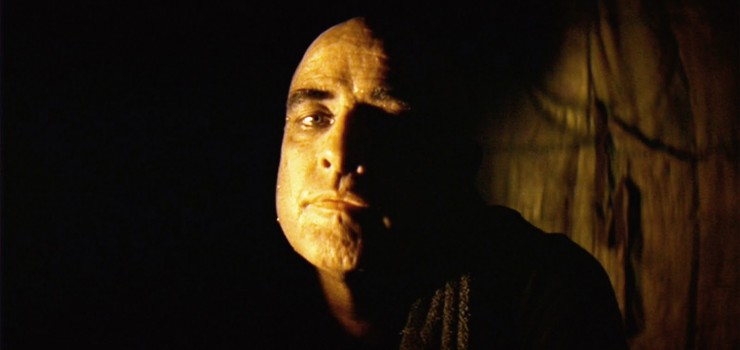
The arrival at Kurtz’s compound is the fufillment of this increasingly unnerving story. We’ve seen the madness on the journey, the pointlessness, and the bemused, carefree confusion of the crew. But at the camp we get the overblown, decadent lunacy of Kurtz. Brando dominates the final 30 minutes of the film, although his monologues are meaningless drivel, the sort of intellectual point-scoring you could hear in a sixth form debating society. To be honest, iconic as Brando’s appearance is, his performance of mumbling battiness is actually a little awful (like one big practical joke from the actor) and the film’s momentum grinds to a halt while he babbles on. 

In fact, so self-indulgent is Brando that in a way it’s a sort of tribute to Coppola’s mastery of cinema that he makes this pompous character make any sense at all – or that he makes this sort of nonsense even remotely watchable. But again it’s the hypnotic pull of the film: Coppola builds towards a chilling, haunting final sequence of Willard and Kurtz’s final confrontation intercut with The Doors’ The End and the real-life slaughtering of an ox by a crowd of real-life villagers (they were going to kill the animal anyway but offered to do it for the camera). Coppola somehow turns all this into iconic cinema, even though, viewed objectively, it’s overblown, indulgent, pretentious rubbish.

The whole film is a testament to hewing compelling filmmaking out of breathtaking insanity. After the film departs in the boat, most of reason, sense and conventional story-telling depart with it. Information only gets conveyed through rambling monologues from Willard. The crew of the boat get into scraps that reflect heightened versions of the American experience in Vietnam – from a war crime as the crew shoot-up what turns out to be an innocent boat, to an attack from unseen tribesmen with spears from the mists of the shore. Sam Bottoms, as surfer-turned-GI Lance, is our guide of a sort here – as he gets more stoned, so narrative logic departs with his senses. 

What keeps the film going throughout is the masterful film-making. Coppola shoots the bizarreness with brilliant, visionary imagination. As a social theorist he’s pretty basic – man is, by the way, a savage animal and the Americans didn’t know what they were getting themselves into in ‘Nam – but as a film-maker he’s one of the best. Who else could have made three hours of episodic boat journeys so strangely compelling? The film is crammed full of great scenes and moments which rarely feel like they tie together – in fact, they could almost be watched in any order – and there is barely a character in there, but the film feels like its throwing you into the madness of Vietnam. 

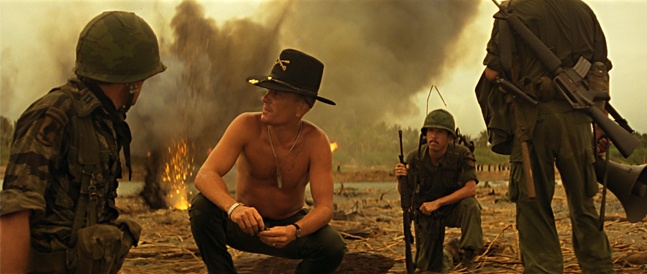
Even the sequence with a bit more narrative is still laced with absurdity. Kilgore’s helicopter assault on a village – and its use of Wagner blaring from helicopters to scare the Vietcong – is justly famous. This is a bravura film-making – and as much a tribute to the astoundingly amazing editing and sound work of Walter Murch as it is the photography of Coppola. Like most of the rest of the film it is visually outstanding, but it also has the film’s best writing (in the quotable but also strangely subtle characterisation of Kilgore) and also the film’s most iconic performance in Robert Duvall. Duvall is terrific as the war-loving, but strangely childish Kilgore, obsessed with surfing and with an ability to live totally in the moment. 

This sequence doesn’t hesitate in showing both the brutality of war – and also the insanity of our commanders. Kilgore is genuinely dreading the end of the war, and you can see why he would since he is clearly having a whale of a time bombing places. Kilgore is a lovable, quotable badass doing what needs to be done – but the film doesn’t forgot that he is also an insane soldier with no off-switch. And Apocalypse Now never really glamourises war, for all the excitement and beauty of watching those helicopters come over the horizon.

It’s the artistry in its film-making, and the genuine effort and work that helps make it a demented classic. Walter Murch’s sound design and editing is possibly flawless – this might be the best edited and sound designed movie ever – from the opening moment when the helicopter blade sounds transform into a hotel room fan you know you are seeing something special. Scenes such as Willard’s hotel-room breakdown hum with intensity as they feel genuinely real – that scene in particular feels like Martin Sheen exposing part of his tortured psyche at the time. Sheen is by the way perfect as Willard, a slightly unknowable killer with dead eyes and a dead soul, still aware of the vileness of his world.

Apocalypse Now is a sprawling batty film – and in many ways an intellectually empty one straining at a depth that ain’t there. But somehow, for all that, it still is a masterpiece. Which is in itself a bit of a miracle as it really should be a disaster. It’s pretentious. It’s overlong. It’s very full of its own importance as a work of art (the re-insertion of the long-winded political discussion at the French Plantation into the Redux version doesn’t help). Some of its performances are plain ridiculous, verging in Brando’s case on outright bad. But yet, it’s delivered with such force of conviction, it’s so wonderfully assembled, so hauntingly shot and edited, that it hammers itself into your brain. You literally can’t forget it, for all its many, many flaws. Despite yourself, you find yourself forgiving it an awful lot – a lot more than you might expect. A mess, but also a classic.