
Tag: Mary Boland

Ruggles of Red Gap (1935)

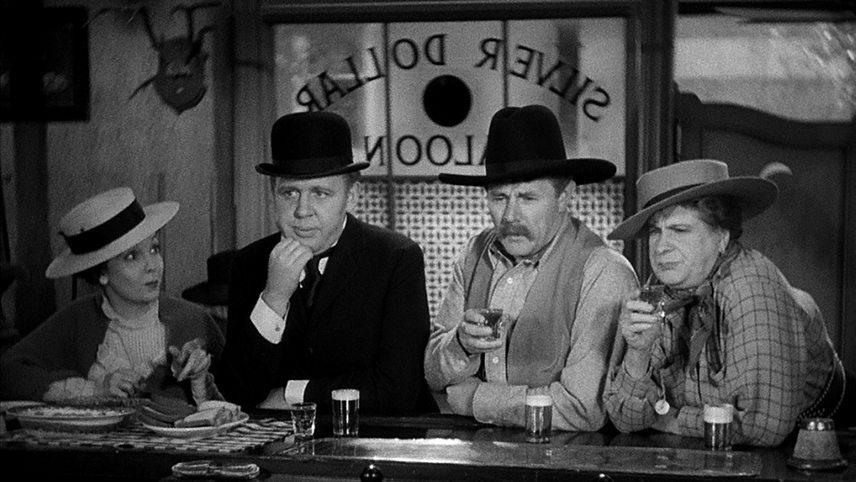
Charles Laughton wonders what he’s got himself in for in Ruggles of Red Gap

Director: Leo McCarey

Cast: Charles Laughton (Ruggles), Mary Boland (Effie Floud), Charles Ruggles (Egbert Floud), ZaSu Pitts (Mrs Judson), Roland Young (Earl of Burnstead), Leila Hyams (Nell Kenner), Maude Eburne (Ma Pettingell), Lucien Littlefield (Charles Belknap-Johnson), Leota Lorraine (Mrs Belknap-Johnson), James Burke (Jeff Turtle)

Ruggles (Charles Laughton) is the perfect gentleman’s gentleman. So how will he react when his gentleman, the Earl of Burnstead (Roland Young), loses him at cards to nouve riche American Westerner Egbert Floud (Charles Ruggles) and his social-climbing wife Effie (Mary Boland)? Wodehousian antics meet societal culture-clashes, in Leo McCarey’s witty and rather sweet comedy from Charles Laughton’s annus mirabilis (Ruggles, Bligh and Javert all in the same year!) that’s a celebration of American egalitarianism and the well-hidden warm cordiality of the polite British.

Directed with a fine sense of comedic timing by Leo McCarey, Ruggles of Red Gap is refreshingly heart-warming and a celebration of the rewards of decency. For all his initial reserve – and Jeevesian distaste for his new employer’s brashness and love of chequered suits – Ruggles emerges as a decent man, liberated by the classless openness of America. In fact, the idea of all men being equal opens Ruggles eyes for the first time to the idea of making his own decisions (after all he doesn’t question being told he will be moving from Paris to Washington State) and being seen as something other than just an extension of his employer.

Ruggles makes this point with some excellently delivered set-pieces. Most of these revolve around the enjoyable cultural clash between Ruggles and his new employer, the relaxed Egbert, who can’t imagine not calling Ruggles by a host of invented names (from “Bill” to “The Colonel” – the latter causing no end of trouble later) or inviting this staid servant to sit down and have a beer. Egbert’s obliviousness to the careful social rules that Ruggles has lived his entire life by works, because there is not a jot of meanness or correction to it. Egbert genuinely doesn’t understand the fine points of class difference and sees no reason not to treat Ruggles like a friend rather than a servant.

It makes for some terrific moments of comic business. Ruggles and Egbert conduct a running battle where Egbert’s natural politeness and Ruggles’ duteous deference leads to them constantly insisting the other walks first through doorways. Their first day together sees Egbert and a friend taking Ruggles to a Parisian bar and getting him roundly pissed (probably for the first time in his life). Later Egbert’s insistence on introducing him when they arrive in Red Gap as his friend “the Colonel”, combined with Ruggles patrician manners leads to him being mistaken as a genuine aristocrat by the snobbier element of Red Gap society.

Regular Americans may be overly boisterous – you can’t miss the increasingly irritated reactions by Parisians at Egbert’s reunion on the streets of Paris with an old friend, which escalates from embraces, to loud whoops to riding each other like horses – but generally they mean well (good natured fun is poked at the American’s hopelessness with foreign languages – “je voodrais ham un eggs”). In Red Gap, the patrons of a saloon greet Ruggles as one of their own. In turn Ruggles – and even the Earl of Burnstead – are charming and respond far more warmly to their decency than the snobbery of the hoi polli.

If there are unsympathetic characters in the film, it’s the snobs of the American elite, desperate to grab a bit of that old world glamour. Egbert’s snobby brother-in-law Charles sticks out as dyed-in-the-wool snob, concerned mostly with position and being seen with the right people. Effie (hilariously played by Mary Boland) is interested in Ruggles largely as a status symbol, and spends her entire time crafting Egbert into her idea of a gentleman. By contrasts the actualupper status chap, the Earl (delightfully under played with a hilarious uber-poshness by Roland Young) is relatively decent, humble and far prefers the fun-loving social crowd of Red Gap the stuffed shirts.

The film was a very personal one for Laughton, deep into his decision to take up American citizenship. Ruggles’ (and Laughton’s) love for American society is captured in the scene where he recites the Gettysburg Address to the rapt patrons of the saloon (none of whom could remember a single word of it when asked beforehand). In previews, the audience sniggered at Laughton’s emotional rendition (he couldn’t get through it without weeping) – so McCarey re-cut so we only see Laughton from behind and instead focuses on the faces of his audience: suddenly the scene carries real emotional force.

Laughton’s performance is an odd mix. Some moments – such as the Gettysburg address – he nails. His interplay with the other actors is highly effective, but many of his reaction shots often feel overplayed. He over eggs the pudding with the comic eyebrows and, like the scenes when he plays drunk, he sometimes seems to be trying too hard to be funny. But his ability to offer several different versions of shock and surprise is pretty faultless and he captures beautifully Ruggles growing sense of independence and delight at there being more opportunities in life than he ever imagined.

The rest of the cast bounce off each other with all the ease of a relaxed repertory company. Charles Ruggles (who knew Ruggles was such a common name!) is brilliant as Egbert, loud, brash but overwhelmingly kind and decent. His comic timing is exquisite and his chemistry with Mary Boland (one patient the other long suffering) is a constant delight. The comic playing of the cast, with assured – if at times visually disjointed – direction by Leo McCarey helps craft this into a delightfully heart-warming comedy of manners with just the right touch of slap-stick. At the end of which you’ll be as willing to jack it all in and set up a grill in Red Gap as Ruggles is.
Pride and Prejudice (1940)

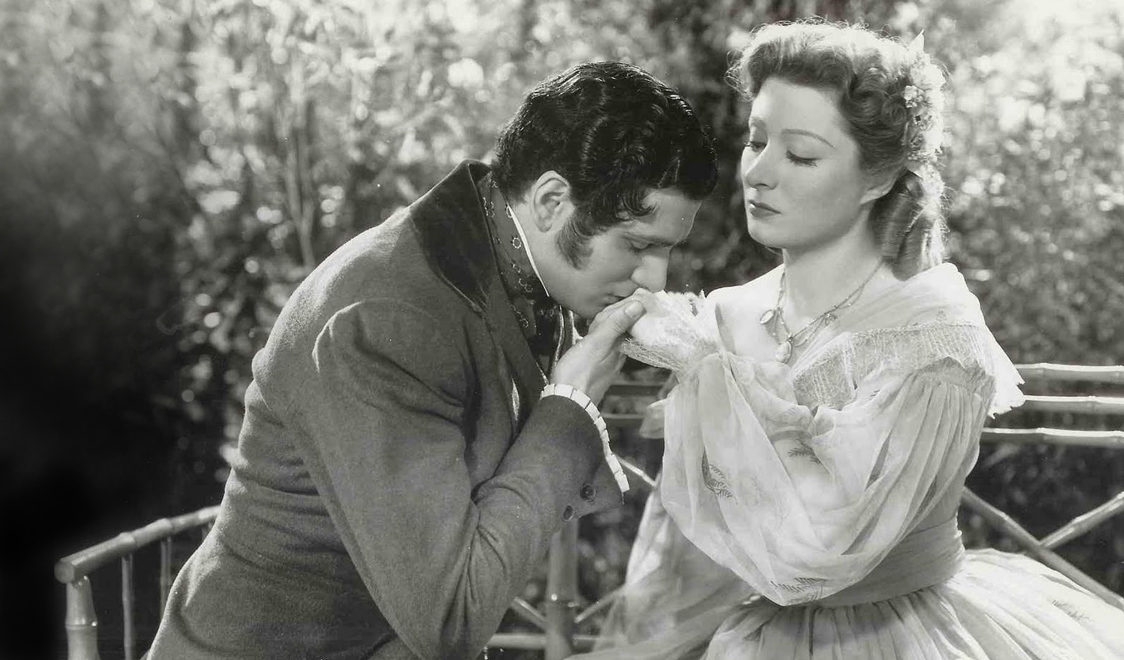
Laurence Olivier and Greer Garson in a just-plain-not-right version of Pride and Prejudice

Director: Robert Z Leonard

Cast: Greer Garson (Elizabeth Bennet), Laurence Olivier (Fitzwilliam Darcy), Mary Boland (Mrs Bennet), Edna May Oliver (Lady Catherine de Burgh), Maureen O’Sullivan (Jane Bennet), Ann Rutherford (Lydia Bennet), Frieda Inescot (Caroline Bingley), Edmund Gwenn (Mr Bennett), Karen Morley (Charlotte Lucas), Melville Cooper (Mr Collins), Edward Ashley Cooper (George Wickham), Bruce Lester (Mr Bingley)
 

There is an expectation that old-school adaptations of literary classics from the Golden Age of Hollywood somehow set the standards of adaptation, that all others will be judged against. That may well be the case with the 1939 Wuthering Heights, among others, but it really isn’t the case with Pride and Prejudice, which is essentially a bastardisation of Austen’s original, as if the book has been humped by Gone with the Wind and we are now watching its offspring.

Do I need to tell you the plot? Well I probably should tell you this movie’s version of it. The Bennet sisters are sassy young things always on the prowl for husbands. Lizzy Bennet (Greer Garson) flirts with the proud Mr Darcy (Laurence Olivier), while her sister Jane (Maureen O’Sullivan) wins the attentions of Mr Bingley (Bruce Lester). But how will pride and prejudice affect the course of true love? Find out in this Aldous Huxley (!) scripted version of Austen’s classic, adapted via a second-rate stage version.

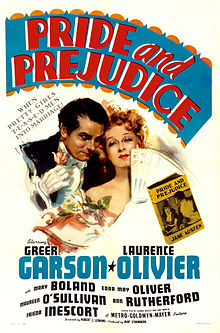
What’s bizarre about this film is how wrong so much of it feels. Now I’m no Austen expert, but even I could see that all the costumes for this production are completely incorrect for the period. Turns out of course that the producers just had a lot of mid-19th century clothing and thought it looked better. Other things feel like low-brow farce: the Bennet sisters and their mother race Caroline Lucas and her mother in carriages in order to be the first to greet Mr Bingley. That’s right, it’s Pride and Prejudice with a horse-drawn drag-race. Who thought that was a good idea? But what can you expect of a film with the tag-line “When Pretty Girls T-E-A-S-E-D Men into Marriage!”? It even takes good lines from the novel and inexplicably rewrites them to make them worse – Darcy’s snobbish and personally hurtful dismissal of Lizzy at the Merryton assembly “I am in no humour to give consequence to young ladies slighted by other men” here becomes “I am in no humour to give consequence to the middle classes”. Why?

I ask you – do these costumes look right?

That’s before you get into the casting. While some of it is pretty good (Edmund Gwenn is very good as an ineffective Mr Bennet, while Mary Boland has a neat line in shrieking as Mrs Bennet) others are downright bad – Bruce Lester is stiff as Mr Bingley, Edward Ashley Cooper is forgettably dull as Wickham, and Melville Cooper hideously overplays as a Collins who seems to have stepped in from a Marx brothers film.

Other parts just feel a bit wrong. Greer Garson and Laurence Olivier as the leads are marvellous actors, but neither of them produces a version of these iconic characters that feels remotely true – or even recognisable. Garson not only looks too old, but she doesn’t have the sense of playful intelligence and spark that Lizzy Bennet needs: she’s more of a slightly aloof tease. Laurence Olivier is reasonably good as Darcy, but the character is re-invented as much softer and more playful from the start, and his willingness to be teased by Lizzy early in the film makes her rejection of him make very little sense.

Their relationship has a flirtatious element throughout, fitting the film’s reimagining of the novel as a sort of romantic comedy in period costume, with elements of Hollywood screwball – but bearing no resemblance at all to the actual relationship Lizzy and Darcy ought to have. At Bingley’s garden party they engage in a playful archery competition (he assumes she’s a novice, she of course is an expert marksman). In itself the scene is good fun, but Darcy’s polite apology and willingness to look a little foolish, means it doesn’t hold together when she condemns him for arrogance. In fact, you’d be pretty hard pressed to identify much pride or prejudice going on at all. The main obstacle to their relationship is shown as Wickham’s denunciation of Darcy – but since Lizzy hasn’t actually seen Darcy do anything particularly bad, it seems particularly forced.

Furthermore, the film makes Lizzy seem like a ditzy schoolgirl, since literally one scene later she has spun on a sixpence and is devoted to Darcy. This is also a flaw of the film’s telescoping of events – within five minutes it feels Wickham elopes with Lydia, then Wickham comes into money, then Darcy reveals his true character, then Wickham and Lydia return. The film rushes through these events, in order to fly towards its artificial happy ending (all the Bennet sisters are given appropriate suitors in a clumsy final shot) without any real sense of Austen, or any real eye for the sort of subtle social satire she had carefully worked into her novels.

The film’s individualist take on Pride and Prejudice does at least distinguish it from other productions I suppose, but it’s terrified of the depths to the story or its characters, and seems to do everything it can to neuter its “bad” characters – Caroline Bingley barely appears, and it’s hard to believe that any reader of the book could picture Lady Catherine as she’s reimagined here: a sort of playful wingman to Darcy’s courtship of Lizzy.

But then this never feels like Austen – it’s got more of an early Gone with the Wind vibe to it, but played as romantic comedy. Lizzy here is an aloof, determined, slightly foolish, but strong-minded Scarlett-O’Hara-lite, while Darcy is a neutered Rhett Butler charmer. The production does everything it can to look like Gone with the Wind in its setting and design. Austen’s social commentary is phased out and replaced with low comedy and bantering lover style dialogue. I suppose as a film in itself, it’s perfectly fine, but as an adaptation of one of the greatest novels of all time, it’s sadly lacking.