Tag: Mary Kay Place

Bound for Glory (1976)

Bound for Glory (1976)

Beautifully filmed but psychologically and politically un-insightful film, easier to admire than enjoy

Director: Hal Ashby

Cast: David Carradine (Woody Guthrie), Ronny Cox (Ozark Bule), Melinda Dillon (Mary Jennings Guthrie), Gail Strickland (Pauline), Randy Quaid (Luther Johnson), John Lehine (Locke), Ji-Tu Cumbuka (Slim Snedeger), Elizabeth Macey (Liz Johnson), Mary Kay Place (Sue Ann), M. Emmet Walsh (Trailer Driver)
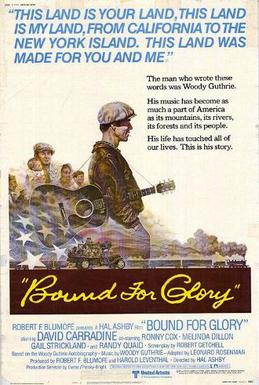
Woody Guthrie was a sort of poet of American folk music, his music influencing a generation of artists, from Bob Dylan onwards. His music spun a vision of the enduring strength of the working man and their rights to a share of the American Dream. It’s mythic stuff, so feels perfectly positioned to be spun into a modern fable in Ashby’s Bound for Glory. Coated in period detail, a sort of Grapes of Wrath by way of Barry Lyndon, it’s a lyrical piece of historical memory making with a nominal grounding in social and political issues. Is it a complete success? Perhaps it’s a film easier to admire than love.

It takes the title from Guthrie’s (David Carradine) biography, and follows his journey from Dust Bowl Texas in the 1930s to the hopes of employment in California, where he joins a mass of not-particularly-welcomed economic migrants. He discovers there an audience for his politically tinged folk music, but steadfastly refuses to compromise his principles. Actually, aside from these broad sketches and Guthrie himself, almost everything in this is essentially fictional. It’s a myth being spun, building a legend of a sort of John the Baptist of American folk music, a nostalgic vision of 30s America which makes little room for Guthrie’s actual politics.

Actually, that’s one of the most fascinating things in Bound for Glory. So keen is this to create a nostalgic view of an America from yesteryear, celebrating the perseverance of blue-collar America, it avoids talking in detail about anything Guthrie actually believed in. Although possibly not a card-carrying member of the Communist party, Guthrie was certainly at least a fellow-traveller. He had sharply left-wing, pro-worker, anti-capitalist views. His music echoed this – ‘This land is your land’ is actually about land ownership. But most traces of this have been carefully rinsed out of Bound for Glory.

That isn’t to say that it doesn’t take a deepe dive into Depression era America than any film since The Grapes of Wrath. Guthrie’s pilgrimage – and there is something distinctly Saintly about how he is presented here, making him more comfortable a figure than a left-wing radical – features plenty of dwelling on injustice and poverty. It opens in the ramshackle poverty of Dust Bowl Texas, where winning a dollar in a bet is potentially life changing. Migrants to California are at hurled from goods trains, then risk being shot (as one of Guthrie’s friends is) when attempting to jump on them as they puff past. They are barred entry on the road to California (in cars weighted down with their few possessions) if they can’t produce $50. The migrant camps are run-down, overcrowded and run by baton-wielding work-bosses who have complete power to decide who works and who doesn’t and don’t hesitate to wield their weapons to enforce their will.

Bound for Glory however avoids saying anything too firm against all this. It can carry sympathy for the plight faced by the working man but, much like The Grapes of Wrath, it’s terrified about saying or doing anything that could possibly be seen as promoting left-wing politics. Guthrie sometimes mumbles vague statements about the working man finding his slice of the American dream, but never anything too pointed about the fact that unfairness and having-and-have-noting is built into the system, like a spine in a body. The bravest shot the film takes is at a complacent priest, who smugly turns a hungry Guthrie away from his large church because he only hands out soup to people who have worked that day. Otherwise, the furthest it allows Guthrie to go is asking his wealthy lover (Gail Strickland in a thankless part) if she feels guilty having so much when others have so little. It’s the washed down, simplistic politics of the playschool.

And, to be honest, it robs Bound for Glory of much of its life and blood. It fails to replace this with a fierce personal story (like The Grapes of Wrath) and it never even attempts to make anything like a political statement as Ashby’s old collaborator Warren Beatty would do five years later with the similarly luminously beautiful Reds. Quite frankly, as Bound for Glory unrolls slowly and deliberately it does so with precious little fire and guts to it and (at times) very little interest. In other words, it’s very possible to sit and watch it and (while admiring it very much) kind of wish you were watching Rocky instead (as the voters for Best Picture at the Oscars that year clearly did).

It becomes instead a triumph of style, photography and design, rather than an enlightening biopic or making a statement about the Great Depression (other than it was tough). David Carradine hasn’t quite got the charisma to bring the vague threads Ashby gives him together. (Almost every single big name actor in Hollywood turned it down, which tells you something). Guthrie remains a vague, drifting blank, whose views and beliefs are undefined and to whom events frequently seem to just happen. Of the supporting roles (several women in particular get dull, thankless parts) only Ronny Cox gets something to get his teeth into as a musician turned union activist.

The real merits of Bound for Glory is it’s Barry Lyndon like recreation of a time and period. A lot of that is due to the breathtaking photography of Haskell Wexler – not for no reason was he the first person billed on the film. Wexler’s work is extraordinary, creating a sepia-toned view of Great Depression America that feels like its been taken straight from a photo library and placed on screen. Bound for Glory also astounded viewers at the time with the first Steadicam shot captured on screen, which starts with an aerial view, glides down to Guthrie and then follows him through a crowd of hundreds of extras to fail to be picked for a work party. It was the cherry on top of the Oscar-winning cake for Wexler.

It’s just a shame that these surface delights are all that really come to life. Other than that, this is distant, reserved and (in truth) slightly empty work from Ashby that presents the basic facts in a mythologised way that you feel removes much of the core truth. It turns a fascinating man of real conviction, into an unknown enigma, an Orpheus of the Dust Bowl who goes on a Pilgrim’s Progress that leads to (if we’re honest) nowhere in particular. It’s a film that strains a bit too hard for high art at the cost of passion or entertainment.
The Big Chill (1983)

The Big Chill (1983)

Heart-warming, engaging and moving ensemble drama, low-key and all the better for it

Director: Lawrence Kasdan

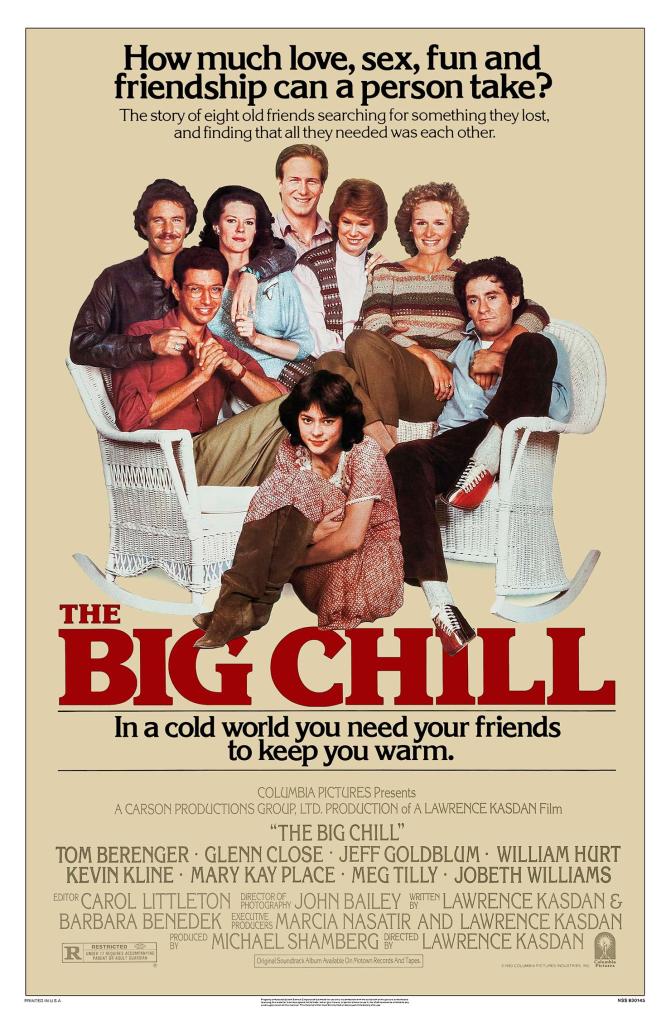
Cast: Tom Berenger (Sam Weber), Glenn Close (Sarah Cooper), Jeff Goldblum (Michael Gould), William Hurt (Nick Carlton), Kevin Kline (Harold Cooper), Mary Kay Place (Meg Jones), Meg Tilly (Chloe), JoBeth Williams (Karen Bowens), Don Galloway (Richard Bowens)

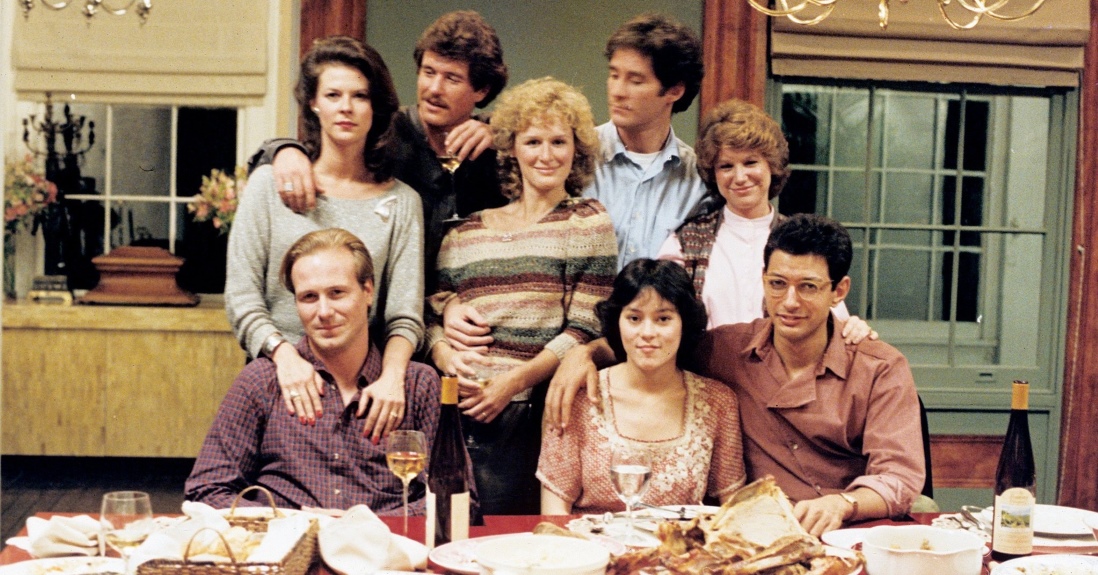
Growing up is hard, isn’t it? The older you get, the harder it is to cling on to the idealism of your younger days. The past can wind up feeling both very familiar and a very different country indeed. It’s something a group of thirtysomething college friends start thinking about when they gather for the funeral of their friend Alex (the famously cut-from-the-film Kevin Costner, seen only via close-ups of his hands and chest while being prepped by an undertaker). Spending a weekend together they reminisce, argue and remind each of why (and if they are still are) friends.

Kasdan’s sharp script, full of sparkling dialogue and rich (if at times familiar) character arcs attracted a smorgasbord of the cream of 80s American film acting, all of whom give fabulously relaxed, extremely genuine performances, largely devoid of grandstanding. The disparate range of career and life-choices the friends have made influenced an armada of ‘college-reunion’ stories, but it’s a trope that works because Kasdan knew it offered such a rich potential for drama.

The Big Chill is the definitive ensemble piece, delightful because it’s structured not around heavy-handed, overtly dramatic clashes, but everyday conversations full of observational humour and low-key emotional truths. There isn’t really a plot as such in The Big Chill: the pleasure comes from Kasdan pulling off the near-impossible trick of making us feel we have been invited to share the fun rather than watching, with our noses pressed up against the window, a film where the actors are having more fun than us. The Big Chill feels truthful, universal and eventually moving because it is so down-to-earth. We’ve all had social groups where we feel absolute loyalty and love for its members, while still being capable of finding them earth-shatteringly infuriating.

Most of them have traded their youthful idealism to change the world for a Reaganite cash-grasping. Sam (Tom Berenger) stars in a hit Magnum PI style TV drama. His former partner in left-wing politics Harold (Kevin Kline) owns a successful running shoes business (named Running Dog in a subtle pop at his own selling out) while his wife Sarah (Glenn Close) is a successful doctor. Michael (Jeff Goldblum) writes shallow celebrity pieces for glossy magazines, Meg (Mary Kay Place) has traded being a public defender for real-estate law. Karen (JoBeth Williams) wanted to be a writer, but instead married an ad executive Richard (Don Galloway).

All of them feel their late friend Alex represents the path they could have taken: a genius scientist who turned down all academic promotions to focus on social work and his old principles. Not that this seems to have made Alex happy. The most like Alex’s seems to be Nick (William Hurt). A former radio-psychiatrist, left impotent after Vietnam, who jacked in his career and is now a drifting drug addict. It’s never quite said, but you can feel the concern of the rest of the group that Nick feels destined to be the next funeral they gathering for.

Much of the tension comes from Nick – largely because he feels more willing to touch nerves the rest are happy to leave unprodded. This is a group that works hard to maintain harmony – after all, Sarah’s affair with Alex hasn’t dented Harold’s genuine grief or his love for his wife, and no one else wants to address it. But there are clear tensions and resentments under the surface: small grudges or irritations many perhaps coming from that uncomfortable feeling of the group seeing their own self-recriminations reflected back at them in their friends faces.

Nick is the only one who raises the scary spectre that decade-old events hold this group together, not their lives today. If they all met for the first time now, would they even be friends? Nick is also willing to take pot-shots at their tendency to self-pitying regret and to provoke the romantic and sexual tensions the others are happy to keep unremarked or compromise on. (Even Jeff Goldblum’s seemingly provocative Michael, avoids trouble by scrupulously taking nothing seriously.)

What makes The Big Chill such a lovable film, despite this, is this doesn’t fracture the group but are islands of tension within a sea of genuine friendship and warmth. Kasdan’s insistence that the company spend a longer time than usual in rehearsal – famously the cast cemented their chemistry via an almost five-hour, Mike Leigh-style, in-character improvisation, involving cooking and eating a dinner together – paid off in spades. They genuinely feel like life-long friends, sharing in-jokes, teasing each other, looking out for each other and making generous offers of help.

There is a lot to laugh at because it feels so universal. We’ve all mucked around with friends while cooking and cleaning. When the group gather to teasingly cheer along with the opening credits of Sam’s cheesy TV show (to his good-natured embarrassment) it makes us laugh because we recognise the affection. The hilarious absurdity of Harold, Nick and Sam chasing a bat out of the attic feels real. Just as the emotions hammer home – Harold’s grief in his eulogy for Alex, Sarah’s tears at a meal, Nick’s tragic middle-distance gloom or Karen’s private ennui among her friends.

It’s all helped by superb performances. JoBeth Williams is excellent in, arguably, the film’s most challenging role, deeply unhappy with where her life has gone, wanting to pretend she can seize the day but not having the conviction to see it through. Goldblum is drily witty but distant as the group’s closest thing to an outsider, Berenger affectingly modest at his sell-out success, Place quietly desperate as a woman whose body clock is ticking down. Kline is very funny and sweet as a man desperate to help those around him, while Close in the flashier (and Oscar-nominated) part as the group’s nominal ‘mother figure’, far more deeply affected by Alex’s death than she is willing to let on.

Perhaps best of all is Hurt, vulnerable, gentle and quietly lost as Nick, his pain manifesting itself in occasional bear-prodding outbursts, but who will quietly apologise the next morning with a gentle, unremarked hug. He also forms a warm and genuine bond with Alex’s younger girlfriend Chloe, played with a sparky energy by Meg Tilly, who (not surprisingly) sees a lot of Alex in him.

Kasdan’s film gently explores the tensions of a group of adults unsure about where their life has taken them, but it does so in a warm and charming structure that makes us really care for the characters all of whom are expertly and humanly drawn. It’s lack of explosive melodrama is a large part of its success, helping ground the film as something relatable that we can feel a real bond with.

Being John Malkovich (1999)

A portal into the head of a famous actor? What better way to find out what it’s like Being John Malkovich

Director: Spike Jonze

Cast: John Cusack (Craig Schwartz), Cameron Diaz (Lotte Schwartz), Catherine Keener (Maxine Lund), John Malkovich (John Horatio Malkovich), Orson Bean (Dr Lester), Mary Kay Place (Floris), Charlie Sheen (Himself), W Earl Brown (JM Inc Customer)

Is there a more consciously eccentric film ever made than Being John Malkovich? Can you imagine the pitch to the Hollywood suits? 

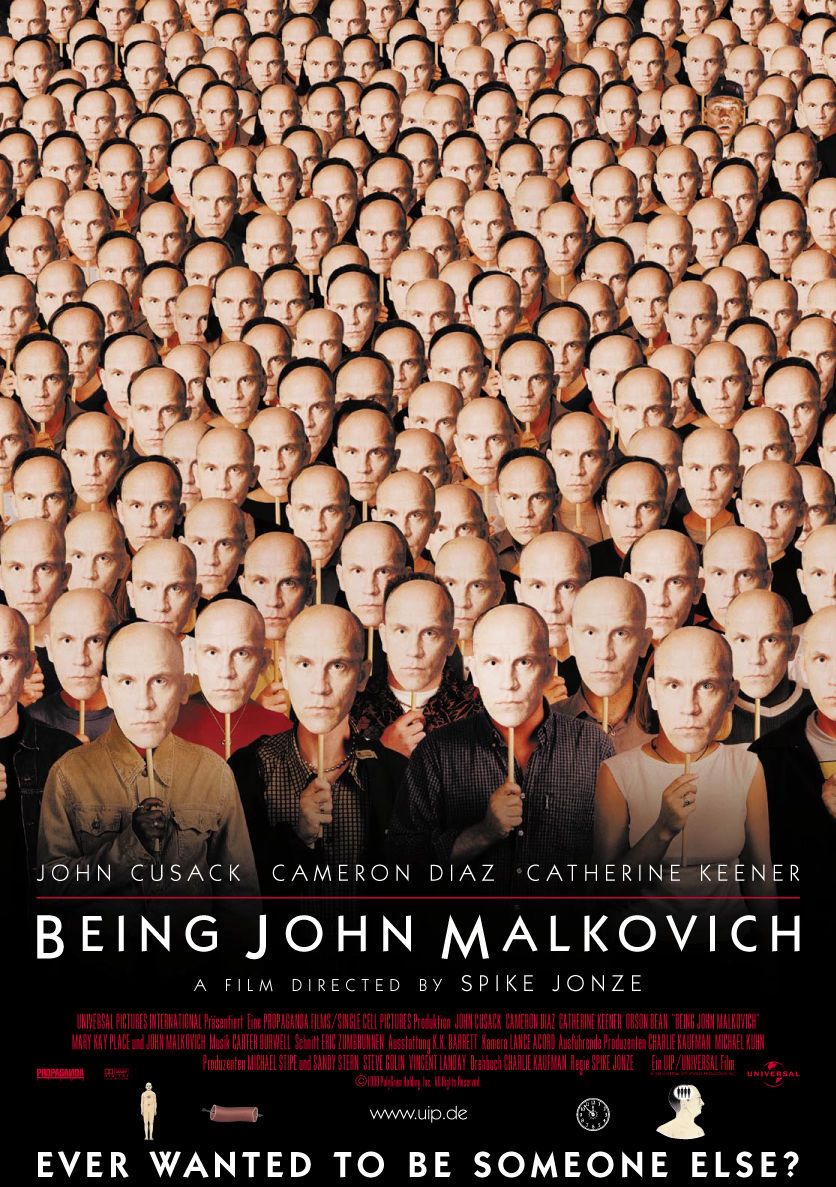
Our hero, Craig Schwartz (John Cusack) is a weedy, bitter puppeteer (as well as creep and potential stalker), whose wife Lotte (Cameron Diaz) fills their house with rescue animals, from talkative parrots to a chimp with PTSD. Needing to make ends meet, Schwartz takes a filing job at a company based on floor 7½ of an office block (it’s a low ceilinged floor built between the other two floors – it’s cheaper on the rent obviously) where he becomes obsessed with his sexy co-worker Maxine Lund (Catherine Keener), who is resolutely not interested. But all this changes one day when Schwartz finds a fleshy, dark tunnel behind a filming cabinet that takes someone into the mind of actor John Malkovich (John Malkovich) – for 15 minutes, before expelling you onto the New Jersey turnpike. Sounds like a business interest for Schwartz and Maxine (spend 15 minutes in someone else’s body!), but the experience of being in someone’s body slowly begins to change Schwartz, Lotte and Maxine – and having his brain invaded has a terrible impact on Malkovich himself.

If that’s not the oddest plot you’ve ever heard, then I don’t know what films you’ve been watching. The film was the brainchild of Charlie Kaufman, who developed from this into one of the most distinctively gifted screenwriters in Hollywood, a master of the quirky and weird, the off-the-wall and the science fiction tinged everyday fantasy, blessed with the ability to mix in genuine human emotion amongst the oddness. 

Being John Malkovich is an inspired idea and Kaufman’s script is ingenious in its structure and progression. Never once does the film settle for the expected narrative development or the conventional structure. It’s a livewire of a film that constantly leaves you guessing, switching tone and throwing logical but unexpected plot twists at every turn. There are plenty of moments where you could expect events to take a conventional turn, but the film never settles for the obvious.

Kaufman’s inspired script was lucky enough to find a quirky visual stylist who was willing to embrace it as much as Spike Jonze did. Jonze’s direction is a masterclass in small detail, slight twists and little touches of invention that never draw excessive attention to themselves but combine to make a thrillingly off-the-wall final picture. 

Jonze knows that the jokes and surrealism of Kaufman’s script are so effective that they don’t need a firm directorial hand to lean the humour on – they work absolutely fine presented almost as written, and make for terrific entertainment. He shoots the low ceiling of floor 7½ with such straightforward confidence that each scene becomes hilarious for its stooped actors and crammed rooms. Jonze can therefore concentrate the flourishes on core moments, from the puppetry that Schwartz and later a Schwartz-controlled Malkovich make their life’s work, to assorted training and educational videos that pepper the film at key moments.

Like Kaufman as well, Jonze’s storytelling works because he inherently understands human emotion and isn’t afraid to throw it into the film alongside the humour. Plenty of directors would have been happy to have all the principals settle into being comic stereotypes, or overplayed pantomime figures. Jonze encouraged the actors to find the depth – and sometimes the darkness – in their characters, to ground the film effectively with touches of real life tragedy and human flaws that give weight to the surreal sci-fi elements – so much so that they start to feel as real as the rest.

John Cusack’s Schwartz is a bitter, increasingly twisted fantasist and dreamer – the sort of guy who believes that his lack of willingness to compromise his art in any way is a strength (his puppetry shows are highly complex, sexualised, high-blown, poetry-inspired hilarious puffs of pretension). Schwartz could have become a joke or a guy with a big dream – but the film increasingly shows him to be a dark, obsessive, cruel even dangerous outsider, who has no problem with harming other people to get what he wants, his moral compass is driven by his self-assessment of himself as a man treated badly by others, so doing what he wants is somehow deserved. It’s an increasingly dark portrait of a man who has more than hint of danger to him.

Keener, as the focus of his obsession, also does extraordinary work as a woman the film is not afraid to present as unpleasant in her selfishness, casual cruelty and greed – but a woman who slowly allows herself to open up and reveal an emotional openness and romanticism someone watching the start of the film would never expect. Similarly Diaz’s downtrodden, sad wife at home flourishes and grows as a person, as she finds in herself a new comfort and ease with who she is, from inhabiting the mind of another person. Both are excellent.

The film explores fascinating ideas of identity – Lotte and Maxine find a freedom and an exciting otherness in being a passenger in another person’s body, and use it as voyages of self discovery for themselves. Schwartz on the other hand sees this body – just as he sees all human beings – as just another puppet for him to control, another way of adjusting the world to match his requirements, rather than change anything about himself. While some lose themselves in Malkovich’s body and find the experience rewarding, Schwartz can only find happiness when bending the body to his own will.

And what of Malkovich himself?  Well has there ever been a braver performance in film? Malkovich is superb as an arch portrait of himself as a rather self-important actor, with an unknowable coolness about him, an intellectualism that makes him a man easy to respect but strangely hard to relate to, a face that is distinctive but a strangely unrelatable style that makes him hard to remember (it’s really an extraordinarily funny and brave performance). As Malkovich realises what is happening to him, the film plays with real beats of tragedy and even horror – what would it be like to be forced into being a passenger in your own head? This is nothing compared to the horror Malkovich encounters when he enters the tunnel himself – to find himself in a world where everyone looks like Malkovich and can only speak using the word “Malkovich”.

Being John Malkovich uses its surreal ideas to explore profound – and even chilling – ideas of control, destiny, personality and identity. With several superb performances, a brilliant script and controlled and intelligent direction, it’s a film unlike any other – and continues to delight and surprise twenty years on from its release.