
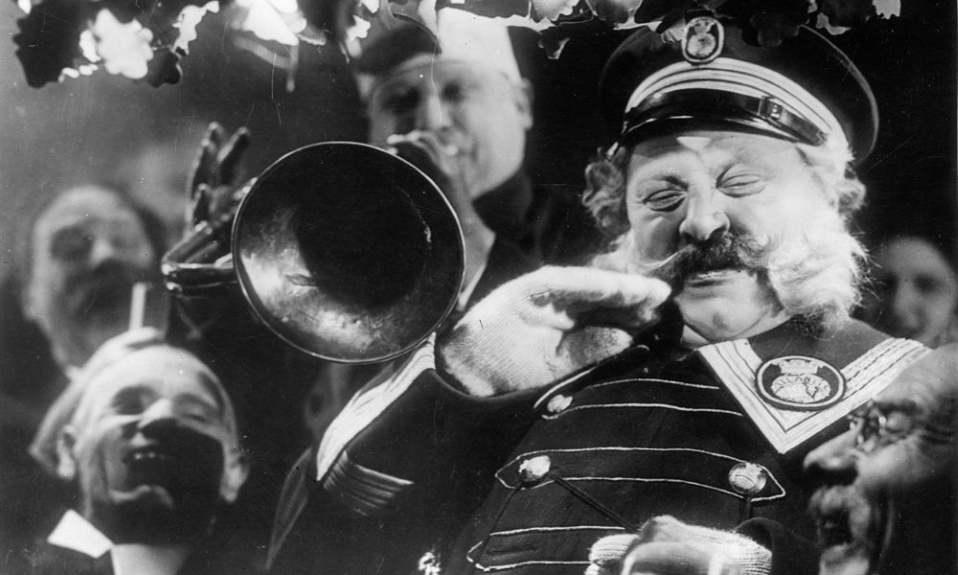
A hotel doorman faces despair, in this fluid piece of film-making brilliance from Murnau
Director: FW Murnau
Cast: Emil Jannings (The doorman), Maly Delschaft (His niece), Hans Unterkircher (The manager), Georg John (The night watchman), Max Hillier (The bridegroom), Olaf Storm (Young guest), Herman Vallentin (Guest with pot belly)
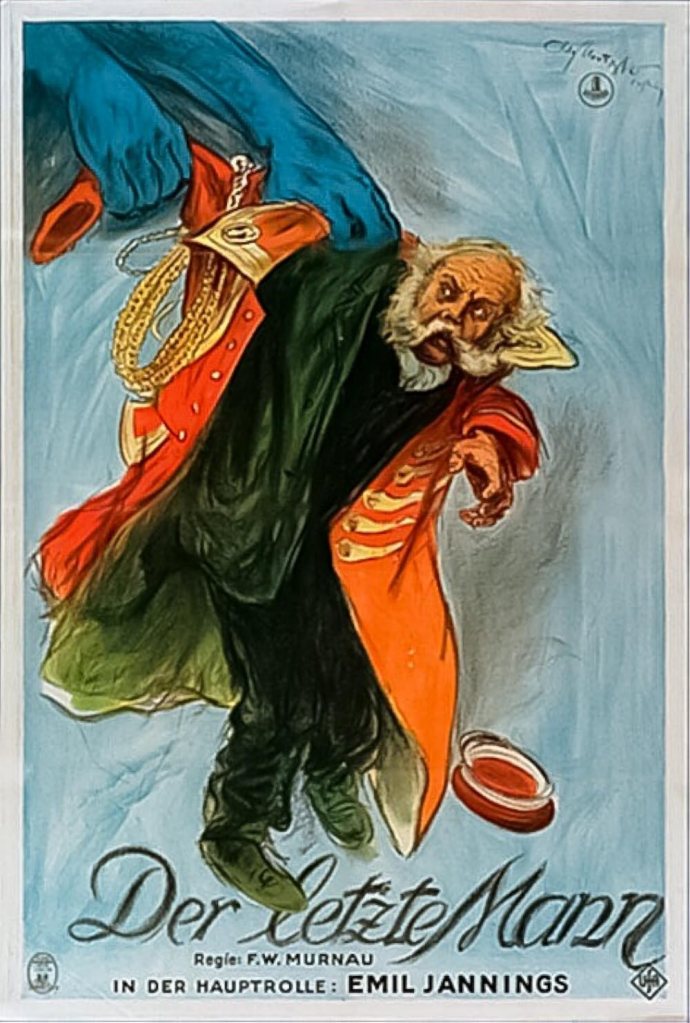
Released in Germany as the Der Letzte Mann, it became The Last Laugh in English-speaking cinema to avoid confusion with a long-forgotten silent comedy The Last Man. Having its title stolen seems very appropriate for Murnau’s masterpiece, a masterfully simple morality tale by Carl Mayer. The Atlantic Hotel’s doorman (Emil Jannings) is the highly respected master of his neighbourhood. All that changes when, due to his advancing age, he is stripped of his position and demoted to cleaning the basement toilets. Humiliation piles on humiliation as word of his new position spreads.
It’s a simple story, in many ways little more than anecdote or an Aesop’s fable of pride before a fall. But you can see it as having universal force, and a particular relevance to its time and place. The doorman, with his ramrod back, carefully manicured moustaches and, above all, his grand uniform emblazoned with epaulettes and tassels, looks like some sort of Field Marshal. He certainly behaves like one, walking through his neighbourhood like it’s a parade ground, dishing out salutes and accepting deference from all and sundry. He’s the puffed-up symbol of pre-War Germany, overwhelmingly certain of his position and obsessed with the ephemera of his office.
All that gets stripped from him in seconds, as he is bluntly called into an office, passed a note by a distracted manager informing him his glory days of greeting guests are over. His uniform is practically torn from him – a button falling from his coat and landing on the floor, a beautiful little moment of visual degradation – and he becomes a stooped, scruffy, shambling old man dressed in a non-descript white jacket. From Kaiser, he’s now the downtrodden and humiliated Versailles Germany, stripped of empire and reduced to passing a towel to guests for coins.
It’s a beautiful little metaphor for a whole country, captured in the collapse of status of a single man, told with a suggestive lightness that makes it universal. It becomes a domestic tragedy could be about anyone, anywhere – and the fact it is a perfect fit for post-war Germany is a happy marriage. Another happy marriage is the casting of Jannings. No actor in history embraced humiliation and masochism as much as Jannings. He eases into his old age make-up like a seasoned ham, his body shrinking and collapsing into a timid stoop. Jannings is left in near catatonic shock at his demotion, then desperately clings to a fantasy of preserving his status outside the workplace, all while he becomes increasingly dishevelled.
The Last Laugh presents this within a gloriously inventive, technically superb version by FW Murnau, working closely with cinematographer Karl Freund. Murnau’s desire to let the visuals do the storytelling sees The Last Laugh almost completely shed any on-screen captions (bar a few close ups on a letter, a newspaper and a final ‘note from the author’). Instead, the story unfolds perfectly and gloriously in images alone, the twists and turns expertly unfolding with perfect clarity.
On top of which, The Last Laugh is awash with cinematic verve. From its opening shot, a pacey tracking shot that reaches the hotel lobby via the lift and then pans through the lobby to the doorman, Murnau makes the camera mobile and engaging. The Last Laugh makes use of several crash zooms to accentuate points, be it shock (a zoom in to the face of the doorman’s housekeeper when she discovers the truth), foreboding (a zoom into the exterior of the hotel and its new doorman), to ironic glory (a diving crane shot that pulls into a trumpeter on the street whose music invades the doorman’s drunken fantasies), it’s a film of dynamic movement.
Murnau also uses doors, fittingly, as a neat visual metaphor. Repeated shots framed through the hotel’s revolving doors hint at the circular nature of fortune that its lead character discovers only too harshly. The doorman’s dismissal is shot from outside a pair of glass doors, the divide separating the shell-shocked doorman from his distracted manager. The door down to the basement toilet, swings shut with the finality of some sort of Dante gateway, leading to the gloom below. Doors appear throughout to separate or trap characters, especially the doorman. And in his fantasy, the doorman pictures himself guarding a revolving door so tall it would dwarf the hotel.
The doorman’s fantasies are another moment of influential cinematic invention. Hearing music in the street, after holding court during his niece’s wedding (dressed in a stolen uniform), the hungover doorman day dreams of being restored to his position. As his head bobs and sways, stationary in the frame, the room around him spins and rotates. Bleary, superimposed fantasy shots intrude as the doorman sees himself restored to glory in the foyer, lifting and juggling singlehanded the massive luggage crate he had been unable to pick up earlier.
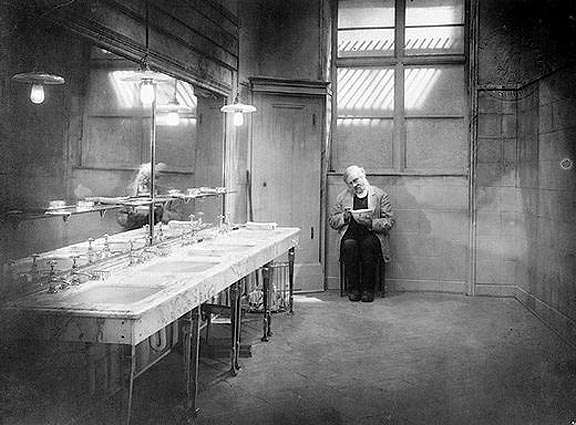
The same swirling super-imposed images haunt the doorman when the truth of his demotion becomes known. He imagines a whirling collection of laughing faces, delighting in his humiliating fall. His final fate sees him escorted, late at night, to the bathroom by a kindly night watchman (Georg John), ending sitting against the wall framed in a pool of light, like a condemned man facing a never-ending sentence.
Or is he? Really the film should stop at the 80-minute mark, because there is no coming back from this – only a long trudge towards death. But the money men felt, “Mein got! that’s a bit depressing!”, so we get our first proper caption telling us that, unlike in real life, the author will provide a happy ending. So, the doorman inherits a fortune from an eccentric millionaire, becomes a guest at the hotel and is restored to all his former glory and then some. It’s a crazy ending, framed by Murnau in a comedic fashion (tellingly, the guests all continue to laugh at the doorman behind his back), but at least gives the doorman some sense of closing dignity.
Is it needed? Probably not. And, to be honest, it’s probably better to stop at that 80-minute mark, for all the cinematic invention that continues in that coda. But there is no denying that The Last Laugh is a virtuoso piece of film-making, crammed to the rafters with flair and invention, superbly directed and shot and with a towering performance of puffed-up pride turned shambling shame by Jannings (just the right side of hammy). It’s a film that stands as a milestone of cinema as a visual language.

