Tag: Michael Maloney

Belfast (2021)

Belfast (2021)

Kenneth Branagh pays tribute to his early years in Northern Island in this autobiographical film

Director: Kenneth Branagh

Cast: Jude Hill (Buddy), Caitríona Balfe (Ma), Jamie Dornan (Pa), Judi Dench (Granny), Ciarán Hinds (Pop), Lewis McAskie (Will), Colin Morgan (Billy Clanton), Michael Maloney (Frankie West), Lara McDonnell (Moira), Gerard Horan (Mackie), Conor MacNeill (McLaury), Turlough Convery (Minister), Olive Tennant (Catherine)
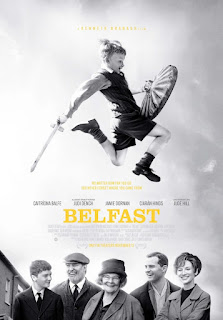
Directors making films about their childhood is a well-established sub-genre. Fellini got the ball rolling, a few years ago Alfonso Cuarón made his own black-and-white look at growing up in troubled political times in Roma and this year Pablo Sorrentino has released a film focused on his own teenage years in The Hand of God. Huge admirer of Kenneth Branagh as I am, I can’t deny he’s not a unique visionary in the vein of those filmmakers. But, Belfasthas a heartfelt, genuineness and a sweetness that verges just the right side of sentimentality and is a loving tribute not only to the city he grew up in but also to his parents, making it Branagh’s most personal project since In the Bleak Midwinter and possibly his finest non-Shakespeare film.

Branagh’s substitute is 9-year-old Buddy (Jude Hill), the child of a protestant family, living on a cross-community street in August 1969. His main concerns in life are friends, films, football and a classmate he has a crush on at school. But for his parents (Caitríona Balfe and Jamie Dornan), their worries are much more about the growing sectarian violence in the city. Pa has an offer of a job in England, which could bring them a new life. But it means the whole family leaving behind it everything it has ever known, including Buddy’s beloved grandparents (Judi Dench and Ciarán Hinds). As the city becomes more dangerous, what will the family decide to do?

If there is a memory piece Belfast reminds me of most, it’s John Boorman’s Hope and Glory. That film was true to Boorman’s memory, that growing up during the Blitz was also an exciting time, because as a child he never realised that death could be seconds away. It’s the same with Belfast. Branagh is keeps the film as much as possible from the child’s perspective. A child might be aware of the news playing on the TV, see the growing number of soldiers stopping and searching people on the streets and be wrapped up in riots, while never really understanding what exactly is going on.

The film has been unfairly attacked by some for not focusing on the accepted narratives of this era of Belfast’s history: misery, killing and brutality. What Belfast instead brings to the fore is the warm community. Streets where everyone knew your name, people sat outside their homes and chatted with neighbours, shared celebrations together and looked after each other. You can understand why it was such a wrench to leave this behind – even with soldiers patrolling the street. How scary it was for a person of any age – from Buddy to Ma, who has known nothing but Belfast her entire life – to even consider going to a place where no-one would know you and you would be an outsider.

Belfast is dedicated to those who stayed behind, those who left and all the lives who were lost. It’s a tribute to a community spirit and family, that has chimed with a great deal of people who lived in the city at the same time and place. The film is fundamentally hopeful because, under the violence and danger, it makes a plea – and demonstrates – that many people in Ireland just wanted to live their lives and didn’t care which church their neighbours went to. The opening few moments of the film is a snapshot of these halcyon days, kids from different communities playing together on the streets and their families gossiping and laughing together.

It’s shattered by the film’s first outburst of violence, as a Unionist gang attacks the street and hurl Molotov cocktails at the houses of Catholic residents – with Buddy, confused and terrified, caught in the middle and dragged into his house and safety by his frantic Ma. It’s a threat that will hang over the film for the rest of its runtime, embodied by Colin Morgan’s bullying enforcer, but only vaguely understood by Buddy – and considerably less important to him than whether he gets to sit next to the girl he has a crush on at school.

That crush is one of many things he gets advice on from his Grandad, played with a genuinely heart-warming twinkle by an Oscar-nominated Ciarán Hinds. Hinds is the picture of the perfect Grandad, wise, attentive, patient and full of homespun advice and wisdom – dialogue that Hinds brings to life with an expressive warmth. He’s paired to wonderful effect with Judi Dench (also Oscar-nominated) as Buddy’s Granny, who’s got a sharper tongue (and most of the funny lines) and has a cold-eyed realism about what it might be best for her son and his family.
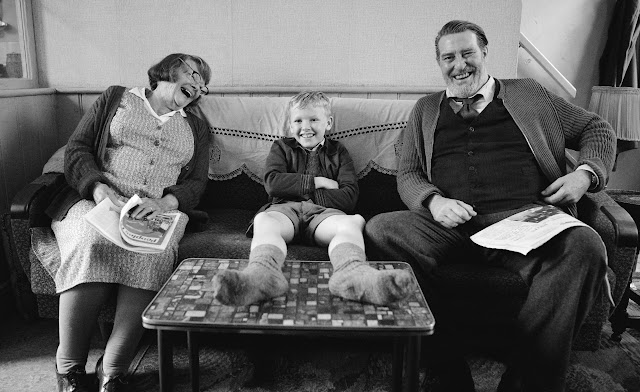
You could check yourself and ask if Branagh is idealising his memories. But I think this is partly the point of the film. At several moments there is a slight air, not so much of fantasy, but of a childhood’s perception and memory being restaged. Jamie Dornan’s hard-working, caring Dad is frequently shot by Branagh in a way reminiscent of the Western heroes in the film buddy watches (High Noon in particular). A late confrontation between Dornan and Morgan plays out like a child’s romanticised memory of how something might have played out – as does a sequence where Dornan and Balfe sing and dance to Everlasting Love. I think Branagh is asking us to consider this might not be exactly what happened, but a fantasy tinged, child’s idealised memory of an event.

And Branagh’s film – shot in a luscious black-and-white – is told with a sharply edited pace and economy. It frequently allows us to see the ‘true’ situation in the background or on the edge of Buddy’s perception. Ma – beautifully played by Caitríona Balfe as grounded, moral but vulnerable and scared – has genuine worries not only about the violence but also the couple’s financial situation. There is an argument, and a later sad half-ultimatum, between Ma and Pa that we understand but Buddy is only vaguely aware is happening. Branagh’s film is full of half moments like this, where he trusts we are intelligent enough to see exactly what the child is seeing and also see more.

Branagh also draws a superb performance from Jude Hill as Buddy. This is a kid who is wide-eyed, natural, unforced and gets the balance just right between sweetness and a childish selfishness and vulnerability. There are real moments of terror and distress for Buddy, which are immensely well-done, and Branagh proves again there are few better directors of actors out there.

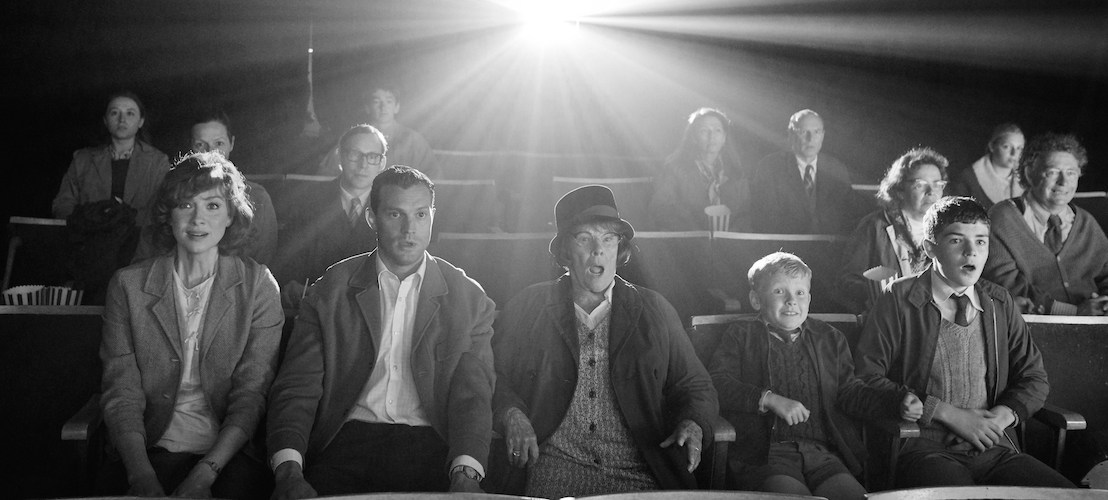
In among this there are some lovely moments where we see Branagh’s passion for the arts and film-making take hold. These are shown in splashes of pure colour: from clips of Chitty Chitty Bang Bang which an enraptured Buddy watches in the cinema, to actors performing A Christmas Carol in the Belfast theatre appearing in perfect colour. That’s not to mention touches of everything from Westerns to Star Trek to a shot of Buddy reading a Thor comic-book (sadly no Shakespeare).

Belfast is above all warm-hearted and loving tribute from a son to his parents and the impossible decisions they needed to take to give him opportunities in life they never had. Branagh’s script is crammed with some wonderful lines and plenty of hard-earned sentiment and the cast play each of these moments to perfection. It’s a passion project that really communicates its passion and shows how love, family and hope are universal. Cynics will sneer, but it’s a lovely film.

Notes on a Scandal (2006)

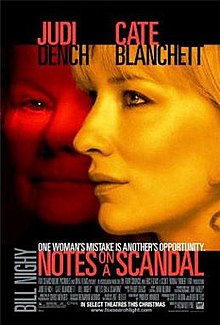
Cate Blanchett and Judi Dench battle with obsession in Notes on a Scandal

Director: Richard Eyre

Cast: Judi Dench (Barbara Covett), Cate Blanchett (Sheba Hart), Bill Nighy (Richard Hart), Andrew Simpson (Steven Connolly), Phil Davis (Brian Bangs), Michael Maloney (Sandy Pabblem), Joanna Scanlan (Sue Hodge), Tom Georgeson (Ted Mawson), Shaun Parkes (Bill Rumer), Emma Williams (Linda), Julia McKenzie (Marjorie), Juno Temple (Polly Hart)

Zoe Heller’s novel Notes on a Scandal makes superb use of an increasingly unreliable narrator to reveal the complications in the affair between a female art teacher and a young male student. It’s a device that doesn’t always carry across as well to film, but Richard Eyre and screenwriter Patrick Marber have still crafted a fine story about obsession and envy in all its different ways.

In an inner-city school, bohemian art teacher Sheba Hart (Cate Blanchett) is a new arrival, struggling to learn how to control her students. It’s a skill long-since mastered by jaded and bitter history teacher Barbara Covett (Judi Dench), who soon finds herself fascinated by the attractive and engaging Sheba. This relationship is complicated when she discovers that Sheba has begun a sexual relationship with one of her 15-year old students, Steven Connolly (Andrew Simpson), a student with a difficult record who has shown a surprising interest in art. As Barbara positions herself as Sheba’s only trusted confidant, the danger of discovery begins to become ever more likely as Sheba’s behaviour becomes more and more reckless.

The real strength of Eyre’s film are the two lead performances from Dench and Blanchett, a match-up surely made in casting heaven. Dench is superb in one of her best film roles, turning Barbara Covett into exactly the sort of shrivelled up, bitter spinster you are not surprised to learn has led a life of loneliness. Dench laces the performance with a sharp nastiness, masked behind a chilly professionalism, but she also makes clear the aching loneliness, the desperation and the ability to deceive herself that Barbara has, the longing to be loved but also the possessive obsession that drives love away.

She’s equally well-matched by Blanchett, at her most glamourous and natural as Sheba. One of the film’s strengths is the way it avoids giving spurious psychological reasons for Sheba’s obsession for this basically fairly unpleasant young lout. Blanchett identifies this sense of being trapped in Sheba, this desire to rebel and taste a little bit of freedom (in every home scene she is shown undertaking most if not all the housework and childcaring duties), feelings that mutate into a sexual obsession with Connolly. Blanchett is desperate, self-deceiving and hugely tragic, unable to fully express the reasons for her feelings herself, but unable to let go of her addiction to a new wildness and danger in her life that you feel she has never really felt before.

These two performances power a film that explores obsession and envy, with Barbara obsessed (to a scarily possessive and manipulative degree) with Sheba, exploiting Sheba’s own reckless and sexual obsession with Connolly. These feelings are shown to be often beyond the understanding of other characters, and both women ret-con events and reactions from the target of their obsessions to build elaborate fantasy worlds. It’s the danger of obsession here, the way we shape the facts to meet our desired preconceptions. It doesn’t matter what reality, or what anyone else, says – you want to believe what you want to believe.

And it’s these obsessions that lead people both to take unbelievable risks and also to feel a crushing sense of envy and possession. Both Barbara and Sheba can barely tolerate the idea of their loves focusing attention elsewhere, and despite seeming to have so much control in their relationships are helpless victims. Sheba is reduced to begging tears when it feels like her relationship with Connolly is burning out. After all is revealed, Barbara’s efforts to take control of Sheba’s life are revealed to be powered by an almost desperately sad need to believe that Sheba and she are starting a new life together. So deep is Barbara’s denial about her own lesbianism (and so extreme her unhappiness about herself), it’s a romantic vision she is so deep in denial feels unable to even begin to put any sexual dimension onto.

Envy and human frailty run through the whole film. Most of the teaching staff, especially Phil Davis’ sad-sack maths teacher in love with Sheba, carry their own small obsessions and envies. Sheba’s husband himself left his first wife for Sheba when she was one of his students. The students have more than enough rivalries to deal with. 

It’s a deadly circle, with contact breeding obsession, breeding envy. To get such an effect, Marber’s adaptation needs to streamline the book. The biggest loss as a result is the book’s slow, creeping, realisation that Barbara is a deeply arrogant, bitter, unlikeable person who views most of the people around her with contempt. Here Dench’s waspish voiceover immediately makes it clear to the viewer that she is not that nice a person. It’s a shame, as it rather signposts for the viewer where the film may be heading. 

The storyline also races through the book (the film is less than 90 minutes) which means it often feels more like a melodrama. While I think it’s a strength that the film doesn’t try and give a real reason for Sheba’s decision to seduce (or be seduced) by her student, other than to hint at her own sense of bohemian freedom being lost at home, I can see how others will find the reasons for why the radiant Sheba is so drawn to such a surly kid rather hard to accept.

But it still works, because the film is so well-played. With Dench and Blanchett at their best (and excellent support from Bill Nighy, quietly superb as Sheba’s husband, a decent guy who can’t believe his luck that he is married to such a wonderful woman, and whose world falls apart in bitter recrimination), it’s a film that gives more than enough rewards. The film gives us a decent ending from the book, with more hope for Sheba – but the balance suggests that for Barbara the cycle of obsession will only continue. Heaven help anyone who sits down on a park bench next to her.

The Young Victoria (2009)

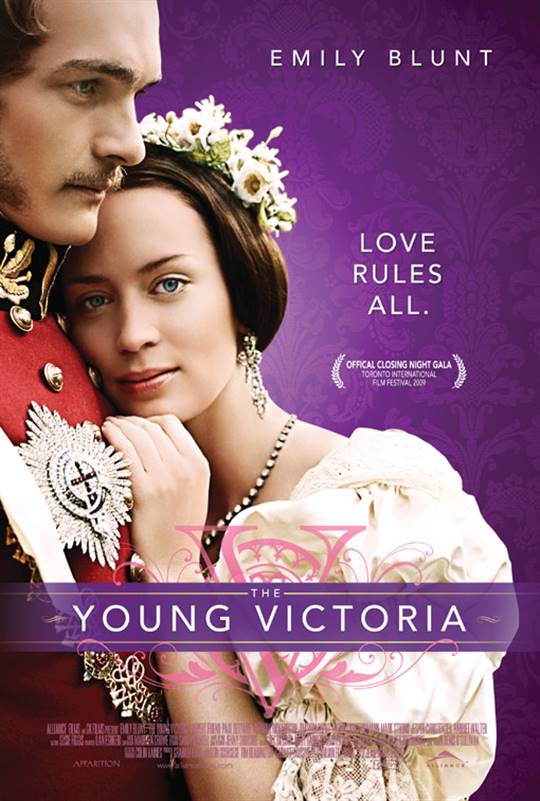
Emily Blunt and Rupert Friend play the royal couple in the cozy The Young Victoria

Director: Jean-Marc Vallée

Cast: Emily Blunt (Queen Victoria), Rupert Friend (Prince Albert), Paul Bettany (Lord Melbourne), Miranda Richardson (Duchess of Kent), Mark Strong (Sir John Conroy), Jim Broadbent (King William IV), Harriet Walter (Queen Adelaide), Thomas Kretschmann (King Leopold), Jesper Christensen (Baron Stockmar), Jeanette Hain (Baroness Lehzen), Julian Glover (Lord Wellington), Michael Maloney (Sir Robert Peel), Michel Huisman (Prince Ernest), Rachael Stirling (Duchess of Sutherland)

Now ITV’s Victoria exists, it’s a bit strange to go back and watch The Young Victoria. With the love today of long-form drama, and the time it can invest in things, it’s funny to see what the drama took almost 8 hours to do being crammed into an hour and a half here. But saying that, The Young Victoria is still an entertaining, luscious viewing experience which, while it has some strange ideas about certain events, is the sort of relaxing Sunday afternoon viewing that will take you out of yourself.

After the death of William IV (a slightly overripe Jim Broadbent), Victoria (Emily Blunt) is elevated to the throne. Finally able to shed the control of her mother’s (Miranda Richardson) domineering secretary Sir John Conway (Mark Strong), Victoria is determined to steer her own course. But she is surrounded by competing influences, not least from the charming arch-politician Lord Melbourne (Paul Bettany). King Leopold of Belgium (Thomas Kretschmann) dispatches his nephew Prince Albert (Rupert Friend) to England with the express interest of marrying Victoria and controlling her – but Albert and Victoria find themselves as kindred spirits, supporting each other to rule.

The Young Victoria is the epitome of prestige costume dramas. It looks fantastic, the cinematography is ravishing, the production and costume design exquisite. It’s pretty clear what the producers thought would sell the picture abroad. The royal regalia is pushed very much to the fore, and we get some wonderfully sweeping scenes, not least an impressively large-scale coronation. The soundtrack brilliantly riffs on Handel, and Julian Fellowes’ script mixes period regal style with a sweeping feeling of romance between Victoria and Albert.

The film actually does a very good job of repositioning Victoria as a young woman, and gives her a strong quality of self-determination and a desire to be herself in a man’s world. It’s really helped in this by the combination of imperial strength, girlish wilfulness and sharp intelligence Emily Blunt brings to the role. Blunt and the film also aren’t afraid to show that, however much Victoria had guts and determination, she was also quite a headstrong woman not above making emotionally led mistaken decisions. In fact, much of the drama spins out of Victoria learning to try and put these youthful crushes and prejudices aside.

Having said that, it’s interesting that the successful conclusion of the film centres on Victoria accepting that she needs the help of Albert to run the kingdom, and that she needs to remove competing influences for her affection – Melbourne and Lehzen – to focus her affection and loyalty on him. The film frames this as a winning romance and a successful partnership (which it was) – but it’s also vaguely creepy if you think about it. Mind you, since all the affectionate influences on Victoria are implied by the script to be at least partly motivated by self-interest, with the possible exception (eventually) of Albert, it manages to suggest this was for the best.

Albert’s background gets some interesting exploration here. He’s very much presented at first as the tool of Leopold as a means of controlling British politics. But he is far too independent, smart and noble to ever be the means of manipulation. Friend is very good here – his performance is quiet, authoritative but also heartfelt. Fellowes guilds the lily a bit to show his devotion by having Albert shot by a would-be assassin late-on in the film. Historically the assassin’s pistol wasn’t loaded, and Albert didn’t get shot (though Fellowes protests Albert didput himself in front of Victoria and that this intent is what’s important, not whether he was shot or not) but the moment does work – it gives the drama a boost and it’s undeniably moving.

While Albert is presented overwhelmingly sympathetically, interestingly Lord Melbourne gets quite a kicking. Paul Bettany is presented far more as a rival love interest than the sort of father-figure Melbourne was in real life (Bettany is probably 20 years younger than the real Prime Minister). Melbourne is shown as cynical, controlling, manipulative and overwhelmingly motivated by self-interest (a few more pushes and he would virtually become the film’s villain). He’s constantly contrasted negatively with Michael Maloney’s upright, honest Sir Robert Peel (one of my favourite statesmen of the 19th century so at least I’m pleased) – and his relationship with Victoria is one of self-promotion, which seems odd seeing as historically the two of them were so close. 

The film introduces other villains for us to hiss at. Kretschmann and Christensen do a good job as arch political schemers. Our real villain though is Mark Strong, who does a great job of scowling, controlling nastiness as the failed-bully Sir John Conroy. Strong’s performance works so well because he makes it clear that Conroy feels that his “Kensington System” (an attempt to manipulate and cow Princess Victoria into being a submissive puppet) is genuinely in her best interest, and that he genuinely cares for her. His partnership with Miranda Richardson as Victoria’s near-love-struck mother works very well.

The Young Victoriathrows in enough interesting character beats like this for it to really work as an enjoyable afternoon period-drama. With some great performances – Emily Blunt carries the movie brilliantly – and while some of the historical characterisation is a bit off, and other moments feel a little too chocolate box it’s a very entertaining, undemanding view., it’s great fun. The hardcore Victorian costume-drama fans will probably prefer Victoriafor the same story in more depth – but this film does it with great sweep (and doesn’t cram in Victoria’s stupid below-stairs plotlines!).

Othello (1995)

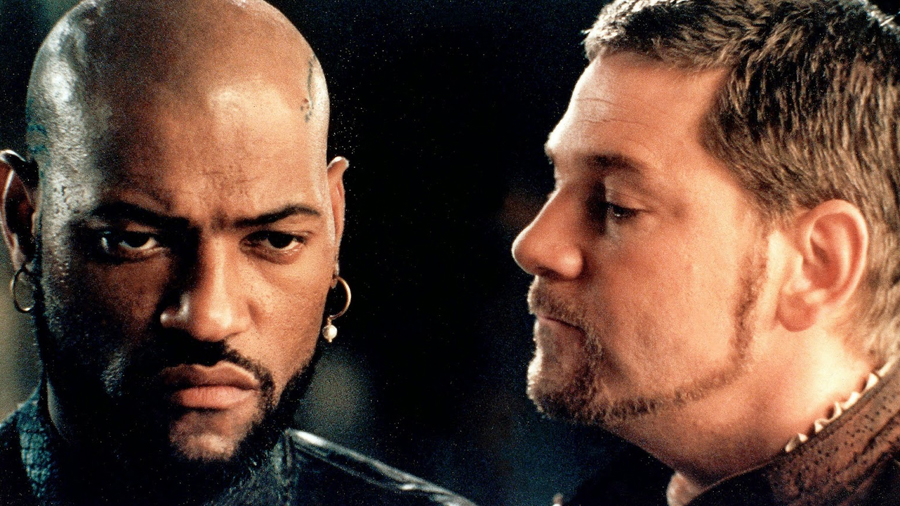
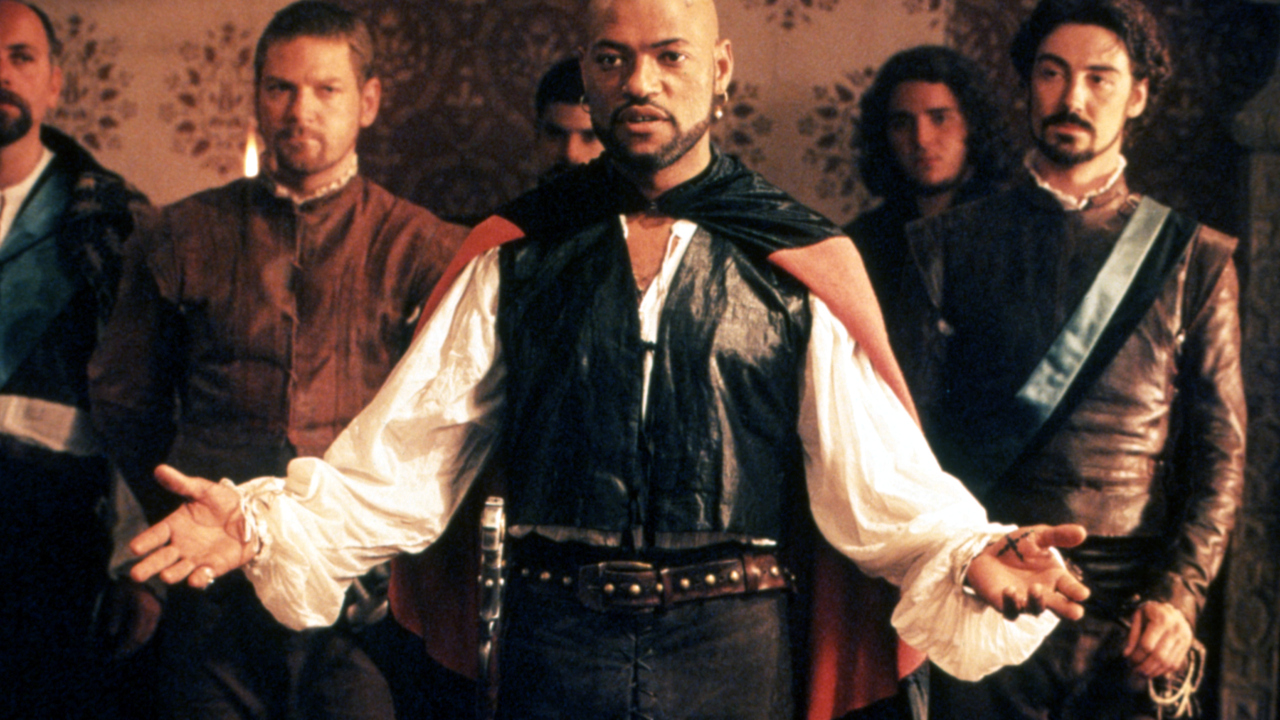
Laurence Fishburne falls foul of Kenneth Branagh’s schemes in this traditional but decent Othello adaptation

Director: Oliver Parker

Cast: Laurence Fishburne (Othello), Irène Jacob (Desdemona), Kenneth Branagh (Iago), Nathaniel Parker (Cassio), Michael Maloney (Roderigo), Anna Patrick (Emilia), Nicholas Farrell (Montano), Indra Ové (Bianca), Michael Sheen (Lodovico), Gabriele Ferzetti (Duke of Venice), Pierre Vaneck (Brabantio)

Othello is perhaps one of the most famous tales of betrayal and jealousy ever written. And yet Shakespeare’s tale of the noble general who descends into murder when convinced by his trusted ensign Iago that his wife is unfaithful, hasn’t often been made into a film. This is probably because its lead role requires a black actor and – for depressing historical reasons – most films aren’t considered good investments without a famous white actor in the lead (of course this has also been the case on stage). So we’ve had blacked-up performances from Orson Welles, Laurence Olivier and Anthony Hopkins – but this was the first proper adaptation of the play with a black actor in the lead role.

As the two leads, Laurence Fishburne and Irène Jacob are a mixed bag. Fishbourne has all the dignity and statue of the great general, and he brings a muscular physicality to the role which really works. He has a wonderful timbre to his voice and he handles the disintegration very well. He does sometimes feel a little hidebound by the language – treating the dialogue with a little too much reverence – but he’s the most believable Moorish general (for many reasons…) you’ve seen on screen so far. Jacob has greater difficulties – although many of these I think are due to this being her first film in English (talk about jumping in at the deep end) – and attempts to make Desdemona a free-spirit don’t really work that well.

Oliver Parker claimed he wanted to cast actors who weren’t associated with Shakespeare. Bizarre then that his cast is rounded out by Kenneth Branagh, the actor perhaps more associated with Shakespeare than anyone else alive. But then I guess when you can get Branagh in your movie, you aren’t going to say no. And it’s great he did, because this might just be one of Branagh’s finest Shakespearean performances: as if not also directing the thing (although many people mistakenly think he did!) freed him up to just focus on his performance. (It’s unfortunate for the other two leads that Branagh’s skill with both Shakespearean dialogue and performing it for the movies also serves to point up Fishburne’s more traditional take and Jacob’s discomfort.)

His Iago is superb, and he plays the part just right, never tipping the wink during his scenes with various characters, but playing Iago totally straight and completely genuine. He appears to be a decent, kind, lovely guy to everyone: it’s only in those asides to the camera that we see his real self, although even here he treats us with just as much charm. His Iago is the sort of guy you’d go for a drink with – and then be shocked to hear he had smilingly bad mouthed you to all your friends. Branagh also adds a homosexual undertone to the film, his Iago having incredibly mixed, repressed feelings about Othello: he seems genuinely moved when Othello makes him his lieutenant and a half twitch of regret crosses his face when the general dies.

Not that it stops him from being a bastard the rest of the time – and Parker does a very neat line in bringing the pivotal seduction of Othello to life on camera. On stage, Iago’s entrapment of Othello is a single, poison-dripping conversation – here, taking advantage of what you can do with film and editing, Parker spreads it over three locations: first a training-ground skirmish outside (where Othello bests Iago), then a sort of armoury changing room (where the outside is still visible), then finally a dungeon. As each lie gets more seductive, so Othello is literally dragged deeper and deeper into the castle. Then we get a neat flip: when he’s fully sold on Desdemona’s treachery, and begins raging and storming, we end up on huge open beaches or castle battlements, as if Othello has been reborn into a larger, refocused world.

This device smoothe out one of the problems with the original play – rather than Iago turning Othello against his supposedly beloved wife during one chat, the cuts from location to location (and different times of day) give the impression of a prolonged disintegration. Othello begins to get the first lines of each section, giving the impression that he has been dwelling on these lies in the interim, and that he is now the one bringing the subject back up, unable to stop prodding at it. It’s makes for a more convincing (and modern) psychological portrait of the corrosive triumph of jealousy than can be achieved in a traditional stage version.

The film has moments of invention – at one point Iago pours poison into Roderigo’s ear while they lie under a wagon where a couple are noisily rutting – and it does some really interesting stuff as mentioned with the “seduction” of Othello. Parker also throws in some expected cinematic tricks – so we get moments of Othello fantasising over Cassio and Desdemona together. But Parker’s not the most unique or challenging director, and he mostly shoots the film with a traditional straight forwardness, using a very traditional setting and editing style.

The film has other problems, too. Othello and Desdemona don’t have much chemistry between them, and Fishburne’s emotionally distant performance makes Othello harder to root for. Maybe this is just Branagh unbalancing the film – his Iago is so compelling, it throws off the film. Parker tries to make Desdemona a stronger character, but this doesn’t always work. Jacob’s slightly awkward tension with Shakespeare is part of this, but we also get the confusion of a Desdemona who fights for her life at the film’s conclusion and then strokes her husband’s head with affection as she dies.

Other performances don’t quite work. Michael Maloney is too overblown as Roderigo – though this Shakespearean wimp does at least get to genuinely threaten Iago and is slightly more convincing for the series of fights Iago puts him up to. Between them, the script editor and Anna Patrick turn Emilia, one of the play’s most intriguing characters, into a blank – she barely has a line in the first hour, and those she does have are delivered pretty blandly. Nathaniel Parker, though, is pretty good as Cassio (incidentally, Parker is of course the director’s brother, and Anna Patrick is the director’s sister-in-law – it’s a home movie!).

The main problem? As the play heats up to the final confrontations, the film slows right down. It’s hard to believe – as we enter Act 5 of the play – that there could still be half an hour of the film left, so snappy have the first four acts been. But the film dawdles and drags over the finishing line – and all the chase scenes of a desperately fleeing Iago can’t save it. For a film which has trimmed the play quite successfully into something sleek and fast-paced, it’s a shame that it drops all this for a wordy and over-played final half hour.

Of course Parker throws in decent moments: I like Cassio slipping Othello the knife he’ll use to kill himself. I really like Iago crawling his way on the bed loaded with dead characters, as if to try and force himself back into their story. The symbolism has been overplayed – and the image of two bodies buried at sea, water trails entwining, has been signposted far too often earlier – but these small moments work, even while the rest of the film’s conclusion drags. And maybe that’s because you don’t really care that much about Othello – he’s never seemed like a character easy to empathise with. And without that, the film can never completely work.