Tag: Miriam Hopkins

The Heiress (1949)

The Heiress (1949)

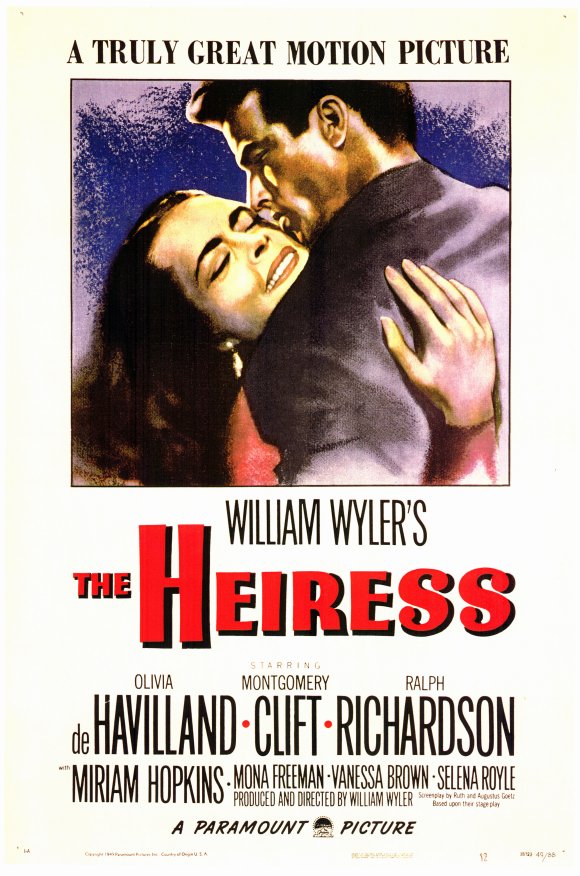
Is it love or is it avarice? Wyler’s sumptuous costume drama is a brilliant translation of Henry James to the screen

Director: William Wyler

Cast: Olivia de Havilland (Catherine Sloper), Montgomery Clift (Morris Townsend), Ralph Richardson (Dr Austin Sloper), Miriam Hopkins (Lavinia Penniman), Vanessa Brown (Maria), Betty Linley (Mrs Montgomery), Ray Collins (Jefferson Almond), Mona Freeman (Marian Almond), Selena Royle (Elizabeth Almond), Paul Lees (Arthur Townsend)
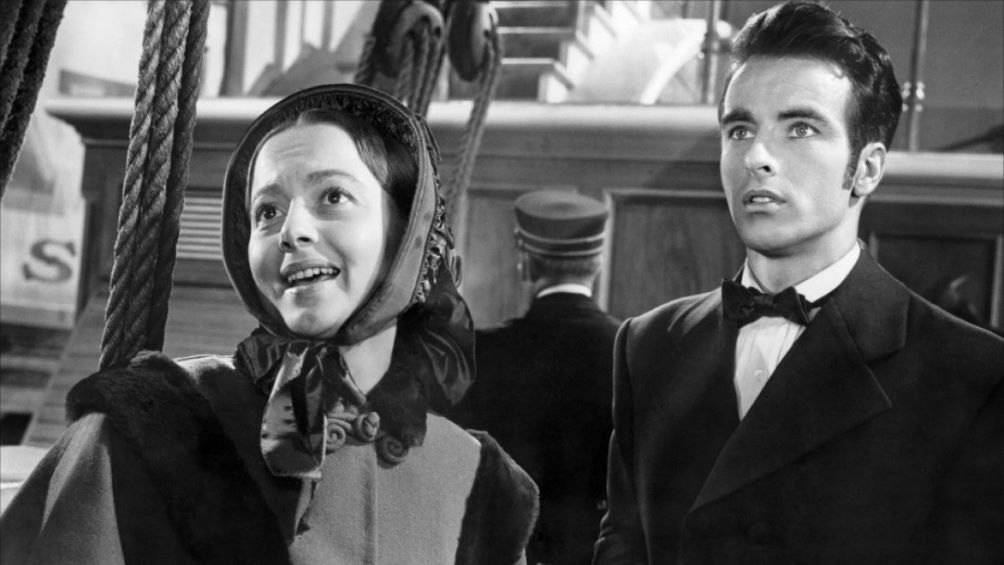
Pity poor Catherine Sloper (Olivia de Havilland). She’s seems destined forever to be the spinster, the last person anyone glances at during a party. Her father Dr Sloper (Ralph Richardson) can’t so much as walk into a room without gently telling how infinitely inferior she is to her mother. And when a man finally seems keen to court her, her father tells her that of course handsome Morris Townsend (Montgomery Clift) will only be interested in her inheritance. After all, there is nothing a young man could love in a forgettable, dull, second-rate woman like Catherine. He’s cruel, but is he right – is Morris a mercenary?

The Heiress was adapted from a play itself a version of Henry James’ Washington Square. It’s bought magnificently to the screen in a lush, sensational costume drama that comes closer than anyone else at capturing those uniquely Jamesian qualities of ambiguity and contradictory motives among the New American elites. Magnificently directed by William Wyler, it brilliantly turns a theatrical character piece into something that feels intensely cinematic, without once resorting to clumsy ‘opening up the play’ techniques. And it marshals brilliant performances at its heart.

Sumptuously costumed by Edith Head, whose costumes subtly change and develop along with its central character’s emotional state throughout the story, it’s largely set in a magnificently detailed Upper New York household, shot in deep focus perfection by Leo Tover, which soaks up both the reaction of every character and the rich, detailed perfection of decoration which may just be motivating some of the characters. Not that we can be sure about that, since the motives of Morris Townsend and his pursuit of Catherine remain cunningly unreadable: just as you convince yourself he’s genuine, he’ll show a flash of avarice – then he’ll seem so genuinely warm and loving, you’ll be sure he must be telling the truth or be the world’s greatest liar.

Catherine certainly wants it to be true – and believes it with a passion. The project was also a passion piece for de Havilland, and this is an extraordinary, Oscar-winning performance that delves deeply into the psyche of someone who has been (inadvertently perhaps) humiliated and belittled all her life and eventually reacts in ways you could not predict. Catherine is clumsy, naïve and lacking in any finesse. With her light, breathless voice and inability to find the right words, she’s a doormat for anyone. She even offers to carry the fishmonger’s wares into the house for him. At social functions, her empty dance card is studiously checked and her only skill seems to be cross-stitch.
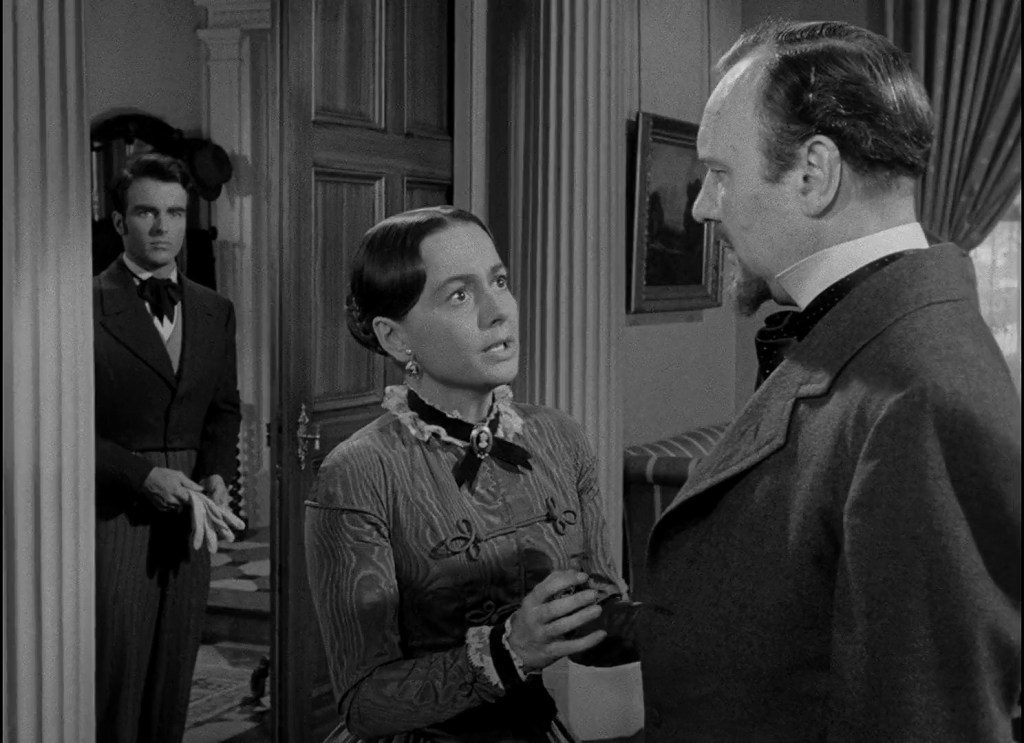
She is an eternal disappointment to her father, who meets her every action and utterance with a weary smile and a throwaway, unthinking comment that cuts her to the quick. Richardson, funnelling his eccentric energy into tight control and casual cruelty, is magnificent here. In some ways he might be one of the biggest monsters in the movies. This is a man who has grown so accustomed to weighing his daughter against his deceased wife (and finding her wanting) that the implications of the impact of this on his daughter never crosses his mind.

Catherine is never allowed to forget that she is a dumpy dullard and a complete inadequate compared to the perfection of her mother. Richardson’s eyes glaze over with undying devotion when remembering this perfection of a woman, and mementoes of her around the house or places she visited (even a Parisian café table later in the film) are treated as Holy Relics. In case we are in any doubts, his words when she tries on a dress for a cousin’s engagement party sum it up. It’s red, her mother’s colour, and looks rather good on her although he sighs “your mother was fair: she dominated the colour”. Like Rebecca this paragon can never be lived up to.

So, it’s a life-changing event when handsome Morris Townsend enters her life. There was criticism at the time that Clift may have been too nice and too handsome to play a (possible) scoundrel. Quite the opposite: Clift’s earnestness, handsomeness and charm are perfect for the role, while his relaxed modernism as an actor translates neatly in this period setting into what could-be arrogant self-entitlement. Nevertheless, his attention and flirtation with Catherine at a party is a blast from the blue for this woman, caught mumbling her words, dropping her bag and fiddling nervously with her dance card (pretending its fuller than of course it is).

Her father, who sees no value in her, assumes it is not his tedious child Morris has his eyes on, but the $30k a year she stands to inherit. And maybe he knows because these two men have tastes in common, Morris even commenting “we like the same things” while starring round a house he all too clearly can imagine himself living in – by implication, they also have dislikes in common. (And who does Sloper dislike more, in a way, than Catherine?) Morris protests his affections so vehemently (and Sloper lays out his case with such matter-of-fact bluntness) that we want to believe him, even while we think someone who makes himself so at home in Sloper’s absence (helping himself to brandy and cigars) can’t be as genuine as he wants us to think.

As does Catherine. Part of the brilliance of de Havilland’s performance is how her performance physically alters and her mentality changes as events buffet her. A woman who starts the film mousey and barely able to look at herself in the mirror, ends it firm-backed and cold-eyed, her voice changing from a light, embarrassed breathlessness into something hard, deep and sharp. De Havilland in fact swallows Richardson’s characteristics, Sloper’s precision and inflexibility becoming her core characteristics. The wide-eyed woman at the ball is a memory by the film’s conclusion, Catherine becoming tough but making her own choices. As she says to her father, she has lived all her life with a man who doesn’t love her. If she spends the rest of it with another, at least that will be her choice.

Wyler assembles this superbly, with careful camera placement helping to draw out some gorgeous performances from the three leads – not to forgetting Miriam Hopkins as a spinster aunt, who seems as infatuated with Morris as Catherine is. The film is shaped, at key moments, around the house’s dominant staircase. Catherine runs up it in glee at the film’s start with her new dress, later sits on it watching eagerly as Morris asks (disastrously) for her hand. Later again, she will trudge up it in defeated misery and will end the film ascending it with unreadable certainty.

The Heiress is a magnificent family drama, faultlessly acted by the cast under pitch-perfect direction, that captures something subtly unreadable. We can believe that motives change, grow and even alter over time – and maybe that someone can love somebody and their money at the same time (perhaps). But we also understand the trauma of constant emotional pain and the hardening a lifetime of disappointment can have. It’s the best James adaption you’ll ever see.

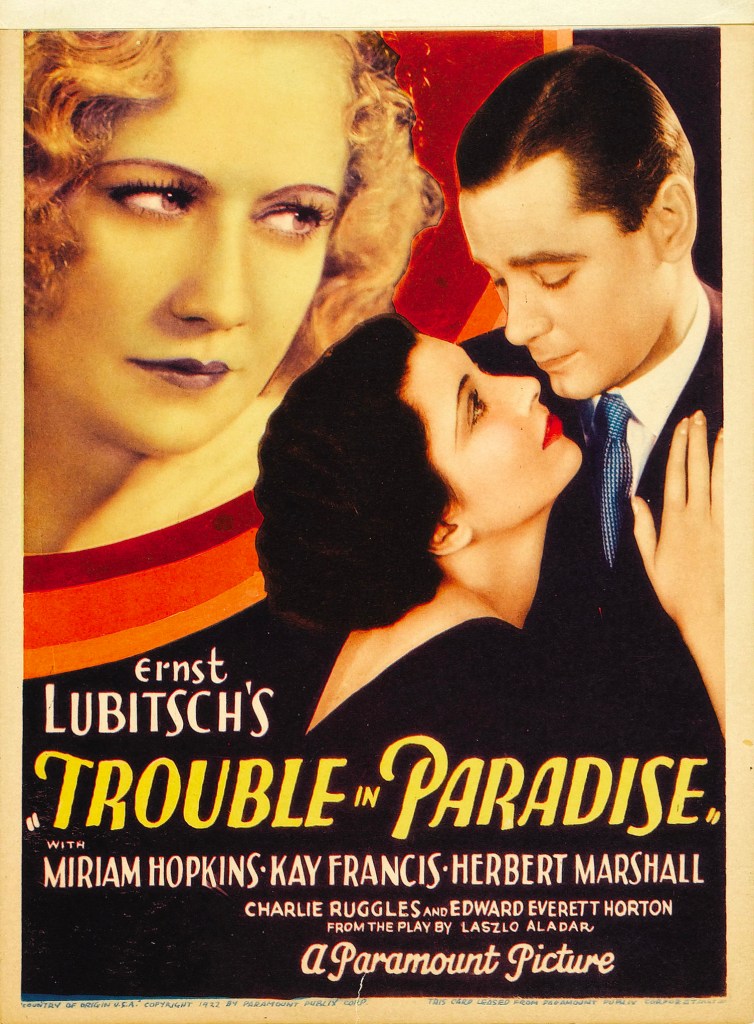
Trouble in Paradise (1932)

Trouble in Paradise (1932)

Stealing, swindling and sex abound in Lubitsch’s masterful – and influential – early Hollywood comedy

Director: Ernst Lubitsch

Cast: Miriam Hopkins (Lily), Kay Francis (Madame Colet), Herbert Marshall (Gaston Monescu), Charles Ruggles (The Major), Edward Everett Horton (Francois Filiba), C. Aubrey Smith (Adolph J Giron), Robert Greig (Jacques, the butler)

“Ah, that Lubitsch touch!” It was a slogan invented by the studio (probably to help turn Lubitsch into a brand – see also “The Master of Suspense!”). No one has ever been quite sure what it is exactly – but you can’t argue it doesn’t exist after watching Trouble in Paradise. A smoother, more charming slice of Wildean wit mixed with saucy naughtiness you couldn’t hope to find. All put together with effortless, cosmopolitan wit by Lubitsch, where every shot and camera movement has been planned for maximum effect. No wonder it’s one of the great early Hollywood comedies.

It’s Vienna and a Baron and a Countess are sitting down to a wonderful dinner together. But both know all is not what it seems: they’re both professional conmen. The Baron is Gaston Monescu (Herbert Marshall), the Countess Lily (Miriam Hopkins) – and they can pick each other’s pockets as easy as breathing. Falling in love, they team up and head for Paris, there to relieve fabulously wealthy Marie Colet (Kay Francis) of some of her firm’s dividends. Gaston becomes Marie’s private secretary – but don’t you know it, he finds himself falling in love with her. Will he go through with the scam? And will Lily give him the choice? The answer is almost certainly not what you think.

Trouble in Paradise is so swift, smooth and gloriously comically inventive that its very existence is enough proof of that Lubitsch touch. The comic business here is so marvellously done, so hugely influential and inventive, that half the comedies existing owe it a debt. Take a look at that first sequence as the two of accuse each other of being thieves and liars, in between passing each other the salt, with consummate politeness then proceed to take part in a pickpocketing game of one-upmanship (purses, pins, watches, garters, you name it!). All shot and directed with a perfect mixture of one-take dryness, matched with perfectly chosen fluid camera movements that accentuate punchlines.

Then there’s that script (“Do you remember the man who walked into the Bank of Constantinople and walked out with the Bank of Constantinople?”). It’s crammed to the gills with sensational bon mots with more than a touch of Wilde or Coward but also a certain emotional truth (“I came here to rob you, but unfortunately I fell in love with you.”). Trouble in Paradise is an intensely suave and sophisticated film that delights in making its characters feel like the nimble-thinking smartie-pants who always know what to say, that you’d love to be, but never quite are.

It’s grist to the mill of Lubitsch, who coats the film in the three things that really makes it work: European sophistication and ruthlessly dry wit; playfully smooth direction; and more than a dollop of sex (and lots of people in this, let’s face it, are pretty impure to say the least). Sex is in fact what’s at the heart of this film: they may be criminals, but Gaston and Lily are at least as interested in getting some of that as anything else and Marie is more than a match for them.

Trouble in Paradise is pre-Code – and far racier than anything we normally expect from Old Hollywood. After all, this is a film that makes a series of perfectly timed punchlines out of a Butler constantly knocking on the wrong bedroom door to find Marie, unaware that Gaston and Marie are “spending time together” elsewhere. Gaston and Lily’s first meeting is capped with a “do not disturb” sign being hung on their bedroom door. The word sex gets bandied about. In case we missed the point, Lubitsch shoots a romantic clinch between Gaston and Marie by focusing the camera on the bed where their shadows are being cast, looking for all the world like they are lying down on it. Later Lubtisch will focus on a clock marching forward in time as we hear Gaston and Marie flirt (and clearly more than just flirt) as the time flows by.

No wonder when the Code was introduced, Trouble in Paradise was slammed on the shelf for years. It’s more than clear that Gaston has it away with Marie and Lily – and, even more scandalously, no one seems to mind that much. There is sexual liberalness to Trouble in Paradise. Marie is happily stringing along two boorishly foolish suitors (Charles Ruggles as a bluff retired major and Edward Everett Horton as a slightly pompous fop, fleeced in the past by Gaston – both very funny). Gaston feels many things, but never ashamed, while Marie seems sexually excited by the idea that he might be a crook. (Their first meeting is a simmering swamp of sexual tension.)

Lubitsch keeps the film flowing so effortlessly, it glides down barely touching the edges. The humour is spot on and perfectly delivered. At one point Lily (still disguised as the Countess at this point) phones her “mother” in front of Gaston. Her conversation is polite and giddy – then Lubitsch cuts to the other end of the call where her crude landlady is prattling bored on the end, and we realise it’s all part of a con. Gags like this have inspired filmmakers for years. You can see the root of half the screwballs that were to come in the love triangle flirtatiousness between Marshall, Francis and Hopkins.

All three of them are excellent. Marshall had few better opportunities to showcase his dry wit and sex appeal (he was so often cast as stuffy, dull husbands), and he’s the ideal arch gentleman here, with a twinkle in his eye at his daring smartness and very sexy in his confidence. (The constant shots of Gaston running up and down stairs is, in itself, a gag – Marshall had only one leg and all that running was a body double). Far from a rube, Kay Francis makes Marie a sexually curious, determined and out-going woman who knows what she wants and happily plays the game to get it. Miriam Hopkins has a punchier feistiness as a woman who can shift personae with effortless ease.

Trouble in Paradise – that Paradise being Gaston and Lily’s natural partnership – slides so smoothly from set-piece to set-piece, each of them shot with superbly smooth camera movements that perfectly accentuate their comic impact, that it continues to offer huge entertainment. Brilliantly acted, packed with superb set-pieces, it benefits above all from that glorious Lubitsch touch. Sophisticated, amoral, naughty but with a touch of heart among all the lying and cheating, it’s very funny and very cheeky and all about sex and stealing. It’s a landmark film.

The Children's Hour (1961)

Audrey Hepburn and Shirley MacLaine are victims of scurrilous rumours in The Children’s Hour

Director: William Wyler

Cast: Shirley MacLaine (Martha Dobie), Audrey Hepburn (Karen Wright), James Garner (Dr Joe Cardin), Miriam Hopkins (Lily Mortar), Fay Bainter (Mrs Amelia Tilford), Karen Balkin (Mary Tilford), Veronica Cartwright (Rosalie Wells), Mimi Gibson (Evelyn), William Mims (Mr Burton)

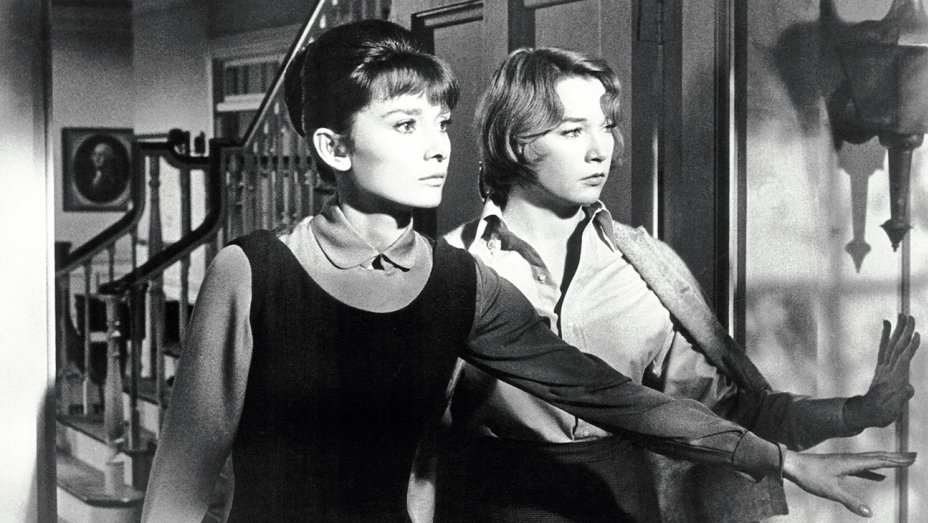
The Children’s Hour was William Wyler’s second stab at directing an adaptation of Lilian Hellman’s play of the same name: a story about  two young teachers at a private girls’ school, and the destruction wreaked on their lives when a malicious pupil spreads rumours the two are in a secret lesbian relationship. His first attempt from 1936, These Three, kept as many of the themes as possible but carefully deleted every single reference to homosexuality in the script. This second film version restores this core theme in a carefully structured, well directed, respectful film adaptation that, with its careful analysis of the danger of rumours and snap judgements, still feels relevant today. 

Martha Dobie (Shirley MacLaine) and Karen Wright (Audrey Hepburn) run a private girls’ school. Karen is engaged to Dr Joe Cardin (James Garner), and this prolonged engagement is part of the arsenal used by a bitter, bullying student Mary (Karen Balkin) when she decides to start spreading innuendo about a scandalous relationship between the teachers, painting Martha as consumed by sexual envy. Mary’s story is believed whole-heartedly by her grandmother, doyen of the social scene and Joe’s aunt, Amelia Tilford (Fay Bainter). Thoughtless words from Martha’s aunt Lily Mortar (Miriam Hopkins) make things worse. In no time, the school is ruined, the children all gone and Martha and Karen face a desperate battle to prove that there is nothing to this but gossip.

Wyler’s film is a strange mixture at times, in part a commentary on prejudice, and also a scorching condemnation of jumping to judgements. The film plays out all this with calmness and a general careful avoidance of histrionics and lecturing. The removal of the children from the school is brutal and cowardly – with none of the parents having the guts to say why they are doing what they are doing until finally confronted by Karen. Amelia Tilford goes about her campaign of moral righteousness with a holier-than-thou superiority while constantly stressing that she takes no pleasure in this. In the latter half of the film, the abandoned school seems to be constantly surrounded by smirking men.

The film carefully outlines that this sort of moral judgement is inherently wrong, and it brings out some true moral judgement on many of the people involved. It draws out a brilliant Crucible-like indignation at the rigidity and hypocrisy of how those who are judged to be different are treated. The film’s finest sequence is at the centre of the film, where Martha and Karen make a (failed) attempt to nip the scandal in the bud by confronting Mary at her grandmother’s house. The scene zings with a burning sense of injustice, as Mary’s lies are believed, doubled down on and then confirmed by a blackmailed fellow student, all while the audience knows that everything that is being spun is florid, innuendo-filled rubbish.

Mary is a bitter, twisted, angry little girl whose face seems permanently screwed into a furious frown. She also has the sharpness and ruthlessness of the natural bully, successfully blackmailing a sensitive, kleptomaniac student to endorse all her lies at every turn. Wyler carefully demonstrates that she has a natural manipulator’s deviance and that half-facts and muttered comments carry more conviction and force than carefully stated arguments ever would.

But Mary’s actions partly stem from Karen’s own forceful treatment of her – and Karen’s moral inflexibility and personal certainty is just one of the many character flaws that this lie brings closer and closer to the surface. Well played by Audrey Hepburn, using her occasional slight imperiousness to great effect, Karen’s lack of compromise, her domineering personality and her own moral superiority help to make her both an unsympathetic victim to many, and a person who manages to drive wedges (inadvertently) between herself and her two closest friends, Joe and Martha.

That wedge spins out from the fact that the more sensitive Martha (a sensitively delicate performance from Shirley Maclaine) does have romantic and sexual feelings for Karen, feelings that she has carefully suppressed (or perhaps not even understood) and confesses to late on in a wave of guilt and shame, mixed with an almost unspoken hope that Karen might respond to this confession with more than silence and a quiet assurance that it won’t change anything. Neither of which is what Martha wants (or needs) to hear. 

MacLaine was critical of Wyler for removing from the film scenes that showed Martha’s love and affection for Karen in a romantic light. Perhaps Wyler was still slightly squeamish about the likelihood of America accepting a lesbian character presented honestly and sensitively. –But MacLaine has a point for, while the film does suggest it is reprehensible to  make judgements about other people’s private lives, it falls well short of suggesting that a lesbian relationship is as normal and valid as a straight one, or that Martha’s feelings for Karen are the equal of Karen’s for Joe. Karen will let the idea slide, but she is hardly thrilled by it, meanwhile Martha is made the more passive and hysterical of the two women, and her feelings for Karen are a source of tragedy in the story. While it’s of its time, the film still shies away from the idea that a lesbian relationship could ever be without a tinge of scandal. Unlike, say, Dirk Bogarde’s gay barrister in Victim, there is always something “not quite right even if we shouldn’t judge” about homosexuality in the film.

It’s why the film is at its strongest when showcasing its outrage for the many selfish and self-appointed moral guardians who ruin lives with sanctimonious self-regard. Miriam Hopkins is eminently smackable as Martha’s appalling aunt, whose love of gossip pours fuel on the fire. Fay Bainter is very good (and Oscar nominated) as Amelia, whose reluctance and unease about her self-appointed role as the moral police, only partly tempers her rigidity and inflexibility. Words of support and encouragement from others are noticeable by their absence, and even the long-standing loyalty of Joe (a rather charming James Garner) is eventually tinged (forever for Karen) by a moment of doubt. 

Rumours and innuendo are dangerous and cause real and lasting damage to people’s lives. It’s a fact the film enforces strongly – and it’s an idea that perhaps is even more relevant today at a time when social media sends moral judgements that ruin lives around the world even faster than Amelia Tilford’s phone can. A well-made film with moral force, that could have gone further, but still went further than many others dared at the time.