
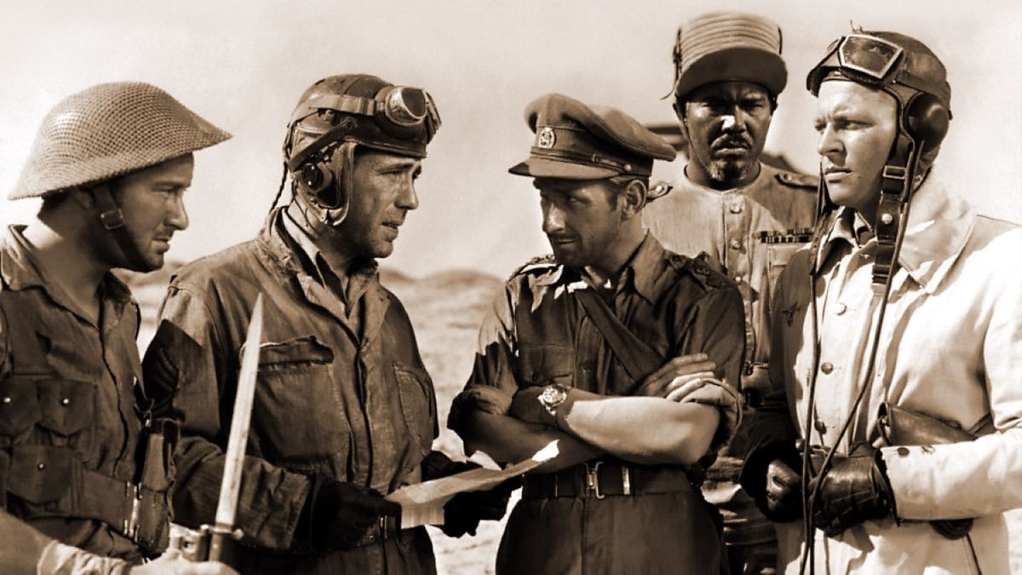
Bogart does desert warfare, in this tense, very well-made war film both men-on-a-mission and a siege film
Director: Zoltán Korda
Cast: Humphrey Bogart (Sgt Maj Joe Gunn), Bruce Bennett (Waco Hoyt), J. Carrol Naish (Giuseppe), Lloyd Bridges (Fred Clarkson), Rex Ingram (Sgt Maj Tambul), Richard Nugent (Captain Jason Halliday), Dan Duryea (Jimmy Doyle), Carl Habord (Marty Williams), Patrick O’Moore (Bates), Louis Mercier (Frenchie), Guy Kingsford (Stegman), Kurt Kreuger (Captain von Schletow), John Wengraf (Major von Falken)
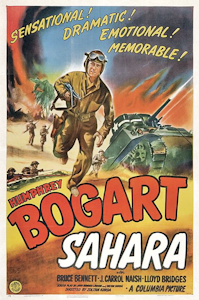
Sahara was ripped from the headlines: with the war still in full swing. So much so, it not only told a tale of a battle effectively still being fought but is also perhaps the only American film in existence to credit a Soviet film for providing the original story. It’s 1942 and the British army are in full retreat from Rommel’s Afrika Korps. Among them is Sgt Joe Gunn (Humphrey Bogart) and his tank Lulubelle, one of a small group of American tanks getting some real life combat experience with the Brits. Heading South through the desert, Gunn and his crew, Waco (Bruce Bennett) and Joe (Dan Duryea), pick up a motley collection of Allied soldiers led by Captain Dr Halliday (Richard Nugent) including Sudanese sergeant Tambul (Rex ingram) and his Italian prisoner Giuseppe (J. Carrol Naish). All of them are caught between two enemies: the Germans and the complete lack of water in the desert.
Sahara is an exciting, assured war film that combines a ‘men on a mission’ set-up with a classic ‘base under siege’ setting. Our heroes eventually find themselves at a dried-up desert well and the target of a desperately thirsty German battalion. Gunn decides to hold the dry well to slow the German advance down, fighting a gruelling siege, desperately waiting for relief, as the battle takes a terrible burden. This is Boys Own Adventure stuff, but told with a genuinely affecting sense of duty and sacrifice, as our heroes knuckle down in impossible circumstances.
At the heart of it, Bogart delivers exactly the movie star charisma the film needs while. Rudolph Maté’s photography is extraordinary, transforming the Californian desert into the African sands. Sahara brilliantly understands the importance of resources in the desert, and Korda captures perfectly the sweaty, sand-covered desperation for liquid. Sahara is tense, exciting and surprisingly hard-hitting with a strong cast.
What it really is of course, is a celebration of the attitudes that separate the Allies from those nasty Nazis. The Allies are a smorgasbord of nationalities, all of whom are shown (after some clashes) to work together with respect, admiration and a shared sense of purpose. Richard Nugent’s medical officer modestly defers leadership to the tank-and-combat experience of Bogart’s sergeant – no awkward arguments of seniority. Despite the collection of Americans, Brits, a South African, a Free Frenchman, a Canadian and a Sudanese sergeant, there is almost no trace of either national or racial clashes.
These men work in partnership, deferring to other’s areas of expertise to survive. Rex Ingram – excellent as Sergeant Tambul – instantly proves himself invaluable with his survival knowledge and ability to locate water. It’s Tambul who is at the heart of a tense search for any moisture in the seemingly dried up well our heroes hole up at, and later he is pivotal in the defence of the well. Saraha has a marvellously low-key but affecting scene of cross-cultural understanding as Tambul and Bruce Bennett’s Texan Waco jokingly compare outlooks on the world that are far more similar than they expect.
The message here is clear: teamwork, respect and the ‘dignity of freedom’ gives the Allies the moral edge over the Axis. The supportive respect, good humour and unflashy bravery of the Allies who get on with it and put duty first while respecting the rules of war is contrasted with the Germans. Bogart may flirt with the idea of abandoning Giuseppe in the desert (to preserve their water supply) but of course, when push comes to shove, he won’t (as Waco and Jimmy suspected he wouldn’t). Later, Bogart will even share the same limited water ration with their German prisoners.
Compare and contrast with the Germans. Their main representative, captured pilot von Schletow (played with a wonderfully smug viciousness by Kurt Kreuger), is portrayed as an instinctive racist (he’s the only character to make any slur towards Tambul), a bully and fanatic. There’s very little trace of decency in him: he’s confrontational, two-faced and dripping with nationalist superiority. The other Germans we see aren’t much better: a German soldier turns on his companion for a drop of water, a senior German officer breaks on a truce and the Germans fight as individuals rather than a supportive unit.
Caught in the middle? The Italians, represented by Giuseppe. J. Carrol Naish is excellent (and Oscar-nominated) as a soldier a million miles from Kreuger’s fanatic: a family man who keeps his word and just wants to go home. Naish has two knock-out scenes: the first a desperate pleading to Gunn to not be left to certain death in the desert and the second a contemptuous denunciation of German fanaticism to von Schletow: as he puts it, it’s a job to the Italians but a way of life to the Germans. Perhaps it was easier (with America’s large Italian population) to give the Italians more of a pass, but it allows the film to suggest there is some hope that behind the fanatics stood many regular people (something it’s hard not to see mirrored in the desperate German soldiers).
Sahara marshals all of this into a final siege that threatens to head the film into very dark territory indeed. Death is a constant in Sahara: the film opens with a view of the wreckage of battle, the unforgiving harshness of the desert is constantly stressed and we are shown repeated images of makeshift graves as bodies pile up and it becomes clear no-one is safe. Many heroic deeds have fatal outcomes and there is a hardened realism to the fighting. Like the Allies, the viewer ends up hoping for a miracle. It’s makes for a gripping and overlooked war film, that provides a genuinely hard-hitting taste of how unforgiving war can be. Tense, well-filmed and exciting it’s a little gem.


 Movie Musings