Tag: Rufus Sewell

Scoop (2024)

Scoop (2024)

Interview dramatisation which mostly fails to turn news into drama, making empty points

Director: Philip Martin

Cast: Gillian Anderson (Emily Maitlis), Keeley Hawes (Amanda Thirsk), Billie Piper (Sam McAlister), Rufus Sewell (Prince Andrew), Romola Garai (Esme Wren), Richard Goulding (Stewart MacLean), Amanda Redman (Netta McAlister), Connor Swindells (Jae Donnelly), Lia Williams (Fran Unsworth), Charity Wakefield (Princess Beatrice)

It was one of those interviews that shook the world – largely because it was such car-crash TV. Prince Andrew (played, under layers of effective make-up, by Rufus Sewell) desperately wanted to distance himself from the Jeffrey Epstein scandal and BBC’s Newsnight was seen as the most appropriate outlet for a reputation-restoring chat with a proper journalist, Emily Maitlis (Gillian Anderson). The interview was booked by producer Sam McAlister (Billie Piper) – whose book Scoops inspired this – and advocated for by Andrew’s senior advisor Amanda Thirsk (Keeley Hawes). The revelation of Andrew’s priceless mix of out-of-touch privilege and shallow dimness, combined with his inability to understand the impact on anyone but himself, consigned him to royal oblivion.

Scoop tries its best to turn the behind-the-scenes story into drama – but, to be honest, it comes across as a hugely underwhelming Frost/Nixon-lite. It’s hard not to feel an episode of Netflix’s The Crown would have dealt with this with more depth and interest than this manages. Scoop commits the cardinal sin of any “plucked-from-the-TV-headlines” biopic: all its most interesting parts are pitch-perfect recreations of an interview you can watch at your leisure on YouTube. Once you’ve got over how well Anderson and Sewell have captured their subjects, that’s basically it.

That’s Scoop all over. It’s a film that’s all flash and no substance. Martin and screenwriter Peter Moffat work overtime to suggest that this interview was a seismic piece of journalism, a sort of David-v-Goliath reveal. It ends with the Newsnight team giving themselves a self-congratulatory round-of-applause for “having given a voice to the victims” – a bit rich considering neither the interview or this film gives them much more than a second or two. Maitlis and co are shown to be trembling with nerves before interviewing this Royal Spare who no-one ever took particularly seriously (as McAlister bluntly tells him at one point), something which feels a bit odd since we are repeatedly told Maitlis has quizzed Bill Clinton among a score of other names.

There is a Spotlight-ish attempt to show the Newsnight team verifying some facts before the interview takes place – Scoop is one of the few films you’ll see where a paparazzi photographer, played as a cheeky wideboy by Connor Swindells, presented as a noble crusader for the truth – but it never rings true. No real facts about the Andrew-Epstein case were either unknown, in dispute or revealed during the interview. Andrew wasn’t even undone because of “gotcha” questions: it was because he performed so catastrophically badly, painting himself as the “real victim” and revealing he existed in a reality no ordinary person could begin to recognise.

There is very little drama in Scoop. Based on McAlister’s book, Scoop is duty-bound to place her as centrally as possible. Problem is the slogging hard-work of building trust over time to land big interviews is quite undramatic. Instead, the film boils McAlister’s work down into a chance email, a pub chat and a bit of Hollywoodish-straight-talking from McAlister during a meeting with the prince. This sells her skills short. In fact, unlike Frost/Nixon which got chunks of drama out of the will-they-won’t-they dance to set-up the interview, Scoop gives the impression everyone wanted it to happen. In fact, it makes it look so straight-forward, you end up thinking McAllister’s bitter colleague might be right – how highly skilled is her job?

The desire to centralise McAllister creates further problems: their nominal lead’s key involvement ends before the stuff the film is really interested in (the interview) even begins prepping. Scoop falls back on plucky outsider to keep her involved, retrofitting McAllister (a producer with nine year’s experience with world leaders) into a working-class outsider, who needs to force herself into “the room where it happens”. Problem is as soon as she’s in the room, McAlister has nothing to say or do (one suspects the whispered legal battles connected with a rival mini-series on the same subject stopped the writing of any McAllister-ish insight here, for fear it would be promptly denied by the Maitlis-backed rival production).

McAlister becomes a side-bar, a largely silent background character in her own story. Not quite the message that the film wants to promote on female empowerment (even if her bosses are all women). There are similar odd notes in here. Amanda Thisk’s colleague, an aggressive male we are clearly not meant to sympathise with, resigns when the interview is agreed saying it’s a terrible idea. Scoop paints him as a chauvinist bully, furious at being over-ruled by a woman – problem is he’s right. The most effective moment on this subject is arguably more about privilege in general, as Andrew demeans a female cleaner for incorrectly sorting his teddy bear collection. As mentioned the actual victims remain voiceless and nameless on the margins, barely meriting even a post-credits mention.

Perhaps the real problem with Scoop is it wants to be an All the President’s Men style journalism film but the interview was really a soapish showbiz story. There is not investigation, no wrongs bought to light. There is no gladiatorial duel (compare to Frost/Nixon). Andrew essentially commits reputational suicide in front of his stunned opponents, when confronted with fairly routine, fact-based questions. It’s not like toppling someone really important – and the film is so careful about legal implications it avoids putting any stance on what Andrew may or may not have done, knowingly or otherwise.

What the film doesn’t want to say is that Newsnight landed a big hit by giving us exactly the sort of easy-to-digest, car-crash, celeb news it’s staff start the film scorning. Now a film embracing that would be interesting! In the film McAlister says they need to rejuvenate the programme, to stop talking in an echo-chamber to the Metropolitan elite on subjects like Brexit but focus on the things people really care about and challenge its viewers with positions that differ from their own. Was this story about Prince Andrew in any way at all an answer to that challenge? No. Did it change the world? No. Did it really deserve a film – and that rival three-part series? Scoop never suggests it does.

Judy (2019)

Judy (2019)

A star turn is the only thing of note in this empty, uninsightful biopic

Director: Rupert Goold

Cast: Renée Zellweger (Judy Garland), Jessie Buckley (Rosalyn Wilder), Finn Wittrock (Mickey Deans), Rufus Sewell (Sid Luft), Michael Gambon (Bernard Delfont), Richard Cordery (Louis B Mayer), Darci Shaw (Young Judy Garland), Bella Ramsey (Lorna Luft), Royce Pierreson (Burt Rhodes), Andy Nyman (Dan), Daniel Cerqueira (Stan), Gemma-Leah Devereux (Liza Minnelli)

By 1969 Judy Garland (Renée Zellweger) was homeless, broke and stuck in a pill-and-alcohol fuelled depression. Desperate to provide a home for her children, she flew to London for a five-week booking at the Talk of the Town nightclub. Judy sees her, pushed beyond her physical and emotional limits, as she struggles to complete the run – or even get on stage – marrying the feckless young Mickey Deans (Finn Wittrock) and flashbacks to her memories as a Hollywood child star (Darci Shaw), under the punishing “mentorship” of studio head Louis B Mayer (Richard Cordery).

All this gets mixed together in Goold’s uninspired, sentimental and rather empty biopic that never really gets to grips with Garland’s personality, so desperate is it to shoe-horn her into a bog-standard narrative of redemption mixed with personal tragedy. Garland, I’m sure, would have hated it: she always pushed back against the idea that her life had been tragic (which this film whole-heartedly embraces) and the portrayal of her as a constantly misunderstood victim, generously one-sided as it is, boils her down into someone with no agency or control at all in her life.

As such, the most effective parts of this film are the flashbacks to her childhood, filming Wizard of Oz, living off diet pills so she can’t put on weight and working 18-hour days. All under the direction of a monstrously calm Louis B Mayer – a terrific performance of amiable, grandfatherly menace from Richard Cordery – who pleasantly tells her she is a dumpy child who must work like a dog to get ahead and owes everything to him. If the film gets anywhere to understanding Garland’s psychology, it’s in these scenes – I’d rather they’d made it about this than her swan song in England.

In the 1969 sections, the film continues to try and communicate that a life of constant work and pressure left Garland an emotional, physical (and possibly mental) wreck. It puts us on her side, stressing her vulnerability and desperation which she covers with brittle, demanding behaviour. But it’s too squeamish to show too much of her popping pills and downing more than the odd glass of vodka – despite the fact she’s clearly intoxicated for large parts of the film. It only briefly looks at how crippling anxiety affected her unwillingness to rehearse and implies her time in London was a lengthy period of unending servitude rather than a five-week booking singing her greatest hits (the film is hugely vague about timelines to increase the feeling of Garland’s powerlessness).

The film isn’t even smart enough to give us moments where other characters get a glimpse of the fragility under Garland’s prima donnai-sh petulance. Despite her treating both of them as a mix of underlings and informers, Jessie Buckley’s minder and Royce Pierreson’s pianist inexplicably become friends to the star part-way through the film. There is no scene to transition this, no moment of fragile tenderness they witness that makes them understand there is more to this demanding person than they initially thought. Instead, it feels like the narrative requires them to like her just as the audience is supposed to, so whoosh they like her.

The one affecting sequence sees a lonely Garland bumping into two gay fans (Andy Nyman and Daniel Cerqueira) and rather sweetly asking if they would have dinner with her (they are of course thrilled). Back at their apartment, they cook a disgusting looking omelette, play the piano and she listens as they are tearfully talk about their life of persecution in homophobic Britain. It’s gentle, sweet and the only time we (or she) get a real sense of what Garland means to people – these fans idolise her as a symbol of hope. Even this scene is undermined by (a) it not having any lasting impact on Garland as soon as it finishes and (b) these characters being shoe-horned into a blatantly emotionally manipulative ending almost unwatchable in its cloying feel-good-ish-ness.

The one thing the film has going for it is a committed, pitch-perfect performance by Renée Zellweger who captures the vocal and physical mannerisms perfectly. She won every award going including the Oscar. It’s an impressive study and she plays the moments of pain as committedly and rawly as the gentle, tender moments. She does everything the film asks of her, and it’s not her fault that it asks so little of her. There is no dive into Garland’s personality, no questioning that any of her ills were self-inflicted, no criticism for her not turning up for gigs where customers have paid a fortune to see her, no attempt to explore other perspectives on the impact of her actions or how she has become the woman she is.

Instead, Judy meanders towards its semi-feelgood ending without ever really letting us feel we’ve understood much about either this woman or her difficult life, other than framing her as a victim from a life of exhausting show-biz exploitation. Told within a story that is low on drama, pathos or humour, you end up wondering what point it was trying to make in the first place.

The Father (2020)

Olivia Colman and Anthony Hopkins excel in Florian Zeller’s sublime The Father

Director: Florian Zeller

Cast: Anthony Hopkins (Anthony), Olivia Colman (Anne), Rufus Sewell (Paul), Imogen Poots (Laura), Olivia Williams (The Woman), Mark Gatiss (The Man)

Is there any worse nightmare than the thought of losing your mind? Worse of all, to lose your mind in stages: to be aware, in every moment, that things are not as they should be, that people and places no longer seem to fit your memory of them. That you can walk into a room and completely forget why or meet someone close to you and have no a clue who they are. It’s an unimaginable condition to go through – and the subject of Florian Zeller’s exceptional adaptation of his award-winning play, The Father.

Anthony (Anthony Hopkins) is a retired engineer slowly succumbing to dementia. Events are increasingly confusing to him. Is he living in his own flat, or is he living with his daughter Anne (Olivia Colman)? Is Anne moving to France or not? Is she married to Paul (Rufus Sewell) or not? Where is his other daughter who looks so like a woman who may-or-may-not be his new carer, Laura (Imogen Poots)? From moment-to-moment Anthony struggles with confusion, rage and fear as the world constantly fails to coalesce into a meaningful picture, but instead remains a fragmented jumble.

That’s the brilliance behind Zeller’s adaptation of his own award-winning play. It captures the perspective of the world for those suffering from dementia in a way no film has done before. The play’s timeline is disjointed in an almost Nolan-esque way, and it’s not clear whether we are watching ‘real’ events’ or if all of these events are memories of Anthony’s which dementia has shuffled, reordered and recast. Either way, the film constantly refuses to allow you any grounding from scene-to-scene, and refuses to present clear answers (although you can infer much).

Even the sets betray us. From to scene to scene the apartment is redressed, sometimes in subtle ways, sometimes in jarringly different ways. The same fundamental layout sees every room constantly redesigned. Sometimes it could be Anthony’s apartment. Sometimes Anne’s apartment. Sometimes a mix of the two. Sometimes it’s a hospital, in others a retirement home. Often it might be a combination of one or more of these locations all at once. The style of decoration is inconsistent, the furniture changes, pictures move, even the colours of bedsheets change. Every single scene disorientates us: it’s only a movie for us, but for Anthony this is his life.

In fact, if The Father has a filmic influence, interestingly it’s a horror-film. Anthony is a man trapped in a situation where he knows everything is wrong, but can never fully understand why, or get people to listen to him. Often the camera catches discomfort and fear on Hopkins’ face, and it’s clear he neither knows where he is or, in many cases, who the people with him are. But for fear of not being believed or a sense of powerlessness, he’s too proud and scared to ask. It taps into the powerlessness of horror films, where you are relentlessly chased by a force outside your control: in The Father that force is life, which has become for Anthony a disturbing kaleidoscope where everything makes sense to everyone except him.

Of course, a large part of this is sold by Anthony Hopkins Oscar-winning lead performance. Hopkins delivers to an astonishing degree: this might just be the greatest performance of his career. Although we see flashes of ‘the true Anthony’ – his wit, playfulness and intelligence – Hopkins deftly and subtly demonstrates the wildly varying mood swings dementia brings. At times he’s paranoid, defensive and even aggressive. At others he’s stunningly vulnerable and scared – he has two breakdown scenes of such heart-breaking vulnerability and boyish fear, they are tough to watch.

The film opens with Anne telling Anthony she’ll be leaving for Paris, and Hopkins’ face collapses into a crumpled, puffy, scared-little-boy face while he plaintively asks what will happen to him. Anthony fixates on things that give him any sense of control: he is obsessed with his watch, hiding it and continuously searching for it. He will dredge up a fact from the distant past to ‘prove’ he has not lost his memory. He snaps angrily when he feels he is being talked down to. His resentment expresses itself in viciously cruel verbal assaults on Anne, labelling her a disappointment, failure and his least favourite child. Then a few scenes later he’ll squeeze her shoulder and quietly and lovingly thank her for everything she has done for him. All of this is delivered by Hopkins with no grand-standing, but with a hugely affecting truthfulness. It’s an astonishingly good performance.

Every scene carefully demonstrates time and again Anthony’s fear and vulnerability. Actors are even replaced by other actors in several scenes. In Anne’s second appearance she is played by Olivia Williams. In a beautiful piece of subtle acting by both Hopkins and Williams, it’s clear Anthony doesn’t recognise Anne and she realises this but decides not to say anything. Anne’s husband (or boyfriend – Anthony remains unclear, so at times so do we) Paul (as he’s called most of the time) is mostly played by Rufus Sewell, but sometimes by Mark Gatiss. Paul is the closest the film has to an antagonist, although much of that is filtered through Anthony’s confused perception and, in any case, Paul is right that Anthony’s condition is making it too difficult for him to remain at home.

And we can see his point. Although each scene more-or-less makes sense within itself, the complete film is like looking at a jigsaw puzzle with all the pieces upside down and no picture, and then being asked to assemble it. In one particularly brilliant dinner scene, the film starts with Anthony witnessing a conversation between Paul and Anne, then loops through the scene and ends with Anthony witnessing exactly the same conversation again. The film is a deliberately, brilliantly, opaque tableau that defies easy meaning.

In all, The Father is a quite unique and brilliant film, that translates a theatrical piece into something highly cinematic. Hopkins is breath-taking, but Colman is also superb as Anne, in a part tailor-made for her ready empathy and easy emotionalism. Zeller’s direction is astonishingly confident and dynamic for a first-timer and the film slots you into the world of a dementia sufferer with an alarming immediacy. A superb film.

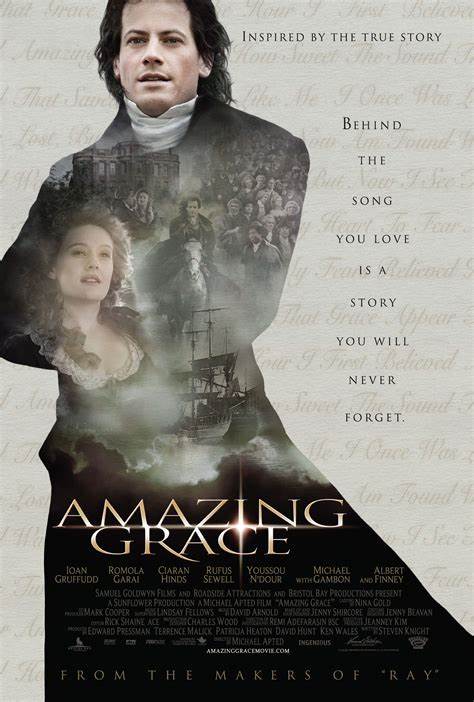
Amazing Grace (2006)

Ioan Gruffudd in full flight in the conventional but charming Amazing Grace

Director: Michael Apted

Cast: Ioan Gruffudd (William Wilberforce), Romola Garai (Barbara Spooner), Benedict Cumberbatch (William Pitt the Younger), Ciaran Hinds (Banastre Tarleton), Albert Finney (John Newton), Michael Gambon (Charles James Fox), Rufus Sewell (Thomas Clarkson), Youssou N’Dour (Olaudah Equiano), Toby Jones (Duke of Clarence), Nicholas Farrell (Henry Thornton), Sylvestra Le Touzel (Marianne Thornton), Stephen Campbell Moore (James Stephen), Bill Paterson (Heny Dundas), Jeremy Swift (Richard)

From 1782 to 1807 William Wilberforce (Ioan Gruffudd) fought a long – sometimes lonely – campaign to end the slave trade (and eventually slavery – the film confuses the two, with slavery continuing in much of the Empire for over twenty more years) in the British Empire. During that time, he competed with vested interests, parliamentary rivals and accusations of being a radical at a time when Britain was at war with Revolutionary France.

Michael Apted’s old-fashioned film covers this, hitting every beat you would expect for a biographical drama. It uses a traditional framing device of starting in the middle of the story: Wilberforce in 1797, depressed, hooked on laudanum and out of hope, revitalised by meeting Barbara Spooner (Romola Garai) who will become his wife. This makes for a perfect narrative tool as it means she can ask him questions like “tell me what happened” which serves as a neat entrée into a whole host of flashbacks sketching out in the swiftest means possible the history of abolitionism.

Amazing Grace could have been made in the 1930s, so closely does it hue to the classic rules of biopics. It’s practically a structural brother to The Life of Emile Zola, a hagiographical portrait of an (admittedly outstanding) man which shows the expected arc of moral awakening, early success, tricky mid-point, the sad years, getting the band back together for one final big push ending in friends and foes alike coming together to hail his accomplishments. It’s all threaded together with a script that carefully moves through every event, simplifies history down and sometimes wears its research rather heavily.

You can’t argue that it isn’t well-meaning and heartfelt, but its simplicity (and the careful traditionalism of its shooting) makes it look more like a well-made TV special than an actual movie. But if you are a sucker for such things, as I am, it has more than enough to engage you. It also makes a compelling case about the horrors of the slavery and allows a few moments of spotlight to fall on former slave turned abolitionist Olaudah Equiano (well played by Youssou N’Dour). It certainly has its heart in the right place, its passionate liberalism and sense of moral outrage very clear.

Gruffudd – his skill for playing reluctant moral authority and duty honed from playing Hornblower – is good as Wilberforce, his obvious investment in the subject matter clear. Garai doesn’t have much to do other than tee up flashbacks, but does it with charm. Many of the rest veer on the side of fruity: Hinds and Jones scowl effectively as slave-owning senior lords (for some reason they sit in the House of Commons; Jones is even playing a Duke for goodness sake!). Gambon twinkles as only he can as Charles James Fox. Finney hams up lustily as the blind John Newton. Best of all though are Sewell as an eccentric Thomas Clarkson and Benedict Cumberbatch in an early sign of star-quality as the morally divided, reserved but decent Pitt the Younger.

It all comes together into something that seems tailor-made for Sunday afternoons. Nothing wrong with that – and not every film needs to reinvent the wheel – and since it wears its heart so openly on its sleeve, you can’t help feeling warmth towards it. It’s a Spark notes look at history – and glosses over the fact that slavery itself continued for decades – but as hagiography it’s endearing and as a feel-good biopic it succeeds at what it sets out to do.

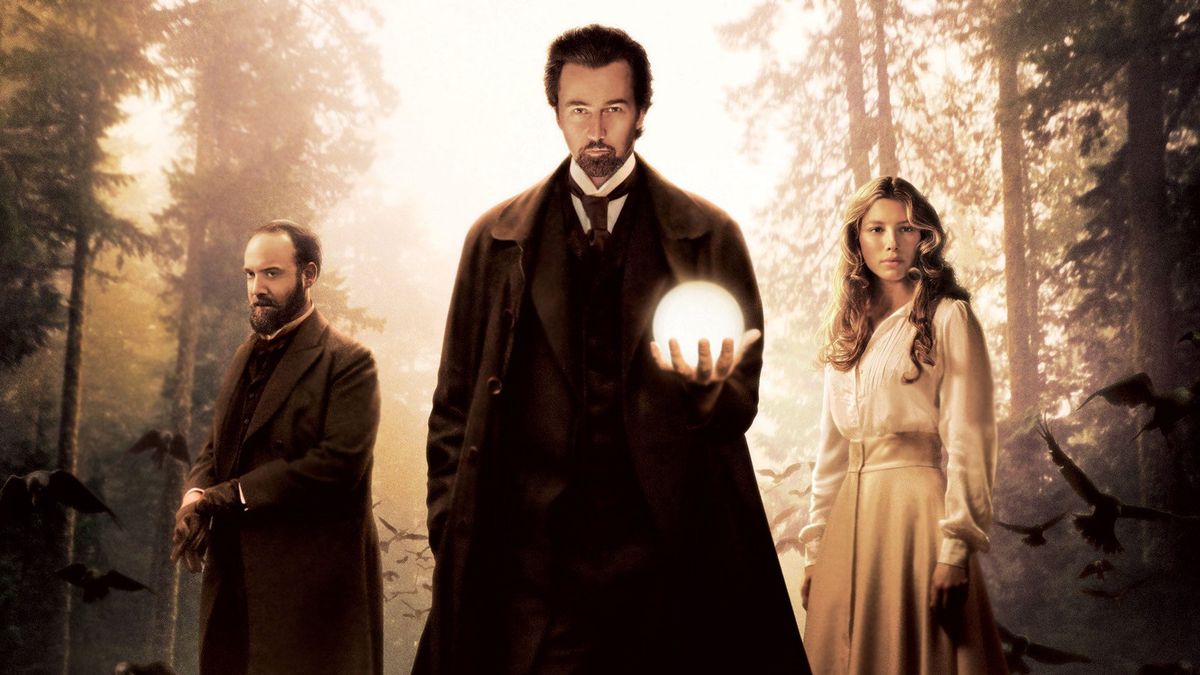
The Illusionist (2006)

Ed Norton, Paul Giamatti and Jessica Biel are wrapped up in the tricks of The Illusionist

Director: Neil Burger

Cast: Edward Norton (Eisenheim), Jessica Biel (Sophie), Paul Giamatti (Inspector Uhl), Rufus Sewell (Crown Prince Leopold), Eddie Marsan (Josef Fischer), Jake Wood (Jurka), Tom Fisher (Willigut), Aaron Taylor-Johnson (Young Eisenheim), Eleanor Tomlinson (Young Sophie), Karl Johnson (Doctor)

In 2006, The Illusionist was the other film about nineteenth-century magicians that wasn’t Christopher Nolan’s The Prestige. As such it got rather overlooked, which is unfair as this is a handsomely made, intriguing little puzzle which doesn’t reinvent the wheel but does what it does with a fair amount of invention and beauty.

In turn-of-the-century Vienna, the illusionist Eisenheim (Edward Norton) is a revelation – a mystery character whose past is investigated by Police Inspector Uhl (Paul Giamatti) under the orders of Crown Prince Leopold (Rufus Sewell). The Crown Prince feels Eisenheim’s illusions – which suggest at times dark truths in the Prince’s own personal life – are a serious risk to his position. On top of which, there is a secret past romance between Eisenheim and the Prince’s intended wife Countess Sophie (Jessica Biel), and the Prince is not a man to be crossed. So begins a cat-and-mouse game of trick and illusions between Uhl and Eisenheim.

The greatest thing about Neil Burger’s period piece is the grace and beauty with which it has been filmed. Dick Pope’s mixture of sepia tones and candlelit blacks makes for a series of gorgeous images, contrasted perfectly with Philip Glass’ beautiful score. Both contribute hugely to creating an atmosphere of mystical unknowingness around the Vienna locations, and give the film something in every scene to delight the senses.

What works less well is the slightly routine scripting and filmmaking that pulls the film together. For all the beauty with which it is presented, there isn’t quite enough of the original or – for want of a better word – the magical about what we see on the screen. The story is just ever so slightly too familiar, the points it intends to made – be it about the nature of power, or magic, or love, or hope – never quite coalesce into a coherent and clear message that really feels like you are being told something or shown something you haven’t seen in several movies before. 

Instead we see that behind the eyes of even the most obscure and unreadable conjurer there is deep and abiding love – love that will push them to do wild, even morally questionable, things. For others like the Crown Prince, that love is tied in altogether with possession and power and that there is no place for truth. Illusion is in all things: from Eisenheim’s entire life to the Prince’s front as a man of the modern world and his desire to become a dictator. Maybe that might be as close as the film gets to a deeper meaning – that illusion hides and protects our truths. 

As Eisenheim’s tricks get closer and closer to mesmerism and séance, the film suggests that it is a human need to want to see the truth behind tricks. The crowds who see Eisenheim raise the dead in flickering images want to believe it, that they could talk to their own deceased loved ones. Even in his early magic tricks, the less poetic characters of the film see value in the tricks only when they feel they have worked out the illusion behind it. Both are looking for a form of truth in the illusion, but the truth behind the trick is often deeper and more complex than the mechanical process by which it is done.

It’s a shame the film doesn’t tackle these ideas more, and settles for a more traditional “love across the divide” romance, but perhaps it doesn’t quite engage because Eisenheim and Sophie aren’t really interesting enough characters. Edward Norton plays Eisenheim with grace and intelligence, and draws a lot of depth and emotion from scenes that often require him to wordlessly stare. But juggling a character who deliberately conceals the truth and his intentions at every single turn seems slightly to have straitjacketed Norton, an elliptical actor at the best of times. There is something unknowable about him in this film which, while perfect for the character, makes him one you can’t really invest in. Similarly, Jessica Biel (a last minute replacement for Liv Tyler after filming had started) certainly looks the part, and gives Sophie a warmth, but she never really makes an impression as a character. Rooting for these two star-crossed lovers is difficult because we never get a sense of who they are.

Instead the film is dominated by hard-nosed rationalist Inspector Uhl, a man with a curiosity for conjuring, an appetite for power, a determination to get things done, but finally more than a bit of humanity. Paul Giamatti is excellent in the part, playing a role that emerges as the audience surrogate, trying as hard as we are to work out what is real and what is illusion. He doesn’t put a foot wrong with Uhl’s affable professionalism nor his ability to switch to business-like harshness. He’s also adept at playing a man who is the third smartest character in the film, but believes himself to be the smartest. You could also the same for Rufus Sewell’s (also great and clearly having a ball) Crown Prince, a bully who thinks he is an enlightened man.

It’s Uhl whom the film finally bonds with the most, and it’s his attempts to piece together what’s going on that becomes the most engaging thing in the second half of the film. For all the beauty of its making, and the skill that has gone into creating the optical illusions (some of Norton’s sleight of hand tricks in this movie are extraordinary), it’s a film that doesn’t quite satisfy. When the final reveal occurs in the film’s closing moments, you won’t quite be as satisfied as you would expect, perhaps because you won’t really care about Eisenheim or Sophie. Burger has made a handsomely mounted but strangely cold film.

Gods of Egypt (2016)

Just your standard Giant Meets Boy Gets Chased by Female Assassins Riding Giant Worms Story. Really didn’t anyone learn anything from Dune?

Director: Alex Proyas
Cast: Nikolaj Coster-Waldau (Horus), Gerard Butler (Set), Geoffrey Rush (Ra), Benton Thwaites (Bek), Chadwick Boseman (Thoth), Elodie Yung (Hathar), Courtenay Eaton (Zaya), Rufus Sewell (Urshu), Bryan Brown (Osiris)

Oh good lord where to begin. It’s not so much that this is a terrible film – although it is. It’s not offensive or unpleasant. It’s just a film that is almost impossible to take seriously whatever. It’s a fat, bloated, overblown mess where the plot makes almost no sense, the design is totally ridiculous, the acting bored or unengaging, and the directing totally lacking any charisma. It’s a film you can only laugh it, except for the fact that it’s so lamentably badly that it’s not even that funny. There is so little joy in the making of this bloated fart of a picture, that even as a joke it falls flat.

As far as I can tell, in a fictionalised ancient Egypt the Gods live among men. Horus’ coronation as the new king is interrupted by his uncle Set who seizes the throne, removes Horus’ eyes and sets about turning the realm into a dictatorship. He has some sort of overall plan but I’m really not sure what it was. Something to do with immortality or something. The film barely cares so neither should you. Set is a baddie. Horus is supposed to be a goodie, I guess, but he is such a humourless, arrogant, cold and (above all) boring God you probably won’t give a toss about him.

The film is a disaster almost from start to finish. In a decision that guarantees giggles every few minutes, the Gods are all 9 feet high, making the humans look like chippy midgets. Poor forced perspective hammers home this ridiculousness every few seconds. If this didn’t make the Gods silly enough, they also have some bizarre metal “battle modes” they transform into, which along with some piss poor special effects makes them look like refugees from Mighty Morphin Power Rangers. The colours are bright and primary and the sets all have the sheen of CGI, lacking any substance. The design decisions cross swiftly from daring into dumb. If you ever wanted to see a flying chariot pulled by winged scarabs or to see mix and match female hitmen ride giant worms chasing a giant and his normal sized friend, well hallelujah your day has come, this is the film for you.

The script, such as it is, is a loosely connected series of incoherent events. The acting is simply awful. Coster-Waldau completely lacks the big screen presence to carry the movie, his upper crust arrogance from Game of Thrones here comes across as insufferable and dull. Thwaites comic relief is about as funny as a hernia and his quest to save his true love has all the drama of running to catch a bus. Boseman aims for wisdom and grace but delivers camp and affectation in a truly terrible performance. Butler does at least have a bit of charisma, even though Set is such a poorly defined character he’s impossible to get interested in. Various other actors chip in autopilot performances for the cash. The female characters are little more than props. Geoffrey Rush needs a new agent: seriously how much money does he need?

The biggest problem though is it isn’t quite ridiculous, campy or shite enough to be a camp classic. Instead it’s just boring. It doesn’t have the sort of cosmic sweep or visual splendour to give you something to look at. Instead it’s loud, boring and stinks like animal droppings. That’s the worst thing of all: not even as a camp classic will this be remembered. Simply crap.