Tag: Ruth Nelson

Awakenings (1990)

Awakenings (1990)

Decent performances from the leads can’t save a shamelessly manipulative, saccharine movie

Director: Penny Marshall

Cast: Robert De Niro (Leonard Lowe), Robin Williams (Dr Malcolm Sayer), Julie Kavner (Eleanor Costello), John Heard (Dr Kaufman), Penelope Ann Miller (Paula), Max von Sydow (Dr Peter Ingham), Ruth Nelson (Mrs Lowe), Alice Drummond (Lucy), Judith Malina (Rose), George Martin (Frank), Dexter Gordon (Rolando), Keith Diamond (Anthony), Anna Meare (Miriam), Mary Alice (Margaret)

There can be few things more terrifying than being trapped inside your own body, unable to engage with the world, but to be in a sort of waking coma for years. Imagine how wonderful – and how terrible – it might be if you briefly woke to normality, only to return to your catatonic shell? This actually happened to patients of Dr Oliver Sacks – here re-imagined as Dr Malcolm Sayer (Robin Williams) – in a Bronx hospital in 1969. Looking after catatonic survivors of the encephalitis lethargica epidemic of 1919-30, Sayer discovered they responded to certain stimuli: their name, music, catching balls etc. With an experimental drug he discovers he can restore the patients to ‘life’ – foremost among them Leonard Lowe (Robert De Niro), just a boy when afflicted – only to discover the effects won’t last and they are doomed to return to their coma-like state.

It’s such a terrible thing to think about that it even gives genuine emotional force to Awakenings an otherwise hopelessly manipulative, sentimental film that plays like a TV-Movie weepie. It certainly didn’t need the naked emotional manipulation that washes over the whole thing like a wave, with Randy Newman’s sentimental, tear-jerking score swells with every single heart-string tucking moment. Awakenings is so determined to make you feel every single moment it eventually starts to make the story less affecting than it really is. A simpler, less strenuous film would have been more moving rather than this film almost genetically engineered into ‘life-affirming’.

Everything in Awakenings feels like it is always trying too hard. Every moment is laid on for maximum emotional impact. Adapted from Oliver Sacks’ book chronicling individual cases, it presents a stereotypical Hollywood ‘feelings’ film, with lessons for all. Worse, there is a tedious ‘seize the day’ message that keeps ringing out of the film. The awakening is, of course, not only literal but metaphorical – the patients (and their doctors) ‘awoke’ to appreciate life and living more. It’s hard not to think at times there is something rather patronising about partially using Leonard’s brief experience as a lesson for Dr Sayer to stop being so damn timid and ask a nurse out on a date. As traumatic as it is for Leonard to return to his coma, at least Dr Sayer learned to live a little!

It’s a very fake attempt at a hopeful ending to an otherwise down beat true-story. Dr Sayer is a retro-fitted version of Oliver Sacks, sharing many of his characteristics – but not his sexuality or decades long celibacy – and the film presents him, as Hollywood loves to with geniuses, as a shy, awkward type who no-one of course could expect anything of. He combines this with quiet maverick tendencies, putting the patients first against the ‘numbers-first-risk-free’ obstructionist bureaucrats (represented, of course, by John Heard, though he does thaw a little) who run the hospital and poo-poo his ideas.

Awakenings is full of sickly moments of heavy-handed sentimentality – its opening shot of Leonard as a boy carving his name in a bench under the Brooklyn Bridge tells you immediately one of the first places he’ll go as an adult for a wistful smile – that keep trying to do the work for you. (Of course, all the nurses and cleaning staff offer up cheques to help pay for the patients drugs!) The story doesn’t need it. Just seeing the facts of these vibrant adults emerge for a brief time in the sun is moving enough. Leonard quietly, but with dignity, asking the hospital board for permission to go outside alone is more moving than watching him forcibly dragged from the door by porters or seeing him rant on the mental ward he’s been consigned to as a punishment. We don’t need Sayer to literally tell us some things are too sad for him to film, when we can see it on Williams’ face.

The leads are not always immune to the try hard nature of the film, but they do some decent work. De Niro (Oscar-nominated) brings a touching sweetness to Leonard, essentially a boy who wakes in the body of an adult. There is a genuine wonder in his eyes at the world around him – wonder that transforms into frustration at the continued restrictions placed on his freedom. There is something slightly studied about the physical effects (especially in the film’s final act) but De Niro understands that underplaying and quiet honesty is more moving than when the film pushes him towards grandstanding.

Williams is also very good – if at times a little mannered – as the quiet, awkward Sayer. With the less flashy – but potentially more complex role – he again shows how close humour is to pathos. It’s a performance with several little eccentric comic touches, but wrapped up in a humanitarian shell of earnestness that is quite affecting. It’s a shame that the film constantly undermines his restraint by using every conceivable trick of framing, scoring and composition to wring sentiment from him.

But then that’s Awakenings all over. You can imagine the script covered with annotations along the lines of ‘make them cry here’. And it worked with a great many people, the mechanical nature of the film working overtime to tickle the tear ducts. But the film’s utterly unnatural sense of artifice constantly prevents you from really feeling it. You are always aware of Marshall nudging you to remind you of the unbearable emotion and the tragedy of lives not lived. All easily washed down in a narrative structure as old as the hills – Sayer is an outsider who proves himself, he and Leonard fall out then come back together stronger than ever etc. etc. – that continually reminds you of its functional, manipulative nature.

Wilson (1944)

Wilson (1944)

Well-meaning if slightly dry hagiography that struggles to turn history into drama

Director: Henry King

Cast: Alexander Knox (Woodrow Wilson), Charles Coburn (Professor Henry Holmes), Geraldine Fitzgerald (Edith Wilson), Thomas Mitchell (Joseph Tumulty), Ruth Nelson (Ellen Wilson), Cedric Hardwicke (Senator Henry Cabot Lodge), Vincent Price (William G McAdoo), William Eythe (George Felton), Mary Anderson (Eleanor Wilson), Ruth Ford (Margaret Wilson), Sidney Blackmer (Josephus Daniels), Madeline Forbes (Jessie Wilson), Katherine Locke (Helen Bones)

Darryl F Zanuck had a passion project: a biopic of the 28th President Woodrow Wilson. It would be both a tribute to a man, he felt, was overlooked and also a homage to current President Roosevelt – and a warning for the future. Like FDR, Wilson had introduced a raft of reforms and led the country in wars – and Zanuck was worried America would fudge the peace, just as Wilson had failed to get the Senate to endorse the League of Nations, leaving it a toothless lion.

Zanuck’s no-expense spared approach gives us a laudatory biopic that lavishes Wilson in euphoric praise, smooths off all his edges and presents him as a visionary and a near-flawless leader. The money was thrown into building elaborate sets and costumes – vast swathes of the White House and the Palace of Versailles were re-built on the sound stages of 20th Century Fox – and the script repackaged a series of major events interspersed with Wilsonian speeches. It was launched to a fanfare, was nominated (largely due to Zanuck’s influence) for ten Oscars (winning five) and was a box-office failure.

But is it a good movie? In truth, not quite. Despite the lavish production values, this is a dry, unimaginative and stately progression through its subject’s life. Henry King marshals events with the professionalism of an accomplished journeyman, but little inspiration. There is nothing striking, original or brave in a single minute of Wilson, but everything is perfectly framed and (considering its immense length) well-paced. King uses a series of low-angle shots to hammer home the magnificent detail of the sets and Alfred Newman’s score remixes a series of patriotic scores and heavenly-sounding choirs to build the impression of Wilson as secular saint.

But Wilson remains a largely undramatic movie, with an (Oscar-winning) script by Lamar Trotti that fails to inject drama or skilfully convey information. The warning signs are there in the film’s opening, with a group of New Jersey Democrats arrive to recruit Princeton head Wilson to run for Governor and clumsily give each other a potted precis of his CV and academic achievements while they wait for him to join them. Dialogue frequently info dumps historical research in our ears. Newspapers bluntly tell us in crude headlines what’s happening. Poor Thomas Mitchell’s entire role seems to be made up of running into rooms clutching telegrams announcing major events.

In amongst all this research though, we get very little idea of what Wilson actually stood for. There is virtually no time spent on his Governorship of New Jersey, other than a two-scene disagreement with the Democratic bosses whose power he breaks. On becoming President, his major legislative reforms are covered in a less-than-a-minute montage of signed bills. He consults his cabinet once or twice and, when war comes, walks a fine line between preserving American strength and not rushing into war. The final act of the film covers his failed battle for the League of Nations, the only policy the film invests any time into explaining.

For much of the rest of the time, this hagiography concerns itself with down-playing or skating over anything in Wilson that could be perceived as a flaw. Wilson here talks a good game of reform, equality and rights for all. In real life, he was a dyed-in-the-wool segregationist, sceptical about women’s suffrage as well as being an intellectually arrogant elitist who, later in his Presidency, began to see himself as a sort of vessel for God’s policies. While he was undoubtedly a highly effective moderniser and legislator, none of his faults make it to the screen.

Other areas are also carefully removed. Wilson was often accused of being heavily under the influence of advisors like “Colonel” House – House gets a one-scene cameo here. He ran for re-election in 1916 promising to keep America out of the war – this unfortunate broken promise is repackaged as Wilson sitting in the White House deeply regretting the campaign the party is running for him but stating there’s nothing he can do about it. His controversial re-marriage in 1915 to the much-younger Edith Galt (only two years after his wife died) is excused by his wife informing his daughters on her death bed that Wilson must marry again as he needs a wife. Wilson’s incapacity after a stroke in 1920 is down-played, while Edith (who effectively took over running the country for her husband in a constitutional scandal that would never stand today) states “I never made a decision without your knowledge and consent” while sitting with a sturdy Wilson.

All of this is played out in parallel with making Wilson’s rivals in the Senate mustachio-stroking schemers. None more so than Henry Cabot Lodge (well played by Cedric Hardwicke) who begins a career of animosity against the President after being made to wait for a meeting at the White House. In real life, Wilson refused any compromise offered by Lodge to get the League approved by the Senate, but here Wilson is a noble crusader foiled by political pygmies.

Saying that, the film benefits hugely from a very strong performance from Alexander Knox as Wilson, who not only looks and sounds exactly like the President, but perfectly captures his mannerisms. It makes you regret though the film is so little interested in Wilson’s personality or in building any picture of the humanity behind this leader. The rest of the cast have little to do other than state historical facts or stand to listen to Knox masterfully delivering Wilsonian speeches.

Wilson has a historical interest for Presidential buffs and, while it downplays the negatives around Wilson, it makes a very effective case for the President as a visionary leader (he was undoubtedly right about the League of Nations – even if his stance here is restructured into an FDRish self-determination for all nations). But this is a dry, stately film that never manages to turn the march of time into the thrust of drama. The Oscar-winning sets and photography look impressive, but its simplistic and hagiographic presentation of events eventually shakes your interest.

A Tree Grows in Brooklyn (1945)

A Tree Grows in Brooklyn (1945)

Easy-going father-daughter sentimentality in Kazan’s debut, which softens up an already gentle novel

Director: Elia Kazan

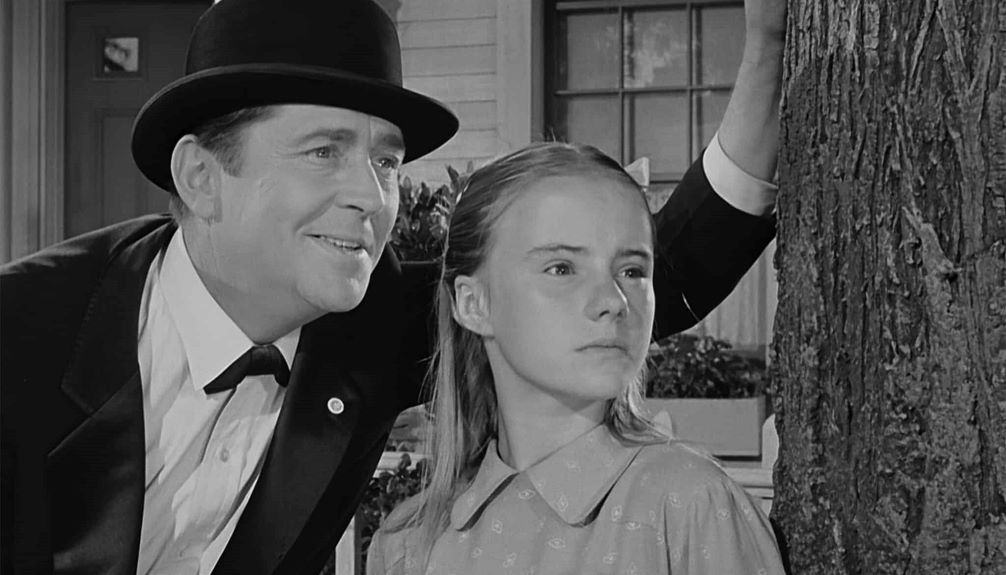
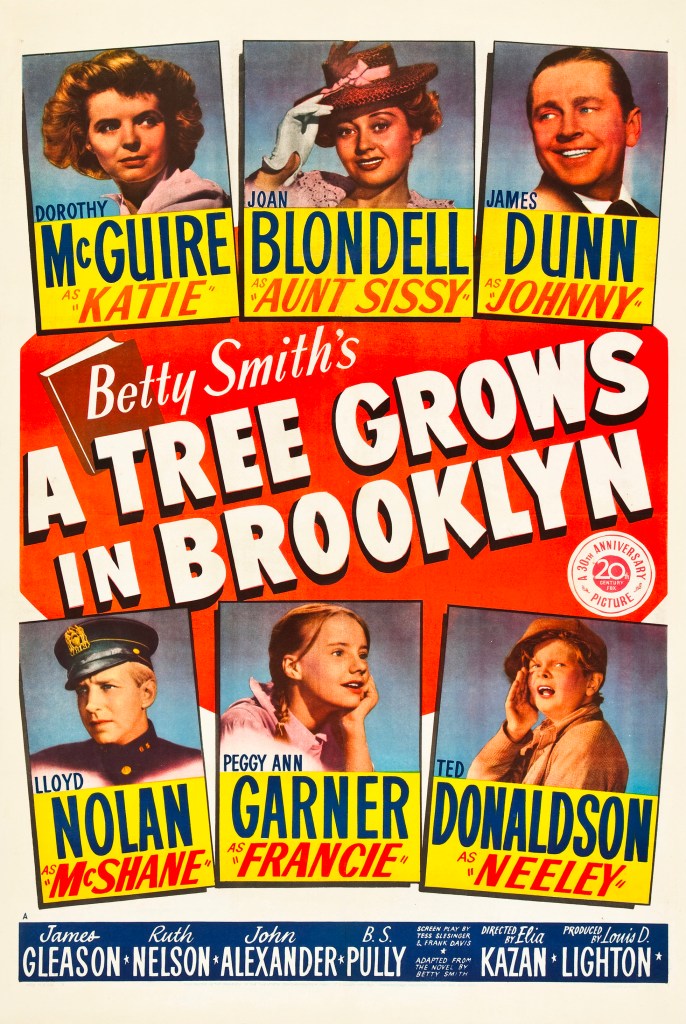
Cast: Peggy Ann Garner (Francie Nolan), Dorothy McGuire (Katie Nolan), Joan Blondell (Aunt Sissy), James Dunn (Johnny Nolan), Lloyd Nolan (Officer McShane), Ted Donaldson (Neeley Nolan), Ruth Nelson (Miss McDonough), John Alexander (Steve Edwards)

In 1912 an Irish-American family, the Nolans, struggle to make ends meet in Brooklyn. Mother Katie (Dorothy McGuire) keeps a close eye on the purse strings to ensure she can keep a roof over the head of her children: 13-year-old Francie (Peggy Ann Garner) and young Neeley (Ted Donaldson). Problem is, Katie also has a third child: her husband Johnny (James Dunn), a happy-go-lucky dreamer and “singing waiter” who is also a hopeless drunk. Johnny, with his “live-your-dreams” outlook on life, natural charm and instinctive understanding of people, is Francie’s idol. With another child on the way, and the Nolan cash reserves at breaking point, can the family hold together?

A Tree Grows in Brooklyn drips with sentimental, old-fashioned, easy-watching charm. Adapted from a best-selling novel by Betty Smith, it strips out most of the plot (which covers nearly 17 years rather than the single one featured here) and considerably waters down the original’s content. (It also, hilariously, avoids any appearance at all of the eponymous tree at the centre of the Nolan tenement block, which is cursorily referenced only twice.) Smith’s book was a semi-auto-biographical chronicle of a life of struggle survived by a daughter who flourishes, but the film is more of an optimistic fable of the triumph of family love.

It feels strange that this is the first film of Elia Kazan, who would become better known for hard-hitting, location-shot, method-tinged dramas rather than the tear-jerking charm here. Kazan was later sceptical about the film – highly critical of what he considered his overly theatrical staging, particularly of the scenes set in the Nolan home – and even at the time stated he was so unsure about what he was doing that the film was effectively co-directed by cinematographer Leon Shamroy. But Kazan’s skill with actors shines through and he invests it with a great deal of pace and emotional truth.

His main benefit is the very strong performances from Garner and Dunn in the film’s most important relationship. Both actors won Oscars (Garner the juvenile Oscar, Dunn for Best Supporting Actor) and it’s the loving meeting of hearts and minds between father and daughter that lies at the film’s heart. Francie is a young girl dedicated to education – slavishly, but obsessively, reading through the local library in alphabetical order, regardless of suitability of the books – who dreams of going to a better school and bettering her life. It’s a dream that her mother struggles to grasp – largely unable to see beyond the immediate needs of putting food on the table – but which her father understands and is desperate to support.

This bond is partly what leads to Francie’s idolising her doting dad. And Johnny is doting. He’ll do things her mother won’t dream of doing – including weaving an elaborate fantasy to win her a place at that better school. He’ll joke and laugh, sing songs and entertain her while indulging her artistic leanings. Unfortunately, he’ll also make promises to reform he won’t keep, stumble home late at night or be found, drunk in the street, having boozed away every penny he’s earned.

Dunn poured a lot of himself into this self-destructive dreamer. A vaudeville comedian who had a successful run of films with Shirley Temple in the 1930s, he had blown most of his fortune in bad investments. By the 1940s was struggling to find work with his drink problem widely known. But he was also charming, decent and kind, but seen to lack the drive to build a successful career. In effect, Johnny was a version of his own life, and Dunn not only nails Johnny’s charm but also laces the performance with a rich vein of sadness, guilt and shame, but still loved by all.

While Johnny jokes and laughs with the neighbours, Katie cleans the hallway of their tenement block to earn extra bucks and moves the family to a smaller room to save what money she can. Played with a fine line in drudgery and put-upon stress by Dorothy McGuire (in a role as thankless as Katie’s life is), Katie remains unappreciated by her daughter (who sees her as a moaner who won’t cut her father a break) and by her husband as being too obsessed with the purse-strings.

The major flaw, for me, of A Tree Grows in Brooklyn is that the film falls almost as uncritically in love with Johnny as Francie. Getting older it’s hard not to see Johnny as essentially irresponsible and selfish, a well-meaning but destructive force on the family, the cause of the poverty which has made Katie crushed, dowdy and increasingly stressed and bitter. She essentially suffers everything – skipping meals, slaving over multiple jobs, saying no to every desire Francie has – while Johnny flies in, cracks jokes, says yes to everything and disappears when its time to work out how to deliver.

A Tree Grows in Brooklyn, however, wants to tell a sentimental story of a father-daughter bond and hasn’t got too much time for Katie – or for making Francie really face the flaws in her father and the virtues of her mother (for all the film gives mother and daughter a late reconciliation). There is something fake about this (tellingly the book gives a sharper realisation for Francie and subtly changes Johnny’s fate to make it less idealised). But all edges are shaved off here and the family divisions are bridged as easily as poverty is eventually solved. (There is also considerable watering down of the liberated lifestyle of Katie’s sister, engagingly played by Joan Blondell).

It makes for a film that’s warm, comforting and essentially light and even a little forgettable. It’s all too easy to drop off in front of it on a Sunday afternoon. Try as you might, you can’t say that about other Kazan films. A little more grit to this would have increased its impact considerably.