Tag: Ryan Gosling

The Fall Guy (2024)

The Fall Guy (2024)

Very enjoyable action caper and also a rather sweet tribute to the unsung heroes of filmmaking

Director: David Leitch

Cast: Ryan Gosling (Colt Seavers), Emily Blunt (Judy Moreno), Aaron Taylor-Johnson (Tom Ryder), Hannah Waddingham (Gail Meyer), Teresa Palmer (Iggy Starr), Stephanie Hsu (Alma Milan), Winston Duke (Dan Tucker), Ben Knight (Dressler)
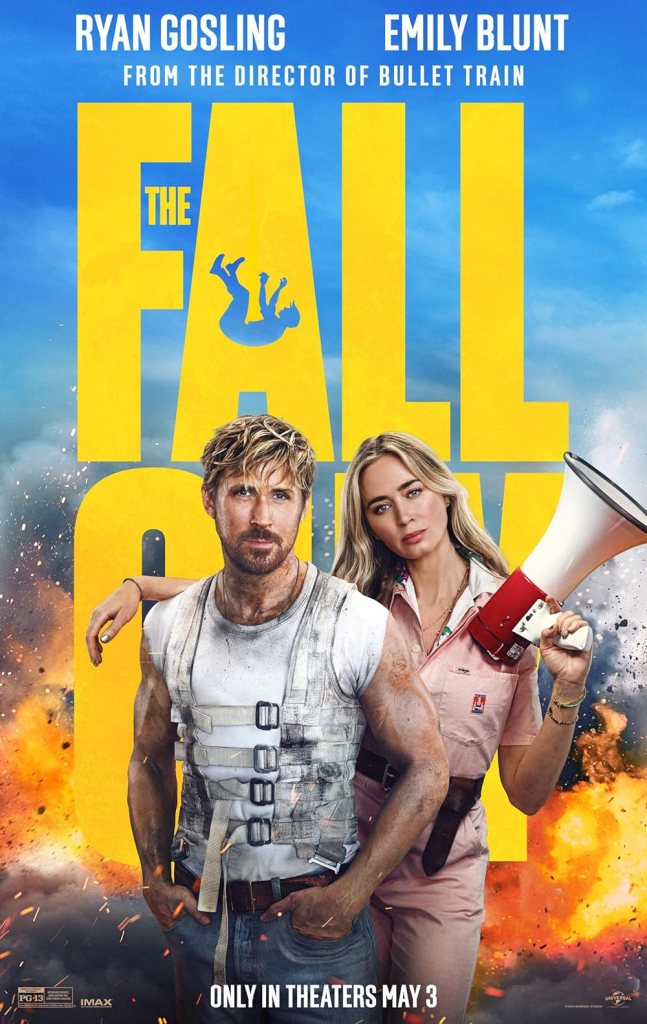
I’ve seen every single Hollywood Superstar I’ve ever heard of perform miraculous acts of derring-do in front of my very eyes. That all happened right? The camera doesn’t lie! Alas what we saw wasn’t the Legendary Star but instead a well-trained guy, dressed in the same costume, putting life and limb on the line for the big shot. And they don’t even get Oscars for it! The Fall Guy is a witty, exciting and rather sweet tribute to the unsung hero of the movies, the stunt guy, all wrapped up in a pulsating, tongue-in-cheek action-adventure that showcases two likeable stars and, of course, their similarly costumed fall guys.

Our hero is Colt Seavers (Ryan Gosling), stuntman of choice for superstar Tom Ryder (Aaron Taylor-Johnson), a spoilt man-child who brags he does his own stunts but can’t cross a road without a double. Colt is riding high, in a promising relationship with cinematographer Jody Moreno (Emily Blunt), until a stunt goes wrong leaving him badly injured. Colt disappears, breaking-up with Jody and wallowing in depression for eighteen months. However, he comes storming back when summoned to Australia by producer Gail Meyer (Hannah Waddingham) who claims Jody personally asked him to double for Tom on her directorial debut, Mad-Max-meets-Independence-Day sci-fi epic Metalstorm. Only turns out she didn’t ask: Colt is in fact tasked by Gail to find the missing Ryder or she’ll be forced to cancel the film and end Judy’s career. Colt soon gets bogged down in drug lords, dead bodies, hitmen who don’t quit and imaginary unicorns. Can he find Ryder and make amends with Judy?

The Fall Guy is fast-paced, loose and funny with a script of punchy Drew Pearce jokes, focused overwhelmingly on giving the viewer a cracking night out at the movies. It leaves very little in the locker room which is fitting for a film is all about celebrating the joy of doing things for real. The Fall Guy pushes the envelope for stunts, be it stupendously high falls, multiple barrel roll cars, furious fisticuffs that use everything going and car chases that leave burnt rubber skid marks on every surface. Basically, it’s a celebration of the art of stunt work, no more than you would expect from Leitch, a former stunt co-ordinator and champion of doing it for real.

It very successfully mixes giddy action thrills with a engaging romantic comedy that uses its two stars to great success. Gosling is relaxed, witty and above all extremely cool, his obvious enjoyment of the material very infectious. Blunt’s comic timing is immaculate. Together their chemistry not only creates plenty of laughs, but makes us invest in wanting them to be together. But The Fall Guy doesn’t just settle for rom-com conventions. A focus of the film is watching Colt get in touch with his feelings (how many other action films feature their stars quietly crying in a car, listening to Taylor Swift?) and accepting his stuntman bravado (it’s the profession where you stick your thumb up at the end of the stunt, regardless what happens) led him to drive Judy away out of twisted shame.

Of course, on the way to getting in touch with his findings, Colt doesn’t half stumble through more than his fair share of brawls. You couldn’t make a film about a stuntman without packing in more death-defying thrills than you can shake a stick at. The Fall Guy delivers two types of stunt thrills. One is the behind-the-scenes on-set stunts Colt executes – death-defying falls, flipping and rolling cars, people being thrown across a field into a rock – where we get to see a few tricks of the trade behind the magic. And then we also get genuine ‘real world’ stunts of epic, popcorn-munching excitement as Colt goes about his search. This is some of the most impressive stuff you’ll see (and its expertly deconstructed in the behind-the-scenes clips that festoon the end-credits), from Colt being hurled and smashed through every inch of Ryder’s apartment to a stunning car-chase that turns into a bare-knuckle dumper-truck fight that’s the film’s mid-act calling card.

The action is somehow even more enjoyable because of the world-weary comedy Ryan Gosling plays it with. After all, being thrown into situations like this is bread-and-butter for Colt, so whether its spending a fight protecting an elusive jet-lag-defeating espresso or working out exactly when he to jump into the road to collide with a car, everything is met with a semi-resigned shrug. He also gets some excellent partners-in-crime, trading stunt-movie facts with colleague Dan (a very funny Winston Duke, shouting the name of the Hollywood stars whose signature moves he’s replicating during fights) and, perhaps best-of-all, a French speaking stunt dog called Jean-Claude who Colt treats like a friend (a dog that bites people in the groin shouldn’t be as funny as this, but I must have been in the right mood). The final battle also sees Colt call on an army of fellow stunt-people.

It makes sense in a film that celebrates this brotherhood. When Colt and the team are working on set, The Fall Guy centralises their creativity and commitment. The shooting of a Metalstorm battle scene is hugely improved by Colt and the team pushing the envelope with suggestions and improvements to the rudimentary script and the whole crew is scrupulously dedicated, professional and committed.

The real threats in The Fall Guy are the things that work against this. Special effects and deep fakes (whch plays into the film’s neat double-meaning title) are the tools of the villains and, in a wider sense, kill the flesh-and-blood of film-making. Hollywood stars and bottom-line Hollywood suits with no respect for the craft are the baddies. Aaron Taylor-Johnson has a lot of fun in a role that parodies almost every star you can think of (Tom Cruise is twice specifically named in the film, as if to stress for the laywers Tom Ryder is not him) while Hannah Waddingham is a smilingly heartless producer, never seen without clutching an oversized diet coke.

The Fall Guy is, above all, a film designed to cheer you up no-end. Crammed with sharp one-liners, expert sight gags and thrilling stunts with a cast having an absolute ball in their roles, it’s the sort of treat that will be remembered long after its slightly disappointing box-office haul has been forgotten.
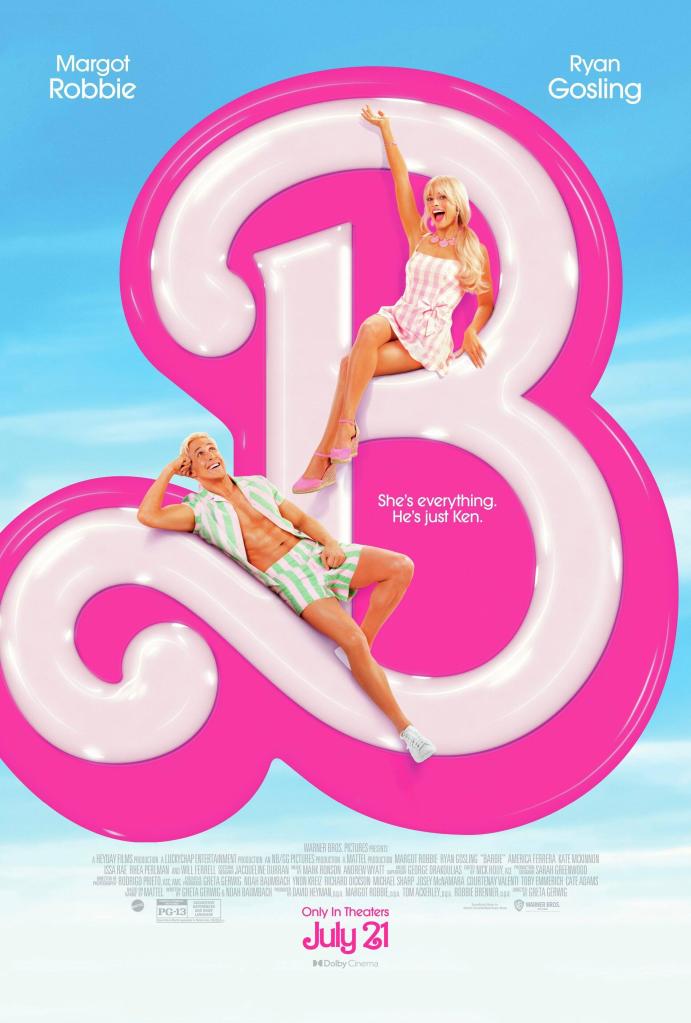
Barbie (2023)

Barbie (2023)

Fabulously pink comedy with serious – and very earnest – things to say on sexism and gender

Director: Greta Gerwig

Cast: Margot Robbie (Barbie), Ryan Gosling (Ken), America Ferrera (Gloria), Will Ferrell (Mattel CEO), Ariana Greenblatt (Sasha), Kate McKinnon (Weird Barbie), Issa Rae (President Barbie), Alexandria Shipp (Writer Barbie), Emma Mackey (Physicist Barbie), Hari Nef (Dr Barbie), Sharon Rooney (Lawyer Barbie), Kingsley Ben-Adir (Basketball Ken), Simu Liu (Tourist Ken), Ncuti Gatwa (Artist Ken), Michael Cera (Alan), Rhea Pearlman (Ruth Handler), Helen Mirren (Narrator)

Who knew that the film which sparked the most conversation in 2023 about the roles of men and women would be one launched by a toy company, with the goal of selling toys? Barbie feels a little like a project happily hijacked. In another world this could have been a straight-forward, Adventures of Barbie flick, designed only to get kids crying out for that Margot Robbie Barbie to be appearing under the Christmas tree. Instead, thanks to the team of Gerwig and Robbie, this is a self-reverential, witty, smart and highly engaging look at gender politics which also manages to be a fun, gag-filled evening out at the cinema.

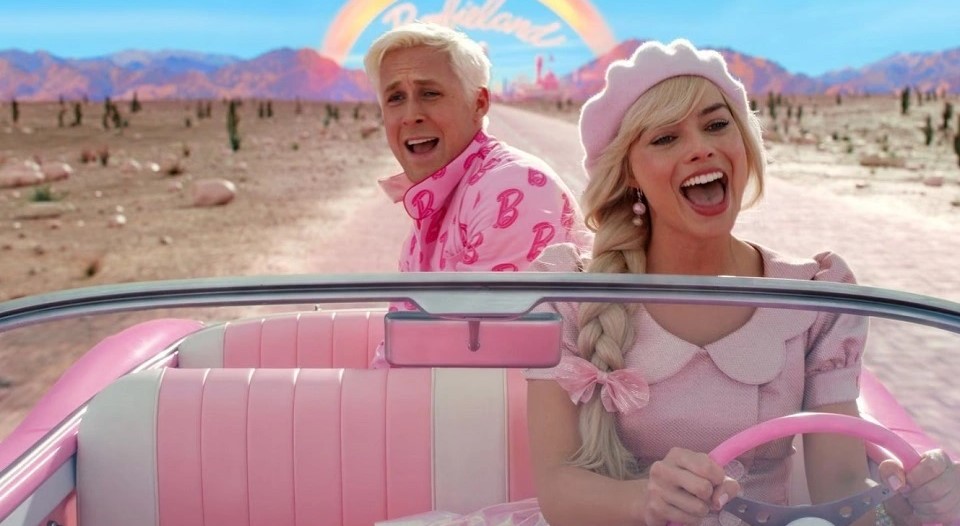
Stereotypical Barbie (Margot Robbie) leads a blissful life in Barbie-Land, where every day is the best day ever. Every Barbie knows they’ve inspired change for the better for women in the Real World. Everything is perfect until one day Barbie starts thinking about Death. Before she knows it, she has flat feet, cellulite and a crisis of confidence. The only way to fix this? A journey to that Real World to meet with the child who’s playing with her. But Barbie and Ken (Ryan Gosling) find the Real World very different from what they expected: all women’s problems are not solved and Ken discovers The Patriarchy, a wonder he is determined to bring back with him to Barbie-Land. Can Barbie save Barbie-Land and help rebuild a relationship between moody teenager Sasha (Ariana Greenblatt) and her mother Gloria (America Ferrera) in the real world?

Barbie’s sharp playfulness mixes heartfelt messages on gender politics with the sort of joyful fish-out-of-water stuff beloved of family films where a naïve figure from our childhoods finds the real world a much harsher, more cynical place than they expected. Barbie’s expects our world to reflect of the female-dominated  Barbie-Land is immediately exploded. Arriving in California, the reaction to an attractive woman roller-skating along a beach is remarkably different to what she’s used to. Wolf whistles, a parade of sexualised comments from construction workers (not a woman among them, to her shock) and a world where nearly all the top jobs are held by men.

Barbie addresses head-on whether a doll can really be an aspirational figure. In a surprisingly complex manner, Gerwig’s film looks at the pros and cons. Teenage Sasha doesn’t think Barbie has shown her world of possibilities, but instead sees her as a puppet of corporate America presenting a veneer of opportunity to women, while pushing them back into a box marked “pretty woman”. (This deadpan tirade provokes one the film’s many laugh-out loud lines as Barbie bemoans she can’t be a fascist as “I don’t control the railways!”.) Barbie may be able to do any job under the sun but this encourages attainment and also piles expectations on young women. If you can be almost anything at all, doesn’t that make it even the obligation to be something even more of a burden?

The real world is also a revelation – in a different way – to Ken. In our world, Ken discovers men (and possibly horses, Ken isn’t sure) rule though a marvellous thing called “the patriarchy”. Watching the Kens become infected by toxic masculinity, becoming high-fiveing bros who down beers, mansplain and call all the shots, is both funny and also a continuation of the film’s earnest exploration of gender politics. You can see, unpleasant as he becomes, that Ken might well want a piece of that action, coming from a world where men are so marginal they don’t even have homes (after all Mattel never made “Ken’s Dream House”). It’s also a neat gag that the other Barbies are easily brain-washed into accepting demeaning Stepfordish roles (dressed almost uniformly as French maids or in bikinis) because the confidence with which the Kens express their rightful place as masters-of-the-universe is literally mesmerising.

It’s also a neat part of Gerwig’s commentary here that the crucial factor to breaking out of this state is all about embracing the pressures of being expected to do it all: of being clever but not a know-it-all, ambitious but not a monster, raising a family but also having a career etc. If Barbie-Land in its beginning is a sort of vision of utopian feminism, then its salvation lies in accepting and embracing the struggle of marrying together a raft of contradictions and expectations. Sure, this isn’t exactly reimagining the wheel and its fairly easily digestible stuff – but it also rings true and you can’t argue with the connection its made with people.

All of which might make you think ­Barbie might be a po-faced political lecture. Fortunately, not the case when every point is filled with laugh-out-loud, irreverent humour expertly delivered by a cast clearly having the time of their lives. They are led by Margot Robbie, sensational in bringing to life a character who begins the film feeling like a doll made flesh and ends it as a three-dimensional character who embraces the contradictions of life. Robbie, who produced and set out much of the film’s agenda, is fabulous – funny, endearing, heartbreakingly vulnerable and extraordinarily sweet, mixing light comedy with genuine moments of pathos.

Equally good is Gosling playing the almost preternaturally stupid Ken with a winning sense of self-mockery, walking a brilliant line presenting a character who is (at times) the nominal villain but also a lost soul. Barbie also employs him and Robbie in some outstanding song-and-dance routines, deliciously performed and exquisitely funny. The other Barbies and Kens are uniformly excellent in their winning mix of initial shallowness and growing emotional depth while America Ferrera and Ariana Greenblatt are immensely winning as a mother and daughter overcoming a divide.

Barbie is also an explosion of delightful design and superb eye-for-detail, in its pitch-perfect recreation of a host of Barbie toys and props in real-life size, all thrown together with the perfect level of pink presentationalism. Drily narrated by an unseen Helen Mirren, every scene has a winning gag or laugh-inducing piece of business, especially when poking fun at the naïve optimism and artificiality of the Barbie world. Saying that, the film stumbles when it blurs the lines in the real world, which is half presented straight, half as a weirdly Wes-Andersonish oddity, particularly in the Mattel building and its corporate board, who are played as even more cartoonish than the actual toys populating Barbie-Land.

Barbie though generally works because it successfully mixes a heartfelt, earnest look at gender politics and the pressures on women with great gags, winning performances and a bouncy sense of off-the-wall fun that ensures nothing gets too serious. From its 2001 style opening, through its pink-led-primary colour settings, to its song-and-dance and larger-than-life-but-grounded performances, it’s a treat and in particular a triumph for its originator, producer and star Margot Robbie.

Drive (2011)

Drive (2011)

Neon, darkness and shades of grey fills the screen in a film that’s practically the definition of cult

Director: Nicholas Winding Refn

Cast Ryan Gosling (Driver), Carey Mulligan (Irene Gabriel), Bryan Cranston (Shannon), Albert Brooks (Bernie Rose), Oscar Isaac (Standard Gabriel), Christina Hendricks (Blanche), Ron Perlman (Nino Paolozzi), Kaden Leos (Benicio Gabriel)

Impassive and supernaturally calm, the Driver (Ryan Gosling) sits with the car engine purring. In this five-minute window he is the get-away driver who will go to any length. Outside of that, criminals are on their own. Its one of the simple rules he lives by. He never compromises. Until, of course, he finds something worth compromising for. That would be his neighbour Irene (Carey Mulligan) and her young son Benicio (Kaden Leos), trying to make ends meet while her husband Standard (Oscar Isaac) is in prison. The Driver helps them – and feels compelled to go on helping them when newly released Standard (trying to go straight) does one more job to get out from under the thumb of his criminal friends. That last job is always the worst one isn’t it? Particularly when crime lords as ruthless as Bernie (Albert Brooks) and Nino (Ron Perlman) are involved.

Drive won Refn the best director award at Cannes (after a huge standing ovation). It’s not hard to see why. This film is so overflowing with style, uncompromising cool and unreadable enigma it was practically a cult classic before it was even released. Layered in a mix of 70s and 80s chic – with its electric pink titles, John Carpenter-ish Los Angeles visuals and counter-culture smarts – it echoes cutting-edge crime drama from the punk years of Hollywood (it’s practically a remake of The Driver for starters!), by way of touches of Melville crime drama and Spaghetti Western anti-hero. Scored to a mix of ambient beats and electronic rock, it’s the dictionary definition of style.

It keeps you on your toes from the start. Its opening not only explores the Driver’s incredible skills (speed, manoeuvring, ingenious evasions and knowing when to go slow, he can do it all) it also sets us up for the whole film. Shot largely alongside the Driver in the car, we zip through streets and understand the determination (and hints of danger) under his impassive surface. That prologue is the whole movie in capsule – a careful wait, a sense of a fuse being list, touches of humour to distract us (the Driver’s precision with his gloves) and brilliant misdirection when his focused  attention to listening to a football game on the radio pays off in spades when we see his plans revealed.

Much of the first 40 minutes carefully develops the Driver’s surprisingly contented life: his happy acquiescence in the racing dreams of his fixer and mechanic boss Shannon (an ingratiating Bryan Cranston), who the Driver likes so much he doesn’t care that Shannon regularly swindles him; a soft, unspoken half-romance with Irene (Carey Mulligan, truthful and with a strength beneath the vulnerability); and a big-brother bond with her son Benecio. In another world this could have been a film where a loner learns to make a connection and finds love.

But it ain’t that film. The troubles start with Standard’s release from prison. Skilfully played by Oscar Isaac as well-meaning but essentially hopeless, Standard’s problems become Irene and Benecio’s problems. That one last job goes south – as they always do – in an orgy of cross, double cross and increasingly graphic violence. And the burning propulsive energy that lies under Drive, just like that purring engine in the films opening, is let rip.

What we get in the second half is dark, nihilistic and violent. Oh, good Lord, is it violent. Bone crunchingly, skull shatteringly, blood spurtingly violent. Because when gangsters get pissed off, they play for real. And it turns out, when the Driver finds something to care about, he plays for real as well. Refn’s eye for violence is extremely well-judged. We see just enough for it to be horrifying, but the worst is done via sound and editing (the Driver’s almost unwatchable assault on a goon in a lift puts almost nothing on screen, but the squelches and crunches on the soundtrack leave nothing to the imagination).

Refn’s trick is to combine lashings of indie cool and ultra-violence with a deceptively simple story that allows plenty of scope for interpretation. Drive has a sort of mythic, Arthurian quest to it, with the Driver as a sort of knight errant, defending a damsel in distress. But it’s also a grim crime drama, with a man at its centre who brutally kills without a second thought. This all depends on the enigmatic Driver at its heart. No other actor alive can do unreadable impassivity like Ryan Gosling – this could almost be his signature role. He’s ice-cool and professional, but also rather child-like and gentle.

Is he a guy dragged down by his own worst impulses? His jacket has a large scorpion on its back, echoing the old fable of the frog and the scorpion. Rather than one or the other, the Driver feels like both in one. A frog who wants to carry everyone over the river, but whose poor instincts and capacity for violence acts as the scorpion that destroys him. Where does he come from? What is his past? The film ends with a series of enigmatic shots that, to my eyes, suggest a supernatural quality to him. I sometimes toy with the idea he’s a sort of fallen angel, constantly protecting the wrong people like he has a scorpion curse on him. Refn’s gift is to craft pulp with psychological intrigue.

Drive is a very cool film – and Carey Mulligan and Ryan Gosling’s careful playing gives it a lot of heart, just as Albert Brooks’ marvellously dangerous gangster gives it a sharp, unpredictable edge. It rips its eye through the screen, with pace, speed and iconic imagery, all splashed with a pop art cool. But it’s not just a celebration of style: it’s also a dark romance, a tragedy and an exploration of a character who may be his own devil or may not even be human at all. Either way, its intriguing and exciting. Can’t ask for much more than that.

The Big Short (2015)

The Big Short (2015)

An all-star cast juggle dollars, acronyms and lots of shouting in McKay’s smart but heartless film

Director: Adam McKay

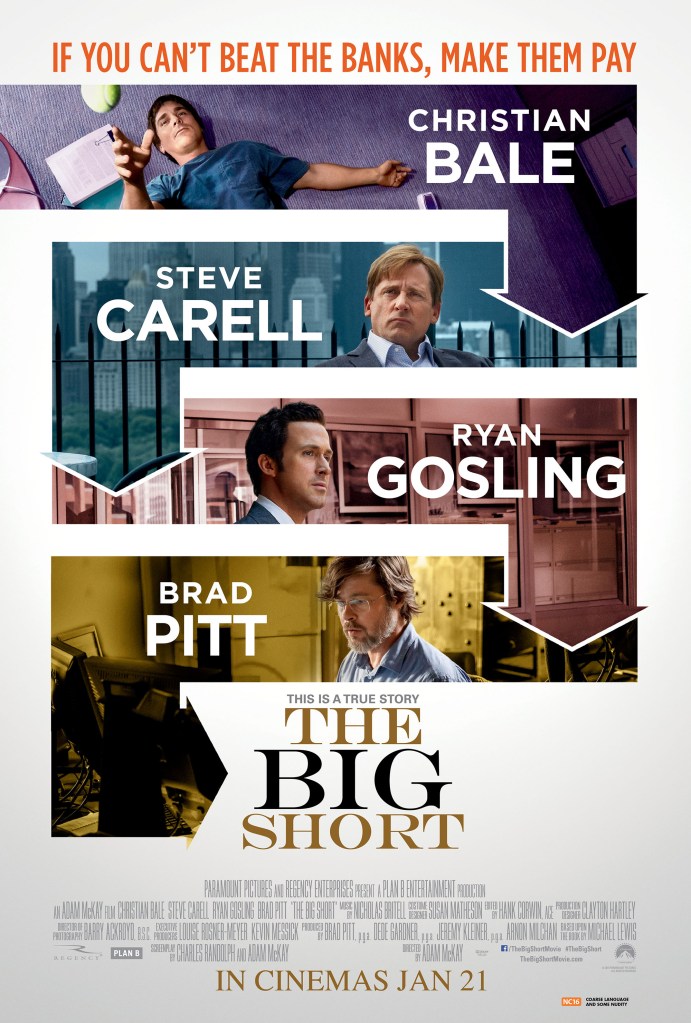
Cast: Christian Bale (Michael Burry), Steve Carell (Mark Baum), Ryan Gosling (Jared Vennett), Brad Pitt (Ben Rickert), John Magure (Charlie Geller), Finn Wittrock (Jamie Shipley), Hamish Linklater (Porter Collins), Rafe Spall (Danny Moses), Jeremy Strong (Vinny Daniel), Marisa Tomei (Cynthia Baum), Tracy Letts (Lawrence Fields), Melissa Leo (Georgia Hale), Karen Gillan (Evie)

We all experienced the financial crisis of 2007 but very few of us actually understood it: above all, perhaps, what the hell actually happened and why. That’s what McKay’s film – somewhere between drama, satire, black comedy and tongue-in-cheek infomercial – tries to resolve. Adapting a book by leading financial journalist Michael Lewis, The Big Short charts the whys and wherefores of the collapse, by focusing on the money men who saw the signs of the impending crash and bet against the booming economy.

Those men (and they are all men of course) are played by a series of actors enjoying themselves thoroughly playing larger-than-life characters who it’s never entirely clear if we are supposed to empathise with, sympathise with, cheer on or stand aghast at while they make fortunes from the ruin of others. I’m not sure the film does either though.

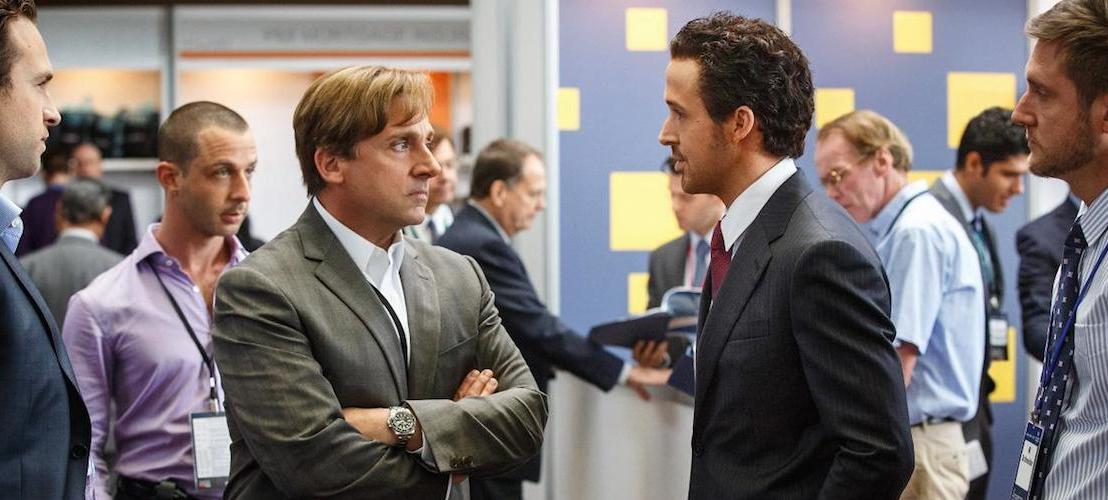
Christian Bale is the eccentric hedge fund manager whose analysis predicts the crash and takes eye-watering investment charges that will pay off thousands of times over when the crash comes. Ryan Gosling is a banking executive who understands that analysis and robs in Steve Carrell’s hedge fund manager to similarly invest to cash in (Carrell’s character, for all his misanthropic oddness is the only one truly outraged at the corruption in the system that will lead to the collapse). Brad Pitt is the retired trader roped in for “one more job” by young traders Finn Wittrock and John Magure to make their own bets against the house. They too will eventually realise the huge impact this will have on people – but are powerless to get anyone to listen as they try and warn against the pending disaster.

McKay’s film, with its tightly-controlled but surprisingly effective off-the-cuff feel (it’s stuffed with neatly edited jokes, straight to camera addresses and a constant running commentary from the characters on the accuracy – or otherwise –  of outlandish moments), may sometimes have the air of a slightly smug student film, but what it does well is explain the financials. If you were unsure about what CDOs, AAA ratings, Quants, credit default swops and sup-prime mortgage were before the start, you’ll have a much better idea later. Neat inventions describe this: from narration, to graphics, to Jenga blocks to famous people (Margot Robbie, Anthony Bourdain and Selena Gomez among others) popping up to glamorously put things in other contexts.

The Big Short does this sort of thing rather well. Sure, it’s got a “lads” feeling to it – there is no “for the girls” equivalent to Margot Robbie in a bath explaining sub-prime mortgages – and the entire dialogue and pace of the film has a frat-house wildness that I suppose does reflect the tone of many of these financial institutions, which were little better than sausage parties. But it presents its ideas nicely and has some good jokes. The verité style McKay goes for is more studied than it natural – and it’s hard not to escape the feeling that the film is very, very pleased with itself, so much so that it’s not a surprise both his follow-up films the dreadful Vice and the shrill Don’t Look Up double down to various degrees on the slightly smug, self-satisfied liberalism here that sees those in power as corrupt, greedy, fools or all three and everyone else as innocent victims.

Where the film is less certain is exactly how it feels about its central characters. In other words, it doesn’t always turn the same critical eye on these people profiting from a disaster that will lead to millions losing their homes (the millions are represented by a single immigrant family). Brad Pitt may reprove his young charges from celebrating gains that will be the losses of millions of others. Steve Carrell gets several lines berating the callous, short-sighted greed of the banks. Christian Bale’s character is appalled by the “you scratch my back, I’ll scratch yours” relationship between banks, investment ratings agencies and insurance companies, all working together to keep artificial profits up. But the film still wants us to celebrate as these plucky outsiders and weirdoes clean out the house and carry home cartloads of cash while the casino burns down.

Basically, the film is all good fun but gives us little to actually care about. It’s highly influenced by the gonzo macho representation of this world Martin Scorsese’s The Wolf of Wall Street gave us, but far less skilled than that film in presenting its players as the childish, amoral vacuums they are. Furthermore, it does far less to really look at the impact of what it’s doing: in fact, it spends so long delighting in how it tells the story, it doesn’t show us what happens. It dwells at the end on abandoned trading floors and closed banks, like the fall of the Roman Empire, but finds no time at any point to hear from a real person who lost their home.

Perhaps because the real impacts are too depressing – and would have made it impossible to feel the triumphal buzz the film wants from seeing its heroes vindicated and the smug assholes we’ve seen from the banks get egg on their face. It might have felt a lot less funny if we had seen even a closing montage of the real victims and the human impact.

It’s where The Big Short falls down and why it feels in the end like a student film made on a huge budget. It nods its head at real mature themes but actually isn’t really interested in them at all.

First Man (2018)

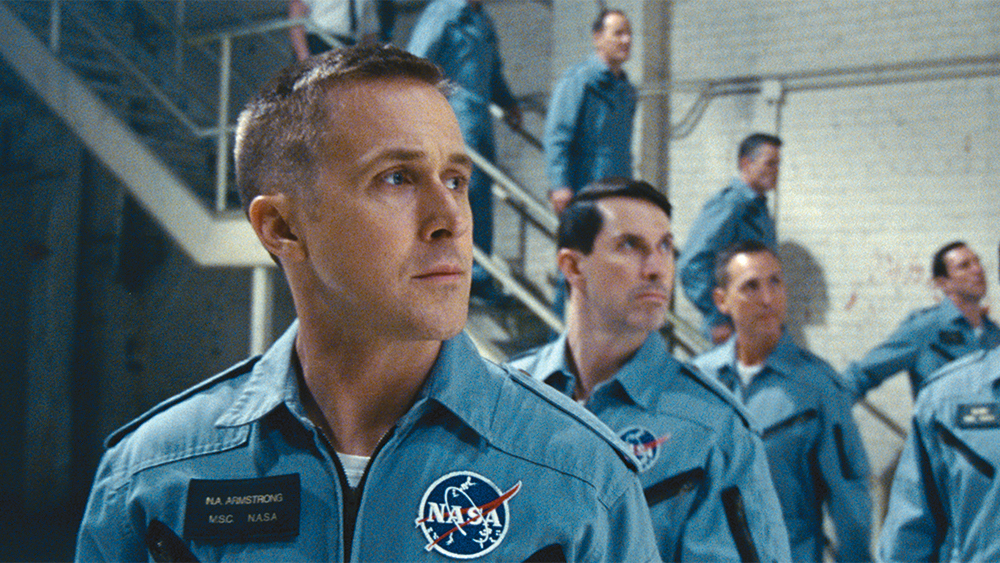
Ryan Gosling as an unreadable Neil Armstrong in the engrossing but cold First Man

Director: Damien Chazelle

Cast: Ryan Gosling (Neil Armstrong), Claire Foy (Janet Armstrong), Jason Clarke (Ed White), Kyle Chandler (Deke Slayton), Corey Stoll (Buzz Aldrin), Pablo Schreiber (Jim Lovell), Christopher Abbott (David Scott), Patrick Fugit (Elliot See), Lukas Haas (Michael Collins), Shea Whigham (Gus Grissom), Brian d’Arcy James (Joseph Walker), Cory Michael Smith (Roger Chaffee), Ciaran Hinds (Robert R Gilruth)

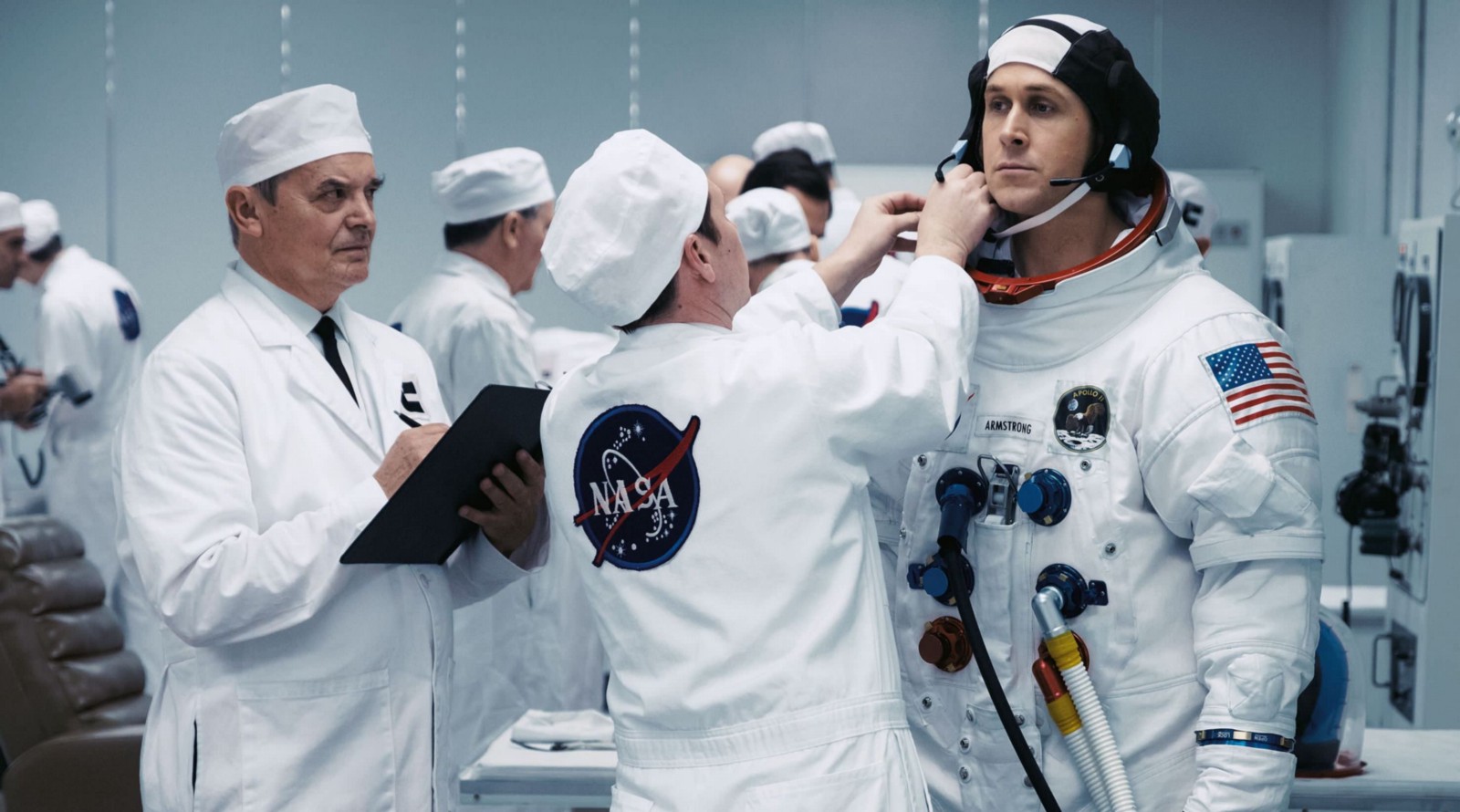
About halfway through this film, it struck me: Neil Armstrong is a not particularly interesting man who experienced the most interesting thing ever. It’s a problem that First Man, an otherwise exemplary film, struggles with: Armstrong himself, put bluntly, is unknowable, undefinable and, in the end, an enigma I’m not sure there is much to unwrap. Which is not to detract one iota from Armstrong’s amazing achievements, or his legendary calmness under pressure or his courage and perseverance. It just doesn’t always make for good storytelling.

First Man charts the years 1961-1969. During these years of professional triumph, Armstrong has success as test pilot, an astronaut on the Gemini programme (including command of Gemini 8, carrying out the first docking in space then saving his own life and the life of his pilot with his quick thinking when the mission nearly encounters disaster) and then the Apollo programme and his own first steps upon the moon. But Armstrong’s life is dogged by loss and tragedy, first his five-year old daughter to cancer, then a string of friends in accidents during the hazardous early days of the NASA space programme, including the deaths of Gus Grissom, Ed White and Roger Chaffee in the Apollo 1 fire. Armstrong becomes a man burdened with these losses.

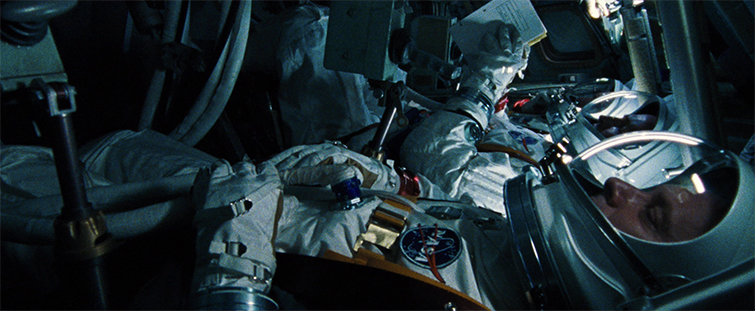
There is very little to fault in the making of First Man – in fact it’s further evidence that Chazelle is a gifted filmmaker with a glittering future of great movies ahead. There are two things this film absolutely nails: the supreme majesty and awe of space and the terrifyingly rickety nature of the spacecraft we send men up into it in. 

Helped hugely by a superb score by Justin Hurwitz, which makes extensive and beautiful use of a theremin, the film captures the sense of mankind’s smallness, our vulnerability, in the face of the overwhelming vastness of space. Mixing goose-bump inducing wailing solos with orchestral sweep, and encapsulating the feeling of how small and lonely man in space is, the score goes a long way to match up with the visuals in creating a sense of space. The Oscar-winning visual effects – mixing computer graphics with some ingenious practical effects – never intrude but bring out the gritty reality of tin cans in space. 

Chazelle also really understands the impact of being so far beyond anything we can imagine, and his moon landing sequence is a thing of beauty. He expertly uses a number of close ups in the confined, claustrophobic campaign and largely eschews exterior shots (most of which only use the perspective of the crew’s view from the tiny windows, or of the cameras mounted on the side of the spacecraft). The moon landing follows suit, as we are thrown in alongside Armstrong and Aldrin as the lunar landing module takes its place on the moon – until the hatch opens with a whoosh of air (and sound) escaping the picture. And with that whoosh, the camera flies out of the hatch and switches – in an astonishing visual trick – from wide screen to IMAX shot to give us our first view of the vastness of space filling the frame. Suddenly, space fills the entire screen and the shocking beauty of the moon is a beautiful touch. We get as close as we can visually to experiencing the switch for Armstrong from confined spaces and beeping switches to vast panoramas and all-consuming silence.

And we really feel the switch, because Chazelle has so completely immersed us into the dangers and insecurities of the space programme. The spacecraft are repeatedly shown as alarmingly shaky, screwed together (the camera frequently pans along lines of bolts inside the cabins), thin, tiny, vulnerable capsules that shake, groan, whine and seem barely able to survive the stresses and strains they are put under. Any doubts about the risks the astronauts are under are dispelled in the opening sequence when Armstrong’s X-15 rocket twice bounces off the atmosphere and the internal cockpit around him glows orange under the extreme heat. But it’s the same on every flight we see – these craft don’t look safe enough for a short hop to the Isle of Wight, let alone hundreds of thousands of miles to the moon and back.

And that’s clear as well from the danger that lurks around every corner of the space programme. Death is a constant companion for these pilots and can come at any time. Armstrong himself escapes only due to a combination of luck and skill. When luck disappears, death follows swiftly for many of his co-pilots. Off-screen crashes claim the lives of three of his friends. Chazelle sensitively handles the horrifying Apollo 1 fire (news reaches Armstrong of the death of several friends, including his closest Ed White, while wining and dining politicians at the White House), and the terrible cost of this tragedy hangs over every single second of the moon programme. Fate or chance at any moment could claim lives. This grim air of mortality hangs over the whole film, a melancholic reminder of the cost of going further and faster to expand mankind’s horizons.

This grief also runs through Armstrong’s life and shapes him into the man he becomes. The death of Armstrong’s daughter at the start of the film sets the tone – the shocking loss of a child at such a young age is tangible – and it seems (in the film) as if this was the moment that led to Armstrong hardening himself against the world. He weeps uncontrollably at the death of his daughter, but later deaths are met with stoic coolness. Armstrong in this film is a cool enigma, who by the end of the film treats concerned questions from his children about whether he will return alive from the moon mission with the same detachment he shows at the official NASA press conference. “We have every confidence in the mission” he tells these two pre-teens, “Any further questions?”

It’s the film’s main problem that in making Armstrong such an unreadable man, who buttons up and represses all emotion, that it also drains some of the drama and human interest from the story. While you can respect Armstrong’s professionalism and coolness under pressure, his icy unrelatability makes him hard to really root for over the course of two hours. The film also strangely only sketches in the vaguest of personalities for the other astronauts (Aldrin gets the most screentime, but is presented as an arrogant, insensitive blowhard) so we hardly feel the loss of the deaths. Its part of the attitude towards Armstrong as a man chiselled from marble, so lofty that the film doesn’t dare to really delve inside his own inner world or feelings but builds a careful front around him to avoid analysis.

It’s not helped by Ryan Gosling, whose skill for blankness makes him somewhat miscast here. Try as he might, he can’t suggest a deeper world of emotional torment below the calm surface, no matter how soulful his eyes. It’s a role you feel needed a British actor, who could really understand this culture of repressed stiff-upper-lipness. Indeed Claire Foy fares much better as his patient, loyal wife who holds her composure (more or less) for the whole film under the same pressures of grief as Armstrong. Gosling just can’t communicate this inner depth, and his blankness eventually begins to crush the film and our investment in its lead character.

First Man in almost every other respect is a great piece of film-making and another sign of Chazelle’s brilliance. But it’s never as dramatic as you feel it should be. Armstrong’s life doesn’t carry enough event outside his moon landing experience, and the film can’t make an emotional connection with the man, for all the loss and suffering it shows for him. For a film that is so close to so perfect on space and the Apollo programme it’s a shame – but makes this more a brilliant dramatized documentary than perhaps a drama.

Blade Runner 2049 (2017)


Ryan Gosling does a man’s job filling some difficult shoes in Blade Runner 2049

Director:  Denis Villeneuve

Cast: Ryan Gosling (Officer K), Harrison Ford (Rick Deckard), Ana da Armas (Joi), Sylvia Hoeks (Luv), Robin Wright (Lt. Joshi), Mackenzie Davis (Mariette), Carla Juri (Dr Ana Stelline), Lennie James (Mr Cotton), Dave Bautista (Sapper Morton), Jared Leto (Niander Wallace), Barkhad Abdi (Doc Badger), Edward James Olmos (Gaff), Sean Young (Rachael)

SPOILERS: It’s pretty much impossible to discuss Blade Runner 2049 without revealing some of the workings of the plot. Since the film makers have gone out of the way to say “don’t reveal any of the plot” I thought it fair to say I’ll discuss some things fairly freely here. So you’ve been warned!

Making a sequel is a risky business at the best of times. Then imagine making a sequel to a film that is not just a cultural and artistic landmark film but one people genuinely love. The possibility of creating a massive disappointment? Pretty big. You need some guts to take that on – like announcing you are making Gone with the Wind: Blown Away or Casablanca: Everyone Back to Rick’s. That’s the sort of challenge for the makers of the long-awaited Blade Runner sequel. Could they make something that both complemented and expanded on the original?

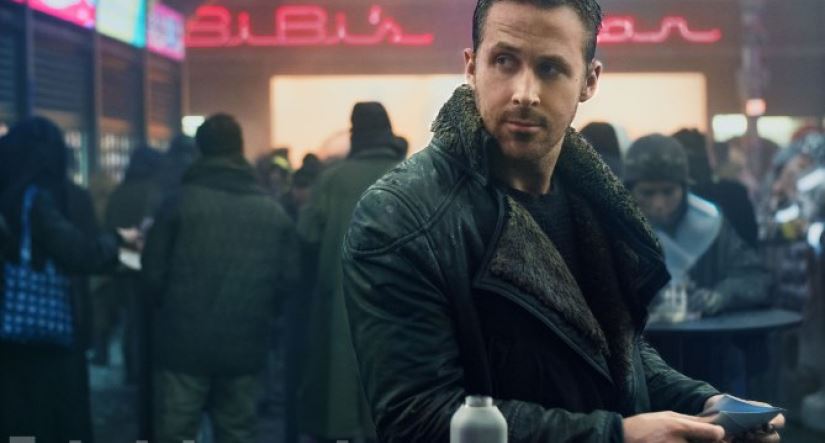
The year is 2049 (of course!). K (Ryan Gosling) is a Blade Runner with the task of hunting down long-lived Nexus-8 replicants – the twist being (and its revealed in the opening minutes of the film!) that K himself is a replicant, a more obedient Nexus-9 model. After “retiring” aged replicant farmer Sapper Morton (a career best Dave Bautista), K locates the buried remains of a female replicant who died after an emergency caesarean section. Terrified that replicants may be developing the ability to reproduce, K’s superiors order him to “retire” the child and all who know of it. As K investigates, his loyalties become ever more divided – while sinister corporate genius Niander Wallace (Jared Leto) and his Nexus-9 hit-woman Luv (Sylvia Hoeks) have their own plans for the replicant child.

So the big question is, does Blade Runner 2049 succeed? The answer is a firm and reassuring yes. The big issue is, does the existence of this film affect (or even ruin) the previous film? Blade Runner 2049 not only complements the original, it builds on and expands its themes, and poses far more questions than answers. In some ways it’s even more profound and searching than the original – arguably it engages with ideas and concepts even more overtly (and richly). If your concern going into this film was it would end any discussion about whether Deckard is a replicant or not, then have no fears – the question remains as open as ever (and works either way for this story).

Even more than the original, this film tackles what it means to be human and how we define humanity by the ability to express emotions and empathy. It comes at this from a different stand-point from Blade Runner by removing any doubt about our hero’s nature. What is more, he is a replicant deliberately designed to be more obedient than earlier models. A cool, minimalist actor with a mastery of small expressions, Ryan Gosling is almost perfectly cast as the quiet K, developing deep yearnings to be more than what he is. The entire film revolves around this question of how capable K is not only of forming emotions, but of making his own choices.

The ability to live freely and choose is at the heart of the conundrums for all our characters. To what extent are they able to do this? K goes about his work of dispatching fellow replicants with a quiet reluctance, but does his duty nevertheless. But he is a character yearning to be “more” – and what, in many ways, is more human than that? The film taps into this expertly with K’s belief that maybe he himself is replicant child. The film’s mantra is about choosing what we live and what we die for and, regardless of who or what we are, being able to do this is what makes us “more”.

In a film stuffed to the gills with replicants and other artificial characters, we are constantly asked to address and question how far each of them goes towards achieving “humanity”. Just as with Blade Runner, the only two definitely human characters (Niander Wallace and Lt Joshi) are strangely distant, hard to read or even cruel authoritarian figures, making a damn bad case for real humans.

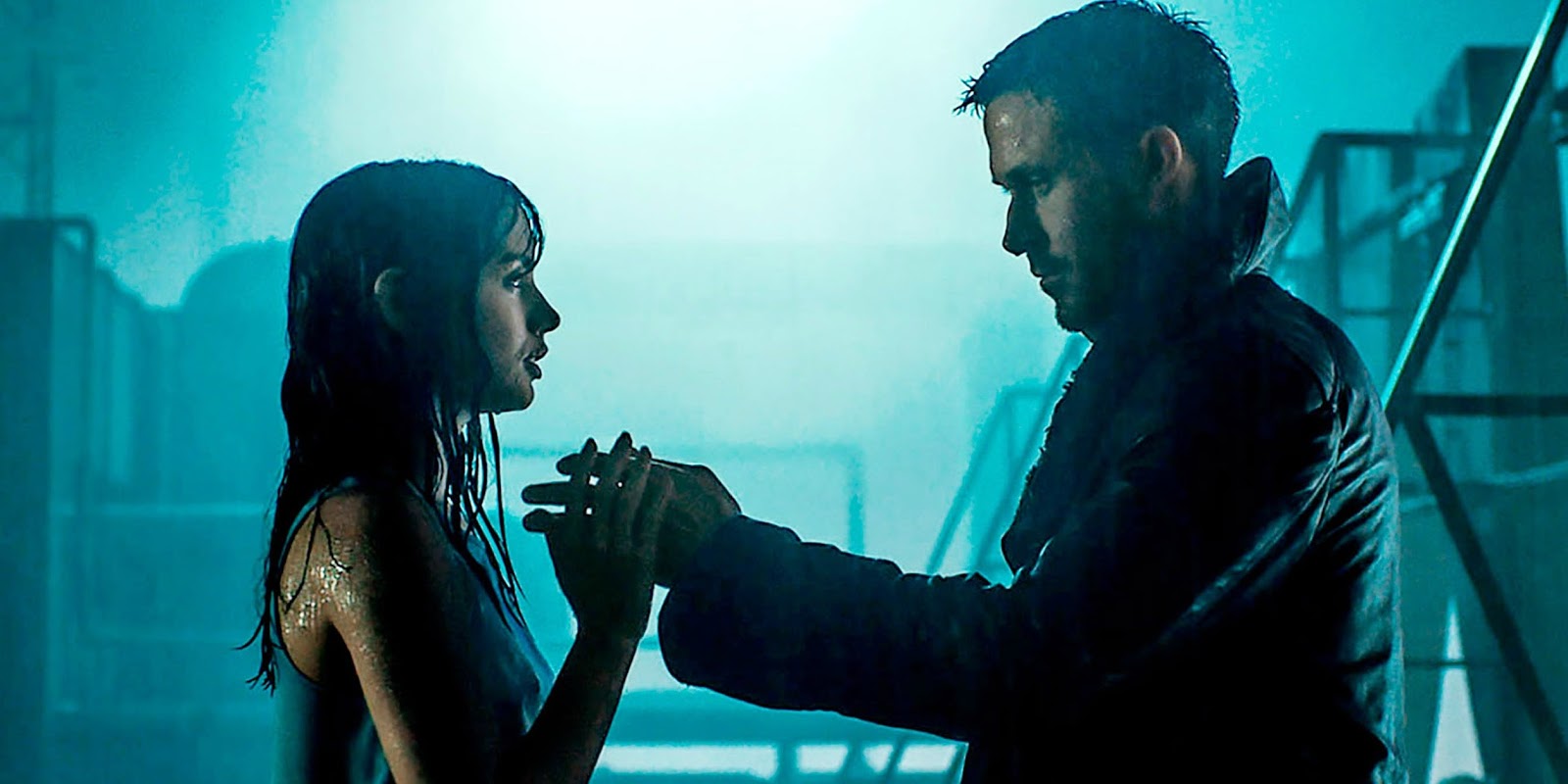
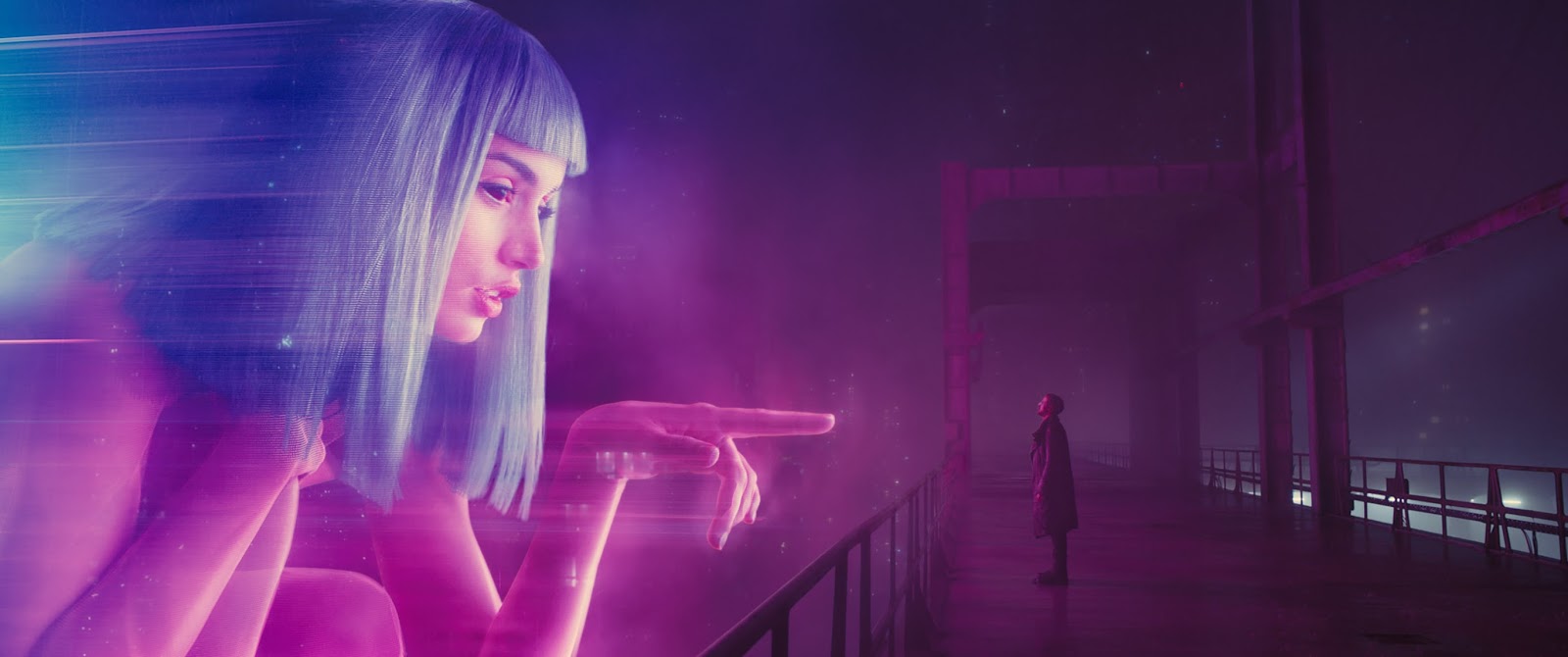
Joi (brilliantly played by Ana de Armas), K’s girlfriend, is a warm, caring, loving woman – but she’s also a hologram, designed to be the perfect companion. K and she go to great lengths to protect and care for each other over the film – and her final fate is a deeply moving moment. But Joi is a computer programme – and a late sequence in the film where K interacts sadly with a looming holographic advert of another Joi that repeats many of her phrases in a disconnected style casts a sad light on all their previous interactions. Every time Joi said anything with love or affection to K, was this just a computer reflecting back what her owner wanted to hear?

It’s not a great surprise to say K does eventually learn to make his own choices and to decide his own fate. In many ways this is a fable of growing up – K accepting his limitations while forging his own destiny – but it makes a contrast with other replicants. While the older models form their own resistance, K’s counterpart Luv (an imposing Sylvia Huks) can’t or won’t break free of following Wallace’s commands. There are more than a few hints Luv is not always happy with the duties she is asked to perform (at one point she weeps quietly as a replicant is dispatched). But at others, she’s clearly striving as much as K to be “special” – she triumphantly repeats a mantra to herself about being the best, like a daughter trying to impress her father.

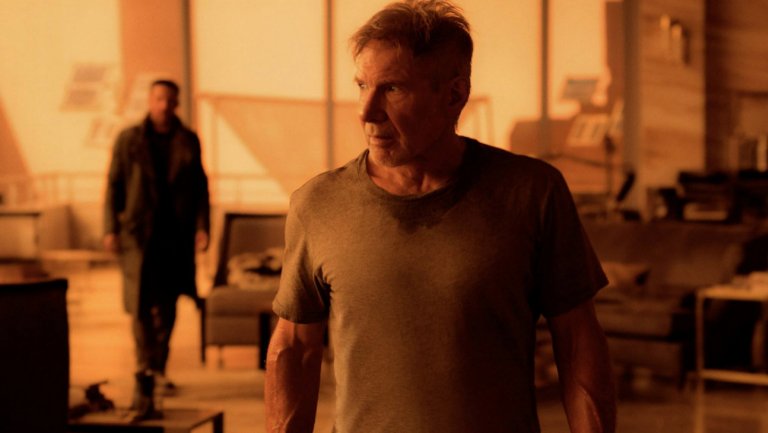
These new characters offer such diverse and exciting story-telling opportunities, you almost don’t notice that Deckard doesn’t appear in the film until nearly the third act. Harrison Ford may have been slightly uncomfortable in the original – but he fully understands the more assured, confident Deckard in this film, who has made his peace with leaving the world behind. Ford gives this new Deckard an almost Han Solo-ish shoot-first swagger, but mixes it with a world-weary sadness. I’d go so far as to say he’s actually better in this film than the first one.

Which is a further testament to the strength of this film. All the themes and ideas of the original are used as bouncing-off points for further exploration. This never feels like a retread, reboot or remake – it feels like a rich and rewarding piece of intelligent sci-fi by itself. I actually feel it could be watched independently of the first film, and still have plenty to offer. It’s not interesting in tying the first film up in a bow – instead it serves as a stimulus for future discussion. You could imagine a sequel to this film sustaining enough interest for 35 years.

Technically of course the film is an absolute marvel. Roger Deakins’ photography is gorgeous, capturing every element of this dystopian nightmare world in a series of brilliant images, in turns drained, bleached and sun kissed. Every frame is artfully composed for maximum impact. The production design is similarly magnificent, Dennis Gassner’s work melding the world of the original, with its steam-punk look, with a mix of technological developments. The score by Hans Zimmer and Benjamin Wallfisch is similarly perfect, giving the film a brooding intensity.

But most of this artistry comes back to the film-making mastery of Denis Villeneuve, a director so gifted I think he may be more interesting than Ridley Scott. His control of the pace of the film is brilliant – despite being very long, it never drags – and he shoots every scene with a careful, intellectually engaged brilliance. He is able – possibly even more than the original – to mix emotion and elliptical theorising, and to draw a raft of brilliant performances from an outstanding cast. More than anything else, he treats the audience with respect, giving them a measured and thoughtful film that trusts we have patience. Villeneuve tops Arrival here, and does so with confident aplomb.

Blade Runner 2049 is a film that demands to be seen more than once. It’s a patient and intensely thoughtful piece of science fiction, that asks profound questions about humanity and the characters in it. I don’t really feel from one viewing I’ve got a grip on it – in fact the more I think about it, the more its haunting, elegiac quality starts cramming into my head. You need to be patient and go with it – you need to be in the right mindset for this slowburn concept film. But, get in that mindset and this film is constantly rewarding. If you want to criticise something, I will acknowledge that many of the female characters are a little more clichéd (most are prostitutes or similar) – but this world where many women seem to be in subservient roles to men is in many ways an extension of the world created in the original film (and now an expression of the dystopian future).

However this is a great film. A really great piece of adult science-fiction. I’ll go out on a limb and suggest it is better than the original film.

The Ides of March (2011)


George Clooney is a Presidential candidate with feet of clay in this bitter indictment of American politics

Director: George Clooney

Cast: Ryan Gosling (Stephen Meyers), George Clooney (Governor Mike Morris), Evan Rachel Wood (Molly Stearns), Philip Seymour Hoffman (Paul Zara), Paul Giamatti (Tom Duffy), Marisa Tomei (Ida Horowicz), Jeffrey Wright (Senator Franklin Thompson), Jennifer Ehle (Cindy Morris), Gregory Itzin (Jack Stearns), Max Minghella (Ben Harpen)

Stephen Meyers (Ryan Gosling) is an ambitious young political advisor on the presidential campaign of Governor Mike Morris (George Clooney). However, scandal bubbles under the surface of the campaign and Meyers finds himself a pawn in the power struggles between his boss Paul (Philip Seymour Hoffman) and the rival campaign manager Tom (Paul GIamatti), as well as increasingly drawn to a young intern Molly (Evan Rachel Wood) with a secret.

Like some of the work of the current crop of actor-directors (Clooney and Affleck being the prime examples) this feels like a thematic remake of classic (better) films from the 1970s, in this case Robert Redford’s classic The Candidate. Like that film, this one explores a politician whose dynamism, photogenic appeal and liberalism hide feet of clay. The film takes a supremely cynical view of modern politics, presenting a world where even idealists will (when push comes to shove) do anything to assure their position because they believe that only they can deliver the change the country needs. As Rich Hall said in the build-up to the most recent election, it takes a special kind of ego to say “I’ve looked at this countries problems and what you need to solve them is me”.

To get this idea across a bit more, it probably would have helped to get more sense of what Morris (and his rival Pullman) stands for. The film tries to get round this with the shorthand of casting Clooney as Morris: we all know Gorgeous George is a Good Thing (although I’d also add that Clooney’s smoothly groomed, almost too-perfect good looks give him plausibility as a character drenched in hypocrisy behind his charismatic smirk). Instead we have to take it for granted, from his appearance and few phrases about green politics and job creation, that Morris is a Kennedy-like force for change. The film rather weights the decks by presenting no-one in this political game as being truly idealistic or in it for any other reason than personal gain or the thrill of the game – even Morris, a force for the film argues good, is shown to be totally hypocritical and devoid of personal empathy, believing that any means are justified by the end.

Gosling’s Stephen Meyers is the heart of the film, and it’s his growing corruption the film charts. Meyers starts as a slightly uneasy mix of professional politician, cynical about the media and the public, and idealist eager to change the country for the better. Gosling’s performance is the embodiment of the struggle between these good and bad angels, and Gosling has the right balance of naivety and ruthless careerism in his looks to capture this. Having seen this film once before, I actually found it more rewarding this time: Meyers is a cynic who wants to be an idealist.

Slightly less clear, however, is Evan Rachel Wood’s role as an intern. I don’t think it’s much of a spoiler to say her role is largely a tragic one – but the film never quite shapes her as a real person. She’s a model of the intelligent, sexy young woman, more of a collection of beats than a real person (however winningly Wood plays her). Her eventual tragedy is something that happens rather than something that feels like it happens to her – and the story is about the effect this has on the male characters around her rather than what it might have meant for her. She’s a well designed plot device rather than a person.

The film does have an interesting stance on politics – even if it already feels outdated in our new Trumpian, post-truth days. Hoffman and Giamatti do good work as contrasting political fixers at opposite ends of the idealist and cynic spectrum. The vision of politics has something designed to support news cycles rather than to serve the people feels like it has more than some truth behind it. It’s not a masterpiece by any stretch of the imagination, but it’s well made and has some brains behind it. And it does actually grow better on a second viewing.

La La Land (2016)

Emma Stone and Ryan Gosling literally dance the night away

Director: Damien Chazelle
Cast: Ryan Gosling (Sebastian Wilder), Emma Stone (Mia Dolan), John Legend (Keith), Rosemarie DeWitt (Laura Wilder), Finn Wittrock (Greg Earnest), JK Simmons (Bill) 

WARNING: SPOILERS AHEAD!

Okay this review will discuss the plot of the film in some detail, including the ending so if you want to avoid hearing more(and I think the film is best enjoyed as an experience if you don’t know what happens at all) don’t read on.

A sweeping camera carries us over a freeway. The drivers honk horns and impatiently stare at the gridlock. Then the camera hones in one woman who starts to sing. Then others join in. The camera never cuts as the singing and dancing spreads around the whole freeway. Through the number, it follows people back into their cars and then settles on a woman reading over her audition piece. It’s a bravura moment, an ambitious piece of cinematic daring. It tells us that we are in for a ride. We get on.

Seb (Ryan Gosling) and Mia (Emma Stone) are early-30-somethings in Los Angeles. She is trying to make it as an actress (and this film really shows the soul-destroying nature of auditions), he dreams of opening a jazz club. Their paths cross a few times, until they meet at a party where he is performing as part of a terrible covers band. They flirt, they fall in love. But can true love survive the ups and downs of life?

Firstly, Chazelle directs wonderfully and Gosling and Stone are radiant in these roles. Emma Stone gives the sort of performance that makes her automatically popular: Mia is warm, funny, kind but also slightly prickly and lacking in confidence about making that big break. Seb is engaging, animated, confident but also slightly distant, standoffish with an intensity behind his eyes. Both actors carry the whole film – this is almost a two hander, as virtually no other actor has more than a few minutes of screen time – and are simply brilliant, capturing that mix of Hollywood magic and real-life tension that the film mixes together throughout its running time.

Very rarely have I seen a film before that I think caught the magic of falling in love as effectively as this one did. The third of the film given to the courtship between Gosling and Stone’s characters is sweet, endearing, heart-warming and rings very true. It has exactly the right sense of tentativeness and uncertainty alongside the natural chemistry between the two leads, that sense of nervousness because you are not sure if the other person is feeling what you are feeling. This portion of the film brilliantly succeeds in getting the viewer to invest in this relationship between the two characters.

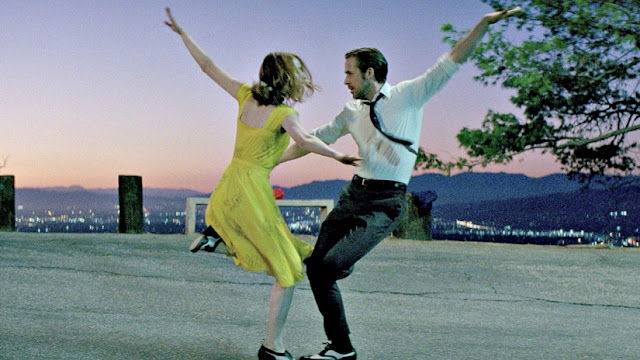
Chazelle also fills the frame at this point with some of the best Hollywood old-school musical magic: the song-and-dance routines really work here, giving visual expression to the high flung emotions of our heroes (the sequence at Griffith observatory is the obvious highlight here, but the relationship is handled so well that their first date at the cinema beforehand feels overwhelmingly sweet and real). It’s never cloying and for a film that (certainly during this section) is a real confection, that is quite some achievement.

And that’s the first point in the film where it could stop. But this is a film where Chazelle wants to combine the high concept of cinema with the difficult reality of real life. So what this film is really about is not romance but the sometimes painful truth that relationships, for a number of reasons, don’t always work out. That even the most perfect couple can, for reasons of career, ambition or due to just everyday mistakes, end up drifting apart, even if they still remain deeply emotionally attached to each other. What Chazelle does so well is that seeing these two slowly work towards breaking up isn’t traumatising or unbearably sad – it seems natural and real, something almost inevitable. In fact we can all see the mistakes happening, the ill thought out angry words, the events missed, we can see where it is going, but the underlying affection and love between the two characters is still there, so there remains the hope that they will conquer this “sticky patch” as per hundreds of films before.

Chazelle teases us – and there are several moments again where the film could stop that would leave the audience with optimism that a future reconciliation will occur, or that they will rekindle that initial spark. A possible ending is before the five year time jump that covers the final five minutes: Mia and Seb sit after her last audition. Neither of them are sure what will happen next, but both of them confess they will always love the other.

Many films would end here, and we could interpret what will happen next. Chazelle takes us forward five years for a beautifully moving bittersweet coda (heavily inspired by the end of An American in Paris), where we see both have achieved their ambitions – but not with each other. Mia is married with a young child, Seb seemingly single. Mia finds herself in Seb’s bar on opening night. Their eyes meet across the room and the whole cinema seems to crackle with the emotion – we know in seconds that they still devoted to each other, and regret consumes the room. Seb begins to play their love theme on the piano… Chazelle then gives us a masterful flashback to their first meeting and a wordless, music and dance accompanied replay of the entire film with every mistake corrected, showing them the life they could have had. It’s a beautiful tease – is this a dream? Was the film we watched a dream? Chazelle could leave us at the end of this sequence and allow us to make up our mind. Instead we return to the bar, as Mia leaves. They catch each other’s eyes and smile. It’s a smile that says love, it says happiness for the other but it also carries regret and acknowledgement that they may never see each other again. It’s a beautiful moment, profoundly true and moving and perfectly encapsulates our regret for the road not taken.

Chazelle’s La La Land was a passion project for the director, and his passion for it is clear. It’s beautifully filmed, hugely affecting, and the song and dance moments will put a smile on your face as well as being moving. Your response to it will be affected by how you respond to the mixing of Hollywood glamour with kitchen-sink reality. My wife was jarred by the fact that the film seems to promise the happy ending that old-school musicals so regularly delivered, but then inverts the concept at the end. I, however, found the ending perfect, and the bittersweet sadness of the road not taken in life (a life where other dreams and ambitions are achieved) very moving.

It’s a film that asks us to question our decisions and place values on dreams and ambitions. I’d need to see it again to decide how successfully it does this: in the real world Mia achieves her dreams and is unwilling to sacrifice them to be just a partner to Seb. In the dream sequence, Seb drops his dreams to support Mia, and the film may be suggesting that two ambitious people in a difficult world like this will struggle to be mutually successful. However, it is also clear that one of the things drives Mia away from Seb is his own drift away from immediately pursuing his dream, by signing on for years of touring with a band playing music he hates. What is the message here? Is there a message? Or is the message that life is never clean, never easy, and that having dreams in an adult world will always complicate lives? It’s a question I look forward to addressing when I watch this wonderful film again. It’s too early to say if this is a classic, but it will do until the next classic comes along.