Tag: Stanley Ridges

Sergeant York (1941)

Sergeant York (1941)

Patriotic flag-waver with a great performance from Cooper and plenty of genuine heart

Director: Howard Hawks

Cast: Gary Cooper (Alvin C. York), Walter Brennan (Pastor Rosier Pile), Joan Leslie (Gracie Williams), George Tobias (“Pusher” Ross), Stanley Ridges (Major Buxton), Margaret Wycherly (Mother York), Ward Bond (Ike Botkin), Noah Beery Jr. (Buck Lipscomb), June Lockhart (Rosie York), Dickie Moore (George York), Clem Bevans (Zeke), Howard Da Silva (Lem), Charles Trowbridge (Cordell Hull)

In 1941, after Japanese bombs landed on Pearl Harbor, America needed patriotic big-screen heroes. Few stood out more than Alvin York. A young man (over ten years younger than Gary Cooper) who had lived a youth of drunken rough-and-tumble before he found the light. When America joined the First World War, the 30-year-old York was called up. A gifted sharp-shooter, York was perfect for soldiering – but had to wrestle with his conviction to stick to the Commandments from the Good Book. Finding a solution to his moral quandary, York fought in France where his sharp-shooting instincts saw him almost single handedly capture a German machine gun embankment and 132 Germans (it’s an achievement that sounds pure Hollywood, but is in fact entirely true).

It’s an inspiring hero story that Warner Brothers bought to the screen at the perfect time, it’s release seeing tales of streams of young men walking from the cinema straight to the enlistment office. Producer Jesse L Lasky spent no less than twenty-two years attempting to persuade the notoriously publicity-shy and modest York (just as in the film, the real York couldn’t wait to leave the glitz and glamour of his triumphant homecoming behind and return to his fiancé, farm and work with the Church) to grant him the film rights to his life. York agreed only with the advance of Hitler, a hefty payment to his Church and a promise that no-less than Gary Cooper would play.

Cooper was reluctant – pointing out he was far too old to play this national hero – but really no other actor could have done it. Cooper won his first Oscar for the role, and it’s his understated sincerity and decency that really sells the film. He turns what could otherwise by a potentially cloyingly perfect man into someone utterly sympathetic and endearing. There is an aw shucks quality to Cooper, as he captures York’s modesty, his shrugging off his accomplishments as no more than his duty, his palpable discomfort with attention (be it from congressmen or his fellow Tennessee farmers commending his shooting) and a deep-rooted genuineness in his love for his beau Gracie (Joan Leslie giving a commendable performance of endearing brightness that helps you overlook she was 24 years younger than Cooper – thankfully she doesn’t look it).

Cooper’s performance powers a sprightly, very enjoyable film by Howard Hawks (who picked up his only Oscar nomination for this) that manages to transcend the danger of being an overbearing flag-waver. (Don’t get me wrong though – this film waves the flag so much, you can practically feel the strain in its arms). Hawks produces a film that in many ways owes as much to The Adventures of Robin Hood as an heroic All Quiet on the Western Front. Despite the patriotic focus being the final few Acts, as York carries out his act of astonishing heroism, the film’s real heart is in the opening half and the conversion of a man who is never-too-naughty into one who casts aside the demon drink, works hard to earn what he has, and puts his faith and the good of others before his own concerns.

Hawks shoots this part of the film with a palpable energy and a rough-and-tumble sense of humour. It’s there from the film’s opening as Walter Brennan (in a role he invests with all his wheezy, twinkly dignity) finds his sermon constantly interrupted by the gunplay of the drunken York and his buddies. There is a light humour when Margaret Wycherly – a little too ethereal for my taste as York’s saintly mum (although her casting does make York and White Heat’s Cody Jarrett siblings) – archly observes that, even when drunk, her son’s accuracy with a shooter is second to none. That’s the skill of Sergeant York there: in it’s end is it’s beginning, York is already deeply skilled and as his slightly embarrassed reaction shows when he sobers up, reformation is not a long journey.
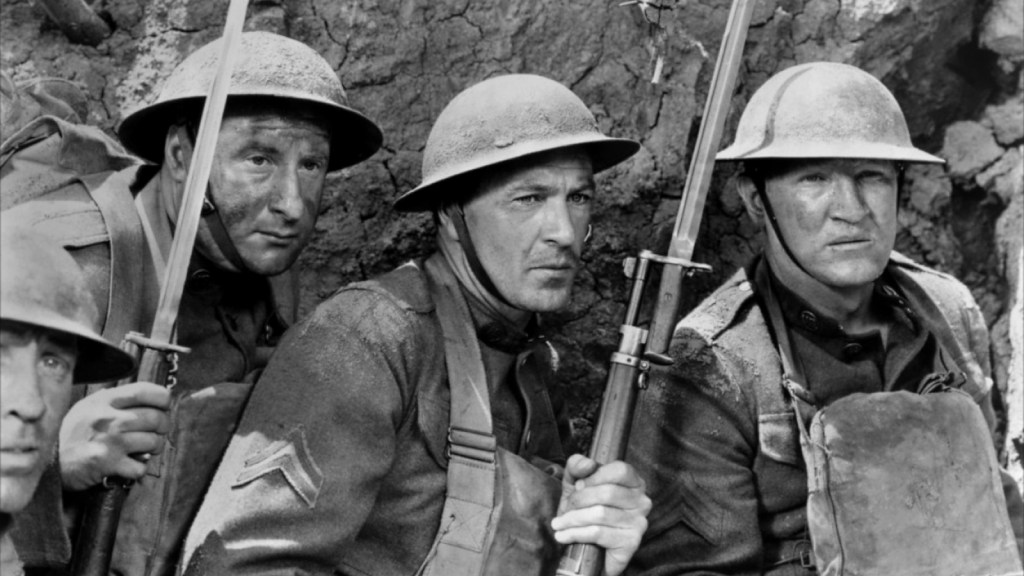
A large part of the success is making York one of us. Striving to save the money he needs to buy the farmland of his dreams, Hawks provides a sweet montage of York undertaking no end of backbreaking, thankless work and returning home to tick off his slowly accumulating dollars under the smiling approval of Ma. When, after all his work, he finds the land has nevertheless been sold (because the owner never believed this previously idle lush could hold on to his hard-earned pennies), his outrage at the breaking of another man’s word is a clarion call to all of us who have played by the rules and been shafted. When his conversion comes, it’s not as out-of-the-blue as it could seem, but a logical conclusion for a journey we’ve watched him go on.

It’s undercut with scenes that drip with Hawksian skill. A marksmanship competition is crammed with a playful Robin Hoodesque skill. A bar-fight that the drunken York gets wrapped up in is so full of comedic tumbles and prat falls it’s hilarious. York’s constantly being fetched for various tasks by his kid brother is expertly played for subtle laughs. Alongside this, the romance between York and Gracie (and the off-screen slapping he hands out to a rival who treats her with disrespect) is beautifully handled.

The only real Hawksian touch missing is that little slice of cynicism, that ability to look under the skin of a legend (like with Wayne in Red River) and see a more flawed person. York basically is perfect, and in a film dripping with patriotism there can’t be any fault with either the army or the moral question of whether gunning down your fellow humans is alright in the service of your country. There is a version of Sergeant York where his commanding officer’s invitation that he take some time and read his way through the history of America (a replacement good book) was an act of naked manipulation of a guileless man. Or where we see the sort of guilt at his taking of life that the real York felt, play out across Cooper’s face. There’s none of that here.

In fact, after the vibrant, playful, heartfelt first few acts, you feel Hawks felt less interested in the war itself. There is a functionality about the final acts of Sergeant York as York aces his shooting tests on the range (although the flabbergasted reaction of his training officer and York’s apologetic manner at his failure to only manage five dead-on bulls-eyes on his first time using an army-issue rifle are funny). Hawks spices it up with York’s turkey-shoot metaphor, and a warm supporting turn from George Tobias (as a New Yorker soldier) and York’s gobble-gobbles to distract his German opponents. But, for all the realism of the trenches, there is an air of duty about this sequence.

But then Sergeant York works not because of the deed, but the man. And the film’s success in investing us in a man who could very easily have been all-too-perfect, in a playful and energetic first half works wonders. With a very fine, perfectly judged performance by Gary Cooper, this may not be Hawks most characterful work – but as the sort of film to showcase a man who inspires you to achieve acts of heroism, it hits the target perfectly.

To Be or Not To Be (1942)

To Be or Not To Be (1942)

Hilarious Lubitsch comedy that walks a fine line between the dark horrors and absurdities of Fascism

Director: Ernst Lubitsch

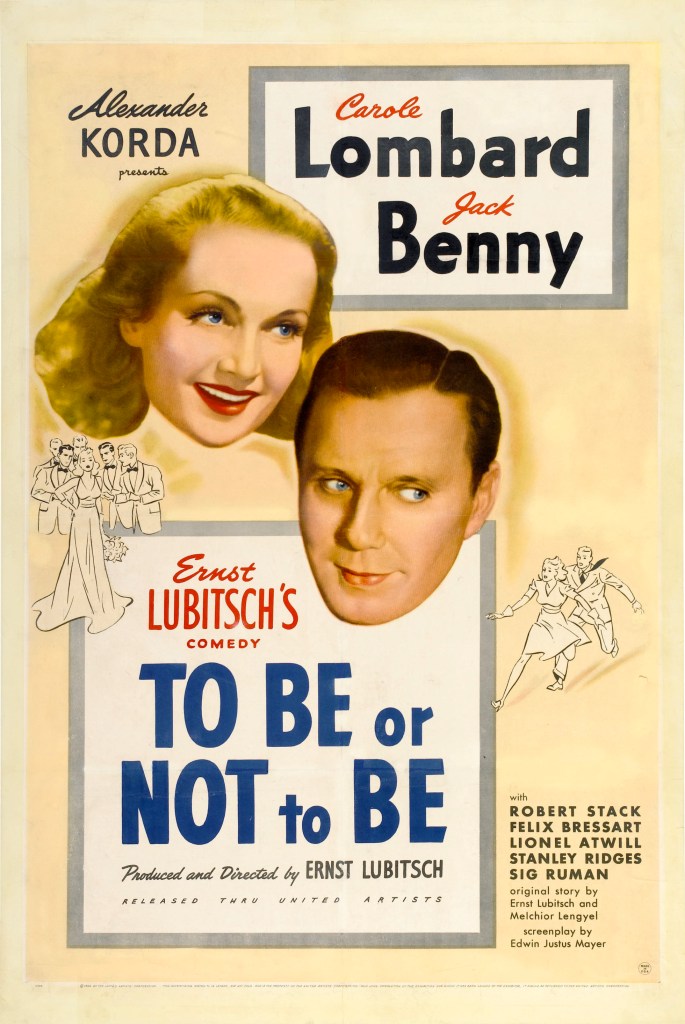
Cast: Carole Lombard (Maria Tura), Jack Benny (Joseph Tura), Robert Stack (Lt Stanislav Sobinski), Felix Bressart (Greenberg), Lionel Atwill (Rawitch), Stanley Ridges (Professor Alexander Siletsky), Sig Rumann (Colonel Erhardt), Tom Dugan (Bronski), Charles Halton (Dobosh), George Lynn (Actor Schultz), Henry Victor (Captain Schultz)

Is there a setting less likely for the famous Lubitsch Touch than war-torn Warsaw? To Be or Not To Be is a farce set at the most serious of times, sharp-paced, smooth and very funny. But it’s also about how the sort of playful, civilised class of eccentric free-spirits that Lubitsch excelled at can win through, even at the most dreadful of times against barely-sane bullies. What To Be or Not To Be does best – as well as make you laugh – is give you hope there is some light at the end of the tunnel.

The Turas – husband and wife Joseph (Jack Benny) and Maria (Carole Lombard) – are the (self-proclaimed) most famous actors in Poland. But the season 1939 is tough: their latest play Gestapo (a piss-take of course) is canned because the government is worried it might upset Hitler. Joseph revives his Hamlet and Maria uses the start of his ‘To Be or Not To Be’ soliloquy as the perfect time to entertain her current lover Lt Sobinski (Robert Stack) in her dressing room. Flirtations like this get left behind after the Germans invade, Sobinski flees to join the RAF and the theatre is shuttered.

For most of that, To Be or Not To Be fits neatly into the Lubitsch Touch. The Tura’s – with their fast-talking wit and casual attitude to sexual fidelity – are not a million miles from Trouble in Paradise’s con artists. Joseph’s principal concern isn’t that his wife might be walking out with someone else, but that someone is walking out of his performance (the worst fate imaginable!). The company are a parade of theatrical hams (Lionel Atwill’s grandiose Rawich can never resist padding his role) or spear-carrying dreamers, like Felix Bressart’s Greenberg (dreaming of Shylock). These are all denizens of Lubitsch Land, and it’s all wonderfully funny, soaked in Lubitsch’s love for actors and theatre.

But the world they are about to step into is entirely different. Lubitsch opens the film with a hilarious misdirection: first it seems Hitler (Tom Dugan) himself is walking around Warsaw, before cutting to Jack Benny in Nazi uniform (a sight so shocking to Benny’s Jewish Polish Dad, he walked out and had to be coaxed by his son back in to finish watching it). But the conversation we hear – with its parade of nervous ‘Heil Hitlers’, ridiculous bribing of a small child with a toy tank – is slightly too absurd and, by the time Dugan’s Hitler enters with a proud ‘Heil myself!’ it becomes clear we’re watching rehearsals for Gestapo (at the end of which Dugan’s Bronski heads out into Warsaw to prove he can pass as Hitler).

It’s a fabulous lead into what we can expect for the rest of the film, which sees the actors swopping identities and character with desperate abandon as they get trapped into an espionage plot. In Britain Sobinski is rightly suspicious of Polish exile Professor Siletsky (Stanley Ridges), largely because he’s never heard of Maria Tura. With Siletsky carrying information to Warsaw that could shatter the resistance, Sobinski smuggles himself back into Poland and loops the actors –especially Joseph – into a complex, improvised deception scheme to get the deadly information back, save the resistance and dodge the real Gestapo under ruthless but desperate Colonel Erhadt (Sig Ruman).

To Be or Not To Be ups its gear into one of the wildest, riskiest and outrageous farces of all time. Jack Benny is front-and-centre as the vain-but-decent Tura, roped into impersonating first Erhardt to Siletsky, then Siletsky to Erhardt, with the help and hindrance of the company (many of whom, especially Rawitch, still instinctively take every chance to expand their roles). Benny’s comic timing throughout is exquisite, using every inch of his gift for comic vanity, brilliantly bouncing from assurance to barely concealed panic (usually when his pre-prepared lines run out). While working overtime to do the right thing, neither he – nor Carole Lombard’s beautifully performed Maria – step to far from the sort of flirtatious, catty banter that wouldn’t be amiss in a Noel Coward comedy.

Lubitsch’s film is in-love with actors, showing them as instinctively decent and brave, while also being squabbling, competitive misfits either pre-occupied with themselves (from Joseph unable to imagine anything worse than a bored audience, to a rehearsing Rawich not even noticing he has walked into a light backstage) or dreaming of glories to come. Sure, he has fun with their reliance on a script – Joseph runs out of lines so quickly as Erhadt he is hilariously reduced to simply saying over and over again “So they call me Concentration Camp Erhadt”, inevitable raising the suspicions of Siletsky – but at the same time in this crazy, dangerous world, the theatre is a bastion of civilisation.

Civilisation is of course in danger from the worst of the worst. Lubitsch is the comic director, par excellence but he is not afraid to dramatically shift tone and style throughout. The war action, as shells rain up towards Sobinski’s plane, would not look out of place in an action film. Sobinski’s attempt to contact the resistance could be dropped in from a Hitchcock thriller. When a Fritz Lang-inspired chase of Siletsky through a dark theatre is called for, Lubitsch goes entirely straight. The subtle threats behind Siletsky’s attempted seduction of Maria are quietly chilling if you stop to listen (Siletsky is the only character neither funny or on some level ridiculous, as if he has walked in from a serious thriller). There are moments in To Be or Not To Be that are surprisingly tense: when guns are pulled, we know having seen them used earlier that lives are at risk.

The most controversial element of To Be or Not To Be is whether Nazi occupied Poland is a suitable topic for comedy – and lines from Edwin Justus Mayer’s exceptional script like “What [Joseph] did to Shakespeare, we are now doing to Poland” feel close to the bone today. Lubitsch was of course not to know that plans were already being formed forthe Holocaust. But he had been the literal face of Hollywood Jewish corruption in the Nazi’s deplorable The Eternal Jew and the vileness of Nazism was familiar to him. He acknowledged it with Siletsky, the dogmatic, obsessed Nazi (who even dies with the word Heil on his lips). Erhardt brags about the powers of life and death he holds and casually talks of torture and executions. To Be or Not To Be couldn’t picture the evils of mechanised death, but Lubitsch knew the people he was dealing with.

He also knew nothing punctures evil like mockery – and, like most bullies, many Nazis were small, pathetic people. Erhadt – superbly played as a wide-eyed, panicked middle-manager and deadly dispenser of punishments by Sig Rumann – might be dangerous, but he’s also a twitchy, clueless idiot, blaming his subordinate for all his mistake (it’s part of the film’s joke that Joseph’s suave Erhardt feels more convincing than the bug-eyed ignoramus himself). The Nazis are small-minded bullies, with their continued parroting of Heil Hitler and kneejerk obedience to orders (up to jumping out of a plane). Lubitsch treats Nazism seriously while showing how ludicrously puffed-up and stupid it is.

It’s a fine tight rope walk, which echoesThe Great Dictator – but without Chaplin’s heartfelt, fourth-wall plea for peace and understanding. To Be or Not To Be manages to make identity switching farce a sort of commentary on how the Nazis are incapable of questioning the reality they are ordered to accept. Lubitsch shows Nazism as a cult diametrically opposite to the more libertine, bickering and free-minded actors. As such, it’s a valuable reminder in war time that we can prick the pomposity of tyrants by hitting them where it hurts them most: in their pride.