Tag: Thomas Kretschmann

Indiana Jones and the Dial of Destiny (2023)

Indiana Jones and the Dial of Destiny (2023)

Is there a place for Indy in the 2020s? The nostalgia-tinged would-be epic doesn’t provide an easy answer

Director: James Mangold

Cast: Harrison Ford (Indiana Jones), Phoebe Waller-Bridge (Helena Shaw), Mads Mikkelsen (Jurgen Voller), Antonio Banderas (Renaldo), John Rhys-Davies (Sallah), Toby Jones (Basil Shaw), Boyd Holbrook (Klaber), Ethann Isidore (Teddy Kumar), Karen Allen (Marion Ravenwood), Shaunette Renée Wilson (Mason), Thomas Kretschmann (Oberst Weber), Olivier Richters (Hauke)

Okay let’s get the elephant out of the room: It’s better than The Kingdom of the Crystal Skull. Yes folks, we have a new fourth-best Indiana Jones film. Is that something to celebrate? Indiana Jones and the Dial of Destiny makes some of the same errors as the previous valedictory effort, but at least it learned a few things and it’s been made by people who clearly love Indy. But they loved it too much, creating an often overblown, hellishly overlong, everything-but-the-kitchen-sink film which never just jump when it can flip, spring, bounce then explode at the end of it.

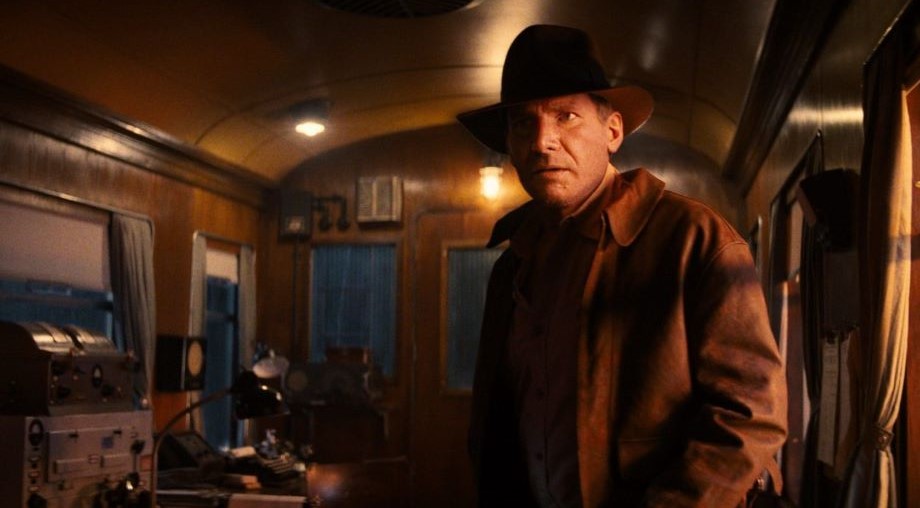
It opens with a (younger) Indy (Harrison Ford) battling Nazis in the dying days of the Second World War, trying to save a train full of precious artefacts. After defeating them, we flash forward to 1969 with Indy now a retiring archaeology professor to disinterested students in New York’s Public University, out of a place in an era where man has stepped on the moon. Grouchy, separated and fed-up, Indy’s life gets disrupted one more time when his god-daughter Helena Shaw (Phoebe Waller-Bridge) turns up on the hunt for Archimedes’ Dial. Indy knows about this dial as it was also the obsession of Nazi physicist Jurgen Voller (Mads Mikkelsen), last seen on that train in 1945 and now the brains behind the NASA moon landings. Indy and the unscrupulous Helena end up in a duel with Voller to find the dial – the prize being what Voller believes is a chance to change history.

Back in the day, Raiders of the Lost Ark was largely made so Spielberg and Lucas could show they could make an action-packed, crowd-pleaser quick and cheap. Today The Dial of Destiny is one of the most expensive films ever made (lagging only behind assorted Avengers films, the recent Star Wars trilogy and various other franchise entries). So much mony to make something less than half as good.

What this has allowed is Mangold and co to act like kids given the keys to their parents’ car. The Dial of Destiny is an explosion of Indy ideas, all rammed into the film willy-nilly. It’s made by people who feel this is their only chance to make an Indy film and don’t want to miss the opportunity to include every idea they’ve ever had.

We end up with a film that feels both far too long and yet strangely rushed. The Dial of Destiny would be immeasurably improved if about twenty minutes (at least) had been cut from its run-time and its poorly sketched thematic ideas condensed down. Its narrative structure has one too many quests, with Indy and Helena forever searching for a thing that leads to a thing that leads to yet another thing. An entire sequence, involving a pointless cameo from Banderas as a one-legged diver, would have been better slashed to ribbons or cut altogether. Every single one of the mega-budget chase sequences go on at least 2-3 minutes too long, straining the interest.

At the same time, the film manages to feel rushed. Ideas are presented and then taken nowhere at all. We see Indy tipping most of a bottle of whisky into his coffee in the morning – this suggested alcoholism never rears its head again. Voller is working in partnership (it seems) with the CIA, but their motives for this are never explained and Voller calmly ditches them part way through the film. Indy is framed for murder, but this plot thread is judicially abandoned by the time we get to the end. John Rhys-Davies literally pops up to drive Indy to an airport and make a trailer-friendly speech.
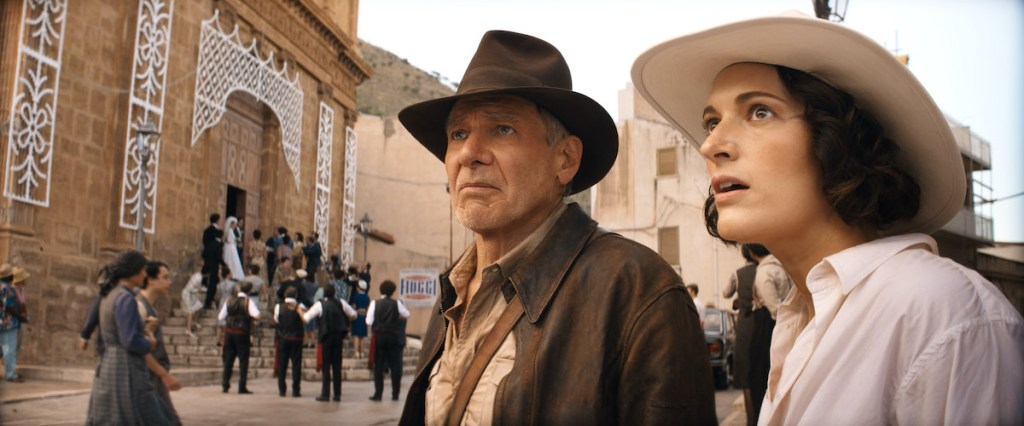
Most strikingly, all the films blaring action and endless bangijg stuff buries the most interesting plot thread of a tired, depressed Indy who no longer knows his place is in the world. The film solves Shia LaBeouf’s toxic unpopularity by having Mutt die in Vietnam, giving Indy a burden of guilt and grief. This is an Indy who has fallen from his Princeton heights, as ancient to his students as the artefacts he lectures about. It’s a thread though that the film only intermittently remembers, so crowded out is it by overlong chases, so that when the film’s conclusion returns to it as a major motivator for Indy it feels forced.

In any case, the film’s action set-pieces peak with the 1945 opening section with a digitally de-aged Ford and Mikkelsen facing off on a speeding train. I think the de-aging effect is very well done (though Indy speaks with Ford’s current 80-year-old voice), and this sequence has a sort of nostalgic charm to it and at least it feels of a piece with the originals. Not that its perfect: it’s overlong and overblown of course – a castle explodes, Indy runs over the top of a speeding train – and looks like something created with blue-screens and digital effects rather than in reality. (It’s also clear a digitally de-aged Ford head has been placed on a stunt double at key points.)

But it’s a bright-spot. There are others: Harrison Ford, again, is perfect for the role – crusty, resigned but still with the glamour of excitement in his eyes. He and the film don’t back away from his advanced age – Indy looks more vulnerable than ever – and Ford sells the moments he’s allowed in the film’s breakneck speed to reveal Indy’s emotional turmoil. He also has a great chemistry with Phoebe Waller-Bridge, who effectively channels Han Solo as an immoral adventurer who learns about decency. Mikkelsen’s mastery makes him an impressive villain.

I’ve been really hard on this film. It is fun I promise. I laughed and at times I was thrilled. But it is too much. Even the settings of the chases offer a sensory and time overload: a chase around a ticker-tape parade in New York onto a subway (with Indy on a horse) has an overload of visual details. A chase through the streets of Marrakesh goes on forever – and is over-built with our heroes chasing Voller while also being chased by Helena’s gangster-former-fiancee. film culminates in a final sequence which is just about not as silly as aliens – but by any other score is incredibly silly.

Essentially The Dial of Destiny is undermined by fan love. Mangold is a good director but doesn’t know where to stop. The film leans into nostalgia too hard but, above all, it offers far too much bang for your buck. The film is frequently at its most effective in its quieter, character-driven moments. Like Crystal Skull, it mistakes bigger for better. It’s still a more entertaining and a better film than Crystal Skull – but, somehow, its excessive overindulgence makes you feel strangely disappointed.
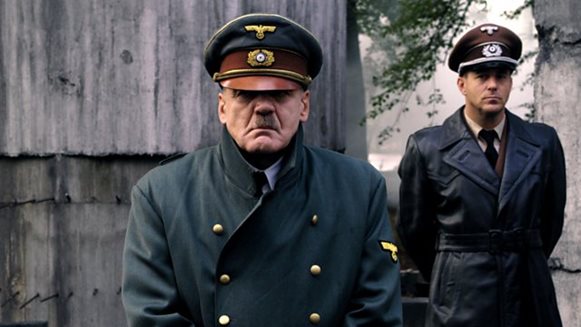
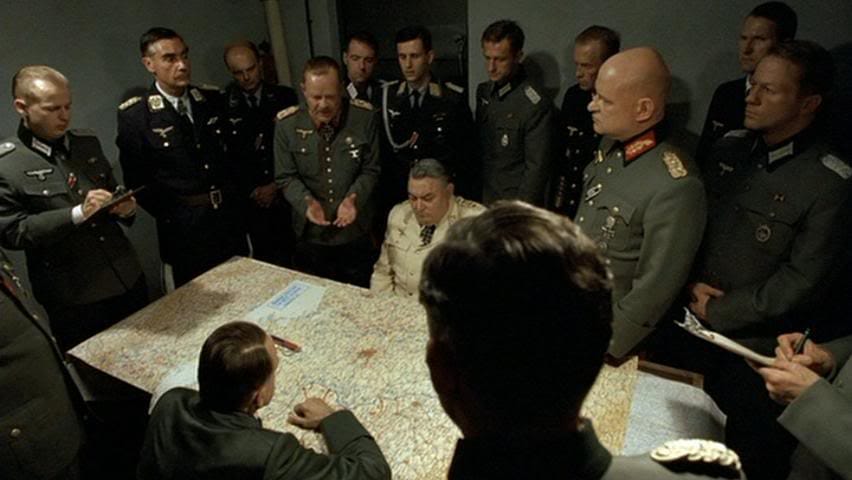
Downfall (2004)

Bruno Ganz excels as Adolf Hitler in Downfall

Director: Oliver Hirschbiegel

Cast: Bruno Ganz (Adolf Hitler), Alexandra Maria Lara (Traudl Junge), Ulrich Matthes (Joseph Goebbels), Juliane Kohler (Eva Braun), Corinna Harfouch (Magda Goebbels), Heino Ferch (Albert Speer), Christian Berkel (Professor Ernst-Gunther Schenck), Matthias Habich (Professor Werner Haase), Thomas Kretschmann (Hermann Fegelein), Michael Mendl (General Weidling), Andre Hennicke (General Mohnke), Ulrich Noethen (Heinrich Himmler), Birgit Minichmayr (Gerda Christian), Rolf Kanies (General Hans Krebs), Justus von Dohnanyi (General Burgdof)

Few people had such an impact on the 20th century than Adolf Hitler. Countless dictators unleashed genocide and war, but few on Hitler’s scale. His dark presence lingers like a cancer on German history, an existential guilt the country has spent generations trying to exorcise. Chronicling the final days of Hitler in his Berlin bunker, told with cinematic verve and documentary realism, Downfall was the first German film to directly tackle Hitler. Perhaps it needed a German film to present a Hitler who felt real rather than an under-the-bed monster – and was able to look into his darkness, and the horror of his world, in a way few films have ever done.

Downfall was controversial on release for ‘humanising’ Hitler. Certainly, the film shows a man capable of consideration and even moments of warmth. But it’s never in doubt a man can be kind to a secretary or affectionate to a dog and still be a sociopath who greets news of young soldiers dying with the words “that’s what young men are for”. Can still be so wickedly egotistical he decides the entire German population should join him in immolation while manipulating with quiet emotional pressure as many of his followers as possible to join him in suicide. Watching the film, you cannot escape Hitler’s monstrous destructiveness, his complete lack of empathy and his instinctive, brutality.

Much as we might not want to face it, Hitler was human: a ruthless, megalomaniac and genocidal one. Part of the fascination of the film is watching those closest to him – Eva Braun, his secretaries, his immediate staff – try to reconcile the kinder private man they know with the one they hear screaming for his Generals to be shot and ranting about Jews and his desire to annihilate entire populations. At one point Eva Braun tells Junge that when saying those things “he is being the Fuhrer” – as if Hitler and the Fuhrer are some hideous Jekyll/Hyde monster.

Downfall charts the final spiral of Hitler as he goes through the stages of grief at his impending defeat. Self-confidence turns into carpet-chewing anger, when reality becomes unavoidable. Grief mixes with fury as Hitler blames everyone – his Generals, his followers and finally the German people themselves – except himself. Never once does the film offer the slightest shred of sympathy for Hitler, this nightmare being all his own creation, consuming him just as it consumed tens of millions before.

As Hitler, Bruno Ganz is quite simply phenomenal. Studying for months film of Hitler, Ganz captures his physicality perfectly – adding Hitler’s likely (undiagnosed) Parkinson’s, a twitching hand he constantly hides behind his back like a nervous expression of his doubt. In private conversation, Ganz’s Hitler is polite and even a little warm, but never anything less than a monster of self-absorption. His favourite topic is himself, and his quiet expectation that everyone should join him in death is matched only by his cold dismissal of those who fail to live up to his twisted standards.

This is nothing to his furious outbursts at those perceived to have betrayed him. His spittle-fuelled rants perhaps only come close to the true carpet-chewing bawlings Hitler was apparently capable of, but they are tour-de-forces of relentless fury and self-pity. Ganz plays Hitler with empathy, but makes it very clear Hitler was incapable of such an emotion himself. The suffering of others is nothing to him. He sheds tears over the death of his dog and barely bats an eyelid at the deaths of thousands: instead they are a perverse monument to himself.

Nazi Germany is the country he created, and Downfall is exceptional in showing how the last days of the Reich were like the final hours of a cult. Few things display this better than the Goebbels themselves. Ulrich Matthes chilling Goebbels is so consumed with devotion for his leader, weeping when ordered to survive and continue the fight, that he cannot imagine living without him. Like Hitler, his fury is reserved for the German people – to him the German people chose their fate and cannot complain that their throats are now being cut.

This is matched by the devotion of his wife Magda, played with a chilling, twisted sadness by Corinna Harfouch, so devoted to Nazism and Hitler she decides (with the logic of a twisted fanatic) her children should die rather than live in a world without them. In a quietly devastating, almost impossible to watch, scene she feeds them ‘medicine’ (actually a sleeping agent) – her eldest daughter, sensing something is wrong, resists desperately before being force fed – then silently breaks a cyanide capsule in each of their mouths, with a kiss to each forehead. Everyone in the bunker knows this happening, but no one stops her. In this cultish world, where death is normalised and suicide expected, it’s only natural.

The second half of the film is a rash of suicides. A German doctor, his hands filthy with the euthanasia programme, detonates two grenades at a dinner, killing his whole family. The Goebbels shoot themselves and order their bodies cremated in a grim echo of Hitler’s own fate. As survivors plan a breakout, an officer calmly states he’s not leaving and shoots himself in the mouth – no one bats an eyelid. Hitler hands out cyanide capsules like candy, the unspoken expectation constant.

This callous brutality and nihilistic embracing of death is constant during the grim, pointless, desperate battle for the city. Indoctrinated children are press ganged into the front-lines and then choose suicide over surrender. Lynch mobs prowl the streets, executing anyone not seen to be fighting – mostly old men, disabled veterans and anyone not holding a gun. The film never suggests the German people are victims, but suggests the final target of the Nazis was Germany itself.

The film is a long spiral into an anti-chamber of hell. After the opening half hour, the Russian advance means the action retreats almost entirely underground into the bunker. In this subterranean world, the cast slowly thins out as people seize their chance to flee, leaving only the most deluded, hard-boiled and fanatical. Generals may protest Hitler’s denunciations of the ordinary soldiers, but will pull their guns on anyone who even suggests the idea of surrender.

In a country where Hitler has encouraged a denial of reality, the scheming and jockeying for position continues even in this madness. Even those who see the end is here are still deluded: Himmler firmly believes a brief chat with Eisenhower will be enough for the SS to be entrusted with maintaining the peace against Bolshevism. Only Speer (played perhaps with too much sympathy by Heino Ferch, in the film’s one mis-step) is clear eyed about what is happening.

Downfall is relentless and eye-opening in destruction of the final days of the Reich. Its reconstruction and research is faultless and acting breathtaking. Framing the device through the experiences of naïve secretary Traudl Junge (an excellent Alexandra Maria Lara), we get a sense of how the scales slowly and painfully fell from the eyes of the German people. It’s atmosphere of oppressive claustrophobia and bleakness is expertly done, with events swiftly and awfully spiralling down into one where death becomes an unremarkable inevitability. No one could come out of this either admiring Hitler or seeing anything in Nazism other than a twisted cult that consumed its followers with the same blood-curdling carelessness it did its millions of victims. Hitler may have been a human, but Downfall makes clear he was never humane.

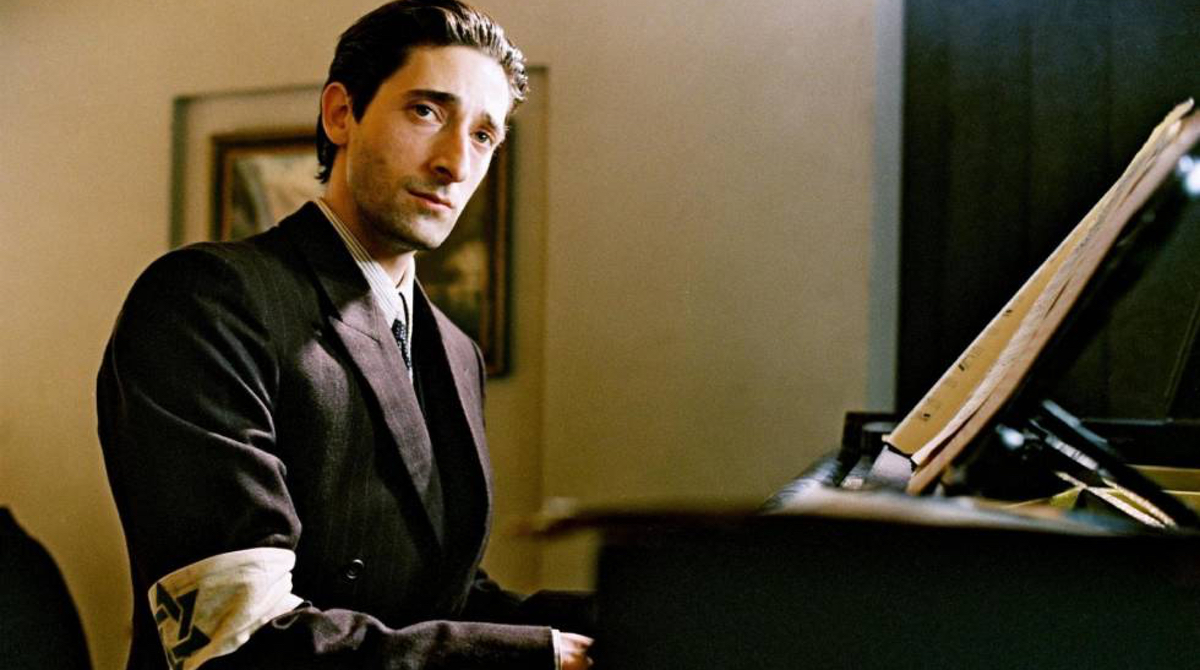
The Pianist (2002)

Adrien Brody is outstanding in the compelling The Pianist

Director: Roman Polanski

Cast: Adrien Brody (Wladyslaw Szpilman), Thomas Kretschmann (Captain Wilm Hosenfeld), Frank Finlay (Samuel Szpilman), Maureen Lipman (Edwarda Szpilman), Emilia Fox (Dorota), Ed Stoppard (Henryk Szpilman), Julia Raynor (Regina Szpilman), Jessica Kate Meyer (Halina Szpilman), Ronan Vibert (Andrzek Bogucki), Ruth Platt (Janina Bogucki), Andrew Tiernan (Szalas)

Few directors have as personal a link with the Holocaust as Roman Polanski. As a boy, he witnessed his parents deported to their deaths, surviving only by chance, escaped the Krakow Ghetto and was sheltered by a Catholic family. The lasting impact is clear to anyone who has seen a Polanski film and he avoided Holocaust projects for decades (including Spielberg’s offer to direct Schindler’s List). The Pianist was the film he made on this trauma. Perhaps because the experience of Wladyslaw Szpilman was, in many ways, similar to his own.

Wladyslaw Szpilman (Adrien Brody) is a famous Polish concert pianist. As the German occupation begins, Szpilman and his family face the cruel downward spiral of the new regime’s anti-Semitic policies. Very quickly, laws move from a ban on Jews in public places, to wearing Star of David badges to herded into ghettos. In the ghettos, life is a terrifying struggle, as the German occupiers shift from simple bullying to acts of random, indiscriminate murder. The whim of a German soldier decides whether you live or die. Szpilman’s family are eventually deported to Treblinka, but by a twist of fate Szpilman escapes – and finds himself hiding in Warsaw for years, sheltered by the Polish resistance, desperately trying to survive until the war ends.

Polanski’s film is heart-breakingly sincere and the documentary matter-of-factness it presents appalling, unjustifiable crimes gives great power to the whole film. It never blinks or looks away, and never offers false hope or sentiment. Only the terrible realisation that nothing can have any impact on whether you live or die: death could come from as little a thing as dropping a brick. People are plucked from lines and shot, speaking at the wrong moment is a death sentence and people in wheelchairs are tipped out of fifth storey windows.

There are moments where Polanski seems to be commenting on Schindler’s List’s touches of melodrama: that film featured a Jewish man saved from death by a German officer’s gun jamming – when the same thing happens in here, the German officer calmly stops, carefully reloads the gun, checks it and shoots his victim in the head. That’s the reality. The Pianist tracks all this with a traditionalist, stable camera and a marked restraint. There is no flair, or immersion, to any of this film. Instead, it grimly and calmly shows you each horror.

There is also no sense of fate or destiny. Szpilman survives – while every other Jewish character he encounters does not – not because of things he does himself, but because of chance, luck and risks taken by others. There is a powerful will to survive in Szpilman, but you can say the same for thousands of others. And, as the film demonstrates time and again, determination and desire to live won’t save you if a German officer decides to make an example of you.

Polanski’s film is honest and shocking in its presentation of the descent into brutality in the ghetto. The film chillingly presents the viciousness of what starts as bullying – the German officers who smack Szpilman’s father (a dignified Frank Finlay) around and force him to walk in the gutter – into killing-for-sport. Literally so: German officers turf out the occupants of a building, just for the ‘fun’ of shooting them down like rabbits in their car headlights as they run away.

While the first half of the film covers the horrors of the Ghetto – from over-crowding, to deportations to the increasingly open and random violence – the second half becomes a survival tale that owes a lot to the unsettling horror films of Polanski’s early career. Hiding in a series of apartments, knowing discovery will lead to instant death, Szpilman find himself in a terrifying city where the slightest sound will condemn him. After the noise of the ghetto, the silence of these apartments – and the long periods of silence from Szpilman himself – become increasingly overbearing, while also helping build the dread of discovery.

The only sound we hear are the piano concertos Szpilman is reduced to playing in his head. Frequently Szpilman’s hands move to play an imaginary piano. In one apartment, there sits a piano he can never play: nevertheless his first act is to open it and let his hands dance perfectly above the keys, imagining the music they produce. It’s a brilliant reminder of the ordinary life he has been forced to leave behind – and how, even when things are at their worst, we cling to the things that make us human.

As Szpilman weakens and grows pale in his apartment prisons, he witnesses both the Ghetto uprising of 1943 and the Warsaw uprising of 1944. Polanski treats this urban war with the same chilling matter-of-factness as the rest. From Szpilman’s window we see bodies fall and buildings burn. People slump dead in unusual, un-cinematic positions – a woman, shot in the back, falls to her knees and slumps forward – and with an abrupt, horrible finality. Only someone who has seen death in war, could film it like this.

When Szpilman finally emerges into Warsaw – a city Polanski has only let us see as Szpilman sees it, a few buildings, a street or two – he finds the city a burned-out ruin. It’s the first crane shot of the whole film, that until then has kept its formal angles down at the level Szpilman has experienced. The wreck of the city also matches Szpilman, now an emaciated, mute Beckettian tramp, clutching his only food, a can of pickles.

Despite all this, the film is full of good, brave people who help Szpilman, many of them in the Polish resistance. Most affectingly of all is the touch of hope the story offers – the last to help is a German pfficer (affectingly played by Thomas Kretschmann). The motives of this character are left vague – is it kindness, weariness with war, disgust at Nazism or just another whim – perhaps because all we know is this man, who helped many others as well, died in 1952 in a Soviet prison camp. For all that, seeing a good man in a uniform worn by so many murderers,  gives you hope something can come out of this wreckage.

At the heart is Adrien Brody, who gives a transformatively superb performance as Szpilman. Wry and dry at first, the film sees him being hollowed out into someone scared, desperate and finally emaciated and traumatised. Brody’s brilliance is in stressing there is nothing out of the ordinary to Szpilman beyond his piano playing. He has to learn to bear the guilt of having no choice but to walk away while his family are killed. But he never loses his humanity and dignity – even as a frazzled tramp, when finally allowed to play a piano, after a pause he launches into a performance of breath-taking cathartic release. It’s a superb performance.

The Pianist showcases the sadistic whim that drove the Holocaust. Death is not operatic, but functional, everyday and comes without warning. The film is unflashy, almost classical in its approach, carefully paced and un-melodramatic. But that reflects the lack of romance in war and the grinding terror and suffering of just surviving. By focusing on a single man’s story and experience, it helps us begin to appreciate that his story was just one of millions. That helps make The Pianist one of the most compelling, moving and brilliant Holocaust dramas ever made.

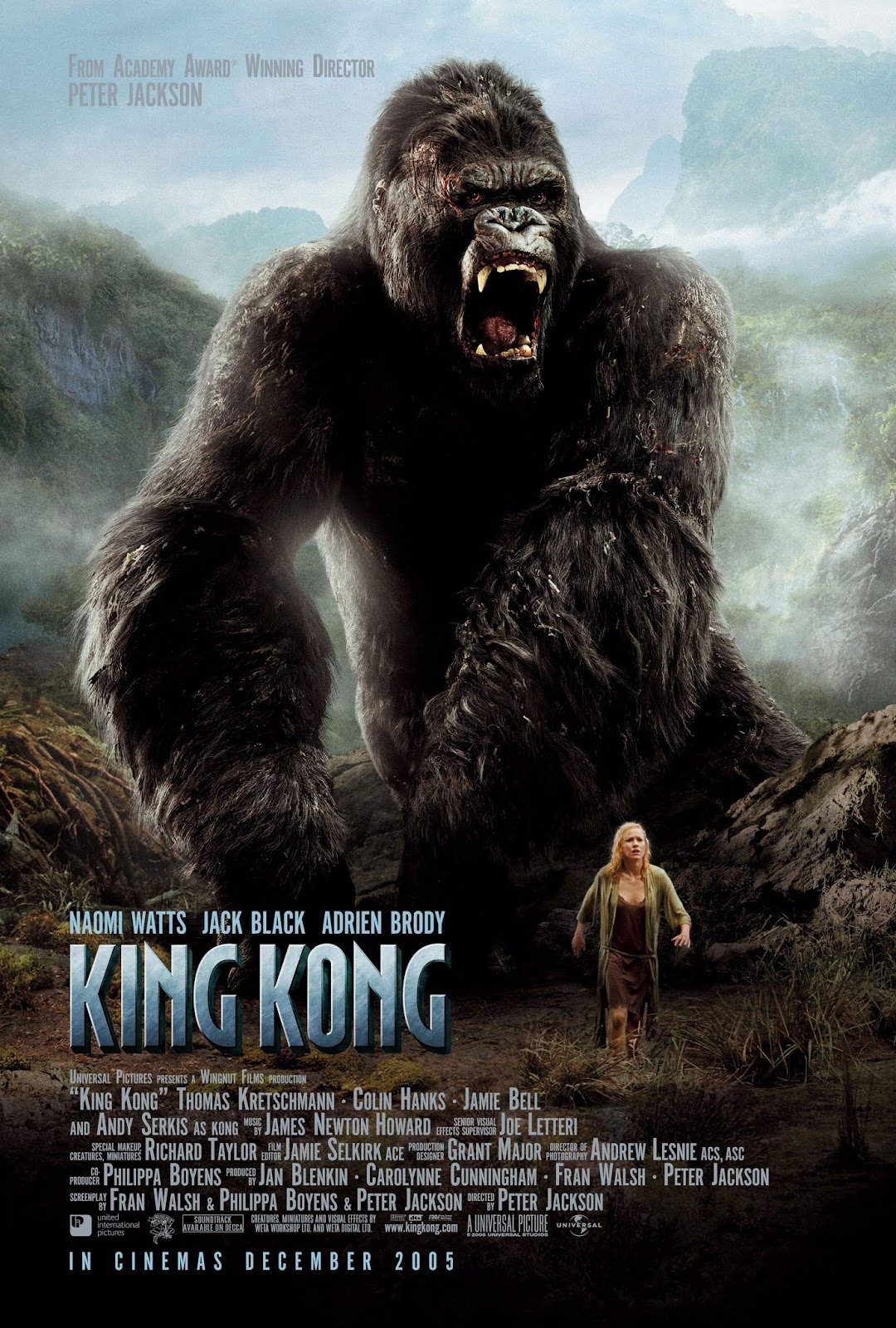
King Kong (2005)

Naomi Watts and a mo-cap Andy Serkis bring to life Peter Jackson’s dream in King Kong

Director: Peter Jackson

Cast: Naomi Watts (Ann Darrow), Jack Black (Carl Denham), Adrien Brody (Jack Driscoll), Thomas Kretschmann (Captain Englehorn), Colin Hanks (Preston), Jamie Bell (Jimmy), Andy Serkis (Kong/Lumpy), Evan Parke (Ben Hayes), Kyle Chandler (Bruce Baxter), John Sumner (Herb), Lobo Chan (Choy), Craig Hall (Mike)

In the late 90s Peter Jackson was working hard on putting together the plans for his dream project. It was a complex project, with unprecedented special effects demands, a huge cast, a demanding shoot and a big budget. However, plans fell through, so Jackson decided to move his attention to that Lord of the Rings trilogy idea he had been banging around instead. Hot of the success of that little escapade, he delivered at last his dream: a huge remake of King Kong.

Carl Denham (Jack Black) is a ruthless film director, desperate to make the big epic that will dwarf all others. Pulling together a team including playwright Jack Driscoll (Adrien Brody) and vaudeville dancer Ann Darrow (Naomi Watts), he heads out on a ship for location shooting on the mysterious Skull Island. Arriving on the Island, they find that the savage natives aren’t the only dangers on an Island that has bypassed evolution. The crew find themselves hunted by dinosaurs, huge creepy-crawlies and other horrors all while they try to find and rescue Ann from the Island’s Alpha – a huge gorilla, King Kong (famously motion-captured by Andy Serkis). Led by Jack, who has fallen in love with Ann, dangers surround the crew – but is mankind, and the ambitious Carl, the real danger?

Time and public perception has not always been kind to Jackson’s labour of love. Perhaps coloured by the generally negative reception to his Hobbit films (which are a mess), perhaps also by the film being more of a gentle, sentimental film mixed with cartoon-splatter horror rather than the monster-mash B movie later Kong films have been, it’s generally remembered as a bit of a disaster. This is far from fair. Yes it’s overlong (hugely so at well over three hours – nearly twice as long as the original) and over-indulgent but it’s also quite a sweet, if rather tonally mixed, film that more or less manages to keep an audience entertained.

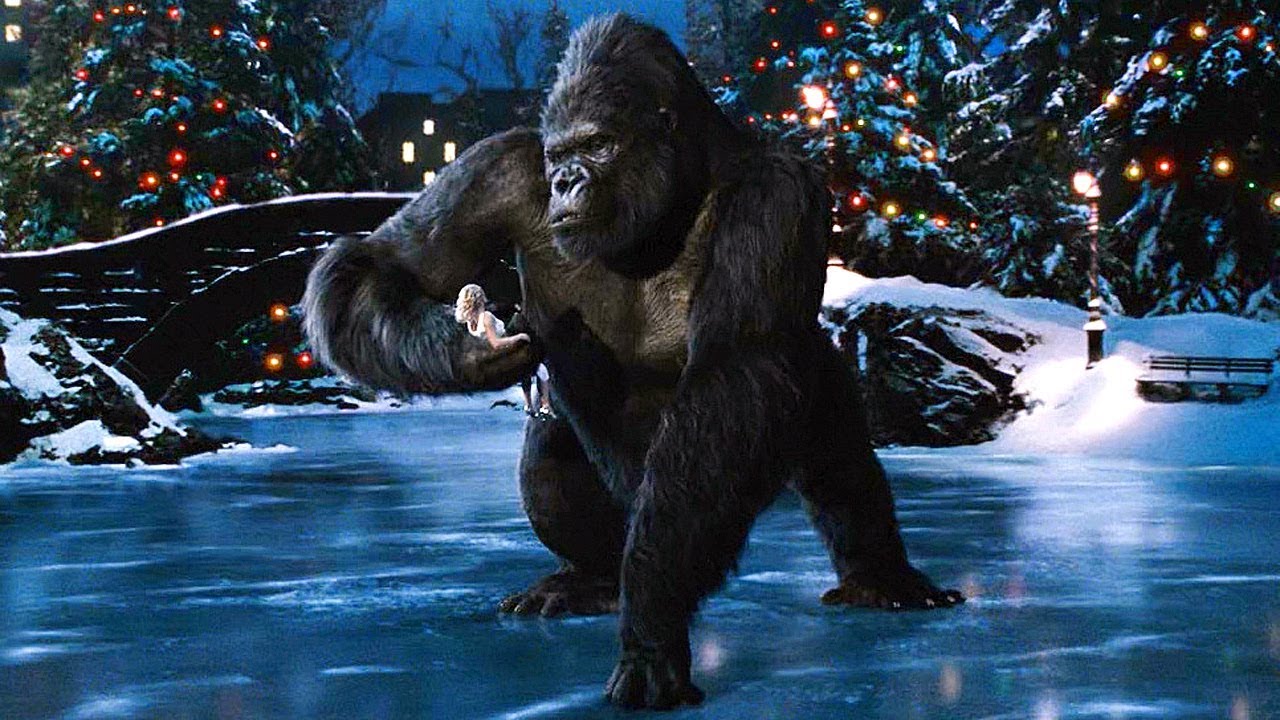
Unlike later films which have enjoyed Kong (or Godzilla) most when he smashes things – even if he is often the film’s hero or at least anti-hero – this Kong film is perhaps at its most contented when it is finding the humanity in the ape. As a 9-year old, Jackson talks about crying when Kong fell dead from the Empire State Building – and it is this engaging giant that he wants to bring to life here. Using Serkis – cementing his reputation here as the whizz of motion capture – to have a human literally inside the Gorilla, giving real expressions and genuine character to a giant ape was deliberate. The film’s most heart-felt – and quietest – moments both involve moments of gentle play or innocence from the Gorilla, either starring at a beautiful sunset (which he does both on the island and on the Empire State) or playfully slipping and sliding on a Central Park frozen lake, this is a monster that Jackson sees as a misunderstand soul, that bond he felt at 9 brought to the screen.

That’s the key between the bond that Ann feels with this beast who starts as potential killer, becomes protector, friend and finally a sort of romantic interest of a kind. Well played by Naomi Watts, Ann Darrow herself is a damaged soul, a bright-eyed, naïve dreamer with a dose of realism slowly entering her soul, who wants to entertain people but also to make her immediate world a better, warmer place. It’s natural that such a person would start to feel a deep bond with Kong, to learn to appreciate his gentleness and protectiveness, to put herself at risk to try and save his life. It’s a huge development of the character from scream-queen, and positions Ann (or tries to) as a more pro-active force in her own story.

And the ape responds to this, slowly revealing his own true nature as a potentially gentle giant, albeit one who is prepared to rip a few T-Rex’s apart to protect his love. He certainly ends up feeling more of an ideal partner for Ann than the other men in the film. Adrien Brody’s Jack Driscoll is a determined, principled and brave man but there is a touch of inadequacy to him, a surrendering of responsibility and a lack of proactivity in his make-up. While the early love story between the two characters is sensitively drawn, it tellingly can’t survive the events of Skull Island – at least not in the same way.

Mind you Driscoll is better than Denham, who is transformed in this film to a soulless monster interested only in his own greed for fame and power. Jack Black delivers what the script demands – even if the film is pushing on the edge of his range. As Black’s stock has fallen, so perhaps as some of the film’s – and the perception of his performance here. It doesn’t help that the idea of the ruthless film director seems to be a common trope for film director’s to explore (and interesting psychological question there!) so the character’s shallow lack of regard for anyone else, coupled with his fierce ambition to be the greatest showman around start to grate after a while. It’s a character lacking any depth.

But then that’s the case for most of the rest of the cast as well, who struggle to make room in a film that is overloaded with events and action to the detriment of its overall impact. Jackson’s heart may really lie in the quiet moments between beauty and beast – but he also loves an action scene. And King Kong has too many of these. Much of the middle hour of the film is given over to a never-ending parade of events on Skull Island, that after a while seize to have any real impact. As nameless crew members are crushed by boulders, or stampeding dinosaurs, or savaged by giant insects, or have their heads caved in by savage islanders (not surprisingly these H Rider Haggard style savages, with their lust for human sacrifice, drew more than a little criticism – and it hasn’t aged well) you start to feel your interest sagging. Kong’s brawl with three savage T-Rex’s is perfectly made in every respect, except for the fact it goes on forever.

Ambition lies behind every frame (all of them beautiful by the way) of this huge three hour epic monster picture – but it gets all so much that it buries the story. Like Kong himself, it touches the heavens only to fall tragically to Earth, trying to protect the thing it loves. Jackson wants to protect Kong from being just seen as a massive ape that hits things – but loses his way at times when Kong does little more than exactly that. It is still an intelligent and heartfelt film – but it struggles as well with being an uncontrolled play in the sandbox.

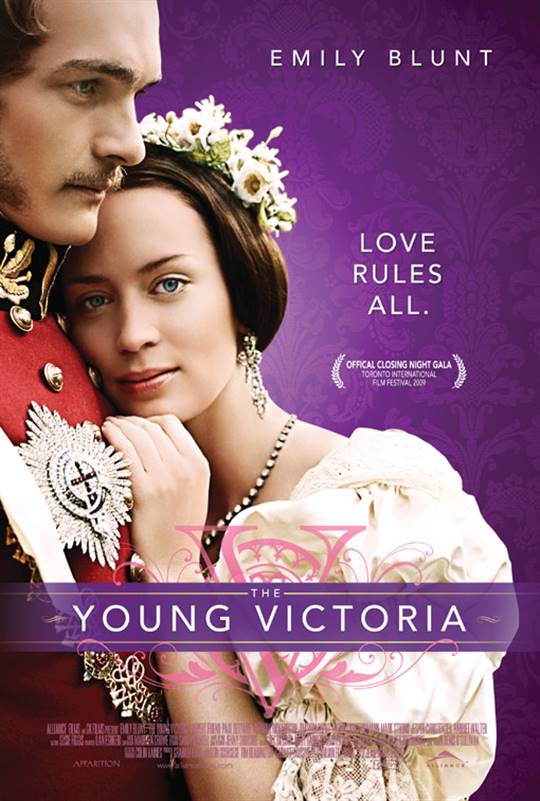
The Young Victoria (2009)

Emily Blunt and Rupert Friend play the royal couple in the cozy The Young Victoria

Director: Jean-Marc Vallée

Cast: Emily Blunt (Queen Victoria), Rupert Friend (Prince Albert), Paul Bettany (Lord Melbourne), Miranda Richardson (Duchess of Kent), Mark Strong (Sir John Conroy), Jim Broadbent (King William IV), Harriet Walter (Queen Adelaide), Thomas Kretschmann (King Leopold), Jesper Christensen (Baron Stockmar), Jeanette Hain (Baroness Lehzen), Julian Glover (Lord Wellington), Michael Maloney (Sir Robert Peel), Michel Huisman (Prince Ernest), Rachael Stirling (Duchess of Sutherland)

Now ITV’s Victoria exists, it’s a bit strange to go back and watch The Young Victoria. With the love today of long-form drama, and the time it can invest in things, it’s funny to see what the drama took almost 8 hours to do being crammed into an hour and a half here. But saying that, The Young Victoria is still an entertaining, luscious viewing experience which, while it has some strange ideas about certain events, is the sort of relaxing Sunday afternoon viewing that will take you out of yourself.

After the death of William IV (a slightly overripe Jim Broadbent), Victoria (Emily Blunt) is elevated to the throne. Finally able to shed the control of her mother’s (Miranda Richardson) domineering secretary Sir John Conway (Mark Strong), Victoria is determined to steer her own course. But she is surrounded by competing influences, not least from the charming arch-politician Lord Melbourne (Paul Bettany). King Leopold of Belgium (Thomas Kretschmann) dispatches his nephew Prince Albert (Rupert Friend) to England with the express interest of marrying Victoria and controlling her – but Albert and Victoria find themselves as kindred spirits, supporting each other to rule.

The Young Victoria is the epitome of prestige costume dramas. It looks fantastic, the cinematography is ravishing, the production and costume design exquisite. It’s pretty clear what the producers thought would sell the picture abroad. The royal regalia is pushed very much to the fore, and we get some wonderfully sweeping scenes, not least an impressively large-scale coronation. The soundtrack brilliantly riffs on Handel, and Julian Fellowes’ script mixes period regal style with a sweeping feeling of romance between Victoria and Albert.

The film actually does a very good job of repositioning Victoria as a young woman, and gives her a strong quality of self-determination and a desire to be herself in a man’s world. It’s really helped in this by the combination of imperial strength, girlish wilfulness and sharp intelligence Emily Blunt brings to the role. Blunt and the film also aren’t afraid to show that, however much Victoria had guts and determination, she was also quite a headstrong woman not above making emotionally led mistaken decisions. In fact, much of the drama spins out of Victoria learning to try and put these youthful crushes and prejudices aside.

Having said that, it’s interesting that the successful conclusion of the film centres on Victoria accepting that she needs the help of Albert to run the kingdom, and that she needs to remove competing influences for her affection – Melbourne and Lehzen – to focus her affection and loyalty on him. The film frames this as a winning romance and a successful partnership (which it was) – but it’s also vaguely creepy if you think about it. Mind you, since all the affectionate influences on Victoria are implied by the script to be at least partly motivated by self-interest, with the possible exception (eventually) of Albert, it manages to suggest this was for the best.

Albert’s background gets some interesting exploration here. He’s very much presented at first as the tool of Leopold as a means of controlling British politics. But he is far too independent, smart and noble to ever be the means of manipulation. Friend is very good here – his performance is quiet, authoritative but also heartfelt. Fellowes guilds the lily a bit to show his devotion by having Albert shot by a would-be assassin late-on in the film. Historically the assassin’s pistol wasn’t loaded, and Albert didn’t get shot (though Fellowes protests Albert didput himself in front of Victoria and that this intent is what’s important, not whether he was shot or not) but the moment does work – it gives the drama a boost and it’s undeniably moving.

While Albert is presented overwhelmingly sympathetically, interestingly Lord Melbourne gets quite a kicking. Paul Bettany is presented far more as a rival love interest than the sort of father-figure Melbourne was in real life (Bettany is probably 20 years younger than the real Prime Minister). Melbourne is shown as cynical, controlling, manipulative and overwhelmingly motivated by self-interest (a few more pushes and he would virtually become the film’s villain). He’s constantly contrasted negatively with Michael Maloney’s upright, honest Sir Robert Peel (one of my favourite statesmen of the 19th century so at least I’m pleased) – and his relationship with Victoria is one of self-promotion, which seems odd seeing as historically the two of them were so close. 

The film introduces other villains for us to hiss at. Kretschmann and Christensen do a good job as arch political schemers. Our real villain though is Mark Strong, who does a great job of scowling, controlling nastiness as the failed-bully Sir John Conroy. Strong’s performance works so well because he makes it clear that Conroy feels that his “Kensington System” (an attempt to manipulate and cow Princess Victoria into being a submissive puppet) is genuinely in her best interest, and that he genuinely cares for her. His partnership with Miranda Richardson as Victoria’s near-love-struck mother works very well.

The Young Victoriathrows in enough interesting character beats like this for it to really work as an enjoyable afternoon period-drama. With some great performances – Emily Blunt carries the movie brilliantly – and while some of the historical characterisation is a bit off, and other moments feel a little too chocolate box it’s a very entertaining, undemanding view., it’s great fun. The hardcore Victorian costume-drama fans will probably prefer Victoriafor the same story in more depth – but this film does it with great sweep (and doesn’t cram in Victoria’s stupid below-stairs plotlines!).

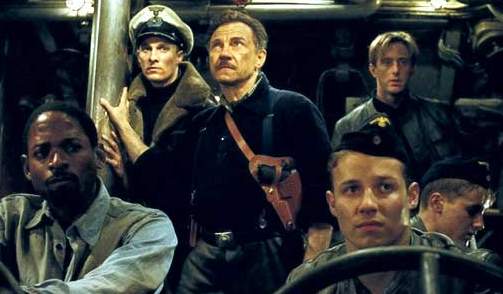
U-571 (2000)


Matthew McConaughey and Harvey Keitel crack the Engima Code. With lots of guns. And no maths at all.

Director: Jonathan Mostow

Cast: Matthew McConaughey (Lt. Andrew Tyler), Bill Paxton (Lt. Com. Mike Dahlgren), Harvey Keitel (Chief Henry Klough), Jon Bon Jovi (Lt. Peter Emmett), David Keith (Major Matthew Coonan), Jake Weber (Lt. Michael Hirsch), Jack Noseworth (Bill Wentz), Erik Palladino (Anthony Mazzola), Thomas Kretschmann (Capt. Gunther Wassner)


On its release, U-571 was something of a sensational scandal– and in fact gained far more attention than a fairly standard submarine movie probably deserved. Why is that? Because it epitomised the perception in this country of American films taking war achievements from us poor Brits and giving them to Yankee heroes. Was this annoying for a British people all to used (it seemed) to having their war contribution lost in the crush of American films? You betcha.

During World War 2, Lt. Andrew Tyler (Matthew McConaughey) is sent to lead a team of American sailors to capture an Enigma machine from a stranded German sub. The Enigma machine, and the inability of the Allies to break it, is losing America (whose involvement in the war has been moved forward for the purposes of this story) the war after all. However, the mission swiftly goes wrong and Tyler is left commanding a rogue bunch of terrified sailors on the captured German submarine, trying to get the Engima machine back to the US Navy before its loss is discovered. All that is missing is Alan Turing reinvented as a hard-boiled Brooklyner totting a machine gun and shouting “I gotta Bombe for ya, ya Kraut Bastards!”.

The movie itself is not too bad, to be honest. although nothing special. The expected clichés of the submarine are all there: the fears about water pressure, claustrophobia, a sequence where the boat sinks inexorably towards the bottom of the ocean, torpedoes in the water, depth charges, “right full rudder”, sonar pings, water gushing from pipes, someone having to undertake a vital repair underwater with limited air supply etc etc. – it’s all been done before, from Enemy Below to Crimson Tide. Saying that, Jonathan Mostow knows how to cut the heck out of a movie and as a result this charges forward with a relentless energy which works rather well and makes this a suitably tense film. Special mention also goes to the sound editing, which won an Oscar for its brilliant creation of the aural impact of everything from depth charges to torpedoes scraping hulls.

Of course the story itself is nothing unique: even the personal plot lines are largely recycled from other movies: will McConaughey’s young XO be placed in a situation where he has to prove his chops as a commander? You bet he will! Keitel is an Old Sea Dog, Paxton is a fatherly Captain, Kretschmann is a cold professional German – but the actors play these well shuffled stock characters with an admirable level of commitment. The film has a great “Dirty Dozen” vibe to it, and does manage to throw in a couple of surprises about character fates. For those of us who love the predictable trotted out with po-faced commitment and energy, it’s hard not to be entertained.

There are some well-done (if unsurprising) scenes as Tyler struggles with his authority over men who don’t have trust in him and are terrified of getting killed. It’s interesting how much the film asks us to invest in essentially willing Tyler (a decent performance by McConaughey) to have the guts to send a man to his death for the good of the ship. Centring this moral dilemma as a crucial qualification for leadership at least means the film does take a honest look at the complexities of command to counter the boys’-own heroics elsewhere. Saying that, the almost pathological mutinous rumblings of Seaman Mazzola against an officer we are told early in the film is “popular with the men” does seem rather sudden – possibly because making Tyler a distant stick-in-the-mud (which he would need to be for the level of rejection from the crew to really work) rather than a regular Joe might have made us less likely to root for him at the start.

Of course all of this seems pretty inconsequential next to the real issue of the film, which is its historical accuracy (or complete lack thereof). To be honest, the fury against the film’s appropriation of British Naval achievements is rather harder to sustain (a) nearly 20 years on and (b) when you see what an agenda-free, entertainment-only movie it is. Perhaps the real insult was that the crew of this mission contained actors like Jon Bon Jovi and the guy who played ER’s Dr Dave. But that doesn’t change the fact that this stuff didn’t happen, and the elements of the story that did certainly didn’t happen like this and were done by completely different people. It’s hard to shake the feeling, even while you enjoy the film, that it gives a false glory to the wrong people. If even a few people came out of it thinking the Americans cracked Engima (or that Engima was cracked like this rather than primarily by maths) it’s certainly a few people too many. 

As a side note, while reading up about the film before this review, I found that one of the screenwriters, David Ayer (now a purveyor of average WW2 films himself with Fury), had this to say about the controversy of the film’s re-writing of history: “[I do] not feel good…it was a distortion, a mercenary decision to create this parallel history in order to drive the movie for an American audience…Both my grandparents were officers in World War Two, and I would be personally offended if somebody distorted their achievements…I understand how important that event is to the UK, and I won’t do it again.”