Tag: Torin Thatcher

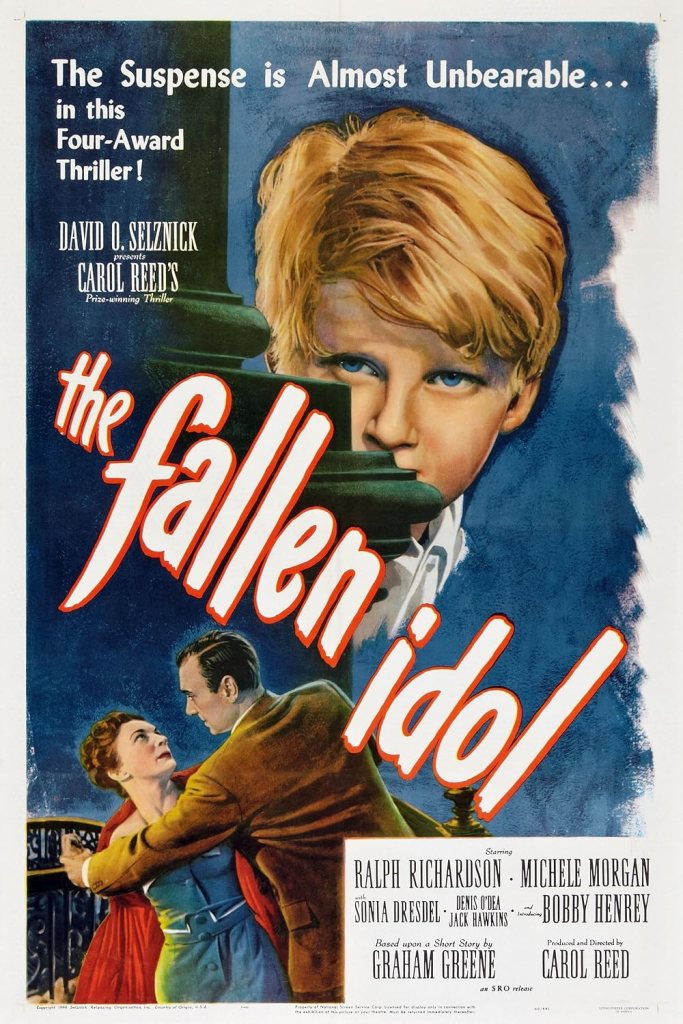
The Fallen Idol (1948)

The Fallen Idol (1948)

Brilliant thriller about how hard the world is for a child to understand

Director: Carol Reed

Cast: Ralph Richardson (Baines), Michèle Morgan (Julie), Sonia Dresdel (Mrs Baines), Bobby Henrey (Philippe), Denis O’Dea (Chief Inspector Crowe), Jack Hawkins (Detective Amos), Walter Fitzgerald (Dr Fenton), Dandy Nichols (Mrs Patterson), Geoffrey Keen (Detective Inspector Davis), Bernard Lee (Inspector Hart), Dora Bryan (Rose), Karel Stepanek (First Secretary), Torin Thatcher (Constable)
We’ve all had heroes we worship haven’t we? Few hero worships burn as brightly as a child’s. Eight-year-old Philippe (Bobby Henrey), son of a foreign ambassador in London, is awe-struck by the embassies English butler Baines (Ralph Richardson), a kind, decent man with a twinkle in his eye who enjoys spinning stories for Phil about his exciting life in India. The highlight of Phil’s day is spending time in Baines’ parlour. For Baines though, his highlights are the snatched moments of release from his domineering, unloving wife (a masterfully tough-to-like Sonia Dresdel) that he spends with embassy secretary Julie (Michèle Morgan).

The affair is obvious to us in seconds. But Phil – from whose perspective we see large amounts (but, crucially, not all) of the film play-out – is of course oblivious, readily accepting Baines awkward assurance Julie is just his niece. The Fallen Idol – the middle film in Reed’s astonishingly high-quality run of films that includes Odd Man Out and The Third Man – is a brilliantly tense, very moving story of how adrift children feel in the adult world, how easily they misinterpret signals and misread social cues. Superbly filmed, with a wonderful script by Graham Greene (from his own novel) it’s a masterclass in how the simplest situation can lead to the most intense drama.

It revolves around a fatal trap for Baines. Believing his wife is away for the weekend (she has in fact concealed herself in the embassy mansion), Baines treats himself to a day and night with Julie. Discovered, the confrontation leads to Mrs Baines dead at the bottom of the stairs. The argument is partially witnessed by Phil – but crucially, only glimpses of it as he runs down the exterior fire escape, peering in through windows as he goes – but in full by the viewer. It’s clearly a terrible accident, taking place after Baines had left. But Phil is convinced he has witnessed a murder – and so passionate is his hero worship of Baines (and loathing of Mrs Baines), he decides to do everything he can to protect the butler.

The genius of Reed’s The Fallen Idol is that we are always know more than any of the characters. Just as we can tell immediately from witnessing Baines and Julie’s whispered, Brief Encounter-ish meeting in a London coffee shop that they are in the midst of a passionate affair, so we also know much faster than any character that Mrs Baines is still in the house and that her death is a clumsy accident. We can also see, in ways Phil cannot, that his desperate lies only undermine Baines honest version of events. We know all the details well ahead of the police, watching them misinterpret clues and behaviour in the worst possible light. The entire film shows how damning circumstances and coincidences can fold up into a vice-like trap from which there is almost no escape.

The Fallen Idol is a film awash with lies. In many ways it’s a heartbreaking reveal of how quickly the compromises and selfishness of the adult world corrupts the child’s. At the heart of these lies is Baines himself. The role is beautifully played by Ralph Richardson, utilising his eccentric cuddliness to exceptional effect, but also perfectly capturing the selfishness, weakness and cowardice of Baines. Because Baines is a liar – not only to his wife, but also to Julie (he spectacularly lacks the guts to ask his wife for a divorce, despite what he tells Julie) and, walking Phil back after he has crashed Baines’ tea-time meeting with Julie, urgently instructs him to lie if he is ever asked about what happened that afternoon. Baines doubles down on his duplicity by using the unwitting Phil as a shield to cover a zoo-trip date with Julie, and even his adventure stories to Phil are all slightly self-aggrandizing tall tales.
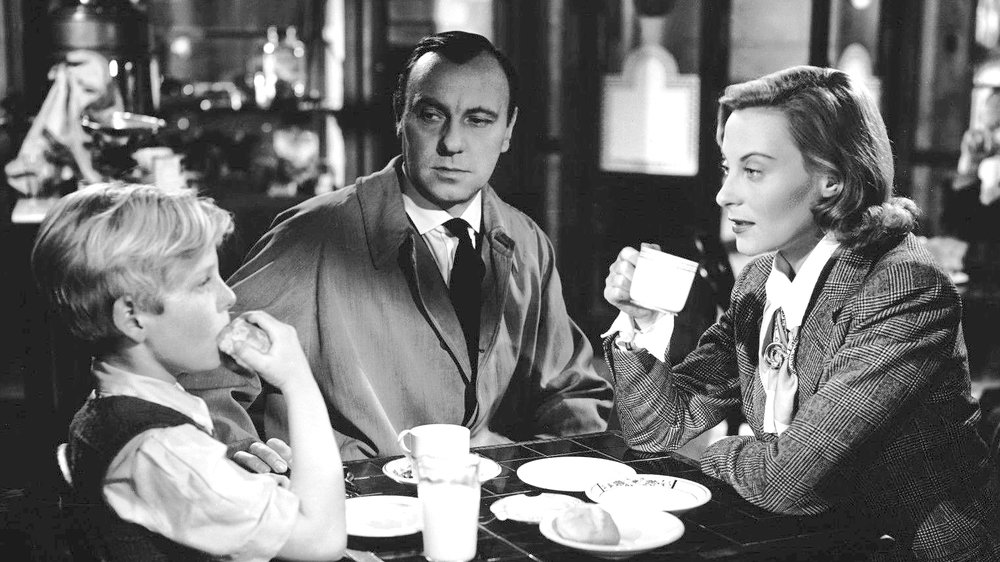
One of the toughest things about The Fallen Idol is that hero-worship is a confused one-way street, especially when children are involved. Baines is fond of Phil but often treats him with distracted affection out-of-kilter with the earnest, devoted adoration Phil pours on him. This devotion from Phil is so great, even his belief that his hero is a murderer makes no impact on him. Having taken his idol’s lessons to heart, about what to do when questioned about anything to do with Julie, Phil lies and lies to the investigating officers, corrupting himself (he believes, after all, he is helping a killer) while also making the innocent Baines seem guiltier-and-guiltier with every word.

Carol Reed draws a superbly natural performance from Bobby Henrey, in a performance utterly lacking in childish, mannered acting tricks. It’s a hugely natural performance, over-flowing with innocence making Phil a character we end up deeply caring for. The early half of the film throws us perfectly into the excited world of a child with a whole mansion to run around in, cuddling his pet snake close to his chest. Reed also brilliantly captures how a moment of trauma confuses and terrifies an innocent into not knowing what action to take. Fleeing the house barefoot – clearly terrified and heartbroken – immediately after the death, Phil is petrified when he encounters a policeman not because he is intimidated, but because he fears inadvertently betraying his idol.

Reed superbly captures the desperate vulnerability of children, the nightmare of not having your voice listened to as adults talk over and around you. The Fallen Idol (with its careful use of disjointed angles and God-like, wide-angle shots from above) has a superb sense of the horror of being caught in a situation you neither fully understand or can influence. It’s echoed perfectly by Baines’ increasingly defensive panic as each denial falls on all-too-obviously deaf ears. Phil also misinterprets almost everything he is told in the film, right up to when the sympathetic Julie (a lovely, warm performance from Michèle Morgan) begs him that only the truth can help Baines.

The Fallen Idol spices this up with superb moments of comedy. Dora Bryan has a delicious cameo as a ‘lady of the night’, called upon to by the flummoxed policemen at the station Phil has fled to, to try and draw some words out of the stubbornly silent child – and who can only fall back on the cliches of her profession (‘Can I take you home dearie?’). An Inspector (a lovely cameo from Bernard Lee) called in to translate in the embassy is begged by the first secretary to drop his inept schoolboy French. A tense interrogation of Baines is interrupted when a pedantic embassy staffer insists he must be allowed to check the clocks in the room (Reed wittily shows the characters revolving, clockwork like, impatiently on the spot in the background while this interminable check goes on).

But the great strength of The Fallen Idol is how it captures the joyful innocence of childhood and the Kafkaesque confusion the adult world can have on a child. Poor Phil never really understands anything that goes on (although the film ends with a sweet irony of Phil being the only person who perhaps understands a vital ‘clue’ only to be completely ignored) while we are always in complete understanding. Reed’s direction is faultless, both from his work with actors to his masterful use of camerawork and editing to really capture the confusing, unreadable adult-world from a child’s perspective. It’s a masterful, gripping, heart-rending film – a small scale classic that perfectly mixes tension and wit.

Love is a Many-Splendored Thing (1955)

Love is a Many-Splendored Thing (1955)

Very thin romantic drama that finds very little to offer beyond it’s set-up of “love across the divide”

Director: Henry King

Cast: William Holden (Mark Elliott), Jennifer Jones (Dr Han Suyin), Torin Thatcher (Humphrey Palmer-Jones), Isobel Elsom (Adeline Palmer-Jones), Murray Matherson (Dr John Keith), Virginia Gregg (Anne Richards), Richard Loo (Robert Hung), Soo Yong (Nora Hung), Philip Ahn (Third Uncle)

In 1940s Hong Kong, Eurasian Dr Han Suyin (Jennifer Jones) works at a respected hospital and carefully balances her relationship with the Chinese and Western expat communities. All of which is shaken up when she falls in love with American journalist Mark Elliott (William Holden). As China’s civil war sees the country turn Communist – and with war rumblings in Korea – can this love across the divide survive prejudice, Mark’s estranged wife and the disapproval of her friends?

Love is a Many-Splendored Thing was a box-office hit and scooped no fewer than eight nominations (including Best Picture) in a weak year at the Oscars. It won two of them for its main virtues: the lush, romantic score from Alfred Newman and its title song (which became a massive hit). Aside from that, it’s a very slight romance (with a tragic ending) based on Han Suyin’s autobiographical novel (Suyin, who sold the rights because she needed the money, refused to watch it).

It’s very much a film of its time. The focus is at least as much on the locations and wide-screen framing as it is on story (it was made slap-bang in the middle of the era when these were considered cinema’s unique selling point over TV). Before the script was even completed, a second unit team was dispatched with the stars to shoot wordless sequences on location, all to capture that Hong Kong atmosphere. Writer John Patrick and director Henry King’s job was then to build a narrative framework using as many of these as possible, inspired by the book.

What they came up with is as conventional as they come: essentially, two charming, attractive Hollywood stars meet, flirt, fall in love and face the consequences. Despite the earth-shattering events around them, very little intrudes into the story. The outbreak of Chinese Communism gets name checked a few times – one of Suyin’s colleagues at the hospital is a proud Commie – but only a few moments are spent on considering the impact this might have on Hong Kong or the expat community. Similarly, the Korean War might as well have been started by people who just wanted to drag William Holden away from romantic bliss.

Love is a Many-Splendored Thing has its chances to really tackle the racial element of this relationship. But bar a few small moments, it mostly avoids this. Sure, Suyin loses her job for largely unspecified reasons (the implication is there that it’s for crossing this racial divide), and she gets dragged across town to get a ticking off from the grand doyen of the expat community for flirting with a white man (although this could just as well be for the fact he’s separated but still married). But her Chinese family mostly accept Suyin’s relationship with little complaint, and far more easily than they do her cousin’s relationship with a foreigner (guess it’s because Mark is such a top bloke). The whole issue feels slightly swept, awkwardly, under the carpet – which just doesn’t feel true. For all its patronising heavy-handedness, at least Sayonara two years later really engaged with this theme.

But then, maybe it’s because Jennifer Jones doesn’t even look remotely Asian. Reportedly unhappy with her make-up, its toned down to such a subtle extent that honestly half the time she doesn’t look that different than she does in any other role. I suppose, today, we should thank our lucky stars they didn’t go the whole yellow-face hog, but it does look odd considering everyone else of even remotely Asian descent is played by an Asian-American actor.

Despite this, Jones is actually rather good as Suyin: intelligent, sensible and very surprised to find herself falling in love with someone so socially unsuitable for her as Mark appears to be. She’s compassionate, witty and knows her own mind, and if Jones is given a few too many speeches explaining Asian culture to Mark (or rather to the viewer), at least she delivers them with grace and gravitas. Holden is also good, even if he could play this dashing romantic role standing on his head.

Fascinatingly both stars, despite their convincing on-screen chemistry, couldn’t stand each other. As well as having incompatible working styles – Jones was details oriented, Holden more instinctive – they failed to bond personally. (Jones reported she ate garlic to annoy famed lothario Holden, while Holden claimed a bunch of flowers he purchased Jones to clear the air were literally thrown back in his face.) It, surprisingly, doesn’t come across on screen, and the film’s strongest moments by far are the romantic ones between the two leads.

Fortunate, as that’s the meat of a film that barely has anything else on its bones during its swift runtime. King directs with a professional competent flatness that doesn’t give any additional life to the project. Aside from some decent romantic moments atop the couple’s favourite hill and a swimming sequence (obviously imitating From Here to Eternity but without an ounce of that film’s dynamism and sexiness) there is little to keep drawing you back.

Love is a Many-Splendored Thing settles for being a reassuring, lightweight romance, in which two handsome people, in luscious locations, fall in love. It offers very little outside of that, so basically your enjoyment of the film will be decided by how much that sort of thing wins you over. If you want more from your romances, it’s not for you.

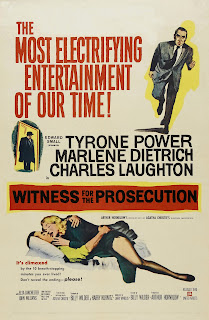
Witness for the Prosecution (1957)

Witness for the Prosecution (1957)

A court case hinges on a heck of a twist or two in Wilder’s well-mounted Christie adaptation

Director: Billy Wilder

Cast: Tyrone Power (Leonard Vole), Marlene Dietrich (Christine Vole), Charles Laughton (Sir Wilfrid Robarts), Elsa Lanchester (Miss Plimsoll), John Williams (Mr Brogan-Moore), Henry Daniell (Mr Mayhew), Ian Wolfe (Carter), Torin Thatcher (Mr Myers QC), Norma Vaden (Emily Jane French), Una O’Connor (Janet McKenzie), Francis Compton (Justice Wainwright)

Agatha Christie is better known for detectives who unearth murderers, not lawyers defending those accused in court. But that doesn’t mean Witness for the Prosecution, a very effective courtroom drama, shirks on classic Christie flourishes. Witness has a single stonking twist that huge numbers of people never see coming (the end of the film comes with a sonorous warning entreating people not to spoil the surprises, the sort of anti-spoiler warning that would make Marvel proud).

Leonard Vole (an unlikely Tyrone Power) is the soldier and would be entrepreneur, who stands accused of the murder of a rich older woman (Norma Vaden) who conveniently left Vole her money. Defending Vole is richly-toned, highly-skilled barrister Sir Wilfrid Robarts (Charles Laughton), recovering from a heart attack and doing his very best to dodge the overly attentive concern of his private nurse Miss Plimsoll (Elsa Lanchester). Vole’s case looks difficult, with much circumstantial evidence stacked against him and worries about whether his German wife Christine (Marlene Dietrich) will stand by him or not?

Billy Wilder directs with a smooth professionalism – he later modestly claimed of his Oscar nomination, that it was like giving the crew that moved Michelangelo’s Pietá an award for best sculpture – but his real contribution (with fellow writer Harry Kurnitz) was sharpening the dialogue, expanding Christie’s characterisation (in particular adding much more shrewdness and eccentric pomposity to Robarts) and upping the zip of Christie’s original. It certainly met with the approval of the grandé dame of crime who listed this, and Lumet’s Murder on the Orient Express, as the only two adaptations of her work she liked.

The film is largely based around the courtroom dynamics, as witnesses are examined and cross examined and facts gently dragged into the light. There is plenty of quality theatrics, not least since Robarts and his opposition counsel Myers (a fearsome Torin Thatcher) are more than a little skilled at keeping things sparky for the jury. There is a hint of cynicism in Witness: Robarts needs to convinces himself of a client’s innocence, but there is a suggestion this is because it helps him work out how to effectively defend them, less because of any moral reasons. And certainly, the entire mechanics of the trial operates largely as a show, an entertainment with jokes and compelling stories offered by both sides.

There is of course no better showman than Robarts. Played by Charles Laughton in one of his last great – and possibly most enjoyable – performance, Robarts is an affectionate, witty performance of carefully studied eccentricity and barking bluffness. But there is also a vulnerability in him: Robarts needs to belief in his own legend and his ability to separate truth from lie (he even prides himself on his “monacle test”, using a reflection from it to shine in suspects eyes, believing a liar will get flustered and trip themselves up – needless to say it turns out to be faulty).

Wilder – with Laughton as a brilliant collaborator – transforms Robarts into a far more forceful and charismatic figure, making the late plot twists even more of a shock. If someone as professionally adept and plugged in as Robarts can be taken in, what chance do the rest of us have? Oscar-nominated, Laughton, a twinkle permanently in his eye, powers through moments of high court theatricality but also heartily enjoys the banter of real life, taking a real delight in his schoolboy mischief as he persists in having his own way.

A large part of that, is a running of dodging treatments and sticking to a diet of things that are bad with him. Wilder’s finest change from the original, in introducing Robart’s ill health and his love-hate relationship with his nurse Miss Plimsoll. Who is, of course, played by Elsa Lanchester, Laughton’s real-life wife. The chemistry between these two is spot-on, with Lanchester (also Oscar nominated – and unlucky to lose to Miyoski Umeshi in Sayonara) in particular playing the combination of world-weary exasperation and growing affection for Robarts perfectly.

Combined with those twists, it’s the interplay between these two that is the real highlight in the film – well that and the twists. Many of those twists are bound up with Marlene Dietrich’s character. Dietrich gives one of her most colourful and wide-ranging performances here. The secrecy of the film probably stopped her from landing an Oscar nomination (much to her regret – Wilder even apologised to her). Power is miscast – he lacks the required natural innocence and looks both too old and incongruously American – but fortunately spends most of the film in the dock.

The final twist is a doozy, perfectly delivered by the actors and Wilder. Wilder directs throughout with quiet authority – as well as fine sense of humour, in particular a stair lift scene that sees Robarts using the device as a tool to dodge being told what to do. Laughton and Lanchester in particular are wonderfully funny. It’s got some excellently handled courtroom tricks and you won’t forget how it turns out. It’s a solid example of Wilder’s skill behind the camera – but a very enjoyable film and a must for Christie fans.