

Entertaining melodrama leads into a very well-staged disaster epic that burns a city
Director: Henry King
Cast: Tyrone Power (Dion O’Leary), Alice Faye (Belle Fawcett), Don Ameche (Jack O’Leary), Alice Brady (Molly O’Leary), Phyllis Brooks (Ann Colby), Andy Devine (Pickle Bixby), Brian Donlevy (Gil Warren), Tom Brown (Bob O’Leary), Berton Churchill (Senator Colby), Sidney Blackmer (General Phil Sheridan)

San Francisco showed Hollywood the way: spice up a melodrama with a disaster-laden ending. The first took the San Francisco earthquake: In Old Chicago takes the Great Chicago Fire of 1871 which burnt down over three-square miles of the city, destroyed over 17,000 buildings and killed over 300 peoples. Despite a rather earnest message that research was scrupulously carried out with the Chicago Historical Society – other than the fire itself, the entire film is a great big fictionalised soapy melodrama, building towards a grandly staged recreation of the great conflagration itself.
The melodrama is built around the O’Leary family. In legend Mrs Catherine O’Leary, of the city’s large Irish community, was the fire’s unwitting cause after her cow knocked over a barn lamp. Here she is reimagined as Molly (Alice Brady), mother to a flock of sons. In the way of these melodramas one, Dion (Tyone Power), is a cheeky rogue with criminal links the other, Jack (Don Ameche), is a legal straight-shooter determined to clean this town up. Club owner Dion controls a stack of corrupt votes to get Jack elected Mayor – screwing over kingpin rival Gil Warren (Brian Donlevy) in the process – under the mistaken impression he can control his brother (dead wrong). Meantime, Dion bounces through a heated love-hate relationship with glamourous bar-singer Belle (Alice Faye), who knows a little too much about his corrupt dealings.
These elements are expertly melodramatically mixed together with very few narrative surprises to establish some recognisable faces for when the city-burning destruction kicks in, with its punishments and redemptions. King directs all this with a glitzy, big-budget flair while the shallow characters go through familiar motions. Truth be told, there isn’t much especially new about In Old Chicago, which follows the San Francisco model to a tee with soapy personal rivalries (skimming the surface of Chicago’s corruption) beefed up with (fairly forgettable) songs from Alice Faye. There’s even a literally soap-sud filled transition at the start to take us into a superbly re-constructed nineteenth century Chicago, in a film full of impressive production design. But yet, don’t get me wrong, it’s all done with such energy it’s consistently enjoyable.
The two brothers are, of course, studies in contrast (third brother, Tom Brown’s Bob is so decently dull he barely makes any impression). As the ‘bad’ brother, Tyrone Power enjoys himself as a lip-smacking cad obsessed with power. Smirking and full of self-satisfaction at his own cleverness (not as clever as he thinks), he’s a ruthless liar and manipulator who deceives everyone around him: his brothers, the woman he loves, his political allies and rivals. It’s one of Power’s most engaging performances, successfully making Dion the sort of bastard you love to hate without ever making him utterly deplorable. In fact, he feels like a big kid (and a mummy’s boy at that), literally leaning back in his chair and expecting praise for his cleverness.
Opposite him, Don Ameche is saddled with the impossibly noble Jack, a crusading lawyer (who wouldn’t think of charging low-earning clients) and who wants to become Mayor to change the town for the better. His straitlaced decency is constantly thrown off by his brother’s dastardly lack of principle (their relationship eventually culminates in an entertainingly well-staged, no holds-barred fisticuff scuffle). Ameche does a good job of investing depth in this on-paper rather dull character.
The film presents an entertainingly straight-forward picture of machine politics, with votes controlled by bosses, various voters encouraged to register (and vote) multiple times and bosses controlling vast teams of followers. Brian Donlevy brings a very fine sense of arrogant domination to would-be boss Gill Warren (the sort of guy who casually mentions a rival’s bar looks rather flammable during a shake-down). It’s all very much presented as bad apples spoiling the whole barrel (rather than the whole system being a bucket of corrupt snakes), but fun nevertheless.
The romance comes between Dion and Belle, played with a decent mix of rascally bad-girl and misunderstood decency be Alice Faye. Faye (taking over the role at short notice from the late Jean Harlow) gets a few decent songs but the meat of the role is her love-struck switching between adoring and loathing Dion, who (with his flirtation with Senator’s daughter Ann Colby, played by Phyllis Brooks) barely deserves her. Some of Dion’s initial courting – consisting of sneaking into her carriage, pinning her down and kissing her – hardly feels comfortable now, but it supports a neat running joke of Belle’s maid running for help only to return to find the two locked in a passionate embrace.
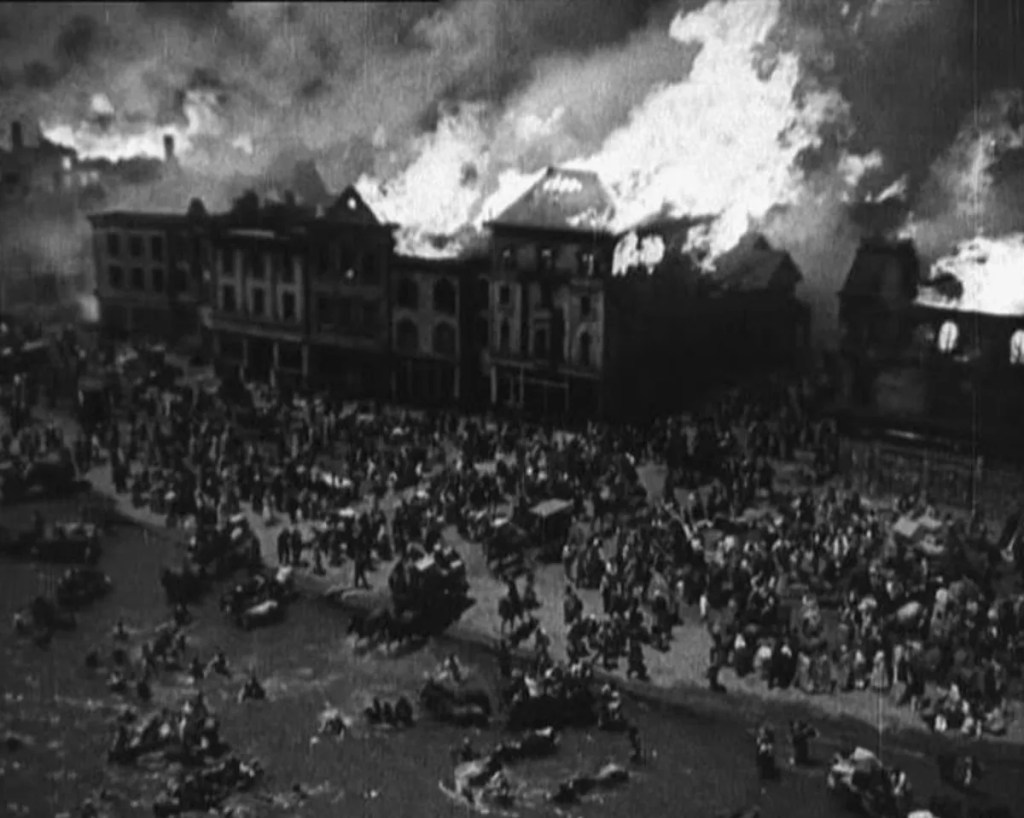
But all of this is just build-up for the main event: an impressively staged reconstruction of the Great Fire. Shot with a mix of real sets and models – you can see where the money was spent on (briefly) the most expensive film ever made. It throws at us buildings aflame, crashing to the ground, huge crowds of extras charging past the camera in tracking shots, a panicked army of bulls fleeing (and crushing those unlucky enough to get in the way). This sequence is genuinely grippingly put-together and impressively epic, utilising some very effective aerial model shots of the city to establish the scale of the fire and the devastation. It balances culminating its plot threads at the same time as embracing the disaster excitement.
This end sequence makes the slightly patchy, familiar soap beforehand retrospectively work even better. It certainly helped deliver a box office bonanza for the film – just as Alice Brady’s closing speech about the unbeatable spirit of Chicago probably helped her to an Oscar (it’s a part Brady clearly enjoys, cementing a stereotype of the domineering Irish mother). After San Francisco, In Old Chicago proved entertaining disaster epics could thrill audiences with destruction for years to come.


 Movie Musings