Tag: Yahya Abdul-Mateen II

The Matrix: Resurrections (2021)

The Matrix: Resurrections (2021)

We saddle up one more time for this belated sequel, which does enough to be the second-best film in the franchise

Director: Lana Wachowski

Cast: Keanu Reeves (Thomas Anderson/Neo), Carrie-Anne Moss (Tiffany/Trinity), Yahya Abdul-Mateen II (Morpheus/Agent Smith), Jessica Henwick (Bugs), Jonathan Groff (Smith), Neil Patrick Harris (The Analyst), Priyanka Chopra Jones (Sati), Jada Pinkett Smith (Niobe), Toby Onwumere (Sequoia), Max Riemelt (Sheperd), Brain J Smith (Berg), Erendia Ibarra (Lexy), Lambert Wilson (The Merovingian), Christina Ricci (Gwyn de Vere)
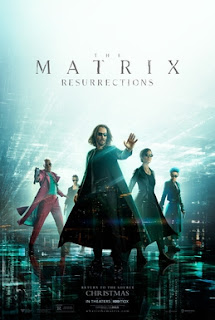
Thomas Anderson (Keanu Reeves) is the most famous games designer in the world. His award-winning game The Matrix revolutionised the genre, but now he needs to make a sequel. But Anderson is juggling all sorts of depression, chugging blue pills like there’s no tomorrow in order to keep back disturbing feelings and sensations that there is more to that Matrixconcept than he remembers. Was it in fact closer to reality? Why is he so drawn to Tiffany (Carrie-Anne Moss) the woman he sees in his coffee shop? Why is he unsettled by his business partner Smith (Jonathan Groff)? Should he follow the White Rabbit?

Bringing The Matrix back is a tough ask. It’s been well over twenty years since the first film revolutionised action and sci-fi – and then the two sequels managed to progressively strip out any of the fun, romance and wonder from the original. Now Resurrections attempts to put it all back in again. It’s a noble attempt – and this is easily the second-best Matrix film – but there is still an air of obligation about the whole thing.

It’s hard to escape that feeling from the on-the-nose opening act, which literally includes dialogue from Smith to Anderson to the tune of: ‘Our parent company, Warner Brothers, say they want a sequel to The Matrix and they’re going to do it with or without us, so we might as well come up with an idea’. Partially set in a new Matrix where the events of The Matrix form the basis of an award-winning game everyone knows by heart, characters constantly riff excitedly on how some events in this film parallel those in the first film (always the first film). There is a spit-ball planning session at Anderson’s workplace, where his design team bounce phrases like “Guns. Lots of Guns” at each other or playfully mime out bullet time. I suppose this relates to Wachowski’s experience of having the Studio for years demand a fresh new Matrix film. But it is a little on-the-nose.

The self-reverential nature of the film continues throughout. From an opening that sees Hacker Bugs (a very good Jessica Henwick) watch a simulation of the opening of the first Matrix film – with a few changes – a mixture of homage and nostalgia runs through the film. As an alliance of humans, machines and programmes try to free Anderson/Neo from his new Matrix cage, they ease him in by playing (on huge projector screens) iconic scenes from The Matrix. Anderson’s flashes of memory, as things start to fall in place, are full of flashbacks to the earlier films. When Neo arrives in the real world, he finds himself in a dystopian future where he is a celebrity, and the events of his life are as much a part of this world’s folklore, as memories of the plot of the original trilogy is in the minds of my generation watching the film.

It’s quite a tribute that the film manages to keep all this self-reverential stuff balanced and neither becoming too annoying or collapsing in on itself. It does so because Wachowski manages to keep it playful. She’s clearly learned from the legacy of the two Matrix sequels, that puffed themselves up so much they burst. This features some discussions around truth, reality and choice but keeps them low-key and free of sequel’s aura of pomposity. It wisely (and plot logically) depowers Neo so that he is no longer completely invulnerable. It again makes him an outsider, fighting against a dominant system that seems to hold all the cards. And it puts at its heart a battle of two people to be together.

It’s also lovely to see Reeves and Moss back in these roles, which they fit back into with a charming ease and comfort – and also to see that their chemistry still exists. The plot of the film is at times garbled and even poorly communicated – it is very hard at times to understand why things are happening or what the rules are in this new Matrix (and its particularly hard to understand the plot around Smith, and how, if at all, he is restrained within this Matrix). But what you do understand is the emotional imperative that lies behind these characters actions – in a way that was often lost in the two original sequels.

The film also manages to keep more than its share of inventive action set-pieces. While its ending – a motorbike chase through a city where the whole population is turned against our heroes – feels very reminiscent of other things we’ve seen, earlier set-pieces use a lot more invention. In particular there is a very neat innovation of doors that jump thousands of miles – and see the characters move from one orientation to another as they pass through them. A chase through these allows for some dynamic movements and more than enough of the gravity defying bouncing and gunplay the franchise is famous for. New actors do very good jobs, in particular Henwick and Yahya Abdul-Mateen II as a new version of Morpheus and Jonathan Groff as a twist on Smith.

But Resurrections feels like a dutiful film and it’s laced with the odd clunky scene (none more so than a reappearance of Lambert Wilson, ranting direct to the audience about social media) and the odd gap in logic and plot definition. Its main problem is that it never feels essential. To bring the franchise back after all this time, into a world where its cultural cache has declined, you feel it needed to do something really special or redefining. It doesn’t really do this: it seems more interested in riffing on the past rather than building a future. It’s a reassuring film that hews closely to the plot and structure of the original film (deliberately so, with the characters even refencing similarities) that isn’t going to scare or annoy the fans – but also (and the film’s box office failure supports this) also not going to win over new converts. But it’s still the second-best film.

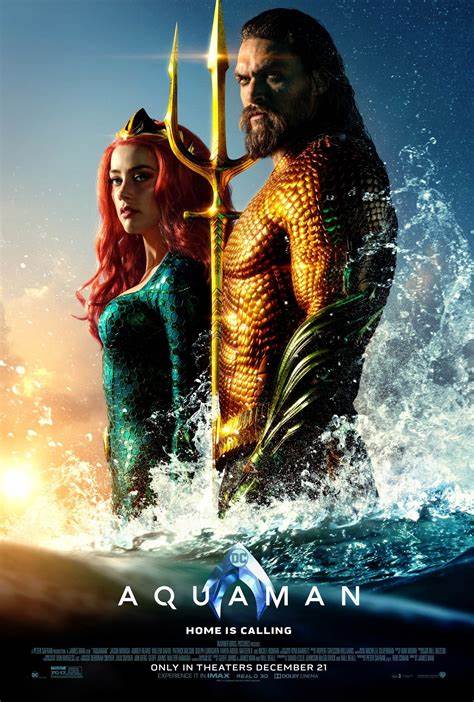
Aquaman (2018)

Jason Momoa takes himself rather seriously in the deeply silly Aquaman

Director: James Wan

Cast: Jason Momoa (Arthur Curry/Aquaman), Amber Heard (Mera), Willem Dafoe (Nuidis Vulko), Patrick Wilson (Orm Marius), Dolph Lundgren (King Nereus), Yahya Abdul-Mateen II (David Kane/Black Manta), Ludi Lin (Captain Murk), Temuera Morrison (Thomas Curry), Nicole Kidman (Queen Atlanna), Micheal Beach (Jesse Kane), Julie Andrews (Karathen)

After helping the rest of the Justice League save the world Arthur Curry aka Aquaman (Jason Momoa) is quite the celebrity. Curry is the son of lighthouse keeper Thomas (Temuera Morrison) and Atlantian Queen Atlanna (Nicole Kidman), who fled her unloved husband and his underwater kingdom but was recaptured when Arthur was young. Her other son Orm (Patrick Wilson) is now King of Atlantis, planning to lead the forces of the sea in a war against those on land. Can Arthur and Orm’s unwilling betrothed Mera (Amber Heard) combine to prevent a war? And will Arthur become a worthy hero?

Aquaman makes a valiant effort to embrace perhaps the silliest set-up for a comic book novel yet. Based around a massive, technologically advanced underwater kingdom that has (inexplicably) remained silent and secret for thousands of years, who inhabitants all seem to have superhuman strength and magical skills (guess it must be all that water pressure), the film at times is hard to take seriously. But it sort of gets away with it, as Wan leans into the tongue-in-cheek campness of all this (and I’m amazed how camp these Atlantians are) and asks us not to take anything we see that seriously, but just to sit back and enjoy the ride.

And the film is basically just a big ride, as we travel from place-to-place and watch Aquaman hit things in various under-water and above ground locations, while keeping up a bit of rapid-fire banter that will flower (but of course!) into an opposites-attract romance with Mera. One thing Wan does very well is to find a way to present the various fights in a style I’ve not seen before. The showpiece one-on-ones take place in a series of incredibly smooth one-shots, which twist and glide around our heroes while they despatch countless foes and, in one impressive show-piece, in and out and across buildings during a fight in an Italian cliff-side town. The ending may be your typical CGI smackdown, but Wan’s presents the fights in a way that actually looks different and excites a bit of awe.

Where the film is less successful is in its slightly tired coming-of-age/proving-his-worth/resolving-his-loss storyline, which offers few surprises. Try as I might, I can’t find Jason Momoa a charming enough actor to effectively make me invest in his character. Compare him to Dwayne Johnson, who is always willing to laugh at himself and is the very embodiment of charming self-awareness. Momoa takes himself very seriously – he always needs to be the coolest guy in the room – and his air of cocky self-importance sometimes jars in a film as dopey as this one.

This also means the film fails to sell a real plot arc for Aquaman himself. Its nominally about a character learning to acknowledge his mistakes, vulnerability and inability to go-it-alone. This doesn’t always feel earned and sometimes emotionally confused. One of Aquaman’s earliest acts is to let the ruthless father of a hijacker (a scowlingly charismatic Yahya Abdul-Mateen II) drown. Later he expresses regret for doing this as, by making an enemy, he endangered Mera. Not regret because it was wrong to let the man die, but a sociopathic concern for his loved ones rather than someone else’s. The character’s growth never really convinces – he still seems like the same cocky maverick at the end than he was at the beginning, rather than someone who has matured into a real leader.

But aside from these doubts, this is a big silly pantomime pretty much told with the right balance between seriousness and tongue-in-cheek. Amber Heard mixes heroism with a dopey, flower-eating sweetness as Mera. Willem Dafoe constantly looks like he’s about to snigger as a wetsuit glad Grand Vizier. There is something rather lovable about a film so eclectic in its cast that Julie Andrews (of all people) voices a sea monster and Dolph Lundgren tackles King Nereus like it’s his shot at Macbeth.

Bangs, booms and few jokes carry us through a deeply silly but enjoyable film. There is a great deal of visual imagination for the sea kingdoms, a mix of Greek inspired nonsense and space-ship bombast. Wan pretty much throws the kitchen sink at the screen, and while it’s definitely rather too long it’s also bubbling with just as much tongue-in-cheek fun that you roll with it. Nothing here reinvents the wheel – and the plot often feels like a rather clumsy after-thought – but it’s still an entertaining wheel.

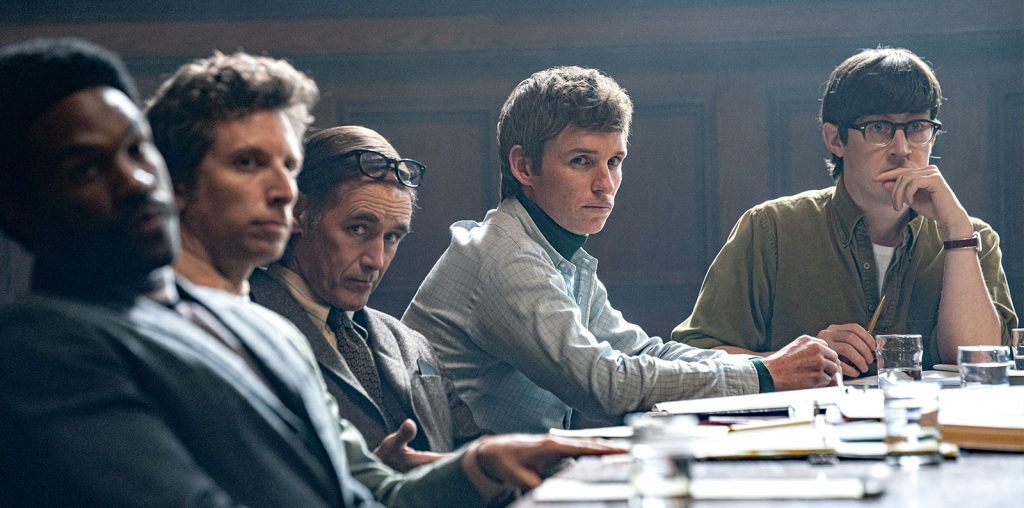
The Trial of the Chicago 7 (2020)

Sacha Baron Cohen leads a campaign for justice in Aaron Sorkin’s The Trial of the Chicago 7

Director: Aaron Sorkin

Cast: Eddie Redmayne (Tom Hayden), Sacha Baron Cohen (Abbie Hoffman), Joseph Gordon-Levitt (Richard Schultz), Mark Rylance (William Kunstler), Yahya Abdul-Mateen II (Bobby Seale), Michael Keaton (Ramsey Clark), Frank Langella (Judge Julius Hoffman), John Carroll Lynch (David Dellinger), JC MacKenzie (Tom Foran), Alex Sharp (Rennie Davis), Ben Shenkman (Leonard Weinglass), Jeremy Strong (Jerry Rubin), Kelvin Harrison Jnr (Fred Hampton), Noah Robbins (Lee Weiner), Daniel Flaherty (John Froines), Caitlin Fitzgerald (Daphne O’Connor)

Aaron Sorkin’s work celebrates the great liberal possibilities of America. Is there any writer who has more faith in the institutions of the American state – while being so doubtful of many of the actual people running those institutions? You can imagine Sorkin sees more than a bit of himself in Abbie Hoffman, jocular prankster and wordsmith, angry at his country in the way only someone who really loves it can be. This idea is at the heart of Sorkin’s biopic of the trial of seven activists for promoting violence in the build-up to the Democratic convention of 1968 in Chicago.

Vietnam is in full swing with young men dying in their thousands to defend a cause many are starting to believe isn’t worth it. Nixon has just been elected – and his government wants to make an example of these left-wing, hippies he believes are drowning out “the silent majority”. Student leaders Tom Hayden (Eddie Redmayne) and Rennie Davis (Alex Sharp), hippie activists Abbie Hoffman (Sacha Baron Cohen) and Jerry Rubin (Jeremy Strong), and pacifist David Dellinger (John Carroll Lynch) are arraigned in court for conspiracy to incite a riot, facing a ten year prison sentence. Black Panther Bobby Seale (Yahya Abdul-Mateen II), who wasn’t in Chicago at the time, is thrown in to make them look more threatening. With radical lawyer William Kunstler (Mark Rylance) in their corner, the defendants deal with a slanted case from the government, being backed all the way by the judge Julius Hoffman (Frank Langella) who can’t hide his contempt for them.

The Trial of the Chicago 7 feels like it’s on the cusp of making a grand statement about the rights and liberties of Americans, at a time of great civil unrest. With the country more divided now than it’s  ever been since the events of the film, this should be a timely message. But somehow the film doesn’t quite manage to deliver it. There is too much going on – an attempt to cover divisions in the left and counter-culture, the events in Chicago in 1968, the trial, clashes outside of court – it’s almost as if Sorkin the director has failed to marshal Sorkin the writer into making a clear and coherent thematic point. Instead the film becomes a chronicle of shocking courtroom events, affecting, but not as earth-shaking as it should be.

Part of this is the fragmented script. An occasional device is used, whereby Hoffman turns the events of the trial into a lively stand-up routine at some unspecified future point. This is a pretty neat idea as a framing device – however it only pops up at odd moments rather than giving a spine to the film (as well as missing the chance to filter events through the perception of one member of its sprawling cast). You end up thinking it’s just Sorkin the writer coming up with a way of giving us information Sorkin the director can’t work out how to do visually.

This tends to affect a lot of the stuff outside of the courtroom. Sorkin’s dialogue is surprisingly plodding here, too often ticking the boxes or establishing backstory and motivation that will play out later. He has his moments and his gift for capturing revealing details make for brilliantly inspired speeches and dialogue riffs that reveal acres of character while feeling very light. But, considering what he is capable with (and could have done with this material) it feels like autopilot.

That’s the problem here: it’s a little too pedestrian. Only an argument between frustrated liberal Hayden and his lawyer Kuntsler captures something of the dynamic pace of Sorkin at his best. Other scenes – such as an out of courtroom scene between decent just-doing-my-job prosecutor Richard Schulz (a low-key but very good Gordon-Levitt) and Hoffman and Rudin – are a little too on-the-nose in making their points about liberty, truth and justice. 

The strongest moments by far are in the courtroom – and the true-life staggering lack of proper procedure followed there. The film is rightly angry, without tipping too much into outright preaching. It’s shocking to see how little the rights of the defendants were respected. Much of this came from the attitude of the judge, Julius Hoffman: a traditionalist, his contempt for the defendants clear throughout, handing out contempt of court charges like sweeties. Frank Langella stands out as a man so convinced of his own morality – and so locked into his own certainty about right and wrong – that he is completely unaware many of his rulings are biased and is deeply hurt at being accused of racial imbalance, while having the only black defendant literally bound and gagged.

Yahya Abdul-Mateen II is superb as Bobby Searle, the Black Panther leader furious at being roped into the trial. Searle loudly – and vigorously – protests the trial has not been delayed to allow his lawyer to attend and that he has been refused (consistently) by the judge his right to represent himself. The treatment of him is shocking and appalling. But it feels like no attempt is made to put this in wider context either of civil rights at the time or in America since. And that feels like a major miss. We’re only a few degrees from the same effectively happening today.

This is part of the film’s general problem in finding its real focus, or wider context. I suspect its heart is probably in the views expressed by Hoffman on the stand – particularly those around not having his thoughts on trial before – but this film is too scatter-gun.

What the film does do well is with the quality of its performances. Sorkin may be a rather a visually flat director – his shooting of the convention riots completely fails to conceal the lack of budget – but he encourages great work from actors. Redmayne and Cohen give skilled performances as the acceptable and radical faces of left-wing politics. Strong is wonderful as a hippie with a firm sense of right and wrong, while Carroll Lynch is great as a pacifist driven to the edge. Mark Rylance excels as radical lawyer Kunstler, softly spoken but passionate, who brings fire to proceedings.

It’s a shame though that The Trial of the Chicago 7 settles for mostly being a walk-through of the trial. An attempt to really capture a sense of the deeper politics gets lost, and the failure of the film to really draw parallels with today or place these events in their wider context feels like a missed opportunity. Even the film’s end captions don’t give you as much information as you would hope – especially telling considering its abrupt ending. A well-meaning effort, but a middle-brow film.

Us (2019)

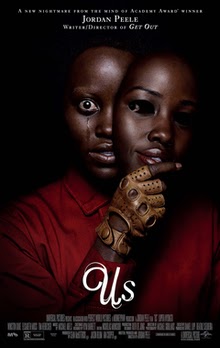
Lupita Nyong’o prepares to take on the dreaded Us

Director: Jordan Peele

Cast: Lupita Nyong’o (Adelaide Wilson), Winston Duke (Gabe Wilson), Shahadi Wright Joseph (Zora Wilson), Evan Alex (Jason Wilson), Elisabeth Moss (Kitty Tyler), Tim Heidecker (Rosh Tyler), Yahya Abdul-Mateen II (Russel Thomas), Anna Diop (Rayne Thomas), Madison Curry (Young Adelaide)

Jordan Peele’s Get Out is a tough film to follow. Smart, socially aware, funny, scary and haunting, it’s both one of the best horror films in years, and also one of the finest films made about modern America. It means his follow-up has some tough shoes to fill. Us perhaps doesn’t quite fill them as well, but judged on its own terms it’s another example of what a witty, skilled and intelligent film-maker Jordan Peele is and how skilfully he is able to both defy and define genre tropes.

The less you know about the plot the better, but Lupita Nyong’o plays Adelaide Wilson, a woman returning with her family to spend a holiday at Santa Cruz beach. While her husband Gabe (Winston Duke) and children Zora (Shahadi Wright Joseph) and Evan (Jason Wilson) are filled with excitement about the trip away, Adelaide fears returning to the location where she traumatically got lost one night in a hall of mirrors and encountered what felt like a doppelganger of herself. But as strange coincidences begin to mount up on their holiday, Adelaide begins to fear her whole family may in fact be in great danger…

Us mixes moments of unbearable tension with beats of almost slapstick humour. But, like Get Out, it’s also a film that leaves you grasping at the implications of its setting and ideas and opens up an ocean of possible interpretations and meanings. There is no chance at all Jordan Peele is a one-hit wonder, because this film is a blindingly good, brilliantly made chiller/thriller that stays with you once you leave the cinema. 

It has such an impact largely because Peele is such an immersive and mesmerising director. His mastery of the tricks and turns of the genre are obvious, but what really makes this go the extra mile in effectiveness is his brilliant understanding of cinema. The camera work here is superb: he knows exactly how long to let a shot linger, exactly how a slow zoom or pull out can build tension and fear to such excellent effect, how the right choice of music can give a scene anything from an ominous Omen­-like terror to a streak of black comedy (there is one musical choice that is so perfectly hilarious and yet bleakly dark that it will have you laughing out loud despite the horror of the scene it accompanies). Us is a superbly made film by a master movie-maker, with every moment giving some imaginative flourish or striking image.

Us is also a film that works because of its depth and the humanity of its characters. Each character is given establishing moments – big and small – that immediately ring true and allow you to understand and relate to that person in seconds. Peele’s horror comes not from blood and guts – which is present but never exploitative (this is a million miles away from a mindless slasher) – but from watching people we have grown to care for and like going through ghastly events. A prolonged home invasion sequence is almost unbearable to watch in the chilling hopelessness of the family caught up in it: and it works because the empathy we have built up for these people allows us to put ourselves immediately into their shoes. The film has a brilliant understanding of our universal fears, from not being safe in our homes to being powerless to protect our children, and uses these for great effect.

The second half of the film (thankfully!) doesn’t continue this unbearable, stomach pulling dread (if it did you wouldn’t be able to watch it) and probably segues more into science-fiction-thriller territory. Not that that’s a problem as the film remains gripping and compelling throughout. It also delves further into the fascinating themes that Peele is confident enough to place on the table without feeling the need to hammer home an interpretation or meaning for the viewer. There are questions here throughout about the underbelly of America, the unspoken questions of class that run through the country. “We are Americans” the ‘villains’ of the film proudly state at one point – and the more we learn about them, the more we understand about why they cling to this idea of belonging. And of course why they feel the way they feel about their country.

What is class in America? How is this nation divided by the haves and the have nots – and how does it affect the decisions people make about their lives? What impact does commercialisation and the need to both have things and to be part of something have on us? What in modern America can both bring us together and drive us further apart? These are questions that run throughout the film – without clear cut answers – but challenge you to think for yourself.

The performances in amongst all this are brilliant. Lupita Nyong’o probably won’t get the awards recognition she deserves here for an extraordinary performance of empathetic gentleness and distress hardening into a grim determination to do whatever is necessary to protect her family. Nyong’o has a double role in the film, and this second performance is equally wonderful, a triumph not only of physical acting but also of tortured psyche. Winston Duke is equally good as a lovable doofus of a husband, while Wright Joseph and Evan Alex give exceptional performances as their children. 

Peele throws in a late narrative twist – effectively signposted throughout – which challenges many of our assumptions about what we have been watching, but doesn’t distract from the social questions he has been tackling throughout the film in a subtle way. Once again his narrative control is flawless and the depth he can suggest behind horror tropes is staggering. Us is perhaps more of a fairground ride than Get Out, more about the terror of being chased and the black comedy of ordinary people fighting back with extreme violence, but it’s a damn entertaining one and leaves you with more to think about the longer you reflect on it.