
Tag: Yves Montard

Z (1969)

Z (1969)

Costa-Gravas thrilling conspiracy thriller is possibly one of the finest political films ever made

Director: Costa-Gravas

Cast: Jean-Louis Trintignant (Examining Magistrate), Yves Montand (Deputy), Irene Papas (Helene, the Deputy’s wife), Pierre Dux (General), Jacques Perrin (Photojournalist), Charles Denner (Manuel), François Périer (Public Prosecutor), Georges Géret (Nick), Bernard Fresson (Matt), Marcel Bozzuffi (Vago), Julian Guiomar (The Colonel), Gérard Darrieu (Barone), Jean Bouise (Georges Pirou), Jean-Pierre Miquel (Pierre)
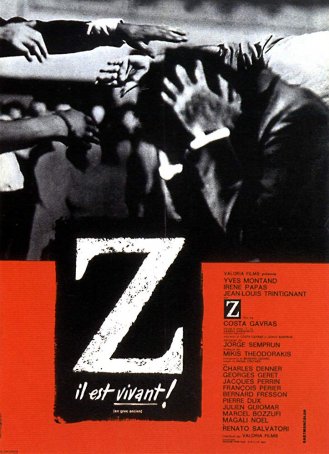
Costa-Gravas Z is an explosive political thriller, ripping a lightly fictionalised story from the Greek headlines (the opening credits playfully state ‘any resemblance to real people is ‘purely intentional!’) and turning it into a compellingly angry, cold-eyed look at political repression. It was based on the state-backed murder of Greek politician Grigoris Lambrakis in 1963 and the investigation by magistrate Christos Sartzetakis which briefly looked like it might expose repressive military forces but actually kick-started a 1967 military junta counter coup in Greece. Z takes this as inspiration for a truly universal story that continues to feel like ‘it could happen here’.

Lambrakis becomes The Deputy, played with great charm and determined charisma by Yves Montand. After death threats, he is murdered after a political rally by two thugs in a hit-and-run, in a public square, surrounded by police officers and a legion of witnesses. The police, represented by the virulent anti-communist General (Pierre Dux) declare it a tragic accident. They firmly expect our Sartzetakis-figure (Jean-Louis Trintignant, putting his enigmatic unreadability to extraordinarily good-use), son of a war hero, to back-up their bullshit. But he didn’t get the memo, conducting a genuine investigation which reveals the extensive links between the military and police and far-right organisations, how they planned the hit and did everything to ensure its success. But will this investigation lead to real change?

Costa-Gravas’ film is a hard-boiled conspiracy thriller with echoes of The Battle of Algiers’ primal urgency and immediacy. It’s committed to throwing you into the middle of the turmoil, with fast-cutting, hand-held camerawork, tracking shots through crowds and shots which zero in on the faces of victims and perpetrators alike. The film’s influence on directors like Oliver Stone is palpable. But, unlike Stone’s work, Z wears its moral outrage carefully: it presents events with a journalistic matter-of-factness, trusting us to recognise the corrupt horror of over-mighty governments. The resolute professionalism of Trintignant’s magistrate helps enormously here – heroism in this world is being honest and doing your job.

What Costa-Gravas film reveals is that these authorities believe they can act with utter impunity, convinced they will never be questioned by anyone, other than their liberal targets. Z opens with a darkly comic scene that outlines this thinking: during a lecture, the pompous General outlines (to a military audience shown impassively watching in a series of quick reaction cuts) his theory of ‘ideological mildew’ attacking the ‘tree of liberty’, using a tortured pesticide metaphor to suggest it is their duty to kill the mildew (liberals and socialists). This tyrannical view is parroted by people who are neither lip-smacking villains or fiendishly clever – they just have absolute, fixed certainty.

Z makes clear that such men, placed in position of authority, will attempt to shape events with a breath-taking arrogance. The assassination plot is shockingly clumsy and obvious and cover-up so full of transparent bare-faced lies, you’d need to be impossibly arrogant to even consider you could get away with it. Copious evidence shows meetings between senior officers and members of the right-wing CROC group. It’s claimed the Deputy’s fatal head-wound came from hitting the pavement, even though this is ruled impossible by both an autopsy and hundreds of witnesses. The General claims not to know the driver who ‘rushed’ the wounded Deputy to hospital (stopping at every opportunity), even though the man is his personal chauffeur. Everyone repeats the same tortured, unusual phrases – from the head of police to the thugs themselves.

It doesn’t stop there. Once it becomes clear Trintignant’s magistrate is genuinely investigating – that he has his own mind and opinions – the clumsy cover up turns aggressive. Blame is put on the Deputies own supporters (the word ‘false-flag operation’ didn’t exist then, but the idea is seized on); his lawyer is almost killed in a park hit-and-run in front of dozens of witnesses; a witness who can testify to the plans of the hitmen is pressured, told he has epilepsy, framed as a radical (he’s clearly not) and then nearly assassinated by one of the hit-men (put up in the same military hospital with a pretend broken leg), who flees the scene and in front of his doctors, while giggling at his cheek.

Some of this is in fact blackly funny. It perhaps almost would be, if it wasn’t for Z’s moral indignation. Even without murder, this is a repressive, corrupt regime: the Deputy’s team have innumerable petty obstacles placed in their way for their rally, their supporters are openly attacked by bused in protestors mixed with baton-wielding under-cover officers. Costa-Gravas doesn’t show the Deputy as a saint – flashbacks reveal he is an adulterer – but it does make clear his bravery (confronting and cowing crowds of anti-liberal rioters, utterly unrestrained by the police), leadership and the fear he overcomes. It also shows, especially in Irene Papas’ emotionally underplayed but quietly devastating performance, the raw grief of those who love him. His closest colleagues weep at news of his death, the post-death slandering of him all-the-more disgusting.

Z presents its evidence with an increasingly overwhelming force. The magistrate corrects (for a long time) any use of the word murder for ‘accident’ – by the time he himself says ‘murder’ it’s almost easy for us to miss it, so natural has the conclusion become. Pressure is, of course, applied to him: senior officers bluster about metaphorical eggs and omelettes; his bosses suggest he charge only the hit-men and (for good measure) charge the Deputy’s people for disrupting the peace by holding the rally in the first place. Plenty of ordinary people know exactly what’s going on, but don’t want to take risks: a newspaper editor reports what he’s told to, the Deputy’s doctor regrets not joining his lonely ‘march for peace’ but, well, you know how it is…
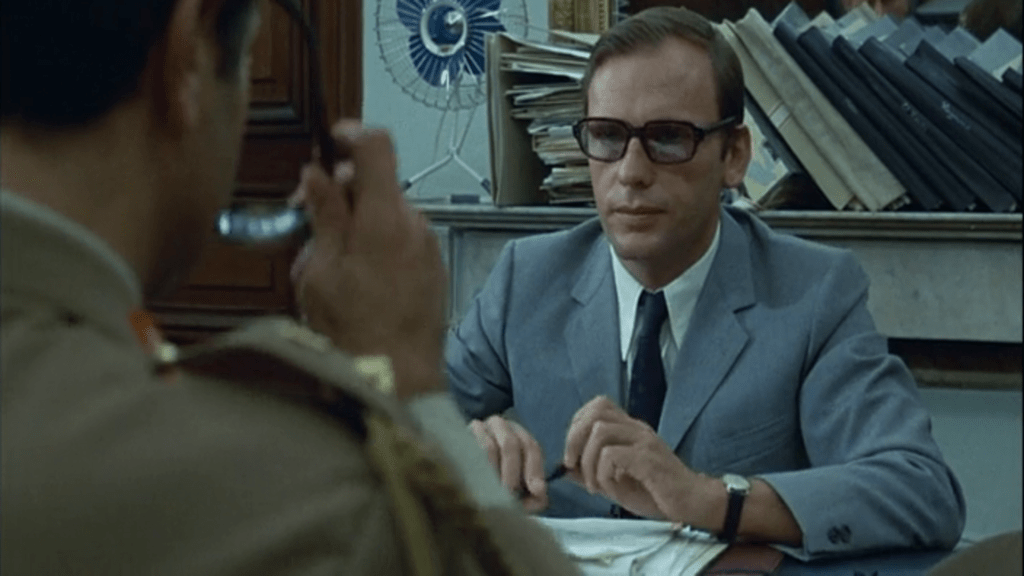
Given the blatant criminality of the police and the army – and the sadistic arrogance of hit-man Vago (an uncomfortable beat in Z is the whiff of homophobia in the depiction of Vago as a predatory homosexual and pederast) – it’s truly triumphant to see them bought to book. Despite their bombast (each officer states he will have no choice but to take his life to avoid the shame, something of course none of them do), each flees the building railing at the press. (The General, an antisemite among everything else, even roars ‘Dreyfus was guilty!’ when a journalist compares the affair to that).

But it’s short-lived. Perhaps Irene Papas’ Helene knows it will be when she responds to news of the arrest with a quiet middle-distance stare. Z closes with a dark coda that could almost be funny if it wasn’t horrifying. A photojournalist (played by producer Jacques Perrin) who we have followed uncovering the plot, reports the aftermath: initial resignations followed by slap-on-the-wrist sentences for the hit-men, charges dropped for the officers and a coup d’etat (at this point a cut removes Perrin) which sees the arrest or ‘accidental’ death of all the Deputy’s supporters, a junta government and bans of everything from authors, mini-skirts, modern mathematics and, above all, the letter Z, as zi has been taken by protestors as the badge ‘He Lives’.

It would be funny. It almost is funny. If it wasn’t part of a system that crushes freedom with violence and murder. Costa-Gravas’ brilliant, engrossing and perfectly judged film shows how terrifyingly swiftly it can happen, how freedoms and justice can be strangled before our very eyes. Watching it today, you can’t imagine a time when it won’t be coldly, chillingly, terrifyingly relevant.

Jean de Florette & Manon des Sources (1986)

Jean de Florette & Manon des Sources (1986)

Luscious scenery and combines with fine acting to produce a sort of French Merchant Ivory

Director: Claude Berri

Cast: Yves Montard (César Soubeyrnan), Daniel Auteuil (Ugolin), Gérard Depardieu (Jean Cadoret), Emmanuelle Béart (Manon Cadoret), Elizabeth Depardieu (Aimée Cadoret), Ernestine Mazurowana (Young Manon), Hippolyte Girardot (Bernard Olivier), Margarita Lozano (Baptistine), Yvonne Gamy (Delphine)

At the time this double bill (which I’ll refer to as Jean de Florette unless specifically referring to the sequel only) were the most successful foreign language films ever released. Shot over seven months, they were also the most expensive French films ever made and garlanded with awards, including a BAFTA for best film. Jean de Florette turned Verdi into the soundtrack for France, while its photography transformed the rural idyll of Provence into a major tourist destination and the dream location for holiday homeowners. The films themselves remain rich, rural tragedies, gorgeous French heritage films, a sort of French Gone with the Wind replayed as Greek tragedy.

Told in two parts – although designed as one complete movie – they tell a story of how greed destroys lives in 1920s rural Provence. César (Yves Montard) is the childless landowner whose only hope of a legacy is his hard-working but dense nephew Ugolin (Daniel Auteuil). Ugolin dreams of growing carnations but the perfect land is frustratingly not for sale. When an argument with the owner leads to his accidental death, the land falls to Jean Cadoret (Gérard Depardieu) hunch-backed former tax collector from the city and son of Florette, the girl who broke César’s heart decades ago when she left the village while he impulsively served in the foreign legion.

César and Ugolin resent Jean – Jean of Florette as they call him – and hatch a plan to see his dream of a rabbit farm fail. They secretly block up the spring on Jean’s land and keep his connection to Florette a secret from the rest of the village, encouraging them to see him as an outsider and hunchbacked bad-luck charm. Ugolin befriends the decent, optimistic and hard-working Jean and watches the farm disintegrate. A decade later, in Manon des Sources, Jean’s daughter Manon (Emmanuele Béart) plots revenge for her father on Ugolin and César.

Jean de Florette and Manon des Sources were adapted from Marcel Pagnol’s novel – written, ironically, after Pagnol’s film Manon des Sources was butchered down by the studio in 1952 from four hours into an abbreviated two. It’s a richly filmed, luscious picture crammed with gorgeous locations, sweeping camerawork and marvellous score that riffs on Verdi. It’s an entertaining story of injustice and comeuppances. It’s first half (Jean de Florette) is an, at-times painful, unfolding of Jean’s inevitable failure. The second (Manon des Sources) sees all those chickens come home to roost as Manon’s suspicions about César and Ugolin’s duplicitousness are confirmed.

But what perhaps made Jean de Florette as successful as it was, is its mix of Merchant Ivory and BBC costume-drama. Many outside of France essentially took it as art because the characters spoke French. But Jean de Florette is a tasteful, classy, very well-made prestige package designed to be easily digestible. Claude Berri marshals events with the skill of a natural producer – he’s effectively a sort of French Richard Attenborough with a great deal of natural talent with actors, but without the true inspiration of the greats. You couldn’t mistake Jean de Florette as something made by Carné let alone Godard or Truffaut. It’s decidedly too carefully, tastefully made for that.

Which is not to say it isn’t in many ways a very fine film. Its construction is well-executed across its two parts. Berri makes clear that – for all the film showed a picture post-card view of France, encouraged to promote tourism and ‘traditional values’ by the government – the village our film is centred around is rife with prejudice and underlying hostility. It’s all too easy to for them to take against Jean: not only he is an outsider, he’s a tax-collector and a hunchback to boot. Prejudice naturally sets them against him (the villagers gleefully watch this “city man” destroy himself vainly trying to turn his dry land fertile). Manon des Sources makes clear the whole village at the very least suspected the spring had been deliberately dammed but effectively couldn’t be bothered to help.

It’s not a surprise as Jean’s techniques are totally alien to the traditionalists. Played by Depardieu with a wide-eyed enthusiasm, guileless honesty and trust, Jean takes on farming as if its another mathematical problem. He has books full of calculations and productivity rates he expects to hit, covering everything from rabbit breeding to the daily amount of soil and water needed for crops. He is prepared for anything except the cruelty of humans and the weather (Berri makes clear that, even with one arm tied around his back by the spring being blocked, he nearly manages to pull it off).

Instead, his super-human efforts come to naught. Forced to walk miles a day to carry gallons of water back to his farm to irrigate his land, he starts to resemble the weighted down donkey he drags with him. Rubicons are crossed one by one: even his wife’s necklace is eventually called on to be pawned, for all his promises that it would never come to that (fitting the Zolaish tragedy here, the necklace turns out to be worth sod all). Ugolin does everything he can to befriend and support Jean without helping him, even ploughing the land for him when Jean comes close to finding the hidden water supply. The events beat down Depardieu, here in one of his finest “man of the soil” peasant roles, until he is literally left shouting at the heavens, imploring God to give him a break.

This makes is all the easier to despise César and Ugolin, especially as Berri cuts frequently to these hypocrites giggling at their own deviousness and Jean’s suffering. It makes Manon des Sources – arguably the even more rewarding part – all the more satisfying as we watch the two of them slowly destroyed, events replaying themselves from the other direction. Manon des Sources features a performance of Artemis-like grace from Emmanuelle Béart as the older version of Jean’s daughter (the younger noticeably never trusted Ugolin), whose beauty enraptures Ugolin and who in turn dams the source of the village’s water to expose the crimes against her father.

It leads to a series of shattering reveals that break César and Ugolin from their satisfaction and complacency. These two villains are portrayed in masterful performances by Yves Montard and Daniel Auteuil. Under buck teeth and a foolish grin, Auteuil is sublime as a man who has it in him to be decent but is all too easily led by his forceful uncle. He regrets his actions, while never making an effort to reform and reverts all too easily into a love-struck Gollum, spying on Manon and literally sewing her lost ribbon into his skin. He’s a pathetic figure.

Montard has the juiciest part, which flowers into one of true tragic force in Manon des Sources. César is a man whose life of regret and loneliness has turned him into a bitter old man, grasping, greedy and hungry for a legacy. He treasures the few possessions he has of Florette – faded letters and a single hair comb – like relics and subconsciously can’t bring himself to actually meet her son. Suppressed sadness makes him every more tyrannical and foreboding. But Manon explodes this exterior, as events and revelations strip away all he holds dear. It culminates in a breath-taking sequence of raw grief from Montard – which depends on the magnetic power of his eyes – as his last delusions are stripped away and the true horror of his actions exposed to him.

It’s this emotional power that gives the two parts of Jean de Florette its force and impact and lift it the higher plain of its costume drama roots. It may be a very self-consciously prestige picture, designed to appeal to the masses, but Berri’s conservative style is matched with a great skill of drawing powerful performances from the actors. He does this in spades with his four leads and events eventually gain, through their performances, some of the force of a Provence Greek Tragedy. Jean de Florette manages to avoid melodrama and provides real dramatic meat and, while it is not high art, it’s certainly very high drama.

The Wages of Fear (1953)

Yves Montard and Charles Vanel struggle to collect The Wages of Fear

Director: Henri-Georges Clouzot

Cast: Yves Montard (Mario), Charles Vanel (Jo), Folco Lulli (Luigi), Peter van Eyck (Bimba), Véra Clouzot (Linda), William Tubbs (Bill O’Brien), Darío Moreno (Hernandez), Jo Dest (Smerloff)

You’re stuck in a dead-end town without the money to get out. There’s been an accident at the local mining company that runs the town. They need to get super-duper, explosive material up there to blast the mine and prevent a fire spinning out of control. The only way to do it is in a truck up a bumpy hill road in the blazing sunshine. The company will pay a small fortune to anyone desperate or stupid enough to do it. Would you collect these Wages of Fear?

That’s the conceit in Clouzot’s slow-burn, tension-packed masterpiece. Mario (Yves Montard), along with several others, is stuck in a dead-end desert town in South America unable to afford the air fare to escape. Mario befriends an ageing gangster Jo (Charles Vanel), now also stuck in the town, and the two of them are tempted to drive trucks full of nitroglycerine (which can explode when hot or under the slightest jolt or pressure) to help put out a massive fire at the local American-owned oilfield. Along with Bimba (Peter van Eyck), a German, and Luigi (Folco Lulli), an Italian, they drive trucks up there – but the pressure affects the men in different ways and the dangers of the drive make it highly unlikely that they will all make it.

The Wages of Fear is the classic slow-burn leading to (literally) explosive tension. It’s almost a full hour into the film before the nitroglycerine makes an appearance, but after that the film lays a constant series of dilemmas in the way of our heroes as they try to make their way 300 miles to the oilfield. Never before has the slightest jolt of a car, or the smallest pot hole, been more wracked with danger. Is it any wonder each of the men go a little insane: who could do this and not be a little cracked in the head?

Clouzot directs this with a sublime brilliance. The film is a masterclass in subtle build-up. The opening act of the film establishes the characters of Mario and Jo (and to a lesser extent Bimba and Luigi). We see them in their natural habitat, and learn to understand their characters so thoroughly, that we are genuinely surprised and a little unnerved about how much they change over that long and dangerous 300 miles. Yves Montard’s Mario is a quintessential cool customer – hanging at bars, treating his girlfriend Linda (Vera Clouzot, the director’s wife) with a distant disdain – but he’s also a man easily influenced, prone to hero worship not least to new-guy-in-town Jo, on whom he has a massive man-crush.

Jo, played with a sustained brilliance by Charles Vanel, is the big fish in the small pond, a small-time gangster lording it over his fellow town-dwellers with an unruffled arrogance. Jo has no interest in anyone else and claims Mario’s allegiance as his right – in fact he takes delight in provoking Luigi, Mario’s previous best friend (crush?). He watches with amused detachment when Mario drops Linda to spend time with him. He openly provokes a fight in a bar with Luigi (Clouzot’s first sequence of bubbling tension, brilliantly shot with an unease and unpredictability that could see almost anything happen once a gun emerges) and makes a big show of his past relationship with O’Brien the oil company representative. 

The stage is set for us to see Mario as too laid-back, distracted and indolent to succeed and Jo as a collected, calm and controlling presence made for drama. So it works even better to see these two men change position as the journey continues and fear grabs Jo in a way that seems to surprise even him. Mario, meanwhile, becomes almost ruthlessly focused in his determination to see the mission through to its completion, and increasingly distant from those around him. Because in these life and death situations, there is no time for fear or to mollycoddle the concerned. When a single mistake could kill you all, you can’t afford to waste time on someone too scared to carry on.

Mind you, the opening section of the film brilliantly establishes the desperation these people feel to escape from this dead-end town. A young man, not selected for the driving operation, hangs himself in despair. Bimba states that the slightest horseplay or distraction on his trial run with the truck during the selection process will lead to deadly consequences for the joker – and he’s not fooling around. O’Brien of the oil company makes it clear that the mission is almost certainly suicide – and that the company basically doesn’t care at all about the fates of those selected to go on it: they are completely disposable.

Those selected are both lucky and unlucky – and Clouzot uses a brilliant early sequence to establish the danger of the nitro. O’Brien calmly takes a small sample of it in a shot glass and spills it to destructive effect. As one reviewer said, “you sit waiting for the theatre to explode”. Part of this is the way Clouzot uses the men in the film: they are very much rats on a running track, trapped in a route full of danger, with no release or relaxation from the deadly load they carry. Extraordinary sequences abound in the film’s second half, like a whistle-stop our of tension set-pieces from films.

The dangers of everything are doubled because the characters are driving a portable bomb. Moving over a bumpy road – terrifying. Driving round a tight corner on a rickety wooden platform over a cliff – tense enough normally, even more so now. Encountering a road block with a giant stone – guess we need to use some of this incredibly reactive stuff (a brilliant scene as Bimba tenderly pours a small amount of nitro into a drilled hole and rigs up a fuse). Crawling the truck through an oil slick – sublime. And it works so well because the film makes clear that our heroes have no choice at all, they simply must get the money that will come from finishing the mission.

Clouzot totally understands the personal dynamics that underpin these crisis situations. Bimba and Luigi slowly overcome distance to find a real bond between them. Meanwhile Mario and Jo’s relationship disintegrates, as Jo’s cowardice leads to Mario treating him with increasing disdain, contempt and finally disgust. Mario himself becomes increasingly adamantine, fixed on the mission’s success at the exclusion of all other concerns. 

Clouzot ends events with a supremely ironical touch, almost darkly comic – but then somehow not a surprise in this film where life is cheap and can literally blow up in your face at any moment. Sublimely directed, and a masterclass in tension and subtle character development, it features a brilliant performance from Charles Vanel and constantly rewards viewing. The Wages of Fear are high – but their price can be even higher.