Author: Alistair Nunn

The Champ (1931)

The Champ (1931)

Seminal father-and-son drama that largely avoids excessive melodrama while essentially inventing a genre

Director: King Vidor

Cast: Wallace Beery (Andy “Champ” Purcell), Jackie Cooper (Dink Purcell), Irene Rich (Linda Purcell), Roscoe Ates (Sponge), Edward Brophy (Tim), Hale Hamilton (Tony), Jesse Scott (Jonah), Marcia Mae Jones (Mary Lou)

The Champ is the grand-daddy of an entire genre of “Dad-and-lad” films. If it sometimes feels over-familiar today, then that’s because many of now familiar cliches of slightly washed-out Dads caring for (and being cared for) precocious-but-caring pre-teen sons were born here. Even at the time, plenty of people saw The Champ as drowning in more than a little sentimentality. But The Champ is mostly effectively underplayed and directed with a spry energy that stops it becoming too cloying.

Andy Purcell (Wallace Beery) is adored by his 8-year-old son Dink (Jackie Cooper) as “Champ”. Andy was a heavyweight champion once; but is now an over-the-hill fighter more likely to be found propping up a bar or shooting dice than throwing punches in the ring. Constantly guiding Champ away from temptation, Dink doesn’t waver in his devotion, even when presented with the possibility of a new life with his long-lost now-wealthy mother (Irene Rich). Champ wants to prove to his son he can be the man Dink believes he can be, taking to the ring one more time against the Mexican champion – with heart-tugging consequences.

It’s not just dad-and-lad cliches – there’s more than a few boxing cliches whose DNA is in The Champ – Vidor even directed here one of the first-ever training montages, as Champ gets ready to duke it out with the Mexican champ. But its heart is really in the unbreakable bond between father and son, their unwavering love which survives no end of testing the father applies to it. Champ is an unreliable wash-up who makes it a regular habit to piss away money, culminating in selling their treasured race-horse “Little Champ”. But Dink knows, for all is flaws, Champ truly loves his son.

A film like this relies on the chemistry between the two actors, so it’s just as well both Beery and Cooper genuinely feel like they’ve known each other all their lives. (Hopefully it doesn’t spoil the magic to discover the famously misanthropic Beery loathed Cooper, who in turn felt Beery was a scene-stealing bully). Their interplay, their easy, natural chatter and playful physicality is heart-warmingly believable. From sharing a bed in their rundown flat, to messing around with their hats or teasing each other during country jogs, Vidor’s film finds a natural ease in their relationship. There is a genuine feeling of parental love between the two, captured in little moments that feel real, such as Champ’s superstition about Dink spitting on things ‘for luck’ (from betting slips to boxing gloves).

Beery won one of the first Best Actor Oscars – a historic tie with Fredric March in Dr Jekyll and Mr Hyde (ruled a draw despite Beery gaining one fewer votes) – and it’s a deserving one. Beery underplays a role that could billow over the top, from his woozy drunk acting which is convincingly low-key to the streak of guilty self-loathing Beery keeps clear is running through Champ. He’s a man who despises his weaknesses, who knows he is not the legend his son still believes him to be, deeply ashamed of his actions but yet time-after-time lets down and embarrasses his son, from getting arrested in drunken scuffles (in front of the whole town) to slurring nonsense in a bar.

The warmth of Vidor’s direction keeps us on-side with Champ, even as he needs to be sobered up with cold tomato soup and ice to make a meeting with a promoter (even so, he’s still late and screws it up in any case due to still being pissed) or as he is hauled out of a police van, scruffy and swinging misguided punches. It makes us hope for the best from Champ, even if it’s left subtly open whether he strikes Dink (from between the bars of his prison cell) from anger or in an attempt to drive the boy away from his self-destructive father. (Either way, in a touch that inspired Raging Bull, Champ is so ashamed of his perhaps- half-meant blow, he pummels the cell wall with his hand, his face contorted in lashings of shame and self-loathing.)

Beery’s performance is perfectly complemented by Cooper, one of the most natural child stars ever. Cooper’s Dink pulls off the difficult trick of feeling both charmingly wise before his years, but still like a naïve child. Vidor trusted Cooper’s instincts enough to just let be on the camera, notably during a largely improvised sequence where Cooper prattles to himself while climbing up onto the roof of his wealthy mother’s new home. But Cooper can also manage the emotion: when tears come, they feel real and genuinely distraught. In other hands, the final act emotional breakdown might have felt like the worst sort of stage-school tears but Cooper makes it genuinely feel like a child so torn up he can barely process the depth of his feelings.

Cooper’s performance largely sells the film’s heavily melodramatic ending, which could well have collapsed into a soapy mess. It’s the moment where Vidor’s film most insistently tugs on the heart-strings, desperate to get those tears pouring. But he also softens Beery’s self-destructive lunk who, nice-is-he-is, we care for partly because his son is so overwhelmingly devoted to him. And we believe Champ would be desperate to do anything to live up to the sort of hero-worship he has here.

Vidor’s film also gains from his smooth, visually engaging direction. The Champ opens with an impressive tracking shot of our heroes running, and makes excellent use of space and blocking throughout to ground the father-and-son constantly at the centre of a busy world bustling around them. It’s also a generous film: the Champ’s ex is no villain, but a wealthy, decent guy, neither is there racism in the depiction of Dink’s young Black friend Jonah. The decision to use sped-up film for the fight may look vaguely comic today, but adds energy while Vidor largely avoids the trap of hammering the emotional points home too strong.

The Champ is still an effective crowd-pleaser, sailing by in 80 swift minutes, so successfully taking many of the struggling-parent-conventions of ‘women’s pictures’ and applying them to men, that it’s been effectively re-made and re-invented dozens of times, in dozens of settings. And you can’t say more for its effectiveness than that.

Love Story (1970)

Love Story (1970)

Smash-hit romance that I found forced, smug, tiresome and very mediocre

Director: Arthur Hillier

Cast: Ali MacGraw (Jenny Cavilleri), Ryan O’Neal (Oliver Barrett IV), John Marley (Phil Cavilleri), Ray Milland (Oliver Barrett III), Russell Nype (Dean Thompson), Katharine Balfour (Mrs Barrett), Sydney Walker (Dr Shapeley), Tommy Lee Jones (Hank Simpson)

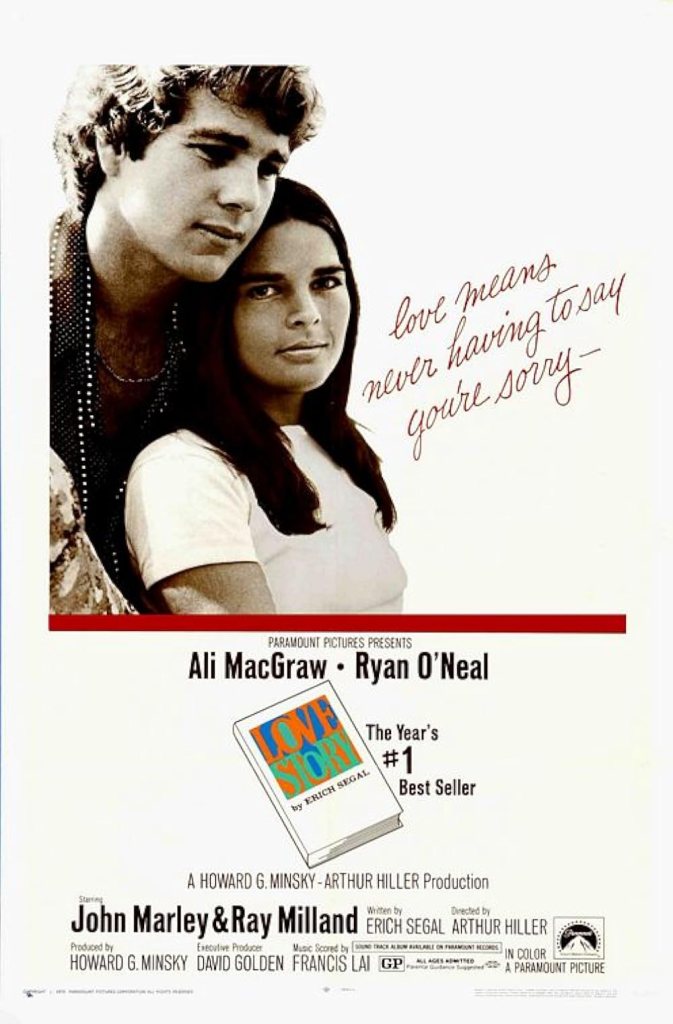
Right from the top Love Story tells you it ain’t Happy Story, as grieving Oliver Barrett (Ryan O’Neal) wistfully asks in voiceover what you can say about a 25-year-old girl who died. The girl, we quickly work out, is Jenny Cavilleri (Ali MacGraw) and the fact we all know she’s doomed didn’t stop Love Story turning into a mega-hit. But a mega-hit isn’t a good film: and Love Story, to tell the truth, is not a good film. And, in the spirit of its mantra  “Love means never having to say you’re sorry” I’m not apologising for that (it also sounds like the sort t-shirt friendly message you might see an abusive spouse wearing).

Oliver comes from a wealthy background, with expectations from his father (Ray Milland) that he will follow in the Barrett family footsteps, to study in Barrett Hall at Harvard and join the Supreme Court. Jenny is the daughter of a baker (John Marley) who dreams of becoming a musician. They meet at college, fall in love and want to marry. Oliver’s father asks his son to wait, Oliver says no, is cut off and he and Jenny work to put him through Harvard (to inevitable success). He gets a high-powered job, she gets a terminal illness. Let the tissues come out.

Anyway, Love Story charts the star-crossed romance between O’Neal and MacGraw, defining their careers and melting the hearts of millions. But to my eyes, this dull, distant, dreary romance lacks charm. The dialogue strains to try and capture a Hepburn-Tracy sparky banter, but it’s as if writer Erich Segal has heard about what a screwball comedy is without ever having actually seen one. O’Neal calling MacGraw a bitch within 180 seconds of the film starting doesn’t feel like a spiky banter, but just plain creepy. All the way through the film’s sentimental courtship, the dialogue consistently makes its characters sound sulky, whiny and self-involved.

This isn’t helped by the fact that both actors lack the charisma and energy these sorts of parts need. Both end up sounding infuriatingly smug and their leaden dialogue clunks out of their mouths, stubbornly refusing to come to life. When the emotion kicks in, neither can go much further than wistful stares with the hint of a tear, which isn’t much of a difference from their forced laughter and studied embraces. Put bluntly, both O’Neal and MacGraw do little to breathe life into the Romeo and Juliet construct the film totally depends on. Watching it with my older, cynical eyes… I quickly lost patience with this pair. I also find it hilarious that O’Neal himself married age 21, divorced by 23 and essentially said the whole thing was a youthful mistake.

Is it really that unreasonable for his father to suggest that perhaps Oliver shouldn’t rush into marriage with a girl he has literally just met? It wouldn’t take much reangling to see Oliver as a Willoughby-type, leading on a love-struck young woman in a selfish act of rebellion. Certainly, I can’t help but see Oliver as (to a certain extent) a stroppy, entitled rich-kid rebelling against his Dad. Just as I can’t help but feel, when he aggressively tells Jenny to mind her own business when she broaches a reconciliation, that he’s more than a bit of a prick. But then, the film keeps vindicating him, by implying his Dad must be an arsehole because he’s rich and reminding us that of course love means never saying you’re sorry.

As for Oliver’s whining about his money problems, being forced (can you believe this!) to actually work to make his way in life – give me strength. Clearly, we are meant to side with him when he is incredulous that Harvard’s Dean refuses to grant him a scholarship (on the grounds they are for academically gifted poor kids, not scions of the Founding Fathers with Daddy Issues). But Holy Smokes, Oliver reacts like a brat who no-one has never said no to before. He even has the gall to complain that he is the real victim of the economic status quo. Every time he bangs on about the difficulties of paying for Harvard (even after Jenny dutifully abandons her dreams to help pay for him), I literally shouted at the screen “sell your car you PRICK” (how many coins would this high performance, expensive to run, classic car get him?). The film never really tackles Oliver’s sulky lack of maturity (he can’t even get through an ice hockey match without throwing a hissy fit), not helped by O’Neal even managing to make grief feel like sulking.

To be honest Jenny isn’t much better. This is a ‘character’ where quirk takes the place of personality. From her forced nick-name of “Preppy” for Oliver (better I suppose than his early nick-names for her, most of which use the word bitch), to her pretentiously shallow love of classical music (she knows all the classics and that’s about it). Her whimsical insistence about calling her dad ‘Phil’ because she’s such a free spirit. MacGraw’s limitations as an actress and flat delivery of the dire-logue accentuate all these problems, preventing Jenny from ever feeling anything other than a rich-kid’s wet-dream of what a boho pixie-dream girl from the sticks might be like.

You can probably tell that the film got my back up so much, I felt like giving up on love. Everything in the film is smacking you round the head to make you feel the feelings. Its vision of New York is a snow-soaked Narnia where it’s always Christmas. The Oscar-winning song soaks into the syrupy soundtrack. I suppose it’s interesting to be reminded of an era where the husband is told about his wife’s fatal illness before she is (and warned not to tell her). But so much else about Love Story had me reaching for a paper bag.

Surprisingly distant, dull, led by two unengaging actors speaking terminally flat dialogue, it was nominated for seven Oscars and made millions. But the longer this Love Story hangs around, the less interesting it seems. A love story that feels like it will only move those who have never seen a love story before.

The Front Page (1931)

The Front Page (1931)

Original and (perhaps) best version of the pioneering cynical journalism story

Director: Lewis Milestone

Cast: Adolphe Menjou (Walter Burns), Pat O’Brien (Hildy Johnson), Mary Brian (Peggy Grant), Edward Everett Horton (Roy Bensinger), Walter Catlett (Jimmy Murphy), George E. Stone (Earl Williams), Mae Clarke (Molly Malloy), Slim Summerville (Irving Pincus), Matt Moore (Ernie Kruger), Frank McHugh (McCue), Clarence Wilson (Sheriff Pinky Hartman), Fred Howard (Schwartz)

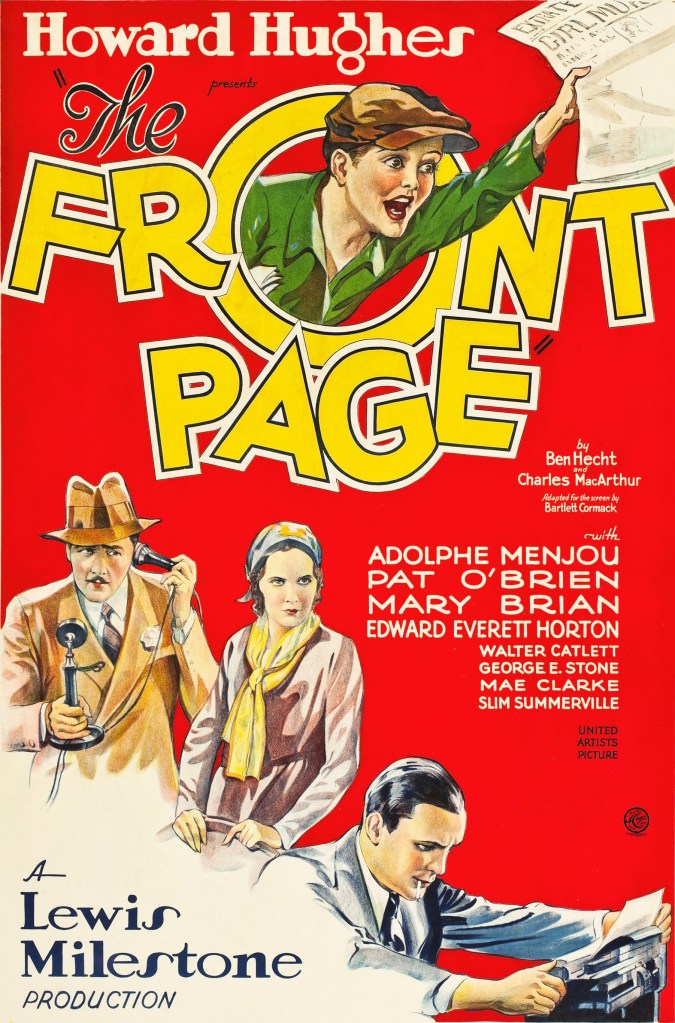
Unscrupulous newspaper men fling fast-paced banter at each other, caring less about the truth and far more about how the copy sells. In many ways the deeply cynical The Front Page hasn’t really aged at all. Probably why it keeps coming back round again-and-again, in different forms for different eras (most famously of course, spiced up with a gender-swopped Hildy as the screwball romance His Girl Friday). I’ll make a confession – not a surprise for those who know my heretical views on His Girl Friday – it’s never been my favourite play and I’ve never found it as funny as others. But, despite my doubts, it’s hard to deny the flair and energy of Milestone’s early talkie.

Star-reported “Hildy” Johnson (Pat O’Brien) has decided the time is right to give up the newsprint game and find happiness with sweetheart Peggy Grant (Mary Brian). But his ruthless editor Walter Burns (Adolphe Menjou) doesn’t want to hear it from his star reporter. Burns is determined to drag Hildy back into the game, and the press-stopping story of an anarchist who escapes hours before his scheduled execution is just the thing to tempt Hildy away from those wedding bells.

And so we get the ultimate cynical press story, adapted from a play that practically invented the image of the newspaper man as a heartless adrenalin junkie more interested in the scoop than the truth. The Front Page is all about the process of collecting the news, and how easily and casually this can be spun into what an audience wants. If the truth does out eventually, it barely happens as a result of the journalists. In fact, our heroes largely end up pushing it because it will get them out of a tight spot and shift a hell of a lot of copies tomorrow morning.

Milestone’s film for years existed as only a bastardised version of the international print: made up of Milestone’s third choice takes and angles with re-edited lines. Restored into his original vision, it’s striking how dynamic and cinematic The Front Page is. While His Girl Friday has it beat on pace (giving us the same story and almost the same amount of dialogue in twelve fewer minutes), arguably Milestone’s film has the edge on cinematic technique. Milestone uses dynamic camera angles and set-ups to inject pace, from the long tracking shot of Burns prowling his newsprint rooms to the rotating camera that roves around the film’s primary location, the courthouse press-room.

It uses fast-cuts and zooms to great effect: the opening shot of a sack of flour, crash zooms out to reveal it’s being used to test a gallows; the ‘yo-yo’ effect as the camera bounces rapidly up-and-down to take us from one reporter’s face to another during a harried reporting scene. Milestone makes large chunks of otherwise single-location farce, come to life through witty angles and blocking, knowing when and when-not to include an actor in the frame to make a joke work. It’s fast-cutting gives it an early screwball style that further accelerates its sense of momentum. It’s a very astutely, very skilfully directed movie that feels several years ahead of its time, and certainly a whole other level above some of the stilted play adaptations Hollywood was churning out.

Even though the script has never been my favourite, it also picks up a lot of screwball dynamism (and healthy dose of pre-Wilder cynicism) in its bones. It’s chorus of newspapermen, all corrupted to various degrees, are finely delineated, each with their own clear characteristics. From Frank McHugh’s shallow cough to Fred Howard’s banjo, via Edward Everett Horton’s prissy germaphobia and half-hearted attempts at woeful poetry, they each have complementary personalities that helps the comedy spark even more. That’s even without their utter disinterest in the personal lives and tragedies of those they are reporting on, or their shameless gilding of the facts of every story (a lovely audio montage sees them all reporting wildly different versions of an arrest).

The Front Page has a strong performance from Adolphe Menjou as the debonair Burns, here embodied by Menjou as a heartlessly ambitious Mephistopheles-type, constantly throwing titbits of temptation in the way of Hildy. Milestone even films him with a Devilish-Murnau strength, popping up seemingly everywhere he needs to be at any moment in time. Add in Menjou’s suave delight in some ruthlessly amoral lines and you have a genuinely spot-on piece of casting. This is less of the case for Pat O’Brien, the sort of actor more familiar as the best friend to a real star, here showing he doesn’t quite have the charisma to carry a dynamic part like Hildy (in fact, O’Brien would have been perfect casting for the male-version of Peggy: dependable, sturdy, dull).

Nevertheless, he and Menjou bounce off each other well in a film that has more than a little homoerotic energy in it (surely the idea for the gender reverse spun from this!) Even Peggy points out Hildy seems as least as excited as the thought of inconveniencing Burns as he does in marrying her (“you’re going to marry me to spite Mr Burns?”). Hildy isn’t just a man fighting against his urge to report on any events happening around him (a potential fire sees him bemoaning he doesn’t have a camera to hand). There is a life and energy to him when riffing ideas with Burns, that he just doesn’t have with anyone else. The two of them burst into life like naughty kids in each other’s company, in a way they just don’t with anyone else.

Hildy may end the film heading into the sunset, but you suspect Burns’ scheme to bring him back (a witty typewriter ping covers a sensor banned piece of naughty language as Burns calls Hildy an SOB on the phone to an underling) is going to succeed with very little hinderance. Because these guys are made for each other and, just like the rest of the cast, they need the buzz of being in the room where it happens far more than the dull dependency of a job in advertising for Peggy’s Dad’s firm.

That The Front Page does very well and while I’m still not an admirer of a play I found overly cynical and glib, Milestone’s dynamically staged version of it may (ironically) be the best of many committed to the screen.

Battleground (1949)

Battleground (1949)

Marvellously realistic, grunt’s-eye view of war, very well made and still carrying impact

Director: William A Wellman

Cast: Van Johnson (PFC Holley), John Hodiak (Pvt Jarvess), Ricardo Montalbán (Pvt Roderigues), George Murphy (Pvt “Pop” Stazak), Marshall Thompson (Pvt Layton), Jerome Courtland Pvt Abner Spudler), Don Taylor (Cpl Standiferd), Bruce Cowling (Sgt Wolowicz), James Whitmore (Staff Sgt Kinnie), Douglas Fowley (Pvt “Kipp” Kippton), Leon Ames (Chaplain), Herbert Anderson (Pvt Hansan), Denise Darcel (Denise), Richard Jaeckel (Pvt Bettis)

Apparently, the Hays Code would let bad language slide, if it was being used about War Heroes. Not many 40s film start with a credit crawl proudly calling its cast a bunch of bastards (in this case “the Bastards of Boulogne”). That’s our Battleground, the Battle of the Bulge, based on the experiences of screenwriter Robert Pirosh (who won an Oscar). Reflecting Pirosh’s experience, this is the Battle from the Grunt-eye-view, following a platoon of privates and sergeants pushed up from the rear to Bastogne, filling in the time between terrifying shelling and German advances, with grouching about everything from the food, to the lack of leave to the rotten army life.

As such, it’s not a surprise that Battleground proved a huge, multi-Oscar nominated hit (including Best Picture). Many in the audience surely saw their own war experiences reflected back at them: crappy rations, freezing cold fox-holes and the horrifying prospect of sudden death from the sky, that many American GIs knew from the war. Louis B Mayer believed the country was sick of war but producer Dore Schary persisted and was proved absolutely right.

It’s a film soaking in authenticity, that genuinely feels like it’s been filmed in the mist and snow covered chill of Boulogne rather than the sunny uplands of California (it’s cinematography won a deserved Oscar for Paul C Vogel). Director, William A Wellman, a decorated veteran from World War One, not only knew how soldiers thought, he was also grimly familiar with the mix of machismo, grit and terror on the front. Most of the cast were veterans, some only just out of uniform: and Battleground was the first film that put its cast through boot-camp to get them bonding like a company.

It’s a film rooted in the detail of army banter, with the same topics coming up time-and-again, in the distinctive language of the trenches. There is the insular togetherness of men who have seen a great deal of suffering and survived. Where a fellow soldier may get on your nerves but you’ll defend him to the death. The suspicion and dismissive attitude to replacement recruits until they have earned their chops. The delight in small moments of humanity also ring true: the Californian private thrilled at seeing snow for the first time, the protective way Van Johnson’s Private Holly guards and protects the eggs he’s dying to eat, the eager joy (and suppressed disappointment) when mail arrives (or fails to). These little touches make the characters feel real, their bonds feel lived in – and makes their moments of fear and panic all the more real.

And Battleground is perhaps unique in 40s war films for not judging soldiers when they show fear (in fact, when new recruit Layton confesses to being scared out of his wits, grizzled cynic Jarvess supportively congratulates him on joining a club everyone is a member of). When the men re-encounter Bettis, a man who ran at the first shelling, there is no judgement or condemnation towards him. After all, so many of them nearly did it themselves. All of them fear becoming a bleeding heap, sobbing for their mamas (as we see one of them do in a quietly affecting moment). Private Holly, our closest thing to a hero, twice nearly cuts-and-runs but both times circumstances and self-reproach see him disguise this with acts of bravery. Others may suspect the truth, but it’s what a man does that matters not why he does it.

Battleground gives a focus most war film never give. There are no generals, no sense of tactics or scale and precious little of the enemy. The Battle of the Bulge is a slog, sitting in a snow-filled pit trying not to die. Paranoia and fear is constant: news of German’s disguised as GIs lead to several awkward encounters, including a darkly funny scene of patrols demanding each other to name various pieces of American trivia to prove their bona fidas (even a senior officer). When they sit down to read the GI news, the men are mystified not only about who they are fighting (“Who is von Rundstedt?”) but even the name the press give the battle (“What’s the Bulge?”). Half of them have no idea where they are (opinion seems divided on Belgium or Luxembourg), few speak French and there is a sense that what the war is about matters less than surviving it.

Perhaps to combat this, in a potentially sentimental moment that Wellman and Pirosh manage to make feel uplifting, an army chaplin (well played by Leon Ames) assures the men ‘why they fight’ really does matter – and that if, later, people question the point of sending young Americans thousands of miles to die for strangers, then they know not of what they speak. In Battleground this sense of pride and honour, that what they are doing matters, is an essential battery recharge after weeks of freezing struggle: and it still carries real impact now, reflecting on what so many did for a cause larger than themselves.

Battleground’s cast is largely made up of MGM contract players seizing the opportunity to embody the sort of gritty, earthy parts so rarely available to actors serving in second-string roles or uninteresting leads in B-movies. Van Johnson’s Holly masks his fear with rumbunctious enthusiasm and exaggerated moaning. George Murphy gives a career-best turn as a determined veteran, ready to go home. John Hodiak’s Jarvess is a pillar of wisdom, Ricardo Montalbán’s Roderigues a burst of exuberant life. James Whitmore (Oscar-nominated) as Sergeant Kinnie practically defines Hollywood’s view of the grizzled, grouchy sergeant who secretly loves his men.

It all comes together very well and if Battleground feels overlong and even a bit repetitive at times, that’s to be expected considering it’s reflecting the experience of its characters. But there can be few 40s films as clear-eyed, realistic and unjudgmental about the pressures ordinary soldiers felt under extraordinary circumstances. That focused on the grim slog of surviving, over the glamour of conventional heroism in battle. And perhaps that’s why Battleground spoke to so many and feels so different.

Captain America: Brave New World (2025)

Captain America: Brave New World (2025)

Pure, unfiltered, content nothing more. Full of stuff you’ve seen, doing things you expect.

Director: Julius Onah

Cast: Anthony Mackie (Sam Wilson/Captain America), Harrison Ford (Thaddeus Ross/Red Hulk), Danny Ramirez (Joaquin Torres/Falcon), Tim Blake Nelson (Samuel Sterns), Shira Haas (Ruth Bat-Seraph), Carl Lumbly (Isaiah Bradley), Xosha Roquemore (Leila Taylor), Giancarlo Esposito (Seth Voelker/Sidewinder), Liv Tyler (Betty Ross)

Welcome to a Brave New World of Content. There’s nothing really wrong with Captain America: Brave New World. But there are also feels like no real reason for it to exist. Let it pass before your eyes for a couple of hours and you’ll have a decent time: then you’ll barely remember it, leaving you as brainwashed as it’s villain’s Mr Blue Sky programmed minions. It exists because the MCU is a gargantuan shark that has to keep moving forward, consuming more and more of the cultural conversation to stay alive.

What’s it about? Sam Wilson (Anthony Mackie) is our new Captain America, still air-bound with his Falcon wings (now powered up with some Wakandan science) but without the super-serum that made Steve Rogers near-invulnerable. His new boss, ex-General-now-President Ross (Harrison Ford, replacing the late William Hurt), has his doubts – but is also dealing with his own anger-management issues. Ross is being manipulated by imprisoned evil genius Samuel Sterns (Tim Blake Nelson) who wants Ross’ hypocrisy exposed to the world – and to turn him into Red Hulk for good measure. Since every single scrap of publicity material reassured us Red Hulk appears in the film, it’s not a surprise to find out he succeeds.

It’s all told in a reassuring way: another film pressed out of the MCU cookie-cutter. There is an interesting story dealing with Sam’s doubts about his worthiness, not least since he lacks Steve’s strength and speed. It’s so interesting… that Marvel has already made a TV series about it. Brave New World offers a less interesting, crib notes version of The Falcon and the Winter Soldier, while anxiously dancing round that series’ engagement with the moral complexities of a Black man taking on the name of Captain America, representing a country whose track-record on race is not something to boast about.

All the best stuff has already been rinsed once through the MCU content machine. Sebastian Stan pops up to repeat the moral message of that series in a single scene. Carl Lumbly returns as an aged Black Captain America, ill-treated by the government (although his background is skirted round by a film, terrified of being accused of any form of political statement). Sam, just as he did in the series, wonders about powering himself up to Steve levels and decides not. For anyone who has seen the series, it’s a shallow retread. For anyone who has not seen it, it makes very little impression.

Brave New World struggles to find its purpose and reason for being. There is an astonishingly large amount of exposition in it, constantly explaining and reminding us what everything is. Brave New World serves as a sort of side-ways sequel to two of the franchise’s least liked, least remembered films (The Incredible Hulk and Eternals), as well as being a thematic remake of a TV series. It feels like what it is: a film shot and reshot over years, until all sense of its tone and originality has been ironed out into the most generic, safe and pointless film you can imagine.

Marvel could sort of tell everyone was wondering why on Earth they should make this film, so dangled Red Hulk before us like a hook desperate that it would get bums on seats. There is something quite tragic about the series being reduced to spoiling their own ending. Particularly as all this transformation really just leads into a fairly familiar end-of-film smackdown in an all-too-obviously CGI created backdrop. This was probably a legacy of the years of delays and reshoots, the film tottering awkwardly between various political issues: hence it’s timid handling of issues from #blacklivesmatter, it’s attempt to not put off the anti-Woke brigade, to it’s meek fear of including an Israeli character in a leading role.

Perhaps that’s why we end up with something as formulaic and straight-forward as this. Anthony Mackie gives of his very best (although he has said in interviews, he prefers the long-form character building opportunities of TV shows – and who can blame him) and makes a winning argument for himself as a figurehead for a struggling franchise. Harrison Ford looks slightly bemused that he’s even in here (and I’ll eat my hat if we see him again in an MCU property), autopiloting through his gravelly grumpiness until he transforms into a big red monster with stretchy pants.

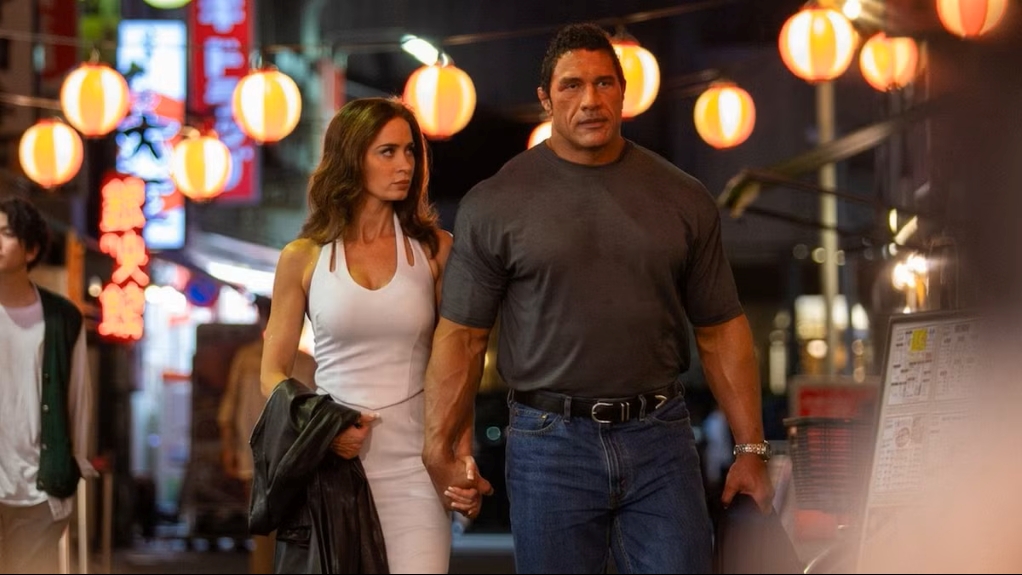
There are some decent action sequences. Giancarlo Esposito gets to riff on his Breaking Bad role in a character (again, some what obviously) added in reshoots years after the project completed filming. A mid-air battle over Japanese waters is gripping enough, if nothing special. A chase scene through the White House and across Washington lands well. Tim Blake Nelson does a decent job as a villain powered by intellect rather than strength. None of this is remotely new, original or particularly different from dozens of other MCU films (did they decide on locations based on where they haven’t really been before?) but its all entertaining enough.

It’s also though painfully, pointlessly, predictable. As inevitable as the arrival of the Red Hulk (a sure sign that the MCU was terrified the film was going to bomb, was when they smacked that guy all over the posters and trailers), every beat feels like dozens of other MCU films. It feels like a middling entry that will be easily skippable for what passes now for the series overarching narrative. Every moment feels fundamentally pre-packaged and shorn of any personality. It’s a highly professional, well-oiled, well-assembled film and you’ll forget almost every single thing about it within about an hour of it finishing. It’s just content from a series that needs new stuff like a lung needs oxygen.

Materialists (2025)

Materialists (2025)

Smug, contrived and misguided romantic comedy with a self important air

Director: Celine Song

Cast: Dakota Johnson (Lucy Mason), Chris Evans (John P), Pedro Pascal (Harry Castillo), Zoë Winters (Sophie), Marin Ireland (Violet)

In the modern world, what do we look for most in a partner? To professional matchmaker Lucy Mason (Dakota Johnson) “the math is simple” (strap in folks, that’s a phrase you’ll hear a lot): we want someone who ticks plenty of our boxes, offers financial and social security as well as being the right height with the right level of charm. Love, you’ll notice, doesn’t play a role in that. So, what’s Lucy to do when she starts a relationship with ‘unicorn’ Harry (Pedro Pascal), exactly the sort of charming, super-wealthy and tall guy women dream of, just when her ex-boyfriend John (Chris Evans), part-time-actor-and-waiter, suddenly resurfaces in her life. How strong will her principles to make the best deal possible be?

It sounds like the set-up for a romantic comedy. And honestly, it would have made a perfectly good one. Our heroine would be warm and charming even as she professed her cynicism, and the plot focussed on the whimsically old-fashioned concept of matchmaking would have gradually led her to embrace love (along with, inevitably, the poor but adorable love interest.) But Celine Song’s follow-up to Past Lives is a scrupulously dry character study, that wants you to think it’s got a deep and meaningful message about relationships in the world today, but eventually pedals the same rom-com message you imagine it would call trite.

But in a rom-com, the audience knows they’re watching a candyfloss fantasy – Song tries to staple the same “abandon realism here” kind of ending onto her ponderously, pretentious story, despite it contradicting the heroine’s entire personality and the characters’ painstakingly spelled out obstacles, and doesn’t seem to have noticed it makes the whole thing a complete dog’s dinner.   

Putting it simply: I didn’t particularly like Materialists, found its smugly superior attitude irritating, its final message deeply confusing, and felt it eventually chickened out of making a real point about modern dating. It’s an art-house film, dressed as a rom-com, trying to fool you into thinking it’s a state-of-the-nation film while letting its lead end up in a reassuring fantasy that only happens in the movies.

Partly based on Song’s experience as a match-maker, the most interesting content in Materialists is its exploration of what makes people choose who to date. I think this is a very interesting topic: at a time when people find it harder to meet (and the financial demands of the modern world harder to cope with), hundreds of thousands of people will be making relationship decisions based on cold hard financial and social facts. And yeah, some of them probably do feel guilty about that, much as Materialists suggests.

But exploring the loneliness of modern life isn’t Song’s goal. Lucy’s clients (bar one) are deliberately awful caricatures – who cares why someone like that would be looking for love, right? The film is solely here for Lucy’s Great Dilemma: How far will she go in a relationship with a box-ticking man she likes, but whom she doesn’t love. (A more challenging version of Materialists might have left out Evans’ unbelievably-handsome-and-decent penniless actor, and just really explored this dilemma for Lucy.)

But instead, the love triangle offers an easy get-out card for Lucy. Because, unlike her clients, Lucy has already met her perfect match. In fact, while her desperate and deluded clients just want to meet someone who can stand to be at the same table sa them, Lucy has two gorgeous, considerate, tall, charming men begging her to let them commit their lives to her. (And who, by the way, can believe a charming, six-foot multi-millionaire who looks like Pedro freaking Pascal can’t get a date?) She’s got the lovely Harry, whose stunning Manhattan penthouse she gazes at awe-struck, like Lizzy Bennett at Pemberly. And there is literally nothing wrong with John, aside from his lack of income (he’s the only actor in the world who doesn’t have an agent and doesn’t want commercial work) – he’s kind and decent  and trying to follow a dream. It makes her conundrum a false fantasy.

That’s one of the worst things about Materialists which, in many ways, is even less risky and daring than flipping Pretty Woman. It talks a big game about dating and relationships being economic and social decisions. It bangs on endlessly about this topic but, deep down, clearly doesn’t believe in it at all. Because even an astute analyst of people’s personalities (as Song can be) isn’t brave enough to make a film that commits to its initial proposition. Instead, Song sets up a parade of straw-man arguments that Lucy’s experiences can knock down to reach the ‘correct’ decision.

Ah Lucy. This mystifyingly motivated character who Dakota Johnson struggles to make coherent sense from. It’s not helped by Johnson’s breathy, evenly paced delivery that makes it very hard sometimes to work out what her character is meant to be thinking or feeling. Her air of dead-eyed professional monotone makes sense for her interactions with clients, but her colourless delivery of nearly all her lines made it almost impossible for me to work out when her character’s views change.

It’s not completely Johnson’s fault that Lucy is a deeply irritating character, but it would take a significantly more charismatic actor to make you overlook what a self-pitying, self-loathing waif she is, whose fundamental selfishness isn’t softened by constantly telling us she knows how selfish she is. Are we supposed to be rooting for her, when she essentially treats John (Evans, very likeable, sweet and witty) as an emotional-comfort-blanket, who can be dropped when she gets bored with him? Even when John calls her out on this, by the next sentence he’s absolving her for it.

Then in order to provoke her epiphany, the film clumsily introduces a sexual assault plotline for a supporting character, which exists solely to give Lucy the equivalent of “man-pain” – honestly, if the same plot was put in a film with a male lead, the socials would be burning up with cries of foul. This plotline is ludicrous from start to finish, while simultaneously treating a genuinely serious issue in dating like a ‘problem-of-the-week’ that can be solved with a hug. No male writer could have gotten away with the shallow, clumsy, plot-contrived development – and I don’t think Song should either.

Materialists takes place in a crazy world, where a dating firm has offices across the world, where the Manhattan police don’t respond to harassment call-outs from rapists, where everyone is paying tens of thousands of dollars to hook-up and John seems to be the only poor person. It’s dripping with smug assurance at its own cleverness, while offering a sort of moral message identical to a Sanda Bullock 90s romcom (but with fewer gags and chemistry). It’s frequently ponderous, stuffed with overly mannered dialogue and goes on forever. Having a Michael Haneke inspired closing shot, doesn’t change the fact the scene itself could have come straight out of The Runaway Bride. Materialists was not good.

Random Harvest (1942)

Random Harvest (1942)

Two superb leading performances hold together a romantic confection of a film

Director: Mervyn Le Roy

Cast: Ronald Colman (Charles Rainier/”Smithy”), Greer Garson (Paula Ridgeway/ “Margaret Hanson”), Philip Dorn (Dr. Jonathan Benet), Susan Peters (Kitty Chilcet), Henry Travers (Dr. Sims), Reginald Owen (Biffer), Bramwell Fletcher (Harrison), Rhys Williams (Sam), Una O’Connor (Tobacco Shopkeeper), Aubrey Mather (Sheldon), Margaret Wycherly (Mrs. Deventer), Arthur Margetson (Chetwynd Rainier), Melville Cooper (George Rainier), Alan Napier (Julian Rainier), Jill Esmond (Lydia Rainier)

Random Harvest is one of the most fondly remembered romances of Golden Age Hollywood – if you want yearning dedication bought to life, this is the film for you. It might also be one of the barmiest films ever made, stuffed with so many outlandish plot developments, hilarious logic gaps and hand-waved contrivances it would put a Netflix soap to shame. You can see why Syndey Pollack and Anthony Minghella eventually abandoned remakes: you can’t imagine a modern audience going with Random Harvest’s essential loopiness and not laughing somewhere along the line. Which is not to say it isn’t beautifully made and winningly bought to life at times.

It’s the final days of World War One, and amnesic soldier “John Smith” (Ronald Colman) can’t remember anything about his life. On the final day of the war, he sneaks out of the asylum and runs into music hall performer Paula (Greer Garson). She takes a shine to “Smithy” and decides to save him. They run away to the country, fall in love, get married, have a baby, he starts to write, goes to Liverpool to start a journalism career… and gets hit by a cab. The collision restores his original memory – but also causes him to forget everything about Paula and his life as Smithy. Instead, he restarts his original life as industrial heir Charles Rainier, presumed dead by his family. While he lives this life for years, Paula takes a job as his secretary “Margaret”. Will he remember who she is?

It says a lot that that summary only scratches the surface of a plot that throws in the kitchen sink in attempting to ring as many tear-soaked tissues out of you as possible. Smithy and Paula carry out their little memory dance over the course of over twenty years. It’s the sort of a film where millionaire Charles only thinks about investigating what might have happened to him in Liverpool when nudged to do so after over a decade. Where the couple enter a ‘marriage of convenience’ as the memory-free Charles and fake Margaret. Where Charles’ owns a major factory in the town where our lovers first met, but neither (a) stepped foot there in 15 years (since the moment he does his memory starts to return) and (b) the heir to the town’s major employer wasn’t recognised by anyone while living in an asylum five minutes walk down the road.

Take it on the merits of logic and conventional narrative and Random Harvest crashes and burns. But this isn’t a film about those things. This is a classic weepie that stole the hearts of a war-torn nation in 1942 (it was the biggest hit of the year). Powered by two committed and emotional performances, if it hits you in the right mood its probably irresistible. The sort of long-term adversity that makes Romeo and Juliet’s look like a casual dalliance (so full of tragedy, the death of their son is literally a throwaway moment). It’s framed with a great, sensual beauty by Mervyn LeRoy and powered by an emotionally throbbing score by Herbert Stothart that’s just the right side of sickly.

Ronald Colman’s performance is quiet, measured and vulnerable (especially in his “Smithy” performance). From the start, he has eyes of hesitant, unknown sorrow and stumbles into a relationship with Paula like a new-born discovering life. Threads of his gentleness and excitability work their way into his Charles persona, tinged this time with the natural confidence of wealth. Nevertheless, Colman makes Charles a man who has dealt with unnerving amnesia by actively not thinking about it, carrying on a watch-chain the key to his “Smithy” home as a subconscious reminder. It’s a fine performance – so much so you can overlook he’s twenty-five years too old (the restored Charles forgoes returning to university, something that looks long gone for Colman).

Just as fine is Greer Garson, fully embracing an emotional roller-coaster as Paula. Introduced as a good-natured music hall singer (and Garson sings a high-kicking She’s Ma Daisy number in possibly the shortest skirt the Hays Code ever allowed), Garson’s warm and playful Paula is drawn towards “Smithy” in ways she almost can’t understand. But it’s a wonderfully different side for an actress so often associated with self-sacrificing wives and mothers: Paula is vivacious, forward and seizes the things she wants from life. It’s the second half – the patient, yearning desperation of “Margaret” hoping her husband will remember her – that leans more into her Mrs Miniver wheelhouse, but Garson mixes this with a real lingering, desperate sadness tinged with just enough hope that her husband might just recognise her.

Both performers overwhelmingly lift this otherwise (frankly) slightly contrived film into something rather sweet and endearing. It is, however, a film that would be even more so if it was shorter: the general morass of missed opportunities, misunderstandings and wrong ends of sticks being grasped would be easier to sustain over 90 than 120 minutes. It’s a rare film that covers so much ground over so much time that it’s lead character is declared dead twice.

The second declaration is Paula gaining that status for “Smithy”, dissolving their marriage and removing (you suspect for Hay’s Code reasons) the risk that Charles might accidentally commit bigamy by marrying his young niece. This is a lovely performance of youthful idealism and earnest devotion from Susan Peters (a tragic accident shortly after curtailed her promising career), and if the whole years-long subplot of the possibility of Charles marrying his besotted niece is a narrative cul-de-sac the overall film would be better without, it does at least mean we get the pleasure of Peters, performance captured forever.

But Random Harvest remains a pure romance: where no less than two women spend decades of their life in selfless, one-sided devotion for the lead and he still comes across as the sort of saintly man cheered by his own factory workers for sorting out a strike. The whole confection is a very fragile thing, but LeRoy carries this fully-loaded glass ornament with pure skill and the performances of Colman and Garson set the bar for classic Hollywood tragic romance. Minghella and Pollack were right – our cynical age can’t believe the nonsense – but on its own terms it still works.

An Autumn Afternoon (1962)

An Autumn Afternoon (1962)

Ozu’s final film feels like a perfect summation of the rich sense of ordinary life in his work

Director: Yasujirō Ozu

Cast: Chishū Ryū (Shuhei Hirayama), Shima Iwashita (Michiko Hirayama), Keiji Sada (Koichi Hirayama), Mariko Okada (Akiko Hirayama), Teruo Yoshida (Yutaka Miura), Noriko Maki (Fusako Taguchi), Shinichiro Mikami (Kazuo Hirayama), Nobuo Nakamura (Shuzo Kawai), Eijirō Tōno (The Gourd), Kuniko Miyake (Nobuko Kawai), Ryuji Kita (Professor Horie)

Ozu’s final film feels like a luscious, beautifully filmed summation of a life’s work. Deceptively quiet, simple and gently paced, like the best of Ozu’s work it throbs with a deep understanding of the quiet joys, regrets and pains in ordinary life, where the march of time can relentlessly change and mould your world. An Autumn Afternoon returns to themes familiar from Ozu past work – you see it as almost a remake of Late Spring (with Chishū Ryū, effectively, in the same role) –with his subtly effective recognition of how each generation echoes and reimagines the one before. It’s a deeply humane film from a director who understood everyday life better than almost any other.

Once again, a man feels pressured to marry off a daughter. Shuhei Hirayama (Chishū Ryū) is a middle-ranking factory manager, whose home is tended to by 24-year-old daughter Michiko (Shima Iwashita). Hirayama’s old school-friend and colleague Kawai (Nobuo Nakamura) suggests an arranged marriage for her. Hirayama quietly lets the subject drift, little motived to shake up his home. His opinions slowly shift as he re-encounters his former teacher The Gourd (Eijirō Tōno), now a down-at-heel noodle restaurant owner, who lives with an unhappy spinster daughter. Does Hirayama sees parallels between himself, Michiko and this pair? Is Michiko bothered either way?

It’s a classic Ozu set-up: the different views and perceptions of the generations, contrasted against each other. In many ways, very little happens in An Autumn Afternoon, but in other ways a whole life-time plays out. Skilfully, with an observing, restrained (Ozu’s final film is stiller than ever) camera, Ozu observes people in the Spring, Summer, Autumn and Winter of their lives. In doing so, he captures a particular moment of Japanese history, where pre-War, war and post-war generations confront the world with subtly different outlooks.

In the first darkening of the Autumn of his life, Hirayama is a quiet man with a rich vein of humour. He’s from a generation which sees itself on being more liberal than those before. He meets regularly with a bunch of former school friends, who pride themselves on holding their drink and frequently prank each other in dead-pan comic exchanges. There is a delighted ragging of their friend Professor Horie’s barely concealed sexual glee at his new (younger) wife. They have traditional values (Hirayama assumes marriage will lead to immediate resignation for his young secretary) but enjoy the post-war flourishing of Japan.

Hirayama is comfortable with Americanised Japanese culture, from bottled beers and baseball to American bars and their stools. He drinks too much, make generous offers to others and indulges his children. He’s perfectly happy with the way things are: perhaps because he already fears what his life may be like when his two youngest children flee the nest. It’s a beautifully judged performance from Ryu, genuine, relatable, quietly content but with a subtle sense of sadness and anxiety at change.

There is a sense Ryu’s Hirayama doesn’t want the world shaken, as he has already lived through enough shaking to last a lifetime. He’s a former career Naval officer, who captained a ship in the War. His late wife, it’s implied, died in the American bombing of Tokyo. (Of his children, only two can really remember her, talking about her only wearing trousers during air raids). Bumping into one of his former petty officers, the two men indulge in reminiscences and reflections of what life might have been like in victory (in an American themed bar of all places). Hirayama is drawn to return to the bar again and again, as the barmaid reminds him of his late wife (this small detail would be the entire plot of another film) – although Ryu’s quietly sombreness suggests the memory is to painful to dive into.

But this man contrasts sharply with his children. Hirayama never re-married, and his children have filled the companionship gap in his life. While Michiko matches neatly the traditional view of a Japanese woman as dutiful and guarding of the home (she wears a kimono more than any other female character), his youngest son Kazuo dresses like an American teenager and isn’t afraid to criticise his father. And even Michiko too wants to make her own choices about her life, regardless of the views of others.

The most intriguing contrast though is the marriage between his oldest son Koichi (Keiji Sada) and Akiko (Mariko Okada). Here power dynamics are strikingly different. Both partners work – indeed at one point, Akiko arrives home to find Koichi cleaning and cooking. Decisions are made between them, with Akiko frequently calling the shots. A dispute about Koichi’s plan to spend the excess of a loan from Hirayama on a second-hand set of golf clubs, sees Akiko take firm control of finances (Koichi seems to have inherited his father’s quiet desire not to rock the boat) and has the final say. It echoes, in a way, Professor Horie’s second marriage, where his wife has a level of control over his comings-and-goings that surprises Hirayama and Kawai.

Hirayama may also be quietly disturbed by a vision of what the winter of his life might be like, from ‘The Gourd’, a respected teacher of his childhood, played with a superb desperation and forced good humour by Eijirō Tōno. This once-respected man now works for customers who barely look at him and is totally reliant on a daughter miserable at her life (Ozu quietly watches her break down in tears dealing with her drunken father) and gets embarrassingly pissed at the slightest opportunity when someone else is paying. Considering Hirayama is also a heavy drinker (both men are prone to slumping forward, or swaying on the spot when under the influence) there is a lot that suggests his Winter might not be wildly dissimilar from the Gourd’s.

All of these multi-generational issues are superbly explored by Ozu, all without forced commentary, in a film that is a triumph of his distinctive style of low-angle static cameras, transitions that ground us in location, made even more striking by the film’s gorgeous use of colour (especially its reds). And the film leaves it all open to us to interpret. Because there is no right-or-wrong in Hirayama’s situation: should he let his daughter remain or help her move on and embrace her life?

An Autumn Afternoon concludes with one of the most quietly heart-breaking moments in Ozu’s cinema – under-played to utter perfection by Ryu – as Hirayama sits alone, drink swishing around his guts, singing songs of a martial Japan and facing an unknown future that might see him forced to confront the loneliness he has avoided since his wife died. As the final shots complete of Ozu’s final work – a series of cuts to parts of Hirayama’s home – it feels like a perfect final statement from an artist who looked at the small tragedies of life like no other.

Superman (2025)

Superman (2025)

A fun, character-led, engaging film that makes a better stab at starting a massive franchise

Director: James Gunn

Cast: David Corenswet (Clark Kent/Superman), Rachel Brosnahan (Lois Lane), Nicholas Hoult (Lex Luthor), Edi Gathegi (Mister Terrific), María Gabriela de Faría (The Engineer), Anthony Carrigan (Metamorpho), Nathan Fillion (Guy Gardner), Isabela Merced (Hawkgirl), Skyler Gisondo (Jimmy Olsen), Sara Sampaio (Eve Teschmacher), Wendell Pierce (Perry White), Pruitt Taylor Vince (Jonathan Kent), Neva Howell (Martha Kent), Zlatko Burić (President of Boravia), Frank Grillo (Rick Flagg), Bradley Cooper (Jor-El)

In 1978 Hollywood promised to make us believe a man could fly. In 2025 it just wants us to believe a franchise can be reborn. Superman, again, hopes the man of steel can launching a DCU franchise to compete with Marvel (in some ways, hilarious that this is just at the point when the world seems tired of interconnected monolith Comic Book worlds). Has it learned the lesson of the first attempt? I’d say yes: under the experienced hand of James Gunn, Superman is light, fun, exciting and engaging. It may all be (inevitably) heading towards a city-sized smackdown to save the world, but at least it does it with a bit of charm and character work along the way.

What it also definitely isn’t is an origins story. And, in many ways, thank God: is there anyone under this yellow sun that doesn’t know Superman is from Krypton, his alias is mild-mannered reporter Clark Kent at the Daily Planet, he’s got the hots for Lois Lane, his enemy is balding super-genius Lex Luther and he’s got a deadly fear of Kryptonite? Gunn is totally spot-on that we didn’t another hour plus on film laboriously putting all those pieces in place again.

Superman instead throws us straight into the second act: the invulnerable hero (David Corenswet) getting beaten for the first time, outmatched by Lex Luthor’s (Nicholas Hoult) Ultraman who has all of Superman’s powers and none of his personality. It’s part of a doom spiral where Superman’s decisions to unilaterally intercede in a war are condemned for overstepping, painful revelations about his past leave him ostracised by the world and he winds up imprisoned by Luthor who wants to reshape the world as he sees fit. Can reporting (and romantic) partner Lois Lane (Rachel Brosnahan) rope in the Justice Gang (a group of meta-human heroes) to help?

That probably doesn’t give quite a clear enough picture of what a barmy, primary-colour spectacle Superman is. To say it throws in everything including the kitchen-sink at your would be an understatement. Gunn’s film is soaks in love for the scatter-gun, heightened reality of comic books. If the first wave of DCU films were about trying to ground superheroes in the real world, this throws us into a nutsy world where: the Justice Gang are celebrities and their members include a half-hawk woman and a cocky dickhead with a magic ring; the villain has a private pocket universe he’s using as a personal Guantanamo Bay; and battles with giant space monsters are such a regular sight people whip out their phones to film it rather than runaway.

In fact, in this world, Superman facing off against his super-powered foe in a city collapsing into a giant rip in space-and-time actually feels strangely grounded. Compared to floating around on flying platforms through a purple pocket universe or swimming through a river of anti-matter to save a meta-human baby who can change his form into any material on earth, it’s pretty normal. But Gunn’s film embraces its madness with a tongue-in-cheek joie d’vivre: in fact, it’s refreshing that the film acknowledges there is no point trying (once again) to Nolanise this stuff.

In fact, Gunn works hard to make sure any real-world commentary is delivered with a soft-touch. A key sub-plot about the invasion of Jarhanpur (a stand-in for both Ukraine and Gaza) by its neighbour Boravia (blatantly Russia) gets funnelled into a black-and-white moral issue. A Trump stand-in is Boravia’s blow-hard leader, with a thick Russian accent (distancing him from the real thing). Social media gets a kicking (not surprising considering the director’s personal experience on it), but with off-the-wall gags like Luthor owning a legion of engineered monkeys endlessly typing angry comments into the ether to drive algorithms. Metropolis is the only city where a daily paper not only drives discussion, but is the most trusted source of news.

The colourful barmyness also works, because Superman grounds itself in warm and relatable characters. Bought to life with a great deal of humility and relatability (the one area the film plays it completely genuinely) by David Corenswet, this version of Superman embodies the virtues of kindness. He’s endlessly polite and attentive, from his robot servants in the fortress of solitude to his hardest language being “gosh”. He’s dedicated to preserving life (from humane subduing of giant monsters to saving a squirrel mid-fight) and putting others first. He’ll go to great lengths to protect his pet dog Krypto (possibly the most genuinely endearing dog on screen since The Artist).

And it makes a great framework for a film that deconstructs Superman by stripping him of his certainties. Dramatically it’s always difficult to fear for an invulnerable hero, so Gunn’s decision to open with our hero having had the crap beaten out of him (not for the last time in the film) is a good touch. But Gunn also challenges Superman’s moral certainties, in particular with a unique reveal in Superman-lore leaving him questioning everything he thinks he knows about his past. It’s refreshing to see a film challenge superheroes for taking unilateral decisions on behalf of everyone, with even Lois criticising him for a power-grab. Sure, it’s a strawman – there is no doubt Superman’s decision to stop Boravia is the right thing to do – but it’s good to see it discussed and questioned.

Superman uses this to explore characters, in particular the emotional vulnerability of Clark Kent and the bond between him and Lois. There is a refreshing scene where Corenswet and Brosnahan simply sit and talk about his turmoil, while outside the window in the distance a bizarre intergalactic-eye monster is fought by the Justice Gang. (Both a good gag, and a sign of the film’s focus on character). But, unlike other Superman films, Corenswet’s Man of Steel confronts him with the possibility of physical and moral failure on every level. Throw in a Luthor who, for all his man-child antics, carries out some of the darkest, most brutal acts any version of the character has before and this leads to some genuinely affecting moments of grief and guilt.

Gunn combines this genuine interest in character with some engaging use of obscure comic book characters, about him the general viewer has no pre-viewing expectations. Krypto is a genuinely funny addition as a hyper-active chaos pet. Nathan Fillion is good fun as a dickish blow-hard with super-powers. Edi Gathegi is wonderfully droll as the wearily frustrated Mr Terrific. And the three leads make a very effective combo: Corenswet’s selflessness and kindness very well contrasted with Hoult’s petulant arrogance while Brosnahan gives Lane gallons of determination and can-do attitude.

It’s not perfect. A sub-plot about Luthor’s girlfriend is presented as a victim of an controlling relationship and a source of comedy for a desperate neediness. It’s resort to a big-city smackdown is overly familiar, while a few reveals can be seen coming far off. Hoult’s Luthor is a big-swing of a performance that doesn’t always hit. But when it works, it’s a bubbly ball of super-hero-fun that celebrates basic decency, kindness and looking after each other. And maybe that’s the hero we need right now.

The Taming of the Shrew (1967)

The Taming of the Shrew (1967)

Burton and Taylor are perfect casting in this rollicking adaptation of Shakespeare’s most difficult comedy

Director: Franco Zeffirelli

Cast: Elizabeth Taylor (Kate), Richard Burton (Petruchio), Cyril Cusack (Grumio), Michael Hordern (Baptista Minola), Alfred Lynch (Tranio), Alan Webb (Gremio), Michael York (Lucentio), Natasha Pyne (Bianca), Victor Spinetti (Hortensio), Roy Holder (Biondello), Mark Dignam (Vincentio), Vernon Dobtcheff (Pedant), Bice Valori (Widow)

There’s a reason why the poster screamed “The motion picture they were made for!” Who else could play literature’s most tempestuous couple, than the world’s most tempestuous couple? After all, they rolled into this straight off the success of Who’s Afraid of Virginia Woolf? and, say what you like, a knock-about piece of Shakespearean farce is certainly more fun than two hours of Edward Albee. So, Burton and Taylor turned up in Italy, entourage in hand, to bring The Taming of the Shrew to life in a gorgeous explosion of grand sets and wonderfully detailed costumes.

The Taming of the Shrew actually translates well to the screen – and Zeffirelli’s high-octane style. Odd to think now, for a film soaked in elaborate period setting, that in the 60s Zeffirelli’s style was seen as border-line sacrilegious to the Bard. He actually escaped with less opprobrium from the critics than he faced for cutting two-thirds of Romeo and Juliet a year later, since most seemed to think Shrew was less of a holy text. Not that it stopped a lot of critics reckoning Zeffirelli should focus more on executing every pentameter to perfection and less on gags and visual story-telling.

But actually, that’s perfect for a story that was always a raucous farce at heart – so much so, even the original play presents it as a play-within-a-play told to a drunken Christopher Sly (cut here). The bawdiness feels fresh out of Chaucer and Boccaccio, a parade of people in period costumes slapping thighs, roaring with laughter, double taking and enjoying a series of cheeky jokes (did Pasolini watch this before making his lusty adaptations?). Padua is a city of sin, with prostitutes openly advertising their wares (and later, clearly, invited to Bianca’s wedding) and a wife-stealer is in the stocks.

Zeffirelli’s Shrew is full of rowdy wildness – in a nod to the cut Sly framing device, Padua is in the midst of a feast of fools, students turning a choral sing-along into a drunken celebration. Kate and Petruchio’s high-octane gunning for each other, feels fitting for a location where everyone is careering wildly towards the target of their immediate emotions, either horny beyond belief, desperate to marry off daughters or furious at supposed crimes or betrayals.

The age-old question you have when staging Shrew is what to do about its fundamental misogyny (and it’s hard not to argue, much as the bard’s defenders have tried, not to see it as a play deeply rooted in the patriarchy). Zeffirelli’s solution is an intriguing one: his Shrew is enigmatic, with Kate’s motivations, feelings and reasonings often left cleverly open to interpretation. It’s also helped, of course, by the natural chemistry between the two leads. If there is one thing we all know, it’s that Burton and Taylor were really into each other and drove each other up the wall. What Shrew does here is take that sexual force and exuberance of its leads and balances that with a subtle unreadable quality to Kate that leaves the relationship’s power-balance just open enough to interpretation.

In addition, the film makes clear Kate’s behaviour is unacceptable, introduced screaming abuse from a window and smashing up all the furniture in a room in a fit of furious pique. There’s a lovely touch where Petruchio stares into his own reflection, while planning his campaign – a nice suggestion that he will mirror her behaviour to show its unacceptability (indeed, on returning to their marriage home, he’ll also twice smash up a room’s contents in a pointless display of adolescent petulance). Kate has, to put it bluntly, anger management issues and if Petruchio’s methods are extreme you can see the twisted logic.

Their first meeting sets a pacey tone that will run through the whole film. It’s a wild chase through the Baptista home, through a connected wool barn, over a roof and back again. One in which they will bellow at each other, Kate will rip up planks and bannisters to throw at him, they’ll roll in the wool (hard not to see a sexual charge here) and eventually collapse through the roof to land back in the wool. Petruchio will then announce her consent to marry with an arm twisted round her back, just as he will cut off her refusal at the altar with a kiss (the wedding scene is a neat interpolation, showing something the Bard only reports). They are in a constant pursuit of sorts from here, from the back-and-forth at Petruchio’s house, to the journey to Padua and then finally through a crowd of women at the film’s end. But where does the power lie: pursued or pursuer?

At first, of course, with the pursuer. Burton’s Petruchio is a wild-eyed force-of-nature, permanently partly sozzled (Burton spends most of the film with a pale, damp drinking sweat that was probably not acting), his tights full of holes, his manners rude (he’s basically Christopher Sly in the lead role), focused on the money he’ll get from wooing Kate. But, while he’s a powerful alpha male, it’s remarkable how the balance slowly shifts to Kate. After their arrival at his home (she, soaking wet after falling in a puddle to Petruchio’s laughter), she puts her drunken husband to bed, has the house redecorated, the servants redressed and everything arranged to her liking.

Taylor’s performance here adds to the effect. It’s an intelligent, camera-wise performance which uses looks to convey Kate’s loneliness and pain. Locked in a room before the wedding, she glances out of a window with aching sadness. She looks with gentle envy at warm friendship in others. Taylor gives a wonderfully calm, genuine delivery of the famous closing speech of wifely piety. But it’s words are undermined in two ways: firstly by the suspicion it’s partly done to show-up the jokes against her throughout the wedding, and then by Taylor’s immediate departure after kissing a finally flabbergasted Petruchio, leaving our macho hero wading through a pile of laughing women in a desperate attempt to catch-up. Who might just rule here, long term?

Zeffirelli’s film moves the Lucentio (a wide-eyed Michael York) sub-plot even further to the margins – in a neat invention, Petruchio during the first chase, keeps barging in on rooms where different sub-plot scenes are all going on at the same time. As a result, this does mean a number of first-rate actors get very little to do: Cyril Cusack’s Grumio becomes a grinning observer of the chaos, Alfred Lynch’s Tranio (after some initial fourth-wall breaking) fades into the background, Michael Hordern has little to do but look aghast as a desperate Minola, Alan Webb barely registers as a rejected suitor while after an initial sight gag (his minstrel player disguise making him look like the fifth Beatle) Victor Spinetti gets similarly fades away.

But then audiences were here for the Burton-Taylor show, and they get that in spades: framed within a medieval setting inspired by classical painting (and which features an obviously fake backdrop for its countryside exteriors). And The Taming of the Shrew is rollicking good fun, which manages to work an interesting line on the play’s troublesome sexual politics, suggesting that all but not always be as it seems. And it nails the atmosphere of rollicking fun in this ribald Shakespeare yarn.