Author: Alistair Nunn

Out of Africa (1985)

Robert Redford and Meryl Streep in this sweepingly empty romance Out of Africa

Director: Sydney Pollack

Cast: Robert Redford (Denys Finch Hatton), Meryl Streep (Karen von Blixen), Klaus Maria Brandauer (Bror von Blixen), Michael Kitchen (Berkeley Cole), Michael Gough (Lord Delamere), Suzanne Hamilton (Felicity Spurway), Rachel Kempson (Lady Belfield), Shane Rimmer (Belknap), Malick Bowens (Farah Aden), Joseph Thiaka (Kamante), Donal McCann (Doctor), Leslie Phillips (Sir Joseph Byrne)

In the 1980s Hollywood faced an identity crisis. Throughout the 1970s, the films the Oscars honoured and those that topped the box office were often one and the same. The industry saw itself as the purveyor of classy, intelligent, popular entertainment. But in the 1980s, people flocked to see the latest Rocky or Rambo film, instead of the likes of Kramer vs Kramer. Hollywood wanted to carry on feeling good about itself: so it honoured as “Best Picture” the sort of sumptuous, prestige products it wanted to shout from the rooftops about, even if people weren’t flocking to see them at the cinema in the same way. So something as mundane, average, tasteful and empty as Out of Africa hoovered up eight Oscars.

Based on Karen Blixen’s memoir of her 17 years (from 1913) owning and running a coffee farm among the British community in Kenya, the film reorganises a deliberately non-linear memoir (full of impressions and reflections, thematically arranged) into a simpler narrative, and throws in content from at least two biographies of Blixen (played by Meryl Streep). As such, the film charts her life, specifically her relationship with philandering and unreliable husband Bror (Klaus Maria Brandauer) and love affair with British game-hunter Denys Finch Hatton (Robert Redford).

Pollack directs this epic with a clean, smooth, professional and lifeless tastefulness that makes it a long film full of pretty things, but a fundamentally empty experience. At the film’s conclusion, Karen is invited into the Men Only club for a drink where she is toasted. It feels like it should be the culmination of plot threads running throughout the film. But instead, its under-explored and unfocused, struggling for any attention. Rather than a culmination of a nearly three-hour experience, the moment feels unearned.

That’s about par for the course for a film ticking all the boxes of “prestige” movie making, but which tells us nothing at all. It’s clear Pollack has only a limited understanding of the intricate rules of the British upper-class community. We learn nothing about Africa, or the role of Empire there or the impact this had on the Kenyan people. Instead, the Kenyan people are seen as exotics or charming superstitious eccentrics.

The film is only interested in how beautiful colonial Britain was – the lovely clothes, the sumptuous set-design, the detailed props – and the gorgeous scenery. There is some focus given to the Kenyans – particularly Karen’s relationship with her servant Farah, very well played by a stern but wise Malick Bowens – but it is always defined as Karen visiting them, encouraging their education and pleading for their rights. There is more than a touch of the white saviour, and the film fails to really give us a sense of Karen gaining an understanding of the Kenyan people on their own terms, rather than hers.

That might be because the film is determined to turn the story into a straight-forward romance, giving most of its focus to Karen’s relationship with Denys. This is the root cause of most of the film’s problems, as Pollack casts two fundamentally unconnected actors. Streep gives a performance of such technical detail, you find yourself admiring the work while never really connecting with the character. Her Danish accent is perfectly studied, she has clearly read everything on Blixen she can find, and every single beat is perfectly observed. You can’t miss she is acting in every frame: there is nothing relaxed or truly intimate in the performance. It’s the work of a master craftsman.

This detailed excellence literally feels like it is happening in a different movie to the one Redford is in. Redford looks like he just stepped off the plane and started shooting. Pollack was convinced no English actor could play Denys in the sweeping romance he had in mind (Charles Dance anyone? Michael Kitchen – very good as Denys’ best friend – is far closer to what the part actually required, and would have been excellent). Redford was parachuted in and encouraged to play the role with his natural accent (is he still meant to be British? No idea).

The two performances never click together, and Redford’s Californian approach feels totally wrong for the Houseman-quoting, Mozart-playing, Great White Hunter he is meant to be. Not for one second can you forget this is the Sundance Kid – making it nearly impossible to buy into this relationship the film is trying to sell you, as well as making Streep’s Danish accent sound out of place (I mean why is she going to so much trouble when Redford can’t be arsed?).

All the romantic hair washing in the world can’t make these two stop being a chemistry free, jarring couple. Take away the sort of epic romance the film needs – the sort of thing The English Patient would do so right 11 years later – and all you really have left are two handsome actors in a very picturesque setting. Out of Africa looks lovely – but in a National Geographic way. The African Plains look wonderful, you’d have to do a poor job to make them look bad. Really the film is visually dull.

Pollack’s limitations as a director are revealed – he can’t give this the sweep and sense of the epic it needs and he can’t find depth in this canvas. Instead, everything is painted in the broadest brush strokes and any sense of romance it gets is from John Barry’s exquisite, luscious score. The film crams in as many shots of Africa as possible – but is bored witless by the story-telling and poetry that are supposed to be at the heart of Denys and Karen’s relationship. It rips the heart out of these two characters and their romance.

Out of Africa won all those Oscars – but feels like a box-tick exercise. Like the voters just thought everything in it musthave been Oscar-worthy. 1985 was a poor year for movies – perhaps only Ran, Brazil and Back to the Future have really grown in stature – but Out of Africa feels like the emptiest, least interesting, least effective prestige picture that ever scooped the Oscar. Nothing sticks in the memory – other than the repeated “I had a farm in Africa” line in Streep’s tongue rolling accent. Kitchen, Suzanne Hamilton and Brandaurer (charming and likeable as Blixen’s husband, despite playing a complete shit) are good, but nearly nothing else really works beneath its surface impact. Middle-brow, tasteful and pointless.

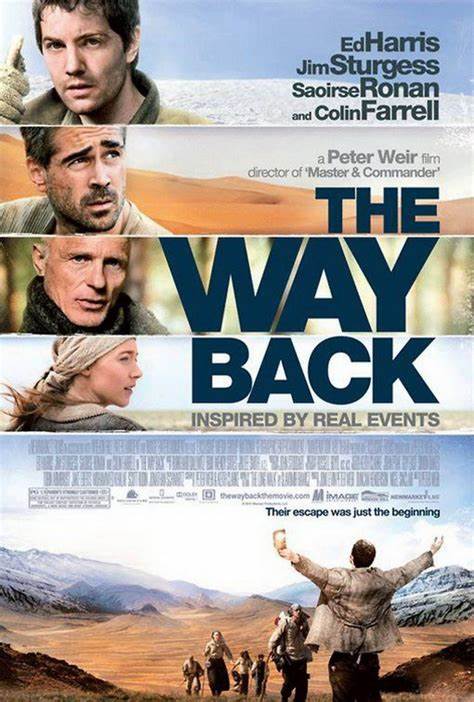
The Way Back (2010)

Harris, Sturgess and Farrell cross a great distance in Peter Weir’s The Way Back

Director: Peter Weir

Cast: Jim Sturgess (Janusz Wierszczek), Ed Harris (Mr Smith), Saoirse Ronan (Irena Zielinska), Colin Farrell (Valka), Dragos Bucor (Zoran), Alexandru Potocean (Tomasz), Gustaf Skarsgard (Andrejs), Sebastian Urzendowsky (Kazik), Mark Strong (Andrei Khabarov)

During the Second World War, Stalin spent almost as much time rounding up potential enemies of the state as he did fighting the Nazis. This was also his exclusive focus during the early years of the war when, in league with Nazi Germany, Russia invaded half of Poland. Polish officers were rounded up – many were massacred but Katyn, but some were sent to the gulags of Siberia. Among that number is Janusz (Jim Sturgess). But he is desperate to get home – so, with a collection of fellow prisoners, including American Mr Smith (Ed Harris) and hardened criminal (and pro-Stalinist) Valka (Colin Farrell) he escapes. Trouble is freedom is over 4000 miles away – through Siberia, Mongolia, the Gobi Desert and the Himalayas. To even contemplate the walk is staggering.

Which is more than you can say about the film. I never thought I would see a Peter Weir film that left me cold, but I now I have. How did Weir manage to make a compelling survival story into a film at times so unengaging you feel you have done the walk in real time? The real problem is the lack of characters. Halfway through the film the group encounters a young woman (played by Saoirse Ronan). She asks them what their background is – and they tell her (off-camera). And she tells them to Ed Harris. And he tells her his backstory off camera – and she tells it to Jim Sturgess. And there is the problem in a nutshell.

We’ve spent nearly an hour with this lot by then – and in that hour you’d struggle to know their names and certainly don’t know anything personal about them. We have no idea where they came from, what they lost or what they are yearning to return to. An hour during which it was hard to tell them apart (except for the more famous actors) but the film still wants me to invest in them fighting against the elements. Now, I know for many people, this isn’t be a problem. But for me it was an insurmountable obstacle.

I can admire the work that has gone into location shooting, make-up and costumes that show the ravages of this impossible journey. But, at the end of the day, if I know nothing about these characters and have no reason to invest in their fate, all the skill in the world won’t make this into a film I can invest in. Look at the great survival films – from The Flight of the Phoenix to another true-life (more of that later) story Apollo 13 – what makes them work is the dread that something awful might happen to the characters we care about. Without that feeling, it’s just pictures, nothing more. Weir’s mistake is to focus so much on how the Gulag crushes personalities and creates alliances of convenience, that he gives us no reason to bond with the characters.

The wispy, thin script gives very little for the actors to work with. Colin Farrell has the best part as a blackly comedic man of violence (and he drops out well before the end of the film). Mark Strong makes a big impact from a few short scenes as a prisoner who is all talk but no trousers. The others make little impression. Ed Harris does his trademark gravel, Saoirse Ronan adds much needed warmth (and provides a hugely needed audience surrogate figure – again far too late) but Jim Sturgess lacks the presence or force of character to carry the film. Force of character is missing throughout – you don’t get the sense of the strength of will needed to even undertake this, not to mention the psychological impact of this level of hardship.

It’s also oddly paced – you really lose track of how far or how long they have been travelling. Big time jumps take us from the first day of the escape to a cave in the forest which (we assume) they have spent weeks travelling to, reaching the edge of starvation. Then, before we know it they are at the border, then Mongolia. The film gets lost in a huge sequence in the Gobi Desert (for some reasons the characters always walk in the day and rest at night, the exact opposite of what anyone would do) – emerging with 12 minutes to go, bounding over the Himalayas in about 30 seconds (was it too difficult to film there?). The film caps with a bizarre “he walked forever” sequence, with superimposed walking feet over newsreel footage – a failed attempt to hammer home that Janusz needed to wait until the end of the Cold War before he could get home.

It’s nominally based on a true story. The author of the book it is based on is believed to have either invented or stolen the story from someone else and there is huge debate about whether it happened or not and if so who did it. This should have given Weir some freedom – but instead it seems to have given him too little to build on. Most damning in it I can’t find any reason in it to care whether they make it to freedom or not, instead the time dragging as much as the characters swollen feet. A terrible missed opportunity – and a rare misfire from a great director.

Cavalcade (1933)

The Marryots and the Bridges face a world in motion in Cavalcade

Director: Frank Lloyd

Cast: Diana Wynyard (Jane Marryot), Clive Brook (Robert Marryot), Una O’Connor (Ellen Bridges), Herbert Mundin (Albert Bridges), Beryl Mercer (Cook), Irene Brown (Margaret Harris), Frank Lawton (Joe Marryot), Ursula Jean (Fanny Bridges), Margaret Lindsay (Edith Harris), John Warburton (Edward Marryot)

Before Upstairs, Downstairs and Downton Abbeythere was Cavalcade. Winning the Best Picture of 1933 (beating out more highly regarded films today – and King Kong wasn’t even nominated!), Cavalcade shows a romantic weakness for dramas about the struggles of the British Upper classes and their servants is nothing new. Based on Noel Coward’s play, it’s a grand, soapy drama that’s been done better since (not least by those two shows) but makes an entertaining genre template.

Carefully ticking off historical events between 1899 and 1933, the film follows the Marryot family – father Robert (Clive Brook), mother Jane (Diana Wynyard) and their two sons Joe (Frank Lawton) and John (Edward Marryot) – and their servants turned pub owners the Bridges – Albert (Herbert Mundin), Ellen (Una O’Connor) and their daughter Fanny (Ursula Jean). From the Boer War via the death of Queen Victoria, the first flight across the Channel, two characters taking an unfortunate honeymoon trip on the Titanic to the First World War, we see how events affect both families (invariably with tragic consequences) as Britain slowly changes.

You can look at Cavalcade and find it hilariously old-fashioned. The accents are so sharply clipped they could be cut-glass, while the working-class characters speak with “evenin’ guv’ner” ‘umbleness. In preparation for the film, the Studio flew a camera team over to film the London production (then hired several of the actors to repeat their roles, including O’Connor) and the film sometimes feels like a slightly stuffy stage production bought to the screen.

This is most noticeable in Diana Wynyard’s performance. She clearly has no idea to act for the camera – and Lloyd didn’t correct her. ‘Asides’ see her frequently turn towards the camera and stare into the middle distance. For the innumerable times she is called onto to weep, she throws herself to the floor dramatically. With her declamatory style, she’s constantly playing to an imaginary back row. It sticks out particularly badly when watching the far more experienced Brook relatively underplay each scene without physically telegraphing every emotion. Surprisingly Wynyard landed an Oscar nomination – but soon left Hollywood and returned to the stage.

The rest of the cast are split between the two approaches, all while balancing the stiff-upper-lipped demands of the script, with its “I must go the war/Don’t go darling/I must they won’t start without me” exchanges (to paraphrase Eddie Izzard). The younger actors – John Warburton and Margaret Lindsay as the young couple booking a berth on the Titanic – offer performances so restrained they feel strait-jacketed. The working-class characters cut lose a little. Una O’Connor is a little broad, but quite engaging while Herbert Mundin gives possibly the best performance as a landlord too fond of his own product. Ursula Jeans makes a fine romantic lead as their daughter, delivering decent renditions of several songs in particular “Twentieth Century Blues”.

Those blues are nominally what the film is about, as the world leaves the Marryots behind. It’s bookended by two New Years –in 1899 and 1933 – during which time the world has changed completely. War has shattered the cosy Victorian status quo, leaving millions dead and the Marryots struggle to recognise this new England. Cavalcade only lightly engages with themes of societal upheaval – probably because it is simultaneously wallowing in so much nostalgia, that Coward’s more sombre ideas would bring the party crashing down.

Instead, Cavalcade luxuriates in nostalgia, loving the idea of a hierarchical, old-fashioned, English world where everyone knows their place (even after leaving their employ, the Bridges treat the Marryots with deference, while the Marryots look at them with a paternal indulgence). But its soapy stories – predictable as they seem to us now – are actually rather effective, and the flashes of genuine emotion (best of all, when Brook’s Robert says farewell to his son as he heads out on “one last patrol” in the last days before the Armistice) are surprisingly effective.

Lloyd’s direction of the larger set-pieces also show an impressive flair. The domestic scenes may seem stagey, but when the camera films a crowd it feels ambitious and dynamic. A huge pier scene with hundreds of men heading to the Boer War is handled very well. Bustling street scenes feel real. Wynyard’s finest moment comes in a crowd scene as she tries to merge into a crowd celebrating the Armistice, while caught up in a personal grief. A montage covering 1918 to 1933 is effective in showing the march of change.

Best of all is a wonderful montage communicating the horrific cost of the First World War. Lloyd presents the war as a never ending stream of soldiers marching into a tunnel. Initially the backdrop around is an English town, with smoking chimneys. This morphs into No Man’s Land, with the chimney smoke becoming explosions. Super-imposed over this are images of soldiers in close-up, at first marching in smiles, then dying at an accelerated rate. Nostalgia turns into Danteish circle of hell, innumerable bodies piling up. It stands out as a moment of expressionist inspiration (and must have had a strong impact on the audience).

It’s the finest moment in Cavalcade, your enjoyment of which will be directly related to how much patience you have with Downton Abbey. Find that an enjoyable diversion (as I do), and you will certainly find something to enjoy in Cavalcade. If Downton’s rose-tinted view of Edwardian social structures puts you on edge, you will struggle. I was pleasantly surprised by how charmed I was by it. And that World War One sequence is worth the price of admission alone.

Saving Private Ryan (1998)

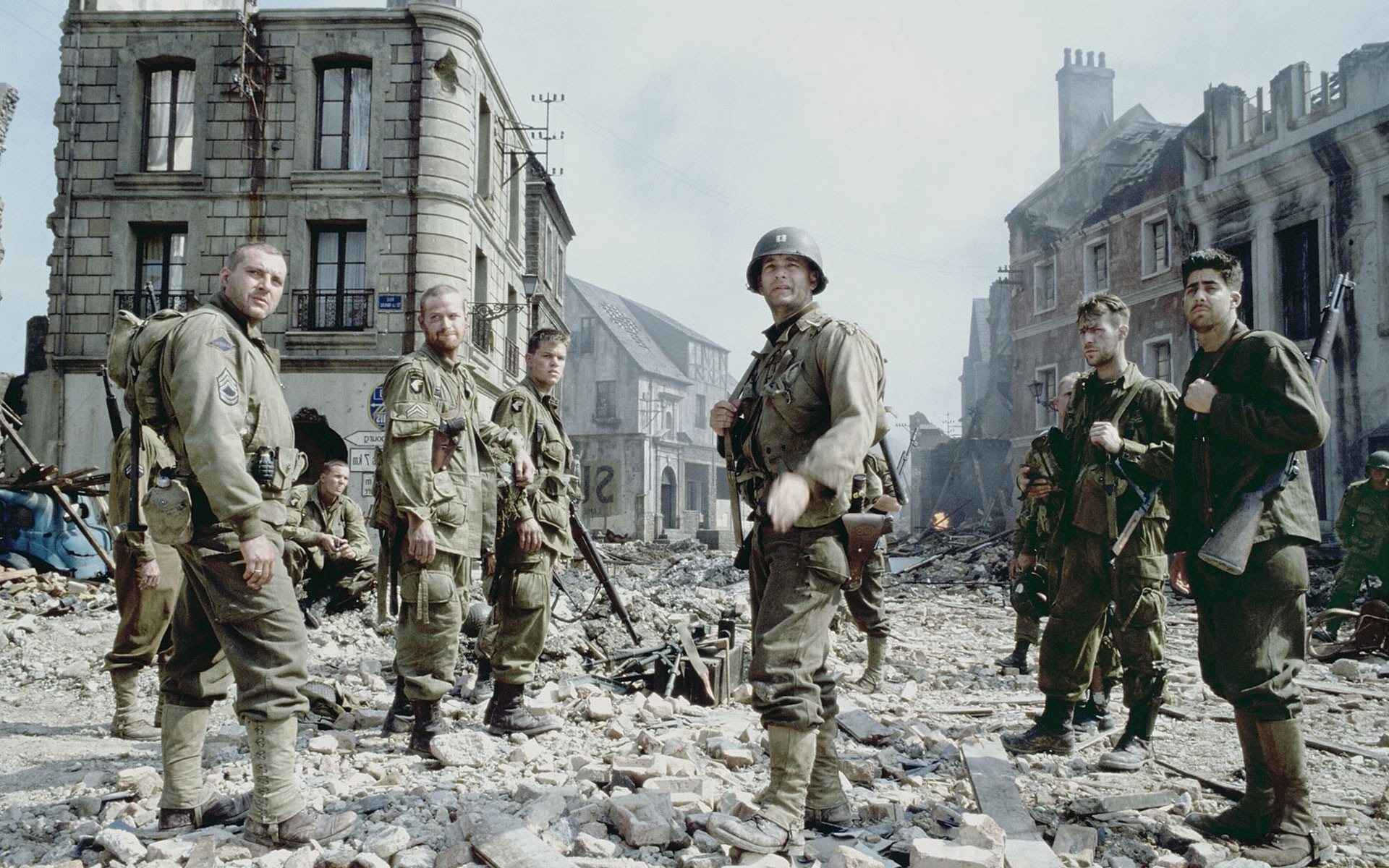
Tom Hanks leads a platoon of men through incredible sacrifice in Spielberg’s landmark Saving Private Ryan

Director: Steven Spielberg

Cast: Tom Hanks (Captain John Miller), Edward Burns (Pvt Richard Reiben), Matt Damon (Pvt James Francis Ryan), Tom Sizemore (Sgt Mike Horvath), Jeremy Davies (Cpl Timothy Upham), Vin Diesel (Pvt Adrian Caparzo), Adam Goldberg (Pvt Stanley Mellish), Berry Pepper (Pvt Daniel Jackson), Giovanni Ribisi (Medic Irwin Wade), Dennis Farina (Lt Col Anderson), Ted Danson (Cpt Fred Hamill), Harve Presnell (General George Marshall), Bryan Cranston (Colonel), Paul Giamatti (Sgt William Hill), Nathan Fillion (“Minnesota” Ryan)

There are few films you can categorically point to as changing cinema. Saving Private Ryan is one of those films. Before it, there had never been a war film like it: afterwards there would not be war film uninfluenced by it. Spielberg turned the Second World War from the picturesque setting for an all-star epic, into something immediate, ground-level and utterly, terrifyingly all-consuming. The “boots on the ground” vision of war, that didn’t shirk once from capturing the horrific cost and terror of war and had no suggestion of adventure. Hollywood would look at war differently ever more.

From landing at Omaha beach on D-Day, the film follows a single week in the lives of Captain John Miller (Tom Hanks) and a platoon of soldiers, sent on a ‘public relations’ mission. Three brothers have all been killed in action, with their mother receiving notification of their deaths all on the same day. The top brass decide she has suffered enough and that her last remaining son James (Matt Damon) should be bought home. Problem is, he’s a member of the 101st Parachute Airborne – and no one is quite sure where he’s been dropped. Miller and his men are to find Ryan and bring him home – despite the resentment of his men that their lives at being put at risk to save one man.

Any discussion of Saving Private Ryan begins with that Omaha beach sequence.  It’s hard to even begin to understand the impact this sequence had on audiences in 1998. Quite simply, we’d never seen anything like it. Expectations before its release was that Spielberg was producing a crowd-pleasing, Dirty Dozen style men-on-a-mission film. No one expected a savage, brutally realistic vision of what warfare actually meant, with its brutal, swift and random death.

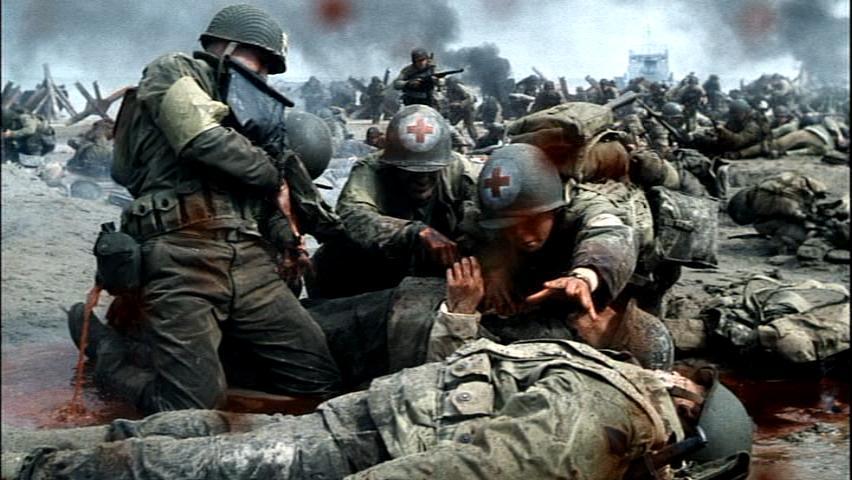
The sequence starts with Spielberg panning across the faces of soldiers in the landing craft Miller and his company are riding to the beach. He lingers on these faces – only for them to be promptly ripped to pieces by machine-gun fire the second the doors open. Omaha beach is a savage nightmare, the closest thing you can image to hell on earth. Machine gun bullets rip down relentlessly on the pinned down soldiers – and the camera throws us right in there with them.

With drained out colours, hand-held camerawork (some of it operated by Spielberg himself), mud, blood and sand spraying up into the lens, it’s all-consuming. The film’s sound design is awe-inspiringly good, every single sound (the splatter of sand, the thud of bullets ripping through flesh, the snap of rifles) builds into a shatteringly immersive crescendo with no respite. Spielberg doesn’t shy away from the horror. Bodies are mutilated by bullets. Heads are caved in. A soldiers walks the beach, carrying his own severed arm. Medics treat soldiers drowning in their own blood, crying for their mothers. Bullets claim the brave and scared alike.

You watch and you can’t believe anyone emerged from this alive. The cost of getting off the beach is seismic. The visceral horror doesn’t let up over the first 25 minutes as Miller’s company – suffering huge losses – struggles from landing craft, to beach, to storming the German defences. Our ear drums are assaulted by bullet sound effects, and every single step shows us some new horror. There are no long-shots, no cut aways and the only peace we get is when we share with Miller his tinnitus from narrow-escape explosions. The brutality is even-handed – after the massacre on the beach, the US soldiers show no mercy to the Germans (two of whom are gunned down surrendering and begging for mercy), officers urging their men to “let ‘em burn” as on-fire Germans fall from incinerated machine gun banks.

It’s extraordinary – and sets the tone. Combat is immediate, visceral, terrifying, brutal and always carries a heavy cost. The human body is infinitely fragile and every death – high or low – is met with fear, loneliness and regret. Veterans had to leave the cinema during screenings to compose themselves, and viewers were stunned into silence. You could watch Saving Private Ryan and feel you never even began to understand what war was until then – and that even with this taste you can still never understand it. It’s a brutal zero-sum game with only losers.

Any film would struggle to follow that: but Saving Private Ryan does a fabulous job of maintaining the dramatic force of its opening sequence before its book-end final battle, as the remains of the platoon join Ryan’s unit in a seemingly-hopeless defence of a vital bridge in a bombed out town (another grim, gripping and stunning slice of war with the added kick to the guts of watching people we have spent the entire film with being blown away and ripped apart by bullets).

Spielberg’s film explores what makes the cost of this worth it. It’s a film about the power of sacrifice: the sacrifices the men make to find Ryan, but on a larger scale the sacrifices this whole generation made for those that were to come. When Miller urges Ryan to “earn this”, he’s speaking to us all. Men like him died to give us the chance to make the world a better place. The sacrifices of this platoon for one man is all part of the same price this entire generation made for the ones that were to come.

And one of the things sacrificed is the rules of humanity. Prisoners are shot, unarmed men are killed – if you play this game, you play to win. Thrown into Omaha, the audience understand this – meaning we feel as little patience with translator Upham (a fine performance of out-of-his-depth-fear from Jeremy Davies), who whines about right-and-wrong, as his colleagues, who understand living-and-dying is the only issue out here anyone cares about.

Understanding this depends on relating to the soldiers – and the cast has been hand-picked for that. None more so than Tom Hanks, channelling his relatability into a home-spun, ordinary man forced into extraordinary and brutal situations that have left a shattering mark on him. With an intermittent tremor in his hand, Hanks embodies the stoic sacrifice of a generation. It’s a landmark performance. There are many fine performances in the film, Tom Sizemore (battling drug addiction and a promise of instant dismissal if he relapsed) perhaps the stand-out as his hardened sergeant.

If Saving Private Ryan has a fault, it’s that it falls into Spielberg’s sentimentality trap. Sometimes the man can’t help himself. The film is bookended by an old man visiting war graves – someone we discover at the film’s end is Ryan himself. As if somehow still not trusting us to get the message about sacrifice and horror the film has so effectively communicated, old-man-Ryan explicitly tell us, tearily asking his wife if he has led a “good life”. It’s a hammer-home the film doesn’t need and dents its final impact. (I’d also say the film has endless empathy for US Joes, but sees all the Germans as a ruthless swarm fighting an evil cause, although many of them were also as scared).

But these are quibbles in a film that does so much right – and which reinvented an entire genre. It’s one of Spielberg’s masterpieces, a stunning display of directorial skill and immersive film-making, and its impact never seems to lessen. It gets as close as any film can to showing us war – and yet it is still a million miles further away than most of us (thankfully) will ever have to get.

The Great Ziegfeld (1936)

Luise Rainer and William Powell bring the life of The Great Ziegfeld to life in this decent-but-not-great Best Picture winner

Director: Robert Z Leonard

Cast: William Powell (Florenz Ziegfeld Jnr), Myrna Loy (Billie Burke), Luise Rainer (Anna Held), Frank Morgan (Jack Billings), Fannie Brice (Herself), Virginia Bruce (Audrey Dane), Reginald Owen (Sampson), Ray Bolger (Himself), Ernest Coassart (Sidney), Joseph Cawthorn (Dr Ziegfeld), Nat Pendleton (The Great Sandow)

I’d always been led to believe The Great Ziegfeld was one of the low points in Best Picture history – that the Oscar had gone to a plotless, over-long, empty mess. So, watching this film for the first time, I was pleasantly surprised. The Great Ziegfeld may be flawed, but it’s not as bad as all that. In some places it’s even pretty good.

Florenz Ziegfeld Jnr (William Powell) is a showman with big dreams. From the Chicago World Fair of 1893, where his show features strong-man The Great Sandow (Nat Pendleton) – lifting a massive pair of dumb bells inside of each is a “Dumb Belle” (geddit?!) – Ziegfeld heads towards New York. There he puts on a series of variety shows, The Ziegfeld Follies, crammed with popular entertainers and gorgeous babes. Along the way he spends money like water, marries star Anna Held (Luise Rainer), cheats on her a lot (although the film handles this coyly) and finds love with star Billie Burke (Myrna Loy – the real Burke grudgingly agreed she was too old to play herself).

Watching The Great Ziegfeld you can see how it influenced so many later films. A witty, show-piece crammed crowd-pleaser about a impresario, its essentially the grandfather of The Greatest Showman. It’s unpretentious and easy-going – but also impossibly long, far too long for its slight story. It’s sprawling, puffed-up and the musical numbers are often mundane and tedious – but it, just about, manages to stay entertaining.

In real life Ziegfeld was a chancer with a roving eye. He left a mountain of debt and his genius was at least as much about promotion as it was art. You can see why Hollywood has a soft-spot for him: he was all about spectacle (a running gag has him always wanting “higher steps”, a neat short-hand for making things bigger). His rough edges (the affairs and the financial chicanery) are filed down as the film’s Ziegfeld is a charmer with a Wodehousian wit, cheeky and naughty but always a gentleman.

William Powell is perfect casting, and a big part of the film’s charm is tied up in his winningly (and deceptively) casual performance. Powell turns the role into a personality part, smoothly underplaying with a wink to the camera. He delivers the various bon mots with a real skill and provides nearly all the film’s pace and energy and a big barrel of its sense of fun.

He sits at the centre of a film that has genuine moments of directorial flair from Robert Z Leonard. There are some great tracking shots and he handles the ‘acting’ scenes very well – a scene with Ziegfeld chatting with Will Rogers and Fanny Brice (playing herself) is worth the price of admission alone. The performers mostly bounce effectively off each other.

Leonard also gets emotional impact from Ziegfeld’s late romance with Burke (a sequence of the two of them chatting, coyly holding hands is very well done) and creates a superb series of visuals to close the film (a shot of the ageing Ziegfeld sitting in his chair, staring at his name in lights over his theatre, is a wonderful summary of the man’s life – and maybe, when his hand drops down releasing a flower, it even gave Welles a bit of inspiration for Kane’s death five years later).

When The Great Ziegfeld focuses on Powell’s lightness of touch, and character-led moments (Frank Morgan is also great fun as Ziegfeld’s bombastic, long-suffering rival) it works really well. What has suffered over time – and today feel like its weakest parts – are those heavily praised in 1936.

MGM marketed this as the most expensive film ever made, the money splurged on those massive musical numbers, with scores of extras and enormous sets. The centre-piece is the “A Pretty Girl is Like a Melody” number, featuring countless extras on a massive rotating “wedding-cake” set, 175 spiral steps high. Like Ziegfeld’s shows it’s all about the cost, spectacle and size. And they are not even 1% as interesting as watching Astaire and Rogers tap dance in a marquee in Top Hat.

The film’s numerous musical numbers often feel like dull products of yesteryear. Over-long, over-extended, shot to squeeze the set into frame rather than focusing on skill or grace. These numbers – some of which I admit I fast-forwarded through – pad out the running time but contribute nothing to either story or entertainment factor. If anything, you are desperate to get back to Powell’s skilled playing of the biographical scenes, rather than sitting through another over-ripe number.

Similarly much of the acting has aged less well. Myrna Loy is strangely uncomfortable as Burke (perhaps all to aware the real Burke was just off camera). Luise Rainer won the first of her two consecutive Oscars – but her performance is extremely over-played, utterly lacking in nuance. Her famous “telephone” scene (heartbroken, she calls Ziegfeld to congratulate him on his new marriage) was hailed as great acting, but today looks mannered and overblown.

But despite all these flaws – mundane and boring musical numbers, a lack of spark and pace – there is actually a fair bit of wit and charm. Its early sequences – which focus on Powell and Nat Pendleton’s witty turn as Sandow – are surprisingly light and engaging. The moments where the film relaxes and isn’t straining to impress are engaging and fun. There is a decent 90-minute Astaire-Rogers film straining to get out here, crushed under the weight of the Ziegfeld/MGM grandeur. It’s entertaining – better than you might have heard – but can’t hold a candle to the great Hollywood musicals of yesteryear, its charm spread very thin.

The Lord of the Rings: The Two Towers (2002)

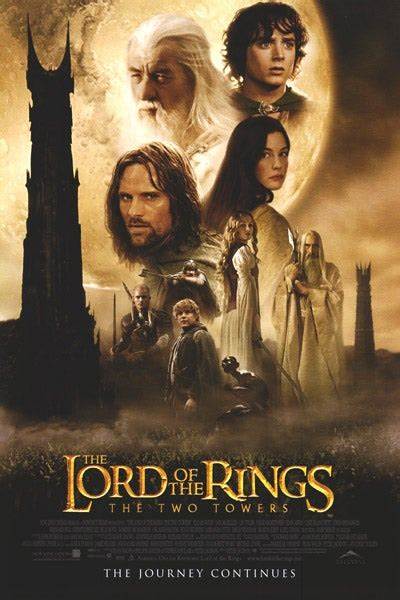
Peter Jackson’s second film in the Lord of the Rings trilogy is another triumph

Director: Peter Jackson

Cast: Elijah Wood (Frodo Baggins), Ian McKellen (Gandalf), Viggo Mortensen (Aragorn), Sean Astin (Samwise Gamgee), Liv Tyler (Arwen), Andy Serkis (Gollum), Billy Boyd (Peregrin Took), Dominic Monaghan (Meriadoc Brandybuck), John Rhys-Davies (Gimli/Treebeard), Orlando Bloom (Legolas), Cate Blanchett (Galadriel), Bernard Hill (King Theoden), Christopher Lee (Saruman), Hugo Weaving (Elrond), Miranda Otto (Eowyn), David Wenham (Faramir), Brad Dourif (Grima Wormtongue), Karl Urban (Eomer), Sean Bean (Boromir), Craig Parker (Haldir)

After Fellowship of the Ring we knew we were in safe hands. So, the real question was would The Two Towers continue to win over long-term fans and new-comers to Middle Earth? Would Jackson pull off the difficult middle chapter, resolving some things, but leaving us with enough tantalising hooks? He succeeded: for many The Two Towers is their favourite film in the series.

The fellowship is broken. Boromir (Sean Bean) and Gandalf (Ian McKellen) are dead. Frodo (Elijah Wood) and Sam (Sean Astin) are making their own way to Mordor – now guided by the former ring-bearer, the dangerously untrustworthy and unbalanced Gollum (Andy Serkis). Aragorn (Viggo Mortensen), Legolas (Orlando Bloom) and Gimli (John Rhys-Davies) are tearing across the land of the kingdom of Rohan following the orcs who kidnapped Merry (Dominic Monaghan) and Pippin (Billy Boyd). Meanwhile, the dark forces of Saruman (Christopher Lee) are moving against Rohan and its sickly king Theoden (Bernard Hill), determined to destroy it. War has truly come to Middle Earth – but can the return of an old friend help to turn the tide? And will Frodo and Sam find safety or danger when they meet Boromir’s brother Faramir (David Wenham)?

Hard to believe considering the scale of the first film, but Jackson’s second Tolkien adventure ramps up the scale even further. It continues the immersive capturing of the look and feel of the novels, while reconceptualising it into something closer to a stirring, gripping action epic. The Two Towersis awe-inspring in its scale and world-creation, building towards one of the all-time great cinematic battles as the few of Rohan hold out against the massed forces of Saruman at Helm’s Deep.

Just as in Fellowship the pace and tension is heightened. With the heroes split into three groups, there are a number of balls to juggle. But Jackson and co-screenwriters Fran Walsh and Phillipa Boyens superbly intercut the more linear book chapters – feeling free to shift orders, motivations and inventing their own narrative flourishes to link events together. The film adapts around 13 of the novel’s twenty chapters (the rest being assigned to the other films), but is so perfectly paced it never feels overstretched or disjointed. They even add more material involving Saruman, making this arch-manipulator a larger presence in the film than in the novel.

The Two Towers radically changes many of the events of the novel – but in most cases (except one) this is done with such respect for Tolkien that even most fans overlooked them. So, it hardly matters Theoden’s motivations for making a stand at Helm’s Deep have radically changed or that the films add warg action or has Aragorn presumed dead at the halfway point. Elves turning up to fight at Helm’s Deep is such a “Hurrah” moment, only the most extreme Tolkien purist could object (they would have objected a lot more to the original plan to have Arwen fight there). Merry and Pippin’s interaction with the Ents (living trees) are re-purposed to give them greater agency.

In fact, the changes to Faramir were the only ones anyone objected. In the novel Faramir is pure-of-heart and untempted by the Ring. With much of the novel’s Frodo material transferred to The Return of the King, Jackson, Walsh and Boyens needed to make Faramir “an obstacle”. Cinematically, the idea of Faramir trying to take the Ring to Gondor – motivated by the urge to win the affection of his distant father – made perfect sense (and Wenham delivers the character very well).

But for many book fans, this was a travesty of a beloved character (for all that Faramir eventually proves his quality). I’ve never met a book fan who wasn’t displeased by “movie Faramir”. For those familiar with the films, there won’t be a problem – but I can see the point. The character is clearly, in a subtle way, different from the more whimsical and unsullied man the book presents.

If there is one element of Tolkien Jackson, Walsh and Boyens are not interested in, it’s Tolkien’s whimsy and idea of characters as paragons (or parAragorns). For the film, the conflicted Boromir is more interesting and sympathetic than goodie-two-shoes Faramir. By contrast, to Tolkien Faramir was an ideal and Boromir a shadow of the martial blowhards who led millions to death in the trenches. Tolkien wanted heroes who were more certain and perfect. The films are about the struggles people face with doing their duty, questioning their purpose. The films are not about questions of spiritualty and moral purity. Tolkien gives over long chapters to the spirituality of the Ents and one short one to Helm’s Deep – that balance is completely flipped here.

But the advantage is that the idea of true heroism being conquering your own doubts pays off hugely in the adaptation. Aragorn – a superb and hugely charismatic Viggo Mortensen, literally sweating heroism and poetic sensibility – has his character arc improved by the film. In the book, he has not doubt at all. The film establishes his reluctance to lead and unwillingness to acknowledge he is of men. From seeing only the weakness of men, he slowly identifies with them. It’s a conscious decision for him to fight at Helm’s Deep and the battle sees him finally accepting leadership. It’s a richness not found in the novel.

Of course, battles are more compelling on screen than the page. Helm’s Deep is perhaps the greatest battle on screen, a Kurosawa-inspired, rain-splatted masterpiece, perfectly mixing character beats and action. It never forgets that we care about people not action, so rarely more than thirty seconds go by without one of our heroes front-and-centre. Shots of refugees establish the stakes, the costs of war are laid shockingly bare and the battle is crammed full of awe-inspiring shots of mayhem and martial prowess. You can’t not be excited by this superbly choreographed epic, with just the right level of Jackson’s pulpish-gore background laid on.

But this is not just a film about a battle. As always, every beat is perfectly worked – even if the Ents material suffers from the reduced interest from the creative team. The opening sequence expanding the battle between Gandalf and the Balrog is jaw-dropping. The world of Rohan is created beautifully. Bernard Hill’s Theoden is plagued with self-doubt. Miranda Otto is very good as a woman who wants to prove her place in a man’s world (even if the hinted romantic sub plot between her and Aragorn feels a little forced).

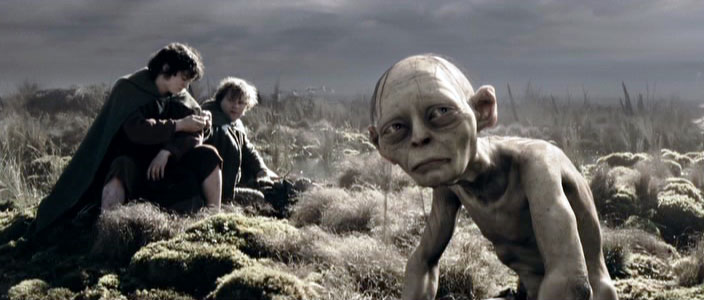
But the biggest magic in the film, and its most special effect, might just be Gollum. While the computer wizardry to create the character is astounding, it works because the acting behind it is sublime. Serkis invented a whole school of acting in motion capture. The screenwriters expand the novel’s conflicted psyche and explores even more the character’s split personality – Gollum (the Ring dominated side) and Smeagol (the timid but dangerous side), both made distinctive by Serkis. Jackson’s most bravura scene might be one of his most simple, a two-shot argument between the two sides, that sees Serkis switch personality with each cut. It’s a superb combination of cinematic language and acting skill.

The Two Towers is superb film-making, with music, photography, editing and design all faultless. The acting is again brilliant – Wood, McKellen, Astin, Tyler as well as those mentioned above. But it’s also a brilliant adaptation of a novel, making changes to increase tension and drama and carefully selecting the elements that will work most effectively on screen. It’s closing battle is one for the ages, but the entire film is a perfectly paced epic, with a growing sense of danger and doom that ends on a beat of quiet hope. This series is a thing of beauty.

From Here to Eternity (1953)

From Here to Eternity (1953)

Glorious romance goes up against military discipline in this sweeping, entertaining Oscar-winner

Director: Fred Zinnemann

Cast: Burt Lancaster (First Sergeant Milton Warden), Montgomery Clift (Private Robert E. Lee Prewitt), Deborah Kerr (Karen Holmes), Donna Reed (Alma Burke/Lorene), Frank Sinatra (Private Angelo Maggio), Philip Ober (Captain Dana Holmes), Mickey Shaughnessy (Sergeant Leva), Harry Bellaver (Private Mazzioli), Ernest Borgnine (Staff Sergeant James “Fatso” Judson), Jack Warden (Corporal Buckley)

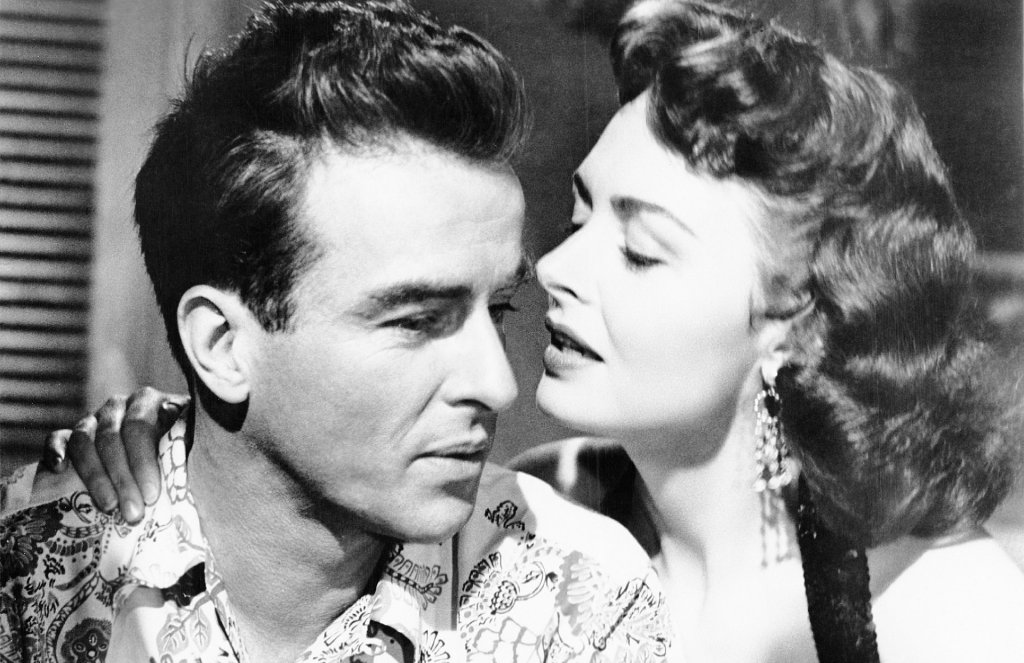
Dominating the 1953 Oscars, From Here to Eternity is exactly the sort of sweeping, highly-professional studio epic Hollywood at its best produced in its Golden Years. Everything turned out pretty much right, with iconic imagery and characters, and skilled production and acting turning a soapy story into something quite profound. From Here to Eternity is entertainment-as-art, a sharply intelligent film that sails along smoothly. It feels like a generational progression from Casablanca – it may not quite hit those heights, but it deserves to be in the same conversation.

It’s 1941 at Pearl Harbour and three soldiers discover going their own way, rather than conforming to rules and expectations, causes no end of trouble. Private Prewitt (Montgomery Clift) is repeatedly hazed by his comrades (with the support of his CO) for refusing to join the boxing team. A champion boxer, Prewitt retired after accidentally blinding an opponent and nothing will persuade him to go back. His only comfort is with local social club ‘hostess’ Lorene (Donna Reed). First Sergeant Warden (Burt Lancaster) is persuaded to try for officer – because otherwise he risks prison for his love affair with the CO’s unloved wife Karen (Deborah Kerr). Private Maggio (Frank Sinatra), Prewitt’s only friend, is a loyal wild-card who can’t stick to the rules and is targeted by brutal stockade sergeant “Fatso” Judson (Ernest Borgnine).

From Here to Eternity sounds like a great big soap, a sort of 1980s glossy TV mini-series made before its time (it was later remade exactly as that). It’s got that in its DNA, but is made with such luscious, professional, old-school Hollywood excellence it becomes something special. Superb craftsmen work in every position to produce a classic melodrama with touches of romance, thriller, war drama and tragedy. With excellent performances across the board (Sinatra and Reed both won Oscars, while Lancaster, Clift and Kerr were all nominated), FHtE tells emotive, empathetic stories about genuine characters trapped in situations beyond their control.

The film is a masterclass in adaptation. The original novel – a popular tome of its day – tells a story crammed full of sex, STDs, homosexuality, bad language and violence across its 800+ pages. No wonder it was a hit – and no wonder, under the Production Code, it was thought impossible to adapt it into a film. Screenwriter Daniel Taradash carefully reworked and ‘hinted’ at several things that could not be explicitly said (for example, no one calls Lorene a prostitute, but you’d have to be pretty dense not to realise she is doing more than pouring drinks in that bar). Restraint, as it often did, demanded invention and bought out the best (and subtle work) in people. The film’s requirement to focus on dialogue and character rather than controversy hugely works to its benefit.

Zinnemann was the perfect director for the material. Drawing wonderful performances from the actors, he also keep the film intimate, drawing us closer to the characters over scale, despite the temptations of the film’s location shooting in Hawaii (Zinnemann pushed strongly against shooting in technicolour and widescreen). The film also fits perfectly with one of Zinnemann’s key pre-occupations: the struggle of principled men (most strikingly Prewitt) in a society that demands them to say or do something against those principles. Just as the townspeople wanted Marshal to run and the Tudor court wanted More to swear allegiance, so our characters buck against conforming with the roles they are expected to play.

You can see why the military – after supporting the project – were less happy when they saw the film. The individual is championed at the cost of the machine. Prewitt’s principles are praised, while his regiment is hopelessly corrupted by his incompetent and careerist commander. The hazing is endemic, and supported from above – and no one even notices or cares that Fatso is also abusing his position to brutalize Maggio. The CO is so useless – as well as ruining his wife’s life, rendering her infertile and cheating on her all over town – that the company is effectively run by First Sergeant Warden, the only NCO with the courage of his principles. Under pressure from their army sponsors, the film does see the chain of command cashier the CO (a scene Zinnemann hated) – but the sympathy is with the individual rather than the system.

From Here to Eternity is also a highly effective romance. Its most famous image will always be the clinch between Lancaster and Kerr, kissing and embracing while the turf washes up around them. But the film is also realistic – its why it remains so effective. Warden and Karen are made as miserable by their growing love as they are happy (they even comment on this). Relationships are never an easy ride, and demand constant dedication. Lorene and Prewitt’s relationship is far from rose-tinted, with the two of them constantly forced apart by their own mistakes and choices.

It’s melodrama told with emotional intelligence and realism – and Zinnemann gets great performances from great actors. Lancaster brings immense strength and purpose to Warden, but also a concealed vulnerability and decency. Kerr – revitalising her career after a string of “good wives” – brilliantly conveys Karen’s desperation and misery, along with her wary hope her life could change. That moment on the beach, the surf washing around them as they make-out is a rare moment of relaxed happiness. Other than that, its one tough conversation after another – stolen moments in bars or cars, where the two of them confront the difficulty of their situation, but also their need for each other. That’s old school romance for you – unavoidable, but never-endingly difficult and even a little painful.

Sinatra (in the role that changed his career – and the debate around how he got the role inspired that horse’s head in The Godfather) brings charm, cheek and tragedy to Maggio. How did Maggio end up in this man’s army? He’s quietly fun loving, but bucks the rules like almost no other character in the film. Sure he’s an upstanding guy – the only one who sticks by Prewit and defends him – but he can’t follow a simple order. Mostly because he’s not really disciplined enough. Plus he makes enemies – worst of all Borgnine’s bruising sergeant. He’d be so much happier running a bar for soldiers than he ever is being a soldier himself.

This makes him very different from Clift’s Prewit. Clift gives one of his finest performances as this fully-realised tragic hero. Prewit is a man of principle who, for the best reasons, makes choices that have a terrible impact on him. He’ll stand by his decision not to box, even though it opens up a bucket load of unpleasantness for him and Maggio. If that leaves him with one friend and no supporters, so be it. He may not look like a boxer (the studio wanted a more muscular lead), but he is every inch the emotionally conflicted, guilt-plagued and confused GI, stubborn but profoundly sincere, with the strength of character to stand alone, but the vulnerability to need affection from Lorene (and respond like a lovesick kid when he thinks she has spurned him). It’s a complex, mature and excellent performance.

All these events are eventually dwarfed by the outbreak of war. If there is one thing that Zinnemann will accept is bigger than the individual, it’s world war. The film quietly counts down to the attack on Pearl Harbor (without the characters realising it), sneaking us peaks at calendars and reports to let us know how close we are to the fateful day. When it comes, it reveals the characters of the people we’ve been following. Warden takes command in a way his CO never could. Prewit, hiding out with Lorene (Reed by the way is marvellous, her investing Lorene with a real world-weary sadness), decides its his mission to return from AWOL, despite the dangers this will cause him. The attack is grippingly but simply filmed.

From Here to Eternity is a complex film, made with real professional skill, and a rewarding character study. Zinnemann gets the tone right at almost every single point and draws out brilliant performances from a very strong cast. As an example of Hollywood Studio film making, it’s hard to beat.

The Towering Inferno (1974)

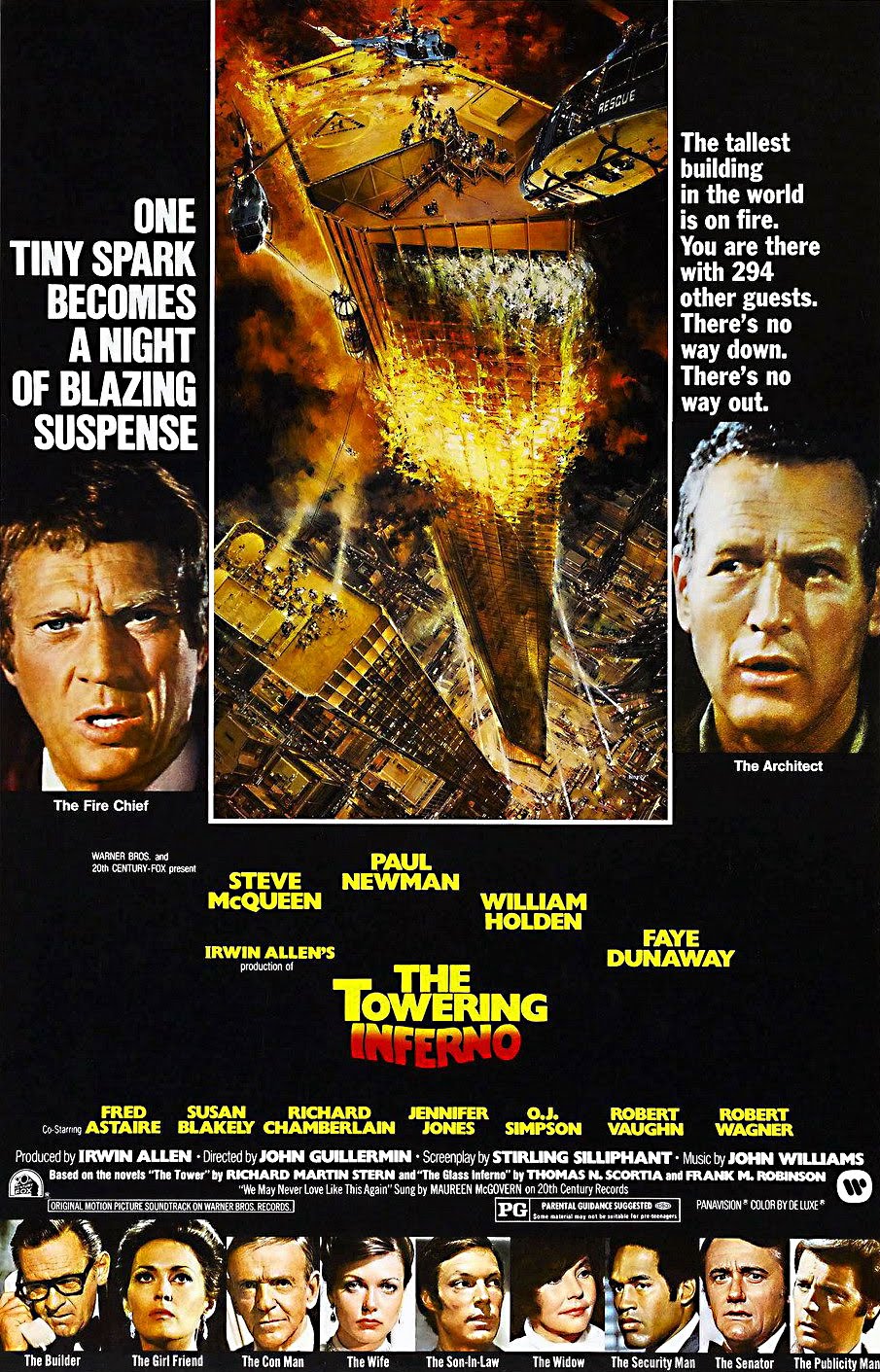
Newman and McQueen tackle a huge blaze in The Towering Inferno

Director: John Guillermin, Irwin Allen

Cast: Steve McQueen (Fire Chief Michael O’Halloran), Paul Newman (Doug Roberts), William Holden (James Duncan), Faye Dunaway (Susan Franklin), Fred Astaire (Harlee Claiborne), Susan Blakely (Patty Duncan Simmons), Richard Chamberlain (Roger Simmons), Jennifer Jones (Lisolette Mueller), OJ Simpson (Harry Jernigan), Robert Vaughn (Senator Gary Parker), Robert Wagner (Dan Bigelow), Susan Flannery (Lorrie), Shelia Matthews Allen (Paula Ramsay), Jack Collins (Mayor Ramsay)

Architect Doug Roberts (Paul Newman) flies into San Francisco for the grand opening of The Glass Tower, the newly constructed tallest building in the world which he has designed for developer James Duncan (William Holden). A celebration with the rich and famous is planned – too bad Duncan’s rogueish son-in-law Roger Simmons (Richard Chamberlain, smarming like his life depends on it) has saved a few dollars by stuffing the building with sub-standard wiring. Surely the world’s largest building can’t catch fire? You bet it could – and only heroic Fire Chief Michael O’Halloran (Steve McQueen) has the expertise to put it out.

The Towering Inferno was the peak of the “all-star disaster” genre. It was bought to the screen by Producer (and “Master of Disaster”) Irwin Allen, and pretty much ticks all the boxes you expect from the genre. A star at every turn! A huge running time! Constant denials that anything could go wrong (of the “This building can’t burn down!” variety)! Kids in peril! Death-defying stunts! A brave pet! An elder statesman of Hollywood risking life and limb! A scoundrel we can boo! A tear-jerking death! The Towering Inferno pretty much has it all, and it plays every single beat with the sort of po-faced seriousness that was already starting to look a bit silly by 1974.

Films like this work because audiences – as we’ve seen time and time again – never lose their taste for watching things get trashed. In the 1970s every studio wanted its own mega-budget disaster film. The Towering Inferno’s real uniqueness is the story behind its making – two studios had competing “Skyscraper on Fire!” projects but, instead of competing, pooled their resources to make one mega hit. So, Warner Brothers The Tower and 20th Century Fox’s The Glass Inferno became this.

Irwin Allen was handed the keys – because no-one did it better – and each studio contributed a star. McQueen and Newman spent almost as much time negotiating equal terms as acting in the movie. Both were paid 10% of the gross and agreed they would have exactly the same number of lines (many of Newman’s final scenes sees him perform stunts wordlessly, as he burned through his allotted lines during the 40 minutes he spends on screen before McQueen turns up). The billing was negotiated carefully: their names would appear on screen together with Newman slightly higher, but McQueen’s name to the left (both could therefore claim they were “first billed”).

Their interest in the film pretty much ended there. Newman was famously disparaging of what he called “a piece of shit” and the only time he did something purely for the money. He coasts through on those blue eyes and twinkly grin. Eager that his character be absolved of responsibility (he has designed a tower that will claim 200 lives!) Newman’s architect is continuously absolved of any responsibility by the rest of the cast and leads on saving lives. McQueen grabbed the better role as the all-action fire-chief, riding in after 45 minutes (thus wisely missing out the tedious build-up of the soapy plot lines), takes charge and does nothing but manly action, but he also looks like someone going through the motions.

But then they know the things that will be remembered are the set-pieces. As flames stretch up the building, our star names dodging explosions, climbing up shattered staircases, dodging collapsing ceilings and taking on vertigo-inducing heights, it’s hard not to be excited. As in all disaster films, the disaster takes a strong moral stance. Of all the characters who die only one ‘doesn’t deserve it’. Aside from that, the actors playing philanderers, swindlers and bastards inevitably bite the dust, while the upstanding and noble pretty much see their way to the end.

The disaster sequences are impressive – and the fire-effects are really well done. Allen directed the ‘action sequences’ – aka the only bits of the film you really remember – while Guillermin handled ‘the acting’ (the dull, soapy, badly written bits you forget). The cardboard characters (no wonder they catch fire so easily!) could have had their personalities scribbled on the back of a stamp, and are pretty much dependent on the charms of the actors playing them. Fred Astaire’s gentle conman (the sweetest grifter you’ll ever meet) is a ludicrous character, but works because of Astaire’s twinkle-toed charm (Astaire grabbed a wave of affectionate awards nominations). Jennifer Jones plays off him rather well in the film’s ‘heroic elder statesman of Hollywood’ role, as a woman who puts herself at huge risk to save two kids (and their deaf mum) from immolation.

But pretty much all the character-based stuff in Towering Inferno is ludicrously silly, with some strikingly bored actors (Faye Dunaway looks like she wants to be anywhere else) but it hardly matters as we are there to watch the world burn. Which it does to spectacular effect, and the reassuringly, camp predictability of the film’s events is endearing – and raises a few good-natured laughs (you have to laugh at something like this, even though it wants to take itself so seriously). The Towering Infernowas the largest of all the disaster flicks of the 1970s. Allen shoehorns in a few points about fire safety in tall buildings for the ‘serious bits’, but his heart is in consigning most of the second tier of his all-star cast to dramatic, firey deaths. Overlong, very silly but rather sweet.

Amazing Grace (2006)

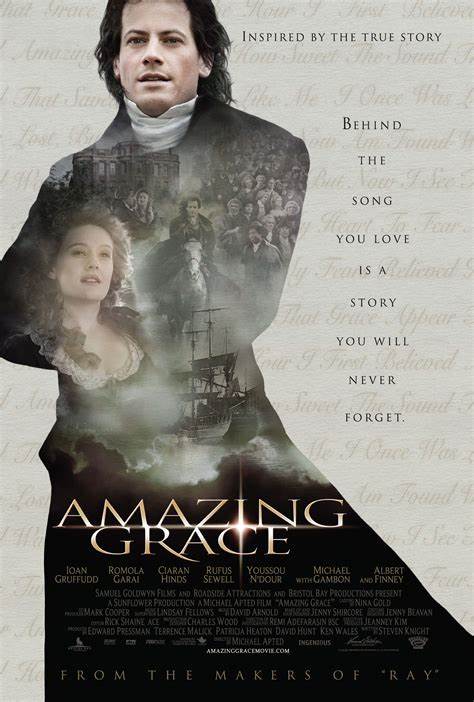
Ioan Gruffudd in full flight in the conventional but charming Amazing Grace

Director: Michael Apted

Cast: Ioan Gruffudd (William Wilberforce), Romola Garai (Barbara Spooner), Benedict Cumberbatch (William Pitt the Younger), Ciaran Hinds (Banastre Tarleton), Albert Finney (John Newton), Michael Gambon (Charles James Fox), Rufus Sewell (Thomas Clarkson), Youssou N’Dour (Olaudah Equiano), Toby Jones (Duke of Clarence), Nicholas Farrell (Henry Thornton), Sylvestra Le Touzel (Marianne Thornton), Stephen Campbell Moore (James Stephen), Bill Paterson (Heny Dundas), Jeremy Swift (Richard)

From 1782 to 1807 William Wilberforce (Ioan Gruffudd) fought a long – sometimes lonely – campaign to end the slave trade (and eventually slavery – the film confuses the two, with slavery continuing in much of the Empire for over twenty more years) in the British Empire. During that time, he competed with vested interests, parliamentary rivals and accusations of being a radical at a time when Britain was at war with Revolutionary France.

Michael Apted’s old-fashioned film covers this, hitting every beat you would expect for a biographical drama. It uses a traditional framing device of starting in the middle of the story: Wilberforce in 1797, depressed, hooked on laudanum and out of hope, revitalised by meeting Barbara Spooner (Romola Garai) who will become his wife. This makes for a perfect narrative tool as it means she can ask him questions like “tell me what happened” which serves as a neat entrée into a whole host of flashbacks sketching out in the swiftest means possible the history of abolitionism.

Amazing Grace could have been made in the 1930s, so closely does it hue to the classic rules of biopics. It’s practically a structural brother to The Life of Emile Zola, a hagiographical portrait of an (admittedly outstanding) man which shows the expected arc of moral awakening, early success, tricky mid-point, the sad years, getting the band back together for one final big push ending in friends and foes alike coming together to hail his accomplishments. It’s all threaded together with a script that carefully moves through every event, simplifies history down and sometimes wears its research rather heavily.

You can’t argue that it isn’t well-meaning and heartfelt, but its simplicity (and the careful traditionalism of its shooting) makes it look more like a well-made TV special than an actual movie. But if you are a sucker for such things, as I am, it has more than enough to engage you. It also makes a compelling case about the horrors of the slavery and allows a few moments of spotlight to fall on former slave turned abolitionist Olaudah Equiano (well played by Youssou N’Dour). It certainly has its heart in the right place, its passionate liberalism and sense of moral outrage very clear.

Gruffudd – his skill for playing reluctant moral authority and duty honed from playing Hornblower – is good as Wilberforce, his obvious investment in the subject matter clear. Garai doesn’t have much to do other than tee up flashbacks, but does it with charm. Many of the rest veer on the side of fruity: Hinds and Jones scowl effectively as slave-owning senior lords (for some reason they sit in the House of Commons; Jones is even playing a Duke for goodness sake!). Gambon twinkles as only he can as Charles James Fox. Finney hams up lustily as the blind John Newton. Best of all though are Sewell as an eccentric Thomas Clarkson and Benedict Cumberbatch in an early sign of star-quality as the morally divided, reserved but decent Pitt the Younger.

It all comes together into something that seems tailor-made for Sunday afternoons. Nothing wrong with that – and not every film needs to reinvent the wheel – and since it wears its heart so openly on its sleeve, you can’t help feeling warmth towards it. It’s a Spark notes look at history – and glosses over the fact that slavery itself continued for decades – but as hagiography it’s endearing and as a feel-good biopic it succeeds at what it sets out to do.

The Firm (1993)

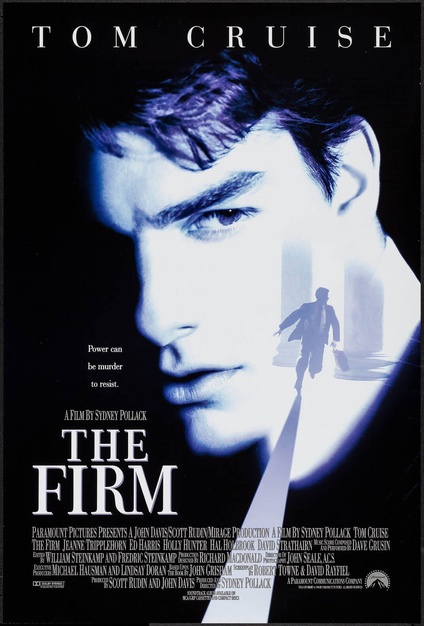
“He can’t handle the truth!” Tom Cruise takes on The Firm. We lose.

Director: Sydney Pollack

Cast: Tom Cruise (Mitch McDeere), Jeanne Tripplehorn (Abby McDeere), Gene Hackman (Avery Tolar), Holly Hunter (Tammy Hemphill), Ed Harris (FBI Agent Wayne Tarrance), Hal Holbrook (Oliver Lambert), Jerry Hardin (Royce McKnight), David Strathairn (Ray McDeere), Terry Kinney (Lamar Quinn), Wilfrid Brimley (Bill DeVasher), Gary Busey (Eddie Lomax), Paul Sorvino (Tony Morolto)

Mitch McDeere (Tom Cruise) is graduating top-of-his-class from Harvard Law. A plucky kid who’s worked for everything he has – and who wants to provide the best he can for wife Abby (Jeanne Tripplehorn) – Mitch has lots of offers but is seduced by a perk-filled offer from a law firm in Memphis. Everything goes wonderfully at first. But then associates at the firm start to die under suspicious circumstances and Mitch discovers no-one everleaves the firm except in a wooden box. Maybe all that off-shore tax-dodging isn’t quite as innocent as it seems – and those big-city clients with Italian-sounding names aren’t so friendly after all…

Adapted from a best-selling novel by John Grisham at the height of his airport-novel flogging days, The Firm is bought to the screen by Sydney Pollack. And what a complete dog’s dinner he makes of it. The Firm is a dreadful film: long, slow and dull with a plot that stretches right through elaborate and comes out the other side as confusing. By the time Mitch is tearing through Memphis, briefcase flapping behind him, you’ll have long-since ceased caring about anything involved in the film at all. Because for a film of such great length, very little seems to happen in it – and what little does happen is wrapped up in a mixture of legalese and curiously flat chase sequences.

Cruise plays Mitch at his most gung-ho, cocky, shit-eating grinnish. He’s preppy, super-smart, arrogant but also loyal, brave and principled. Aside from a brief temptation by money – and that because he wants the best for his family! – and of course a dalliance with a honey-trap on a beach (but it was a set-up, so not his fault!), he’s practically perfect in every way. He’s even a decent athlete, playfully taking part in back-flipping competitions with a break-dancing pre-teen busker (one of the most clumsy and bizarre introductions of a Chekov’s skill in the movies).

To put it bluntly, Mitch is an irritating character and watching him (very slowly) decide to do the right thing doesn’t make gripping viewing. Around him a host of experienced character actors do their thing, none of them stretching themselves. Tripplehorn does her best with the thankless part of “wife”, though she does at least get to do something a little proactive at the end. Hackman grins and coasts as Cruise’s mentor with the lost conscience. Hunter pouts and wisecracks (Oscar-nominated) as Grisham’s twist on an Eve-Ardenish secretary. Holbrook and Brimley scowl behind smiles as high-ups at the Firm. Harris shouts a lot as a permanently angry FBI agent with a heart of gold. Sorvino breaks out his Mob Boss 101.

Pollack marshals all these forces together with minimal effort and then ticks the boxes of all Grisham-cliches. The only thing missing are some courtroom dynamics, but we get the next best thing with wee-Tommy playing the FBI, the Mafia and the Firm off against each other in a desperate attempt to stay one step ahead of the game. I can’t stress enough how turgid and dull this film is. However scintillating you feel the set-up you might be, as the film clocks into the second hour (with 30 minutes still to go), you’ll be amazed how little sense of peril or threat there is.

There is nothing sharp, pointed or pacey about this film. “It has to happen fast” Tom announces at one point, as he kicks his impenetrable plan into gear. “Good luck in this film” my wife commented. She’s spot-on. Pollack fails to bring any sense of pace or peril to the film. For all we are repeatedly told Cruise’s life is at risk, it never really feels like it.

A big part of this massive failure is the terrible musical score that covers every single second of the film. Provided by an Oscar-nominated Dave Grusin (beating out Michael Nyman’s score for The Piano from even being nominated, one of the most inexplicable oversights at the Oscars from the 90s), every single second of the film is overlaid with a plinky-plonky piano score that would not sound out of place in a second-rate jazz bar or a hotel lift. Rather than bring you to edge of your seat, the score actually makes you feel like you should be resting back in it with a large cocktail in hand and a fuzzy sense of upcoming sleepiness clouding your brain. Which to be honest might work: pissed and half-asleep is probably the only way to get anything from the movie.