
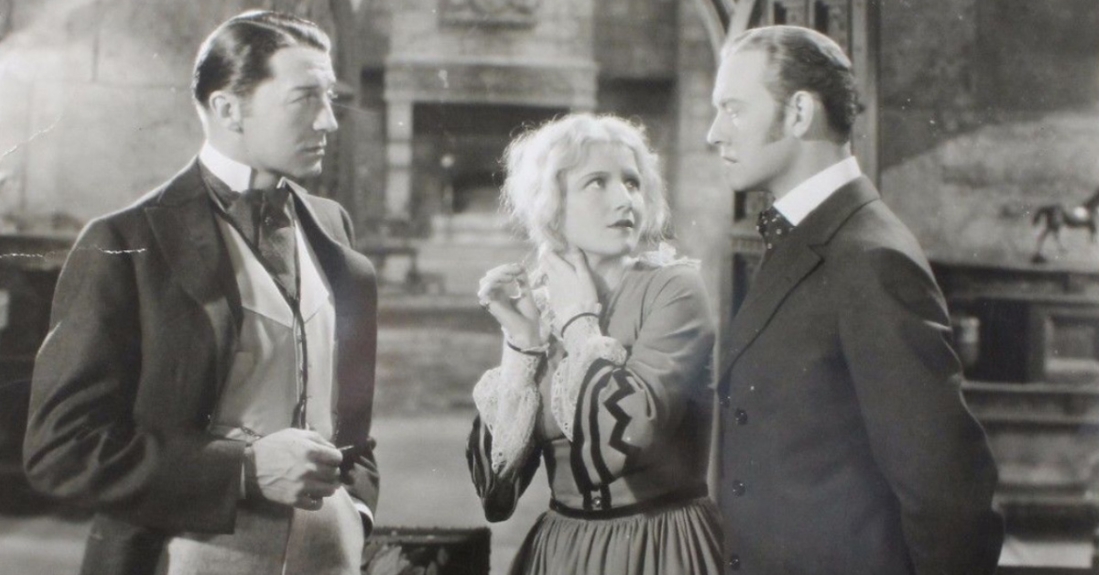
Tag: Clive Brook

East Lynne (1931)

East Lynne (1931)

Nearly-lost Best Picture nominee is a bland melodrama that owes what fame it has to its rarity

Director: Frank Lloyd

Cast: Ann Harding (Lady Isabella), Clive Brook (Captain William Levison), Conrad Nagel (Robert Carlyle), Cecilia Loftus (Cornelia Carlyle), Beryl Mercer (Joyce), OP Heggie (Lord Mount Severn), Flora Sheffield (Barbara Hare), David Torrence (Sir Richard Hare)
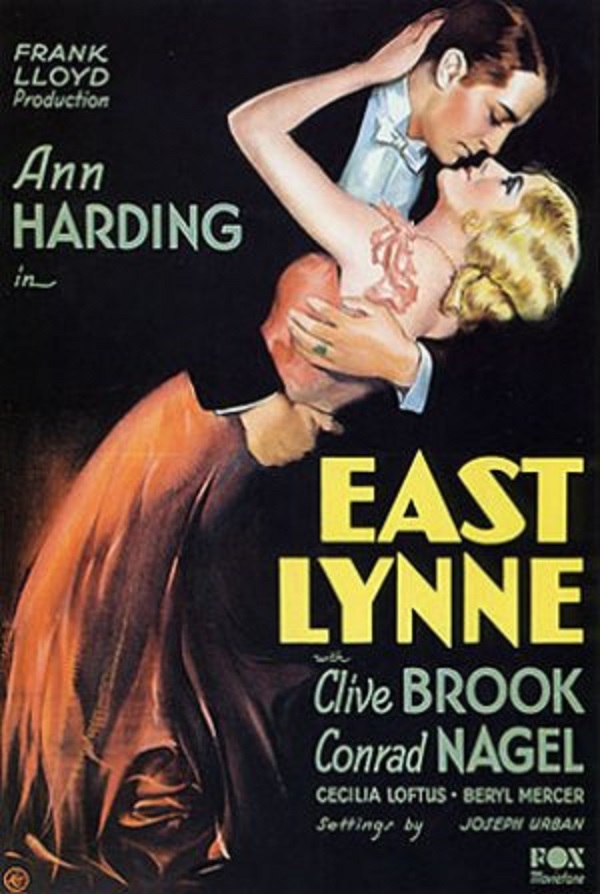
East Lynne is one of the three hardest historical Best Picture nominees to find today. Along with The White Parade (1934), only one print of it exists held by UCLA (which is better than Ernst Lubitsch’s The Patriot from 1928, of which precisely no copies exist). That fact is probably now the most famous thing about it, with Oscar afficionados (like myself!) hunting down bootleg copies (thanks go to WestLynne for posting a copy, including the hard-to-find final ten minutes) on YouTube. It’s possibly one of the oddest illicit films you could hunt down, not least because in many ways it’s a hilarious dated piece of misery porn, soaking in melodrama and some stilted acting.

It’s loosely based on a tragic Victorian misery novel by Ellen Wood (who, at one point, was nearly as famous as Dickens) – I say loosely as that was written in 1861 and this film is largely set during the 1871 Franco-Prussian war (presumably because it was a cooler backdrop). Isabella (Ann Harding) marries wealthy Robert Carlyle (Conrad Nagel), to become mistress of his house East Lynne. However, that’s in name only as the shots are really called by Robert’s domineering sister Cornelia (Cecila Loftus) who loathes Isabella with a Mrs Danvers-like fury. Lonely in her own home, she flirts with old friend (and professional rascal) Captain William Levison (Clive Brook) but that’s as far as it goes. Cornelia reports her to Robert as a shameless hussy and, despite Isabella’s denials, Robert divorces her.

Separated from their child, she has no choice but to live with William who indeed turns out to be a selfish rascal – and a near-traitor and crook into the bargain. The two are stranded in Paris during that 1871 war, Isabella denied all access to her son – and it’s all downhill from there. She’s near-blinded in an explosion, uses the last of her failing sight to return home and see her son, is thrown out again and promptly walks off a cliff – just as Robert (inevitably) realises the error he has made in chucking this saint in the first place. Cue the hankees.

East Lynne falls very naturally into the Hollywood trend at the time of suffering women, constantly judged by society and chucked into ever more damaging, depressing and fatal, tear-jerking situations by cruel fate. Because, I suppose, few things are more satisfying than feeling sorry for someone whose life is unquestionably more miserable and disastrous than yours. The film makes tweaks to the novels set up to dial up the injustice – the book’s version of Isabella is undoubtedly guilty of infidelity, whereas the film version is tempted but certainly doesn’t give in. (Also neatly making her more sympathetic to conservative Hollywood audiences).

That is if we believe her denials of course. No reason not to, since Ann Harding’s affronted denials of misdeeds followed by her despondent desperation, hammering on a door to be allowed back in to see her child are clearly meant for us to believe in. To be honest, watching it today, it’s hard not to see (cruel as Robert is in severing, Karenin-like, Isabella from her child) that Robert has a point. There is more than a little enthusiasm in the passionate kiss Isabella shares with William on the night in question – and Lloyd’s decision to cut the scene with Isabella’s bedroom door closing on her and William leaves us with only her word that she instantly threw him out.

A slightly more interesting film therefore lurks under the surface – especially since Isabella adapts very quickly to a life of semi-disgrace among the more flexible society of Vienna and Paris, sharing a home with William after her divorce. I’d actually prefer a version of this story where Isabella at least made some independent choices (although it would give even more of an air of punishment to her ‘reward’ of being abandoned, blinded and killed for it). Especially since Robert – played with a rather wooden stiffness by Conrad Nagel, which at least makes him suitably boring – is hardly anyone’s idea of an ideal husband.

Especially since he’s utterly controlled by his sister, introduced with a tracking zoom shot by Frank Lloyd which hammers home the cold lack-of-welcome she gives this woman who she sees as, at best, a crude interloper in their home. It’s very easy to see the roots of Rebecca’s Mrs Danvers in Cornelia – did du Maurier see East Lynne as she planned that novel I wonder? – sharing with her the same dislike and subtle bullying designed to undermine Isabella’s position. Cecila Loftus does lack the vicious, insinuating, two-faced venom the part really needs (she’s really more of a smackable snob) but again it’s an interesting idea.

East Lynne is a film however full of decent ideas that never quite deliver, not least because it’s all dialled up to the melodramatic max. Isabella’s eventual fate is only the ultimate expression of it – the sight of Ann Harding stumbling through a wood, her hands reaching out in front of her, audibly provokes laughter in the UCLA audience on the bootleg, and who can blame them. The misery piles on and on relentlessly, Isabella tumbling through a conga-line of misfortune, scorn and miserable denial. Not helped of course by the fact the Clive Brook – whose patrician manner and cut-glass accent seem ill-suited to playing the sort of rogue he is here – makes William an utterly selfish rogue.

Ann Harding pushes through all this with maximum commitment, her voice throbbing with emotion as yet more tricks of cruel fate lash her. She has to go for it, since even the slightest doubt or reserve would probably make the ridiculousness of the film stand out even more. But Harding manages to make Isabella just flawed enough to not be a saint – those little touches of good-time-girl that attract William – while unquestionably capturing her devotion and love as a mother. And no one could have sold that arms-out-stretched “blindness” acting that East Lynne closes with.

East Lynne is exactly the sort of competently-made but basically bland melodrama that makes for a very odd Best Picture nominee over 90 years later. The fact that its fame largely rests on its scarcity is fitting – otherwise it would quite happily have been lost altogether and no one would probably have batted an eyelid. Certainly, it wouldn’t challenge any retrospective lists of the great films of 1931.

Cavalcade (1933)

The Marryots and the Bridges face a world in motion in Cavalcade

Director: Frank Lloyd

Cast: Diana Wynyard (Jane Marryot), Clive Brook (Robert Marryot), Una O’Connor (Ellen Bridges), Herbert Mundin (Albert Bridges), Beryl Mercer (Cook), Irene Brown (Margaret Harris), Frank Lawton (Joe Marryot), Ursula Jean (Fanny Bridges), Margaret Lindsay (Edith Harris), John Warburton (Edward Marryot)

Before Upstairs, Downstairs and Downton Abbeythere was Cavalcade. Winning the Best Picture of 1933 (beating out more highly regarded films today – and King Kong wasn’t even nominated!), Cavalcade shows a romantic weakness for dramas about the struggles of the British Upper classes and their servants is nothing new. Based on Noel Coward’s play, it’s a grand, soapy drama that’s been done better since (not least by those two shows) but makes an entertaining genre template.

Carefully ticking off historical events between 1899 and 1933, the film follows the Marryot family – father Robert (Clive Brook), mother Jane (Diana Wynyard) and their two sons Joe (Frank Lawton) and John (Edward Marryot) – and their servants turned pub owners the Bridges – Albert (Herbert Mundin), Ellen (Una O’Connor) and their daughter Fanny (Ursula Jean). From the Boer War via the death of Queen Victoria, the first flight across the Channel, two characters taking an unfortunate honeymoon trip on the Titanic to the First World War, we see how events affect both families (invariably with tragic consequences) as Britain slowly changes.

You can look at Cavalcade and find it hilariously old-fashioned. The accents are so sharply clipped they could be cut-glass, while the working-class characters speak with “evenin’ guv’ner” ‘umbleness. In preparation for the film, the Studio flew a camera team over to film the London production (then hired several of the actors to repeat their roles, including O’Connor) and the film sometimes feels like a slightly stuffy stage production bought to the screen.

This is most noticeable in Diana Wynyard’s performance. She clearly has no idea to act for the camera – and Lloyd didn’t correct her. ‘Asides’ see her frequently turn towards the camera and stare into the middle distance. For the innumerable times she is called onto to weep, she throws herself to the floor dramatically. With her declamatory style, she’s constantly playing to an imaginary back row. It sticks out particularly badly when watching the far more experienced Brook relatively underplay each scene without physically telegraphing every emotion. Surprisingly Wynyard landed an Oscar nomination – but soon left Hollywood and returned to the stage.

The rest of the cast are split between the two approaches, all while balancing the stiff-upper-lipped demands of the script, with its “I must go the war/Don’t go darling/I must they won’t start without me” exchanges (to paraphrase Eddie Izzard). The younger actors – John Warburton and Margaret Lindsay as the young couple booking a berth on the Titanic – offer performances so restrained they feel strait-jacketed. The working-class characters cut lose a little. Una O’Connor is a little broad, but quite engaging while Herbert Mundin gives possibly the best performance as a landlord too fond of his own product. Ursula Jeans makes a fine romantic lead as their daughter, delivering decent renditions of several songs in particular “Twentieth Century Blues”.

Those blues are nominally what the film is about, as the world leaves the Marryots behind. It’s bookended by two New Years –in 1899 and 1933 – during which time the world has changed completely. War has shattered the cosy Victorian status quo, leaving millions dead and the Marryots struggle to recognise this new England. Cavalcade only lightly engages with themes of societal upheaval – probably because it is simultaneously wallowing in so much nostalgia, that Coward’s more sombre ideas would bring the party crashing down.

Instead, Cavalcade luxuriates in nostalgia, loving the idea of a hierarchical, old-fashioned, English world where everyone knows their place (even after leaving their employ, the Bridges treat the Marryots with deference, while the Marryots look at them with a paternal indulgence). But its soapy stories – predictable as they seem to us now – are actually rather effective, and the flashes of genuine emotion (best of all, when Brook’s Robert says farewell to his son as he heads out on “one last patrol” in the last days before the Armistice) are surprisingly effective.

Lloyd’s direction of the larger set-pieces also show an impressive flair. The domestic scenes may seem stagey, but when the camera films a crowd it feels ambitious and dynamic. A huge pier scene with hundreds of men heading to the Boer War is handled very well. Bustling street scenes feel real. Wynyard’s finest moment comes in a crowd scene as she tries to merge into a crowd celebrating the Armistice, while caught up in a personal grief. A montage covering 1918 to 1933 is effective in showing the march of change.

Best of all is a wonderful montage communicating the horrific cost of the First World War. Lloyd presents the war as a never ending stream of soldiers marching into a tunnel. Initially the backdrop around is an English town, with smoking chimneys. This morphs into No Man’s Land, with the chimney smoke becoming explosions. Super-imposed over this are images of soldiers in close-up, at first marching in smiles, then dying at an accelerated rate. Nostalgia turns into Danteish circle of hell, innumerable bodies piling up. It stands out as a moment of expressionist inspiration (and must have had a strong impact on the audience).

It’s the finest moment in Cavalcade, your enjoyment of which will be directly related to how much patience you have with Downton Abbey. Find that an enjoyable diversion (as I do), and you will certainly find something to enjoy in Cavalcade. If Downton’s rose-tinted view of Edwardian social structures puts you on edge, you will struggle. I was pleasantly surprised by how charmed I was by it. And that World War One sequence is worth the price of admission alone.

Shanghai Express (1932)

Marlene Dietrich is on a train full of mystery and danger in Shanghai Express

Director: Josef von Sternberg

Cast: Marlene Dietrich (Shanghai Lily/Madeline), Clive Brook (Captain Donald Harvey), Anna May Wong (Hui Fei), Warner Orland (Henry Chang), Lawrence Grant (Reverend Carmichael), Eugene Pallette (Sam Salt), Gustav von Seyffertitz (Eric Baum), Louise Closser Hale (Mrs Haggerty), Emile Chautard (Major Leonard)

The fourth collaboration between von Sternberg and Dietrich, completed when they were in the middle of – was it an affair, an infatuation or something half-way between obsession and resentment? Who knows. Either way, Shanghai Express is one of the their finest collaborations, a triumph of von Sternberg’s mastery of style and Dietrich’s charisma and appeal, brilliantly shot with some iconic images. The biggest hit of 1932, it’s also a loopy part-thriller, part-romance but with a sort of eerie dream-like logic and that mixes peril and jaunt. It’s a fascinating picture.

Its 1931 and China is in the middle of a civil war. Boarding a train bound for – you guessed it – Shanghai, is a veritable smorgasbord of ex-pats and mysterious travellers. First among them – and reviled by all but one of the other passengers – is infamous “coaster” ‘Shanghai Lily’ (Marlene Dietrich), a woman who (as she says) needed to go through more than one man to get that nickname. The only person in first class who can stand her is Chinese “coaster” Hui Fri (Anna May Wong). The man who has the most cause to resent her though is army physician Captain Donald Harvey (Clive Brook). The two of them were deeply in love, but misunderstandings came between them and he’s nursed a grudge ever since. The rest of the train carry their own petty prejudices – but all these are put in perspective when the train is hijacked by rebel leader General Chang (Warner Orland), who holds Donald hostage to get the release of his right-hand man from the Chinese. What will Shanghai Lili aka Madeline do to save the life of the love of her life?

Clocking in at a slim and efficient 82 minutes, Shanghai Express still manages to have a languid, patient pace to it, taking its time to establish places, relationships and stakes. Part of that also comes from the film being set in a sort of imaginarium idea of China, born entirely out of von Sternberg’s brain. With his long-standing disinterest in realism, von Sternberg’s film is a sort of fever-dream image of China. So it’s kind of fitting the film plays out like a dream, right down to its own pace. At times it rushes swiftly on, at others the stakes hardly seem to matter as the characters move freely around while in supposed captivity and barely consider their lives at risk. At the end of the film, the train arrives (despite the violence en route, the fact its late gets the most comment) and the characters simply get on with their lives.

Perhaps its all part of von Sternberg’s deconstruction of these Europeans and Yanks, whose only engagement with this foreign country is that it should be made as much like the West as possible. Most of the characters on board – with the exception of the women – are selfish, pompous, lecherous, prejudiced, greedy or some combination of all of the above. While they wear an air of respectability, it doesn’t take long to shake them from it. And their judgement of others is swift and irreversible. Even Donald, our nominal hero, fits this bill – he frequently rushes to judgement and pig-headedly sticks there, regardless of logic and experience.

In among this, it’s the women who emerge as the only characters who demonstrate pluck, loyalty, empathy and decency. Anna May Wong’s looked-down-on courtesan goes through a torrid time – demeaned on the train then assaulted by the lecherous Chang not once but twice (the second time an off-screen rape that none of the Western characters ever feel the need to comment on). Despite this, she’s one of the few who acts to defend someone other than herself, and her actions are (eventually) what brings liberation for the passengers (again not that they, or anyone else from the West, thanks her for it). It’s a neatly reserved performance from Wong (perhaps the best in the film), her eyes conveying an only thinly concealed contempt for those around her.

The closest thing she has to a confidante is of course Shanghai Lily herself. This is the perfect role for Marlene Dietrich, a woman who is both imperious and fragile, proud but willing to debase herself to save the man she loves, cold and knowing but also strangely naïve and romantic. As with much of her best work, what she does so brilliantly here is to bring together a host of contradictions that really shouldn’t make sense (except perhaps as some sort of sexual fantasy of von Sternberg’s?) and make it the most charismatic and arresting part of the film. Dietrich is not the most accomplished of actors – but she is an accomplished presence and undeniably charismatic.

Lily proves that she may be a hard-nosed player of the game, but that she’s more than capable of loyalty and faith to those she loves. She has no hesitation when asked to put herself in the way of danger for them. It’s a shame Dietrich doesn’t have a more charismatic scene partner than the rather bland Clive Brook (who ends up looking very forced as a romantic lead – you end up wondering what on earth this woman sees in him). But Dietrich’s movie-star magnetism holds much of the plot of the film together and provides much of its emotion.

She’s also of course beautifully filmed by von Sternberg – one late shot (with lighting pointing upwards in almost a spotlight triangle, creating a truly striking and erotic image of her smoking against a train door) has rightly become iconic, but the film is packed with them. Von Sternberg, working closely with photographer Lee Garmes (Oscar-winning) perfectly uses light and shadow to frame Dietrich with an alluring exoticism that compels the focus.

It’s all part of the film’s beauty and the skills behind its shooting. It starts with a series of flourishing tracking shots through busy train stations (something it returns to later on). Scenes that coat the film in smoke, with just backlighting, while soldiers and passengers move in front like a lantern show are extraordinary. The images make superb use of ultra-dark blacks to introduce frequently gorgeous images. With von Sternberg’s setting that only just touches realism in the faintest way possible, it makes for a wonderfully framed exotic fever dream – just as the film itself oscillates between action and languid romance in its pacing.

Shanghai Express is almost impossible to categorise. A romance with thrills in the middle, an action film where urgency is often off the table, a mystery that travels with an almost pre-ordained certainty towards its goal, it truly has a dream-like logic. And I guess if it’s all von Sternberg’s dream, it makes sense that it’s most striking scenes see Dietrich, perfectly lit, with smoke stroking itself around her. After all her charisma is at the film’s heart.