Category: Coming of Age film

Dead Poet's Society (1989)

Robin Williams is an inspirational teacher (is there any other type in films?) in Dead Poet’s Society

Director: Peter Weir

Cast: Robin Williams (John Keating), Robert Sean Leonard (Neil Perry), Ethan Hawke (Todd Anderson), Josh Charles (Knox Overstreet), Gale Hansen (Charlie Dalton), Norman Lloyd (Headmaster Gale Nolan), Kurtwood Smith (Mr Perry), Dylan Kussman (Richard Cameron), James Waterson (Gerard Pitts)
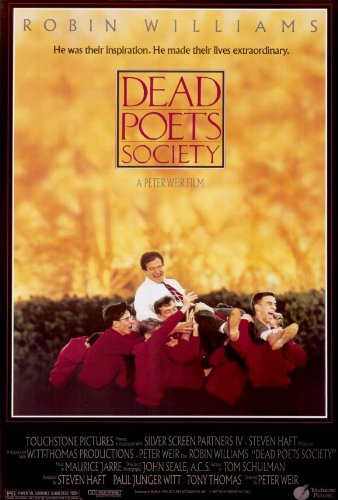
“Oh Captain, My Captain!” Your feelings for Dead Poet’s Society are probably directly linked to how you react to that desk-standing ending. A triumph of emotional film-making? Or garishly over-sentimentalised nonsense? I’ll go for the latter myself, as I found myself non-plussed and unengaged with this conventional “idealistic teacher changes lives of young boys” story. Seen it all before. 

In 1959 at elite, all-male prep school Welton Academy, four young students (Robert Sean Leonard, Ethan Hawke, Josh Charles and Gale Hansen) are surprised by the unorthodox teaching methods of their new English teacher, Welton Academy old boy John Keating (Robin Williams). Rather than teach the stuffy, facts based curriculum, Keating encourages the boy to use their hearts and minds, to be creative and above all to carpe diem as much as they can. The boys start an illicit poetry club (?) and begin to explore their own artistic leanings – but their conservative parents and school won’t stand for this challenge of the orthodox and when tragedy strikes it’s Keating who gets the blame.

Dead Poet’s Society already feels a bit dated, and it’s story line treads all too familiar ground of fusty seniors struggling to understand the artistic stirrings of the youngsters inspired by the sort of maverick inspirational teacher that everyone at one time or another has dreamed of being. Naturally of course (as per the rules of films) all the other teachers are either cynical, disinterested or box tickers. For a genuine artist like Weir, I was struck by how plodding this film was in its story and construction and also its ideas and themes. It’s a struggle between generations played out at a point in history where the cultural revolution of the sixties was just about to happen. These ideas were already over twenty five years old when the film was made – and this adds nothing really too the mix.

Instead we get the standard tropes we might expect, as the students play out expected and predictable plots. Nervy Ethan Hawke, at first too shy to speak, finds the courage to express himself. Josh Charles sets out to woo the girl he loves (at times this is more than a little creepy). Proto-rebel (and no doubt soon to be sixties activist) Gale Hansen begins bucking authority and writing scurrilous articles for the School newspaper. And Robert Sean Leonard begins to defy his domineering father’s wishes to focus solely and exclusively on a medical career by landing the part of Puck in a local play and dreaming of a career in the theatre.

Despite the focus of much of the film’s promotion (and in people’s memories) on Robin Williams’ central performance, the story line is all about these boys. And I will say there are some fine performances from these four principles – three of whom went on to have notable careers. Particularly fine is Robert Sean Leonard, who gets a meaty pile to play with as a young adolescent who lacks the courage to tell his father what he really feels and carries all this with a confidence and assurance (even though his Puck performance is hardly the work of genius the film insists it is!).

It’s unfortunate that most of what they do is the totally expected collection of school yard clichés, which builds towards an inevitable and predictable, sad, sentimental, ending. Keating is the standard inspirational teacher, given to flights of fancy and eccentric touches (tearing pages from books, leading the boys in sports designed to build their poetry skills, encouraging the boys skilfully to recite their own poetry) that will either leave you wishing you had him as a teacher or leave you cold. 

Watching it now, and seeing Keating interact with his students, you can’t help but feel his increasing closeness with the boys, his encouraging them to call him “Captain” (in one skincrawling moment he doesn’t even turn around when walking until one of them addresses him as this!), his taking them to plays, his obvious favouring of a few key students would all contribute to him struggling to get CRB cleared. I actually found his character rather grating, although the film does use a good few moments to underline how Keating rebukes the boys for their more thoughtless and pointless acts of rebellion and how he urges Neil to gain the support of his father before acting.

Nothing particularly wrong with Robin Williams performance though, even though the thing you feel impressed people the most was this most energetic of funny men restraining himself in a relatively straight and low-key part. It’s a role several actors could have taken on just as well, but Williams does a sound job.

It’s a shame that the film itself is so deeply bland. Its later sentimental touches become increasingly heavy handed and overbearing, and it’s parable of betrayal and corruption in a 1950s school hits its points equally hard. There is nothing really fresh or unique here, and the film itself never brings its story to life in a way that feels fresh or unique. It’s a film widely loved, but to be honest for the uninitiated has more than enough moments of weakness for you to want to check out of this class.

The Falling (2014)

Florence Pugh and Maisie Williams deal with tedious coming-of-age antics in The Falling

Director: Carol Morley

Cast: Maisie Williams (Lydia Lamont), Maxine Peake (Eileen Lamb), Monica Dolan (Miss Alvaro), Greta Scacchi (Miss Mantel), Mathew Baynton (Mr Hopkins), Florence Pugh (Abigail Mortimer), Joe Cole (Kenneth Lamont), Lauren McCrostie (Gwen)

Any film set in an all-girls school that succumbs to hysteria, with ominous goings-on that might be supernatural or might all be allegories for coming of age and emerging sexuality, is inevitably going to get compared with Picnic at Hanging Rock. But few films seem to be so desperate to be that film as The Falling does. 

Set in an all-girls school in 1969, at the cusp of the sexual revolution that will soon engulf the whole country, Lydia Lamont (Maisie Williams) and her elder brother Kenneth (Joe Cole) are both obsessed with Lydia’s charismatic classmate Abigail Mortimer (Florence Pugh) – feelings of emotional and sexual dependency that Abigail knowingly encourages and flirts with. After Abigail’s sudden death connected to her pregnancy, Lydia becomes increasingly disruptive at the school and finally becomes “patient zero” in an epidemic of fainting that afflicts the school.

Based on a true story, you can tell that this film is keen to conjure up some sort of deep-rooted mystery at the heart of the girls’ actions, questioning whether they were truly in control of their own actions at this time or under the influence of something else. Is this linked directly to the tragic fate of Abigail – is she in some way possessing the girls, driving them towards this fainting? Or is the fainting just a sort of acting out, as Lydia tries to get over her grief at the loss of her friend?

Frankly, who really cares? It’s pretty hard to get invested in a film that is working so hard to be meaningful that it overshoots the mark and just becomes tiresome. Yeah I get it, teenage relationships can have this unhealthy intensity to them. They can spin out into self-destructive elements. And maybe, if the film had focused more on that rather than trying to suggest some unsettling mystery it might have got further. But with every shot of the British countryside around the school, or the lingering shots on the girls writhing on the floor, or the unsettled terror of the teachers, you feel the film’s attempt to invest these events with meaning.

What you actually end up feeling, throughout this overlong and puffed up film, is impatience at the indulgence of these children. Far from a mystery, the fainting appears to be a tiresome, attention-seeking effort from young girls unable to express and process emotionally the things that have happened to them. There isn’t a single element of the film that makes you seriously consider some ghostly or psychical explanation for the events – they seem, clearly and throughout, to be manufactured by the girls involved. It’s hard to watch it without unsympathetically suspecting that if the adults around them stopped indulging all this nonsense, they’d miraculously recover soon enough. It’s possible to speculate over whether the girls are doing it deliberately or if this is the work of their overwrought subconscious – but while that could form a good premise for a film interested in group psychology, this film seems more interested in pretentious shots of trees. 

As if realising halfway through that it’s not come up with anything compelling yet, the film hastily throws in a poorly developed incest plotline, which is unsettling, illogical, and springs from nowhere. Not content with that, it then shoe-horns a rape into the backstory of a character late on, in a way that is clearly meant to be a dark reveal, but is in fact a really clumsy “obviously this caused all the problems” solution to the questions of the film. The character’s mental health problems and inability to bond with her closest family could have made for a complex and challenging character (and she’s certainly played by an actor who could’ve handled that material). Instead, rape is casually chucked in as a glib explanation for “oh and this is why she’s troubled – ta-da”. It’s cheap and lazy. But then that is on a par with all the sexual awakening content of the film, which is clumsy, clunky and often misguided. It wants to suggest an unsettling fascination with sex, and tie that in with dangerous, subversive ideas. Instead, it just ends up looking like standard teenage experimentation, filmed with a certain amount of style.

This is not to say the film is badly made as such. It looks good and it’s put together well. It’s just trying way too hard. The acting is very good. Maisie Williams is never anything less than watchable as Lydia, and creates a well-drawn character as a girl who goes from easily-led hero worshipper to the troubled centre point of disruption at the school. Florence Pugh is also a revelation as Abigail – a charismatic presence that you instantly believe would be obsessed over by everyone who knows her. Joe Cole is also very good as the creepy, sexually exploitative brother. There are some good performances from the adults, not least Maxine Peake as Lydia’s nervous, agoraphobic mother. 

But none of this cancels out the laboured pretension of the rest of the film, which always wants to let you know how clever it is, and how much it wants you to question the impact of all that dark sexual awakening. Instead, for all the sturm und drang,it ends up looking rather like a collection of silly girls who are acting out. The idea that obsession with Abigail draws rebellious and transgressive feelings from Lydia seems painfully obvious and unoriginal, and the flirtation with incest, rather than invested with meaning, instead feels like a film straining to shock.

The Falling wants to be a great cult classic. Neither of those words can be applied. It’s a well-made but empty spectacle, living in the shadow of other much better films. For all the skill of Maisie Williams and Florence Pugh, it misses the greater depth it is aiming for and settles for being a rather shrill would-be ghost story and a plodding attempt at social commentary.

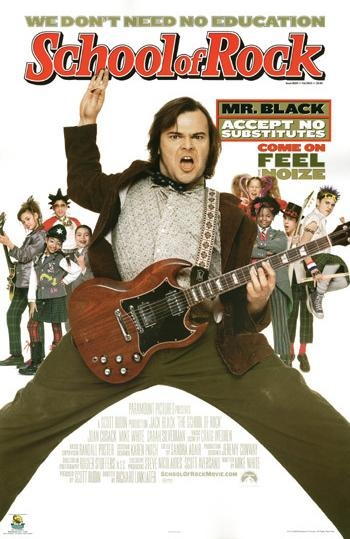
School of Rock (2003)

Jack Black triumphs in high-school comedy School of Rock

Director: Richard Linklater

Cast: Jack Black (Dewey Finn), Joan Cusack (Principle Roz Mullins), Mike White (Ned Schneebly), Sarah Silverman (Patty DiMarco), Miranda Cosgrove (Summer Hathaway), Joey Gados Jnr (Zack Mooneyham), Kevin Clark (Freddy Jones), Rebecca Brown (Katie), Robert Tsai (Lawrence), Maryam Hassan (Tomika), Caitlin Hale (Marta), Brian Falduto (Billy)

The early 2000s saw the rise of a new force in American comedy films: rotund, rock ‘n’ roll, John Belushi-light Jack Black. Following his breakout role as a music-obsessive with purist tastes in High Fidelity, School of Rock saw the legend of Jack Black hit its peak. And it deserves to, as School of Rock is the sort of perfectly-formed treat that achieves everything it sets out to do.

Dewey Finn (Jack Black) is the sort of slacker man-child beloved of indie filmmakers, who has never grown up from his dreams of being a rock star. The only thing really holding him back? Fate and his own selfishness. Dewey’s expelled from his own band, due to his penchant for extended guitar solos and distracting stage antics, and his old bandmate-turned-respectable-supply-teacher, Ned Schneebly (Mike White, also the film’s writer) is pressured into finally asking Dewey for his share of the rent by Ned’s domineering girlfriend Patty (Sarah Silverman). Desperate for money, Dewey impersonates Ned and takes a role as a supply teacher for a group of 12-year-olds at a prep school. At first Dewey just wants to leave the kids to their own devices and pick up his cheque – but when he hears his new students in their music classes, he suddenly has a brainwave: they could be his new band, and help him win The Battle of the Bands competition. 

School of Rock is an immensely heart-warming film that manages to never sell out to become sentimental or depend on its characters learning “lessons” that improve them. Sure lessons are learned, and the film is very sweet, but it manages to wear this all with a cool lightness. In fact the whole film becomes a rather touching paen to the transformative power of music, and the way it gives people confidence and a voice. 

Linklater directs with a breezy cool, drawing some fantastic performances from the whole cast (I can’t give enough praise to a director who gets such relaxed, natural and funny performances from children as Linklater does here) and totally embracing the clichés of the “inspirational teacher” genre, with a comedic bent. The kids are the expected combination – the precocious ambitious one, the shy ones who hide skill, the brash wannabe bully who finds the joy of being part of the group – but they are all portrayed with such freshness and energy that the clichés hum with joy.

Linklater’s real stroke of genius is letting Jack Black rip in the lead role. The part is so perfectly tailored to Black that it feels like almost an extension of his own personality. Black is a force of nature in the role, a perfect combination of showboating and carefully thought out character work – and he works brilliantly with the kids. He’s hilarious as well, first as a wannabe rock star layabout, later as a band leader for the kids who discovers in himself a work ethic and ability to inspire. 

The character works because, deep down, under the selfishness and laziness, Dewey is basically a pretty decent guy. He cares about people’s happiness and he has a romantic view of rock and roll as a source of self-expression and celebration of life. (Although fortunately for the film, he’s no fan of the whole drugs side of many of the musicians he worships – having no time for the “poseurs” who attempt to impress the kids with the smoking and gambling at one Battle of the Bands audition.) And he’s so passionate about this that he can actually turn himself, if not into a teacher, at least into the sort of inspiring mentor who can bring his students out of their shells.

And he does this without really changing fundamentally who he is. Sure he’s touched by the kids, just as he’s touched them (to slightly misquote the film’s cheeky paedophile misunderstanding gag, when Dewey is busted by his charges’ parents!), but the warmth under the bluster is there all the time. And Dewey doesn’t suddenly turn into a high achiever or perfect guy – he just learns to channel his enthusiasm into encouraging musical skills in others (and there is something really sweet in his genuine, warm enthusiasm for talent from the very start). The film even allows the headmistress of the school (very well played by Joan Cusack as an under-pressure uptight woman yearning to cut lose a little) to be a spiritual ally and well-meaning obstacle rather than an opponent.

It’s this good natured warmth that runs through the whole film, and which at the end finds every character contented and united. (Well nearly every character – the film can’t shake its love of wistful man-childishness sufficiently to resist turning Ned’s girlfriend into a humourless, nagging shrew, in the film’s only real misstep). Plus the film rocks really well, and seeing the band together and perform is both fun and really sweet. No one puts a foot wrong here, and a lot of its success is due to Linklater’s ease and Black’s dynamic, verging just the right side of cartooney, comic tour-de-force at the centre.

The Book Thief (2013)

Sophie Nelisse is The Book Thief in this worthy, dull adaptation

Director: Brian Percival

Cast: Geoffrey Rush (Hans Hubermann), Sophie Nélisse (Liesel Meminger), Emily Watson (Rosa Hubermann), Nico Liersch (Rudy Steiner), Ben Schnetzer (Max Vanderberg), Heike Makatsch (Liesel’s mother), Barbara Auer (Ilsa Hermann), Roger Allam (Death)

Every year you get prestigious film versions of novels that have soared up the bestseller lists. Some of these are good or even great films. Other are so lifeless, listless and lacking in spirit they leave you wondering what on earth people got so fussed about the original for. That’s the case here with The Book Thief.

In late 1930s Munich, young Liesel (Sophie Nélisse) is fostered with a local decorator Hans (Geoffrey Rush) and his wife Rosa (Emily Watson). Liesel has a fascination with books – despite not being able to read and write – and soon Hans is teaching her literacy. Liesel has a compulsion to “borrow” books – first from a burning pile of Nazi forbidden tomes, then from the library of the wife of the local mayor. But it’s dangerous to draw too much attention to the family, particularly when they are hiding a young Jewish man, Max (Ben Schnetzer). 

I’ve not read The Book Thief. I can’t say that I feel the need to dash out and do so after this bland, middle of the road picture that makes Fascist Germany seem very picturesque. The film largely fails, like so many films before it, to translate the joy of reading into a visual language so the whole “book thief” concept of the title quickly gets pushed to the margins in favour of a series of episodic events based around Nazi Germany and Second World War tropes that already feel a bit tired. 

Percival’s award-baiting film doesn’t seem like it wants to bring (or is capable of bringing) something unique or interesting to the setting, instead going through the motions as prettily as possible. And the film does look great, I will give it that. It also sounds pretty damn good, not least through a playful and rich score from John Williams (his first original score for a non-Spielberg film for decades). But it never really gets anything special from the content. In fact, that very chocolate-box beauty of the film seems to run contrary to the setting of Nazi Germany. The awards-friendly beauty envelops the film like treacle.

The book was written from the prospective of Death, but, the film seems to drop this unique aspect as soon as it possibly can. Again, it’s a sign that the film cannot reproduce what worked in the book – by stripping out its most unique and interesting point, it makes the film feel as generic as it possibly can. Roger Allam is a wonderful choice as the richly voiced narrator – but he’s so rarely used in the film that when Death talks about how fascinating he found Liesel you are simply left wondering why. 

In fact that why is a real problem with the film – it’s what you’ll be asking all the way through. Why? Why is anything really happening? Why is Death telling us how different and striking this story is when everything we see in the film feels pretty familiar? What is the point of this film or the message it is trying to give us? For a film that tackles war, fascism, persecution of the Jews, and childhood innocence, it seems empty all the time.

And that’s the problem with the film. It’s all about the pretty presentation. The characters speak with forced German accents that make it feel even more like a pretty Hollywood Golden Age film. (By the way the bad Germans, like the Nazis, they speak only in German. Make of that what you will.) The acting is pretty good, Sophie Nélisse is a great find as the heroine. But there is nothing special about it at all. It’s seemingly made entirely as a prestige product for potentially winning Oscars. Any of the depths of uniqueness of the book seems to have been shaved off in service of that, and we’ve been left with a chocolate box that feels like it’s lacking the sweet richness you’d expect to find in it.

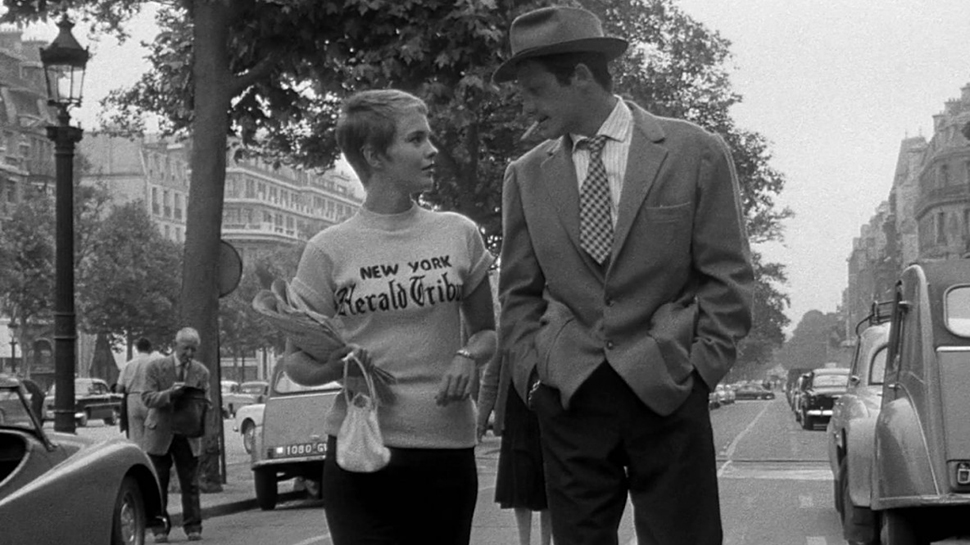
À Bout de Souffle (1960)

Jean Seberg and Jean-Paul Belmondo get obsessed with their own images in À Bout de Souffle

Director: Jean-Luc Godard

Cast: Jean-Paul Belmondo (Michael Poiccard), Jean Seberg (Patricia Franchini), Daniel Boulanger (Police Inspector Vital), Henri-Jacques Huet (Antonio Berruti), Roger Hanin (Carl Zumbach), Jean-Pierre Melville (Parvulesco), Liliane David (Lilane)

The French New Wave emerged from a group of film critics from influential magazine Cahiers du cinema in the 1960s, led by Francois Truffaut (who contributed a four page story outline to this film, although Godard later minimised his contribution as much as possible). The movement believed the director was the “author” of the film, stamping their personality on it. Packed with references to classic Hollywood movies, the films were shot with an improvisational lack of formality (that often hid brilliant cinematic technique) inspired by Italian neo-realism.

Breathless, Jean-luc Godard’s revolutionary masterpiece, was one of the central films in this school of filmmaking. It followed the last few days of Michael Poiccard (Jean-Paul Belmondo). A young man drifting through a life of petty crime, who idealises Humphrey Bogart’s style, he one day steals a car; it happens to have a gun in it, and in a moment of casual indifference he shoots a policeman trying to arrest him and flees. In Paris, while being hunted by the police, he reunites with his girlfriend, American student Patricia Franchini (Jean Seberg), and their self-absorbed relationship plays out under the shadow of the police net getting tighter and tighter.

Jean-Luc Godard’s film was hugely influential, as it seemed to re-write the rules of how films were to be made. Godard’s film is down and dirty, it’s almost guerrilla, but filmed with a wonderful, improvisational beauty. Shots are hand-held and dynamic, the action is all filmed on location, the framing is rough and ready, the camera gets up close and personal with the actors, throwing us in with them with an overwhelming sense of realism. The whole film feels irreverent, casual and cool, and gets a wonderful sense of urban Paris. It magnifies and reflects the very qualities the lead characters believe they have themselves.

Godard’s most influential touch was the use of jump cuts within scenes, with action jumping from moment to moment within a scene seemingly spontaneously, giving an impression of constant movement and ripping out the sense of time between actions. It also gives a sense of the film always driving forward, bouncing from beat to beat. According to rumour, this influential use of editing was a happy accident. The original cut of the film was well over two hours, and the distributors wanted something less than 90 minutes. Rather than cut whole scenes, Godard cut the small moments of movement or peace in scenes, giving the film a jagged freshness.

The whole film is full of these moments, the jumps over silences and conversational gaps, jumps in time lags between walking from point A to point B. It really works as well. The exterior scenes buzz with an exciting freshness. The long second act, basically nothing more than a conversation in a bedroom between the two leads, is edited almost like an action scene in a modern film – perfect for the self-dramatising energy the two characters are leading their lives with.

It’s those two leads who really help to make the film. Seberg picked up a quarter of the film’s budget to be the “name” lead, and she brings the film a soulful but distant sense of coolness. Belmondo was the real find, turning himself overnight into a mega star. In the sixties these were the people that your cool student wanted to be. Belmondo nailed his sense of iconoclastic cool in the opening moments – particularly when turning casually to the camera while driving his stolen car, to involve us personally in the story of his own life that he is constructing.

You can see how the performances (and characters) of the two leads had such impact on filmmaking. Energetic but also listless, contemptuous of authority and certain that whatever the world has in store for them it is definitely something more, self-absorbed and selfish, immature and convinced that their lives are more important that the average people around them – they are the predecessors of Bonnie and Clyde, of the young killers in Badlands. And nothing seemed to capture the counter-culture cool than Belmondo with a cigarette dangling from this mouth, apeing Bogart. 

But both lovers are equally selfish and obsessed with their own stories. Or rather, self-consciously living their lives like they are in a narrative – in fact you could say that the film predicts the self-obsession of the social media age. Michael lives a life that is all an entirely constructed front. He’s a would-be gangster, with a carefully studied front of gritty cool. He spends endless time making sure that his look, his clothes, his postures, his manners are always spot-on. He constantly keeps up a stream of consciousness narrative about his own life and situation, positioning himself as the sort of representative of modern American hip.

And Patricia is the same. Although at first she seems the more natural and grounded of the two, it’s clear her self-obsession is just as profound (if not more so) than Michael’s. Patricia constantly reviews and rebuilds the narrative of her own life, discussing her romantic life like it was a carefully constructed fiction, or some sort of hyper-cool Mills and Boon. “Do I love you? Should I love you? Can I make myself not love you?” Patricia’s construction of her own narrative – and her desire to shape and control it completely – makes her as completely artificial as Michael is. 

She’s so determined to construct her own narrative, that she shrugs off a string of revelations about Michael as if they didn’t exist. He’s a killer? Okay. He’s got at least two names? Hardly matters. He’s married? Nobody’s perfect. When deciding to betray Michael to the authorities, the action seems almost motiveless, but it quickly becomes clear that it is led by her latest review of the life situation and deciding it’s not what she wanted. Surrendering Michael to the law is her chance to say “No, I shape the story here – and I get to control who I feel love for, no one else”. By betraying Michael she is cutting a part of a life narrative out like she was removing a tattoo, something that she is not sure she wants any more but finds hard to remove.

One area where I do struggle with the film now is the attitude it has to its heroes. I think it wants us to kind of admire Michael – for all his faults – as some sort of unconventional hero looking to lead his life. I struggle to feel the engagement with a guy who is literally a murderer as much as the film wants me to – but I think this is the result of a major change from the more rebellious 1960s, to our changed times today. But then I’m also not sure that the film has as much heart as it wants to have – its characters are so consciously artificial that you never really get a sense of them as human beings. They are always characters, never people – and the film is always focused on their constructed images rather than anything real for you to invest in. There is much to admire, and not much to love.

And that doesn’t change the influential nature of the film. While it’s easier to admire the film than to love it – for all the strength of the performances, the characters are selfish fantasists – and its technical achievements sometimes distance as much as they throw us into the action, it’s still brilliantly put together. It’s masterfully made, and while I’m not sure it really has any heart, it’s got enough energy, force and urgency to make dozens of films.

Goodbye Mr Chips (1939)

Robert Donat is superb (and Oscar winning) as an (eventually) beloved teacher in Goodbye Mr Chips

Director: Sam Wood

Cast: Robert Donat (Mr Chipping), Greer Garson (Katherine), Lyn Harding (Dr John Hamilton), Paul Henreid (Max Staeffel), Terry Kilburn (John Colley/Peter Colley I/Peter Colley II/Peter Colley III), John Mills (Adult Peter Colley), Scott Sunderland (Sir John Colley)

Goodbye Mr Chips is the sort of film that feels ripe for spoofing. The sort of idealised stuff-upper lip, Tom Brown’s Schooldays look at the past that should have you spluttering and chuckling. But it’s done with such warmth, such genuine emotion and tenderness, that instead you can’t help but feel yourself welling up while watching it. I certainly did (although I was watching it at half seven on a Sunday morning…)

The film follows the fortunes of Mr Chipping (Robert Donat) from his first joining the school in 1870 as a naïve young Classics teacher, struggling to exert authority over the children, to a beloved elder statesmen of the school in 1933. Along the way, he deals with a host of personal and worldly trials and tribulations, falls in love with a young suffragette Katherine (Greer Garson) who recognises his tender soul, and eventually helps the school through the national trauma of World War I.

It’s a quite beautifully done piece of old fashioned film-making, crammed with those moments of suppressed emotion and unspoken depths that get me every time. Maybe it’s something peculiarly English, but nothing can touch our repressed souls than seeing a kindred spirit struggle to keep his emotions locked down. Chipping loves his job, he loves the children he teaches and he will work tirelessly to give them the best start in life he can. The schoolchildren across 60 years are his children – can he express any of this before his deathbed? Of course not, he’s British.

It’s a film that celebrates the strength of that indomitable British characteristic of keeping on, of struggling forward, of keeping traditions and decency going. It’s a strongly conservative message, I’ll give you that, but it’s carried by such nobility and morality that it stresses the positives of this patriarchal affection. And Wood’s direction avoids over-sentimentality at nearly every point, helped by a wonderfully constructed script by Journey’s End playwright RC Sheriff (among others).

And Chipping himself is such a gentle, unassuming and kindly character – a decent, compassionate man who does everything he can to help others – that the film never feels forced. Indeed, it gives many scenes a real emotion. The courtship between Chipping and Katherine is all the more affecting for understanding how unnatural and difficult it is for the shy and reserved Chipping to open himself up to love. It’s also deeply sweet and endearing to see how Katherine is able to see past his awkwardness and bashful quietness to understand the caring, deeply humane person below the surface, and how hard she works to help this better man flourish.

This humanity is behind everything that Chipping does in the film: from the start it’s clear he cares deeply for the pupils at the school, even if he struggles to build a connection. It’s there on his first day where he tries – ineffectually – to comfort a new boy. At first he is led to believe domineering discipline is needed to keep his authority. What marriage – and Katherine’s love – teaches him is that he can allow people to see his natural warmth, and that personal affection makes discipline all the easier and natural. And makes him a better teacher.

It’s that romantic subplot between Katherine and Chipping that really gets the cockles warmed at the centre of the film. Beautifully played, with sensitivity and tenderness, by both Donat and Garson this is an extremely sweet relationship, where Katherine has to make most of the running to get round Chip’s shyness. You can enjoy – as Chip’s best friend Max Staefel (a lovely performance by Paul Henried) does – the fact that his colleagues expect Katherine to be some sort of aged harridan rather than a beautiful young woman. And it’s clear to see why the boys become devoted to someone warm, friendly and charming like Katherine. In Greer Garson’s first major role, she is superb – a character you feel as strongly about as Chips does, and feel her loss as deeply. 

The death scene – and its reaction – nails everything perfect about Robert Donat’s Oscar-winning performance. Chipping’s shell-shocked, robotic return to work is a brilliant demonstration of his trauma, his determination to not let it affect his work, and (in his quiet, middle-distance staring) his utter inability to get over the pain of losing the most important person in his life. Donat’s performance is superb throughout, convincingly ageing over 60 years during the film, but never losing that consistent sense of Chips being a man who has to learn how to find the balance between the warmer side of his character and the needs of being in a position of authority.

It’s a balance he finds wonderfully, by slowly allowing his humour to be seen by the boys – winning him a reputation as a sort of beloved eccentric, and surrogate father to hundreds of boys. This comes together beautifully as he guides the school through the horror of World War I. The film captures perfectly the shock and horror – under that English reserve – of so many dying for so little, of entire generations of former pupils being lost. Donat’s speech in the church near the war’s end seems to capture these feelings of reeling at the senseless violence.

But what the film does so well is not to make these moments sickly, but play them straight and let the emotions of these moments speak to themselves. We don’t need sentimental camera tricks or swooping music, or zooms into tear laden faces. Robert Donat’s performance brilliantly plays into this – he’s an absolute pillar of gentle reserve and kindness and every moment (he’s in every scene) rings absolutely true. It’s a beautiful, gentle, star turn at the heart of a film that slowly becomes deeply moving.

Parenthood (1989)

Steve Martin struggles with the demands of fatherhood, in the rather sweet Parenthood

Director: Ron Howard

Cast: Steve Martin (Gil Buckman), Tom Hulce (Larry Buckman), Harley Kozak (Susan Huffner), Jason Robards (Frank Buckman), Rick Moranis (Nathan Huffner), Martha Plimpton (Julie Buckman), Keanu Reeves (Tod Higgins), Eileen Ryan (Marilyn Buckman), Helen Shaw (Grandma), Mary Steenburgen (Karen Buckman), Dianne Wiest (Helen Buckman), Joaquin Phoenix (Garry Buckman-Lampkin)

If there is one thing everyone knows, it’s that families can be complex. That’s why good films about family life resonate so well – everyone (and I mean everyone) can find something in it that echoes with their own experiences. Parenthood is very good at this sort of thing, an entertaining but also tender and rather sweet comedy-drama about an expansive family and their many triumphs and problems.

Frank Buckman (Jason Robards) is the patriarch, a distant father with four children all now raising families of their own. Gil (Steve Martin), married to Karen (Mary Steenburgen), desperately wants to be the perfect dad he feels his own never was, but is struggling with the increasingly apparent emotional problems in his oldest son, 12-year-old Kevin. Helen (Dianne Wiest) is divorced, her ex-husband wants nothing to do with their children. Her son Garry (Joaquin Phoenix) is a socially withdrawn teenager, while her elder daughter Julie (Martha Plimpton) isn’t interested in education only in her relationship with gentle but useless Tod (Keanu Reeves). Susan (Harley Kozak) is married to Nathan (Rick Moranis) who is obsessed with turning their young daughter into a child prodigy. Frank’s favourite son is the feckless Larry (Tom Hulce), a wastrel sponger who turns up after years with an unexpected young son, Cool, in tow, in whom he shows little interest.

You can see just in that quick summary you’ve got a huge array of issues for the film to tackle, all of which it manages to do with sweetness, humour and also a certain amount of emotional truth. The film manages the ups and downs, the flat-out comedy and the heartbreak with real confidence, meaning you are moved smoothly from broad laughs to genuine “ahs” of sweetness. 

With the exception of the shallow and selfish Larry (every family has that black sheep), each of the characters has moments to demonstrate their depth and truth, showing sides of themselves you wouldn’t expect. In a large-cast film that delivers in a tight, well-structured two hours, that’s quite an accomplishment to be honest.

Ron Howard directs all this with fabulous control, a reminder that he’s actually quite a skilled director of comedy, with a good sense of timing and pacing. He’s also a superb director of actors, and there isn’t a weak link in the whole cast, from the youngest child actor to the most experienced Broadway veteran. 

Steve Martin is fabulous as the centre of the family saga, the dad desperate to be the best dad he can be, but who overly worries and obsesses about every detail to try and be as perfect as possible. Martin is ace at this sort of stuff, this gentle comedy grounded in reality, and totally understands how to make a character feel real and grounded. Combine that with his natural comic chops and willingness to embrace the absurd at moments – showcased here in a sequence where he desperately has to cover for a missing entertainer at his son’s birthday party – and he supplies many of the film’s stand out moments. 

Dianne Wiest (Oscar nominated) also manages a difficult balancing act in perhaps the film’s most interesting set of plotlines. Helen’s family covers the full range of teenage trauma, from a loving son who seems to turn overnight into a monosyllabic stranger to a daughter who rejects all her mother’s hopes for the future in order to spend time with a boy she doesn’t approve of. Wiest is not only extremely funny in some of her responses to these problems, but also heartrendingly real in her pain, confusion and frustration at not being able to help her children (or herself) as much as she wants, as well as the clear feeling that her life is somehow a failure compared to her two elder siblings. 

What’s also beautiful about the film is that none of these events or storylines work themselves out quite as you might expect. Young Garry (played excellently by an impossibly young Joaquin Phoenix, here billed as Leaf) has clear reasons for his feelings and is dealing with complete lack of interest his father shows in his life. Julie (Martha Plimpton, very good) isn’t the layabout teen you might expect, and has genuine feelings for Tod – who, under Keanu Reeves’ sweet, slacker style, is a man of far greater emotional depth than might be expected.

The other plotlines of the film are secondary to these, but are still wonderfully played and put together. The Moranis/Kozak plotline of “I’m an ignored wife who wants another baby” v “I’m trying to turn our daughter into a genius” is a bit more played for laughs, but the two actors know their stuff and deliver. Tom Hulce channels Mozart as the irredeemable Larry, but works very well with Jason Robards, who expertly portrays a man aware he was not the perfect dad. Again these scenes develop in ways you might not expect – particularly as regards Robard’s character.

The final sequence of the film, showing how the events and lessons of the film have changed the family but brought them together in different ways, and how they have changed and learned, should feel manipulative and pat, but because the whole film is done with generosity and warmth it actually brings a small tear to the eye with its sweetness and warmth. Parenthood isn’t perhaps remembered quite as well as it should be – but it’s a film that never fails to deliver and always leaves you feeling better about yourself. And you can’t ask more than that.

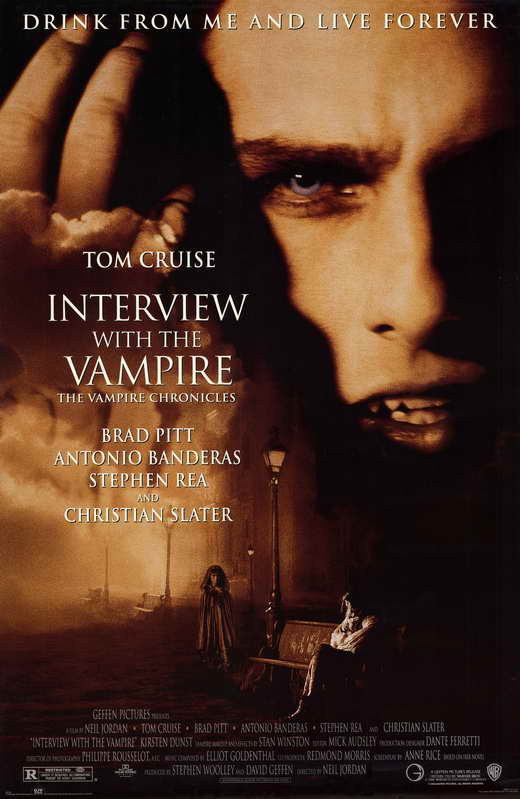
Interview with the Vampire (1994)

Tom Cruise and Brad Pitt bite and flirt in high-minded, but rather camp, Interview with the Vampire

Director: Neil Jordan

Cast: Tom Cruise (Lestat de Lioncourt), Brad Pitt (Louis de Pointe du Lac), Christian Slater (Daniel Molloy), Kirsten Dunst (Claudia), Antonio Banderas (Armand), Stephen Rea (Santiago), Domiziana Giordano (Madeleine), Thandie Newton (Yvette)

Why do vampires constantly keep rearing their ugly heads in films? What is it about them that we seem to find so addictive? Interview with the Vampire is a vampire film that takes a slightly different tone and tries to explore what it might actually be like to live the life of a vampire, the actual psychological impact it might have. It’s just a shame the film also can’t escape the temptation to fall back on the high camp the genre often gets trapped in.

Anyway, the film opens in modern day San Francisco, with young reporter Daniel Molloy (Christian Slater) interviewing a man named Louis (Brad Pitt) who claims to be an ageless vampire from the late 18th century. Louis tells his life story: turned to a vampire by the hedonistic Lestat (Tom Cruise) when he was consumed with grief at the loss of his wife and child. Louis struggles with the morality of taking life, unlike Lestat’s joy in killing. Later they turn a dying girl Claudia (Kirsten Dunst), who over the next 30 years matures psychologically but remains in the body of a 12-year-old. Louis and Claudia slowly begin to fear Lestat’s control and struggle to escape from his shadow.

Interview with the Vampire wants, desperately, to be an intellectual vampire film. A sort of Freudian exploration of the impact of suddenly becoming a creature that can never see daylight, sleeps in a coffin and has an insatiable hunger for human blood. Does it work? Well sort of, I guess. But the problem is most of the depression is carried by Brad Pitt’s Louis and, to put it frankly (as Lestat observes) he’s a whiner. His very human struggle with taking life and his sadness at the loss of his humanity should be engaging, but Louis is not an interesting character. He just mopes around. Rather than being sparked by his predicament, he’s just a boring and frustrating character.

Maybe this is partly Pitt’s performance as well – too withdrawn, too morose. Apparently Pitt hated making the movie (from the long hours of make-up, to the endless night shoots, to the boring character) and it shows in the movie. Pitt just can’t get engaged in the role, his matinee idol looks and rather dull speaking voice combining to make him look like a worse actor than he is. And then Louis keeps banging on and on about how depressed he is. In fact he bangs on so much you start to wonder why everyone – from Tom Cruise’s crazed Lestat, to Antonio Banderas’ ageless vampire – is so obsessed with him.

But then maybe it’s Louis’ looks eh? The film does wallow in the sensuality of sucking on people’s necks, and half the vampires in this seem to be campily metro-sexual. Cruise gives a surprisingly out-there performance of high camp hedonism and preening selfishness, so far out of his expected range that (while not brilliant) it reminds you he is a better actor than he gets credit for. Lestat clearly has a huge crush for Louis, and the orgasmic converting of Louis into a vampire leaves little to the imagination. Later Antonio Banderas as an effeminate, ethereal older vampire also seems to have a huge crush on Louis. The many vampire victims seem to succumb to erotic joy when they are bitten (at least until they die). Sex flows over the whole film, without the film itself ever actually being sexy, and the vampires are all pretty indiscriminate in their tastes.

Unfortunately this all too often tips into pure high camp. Stephen Rea, as a sort of vampire acrobat actor, gives a performance of superb silliness. Banderas lisps and wafts through the picture like a bizarre puff of perfume. Neil Jordan frequently explores the frame with ridiculous overblown action – no less than four times in the picture we watch scenes of operatic fire starting (often with vampires writhing in flamey pain) that suggest Jordan spent too long watching the fire sequence in Gone with the Wind before he made the picture. All the actors (aside from Pitt who barely shows up) dial it up to eleven with their performances, and the long-haired, long finger-nailed vampire representations here are like some sort of odd Halloween dressing up box.

Jordan’s film often trades dark, campy humour in favour of horror or thrills. There are no real jumps or scares in the picture, and the buckets of blood thrown around are more ridiculous than they are disgusting. In fact watching the film, I feel Jordan may have been torn between wanting to do something a little different (a sad vampire film about depression) and having to deliver the blood, guts and gore the genre fans wanted. Certainly, he fails to mine any real poetry from Anne Rice’s source material (although she loved the film, so what do I know) and for all the musings on the tragedies of living a life in the shadow you never really feel that moved by it.

There are however good things. Technically the film is very good. Cruise is surprisingly fun as the colourful Lestat. The film gets stolen by Kirsten Dunst as the physically young, mentally older Claudia, who struggles to find the balance between her teenage blood lust and her later disgust and fury at being trapped forever in the body of a child. But there isn’t enough good stuff among the tosh. Interview with the Vampire is an odd, actually rather bad film that is struggling to be a good one. It has a cast of 1990s heartthrobs who mostly enjoy dressing up and playing at their campy side. But it fails to really be engaging or make someone care about the story it is trying to tell.

Alfie (1966)


Michael Caine excels as amoral cockney moralist lothario Alfie

Director: Lewis Gilbert

Cast: Michael Caine (Alfie), Shelley Winters (Ruby), Millicent Martin (Siddie), Julia Foster (Gilda), Jane Asher (Annie), Shirley Anne Field (Carla), Vivien Merchant (Lily), Eleanor Bron (Doctor), Denholm Elliott (Abortionist), Alfie Bass (Harry), Murray Melvin (Nat)

Is there a more “swinging Sixties” film than Alfie – the story of a cockney wideboy interested only in “birds” and having a good time? On the surface it captures the attitude of the 1960s, with free love, thumbing your nose at authority, and having the sort of fun the wartime generation frowned on. But it’s a more interesting film than this, which criticises the emptiness of the 1960s by showing us Alfie’s selfishness and loneliness. Sure he has a good time now and again – but would anyone really want to live like this forever?

Alfie (Michael Caine) is a handsome chauffeur with a never-ending stream of affairs, commitment constantly avoided. The film follows these entanglements, starting with his needy girlfriend Gilda (Julia Foster), the mother of his child, whom he constantly cheats on. When Gilda finally leaves him – and Alfie loses touch with the son he has become fond of – a medical condition ends up with him in a convalescent home, where his affairs include the wife of a fellow patient, Lily (Vivien Merchant). Later relationships with a young hitchhiker (Jane Asher) and a rich American woman (Shelley Winters) similarly lead to disappointment.

The main thing that makes Alfie last (possibly the only thing) is Michael Caine’s sublime performance. Caine is on screen the whole time, and the film is spotted throughout with his casual direct-to-camera addresses. Caine’s charm and likeability work perfectly for this device, winning the audience over. But Caine never falls for Alfie – even if many audience members clearly did. Caine’s constantly demonstrates Alfie’s hypocrisy, shallowness, meanness and selfishness. Sure he recounts his actions with wit, but most of these actions are extremely shitty. But right from the start there is a charismatic, lothario swagger to him – and a cheeky charm – that makes you like him.

But his general shittiness is more obvious today than back in the 1960s. Then the amount of sex probably shocked viewers the most. Today it’s Alfie’s inability in to refer to women as anything but “it”, like some smooth Richard Keys. His attitude to women is appalling – he describes Jane Asher’s hitchhiker like some sort of floor-cleaning, bed-sharing car. Alfie avoids any sort of emotional connection at all with his conquests, and the film makes clear that this has left him empty and lonely, feelings he buries deep down.

In fact, the film is most telling at the moments when Alfie doesn’t turn to us with that confident grin and place a self-serving spin on what just happened. Seeing his son being warmly embraced by Gilda’s new husband (at the christening of their new child), Alfie can only skulk quietly at the back of the church – as scared to meet our eyes as he is those of this family he could have had. His love for his son is something Alfie refuses to accept himself – but his feelings are all too clear at his physical collapse on losing access to his child, and his later tear-stained reaction to Lily’s abortion.

Ah yes the abortion scene. Probably the highlight of the film – if only because its intense seriousness is so different from the rest of the film, and Alfie’s wheedling weakness and whiny self-justification become all the clearer. His complete lack of principle in sleeping with his only friend’s wife (“Well what harm can it do?”) of course results in her pregnancy. And Alfie is all at sea, firstly with Vivien Merchant’s expert portrayal of distress, pain, shame and guilt as Lily – and with Denholm Elliot’s perfect cameo of grimy, resentful disillusionment as a struck-off doctor turned back-street abortionist. Just to bang the nail on the head, Alfie leaves Lily alone after the operation (telling the audience that there’s nothing he can do anyway, right?). He may be horrified later at what he has done, and may feel moments of empathy – but has he really learned anything?

The film is full of these moments where we are invited to understand that Alfie is not leading a life for us to aspire to, but one we need to avoid. It’s left Alfie alone, miserable and abandoned. For all the jaunty 1960s vibe, and Alfie’s charming cheek, he’s not a happy man but a desperately shallow one. And he’s even got a shelf life for this way of life: “He’s younger than you are” one of his lovers tells him late in the film, as she leaves him. Because what has Alfie got in his life? When he runs through a checklist in the film’s closing monologue (“a bob or two, some decent clothes, a car. I’ve got my health back and I ain’t attached. But I ain’t got my peace of mind”) the emptiness of his life is all too clear.

Caine’s brilliance is to make this tragic, empty, selfish man seem attractive and exciting – while also never losing sight of what a complete shit he is. It’s a great performance and he dominates the entire film. He plugs perfectly into the hip, light touch that Lewis Gilbert directs the film with, and the entire film has a layer of cool on it that works rather well. What makes the film last today though is its shrewd analysis of the empty, soulless, coldness that underpins living your life like this – and how the sort of shallow, no consequences, no emotional investment bouncing around Alfie has just leaves you alone and growing old.

“What’s it all about?” You can argue the answers are buried in this film – but Alfie never spots them.

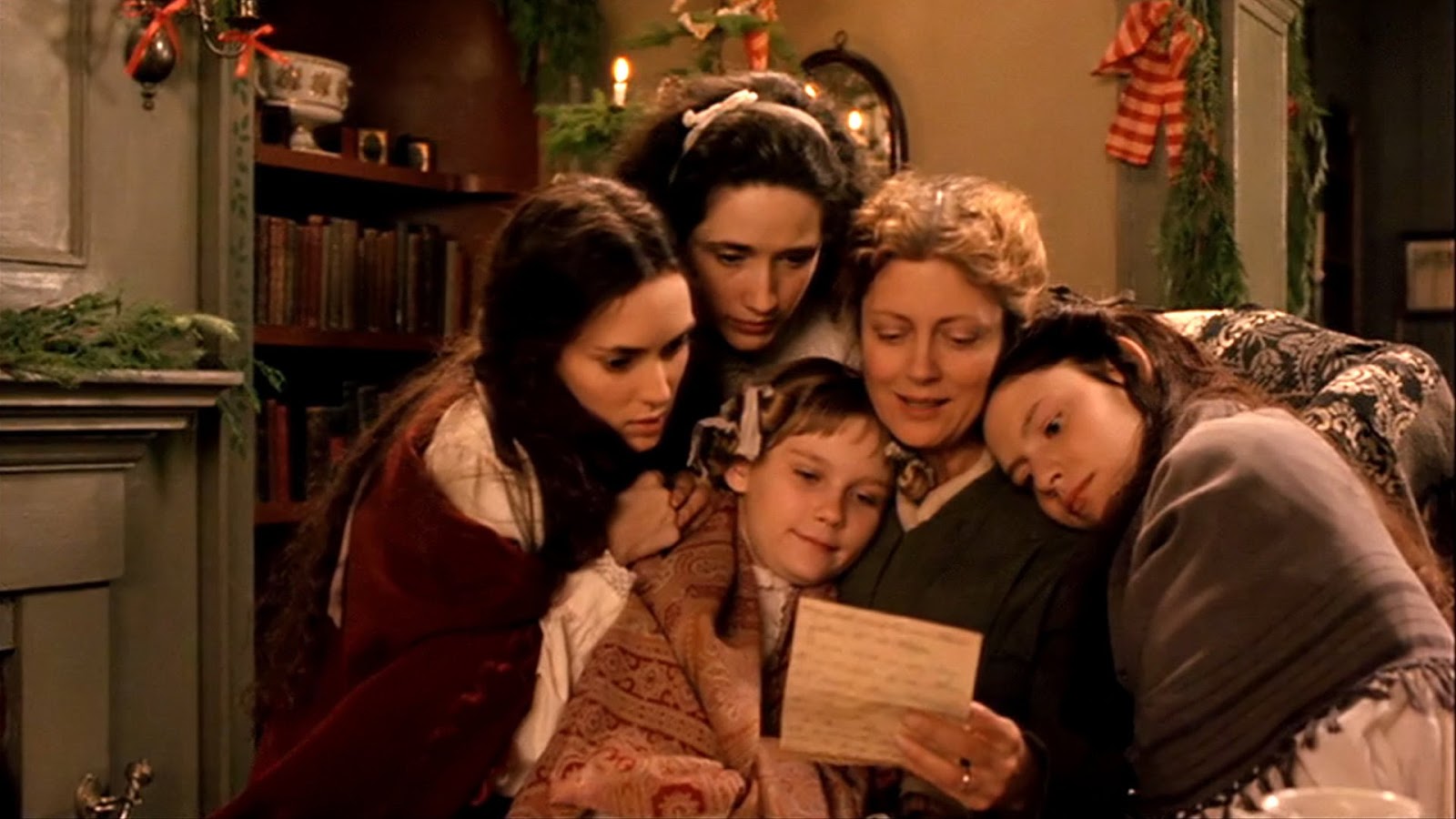
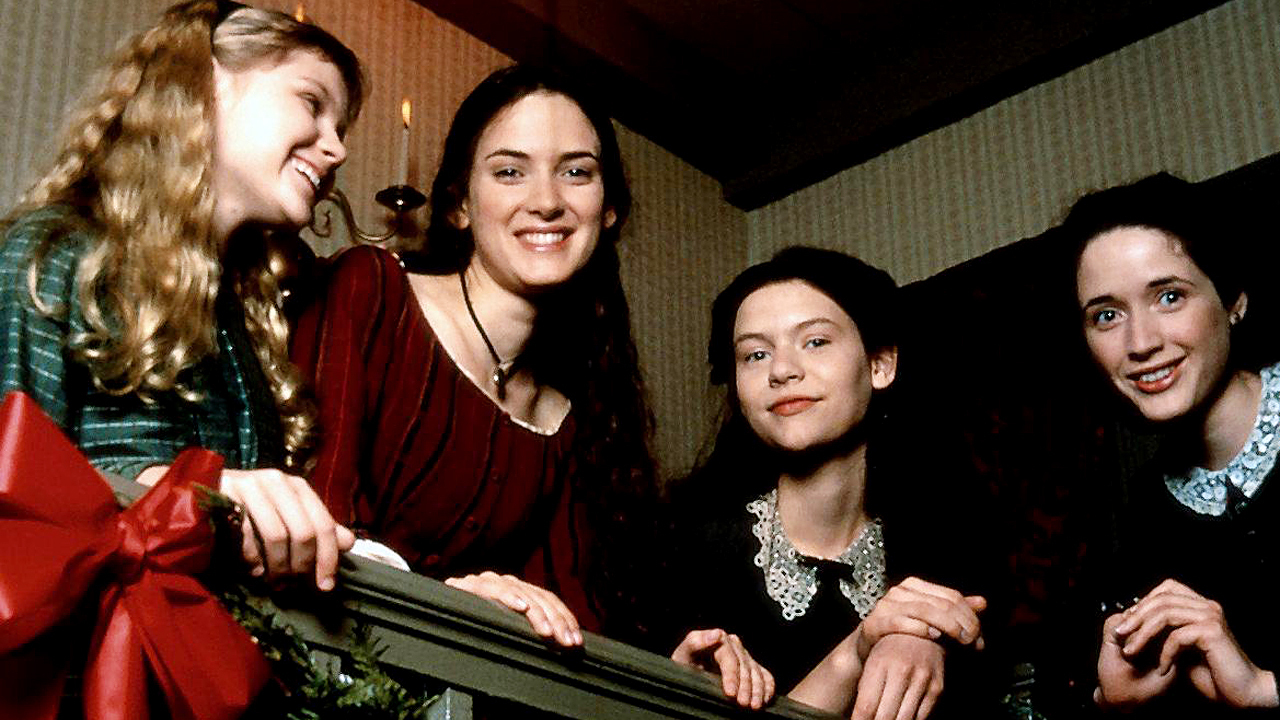
Little Women (1994)


Gillian Armstrong’s beautifully cast and played adaptation of Little Women is a classic

Director: Gillian Armstrong

Cast: Winona Ryder (Jo March), Gabriel Byrne (Friedrich Bhaer), Trini Alvarado (Meg March), Kirsten Dunst (Young Amy March), Samantha Mathis (Amy March), Claire Danes (Beth March), Susan Sarandon (Marmee March), Christian Bale (Theodore Laurence), Eric Stoltz (John Brooke), John Neville (Mr Laurence), Mary Wickes (Aunt March)

There are certain adaptations that simply set the standard. I’m thinking of the BBC Pride and Prejudice or Emma Thompson’s Sense and Sensibility. For productions like this, it almost seems superfluous to create another version: why would you want to when you can already watch the whole thing done perfectly? Gillian Armstrong’s superlative production of Little Women is such a film: so perfectly cast, immaculately acted and brilliantly assembled that I simply can’t imagine another production bettering it.

In Massachusetts during the American Civil War, the March sisters live with their mother (Susan Sarandon): sensible Meg (Trini Alvarado), tomboyish Jo (Winona Ryder), gentle Beth (Claire Danes) and temperamental Amy (Kirsten Dunst). While their father is away fighting, the girls grow up and experience the highs and lows of life and love, while never losing sight of the strong bond that holds them together.

Not only is it impossible to imagine another production besting this, I can’t imagine another creating so many “something in my eye” moments as this film manages. Gillian Armstrong’s tender direction gets a guaranteed emotional response from the audience every time, largely because she keeps the film simple, focused and doesn’t overegg the emotion. She recognises the story itself carries delicious highs and heartbreaking lows – and lets these moments speak for themselves. From its opening moments, establishing the girls’ love of theatricals and their own private “Pickwick club”, you know you are in the safe hands of people who fully understand the novel.

It’s a film which plays it very, very simple and lets the beauty of the moments speak for themselves. Many work perfectly: no less than three times I felt myself welling up, from the presentation of Mr Laurence’s piano to Beth, to Beth’s tragic death, to the final scenes between Jo and Professor Bhaer. Each of these moments is quite simply perfectly played and carry a major emotional wallop. It’s because Armstrong sets out a film that is totally straight, and a completely loving and respectful adaptation of Alcott’s novel. Armstrong, and adapter Robin Swicord, also build a profound, focused story of growing up and learning to adjust to loss and the changes life brings us. Focusing on this creates a very clear journey in the movie – as well as a story anyone who has had any life experiences is going to respond to.

Part of the reason why the film is such a complete success is the superb playing from a cast without a weak link among it. The four March sisters genuinely feel like people who have grown up together, so strong are the bonds of chemistry between them. I’d also hugely commend Armstrong and Swicord for so skilfully establishing the different personalities of the sisters – within the opening few minutes you’ll feel like you know all their personalities exactly (a task utterly failed by a recent three-part BBC adaptation).

In the lead role, it’s scintillating to watch Winona Ryder and remember what a superb, heartfelt and gloriously expressive actress she is. Vulnerable but also tomboyish, boisterous and also tender, she brilliantly captures Jo and her semi-bohemian, semi-homespun yearnings, and her passionate love for a life different from the traditional. Ryder also has such wonderful skill with conveying emotion – at several key moments, waves of emotion seem to pass over her face in careful micro-expressions. Several moments carry the weight that they do, because Ryder sells them so well. 

Her three sisters are equally well-cast. If she has a rival for skill of expression and conveying depth of emotion it’s Claire Danes, who is astonishingly good as the gentle Beth (hard to believe she was only 15 at the time!). Danes’ simple joy and her gentle, unassuming love for those around her really hit home. Danes’ joyful warmth makes Beth’s acceptance of the piano from Mr Laurence a beautiful moment, while her tender humanity makes her death incredibly moving. Kirstin Dunst is superb as the young Amy – part brattish pre-teen, part excitable child. Her sudden horror when she realises the gravity of burning Jo’s book again helps this moment work so well. Trini Alvarado has the less interesting part, but her grounded, calm, proper and gentle performance as Meg balances the work of the sisters really well, and Alvarado demonstrates she has real empathy for the role.

The rest of the cast are equally good. Samantha Mathis (taking over the older Amy) delivers an excellent portrayal of a woman keen to head into the world. Susan Sarandon is perfect as a wonderfully loving, all-knowing mother. Christian Bale is perfect as the playboyish Teddy, full of playful fire. John Neville sells a few crucial scenes as a humane Mr Laurence. Gabriel Byrne is certainly far more handsome than his literary counterpart, but he’s so wonderfully gentle, caring and kind that it hardly matters: the relationship between him and Jo is beautifully judged.

Beautifully judged basically sums up the whole thing: there is not a bum note in this whole film. Armstrong and Swicord nail every single decision. Armstrong’s direction is outstanding: a brilliant example is the gently, unbearably sad sequence of sprinkling roses in Beth’s room after her death – it’s so simply done but incredibly moving. The film is crammed with moments like this, beautifully scored by Thomas Newman. Swicord’s script is marvellous, and it successfully draws out the feminist message of the book, without hammering the points: it gently flags up the lack of opportunities often available for women at the time, but also celebrates the contribution they can make. 

Little Women is a simply superb piece of adaptation, and a deeply affecting and heart-warming film. Only a film that lets you invest in the characters as much as this, could move you as much as it does. When Ryder smiles, you feel your whole world light up. When Danes cries with joy you feel your heart sing. When tragedy comes you feel like you’ve had a loss yourself. The story is superbly streamlined, each character is perfectly established, the relationships between them all are so wonderfully done – you can’t help but fall in love with it. If it had been a film about men it would have been littered with Oscar nominations. As it is, despite the sexism of the Academy, it’s a film you’ll treasure and return to again and again.