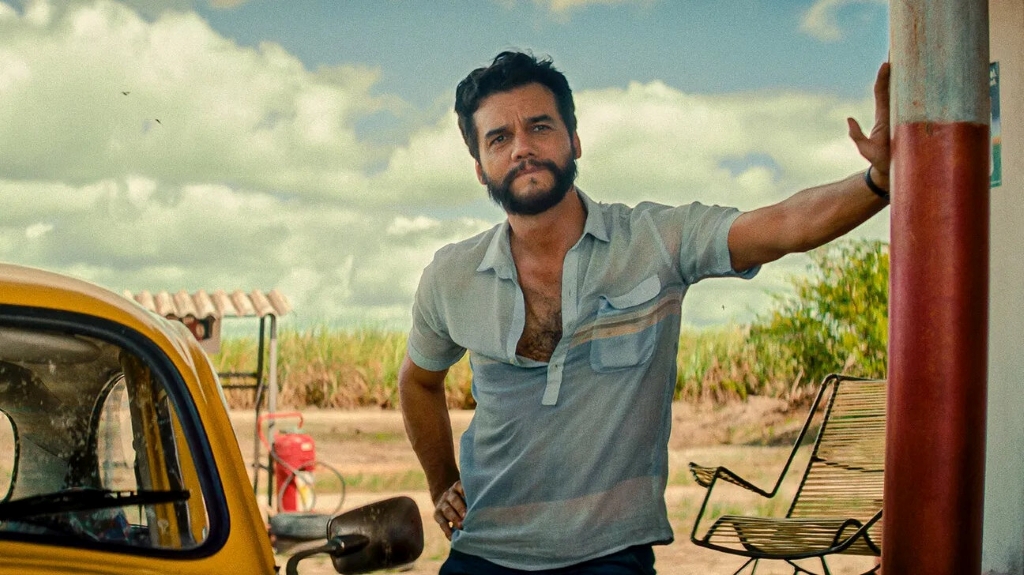
Category: Conspiracy thriller

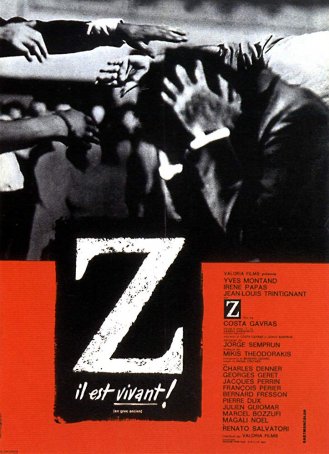
Z (1969)

Z (1969)

Costa-Gravas thrilling conspiracy thriller is possibly one of the finest political films ever made

Director: Costa-Gravas

Cast: Jean-Louis Trintignant (Examining Magistrate), Yves Montand (Deputy), Irene Papas (Helene, the Deputy’s wife), Pierre Dux (General), Jacques Perrin (Photojournalist), Charles Denner (Manuel), François Périer (Public Prosecutor), Georges Géret (Nick), Bernard Fresson (Matt), Marcel Bozzuffi (Vago), Julian Guiomar (The Colonel), Gérard Darrieu (Barone), Jean Bouise (Georges Pirou), Jean-Pierre Miquel (Pierre)

Costa-Gravas Z is an explosive political thriller, ripping a lightly fictionalised story from the Greek headlines (the opening credits playfully state ‘any resemblance to real people is ‘purely intentional!’) and turning it into a compellingly angry, cold-eyed look at political repression. It was based on the state-backed murder of Greek politician Grigoris Lambrakis in 1963 and the investigation by magistrate Christos Sartzetakis which briefly looked like it might expose repressive military forces but actually kick-started a 1967 military junta counter coup in Greece. Z takes this as inspiration for a truly universal story that continues to feel like ‘it could happen here’.

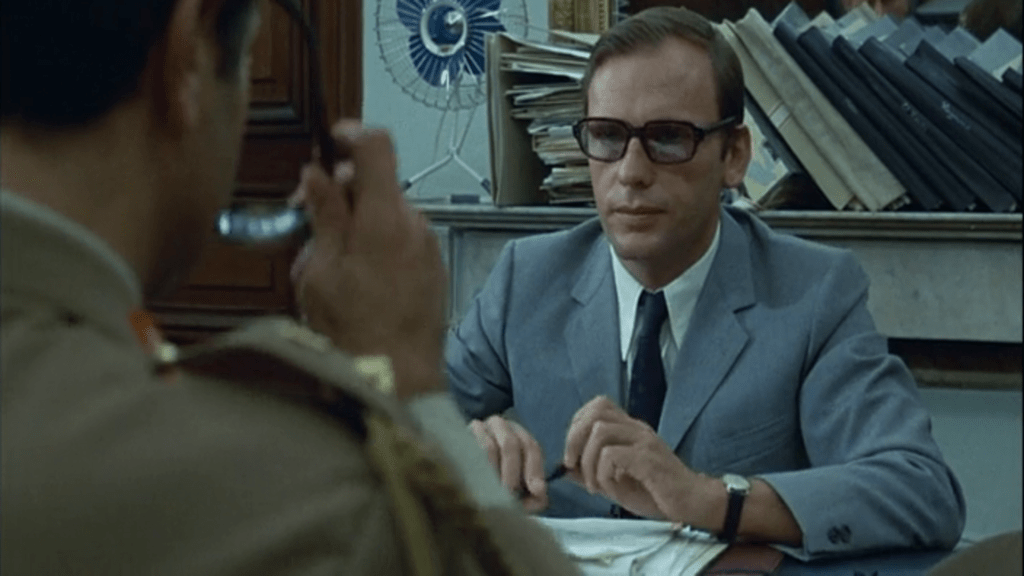
Lambrakis becomes The Deputy, played with great charm and determined charisma by Yves Montand. After death threats, he is murdered after a political rally by two thugs in a hit-and-run, in a public square, surrounded by police officers and a legion of witnesses. The police, represented by the virulent anti-communist General (Pierre Dux) declare it a tragic accident. They firmly expect our Sartzetakis-figure (Jean-Louis Trintignant, putting his enigmatic unreadability to extraordinarily good-use), son of a war hero, to back-up their bullshit. But he didn’t get the memo, conducting a genuine investigation which reveals the extensive links between the military and police and far-right organisations, how they planned the hit and did everything to ensure its success. But will this investigation lead to real change?

Costa-Gravas’ film is a hard-boiled conspiracy thriller with echoes of The Battle of Algiers’ primal urgency and immediacy. It’s committed to throwing you into the middle of the turmoil, with fast-cutting, hand-held camerawork, tracking shots through crowds and shots which zero in on the faces of victims and perpetrators alike. The film’s influence on directors like Oliver Stone is palpable. But, unlike Stone’s work, Z wears its moral outrage carefully: it presents events with a journalistic matter-of-factness, trusting us to recognise the corrupt horror of over-mighty governments. The resolute professionalism of Trintignant’s magistrate helps enormously here – heroism in this world is being honest and doing your job.

What Costa-Gravas film reveals is that these authorities believe they can act with utter impunity, convinced they will never be questioned by anyone, other than their liberal targets. Z opens with a darkly comic scene that outlines this thinking: during a lecture, the pompous General outlines (to a military audience shown impassively watching in a series of quick reaction cuts) his theory of ‘ideological mildew’ attacking the ‘tree of liberty’, using a tortured pesticide metaphor to suggest it is their duty to kill the mildew (liberals and socialists). This tyrannical view is parroted by people who are neither lip-smacking villains or fiendishly clever – they just have absolute, fixed certainty.

Z makes clear that such men, placed in position of authority, will attempt to shape events with a breath-taking arrogance. The assassination plot is shockingly clumsy and obvious and cover-up so full of transparent bare-faced lies, you’d need to be impossibly arrogant to even consider you could get away with it. Copious evidence shows meetings between senior officers and members of the right-wing CROC group. It’s claimed the Deputy’s fatal head-wound came from hitting the pavement, even though this is ruled impossible by both an autopsy and hundreds of witnesses. The General claims not to know the driver who ‘rushed’ the wounded Deputy to hospital (stopping at every opportunity), even though the man is his personal chauffeur. Everyone repeats the same tortured, unusual phrases – from the head of police to the thugs themselves.

It doesn’t stop there. Once it becomes clear Trintignant’s magistrate is genuinely investigating – that he has his own mind and opinions – the clumsy cover up turns aggressive. Blame is put on the Deputies own supporters (the word ‘false-flag operation’ didn’t exist then, but the idea is seized on); his lawyer is almost killed in a park hit-and-run in front of dozens of witnesses; a witness who can testify to the plans of the hitmen is pressured, told he has epilepsy, framed as a radical (he’s clearly not) and then nearly assassinated by one of the hit-men (put up in the same military hospital with a pretend broken leg), who flees the scene and in front of his doctors, while giggling at his cheek.

Some of this is in fact blackly funny. It perhaps almost would be, if it wasn’t for Z’s moral indignation. Even without murder, this is a repressive, corrupt regime: the Deputy’s team have innumerable petty obstacles placed in their way for their rally, their supporters are openly attacked by bused in protestors mixed with baton-wielding under-cover officers. Costa-Gravas doesn’t show the Deputy as a saint – flashbacks reveal he is an adulterer – but it does make clear his bravery (confronting and cowing crowds of anti-liberal rioters, utterly unrestrained by the police), leadership and the fear he overcomes. It also shows, especially in Irene Papas’ emotionally underplayed but quietly devastating performance, the raw grief of those who love him. His closest colleagues weep at news of his death, the post-death slandering of him all-the-more disgusting.

Z presents its evidence with an increasingly overwhelming force. The magistrate corrects (for a long time) any use of the word murder for ‘accident’ – by the time he himself says ‘murder’ it’s almost easy for us to miss it, so natural has the conclusion become. Pressure is, of course, applied to him: senior officers bluster about metaphorical eggs and omelettes; his bosses suggest he charge only the hit-men and (for good measure) charge the Deputy’s people for disrupting the peace by holding the rally in the first place. Plenty of ordinary people know exactly what’s going on, but don’t want to take risks: a newspaper editor reports what he’s told to, the Deputy’s doctor regrets not joining his lonely ‘march for peace’ but, well, you know how it is…

Given the blatant criminality of the police and the army – and the sadistic arrogance of hit-man Vago (an uncomfortable beat in Z is the whiff of homophobia in the depiction of Vago as a predatory homosexual and pederast) – it’s truly triumphant to see them bought to book. Despite their bombast (each officer states he will have no choice but to take his life to avoid the shame, something of course none of them do), each flees the building railing at the press. (The General, an antisemite among everything else, even roars ‘Dreyfus was guilty!’ when a journalist compares the affair to that).

But it’s short-lived. Perhaps Irene Papas’ Helene knows it will be when she responds to news of the arrest with a quiet middle-distance stare. Z closes with a dark coda that could almost be funny if it wasn’t horrifying. A photojournalist (played by producer Jacques Perrin) who we have followed uncovering the plot, reports the aftermath: initial resignations followed by slap-on-the-wrist sentences for the hit-men, charges dropped for the officers and a coup d’etat (at this point a cut removes Perrin) which sees the arrest or ‘accidental’ death of all the Deputy’s supporters, a junta government and bans of everything from authors, mini-skirts, modern mathematics and, above all, the letter Z, as zi has been taken by protestors as the badge ‘He Lives’.

It would be funny. It almost is funny. If it wasn’t part of a system that crushes freedom with violence and murder. Costa-Gravas’ brilliant, engrossing and perfectly judged film shows how terrifyingly swiftly it can happen, how freedoms and justice can be strangled before our very eyes. Watching it today, you can’t imagine a time when it won’t be coldly, chillingly, terrifyingly relevant.

One Battle After Another (2025)

One Battle After Another (2025)

Fabulously made film, a brilliant merging of half-a-dozen genres is one Andersons’s finest

Director: Paul Thomas Anderson

Cast: Leonardo DiCaprio (Pat Calhoun/Bob Ferguson), Sean Penn (Colonel Steven J Lockjaw), Benicio del Toro (Sergio St Carlos), Regina Hall (Deandra), Teyana Taylor (Perfidia Beverly Hills), Chase Infiniti (Willa Ferguson), Wood Harris (Laredo), Alan Haima (Mae West), Paul Grimstad (Howard Sommerville), Shayna McHayle (Junglepussy), Tony Goldwyn (Virgil Throckmorton), John Hoogenakker (Tim Smith)

What is revolution – changing the world or just the relentless grind of One Battle After Another? It’s as hard to define as it is to define Paul Thomas Anderson’s incredibly striking Thomas Pynchon adaptation. Look at it one angle, and it’s a sharp political commentary on America; from another it’s a satire on the insular, self-defeating rules of secret societies; from a third it’s a pulpy chase-thriller; from a fourth a touching coming-of-age story of a daughter growing closer to her dad. Anderson’s skill here is that it’s basically all these and more at the same time, an electric, frequently laugh-out loud funny, hugely eccentric film that defies all categorisation.

Pynchon’s novel Vineland saw the radicals of the 1960s pulled, clumsily, back to life in the 90s. Anderson keeps the time skip, but moves the start to the late 00s and the destination to today. Pat (Leonardo DiCaprio) is a dishevelled, but true-believing, junior member of The French 75, a radical Atifa-style organisation on a wave of armed anti-government action. He’s in love with Perfidia (Teyana Taylor), an adrenalin-fuelled militant whose radicalism is often secondary to the rush she gets from guns and bombs. She’s the source of perverted sexual obsession for bottled-up, socially-striving US army officer Stephen Lockjaw (Sean Penn). After Perfidia makes a terrible choice, 16-years later the disillusioned, frequently doped-out, Pat (now living under the alias of Bob Ferguson) is raising their teenage daughter Willa (Chase Infiniti) when Lockjaw explodes back into their life, desperate to clean up his past indiscretions in case they imperil his acceptance into a secretive Neo-Nazi organisation of wealthy American, ‘the Christmas Adventures Club’. Cue a wild and crazy chase.

Anderson’s film bowls along with a whipper-cracker pace, over-flowing with confidence that it doesn’t need to spoon-feed us timelines, details or locations but trusts us to go with narrative flow. Which I for one really did. It’s a film that throws you straight into the mix – a French 75 raid on an immigration detainment facility – and barely lets up from there. Within the first half an hour we’ve seen a wave of direct action events from blowing up campaign offices (after warning phone calls) to sabotaging a city’s electricity supply – alongside Pat and Perfidia overcome with giddy, sexual thrills at thumbing their nose at the system. It’s a great way of grasping what an addictive rush fighting the man can be, something that’s all too-clear in the excited whooping, cheering and bombastic speechifying of many of its members.

These good times can’t last, but Perfidia wants to enjoy them as long as she can. In a blistering, force-of-nature performance from Teyana Taylor, Perfidia acts completely on impulse, thrilled with her life of action, pulling the naïve Bob in her slipstream. Danger of all sorts is addictive, from bombs to risky liaisons. She’ll spontaneously attempt to sexually humiliate Lockjaw on their first encounter (essentially ordering him to ‘stand to attention’ for her), then throw herself into an off-the-books sexual relationship with him (after he obsessively tracks her down for more humiliation) seemingly for kicks. She embodies the risky, thrilling excitement of the revolutionary world.

She’s also what leads to its destruction (her fellow revolutionaries are reduced to frightened shadows of themselves when, during a bank raid. Perfidia actually uses the lethal force everyone else has just talked about). Anderson’s film, after its propulsive start (assembled like an extended montage across an entire act), jumps to a very different future, where the thrills and spills of the underworld are subtly undermined, firstly by the hilarious dark comedy of all communication being managed through obsessive codeword rules and then by comparison with a far more quiet, but far more effective, underground railroad for migrants run by Benecio del Toro’s (underplaying brilliantly, his natural charisma flowing off the screen) Latin community leader and Taekwondo-sensei.

It’s also clear how hard it is to keep the revolutionary fire-burning. One Battle After Another superbly exploits the vulnerability and anxiety that underpins many of DiCaprio’s best performances. For all his involvement with radical violence, Pat/Bob is a sensitive, true believer starry-eyed, but with an appreciation for every-day duties that his fellow revolutionaries lack. It’s him who believes family and their daughter should come first (Perfidia, in the midst of post-natal depression, even admits she’s jealous of her daughter for absorbing so much of Pat’s love and attention).

DiCaprio brilliantly finds in Bob a good heart, whose desire to do the right thing is undermined by his own incompetence. In disappointment, he’s become a paranoid grouch, grumbling about pronouns, like any other middle-aged man adrift in the modern world. DiCaprio burns through the desperate energy of the part, but mixes it with a rich vein of black comedy at Bob’s frequent inability to cope with his situation. It’s a perfectly judged performance of loyalty and love, mixed with exasperation, panic and frequent well-meaning poor judgement.

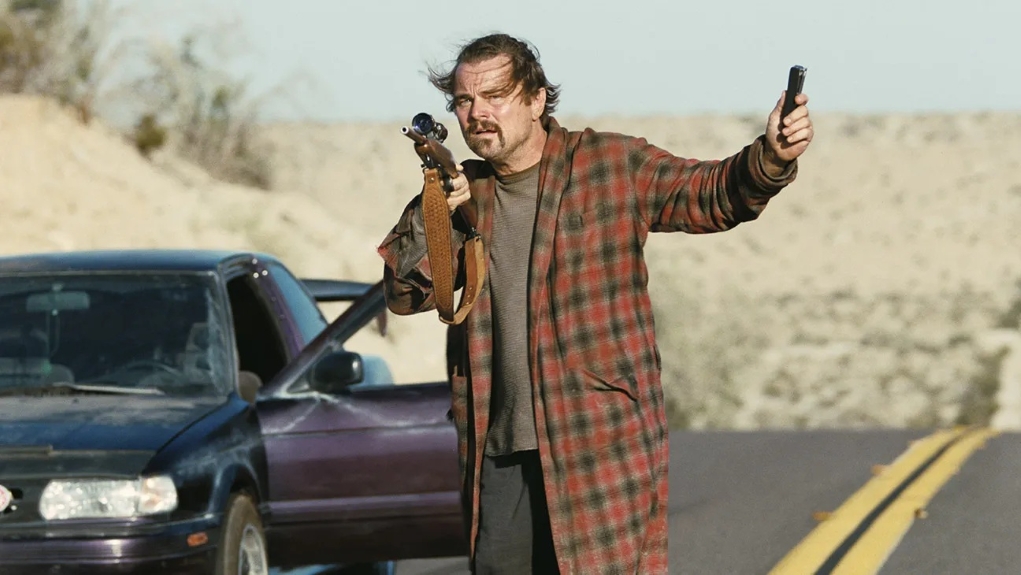
The second-act leans into the satirical comedy of these middle-aged revolutionaries, bought crashingly to life. In a neat comic touch, Bob spends most of the film on the run, desperately trying to find Willa, while dressed, Arthur Dent-style, in the same scuzzy dressing-gown he was wearing before Lockjaw’s raid. Time-and-time again, he’s reduced to swearing impotently down a phone-line like any other middle-aged consumer fed-up with unhelpful customer service, as he repeatedly fails to dredge vital codewords up from his stoned memory. During his escape, he’ll fall off a roof while evading the law, blanch at jumping from a moving car and spectacularly bungle a shoot-out. But what never waivers is his determination to help his daughter. One Battle After Another plays at times like a version of Taken where Neeson’s character had let himself get out of shape but still threw himself into the chase.

Anderson has fun with the bombastic self-importance of revolutionaries and the intricate insularity of their world. But he also has respect for their underlying desire to change the world for the better, even if the film suggests that the carefully, unflashy work being carried out by del Toro’s railroad is a better approach. Among the revolutionaries, there is a genuine warmth and feeling, embodied by Regina Hall’s loyal and humane Deandra (another superb performance in a film packed with them). There is a loyalty and protectiveness among the revolutionaries that bonds them together. And Sergio – del Toro outstanding as a never-fazed Sensei, a performance bubbling with dry wit – has built a community founded on mutual respect and looking out for each other.

And One Battle After Another has no respect at all for the alternative. The Christmas Adventures Club, the bizarre neo-Nazi group Lockjaw dreams of joining, shares the ridiculous language of secret knocks, handshakes and codewords. But it’s repellent in its instinctive racism and treats its members not as allies to be protected, but assets to be exploited and disposed of as needed. And their insidious extremism of its powerful white guys, with their hands on the gears of power, poses a far more dangerous threat.

Lockjaw is superbly played by Sean Penn as a ball of righteous, inadequate anger – from his ludicrous hair (which he frequently combs into an aggressive thrust), his tight t-shirts to accentuate his muscles to the lifts in his shoes to make him taller. Lockjaw is desperate to be a somebody, after a lifetime of social insecurity. Lacking any sense of imagination, with the emotional maturity of a disgruntled teen, Penn makes Lockjaw the embodiment of angry male entitlement trying to grab what power they can.

Anderson fuses all these elements into a film that takes us through several propulsive acts, from it’s French 75 prologue, to Bob’s desperate attempt to evade Lockjaw’s troops to a dusty road-chase that superbly carries an air of Mad Max. But Anderson does this, while never letting the film’s focus slip from the twisted family relationships at its centre: from Bob’s genuine, protective fatherly love, to Lockjaw’s incel jealousy and their twisted struggle for Willa (beautifully played by Chase Infiniti, in a star-making turn, as young woman finding a strength and idealism within herself that surprises her). It finds space for a genuinely moving series of personal relationships, just as it also skilfully shows Willa’s self-belief and social imagination flourishing under insane circumstances.

It’s part of a compelling, exciting, blackly comic and compelling film, which is not afraid to go to extreme, satirical lengths one moment and then pull you up with a scene that is gentle, earnest and heartfelt the next. It also avoids the trap of too directly preaching about America today, while asking several searching (and uncomfortable questions) about where we are now. Superbly acted across the board, it again shows Anderson is one of the finest directors working.

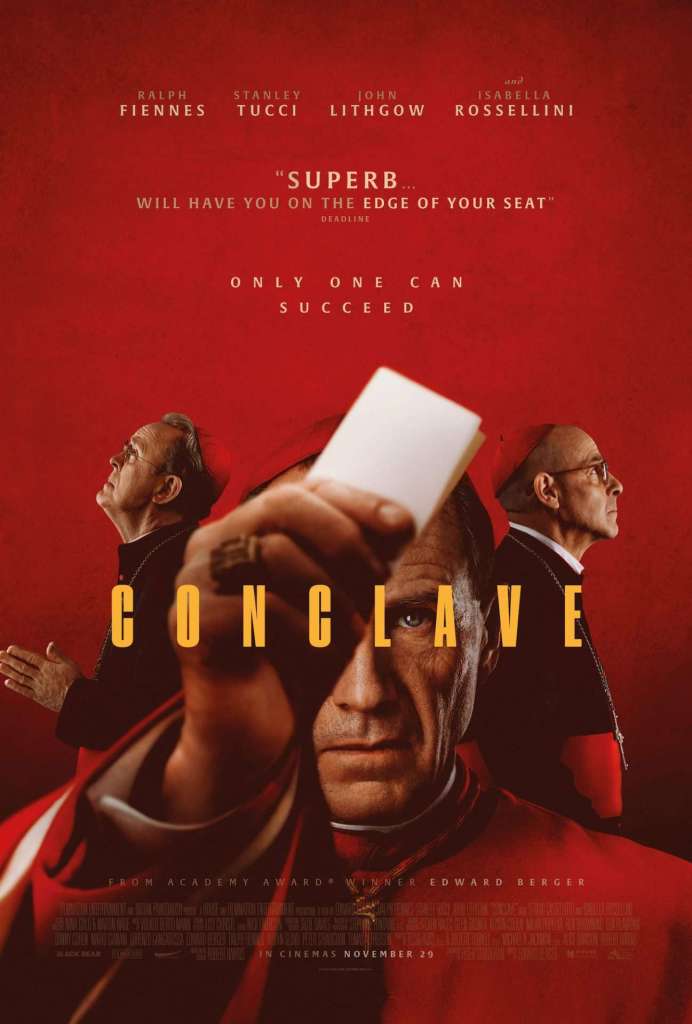
Conclave (2024)

Conclave (2024)

Papal boardroom politics combine with detective mystery in this engaging mix of high- and low-brow

Director: Edward Berger

Cast: Ralph Fiennes (Cardinal Thomas Lawrence), Stanley Tucci (Cardinal Aldo Bellini), John Lithgow (Cardinal Joseph Tremblay), Sergio Castellitto (Cardinal Goffredo Tedesco), Isabella Rossellini (Sister Agnes), Lucian Msamati (Cardinal Joshua Adeyemi), Carlos Diehz (Cardinal Vincent Benitez), Brian F. O’Byrne (Monsignor Raymond O’Malley), Jacek Koman (Archbishop Janusz Wozniak)

Few things have changed as little over 500 years than the election of a pope. Sure, they didn’t need to take away the phones of the Borgias and Medicis, but the idea of locking away the Princes of the Church in the Sistine Chapel until the Holy Spirit guides them towards choosing the next Heir to the Throne of St Peter hasn’t changed. But then neither (probably) has the ruthless politicking and barely concealed ambition of the cardinals (after all some were Borgias and Medicis!), many having dreamt their whole lives of moulding the Church into the shape they believe He wants it to be.

Politicking and spiritual and moral struggles with the temptations of ambition are at the heart of this excellent adaptation of Robert Harris’ novel. After the pope dies, Cardinal Thomas Lawrence (Ralph Fiennes), Dean of the College of Cardinals, is responsible for organising the new Papal Conclave. Lawrence, struggling with doubts whose request to resign was recently rejected by the Pope, is part of the moderate wing and a supporter of Cardinal Aldo Bellini (Stanley Tucci). The other major candidates are conservative Canadian Cardinal Tremblay (John Lithgow) and ultra-traditionalists Italian Cardinal Tedesco (Sergio Castellitto) and Nigerian Cardinal Adeyemi (Lucian Msamati). Lawrence slowly discovers severe reasons to doubt the suitability of all these candidates – while the number of cardinals suggesting he himself might be a suitable candidate grows.

Conclave is a very enjoyable dive into the mysterious world of papal politics. Part of its appeal is seeing that, under the mystery of centuries-old practices, elaborate robes and beautiful artworks, the struggle to elect a pope is a highly political business. Things ain’t changed that much since the Borgias, as various sexual, financial and other scandals crop up to scupper the chances of one candidate after another. As per 15th-century papal tradition, take away those flowing robes and lapses into Latin, and this is a cut-throat boardroom succession struggle that leaves more than a few reputations in ruins (and it ain’t going to be easy – even the late pope’s signet ring only comes off his finger after a rough-handed struggle).

In fact, Conclave works as well as it does because it’s a sort of Succession meets Father Brown, a brilliantly paced and staged merging of high-brow settings with pulpy page-turner thrills. At its heart is a superb performance by Ralph Fiennes as Cardinal Lawrence. Softly-spoken, Lawrence is dutiful, decent and diligent – and plagued with doubts about everything from his faith to his ambition, with permanently sad eyes, full of world-weary resignation. At one point Lawrence stares up at The Last Judgement, his eyes catching a man twisting in torment: he knows how he’s feeling. Unlike all the other cardinals, dripping with certainty, he’d rather be anywhere but there.

Lawrence becomes Father Brown, the quiet, level-headed priest going the extra mile to sniff out wrong-doing. As his concerns about many of his fellow cardinals emerge, he goes to rule-bending lengths to confirm these suspicions – and part of the delight of Conclave is how entertainingly it plays out murder mystery conventions alongside its papal shenanigans. Lawrence carries out his dogged investigation with an earnest sense of duty but what’s great about Fiennes’ performance is that he also manages to suggest the possibly of guilty ambition underneath. After all, Lawrence is a cardinal too, right? Why can’t he have a crack at being the Holy Father?

Lawrence has moments of temptation when the Holy See is dangled before him. Part of Conclave’s argument is that power is best suited to those most reluctant to carry it. Lawrence is one of the most reluctant among the papal players – but even he isn’t immune to guilty temptation. When he opens the concave with an off-the-cuff speech on moral conduct, is it subconsciously to establish his leadership? When he very publicly exposes one candidate’s misdeeds, is a side benefit demonstrating his own virtue? Conclave tracks Lawrence’s vote every time – and when he is tempted to vote for himself, an act of seemingly divine intervention takes place to almost tick him off.

It’s said at one point all cardinals have thought about their papal name. Lawrence shrugs this off, but later unhesitatingly gives an answer. Perhaps the only cardinal who hasn’t really thought about it is Cardinal Benitez (Carlos Diehz, wonderfully serene), secretly appointed Cardinal of Kabul by the late pope, a man almost alone in thinking this is a quest to find the holiest. The rest? They could probably tell their regnal names without thinking. And unlike Lawrence, they are certain about everything: from their own suitability to how pleased God will be when they land it.

Peter Straughan’s sharp and intelligent script gives an array of opportunities for excellent character actors (Conclave would make a good play). Sergio Castellitto’s scene-stealingly bombastic Tedesco, forever vaping when not growling about how chucking the Latin Mass was the end-of-days, can’t imagine he won’t win. It’s a trait he shares with Lucien Msamati’s Adeyemi, although Msamati finds a vulnerable humility that makes Adeyemi’s eventual downfall surprisingly affecting. Lithgow’s imperious Tremblay drips with arrogance (his eventual comeuppance sees Lithgow brilliantly deflate like a pricked balloon). Stanley Tucci is brilliant as the charming, morally upright Bellini who then surprises even himself with how fiercely ambitious he is.

Berger sets all this in a brilliantly oppressive setting, for all the beauty on the walls around them. Berger superbly conveys the isolation of the conclave, lit almost entirely artificially in heartless hotel rooms (that feel like monastic jails) and a fluorescent-lit canteen. The sound design is a massive part of this, the rooms devoid of ambient sound, just a crushingly deadened stillness. Frequently Lawrence’s breathing fills the soundtrack, giving the film a confessional feeling. It all means the late on surprise sound of a gust of wind carries the same impact for us as it does the cardinals.

Male voices dominate in the Vatican, so it’s telling Conclave deliberately undercuts this by giving one of its standout moments to Isabella Rossellini’s primly professional Sister Agnes. Like the other nuns staffing the conclave, she barely speaks – meaning when she does, it seizes the viewer’s attention as much as she does the crowd of cardinals. The flaws of this world return in the film’s final (slightly forced) twist, which helps question how much the alpha-male clashes between these papal academics may have shaped the atmosphere of the Church, and not for the better.

Conclave is tightly directed film, and a great adaptation of a page-turning novel with a faultless cast brilliantly led by Ralph Fiennes. It mixes pomp and ceremony with a fascinatingly tense struggle for power, made all the more gripping that in the parade of languages we hear (and all the cardinals can switch easily from English to Latin to Italian to Spanish) the language of power and ambition is constant but unspoken – and when it is explicitly stated, it has a devastating impact on those who use it. It’s a great touch in an entertaining and engaging film.

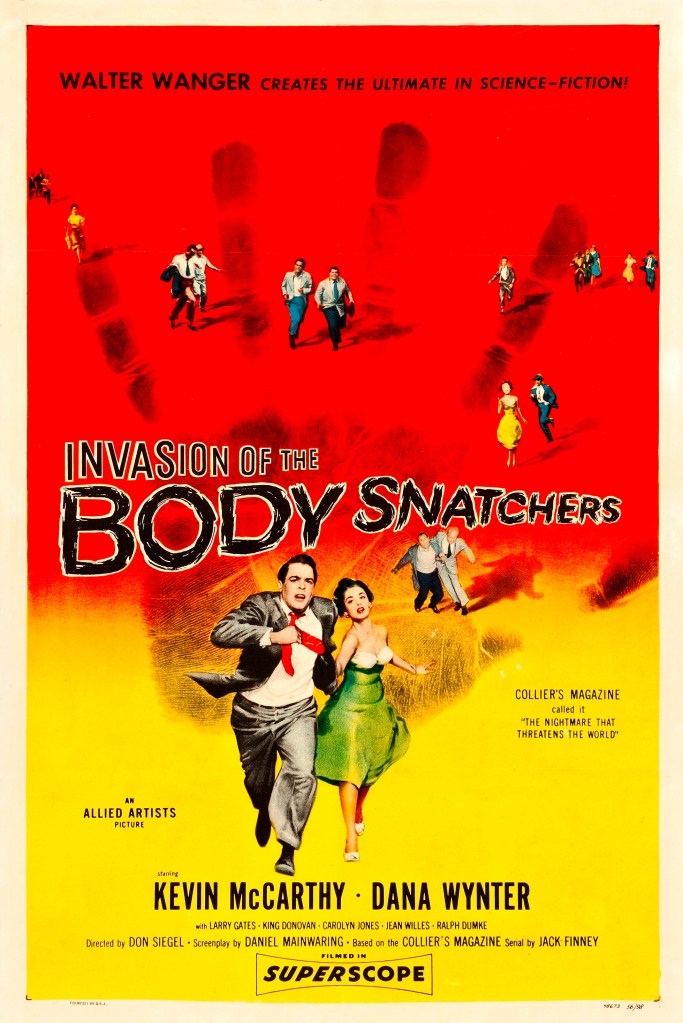
Invasion of the Body Snatchers (1956)

Invasion of the Body Snatchers (1956)

Paranoia in small-town America is superbly executed in Siegel’s creepy sci-fi thriller

Director: Don Siegel

Cast: Kevin McCarthy (Dr Miles Bennell), Dana Wynter (Becky Driscoll), King Donovan (Jack Belicec), Carolyn Jones (Teddy Belicec), Larry Gates (Dr Dan Kauffman), Virginia Christine (Wilma Lentz), Ralph Dumke (Police Chief Nick Grivett), Jean Wiles (Nurse Sally Withers), Bobby Clark (Jimmy Grimaldi)

‘Look, you fools, you’re in danger! Can’t you see?! They’re after you! They’re after all of us! Our wives, our children, everyone! They’re already here! You’re next!’

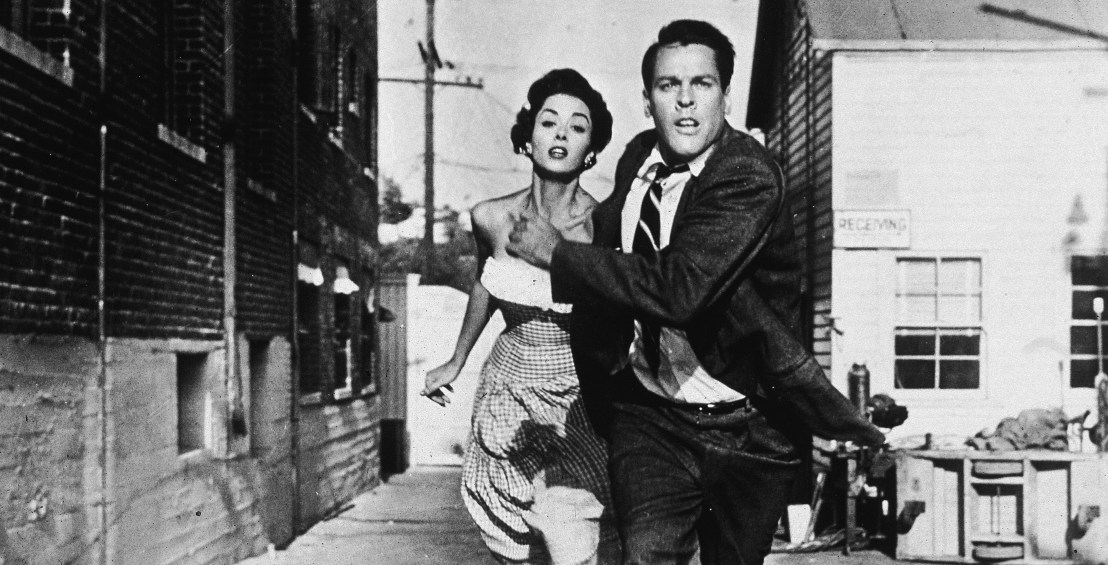
Those paranoid screams from Dr Miles Bennell (Kevin McCarthy) are part of the iconic conclusion of Don Siegel’s thrilling B-movie sci-fi conspiracy, full of the creeping horror of not trusting your own eyes or ears. It’s set in small-town Santa Mira, a sweet-as-apple-pie slice of Americana, where everyone knows everyone and life never changes. Until, of course, it does. Dr Bennell returns from a conference in Los Angeles to an epidemic of people claiming their loved ones are no longer their loved ones but that something about them is different. Bennell shrugs this off, more focused on his budding romance with fellow divorcee Becky Driscoll (Dana Wynter) – until he finds a clone of his friend Jack Belicec (King Donovan) growing in their home and faces the horrific truth: alien invaders are replacing people in the town with emotionless duplicates bent on world domination.

Siegal always claimed it was just a movie. That he wasn’t interested in political statements. You can believe that if you like, but Invasion of the Body Snatchers’ power stems from the terrible political and social parallels it draws with the real-world. The inversion reeks of 50s McCarthyite paranoia at communist infiltration, those suspicious Pinkos uninterested in individuality, only in protecting the system, where people are just cogs in its wheel. Even today, it still feeds on our fear of ‘the system’ absorbing us, crushing all that individuality we pride ourselves in having.

Even scarier at the time, Invasion doesn’t happen in the big city (where individuals are all getting lost anyway), but in that most American place of all, sacred small-town America, of picket fences and lifelong neighbours. If it can happen there, Invasions suggests, it really could happen anywhere. It’s one of many instances where Siegel makes the low-budget work effectively: in the same way he made a massive city full of people you don’t know the perfect space for a killer in Dirty Harry, he makes an intimate community the worst possible place to see people drained of humanity.

Invasions of the Body Snatchers uses that low-budget and limited locations to excellent effect. The bulk of the action taking place in the character’s homes and offices is actually more chilling. Watching a pod person mow a lawn, while his terrified niece (an effective performance from Virginia Christie) swears up-and-down he’s definitely not really her uncle, or a child running in terror from the home of his preternaturally calm mother is even more scary. That gets even more disturbing when our heroes discover replicas of themselves growing in their basements, or watch their small-town streets suddenly turn into a sea of emotionless duplicates.

There is also a hell of a lot snuck under the censor’s watchful eyes (maybe they only half-watched B-movies?) Its sharp screenplay includes plenty of surprisingly racy talk about between Bennell and Becky about his ‘bedside manner’ (‘that comes later’ he wryly tells her), or the fact that both of these characters talk openly about ‘going to Reno’, a popular euphemism at the time for divorce. For the time this is a surprisingly frank discussion of sex, not to mention the possibility of contented divorce (even Bennell’s nurse teases him about his flirtations with married ladies). What’s interesting is to consider is, if part of the appeal of the film is the horror of the familiar disappearing, perhaps the open acceptance of both divorce and sex suggests the process is already happening in different ways? Perhaps the safe world of picket fences is collapsing anyway, into something more permissive (and, who knows, plenty of people might well prefer that).

The creepy body-horror of the pods the duplicates grow in is also surprisingly disturbing for a 50s sci-fi. Splitting open to reveal the half-formed people inside, covered in foam, or the creepily serene complete copies that emerge, there is something deeply unsettling about it. No wonder Bennell’s instinct is to destroy them if he can with a garden fork, a surprisingly graphic choice. It’s hard to imagine a major Hollywood picture getting away with this sort of nightmare imagery.

It helps to build the terror of the film, which grows more-and-more relentless. Much of the final third of Invasion mixes a cat-and-mouse game with Bennell and Becky’s desperate flight from the town. It culminates in Bennell – in a scene really sold by Kevin McCarthy, who is the picture of (literally) square-jawed determination and reasonableness – disintegrate into just the sort of ranting lunatic (as he would do again in a cameo in the 1978 remake) the pod people decide they can let go, because ‘no one will believe him anyway’. Siegel shoots this sequence of paranoid ranting with a fast-cut mix of close-up and unsettling angles, as Bennell fails utterly to get anyone on the highway to slow down and listen to his warnings, like that nightmare of shouting when no one can hear you.

Perhaps it was too much for the producers, who added their own reassurance, introducing a framing device where Bennell recounts his tale to two reassuring figures of authority. I like to think Siegel – who uses visual metaphors for creeping paranoia and panic effectively throughout the film – deliberately shot these sequences as dully as possible (they remind me above all of the pedestrian final sequence of The Magnificent Ambersons) either so that we forget them (which we do) or perhaps to suggest their mundane nature implies these two-dimensional doctors and FBI agents might just be pod people themselves.

Despite the framing device, Invasion of the Body Snatchers is a tightly paced thriller, that builds in intensity throughout and uses its small-town setting as an excellent metaphor for the terrifying thought of your own family being invaded and subverted by a horrendous outside force. It makes for a compelling B-movie and leaves a deeply unsettling feeling behind: no wonder it has inspired so many remakes and reinventions. The terror of the people you know being the same and yet so completely alien and different, is going to have impact on every generation, no matter the context.

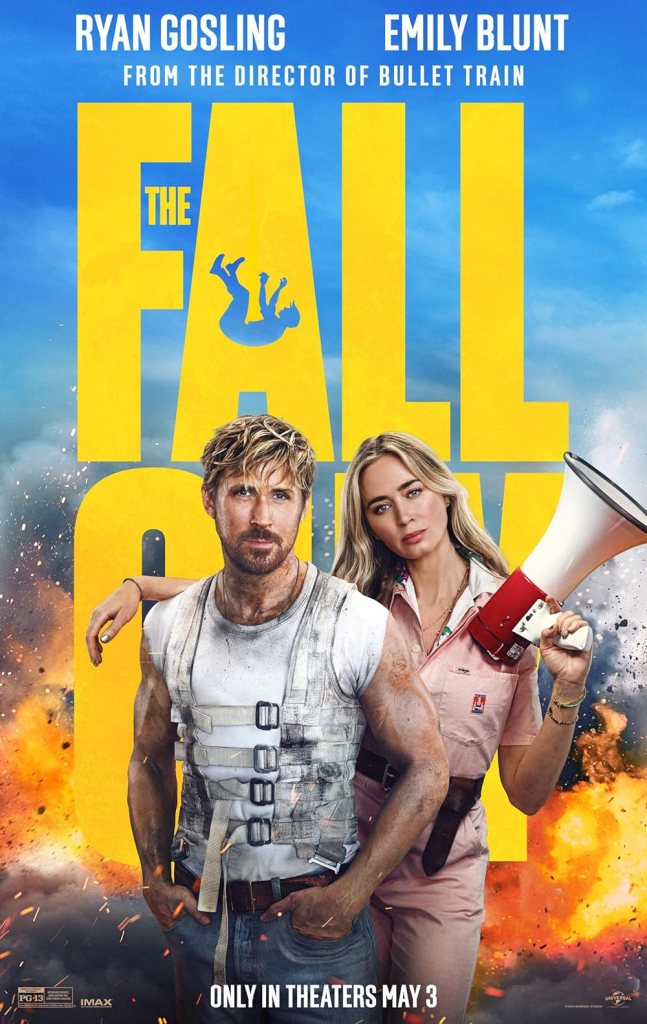
The Fall Guy (2024)

The Fall Guy (2024)

Very enjoyable action caper and also a rather sweet tribute to the unsung heroes of filmmaking

Director: David Leitch

Cast: Ryan Gosling (Colt Seavers), Emily Blunt (Judy Moreno), Aaron Taylor-Johnson (Tom Ryder), Hannah Waddingham (Gail Meyer), Teresa Palmer (Iggy Starr), Stephanie Hsu (Alma Milan), Winston Duke (Dan Tucker), Ben Knight (Dressler)

I’ve seen every single Hollywood Superstar I’ve ever heard of perform miraculous acts of derring-do in front of my very eyes. That all happened right? The camera doesn’t lie! Alas what we saw wasn’t the Legendary Star but instead a well-trained guy, dressed in the same costume, putting life and limb on the line for the big shot. And they don’t even get Oscars for it! The Fall Guy is a witty, exciting and rather sweet tribute to the unsung hero of the movies, the stunt guy, all wrapped up in a pulsating, tongue-in-cheek action-adventure that showcases two likeable stars and, of course, their similarly costumed fall guys.

Our hero is Colt Seavers (Ryan Gosling), stuntman of choice for superstar Tom Ryder (Aaron Taylor-Johnson), a spoilt man-child who brags he does his own stunts but can’t cross a road without a double. Colt is riding high, in a promising relationship with cinematographer Jody Moreno (Emily Blunt), until a stunt goes wrong leaving him badly injured. Colt disappears, breaking-up with Jody and wallowing in depression for eighteen months. However, he comes storming back when summoned to Australia by producer Gail Meyer (Hannah Waddingham) who claims Jody personally asked him to double for Tom on her directorial debut, Mad-Max-meets-Independence-Day sci-fi epic Metalstorm. Only turns out she didn’t ask: Colt is in fact tasked by Gail to find the missing Ryder or she’ll be forced to cancel the film and end Judy’s career. Colt soon gets bogged down in drug lords, dead bodies, hitmen who don’t quit and imaginary unicorns. Can he find Ryder and make amends with Judy?

The Fall Guy is fast-paced, loose and funny with a script of punchy Drew Pearce jokes, focused overwhelmingly on giving the viewer a cracking night out at the movies. It leaves very little in the locker room which is fitting for a film is all about celebrating the joy of doing things for real. The Fall Guy pushes the envelope for stunts, be it stupendously high falls, multiple barrel roll cars, furious fisticuffs that use everything going and car chases that leave burnt rubber skid marks on every surface. Basically, it’s a celebration of the art of stunt work, no more than you would expect from Leitch, a former stunt co-ordinator and champion of doing it for real.

It very successfully mixes giddy action thrills with a engaging romantic comedy that uses its two stars to great success. Gosling is relaxed, witty and above all extremely cool, his obvious enjoyment of the material very infectious. Blunt’s comic timing is immaculate. Together their chemistry not only creates plenty of laughs, but makes us invest in wanting them to be together. But The Fall Guy doesn’t just settle for rom-com conventions. A focus of the film is watching Colt get in touch with his feelings (how many other action films feature their stars quietly crying in a car, listening to Taylor Swift?) and accepting his stuntman bravado (it’s the profession where you stick your thumb up at the end of the stunt, regardless what happens) led him to drive Judy away out of twisted shame.

Of course, on the way to getting in touch with his findings, Colt doesn’t half stumble through more than his fair share of brawls. You couldn’t make a film about a stuntman without packing in more death-defying thrills than you can shake a stick at. The Fall Guy delivers two types of stunt thrills. One is the behind-the-scenes on-set stunts Colt executes – death-defying falls, flipping and rolling cars, people being thrown across a field into a rock – where we get to see a few tricks of the trade behind the magic. And then we also get genuine ‘real world’ stunts of epic, popcorn-munching excitement as Colt goes about his search. This is some of the most impressive stuff you’ll see (and its expertly deconstructed in the behind-the-scenes clips that festoon the end-credits), from Colt being hurled and smashed through every inch of Ryder’s apartment to a stunning car-chase that turns into a bare-knuckle dumper-truck fight that’s the film’s mid-act calling card.

The action is somehow even more enjoyable because of the world-weary comedy Ryan Gosling plays it with. After all, being thrown into situations like this is bread-and-butter for Colt, so whether its spending a fight protecting an elusive jet-lag-defeating espresso or working out exactly when he to jump into the road to collide with a car, everything is met with a semi-resigned shrug. He also gets some excellent partners-in-crime, trading stunt-movie facts with colleague Dan (a very funny Winston Duke, shouting the name of the Hollywood stars whose signature moves he’s replicating during fights) and, perhaps best-of-all, a French speaking stunt dog called Jean-Claude who Colt treats like a friend (a dog that bites people in the groin shouldn’t be as funny as this, but I must have been in the right mood). The final battle also sees Colt call on an army of fellow stunt-people.

It makes sense in a film that celebrates this brotherhood. When Colt and the team are working on set, The Fall Guy centralises their creativity and commitment. The shooting of a Metalstorm battle scene is hugely improved by Colt and the team pushing the envelope with suggestions and improvements to the rudimentary script and the whole crew is scrupulously dedicated, professional and committed.

The real threats in The Fall Guy are the things that work against this. Special effects and deep fakes (whch plays into the film’s neat double-meaning title) are the tools of the villains and, in a wider sense, kill the flesh-and-blood of film-making. Hollywood stars and bottom-line Hollywood suits with no respect for the craft are the baddies. Aaron Taylor-Johnson has a lot of fun in a role that parodies almost every star you can think of (Tom Cruise is twice specifically named in the film, as if to stress for the laywers Tom Ryder is not him) while Hannah Waddingham is a smilingly heartless producer, never seen without clutching an oversized diet coke.

The Fall Guy is, above all, a film designed to cheer you up no-end. Crammed with sharp one-liners, expert sight gags and thrilling stunts with a cast having an absolute ball in their roles, it’s the sort of treat that will be remembered long after its slightly disappointing box-office haul has been forgotten.

The Insider (1999)

The Insider (1999)

Mann’s finest film is a chilling breakdown of the insidious strength of corporations

Director: Michael Mann

Cast: Al Pacino (Lowell Bergman), Russell Crowe (Dr Jeffrey Wigand), Christopher Plummer (Mike Wallace), Diane Venora (Liane Wigand), Philip Baker Hall (Don Hewitt), Lindsay Crouse (Sharon Tiller), Debi Mazar (Debbie De Luca), Stephen Tobolowsky (Eric Kluster), Colm Feore (Richard Scruggs), Bruce McGill (Ron Motley), Gina Gershon (Helen Caperelli), Michael Gambon (Thomas Sandefur), Rip Torn (John Scanlon), Cliff Curtis (Sheikh Fadlallah)

For decades we persuaded ourselves smoking was problem-free. Then, when we finally decided sucking tar into your lungs several times a day probably didn’t go hand-in-hand with good health, Big Tobacco bent over backwards to argue they didn’t believe for one minute nicotine was actually addictive. This lie – they were improving the hit to increase the customer base – was blown upon by corporate whistle blower, and former B&W employee, Dr Jeffrey Wigand (Russell Crowe).

But the battle over the reporting of the story also exposed the fault-lines in corporate-owned media companies, as Wigand’s 60 Minutes interview was canned by a CBS network terrified of legal action imperilling a corporate sale, much to the fury of crusading producer Lowell Bergman (Al Pacino) who spent months bringing Wigand in only to see him brushed aside. The Insider charts these two stories merging into each other: the deadly campaign of intimidation and smears against Wigand, segueing into the caving of CBS in the face of legal threats with Bergman left furious, betrayed and turning his campaigning fire against his own employers.

This all comes grippingly to life in Michael Mann’s superb slice of All the President’s Men inspired-reportage, turning this 1996 TV-and-business scandal into a sleek, intelligent thriller that takes a chilling look at how corporate America rigs the game in its own favour with impunity. The Insider is as rightfully furious at the dirty-tricks and menace of the tobacco companies, as it is at the subtly insidious way corporate interests pollutes news reporting. It does this while also presenting its two heroes as flawed men with more in common than they might think: competitive alpha males, both prone to taking rash, destructive actions in fits of head-strong self-righteousness, caring about their own moral code over the needs of others.

The Insider splits into two clear acts: the agonising decision of Wigand to blow the whistle on corporate malfeasance, in the face of immense personal and professional pressure and Bergman’s subsequent struggle to deliver on his word and get Wigand’s confession on air. The first half offers the more traditional heroics – and the more overt hero-and-villain structure, but increasingly I find the second half, of news shows being dictated to by their paymasters more-and-more unsettlingly prescient, becoming increasingly relevant the older the film gets.

But that first half makes for a compellingly tense pressure-cooker view. It’s powered by an excellent performance by Russell Crowe (effortlessly convincing as someone twenty years older, and collecting his first Oscar nomination). Crowe makes Wigand principled but prickly, brave but confrontational and at times frustratingly self-righteous. His moral qualms are finally sharpened into action his fury at the blunt-intimidation from B&W’s sinisterly avuncular CEO (a masterful cameo from Michael Gambon – one of the great single-scene performances in movies) and its implication that he cannot trusted to stick to his NDA. Wigand barely involves his wife (a tightly-wound Diane Venora) in his decisions, only mentioning his dismissal in passing and deciding to appear on 60 minutes (a decision that will shatter their lives) unilaterally.

But Wigand also has higher motives. He wants to be able to look his daughters in the eye, having sold-out to burnish the dirty-deeds of B&W with his scientific skills. He’s rightly affronted by the lies Big Tobacco has sold the public and undergoes enormous sacrifices (financial, marital, professional, legal, death threats and a public smear campaign) to see things through. Mann’s cool mix of starkness and shadows, full of drained out colours and greys, is perfect for a world where Wigand is shadowed by strangers at a driving range, receives bullets in his mailbox and searches late at night for who has left footprints in his garden. Crowe superbly conveys a man acting out of an increasing sense of moral imperative, struggling desperately to hold himself together under immense pressure.

This section of the film – especially with its clear antagonist – plays as a superb personal and political thriller, Mann expertly conveying lurking menace. In 1999 the second half of the film, the struggle to actually broadcast Wigand’s interview, was often seen as slightly underwhelming. But actually it shows a different type of danger: less overt and heavy-handed corporate power with its legal injunctions and bullying FBI guys hoping for a cushy retirement job with the corporation, more how these corporate masters assert control in quiet, less direct ways to decide what we hear or see.

Our journalists have no fear when confronting criminals or terrorists – The Insider’s prologue establishes this with Bergman and host Mike Wallace not flinching in the face of gun-toting Hezbollah fighters guarding the Sheikh they have arranged to interview. But they face far greater threats to their integrity when confronted with lawyers and corporate directors (effectively embodied by Gina Gershon and Stephen Tobolowsky as uncaring suits) whose threats are indirect and insidious. Wigand’s interview could imperil the sale of CBS and the bonus of the corporate suits, and in that scenario journalist principles can go hang. Christopher Plummer is, by the way, superb as the charismatic Wallace, who caves to pressure then convinces himself he hasn’t, a super-star of the airwaves who loses part of his wider integrity trying to protect his position.

And doesn’t the idea that corporations can squeeze the life out of journalistic stories feel even more chilling today? After all, virtually every single news outlet out there is owned by a major business, all with their own agendas. Can we really believe they’ve not all made calls on gets reported, based on what their shareholders might think? Mann’s film skilfully – and rather chillingly – shows how quickly they can re-work the agenda. It leaves Lowell Bergman raging (as only Al Pacino can) against the betrayal of trust he’s being forced to make towards Wigand.

Crowe’s pressure-cooker performance stole many of the headlines on release but The Insider also benefits from an excellent Pacino performance. Utterly committed to his principles and – just like Wigand – utterly unwilling to compromise them even an inch, no matter the cost, Bergman will pick up the windmill-tilting banner, and charge with it at his own paymasters. No one can rip through speeches quite like Pacino, but he gives Bergman a real genuineness, grounded in a fundamental decency, whose righteous anger is underpinned with world-weary disbelief that it’s come to this.

It grounds an excellently studied breakdown of a journalistic turf war. The Insider plays like All the President’s Men, if Woodward and Bernstein had been spiked after they nailed the story. Mann demonstrates the influence in The Insider’s crisply immersive photography that employs depth of frame and gyroscopic deep-focus, as well as in the crisp editing and the film’s mesmerising emersion in the complex details of building a story. Combine that with a gripping conspiracy thriller on the machinations of ruthless corporations and The Insider makes for a compelling film.

The Godfather Part III (1990)

The Godfather Part III (1990)

The third film in the series is a decent effort – but pales in comparison to the others

Director: Francis Ford Coppola

Cast: Al Pacino (Michael Corleone), Diane Keaton (Kay Adams-Corleone), Talia Shire (Connie Corleone), Andy Garcia (Vincent Corleone), Eli Wallach (Don Altobello), Joe Mantegna (Joey Zasa), George Hamilton (BJ Harrison), Bridget Fonda (Grace Hamilton), Sofia Coppola (Mary Corleone), Raf Vallone (Cardinal Lamberto), Franc D’Ambrosio (Anthony Corleone), Donal Donnelly (Archbishop Gilday), Richard Bright (Al Neri), Al Martino (Johnny Fontane), John Savage (Father Andrew Hagen), Helmut Berger (Frederick Keinszig), Don Novello (Dominic Abbandando), Franco Citti (Calo)

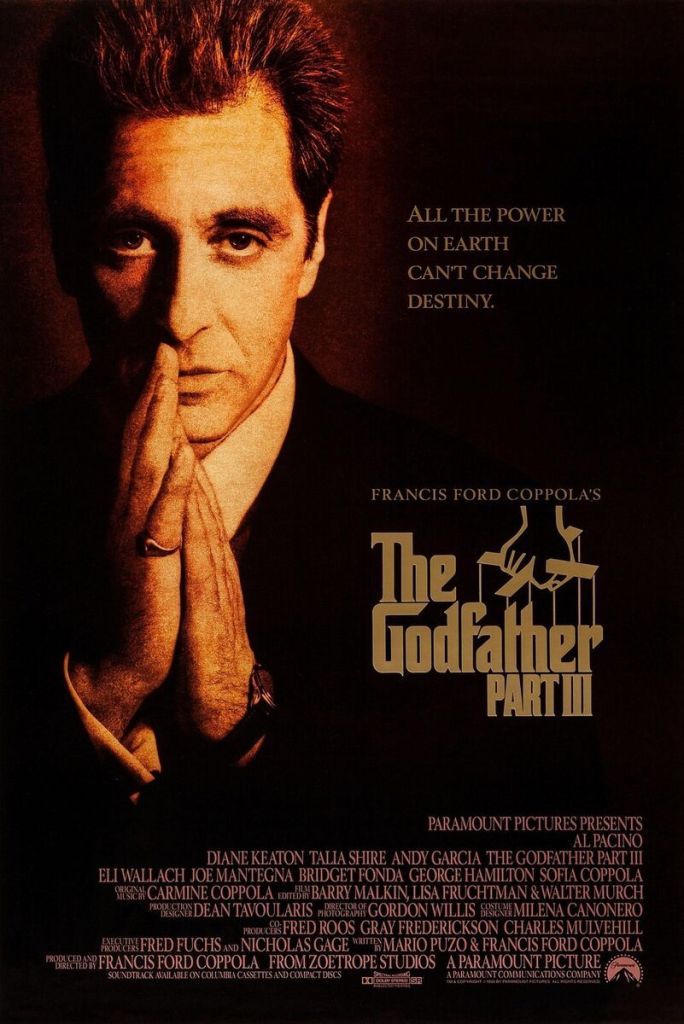
Coppola wanted to call it The Godfather Coda: The Death of Michael Corleone. He got his wish decades later with a belated re-edit release. But at the time, the studio wasn’t having it: this would be a full-blown Third Part to The Godfather. Problem is, those are some very big shoes to step into and The Godfather Part III wasn’t the genre-defining masterpiece its predecessors was. Instead, it’s a decent, melancholic gangster film with touches of King Lear. However, when you are following the sublime being “pretty good” winds up looking like “pretty awful”. The Godfather Part III became the infamous “fuhgeddaboutit” chapter in the saga, the one for completists and those who watch out of duty. On its own merits its fine, but perhaps it was a doomed venture from the start.

It’s 1979 and Michael Corleone (Al Pacino) has aged and mellowed. All his life he’s talked about getting out, and now it seems he finally has. He’s set up a charitable foundation, he’s been honoured by the Vatican and is rebuilding relationships with his children: daughter Mary (Sofia Coppola), now head of his foundation and son Anthony (Franc D’Ambrosio), an opera singer. Even Kay (Diane Keaton) is speaking to him again. Michael is grooming Vincent (Andy Garcia), illegitimate son of his brother Sonny, to take over the reins of the crime family. But then, they drag him back in. Bailing out the Vatican Bank, Michael finds is double-crossed by a collection of Euro-banking crooks, corrupt Church leaders and rival Mafiosi. Will he survive the dangers a return to Sicily will bring?

The unspoken secret of The Godfather is that everyone was always there for the money: they just also had something to prove the first two times and the fire in their bellies to turn gangster grist into cinematic beauty. Fast forward 15 years later, and there hangs an air of “give the studio what it wants” about Part III, coupled with a willingness to rest on laurels. Coppola agreed to do it because his last few films were bombs and he needed the money. Pacino demanded – and got – a massive sum. Keaton coined it. Robert Duvall asked for $1.5 million, didn’t get it and walked. Coppola agreed to turn the script around in lightening time to rush the film to the screen for the inevitable box-office and awards bonanza. No one involved really did the film for either love or passion.

Coppola’s script, written to a deadline, is torn awkwardly between two plots, neither completely satisfactory. His interest lies with the question of whether absolution (of any sort) for Michael is possible. This is the film Coppola wanted to make, but it keeps losing ground though to the other, a complex conspiracy thriller, riffing on real-life events in the Vatican. This conspiracy is frequently dense, difficult to follow and (frankly) not particularly interesting as it trudges through Papal politics and investment banking, seeming existing to provide faces for the inevitable violent montage of inventive hits.

A Part III that zeroed in on Michael himself, his guilts and shame, would have been both distinctive and unique. But The Godfather Part III fudges this. Crucially, the Michael we see here – for all he would have mellowed with age – feels very different from the cold, buttoned-down, calculating figure from the first two. Pacino – perhaps remembering the pressure of Part II that left him exhausted – invests it with more “hoo-hah”. This twinkly Michael, smiles to hide his regrets – when you feel, in reality, years of pressure would have turned him into even more of a murderous Scrooge. I also can’t believe he would be this close to his now adult children. Pacino embraces the moments of raw pain when they come, but this character just doesn’t quite mesh with his previous performances (and his hair looks just plain wrong).

The rushed production further fatally holed this personal plot below the water-line. Duvall was originally intended to serve as the film’s ‘antagonist’, the film planned as a very personal battle between the last two ‘brothers’. Duvall’s departure ripped the heart out of this script, his role redistributed between George Hamilton’s anonymous lawyer, Talia Shire’s Connie (now turned inexplicable consigliere) and Eli Wallach’s treacherous Don Altobello. None of these make any real impact. Rushed production also meant Winona Ryder dropped out of the crucial role of Michael’s daughter, Coppola taking the (disastrous) last-minute decision to cast his daughter Sofia instead.

Sofia Coppola has suffered more than enough from lacerating reviews of her performance (the level of vitriol poured on her is shocking to read today). Let’s just say, while a great director, she is no actor. But then, neither really is Franc D’Ambrosio playing her brother. Both children never become either interesting or dynamic presences. Since their relationship – and the flowering of it – with Michael is crucial to the film’s emotional impact, it’s a fatal flaw. No matter how hard Pacino works, these scenes just don’t ring true. There is no sense of decades of anger and resentment. The drama seeps out of the family scenes and Mary becomes such a flat and two-dimensional character that her impact on the other principle characters never engages.

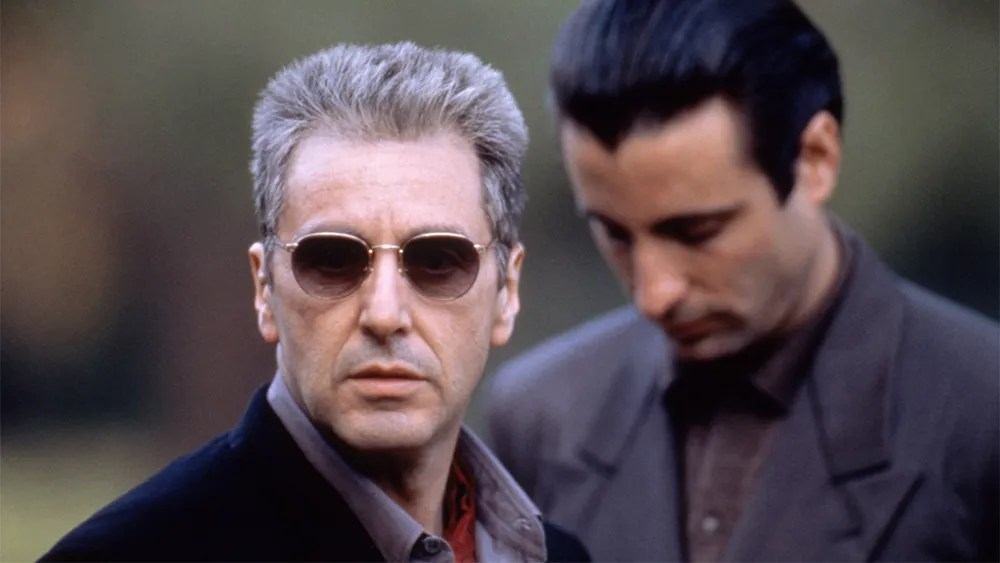
Sofia Coppola similarly struggles in her romantic scenes with Andy Garcia, again despite his best efforts. Garcia is the best thing in the film, full of cocksure confidence and instinctive cunning, channelling the best elements of Sonny and Michael into a character we’d dearly like to see more of. His facing down of two murderous home-invading hoods is the film’s most memorable moment while Garcia also does excellent work charting Vincent’s slow acceptance of the tragic sacrifices – the killing of parts of your nature – that being ‘the Godfather’ demands. Diane Keaton is also excellent as a far more seasoned and stronger Kay than we’ve seen before.

The Godfather Part III has several fine moments, even if it never coalesces into anything more than a decent film. Coppola restages with assurance and poise versions of previous scenes from the saga – a Little Italy festival assassination, Sicilian countryside violence, an assassin surreptitiously moving through a quiet building, Kay closing a door by choice, the montage of killings – mixed with large scale moments (a helicopter attack on a crime boss meeting is the film’s most ‘action moment’). He works really hard to channel a sense of melancholy: Michael is crippled with diabetes, plagued with guilt for his brother’s death, running to stand still and do the right thing. Pacino’s strongest moments are these moments of rawer emotion: his cloister confession to the future Pope is a masterclass in letting simmering pain suddenly rush to the surface.

But The Godfather Part III always feels like a perfunctory re-heat of key moments, not quite mixed successfully with a redemption (or lack of) tale. This film needed to be a more sombre, focused story about an army of chickens coming home to roost. It needed a stronger sense of Michael desperately scrambling to bring back together the family he was so desperate to protect that he destroyed it. Instead, it’s torn between recapturing old glories and being hampered by fudged attempts to provide emotional depth, linked to a poor structure, unfortunate casting choices and lack of focus. It’s not a bad film – but it is not a great one. And for the third in the greatest series of all time, that wasn’t good enough.

Serpico (1973)

Serpico (1973)

Pacino is sensational in this sensational and gripping anti corruption thriller

Director: Sidney Lumet

Cast: Al Pacino (Frank Serpico), John Randolph (Captain Sidney Green), Jack Kehoe (Tom Keough), Biff McGuire (Captain McClain), Barbara Ede-Young (Laurie), Cornelia Sharpe (Leslie), Tony Roberts (Detective Bob Blair), John Medici (Pasquale), Allan Rich (DA Tauber)

Frank Serpico (Al Pacino) is a newly graduated cop in the NYPD. Passionate about changing the world, Serpico wants to clean up the streets – but not at any cost. The aggressive tactics and jobsworth disinterest of many of his colleagues infuriate him while his bohemian style and view that the way to be really effective as an undercover cop is to look like the people he investigates alienates other cops. As Serpico’s experience grows, he discovers the NYPD is overflowing with corruption and on-the-take cops, hoovering up cash and protection money and turning blind eyes. But when Serpico decides to do something about it, he puts himself in the firing line. Literally.

Serpico captures the anti-authoritarian fury of 70s cinema. Who can you trust when your suspicions of those who are supposed to enforce the law are right – they are as dirty, if not more so, than the criminals? Serpico mixes police thriller with paranoid conspiracy thriller, rotoscope filming placing everything in chilling focus, the grimy streets of New York a world where injustice is rampant and the powers-that-be will do anything to maintain the corrupt status quo.

Pacino grips the role of Serpico with the sort of fire-breathing force that made him a phenomenon in the 70s. Pacino transformed himself for the part, prowling the roughest neighbourhoods of New York for research and burying himself under a mountain of shaggy hair. Serpico was shot in reverse, so Pacino could progressively shave off parts of his mountain of hair, starting his work with the jaded, disillusioned Serpico and stripping back into the fresh-faced rookie (there is a neat joke in the fact that the naïve young Serpico looks the spitting image of Michael Corleone).

It’s a performance of bubbling, dizzying intensity, that dominates the film (Pacino is in nearly every scene), with Pacino slowly more and more coiling up with wild, frustrated tension. Edgy, fidgety but searingly naturalistic, Pacino gives this larger-than-life figure a searing sense of moral certainty and rigid principles, a man who slowly realises the world is not what he thought and increasingly furious at its essential shittiness. What Pacino understands is that Serpico doesn’t want to be a crusading whistle blower – he just wants to be a cop, but won’t sit back and watch his colleagues laughing with crooks. It’s a stunning, passionate, technically and emotional superb performance, from an actor at the pinnacle of his powers.

Serpico is a chilling exploration of police corruption. It’s casual, everyday and all evasive. From the free sandwiches handed out by café owners (“If I pay can I get what I want?” Serpico asks and is promptly told to shut up) to the casual brutality handed out to suspects. For a man like Serpico who wants to change the world, it’s a nightmare, even before a stuffed brown envelope is dropped into his hand and he’s urged to take it and shut up. It sits alongside crippling indifference: he can’t even arrest two rapists he spots on the street because the detective running the case is on leave (“They’re here now!” he screams down the phone before taking matters into his own hands.)

All this and more makes Serpico stick out to other cops. In an NYPD still overwhelmingly made-up of white, middle-class besuited guys (the collection of potential undercover cops in a training lecture are hilariously uniform in more ways than one) he’s a bohemian. Interested in the arts, reading books, listening to classical music and watching ballet. In his spare time he dates actresses and hangs out with arty types. He’s a world away from the cops, who view him with mistrust and a potential threat in more ways than one (a fellow cop, disgusted at overhearing Serpico talk ballet, accuses him of soliciting in the department bathroom and won’t be shaken in his belief).

So, he’s in huge danger when he eventually decides he can’t close his eyes to his army of colleagues on the take, but must do something about it. He’s already been warned that the answer “I don’t know” to the question if he would always vouch for any cop is the wrong answer. In a world where Lumet makes clear cops see as sharply divided between themselves and everyone else, where taking some extra payments is a perk of the job, someone like Serpico won’t be tolerated.

Inevitably the system turns on the whistle-blower. Serpico’s fellow cops close ranks, his superiors fob him off or treat him with suspicion. His colleagues move swiftly from offering to hold his cut in trust, to asking why he just doesn’t donate it to charity to finally loathing him. Eventually he’s an isolated, despised figure, padded down for wires, routinely ignored in the precinct and unable to trust anyone (rightly so, since the film opens at the end with Serpico shot after a raid, possibly by a cop, before flashing back to his graduation). And the ‘outside bodies’ he brings in? They move like slugs and Serpico’s disgust at their focus on scalps and not systemic change just re-enforces his isolation.

Serpico was shot quick and dirty on the streets of New York (Lumet shot in 51 days with editor Dede Allen editing each scene as it was finished). Lumet’s immersive camera throws the viewer straight into the gritty world of New York in the 70s, and the city has rarely ever felt more like a wretched hive of scum and villainy. It’s dirty and filthy with danger on every corner. There is virtually no sense of community or public duty and everyone, cops and robbers, are solely out for what they can get. It’s a brutal, terrifying world where injustice and violence are just part of the rations.

Wonderfully directed by Lumet, it’s powered by a tour-de-force performance of sheer, dynamite genius from Pacino in one of his greatest (and most overlooked) roles. Serpico is a searing indictment of a world that creates a friendly atmosphere for corruption and wickedness and where doing the right thing leaves you victimised, isolated and in a hospital bed with a bullet in your cheek.

The Trial (1962)

The Trial (1962)

Welles exploration of paranoia and guilt is an easier film to admire than like (or enjoy)

Director: Orson Welles

Cast: Anthony Perkins (Josef K), Jeanne Moreau (Marika Burstner), Romy Schneider (Leni), Elsa Martinelli (Hilda), Suzanne Flon (Miss Pittl), Orson Welles (The Advocate), Akim Tamiroff (Bloch), Madeline Robinson (Mrs Grubach), Paolo Mori (Court archivist), Michael Lonsdale (Priest), Arnoldo Foa (Inspector A), Fernard Ledoux (Chief Clerk of the Court)

It had never happened to Welles before: in 1960 producer Alexander Salkind shoved a series of literary works at him and said “make one of these into a film! Money no object and complete creative control!”. Welles wasn’t going to say no. It hardly mattered that he’d barely even let Kafka cross his mind before: he could see a way to do The Trial and, by God, he wasn’t going to pass up this chance. To purists, The Trial is one of the few “pure Welles” flicks – the one Welles shepherded from start to finish and more-or-less ended up with what he wanted at the end of it (no wonder he called it “his best picture” – although he said that about all his pictures at one time or another).

The Trial adapts, fairly faithfully, Kafka’s surrealist novel. Josef K (Anthony Perkins), a middle-management pen-pusher, is accused of a terrible crime without being told what it is. He stumbles from encounter to encounter, law court to law court, never given the ability to defend himself, spiralling down the rabbit hole with no sunlight. Welles’ The Trial captures this by turning Kafka’s work into a fever dream. Scenes link together with all the structural logic of a dream – locations seem randomly connected, with Josef turning corners and finding himself in courtrooms or opening cupboards to find surrealist sequences like his prosecutors being whipped by an angry functionary.

Welles shot much of the film on location in a single abandoned Parisian railway station, with the abandoned, decaying rooms redressed into a series of locations from the Advocate’s rooms, to a church to a law court. This was mixed with sequences shot in Zagreb industrial estates and a factory set made up of 850 extras banging typewriters in unison and all rising to end their working day at the same time. There is a horrible un-reality reality to The Trial, a deeply unsettling realisation you are watching something both set in a world real and impossible.

In fact, The Trial may be one of the most uncomfortable films to watch ever made in its innate understanding of the domineering terror of paranoia. Welles used a series of low angles and wide lenses to stress the oppressiveness nearness of walls and ceilings. Rooms always seem to loom in and crush the characters, with K himself frequently framed hemmed in by objects, walls and people. There is a sense of being “watched” in every scene – either from the oppressive bodies that surround K, or the prowling tracking cameras that follow him from location to location.

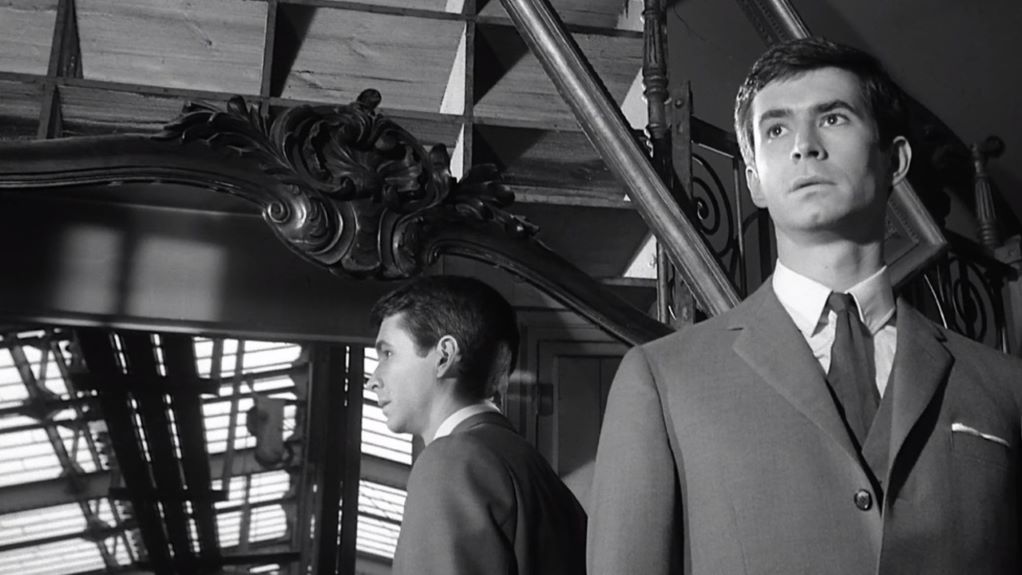
The Trial is a sort of paranoid’s wet-dream, a nightmare world where logic is gone, our lead character has no control over his movements or destiny and the entire world seems to be constantly bearing down on him and us. Who better to play the twitch-laden centre of this than Anthony Perkins. Awkward, uncomfortable and never anything-less than tense, Perkins features in almost every scene but always feels buffeted by events rather than controlling them. He makes K hugely uncomfortable with others – the many women who throw themselves at K he treats with suspicion mixed with terror. His self-loathing bubbles up whenever confronted with mirror images (such as Akim Tamiroff’s timorous Bloch), invariably reacting with barely disguised contempt.

What’s also interesting in The Trial is the possible insight into Welles’ character. The easy interpretation is to see K as Welles, the court standing in for the Hollywood machine that had shoved Welles from pillar to post and never given him a chance. But, if so, why did Welles urge Perkins to play the role as shiftily and uncomfortably as he does? There is an air of guilt around K throughout – as if The Trial was his nightmare about getting caught for whatever he did. Is this how Welles saw himself? How fascinating that this artistic behemoth read The Trial and seemed to see it as the paranoia of a guilty man. Did the film speak to a deep self-loathing in Welles himself? Did he, in the dark when the demons come, think he’d inflicted his destruction on himself?

It’s a fascinating idea and makes it even more interesting that Welles is all over the film. He plays the corpulent, arrogant advocate, meeting supplicants whole luxuriating in bed with his accustomed bombast. But he also speaks the film’s woodcut-illustrated opening parable (a story of a man waiting at a gate, that he moved from the books Priest to his faceless narrator). Welles’ tones are heard coming from a range of mouths as he overdubbed many of his Euro actors. He even speaks the credits. Everywhere you turn you see and hear Welles and it’s hard not to start to feel perhaps we are stumbling inside his own terrible fantasies. Perhaps The Trial is what Welles’ dreams (or nightmares) were like?

The feel of a nightmare often makes The Trial an uncomfortable and, if I’m honest, less than enjoyable watch for all the undoubted panache it’s made with. In fact, since the panache is partly designed to illicit that response, it’s almost a tribute to the film’s success. The Trial is masterful, but in its unsettling sense of paranoia also uncomfortable, although it’s fascinating to see Welles layering some (perhaps inner) guilt on top of Kafka’s tale of an innocent crushed in the system. Either way, there is plenty to admire if not love about The Trial.

Caché (2005)

Caché (2005)

Haneke’s fascinating puzzle is a profound and challenging modern masterpiece

Director: Michael Haneke

Cast: Daniel Auteuil (Georges Laurent), Juliette Binoche (Anne Laurent), Maurice Bénichou (Majid), Lester Makedonsky (Pierrot Laurent), Walid Afkir (Majid’s son), Annie Girardot (Georges’s mother), Daniel Duval (Pierre), Bernard Le Coq (Georges’s boss), Nathalie Richard (Mathilde)

Is any film more aptly named than Caché? Haneke’s film keeps its cards so close to its chest, it’s entirely possible revelations remain hidden within it in plain sight. Caché famously ends with a final shot where a possibly crucial meeting between two people we’ve no reason to suspect know each other plays out in the frame so subtly many viewers miss it. It shows how Haneke’s work rewards careful, patient viewing (and Caché is partially about the power of watching and being watched), but also how unknowable the past can be. It’s a chilling and engrossing film that fascinates but never fully reveals itself.

Georges Laurent (Daniel Auteuil) lives a life of success. A wealthy background, host of a successful TV literary debate show and living in an affluent suburb of Paris, he’s married to publisher Anne (Juliette Binoche) and father to young champion swimmer Pierrot (Lester Makedonsky). But there’s a serpent in his Garden of Eden. Georges and Anne are plagued by a stream of videos arriving at their house. These show long, static shots of their home and are accompanied by crude, graphic drawings. Someone is watching their house and the dread that this could escalate at any time is consuming them. But does Georges know more – do the messages chime with guilty memories in his past?

Haneke’s film is a multi-layered masterpiece, a haunting exploration (free of clear answers) into the things we prefer to forget, the hidden horrors we supress. It’s a film all about the shame and guilt buried amongst the everyday. Haneke even shoots the film on hi-definition video so that the surveillance footage of Georges and his home visually merges with the ‘real’ images of the couple. Within that, Caché starts to unpack the hinterland we hold as individuals (and, quite possibly as entire nations) of the guilts of our past that keep bubbling to the surface to bite us.

Caché is shot through with Haneke’s genius for menace and veiled threat. Can you imagine anything creepier than a camera set up outside your home, filming everything you do – but never knowing where it is? It’s an invasion of privacy that is insidious and covered in the additional menace that, at any time, it could escalate to something worse. The creeping, invasive tyranny of surveillance is in every inch of Caché, its omnipresence giving every interaction the feeling of being watched (something Haneke plays up – watch a man watching Anne when she sits in a café with a friend).

So gradually the book-lined world of the Laurents becomes a base under siege, a feeling amplified by Haneke’s mix of smooth camera movements adrift from establishing shots: constantly the camera glides through a space where we feel we neither truly understand the geography or are confident about the time. It’s accentuated by the window-free room the Laurents largely inhabit. In fact, their whole home feels window free, with curtains frequently drawn and rooms plunged into darkness, the family throwing up a shield to protect them from the outside world.

Or is it to cut them off from the unpleasant facts of life? It becomes clear Georges has built a world around himself, where he is the hero and all traces of the unpleasant or disreputable in his past have been dismissed to the dark recesses of memory, never to be accessed. Played with a bull-headed arrogance by Daniel Auteuil, under his assurance Georges is prickly and accusatory, liable to lash out verbally (and perhaps physically, considering the threat he carries in two key scenes). Auteuil masters in the little moments of startled panic and stress that cross Georges’ face, a man so used to a world that matches his needs, that anything questioning that is met with rejection.

It’s why he lies to Anne about his growing suspicions about the source of the tapes. The cartoons hint at a series of (deeply shameful) interactions, when he was a child in the 60s, with a young Algerian boy, Majid, who his parents considered adopting after the death of Majid’s parents. It was Georges lies that forced this boy out of his perfect farm-house into the cold-arms of the unfeeling French orphanage system. This is the original sin of Georges’ life, arguably the foundation of his success – a guilty secret that so haunts and disgusts him, even the slightest mention of it brings out the muscular aggression he otherwise keeps below the surface.

Of course, it’s hard not to see an echo of France’s colonial past. One of the things that works so well with Caché, is that this subtext is there without Haneke ever stressing it. Just as Georges’ lies forced Majid into a life of depression and misery, so France’s treatment of Algeria is the terrible shame the nation would rather forget. Majid’s parents died in a famously brutal stamping out of an Algerian protest in Paris in October 1961 (the deaths of over 200 people at the hands of French government forces only came to light decades later). The anger many show when presented with inconvenient, horrible past deeds (both personal and national), only feels more relevant today with our culture battles over history.

Georges sees himself as a victim of a vicious campaign. But, when Georges meets Majid, played with startling vulnerability by Maurice Bénichou, he seems light years away from the sort of man who could possibly be capable of such a campaign. Indeed, when a video of Georges encounter with Majid is widely shared, it is Georges (as even he admits) who appears the bully and aggressor. Majid has been demonised in Georges’ memory – in his nightmare he becomes an axe-wielding monster-child – but he’s an innocent, who had everything taken from him in a micro-colonialist coup carried out by a 6-year-old Georges. A coup the adult Georges has let himself forget, making him little different from France itself. (We are reminded the cycle continues, with constant background news footage of Iraq, ignored by the Laurents.)

The mistakes repeat themselves, but they don’t trouble the complacent middle-classes who benefit from them. Georges will even use his influence to have Majid and his son bundled into a police van. Of course it leads to an outburst that will shake this world up. Haneke’s films have always been realistic when it comes to the visceral horror of violence, and Caché contains an act of such shocking violence that it will leave the viewer as speechless and distressed as the witnesses.

And still the question hangs: who? It could be anyone. At one-point Georges storms out of his front door to confront the mystery video-sender, only to return to find a video wedged in the door. It’s literally impossible for this video to be placed without him seeing it done. Haneke is so uninterested in the whodunnit part that, perhaps, he’s implying the perpetrator is the director himself, using the mechanics of film-making to entrap the guilty parties. It fits with the coldly intellectual steel-trap part of Haneke’s mind, the part that uses films (like Funny Games) to tell off and preach. What other director would be more likely to set himself up as unseen antagonist in the film?

And does Georges learn anything? He will continue to confront characters who challenge his world view and dispatch (like nations) his guilt to the recesses of memory. His begrudging peace with his wife – a superbly restrained Juliette Binoche, increasingly resentful at her husband’s secrets – seems built on the shaky ground of their continuing mutual comfort. And suspicions linger over his son, an increasingly hostile figure who (just perhaps) is learning more about the flaws of his parents than they would be comfortable with.

Of course, this might all be open to interpretation from multiple angles. After all the film is called Caché. Haneke has hidden enough subtle implications in it that it can reward analysis from multiple angles. Shot with his characteristic discipline that suggests a dark, creeping fear behind every corner, it’s a masterclass in suggestion and paranoia. Brilliantly unsettling and constantly reworking itself before your eyes, it’s a masterpiece.