Category: Costume drama

Victoria and Abdul (2017)

Victoria and Abdul
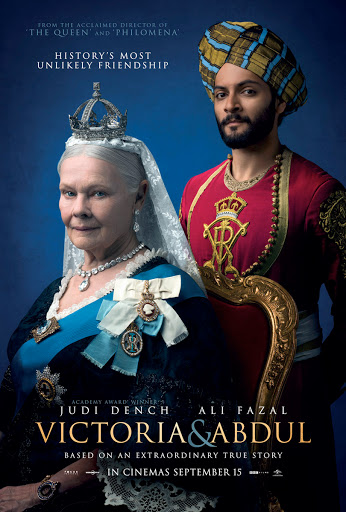
Judi Dench and Ali Fazal forge an unlikely friendship in the tame heritage flick Victoria and Abdul

Director: Stephen Frears

Cast: Judi Dench (Queen Victoria), Ali Fazal (Abdul Karim), Tim Pigott-Smith (Sir Henry Ponsonby), Eddie Izzard (Prince Albert), Adeel Akhtar (Mohammad Bakhsh), Michael Gambon (Lord Salisbury), Paul Higgins (Dr James Reid), Olivia Williams (Baroness Spencer), Fenella Woolgar (Harriet Phipps), Robin Soans (Lord Stamfordham), Simon Callow (Giacomo Puccini)

In the last decade of her life, Queen Victoria (Judi Dench – who else?) makes an Indian servant, Abdul Karim (Ali Fazal), one of her closest friends and advisors. As Victoria and Abdul become closer, the rest of the court are outraged – bad enough that the Queen is spending all this time with an over-promoted servant, but an Indian as well?!

The fundamental events of Victoria & Abdul are true. There was a man called Abdul Karim – and Victoria did raise him from servant to a confidant. He did cause conflict in the royal household and was finally sent back to India after her death, after surrendering most of his papers. But Victoria & Abdul repackages this friendship into a cosy, Sunday-afternoon entertainment, bereft of depth. And carefully works on the rough surfaces to make the story smooth and easy to digest.

The film is clearly trying to ape the success of Mrs Brown – a far more intelligent and emotionally complex (if similarly heritage) film that looked at Victoria’s previous all-consuming friendship with a male servant, John Brown. But that film didn’t close its eyes to the negatives of such relationships, as this one does. It made clear royal attention can be fickle – and being elevated above others can help make you your own worst enemy. In that film, after a honeymoon, the friendship declines into one of residual loyalty but reduced affection. It’s a realistic look at how we might lean on someone at times of grief, but separate ourselves from them later. Victoria & Abdul takes only one lesson from Mrs Brown: that a close bond between monarch and commoner is heart-warming.

The film in general is in love with the idea that if the Queen could only speak directly to her people, the world would be a better place. It presents a Victoria stifled by court procedure who knows very little about her empire and is constrained by the courtiers around her. It wants us to think that if the Queen took direct rule, she’d be kinder, wiser and more humane. That this figurehead symbol could craft a better British Empire if she was an absolute monarch.

Unfortunately, it doesn’t work. This romantic view of “Victoria the Good” is comforting stuff, but undermined even within the film by our introduction to the Queen at a royal dinner, where Victoria stuffs food down herself so quickly that mountains of untouched food goes uneaten on the plates of the other diners (as all plates are removed the moment she is finished). And despite being told that the Koh-i-noor diamond was stolen by the British (to her surprise), she still doesn’t think twice about wearing it later in the film while in the midst of her Indian passion. And while the real Victoria loathed the racist attitudes of some at her court, she still clearly sees herself as a paternalistic mother figure for India, which could of course never be able to make its own decisions about things.

Not that the film is interested in tackling more complex ideas of the position of India and its independence. It’s similarly confused by Abdul himself. In a more interesting film, Abdul would have been partly naïve servant and partly charming rogue. He very carefully spins an invented story of himself as a teacher and thinker (he’s actually a clerk from a fabric office) and it would have been interesting to see his building of a relationship with Victoria at least partly being based on self-gain. He certainly gains an awful lot from her – from his own carriage on her train to a home and his own servants. It would have been possible to have this side of him and still have his loyalty and friendship to the Queen being genuine. But it’s too much for the film to tackle.

An Abdul who was consciously playing a role of exotic thinker might have come across as a scam-artist – but would have given the film a lot more to play with, when the royal court is full of people positioning and presenting themselves for influence. Adeel Ahktar’s fellow-servant Mohammed even suggests in one scene that this is what Abdul is doing – and good luck to him. But the film is scared that this could be seen as endorsing the court’s fears about Abdul. So the character is neutered into nothing: he becomes exactly the sort of empty “exotic”, free of opinion and character, that filled out the extras list of a 1940s epic. He has no agency, never makes any decision or expresses any opinion. And his feelings for Victoria are presented as totally genuine which, combined with his foot kissing, turns him into someone who looks and feels really servile.

This is because the film wants to tell the story of a perfect friendship, with the British upper classes as the hissable baddies (never mind that no one is more upper class than Victoria). Never mind that Abdul’s action will indirectly condemn Mohammed to death in the British climate – or that while Abdul rises, Mohammed becomes his servant, still consigned to sleeping on the floor of his railway carriage. We learn nothing about Abdul. How did this clean-living saint become riddled with the clap? Why did he die so young? Did he really think nothing of the riches and honours Victoria showered him with? We don’t have a clue.

Instead the film keeps it simple with goodies (Victoria and Abdul) and baddies (almost everyone else). The most politically astute character, Mohammed, disappears and never allows things to get unpleasant. Jokes of the courtiers standing around aghast saying things like “Now he’s teaching her Urdu” are repeated multiple times. They’re fun, but it substitutes for dealing with the real issues.

It all has the air of ticking boxes. Frears’ direction is brisk, efficient and free of personality. Dench is great, but she could play this role standing on her head while asleep. Pigott-Smith (in his final role) is fine but Farzal has nothing to work with and Izzard provides a laughable pantomime role of lip-smacking villainy as the future Edward VII. The finest performance – handling the most interesting material – is from Ahktar. He’s the only character who seems to place what we see here in any form of context. Other than that, this film is just a string of very comforting heritage ideas, thrown together with professionalism but a total lack of inspiration.

Ma Rainey's Black Bottom (2020)

Chadwick Boseman excels in his final performance in the stagy Ma Rainey’s Black Bottom

Director: George C Wolfe

Cast: Viola Davis (Ma Rainey), Chadwick Boseman (Levee Green), Glynn Turman (Toledo), Colman Domingo (Cutler), Michael Potts (Slow Drag), Jonny Coyne (Mel Sturdyvant), Taylor Paige (Dussie Mae), Jeremy Shamod (Irvin), Dusan Brown (Sylvester)

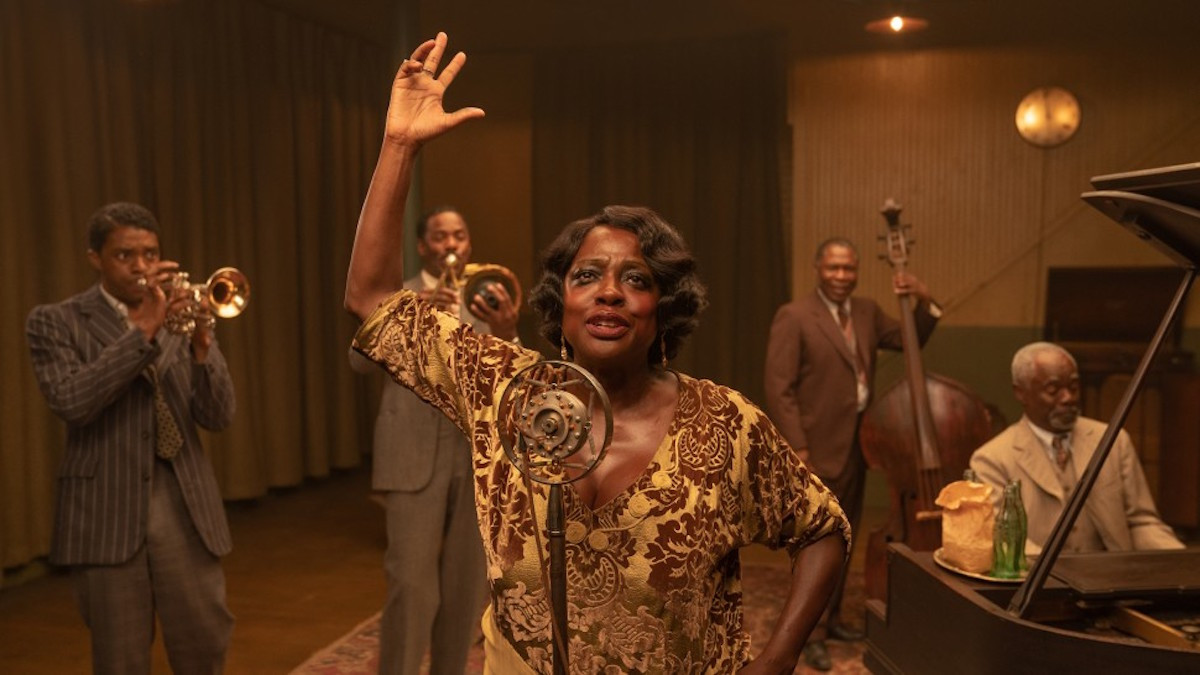
In a Chicago recording studio in July 1927, while the sun beats down outside, blues singer Ma Rainey (Viola Davis) is due to record some of her greatest hits. But she’s almost an hour late. The people who made it on time are her backing jazz band. Cutler (Colman Domingo), Toledo (Glynn Turman) and Slow Drag (Michael Potts) are seasoned pros. But trumpet player Levee Green (Chadwick Boseman) is something else, an ambitious and electric young man who feels he knows what the new sound is in a way that Ma doesn’t. Over an afternoon, as Ma flexes her power upstairs, the white agent and recording studio owner fret, and tensions between the band members slowly simmer towards and explosion.

It’s impossible to watch Ma Rainey’s Black Bottom right now without being very aware of the tragic early death of Chadwick Boseman. Boseman passed away while the film was in post-production, and it’s hard not to guiltily wonder if Boseman was aware this was to be his final performance. Either way, this was a stunning way for this electric, James Dean-like talent to sign off – a scintillating, passionate performance as a man carrying huge burdens and deeply repressed griefs and guilt. August Wilson’s play provides several key set-piece speeches for Levee – and Boseman burns through them with an intensity that will leave its mark on you.

Bright-eyed, with a wiry body of elastic tension that shifts from loose, jazzy movements to rigid bursts of fury, Boseman is extraordinary. Starting the film as seemingly an irresponsible, easy-going young man frustrated at the concessions of his elders, Boseman establishes a deep psychological pain at his core. He’s a young man who has seen his parents vilely mistreated by oppressive white men, who smiles to get what he wants but never forgets that the white bosses he works with see him as little better than a slave, ripe for exploiting. It’s a brilliant performance, one for the ages.

It dominates a film that is told with dynamism but never escapes its theatrical roots. Its set-piece speeches are virtuoso moments for the actors, but the silent observance with which they are watched by other actors feels more suited to theatre rather than the realism of film. The build towards the film’s tragic end, hinging on a moment of violence, is the sort of character breakdown that we accept in the theatre, but seems forced on film – especially when met with the sort of visual tableaux that seems to invite the curtain to come down. Wolfe directs what is very much a conversation piece in two locations with a great deal of energy and imagination – but it remains very much a theatrical venture at heart, where long speeches and elements of Greek tragedy (hubris, nemesis and character flaws) shape the plot.

But it doesn’t altogether matter when the ideas the film tackles are so vibrant and presented with such passion. It’s a film that sharply outlines the racial divide in America. Wilson’s play is all about how master/servant exploitation continues in America. Its early shots establish the only work black people in Chicago can find (all of it manual or secretarial), while the musicians are paid cash-in-hand, even Ma, because no bank will believe a black man hasn’t stolen a cheque.

“All they want is my voice” says Ma, and she’s right. A difficult prima-donna, unafraid of expressing her desires both musical and sexual, Davis is larger-than-life but impressive as the domineering Ma. But Ma behaves badly because it’s the only way she has of exerting some control in this environment. She won’t see the profits from this recording work (it will be the white men running the studio). So, just for a few hours, she wants to remind them that they rely on her. So, she’ll be late. She’ll demand a cold coke. And she’ll insist her stammering nephew speaks the opening monologue of the song, even if that does mean burning through several recording albums to get it right. Because Ma may be an artist, but she’s also a tool to these people – something they will use while she can earn them money, and will then cast aside the second she is done.

It’s the same with the band. And the older hands have accepted it. Sure, they have their resentments and their sadnesses – old pro Toledo even remembers when he had the fire like Levee has – but they understand the game. They are props in the white man’s game, and they are content to earn a decent living from something they like doing, knowing that they are still living a better life than many. Cutler even has his faith to bolster him, a faith Leveee rejects in Boseman’s most electric scene, with a speech that angrily denounces God for his unfairness towards black people.

Levee is another thing again to the rest of them. He has plans and ambitions and wants to form his own band. He’s written his own songs, which have far more of the zip that we know jazz is heading towards. He’ll play nice to get what he wants, but he’s not willing for a second to forget how racist the world is. And he won’t let go of his anger for a moment. Compromise for him only serves a purpose. His youthful defiance and lack of deference spark resentment in the others – who either can’t or won’t understand him – and even Ma, perhaps seeing him as a threat, can’t stand him.

It of course leads to tragedy – and a coda that grimly reminds us all that in this world there may be winners but the thing that unites them all is that they are white. Jazz music may be on the cusp of change – and Ma will pay that price in a few years – but America isn’t. You only need to look at how the musicians are treated to know that equality is a million miles away.

The cast are faultless. Turman carries a quiet sadness and resignation as the ageing Toledo. Colman Domingo is relaxed then taut as Cutler. Taylor Paige has a dangerously selfish energy as Ma’s younger lover Dussie. But it’s still more of a play than a film, even if it is told with pace and energy, acted with such flourish and passion. It leaves you with effective and engaging arguments, but it still feels like it work best in the theatre.

An Ideal Husband (1999)

Cate Blanchett, Minnie Driver and Rupert Everett do the best in this Wilde mis-fire An Ideal Husband

Director: Oliver Parker

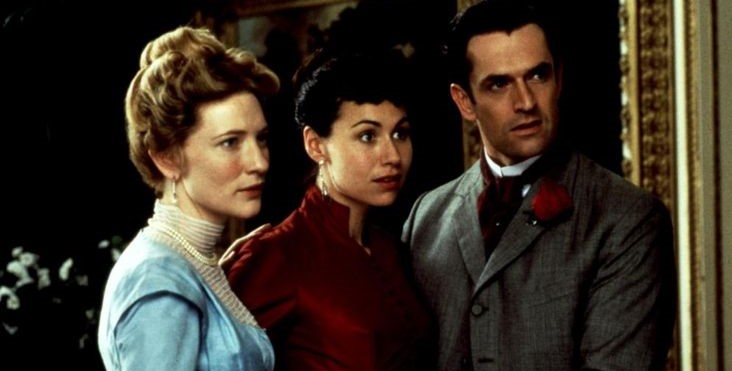
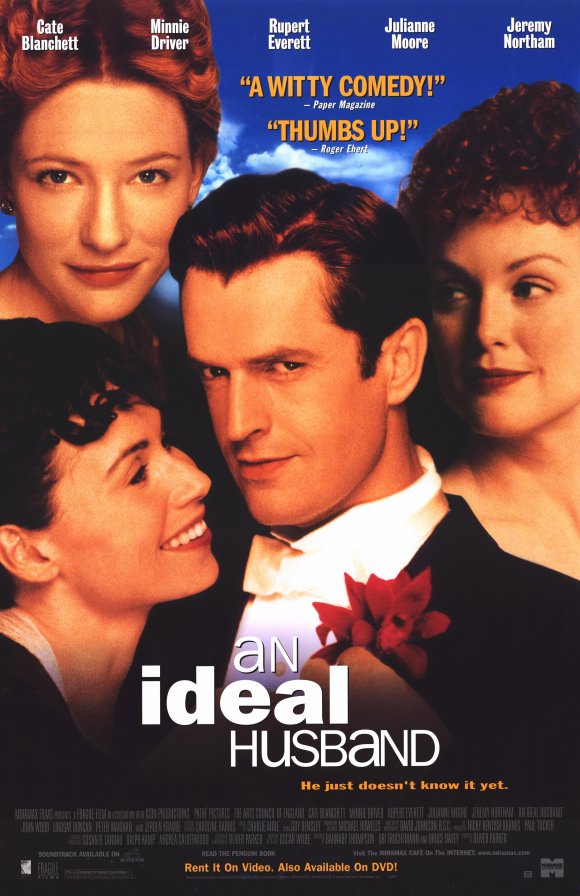
Cast: Rupert Everett (Lord Arthur Goring), Cate Blanchett (Lady Gertrude Chiltern), Minnie Driver (Miss Mabel Chiltern), Julianne Moore (Mrs Laura Cheveley), Jeremy Northam (Sir Robert Chiltern), John Wood (Lord Caversham), Peter Vaughan (Phipps), Lindsay Duncan (Lady Markby), Simon Russell Beale (Sir Edward), Nickolas Grace (Vicomte de Nanjac)

I have a theory that Shakespearean comedy rarely translates well to screen because what makes it work is its theatricality and how it encourages laughter by interacting directly with the audience. I think you could say the same for Oscar Wilde. Certainly, this film version of An Ideal Husband looks lovely and never misses a single Wildean bon-mot. But it’s overlong, drags rather in its final third and, above all, isn’t particularly funny.

The plot has been freshened up and adjusted in places to make for a more filmic narrative, but the principles are the same from the play. Sir Robert Chiltern (Jeremy Northam) is a pillar of the establishment, famed for his unshakeable dedication to principle and adored by his wife Lady Gertrude (Cate Blanchett) who sees him as a paragon. But all that could be shaken up when Mrs Laura Cheveley (Julianne Moore) re-enters his life, bringing with her shocking revelations that could destroy Sir Robert. So he turns to help to his best friend, the witty and debonair Lord Arthur Goring (Rupert Everett), who is himself in love with Sir Robert’s sister Mabel (Minnie Driver). How will events play out as they start to spiral out of control?

Oliver Parker’s film is cautious, safe and – for all that it tries to open the play out with scenes in parks and Parliament – conservative and safe. You can imagine Wilde himself would probably have wanted something a little more daring had he been involved. As it is, things that work very well on stage (the farcical elements of mistaken identity and a house with a different character hiding behind every door) don’t really work on film. These ideas are inherently theatrical and depend on the heightened unreality of theatre – in the cold hard harshness of cinema, they feel out of place.

Put frankly, the big thing the play misses is the live audience. You can imagine this cast going down an absolute storm in the West End. The lines that demand a wink to the audience, bits of business that invite laughter, just fall flat here. They are rendered lifeless by the demands of being fit into a film, or having to take place in a world that seems real, when Wilde’s plays are all about a sort of bizarre ultra-Victorian world of form covering up a suggestive naughtiness. When the characters go and watch The Importance of Being Earnest at the theatre (a sign of the film’s clumsy opening out, and its lack of wit when left to its own devices) the dialogue style that doesn’t really work in the “real world” of film suddenly feels perfectly natural when we see people speak it on stage.

Parker’s film fails to bring any particular inspiration to events. Instead it seems determined to package Wilde as a heritage product, the sort of thing you can imagine people considering a safe thing for the whole family to sit down and watch. There is no sense of cheek, sex or danger in this like you can get in Wilde. Instead it’s all about attractive actors in period-drama drawing rooms, going about their work with skill. All made to look as pretty as possible with some lovely costumes. It’s Sunday tea-time viewing.

But despite this, some of those performances are spot on. I’m not sure there is an actor alive today better suited to Wilde than Rupert Everett. His imperious drawl, his sardonic wit, his louche manner (not to mention his ability to suggest an illicit wickedness under the surface) make him absolutely perfect. Everett has shown time and again – on film and in the theatre – he has an affinity for the dryness needed for Wilde, as well as being able to communicate the intelligence without smugness. All the successful scenes of the movie revolve around him, and he invariably brings out the best from his co-stars. He’s also far-and-away the funniest thing in the film.

The rest of the cast are more mixed. Cate Blanchett is the stand-out in (sadly) the least interesting main role, the rather stuffy Lady Gertrude (you wish you’d been able to see her let rip as the more wicked Mrs Cheveley) – like Everett she “gets it”. Jeremy Northam also does excellent work in the straight-man role of Sir Robert, but his characteristic dignity and intelligence do very well in the role. Julianne Moore though seems oddly constrained by the period setting as Mrs Cheveley (strange that she did this at the same time as her superior work as a restrained Englishwoman in The End of the Affair) while Minnie Driver lacks impact as Mabel. John Wood and Peter Vaughan – two old pros from the theatre – bring much of the energy and wit in supporting roles.

An Ideal Husband is fine. But watching it you’d wonder what all the fuss about Wilde is about. And that can’t be a good thing. If Wilde wrote a review of it, it would be funnier than anything in the film.

The Invisible Woman (2013)

Ralph Fiennes and Felicity Jones excel in the thoughtful and well handled The Invisible Woman

Director: Ralph Fiennes

Cast: Ralph Fiennes (Charles Dickens), Felicity Jones (Nelly Ternan), Kristin Scott Thomas (Mrs Ternan), Tom Hollander (Wilkie Collins), Joanna Scanlan (Catherine Dickens), Michelle Fairley (Caroline Graves), Tom Burke (George Wharton Robinson), Perdita Weeks (Maria Ternan), John Kavanagh (Reverend Benham), Amanda Hale (Fanny Ternan)

In 1865 Charles Dickens was involved in a train accident. While he worked tirelessly, tending to those caught up in the accident, he was also extremely careful to hide the fact he was travelling with a young actress called Nelly Ternan. Ms Ternan was his lover, had been for several years, and the couple were returning from Paris. Dickens managed to avoid the inquest and preserve the secret of his affair. Because, while he was happy to publicly announce his separation from his wife, the idea of the public hearing that he had an affair with someone 27 years younger than him was unthinkable.

The affair is deduced from careful deduction and the small remaining correspondence (both parties destroyed large numbers of letters) by the biographer Claire Tomlin. Her book forms the basis of Fiennes’ thoughtful, careful and intelligent film, with the director playing Dickens and Felicity Jones as Nelly Ternan. The Invisible Woman is restrained and unjudgmental film-making, that largely avoids obvious moral calls and weaves a beautifully constructed tale of two people who make themselves both happy and miserable.

And that misery is partly due to the times they live in. It’s an era of Victorian morals, where all that matters is the surface appearance and any real emotions underneath can go hang. But it’s also a world where very different rules apply to men and women. Dickens can leave his wife (in a press announcement) – but of course a woman could never do the same. It’s a world of strictly defined rules, with clear roles for both genders that cannot be deviated from. And it forces Nelly Ternan to travel to Paris, because the public shame that would come with her pregnancy by Dickens would destroy her. It’s why, years after Dicken’s death, she is lying about how well she knew the man (even changing her name and age to further distance herself) so that she can conform with the expectations of being a school-master’s wife (and ensure she will not be thrown out to the streets).

The rules are so strong that both Dickens and Ternan are as much in thrall to them as anyone else. Dickens is willing to bend the rules – but only so far. He would clearly never dream of living openly with his unmarried partner and their child as his friend Wilkie Collins (a perfectly cast Tom Hollander) would do. And Nelly Ternan is as outraged at this liaison – and as desperately uncomfortable in their home – as any prim housewife would be. In fact, in many ways, Nelly is even more conservative than Dickens.

But then she has to be. After all, he would be a rogue, she would be a whore. Choices aren’t great for women – and in her chosen career of actress, Nelly is clearly far more enthusiastic than she is talented. It’s worries about the career that leads to her mother – an excellent performance of motherly love mixed with a quiet understanding of the world from Kristin Scott Thomas – all but encouraging Dickens to seduce her daughter. Because, for an independently minded woman passionate about the art, if you can’t be an actress your other option is to be a muse.

Even Dickens seems quietly ashamed at his seduction of this woman, while she half-persuades herself it isn’t happening until it is. So, what draws them together? Refreshingly this isn’t a question of an older man excited by a younger woman – or a naïve woman swept up by a powerful man. Instead, these are kindred spirits. Both of them are passionate, intelligent and questioning. They both express an emotional honesty and openness. They have shared passions for literature, theatre and stories. It’s a romance that slowly blossoms and is based on a shared feeling. It would have been easier to tell a story of seduction and abuse – but this is a more intelligent film than that. At that fatal train accident, its Dickens who yearns to stay with Nelly and its Nelly that urges him to leave to preserve his secrets.

As these two, we have two actors with beautiful chemistry. Felicity Jones is inspired as Nelly Ternan. She both idolises Dickens, but is also drawn towards him on a very human level. She is astute, but conservative and at times even remote. Her older self, over a decade later, is both prickly and defensive – and those are qualities you can trace in her younger self, and not just because of her fear of disgrace. It’s a beautifully judged performance, both older than her time and also with a vibrancy and energy that entrances.

Fiennes, a more reserved actor, seems like an odd choice for the bon vivant Dickens – but he brilliantly excels in the role, full of energy and room-filling dominance. He marvellously conveys the charm and passion of Dickens, but also his thoughtlessness. This is after all a man who drops his wife by newspaper announcement and builds a barrier between their bedrooms. Who loves Nelly, but not enough to make her anything but a secret. Who is passionate and excited about his work, but can be turn distant and cool in his personal life. It’s a fabulous performance.

And the two leads are centred in a low-key, poetic film. You get the sense that there is a danger in getting to close to genius. Dicken’s wife Catherine – a beautifully sad and lonely performance from Joanna Scanlan – even warns Nelly about it (while delivering a gift from her husband, sent to her by mistake). It’s a danger that shapes Nelly’s whole life – but also her life is enriched by having Dickens in it. It’s a film that avoids obvious moral judgments – and while there are things done which cause pain, everyone is living in an imperfect society. Fiennes direction and use of visual language is wonderful and this is an impressive film.

The Little Stranger (2018)

Little stranger header
Domhnall Gleeson doesn’t believe in ghosts in The Little Stranger

Director: Lenny Abrahamson

Cast: Domhnall Gleeson (Dr Faraday), Ruth Wilson (Caroline Ayres), Will Poulter (Roderick Ayres), Liv Hill (Betty), Charlotte Rampling (Mrs Ayres), Harry Hadden-Paton (Dr David Granger), Anna Madeley (Anne Granger), Richard McCabe (Dr Seeley)

Can an adaptation of a novel work when the key to its success was the way it was told rather than the story itself? With its unreliable narrator and distinctively interior style, Sarah Waters’ book was a tough ask. But, making it even harder for the big screen, The Little Stranger is a ghost story narrated by a fervent non-believer, who witnesses none of the supernatural elements and spends his time finding detailed, logical reasons for why the people living in the haunted house are as unsettled as they are. It makes for a challenge which, for all the style Lenny Abrahamson brings, the film doesn’t quite manage to meet.

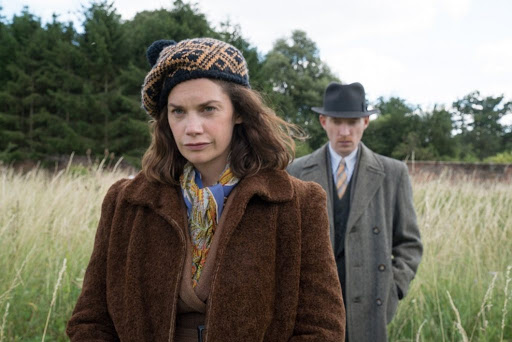
Our sceptic is Dr Faraday (Domhnall Gleeson), a young village GP in the years immediately after the Second World War. Faraday grew up in the shadow of the Ayres house, a grand country seat now being lived in by the last remnants of the Ayres family who have fallen on hard times. Son Roderick (Will Poulter) has been left with debilitating injuries after his RAF service, Caroline (Ruth Wilson) seems destined to become a spinster, and their mother (Charlotte Rampling) struggles to hold together what’s left of the house’s prestige, among leaking roofs and bills that can’t be paid. Dr Faraday becomes an intimate of the household. But are the family’s problems partly linked to a malign presence in the house, perhaps the unsettled ghost of a third, long-dead Ayres sibling? Or is it all just bad luck, frozen pipes, branches on the window and creaking floorboards?

Well of course it isn’t. The film’s main problem is that it takes a book where the narrator spends the entire time stubbornly refusing to accept he is in a ghost story, and repackages it as a more conventional tale of creeps and psychological horror. While moments like this are undoubtedly unsettling, it rather flies in the face of what made the book unique in the first place.

In the book you find yourself – despite knowing deep down he’s wrong, because that’s not how stories work – thinking that maybe all this is just a series of terrible coincidences impacting a psychologically fragile family. In the film, you are never in any doubt that the ghosts are real. Not least, because we are frequently witness to supernatural events. When Charlotte Rampling’s character is terrified in the nursery by the ghost of her lost child, we share the terror with her. A truer adaptation of the book would have only shown us the aftermath – a trembling woman on the ground surrounded with broken glass – and asked us if we shared Faraday’s diagnosis of suicidal depression.

The change in perspective from the book has a particularly bad impact on the Faraday character. Faraday, deep down, is a sort of chippy Charles Ryder, as much in love with the house – and the prospect of one day owning it – as he is with the family itself. This mix of longing, envy and class jealousy bubbles under the surface of the character in the book, qualities that we have to read between the lines to detect. In the film however, these qualities are bought firmly to the surface.

This means that, for all Domhnall Gleeson has just the right rigidity and lack of imagination for the born sceptic, it means the character’s sinister possessiveness towards the Ayres house comes more to the fore. In the film it’s hard to escape the sense Faraday is as much a creep as the ghost (something the film even perhaps vaguely suggests in its open-ended conclusion). He’s cold and undeniably bitter, quietly but resentfully recording each moment where he is treated like a retainer.

The film also loses some of the context of the book as well. Part of the reason this house is falling apart is the declining wealth of the family in a world of post-war depression and higher death duties. Today the Ayres house would have been long since flogged to the National Trust. The crumbling house – compared to the grand vision in Faraday’s memories – is itself a metaphor for a particular class in Britain. However, this gets a bit lost in the film. Instead it’s easy to see the Ayres as just personally unlucky rather than symptomatic of a general collapse of the landed class.

But the film does do lots of good things. The ghost stuff is undeniably creepy – even if, as I say, it leaves the viewer in no doubt that Faraday is wrong and the Ayres are right. Will Poulter is very good in a small role as the bitter and scarred son, while Wilson captures a sense of premature middle-aged drift in Caroline, a woman unhappy in her life but unsure what she wants. Rampling is similarly very strong as a crumbling matriarch.

The film also looks lovely – perhaps too lovely, with its idealised view of a 1950s that surely was dirtier than this – and is well assembled. It just fails to bring a narrative drive to the film to replace the uncertainty and scepticism of the narrative voice that made the book so strong. There Faraday’s dismissals and self-denial about his class envy were what made the story compelling: here they are both removed – and what’s left isn’t quite interesting or unique enough to fill the gap.

Rebecca (2020)

REBECCA
Lily James and Armie Hammer do their best in an overblown Rebecca the swops Gothic chills for lovely costumes and locations

Birector: Ben Wheatley

Cast: Lily James (The second Mrs de Winter), Armie Hammer (Maxim de Winter), Kristin Scott Thomas (Mrs Danvers), Keeley Hawes (Beatrice Lacy), Ann Dowd (Mrs Van Hopper), Sam Riley (Jack Favell), Tom Goodman-Hill (Frank Crawley), Mark Lewis Jones (Inspector Welch)

Hitchcock’s film version of du Maurier’s novel casts a long shadow. Few have taken up the challenge to film it since – and Ben Wheatley’s is the first film version in nearly 80 years. But you can be pretty certain that, unlike Hitchcock’s, this one probably won’t be being watched 80 years from now.

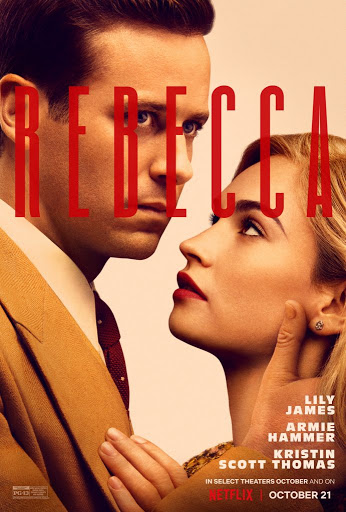
In Monte Carlo, a young woman (Lily James) meets and falls in love with rich Cornish landowner Maxim de Winter (Armie Hammer), a widower on holiday. They marry and return to his seat at Manderley. However, on arrival the second Mrs de Winter finds that she is living in the shadow of Maxim’s deceased first wife, Rebecca. This feeling is encouraged by the passive aggressive manipulation of Rebecca’s devoted housekeeper Mrs Danvers (Kristin Scott Thomas). Slowly, the second Mrs de Winter starts to worry that even her sanity starts to be slipping.

Wheatley is a director with a love of thriller and horror, and he really should be a natural fit to take on du Maurier’s gothic creepiness. But Wheatley feels almost constrained by the period title and beauty. This is a film that totally misses its gothic beats, instead settling for being a lusciously filmed costume drama. It has only a few traces of the unsettling psychology or air of ghostly possession that the story requires, and even those are chucked in haphazardly and then forgotten in order to make way for a pretty sunset or generic shot of Lily James looking sad in the rain.

The inescapable feeling on watching this is that Wheatley actually wants to turn the story into a more conventional romance. The age difference between Maxim and the second Mrs de Winter has been almost removed.  With Armie Hammer too young and Lily James too pretty, there is no ambiguity to Maxim’s feelings or motivations, nor any power imbalance to their charming, sunlit courtship, filled with carefree drives and charming beach picnics. Gone are the suspicions (for both the second Mrs de Winter and us) as to what a rich, sophisticated older man could see in a shy, unremarkable, average-looking girl who’s employed as little more than a servant.

It also removes much of the vulnerability and uncertainty Mrs de Winter should feel, by bringing her onto more equal terms with her husband. From du Maurier’s vision of an innocent woman feeling out of her depth as she’s plunged into an alien world, unable to break through the hauteur of a distant, older husband, we instead get far more of a conventional whirlwind romance that sours when the couple return home.

It’s not really the fault of the two leads, who give sterling work. Lily James has just about the right vulnerability to her, even if she’s still got a bit more spark than the quiet, demure character needs. But James has a fabulous sense determined earnestness to her, an eagerness to do the right thing and not let anyone down (her greater dignity and strength also pays off in sequences where Mrs de Winter takes on a stronger position in the marriage).

As Maxim, Armie Hammer has the right sort of authority and conveys the distance and coolness of the character, even while he is clearly too young and at times seems a bit hampered by his accent and setting. (Like some American actors, he at times struggles to fully comprehend the issues of class within the film.) Perhaps the main weakness to the casting is, by playing up his charm and romanticism, you never really think for a moment that this is a bloke who might have murdered his wife. It also makes him never feel like the sort of chap who could honestly ever have though about dispatching his new wife. It again strips out much of the darkness and dread of the original.

Needless to say, Kristin Scott Thomas has a ball as Mrs Danvers, the obsessed and bitter housekeeper, a part that hardly pushes her to her limits but which she delivers more than enough in. Wheatley pays homage to several of Hitchcock’s shooting decisions around the character, and the conveying of her menace is probably the film’s most successful beat.

However, the film fails at too many other important points. The sense of the previous Mrs de Winter haunting the home is lost completely. Too often the creepiness and psychological fear the film is aiming for gets lost, with periodic bursts of Cornish singing used too obviously to suggest unsettling menace. One very successful sequence set in a room of mirrors just serves to flag up how painfully absent the sense of threat and fear are from the rest of the film. To be honest, it’s a film that needs more darkness, more shadows. Instead everything is lit with all the prestige handsomeness of Merchant Ivory and Sunday dramas. Why did Wheatley go for this visual approach? Did he feel that it was expected from the lovely locations and luscious costumes?

And the costumes and the sets do look lovely. The shooting colours are vibrant and beautiful. It’s very grand and charming and it turns a haunting novel with dark deeds at its heart into something safe and neutered.

 The final product is what happens if a combination of styles are thrown together in a way that service not the story, but how each element of it could be best presented. When the film wants to show off the set and costumes, it’s bright and beautiful. At the few times it wants to suggest ghostly intimidation, we get some chanting and a few darkened rooms and billowing curtains. Neither plays well off the other and the film ends up feeling professionally mounted but workmanlike. It’s a shame as Wheatley could have really made something of this. But it feels like he has been forced into a prestige costume drama straightjacket.

The Dig (2020)

THe Dig header
Ralph Fiennes plays an amateur digger who makes a huge discovery in the poetic The Dig

Director: Simon Stone

Cast: Carey Mulligan (Edith Pretty), Ralph Fiennes (Basil Brown), Lily James (Peggy Piggott), Johnny Flynn (Rory Lomax), Ben Chaplin (Stuart Piggott), Ken Stott (Charles Phillips), Archie Barnes (Robert Pretty), Monica Dolan (May Brown)

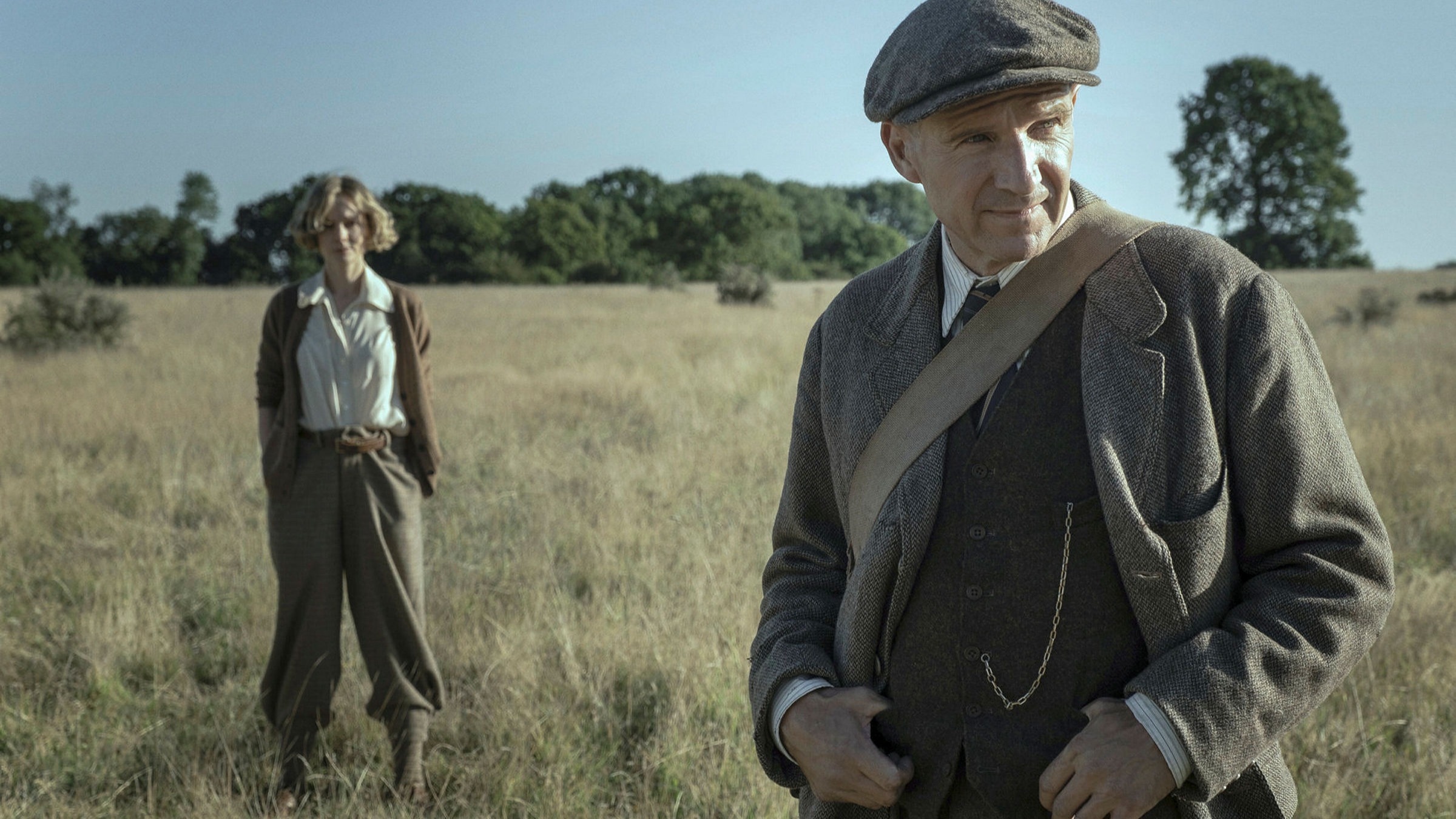
One of the greatest archaeological finds in British History, the Anglo-Saxon burial ship in Sutton Hoo revealed vast treasures and cultural insights that are very rarely glimpsed. Land-owner Edith Pretty (Carey Mulligan), a widow with a young son Robert (Archie Barnes), hires self-taught excavator Basil Brown (Ralph Fiennes) to investigate the curious mounds on her land. Brown discovers one of them holds the buried ship. But the dig is taken from his control by the British Museum, led by Charlie Phillips (Ken Stott): professional archaeologists who want to ensure the work is ‘done properly’. With tensions of class and profession, everyone must race against time to complete as much of the work as possible before the outbreak of the Second World War.

On the surface, The Dig is a charming, heart-felt reconstruction of a fascinating moment of archaeological history, mixed with engaging (but familiar) stories of a working-class amateurs being patronised by upper-class professionals. However, Stone’s film manages to have a richer second layer. With war approaching, and mortality constantly on the mind of most of the characters, it’s also a subtle investigation of legacy, the past and death itself.

Stone’s film develops this with its rich, poetic filming style. Beautifully shot in a series of gorgeous hazy hues, with dynamic use of low-angles and wide-angle lenses, Sutton Hoo is given an almost mystical beauty. Stone also makes extensive use of playing dialogue over images not of the conversation, but smaller moments in character’s lives, from casual meetings to cleaning shoes, that as such take on a profounder meaning. It’s a visual representation of how our legacy is often a snapshot of images and relics, moments that stay in the memory even when events (or conversation in this case) has moved on. It’s subtly done, but carries a beautiful impact.

Then of course, it’s not surprising legacy in on the mind. Each of the characters is at a tipping point in their own lives. Edith Pretty – so consumed with quiet grief over the loss of her husband that she is desperate for there to be something on the other side – is struggling with her own health, aware she will shortly leave her son an orphan. Her cousin Rory prepares for service in the RAF – service she fears will shortly leave him dead (the dangers of the airforce are clearly shown when a trainee pilot crashes and drowns near to the dig).

This connection to the briefness and intangibility of life pushes people to address their own choices. After all they are all standing in the grave of a man considered so important at that the time, a ship was dragged several miles to honour him – and today we have no idea who he was. Married archaeologist couple Stuart and Peggy Piggott confront an amiable loveless marriage (he’s gay, she’s falling in love with Rory) that shouldn’t define their lives. Basil has dealt with quiet grief at a childless marriage, and sees his work in astronomy and archaeology as his legacy.

These ideas are gently, but expertly, threaded together with a reconstruction of the key issues around the dig. Needless to say, the academics – led by Ken Stott at his most pompous – have no time for Basil’s home-spun methods. Basil’s predictions of the Anglo-Saxon tomb are constantly dismissed until he literally digs the ship up. Immediately he is benched to clearing soil (and only on Edith’s insistence is he allowed to remain at all) and later his name will be scrubbed out of the official record. It’s always the way with Britain – and a sign of how tenuous our legacies can be.

The personal stories are not always as well explored. The film has its flaws, not least the sad miscasting of Carey Mulligan as Edith. In reality, Edith was in her mid-50s when the ship was discovered. The film was developed for Nicole Kidman, but with her withdrawal Mulligan (twenty years too young) was drafted in. Sadly, nothing was changed to reflect this: meaning the characters years of spinsterhood before marriage lose impact (seriously how old can she have been when she married? She’s got a 12 year old son!). A softly underplayed romantic interest between Edith and Basil is also rather unsettling considering the vast age difference between them. (It’s better to imagine it as a platonic bond).

It’s still more engaging than the rather awkward love triangle the film introduces late on between the married Piggotts and Edith’s (fictional) cousin Rory. It’s fairly familiar stuff – the closeted gay Piggott, the growing realisation of this by Peggy and the obvious charm and gentle interest of Rory – and more or less pans out as you might expect, although at least with a dollop of human kindness.

The film’s other delight is the acting. Ralph Fiennes is superb as the taciturn Basil, a dedicated self-taught man who knows what he is worth, but struggles to gain that recognition. Fiennes not only has excellent chemistry with Mulligan and Barnes, he also suggests a quiet regret in Basil as well as a fundamental decency tinged with pride. For all that she is miscast, Mulligan does very good work as Edith while Chaplin, James and Flynn make a lot of some slightly uninspired material.

The Dig is at its best when asking quiet and gentle questions about life and when it focuses on the platonic romance between Basil and Edith. Directed with a poetic assurance by Simon Stone, it doesn’t push its points too far and gets a good balance between fascinating historic reconstruction and more profound questions of mortality.

Around the World in Eighty Days (1956)

Around the world header
David Niven and Cantinflas head Around the World in Eight Days in this Oscar-winning epic

Director: Michael Anderson

Cast: David Niven (Phileas Fogg), Cantinflas (Passepartout), Shirley MacLaine (Princess Aouda), Robert Newton (Inspector Fix), Charles Boyer (Monsieur Gasse), Joe E. Brown (Stationmaster), John Carradine (Colonel Proctor), Charles Coburn (Steamship clerk), Ronald Colman (Railway official), Melville Cooper (Mr Talley), Noel Coward (Roland Hesketh-Baggott), Finlay Currie (Andrew Stuart), Marlene Dietrich (Hostess), Fernandel (Paris coachman), Hermione Gingold (Sporting lady #1), Cedric Hardwicke (Sir Francis Cromarty), John Gielgud (Foster), Trevor Howard (Denis Fallentin), Glynis Johns (Sporting lady #2), Evelyn Keyes (Paris flirt), Buster Keaton (Train conductor), Beatrice Lille (Revivalist), Peter Lorre (Steward), Victor McLaglen (SS Henrietta helmsman), John Mills (London coachman), Robert Morley (Gauthier Ralph), Jack Oakie (SS Henrietta captain), George Raft (Bouncer), Frank Sinatra (Piano player), Red Skelton (Drunk), Harcourt Williams (Hinshaw)

In the 1950s, cinema struggled to encourage people to come out of their homes and leave that picture box in the corner behind. Big technicolour panoramas and famous faces was what the movies could offer that TV couldn’t. This led to a trend in filmmaking that perhaps culminated in 1956 with Around the World in Eighty Days triumphing among one of the weakest Best Picture slates ever seen at the Oscars. Around the World had everything cinema knew it could do well: big, screen-filling shots of exotic locations filmed in gorgeous colour; and in almost every frame some sort of famous name the audience could have fun spotting. It’s perhaps more of a coffee table book mixed with a red carpet rather than a narrative film: entertaining, but overlong.

Faithfully following Jules Verne’s original novel (with added balloon trips), Phileas Fogg (David Niven) is a punctilious and precise Englishman of the old school, whose life is run like clockwork and whose only passion is whist. Nevertheless he accepts a challenge from his fellow members of the Reform Club (among them Trevor Howard, Robert Morley and Finlay Currie) to circumnavigate the globe in 80 days or less. Setting off with his manservant – the recently hired, accident prone Passeportout (Cantinflas) – Fogg races around the world, from Paris to Cairo to India to Hong Kong to Japan to San Francisco. Along the way he rescues Princess Aouda (Shirley Maclaine) from death by human sacrifice in India and has to confront the suspicions of Inspector Fix (Robert Newton) who is convinced that Fogg is responsible for a huge theft at the Bank of England. Can Fogg make it back to the Reform Club hall on time to win his bet?

Around the World was the brain-child of its producer Michael Todd. A noted Broadway producer, Todd had been looking to make a similar splash in the movies. Perhaps it’s no surprise that he decided the finest way to do this (after the mixed success of a movie version of Oklahoma) was to produce something that‘s pretty much akin to a massive Broadway variety show. Around the World – as you would expect – is an incredibly episodic film, seemingly designed to be broken down into a number of small sequences either to showcase the scene’s guest star or to provide comic opportunities for Cantinflas to display his Chaplinesque physical comedy.

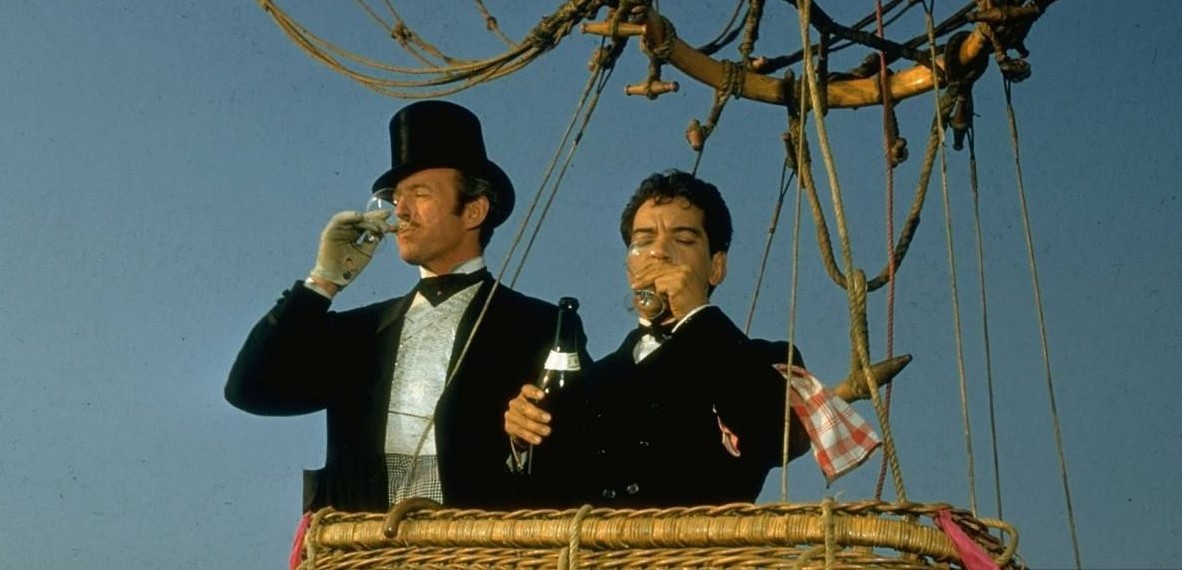
That and lots of opportunities for some lovely scenic photography. Nearly every major sequence is bridged with luscious photography capturing some exotic part of the world – from the coast of Asia to the Great American Plains. It’s pretty clear this is a major attraction of the film: come to the movies and see those parts of the world you’ve always dreamed of, just for the price of a movie ticket! Surely introduction of a hot air balloon to allow Fogg and Cantinflas to travel from Paris to Spain was purely to allow lovely aerial shots of the French countryside and chateaux. It’s the sort of film that proudly trumpeted in its publicity the number of locations (112 in 13 countries!), the vast number of extras (68,894!) and even the number of animals (15 elephants! 17 fighting bulls! 3,800 sheep!). It’s all about the scale.

That scale also carries across to the guest cameos. Between enjoying the scenic photography, viewers can have fun spotting cameos. Can that really be Noel Coward running that employment agency! The chap who owns the balloon, I’d swear that’s Charles Boyer! Wait that steward: that’s Peter Lorre! Good lord that’s Charles Coburn selling Fogg tickets for the steamer! Oh my, Buster Keaton is helping them to their seats on the train! Marlene Dietrich is running that saloon – and good grief that’s Frank Sinatra playing the piano! Most of the stars enter into the spirit of the thing, even if they frequently start their shots with backs to the camera, before turning to reveal their star-studded magnificence. Sadly time has faded some of the face recognition here, not helped by David Niven (perfectly cast as the urbane and profoundly English Fogg, so precise that his idea of romantic talk is to recount past games of whist) probably today being one of the most famous people in it.

Todd marshals all this with consummate showman skill. It’s handsome, very well mounted and generally entertaining – even if it is painfully long (it’s not quite told in real time, but can feel like it at points). The film is nominally directed by Michael Anderson. However, I think it’s pretty clear his job was effectively to point the camera at the things Michael Todd had lined up (be they location or stars) – Todd had already dismissed the original director, John Farrow, after a day’s shooting for not being sufficiently ”co-operative”. To be honest it’s fine as this is an entertainment bereft of personality, instead focused on being “more is more”.

Part of its extended runtime is due to the long comedic sequences given to Cantinflas. A charming performer – and possibly the most famous comedian in Latin-America at the time – Cantinflas can be seen doing everything from bicycle riding, to bull fighting (for a prolonged time), to gymnastics to horseback riding. (Far different from the unflappable and spotless English gentleman Niven is playing.) Your enjoyment of this may depend on how far your patience lasts. I’m not sure mine quite managed to last the course. Sadly one of Cantinflas’ greatest comedic weapons, his Spanish wordplay, was completely lost in translation.

There are some decent sections. The iconic balloon flight is well mounted and gives the most impressive images (the famously vertigo-suffering Niven was replaced by a double for much of this). Others, like the bullfight or an interminable parade in San Francisco go on forever. The casting of Shirley MacLaine as an Indian princess is an uncomfortable misstep (even at the time MacLaine felt she was painfully miscast), made worse by an offensive “human sacrifice” storyline – that got cut when the film was screened in India. Robert Newton though is very good value as the misguided but officious Inspector Fix.

Around the World in Eighty Days is grand, handsomely mounted entertainment. But to consider it as a Best Picture winner feels very strange. It’s not a lot more than an entertaining variety show, its plot impossibly slight (made to feel even more so by its vastly over-extended run time). While you can enjoy it in pieces, it finally goes on too long for its own good. Entertainingly slight as it is, it’s still one of the weakest Best Picture winners ever.

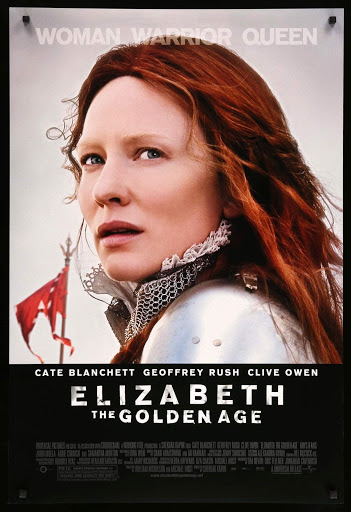
Elizabeth: The Golden Age (2007)

Elizabeth the golden age
Cate Blanchett returns as Elizabeth I in the slightly underwhelming Elizabeth: The Golden Age

Director: Shekhar Kapur

Cast: Cate Blanchett (Elizabeth I), Geoffrey Rush (Sir Francis Walsingham), Clive Owen (Sir Walter Raleigh), Abbie Cornish (Bess Throckmorton), Samantha Morton (Mary Queen of Scots), Jordi Molla (King Philip II), Susan Lynch (Annette Fleming), Rhys Ifans (Robert Reston), Eddie Redmayne (Anthony Babington), Tom Hollander (Amias Paulet), David Threlfall (John Dee), Steven Robertson (Sir Francis Throckmorton), Adam Godley (William Walsingham), Laurence Fox (Sir Christopher Hatton), William Houston (Guerae de Espes)

Its 1585 and the reign of Elizabeth I (Cate Blanchett) has seen England enter a Golden Age. But tensions are rising with the Spanish and their king Philip II (Jordi Molla). The Spanish plot to replace the protestant Elizabeth on the throne with the catholic Mary Queen of Scots (Samantha Morton), sending their agents (including the likes of Rhys Ifans and Eddie Redmayne) to England to ferment rebellion. Can Elizabeth’s trusted advisor Sir Francis Walsingham (Geoffrey Rush) root out this potential rebellion? Or could this be a trap to lure England into a naval war with Spain and its chilling armada of ships?

Elizabeth: The Golden Age is a late sequel to the more influential Elizabeth, which mixed in the ruthlessness of The Godfather, with a sprinkling of sex in a darkly tinged Elizabeth England which seemed to drip conspiracy (setting the tone for costume dramas for the next ten years at least). Compared to its original, Elizabeth: The Golden Age seems a much more traditional piece of filmmaking. It’s luscious and handsomely filmed, with the darkness and oppression of the original replaced with golden hued lighting, sumptuous (Oscar-winning) costumes and some very impressive set-designs, all of which help to point up the glamour of the past in a way that seems much more similar to a 1970s epic than the more inventive work of the original.

It’s a part of the film’s idea of the country now enjoying the glory Elizabeth’s reign has bought, with the dark corridors replaced by the bright lights of peace and opulence. The film’s reimagining of Tudor history does still present some interesting perspectives, not least in the character of Elizabeth. Now firmly in middle-age – and committed to a life of celibate singledom – Cate Blanchett’s regally imperious Elizabeth is still emotionally vulnerable with a deep sense of longing in her. Unable to live the life of romantic freedom she could in her youth, she now lives an emotional life vicariously through her ladies in waiting, particularly Abbie Cornish’s sharp and knowing Bess Throckmorton.

This focuses on Elizabeth alternating between encouraging and discouraging (due to her own half-realised romantic longing) a romance between Bess and famed explorer Walter Raleigh. Played by Clive Owen at his most buccaneering (with an accent that playfully lies between Norfolk and New England, suggesting the American accent came from Raleigh), Raleigh bewitches the Queen with exciting tales of abroad – but with her unable to flirt with him fully as she wishes, Bess is encouraged to dance intimately with him among other romantic gestures. The most important thing throughout for Elizabeth is that it is she controls and dictates the relationship – and when the couple start to make their own decisions, it leads to disaster.

It’s all part of Michael Hirst’s (here sharing script writing duties with William Nicholson) imaginative reinvention of Tudor history (remixed into an exciting version of what could have happened). This also comes together very nicely in an interesting conspiracy thriller take on the Babington plot and the goals of the Spanish to use it to manipulate both Elizabeth and Mary Queen of Scots. The film is at its strongest when playing with historical expectations.

However, too often it plays into the sort of “Britain Triumphant” nonsense that made Michael Gove on release (and you imagine Laurence Fox today – here popping up as Christopher Hatton) thrilled. The British characters – Elizabeth, Raleigh, Walsingham – are brave, charismatic, ingenious and attractive. The villainous Spanish are thick-lipped, spittle flecked, bad-haired meanies with Philip II literally a sinister limping hunchback. No scene in Spain is complete without dark lighting, chanting monks, massive crucifixes and a general air of oppression. When ships sink, the camera doesn’t miss the chance to capture a crucifix sinking to the bottom of the briny. The Babington conspirators plot out of a dyers shop, where blood red dye drips all around them. The plot culminates in a “just missed her” point blank gun confrontation (the film’s most silly flourish). Subtle it ain’t.

And also it feels more Little Englander than its predecessor. Whereas the first film saw as much darkness and dirty dealing among the British as it did Europe, this film feels like a “Britain Stands Alone” against treacherous, lecherous, sanctimonious (or all three) Europeans. Sure the Armada was a terrific win for Britain – here with much of the credit reassigned to Raleigh who steers fire ships into the path of the Spanish ships (Drake is reimagined as a lumpen bureaucrat dazzled by Raleigh’s pizzazz) – but it owed as much (as even the Tudors themselves admitted) to the weather and luck as it did bravery and skill. Unlike the first film, Elizabeth: The Golden Age seems determined to define European and Catholic as suspiciously “other”. It makes for a less rewarding film.

And a less interesting one. For all its playing with psychology, this is a very much more traditional costume drama, celebrating Merrie Olde Englande where the original film challenged us to question our expectations. Kapur and Hirst settle for spectacle and style, over drama and truth. Blanchett is impressive as always – and the rest of the cast very sound – but this is a sequel that only lives as a counterpoint for the original.

Atonement (2007)

Atonement (2007)

Moderately successful literary drama, that succumbs to tricksy showboating

Director: Joe Wright

Cast: James McAvoy (Robbie Turner), Keira Knightley (Cecilia Tallis), Saoirse Ronan (Briony Tallis, aged 13), Romola Garai (Briony Tallis, aged 18), Vanessa Redgrave (Older Briony Tallis), Brenda Blethyn (Grace Turner), Juno Temple (Lola Quincey), Benedict Cumberbatch (Paul Marshall), Patrick Kennedy (Leon Tallis), Harriet Walter (Emily Tallis), Peter Wight (Inspector), Daniel Mays (Tommy Nettle), Nonso Anozie (Frank Mace), Gina McKee (Sister Drummond), Michelle Duncan (Fiona)

The past is a foreign country. Sadly, it’s not always the case that they do things differently there. Instead, it can be a land of regrets and mistakes that we can never undo. Events that once seemed so certain, end up twisting our lives and shaping our destinies. A single mistake can mean a lifetime of never being able to atone. These are ideas thrillingly explored in Ian McEwan’s novel Atonement, one of the finest in his career. The same ideas carry across to this handsomely mounted adaptation, which looks gorgeous but often tries too hard to impress.

In 1935, the Tallis family owns a grand country house. Precocious Briony Tallis (Saoirse Ronan) is on the cusp of her teenage years, and believes she understands the world perfectly. A budding writer, her imagination, curiosity and romanticism overflow. But her youthful mis-interpretation of the romantic interactions between her sister Cecilia (Keira Knightley) and the housekeeper’s son Robbie Turner (James McAvoy)ends in a tragically mistaken accusation that destroys Robbie’s life. Five years later, Robbie serves as a private during the British retreat from Dunkirk, Cecilia is a nurse in London and Briony is training to become the same – their lives still shaped by those misunderstandings on that fateful night.

Atonement is a film I’m not sure time has been kind to. Released in 2007 to waves of praise (including Oscar nominations and a BAFTA and Golden Globe for Best Film), it has the classic combination of literary adaptation, period beauty and big themes. But re-watching it (and it’s the third time for me), the film rewards less and less. Instead, my overwhelming feeling this time was it was a tricksy, show-off film that – despite some strong performances, in particular from McAvoy and Ronan – strained every second to demonstrate to the viewer that Joe Wright belonged with the big boys as a cinema director.

Constantly, the emotional impact of the film is undermined because nearly every scene has an overwhelming feeling of being ”Directed”. Wright pours buckets of cinematic tricksiness and flair into the film – so much so that it overwhelms the story and drowns out the emotion. With repeat viewings this overt flashiness becomes ever more wearing. Scenes very rarely escape having some directorial invention slathered on them. Direct-to-camera addresses where the background fades to back (giving the air of a confessional). Events unspooling (and at one tiresome moment played in reverse) to illustrate time reversing to allow us to see events from a different perspective. Other visual images seem cliched beyond belief: a divine flash of light behind McAvoy while he struggles against death in Dunkirk or, worst of all, Nurse Briony talking about never being able to shed the guilt from her childhood actions while vigorously washing her hands.

Perhaps most grinding of all is the (Oscar winning) score from Dario Marinelli which hammers home the questionably reality of some of the scenes we are watching (or at least the creative filter that Briony is placing over them) by building in excessive typewriter whirs and clicks into its structure. It hammers home one of the film’s key themes: that at least part of what we are watching is based solely (it is revealed) on the recollections of the much older Briony, now a respected novelist. That perhaps, some of the events are her creative interpretation, wishes or even flat-out invention. This is a neat device, but perhaps one that could have worked better with a framing device to place it into context. Instead the reveal feels tacked on at the end – for all that this is the same approach McEwan takes in the novel (with greater effect).

But then, for all the film faithfully follows the structure of the novel (in a respectful adaptation by Christopher Hampton), too often its warmth and feeling get lost in the showy staging. Although part of the tragedy is that Robbie and Cecilia’s relationship is destroyed before they even get a chance to explore it fully, the chemistry between the two of them isn’t quite there and the film doesn’t quite communicate the bond between them being as deep as it would need to be. So much of this in the book was communicated through interior monologue – and the film refuses to take a second away from its flashiness to compensate for this by allowing the relationship between the two to breathe.

Instead Joe Wright prioritises his directorial effects. For all that his over five-minute tracking shot through the beach of Dunkirk is hugely impressive and dynamic – and it really captures a sense of the madness, despair, fear and confusion of the evacuation – this isn’t a film about Dunkirk. It is a film about a relationship – and using the same flair to make us fully buy into, and invest in, this relationship would perhaps have served the film better. It’s striking that, in the long-term, the most impressive scenes are the quieter ones: Benedict Cumberbatch’s chilling house guest’s subtly ambiguous conversation with Briony’s young cousins, or Robbie and Cecilia meeting in a crowded café after years and struggling to find both the words and body language to communicate feelings they themselves barely understand. In the long term, scenes like this are worth a dozen tracking shots – and demonstrate Wright has real talent behind all the showing off.

But the film is striking, looks wonderful – as a mix of both The Go Between and a war film – and in James McAvoy’s performance has a striking lead. McAvoy’s career was transformed by his work here – boyish charm with a slight air of cockiness under his decency, turned by events into fragility, vulnerability, fear and an anger he can’t quite place into words. Knightley gives one of her best performances – although, as always, even at her best she hasn’t the skill and depth of a Kate Winslet. Or a Saoirse Ronan for that matter, who is outstanding as the young Briony – convinced that she is right and that she understands the world perfectly, but as confused and vulnerable as any child thrown into a world that in fact she doesn’t comprehend.

Atonement has its virtues. But too often these are buried underneath showing off, ambition and tricksiness. Sadly this reduces its effect and leaves it not as successful a film as it should be.