Category: Crime drama

The Wolf of Wall Street (2013)

The Wolf of Wall Street (2013)

Greed is Good? Scorsese’s masterpiece is a heady deconstruction of the excess of white collar criminals

Director: Martin Scorsese

Cast: Leonardo DiCaprio (Jordon Belfort), Jonah Hill (Donnie Azoff), Margot Robbie (Naomi Lapaglia), Kyle Chandler (FBI Agent Patrick Denham), Rob Reiner (Max Belfort), Jon Bernthal (Brad Brodnick), Matthew McConaughey (Mark Hanna), Jon Favreau (Manny Riskin), Jean Dujardin (Jean-Jacques Saurel), Joanna Lumley (Aunt Emma), Cristin Milioti (Teresa Patrillo), Christine Eberle (Leah Belfort), Kenneth Choi (Chester Ming), Brian Sacca (Robbie Feinberg), Henry Zebrowski (Alden Kupferberg)

All The Wolf of Wall Street is really missing is an early freeze frame of a coke-fuelled banker slamming the phone down on a closed deal and a wistful voiceover from Jordan Belfort: “As far back as I can remember, I always wanted to be Wall Street trader”. If Goodfellas was Scorsese’s exploration of the attractions – and dangers – of a life in blue collar crime, then The Wolf of Wall Street is its white collar companion piece. The fact that so many viewers find the behaviour of Belfort morally outrageous in a way that no one ever objects about Henry Hill is, for me, an indication of how much we loath these masters-of-the-universe. For all their faults, we’d still rather see a violent criminal as one of us.

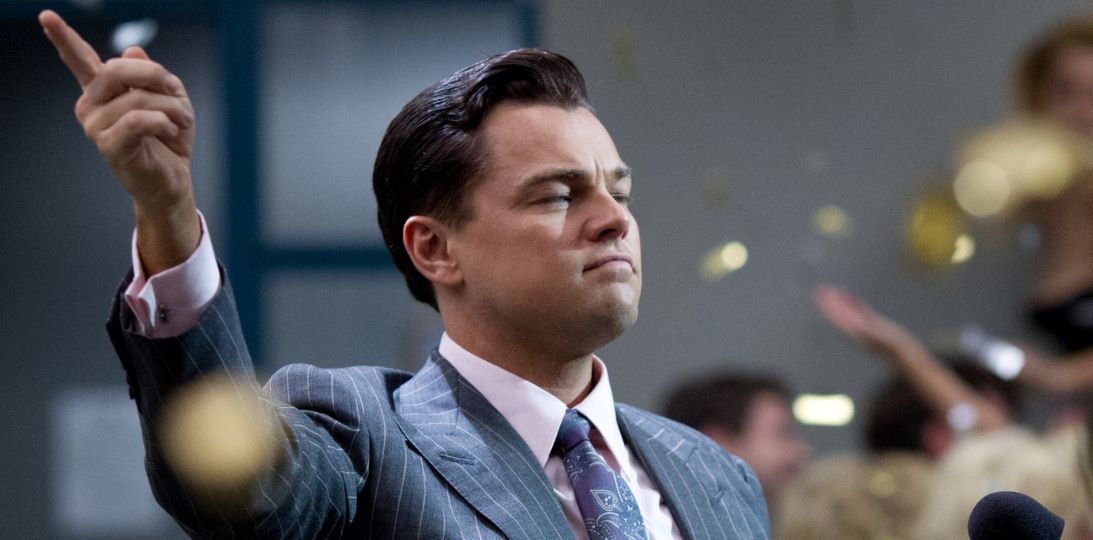
Based on Jordan Belfort’s (Leonardo DiCaprio) autobiography, The Wolf of Wall Street follows his time building a dodgy trading empire and a large fortune. Not that he can remember most of it, as he seems to be on a permanent intoxicated binge of drinks, hookers and every drug you can ever imagine (and some you can’t). The FBI catches up with him eventually, but Belfort learns precious little from his experiences. Other than, perhaps, that so long as you are rich and white in America, you can basically get away with anything.

That’s perhaps the key to Wolf of Wall Street. Scorsese may not shy away from the delicious dark comedy of Belfort’s life of excess, but it doesn’t blind him to the shallow awfulness of the man or his unthinking, instinctive greed and self-obsession. You would need to be a pretty shallow person to look at Belfort’s greed, moral emptiness and self-destructive binges and want to ape him. If you think watching DiCaprio literally paralytic on quaaludes is the life you want, frankly there is something wrong with you.

What perhaps made some feel Wolf of Wall Street was oddly in love with Belfort is its electric pace. The film is a brilliant reminder of Scorsese’s faultless understanding of pace. Or one who matches unparalleled cinematic skill with the rambunctious energy of a first-timer allowed to play with his movie toys for the first time. Brilliantly assembled, this is a superb collection of cinematic techniques, from jump cuts to fluid transitions that power through a series of increasingly bacchanalian parties and isn’t afraid to admit that, in the moment, this stuff can be fun (rather like getting the best table in Goodfellas) but ultimately self-destructive. (After all, few know the dangers of drugs like Scorsese.)

At the centre of this whirlwind is a stunning performance from Leonardo DiCaprio. With his still youthful, charismatic handsomeness, DiCaprio only needed to tweak his screen persona to provoke the sort of perverted idolatry Belfort receives from his co-workers. But he goes above and beyond in his transformation in this role. He makes Belfort simultaneously oddly childlike and revoltingly corrupted, someone whom we enjoy spending time with while finding repulsive. He rips through Belfort’s trademark, drug-fuelled motivational speeches, monologues of insanely eye-popping intensity, explosions of off-the-chain wildness. At other times he’ll sulk and whine like a spoilt child. DiCaprio struts across the screen with an unpredictable physicality – his embodying of the physical effects of mind-altering drugs is hilarious and horrifying –in possibly his finest ever performance.

DiCaprio is the raw energy source that helps power the rest of the film. Scorsese matches him blow-by-blow with this dynamic expose of white-collar corruption. Using Belfort as a narrator – which serves to further expose his shallowness, greed and utter inability to learn any sustained messages from the depths he plummets to – the entire film is all about how the flip side of the American Dream tacitly promotes and encourages this sort of behaviour.

Belfort is the rash the system has come out as. In a highly effective early cameo, McConaughey plays Belfort’s first mentor, a coke-fuelled hedonist hooked on the buzz of closing deals, who pushes Belfort towards a career of success (including introducing a brilliant breathing exercise – improvised by McConaughey based on his own warm-up exercises – that becomes a mantra in the film). DiCaprio’s eyes have already lit up at watching a deal closing. Drugs and sex are just an attempt for Belfort to replicate the buzz of the real addiction: money.

Scorsese recognises that we don’t need to know the details of Belfort’s illegal dealings. (In his voiceover Belfort literally tells us it doesn’t matter, all that does is the shitload of cash they were bringing in.) We learn enough about the huge mark-ups (50% of the deal’s value) he can make from selling penny stocks (trades of small public companies) and “pump and dump” tactics to know it’s wrong. I will admit the film does little to show the victims – but then Belfort never cares either, proudly stating at one point he has no guilt fleecing his clients out of cash, because he knows how to spend it, better than they do.

It all pours into a hedonistic, alpha-male environment where the air is as littered with fucks (the film held a record for most use of the word) as the floors and desks of Belfort’s offices are during his hooker-filled end-of-week parties. Wolf of Wall Street is also an expose of toxic alpha-maledom. Bullying, abuse and screaming are ripe, women are basically commodities traded as easily as shares. The only exceptions are those allowed into the boys’ club as either surrogate-male fellow traders or trophies to adorn the arm. Margot Robbie (superb in a star-making role) plays Belfort’s glamourous wife, who knows she needs to use her physical assets to make her way in this world.

The film rips along through a party-deal-party structure. Belfort goes from wowing his fellow penny stock traders by making $2k in two minutes to wrapping the trading floor of his fake-old-school Wall Street firm around his finger in excess filled speeches. He also goes from a charming party animal to an incoherent, rambling, deeply unpleasant and dangerous drunk and drug addict. But crucially, he learns nothing . There is no life-and-soul shattering payback like Henry Hill undergoes. Fault, guilt and consequences roll off his rich, spoilt back. He ends the film still winning the adulation of would-be millionaires, his conscience (if it exists) untroubled by any impact his actions have had on others.

Perhaps Scorsese could have allowed more space to victims – and to Kyle Chandler’s dutiful and dedicated FBI agent who brings him down (our final shot of this character stresses his humble, low-paid status – echoing back to his confession to at times regretting leaving a trading career for a law one). But that’s to criticise the film for not being obvious enough. Of course parties are fun. But each party becomes wilder, more orgiastic and uncomfortable as the film goes on. But if we didn’t understand the fun, we couldn’t understand how people get hooked on this adrenalin fuelled life.

Wolf of Wall Street though is a warning to the curious – if you are smart enough to look. Belfort’s soulless, horrible life is not one to aspire to, and his moral emptiness not one to wish to have. It’s a funny film, but it’s also a dark one. DiCaprio is brilliant beyond belief, Jonah Hill funny and pathetic as his best friend, Margot Robbie becomes a star and Scorsese rips through the film with the energy, passion and dynamism of a much younger director. An outstanding tentpole film in his CV.

Widows (2018)

Widows (2018)

Sexism, racism and corruption get mixed in with crime drama in McQueen’s electric heist film

Director: Steve McQueen

Cast: Viola Davis (Veronica Rawlings), Michelle Rodriguez (Linda), Elizabeth Debicki (Alice), Cynthia Erivo (Belle), Colin Farrell (Jack Mulligan), Brian Tyree Henry (Jamal Manning), Daniel Kaluuya (Jatemme Manning), Jacki Weaver (Agnieska), Carrie Coon (Amanda), Robert Duvall (Tom Mulligan), Liam Neeson (Harry Rawlings), Jon Bernthal (Florek), Garret Dillahunt (Bash), Lukas Haas (David)

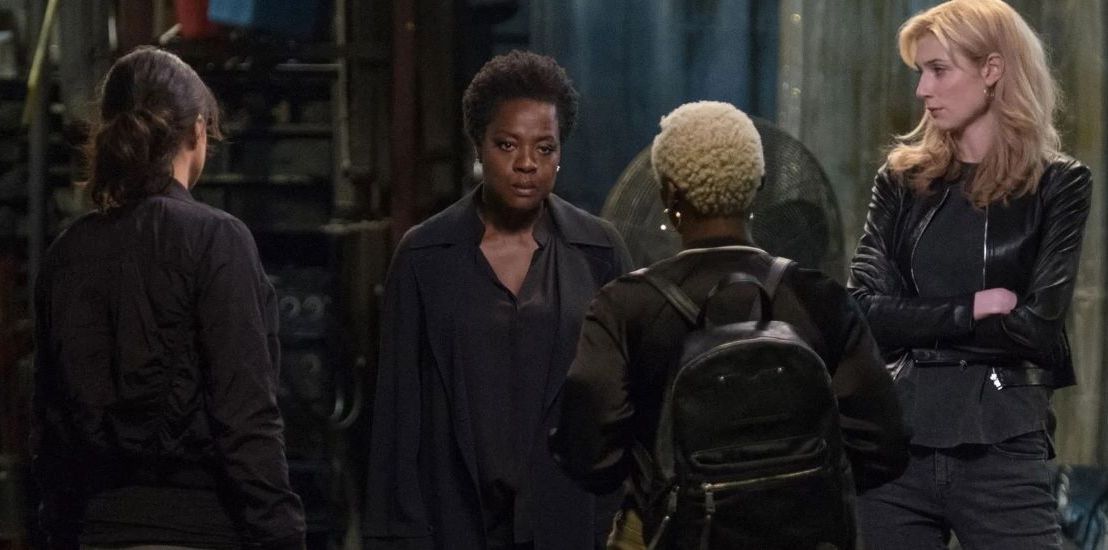
A getaway goes wrong and Harry Rawlings (Liam Neeson) and his criminal gang all wind-up dead and their loot burned up. Their last job was cleaning out the election fund of gangster-turned-electoral-candidate Jamal Manning (Brian Tyree Henry). Manning believes he’s owed a debt by Harry’s widow Veronica (Viola Davis). On the hock for millions, Veronica has no choice but to recruit the widows of Harry’s gang to help her pull off the next job Harry planned: cleaning out the campaign fund of Manning’s electoral rival Jack Mulligan (Colin Farrell).

Adapted from an 80s British TV mini-series, Widows has been run through Steve McQueen’s creative brain, emerging as a compelling, beautifully shot crime drama mixing social, racial and gender commentary with blistering action. It takes a traditionally masculine genre – the crime caper – and places at its heart a group of women motivated by desperation and survival rather than the lure of lucre.

What’s particularly interesting is that none of these women fit the bill of the sort of person you expect to arrange a daring heist. Viola Davis’ Veronica is a retired teachers’ union rep; Elizabeth Debicki an abuse victim, treated terribly by her husband and selfish mother; Michelle Rodriguez a shop owner desperately trying to give her kids a chance, despite her husband’s reckless gambling. Even the driver they hire, played by Cynthia Erivo, is a hairdresser and babysitter. These women are a world away from the ruthless criminals you’d expect to pull off this kind of operation.

It’s probably why they are routinely underestimated and patronised by men. Veronica is advised clear her debt by selling either everything she owns and disappear. As with the rest of the women, the world expects her to put up and shut up. These are women defined by their husbands and the expectation that their needs are subordinate to others’. Debicki’s Alice is all-but pushed into escort work by her demanding mother, while Rodriguez’s Linda is blamed by her mother-in-law for her husband’s death. But these women have a steely survival instinct that makes them determined and (eventually) ruthless enough to take this job on.

Davis is superb as a determined and morally righteous woman, whose principles are more flexible than she thinks. She efficiently (and increasingly sternly) applies her organisational skills to planning the heist, pushing her crew to adapt her own professionalism. Davis wonderfully underplays Veronica’s grief, not only at the loss of her husband but also the recent death of her son (shot by police officers while reaching to answer his phone behind the wheel of an expensive car – in front of a wall of Obama “Hope” posters, a truly striking visual image).

Her co-stars are equally impressive. Debicki has mastered the mix of vulnerability and strength behind characters like this (how many times has she played suffering, glamourous gangster molls?). Her Alice gains the self-belief to push back against those exploiting her. Rodriguez beautifully balances grief at the loss of her husband with fury at the financial hole he has left her in. Erivo gets the smallest role, but makes Bella dry, loyal and sharp. All four of them use the way men underestimate them – seeing them as widows, wives, weak or sex objects – to plan out their heist.

The reversal of gender expectations crosses over with the social political commentary McQueen wants to explore. This sometimes works a treat: the flashback to the shooting of Veronica’s son is shockingly effective. But the film’s dives into the Chicago political scene and the deep class divisions in the city don’t always have the impact they should. There is a marvellous shot – all in one take, mounted on the car bonnet – as Farrell’s Mulligan travels (in a few minutes) from a photo op in a slum back to his palatial family home, emphasising how closely extreme wealth and poverty sit side-by-side in America.

Both candidates are corrupted in different ways. Jamal Manning – a knife behind a smile from Brian Tyree Henry – is a thug talking the talk to line his pockets. Farrell’s Mulligan has more standards – and you wish for more with this fascinating put-upon son part on-the-take, part genuinely wanting to help. His domineering dad – an imperiously terrifying Robert Duvall, who wants to backseat drive his son in office – demeans his son, shouts racial slurs and bullies everyone around him. Politics: your choice is the latest off-spring of a semi-corrupt dynasty or a literal criminal.

But the film doesn’t quite find the room to explore these issues in quite as much detail as you feel it could: it’s a strong hinterland of inequality, but you want more. McQueen however, does have a gift for unique character details that speak volumes: the women’s operation is shadowed by an electric Daniel Kaluuya, as Manning’s calm yet psychotic brother, who listens to self-education podcasts on Black history and shoots people without a second thought. He, of course, underestimates the women as much as everyone else. That’s as much of a political statement as anything else: none of the men in this film seem to even begin to think that they could be in a world which is truly equal.

The film adds a late act reveal that doesn’t quite work – and the film as a whole is trying to do a little too much – but it’s a confirmation of what a gifted and superb film-maker Steve McQueen is. McQueen shoots even conventional scenes in unique and interesting ways – check out his brilliant use of mirrors throughout – uses editing superbly to set tone and is brilliant at drawing the best from talented actors. Widows is crammed full of terrifically staged scenes and gallops along with pace and excitement. It’s a fine example of a great director turning a genre film into something deeper.

Bugsy (1991)

Bugsy (1991)

Old school glamour is the order-of-the-day in this luscious but slightly empty gangster film

Director: Barry Levinson

Cast: Warren Beatty (Ben “Bugsy” Siegel), Annette Bening (Virginia Hill), Harvey Keitel (Mickey Cohen), Ben Kingsley (Meyer Lansky), Elliot Gould (Harry Greenberg), Joe Mantegna (George Raft), Bebe Neuwirth (Countess Dorothy de Frasso), Bill Graham (Charlie Luciano), Lewis van Bergen (Joe Adonis), Wendy Phillip (Esta Siegel), Richard C Sarafian (Jack Dragna)

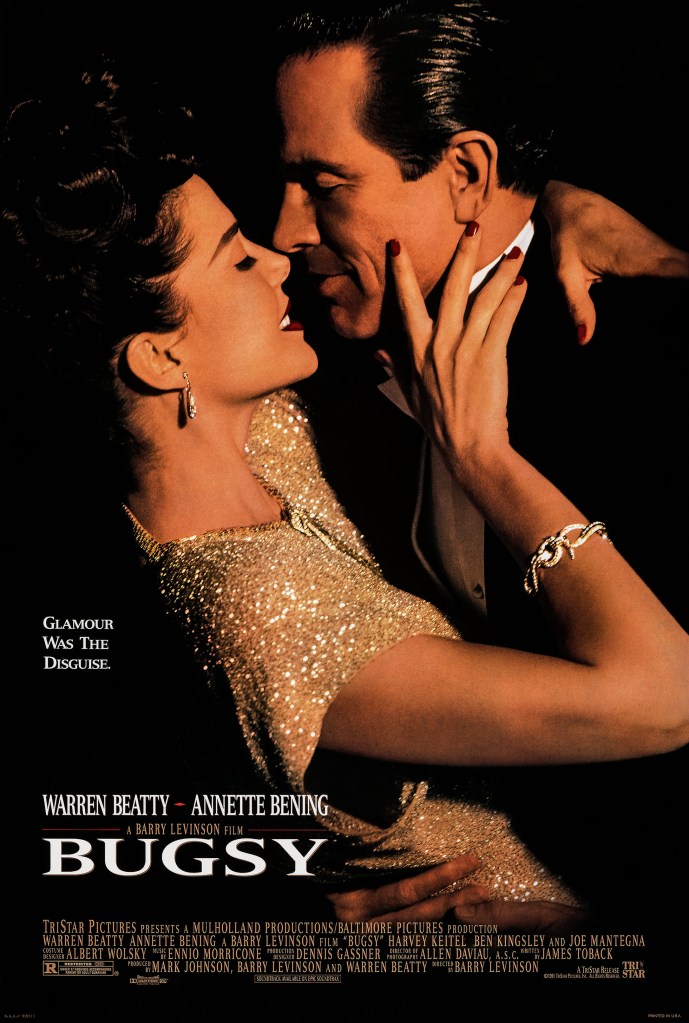
Las Vegas: the city of dreams for gangsters. As Ben (“Bugsy” – but don’t call him that) Siegel (Warren Beatty) tells a room full of gangsters when he’s pitching for their investment, like a hyper-violent Dragon’s Den: build the largest city in a state, you own the state, own the state and you own a slice of America. Imagine how the money can come rolling in then. It’s fair to say the mobsters aren’t so certain – and maybe Las Vegas would never have been a huge success if Bugsy had run it rather than being whacked – but God knows their investment paid out millions of times over.

The dream of building Las Vegas is at the centre of Beatty’s passion project (in this one he just played the lead and produced, dropping a couple of hyphens compared to Reds), a Golden-hued, romantic biopic of notorious gangster (and killer) “Bugsy” Siegel. Siegel sees what no-one else could see: how a city in a law-lax desert could become a mecca for gamblers, and crime could reap the profits. But the project goes millions over budget – not helped by girlfriend Virginia Hill (Annette Bening) creaming millions off the top. Trouble is Bugsy’s investors aren’t the sort of guys who shrug their shoulders at failed investments.

You can see what attracted Beatty to Bugsy. For all it’s about gangsters, I couldn’t escape the feeling Beatty sees Bugsy as something akin to a fast-talking movie producer. Bugsy spins elaborate stories for his backers of how their investment will pay-off, builds fantasies on a huge scale, won’t accept any compromise (a load-bearing wall should be knocked down if it’s blocking the view of the pool!), pouring his heart-and-soul into every detail of his vision. It doesn’t feel a world away from the same control-freak energy Beatty poured into Reds (Bugsy is basically financier, manager, backseat architect and marketing man for his dream).

Bugsy feeds a lot off the fascinating two-way admiration street between Hollywood and gangsters. Beatty’s Bugsy is enamoured with Hollywood, even shooting a (terrible) test reel to try and break into the movies. He’s thrilled to be hanging around with old pal George Raft (a muted Joe Mantegna), who seems equally jazzed to hook up with notorious criminals. Hollywood laps up the notoriety of criminals, both on-screen and off. For his Flamingo launch, Bugsy wants to stuff the place with stars (to his fury, bad weather prevents them arriving), and schmoozing celebrities is at least part of what is going to make the City of Sin such a fun place.

Levinson’s film is shot with a romantic lusciousness, a sepia-tinged nostalgia that wants you to soak up the glory of the costumes, sets and the cool of being a quick-witted gangster who gets all the best girls. It’s very different from the real Bugsy, a brutal killer with a huge capacity for violence. The film tries its best to match this, but can’t escape the fact that Beatty is way more suave and charming than Bugsy deserves. For all we’re introduced to him gunning down a cheating underling – and we see him brutally beat others for bad-mouthing Virginia or using his loathed nickname – he never feels like a brutal criminal, but more like a flawed, romantic dreamer with a temper.

It’s hard not to compare Bugsy with the best works of Scorsese from the same era. Goodfellas knew that, under the surface glamour, this was a dog-eat-dog world and that there was no romance at the end of a bullet. Casino (which followed a few years later, a sort of semi-sequel) sees the true vicious sadism and greed at the heart of this city-building operation, while Bugsy sees it more as a lavish dream and a tribute to a sort of visionary integrity. Even seeing Bugsy gunned down in his own home by a sniper, doesn’t carry  with it the sort of inevitability it needs. As Scorsese understands, this way of life is like playing Russian roulette forever – eventually the chamber is going to be full. For all Bugsy literally plays roulette, it never feels like he’s playing with fire, more that he’s reaching slightly beyond his grasp.

Perhaps Levinson doesn’t quite have the vision to make the film come to life or stamp a personality on it. It feels like a film that has been carefully produced and stage-managed to the screen – and Levinson deserves credit for marshalling such an array of commanding personalities together to create such a lavish picture. But it’s muddled in its message. Is Bugsy actually worth making a film about? What are we supposed to understand from this: was he a killer out of his depth, or an unlucky dreamer? Bugsy wants him to be both, but fails to make a compelling argument for either.

Beatty is impressive in his charisma though, for all he never quite seems to have the edgy capacity for instant violence the part needs. He does capture Bugsy’s desire for self-improvement, from the Hollywood dreams to the eternal elocution lessons he repeats over-and-over like a mantra. His desire for glory even manifests as a bizarre fantasy that he is destined to assassinate Mussolini. It also perhaps explains why he’s drawn to Virginia, a would-be starlet. Annette Bening gives arguably the most impressive performance (but, inexplicably, was practically the only major figure involved in the film not to pick up an Oscar nomination) as a woman who is an unreadable mix of devoted lover and selfish opportunist, leaving us guessing as to her real intentions and feelings.

There is good support from Keitel (hardly stretching himself as Bugsy’s number two Mickey Cohen), Kingsley (an ice-cool but loyal Meyer Lansky, unable to stop Bugsy destroying himself) and, above all, Elliott Gould as Bugsy’s hopeless, pathetic best friend. Bugsy though, for all it’s entertaining, feels like a mispackaged biopic that wants to turn its subject into a romantic figure, unlucky enough to be rubbed out before he could be proved spectacularly right. This soft-soap vision doesn’t ring true and misses the opportunity the film had to present a more complex and nuanced view of the era and its crimes.

Murder by Decree (1979)

Murder by Decree (1979)

Sherlock Holmes investigates Jack the Ripper in this overlong but enjoyable Doyle pastiche

Director: Bob Clark

Cast: Christopher Plummer (Sherlock Holmes), James Mason (Dr John Watson), David Hemmings (Inspector Foxborough), Susan Clark (Mark Kelly), Frank Finlay (Inspector Lestrade), Anthony Quayle (Sir Charles Warren), Donald Sutherland (Robert Lees), Geneviève Bujold (Annie Crook), John Gielgud (Lord Salisbury)

In the world of Sherlock Holmes pastiches, it’s a popular sub-genre: Sherlock Holmes vs Jack the Ripper. How would Holmes have taken on the murderer who has baffled generations since those brutal Whitechapel killings in 1889? Murder by Decree explores the idea, mixing Conan Doyle with a deep dive into (at the time) the most popular theory in Ripperology, the Royal Killings (Murder by Decree indeed!).

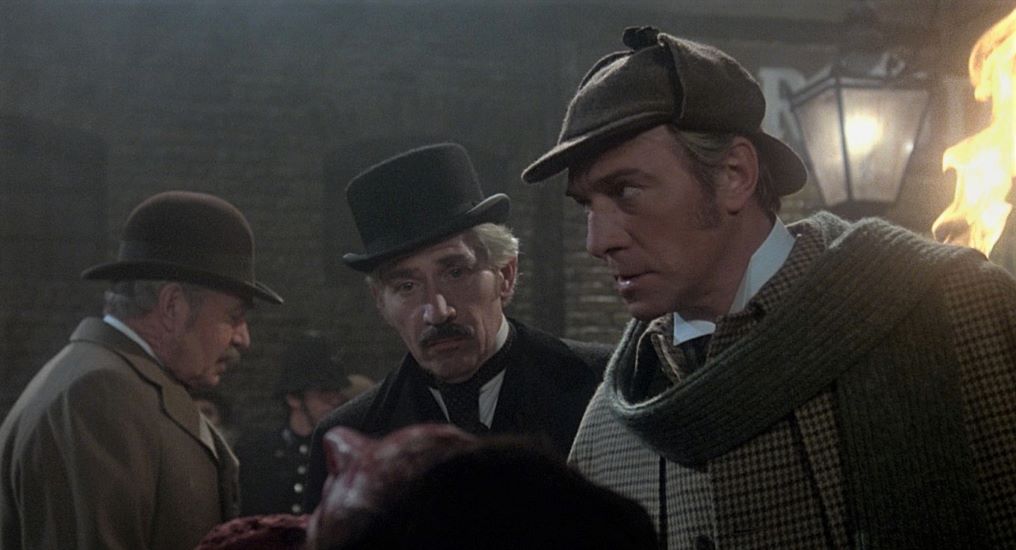
It’s all pulled together into a decent, if over-long, film, shot with sepia-toned stolid earnestness by Bob Clark. With its fog-ridden Whitechapel sets (carefully built but always strangely empty), heavy-duty actors sporting large sideburns, wavy-screen flashbacks and carefully unimaginative framing, there is something very old-fashioned about Murder by Decree. That also extends to its Ripper theory, steeped in a very 70s class-conscious conspiracy. The film pads out its two-hour run time with many a POV shot of the Ripper prowling the streets, which bring to mind Jaws and slasher horror films of the time.

Where Murder by Decree does stand out is in its imaginative characterisation of Holmes and Watson. They are presented as affectionate friends – Mason’s older Watson has a sweet indulgent elder-brother feeling to him, giving Plummer’s sparkly Holmes plenty to tease and bounce off. They split the casework between them – Watson is an equal partner, even if Holmes does the brainwork – and use their strengths to complement each other (notably, Watson frequently distracts people so Holmes can interrogate a witness more closely). They genuinely feel like long-term friends (there is a delightful sequence where Holmes is so distracted by Watson’s attempt to fork a pea, that he squashes it onto the fork – to be met with a forlorn “you’ve squashed my pea” from Watson, who likes the peas intact so they “pop in my mouth”).

They are dropped into the middle of a very much of-its-time Ripper theory. Murder by Decree centres on the theory that the murders were ordered (the film reluctantly suggests tacitly) by the establishment to cover up the secret marriage of Prince Edward, Duke of Clarence to a Whitechapel woman, Annie Crook. This alleged marriage produced a baby, and a royal doctor, sheltered by a Masonic conspiracy, sets about eliminating everyone who knows the truth. Of course, it’s almost certainly bollocks – but with its mix of secret societies, Royals, a lost heir and the rest, it’s an attractive story.

It gains a lot from the performances of the two actors. James Mason flew in the face of then popular perception by presenting a quick-witted, assured Watson, more than capable of looking after himself (he bests a blackmailing pimp in a street fight and is very comfortable with guns – far more than the reticent Holmes). He’s still the classic gentlemen, who loves King and Country, but also shrewd, brave, loyal, able to win people’s trust and look at a situation with clear eyes.

With Christopher Plummer, Murder by Decree has one of the all-time great Sherlock Holmes. Plummer’s Holmes is refreshingly un-sombre, twinkly with a ready wit, who loves teasing Watson (cleaning his pipe with Watson’s hypodermic needles) and delights in his own cleverness. But Plummer takes Holmes to places no other film Holmes goes. The case as a devastating effect on him: he weeps at the fate of Annie Crook (consigned by conspirators to a slow death in an asylum) and furiously attacks her doctor. When the conspiracy is unmasked, he emotionally confronts the Prime Minister and berates himself for his failures. There is a depth and humanity to Plummer’s Holmes unseen in other versions, a living, breathing and surprisingly well-adjusted man, unafraid of emotion.

Sadly, the film takes a little too long to spool its conspiracy out. Rather too much time is given to an extended cameo by Donald Sutherland as a pale-faced psychic who may or may not have stumbled upon the killer. There are a lot of unfocused shots of that killer, all swollen black eyes and panting perversion. It relies a little too much on a Poirot-like speech from Holmes at the end explaining everything we’ve seen. But there are strong moments, best of all Geneviève Bujold’s emotional cameo as the near-catatonic Annie Crook, cradling in her arms a memory of her stolen child.

There are many decent touches. The film is open in its depiction of the filth and squalor of life in Whitechapel – a pub is an absolute dive, and the women pretty much all look haggard and strung out. It has a refreshingly sympathetic eye to the victims, with Holmes denouncing the attitudes of both Government and radicals (looking to make political hay from the killings) who see them as lives without intrinsic worth. Holmes places no blame or judgment on them, or the choices life has forced on them, which in a way puts him (and the film) quite in line with modern scholarship (even if there is the odd slasher-style shot of mangled corpses).

The main issue is the film never quite manages to come to life. It’s a little too uninspired, a bit too careful and solid where it could have been daring and challenging. There are good supporting roles: Finlay is a fine low-key Lestrade (at one point persistently raising his hand to ask his superior permission to speak) while Gielgud sells the imperious Lord Salisbury. There is enough here for you to wish the film just had a bit more of spark to lift it above its B-movie roots. But in Plummer and Mason it has a Holmes and Watson to treasure – and for that alone it’s worth your time.

Calm with Horses (2020)

Calm with Horses (2020)

Irish gangsters manipulate a violent but needy boxer in this well-made debut

Director: Nick Rowland

Cast: Cosmo Jarvis (Arm), Barry Keoghan (Dymphna), Niamh Algar (Ursula), Ned Dennehy (Paudi), Kiljan Moroney (Jack), David Wilmot (Hector), Anthony Welsh (Rob), Simone Kirby (Jules)

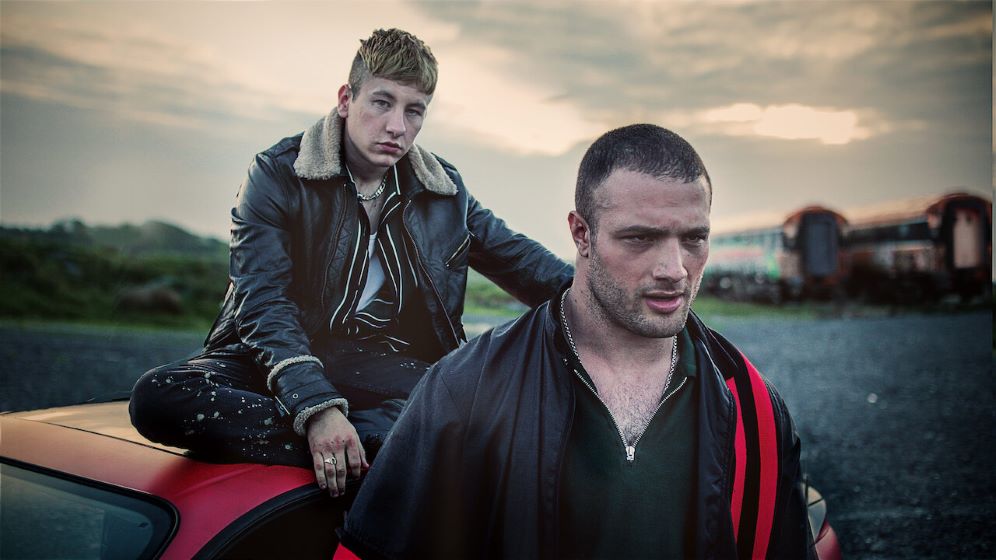
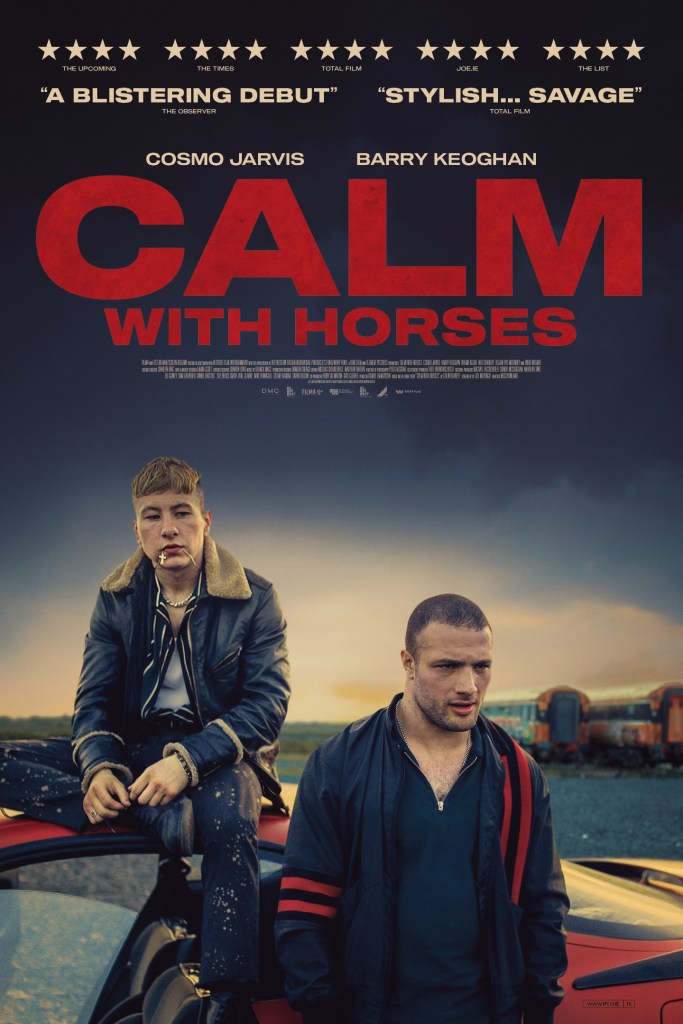
In rural Ireland a former boxer, Arm (Cosmo Jarvis), has found a new outlet for violence as an gang enforcer. But Arm is, at heart, a gentle soul, and his desire to belong and be part of a “family” is effectively exploited by the gang, especially his weaselly, bullying boss Dymphana (Barry Keoghan) who treats him like an affectionate pet-dog. His ex, Ursula (Niamh Algar), mother to his autistic son Jack, wants him to change his ways or stay out of their lives. But can Arm change?

Rowland’s film has a deliberately seedy quality to it, shot with a grimy intensity and crawling along on its belly among the mud and filth of Irish crime gangs. It’s a thrilling expose though of how crime takes and takes and is never satisfied. It’s turned Arm into a shell, throwing him the odd bone of inclusive comfort, then ordering him out like a rabid dog to hand out another beating to anyone who has crossed the family.

The main target is a man the heads of the family suspect of raping their teenage niece – although whether this was genuine sexual assault or simply a question of perverse family pride is left open. Arm opens the film by handing out a vicious beating – albeit one where he carefully lays out the ground rules with his victim before going about it with a punch-clock sense of duty. It’s what Arm is used for – a not that bright, piece of muscle who, despite his intimidating presence, will do (almost) anything for anyone who makes him feel wanted.

Even if the main person who does is as a dastardly as Dymphana. Keoghan is very good as a snide, insidious small-time crook, who openly calls Arm his dog and fills his head with prejudices and suspicions designed to keep him in his place. If he’s the dark angel, then Ursula is the good one: Algar equally brilliant as a decent, kind, supportive person who has come to the end of her tether with a man who she now feels is a danger to the fragile temperament of her autistic son.

It’s the fate of this son that will penetrate through the dead exterior shell that surrounds Arm, and make him start to question his own life. There is more than a hint that the fragile, timid, surly Arm – beautifully played, with a haunting gentleness under the violent exterior by Cosmo Jarvis – suffers from a similar condition to his son. Like him, he finds rage he can’t control bubbling up inside him (Arm is hopelessly ill prepared for helping his son during Jack’s emotional outbursts). He at times lacks an emotional intelligence to understand how people are treating him and why. It’s something Ursula knows and recognises – and why she gives him as many chances as she does.

Like his son, Arm finds himself calmed by engagement with animals (the title comes from Jack’s therapy sessions, horse riding). He also, buried somewhere in him, has a strong sense of right and wrong and eventually finds the courage to question his orders, as he begins to understand he really belongs not with them but with his ‘true’ family. His motivations shift from simply pleasing his masters to finding the money Ursula needs to move to Cork and place Jack in a special-needs-school, a need for his son that he slowly learns to place above his own wants and desires.

Eventually this explodes into scenes of retributive violence, shot by Rowland with an immersive intensity (there are some particularly uniquely filmed country-lane car-chase scenes, with the camera mounted on the car at an unusual angle). The violence that has lurked only just beneath the surface of the crime family, bubbles savagely to the top as it’s made clear that even the slightest deviation from what the family wants or expects from its enforcer will never be tolerated.

At times, Calm with Horses is a little too reminiscent of other crime dramas: for all its intelligent and skilful construction and playing, there isn’t a lot that feels really original here. Its influences are plain, but what it has is an intelligent empathy for its characters, and their situations, that constantly rewards you. At times, these characters surprise you with how far they will go: at others they disappoint you with their selfishness. But, thanks to the acting and direction, they always feel real.

Calm with Horses is an impressive debut, confident and exciting. Jarvis is superb as an inarticulate, unaware gentle-ish giant, with Keoghan and Algar outstanding in support (both were BAFTA nominated). It’s grimy, matching the dangerous world its set in, but it also has flashes of hope and understanding in it, little moments of calmness that pepper the darkness. It’s a fine crime drama.

Grand Hotel (1932)

Grand Hotel (1932)

A hotel has an all-star check-in desk in this Best Picture winning drama

Director: Edmund Goulding

Cast: Greta Garbo (Grusinskaya), John Barrymore (Baron Felix von Gaigern), Joan Crawford (Flaemmchen), Wallace Beery (General Director Preysing), Lionel Barrymore (Otto Kringelein), Lewis Stone (Dr Otternschlag), Jean Hersholt (Head Porter Senf), Morgan Wallace (Chauffeur)

Grand Hotel: “People coming, going. Nothing ever happens”. Of course, despite those opening remarks by war-scarred veteran and permanent resident Dr Otternschlag (Lewis Stone), nothing could be further from the truth. In this, one of the first “All-Star-Extravaganzas” (every MGM mega-star in one movie!) the eponymous Berlin hotel is the host to an ocean of drama over the course of one twenty-four hour period. Scooping an Oscar for Best Picture (setting a surely-never-to-be-equalled record of being the only Best Picture winner to only be nominated in that category), Grand Hotel was a huge hit, and great-big-old-fashioned soapy fun.

Confidently directed by Edmund Goulding, the film threads together its plots very effectively, moving smoothly from star-to-star. The five stars take up nearly 90% of the dialogue just by themselves (with all those egos there wasn’t time for anyone else to have so much as a line) but what stars: three then-and-future Oscar winners and two legends in John Barrymore and Garbo.

Each of them has more than enough to sink their teeth into. Garbo is a maudlin ballerina, teetering on the edge of depression, who falls in love with Raffles-like jewellery thief Baron von Gaigern (John Barrymore). The penniless Baron – who steals to live – befriends Otto Kringelein (Lionel Barrymore), a deceptively spry old-man, suffering from a terminal disease and using his savings to see how the other half lives. Kringelein’s former employer Preysing (Wallace Beery) is desperately trying to negotiate a merger to save his job. His stenographer is would-be-actress-part-time-glamour-model Flaemmchen (Joan Crawford), who is flirting with the Baron and also befriends Kringelein. Inevitalby there are life-changing consequences.

If you are a sucker for grand, soapy, old-fashioned drama like this, you’ll find much to enjoy in Grand Hotel. The plots it peddles were pretty cliched and predictable even then, but they are delivered by a series of stars at the top of the game who invest the film with every inch of their glamour. They make the hodge-podge of stories work rather well, and the film even manages to pull out a late shock death that’s genuinely a surprise, both in its suddenness and brutality.

But then Grand Hotel is a pre-code film, so it’s not afraid to acknowledge sex exists and violence has nasty consequences. Crawford’s Flaemmchen is a confirmed flirt, not ashamed to accept an invitation to an ‘adjoining’ room with Preysing to secure her job. Neither is the supremely sexy Crawford (light, winning and possibly the best thing in the film) afraid to all but proposition the Baron. Not surprisingly Crawford was worried more censorious States would cut large parts of her role (she was right). But sex still runs through Grand Hotel: the Baron creeps into Grusinskaya’s room to rob her, and ends up sharing the night (and certainly not in separate beds).

As Grusinskaya, Greta Garbo gets possibly her most iconic line (“I want to be alone”) though her matinee idol pose-striking at times more than a little artificial today. However, what does come across is the power of her personality as a performer (like Marlene Dietrich at this time, there is something utterly fascinating about her). In other hands, the role (with its pity-me dialogue giving way to flashes of youthful, passionate abandon) would look a bit silly, but Garbo makes the whole thing work though force of personality alone.

She’s well matched with John Barrymore at the height of his powers as America’s greatest actor. Barrymore has a matinee idol swishness here, a relaxed romanticism that always makes us sympathise with him, even though he’s a self-confessed liar, cheat and thief. This gentlemen thief may be penniless, but he’s far from ruthless: he treats Kringelein with respect, is genuine in his feelings for Grusinskaya (although his repeated assurances that he will definitely make it the train station to meet her tomorrow is enough of a flag that something is bound to go wrong) and despises the bullying Preysing.

As Preysing, Wallace Beery plays the only unsympathetic character (naturally, despite the film’s German setting, he’s the only one with a Teutonic accent) with a bravado that dances just-this-side of OTT. By contrast, Lionel Barrymore (brother to John – and its very nice seeing these two play so many scenes together) is the film’s heart as a sweet, gentle and endearing old man who is just delighted to be living the dream, even if only for a few days.

It’s all shot in a revolutionary 360° set. The hotel foyer, where the film opens, was one of the first completely constructed sets (many films before constructed their sets like traditional proscenium theatre sets) and Goulding’s camera takes advantage of this in the opening sequence by moving fluidly in a series of long takes that introduces each character and sees them first interacting with each other. There are some other striking images, including a Jason Bourneish wall climb John Barrymore’s Baron carries out to bridge the gap between one balcony and another – although many of the scenes in hotel rooms go for traditional straight-on set-ups.

The film is focused on being a grand entertainment – and, to be honest, little more. Perhaps that’s why, despite being set in Berlin in 1932, there is no mention of any events in the country at that time. Even more surprisingly, there is no mention of the depression – despite it surely being a major factor in Preysing’s desperation, the Baron’s loss of his wealth and Flaemmchen’s need for a job. But that would add weight to a film that wants a light, fun tone. Grand Hotel has inspired a legion of Mills and Boon style stories. It might look an odd Best Picture, but it’s had plenty of influence.

French Connection II (1975)

French Connection II (1975)

Change of setting isn’t really enough to justify the existence of this half-hearted sequel

Director: John Frankenheimer

Cast: Gene Hackman (Detective Jimmy “Popeye” Doyle), Fernando Rey (Alain Charnier), Bernard Fresson (Inspector Henri Barthélémy), Philippe Léotard (Jacques), Ed Lauter (General Brian), Charles Millot (Miletto), Jean-Pierre Castali (Raoul Diron), Cathleen Nesbitt (Old Lady)

Did The French Connection really need a sequel? Friedkin’s original was a self-contained gem, based on a true story, that even ends with a series of “what happened next” captions. But there was enough of a foot in the door for a completely fictionalised resolution to fates left hanging. French Connection II has some similarities with the original, but it’s also a slight film caught even more obviously than the first between documentary realism and trigger-happy actioner.

The whole film feels like it has been assembled in a rush. The plot is incredibly slight. “Popeye” Doyle (Gene Hackman) arrives in Marseilles to help the police track drug kingpin Alain Charnier (Fernando Rey). Doyle doesn’t speak a word of French and charges around pissing everyone off and generally making a nuisance of himself. He’s grabbed off the streets by Charnier’s men. To get him to talk they spend weeks force-feeding him heroin until he’s hooked then cut off his supply. They then return him to the Marseilles police who lock him in a cell and help him go cold turkey. When he comes out if Popeye wasn’t mad before, he certainly is now.

That (long) sequence of heroin addiction and painful cold turkey is one of two things that really makes Frankenheimer’s sequel stand out. I think it must be what attracted Hackman to the film. Not only did the liberal Hackman (troubled by Doyle’s slight neo-fascism in the first film) probably enjoy the idea of seeing this guy hit rock bottom, it’s also an opportunity for an acting tour-de-force. Hackman is probably given more challenging material in this largely forgotten sequel than in his actual Oscar-winning role.

Weaned onto the drugs, Hackman’s body language shifts from defiant resistance to despondent, dope-strewn lethargy until he can’t be bothered to record the passing of days any more in his tally chart. He goes from being cuffed and dragged around, to blankly following his captors and rolling up his sleeve to accept another shot. But that’s nothing compared to the cold turkey scenes.

Locked up in a dingy cell under the police station (the French police worried about taking the blame and also feeling a brotherhood with this fellow cop), Doyle goes through withdrawal mourning – anger, bargaining and eventual grief – in a series of calmly shot, claustrophobic scenes that allows Hackman let rip. And he certainly does, deconstructing this proud man’s self-image until he’s a weeping mess, kicking doors, throwing food around and so full of self-loathing, he can barely face himself in the mirror. It’s hard to watch, and something truly unique – a twisted punishment for a drugs cop and a man who defines himself by his lack of reliance for anyone or anything else.

This long sequence takes up the centre of the film – and includes an equally difficult scene to watch, as Frankenheimer stages in (a single take) forensic detail the French police’s pumping of Doyle’s stomach to get a final (deadly) overdose out of his system. It’s quite unlike anything else I’ve seen before in a cops and robbers shoot-em-up (which is what most of the rest of the film, at heart, is) and you can guarantee it’s the one thing people will remember.

The other element that stands out is Frankenheimer’s – a long time Francophile – ability to shoot Marseilles not as a tourist destination, but a strikingly real urban environment. On top of this anti-picture-postcard environment, he stresses Doyle’s isolation. None of the French dialogue in the film is translated, leaving us as stranded as Doyle is in trying to understand what is going on and what people are saying. Doyle clumsily pantomimes for everything he wants, be that information from a suspect (he tries his toe-picking line to no effect what-so-ever) to a drink in a bar (a long exchange until he finally reaches an understanding with the barman on “whiskey”). Doyle, of course, has made no effort to learn any French and blunders about in a city he doesn’t understand, ruining operations and getting himself and others in trouble.

Aside from these moments though – and despite the film being well shot by Frankenheimer, with a nice continuation of the original’s drained out neo-realism – this is otherwise a conventional and unimaginative film that ticks a number of expected boxes. It has an action set-piece at a dry dock that feels unreal (and also copies the central idea of the car smuggling operation from the first film) and concludes in a chase and shoot-out that’s almost a copy of the original’s ending – with an ending even more sudden. For all Frankenheimer’s love of France, the film still has a suspicion for Europeans – be they smooth criminals or obstructive cops.

French Connection II tries a couple of different things, but never really makes a case for itself as a truly stand-alone film. It’s main rivalry between the hero and villain is dependent on having seen the first film and its slender plot veers into the sort of shoot-outs and set-pieces that don’t feel remotely like they are occurring in a ‘real’ world. It deserves credit for the bravery and honesty of its cold turkey sequence, but it’s a sequence caught in a film that otherwise offers little that’s truly unique.

The French Connection (1971)

The French Connection (1971)

A ruthless, obsessed (of course!) cop chases down a drug kingpin in this Best Picture winning crime drama

Director: William Friedkin

Cast: Gene Hackman (Detective Jimmy “Popeye” Doyle), Fernando Rey (Alain Charnier – “Frog One”), Roy Scheider (Detective Buddy “Cloudy” Russo), Tony Lo Bianco (Salvatore Boca), Marcel Bozzuffi (Pierre Nicoli – “Frog Two”), Frédéric de Pasquale (Henri Devereaux), Bill Hickman (FBI Agent Bill Mulderig), Ann Rebbot (Marie Charnier), Harold Gray (Joel Weinstock), Arlene Faber (Angie Boca), Eddie Egan (Captain Walt Simonson), Sonny Grosso (FBI Agent Clyde Klein)

Cops and criminals: do they have more in common than we’d like to think? In Friedkin’s Oscar-winning The French Connection, the lead cop and criminal are both obsessive, single-mindedly ruthless and locked into a cycle of actions that isn’t going to be change with one big bust. Look at them in isolation and its hard to tell at times which is which: the French drug dealer is a suave cosmopolitan type, unfailingly cultured and polite, but remorseless; the cop is a border-line racist and narcissist who doesn’t give two hoots about collateral damage, kills without remorse and whose life is one of tunnel-visioned obsession.

Based on a true-story – the model for Doyle, Eddie Egan, has a cameo playing his own boss – the film covers the arrival in New York of French heroin dealers, led by Alan Charnier (Fernando Rey) looking to make a killing with their prime product. Opposite them is narcotics officer Jimmy “Popeye” Doyle (Gene Hackman), who’s practically the dictionary definition of anti-hero. Doyle and Charnier engage in a battle of wits and force across New York during one blisteringly cold few days in Winter, and never mind who gets in the way.

The French Connection is about masculinity, and that no matter what many men don’t like to lose. Getting beat is certainly the main concern for Doyle, who I’m not sure has ever really thought twice about the impact of drugs (he’d be just as passionate chasing down coca-cola or stamps if you banned those). Neither has Charnier, with his reassured cool of old Colonial Europe, which just knows better than the nouveau Americans. (there is an underlying subversive fear of America being undermined by this suspiciously metropolitan Frenchman, the country’s best defence being a loud-mouthed, son of the streets).

Played superbly by Gene Hackman, Doyle is presented as a man we are invited to make up our own mind about. He’s obviously an effective detective and he doesn’t just go the extra mile: the job is a night-and-day obsession. He’ll spend hours pounding the streets, staking out a hotel on a rainy street, walk miles tailing a subject and barely spend a minute off-duty. He’ll also drive cars wildly though crowded streets, shoot a man in the back, rough-up suspects and treat others with an abrupt anger, xenophobia or both. As a model for the society he’s sworn to protect, he’s a disgrace – but is he the effective agent of crime-fighting we need?

Friedkin’s film largely aims to present Doyle as he is, within its documentary realism – although I’d argue the film repeatedly looks at his commitment and never-say-quit-energy with barely veiled admiration. The film is assembled with an on-the-streets immediacy reminiscent of The Battle of Algiers – added to by the casting of many non-actors in key roles. It’s shot with a drained-out series of muted colours (even more drained-out in Friedkin’s egotistical blu-ray remastering). All shot on location, it captures the slummy flavour of the rougher ends of New York. Right from the off, we see Doyle and Russo roughing up an informer in something between a slum and building site (including the famous “do you pick your toes in Poughkeepsie” exchange, a classic bit of psychological messing with criminals – incidentally check out Scheider trying not to corpse as Hackman roars through this.)

The investigation proceeds with a muted sense of grounded realism. There is a lot of time-consuming following, watching and taking notes. Word is picked up by informers. Careful surveillance work fills out the gang and its members. Doyle is constantly frustrated by bureaucratic demands, not to mention turf-war squabbles with the FBI (who, in addition, think he might be next door to a dirty cop which is pretty fair). Similarly, the criminals go through careful negotiations around timing, testing the purity of the goods and working out the best way of dodging the cops.

Friedkin’s film is so wrapped up in a perfect “slice of life” documentary realism shell, that it gets away with much of the second half being a piece of pure filmic flair. First and foremost is its famous car-chase. Narrowly surviving an assassination attempt from “Frog Two”, Doyle requisitions a car and hares through New York at 100mph trying to beat the elevated train “Frog Two” is escaping on, to the next station. In this superbly cut sequence, Friedkin pioneers the sort of low-angled front bumper shots that would be a staple of car chases for years to come. It’s pounding, gripping and brilliantly assembled, a raw slice of action that uses the film’s documentary style to trick you into thinking it’s something akin to the realism elsewhere.

But it’s a bit of filmic fantasy – and wouldn’t be out of place in Dirty Harry, the other 1971 film about a morally-complex cop. Doyle is certainly a less attractive person than Callahan – with no real moral feelings just a love of winning. Winning is what motivates him in this car chase: he has little interest in questioning the shooter (who has, to be fair, taken out several civilians, including a mother of a young baby) or preserving public safety and way more about getting revenge. He tears through the streets, sending civilians flying, scares Frog Two into killing two more people and finally caps it by shooting his unarmed would-be-killer in the back after a cursory warning. (Not the first time he’ll pull the trigger after only the most slender of warnings).

Winning is all that matters though. Charnier is just as bad. He ruthlessly exploits a patsy and has no concerns about bodies piling up. Fernando Rey’s impish smile and campily cool little wave to Doyle through the subway doors, after he has managed to shake him off in a marvellous sequence in a subway station, is all about enjoying a smug triumph. No wonder Doyle repeats the same gesture to him late in the film when the tables are turned.

It’s the way Friedkin’s film mostly doesn’t ask us to blindly root for Doyle that really makes it stand out. In many ways the film is less exciting – or even less intriguing a character study – than Dirty Harry. It uses its documentary realism heavily at times, to justify showing the sort of shocking, exploitative material (at one point, the camera lingers on the incidental victims at a car crash scene at distasteful length) that you would expect to find in Dirty Harry or Shaft. What Friedkin’s euro-inspired style – and Hackman’s committed playing – managed to do was make itself feel like it was making a higher artistic statement than those films, which played a much more conventional hand.

That and the sense that nothing has really changed. Early in the film Doyle and Russo charge into a bar – a bar by the way with an entirely black clientele, who Doyle delights in abusing – to seize whatever drugs people seem to have on them. It’s a basic clean-up and shakedown – but hours later you can be sure it will be look nothing happened there. Similarly, the film’s end credits reveal all involved basically dodged charges (except for the patsy for the smuggling of course), while the cops got transferred. We’ve got one small win at the cost of at least five lives.

I seem to change my mind on The French Connection every time I see it. Sometimes I think it’s not that different from a host of other police actioners released at the same time (add Bullit to that list). At others, I get gripped by its edgy mise-en-scene and Friedkin’s challenges to conventional morality. And I guess, a film that can make you switch your mind constantly, should be seen as some sort of classic.

Nightmare Alley (2021)

Nightmare Alley (2021)

A mysterious drifter gets more than he bargained for in del Toro’ flashy but unsatisfying film

Director: Guillermo del Toro

Cast: Bradley Cooper (Stanton Carlisle), Cate Blanchett (Lilith Ritter), Rooney Mara (Molly Cahill), Toni Collette (Zeena Krumbein), Willem Dafoe (Clem Hoatley), Richard Jenkins (Ezra Grindle), Ron Perlman (Bruno), David Strathairn (Pete Krumbein), Mark Povinelli (Major Mosquito), Mary Steenburgen (Felicia Kimball), Peter MacNeill (Judge Kimball), Paul Anderson (Geek), Clifton Collins Jnr (Funhouse Jack), Jim Beaver (Sheriff Jedediah Judd), Tim Blake Nelson (Carny Boss)

There isn’t any magic left in the world, it’s all show and tricks and no wonder. Nightmare Alley is del Toro’s follow-up to his Oscar-winning The Shape of Water and you can’t not admit it’s a triumph of style. It’s a glorious fusion of film noir and plush, gothic-tinged horror. There is something to admire in almost every frame. But it’s also all tricks and no wonder. There’s no heart to it, just a huge show that in the end makes nowhere near the impact you could expect.

In the late 1930s Stanton Carlisle (Bradley Cooper) is a drifter with a dark past, who is recruited as a labourer in a travelling carnival. Learning the ropes from freak show owner Clem (Willem Dafoe), he’s taken under the wing (in every sense) by mesmerist mind reader Zeena (Toni Collette) and taught the tricks of the art (observation and careful word codes using an assistant to guess names, objects and other facts) by Pete (David Strathairn). Eventually Stanton and his love, circus performer Molly (Rooney Mara), head to the big city where, after two years, Stanton reinvents himself as celebrity mind-reader and medium. There Stanton gets involved with psychiatrist Lilith Ritter (Cate Blanchett) in a long con where he will use the recordings of her sessions with patients to act as a medium to put them in touch with their lost ones. But is there a danger Stanton isn’t ready for in one of his clients, powerful businessman Ezra Grindle (Richard Jenkins)?

Nightmare Alley looks fabulous. But it’s hellishly overlong and curiously uninvolving. It’s like Del Toro fell in love with the whole project and forgot to search for the reason why somebody else would love it. It’s a strangely unshaped film, alternating between long, loving scenes glorying in the dark mood, baroque performances and design but then makes drastic, swift jumps in character psychology that constantly leaves you grasping at engaging with or understanding the personalities of its characters.

Its design is faultless though – it’s no surprise that its only Oscar nominations outside the Best Picture nod were all in technical categories. Dan Lautsen’s cinematography is inky black, with splashes of all-consuming colour. It’s a marvellous updating of film noir, with deep shadows spliced with angles reminiscent of Hammer-style horror. The production design is a labour of love, the carnival sets a hellish nightmare of unsettling shapes, forms and structure contrasting with the art deco grandness of the big city. The design is pretty much faultless, a real labour of love.

But the same effort didn’t go into pacing and story. This is a slow-moving, self-indulgent film, that frequently seems to be holding itself at arm’s length to make it all the easier for it to admire itself. It looks extraordinary, but it’s a frequently empty experience, more interested in mood and striking imagery than character and emotion.

Bradley Cooper gives a fine performance as Stanton. He has an air of cocksure charm, and Cooper skilfully shows this is largely a front of a man who, when push comes to shove, is capable of sudden and unflinching acts of violence. We get an early hint of this when he reacts to being struck by an escaping circus freak with unhesitating brutality. It recurs again and again in the film, and Stanton proudly states his avoidance of alcohol with all the assurance of a man who knows the bottle could unleash dark forces that he could never control. Cooper is vulnerable but selfish and above all becomes more and more arrogantly convinced of his own genius and bulletproof invulnerability, so much so that he drives himself further and further on into self-destruction.

There is some rich material here, so it’s a shame that for all that we never really seem to be given a moment to really understand who he is. Much has to be inferred from Cooper’s performance, since the film seems content to state motivational factors – troubled parental relationships, greed, ambition, a desire to make something of himself – without ever crafting them into a whole. Stanton remains someone defined by what he does.

And Stanton is the only character who gets any real oxygen to breathe, with the others largely ciphers or over-played caricatures. Rooney Mara as his gentle love interest is under-developed and disappears from the film for long stretches. Cate Blanchett gives a distractingly arch performance, somewhere between femme fatale and Hannibal Lector and is so blatantly untrustworthy it’s never clear why Stanton (an expert reader of people!) trusts her completely. Richard Jenkins is miscast as a ruthless businessman, lacking the sense of danger and capacity of violence the part demands.

Most of the rest of the cast are swallowed by the long carnival prologue, that consumes almost a third of the film but boils down to little more than mood-setting and a repeated hammering home of a series of statements that will lead into a final scene twist (and I will admit that is a good payoff). The carnival seems like a self-indulgent exploration of style, and several actors (Perlman, Povinelli and even Collette) play roles that add very little to the film other than ballooning its runtime.

The earlier section would have perhaps been better if it was tighter and more focused on Stanton and his mentor, well played by David Straithairn. I appreciate that would have been more conventional – but it would also have been less self-indulgent and helped the opening third be less of a stylish but empty and rather superfluous experience (since the film’s real plot doesn’t start until it finishes). Drive My Car demonstrated how a long prologue can deepen a whole film – Nightmare Alley just takes a long, handsome route to giving us some plot essential facts, without really telling us anything engaging about its lead character.

It makes for an unsatisfying whole, a cold and distant film packed with arch performances – although Cooper is good – and events that frequently jump with a dreamlike logic. It’s a marvel of design but way too much of a good thing, and constantly seems to stop to admire itself in the mirror and wonder at its own beauty. It becomes a cold and arch study of a film not a narrative that you can embrace. And you can’t the same about many of Del Toro’s other films – from Pan’s Labyrinth to Pacific Rim they’ve got heart. Nightmare Alley doesn’t really have that.

Klute (1971)

Klute (1971)

Paranoia runs rampant in this fascinating – and chilling – murder thriller that taps into into conspiracy thrillers

Director: Alan J. Pakula

Cast: Jane Fonda (Bree Daniels), Donald Sutherland (John Klute), Charles Cioffi (Peter Cable), Roy Scheider (Frank Ligourin), Dorothy Tristan (Arlyn Page), Rita Gam (Trina), Nathan George (Trask), Vivian Nathan (Psychiatrist), Morris Strassberg (Mr Goldfarb)

There is one question everyone asks when watching Klute: why the heck is it called Klute? Would calling the film Daniels have been too dull? Would Bree have made it sound like a history of cheese? Klute is dominated by its character study of Jane Fonda’s Bree Daniels, split between her desire to be an actress and the comforting sense of control and avoidance of intimacy her work as call-girl brings. Klute uses the conventions of the male detective movie to conduct a sympathetic, compassionate character examination of its female lead. Match that with Pakula discovering his affinity for creeping 70’s paranoia, and you’ve got one of the most interesting and rewarding films of the decade.

John Klute (Donald Sutherland) is a small-town cop called in as a private investigator after a six month New York police investigation fails to find his friend, businessman Tom Gruneman. The only lead they have is a series of obscene letters found in Gruneman’s office written to New York call girl Bree Daniels (Jane Fonda). Klute discovers Bree has no memory of Gruneman, but Klute believes she may be in serious danger. Together they investigate the crime further, which becomes more and more focused on a mysterious abusive client and even more complicated by the growing relationship between the quiet, reserved Klute and the strong-willed, independent Bree.

Klute uses the conventions of a gumshoe detective movie, spliced with a hard-hitting 70s fascination with grimy, sensationalist crimes (this was the same year as hard-bitten, shades-of-grey cops in Dirty Harry took on a serial killer and The French Connection explored the drugs trade), in this case the assault and murder of prostitutes. But this isn’t a whodunnit, or even really a detective story. The film is barely 45 minutes old before Pakula basically reveals who the killer is (the suspect list has only two people on it in any case). Most of the investigation takes place off screen. Some answers are kept vague. There is no cathartic moment of success.

Instead, the film feels far more like it’s using its Laura-ish set-up (the big difference here being the taciturn detective’s love interest is alive rather than just a painting) as a backdrop to deep dive in Bree’s personality. Bree is played with a stunning (and Oscar-winning) verisimilitude by Jane Fonda. Fonda immersed herself totally in the character, even living in the apartment set during shooting (Pakula had a working toilet installed) and developing a careful psychological background to Bree that is brilliantly introduced through our frequent cuts to her sessions with a coolly professional psychiatrist.

This is a portrait of a female sex worker on screen, where she’s neither a tragic or pathetic figure, or a hooker-with-a-heart-of-gold (the standard tropes). Instead, this is a woman struggling with a crippling fear of intimacy and a compulsion to control, who finds a freedom and release in acting out the fantasies of others. Bree speaks to her psychiatrist of being a call girl not as a curse or source of shame, but something she takes a sort of freedom from. It’s clear that really makes her sweat is not adjusting herself to whatever men want (faking an orgasm while checking her watch with one John, or acting out an elaborate, detailed fantasy for a lonely tailor) but the idea of having to be herself, to display something emotional and true.

And prostitution has the advantage over acting as she sets the terms. We are introduced to Bree as just one in a row of sitting actresses auditioning for an advert, each of them dismissively given a score from A to C. She later auditions for Shaw’s Saint Joan with a detailed, heartfelt reading (she’s clearly a good actress) which is stopped mid-speech by a bored director. With Fonda making clear that control is vital to Bree’s sense of well-being, no wonder she struggles with this dismissive world. Or that she finds a greater freedom in high-end prostitution, where we see she sets the terms with a business-like professionalism and is the centre of the focus and attention of her John’s for the whole of their session. This is a feeling she doesn’t get from anyone else.

What really scares her is the thought of a genuine emotional intimacy with Klute. In their first encounters she assumes she can seduce him with the professional ease she does most men, dropping naturally into her role of seductive dream-girl, offering him sex in return for recordings he has of her from his investigation. Later she will prove a point by coming to him in the night and seducing him with a pretence of vulnerability and fear, as if to prove to him (and herself) that she can work out exactly what mood she needs to control any man.

But it’s buried in genuine fear about emotional attachment. To her psychiatrist she talks about not understanding why Klute seems, with no ulterior motive, to be concerned for her safety and well-being despite the things he’s knows about her or that she’s done and said to him.

There is a marvellous scene where the two of them go shopping for fruit (Klute of course knows exactly how to choose the best fruit, he’s that sort of guy). First, she impulsively steals an apple like a naughty, impulsive child. When Klute responds with a bemused half-shock, she stands behind him, a grin spreading across her face, then she lightly rests her head (almost not touching) on his back – then follows him down the street, holding the end of his coat. It speaks worlds of how something in her emotional growth has been slightly stunted somewhere along the line. And the fact this intimacy is followed in the next scene by a drug-fuelled blow-out, speaks volumes of her fear of it.

It’s a brilliant performance by Fonda, throbbing with empathy and emotional complexity. She’s perfectly abetted by Donald Sutherland, who proves himself once again one of the most generous actors in the game. Klute is in many ways the typical rube in the big city, the one honest cop. But he also has a wet-eyed vulnerability, a tenderness and an urge to protect that as motherly as it masculine. He reveals very little emotionally, not from fear but from a shyness.

He’s also an observer. And Pakula’s film partly draws links between detective and voyeurism. Let’s not forget Klute also bugs Bree’s phone and follows her. The camera frequently shoots the action from distance, through windows and looking down on the action: the idea of being constantly observed lingers over the picture, giving it a rich vein of paranoia. The killer listens to disembodied audio recordings of Bree, and these frequently play over the action not only echoing this paranoia, but re-enforcing how her personality is a fractured one between the independent exterior and the less certain interior.

Pakula’s film pulls all this together into something creepy and unsettling but is also a fascinating character study. That is perhaps its best trick. You come into it expecting a film noir or a detective story. What you get is a compelling analysis of the psyche of one woman, who emerges into the picture and takes complete control of it. Perhaps that’s why it’s called Klute – it’s as much a part of the misdirection as everything else. With its psychological complexity and creeping sense of being watched, this would set the tone for many other films that followed in the 70s.