Category: Directors

A Matter of Life and Death (1946)

A Matter of Life and Death (1946)

A pilot is stranded between Earth and…somewhere else in this brilliant romantic fantasy

Director: Michael Powell, Emeric Pressburger

Cast: David Niven (Peter David Carter), Roger Livesey (Dr Frank Reeves), Raymond Massey (Abraham Farlan), Kim Hunter (June), Marius Goring (Conductor 71), Robert Coote (Bob Trubshaw), Kathleen Byron (Officer Angel), Joan Maude (Chief Recorder), Abraham Sofaer (Judge/Surgeon), Richard Attenborough (Pilot)
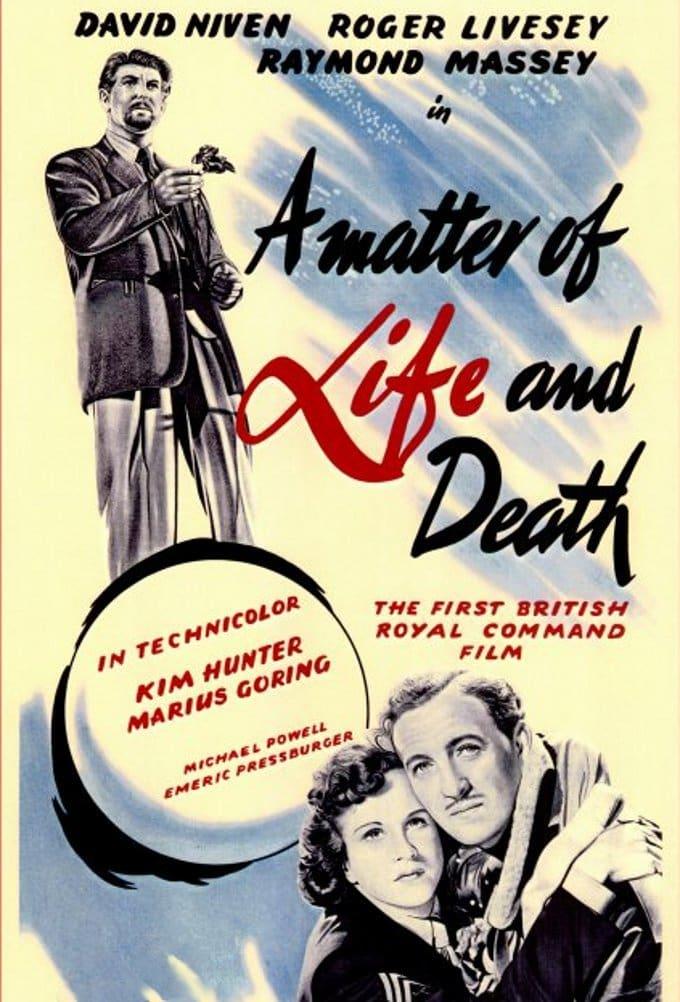
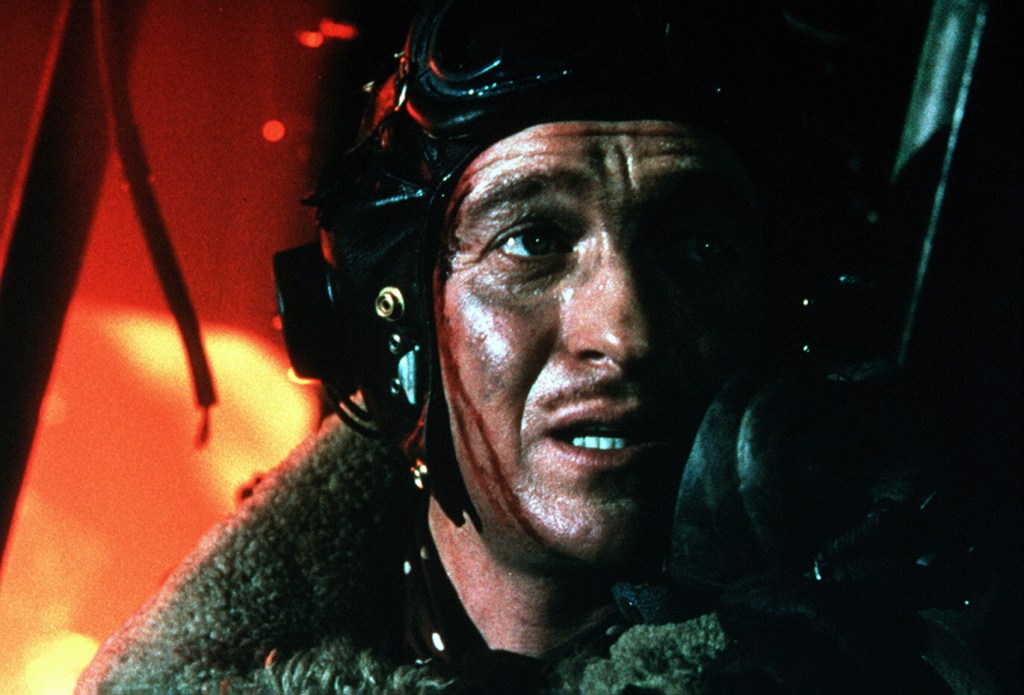
In the final days of World War II, a plane glides across the Channel in flames. The crew has bailed out, leaving only their skipper behind. Unknown to them, he’s not got a parachute – and is facing a choice between jumping or crashing to certain death. With only moments left to live, when is there a better time to fall in love? Quoting poetry and embracing what life he can in his final moments, Peter Carter (David Niven) falls in love with American radio operator June (Kim Hunter), the last person he expects to talk to. It’s stirring, sweeping, hugely romantic – and then Peter jumps at 50,000 feet.

So that’s it, right? Wrong. Peter washes up on the shores of Britain, not dead and practically on June’s doorstep. Happy ending? Perhaps not: at the end of a huge escalator linking our world to another (maybe the next?) Peter was expected. His “conductor” (Marius Goring), a French fop executed during the Revolution, whose job it was to take his soul “up” lost him in the fog. Now a man who isn’t supposed to be alive is walking around on Earth falling in love. Can it be allowed? Or will Peter need to head up that staircase? Or is all of this in fact in Peter’s head, a product of a head injury diagnosed by Dr Frank Reeves (Roger Livesey)? Either way, Peter faces two trials: life-saving surgery on Earth and a tribunal in that other place to decide whether he stays on Earth or not.

When released in America, AMOLAD was renamed Stairway to Heaven – a title rightly hated by Michael Powell. Part of the magic – and there is a lot of magic realism here in the most beloved of all British filmic fables – is the film’s carefully measured ambiguity. The film superbly doesn’t give any answers. The two worlds are clearly, visually distinguished and when Goring’s Conductor and others descend to Earth to freeze time and converse with Peter, their appearance is always foreshadowed with the same symptoms (smells and headaches) Frank diagnoses as part of Peter’s condition.

The beauty of AMOLAD is how wonderfully gently it explores the struggle of two nations – here represented by Peter and June – to emerge from the trauma of war and return to everyday life. From a world where death lies around every corner – where your plane can plummet to fiery doom in moments – they must readjust to one of romantic picnics, amateur theatricals and games of table tennis. Peter’s struggle to survive his surgery is a beautiful metaphor for returning to a life full of hope, possibility and looking forward rather than backward.

It’s why the visual impact of the film is so important. “Heaven” is shot in crisp black-and-white. As the Conductor says when travelling down to Earth, “one is starved of Technicolor up there”. This Heaven is a place of peace, but also of bureaucratic efficiency. Arrival lounges are staffed with decent but practical Angels (Kathleen Bryon is marvellous as the first of these we meet – and there is a fabulous shot from Powell that frames her in front of a clock, making the edges of its face appear like a halo around her head). There are rules and paperwork – in fact a whole city of clerks and arrival lounges. What it doesn’t have is the warmth and passion – the colour – of Earth. Down here, everything is in luscious, gorgeous Technicolor. Up there life is restful, but monochrome.

Jack Cardiff’s photography of AMOLAD – combined with Powell’s astute visual eye – crafts one of the most ravishing films you’ll ever see. Blues, oranges and reds practically pour off the screen into your eyes. Filters add a golden hue to much of what we see. The ramshackle details of locations – Frank’s cluttered library with its piles of books, June’s country-house-base – see every single detail captured in painterly beauty, colours popping out. Only Peter’s surgery room feels like a bridge between ”Heaven” and Earth, cooler filters stressing their blues and cool icey whites.
This is what Peter is fighting to stay in. A world of colour, of joy and poetry. Perhaps “Heaven” is just his imagination of what the afterlife could be like. It resembles the military operations he has spent the last few years emersed in. It’s filled with the historical generations he taught at university. Familiar faces up there fight his corner and represent him at the great trial to decide his fate. His surgeon on Earth shares the face of his judge in “Heaven”. Powell and Pressburger don’t lean too far either way – it’s all gloriously left open to our imagination.

And who, in 1946, wouldn’t want to believe in a heaven as reassuringly welcoming as this. (On a side note it’s refreshing to see a film from the 40s that depicts such a racially diverse after life). One where all are equal and questions of colour and creed are left aside. “Heaven” is packed with soldiers from all across the world – and the sheer volume of uniforms up there reminds us of the trauma down here.

AMOLAD is all about the world we might decide to live in after the trauma of war. It’s also about forging lasting bonds between two nations bought together to fight. No one feels more English than David Niven: and AMOLAD is, arguably, his finest performance. He makes Peter a man of casual wit and lightly worn intelligence, but with hints of the burdens he has carried across years of war. He’s the best of us Brits – and now he has fallen in love with the best of America. June, wonderfully played by Kim Hunter, is practical, brave and grounded. Their love (and the life they could spend together) becomes the battleground at the heavenly trial.
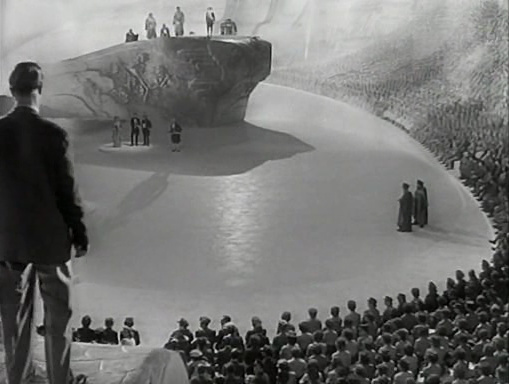
On the one side: a prejudiced revolutionary American (played with gusto by Raymond Massey) – on the other the perfect embodiment of English decency. There could have been no better choice of actor for this than the glorious Roger Livesey. Livesey’s Frank Reeves becomes a mix of English eccentric, master surgeon and Prospero-like magus. It’s no coincidence that among his hobbies is a large camera obscura with which he observes events on his village streets with a protective, grandfatherly care. His study is lined with books, his knowledge is infinite and he is always open to Peter’s tales of heavenly staircases and visitations from mysterious conductors. Then as his advocate in “Heaven” it is he who has the clear sight and judgement to focus the jury not on what divides us, but what unites us – what makes us all human, not what drives us apart.

AMOLAD is about what brings us together. It’s open about the flaws of Britain – the first trial jury is awash with Boers, Indians and other victims of Empire – but also a celebration of its virtues. It celebrates the melting pot of America – the second trial jury is made-up of an incredibly diverse selection of American citizens – and is a hymn to personal freedoms. Farlan picks up on what divides Britain and America – cricket vs American dynamism – but what unites us is our desire for life. So what does it matter if Brits can be austere or Americans so brash they raid a coke dispenser on arrival in “Heaven”. We’re still cousins.

All this helps capture the film as a universal fable, of love being discovered in the magical boundaries between worlds (its no coincidence we see Midsummer Night’s Dream being rehearsed by an American cast under a British vicar). This is a quiet, decent struggle about emerging from the horrors of war into the chance of a new world of love. It’s a struggle for Peter and June that is both very personal and hugely universal.  Powell and Pressburger’s film captures this perfectly in a film that’s sublimely directed and never-endingly rich in dialogue and visuals. It perfectly offers up a universal fable that speaks to the heart. It’s perhaps why this is their most beloved – and finest – hour.
The Quiet Man (1952)

The Quiet Man (1952)

Ford’s sweet and funny Irish fable is possibly his most purely enjoyable film

Director: John Ford

Cast: John Wayne (Sean Thornton), Maureen O’Hara (Mary Kate Danaher), Barry Fitzgerald (Michaleen Oge Flyyn), Ward Bond (Father Peter Lonergan), Victor McLaglen (Squire Will Danaher), Mildred Natwick (The Widow Sarah Tillane), Francis Ford (Dan Tobin), Eileen Crowe (Mrs Elizabeth Playfair), Arthur Shields (Reverend Cyril Playfair), Charles B Fitzsimmons (Hugh Forbes), James O’Hara (Father Paul), Jack MacGowran (Ignatius Feeney), Sean McClory (Owen Glynn)

John Ford wasn’t born in Ireland, but he loved the place in the way only the child of ex-pats could. The Quiet Man is a loving, romantic, almost fairy-tale view of Ireland, an affectionate feelgood fantasy that transcends any possibility of patronising its subject through its warmth and charm. It’s an unashamedly feel-good film, a delightful fable full of luscious scenery and tenderly sketched characters that plays out like a warm end-of-term treat where we are all invited to the party. It’s possibly Ford’s most purely enjoyable and heart-warming film.

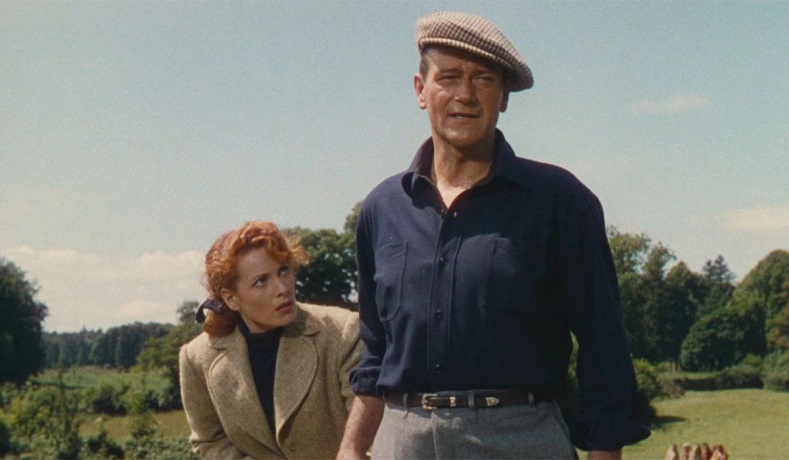
Set in 1920s Ireland, Sean Thornton (John Wayne) returns to his childhood home of Inisfree after growing up and becoming a boxer in Pittsburgh. Sean loves his home country, but with his American upbringing is out-of-step with the customs and traditions of Ireland – something that becomes very clear when he falls in love with Mary Kate (Maureen O’Hara), sister of local squire Will Danaher (Victor McLaglen). Their rules-bound courtship – overseen by matchmaker Michaleen Oge Flynn (Barry Fitzgerald) – eventually leads to marriage, but via tricking Will, who withholds Mary Kate’s dowry, the sign of her independence. Mary Kate wants Sean to fight for it – but the former boxer is haunted by the accidental killing of an opponent in the ring and wants to live-and-let-live. Problem is everyone, from Mary Kate down, sees that as cowardice.

Ford was desperate to make The Quiet Man, the rights for which he had paid $10 for in 1933 when the short story was published by Maurice Walsh (Ford ensured Walsh received another $5k when the film was finally made). B-movie studio Republic Pictures was the only one willing to take a punt on it. But, alarmed by Ford’s insistence to shoot in colour and (even more expensively!) on location, they were convinced they had a box office bomb on their hands. They insisted Ford and his cast made a western first – the literally for-the-money Rio Grande – to cover the expected losses. They even demanded Ford couldn’t make it longer than 2 hours. Ford screened the final 2 hours and 9 minutes cut to them, stopping the film on exactly the two hour mark and asking them what they’d cut. They released the film unchanged. The film was an Oscar-nominated smash-hit.

It’s not a surprise why, because the film is a whimsical delight. Ford isn’t often remembered for his sense of fun, but The Quiet Man is unarguably funny. It’s crammed with sight gags – from sly double takes (there is a delightful one from the railway station workers, who watch first a determined Sean then a horse walk straight past them), to Sean and Will grimacing in pain but smiling as they exchange a brutal handshake, to Mary Kate jumping over obstacles as Sean drags her back to the village to have it out with her brother. It famously ends with an extended comic set-piece as Sean and Will launch a mano-a-mano “Queensbury Rules” fistfight that takes most of a day, moves across the whole village, and is interrupted only by a break for a pint.

All of this takes place in an Ireland that, while it never feels entirely real, is drawn with such loving affection and cast with such careful exactitude that it hardly matters. Ford’s insistence on shooting all the exteriors on location paid off in spades. The country has never looked more ravishing than through Winton C Hoch’s technicolour lens. Rolling vistas, gentle brooks, quaint villages, perfect beaches. You totally understand why Sean, on arrival, simply stands on a stone bridge and stares across the valley of Inisfree, lost in memories and his emotions.

Sure, it’s a romantic vision. And 1920s Ireland wasn’t the sort of haven depicted here, where Catholic and Protestant lived in perfect harmony, politics never reared its head and the local IRA man is a jolly joker in the pub. If The Quiet Man had not been so well-meaning, you can imagine people taking offence at a picture of the country full of roguish charm, horse-drawn carriages, drinking and fighting. (You could say The Quiet Man shaped many Americans’ perceptions of what the country is like.) But Ford never makes any of this a subject of humour. In fact, it’s a subject of love. The joke is never on the Irish. Inisfree is in fact a haven of community spirit, a supportive village where its people are wise, caring and decent, tradition is respected and what people say and do matters.

It’s why so many are shocked by Sean’s seeming cowardice at not raising his fists earlier. That’s not what “men” do. John Wayne is very effective as the easy-going Sean, a guy who just wants to settle down to marriage. It’s a decent playing-against-type by Wayne, that balances his quiet sense of dignity with the sort of manly determination we know will eventually come through. It’s easy to see why he and Mary Kate fall in love. Also, why she is both swept up in his masculinity and also enraged that he doesn’t behave enough like a man, by refusing to take a stand to defend her honour and secure that dowry that will make her a true wife.

O’Hara is marvellous in a challenging role as Mary Kate. This is a feisty and determined woman, who knows what she wants but denies to herself what that is. She and Wayne share a striking, windswept early kiss – her mood in it going form surprise, to fascination, to irritation, to surrendering to her own desires. While you could suggest the film’s comic set-piece of Sean dragging her (sometimes literally) back to the village so she can watch him fight her brother the way she’s demanded from the start feels uncomfortable today, but it’s also Sean not only delivering what she has wanted him to do from the start, but also strangely the thing that finally bonds them together.

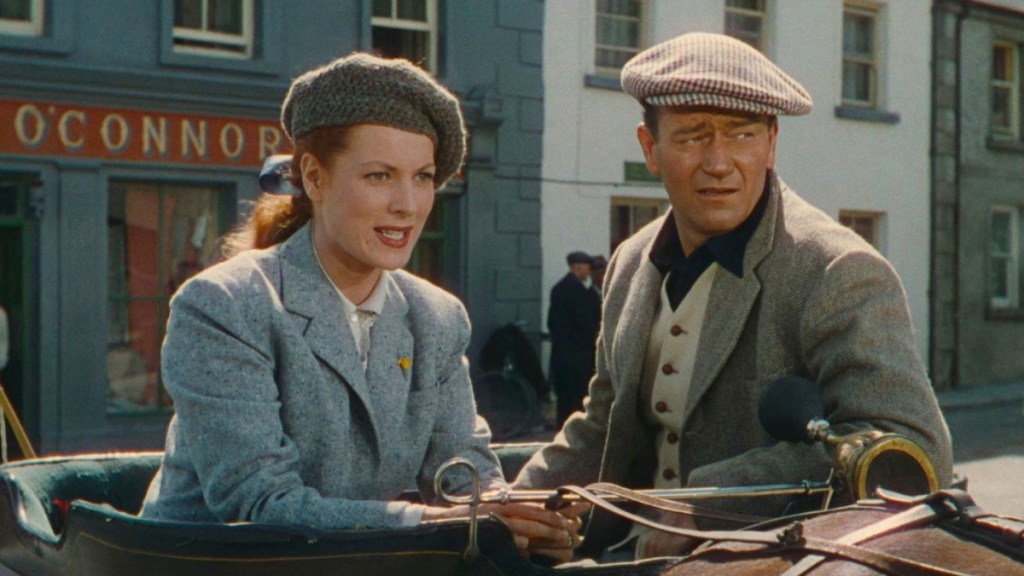
A bond is what they have, both of them straining against the confines of the courtship rules of Ireland. Together they flee the chaperoned carriage ride Michaeleen (a delighful Barry Fitzgerald) takes them on to ride a tandem through the streets. Mary Kate constantly, bashfully, tries to go after what she wants – and a large part of that is the lurking “bad boy” tendency that she detects under the surface of the quiet Sean. Something her less-bright brother Will can’t see.

Victor McLaglen (Oscar-nominated) swaggers, slurs and puffs himself up as this rough-and-tough, punch-first-think-later bruiser, who constantly thinks he’s being cheated. He and Wayne throw themselves into the long dust-up that ends the film with the same comic energy and enthusiasm they did exchanging handshakes. Part of The Quiet Man’s success comes from the comfort and familiarity the cast felt for each other. The trip to Ireland was like a friends-and-family holiday: old mates like Ward Bond, Ford’s brother, O’Hara’s brother, Wayne’s children – they all round out the cast. It helps build even more the family and community feeling that makes the film a delight.

Above all, The Quiet Man leaves you with a smile on your face. With expertly filmed set-pieces – a horse race, Sean and Mary Kate’s long walk back to Inisfree and the epic punch-up – combined with luscious shooting (also done with wit – a sexually frustrated Sean pounds through the countryside, tossing heavily puffed cigarettes aside, after Mary Kate withdraws favours) – it’s also fast-paced, witty and warm. The cast even effectively take bows as Ward Bond’s (his finest hour) priest delivers a final voiceover. Full of affection and charm, it’s a delight and is perhaps the only foreign “Irish” film that has been embraced by the Irish.

Salvador (1986)

Salvador (1986)

Oliver Stone’s passionate denunciation of American policy, highly politicised but electrically made

Director: Oliver Stone

Cast: James Woods (Richard Boyle), Jim Belushi (Doctor Rock), Michael Murphy (Ambassador Thomas Kelly), John Savage (John Cassady), Elpida Carrillo (Maria), Cindy Gibb (Cathy Moore), Tony Plana (Major Maximiliano Casanova), José Carlos Ruiz (Archbishop Oscar Romero)

To many countries the Cold War was very hot. The USA and USSR may not have crossed swords personally, but they were happy to funnel money and arms to governments and resistance groups in other countries to fight for them. The Salvadoran Civil War became another proxy battleground for East vs West – or rather Capitalism vs Communism. The US backed the military dictatorship, the USSR the left-wing revolutionaries. Caught in the middle? The people of El Salvador and their shattered human rights.

It’s not surprising this attracted the attention of Oliver Stone. Released in the same year as Platoon, Salvador is the second half of a one-two punch against the failures of American intervention. It was considerably less palatable to the masses though: Salvador is a furious, spittle-mouthed denunciation of American policy. Unlike Platoon where the victim is basically the innocence of a whole generation of Americans (an American tragedy), here you can’t fail to notice America is one of the bad guys. To Stone, El Salvador (as Richard Boyle points out in the film) was America’s chance to fight Vietnam again, only this time “right”: win it while sacrificing the lives of another country instead. It’s a considerably less easy to digest message.

Salvador is based on a fictionalised version of gonzo-journalist Richard Boyle (played with mesmeric intensity by an Oscar-nominated James Woods) who escapes from the mess of his life in San Francisco to cover the war first hand in El Salvador. There he finds himself growing increasingly sympathetic to the left-wing rebels, as the US-backed government forces commit atrocity after atrocity: mountains of corpses, assassinations and out-of-control death squads. And no-one in the embassy wants to admit to it, not when they are more concerned about keeping El Salvador from going Red. To stop that, any price is worth paying.

It makes for a passionate, angry but not subtle film. But then is Oliver Stone known for anything else? It hectors, it bellows, it hammers its points home. Stone’s writing is often a touch simplistic. There are traces of the unpleasant racism of Stone’s scripted Midnight Express in the scruffy, lecherous vileness of many of the government troops while death squad leader Major Max (Tony Plana) struts around like a mix of Tony Montana and Henry II, all but saying “who will rid me of this turbulent priest?” as he plots the murder of leading protestor Archbishop Oscar Romero.

It’s a film that lands punches that would have been better pulled. I could have done without the all-too-detailed recreation of the rape and murder of four American missionaries by a government death squad. Changing the names, doesn’t change the fact that these are fundamentally real people whose final moments are staged with a little too much queasy detail (or close-ups of their mistreated, bullet ridden bodies). But then, Stone is equally unafraid – and perhaps rightly so – to show us mountains of dead Salvadoran bodies, including children, so maybe it’s hypocritical of me to argue restraint for American victims.

Stone shoots the film with a real urgency and immediacy. Boyle frequently makes his way to the heat of the action and the camera follows him right in there. It ducks and sways among panicked mobs of people. It sees charges of horse-backed revolutionaries head towards it. It follows Boyle through devastated streets and scenes of despicable human carnage. It doesn’t flinch from executions and murders and when Boyle is thrown to the ground by explosions and gunfire, it goes down with him. Stone allows bombastic excess into the film, twinned with a score that adds a little too much classical self-importance, but at least his reasoning behind making this an overwhelming film makes sense. The whole ghastly civil war is overwhelming.

And so is America’s part in it. Aside from the ambassador – a Carter-ish hangover, played with ineffectual decency by Michael Murphy – the figures we see from government are heartless, cold warriors, interested only in the ends and caring nothing for the means. They pour money into death squads, provide air support and tanks for rebels to be strafed on the ground and are totally indifferent to morality. The media largely backs them all the way, parroting the government line and painting the revolutionaries as terrorists. They even suggest those dead missionaries were either foolish or mixed up with the rebels – either way fundamentally responsible for their deaths.

The government contrasts with the “ordinary” Americans we see. Missionaries down here to do good. And, of course, the cryptic figure of Richard Boyle. Boyle is, in many ways, a deeply unsympathetic character. Woods makes him selfish, sleazy and self-interested, constantly letting people down and taking what he can get from friendships and situations. But the things he sees in El Salvador reawakens his sense of right and wrong. He’s vile but he’s kind of brave. He will call out what he sees as wrong. He will protect others, instinctively covering those he loves when bullets fly.

And, finally, he tries to do something right, smuggling his girlfriend Maria (sweetly played by Elpidia Carrillo) and her young son back to America (needless to say, the authorities do not react well). Part of Salvador’s success is in seeing Woods perfectly craft a character arc that takes a man interested only in himself through to putting himself at risk for innocents. It’s a long road from the gonzo washout who drives down to the country stoned with drinking buddy Dr Rock (Jim Belushi, rather good as grungy stoner, sweeter than he appears, who grows to love the country and its people).

He’s a complex hero though, superbly bought to life by Woods in a performance that’s like a raw wound in a complex film. While Platoon could be seen, for all its loss of innocence, as a film where America was the victim, Salvador casts the country as the villain sharing morally responsibility for the piles of corpses Boyle picks his way through. Stone acknowledges the crimes of the revolutionaries – Boyle furiously denounces them for their shooting of unarmed soldiers pleading for the lives – but his real anger in this passionate, vibrant polemic is America itself. It’s delivered with verve, commitment and drama and helps make Salvador one of his best and most overlooked films.

Decision to Leave (2022)

Decision to Leave (2022)

Obsession, murder and romance combine in this stunningly made inventive romantic film noir

Director: Park Chan-wook

Cast: Tang Wei (Song Seo-rae), Park Hae-il (Detective Jang Hae-jun), Lee Jung-hyun (Jung-an), Go Kyung-pyo (Soo-wan), Park Yong-woo (Im Ho-shin), Kim Shin-young (Yeon-su), Jung Yi-seo (Yoo Mi-ji), Jung Young-Sook (Granny Hae Dong), Yoo Seung-mok (Ki Do-soo), Park Jeong-min (San-oh), Seo Hyun-woo (Sa Cheol-seong “Slappy”)

Death from dizzying heights, a mysterious femme fatale and a detective who tips into unhealthy, romantic obsession. Sound familiar? Park Chan-wook’s Decision to Leave is an enticing spin on Vertigo, but also a beautifully made marriage of Park’s visually dynamic style with classic Hollywood film noir. Decision to Leave is soaked in the sort of atmosphere you’d find in Laura or Double Indemnity and is a breath-taking marriage of half-a-dozen genres, from noir to romance to tragedy. It rotates continuously, no matter how much we observe and watch people, on how little we understand them – and how little we understand ourselves. It’s a stunning piece of film-making.

Jang Hae-jun (Park Hae-il) is a high-flying Busan murder detective, the youngest senior investigator on the force. He’s also a reserved man, crippled with insomnia and weighed down with guilt over cases he failed to solve, conducting a long-distance marriage with Jung-an (Lee Jung-hyun) a scientist at the nuclear plant in distant Ipo. He’s called into investigate the death of a civil servant and keen climbing enthusiast, who fell to his death from his favourite climbing spot. His much younger Chinese wife Song Seo-rae (Tang Wei) is strangely unmoved by his death and becomes the investigation’s focus. She also becomes the focus of Hae-jun’s sleep-deprived obsession as he stakes out her home. Gradually Seo-rae and Hae-jun form an intimate but unromantic relationship as they discover a deep bond between them. But does that mean that Seo-rae isn’t a murderer?

Questions of motivation and the reasoning behind decisions is central to Park’s film. At its heart is Seo-rae, a woman constantly unreadable, as hard to distinguish as her turquoise-tinged clothes are between blue or green (depending on who you talk to). A Chinese woman in South Korea, her Korean is formal and perfectly phrased but she relies on Google Translate to render more emotive sentences into Korean. She nurses ageing women in their homes, showing them care and attention. She might also be a murderer several times over, for motives that are impossibly unreadable.

It must be particularly unreadable for a detective whose mind is clouded by lack of sleep. Hae-jun’s eyes in his lined, weary face are frequently blurred by eye drops (the same eye drops covering POV camera shots). As a detective he’s prepared for everything. He wears trainers, constantly prepared for sudden sprints after criminals (one of these sees him pounding up the side of Busan’s mountain – both he and the suspect collapsing, wheezing for breath, at the top), he has specially tailored coats filled with any object he might need, from tissues to aspirin to a knife glove for hand-to-hand combat. He is calm, unruffled and ready for anything. He’s also a man who struggles with knowing who or what he wants and has placed such pressure on himself that insomnia feels like his body telling him sleeping is irresponsible in a world where there is so much to fix.

Decision to Leave revolves around the fascinating dance between these two characters, a Sherlock Holmes and Irene Adler, who recognise on some-level they are kindred spirits. Both are quiet, dedicated observers of people. Both have the ability to zero in on details – its telling that Seo-rae is the only one who can help Hae-jun begin to crack his old cases and that Hae-jun is the only one who delights in every detail of Seo-rae’s careful, formal Korean. Neither are exhibitionists, both quest obsessively because they feel they must for others: Hae-jun for the victims of crimes, Seo-rae to reclaim the Korean land her grandfather had been forced to leave behind when he fled to China.

But yet… these are also people seemingly determined to manipulate and entrap each other. Sae-jae’s growing closeness with Hae-jun is also a way to get closer to the case, to follow Hae-jun’s progress and to nudge (or outright shove) it in certain directions. Her motives and decisions remain unclear. When they go on a tenderly chaste date to a Buddhist temple, is their connection and intimacy genuine for her, or is she ruthlessly playing a lonely man for advantage?

Because Hae-jun defines himself as a detective – after all, he will chase cases to the end long-after his bosses have demanded he file it. Decision to Leave explores how far this will affect Hae-jun: how far will he go to protect someone he suspects might be a killer? If he helps Seo-rae, how much would he grow to hate himself for doing it? Or to put it another way – is there a greater expression of love that a Holmes is capable of, than to help his Irene Adler get away with it?

These dizzying themes interweave with fascinatingly oblique motivations in this endlessly rewarding puzzle-box of a movie. It’s also clear to see the Vertigo parallels, as manipulators fall in love and stalkers try to shape people and events to meet their desires. It’s second act, set in Ipo, as the characters come back together after a time-jump is a brilliantly engaging dance between two people who might be deeply in love and might be doing their very best to manipulate each other. Here acts of love include reading seized phone call transcripts or draining a swimming pool of bloody water.

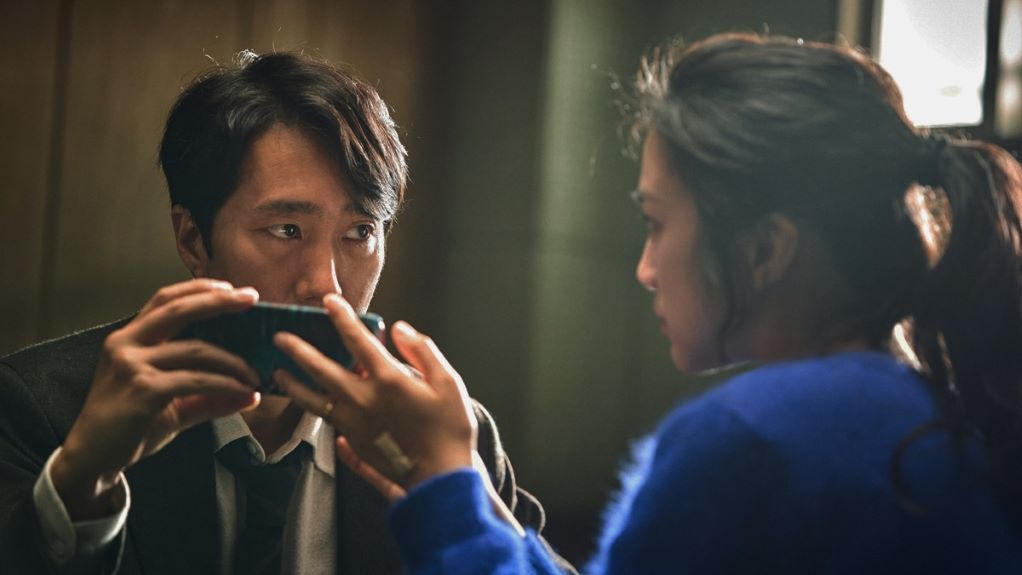
It’s extraordinarily shot by Park chan-wook – this is the sort of film that makes you want to run out and see everything else he’s ever made straight away. Decision to Leave is more classical and reserved than his other ‘cinema of cruelty’ films. But that isn’t to say it’s not crammed with endless inventive flair. Camera angles plumb every depth of imagination – from vertigo-inducing heights to shots that seem to place the camera inside phones, their graphics superimposed across the screen.

As Hae-jun imagines Seo-rae’s actions or stakes out her home, he is visually inserted into her memories or placed in the scene as a witness as he deduces how she may have killed her husband. As this dedicated, obsessive watcher – who can’t leave his fascination with the case alone – watches her home, Park suddenly places Hae-jun inside Seo-rae’s home, sitting alongside her on a sofa. Scenes replay from multiple angles to show us new perspectives, and the characters blur and switch roles as Seo-rae stakes out Hae-jun in Ipo, noticing how his smart shoes (not suitable for running) are in fact a sign of his collapse in confidence.

Decision to Leave gains hugely from Tang Wei and Park Hae-il’s superb performances. Tang Wei is utterly unreadable, her motives and emotions discernible moment-by-moment only in micro-clues – but by the film’s conclusion you feel you finally have an understanding of her tortured, confused emotions. Park Hae-il drips crumpled loneliness and sadness under a professional demeanour, his emotional vulnerability becoming more and more apparent, his job a fig leaf to give his life definition. The chastely, strangely innocent, intimacy between the two of them has profound emotional impact – this is a classic romance, about two people far closer than sex could make them.

Park’s direction of all this is perfectly paced – for a slight plot and an extended run-time, this feels like a film where not a moment is wasted. Like Vertigo every moment fits together into a complete whole which might only be understandable when you step back and look at. Visually, it’s a treat – inventive but not flashy, unique but not overbearing. And it builds a carefully modulated and deeply moving spiritual romance at its heart. It’s a beautiful slice of film noir, rung through with poetry. It’s a marvellous film.

The Virgin Spring (1960)

The Virgin Spring (1960)

Revenge, violence but also a touch of hope abound in Bergman’s haunting Oscar winning classic

Director: Ingmar Bergman

Cast: Max von Sydow (Töre), Birgitta Valberg (Märeta), Gunnel Lindblom (Ingeri), Birgitta Pettersson (Karin), Axel Düberg (Thin Herdsman), Tor Isedal (Mute Herdsman), Axel Slangus (Bridge-keeper), Allan Edwall (Beggar), Ove Porath (Boy)

Spoilers: If you can spoil a Bergman classic, the full content of the film is discussed below

If a film cemented Bergman as the master of misery, it was his Oscar-winning The Virgin Spring. On the surface, a grim fable of rape revenge shot in wintery horror, it’s hard to imagine most people nerving themselves to watch it based on a synopsis. But they would be missing out. The Virgin Spring is, for all its hard-hitting violence and cruelty, a surprisingly hopeful film. Like the best of Bergman, it’s profoundly challenging, searching and operates on multiple levels – but rewards the viewer with splashes of strange optimism that feel a world away when it opens. It’s one of his truly great films.

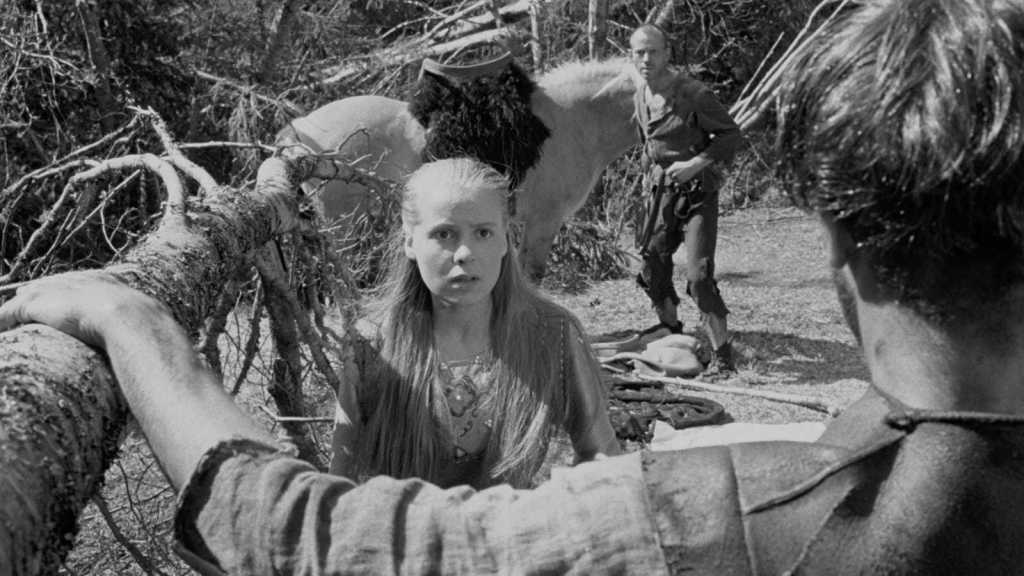
Set in medieval Sweden, Töre (Max von Sydow, magnificently, chillingly grief-stricken) is a prosperous and devotional Christian farmer, in a cooling marriage to Märeta (Birgitta Valberg). The light of his life is his daughter, the beautiful Karin (Birgitta Pettersson). One day, Töre tasks Karin to travel to the Church (half a day’s ride) to deliver some candles. She travels with Ingeri (Gunnel Lindblom – bitter, damaged and brilliant), a pagan servant girl, heavily pregnant and resentful. Along the way they two are separated and Karin meets with three peasant brothers in the forest, who share her meal with her before the two adult brothers (Axel Düberg, Tor Isedal) rape and murder her. The brothers walk on and take shelter that night in Töre’s hall. When he discovers their deed, he murders them all (even the innocent youngest brother, a boy) then, horrified, pleads to God for forgiveness. At which point a spring, bursts forth where Karin was killed.

Not exactly a bundle of laughs. But this is powerful, compelling film-making from Bergman. His influence on horror has been overlooked, but The Virgin Spring show how much he inspired everything from shlock to The Exorcist. This is a tense, unbearably so, film which twice draws out the long build-up to shocking violence in a way that would make Sergio Leone proud. Played out in a beautifully moody, bleakly cold and wintery visual style from Sven Nykvist (his first collaboration with Bergman) and often in an atmospheric mix of silence and natural sound, you can feel your stomach knot as the inevitable transgressive act looms ever closer.

The film pulls no punches, while never being exploitative. The rape and murder of Karin (excellently played with just the right mix of innocence and spoilt certainty by Birgitta Pettersson) unfolds with a cold matter-of-factness, as she slowly realises these men are far more dangerous than she imagined. The event is hard-to-watch for its simplicity rather than its graphicness, and for the cold indifference of its perpetrators who act on a whim. It takes place almost in silence and the killing (mercifully off-camera) is more because they don’t know what to do next. Mix that in with the terrified stares of Ingeri from afar, and the shell-shock of the younger brother (who vainly tries to bury Karin with dirt before running away), makes a scene devoid of sensationalism but terrible to watch.

It’s reflected in the film’s later act of violence. The brothers having tried to pass off Karin’s blood-stained dress as their (imaginary) sister’s, sell it to Märeta (who instantly recognises a garment she stitched herself, even as she’s asked to admire the handiwork), are locked in the hall while they sleep. Töre’s slaying of them, however, never feels triumphant. Instead, the Christian Töre abandons his faith to embrace pagan revenge. Like a priest before a blood sacrifice he dresses himself in butchery gear, discards a sword for a smaller knife, carefully prepares the room for the brothers to wake and then sits, idol-like, in his chair waiting. This is a damning ritualistic insight into how our faith – the faith Töre was so proud of – can drop away to reveal our vengeful simplicity below.

The fight that ensues feels like something from the nether-regions of hell. One brother is skewered, arms wide, to Töre’s chair. Another is stabbed under Töre’s body weight – shot in a way reminiscent of Karin’s rape, with the flames of the fire dancing between them and the camera – his body left to burn in the fire. Their brother – a child – runs to Märeta for protection, yet Töre hurls him against the wall breaking his neck. There is no triumph. Töre speaks not a word – the brothers die having no idea who he is. Töre is left starring at his trembling hands in shock, as if waking from a dream not recognising the man he has become who turned his back on every article of faith he held dear.

It’s a film that shows the impact of grief and trauma. From the terrified face of the youngest brother – shovelling dirt on a dead body with tear-stained eyes – to Töre’s shell-shocked realisation his daughter is dead. Deep down, people blames themselves. Märeta believes she is being punished for envying Karin’s closeness to her father. Ingeri believes she has cursed Karin to suffer the same shame as her. Töre, perhaps, feels guilt at his own semi-incestuous closeness with his daughter. Why else does he struggle to bring down with his bare hands a new-planted birch tree (in beautifully haunting medium shot), cutting branches from it to flay himself in a sauna before he takes his revenge? It’s both punishment for past and future sins.

This is also a film that challenges us to decide whether brutal revenge is justified. The build-up to the murder of the brothers is very similar to the murder of Karin. A long meal, shared, even with similar food – so similar that the innocent younger brother vomits at the memories it brings back. This young boy is the death of innocence in this world. Betrayed into crime by his vile elders then forced to pay a terrible price for a deed he was powerless to stop and left him deeply distressed. How can we really triumph in Töre’s killing, when we see it performed so violently at such a price?

Bergman tests throughout how far faith goes, and questions what power God has. The film opens with two pleas, to two very different Gods. Ingeri pleads to Odin to punish the virtuous Karin, who in Ingeri’s eyes is a working rebuke for her wedlock-free pregnancy. Töre prays to a Dürer style carved cross for God to keep their household safe. Only one deity delivers: and rightly Töre will plead at the film’s end “You see it God, you see it…you allowed it. I don’t understand you.” Töre has even mirrored the rapists, in murdering an innocent. He repents later, but is a heathen in the moment.

Paganism is strong in The Virgin Spring. But it is not good. Ingeri separates from Karin when she meets a half-blind bridge-keeper, in a house full of ravens, in the wood. The man ticks every box for representing Odin and conveys dark promises of powers beyond mankind. But he is a vile, Devilish figure who takes an impish delight in cruelty and mischief. Ingeri’s departure from him coincides with Karin’s encounter with her killers – as if these demonic sprites had been conjured up by Odin to punish Ingeri by providing her with exactly what she asked for.

Why then is a film so grim, so cold, so difficult and challenging also feel strangely hopeful? Odin has won and Töre has turned his back on Christian faith to embrace cold, merciless, pagan violence. But as Töre pleads for forgiveness a spring bursts forth from below the point where Karin’s head lay. Suddenly, water pours out of the ground. Light bathes the clearing from above. Ingeri washes her face and hands, cleaning symbolically the parts of her that made those pagan pleas. Suddenly, from nowhere, the film presents an intense moment of spiritual hope that I found surprisingly moving. Rarely has something so grim, felt so cleansing at its close. Perhaps viewers need the simple, honest refreshing splash of water to help themselves after. That’s what helps makes The Virgin Spring difficult, uncomfortable but essential.

Indiana Jones and the Kingdom of the Crystal Skull (2008)

Indiana Jones and the Kingdom of the Crystal Skull (2008)

Indy is back. Hunting aliens. What could go wrong? Grab a fridge and let’s work it out.

Director: Steven Spielberg

Cast: Harrison Ford (Indiana Jones), Shia LeBeouf (Mutt Williams), Cate Blanchett (Colonel Irina Spalko), Karen Allen (Marion Ravenwood), Ray Winstone (George “Mac” McHale), John Hurt (Harold Oxley), Jim Broadbent (Dean Charles Stanforth)

Flying into ignominy faster than a tumbling fridge, you’d be hard-pressed to find anyone who lists Kingdom of the Crystal Skull as their favourite Indy film. I’ll confess I enjoyed it in an affectionate escapist way when I first saw it. But lord, doesn’t it just get worse after every viewing?

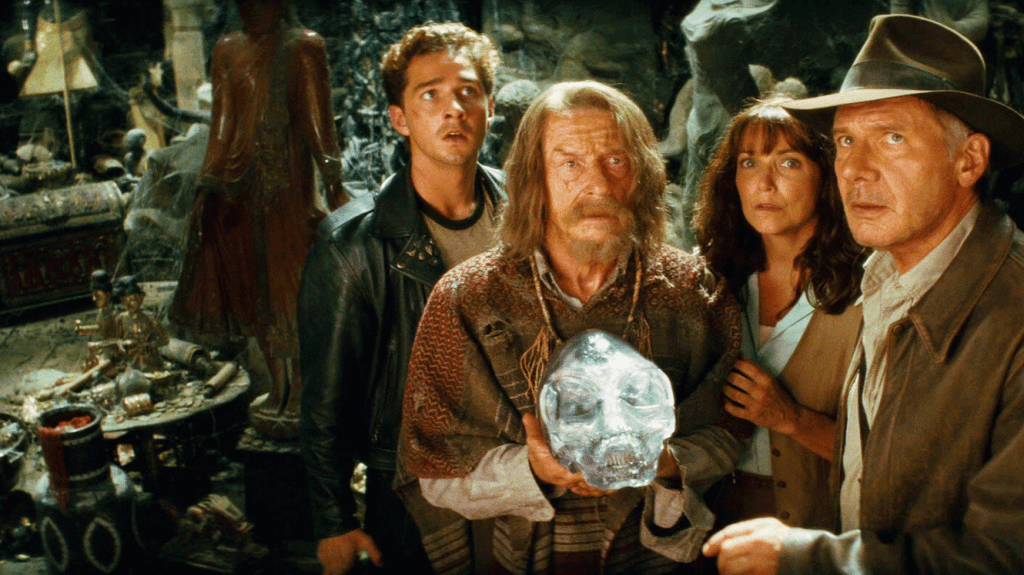
It’s the 1950s and Indiana Jones (Harrison Ford) is still hunting for archaeological gems. Just as he’s still getting into trouble. This time with the Russians. A secret group in America, led by Colonel Irina Spalko (Cate Blanchett) is on the hunt for a mysterious artefact – a secret mummified alien corpse. Spalko wants to trace the aliens to find the fountain of all knowledge. Indy is suspected of being a Commie agent – not least after his old ally Mac (Ray Winstone) is revealed as a double agent – but soon finds himself roped into searching for the secret aliens and their buried crystal skulls by Mutt Williams (Shia LaBeouf), a greaser and school drop-out and son of Marion Ravenwood (Karen Allen) (wonder who the father could be?). Soon they are racing to a secret alien tomb in the Amazon.

You can spend ages scooting around what doesn’t work here. But the heart of it might be this: this is a sequel trying to pass as a young man’s film, made by two older directors who had long since fallen out of touch with the passions that filled their lives 30 years earlier. Truth be told, I suspect both Spielberg and Lucas always saw Indiana Jones as a fun diversion from other passions and never really cared about it the way generations that grew up quoting it did. Perhaps that was the biggest disappointment of all about Indiana Jones and the Kingdom of the Crystal Skull, a film that has potential but always feels like it’s being put together by obligation (and to make money).

Still, the good stuff. Harrison Ford is, of course, still Indy and there is a great deal of pleasure in seeing him inhabit this gruff mix of brains, fists and reluctant, cynical decency. The film also does a good spin on the father-son relation of Last Crusade by casting Indy as the exasperated father who finds a bond with his wild-card son (well played by Shia LaBeouf). The two have a lovely run of banter, and some neat comedy – not least a great little moment in a bar where Mutt steals a drink from a waitress’ tray, only for Indy to smoothly put it back all the same motion.

There is an exciting chase through the streets of New Haven, with Indy and Mutt on a bike escaping the Russians, including a great sight gag of Indy being pulled into a chasing car passenger window, fighting through the car and emerging the other side back onto Mutt’s bike. The opening extended fight and chase sequence (before we hit that fridge) in an Area-51 storage site is equally well done, fast paced, witty and crammed with tonnes of Spielberg flourishes. Cate Blanchett is intriguingly off-the-wall as the villain. The film even leans into Ford’s age as Indy swings over a gap and misses (“Damn I thought that was closer”) and gives Indy much of his Dad’s grouchiness.

But too much doesn’t work. And all those beats that fall on their face eventually bury the moments that do work. For starters, the original films felt real. They are shot with a grainy realism and featured practical effects. Spielberg stressed in the build-up he wanted to keep that look. So naturally the first thing we see in the film is a CGI gopher. The film is shot with a glossy, lens-smeared shininess. After a while loads of stuff looks unreal. From the fake CGI sky in the opening scene to the hideously unreal looking jungle chase, culminating in the bizarre sight of Mutt swinging, Tarzan-like, leading an army of monkeys. Like the Star Wars prequels, it feels like Lucas and Spielberg mistook making things bigger, glitzy and more exotic for making them better. Truth is nothing in this film is as exciting as Indy climbing over a real van in Raiders or riding a real horse alongside a real tank in Last Crusade. These are real and gripping. Everything here looks like it’s been built in a computer, nothing feels real or possible, and everything is bigger and heartless.

That heartlessness carries into the plot. The earlier films had clear and emotionally engaging stakes. Indy had to save his soul (Raiders and Doom), a village of children (Doom) and his relationship with his father (Last Crusade) while chasing clearly defined artifacts. Here he’s sort of incidentally building a father-son relationship with a kid he doesn’t realise is his son until over halfway through and heading into the Amazon to return a glass skull because it told him to do it. These are not well-defined stakes. That’s before we even touch on the aliens.

I can’t quite put my finger on it, but where artefacts based on the Bible or Hindu religion make perfect sense, an alien skull chase that culminates in a parallel dimensions and flying saucers feels silly. It feels as awkwardly out-of-place as midichlorians in Phantom Menace. It makes the film jar as much as those special effects filled set pieces. I know it’s supposed to mirror the 50s setting by playing with the classic 50s B-movie set-up. But it doesn’t fit with the rest of the franchise.

And you are made even more aware of this by how cynically the film has been filled with fan-bait call-backs: the opening sequence in the Grail storage warehouse, the music cues, Karen Allen, a repeat of the father-son set-up (this time flipped), a car chase through a hostile environment, horrible small animals, Commies standing in for Nazis. Killer ants standing in for snakes, horrible insects and rats. Travel and map montages. All this does is remind you of better films.

It’s not helped by how many performances fall flat. Winstone and Hurt both insisted on reading the script before they signed up. Perhaps they also read their pay offers at the same time, because that’s surely the only reason they said yes to these roles. Winstone is painfully unfunny as the ever-betraying Mac whose geezerish cries of “Jonsey!” quickly gets on your nerves. Hurt is saddled with a sort of Ben Gunnish eccentric, babbling nonsense (you won’t believe by the way he and Ford are similar ages). Karen Allen, bar the sweetness of seeing her again, is not great.

The feeling you are watching the runt of the littler is impossible to escape. Indy was a hero people loved because you could see him bleed. When he was punched it hurt. When he fell, he struggled to get back up. The Indy from Raiders would never have been hurled miles in a fridge from a nuclear blast and been absolutely fine. Christ, he was too knackered to stand up after running from that rock. That’s why the fridge moment doesn’t work: no one watching it can believe for a moment that either (a) a fridge would be hurled away like that rather than melt (b) that anyone would be utterly unharmed by it or (c) that its lead lining would save anyone from being irradiated. A mystic box that melts people’s faces when open we can buy because its “power of God” is carefully established with just enough mysterious power. Something grounded in reality like a nuclear blast can’t work. We know what that does – the fridge stretches our willingness to disbelieve too far.

But then you feel Spielberg and Lucas didn’t mind. To them these were fun home movies, a chance to indulge some childish gags. They weren’t invested in it the way we were. They had moved on and I don’t think really either of them wanted to make it. When they did, they showed they didn’t really know what people really liked about the films in the first place. They assumed it was the action. Maybe they thought they needed that with the blockbusters they were going up against. But people loved the heart and the reality. When the fridge was nuked, they knew they won’t going to get that here. That Kingdom of the Crystal Skull would have none of what made us fall in love in the first place. It was an adventure we wouldn’t want to follow Indy on ever again.

The Front (1976)

The Front (1976)

The Blacklist is skewered in this heartfelt comedy that turns tragedy

Director: Martin Ritt

Cast: Woody Allen (Howard Prince), Zero Mostel (Hecky Brown), Herschel Bernardi (Phil Sussman), Michael Murphy (Alfred Miller), Andrea Marcovicci (Florence Barrett), Remak Ramsey (Francis X Hennessey), Lloyd Gough (Herbert Delaney), David Marguiles (William Phelps), Danny Aiello (Danny LaGattuta), Josef Summer (Committee chairman)

The first Hollywood drama about the “the Blacklist”, the shamefully unconstitutional banning of left-leaning Hollywood figures from working as a result of the House of Un-American Activities Committee’s investigation into alleged communist subversion. If there was any doubt how personal the film was to its makers, the credits scroll with the Blacklisting dates of many of its makers including Ritt, screenwriter Walter Bernstein, Mostel, Bernardi, Gough and Delaney. The Front is a tragedy told with a wry comic grin. Perhaps the makers knew that if they didn’t laugh they’d cry.

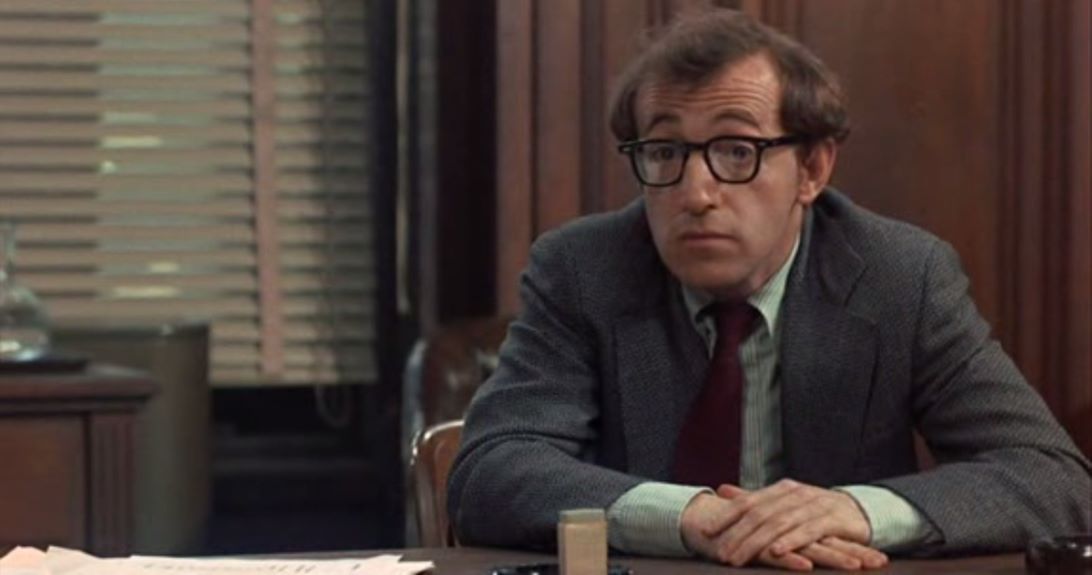
When screenwriter Alfred Miller (Michael Murphy) is blacklisted he asks an old friend, small-time bookie and cashier Howard Prince (Woody Allen) to attach his name to Miller’s scripts and submit them. In return Prince will keep 10% of all payments. The scheme is so successful Prince becomes “the Front” for two other writers and the quality and volume of Howard’s ‘output’ wins him a lucrative job as lead writer on a successful TV show, while his ‘genius’ wins the love of idealistic script editor Florence (Andrea Marcovicci). But, as the Blacklist takes hold – driving out of work actors with tenuous links to Communism like the show’s star Hecky Brown (Zero Mostel) – will Howard take any sort of moral stand about what’s happening in America?

The Front took a bit of flak at the time for not being more overtly angry about the Blacklist – as if the only response possible was spittle-flecked fury. However, today, its mix of comedy and real, visceral tragedy looks like the perfect response. The Front embraces the Kafkaesque ridiculousness the Blacklist created. Howard locked in an office at his studio to do an emergency re-write, calling Miller who taxies round replacement pages. Howard’s general ignorance of writing in general and his desperate mugging up on Eugene O’Neill and Dostoyevsky to pass them off as ‘influences’. The fact the list hasn’t done anything to stop these writers’ work from getting out there.

It’s also strong on the sense of underground community that grew among the banished writers. As veterans themselves, Ritt and Bernstein could be nostalgic about the sense of ‘all being in it together’ that the unemployed scribblers had.That vibe comes across well form Miller, Delaney and Phelps meeting in restaurants, libraries and hospital rooms to knock ideas around. There is the espionage-tinged excitement of watching script pages being palmed across to Howard like dead-drops. The film never forgets the gut-wrenching difficulty, stress and pain of not being able to work openly. But it also remembers the family feeling of a support network, giving people the courage to keep going.

But then the Kafkaesque comedy slowly drains away, as the punishing injustice creeps to the fore. Studio fixer – and vetting officer – Hennessy (played with self-satisfied relish by Remak Ramsey) calmly pressures creatives to turn on each other. Sure, there is comedy in him telling a victim of mistaken identity that there is nothing he can do to help him as the guy has nothing to confess to – that’s Kafka – but Ritt doesn’t miss the desperation and fear in the victim’s eyes. To Hennessy everyone is guilty, innocence is something that needs to be proved – and it’s a lot less funny when he strips people of their livelihoods because their personal views don’t fit.

The film’s true tragedy is actor Hecky Brown. Beautifully played by Zero Mostel, in a performance of a jovial front placed over ever-growing bitterness, anger, self-loathing and despair, Hecky can’t work quietly behind a front. As an actor, once he’s under suspicion, he’s unemployable. Despite his jokey pleas that he only marched on May Day and subscribed to the Socialist Worker (six years ago, when as he points out the USSR were our allies) to impress a girl, he’s goes from star to begging for work at the Catskills. There the manager is all smiles and pays him $250 for a gig worth thousands (based on a real life incident that happened to Mostel – and the pain and anger of it is still in his eyes).

Mostel’s performance is the heart-and-soul of the film which follows his increasingly bleak tip into despair. He scuffles with that Catskills manager over his hypocritical sorrow. Staying in Howard’s apartment, he despises himself as he searches through Howard’s desk for incriminating evidence. In a striking scene, he berates “Henry Brownstein” (Hecky’s real name) for stopping him turning state’s evidence. It’s a sad, moving picture of the real human cost of this injustice that helps moves the film past comedy and into dark drama.

And to get an even better of how serious this human cost, what could be better than placing a self-interested, politically disengaged chancer at its heart and seeing how he responds. The casting of Woody Allen – in one of the few films he appeared in and didn’t write – is perfect. There is no-one more politically disengaged and full of pinickity obsession that Allen. Howard Prince is a decent guy but his main interests are money (his eyes light up at earning 10% for nothing), his fancy apartment, seducing Florence and the adulation from fawning producers.

What better way to show the impact of the Blacklist injustice, than to see how Howard slowly shifts from a man so disinterested he doesn’t even know what the Fifth Amendment is, to someone who feels compelled to make a stand. Slowly he finds he can’t ignore the injustice – there is a beautiful moment when Howard embarrassedly drinks and stares at a poster on the office wall at the back of the frame while Hecky begs for $500 from that Catskill’s manager. He gradually realises a fun ride for him is a dystopian nightmare for others – his self-satisfied shrugs turning into real principle.

Because, he will learn, HUAC doesn’t care for names – they care about breaking people. Being as ignorant and disinterested in politics as Howard won’t save you. That’s what Ritt and Bernstein have been driving to: this wasn’t Kafka, it was Orwell, it wasn’t about the obstructive indifference of bureaucracy but Big Brother’s ruthless rooting out of thought crime. So, when Allen tells them – in the final lines of the film – to go fuck themselves, and the film freezes so he can walk out of it, you really understand why this is a glorious cry of wish fulfilment straight from the heart of the film-makers.

Misery (1990)

Misery (1990)

Obsessive fans wanting to control the narrative is nothing new in this tension-filled King adaptation

Director: Rob Reiner

Cast: James Caan (Paul Sheldon), Kathy Bates (Annie Wilkes), Richard Farnsworth (Sheriff Buster), Frances Sternhagen (Deputy Virginia), Lauren Bacall (Marcia Sindell)

“I’m your number one fan”. Do any other words strike more fear into the hearts of celebrities? Stephen King’s Misery feels more and more ahead of the time. We live in an era where obsessed fans frequently take to YouTube (or obscure blogs – oh dear…) to shout their fury into the ether about how their beloved franchise has taken a wrong (i.e. counter to their head cannon) turn. Stephen King wasn’t a stranger to this: he’d already had fans in the mid-80s lambast his non-horror books. Misery takes it all a step further.

Successful novelist Paul Sheldon (James Caan) has written a series of Mills & Boon style Victorian romance novels about a character called Misery Chastain. Wanting to restart a career as a serious novelist, Paul retreats to the depths of Colorado to put the finishing touches to his new non-Misery novel. Driving back to New York, he has a car accident. With two broken legs and fractured shoulder, he is dragged from his car by nurse and fanatic Misery fan Annie Wilkes (Kathy Bates). Annie tells him not to worry: the phone lines will be back up soon and until then he can stay at her home. Until she discovers Paul has killed off Misery in his recently published book. A furious Annie makes it clear no one knows he’s there and that, if he ever wants to escape her secluded home, he’ll write a new Misery book to Annie’s personal specifications.

Misery is part horror, part deeply black comedy – a heightened fantasy of increasing paranoia powered by a superb performance by Kathy Bates that walks a fine line between grand guignol, farce and deluded tragedy. In many ways Annie, monstrous in her obsession, is a superb dark comic creation. She has an anorak-level obsessive knowledge about her passions, litters her speech with prudish replacement swear-words (“cockadoodie!”), bounces around the room with schoolgirlish excitement at having Paul in her presence and adores her pet pig (named, of course, Misery). Bates is energetic, wide-eyed and times kind of sweet.

But she’s also a chillingly ruthless and capable of great outbursts of rage and fury at the slightest provocation. A lonely woman with clear signs of being either bipolar or deeply depressed, sinking at times into “black dog” moods, stuffing herself with junk food in front of trashy TV, she relies on Paul’s books to give her a slice of the romantic, exciting life she feels she has missed out on. Like the most toxic fans today, she feels such emotion for the Misery books, she believes they belong to her personally – and if they deviate from what she wants it’s a personal affront. She is also so desperate to love and be loved, she takes a brutal control of the world around her, convinced that if she just works really hard the object of her admiration will admit he feels the same.

Bates is extremely good in a performance strikingly similar to Hopkins’ Lecter a year later (also, of course, Oscar winning). It’s a masterclass in actorly tricks, all deployed with triumphant expertise to create a character who is both darkly funny and terrifyingly controlling. Annie is so twisted that, in a way, doping Paul up on drugs and smashing his legs with a sledgehammer is like an expression of love. If he really understood what she was trying to do for him, how she knew the sort of books he should be writing, he’d never want to leave anyway right?

That leg smashing scene – and God it’s almost impossible to watch – is the height of Reiner’s taut direction that brilliantly makes this an endlessly tense chamber piece. The camera frequently shoots Annie from Paul’s prone position, meaning we are craning our heads up to look at her in exactly the same way he is. Later sequences, where Paul finally works out how to pick the lock of his room and explore (in his wheelchair) Annie’s kitsch-filled house with its shrines to her favourite celebrities, also place us on his visual level. Several scenes use tension effectively – you’ll catch your breath at the dropping of a model penguin, clench as Paul hides pills and knives around him for future escape attempts or sweat as Paul rushes to return to his room when Annie arrives home suddenly. But Reiner also threads in Hitchcockian wit throughout, amongst the tension.

It also gains a great deal from James Caan’s measured performance as Paul. Caan was last in a longlist of male actors offered the role (a sharp change from those days when Caan turned down roles that went on to win other actors Oscars) but willingly plays the passive, scared Paul with a low-key humbleness that works very well. He becomes someone who it is easy to root for.

Misery explores the lengths obsessive fans will go to to own their passions very well. Annie rejects Paul’s first attempt at humouring her with a new Misery book for its inconsistencies with previous novels (she clearly knows way more about it then him). That’s not even mentioning she demands he burns the (only) copy of his new non-Misery novel because “it’s not worthy of him” (being full of naughty words). It’s so good – and in a way prescient of where fandom is heading – it feels a cheap cop-out to also reveal Annie is a serial killer. Far more interesting is how quickly an unhealthy fixation could tip a maladjusted person from demands, to threats, to leg smashing fury.

Misery also fits a little too neatly into a trend – common at the time – of “regular guys” having their lives turned upside down by dangerous, deranged women (there are more than a few nods to Fatal Attraction and it’s not a surprise to hear Michael Douglas was offered the role). For all the dark skill Bates plays Annie with, we are rarely invited to sympathise with or understand her (she’s cemented as a freak with the discovery of her killer past) – again, how more interesting (and prescient) would it have been to just have a woman driven to extremes by obsessive monomania?

The film works best as a chamber piece. So much so, that any scene outside of the house feels superfluous – despite the excellent work from Richard Farnsworth as the local sheriff investigating Paul’s disturbance. Misery, with its abandoned house in the middle of nowhere, is sometimes a little too open in its huge debt to Psycho. But it’s ahead of its time in understanding the obsessive anger that lies under the surface of the darker elements of fandom – so much so you wish it had stuck to that.

The Whale (2022)

The Whale (2022)

Manipulative and sentimental, Aronofsky’s tear-jerker is dishonest and disingenuous

Director: Darren Aronofsky

Cast: Brendan Fraser (Charlie), Sadie Sink (Ellie Sarsfield), Hong Chau (Liz), Ty Simpkins (Thomas), Samantha Morton (Mary), Sathya Sridharan (Dan)

The Whale is the sort of film that is either going to bring you out in tears or hives. Me? Let’s just say I felt incredibly itchy as I sat through this naïve, sentimental and manipulative film. I hated its dishonesty and its disingenuousness. The only thing I felt move was my stomach.

Charlie (Brendan Fraser) is a morbidly obese, reclusive English professor who teaches online courses with the camera turned off. Nursed by Liz (Hong Chau), the sister of his deceased partner, Charlie has never processed his depression and guilt at his partner’s suicide. Now, facing death from congestive heart failure, his last wish is to finally bond with his daughter Ellie (Sadie Sink) whom he has not seen in the eight years since he left her and her mother (Samantha Morton). Ellie is now an angry, high-school drop-out teenager. But Charlie is sure he can see the good in her.

So much has been made about the morbid obesity of the film’s lead. The prosthetics coating Fraser in layers of fat are impressive. An opening montage shows Charlie struggling to move around the house. Picking something up off the floor is impossible and he has to lever himself out of the bed or into the shower. But the film is hugely pleased with itself that it dares to see a fat person as “one of us”. Aronofsky initially films him like a freak show monster – already patting himself on the back about how “humanising” it will be when we learn that obese people are just as capable of being at the heart of maudlin, self-pitying films as thin ones.

The Whale is adapted from a stage play. Not only does it really feel like it (it’s all set within Charlie’s apartment, with characters announcing their arrival in a neat four-act structure), it also sounds like it. The dialogue is forced, artificial and clumsy, making on-the-nose emotional points. Characters feel like narrative constructs. Sadie Sink’s Ellie is the sort of precocious-but-angry tear-away genius brat you never find in real life. Ty Simpkins’ hipster-turned-missionary is more a collection of quirks than a person. The script leans heavily on clumsy metaphors – a walk on the beach, bible quotes, Ellie’s childhood essay on Moby Dick – milked for all they are worth.

Worst of all, a film that prides itself on being about the power of honesty feels like a big, walloping lie. It lies about its characters and it lies about the real issues that drive them. Firstly, it never once touches on issues of mental health and addiction that have led Charlie to this state. Sure, we get a scene of him compulsively eating. But Liz, his “caring” nurse, brings him medicine and huge piles of food (a massive bucket of fried chicken, enormous sub sandwiches…). It’s like caring for an alcoholic by bringing him chicken soup and a huge bottle of whisky. How is this helping someone recognise and deal with an addiction? Which is what this level of over-eating is.

Worst of all the film treats this as a “charming friendship between two eccentrics”. It eventually touches on the fact they are both hurting from the suicide of Charlie’s partner Alan. But never once is the film brave enough to link their behaviour now to this act. Charlie failed to get Alan help, keeping him away from the world and others, believing that the isolated love of a single person would solve his depression. Liz repeats the same mistakes. She isolates Charlie, encourages him to eat, never challenges him to seek help or process his grief, and creates a safe environment for him to destroy himself. If he was a drug addict, what would we say about a carer who draws the curtains and encourages him to shoot up? We’d be calling her the villain of the piece.

That’s before we even dive into the film’s lack of honesty about Charlie. It’s sad to think of a character being so depressed he’s eaten himself to death. That’s awful – even if the film never wants to reflect on the emotional and psychological reasons for this (because that would be depressing in a film as desperate to be upbeat as this one). But by showing us Charlie at the end, full of regret and self-pity, the film white-washes his mistakes and selfishness. There are clear flaws in Charlie that contributed to this state – however much the film wants to present it as a terrible accident.

Charlie abandoned his family and made no contact with his daughter for years (he complains it was too difficult and tries to blame her mother), leaving her traumatised. The film loves its sentimental device of Charlie reading to himself Ellie’s childhood essay (which he knows by heart). But this is, basically, a selfish fantasy: an idea for Charlie to cling to that he was a good Dad and Ellie a kid with a future, radically different from the actual reality. Just like he never addresses why guilt and depression drove him to destroy himself, so he refuses to deal with the issues Ellie is facing now by simply not acknowledging that she has changed from his idealised version of her as the sweet, sensitive girl who knew Moby Dick was really about Melville’s unhappiness.

Instead, the film suggests her mother is the one who really failed. Charlie – who has spent about an hour in her company in eight years – would have donebetter. Just like Liz passing him chicken buckets, Charlie’s solution to solving his daughter’s problems is to smother her with love rather than get her to ask herself why she does and says the cruel things she does. How can the film not see he is repeating the same ghastly cycle again, encouraging a depressed, vulnerable person to stick her head in the sand and hope for the best? Well, he’s wrong. And the fact that the film doesn’t see this means it’s lying to itself as much as he is.

By the end you’ll be stuffed by sentiment, greased by the insistent score. Every single frame is like being walloped over the head while Aronofsky shouts “cry damn you”. The dreadful script is well acted, even if no-one ever makes these device-like characters feel like real people (except maybe Morton). Fraser is committed, a lovely chap and I’m very pleased he’s having “a moment”. But this is a simplistic character, that requires little of him other than to wear a fat suit and cry. He never once really delves into any complexity. It’s also true of Hong Chau, a collection of quirk and tears.

The Whale is a dreadful film, manipulative, artificial and full of naïve and dishonest emotions that avoids dealing with any complex or meaningful issues. Instead, it thinks it’s achieved something by making you see a fat person as a real person. There is almost nothing I can recommend about it.

The Magnificent Seven (1960)

The Magnificent Seven (1960)

Man’s gotta do what man’s gotta do in this iconic rollercoaster of a Western

Director: John Sturges

Cast: Yul Brynner (Chris Adams), Steve McQueen (Vin Tanner), Horst Buchholz (Chico), Charles Bronson (Bernardo O’Reilly), Robert Vaughn (Lee), James Coburn (Britt), Brad Dexter (Harry Luck), Eli Wallach (Calvera), Vladimir Sokoloff (Old Man), Jorge Martinez de Hoyos (Hilario), Rosenda Monteros (Petra), Rico Alaniz (Sotero), Pepe Hern (Tomas)

“That’s the greatest shot I’ve ever seen!” – Chico after seeing Britt take down a bandit on a horse with a pistol from an unimaginable distance.

“The worst. I was aiming at the horse.” – Britt’s response.

To be honest I could probably just watch The Magnificent Seven for that moment alone. Akira Kurosawa enjoyed this remake of his greatest film so much, he presented Sturges with a samurai sword as congratulations. It’s a staple of any rainy Bank Holiday and the actors who played the seven is a classic pub quiz question (how many have scratched their heads trying to remember Brad Dexter’s name?). The Magnificent Seven has passed into cultural legend.

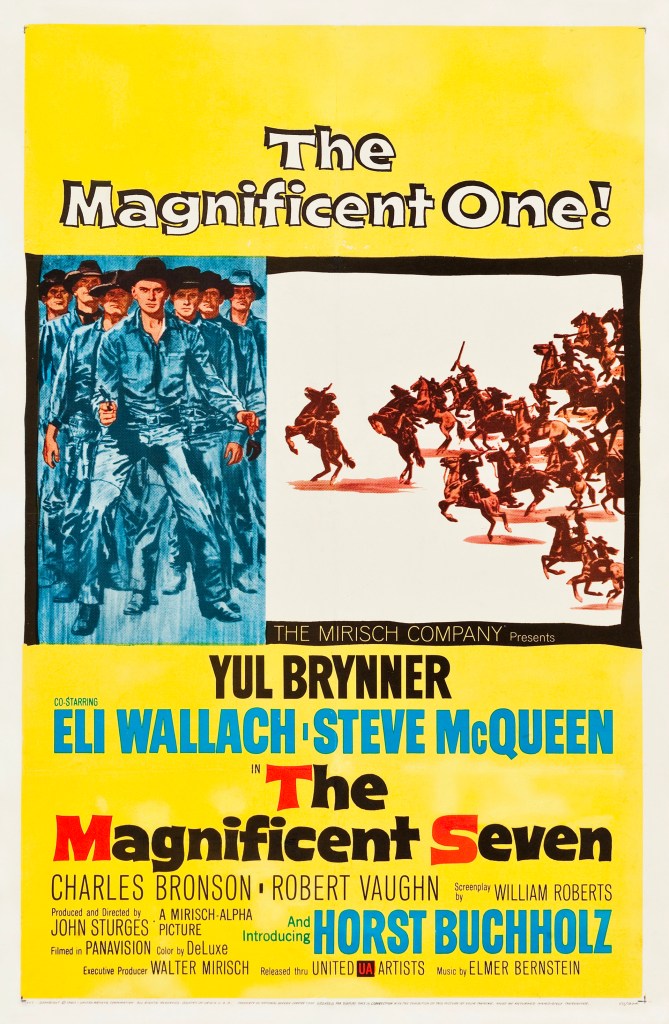
It’s a very faithful remake of the Japanese original (if an hour shorter). A farming village is plagued by bandits, led by scruffy, smug rogue Calvera (Eli Wallach). So, the farmers set out to find a gang of gunmen willing to work (almost literally) for peanuts to protect them. And they find themselves a heck of a posse: Chris (Yul Brynner), the unflappable tactician, Vin (Steve McQueen) the maverick sharp-shooter, tough-as-nails Bernardo (Charles Bronson), nervy veteran Lee (Robert Vaughn), samurai-like Britt (James Coburn), boisterous mercenary Harry (Brad Dexter) and plucky newbie Chico (Horst Buchholz). But will these few protect the village or will they cut and run when the going gets tough?

What do you think? The Magnificent Seven is one of those classic men-on-a-mission films, where men were stoic, noble and only stopped taking names to kick some ass. While The Magnificent Seven sheds much of the class and culture-based depth and tragedy of the original, it certainly doubles down on its fun and excitement. It barrels along with glorious energy from set-piece moment to set-piece moment, all marshalled with great skill by Sturges.

And those set-pieces are great. Chris and Vin riding a hearse shotgun (literally) through town when no-one else has the guts to do it. Britt’s dazzling knife-throwing skills calmly winning him victory in a one-on-one with a braggart. Chico proving his worth on the journey back to the village and berating the villagers running in fear from their rescuers (“Now we are seven”). The first battle with the bandits. That legendary bad shot from ice cool Britt. The final face-off in the village. What’s not to love about this explosion of well-paced, gripping, exciting action?

The casting was a smorgasbord of talents. Books have been written about Brynner and McQueen’s personality clash. The evidence of their on-going game of one upmanship is all over the picture. In nearly every shot Brynner is in, McQueen can be spotted in the background fiddling around with his hat to pull focus. Brynner took to elaborate cheroot lighting using his boot to keep eyes on him. Either way, the two of them bring their qualities perfectly to the screen. Brynner has more than a touch of the old master samurai to him, McQueen the cocksure cool (it wouldn’t be a surprise to see him turn up to the village on a motorbike). Sturges’ film builds a surprisingly warm friendship between these two that forms the emotional heart of the film.

The rest of the gang all get their moments in the sun. Robert Vaughn expertly makes Lee’s loss of nerve look like careful, deadly precision rather than a desire to duck whenever bullets go flying – in a few strokes he presents a lifetime of front to maintain presence. James Coburn – a huge fan of the original – brilliantly channels Seiji Miyaguchi as an unflappable professional. Brad Dexter bounces along as jovial chancer. Bronson gets the dullest role as the guy who befriend the village kids but manages to make his priggish material (the Western equivalent of “you kids should take care of your education and listen to your parents”) sound like tough-guy cool.

The film’s main change was to dramatically reduce the importance of Toshiro Mifune’s character, here represented by Horst Buchholz’s farmer turned gunman (also taking on Isao Kimura’s romantic subplot). Buchholz gets a version of the “the farmers are made who they are by the warriors” speech that the iconic Mifune nailed in Seven Samurai. But it’s a weaker, under-written part – it feels like what it is, a functional role for a pretty actor – with Buchholz awkwardly and dutifully going through the romantic motions with village girl Petra.

It’s part of the lack of depth to The Magnificent Seven. The original’s study of shattered world orders and the dangers of progress and change have no comparison here, although the film has a rather nice moment as the heroes bemoan the loneliness of their chosen lot (“Home, none. Wife, none. Kids… none. Prospects, zero. Suppose I left anything out?”). Brynner’s Adams has a lovely touch of regret at lost chances behind his manly eyes. The surviving gunmen know it’s the farmers who really win in the end. But, even with that, this is a film more interested in entertaining you.

That’s why we get a proper villain – Wallach’s great value as this ingratiating bully, who can’t even begin to understand what would motivate people to do something for so little gain – to give the final battle even more of a personal touch. Sturges also makes sure we get the full entertainment value of these grizzled fighters giving their all – perhaps for the first time – for a cause that goes beyond their immediate needs and that might just help give some meaning to their lives.

Above all though it’s rollicking good fun. Sharply written with tons of good lines, well-played by the cast and shot with pulsating excitement by John Sturges, every scene offers a little moment of delight. It’s a film you can kick-back and enjoy no matter what day it is, full of thrills and spills. One of those classics that never troubles the greatest films list, but always finds a place on the most popular lists.