Category: Directors

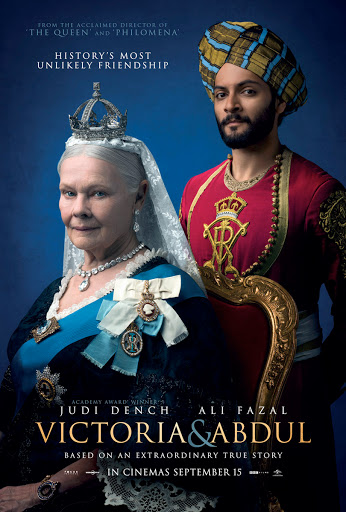
Victoria and Abdul (2017)

Victoria and Abdul
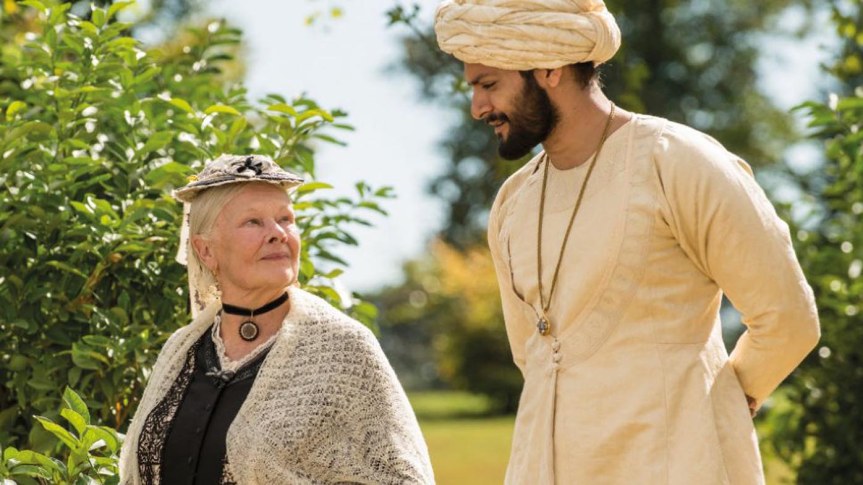
Judi Dench and Ali Fazal forge an unlikely friendship in the tame heritage flick Victoria and Abdul

Director: Stephen Frears

Cast: Judi Dench (Queen Victoria), Ali Fazal (Abdul Karim), Tim Pigott-Smith (Sir Henry Ponsonby), Eddie Izzard (Prince Albert), Adeel Akhtar (Mohammad Bakhsh), Michael Gambon (Lord Salisbury), Paul Higgins (Dr James Reid), Olivia Williams (Baroness Spencer), Fenella Woolgar (Harriet Phipps), Robin Soans (Lord Stamfordham), Simon Callow (Giacomo Puccini)
In the last decade of her life, Queen Victoria (Judi Dench – who else?) makes an Indian servant, Abdul Karim (Ali Fazal), one of her closest friends and advisors. As Victoria and Abdul become closer, the rest of the court are outraged – bad enough that the Queen is spending all this time with an over-promoted servant, but an Indian as well?!

The fundamental events of Victoria & Abdul are true. There was a man called Abdul Karim – and Victoria did raise him from servant to a confidant. He did cause conflict in the royal household and was finally sent back to India after her death, after surrendering most of his papers. But Victoria & Abdul repackages this friendship into a cosy, Sunday-afternoon entertainment, bereft of depth. And carefully works on the rough surfaces to make the story smooth and easy to digest.

The film is clearly trying to ape the success of Mrs Brown – a far more intelligent and emotionally complex (if similarly heritage) film that looked at Victoria’s previous all-consuming friendship with a male servant, John Brown. But that film didn’t close its eyes to the negatives of such relationships, as this one does. It made clear royal attention can be fickle – and being elevated above others can help make you your own worst enemy. In that film, after a honeymoon, the friendship declines into one of residual loyalty but reduced affection. It’s a realistic look at how we might lean on someone at times of grief, but separate ourselves from them later. Victoria & Abdul takes only one lesson from Mrs Brown: that a close bond between monarch and commoner is heart-warming.

The film in general is in love with the idea that if the Queen could only speak directly to her people, the world would be a better place. It presents a Victoria stifled by court procedure who knows very little about her empire and is constrained by the courtiers around her. It wants us to think that if the Queen took direct rule, she’d be kinder, wiser and more humane. That this figurehead symbol could craft a better British Empire if she was an absolute monarch.

Unfortunately, it doesn’t work. This romantic view of “Victoria the Good” is comforting stuff, but undermined even within the film by our introduction to the Queen at a royal dinner, where Victoria stuffs food down herself so quickly that mountains of untouched food goes uneaten on the plates of the other diners (as all plates are removed the moment she is finished). And despite being told that the Koh-i-noor diamond was stolen by the British (to her surprise), she still doesn’t think twice about wearing it later in the film while in the midst of her Indian passion. And while the real Victoria loathed the racist attitudes of some at her court, she still clearly sees herself as a paternalistic mother figure for India, which could of course never be able to make its own decisions about things.

Not that the film is interested in tackling more complex ideas of the position of India and its independence. It’s similarly confused by Abdul himself. In a more interesting film, Abdul would have been partly naïve servant and partly charming rogue. He very carefully spins an invented story of himself as a teacher and thinker (he’s actually a clerk from a fabric office) and it would have been interesting to see his building of a relationship with Victoria at least partly being based on self-gain. He certainly gains an awful lot from her – from his own carriage on her train to a home and his own servants. It would have been possible to have this side of him and still have his loyalty and friendship to the Queen being genuine. But it’s too much for the film to tackle.

An Abdul who was consciously playing a role of exotic thinker might have come across as a scam-artist – but would have given the film a lot more to play with, when the royal court is full of people positioning and presenting themselves for influence. Adeel Ahktar’s fellow-servant Mohammed even suggests in one scene that this is what Abdul is doing – and good luck to him. But the film is scared that this could be seen as endorsing the court’s fears about Abdul. So the character is neutered into nothing: he becomes exactly the sort of empty “exotic”, free of opinion and character, that filled out the extras list of a 1940s epic. He has no agency, never makes any decision or expresses any opinion. And his feelings for Victoria are presented as totally genuine which, combined with his foot kissing, turns him into someone who looks and feels really servile.

This is because the film wants to tell the story of a perfect friendship, with the British upper classes as the hissable baddies (never mind that no one is more upper class than Victoria). Never mind that Abdul’s action will indirectly condemn Mohammed to death in the British climate – or that while Abdul rises, Mohammed becomes his servant, still consigned to sleeping on the floor of his railway carriage. We learn nothing about Abdul. How did this clean-living saint become riddled with the clap? Why did he die so young? Did he really think nothing of the riches and honours Victoria showered him with? We don’t have a clue.

Instead the film keeps it simple with goodies (Victoria and Abdul) and baddies (almost everyone else). The most politically astute character, Mohammed, disappears and never allows things to get unpleasant. Jokes of the courtiers standing around aghast saying things like “Now he’s teaching her Urdu” are repeated multiple times. They’re fun, but it substitutes for dealing with the real issues.

It all has the air of ticking boxes. Frears’ direction is brisk, efficient and free of personality. Dench is great, but she could play this role standing on her head while asleep. Pigott-Smith (in his final role) is fine but Farzal has nothing to work with and Izzard provides a laughable pantomime role of lip-smacking villainy as the future Edward VII. The finest performance – handling the most interesting material – is from Ahktar. He’s the only character who seems to place what we see here in any form of context. Other than that, this film is just a string of very comforting heritage ideas, thrown together with professionalism but a total lack of inspiration.

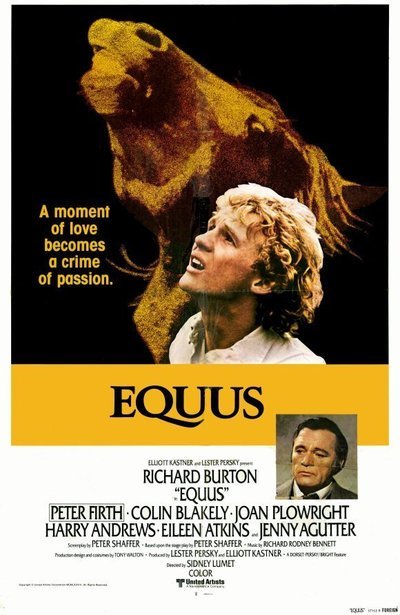
Equus (1977)

Equus (1977)

Clumsy adaptation that presents theatrical invention with the heavy-hand of realism

Director: Sidney Lumet

Cast: Richard Burton (Dr Martin Dysart), Peter Firth (Alan Strang), Colin Blakely (Frank Strang), Joan Plowright (Dora Strang), Harry Andrews (Harry Dalton), Eileen Atkins (Hesther Saloman), Jenny Agutter (Jill Mason)

In a parallel universe somewhere, there is a film version of Equus that doesn’t have a single horse in it. It’s probably a better version than this. Peter Shaffer’s stage play was a sensation in the 1970s in the West End and on Broadway – but Lumet’s film robs it of the mystique that made it work, by introducing a (literally) brutal realism. This helps reduce the play into being a quite self-important piece of cod-psychology, with ideas that increasingly seem more simplistic the longer the play lasts.

Dr Martin Dysart (Richard Burton) is a depressed and discontented child psychologist, who is struggling with a general sense of ennui, not sure what is life is for and stuck in a loveless, functional marriage. These feelings grow in him, as he begins to work on the case of Alan Strang (Peter Firth), a troubled young man who blinded an entire staple of horses in a seemingly random act of brutality. What were the deep-rooted psychological problems that caused Alan to carry out this senseless attack? And, by curing it, will Dysart remove from Alan anything that makes him unique?

Shaffer’s stage play used a combination of impressionistic moments, and mime artists, to create the impression of the horses that dominate the imagination (and desires) of Strang. Moments of horse riding (or eventual blinding) were presented symbolically. Meanwhile, Dysart functions as a quasi-narrator, delivering long speeches to the audience on the case, it’s causes and (increasingly) his own feelings of inadequacy and emptiness. It’s a tightrope, that manages to prevent the at-times portentous dialogue and student psychology from seeing either too self-important or slight. Lumet loses this mesmeric suggestiveness, doubling down on its pomposity. It makes for a bit of a mess.

I can totally see why, on film, it was felt necessary to go for real horses. However, it just plain doesn’t quite work. Watching a nude Peter Firth hug, stroke and eventually ride a horse until he reaches an orgasm mid-canter, might have had a sort of magic acted out on stage with dumb-show, puppets and actors as horses. On film, it’s tiresome and suddenly way too much. That’s as nothing compared to the decision to stage the blinding of the horses at the film’s end by showing us in graphic detail a sickle plunging into the eyes of alarmingly real-looking horses, blood pouring across Firth’s face. As that’s (pretty much) the last impression left on the audience for the film, rather than swept up in symbolism you’ll feel grossed out by the graphic violence. It’s not good for the play.

In fact, overlong and too full of speeches and not enough scenes, you watch this and start to wonder if Equus was much cop in any case. Certainly, the way it’s staged here doesn’t work. When Shaffer worked with Milos Forman on Amadeus that play was radically re-worked, extended and remodelled into an actual film that shared lines and DNA with the play, but was a very different beast. Equus is basically pretty close to an exact filming of the stage script, except on location. The show-stopping speeches by Dysart – brilliantly delivered by Burton as they are – come across heavy-handed, portentous and (in the end) off-putting and alienating.

That’s to mention nothing about the plays take on sex and psychology which feels very tired. Needless to say, Strang’s problem is rooted in his relationship with his parents (they fuck you up, you know). His mother (played with wound-up tension by Joan Plowright) is a holier-than-thou type who thinks sex is something a little dirty, while his father (an equally buttoned-up Colin Blakely) is a deeply repressed man who thinks sex is something to be ashamed off. Bound that up with the parents clashes about religion and you wind up with a boy who sublimates his sexual feeling into a confused horse worship, laced with religious overtones.

Which all sounded more daring then than perhaps it does now. Now this sort of sexual confusion (various theories suggest that the young Colin felt his first ever sexual longings after sharing a ride on a horse with a young man and – ashamed of these homosexual yearnings – transferred the association with sex from the man to the horse) was familiar then – it’s pretty much the first thing we look for now. And the insights the play offers around this, don’t carry nearly enough impact or insight to make you feel you are learning something. Anger, frustration, impotence, fear and shame all rear their heads as expected.

Saying that, Peter Firth – who originated the role at both the National and on Broadway – is excellent as Strang. It’s a full-bloodied, committed performance – but also one that is packed with an acute empathy and insight, a sensitive empathy and vulnerability that makes Strang deeply sympathetic even when he is at his most odd.

Richard Burton – who lost his final Oscar bid with this film – is also very good as Dysart. The rich Burton voice is perfectly used for Dysart’s monologues (all filmed in one day, in consecutive order, by Lumet). Burton’s puffy, unhealthy face also matches up perfectly with the sadness and resignation in Dysart – qualities that Burton again brilliantly conveys, his eyes brimming with regrets and his voice catching behind it oceans of confusion, sorrows and self-accusation. It’s one of Burton’s greatest performances, the ideas and elaborate language being a gift for an actor like him who worked best when challenged with complex material.

Unfortunately, the play itself is bogged down in a grimy, unattractive literalism that grinds the life out of it and ends up making it look very slight (this isn’t helped by its huge length). While the acting is very good – Jenny Agutter is also excellent as a young woman whose attempted seduction of Strang triggers a breakdown – the direction is leaden and the play ends up feeling histrionic and simplistic rather than engrossing and insightful.

Children of Men (2006)

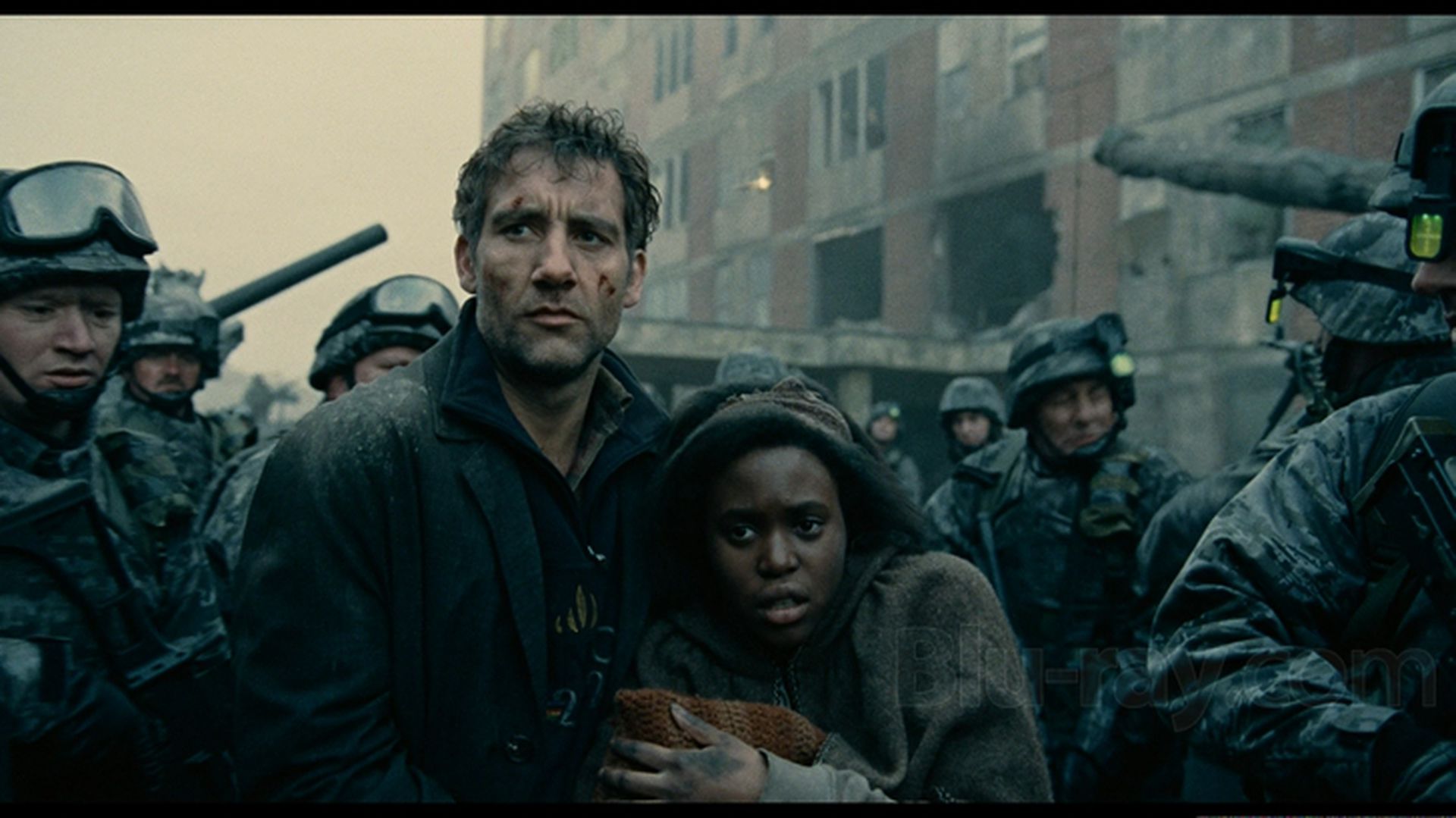
Clive Owen and Claire-Hope Ashitey could be the last hope for mankind in the masterful Children of Men

Director: Alfonso Cuarón

Cast: Clive Owen (Theo Faron), Julianne Moore (Julian Taylor), Claire-Hope Ashitey (Kee), Michael Caine (Jasper Palmer), Chiwetel Ejiofor (Luke), Charlie Hunnam (Patric), Pam Ferris (Miriam), Peter Mullan (Syd), Danny Huston (Nigel)

Children of Men was overlooked on release. But the more it ages, the more it clearly hasn’t aged it at all. Criminally ignored at the major awards, this might well be the finest film of 2006 and certainly one of the best movies of the noughties. Rich in thought-provoking content and cinematic skill, this is truly great-film-making from Alfonso Cuarón. Dark, grim, edgy but also laced with hope, faith and kindness, Children of Men grows in statue with each viewing, rewarding you more and more.

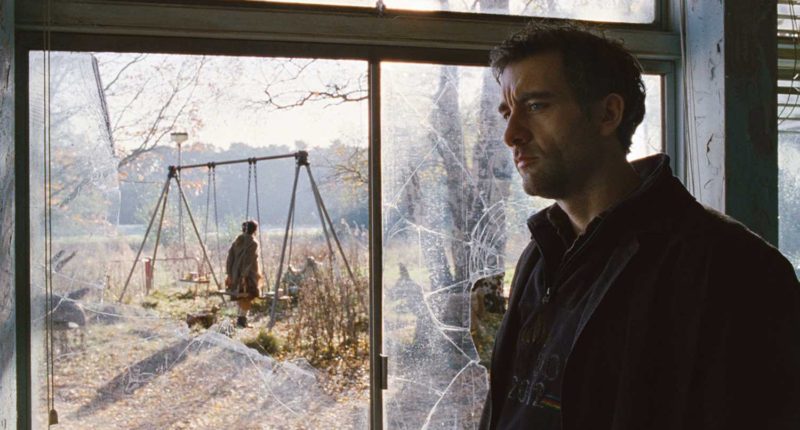
It’s 2027 and the world has gone to hell. Mysteriously mankind became infertile 18 years ago, and faced with the despair that the extinction of the human race is inevitable, society has collapsed. Cities lie in ruins and war has torn countries apart: Britain “stands alone”, one of the few with a functioning government – even though that government is a totalitarian, nationalist police state. Aggressive campaigns are waged against refugees from around the world, who are herded into hellish concentration camps. In this chaos, Theo (Clive Owen) is a disaffected civil rights activist, now plodding through a dead-end job and smoking weed with his friend, ex-newspaper cartoonist Jasper (Michael Owen). All this changes when he is entrusted by his activist/’terrorist’ estranged wife Julian (Julianne Moore) to protect Kee (Claire-Hope Ashitey) who carries inside her something that could change the whole of humanity: an unborn child.

Today Children of Men seems alarmingly prescient. In a world of migrant crises, Brexit, Trump and coronavirus (the film even refers to a flu pandemic of 2008!) the vision of the future it presents seems only a few degrees away from our reality. Rather than a hellish view, it seems more and more like something that could happen. Everything is worn out and grubby. Streets are lined with rubbish, buildings coated with graffiti. Televisions and advertising screens alternate between demands to report immigrants with promotions for “Quietus”, a suicide pill. Fences, armed police, barbed wire and crowds of filthy, terrified and brutalised people are common. Humanity has given-up: there is no hope in the world.

It’s that collapse of any sense of hope and optimism that has driven this collapse of society in Cuarón’s vision. In a world where the extinction of mankind is inevitable, what’s the point contributing to society or worrying about your legacy or the future? Why preserve anything when no-one will be around to see it in a hundred years? By such fragile threads, does society hold itself together. The crushing depression of knowing you live in the final days of humanity is everywhere. There is not a single person alive in their teens: a fact hammered home by the characters visiting a deserted and derelict school. Everyone has lost any sense of purpose, with life a grim daily grind.

Perhaps that’s also why physically the world hasn’t changed much. Unlike most “future set” dramas, this view of 2027 could be 2006, just dirtier and with a few more electronic screens (in fact this has helped hugely in not dating the film). It’s like all life has stagnated. And liberals like Theo have turned into apathetic drunks, drifting blithely through life not bothering to engage or change anything about the shit show all around them

All this makes the film sound impossibly grim – and Cuarón is superb in building this world (including the genius stroke of never explaining, even in the smallest detail, what has caused this pandemic of infertility – the film is refreshingly free of any clumsy scene setting) – but it works because it’s a film laced with hope and a belief in the fundamental goodness of people. The story has overtones of a religious fable: Theo and Kee as a sort of Joseph and Mary travelling to protect an unborn child whose birth could save the world. Specially composed choral music, rife with religious overtones, underplays key moments and scenes subtly leaning into this spiritual journey.

And the goodness that people find in themselves is inspiring. Theo, brilliantly played by Clive Owen who has just the right dissolute cynicism hiding crusading courage, may have given up but actually he’s a deeply empathetic and caring man. Animals instinctively love him. He’s a natural protector, who shows concern in all sorts of ways for people him, who puts himself at risk to protect people and refuses to ever accept defeat. But he’s a million miles away from a super-man, getting increasingly dishevelled, bashed and brutalised, while his struggles with footwear (he carries out action sequences  wearing just socks, then flip-flops and finally barefoot) is both a neat little gag and also a sign of how vulnerable he is in this dangerous world.

Cuarón’s film builds brilliantly on his empathy to carefully and beautifully build the growing understanding and trust between Theo and Kee (equally well played by Claire-Hope Ashitey). Again, it stems first from his protectiveness (Theo also works hard to protect people around him from disturbing sights, twice urging Kee not to look back and that whoever has been left behind is fine), but also from her instinctive trust in him as a good man and above the only one who seems to have her interests at heart (everyone else is concerned only with what Kee can symbolise – Ejiofor’s vigilante Luke can’t even get the sex of the baby right). Kee is vulnerable, but strong and determined, someone trying to carry the burden of being the hope of mankind.

She’s also brilliantly a member of the very migrant community that the government is trying to destroy. Cuarón’s film wants us all to remember that we are all the same deep down, that what happens to one affects us all. The horrors of what the British government are doing in the war-torn slums of migrant prisons (all of Bexhill has become a lawless hell hole, where executions and riots are daily occurrences) reek of everything from Auschwitz to Guantanamo. But amongst these migrants come the only strangers who seek to help Theo and Kee out of simple goodness and humanity. Strangers put themselves at huge risk, and in many cases sacrifice their lives, to help them. It makes a stark contrast with the revolutionaries who claim to fight for the migrants (but show no compunction in shooting them when needed), but really are only interested in their own selfish battles with no understanding of the bigger picture.

This bigger picture is very much like the thematic richness of the film that was missed on its released. It’s almost a victim of its own technical brilliance, which attracted much more attention at the time. Cuarón constructs several sequences to appear as single-takes, and the stunning camera work really helps establish this grimy, brutal world. It’s a wonderfully immersive film, a technical marvel. Every single part of the photography and design is pitch-perfect, and the key sequences are stomach-churningly tense, inspired by everything from The Battle of Algiers to A Clockwork Orange.

But the film works because it is underpinned by faith and trust in the human spirit. Mankind is being challenged like never before, but Cuarón shows us that the human spirit can survive. That simple acts of kindness can still happen. That there is a chance of hope. The final conclusion of the film is both sad but also upliftingly hopeful. Cuarón’s direction is just-about perfect, as are the performers (not just Owen and Ashitey but also an almost unrecognisible Caine as an ageing Hippie). With its acute and brilliant analysis of humanity – both in its grimness and capacity for goodness and selflessness – and with its prescient look at how easily our world could collapse, Children of Men is vibrant, brilliant, essential film-making.

The Agony and the Ecstasy (1965)

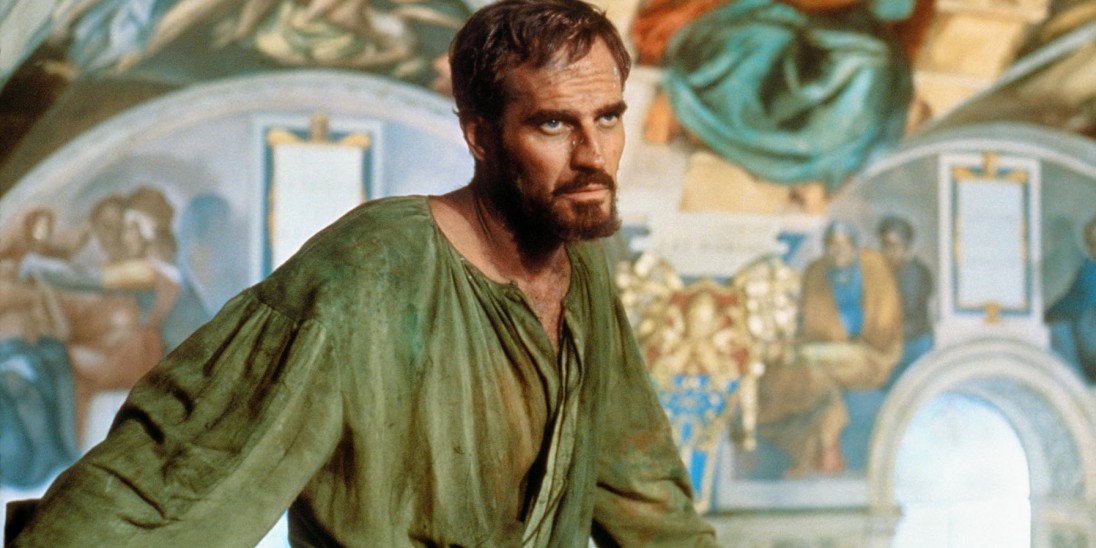
Rex Harrison and Charlton Heston debate the creation of art in The Agony and Ecstasy

Director: Carol Reed

Cast: Charlton Heston (Michelangelo Bounarroti), Rex Harrison (Pope Julius II), Diane Cilento (Contessina Antonia Romola de’Medici), Harry Andrews (Donato Bramante), Alberto Lupo (Duke of Urbino), Adolfo Celi (Giovanni de’Medici), Venantino Vanentini (Paris De Grassis), John Stacey (Giulano da Sangallo)

Call a film The Agony and the Ecstasy and you are tempting fate with the critics. Make your recurring dialogue phrase “When will you make an end?” and you are practically writing the negative headlines for them. Your enjoyment of The Agony and the Ecstasy is pretty going to be pretty much directly linked to your level of interest in Renaissance art, the Sistine Chapel and stodgy Hollywood epics. Don’t care for any of those? This probably isn’t the film for you. For me, I love the first two – and I have a terrible weak spot for the third. I know (trust me, I know) films like this aren’t that good really, but they go about their epic work with such earnestness that they always suck me in.

The film, an adaptation of a doorstop novel by Irving Stone, tells the story of Pope Julius II (Rex Harrison) commissioning Michelangelo (Charlton Heston) to paint the Sistine Chapel. It’s a job which Julius expects will be done and dusted in a couple of months: instead it takes almost four years (and that’s just the ceiling, the film doesn’t even cover the artist moving on to The Last Judgement!). Rejecting the original concept, Michelangelo decides to turn fresco painting on its head: and so one of the greatest masterpieces of all time is born.

The Agony and the Ecstasy lost a bucket load of money (despite this is hoovered up five Oscar nominations, most of which focused on its strengths, above all, it’s 1:1 recreation of the Sistine Chapel which is progressively covered in paint as the film progresses). It more often than not tips somewhere between documentary and reverence of God, the Church, the Artist or all three at once. The first 12 minutes of the film is literally a documentary, a run-down of the artist’s career with mid-Atlantic voice-over and reverential visual slide-show of the artist’s greatest hits.

Once the action starts, all too often the film heads into “men in tights” territory, a stilted, personality-free Hollywood version of the Renaissance, all primary colours and dubbed European actors. Directing, with a smooth emptiness, is Carol Reed. Remember when Reed made films like The Third Man and Odd Man Out? How could the man who made films as original and dynamic as those close out his career making such middle-of-the-road fare as this and Oscar-winner Oliver? Reed delivers by-the-numbers. From swelling chords of Alex North’s well-judged score at our first sight of the interior of the (unpainted) Sistine chapel to the pristine pictorial pleasantry of the marble quarry Michelangelo retreats to, there is not a single unique or interesting shot in the film.

The closest the film gets to visual dynamism is the half-way point as Michelangelo heads to the mountains for inspiration, to see the clouds form themselves into (what we recognise as) the Creation fresco from the chapel. But then perhaps Reed reckoned he couldn’t bring us anything as visually striking as the ceiling (and to be fair who can?). So, the film doesn’t compete.

Instead it settles down into demonstrating the mechanics of how the ceiling is completed. While you could get a good dig in here that we see a real time painting of the ceiling, in fact I felt this demonstration of how you go about transferring a design to a ceiling was fascinating. Certainly, you can see why it takes a burden on Michelangelo. The film builds some nominal drama about whether it will ever be finished: but since it’s clear Julius (who at times is a bit of a “why I oughta…” boss, frustrated but amused by a protégé’s shenanigans) and Michelangelo (tempestuous of course, as artists are) have no intention of not finishing it, it’s pretty manufactured. But it doesn’t matter because this is really a story of the glory of fine art – and the burdens of its creation. And on that score it’s very successful and, for all its earnestness, very effective.

Charlton Heston gives a fine performance as the great artist. While there is no hint of Michelangelo’s probable sexual flexibility – Heston claims to have done his research and decided there was no way any of that was going on in the artist’s life – we do get a lot of his prickly bitterness (his surviving correspondence is a never ending stream of bitching about money and barely a mention of art theory, a sign if ever I saw one that great artist’s need to balance the books like the rest of us). Heston’s grandness may seem at time like he is as carved out of marble as the subject’s work (after all this is the actor cast as Moses based on his physical similarity to Michelangelo’s carving), but he does convince.

Rex Harrison has the juicier part as the war-like Pope, the Prince of both the Church and Realpolitik. Harrison famously declined to grow the beard that Julius was famed for, but he captures the brusque playfulness of this man who remodelled the Papacy as a political force. His scenes carry energy and wit in a way most of the rest of the film lacks.

Overall though the film, I am well aware, is (ironically) as slow as watching paint dry. But yet, it pushes my buttons and I rather like it. Again, it’s probably a bias coming into it. And I forgive it a lot for a beautifully judged and played scene where Julius and Michelangelo study the creation fresco and its meanings for faith. It’s wonderfully written and played and carries a profound spiritual intellect. This is when the film comes to life – it’s gives serious space to proper discussions on questions of art and faith, which is often rewarding.

Sure, it sits within a film that is often dry and old-fashioned. But when it zeroes in on the painting itself: how it came about, its inspiration and its meaning – it carries a real impact. It’s a flawed film: but I find myself with a very soft spot for it.

A Beautiful Mind (2001)

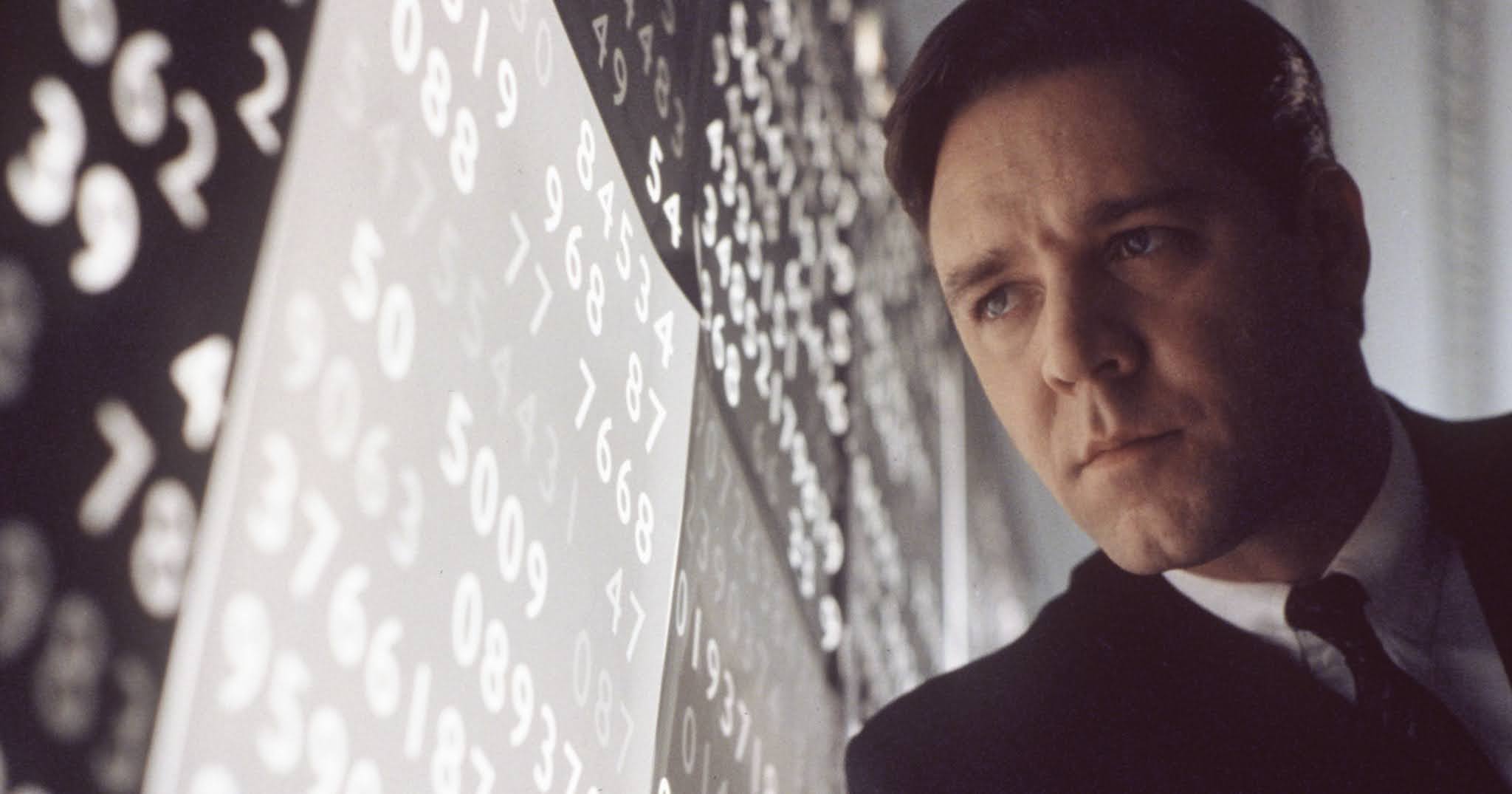
Russell Crowe struggles with reality as Math’s genius John Nash in A Beautiful Mind

Director: Ron Howard

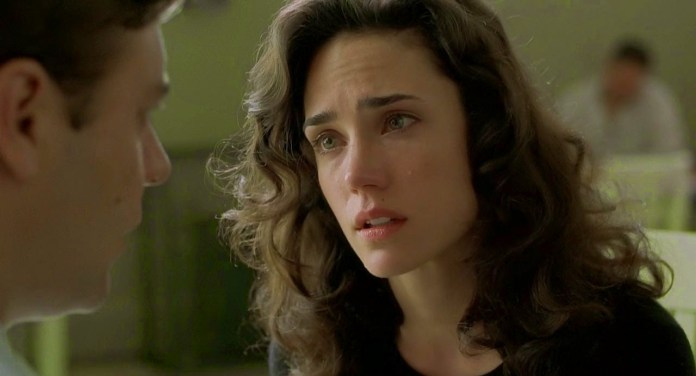
Cast: Russell Crowe (John Nash), Ed Harris (William Parcher), Jennifer Connelly (Alicia Nash), Christopher Plummer (Dr Rosen), Paul Bettany (Charles Herman), Adam Goldberg (Richard Sol), Josh Lucas (Martin Hansen), Anthony Rapp (Bender), Judd Hirsch (Professor Helinger)

There is nothing Hollywood likes more than a man overcoming adversity. Make him a troubled genius and that’s even better. Throw in a supportive wife who bends over backwards to help him and you’ve got the dream Hollywood scenario. You can bet Oscars will follow – and they certainly did for Ron Howard’s A Beautiful Mind, which hoovered up Best Picture, Best Director, Best Adapted Screenplay and Best Supporting Actress (it probably would have also nabbed Best Actor if Russell Crowe’s personal behaviour hadn’t turned him from idol to Hollywood’s most unpopular actor).

The film is a romantically repackaged biography of John Nash (Russell Crowe), a pioneering mathematician whose life was turned upside down by his diagnosis with schizophrenia in the 1960s. Even before then, Nash had become increasingly preoccupied by delusions and fantasies, many of them revolving around “secret government code-breaking work” for a bullying CIA Agent (Ed Harris). Slowly coming to terms with his diagnosis, with the help of his loving wife Alicia (Jennifer Connelly), Nash must learn to put aside the things he knows he are not real, while trying to rebuild his life.

Ron Howard’s film is assembled with his usual assured professionalism. It is never anything less than effective, what it never quite manages to be is inspired. Perhaps because it’s a very standard Hollywood biopic. It effectively presents the life of its troubled genius as something very easily digestible, hitting all the beats of suffering, determination and eventual triumph you could expect when the film starts.

This makes for exactly the sort of middle-brow filmmaking made with absolute professionalism that, if you turn your head and squint a bit, can be made to look like Oscar-winning art. That seems incredibly harsh on the film: but there is really nothing particularly “new” about anything here: in many ways, it could have been made almost exactly the same in the 1940s (and it would probably have won an Oscar then as well).

That’s not to say it’s a bad film. Howard’s direction is sharp and exact, and he stages the film very well, drawing very good performances out of the cast. The film is good at immersing us in Nash’s delusions, particularly in the first hour of the film (it’s not until the hour mark that anyone overtly states there is anything wrong with Nash beyond eccentricity and social awkwardness). Howard shoots the fantasies totally straight: in fact if you had managed to avoid knowing what the film is about, you can totally imagine being tricked into thinking it’s a genuine spy thriller.

With that though, the film gives you just enough hints. Take a beat and look at Nash’s CIA actions and they don’t make much sense. A secret code that involves him tearing pages out of thousands of magazines and pinning them up around his office connected with bits of string (standard filmic language for the obsessive nutter)? The CIA injecting a number implant into his arm? A dead drop at a posh house which requires letters to be sealed with wax? The film gives us the hints that Nash is more troubled than just awkward around people, but doesn’t lay it on too thick. And at least one plot reveal that something we have seen was in fact a Nash-delusion the whole time is so skilfully presented that it surprised me (and I know surprised several other people).

The film is also strong on schizophrenia and delusion. Reworking Nash’s real-life auditory hallucinations into visual fantasies (including imagined buildings and people) works really effectively for film. It also really opens up for us the horror of how difficult living with something like this might be. How would you feel if you could never trust the world you saw around you? What if you discovered things that were central to your life turned out to be fantasies? That people you had built relationships with were not real? That’s a traumatic emotional burden, and the film is very strong at building your empathy with Nash.

It’s also helped by Crowe’s very effective performance in the lead. Shy, buttoned-up, physically awkward, his eyes always cast down, body slouched and voice an embarrassed mumble, Crowe brilliantly embodies a nervous outsider whose problems fitting in only magnify his growing dependence on fantasies that place him at the centre of the world. There is a touching vulnerability about Crowe here that so rarely gets seen. A big part of the film’s success is due to his performance.

Jennifer Connelly also makes a great deal of her very traditional role as the supportive wife, bringing just the right level of assurance, spark and warmth to the role. Connelly carefully shifts the character from flirtatious confidence to heartbroken but supportive wife. But she doesn’t lose track of Alicia’s own frustrations at living with a medicated, unresponsive husband – even if, of course, any regrets she may have about the way her life turned out are overcome swiftly.

Which of course is completely different from real life where, for all her support, the couple divorced. Nash also had a baby (which he didn’t acknowledge) with a nurse he had an affair with. But these are real life complexities that have no place in a crowd-pleasing biopic like this. Similarly gone are Nash’s possible flirtations with bisexuality, his experiments with drugs or his flashes of violence. Added in are an entirely invented “pen gifting” Princeton ceremony and Nash’s Nobel prize acceptance speech where he gives thanks to his loving wife (in real life no such speech happened and the couple were separated). But that’s not the story this film wants to tell, so truth can go hang.

Perhaps these, post-diagnosis, difficulties are why the final third of the story – which sees Nash casting aside the invasive treatments to overcome the power his delusions have over him through willpower alone – is the least involving part. After all, they had to drop most of the actual real-life events that happened (see above). But there simply isn’t as much drama in watching someone quietly adjust to rebuilding a career in maths as there is in seeing them struggle.

Perhaps as well, because maths is a pretty difficult to bring to the screen. The film falls back into many accepted visual tropes – you’ll see a lot of writing on windows – and explains Nash’s theory of co-operative dynamics with a bar-and-booze based conversation around pulling girls in bars. That’s about as far as engagement with maths and understanding his theories goes – but we take it as read that Nash is a genius because he acts like one, people tells he is and he writes lots of big equations on boards.

A Beautiful Mind offers few real surprises (except for one) and presents a story that Hollywood has basically been making for decades. Things from real-life that don’t fit the story have been cut out, to make this as conventional a film as possible: the troubled genius and the loving wife behind him. It’s very well played (as well as Crowe and Connelly, Paul Bettany is brilliantly charismatic as Nash’s eccentric college roommate) and directed with a professional skill. But it’s also a very safe and even conservative film that has skill but not inspiration.
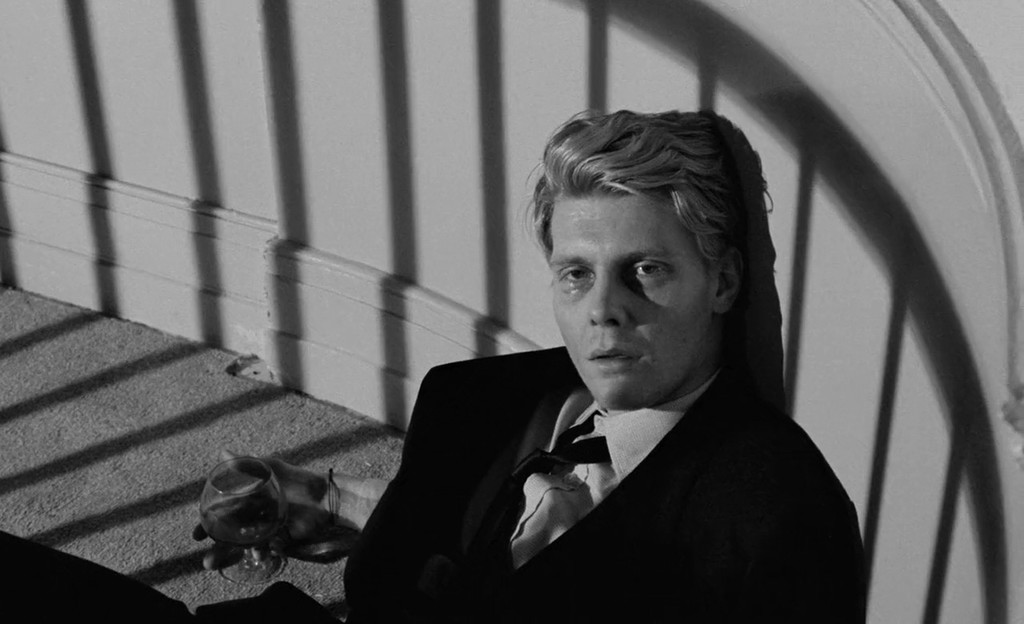
Beat the Devil (1953)

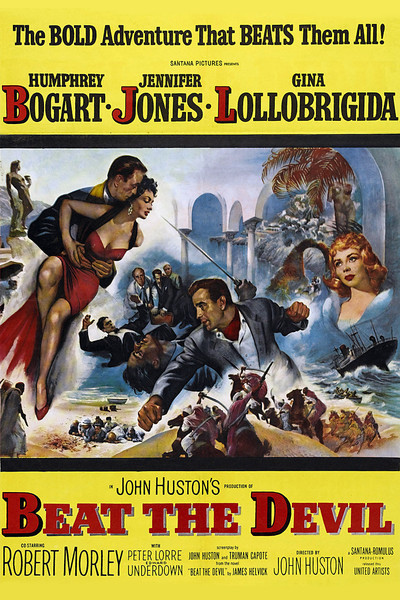
Jennifer Jones, Gina Lollobrigida and Humphrey Bogart in the tongue-in-cheek Beat the Devil

Director: John Huston

Cast: Humphrey Bogart (Billy Dannreuther), Jennifer Jones (Gwendolen Chelm), Gina Lollobrigida (Maria Dannreuther), Robert Morley (Peterson), Peter Lorre (Julius O’Hara), Edward Underdown (Harry Chelm), Ivor Barnard (Major Jack Ross), Marco Tulli (Ravello), Bernard Lee (Inspector Jack Clayton)

Beat the Devil is a curious beast. You could argue it was ahead of its time. Huston and Bogart had started out with the intention of making a straight crime mystery, a sort of Maltese Falcon in Europe. But when they arrived on location, obviously something in the weather got to them and Truman Capote flown in to help redraft the script on a daily basis to turn it into a sort of satirical comedy. For audiences expecting a hard-boiled crime mystery, it left heads scratched and cinema seats empty. Bogart lost a packet on the film – and later claimed to hate it – and it only existed in a badly cut-about version until it was restored in 2016.

The slightly surreal plot hardly really matters. A crowd of unusual people gather in a run-down port in a small Italian town, waiting to take the ship to East Africa. Gwendolen (Jennifer Jones) and Harry Chelm (Edward Underdown) are seemingly upper-class Brits (or are they?). American Billy Dannreuther (Humphrey Bogart) and his European wife Maria (Gina Lollobrigida) might also once have been something, but they sure ain’t now. Peterson (Robert Morley) and his associates the suspiciously un-Irish Julius O’Hara (Peter Lorre), rat-faced bully Major Jack Ross (Ivor Barnard) and nervous Ravello (Marco Tulli) are almost certainly all criminals on their way to a big score in Africa. Thrown together, this unlikely grouping end-up in a heady cocktail of betrayals, schemes, affairs and lies that spools out like a demented shaggy-dog story.

Beat the Devil is really more of an experience, a series of gags and light-hearted scenes played with a grin and a wink. Nothing in it is meant to be taken seriously, and this semi-surreal group of events becomes ever more absurd as it goes on. By the time the cast are abandoning a sinking ship, trudging up a beach to be captured by Arab officials who eventually allow them to row back to port where they find their ship didn’t actually sink…you really should just decide to go with the flow.

Instead the film is about shuffling up familiar tropes from hard-boiled noir with Oscar Wildeish farce. Certainly the Chelms seem to have wandered in from something totally different (not least since Gwendolen’s name is reminiscent of Importance of Being Earnest). Harry (a superbly stiff-upper lipped Edward Underdown) is a blithely unaware would-be English gentleman, pompously aware of his social class and blithely unaware that his wife seems to immediately start an affair with Billy. Gwendolen is the exact sort of character you might expect to see in Wilde, a dreamer tipping into fantasist, who blurts out things she shouldn’t and falls instantly in love with Billy. She’s also whipper-smart – more than capable of defeating Harry at chess without looking (“usually he’s a wonderful loser” she tells Billy, by way of apology for Harry’s strop).

Billy and Gwendolen embark on an immediate affair (although of course, in deference to the Hays Code, its just kept this-side-of-implicit). Mind you the film has a zingy wife-swop feel to it, since it’s pretty clear that Maria is far more interested in the British reserve of Harry (“Emotionally I’m English” she says before eulogising tea and crumpets) than she is in the ordinary-Joe cunning of her husband (although perhaps Harry is just as oblivious to this as everything else around him).

Billy is Bogart deliberately at his most Bogart-ish, channelling every grimy-but-smart dubious-hero the star ever played. Bogart plays the entire film with a grin on his face and delights in lines like “Fat Guys my best friend, and I will not betray him cheaply”. He also sparks delightfully with Jennifer Jones, who seems to having the time of her life as a character so flighty and unpredictable that even she looks like she hasn’t a clue what she is going to do (or feel) from one moment to the next.

The supporting cast of creeps and freaks Dannreuther is conspiring with to make a fortune (its something to do with land and uranium) similarly seem to have walked in from a side-ways Dashiel Hammett universe. For all their dirty deeds – and it seems Petersen had ordered a hit in the UK, although never for a minute would you believe this looking at Robert Morley’s puffed up bluster – they are a rather sweetly naïve and incompetent. Morley’s Petersen, a sort of galloping major, carries no real threat. Peter Lorre is very funny as a suspiciously German sounding Irishman (“Many Germans in Chile have come to be called O’Hara” he comments), prone to flights of verbal fancy and a chronic lack of focus. Ivor Barnard is as close as the film comes to threat as the aggressively incompetent Major Ross, a chippy bully who resents his shortness and eulogises Hitler at the drop of a hat. These heavies are each ridiculous figures.

And it makes sense, since the plot is a great inflated balloon of nonsense. There are chases, sinking ships that stay unsunk, a moment where two major characters are briefly believed dead, obsessive conversations about hot water bottles and reveals that puncture any sense of grandeur for each character. It’s the sort of aimless story you could imagine natural raconteurs like Huston and Capote finding absolutely delightful, and the whole film feels like a dramatization of a dinner-table anecdote.

Take it on those terms and its all rather good fun, even if it makes no sense. The cast look like they are having a whale of a time, and the total lack of seriousness about the whole enterprise generally makes it glide by with ease. Take a couple of drinks, sit back, don’t think about it too much and enjoy the jokes.

Judgment at Nuremberg (1961)

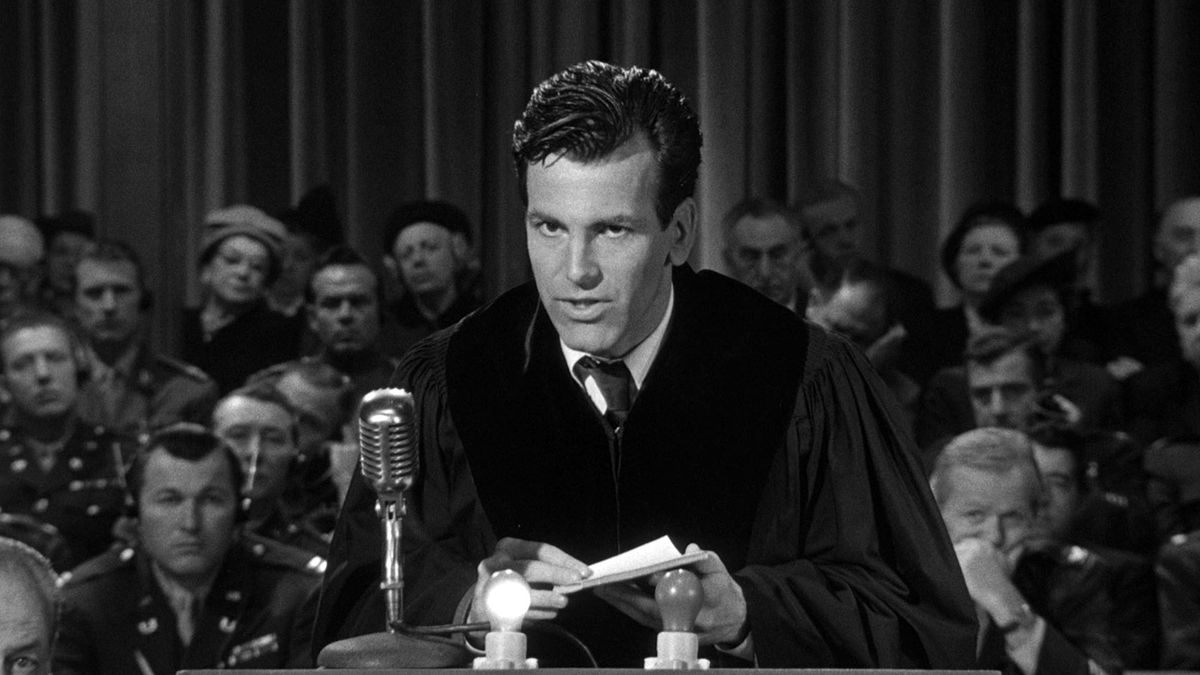
Maximilian Schell on a misguided attempt to salvage his country’s dignity in Judgment at Nuremberg

Director: Stanley Kramer

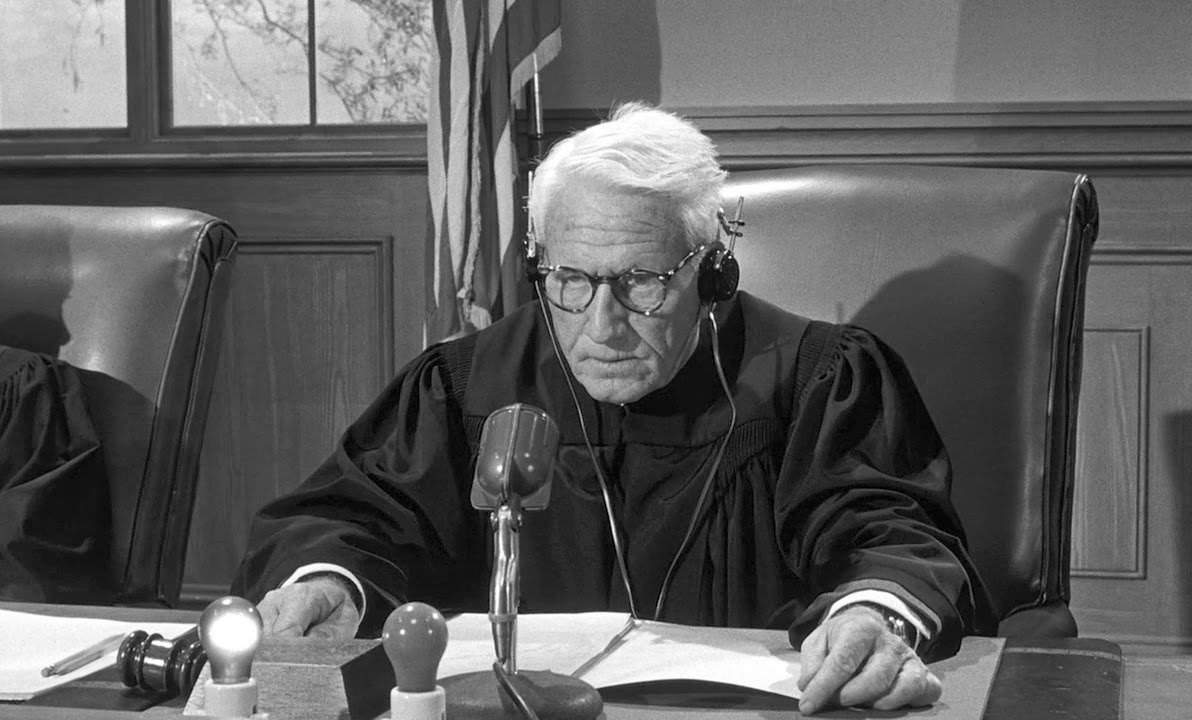
Cast: Spencer Tracy (Judge Dan Haywood), Burt Lancaster (Dr Ernst Janning), Richard Widmark (Colonel Ted Lawson), Maximilian Schell (Hans Rolfe), Marlene Dietrich (Frau Bertholt), Montgomery Clift (Rudolph Peterson), Judy Garland (Irene Hoffmann), William Shatner (Captain Harrison Byers), Howard Caine (Hugo Wallner), Werner Klemperer (Emil Hahn), Joh Wengraf (Dr Karl Wieck), Karl Swenson (Dr Heinrich Geuter), Ben Wright (Herr Halbestadt), Virginia Christine (Mrs Halbestadt), Edward Binns (Senator Burkette)

“I was just following orders”. It’s a statement you instantly associate with people who know they are doing the wrong thing, but cling to the idea it’s not their responsibility because they’ve been told to do it. The Nuremberg trials – which started with the major surviving war criminals, but then investigated every level of German society from the army to industry to doctors to the judiciary – exploded this as an excuse. But the trials also raised wider questions, ones that Judgment at Nuremberg explores: how do you make judgments for individuals when, arguably, nearly everyone in the country holds some sort of moral responsibility? What happens when justice collides with political reality? What price is put on getting justice for the few against the need to move on?

These, among others, are fascinating questions explored in Stanley Kramer’s engrossing – if at times a little dry and on-the-nose – film. In 1948 Judge Dan Hayward (Spencer Tracy) arrives in war-torn Nuremberg to judge the trial of four senior German judges. The most prominent of the accused is internationally renowned Dr Ernst Janning (Burt Lancaster). Janning’s passionate advocate Hans Rolfe (Maximilian Schell) believes the trial is about the Allies punishing the Germans and wants to show “we were not all like them”. Prosecuting laywer Colonel Ted Lawson (Richard Widmark) wants the trials to continue until all the guilty have been punished. But with Cold War tensions rising – and Berlin already under blockade by the Soviets – the politicians back home want the trials to wind down, particularly as the Germans could be key allies against the USSR. How will Hayward balance these pressures as the trial progresses?

Kramer’s film is a brilliant reconstruction of the detail of the trials. He had wanted to film the entire thing on location – but, when the trial room was unavailable, Kramer had the trial room rebuilt in exact detail in the studio (the production design is absolutely spot-on by Rudolph Sternard). The film stages all the issues of simultaneous translation, headphones and trial procedure in loving detail. His technical direction is well managed – even if the camera perhaps once too often pans around those involved in the trial while they speak. The trial drama is structured around three key witnesses (rather than documents), and brings out impressive performances from the entire cast.

Abby Mann’s screenplay wisely focuses in, not on the primary Nuremberg trials, but one of the many sub-trials. Little known, this works so well dramatically, because they both delve deeper into how every facet of German life was corrupted by Nazism – that in this case, leading judges condemned those they knew were innocent to death – and also allow an exploration around the purpose of the Nuremberg trials themselves. Were these trials crucially about justice at all costs and should continue indefinitely – as some characters clearly believe? Or were they meant as representative affairs, demonstrating the guilt of a selected few, at which point their purpose was done?

Kramer’s film is an educative piece, which explores this. Crucially several German characters are introduced, each of them unsure as to how much the national guilt should apply to them. Should Hayward’s household staff consider themselves guilty? As Hayward points out, Dachau was only about 20 miles away: not to know of its existence at all, was surely be wilful ignorance. Marlene Dietrich (excellent as an austere widow), is bitter that she has lost everything after her husband (a German general) was executed (an execution that many of the characters feel was harsh). He never liked Hitler, and he wasn’t a Nazi: how bad could he have been? He only did his duty right?

Meanwhile, firebrand lawyer Hans Rolfe believes that he must salvage some sense of German identity from the trial: he needs to show that “we were not all like that”. And rescuing the reputation of Dr Janning as “the Good German” is crucial to that. An Oscar-winning Schell (the part is perfect for his grandiose style) superbly captures the agonised guilt that has transformed into anger in this man: the desperation to protect his country that leads him to undertake the same brutal interrogations of witnesses during the trial that his clients are accused of doing. Repeating the same actions of the past that he hates, with a misguided goal of restoring pride to his country.

And why does Dr Janning become the focus of this desire to show not everyone was bad? One of the interesting things the film raises is questions of class. Rolfe sees him as the model Good German and Hayward struggles to see why he was involved in miscarriages of justice, because he is very much “one of us”. Ramrod straight, he’s no fanatic (like one of his fellow accused), he’s a noble, world-renowned lawyer. Lancaster’s Janning, with his rigid physicality, clearly thinks himself a world above his fellow accused. He has touched pitch, but feels he’s not really been defiled at heart: that there were clear reasons why he did the things he did. He has no sympathy for the crudity of Nazism, but still feel ashamed that he allowed himself to get tied up with it. He starts the trial trying to be above the entire process, as if not engaging will somehow stop him from feeling corrupted, even while his haunted face drips with shame.

It’s a nobility that many on the US side find appealing. It appeals to the same minds that deems Richard Widmark’s combatative Colonel Lawson as not quite gentlemanly, but vindictive. Never mind that Widmark’s lawyer wants justice done, regardless of the cost. It’s the same sympathy many now feel for Dietrich’s dignified widow, who feels so classy and noble that she can’t really be implicated in any nastiness. Janning unnerves Hayward and others, because if he can fall so can they. It also makes him a perfect candidate for rehabilitation. And, with the Soviets closing in on Berlin, many among the Americans want such a fate as much as Rolfe does, so that Germany can be rebuilt as a bulwark against Communism. But are we kidding ourselves? Janning may be the face of decency, but how decent can he be when he decided justice was an optional extra in his courtroom?

The film carefully explores these questions of politics being the art of compromise: of the need perhaps to end one era in order to start another. They’re attitudes I think the film acknowledges as legitimate, but also questions: “What was the war for?” Widmark’s character asks. When you have horrors such as those in the camps – and the film plays one of the key films to powerful effect during the trial – surely politics as normal can’t be allowed to continue? (Interestingly the film allows Dietrich and Schell’s characters to both, legitimately, question the inclusion of this evidence as too emotive and not relevant to the actual crimes of the accused.) Hayward himself comes under pressure to deliver light sentences which will be better for the country. Will he do so?

How can he when the evidence of suffering is so clear to him. The two key witnesses bought into the film are a man with learning difficulties and a woman who had been accused (falsely) of being seduced by a Jewish neighbour. The roles are played by Montgomery Clift and Judy Garland – and a lot of the emotion of these scenes partly comes from the tortured vulnerability of these two actors. These are people whose lives have been shattered – unjustly – and have paid terrible personal prices. Yes it might be expedient for us to look past these stories, but is it right?

Yes, you can argue Judgment at Nuremberg is a little preachy, but I think there are many more interesting ideas thrown up here than Kramer (usually denounced as a simple right-and-wrong director) gets credit for. The performances are superb: Schell is of course marvellous, but Spencer Tracy perfectly channels his ability to project morality as the unsettled judge who finds his easy assumptions challenged. And the film finally boils down perhaps to the simple question of right and wrong.

Even at the end Janning, while admitting the justice of his sentence, and the wrongness of his actions, is still desperate for everyone to know he wasn’t really one of them. That he never knew it would come to those horrors. As Hayward says “It came to that the first time you sentenced a man to death who you knew to be innocent”. Perhaps that the message of the film: justice is complex but needs to be done – and it doesn’t matter about your motives or thoughts, only the things you do.

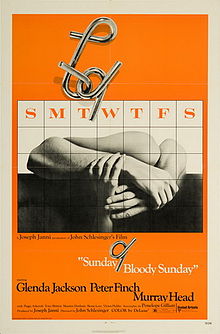
Sunday Bloody Sunday (1971)

Sunday bloody sunday header
Peter Finch, Murray Head and Glenda Jackson in an unconventional relationship in Sunday Bloody Sunday

Director: John Schlesinger

Cast: Peter Finch (Dr Daniel Hirsh), Glenda Jackson (Alex Greville), Murray Head (Bob Elkin), Peggy Ashcroft (Mrs Greville), Tony Britton (George Harding), Maurice Denham (Mr Greville), Bessie Love (Answering service lady), Vivian Pickles (Alva Hodson), Frank Windsor (Bill Hodson), Thomas Baptiste (Professor Johns), Richard Pearson (Patient), Jon Finch (Scotsman)

Is anything better than nothing? Or, sometimes, is nothing better than anything? It’s a question that lies at the heart of John Schlesinger’s mature and surprisingly low-key exploration of relationships Sunday, Bloody Sunday. In the on-going puzzle of life, what on earth are the answers?

Alex (Glenda Jackson), a divorced woman in her mid-thirties, is in a relationship with young artist Bob Elkin (Murray Head). But the bohemian Bob is also in another relationship, with 50-year-old Dr Daniel Hirsh (Peter Finch). Bob moves between his two partners. Alex and Daniel, who have never met, accept they have him on a timeshare basis and work within his rules, for fear of losing him.

That’s a brief summary – but this is not a film overburdened with plot. Rather it’s a character study. Perhaps its greatest strength (and for some it’s main weakness), is the lack of melodrama or conflict in this unconventional set-up. Any expectations that this might be building towards a cathartic outburst or a traumatic event of some kind should be dispelled from the start. This is a very restrained and genuine film, deeply heartfelt, that avoids cheapness.

In fact, the film becomes a very striking study of the fear of loneliness. Both Alex and Daniel live in semi-acknowledged fear of being left alone. You can see the emotional fragility in them, when separated from Bob. Alex – who Bob has abandoned during a weekend’s baby-sitting to visit Daniel – quietly sits eating fudge and trying to read a book, while tears play in her eyes. Later Daniel will similarly resemble a little boy lost after being stood up at a restaurant. The excitement of being with Bob – for all his faults – are just as acute as the sadness when left alone in their own company.

Both Alex and Daniel are people staring down the barrel of a life of being alone. Alex is a woman stuck between two stools – too bohemian to be happy in a nine-to-five and a safe everyday relationship, too conventional to fully embrace the sort of devil-may-care casualness of Bob. She seems uncertain herself what she wants from life (the perfect relationship, or the bursts of happiness with a young lover).

Daniel, a gay Doctor in middle-class London from a traditional Jewish background, has spent a lifetime quietly carrying on and accepting companionship where he can find it. A man who has understood that a certain degree of isolation is just part and parcel of being who he is. Who balances, perhaps, the flaws in his relationship against getting only a part of what he wants as opposed to nothing.

It’s those questions the film comes back to time and time again. Alex expresses them most clearly, happy in the moments of playful joy she finds with Bob, but this only covering deep lying anxieties. Flashbacks reveal her childhood worries about traumatic events befalling her father (bought on by the killing of a friend’s dog in a road traffic accident due to the carelessness of a child she is looking after). These fears are directly linked to her tentativeness towards long-term relationships: she invests emotionally so much in those she cares for, that it’s difficult for her to find a romantic partner that is perfect enough to justify this level of commitment.

But Daniel has similar issues: his life has taught him to expect that he might always be alone. An insight into his romantic life before Bob is shown with a chance encounter with a former pick-up (played with chippy aggressiveness by Jon Finch) who forces Daniel to give him a lift and then pinches his medical bag. These sorts of risky, emotion-free entanglements are dwarfed by the tenderness and warmth Daniel gets with Bob, for all that Bob is mercurial and immature. As Daniel says at the film’s end (in a beautiful fourth-wall breaking address to the camera), Bob isn’t perfect but he’s something and that while Bob never made him completely happy, right now Daniel is happy only when he is not missing him. It’s balances like this that people make in their lives.

It may also be a fascination with youth. Both Alex and Daniel are either heading into – or deep into – middle age, and they surely wouldn’t deny there is an additional excitement from spending time with the defiantly young Bob. Bob – a rather thankless role to be honest, played with a deliberate lack of depth by Murray Head – is in some ways a cipher, a rather selfish young man who can only think about moving on to the next opportunity, not the difficulties of being fixed in one place and making the best of it. Does this young man’s attitude carry additional appeal to two people with greater ties and responsibilities? Perhaps it does.

Schlesinger’s film is well-paced, and directed with an intimacy by the director who surely built many elements of his own life into Daniel. The two leads – who share a scene only twice, at one point literally passing each other in cars like ships in the night – are both superb. Glenda Jackson is superbly able to suggest a hinterland of emotional guardedness and fragility, behind a confident exterior, that only cracks at key moments. It’s a brilliantly subtle performance of small moments.

Peter Finch is equally superb as Daniel. The film was controversial at the time for featuring the first gay kiss in British cinema (sexuality questions are refreshingly not a major part of the equation and never discussed, which makes the film ever more modern – the kiss itself is played with an unshowy naturalism). The part had been hard to cast – Ian Bannan was fired (to his later intense regret) for being visibly uncomfortable – but Finch (less worried, perhaps because his romances with everyone from Vivien Leigh to Shirley Bassey were so well known, no one watching in the cinema could imagine he was really gay) embraces the part with a beautifully sensitive empathy. It’s a wonderful moving portrait of a man who has come to terms with loneliness and accepted it. Tender and very true, it’s wonderfully heartfelt.

Both stars (along with Schlesinger and the script, credited by Penelope Gilliatt but likely the work of several hands) were nominated for Oscars (inexplicably the film itself was snubbed), and its perhaps their sensitive and tender work is behind the film’s success. Schlesinger co-ordinates all this into a unshowy but very mature intelligent analysis of relationships and the compromises that come with them. Thoughtful and questioning, it’s adult cinema.

Shanghai Express (1932)

Marlene Dietrich is on a train full of mystery and danger in Shanghai Express

Director: Josef von Sternberg

Cast: Marlene Dietrich (Shanghai Lily/Madeline), Clive Brook (Captain Donald Harvey), Anna May Wong (Hui Fei), Warner Orland (Henry Chang), Lawrence Grant (Reverend Carmichael), Eugene Pallette (Sam Salt), Gustav von Seyffertitz (Eric Baum), Louise Closser Hale (Mrs Haggerty), Emile Chautard (Major Leonard)

The fourth collaboration between von Sternberg and Dietrich, completed when they were in the middle of – was it an affair, an infatuation or something half-way between obsession and resentment? Who knows. Either way, Shanghai Express is one of the their finest collaborations, a triumph of von Sternberg’s mastery of style and Dietrich’s charisma and appeal, brilliantly shot with some iconic images. The biggest hit of 1932, it’s also a loopy part-thriller, part-romance but with a sort of eerie dream-like logic and that mixes peril and jaunt. It’s a fascinating picture.

Its 1931 and China is in the middle of a civil war. Boarding a train bound for – you guessed it – Shanghai, is a veritable smorgasbord of ex-pats and mysterious travellers. First among them – and reviled by all but one of the other passengers – is infamous “coaster” ‘Shanghai Lily’ (Marlene Dietrich), a woman who (as she says) needed to go through more than one man to get that nickname. The only person in first class who can stand her is Chinese “coaster” Hui Fri (Anna May Wong). The man who has the most cause to resent her though is army physician Captain Donald Harvey (Clive Brook). The two of them were deeply in love, but misunderstandings came between them and he’s nursed a grudge ever since. The rest of the train carry their own petty prejudices – but all these are put in perspective when the train is hijacked by rebel leader General Chang (Warner Orland), who holds Donald hostage to get the release of his right-hand man from the Chinese. What will Shanghai Lili aka Madeline do to save the life of the love of her life?

Clocking in at a slim and efficient 82 minutes, Shanghai Express still manages to have a languid, patient pace to it, taking its time to establish places, relationships and stakes. Part of that also comes from the film being set in a sort of imaginarium idea of China, born entirely out of von Sternberg’s brain. With his long-standing disinterest in realism, von Sternberg’s film is a sort of fever-dream image of China. So it’s kind of fitting the film plays out like a dream, right down to its own pace. At times it rushes swiftly on, at others the stakes hardly seem to matter as the characters move freely around while in supposed captivity and barely consider their lives at risk. At the end of the film, the train arrives (despite the violence en route, the fact its late gets the most comment) and the characters simply get on with their lives.

Perhaps its all part of von Sternberg’s deconstruction of these Europeans and Yanks, whose only engagement with this foreign country is that it should be made as much like the West as possible. Most of the characters on board – with the exception of the women – are selfish, pompous, lecherous, prejudiced, greedy or some combination of all of the above. While they wear an air of respectability, it doesn’t take long to shake them from it. And their judgement of others is swift and irreversible. Even Donald, our nominal hero, fits this bill – he frequently rushes to judgement and pig-headedly sticks there, regardless of logic and experience.

In among this, it’s the women who emerge as the only characters who demonstrate pluck, loyalty, empathy and decency. Anna May Wong’s looked-down-on courtesan goes through a torrid time – demeaned on the train then assaulted by the lecherous Chang not once but twice (the second time an off-screen rape that none of the Western characters ever feel the need to comment on). Despite this, she’s one of the few who acts to defend someone other than herself, and her actions are (eventually) what brings liberation for the passengers (again not that they, or anyone else from the West, thanks her for it). It’s a neatly reserved performance from Wong (perhaps the best in the film), her eyes conveying an only thinly concealed contempt for those around her.

The closest thing she has to a confidante is of course Shanghai Lily herself. This is the perfect role for Marlene Dietrich, a woman who is both imperious and fragile, proud but willing to debase herself to save the man she loves, cold and knowing but also strangely naïve and romantic. As with much of her best work, what she does so brilliantly here is to bring together a host of contradictions that really shouldn’t make sense (except perhaps as some sort of sexual fantasy of von Sternberg’s?) and make it the most charismatic and arresting part of the film. Dietrich is not the most accomplished of actors – but she is an accomplished presence and undeniably charismatic.

Lily proves that she may be a hard-nosed player of the game, but that she’s more than capable of loyalty and faith to those she loves. She has no hesitation when asked to put herself in the way of danger for them. It’s a shame Dietrich doesn’t have a more charismatic scene partner than the rather bland Clive Brook (who ends up looking very forced as a romantic lead – you end up wondering what on earth this woman sees in him). But Dietrich’s movie-star magnetism holds much of the plot of the film together and provides much of its emotion.

She’s also of course beautifully filmed by von Sternberg – one late shot (with lighting pointing upwards in almost a spotlight triangle, creating a truly striking and erotic image of her smoking against a train door) has rightly become iconic, but the film is packed with them. Von Sternberg, working closely with photographer Lee Garmes (Oscar-winning) perfectly uses light and shadow to frame Dietrich with an alluring exoticism that compels the focus.

It’s all part of the film’s beauty and the skills behind its shooting. It starts with a series of flourishing tracking shots through busy train stations (something it returns to later on). Scenes that coat the film in smoke, with just backlighting, while soldiers and passengers move in front like a lantern show are extraordinary. The images make superb use of ultra-dark blacks to introduce frequently gorgeous images. With von Sternberg’s setting that only just touches realism in the faintest way possible, it makes for a wonderfully framed exotic fever dream – just as the film itself oscillates between action and languid romance in its pacing.

Shanghai Express is almost impossible to categorise. A romance with thrills in the middle, an action film where urgency is often off the table, a mystery that travels with an almost pre-ordained certainty towards its goal, it truly has a dream-like logic. And I guess if it’s all von Sternberg’s dream, it makes sense that it’s most striking scenes see Dietrich, perfectly lit, with smoke stroking itself around her. After all her charisma is at the film’s heart.

The Servant (1963)

Through a glass darkly: Dirk Bogarde and James Fox in a dark drama as master and The Servant 

Director: Joseph Losey

Cast: Dirk Bogarde (Hugo Barrett), Sarah Miles (Vera), James Fox (Tony) Wendy Craig (Susan Stewart), Catherine Lacey (Lady Agatha Mounset), Richard Vernon (Lord Willie Mounset)

Imagine a world where Bertie Wooster was a weak-willed, sexually confused drunk and Jeeves a malign force, to whom control over and destruction of his master go hand-in-hand. That’s the basic set-up of Joseph Losey’s masterpiece The Servant, a fascinating and brilliant exploration of class and sex in Britain in the 1960s, a lean, razor sharp, gripping and sinister film that lingers in your memory like a nightmare you can’t shake off.

Tony (James Fox) is a louche, rich young man returning home to Blighty, looking to expand his inherited fortune through dodgy property investments in Brazil. Before then, he needs a home to call his own – and a gentlemen’s gentlemen to run it. Tony hires Barrett (Dirk Bogarde), a scrupulously polite, observant man, able to meet every single one of his employer’s needs. But why is Tony’s fiancé Susan (Wendy Craig) so instinctively hostile to Barrett? And what is Barrett’s exact relationship with the housemaid Vera (Sarah Miles) he introduces into the house – and who quickly becomes the focus of Tony’s interest? Over time, the balance of power between servant and master becomes more and more uncertain.

Losey was an ex-pat American, driven out of the country by the McCarthy hearings. This adaptation of a Robin Maugham novel is the sort of brilliant deconstruction of (and assault on) the British class system and manners that perhaps only an outsider) could have made. The film drips with an air of corruption and vice. Even the earliest, most unobtrusive frames carry an air of over-observant malice. No coincidence this is also the leading quality of Barrett, perhaps one of the most darkly malign forces on film, whose piercing intelligence sees everything and whose self-control never slips. Losey’s camera constantly lingers over the slightest shot and detail, to an increasingly unsettling degree. As the plot becomes increasingly dark, claustrophobic and horrifying, the film’s exploration of the class-fuelled psycho-sexual, alcohol-fuelled relationship between Barrett and Tony becomes ever more pointed.

Losey partnered with the perfect script writer in Harold Pinter (who also briefly appears as a posh restaurant goer). Pinter’s lean, spare and menacing dialogue, with its corrupted poetry and acute psychological insight, is easily his finest film script – and perhaps the only one that truly could sit alongside his finest stage work. Pinter’s brutal vision of this twisted world is coated in a dark menacing commentary on Wodehouse (Susan and Barrett’s “duel” over the placing of a vase comes almost straight out of Jeeves) – and above all on the weakness that underlies those dependent on servants, as well as the loathing a servant can develop for his master, while still loving the control he has over his life.

Losey responds to this masterful script with some inspired work, making the house where the action takes place increasingly claustrophobic and disturbing. The camera work slowly becomes more intimate as the film progresses – and Barrett entraps Tony increasingly into a total, infantile dependence on him. Takes become longer as the house itself – increasingly dishevelled, with Barrett’s property increasingly appearing throughout the property, while Tony’s goods are disposed of – seems to close in around the action. Reflections and mirrors increasingly dominate the film, as if pulling us with Tony through a glass darkly.

It’s a good servant who understands his master’s needs before he knows them. Barrett is the best kind of servant. Within seconds, the unctuous, Uriah Heap-like Barrett (ever so ‘umble), has dissected the character of the foppishly weak playboy Tony, and identified him as man with no will of his own, ripe to be dominated and manipulated. Dirk Bogarde has never been better than his work here, a terrifyingly precise and soulless manipulator, whose veneer of obsequious service drops away with his affected accent to reveal a deeply corrupted, terrifyingly cruel man. Bogarde never allows a second of doubt to enter Barrett’s mind – even when it (briefly) looks like he’s lost his position, Barrett’s face is contorted with a contemptuous curl of the mouth and a cocky defiance. It’s brilliant work from Bogarde, creating one of cinema’s greatest monsters, destroying because he can.

His tools are of course to use his master’s fondness for booze and pretty faces against him. Vera – played with a sparkingly flirtatious richness by Sarah Miles, which disguises her ruthless disgust for Tony and his selfishness – is inveigled into the house as Barrett’s “sister” (actually his mistress), and swiftly instructed to seduce the hapless Tony, bending this playboy to her will. Losey’s camera follows in smooth shots as this woman moves from one man’s bed to another – while you can feel the influence of Pinter in the spare, sexually charged power Vera uses to seduce Tony (and the hints of submissive excitement in Tony). Losey soundtracks their first encounter – Miles erotically discussing the weather, pure Pinter genius, while Fox’s throat is so dry you can almost feel it yourself – with first the dripping of a tap, then the rocking back and forth of a pan in the sink. It brilliantly suggests the way Tony himself seems to be being consumed in a hypnotic trap.

Not that Tony is particularly sympathetic himself: a weak-willed, rather feckless and languid playboy whose interests in pleasure quickly tip into addiction. James Fox is perfectly cast in a role that plays on his aristocratic assurance, but finds deep reserves of doubt and inadequacy in him. Pinter and Losey draw more than a bit of a question mark over the sexual undertone in the relationship between Barrett (at least metrosexual) and Tony, that travels across sharing the favours of Vera. After (temporarily) throwing Vera and Barrett out, Tony collapses into a grief-stricken mess over Vera’s bed – the bed shared with Barrett – the camera gliding gently over male nudes pinned to the wall. Later Tony will debase himself fully to Barrett, reduced to crawling around the floor, his tie used as leash, dragged to perform with prostitutes for Barrett’s dark amusement.

If there is a character who sees through this early it’s Wendy Craig’s sensitively played Susan – but even she can have no idea of the horrors of Barrett’s plans to break Tony completely to his will. Susan recognises – even if she can’t understand why – the sinister satanic nature of Barrett, even while she seems powerless to do anything about it. Her attempts to empower Tony to break his dependence on this omniscient figure fail completely. In a beautiful Pinterish touch, at the end she almost considers joining their bizarre, sex and alcohol fuelled menage – as close as cinema as perhaps got to skirting a sort of sexual hell.

The final act of the film (it has a neat three act structure, Pinter superbly constructing the screenplay to show Barrett and Tony’s shifting power relationship), sees an almost infantalised Tony now meekly accepting (almost apologising) as Barrett lets rip – all pretence at humbleness gone and Northern vowels increasingly let loose – with his abuse and disgust.

In a brilliantly dark commentary on the upper and serving class, such is the dependence on one for the other, that the house collapses in Barrett’s temporary absence. The power may lie with Tony – but when Barrett stops collaborating with that, the imbalance between them is revealed. It’s Barrett who can actually do things – from cleaning to cooking – that Tony cannot. The drive and will of the middle classes eventually overwhelms and breaks the upper class, turning them into a vehicle for their own entertainment, like some sort of dark National Trust.

The Servant is a profoundly brilliant film, one that could stake a claim for being one of the greatest British films ever made. Losey’s sharp outsider’s eye brilliantly dissects both the tensions between the classes, but also the disturbingly awkward relationship the British have about sex, a drug for the reserved, a pot of unspoken but deeply desired treats. Bogarde is quite simply superb, Barrett is one of the greatest monsters of cinema who could strike fear into the heart of Hannibal Lecter. Pinter’s dialogue is brilliant. This psycho-sexual class drama is a work of art and essential viewing.