Category: Disaster film

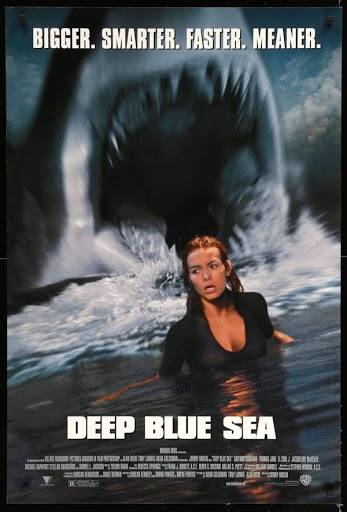
Deep Blue Sea (1999)

Deep Blue Sea header
Just when you thought is was safe to go back into the Deep Blue Sea

Director: Renny Harlin

Cast: Saffron Burrows (Dr Susan McCallister), Thomas Jane (Carter Blake), Samuel L. Jackson (Russell Franklin), LL Cool J (Sherman “Preacher” Dudley), Jacqueline McKenzie (Janice Higgins), Michael Rapaport (Tom Scoggins), Stellan Skarsgård (Dr Jim Whitlock), Aida Turturro (Brenda Kerns)

What would be your first idea for curing Alzheimers? Yup that’s right, you’d experiment on sharks brains: and to make those experiments even more effective you’d want the sharks to have really big brains. So, if you’re going to make them super-intelligent, you might as well make them super big, super ruthless with massive teeth. It’s just common sense. After all, they can never escape from your isolated sea laboratory could they? And even if they did, how much of a threat could they be?

Harlin’s film embraces its ludicrous set-up and B-movie nonsense from the start. Dedicated (and more than a little ruthless herself) scientist Dr Susan McCallister (Saffron Burrows) has bred these sharks to help with her obsessive dreams of curing Alzheimers. With millionaire funder Russell Franklin (Samuel L Jackson) flying into spend the weekend at the lab – with a skeleton crew on board – of course its time to run the final test. Can shark wrangler Carter Blake (Thomas Jane) help lead everyone to safety? Well no not everyone… it’s a monster flick after all.

There isn’t anything particularly surprising in Deep Blue Sea – other than one genuinely well-done shock death, which defies your expectations of which characters are the most important – but there are some decent jumps. Some nice little moments of action. A few good gags as sharks prowl through the base picking off the expected victims, while other characters use their wits and a bit of luck to take out the toothy opponents (even an oven gets employed as a weapon). But it’s quite predictable. And I predict that, if you are in the right mood, you might enjoy it.

The dialogue is unimaginative. Most of the acting is pretty wooden (Skarsgård in particular looks like a man yawning his way to a pay cheque) and the characters have clearly been scribbled on post-it notes. Harlin’s direction has a few playful moments, but there’s nothing special about it. You could pretty much predict where the film is going to go – and have a bit of fun spotting its various influences. But I think the film knows you are going to laugh at it. After all, mega sharks? Come on!

At the centre of this is the chemistry free line-up of Burrows and Jane. I feel a bit sorry for Burrows here. Her character is written as an all-consuming obsessive – she also is responsible for everything that happens – and, partly thanks to Burrows barely-concealed disdain for the whole thing, she never comes across as sufficiently guilty or apologetic. Test audiences watching the film reacted so negatively to the character – and you can’t blame them – that Harlin recut the film to make her more of the villain (not quite as much as the sharks, but up there).

A ‘romance’ with Jane hit the cutting room floor – although there are still several scenes where its DNA is readily apparent – just as well really as the actors are chemistry free. Jane in fact has more chemistry with LL Cool J (easily the films MVP as a charmingly offbeat, born-again cook) and the film works best when this bromance is at the fore.

Oh that, and when the sharks at the heart of it. The characters are so non-descript their fates will largely provoke laughter, but as a piece of popcorn rubbish Deep Blue Sea could be a lot worse. Sure it’s got no originality or real expertise about it all, with everyone chucking one in for the money, but its good fun. After all, who doesn’t love a vengeful super-smart shark eh?

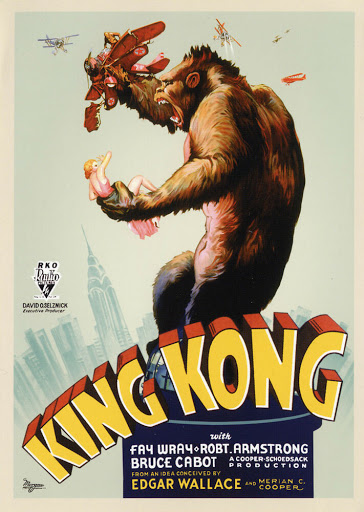
King Kong (1933)

King Kong header
The end of an unsuccessful New York vacation in King Kong

Director: Melville C Cooper, Ernest B. Schoedsack

Cast: Fay Wray (Ann Darrow), Robert Armstrong (Carl Denham), Bruce Cabot (Jack Driscoll), Frank Reicher (Captain Englehorn), Sam Hardy (Charles Weston), Noble Johnson (Native Chief), Steve Clemente (Witch king), Victor Wong (Charlie)

Of course, Citizen Kane is possibly the greatest and most influential film ever made. But, let’s be honest the paw prints of Kong is what we see most often in the latest Hollywood blockbuster. Kong may have met his end atop the Statue of Liberty (a death the poster spoiled), but his children are everywhere, from Alien to Jurassic Park to Avengers: Endgame. King Kong basically sets the template for special effects movies and Hollywood has almost been remaking it, in some way shape or form, for almost ninety years. But few films can match its momentum, action – or above all the heart it gives to its beast.

Carl Denham (Robert Armstrong) is a Hollywood director who has a plan to make his next film a huge success. He’s got a map to Skull Island (no need to worry with that name) where he’s heard rumour that a mighty creature is just waiting to star in his next film. Denham needs a female lead – so plucks Ann Darrow (Fay Wray) off the streets promising her the adventure of a lifetime. During the voyage to the island, she falls in love with first mate Jack Driscoll (Bruce Cabot). On arrival at the island they find a tribe of ferocious narratives, who kidnap Ann intending to sacrifice her to their god Kong – a massive gorilla. Instead Kong falls for Ann and carries her into the jungle. When Driscoll and Denham go to save her they find Skull Island is a dangerous place (who knew!), stuffed with brutal dinosaurs and scary beasts – and that Kong himself has no plans to give Ann back.

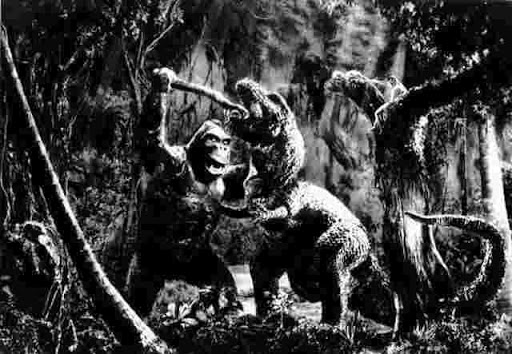
King Kong’s final hour is essentially little more than a stream of action scenes. However, few action films since have paced its action as well as this film does. With special effects by Willis O’Brien, one of the earliest masters of stop-motion, Kong in turn takes on a T-Rex, a pterodactyl, a village of natives and then most of New York in a series of escalating and dramatic sequences which use all the tricks Hollywood had, from animation to models and back projection. Each of these sequences are perfectly done and carry the sort of awe that stop-motion animation can project – all those hours of work! – helped by the successful (and brilliantly clever) use of back-projection to have these battling beasts seeming to tower over the human cast. You can imagine how thrilling it must have been – I’m not sure anything like this had been seen before.

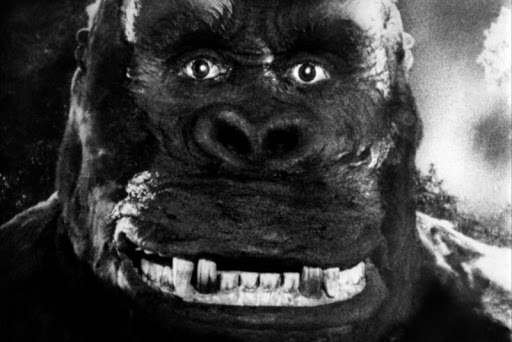
But the film has really lasted because Willis O’Brien’s skill is to add humanity and sensitivity to Kong himself. There is a reason why Peter Jackson (director of the sensitive but overextended remake) talked of weeping when he saw Kong meet his end. From almost the very first shot, Cooper and O’Brien cut to Kong’s eyes, which have a surprising soulfulness to them. And after all what does Kong really do wrong in this film? He is perfectly happy on Skull Island – he even only attacks other creatures when they make the move on him – he has no desire to go to New York and spends half the film trying to protect Ann from danger (not that she thanks him for it). The animation takes several moments to create the soul in Kong – from the ripples of his fur to his curious inclines of the head. After defeating creatures, he curiously picks up their crushed bodies, as if surprised to find them unresponsive. He gently moves Ann. There is a sort of innocence to him. After all what is he but a small-town guy who heads to the big city and falls for the wrong gal?

As such it’s rather hard not to root for him – or feel his pain (and shock) when attacked by planes at the top of the Empire State Building. You can see in Kong’s eyes the lack of understanding about what these metal objects are that are punching through his skin. The shooting gallery is tinged with tragedy – and it’s hard not to cheer when Kong manages to take one of these planes down. For all his fierceness, Kong seems like a real person, a vulnerable guy taken out of his depth against his will. The cruelty of exploiting Kong for Broadway ticket sales, as Denham plans to do, seems particularly un-just. It brilliantly allows us to get the best of both worlds: we can enjoy the spectacle of the wild animal Kong snapping the jaws of T-Rexs but we also feel for him as a confused and frightened animal put to death in a world he doesn’t understand.

Perhaps its easier to sympathise with Kong because so many of the human characters in it barely register. The first forty minutes is low-key – and often frankly rather flat – competently filmed but fairly-stiff build-up, carefully (and at times rather pointedly) establishing the situation and themes. None of the actors make much an impression (not helped that the second half of the film is so Kong focused that they hardly have a line to share). Robert Armstrong is effectively arrogant and ambitious as Denham. Bruce Cabot is pretty wooden as Driscoll (his first film after being recruited from the studio doorman staff, he has said he essentially stood where he was told and that was it). Fay Wray has a certain sweetness and charm as Ann, but barely opens her mouth other than to scream after the first forty minutes (in a neat bit of wit, her rehearsal on ship is standing still and practising screaming silently at an object she can’t see). With its blundering Hollywood director at the heart of all the chaos, King Kong could also be one of the first Hollywood satires.

Intentionally or not the film has an imperialism to it. Denham is an arrogant man out of his depth – although I am not sure how far the film is aware of this – and the crew come across as arrogant and clueless, blundering into a wild environment with an armed over-confidence (that quickly gets them all killed – most of them tumbling to their doom with an almost sickening rag doll snap after a meeting with Kong). You can sense that as well in the awkward lack of PC in framing the (black) residents of Skull Island as blood-thirsty savages with a lust for human sacrifice. However, with its eventual sympathy for Kong, there is enough here to allow the viewer to read into it a certain amount of post-colonial criticism of this sort of H Rider Haggard meets Arthur Conan Doyle world.

The film is very proud of its “Twas beauty that killed the beast” concept (it’s repeated numerous times in the film – not least most famously at the end) – but it’s an idea that is already framing Kong as the victim. So, for all the triumph of the design – the production design is stunning, rarely have Hollywood back lots looked as good – and the awe of Kong, the idea of him as a victim is there from the start.

A lot of that awe though comes from possibly the film’s MVP: Max Steiner. King Kong is one of the first films to use a full orchestral score and the music is vital to adding heft, drama and danger to this stop-motion beast. Steiner’s score superbly uses motifs to build Kong’s presence and operatic crescendos that brilliantly heighten the drama. It’s certainly one of the most influential scores ever written – and it’s impact on film history is so lasting, that watching the film today you take it’s revolutionary nature for granted, so often has the way of using music become part of our accepted cinematic language.

King Kong lasts because of the awe it builds for the monster, but also the way we start to feel for him. Complimented by the professional skill of Cooper and Schoedsack’s direction, King Kong still grips today, for all that you need to read into it more depth than is (perhaps) there. But depth isn’t what made Kong great. It was the excitement and drama of the spectacle – and its so exciting you barely notice that Kong dramatically increases in scale as the film continues. And while special effects have moved on, the power of what’s presented here hasn’t. Deserves to be listed as one of the most influential films ever made.

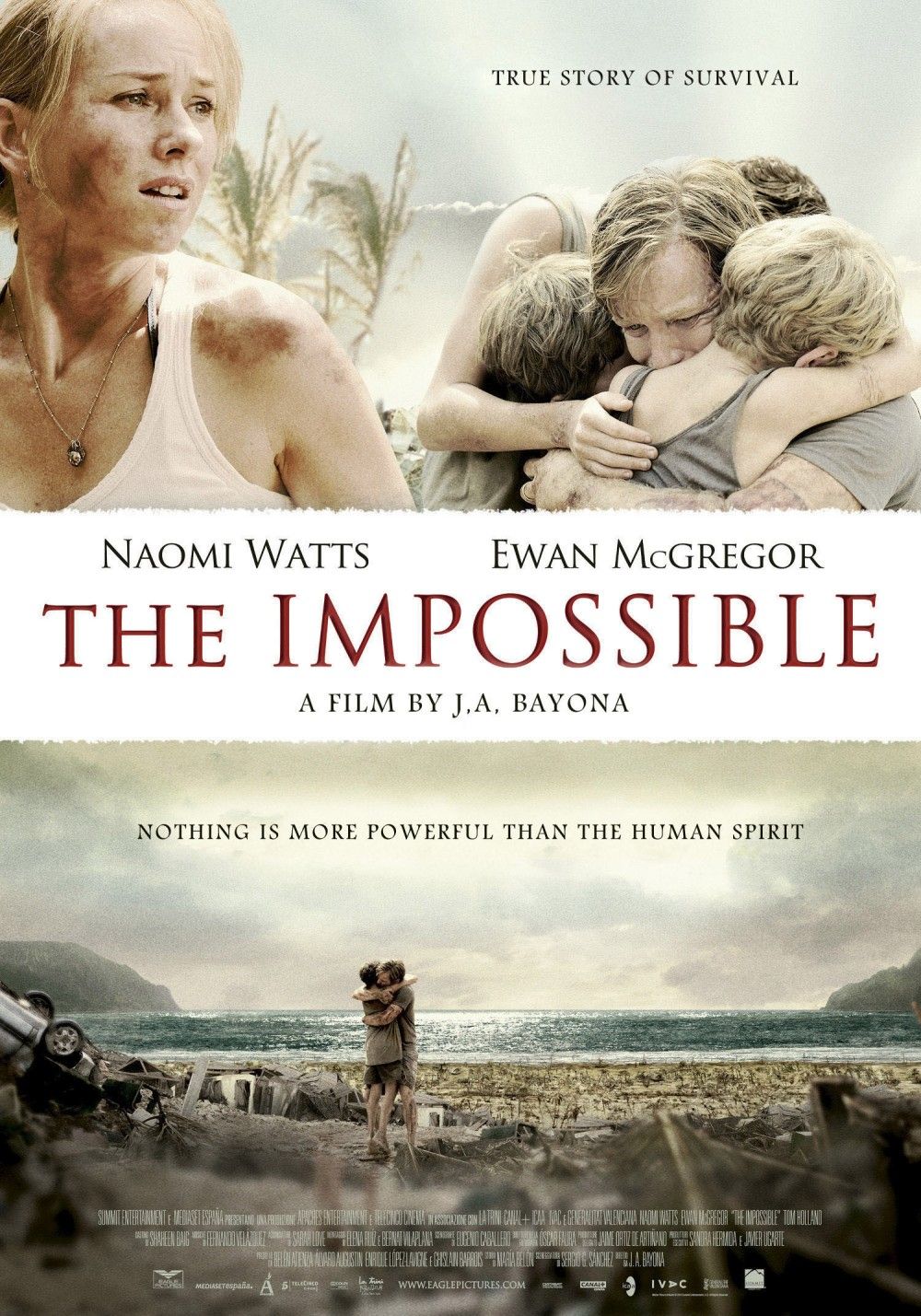
The Impossible (2013)

Naomi Watts and Tom Holland survive extreme circumstances in The Impossible

Director: JA Bayona

Cast: Naomi Watts (Maria), Ewan McGregor (Henry), Tom Holland (Lucas), Samuel Joslin (Thomas), Oaklee Pendergast (Simon), Marta Etura (Simone), Sönke Möhring (Karl), Geraldine Chaplin (Old Woman)

In 2004 the Boxing Day tsunami hit the Indian ocean. The resulting tidal waves devastated communities in several countries, with almost a quarter of a million casualties. The impact left rich and poor alike in a desperate struggle to survive. These terrible events form the basis of this emotionally powerful, if sometimes manipulative, film that recreates the remarkable story of a Spanish family, separated in the tsunami, who all miraculously survived.

Here the family is re-imagined as British (presumably to sell the film around the world a little easier, as they now all speak English). Maria (Naomi Watts) is a doctor who for the last few years has been a stay-at-home mum for her three sons Lucas (Tom Holland), on the cusp of becoming a teenager, Thomas (Samuel Joslin) and Simon (Oaklee Pendegast), both younger. Her husband is businessman Henry (Ewan McGregor). Staying in Thailand for a Christmas vacation, the family are separated when the tsunami hits their resort. Maria (badly injured) and Lucas make their way to a hospital, where Lucas struggles to get the life-saving treatment his mum needs. Henry is trapped in the resort with their other two sons, desperately trying to find his missing wife and child. Around them swirl an entire country of refugees and affected people, all of them trying to find family members.

The Impossible gets an awful lot right. The recreation of the tsunami is faultless. You’ll feel every moment of terror as the water rips through the family’s high-end vacation spot. As Maria and Lucas are swept far away by a deep swell of fast-flowing water (stuffed with mud, filth and debris) you’ll feel every blow to bodies as debris hammers into them, and feel like you’ve lived through every moment of desperation as the two fight against the current to reach each other. The sense of powerlessness and fear – a mother trying to be brave for her son, a son frightened and desperate for reassurance, ashamed at being scared – are powerful, deeply affecting and hugely immersive. Bayona’s experience of directing horror comes wonderfully into play here, as he knows exactly how to push our buttons and make us feel the emotion, fear and anxiety of the situation.

This tone continues through most of the film’s first hour which largely follows Maria and Lucas as they attempt to reach the hospital. Running on adrenalin, Maria only slowly begins to succumb to exhaustion as her grievous wounds (smashed ribs, a horrifically graphic leg injury) sap her strength, even while she tries to maintain an air of calm for her son. What is intriguing in this sequence is that, like a set of scales, as the mother becomes weaker the son becomes stronger – Lucas suddenly propelled into become an adult. Lucas increasingly takes decisions on how best to survive, argues at times for hard calls and becomes, in many ways, the adult in the situation.

This sequence is helped hugely by the performances of the two actors. The physical commitment of every actor isn’t to be doubted (Holland and Watts spent hellish weeks in water tanks filming – although this is only relative compared to the horror of the actual tsunami). Watts (Oscar-nominated) brings power to a mother who believes she is the only thing her son has left in the world, and must survive at all costs for him. Her buttoning down of her terror for as long as she can is deeply moving, and she brings the part significant heart. Tom Holland is simply a revelation as Lucas. He develops an authority well beyond his years, the complexity of the emotions he deals with – from fear to anger and defiance, determination, anxiety, relief and despair – would have challenged an actor three times his age. Holland never loses trace of the central kindness in Lucas – no matter how desperate the situation – and he is the undoubted star of the film, his portrayal of a child forced to grow up scarily quickly is deeply affecting.

Ewan McGregor offers similarly excellent work. Left searching through the rubble of his holiday home, McGregor brilliantly captures a sense of a father trying to deny that his control over events has disappeared. He excels in an extremely moving breakdown scene – after finally contacting his wife’s parents in the UK, he collapses in desperate, uncontrollable sobs of guilt and fear, apologising for not knowing what to do. It’s some of the actor’s best work, brilliantly tapping into his natural warmth for excellent effect.

Where the film struggles more is in its focus. While it is a story of one – affluent – Western family, so naturally its focus will be there, it does turn the rest of the cast into little more than extras. Some focus is given to the Thai people: a group of poor local people is crucial in saving Maria and Lucas’ lives and getting them to a hospital, their immediate humanity and generosity reducing Maria (and the audience) to tears of gratitude, but that’s the only real look we get at them. The hospital where a large part of the story is set is full of Westerners, bar the staff. All the victims we spend significant time with are white and Western (all are presented sympathetically, bar a pair of Americans for whom the tsunami is a holiday inconvenience).

But you could watch the film and not realise that so many of the people who died were part of the indigenous population – and while thousands of Westerners also perished, the survivors did at least return to their homes, whereas those living in affected countries lost everything.

The film’s other flaw is the manipulative tone it moves into late on, in particular a series of prolonged “missed moments” as the separated family walk around the hospital, just missing each other. This may well have actually happened, but is so contrived that it feels like a narrative flourish. The plot slows down in the second half as the characters search for each other. The film’s final title cards were a perfect opportunity to bring more focus to other victims – and to mention the death toll and impact on the countries – but avoids all of this to simply confirm it’s based on a true story.

The Impossible has lots of powerful moments. Its moments of emotion are raw and affecting and, manipulative as it is, you do celebrate when the family is reunited. But it’s also a film that loses its way a bit – which captures a superb survivalist story but then becomes too sentimental towards its end. And by not doing more to acknowledge the impact on the Thai people, among others, you can’t help but feel it turns this tsunami into something that affected rich, white, Westerners – which is harder to forgive.

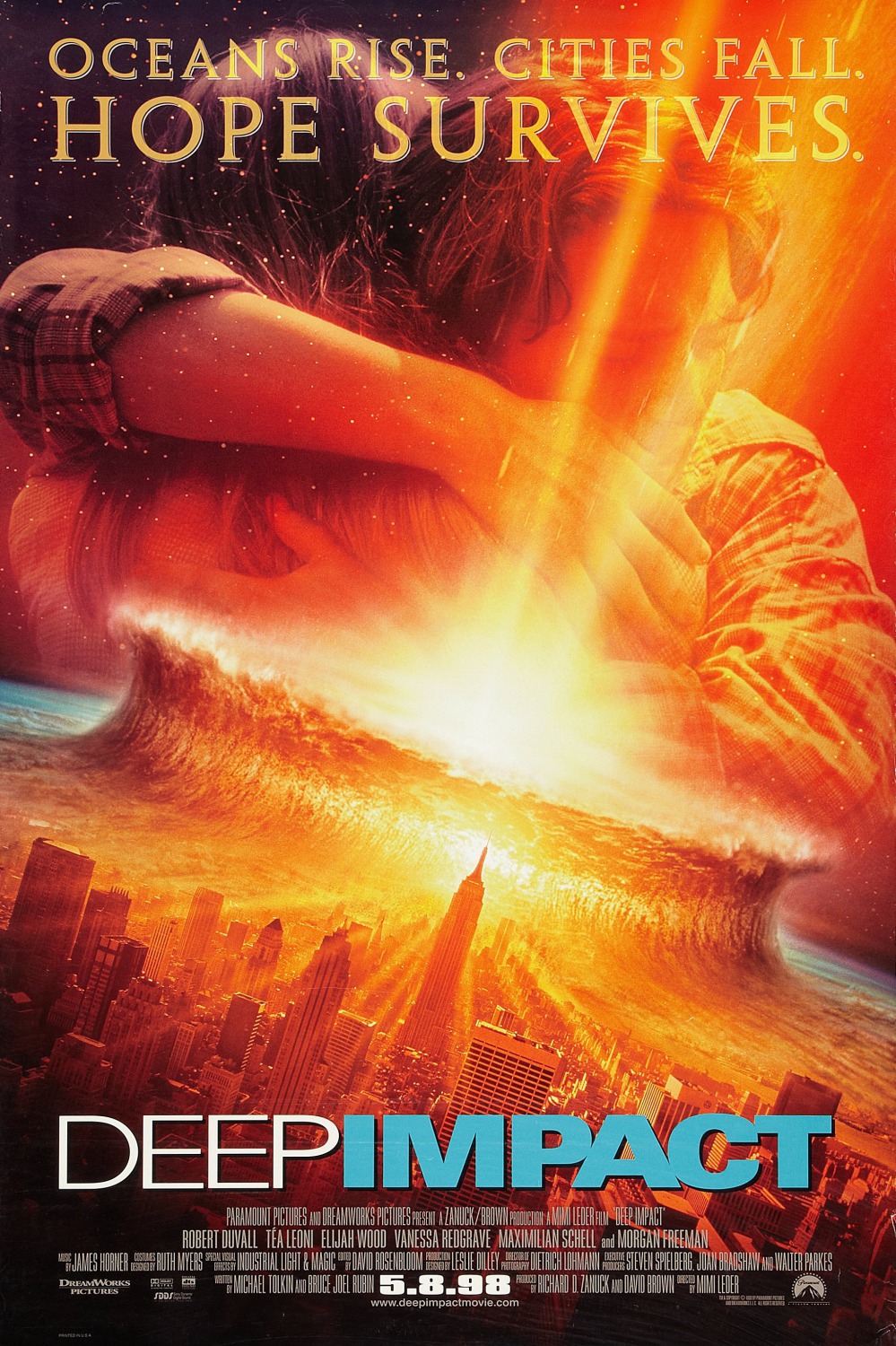
Deep Impact (1998)

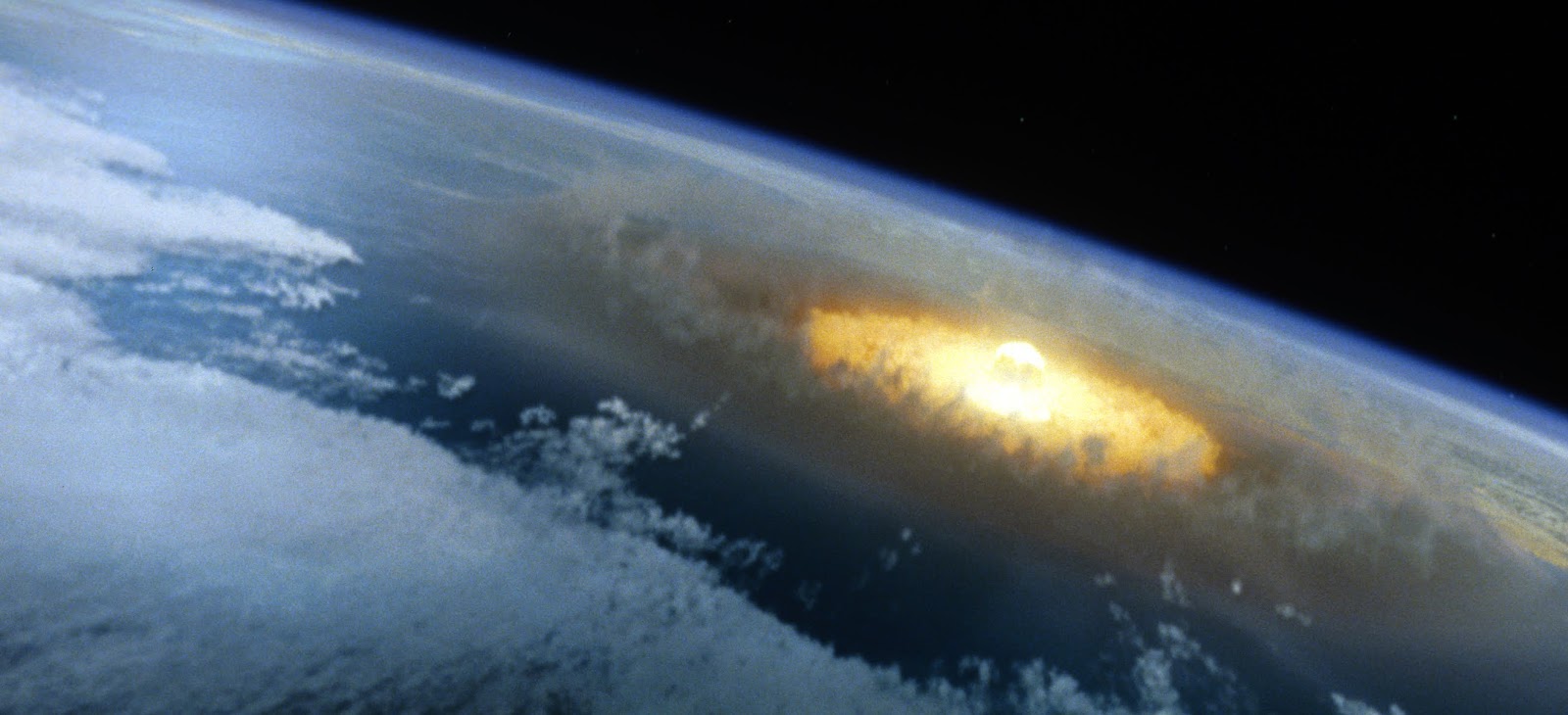
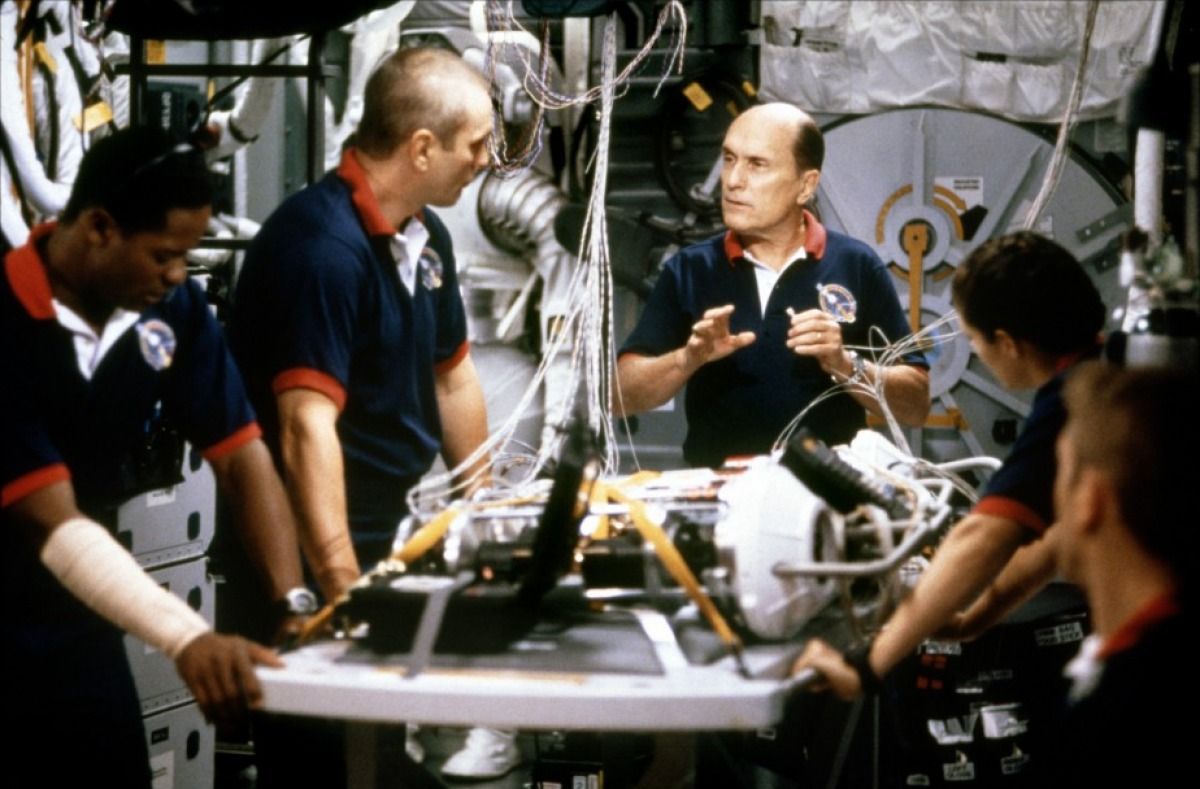
It’s the end of the world in Deep Impact

Director: Mimi Leder

Cast: Robert Duvall (Captain Spurgeon “Fish” Tanner), Téa Leoni (Jenny Lerner), Morgan Freeman (President Tom Beck), Elijah Wood (Leo Biederman), Vanessa Redgrave (Robin Lerner), Maximilian Schell (Jason Lerner), James Cromwell (Alan Rittenhouse), Ron Eldard (Commander Oren Monash), Jon Favreau (Dr Gus Partenza), Laura Innes (Beth Stanley), Mary McCormack (Andy Baker), Bruce Weitz (Stuart Caley), Richard Schiff (Don Biederman), Betsy Brantley (Ellen Biederman), Leelee Sobieski (Sarah Hochtner), Blair Underwood (Mark Simon), Dougray Scott (Eric Vennekor)

Sometimes two Hollywood studies have the same ideas at the same time. When this happened in 1974 they clubbed together and turned two scripts about burning skyscrapers into one movie – The Towering Inferno. But it’s more likely they’ll do what happened with volcano movies in 1997, White House invasion movies in 2013 and asteroids movies in 1998: both make a film and rush to be the first one out. Usually that’s the winner (ask Dante’s Peak or Olympus Has Fallen). The exception was Deep Impact which made plenty of moolah – but was trumped by Michael Bay’s thundering Armageddon, with its far more straight-forward feel-good action.

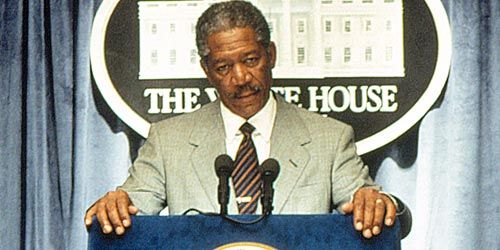
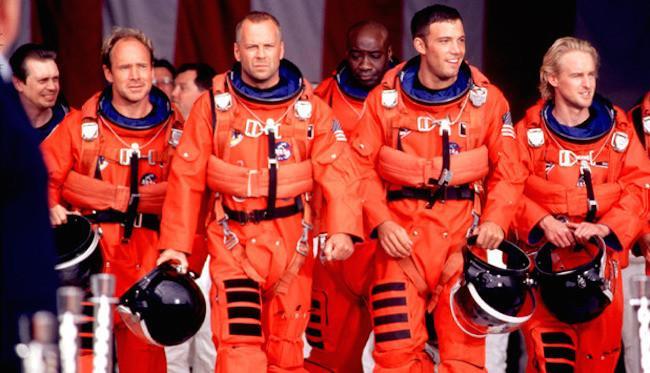
A meteor is heading towards the Earth – and it’s an Extinction Level Event (ELE) that will wipe out all life on Earth. World governments keep it hushed up, wanting to avoid mass panic, and start planning to preserve mankind. Underground “arks” will be built in major countries to protect a small number of population. And a manned space mission, crewed by a team of young bucks and veteran astronaut Spurgeon “Fish” Tanner (Robert Duvall), will head out to the asteroid to try and use a nuclear bomb to blow it up. However news leaks when intrepid young MSNBC reporter Jenny Lerner (Téa Leoni) stumbles on news of a cabinet resignation, over a mysterious “Ellie”, leading to her accidentally uncovering the meteor. President Tom Beck (Morgan Freeman) announces all to the world – and mankind prepares, in hope, for the disaster.

Deep Impact is a well-mounted and surprisingly thoughtful adventure story, that tries to deal with its Earth-ending themes with a seriousness and humanity that’s a world away from the flag-waving crash-bangs of Armageddon. Well directed by Mimi Leder, who juggles effectively huge special effects and low-key personal stories (even if these have the air of movie-of-the-week to them), it’s an ensemble piece with a surprisingly downer ending (no surprise from the poster) that still leaves more than a touch of hope that mankind will persevere.

It’s poe-faced seriousness about reflecting on the end of the world may be dwarfed now by superior TV shows – it’s hardly The Leftovers – but felt quite daring for a 90s blockbuster, at least trying to be some sort of meditation on the end of the world. While the film does do this by focusing on the most mundane of soapy dramas – will Jenny Lind (Téa Leoni in a truly thankless role) manage to reconcile with her estranged father (Maximilian Schell, a bizarre choice but who manages to rein in most of the ham) who walked out on her and her mother (Vanessa Redgrave, if possible an even more surreal choice) before the world ends – at least it’s sort of trying.

Soap also soaks through the storyline about young Leo Biedermann (Elijah Wood), the geeky wünderkid who discovers the asteroid. The drama around a national lottery to select the chosen (very) few who will join the 200,000 essential scientists, artists and politicians in the bunker is boiled down to whether Leo will be able to sneak his girlfriend (Leelee Sobieski) and her family on the list. Needless to say, this plotline boils down into a desperate chase, some heroic sacrifices and a great deal of tears. This sort of stuff doesn’t re-invent the wheel, but it makes for familiar cinema tropes among the general “end-of-the-world” seriousness.

There isn’t much in the way of humour in Deep Impact, perhaps because those making it were worried cracking a joke might undermine the drama. There’s nothing wrong with this, but you start to notice more the film’s “not just another blockbuster” mindset being warn very firmly on its sleeve. The film’s third major plotline, around the mission to blow up the asteroid, is as much about whether grizzled, wise vet Robert Duvall will win the respect of the dismissive young bucks he’s crewed with (spoilers he does) as it is whether they will destroy the meteor. Anyone who can’t see sacrifices coming here btw, hasn’t seen enough films – but these moments when they come carry a fair emotional wallop, partly because the film never puts its tongue in its cheek.

It’s a film proud of its scientific realism, which makes it slightly easy to snigger at the sillier moments – especially when it takes itself so seriously. An astronomer (played by The Untouchables luckless Charles Martin Smith) drives to his death racing to warn the authorities (why not just call them from his office eh?). The astronauts, for all their vaulted training, hit the meteor surface with all the blasé casualness of high-school jocks. Jenny’s journalistic investigation is so clumsy and inept, it’s hilarious watching the President and others assume she’s way more clued up than she is (this also comes from a time when Jenny could key in “E.L.E.” into the Internet and get one result – I just tried it and got 619 million. Simpler times).

I’ve been hard on this film, but honestly it’s still a very easy film to like. Sure it’s really silly and soapy but it takes itself seriously and it wants to tell a story about people and human relationship problems, rather than effects, which is praiseworthy in itself. The best moments go to the experienced old pros, with Duvall rather good as Tanner and Morgan Freeman wonderfully authoritative as the President (it was considered daring at the time to have a Black President). The special effects when the meteor arrives (spoiled on the poster and the trailer) are impressive and while it’s easy to tease, you’ll still welcome it every time it arrives on your TV screen.

Gravity (2013)

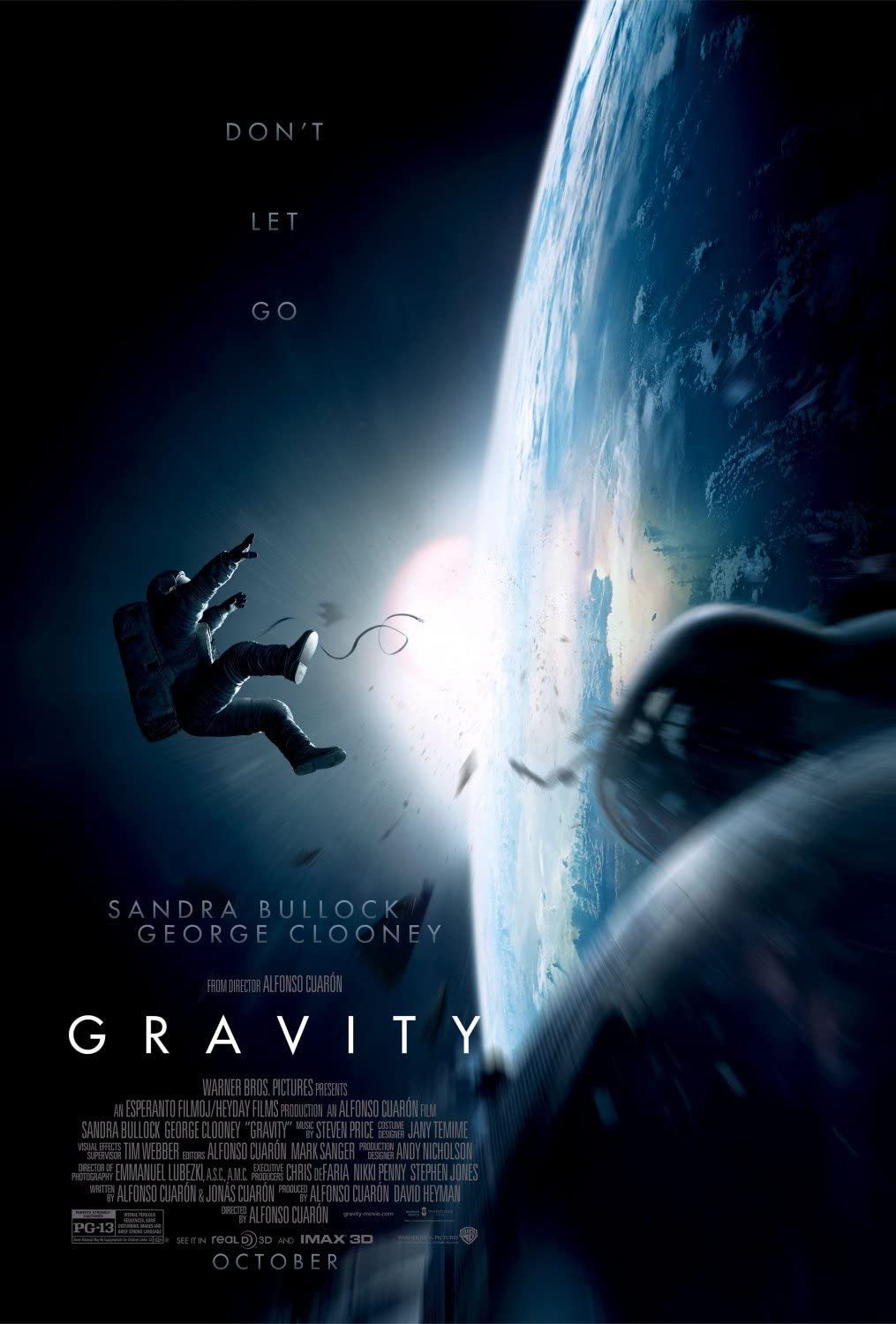
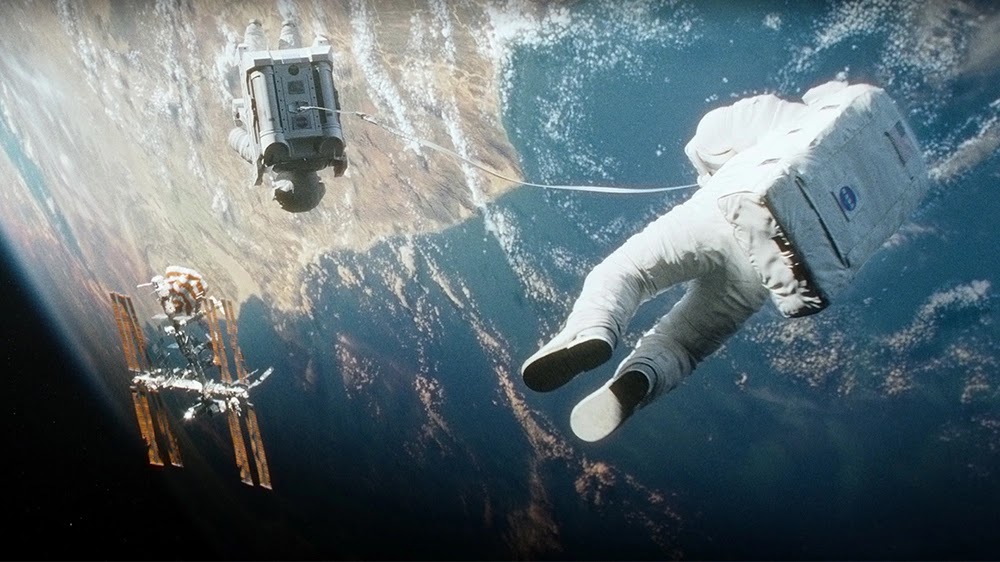
Sandra Bullock is stranded in space in Gravity

Director: Alfonso Cuarón

Cast: Sandra Bullock (Ryan Stone), George Clooney (Matt Kowalski), Ed Harris (Voice of Mission Control)

It’s often been said space is mankind’s final frontier. It’s beautiful and awe-inspiring. But it’s also a terrible place, a void where the normal rules that dictate how our bodies operate are completely suspended. We can only breathe what we carry with us and the lack of any atmosphere or gravity means a few metres might as well be a million miles. It’s in many ways the perfect conditions for a survival film – which, at its heart, is what Gravity is.

On a mission in space to repair the Hubble telescope, a collapsed satellite triggers a chain reaction of space debris hurtling in orbit at extreme velocities. Turned into a vast number of deadly bullets flying completing an orbit once every 90 minutes. This shrapnel destroys the mission, leaving specialist Dr Ryan Stone (Sandra Bullock) and mission commander Matt Kowalski (George Clooney) as the only survivors – and left with their only chance of return to Earth being to travel somehow to one of the other space stations in orbit and hitch a ride home on one of their escape pods.

Cuarón’s film is an engrossing and edge-of-the-seat 90 minute thrill ride, combined with a quietly meditative reflection on how our internal pain can make us drift through life. The film is titled Gravity but it’s there to draw attention to what is missing in the film. Not only the obvious – the lack of pull on her body – but also the lack of grounding in Stone herself. In mourning for the loss of a child, Stone has very little ties to earth or indeed anything. She is drifting through her life emotionally, much as she drifts through space itself. When asked why she likes it up in space, she replies “the silence”. She’s a woman untethered from life on earth in more ways than one.

So this is a film that is not just a survival but also a rebirth. We see Stone go through immense, dangerous moments of tension and terror, battling against all the odds to survive and return home. At the same time, the film carries an emotional weight because it’s also about Stone making a conscious decision to survive, to decide to re-engage with and commit to the world – to choose life if you like. Someone suffering from grief and depression as she does at the start of the film, may well have understandably embraced despair. Instead, the film is her coming to terms with the loss of her daughter, and a resolve to live her life for her.

All of this happens of course in the vast majesty of space, a vision beautifully captured by Cuarón. Filmed in an immersive style, with several long takes that don’t draw attention to themselves – a shot length that serves the purpose of the story not vice versa – and Cuarón is happy to use quicker cuts where needed. The camera follows the journey of Stone in epic and intimate detail, with shots exchanged between vast panamas of the astronauts as dots in space, to extreme close ups that bore into Stone’s eyes and capture her emotions from guilt, to hope, to terror. 

The long opening shot, that ducks and weaves around the weighless astronauts in space as they repair the Hubble telescope is of course a technical marvel, but it also brilliantly established the situation and the joy and fear of being an astronaut, of being allowing in the darkness and emptiness of space. It sets the scene perfectly from later shots that throw you into the adrenalin burning terror of spinning wildly in space with no resistance to slow you down or dodging debris moving at thousands of kilometres per second through space.

In fact the film is almost unbelievably tense – probably the most tense space film since Apollo 13 and in that we actually knew they were coming home alive (in a nice nod to that film, Ed Harris ‘reprises’ his role as mission controller in a voice-only cameo). With its brilliant immersive style, and the emotional bond it swiftly builds with the viewer, it means you will find you hardly draw breath along with the heroes. I’ve seen the film three times and each time after the first viewing I was sure it wouldn’t have the impact the first viewing had. But goddamn it, it works every time. The film is quick – at little under 90 mins – but you won’t feel it (in fact if anything you might be relieved).

Cuarón won the Oscar for direction, and the film is not just a load of flash and technical marvel (although it has a lot of both). It’s grounded in a very simple emotional story of survival, matched with an internal story (not overplayed) of resolving and dealing with grief. A lot of that works from the effectively unflashy performance from Sandra Bullock, who is very good in a part that requires not just physical but also emotional commitment. She’s well supported by George Clooney, who is perfect as the charming but calm and controlled mission commander who mentors her through the early stages of survival in space.

The film has a series of breathtaking set pieces – collapsing Hubbles, spinning astronauts in space, desperate space walks trying to grab any inch of objects to stop them drifting into space, collapsing space stations, burning up on re-entry – all of them shot with an elegance that marries technical excellence and dazzling camerawork and vision with a powerful story. A bag of tricks but one that is delivered with real heart.

King Kong (2005)

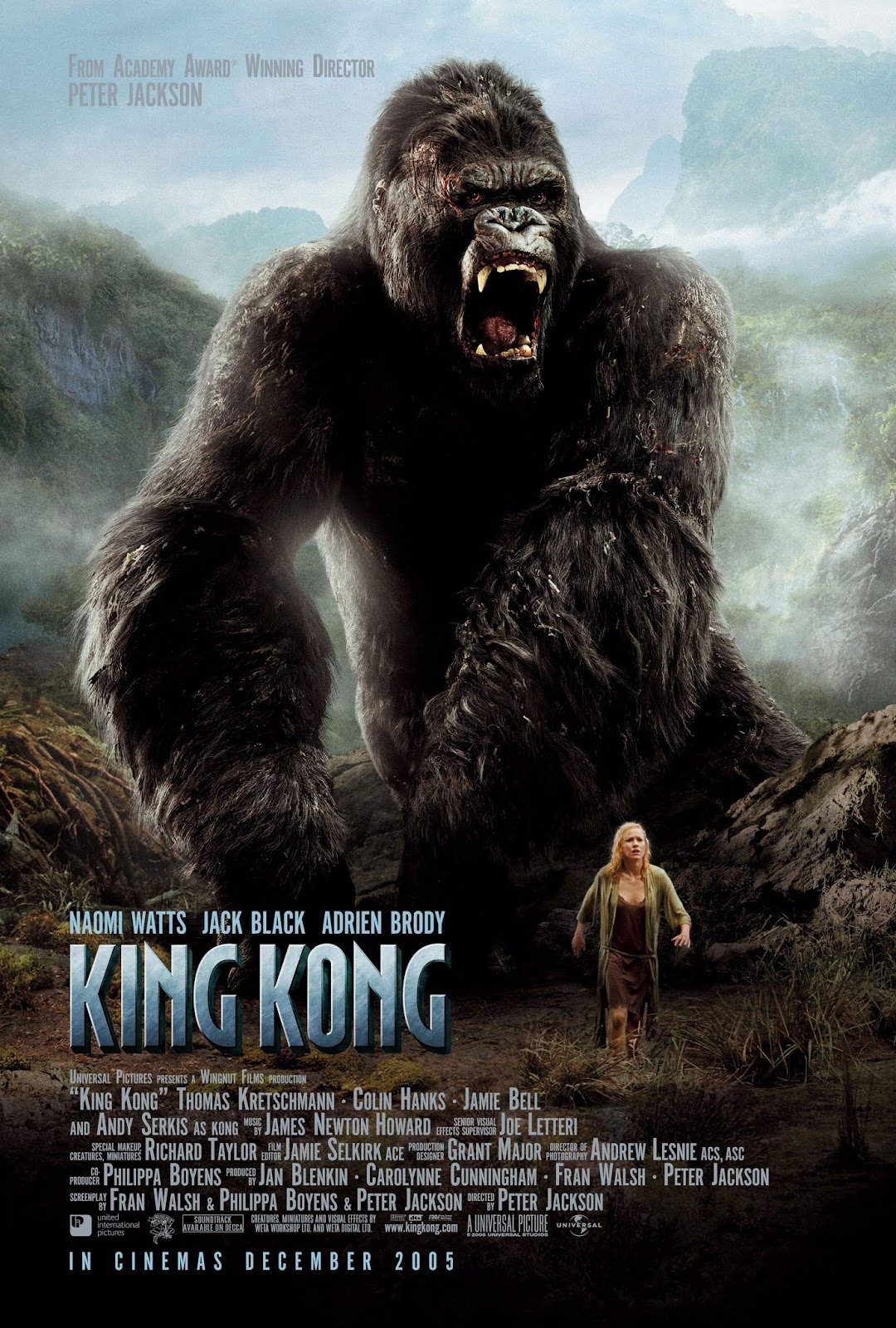
Naomi Watts and a mo-cap Andy Serkis bring to life Peter Jackson’s dream in King Kong

Director: Peter Jackson

Cast: Naomi Watts (Ann Darrow), Jack Black (Carl Denham), Adrien Brody (Jack Driscoll), Thomas Kretschmann (Captain Englehorn), Colin Hanks (Preston), Jamie Bell (Jimmy), Andy Serkis (Kong/Lumpy), Evan Parke (Ben Hayes), Kyle Chandler (Bruce Baxter), John Sumner (Herb), Lobo Chan (Choy), Craig Hall (Mike)

In the late 90s Peter Jackson was working hard on putting together the plans for his dream project. It was a complex project, with unprecedented special effects demands, a huge cast, a demanding shoot and a big budget. However, plans fell through, so Jackson decided to move his attention to that Lord of the Rings trilogy idea he had been banging around instead. Hot of the success of that little escapade, he delivered at last his dream: a huge remake of King Kong.

Carl Denham (Jack Black) is a ruthless film director, desperate to make the big epic that will dwarf all others. Pulling together a team including playwright Jack Driscoll (Adrien Brody) and vaudeville dancer Ann Darrow (Naomi Watts), he heads out on a ship for location shooting on the mysterious Skull Island. Arriving on the Island, they find that the savage natives aren’t the only dangers on an Island that has bypassed evolution. The crew find themselves hunted by dinosaurs, huge creepy-crawlies and other horrors all while they try to find and rescue Ann from the Island’s Alpha – a huge gorilla, King Kong (famously motion-captured by Andy Serkis). Led by Jack, who has fallen in love with Ann, dangers surround the crew – but is mankind, and the ambitious Carl, the real danger?

Time and public perception has not always been kind to Jackson’s labour of love. Perhaps coloured by the generally negative reception to his Hobbit films (which are a mess), perhaps also by the film being more of a gentle, sentimental film mixed with cartoon-splatter horror rather than the monster-mash B movie later Kong films have been, it’s generally remembered as a bit of a disaster. This is far from fair. Yes it’s overlong (hugely so at well over three hours – nearly twice as long as the original) and over-indulgent but it’s also quite a sweet, if rather tonally mixed, film that more or less manages to keep an audience entertained.

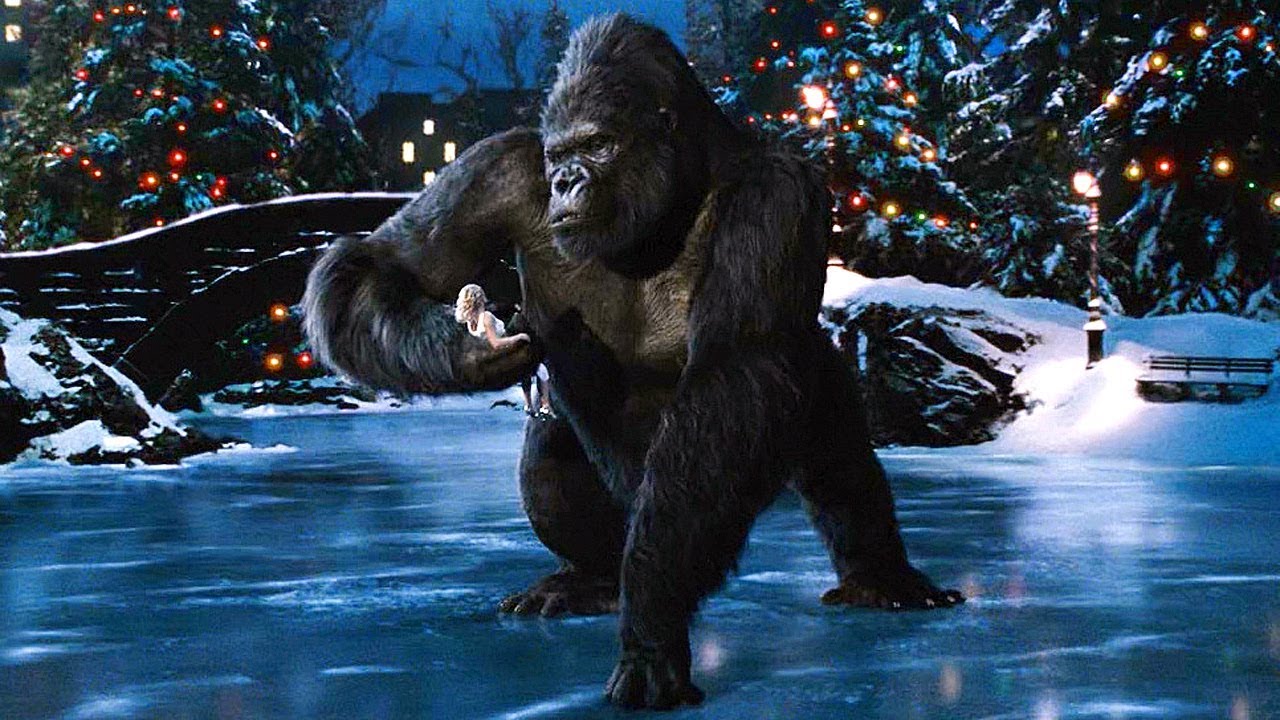
Unlike later films which have enjoyed Kong (or Godzilla) most when he smashes things – even if he is often the film’s hero or at least anti-hero – this Kong film is perhaps at its most contented when it is finding the humanity in the ape. As a 9-year old, Jackson talks about crying when Kong fell dead from the Empire State Building – and it is this engaging giant that he wants to bring to life here. Using Serkis – cementing his reputation here as the whizz of motion capture – to have a human literally inside the Gorilla, giving real expressions and genuine character to a giant ape was deliberate. The film’s most heart-felt – and quietest – moments both involve moments of gentle play or innocence from the Gorilla, either starring at a beautiful sunset (which he does both on the island and on the Empire State) or playfully slipping and sliding on a Central Park frozen lake, this is a monster that Jackson sees as a misunderstand soul, that bond he felt at 9 brought to the screen.

That’s the key between the bond that Ann feels with this beast who starts as potential killer, becomes protector, friend and finally a sort of romantic interest of a kind. Well played by Naomi Watts, Ann Darrow herself is a damaged soul, a bright-eyed, naïve dreamer with a dose of realism slowly entering her soul, who wants to entertain people but also to make her immediate world a better, warmer place. It’s natural that such a person would start to feel a deep bond with Kong, to learn to appreciate his gentleness and protectiveness, to put herself at risk to try and save his life. It’s a huge development of the character from scream-queen, and positions Ann (or tries to) as a more pro-active force in her own story.

And the ape responds to this, slowly revealing his own true nature as a potentially gentle giant, albeit one who is prepared to rip a few T-Rex’s apart to protect his love. He certainly ends up feeling more of an ideal partner for Ann than the other men in the film. Adrien Brody’s Jack Driscoll is a determined, principled and brave man but there is a touch of inadequacy to him, a surrendering of responsibility and a lack of proactivity in his make-up. While the early love story between the two characters is sensitively drawn, it tellingly can’t survive the events of Skull Island – at least not in the same way.

Mind you Driscoll is better than Denham, who is transformed in this film to a soulless monster interested only in his own greed for fame and power. Jack Black delivers what the script demands – even if the film is pushing on the edge of his range. As Black’s stock has fallen, so perhaps as some of the film’s – and the perception of his performance here. It doesn’t help that the idea of the ruthless film director seems to be a common trope for film director’s to explore (and interesting psychological question there!) so the character’s shallow lack of regard for anyone else, coupled with his fierce ambition to be the greatest showman around start to grate after a while. It’s a character lacking any depth.

But then that’s the case for most of the rest of the cast as well, who struggle to make room in a film that is overloaded with events and action to the detriment of its overall impact. Jackson’s heart may really lie in the quiet moments between beauty and beast – but he also loves an action scene. And King Kong has too many of these. Much of the middle hour of the film is given over to a never-ending parade of events on Skull Island, that after a while seize to have any real impact. As nameless crew members are crushed by boulders, or stampeding dinosaurs, or savaged by giant insects, or have their heads caved in by savage islanders (not surprisingly these H Rider Haggard style savages, with their lust for human sacrifice, drew more than a little criticism – and it hasn’t aged well) you start to feel your interest sagging. Kong’s brawl with three savage T-Rex’s is perfectly made in every respect, except for the fact it goes on forever.

Ambition lies behind every frame (all of them beautiful by the way) of this huge three hour epic monster picture – but it gets all so much that it buries the story. Like Kong himself, it touches the heavens only to fall tragically to Earth, trying to protect the thing it loves. Jackson wants to protect Kong from being just seen as a massive ape that hits things – but loses his way at times when Kong does little more than exactly that. It is still an intelligent and heartfelt film – but it struggles as well with being an uncontrolled play in the sandbox.

Sunshine (2007)

Astronauts head out to restart the sun in Danny Boyle’s Sunshine

Director: Danny Boyle

Cast: Cillian Murphy (Robert Capa), Chris Evans (James Mace), Rose Byrne (Cassie), Michelle Yeoh (Corazon), Cliff Curtis (Searle), Troy Garity (Harvey), Hiroyuki Sanada (Kaneda), Benedict Wong (Trey), Chipo Chung (Icarus), Mark Strong (Pinbacker)

Spoilers: Last act surprises are discussed here. Although they did put them in the trailer at the time as well

What would we do if the sun decided to pack it in? To be fair, probably not build a bomb the size of Manhattan out of all the world’s fissile material and then fly it up to the Sun in a huge spaceship to jump start the sun’s core. Because that idea is pretty much like trying to restart a volcano with a match. To be fair, Professor Brian Cox (for it was he) did come up with an actual concept that did work – something involving a Q-Ball in the sun, whatever the hell that is – that the film never mentions. But then who really cares about the science, we only care about the simple idea of restarting the sun’s engine with a massive nuke. That’s an idea I don’t need a staff pass at the Large Hardron Collider to understand.

Mankind’s final fate is in the hand of a team pulled from across the world’s space agencies, with Professor Robert Capa (played by Cillian Murphy as a figure inspired heavily by Brian Cox himself in looks and style) as the boffin whose job is to blow the bomb when the time comes. The mission, Icarus II, is under the command of Captain Taneka (Hiroyuki Sanada), with engineer Mace (Chris Evans), pilot Cassie (Rose Byrne), biologist Corazon (Michelle Yeoh) whose job is to maintain the oxygen garden, psychiatrist Searle (Cliff Curtis), navigator Trey (Benedict Wong) and second-in-command and comms officer Harvey (Troy Garity). Entering the final days of the mission, near Mercury, the crew discover traces of the first missing mission that carried the first payload to restart the sun, Icarus I. Deciding two payloads are better than one, the crew divert to intercept – and of course from there everything slowly falls apart into increasing chaos, destruction and horror.

Boyle’s film was marketed as a sort of slasher-in-space – which to be fair it only really becomes in its final act, as the crew accidentally take on board captain of Icarus I, Pinbacker (Mark Strong), a man driven mad by proximity to the sun, deluded in the belief that it is God’s will that mankind perish with the sun. In fact for the bulk of its runtime – and its primary themes – are really about the psychological impact of prolonged isolation in space with only a small group of people for company (a heightened submarine claustrophobia), the dangers and damage that obsession can cause and the moral complexities that emerge when the fate of mankind is literally in the hands of eight people.

With an intelligent script by Alex Garland, Boyle’s film is smart, superior sci-fi which asks searching questions of how we might respond in the situations this crew are thrown into. How quickly would you make decisions about who is expendable and who is not when you are mankind’s last chance? How quickly would you be willing to sacrifice yourself? What moral qualms would you feel if the fate of the one was balanced against the many? And how are all these feelings heightened by the intense claustrophobia and isolation of prolonged space travel, interacting with the same few people day-in and day-out in a ship of which every inch you would be intimately familiar within the first few months of a mission lasting years?

It’s a wonder more people don’t go crazy in the film. Boyle’s film makes excellent use of the terrifyingly awesome, good-like power of the sun. Its rays are so intense at the range of the ship, that any exposure over about 2% of its full strength is lethal. But there is something about its mighty power, its all-consuming presence, that draws characters too it like moths to a flame. Psychiatrist Searle (impressively played by Cliff Curtis) already seems to be becoming slowly a slave to an obsession with our star, his skin peeling from too many hours in the ship’s solar observation lounge. Pinbacker (a curiously accented performance of intense insanity from Mark Strong) lost his mind in sun worship, his mind seemingly snapped by coming face-to-face with the powers of the heaven compared to the mini-presence of man.

But it’s that presence of mankind that drives the mission, and lies behind all decisions. Hard-ass engineer Mace (Chris Evans, very good) seems like a jerk, but he simply applies Spock’s maxim of the needs of the many to a logical extreme (correctly) objecting to every course of action that invites unknowns into the equation that endanger the mission. And Mace doesn’t hesitate at any time in the film when asked to balance his own safety against the success of the mission. Each crew member – with the exception of Harvey – places their own survival a distant second behind the completion of the mission, and the film is littered with moments of self-sacrifice and self-imperilment.

It’s this humanistic core to the film, of accepting the world is it and that mankind must be preserved within that, which leads to some of the film’s more weighted points around faith and religion. The film has little time for anything away from pure science, and an interest in higher powers and staring too closely at the bright light, is mixed in heavily with a dangerous fundamentalism that eventually leads to the film’s only spiritual figure Pinbacker becoming a psychopath determined to follow what he sees as God’s plan at the cost of all human life. It’s not a subtle picture of religion – and the film could have balanced it with at least one of these characters expressing some faith in some sort of religion on the ship or gently questioning how humbling being this close to the face of God might feel. The film has no time for that.

But then I suppose this is really a psychologically intense mission film, a sort of big-themes action sci-fi that is the sort of ideas based film you wish was made more often. Boyle’s direction is pinsharp as always, and the moments of dreamy awe and shattering power of the sun (as bodies are vapourised, parts of the ship crumble) or the freezing vastness of space (as one character discovers to their cost) provide a series of haunting scenes. Shooting Pinbacker with a juddering out-of-focus intensity – intended to ape the feeling of starring directly at the sun – is effective in making the character chillingly unknowable.  This moments work very well, as does the superb cast which has not a weak link among them (Cillian Murphy in particular anchors the entire thing extremely well). Sunshine is a thought-provoking and blistering science-fiction film that manages to balance big themes and ideas with horror house jumps and haunting moments of tension.

The Birds (1963)

Tippi Hedron has a bad day at the birdcage in The Birds

Director: Alfred Hitchcock

Cast: Tippi Hedron (Melanie Daniels), Rod Taylor (Mitch Brenner), Jessica Tandy (Lydia Brenner), Suzanne Pleshette (Annie Hayworth), Veronica Cartwright (Cathy Brenner), Charles McGraw (Sebastian Sholes), Lonny Chapman (Deke Carter), Joe Mantell (Cynical Businessman)

Alfred Hitchcock is often seen as the master of technique, the doyen of suspense, the master of the shock twist. Perhaps it was his love of this sort of material that led him to this radical reworking of Daphne du Maurier’s short story The Birds. After all Hitch had already directed the greatest ever du Maurier adaptation (Rebecca), so working with du Maurier was hardly new and turning this English suspense story into a sort of post-apocalyptic, tension-filled plot-boiler was right up his street. The Birds is a master-class in the director’s craft, and a curiously empty experience with barely a human heart in sight.

Melanie Daniels (Tippi Hedron), a slightly spoiled heiress, arrives in a small coastal town in California in order to play a practical trick on lawyer Mitch Brenner (Rod Taylor). Deciding to stay the night, she quickly realises that she has chosen the wrong weekend to get away as, while sparks grow between her and Rod, they also grow between humanity and the birds, as our feathered friends (enemies?) begin a series of escalating attacks on the population of the town that eventually lead to multiple deaths and destruction.

Hitchcock’s film is as masterclass in the slow-burn, deliberately the slowest film the director perhaps ever made. Hitchcock prided himself on his films in suspense being the awaiting of an event to happen. The bomb you know will go off on the bus. The plane circling Cary Grant that seems ripe to attack. The Birds takes this to the nth degree. The film’s very title all but tells you that the birds are going to attack, so Hitchcock takes it nice and slow, letting scenes play out with a breezy lack of pace, almost like a low-rent romantic comedy. But somehow this long unwinding of not a lot happening works well, because every scene somehow becomes a corkscrew as tension as every single bird in shot becomes suspicious. 

This atmosphere is increased by the wide open locations and remote locale the film is set in, with these all-American small town sites seeming to stretch on forever around the characters only serving to stress their isolation and vulnerability in the middle of all this deadly nature. Hitchcock also carefully stripped out all musical score from the film, instead providing a sound track of natural noise complemented by slightly exaggerated bird noise (created by use of a Trautonium, supervised by master composer Bernard Herrmann). The often makes the film eerily and unsettlingly quiet, with the soundtrack only punctured by the frequently (perhaps deliberately) mundane dialogue. Suddenly with this brilliant combination game, the entire film becomes a tense waiting game for the unleashing of avian attacks, every frame a tense waiting for the bang you all know is coming. It’s Hitchcock using every aspect of his reputation, and the film’s promise of violence, to create an overwhelming effect that is deeply unsettling no matter how many times you see the movie. 

Hitchcock also gives a slow build to the bird violence. Events escalate quickly, from the unsettling gathering of the birds in several places (most notably along telephone lines and outside a school playground) to subtle messages about chicken’s refusing food, to first Melanie and the other characters colliding with or being bitten by birds. It all builds to a grim reveal of a local farmer who has been attacked over-night, with Rod’s mother stumbling across the mutilated old man, Hitchcock’s camera delightedly cross cutting onto the man’s pecked out eyes. It’s the most grotesque shot of the film – and coming before we’ve seen our first mass bird attack, leaves us in no doubt as to the danger of these animals.

And when those bird effects come they have a real unsettling violence to them. In a blur of both real birds and super-imposed images (I will admit that the special effects of this film do now look a little dated, with the mixture of real, model and photo trickery birds rather jarring) the birds fly with an almost unimaginable aggression at the human beings. Flocks descend, pecking, biting and clawing, leaving human bodies maimed, blinded and bloodied. Crowds of school children are attacked while fleeing their school. A gas attendant is brutally set upon leading to a firey conflagration. Passers-by and those unable to get refuge are beaten to the ground under a flood of winged assailants.

The film changes tack in its final sequence into a tense series of sieges as Melanie, Rod and his family hole up in Rod’s house by the lake, barricading doors and windows as the birds peck relentlessly at doors and windows, slowly forcing their way in. Rooms that fall to the birds become whirlpools of deadly flying creatures, a tornado of wings and pecks that few can stand against. Hitchcock’s camera cuts rapidly from the flood of birds, to ever increasing pecks at hands and arms, to hands thrown up to protect eyes – a brilliant call back to the eye horror shown earlier in the film that immediately inspires. The birds attack in unpredictable waves, their attacks dying down at moments as the sit calmly and placidly only to expectantly burst back into violence.

It’s just a shame that Hitchcock’s film is so enamoured with its undeniable technique that it neglects to feature any heart or soul at all. The characters are a stock collection of forgettable tropes, most played by forgettable actors, or mute ciphers. The film almost deliberately throws together a truly trivial collection of stories and character motivations to pepper the centre (perhaps this bland self-interest is what pisses the birds off so much) of the film, that frankly are not that interesting. Rod Taylor is a solid but uninspiring performer, Jessica Tandy is saddled with a truly pathetically weak role. So many of the other characters such little impact that they barely warrant names. Rarely in Hitchcock films have the human characters felt so much like devices, square pegs in square holes, totally subservient to the Master’s whims. Put frankly, for all the tension of when the birds will turn, you’ll care very little for any of their victims. 

A lot of focus on the film has been on Tippi Hedron, in particular her accusations of ill-treatment (routed in frustrated sexual obsession) from Hitchcock. These stories – and Hitchcock’s subsequent description of her as little more than an attractive prop (a feeling he tended to have for lots of actors) – have drawn attention away from the fact that she is actually very effective in The Birds, and that her brightness and intelligence makes her the only person who feels real in the whole film. It makes it all the more sad that the final sequence renders her into a mute, shell-shocked victim – but Hedron’s promise (never fulfilled due to Hitchcock’s sabotage of her career) is clear here.

Hitchcock’s film finally ends on a truly nihilistic, Armageddon tinged ending that speaks volumes for the post-apocalyptic nuclear anxiety prevalent in the West in the 1960s. The birds rest, triumphant, over the chilling silence of the world as what remains of our heroes beat a retreat. It’s a chilling flourish in a film that is a stylist’s triumph but lacks any real heart. It’s a film that haunts the memory but it doesn’t win the heart. If Hitchcock really did hate actors and most people, this film makes a good case for arguing that’s a pretty honest insight.

Contagion (2011)

Laurence Fishburne leads the drive to fight a pandemic in Soderbergh’s outbreak thriller Contagion

Director: Steven Soderbergh

Cast: Marion Cotillard (Dr Leonara Orantes), Matt Damon (Mitch Emhoff), Laurence Fishburne (Dr Ellis Cheever), Jude Law (Alan Krumwiede), Gwyneth Paltrow (Beth Emhoff), Kate Winslet (Dr Erin Mears), Jennifer Ehle (Dr Ally Hextall), Elliott Gould (Dr Ian Sussman), Chin Han (Sun Feng), Bryan Cranston (Rear Admiral Lyle Haggerty), John Hawkes (Roger), Enrico Colantoni (Dennis French)

It’s a fear that has gripped the world several times this century: the pandemic that will wipe us all out. It’s the theme of Steven Soderbergh’s impressively mounted epidemic drama, which mixes in an astute commentary on how the modern world is likely to respond to an event that could herald the end of times.

Beth Emhoff (Gwyneth Paltrow) is a businesswoman flying back to Minneapolis from Hong Kong (with a stopover in Chicago for a bit of rumpy-pumpy with an ex-boyfriend) who becomes Patient Zero for an outbreak of a virulent strain of swine and bat flu that proves near fatal for the immune system. While her stunned husband Mitch (Matt Damon) is immune, most of the population aren’t. Across the world, health organisations swing to action – from Dr Ellis Cheever (Laurence Fishburne) and Dr Ally Hextall (Jennifer Ehle) at the CDC, to Dr Erin Mears (Kate Winslet) running things on the ground in Minneapolis to Dr Leonara Orantes (Marion Cotillard) investigating for the WHO in Switzerland and Hong Kong. As populations panic, conspiracy-theorist blogger Alan Krumwiede (Jude Law) sees this as an opportunity for personal promotion and enrichment.

Soderbergh’s clinical filming approach makes for a chillingly realistic piece of cinema realitie, possibly one of the director’s finest films in his oddly-uneven career. Soderbergh presents events as they are, laying out the film like a giant Pandemic board. Captions regularly tell us what day we are on from initial outbreak, as well as the populations of the various cities the plot lands us in. The film is shot with a documentary lack of fussiness, and largely avoids either sensationalism or the sort of Hollywood virus clichés of films like Outbreak. It also succeeds in largely avoiding heroes or villains (even the usual baddies for this sort of film, Big Phama companies, are shown as part of a potential solution not the problem) – even the outbreak is largely an act of chance, prompted by mankind’s actions, but there is no reveal that shady suits or military types are behind it all.

Watching the film today in the light of Brexit and Trump it actually appears strikingly profound and prescient in its depiction of the knee-jerk paranoia and wilful blindness of internet and media pundits who believe every opinion is equal and valid regardless of expertise. Alan Krumwiede (a slightly pantomime performance from Jude Law, complete with bad hair, bad teeth and an Aussie accent perhaps intended to echo Julian Assange) all but denounces the views of experts as “fake news”, claims his opinions on the causes and treatment of the disease are as valid as the expert professionals (all but saying “I think we have had enough of so-called experts”), uses his unique hit count as evidence for the validity of his (bogus) conspiracy theories and makes a fortune peddling a snake-oil natural cure which he claims saved his life (and leads to millions of people ignoring the proper precautions and treatments recommended by the WHO and CDC). 

Soderbergh shows that this sort of crap is as much a dangerous pandemic as the disease itself, encouraging an atmosphere of fear and hostility. At the time it just seemed a bit snide to say “a blog is not writing, it’s graffiti with punctuation”, but today, as websites spout up presenting all sorts of horseshit as legitimate fact, this film looks more and more ahead of the curve in its analysis of a public disillusioned and untrusting of authorities can turn their attention and trust to a venal liar who claims to be a tribune of the people, but is interested only in lining his own pocket. 

But then that’s one of this film’s interesting psychological points. If there is an antagonist in this film, it’s human nature itself. The “wisdom of crowds” is continuously a dangerous thing, as areas devolve into rioting and looting. The bureaucracy of local and international governments causes as many problems as the disease: even as bodies pile up in Minneapolis, Kate Winslet’s on-site CDC crisis manager must bat away furious lackeys of the State Governor, demanding to know if the federal government will cover the extra medical precautions. Announcements of public danger are pushed back until after Thanksgiving, so as not to have a negative impact on the holiday. The decent Dr Cheever, who unwisely leaks news of a lockdown of Chicago to his fiancée, is thrown to the dogs by the government who need some sort of scapegoat they can blame the whole mess on.

If our enemies are red tape and the selfish rumour-mongering of the unqualified and the self-important, acts of heroism here are generally rogue moments of rule-benders. A scientist at a private pharmaceutical company continues his work after being ordered to destroy his samples (and then shares his crucial findings about the disease with the world, free of charge). CDC scientist Ally Hextall tests a crucial antibody on herself because there simply isn’t time to go through the lengthy trials needed (needless to say Krumwiede uses this as further evidence that the outbreak is a government stitch-up). 

Alongside all this, Soderbergh’s detailed direction and editing chillingly chart the spread of the disease. Having explained carefully how it can be spread by touch, the camera details every move of infected people, carefully lingering for half a second on every touched item, with the implication clear that everyone else who will touch these objects soon (such as door handles) will themselves become infected. The film pulls no punches in showing the grim effects of the disease (poor Gwyneth Paltrow!) and the resulting chaos as the pandemic progresses, with social structure breaking down, chaos only held in check by mobilising army forces and imposing curfews and a national lottery for cure distribution, with areas off-limits for those not carrying a wristband barcode identifying them as inoculated.

Soderbergh assembles a fine cast for this drama, helping to put human faces to characters who often have to spout reams of scientific and medicinal dialogue. Fishburne is particularly good as a noble and reasonable head of the CDC, who succumbs only once to putting his loved ones first. Matt Damon is the face of “regular joes” as a father going to any lengths to protect his last surviving child. As one reviewer said the “undercard” of the cast is particularly strong, with Jennifer Ehle perhaps the outstanding performer as the eccentrically driven CDC research scientist. Cranston, Gould, Han, Hawkes and Colantoni are also equally fine.

Soderbergh’s film was a bit overlooked at the time, but rewatching it again, the more I think it might be strikingly intelligent analysis of our modern world, ahead of its time in understanding how new media and human nature can interact with government and society, and how this can lead to a spiralling in times of crisis. One of his best.

The Core (2003)

The Only Way is Down for our heroes in super silly Sci-fi disaster The Core

Director: Jon Amiel

Cast: Aaron Eckhart (Dr Josh Keyes), Hilary Swank (Major Rebecca Childs), Delroy Lindo (Dr Edward Brazzleton), Stanley Tucci (Dr Conrad Zimsky), Tchéky Karyo (Dr Serge Leveque), Bruce Greenwood (Commander Robert Iverson), DJ Qualls (“Rat”), Alfre Woodward (Dr Talma Stickley), Richard Jenkins (Lt General Thomas Purcell)

Dr Josh Keyes: “Even if we came up with a brilliant plan to fix the core of the Earth, we just can’t get there”

Dr Conrad Zimsky: “Yes, but – what if we could”

If you have any doubts about the type of film you are going to watch, then that tongue-in-cheek dialogue exchange (and the words can’t capture the playful, I-know-this-is-crap wink that Stanley Tucci tips practically to the camera) should tell you. The core of the Earth has stopped rotating. Which basically means all life on Earth is going to end in the next few months. Unless, of course, we can restart the rotation of the Earth’s core. So time to load up a team of crack scientists into a ship-cum-drill, made of metal that doesn’t buckle under pressure (this metal is, by the way, literally called unobtainium by the characters) so that they can sprinkle nuclear bombs through the centre of the Earth to kickstart the rotation of the planet and blah, blah, blah.

It’s perhaps no surprise that The Core was voted the least scientifically accurate film ever made by a poll of scientists about 10 years ago. Nothing in it makes any real sense whatsoever, and it’s all totally reliant on the sort of handwave mumbo-jumbo where you can tell getting an actual logical explanation was going to be far too much hard work, so better to roll with a bit of technobabble and prayer. Questions of mass, physics, pressure are all shoved aside. The film sort of gets away with it, with a leaning on the fourth-wall cheekiness – no fewer than three times in the film the impossible happens with a “what if we could” breeziness, as a character pulls out a theory or discovery with all the real-world authority of the fag-packet calculation.

But then scientific accuracy is hardly why we watch the movies is it? And this is just a big, dumb B-movie piece of disaster nonsense, which throws in enough death-defying thrills, predictable sacrifices and major landmarks being wiped out topside to keep the viewer entertained. In this film Rome and the Golden Gate Bridge both get taken out by spectacular disasters. Beneath the surface, the characters go through the expected personality clashes and learn the expected lessons.

The script (most of which is bumpkous rubbish) really signposts most of this personal development. Will Zimsky and Brazz rekindle their respect and overcome decades of rivalry? Will Serge, on the mission to save his wife and kids “because it’s too much to think about saving the whole world”, have to pay the ultimate sacrifice? Will Major Childs finally get the courage and determination to take command and make the hard calls? I won’t tease the fate of Mission Commander Bruce Greenwood, but he is called upon so often to reassure Childs that one day she will be ready to take command, alongside other mentoring advice, that the only surprise is that he lasts as long as he does.

So why is hard to not lay into The Core? Because, not that deep down at its core, it knows it’s a silly film. The script has enough awareness of its cliché and scientific silliness that it almost doubles down on it. And the actors play it just about right: for large chunks of it they perfectly hit the beats of sly archness that suggest just enough respect to not take the piss, but enough self-awareness of what they are making. But these are all very, very good actors and when the serious moments come, it’s remarkable how much they can shift gear – with the grisly death of one character (while the others powerlessly try and save him) played with an almost Shakespearean level of tragedy by a distraught Eckhart and Lindo. Later, as three characters juggle over who will go on a suicide mission to keep the mission on track, the bubbling emotions of shame, relief, pride, respect and buried affections are genuinely rather affecting. Its moments like this that makes me kind of love this big, dumb, stupid film.

But it remains stupid. Topside, Alfre Woodard and Richard Jenkins bumble through roles they could play standing on their heads. A hacker – Rat – is as clichéd and full of techno-nonsense as any of the science, which is even more painfully obvious to us now that we’re all so much more tech-savvy than we were in 2003. Events happen because, you know, they can. Discoveries and scientific conclusions are made because the script needs them. But the film knows this, it doubles down on it and it accepts that every problem is just a “But what if we could!” away from being solved. Stupid, but strangely loveable.