Category: Family drama

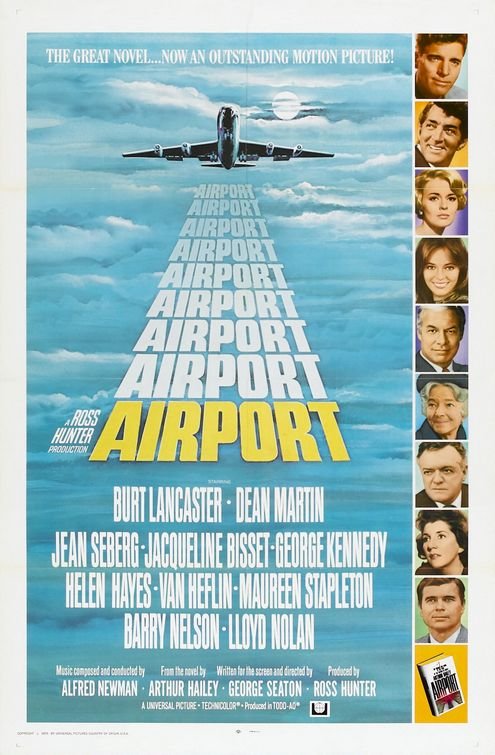
Airport (1970)

Airport (1970)

Disaster awaits in the sky in this ridiculous soap that is less exciting than Airplane!

Director: George Seaton

Cast: Burt Lancaster (Mel Bakersfied), Dean Martin (Captain Vernon Demerest), Jean Seberg (Tanya Livingston), Jacqueline Bisset (Gwen Meighen), George Kennedy (Joe Patroni), Helen Hayes (Ada Quonsett), Van Heflin (DO Guerrero), Maureen Stapleton (Inez Guerrero), Barry Nelson (Captain Anson Harris), Dana Wynter (Cindy Bakersfeld), Lloyd Nolan (Harry Standish), Barbara Hale (Sarah Demarest), Gary Collins (Cy Jordan)

A busy Chicago airport in the middle of a snowstorm. Workaholic Mel Bakersfeld (Burt Lancaster) doesn’t have time to prop up his failing marriage to his humourless wife: he’s got to keep the flights moving, clear the runways and solve the problems other people can’t. He’s not dissimilar to his brother-in-law Vernon Demerest (Dean Martin), who hasn’t got time for his plain-Jane wife at home when he’s got a flight to Rome to run and a saintly pregnant air hostess girlfriend Gwen (Jacqueline Bisset), to deal with. Tensions will come to a head when depressed former construction worker Guerrero (Van Heflin) joins Demerest’s flight, planning to blow himself up so his wife can profit from his life insurance. Disaster awaits!

“A piece of junk”. That was Burt Lancaster’s pithy review of this box-office smash that was garlanded with no fewer than ten Oscar nominations. He’s pretty much spot on. Airport is a dreadful picture, a puffed-up, wooden soap opera that never takes flight, stapled together with a brief disaster plotline that only really kicks in during the final act of the film and is solved with relative ease. Other than that, it’s all hands to the pumps to coat the film in soapy suds, which can be stirred up by the strips of wooden dialogue that fall from the actors’ mouths.

Seaton adapted the script from a popular low-brow novel, though it feels as if precious little effort went into it. It’s corny, predictable dialogue does very little to freshen up the bog-standard domestic drama we’re watching in a novel setting. Both lead actors juggle loveless marriages with far prettier (and much younger) girlfriends. Those girlfriends – Jean Seberg for Burt and Jacqueline Bisset for Dean – play thankless roles, happily accepting of their place as no more than a potential bit-on-the-side and very respectful of the fact that the job damn it is the most important thing.

The film bends over backwards so that we find Burt and Dean admirable, despite the fact that objectively their behaviour is awful. Burt treats his home like a stopover, barely sees his kids and seems affronted that his wife objects he doesn’t attend her important charity functions and doesn’t want the cushy job he’s being offered by her father. Just in case we sympathise with her, she’s a cold, frigid, mean and demanding shrew who – just to put the tin lid on it – is carrying on behind Burt’s back. We, meanwhile, applaud Burt for showing restraint around the besotted Jean Seberg, merely kissing, hugging and chatting with her about how he’d love to but he can’t because of the kids at home damn it!

He looks like a prince though compared to Dean. Only in the 1970s surely would we be expected to find it admirable that a pregnant girlfriend happily takes all the blame – the contraceptive pills made her fat and she knows the deal – begs her boyfriend not to leave his wife and then urges him to not worry about her. Dean’s wife doesn’t even seem that bad, other than the fact she’s a mumsy type who can’t hold a candle to Bisset’s sensuality. That sensuality is overpowering for Dean, who at one point pleads with her to stay in their hotel room because the taxi “can wait another 15 minutes”. Like a gentleman his reaction to finding out Bisset is pregnant, is to offer to fly her to Norway for a classy abortion (rather than the backstreet offerings at home?).

This soapy nonsense, with its stink of Mad Men-ish sexual politics (where men are hard-working, hard-playing types, and women accept that when they age out, he has the right to look elsewhere) is counterbalanced by some laboriously-pleased-with-itself looks at airport operations. Baggage handling. Customer check-in. Customs control checks. Airport maintenance. All get trotted through with a curious eye by Seaton. Just enough to make parts of the film feel briefly like a dull fly-on-the-wall drama rather than a turgid soap.

Soap is where its heart is though. Helen Hayes won an Oscar for a crowd-pleasing turn (from which she wrings the maximum amount of charm) as a seemingly sweet old woman who is in fact an expert stowaway. Van Heflin and Maureen Stapleton play with maximum commitment (Stapleton in particular goes for it as if this was an O’Neil play rather than trash) a married couple whose finances are in the doldrums, leading the husband to take drastic steps.

It’s all marshalled together with a personality-free lack of pizzaz by Seaton, who simply points the camera and lets the actors go through their paces, with a few shots of humour here and there. There are some interesting split-screen effects, but that’s about the last touch of invention in the piece. It’s mostly played with po-faced seriousness – something that feels almost impossible to take seriously today, seeing as the structure, tone and airport observational style of the film was spoofed so successfully in Airplane (a much better film than this on every single level, from humour, to drama even to tension – how damning is that, that a pisstake is a more exciting disaster thriller?)

It smashed the box office in 1970 and got nominated for Best Picture. But its dryness, dullness and lack of pace mean it has hardly been watched since. Although it can claim to be the first all-star disaster movie, it’s not even fit to lace the flippers of The Poseidon Adventure, which far more successfully kickstarted the cliches that would become standard for the genre (and is a tonne more fun as well as being a disaster movie – this has a disaster epilogue at best). An overlong, soapy, dull mess.

Rise of the Planet of the Apes (2011)

Rise of the Planet of the Apes (2011)

You’ll believe an ape can talk in this brilliant relaunch of a franchise that had become a joke

Director: Rupert Wyatt

Cast: Andy Serkis (Caesar), James Franco (Dr Will Rodman), Freida Pinto (Dr Caroline Aranha), John Lithgow (Charles Rodman), Brian Cox (John Landon), Tom Felton (Dodge Landon), David Oyelowo (Steven Jacobs), Terry Notary (Rocket/Bright Eyes), Karin Konoval (Maurice), Richard Ridings (Buck)

It was always a concept some found hard to take seriously. Actors, in heavy make-up, pretending to the Ape masters of Planet Earth. It didn’t help that, after the first few films in the Planet of the Apes franchise the quality took a complete nosedive. Quite a lot for Rise of the Planet of the Apes to overcome: could it take this staple of popular culture and make it not only not a joke, but something people actually wanted to see? Well yes it certainly could. Rise is an intelligent, cinematically rich, surprisingly low-key and brilliantly done relaunch.

It has the advantage of course of decades of special-effects development. Gone are the days of Roddy McDowell in a monkey suit. Now motion capture can literally transform an actor into a chimp. In a way that other Planet of the Apes films never could, it can make the Apes the centre of the film. And if you are going to call for an actor who can help you bring life to a motion capture created character, who else are you going to call but Andy Serkis?

Serkis plays Caesar, the ape who (those of us familiar with the franchise know) will become the founder of the Ape civilisation. The first Ape who stood up and said “No”. He’s the son of Bright Eyes, a chimp who receives ALZ-112, an experimental drug designed to cure Alzheimer’s. Its invented by Dr Will Rodman (James Franco), desperate to cure his father Charles (John Lithgow). The experiment goes wrong and Bright Eyes is killed – but not before giving birth to Caesar, who inherits unnatural levels of intelligence from the drug. Will protects and raises Caesar, treating him as a son. But when Caesar is taken from Will and placed in an abusive ape sanctuary, he begins to see it as his mission to help his fellow apes. The revolution starts here.

Rise – for all it has a computer effect in almost every frame – works because it is small-scale intimate story. For a film full of nothing but effects, it feels remarkably like a sort of sci-fi relationship drama. It’s effectively about a child learning to become a man and find his own destiny, leaving behind a loving (but ineffective) father who, unknowingly, is blocking his progress, to stand as his own man (or rather ape). The motion capture is so stunningly well-done you forget that you are looking at a special effect for in almost every frame, and instead accept Caesar as our lead character.

Wyatt’s film eases us into this, centring Will (played with a generosity and warmth by James Franco) as our lead character and filtering our perception of Caesar through his eyes, as he grows up in his suburban house and learns to climb in San Francisco’s Redwood forests. The careful shift to making Caesar our central character – complete by the time we see him imprisoned in the dangerous environment of the ape sanctuary – is so masterfully done, that we hardly notice that large chunks of the second half of the film take place in wordless silence among the apes, Caesar’s thoughts and emotions communicated only by body language, expressive eyes and hand gestures.

To get that to work, you need a stunning actor behind it. Serkis’ performance is extraordinary: he used motion capture to become an ape, exactly capturing the physicality but also marrying it with real human emotions. We can look at Caesar’s face at any point and know exactly what he’s thinking and feeling. His joy in his home, his protective fury when a confused Charles is assaulted by a furious neighbour, his distress at being locked away, his fear and confusion at his new surroundings his hardening resolve and his determination to liberate his fellow apes. This is extraordinary stuff.

It’s not just Serkis. Every ape has a talented actor behind it. Notary is a master of ape physicality, Konoval creates a beautifully wise and tender orangutan, Ridings finds loyalty and tenderness in a gorilla, Christopher Gordon a psychotic energy to abused lab-rat ape Koba. The marriage between actor and ape is perfect, and means we are completely on their side against mankind (be it in the lab or the ape sanctuary) they are up against. Wordless sequences of Caesar’s ingenuity: establishing himself as the Alpha with shrewd combat tactics, winning friends with cookies, stealing drugs to gift the other apes his own intelligence (their silent wonder at their interior worlds expanding is brilliantly done) and finally leading a revolt (including that goose-bumps rousing “No!”) is superb.

Wyatt’s skilful, calm and controlled visual storytelling is a triumph in making the determination of a CGI Ape a punch-the-air moment. Wyatt makes each Ape as much – sometimes more – of a character than the humans and weaves an emotionally complex story for Caesar. This isn’t about an angry Ape leading bloody revolution. This is a confused, gentle teenager trying to work out who he is. Is he Will’s son or his pet (do sons normally wear leashes in public)? Is he a dreamer or a leader? And, above all, is a man or an ape? When push comes to shove, where will his loyalties lie?

This makes for emotionally rich stuff – so much so that when the Apes make a final act stand for freedom on the Golden Gate Bridge, you’ll shed tears over the self-sacrifice of one of their number. It’s also an intriguing look at humanity, none of whom come out as well as they could. The ‘good’ people – like Will and ape sanctuary worker Rodney – are kind but ineffective (everything Will does goes horrifically wrong, despite his best intentions). The ‘bad’ – Oyelowo’s money-first Drugs Company CEO or Cox and Felton as abusive ape sanctuary owners – are corrupt, selfish and greedy. No wonder the apes, stuck in a hole and only pulled out to be sold for drugs trials, feel so angry.

It’s not perfect. There are some clumsy, awkward homages to the original film (the worst being Felton shrieking “it’s a mad house!”) that don’t pay off. The human characters are at times two dimensional. But that doesn’t matter when the story-telling around the chimps is so superbly done. Wyatt fills the film with effects, but focuses so completely on character and emotion that it never feels like that for a moment. Rise is a small, intimate film about personal growth and a struggle for limited freedom. It helps make it a powerful and highly effective one – and easily superior to every Apes film made since 1968. A superb start to what became a wonderful trilogy.

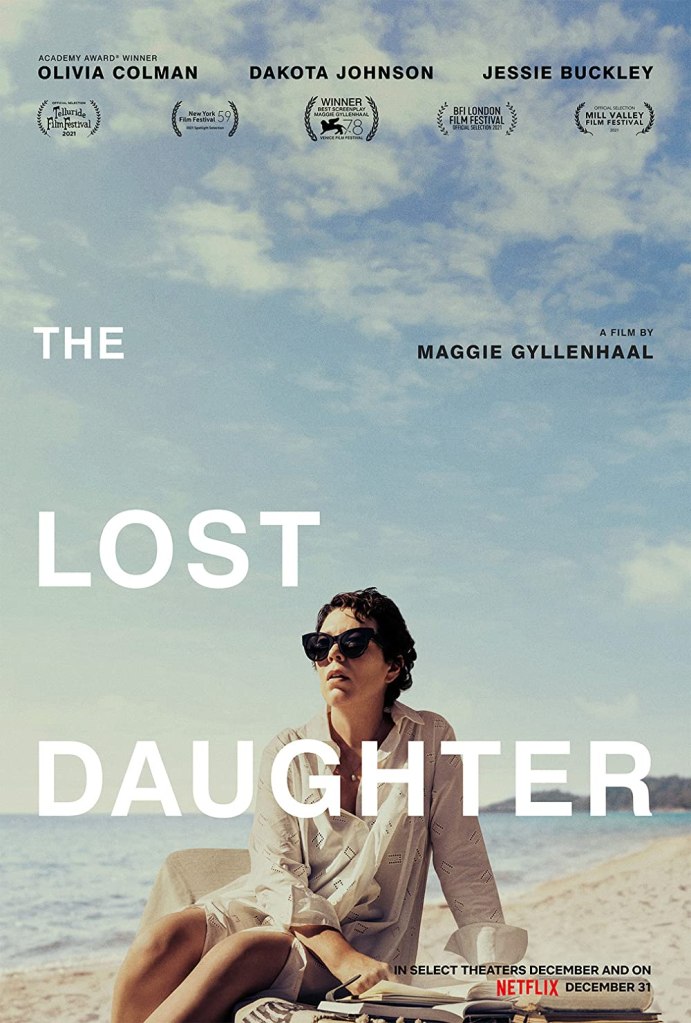
The Lost Daughter (2021)

The Lost Daughter (2021)

Motherhood, loss and guilt are at the heart of this over-extended drama that doesn’t feel like it focuses on the right things

Director: Maggie Gyllenhaal

Cast: Olivia Colman (Leda Caruso), Jessie Buckley (Young Leda Caruso), Dakota Johnson (Nina), Ed Harris (Lyle), Dagmara Dominczyk (Callie), Paul Mescal (Will), Peter Sarsgaard (Professor Hardy), Jack Farthing (Joe), Oliver Jackson-Cohen (Toni), Athena Martin (Elena), Robyn Elwell (Bianca), Ellie Blake (Martha)

Leda (Olivia Colman), a professor of Italian Literature, holidays in Greece. That holiday is disturbed by the arrival of a noisy, aggressive family from Queens. A member of that family, unhappy young mother Nina (Dakota Johnson) loses her daughter on a beach. Leda finds her, but it triggers her own unhappy memories of motherhood (Jessie Buckley plays the young Leda). She impulsively steals the child’s beloved doll, as her paranoia and mournful reflections grow.

Maggie Gyllenhaal’s directorial debut is a confident, assured piece of film-making, but I found it a cold and slightly unsatisfying film. There is a fascinating subject here, that the film fails to really tackle. One of life’s great unspoken expectations is that everyone should find being a parent – especially being a mother – hugely rewarding. This film studies a woman who didn’t, but still wants to reassure us of the love and happiness found in the bond with a child, no matter your mistakes as a parent. In doing so, it marginally ducks an important societal issue and reaches conclusions that feel predictable, for all the ambiguity the film ends with.

Colman’s expressive face and ability to suggest acres of unhappiness in a forced smile or gallons of frustration with a single intake of breath, are used to maximum effect. Leda is a woman comfortable with her own company, forced and uncomfortable in conversation, her eyes flicking away as if looking for an exit. She seems confused about how to respond to the quiet advances of handyman Lyle (a gentle Ed Harris) and increasingly resents the intrusion into her holiday of outsiders.

How much is this slightly misanthropic, isolated view of the world her natural personality, and how much has it grown from her choices in the past? Flashbacks reveal her struggles as a mother – and the strained relationship with her children today – and it’s clear Leda is a bubble of confused emotions, uncertain about what she thinks and feels.

That past, to me, is the real area of interest, rather than the distant, cold woman those choices have created. I’d argue a stronger film – and one that would feel like it was really making a unique point – would have focused on the younger Leda. Expertly played by an Oscar-nominated Jessie Buckley –brittle and growing in claustrophobic depression – she loves her two girls. But, most of the time, finds them overbearing, all-consuming and more than a little irritating. She’ll laugh at their jokes and be terrified when one of them gets lost, while still resenting their domineering impact on her life.

When she wants to work, they demand attention. When her daughter has a small cut on her finger, Leda is repeatedly asked to kiss it better like a broken record. Leda gives her other daughter her own childhood doll – and then throws it out of a window in fit of hurt fury when the daughter covers it in crayon and says she doesn’t like it. The kids get in the way of everything: be it work (she retreats behind headphones to focus), holidays, sex with her husband or even masturbation.

Her feelings go beyond post-natal depression. She is someone who genuinely loves her children, but can’t bear the idea of mothering them. This is the meat of the film, far more than the present-day narrative. Gyllenhaal sensitively tackles a rarely discussed topic: what can we do if we find parenthood was a mistake? Knuckle down or give up and run away? A film exploring this could have been compelling: but it only takes up a quarter of an over-extended film.

Instead, by focusing on the maladjusted present-day Leda, the film presents her motherhood difficulties as the root cause of her problems. Leda sees a potential kindred spirit in young mother Nina – a brash and exhausted Dakota Fanning – who seems equally frustrated by parenting. But Leda is so insular and self-obsessed, is she only seeing what she wants to see? If she thinks Nina is also failing as a mother, will that make her feel better about her own failures?

The Lost Daughter is an unreliable narrator film – and Gyllenhaal expertly suggests much of what we see are Leda’s perceptions rather than necessarily the truth. The menace from Nina’s loud and aggressive extended family is a constant presence: but is it real, or just Lena’s paranoia. Does the family really cover every tree with a missing poster for a child’s lost doll, or does it just that way to Leda? Does Nina share Leda’s own resentments with motherhood, or does Leda just want her to?

It’s a subtle ambiguity that continues until the film’s close. It leaves many questions unanswered and open to the viewers interpretation. Different viewers will take very different messages from it. But for me, the film wasn’t quite interesting enough – and shied away from exploring the questions of guilt and doubt about parenthood. At no point does Leda even voice the possibility that she regrets having kids – for all that she surely does – which feels odd. For me the film takes a long time to not quite say as much as I feel it could have done.

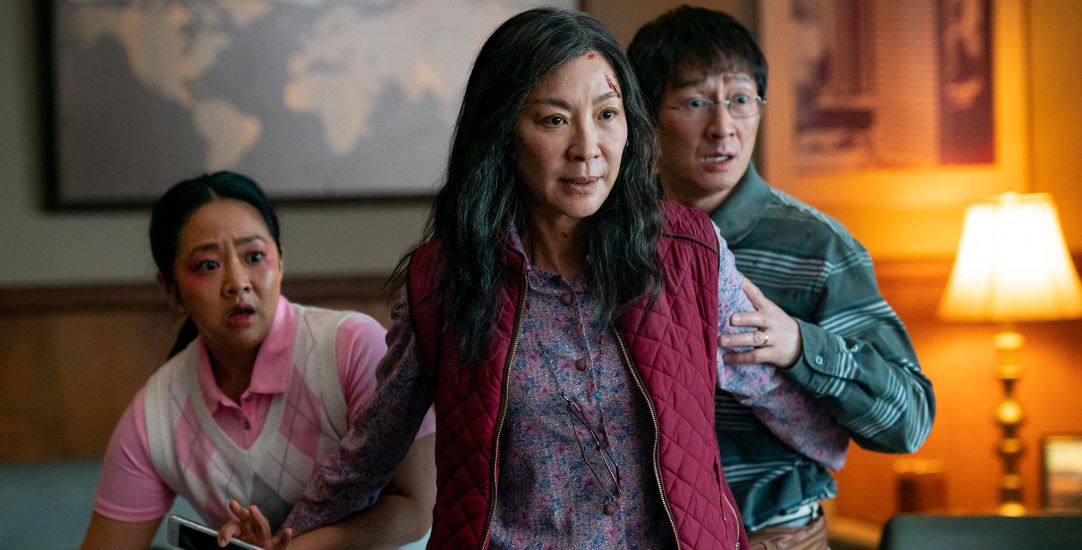
Everything Everywhere All At Once (2022)

Everything Everywhere All At Once (2022)

The multi-verse is at risk of ending – and only a disenchanted woman running a laundromat can save the day in this inventive science-fiction

Director: Dan Kwan, Daniel Scheinert

Cast: Michelle Yeoh (Evelyn Quan Wang), Stephanie Hsu (Joy Wang), Ke Huy Quan (Waymond Wang), James Hong (Gong Gong), Jamie Lee Curtis (Dierdre Beaubeirdre), Tallie Medel (Becky Sregor), Jenny Slate (Debbie), Harry Shum Jnr (Chad), Biff Wiff (Rick)

Evelyn Wang (Michelle Yeoh) has lots on her plate: running her laundromat, completing tax returns for a demanding IRS agent (Jamie Lee Curtis), her waning marriage to goofy husband Waymond (Ke Huy Quan) and drifting relationship with lesbian daughter Joy (Stephanie Hsu), not to mention her fear of the disapproval of her demanding father (James Hong) – its Everything Everywhere All at Once as it is: no wonder she struggles to cope when discovering from an alternate version of her husband that she, and she alone, is the key to saving the entire multi-verse from destruction.

Everything Everywhere All at Once is an endlessly inventive, imaginative and unique spin on everything from science fiction to philosophy, via the struggles of an immigrant family, familial dynamics and love, death and the universe itself. Did I mention it’s got jokes as well? There isn’t anything quite like EEAAO out there, and if the film does lose energy at an inflated runtime of 145 minutes, at least that’s because it must have been a struggle knowing what to cut.

In the mythology of EEAAO, Evelyn lives in just one of a myriad different realities. Every time a decision is taken, a new reality branches off, spawning innumerable different realities. If Evelyn can imagine it, then somewhere in another universe it happened. She should be a film star, a martial artiste, a chef, a blind singer, a pizza sign spinner…there are realities where mankind never evolved or where they evolved with hot dogs for fingers (a joke the film is a way too pleased with and seriously outstays its welcome).

With some technology from the “Alpha” universe – the first universe to discover alternate realities, where Evelyn and Waymond were pioneering scientists – Evelyn can access the memories and skills of her alternates. All she – and others with the right training and equipment – need to do to become experts at anything in seconds is to build a mental link to that reality by performing a highly improbable act. Whether that’s getting four consecutive papercuts, eating a lipstick, swallowing a model frog or – in a comic highlight – Evelyn fighting to stop an opponent shoving an “Employee of the month” award shaped like a dildo up their bottom in public (you’re not going to see that in many movies) – it’s a brilliant comic device that raises belly laughs a plenty.

EEAAO knocks spots off the recent Doctor Strange sequel (that made almost nothing of its parallel universe concept) by not only presenting radically different worlds (in this universe Evelyn is a pinata! Here she’s a rock!), but also exploring how the path-not-taken can have a mesmerising and inspiring/depressing impact. Evelyn – a woman who (justifiably?) believes she has achieved nothing, is both fascinated or heart-broken to see realities where her accomplishments are titanic. EEAO is superbly thought-provoking when it explores the emotional impact of questioning your choices, when you see turning right rather than left could have been the first step on a path of astonishing glory and success and, even, a completely different personality.

This leads into the film’s second half which, after the comic energy of the first, dives into a philosophical debate about the nature of choice. The villain attempting to destroy reality is motivated not by rage or power-lust – but simply by the fact that jumping to a billion realities has persuaded them it all means nothing. Everything is basically a combination of atoms that, with a few pushes and pulls, can turn from one thing to anything else. This nihilistic view of the world – what does it matter killing one person when there are billions of other versions of them, many of them ‘better’ – and balancing it with a more humanitarian view, becomes the film’s key debate.

It’s also rooted in the film’s opening, which is does a marvellous job of exploring universal family questions, while still grounded in the experience of an immigrant family. Evelyn and Waymond, having moved to America in search of their dreams as youngsters – and wound up running a laundromat – struggle to balance their relationship (her growing irritation at his perpetual optimism, his alienation from her cynicism) and, particularly in Evelyn’s case, understanding her more Westernised daughter. Two generations with very different experiences, struggling to understand each other.

On top of which, many of these problems are universal. Generational conflicts: the grandpa who can’t be told his granddaughter is gay, because her mother isn’t sure how he will react. The mother and daughter who have lost the ability to communicate and reduced to saying increasingly cruel things to each other (there is a shocking moment when Evelyn tries to tell her daughter she loves her but instead chastises her for getting fat). Waymond tries to hold things together but is too gentle and ineffective to do anything.

All of this is bundled together in a film stuffed with inventive and hilarious sequences. There are kick-ass fights (one involving Alpha-Waymond and a fanny-pack – bum-bag to us Brits – which has to be seen to be believed), hilarious segues, brilliant parodies of other films (2001, Ratatouille and In the Mood for Love for starters): and then the film will hit you for six with a genuinely heart-breaking moment. I will say there is almost too much good stuff here – ten minutes trimmed from the film would work wonders, and the continued trips back to Hot Dog Hands reality is a joke stretched to absolute breaking point – but better too much than too little.

At the heart of this fabulous work from The Daniels are superb performances, none more so than a career best turn from Michelle Yeoh. Channelling everything Yeoh has ever done in her career into a single film, she of course can handle the astonishing action but also displays an emotional depth and complexity that will break your heart. She’s bitter and trapped, then will shift on a sixpence to agonised guilt and longing. She’s astonishingly good. There is brilliant support from Hsu as her trapped and troubled daughter and Ke Huy Quan (last seen in The Goonies) is heart-breakingly endearing, funny and wonderfully sweet as her good-natured husband (like Yeoh he also plays multiple variants – from confident to cold and distant). James Hong is wonderful as her austere father and Jamie Lee Curtis is having a ball as a bullying IRS agent turned villain’s heavy.

When the major flaw in the film is that it is too damn long, you know you are onto a good thing. There are more ideas in a few minutes here than in the entire runtime of such things as the Doctor Strange sequel. Superbly directed with wit, energy and compassion by the Daniels and with a career-defining role for Michelle Yeoh, Everything Everywhere All At Once is destined to take its place as a year defining cult hit.

Ran (1985)

Ran (1985)

Kurosawa’s epic version of King Lear places style over substance, but offers many glorious visual treats

Director: Akira Kurosawa

Cast: Tatsuya Nakadai (Hidetora Ichimonji), Akira Terao (Taro Ichimonji), Jinpachi Nezu (Jiro Ichimonji), Daisuke Ryu (Saburo Ichimonji), Mieko Harada (Lady Kaede), Yoshiko Miyazaki (Lady Sué), Mansai Nomura (Tsurumaru), Hisashi Igawa (Kurogane), Peter (Kyoami), Masayuki Yui (Hirayama Tango)

An ageing Lord lays down the burdens of office to his three children. Two flatter the old man: the third tells him he’s a fool. The lord banishes the third child and treasures the other two, who betray him tipping him into a lonely madness, screaming on a moor. Sound familiar? Kurosawa takes Shakespeare’s King Lear and transposes it to the final days of Samurai Japan. Lear becomes Hidetora (Tatsuya Nakadai) and his daughters become sons, Taro (Akira Terao), Jiro (Jinpachi Nezu) and Saburo (Daisuke Ryu), with the latter two taking on Hidetora’s land.

Ran translates as “Chaos”. That’s really what the film is about. Kurosawa’s Lear is strikingly nihilistic. Anything from the original play that could be called remotely optimistic – there is no good servant figure, no sensible Albany and no Edgar caring for, and avenging, his blinded father – is removed. Instead, Hidetora’s decision leads to unrelenting death and destruction, a carnival of bodies piling up in burnt out, ruined castles. This is Lear, tinged with the sort of Beckettian-wasteland theorists like Jan Kott would love: bleak and hopeless with only suffering at its heart.

As you expect with Kurosawa, its filmed with poetic beauty. The more frantic, Western-action, stylings of Kurosawa’s youth are gone, a victim perhaps of his auteur reputation. Ran is a self-consciously important film, an epic taking place in a series of stately medium and long-shots (I can barely remember more than a few close-ups), in luscious Japanese countryside, peopled by hundreds of colour-coded extras. Kurosawa’s fault is that he sometimes focuses on this, at the cost of the thematic complexity of Lear.

But what he certainly gets right is the bleakness at its heart. Kurosawa is not remotely seduced by any glamour in Hidetora. Played by Tatsuya Nakadai in a deliberately classical noh­-style (full of elaborate poses and declamatory, plot-heavy dialogue) designed to stress how out-of-touch he is, compared to the more modern styles of the other actors. A vain, proud man who expects to be obeyed without question, Hidetora is never a truly sympathetic figure until his final moments.

Everything we learn about him hammers home his past of violence and brutality – he wiped out of the families of both of his daughters-in-law to steal their lands, he blinded Ran’s prince-turned-beggar Tsurumaru, who wanders the wilderness and gives Hidetora shelter. Falling from power, he’s as stubborn and arrogant than ever, leading his retainers to their death in an ambush. There is none of the “very fond, foolish old man” about him (there isn’t much of that about Lear either), just a tyrant who brings himself low.

Hidetora’s greed has also introduced a serpent into his own nest. Many have seen Taro’s wife Lady Kaede (Mieko Harada) as a Lady Macbeth figure, but really she’s a sort of Edmond or Iago. Seductive, vengeful and interested only in furthering the chaos, she lives in her murdered father’s castle, married to the son of the man who killed him. She schemes to turn both brothers against each other, seduces Jiro and pushes him to murder his wife. Using her body and her brain, she works to destroy the clan, her hatred motivated by Hidetora’s past cruelty.

Chaos is the perfect time for her schemes to take hold. Kurosawa’s setting of Ran near the end of the Samurai era, adds an additional blood-tinged brutality to the film’s battles. This was the time when the Samurai were learning their swords and arrows were poor defence against muskets. The battles are massacres: massacres of people fighting two different kinds of war. One is that of guts and honour: another the brutal long-distance finality of the bullet. Samurai are mowed down in their dozens on futile charges, while two of Hidetora’s sons are shot down from a distance, never seeing their killer’s faces. It’s a million miles from the traditional boar-hunt that opens the film – and it’s a world none of the characters manages to adjust to.

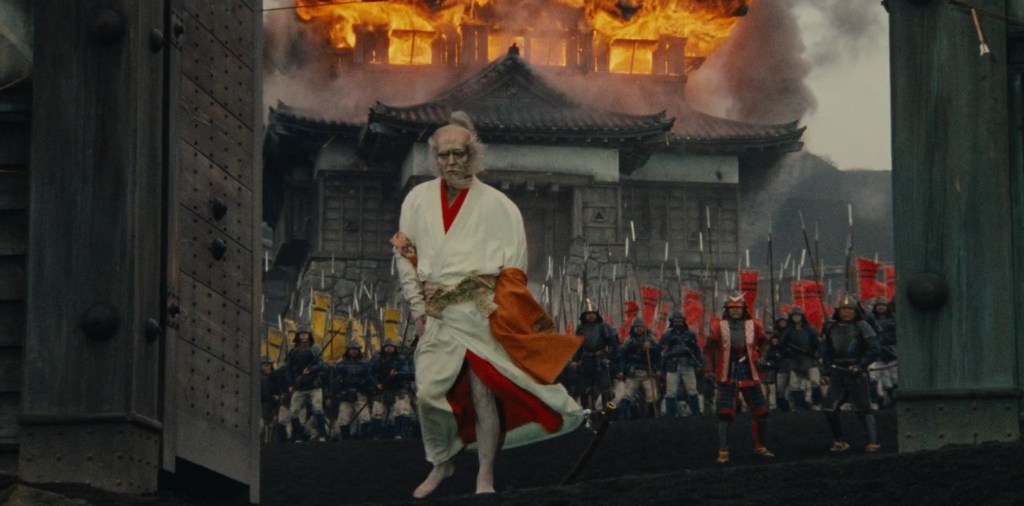
The violence of these battles is the central touch of mastery in Kurosawa’s epic. A whole castle was built – out of plywood – solely so it could be burned down during the pivot sequence at the centre of the film. Hidetora’s last castle is surprised by the armies of both sons, whose soldiers spray it with a never-ending stream of bullets and fire arrows. Playing out in silence under a haunting score, this is a chilling showpiece for Kurosawa’s visual mastery, a terrifyingly nihilistic view of the horror and destructiveness of conflict.

Inside Hidetora’s men are ripped apart or punctured like pin cushions, leaking gallons of crimson blood. His harem commits seppuku. The castle burns down around him. All while Hidetora sits in stoic disbelief at the top of a tower, his connection with reality collapsing. He eventually leaves the castle – walking through the parting invading forces (a shot that could only be attempted once as the set literally burned down around him) and out of the smoking gates. It’s an extraordinary sequence, the finest in the film: wordless, poetic and terrifyingly, hauntingly, brutal.

From here, Kurosawa’s Ran embraces the bleakness of Lear: Hidetora loses all trace of sanity, rages in self-loathing in the same fields he lorded over in the film’s opening sequence, is reduced to pathetically begging for food from the man he blinded and ends the film cradling the body of his murdered son. Around him his fool – an extraordinary performance from Japanese variety performer Peter – mocks his actions and tells bitter jokes about the savagery of the world while despairing and raging at the horrific position he has been reduced to in caring for his master.

Kurosawa embraces that bleakness: but how much does of Shakespeare’s depth does Kurosawa grasp? I’m not sure. In stressing the cruelty and madness of Hidetora, he robs him of Lear’s growing self-realisation about the emptiness of power and his own failings as a ruler. Hidetora is a two-dimensional character, as are most of the others. Kurosawa’s simplification of Lear removes the destructiveness of fate, the grotesqueness of chance and the punishments of loyalty (there is no Gloucester character, while the Kent figure is largely sidelined – both I feel is a real loss).

In making Ran, Kurosawa focused on two things: a depressingly post-Nuclear age vision of the world as a wasteland in waiting, and the pageantry of grand-settings and beautiful imagery. Compare Ran to the faster-paced dynamism of his earlier films (Seven Samurai may be nearly as long, but it doesn’t feel like it compared to the slow-paced Ran). There is a self-important artiness about Ran: it’s more stately style feels like Kurosawa showing he could do Ozu as well as he could Ford, while it’s indulgent run-time (there are many moments of near-silent nihilistic wilderness, that add length and import but not always depth) can test your patience.

Ran is basically a simplification of Lear that takes the core of the story, strips out many of its themes and contrasting sub-plots, and focuses on a single message, of man’s inhumanity to man. In doing that it loses the scope of a play that astutely looks at the personal and the political, the intimate and the epic, that understands the self-deceiving flaws of good and bad men. It’s large and important, but it’s not as powerful a tragedy as Lear because its fundamentally a simple film.

Which is not to say it is a bad film. But it is to say that Kurosawa had perhaps become seduced by his status as a legendary “Great Director” into believing that long and beautiful were synonymous with quality and importance. Ran is a fascinating and chilling film, with many striking and haunting moments. But it also misses some of what made its source material great, and it’s a triumph of moments and visuals than it is of intellect and depth.

Now, Voyager (1942)

Now, Voyager (1942)

Romance, make-overs and erotic cigarette lighting abounds in this classic luscious romance

Director: Irving Rapper

Cast: Bette Davis (Charlotte Vale), Paul Henreid (Jerry Duvaux Durrance), Claude Rains (Dr Jaquith), Gladys Cooper (Mrs Windle Vale), Bonita Granville (June Vale), John Loder (Elliot Livingston), Ilka Chase (Lisa Vale), Lee Patrick (Deb McIntyre), Janis Wilson (Tina Durrance)

The untold want by life and land ne’er granted, / Now, voyager, sail thou forth, to seek and find”. Walt Whitman’s words are the poetic urging of kindly psychiatrist Dr Jaquith (Claude Rains) to patient Charlotte Vale (Bette Davis) before she embarks on a cruise that will change her life. Crushed under her imperious mother’s (Gladys Cooper) thumb, Charlotte grew-up an unloved ugly-duckling and self-loathing spinster. How will a taste of freedom change her life – and, with that taste, a love affair with unhappily married would-be-architect Jerry Durrance (Paul Henreid)?

It’s easy to see Now, Voyager as a piece of soapy, romantic puff – and there are certainly suds in its DNA – but that’s to do an engaging, heartfelt character-study down. This is a sort of moral rags-to-riches story about a woman who has been mocked her whole life, finding the courage to build her own life. But that life is not the picture-perfect final image you might expect: instead, it’s about compromise and, more importantly, choosing your own compromises. Without knowing it, that is what Charlotte has been striving for. “Don’t let’s ask for the moon: we have the stars” are her famous closing lines, and it’s about the idea that choosing a compromised version of the life she actually wants is better than a life foisted upon her by others.

Now, Voyager works as well as it does, almost exclusively down to Bette Davis. She fought to get the role, hand-picked the director (an old friend) and stars (insisting on Henreid, despite a disastrous test) and reshaped most of the dialogue. It’s all justified by her superb performance. Charlotte Vale, with her ugly-duckling opening appearance, and operatic romance with Jerry, could have been a pantomimic performance. Davis though grounds her in sensitivity, reality and a deep emotional empathy. It’s a complex, heart-stirring performance.

Almost uniquely for stars at the time, Davis was not afraid to get ugly when the part demanded (she practically invented ugging-up). Charlotte Vale’s first appearance – Rapper teases the reveal by focusing first on her hands at her desk, legs as she descends a staircase before allowing her to fully enter frame – is a sight. With an eye-catching, hairy mono-brow, mousy glasses, a flattened haircut and dumpy clothing, she’s a million miles from our idea of 40s glamour. But Davis doesn’t make her a joke or play up to the appearance. She gives Charlotte a steel, born of self-defence – she snaps swiftly at Dr Jaquith when she thinks she is being condescended to – and a deep well of pain and ill-defined longing for a change she can hardly grasp.

Matters are beautifully inverted when she heads off on her cruise (you can criticise the film’s portrayal of therapy, which seems to be easy if you are stinking rich and can afford a cruise). Rapper repeats his intro trick again – this time revealing a physically confident and striking Charlotte, made-up and dressed to the nines. But, just as the self-loathing Charlotte had a defensive steel, so this ‘confident’ Charlotte has the same vulnerability and fear of ridicule and rejection just beneath the surface. Davis brilliantly gives the outwardly changed Charlotte, a different but equally moving vulnerability, a woman still working out who and what she is.

It’s a brilliant performance that gives the entire confection of the film a real emotional heft, as we experience every inch of this seminal voyage with her. And a lot of that life-change is filtered through the bond between her and fellow-passenger Jerry. Skilfully played by Henreid with a euro-charm that barely masks his own sadness, loneliness and guilt, Jerry may look the part but like Charlotte he’s close to succumbing to imposter syndrome. Unloved by his wife (this unseen harridan arguably deserves a film of her own – perfect role for Joan Crawford?) – but trapped into the marriage by his sense of duty and his love for his timid daughter Tina (Janis Wilson).

Jerry and Charlotte’s relationship blossoms from shyness into a genuine love affair. Reading between the lines of its 1940s code, it’s clear our two heroes get-it-on. Stranded in Brazil after a car crash (caused by an uncomfortably dated caricature portrayal of a Hispanic driver), the two of them ‘snuggle up’ for warmth while camping the night in an abandoned building. Any doubts about how far this went is removed when Henreid lights two cigarettes in his mouth in the next scene, passing one to Charlotte who sucks sensually on it. (This was the era when the language of cigarettes was crucial as a stand-in for bumping and grinding).

Of course, an affair could never be explicitly allowed, just as any idea of Henreid divorcing his awful wife was anathema. But its knowing that it-can-never-be which gives the film its romantic force. Charlotte will eventually find herself drawn to helping Jerry’s daughter Tina, their shared love for the child being the thing that will allow them to be married in spirit if not in actuality.

You could argue Charlotte’s decision to semi-adopt Tina as companion is not dissimilar from her own mother’s would-be exploiting of Charlotte as an unpaid nurse. But Charlotte has learned a lot from the cruel fierceness of her mother. Played with a witheringly cold grandeur by Gladys Cooper – at one point she taps her finger on a bed post in a way which captures oceans of barely repressed fury – this woman is selfish, self-obsessed and cruel. Standing up to her expectation that nothing has changed is the major challenge for Charlotte, with Bette Davis skilfully showing it takes all her strength to overcome.

Now, Voyager is an effective romantic film. It’s helped a great deal by Max Steiner’s beautifully romantic score, that perfectly complements and enhances every on-screen image. Superbly acted by its four leads – Claude Rains is also wonderful as the kindly and deeply professional Jaquith – it’s a detailed character study that manages to rise triumphantly above its soapy roots.

Peyton Place (1957)

Peyton Place (1957)

Small-town America is the home of hypocrisy in this ridiculously silly soap opera that spawned…a long-running TV soap opera

Director: Mark Robson

Cast: Lana Turner (Constance MacKenzie), Diane Varsi (Allison MacKenzie), Hope Lange (Selana Cross), Lee Philips (Michael Rossi), Arthur Kennedy (Lucas Cross), Lloyd Nolan (Dr Matthew Swain), Russ Tamblyn (Norman Page), Terry Moore (Betty Anderson), David Nelson (Ted Carter), Betty Field (Nellie Cross), Mildred Dunnock (Elsie Thornton), Leon Ames (Leslie Harrington)

Small-town America: what mysteries lie behind those white picket fences? If the small New England town of Peyton Place is a guide, all sorts of terrible things. Why is Constance MacKenzie (Lana Turner) so afraid of sex and romance? Could her fear that the slightest kiss could turn her would-be-writer teenage daughter Allison (Diane Varsi) into a slut, be rooted in her own mysterious past? Why does Allison’s friend Selena (Hope Lange) fear her drunken and lecherous step-father Lucas (Arthur Kennedy) so much? Why is Mommas-boy Norman (Russ Tamblyn) so shy?

If that all sounds like the set-up for a great-big TV soap… well that’s because it essentially is. Peyton Place was a huge box-office success in 1957, but you can argue it found its natural home when it later mutated into a long-running TV soap. It’s one long onslaught of high-flung, ridiculously OTT events, all filtered through the sort of dialogue punctured by swelling music to hammer home the feelings. Peyton Place is completely disposable – but also strangely enjoyable, rollicking along like all the best soaps do, so full of events that you don’t have time to stop and realise how silly it is.

Adapted from a doorstop popular novel, screenwriter John Michael Hayes faced quite a task. The original was crammed with sex, foul language and everything from murder to teenage pregnancy, illegal abortions, rape and incest. That’s not exactly the sort of stuff the Hays Code dreamed of. Peyton Place: The Movie is almost a triumph in how much of this stuff it manages to cover, all in a very cunning, under-the-radar way. Sure, the rough edges are shaved off (and, of course, not the hint of a cuss word makes it to the screen) but it still manages to tick a lot of those boxes.

It’s all to hammer home the hypocrisy of small-town America. Curtain-twitching busybodies watch every moment, leaping for their phones at the merest hint of scandal: from kisses out of school to teenage kids skinny dipping (bet they can’t believe their luck when an actual murder happens). Peyton Place follows in Picnic’s footsteps (to which it is vastly superior, equally shallow but much less pleased with itself and far more entertaining) in exposing the hypocrisy of 50s America, where everybody goes to church and no-one practices the good-will and love it preaches (and yes, I know the film is set in the 1940s, but no one told the costume or production designers).

Peyton Place was littered with acting nominations (in a year where 12 Angry Men got none, for Chrissakes!). It’s a little hard to understand why, considering every part fits neatly into a trope. Lana Turner is the nominal lead as the frigid clothes-store owner who hides a secret shame (all about that long-lost husband) that gets in the way of her flirtation with the newly arrived schoolmaster (played with smug dullness by Lee Philips). But that’s only because she’s the most famous actor in it. Her performance sets a sort of template for mothers that would be repeated countless times.

The real leads (both Oscar nominated for Supporting Actress) are Diane Varsi and Hope Lange as the two teenagers at the heart of Peyton Place’s ocean of hormones (although, it being a 50s film, a smooch at a booze-free party is the furthest anyone goes). Varsi narrates most of the film as a precocious would-be writer, with several grandstanding scenes wailing at her mother for being so unfair. It’s a broad but engaging performance and she manages to make Allison not quite as wet as she could be. She also gets a shy romance with nervous Norman Page (a gentle Russ Tamblyn, also nominated): Norman is clearly closeted, struggling with his sexuality in a small town (“I don’t know how to kiss a girl” he says) but the film does its best to overlook this.

More engaging is Hope Lange, who gets the juiciest material to play. The film is surprisingly daring in staging her rape by her boorish step-father (a slightly too ripe Oscar nominated Arthur Kennedy, although still the most memorable male performance). Robson’s camera pans up from her being pinned down, to her raised hands and then finally cuts outside. Lange plays the trauma of this – including an unwanted pregnancy, removed by the Doctor in an abortion the film bends over backwards to make an accident-induced miscarriage – with a great deal of vulnerability and empathy, her shame and desperation rather moving.

It makes her the target for gossip. Peyton Place smugly ticks off small-town America for its gossipy meanness – while still peddling a message that, if we just followed the warmth of the best of small-town values, the world would be a better place – ending with Lloyd Nolan’s doctor delivering a pompous ticking-off to the town (from the witness box during a murder case no-less). Peyton Place at heart is a fairly conservative film, that ends with most people discovering their inner-goodness (apart from a few irredeemable harridans), and all wickedness resolved.

It’s directed with workmanlike professionalism by Mark Robson, but it didn’t need inspiration. It’s odd to consider this had nine Oscar nominations, since it feels like the sort of disposable mini-series Netflix throws together every week. Its main claim to fame might be that its quaint small-town smugness, masking a bucketload of scandal, served as the main inspiration for Twin Peaks (though dialled up to a whole other level of weird). It’s overlong, overblown and very silly, but because it doesn’t take itself seriously (unlike heavy-duty message film that year Sayonara, a silly soap that thought it was Pulitzer material) it’s actually ridiculously entertaining, in a totally trashy way.

Wild Strawberries (1957)

Wild Strawberries (1957)

An aged doctor reflects on his past regrets and failures, in Bergman’s strangely optimistic masterpiece

Director: Ingmar Bergman

Cast: Victor Sjöström (Professor Isak Borg), Bibi Andersson (Sara/Sara Borg), Ingrid Thulin (Marianne Borg), Gunnar Björnstrand (Evald Borg), Jullan Kindahl (Mrs Agda), Folke Sundquist (Anders), Björn Bjelfvenstam (Viktor), Naima Wifstrand (Isak’s Mother), Gunnel Broström (Berit Alman), Gunnar Sjöberg (Sten Alman/Examiner), Max von Sydow (Henrik Åkerman), Ann-Marie Wiman (Eva Åkerman), Gertrud Fridh (Karin Borg), Åke Fridell (Karin’s lover), Per Sjöstrand (Sigfrid Borg)

Is anything in life more painful than regret? When we look back at our past mistakes, the things we wish had played out differently, the roads not taken, it’s difficult to accept there is nothing we can do about it. It’s the theme of Bergman’s beautiful, strangely optimistic Wild Strawberries (his third consecutive masterpiece, cementing him as one of the most distinctive, visionary directors in the world). Wild Strawberries is filmed with a virtuoso assurance, that still finds a genuine sense of optimism, despite the pain of the past.

It’s about a long, single-day, road trip taken by famed, retired, medic Professor Isak Borg (Victor Sjöström, Sweden’s legendary father of cinema and Bergman’s idol) and his daughter-in-law Marianne (Ingrid Thulin). Isak is receiving an honorary doctorate in Lund but, after a bad dream, spontaneously decides to drive there. They drop by places with huge personal significance: the country chalet where he loved and lost his cousin Sara (Bibi Andersson) and the home of his mother (Naima Wifstand), who perhaps never really wanted him. Along they way they pick up a trio of young hitchhikers, one of whom, Sara (Bibi Andersson again), reminds him of his lost love. Will Isak come to terms with his regrets and failures?

The Wild Strawberries were collected by Sara on the birthday of her and Isak’s uncle. They are touch points in Isak’s memories, a reminder of the summer when Sara broke off her engagement with him to marry his more fun brother Sigfrid (Per Sjöstrand). Did that moment set Isak on the path of distant, judgmental coolness that defined his whole life? Or was he always bound to become who was, especially since his mother matches him for chilly distance? Is the cycle destined to continue, as Isak’s son Evald (Gunnar Björnstrand, full of cold nihilism) is just as austere as his father?

Bergman‘s radiant memory piece, explores all this without casting judgment. Wild Strawberries profoundly studies the regrets that come with facing your mortality. Isak becomes so lost in his memories, he literally becomes a silent witness in them. Sjöström’s beautifully expressive face lights up with a mixture of powerless pleasure, sadness and longing as he sees Sara once more – its implied the only woman (or indeed person) he has allowed himself to purely love.

What’s striking though, is that Isak’s memory of her – flirting with Sigfrid and then tearfully telling another cousin that Isak is so nice but… – is not a memory he can possibly have. He was never there: it can only be his supposition. It’s the same with the birthday party of his uncle (Bergman fills this with some great comedy, not least two gossipy pre-teens who talk simultaneously), an event he was not present at. Isak clings to these as memories, but they are imaginings. It’s not a card the film plays heavily: but Isak is, essentially, an unreliable narrator showing us his version of the past. It makes you wonder: are we all unreliable narrators of our own memories?

Is Wild Strawberries actually a dream piece? These recollections are daydreams, helping Isak accept his choices, and begin to find peace. The film opens with a striking surreal – and chillingly horror tinged – dream sequence that inspired hundreds of imitators: Isak walks an abandoned street, clocks lack hands, a faceless man collapses into water, a hearse overturns and when Isak investigates his own hand emerges to pull him in. (The unsettling artifice of this sequence is so masterful, it makes you realise Bergman could have become the king of terror if he’s wanted to).

A series of sequences take place halfway between dream and memory. In one he’s challenged by a cold and formal Examiner (a mirror of Isak himself?) with unanswerable questions, diagnosed with guilt and loneliness and then taken to witness his most vivid memory – watching his wife in the throws of passion with another man. The memory changes from reality to dream as Isak’s wife (an unsettling Gertrud Fridh) – who loathes him – sits up and dispassionately recounts their conversation later when she confessed/rubbed-his-face-in her infidelity. These aren’t straight memories.

Isak’s reminiscences creep up on him. It’s started by his daughter-in-law Marianne flatly telling him she can’t stand his aloofness and self-satisfied smugness. He seems unmoved: but does it prompt him to take her to the chalet of his childhood, to try and prove her wrong? Surely it can’t be a complete coincidence he awakes from a dream of Sara, by another Sara (Bibi Andersson brilliantly distinguishes between these two very different women, who both speak to repressed romantic yearnings in Isak) or asks for a lift? My private theory: I think Bergman is implying only Isak sees these two people as identical in appearance, like he plops past-Sara’s face on hitch-hiker-Sara’s body. It’s another walking semi-memory-dream.

Sara is one of several people prompting Isak’s reflection and changing our perceptions. Why did he become a man so detached he barely bats an eyelid when his daughter-in-law rubbishes him? A feuding couple the group pick up after a road accident – whose abuse of each other gets so personal and cruel, Marianne throws them out of the car – could almost be past versions of Isak and his wife. How miserable must his marriage have been? When Isak is feted as a doctor at a small village (a neat Max von Sydow cameo), how much does his sad observation that perhaps he should never have left further trigger his softening character?  As hiker-Sara talks about romance and opportunity, how much does this make Isak think about the staid, loveless respectability of his own life?

Our understanding of Isak is also partly filtered through Marianne’s perception of him. Ingrid Thulin is glorious as a woman whose marriage (to a knock-off prototype of his father) is on the rocks due to her husband’s callous loathing of the world. When she meets Isak’s mother, Thulin’s face radiates understanding of how this woman shaped Isak, who in turn shaped his son. As Isak begins to talk about his past and his fears, it prompts her own willingness to confide in him – something she would never have considered at the film’s start. As Marianne changes her perceptions, so do we.

Wild Strawberries benefits most of all from the wonderfully valedictory performance of Victor Sjöström. Bergman begged his mentor to take the role on, and it produces a cinematic wonder. Sjöström is in every scene and his face fills with such powerful emotion – from distraught regret to wistfulness to confusion to a peaceful radiance – that Bergman allows it to dominate the frame at key points. Its an unforced, gentle and underplayed performance with real emotional force.

Not least because, at heart, this is an optimistic film that tells us its never too late. Sure, we can regret mistakes and lost opportunities: but it shouldn’t close our hearts. Isak learns he has been wrong in closing his heart: there is life, warmth and happiness out there for the taking. It comes together in a final dream/memory, as Isak rediscovers a happy memory of his parents (all the more powerful for how few and far these must be) and Bergman’s camera (shot with majesty by Gunnar Fischer) trains one final time on Sjöström’s face and we understand that he has, at last, come to terms with his life. For a director famed as the master of misery, Wild Strawberries shows he could also frame a story of optimism, growth and understanding, making Wild Strawberries one of his most affecting movies.

The Northman (2022)

The Northman (2022)

A viking tears through flesh and blood in quest for revenge in this bizarre, fascinating Viking epic

Director: Robert Eggers

Cast: Alexander Skarsgård (Amleth), Nicole Kidman (Queen Gudrún), Claes Bang (Fjölnir the Brotherless), Anya Taylor-Joy (Olga of the Birch Forest), Ethan Hawke (King Aurvandill War-Raven), Björk (The Seeress), Willem Dafoe (Heimir), Oscar Novak (Young Amleth), Gustav Lindh (Thorir), Ingvar Eggert Sigurðsson (He-Witch), Kate Dickie (Halldora), Ralph Ineson (Captain Volodymyr)

Ask people about Hamlet, and they picture a poetic Prince, plagued with doubt and vulnerability, talking to skulls rather than carrying out his mission of revenge. What you probably don’t think about are Vikings on a Berserker rage, slaughtering left, right and centre. But Hamlet has its roots in a bloody Scandinavian legend, where remorseless death is handed out by a ruthless killer. That’s the side of Hamlet, Eggers takes for inspiration in his bloody, bold and resolute Viking film, a blood-soaked acid trip it’s hard to imagine anyone else making.

It’s 895 and King Aurvandill (Ethan Hawke) returns from conquest to his wife Gudrún (Nicole Kidman) and young son Amleth (Oscar Novak). Amleth takes his vows of manhood with his father, guided by a demented He-witch (Willem Dafoe) – only for his father to be almost immediately killed by his half-brother Fjölnir (Claes Bangs), who seizes his throne and wife. Amleth escapes – and years later has grown into a berserker Viking warrior (and Alexander Skarsgård). He sees his chance for revenge when he disguises himself as a slave, and joins a shipment traveling to Fjölnir’s village (Fjölnir having lost his throne). There he forms an alliance with Russian slave Olga (Anya Taylor-Joy) and works to undermine and terrify Fjölnir, before he can enact his revenge and save his mother.

The Northman is, possibly above all, a shocking, absorbing deep-dive into Viking Culture. Eggers doesn’t shirk for a second from the bloody, ruthless mayhem of Viking life. Our introduction to the adult Amleth sees him first whipping himself (and others) into a (possibly magic mushroom fuelled) Berserker rage, dressed as wolves and howling at the fireside, before launching an unbelievably ruthless attack on a Russian village. The desperate peasants are butchered with savage fury (and blood lust). In the aftermath, rape, murder and other horrors occur uncommented on in the background, while those not seen fit for slavery are herded into a barn to be casually burned alive.

Amleth, at no point, expresses a jot of regret for his actions (as a Viking wouldn’t), and even after passing for a slave never questions the institution. His revenge uses the same ruthless, blood-dripping fury as his ravaging and his only passing moment of pause is about directly killing Viking women and children (he gets over it). In all this he is in no way different from the rest – in fact he’s even one of the more sympathetic – Vikings. Fjölnir – revealed as otherwise a wise and generous leader – ruthlessly murders and rapes his slave as he fancies and a weekend’s entertainment for all is watching two teams of slaves beat themselves to death in a no-holds-barred version of hockey.

Eggers leaves you in no doubt that, for all the grim fascination, this is a brutal and savage civilisation that you would in no way want to encounter. Saying that, despite Eggers’ clear intentions, with the film’s cast modelling a sort of chiselled, gym-trained super-human Aryanism, sweeping away Slavic peasants and enforcing a triumph of Nordic culture, parts of this film are surely being channelled into the wet dreams of elements of the right-wing.

The film doesn’t just explore violence. Family bonds are demonstrated to be all important to Vikings – Amleth and Fjölnir are dedicated to their families and go to huge ends to protect and mourn them. (A funeral of one warrior features elaborate blood-letting, as the deceased’s horse is decapitated and his favourite slave willingly butchered so both can join him on the journey to the afterlife). There is a mutual regard and affection between warriors – even opponents – in a culture that puts itself above others. Honoured slaves are respected – though told they can never be equal. Licensed fools and mystics are given a great deal of freedom – Willem Dafoe’s crazed He-witch at Aurvandill’s court mocks all and sundry with no repercussions. There is a huge faith placed in wise men and women who inspire awe and fear – even a slave, such as Olga, with possible mystic powers is treated with caution. Bonds and duties across generations and to the next life are revered. Prophecies and destinies are respected. Poetry and storytelling is highly valued.

For all the killing, there are elements of a rich culture here and strong family bonds. All these combine in the person of Amleth, who will not be shaken from his destiny but will enact it in his own time, in line with the prophecies he of a seeress (an unrecognisable Björk). Eventually it doesn’t matter if Amleth’s idealised memory of his parents turns out to be not the whole story, or if he has a chance to build a new life. Destiny is, in fact, all.

Eggers’ film takes place in what almost a state of heightened, fevered excitement. Beautifully shot by Jarin Blaschke, it mixes expressionistic near-black-and-white, with drained-out shots of violence and flame-lit moments of psychological and body horror. Visions shot in a piercing mix of blues, greys and icey chilliness puncture the film, with strange compositions of characters, Valkyries, Valhalla and the Gods. Supernatural elements pepper the film, with Amleth’s father influencing events in the shape of a raven and Amleth completing a quest for a fateful sword. These moments of hyper-reality are perfectly executed and in a visually unique, blood-drenched nightmare.

Where The Northman is less successful is exploring the inner-depth of its characters. Skarsgård is charismatic and physically perfect, but doesn’t give much inner-life to Amleth. Moments of doubt or uncertainty in Amleth never quite convince and he feels more a force of nature than a person. There are richer performances from others, Kidman in particular a revelation as a cryptic, unknowable woman with a mid-film encounter of heightened emotional (and sexual) tension between her Skarsgård. Bangs’ Fjölnir is strangely sympathetic. Anya Taylor-Joy carries a dominant, mystical force in her performance that helps make her character a bridge between multiple worlds.

All these combine into a film of shocking violence, jaw-dropping beauty and troubling emotional and psychological horror. There is no doubt the film is overlong – there are probably one too many deeply odd segues into drug-induced ravings of various prophets and seers – but as an exploration of a culture so uniquely alien, its sublime. As a piece of work from a truly distinctive and unmatchable director, it’s superb. You look it The Northman and can’t believe anyone else could have made it. If nothing else, that makes it a film worthy of your time.

The Duke (2022)

The Duke (2022)

An eccentric Brit pinches a priceless painting in this cozy tea-time drama

Director: Roger Michell

Cast: Jim Broadbent (Kempton Bunton), Helen Mirren (Dorothy Bunton), Fionn Whitehead (Jackie Bunton), Matthew Goode (Jeremy Hutchinson), Anna Maxwell Martin (Mrs Gowling), Aimée Kelly (Iree), Joshua McGuire (Eric Crowther), Charlotte Spencer (Pammy), John Heffernan (Nedie Cussen QC), Charles Edwards (Sir Joseph Simpson), Sian Clifford (Dr Unsworth)

In 1961, a 60-year old working-class Geordie and social campaigner (in the “tilting at windmills” sense) Kempton Bunton (Jim Broadbent) made headlines. He went on trial, accused of stealing Francisco Goya’s Portrait of the Duke of Wellington from the National Gallery. Bunton was outraged that the British Government had spent £140k (about £3.3 million today) on preserving the painting for the public. Bunton believed the money would have been better spent paying for TV licences for veterans. When Bunton returned the painting, his trial became a media sensation.

Michell’s film (his final one, as he passed away before its Covid-delayed release) is an inoffensive, gentle, Sunday-afternoon cuddle fest, that never quite decides what it really wants to be. The tone frequently bubbles with a faint “caper”-like atmosphere, with its jazzy 60s score, split screen shooting and pops at the foolishness of the establishment, who never consider the painting could have been nabbed by a British eccentric from oop North (two sexist police officers rubbish a female handwriting expert who correctly identifies Bunton’s background). But it’s a slow, rather unfocused character study that has a melancholic grief at its heart. These elements never really fuse together.

Bunton is the quintessential plucky-British eccentric, railing against the system, that this country loves to love. He has a fixation on the injustice of the BBC licence fee (he even “fixes” his TV by removing the part of the cathode that receives the BBC signal, so that he can legitimately refuse to pay the licence), he’s a convinced class warrior. He’s fired as a taxi driver for (a) giving veterans and others free rides and (b) banging on endlessly about his political fixations to his passengers (even one of his charity rides begs him to shut up). He’s fired from a bakery for standing up for a Pakistani fellow worker in the face of racial discrimination. He sits in the rain vainly trying to get people to sign his anti-licence fee petition.

But he’s got no real idea how to use the painting to achieve his aims. While this lack of a plan fits his character, it does mean the central section of the film tends to drift, mostly taking some cheap shots at the British authorities‘ self-satisfied complacency, while Bunton tucks the painting in a cupboard and does nothing with it other than write the odd letter to the press, trying to leverage its return for support for his causes

The film has an odd, inverted snobbery about art throughout. It sees paintings as solely a preserve of the rich. A female journalist early in the film (who we are clearly meant to sympathise with) questions the money spent because of its small size (as if surface area was the best judge of Artistic value!) – and the director of the National Gallery is only allowed a vague defence of its quality in return (which we are clearly meant to sneer at). Bunton calls the painting “not very good” and disparages Goya as a “drunk Spaniard” (which feels rather like calling Turner a “blind idiot”), with the film offering no counter view. It never mentions that the picture was (a) placed in the National Gallery for all to see for free; or (b) that the government actually only put up £40k with the rest donated by a millionaire.

Instead, the film takes an odd angle that painting is the “wrong sort of art” to be spending so much money on – the writers and directors never mention that in the same year the Government spent £1 million on the National Theatre (25 times what they spent on the Goya). I’m pretty sure Bunton would have hated that as much, if not more (especially since no one could see a National Theatre show for free, unlike the Goya) but you can’t expect writers Richard Bean and Chris Coleman and director Michell to bite the theatre teat that fed them. The film ends with an odd caption stating the licence fee was made free for over-75s forty years later – but doesn’t explain that it was done in a way designed to hobble an institution loathed by the Conservative Government (and I doubt Bunton would have supported the action either!).

On top of this, there is a way more interesting film to be made here about grief. The loss of their daughter, aged 18, to a cycling accident hangs over everything the Buntons do. It’s the source of unspoken tension between Kempton and Dorothy. He visits the grave frequently and can’t understand why she won’t, and they can hardly bring themselves to talk about the loss or display her picture. While centring this would make for a more melancholic film, it feels like its heart.

But that would be a less crowd-pleasing film, and that’s what this film is trying to be. The final act is dedicated to the courtroom, and its mostly about watching Kenton and his lawyer (a lovely turn from Matthew Goode) running rings around the system. Of course every character in the film puts their differences aside to cheer on Bunton on the stand. It’s when the film gets a bit of the fizz back from the opening. Not enough for it to be anything more than passable entertainment – but it helps.

The lead performances are of course excellent, much better than the film deserves. Broadbent is absolutely perfect casting, playing this dedicated social-warrior to charming perfection. Mirren gives a performance way better than the thinly-written exasperated wife deserves. But they’re the main selling points of an otherwise fairly average movie. The film telescopes the events of four years into six months, but only rarely gives itself the sort of energy and fun it needs to be anything more than a something you can let pass before your eyes on a Bank Holiday.