Category: Family drama

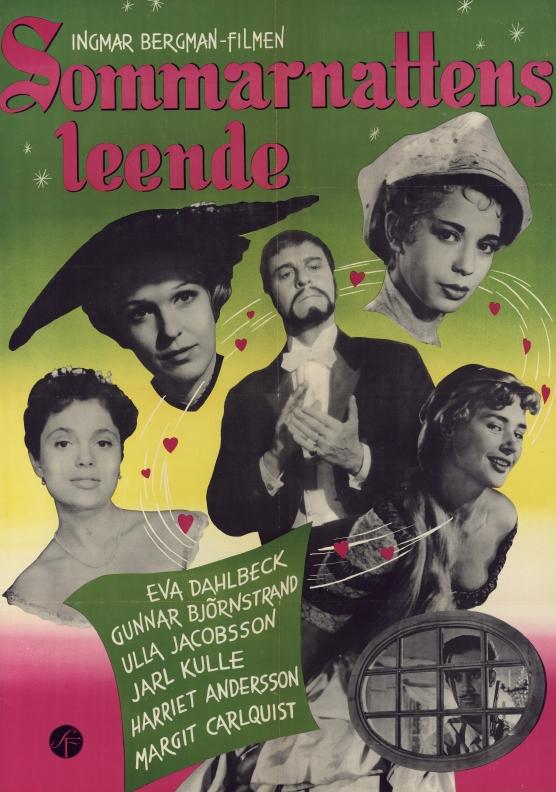
Smiles of a Summer Night (1955)

Smiles of a Summer Night (1955)

Sexual and romantic comeuppances abound in Bergman’s landmark comedy of manners

Director: Ingmar Bergman

Cast: Eva Dahlbeck (Desirée Armfeldt), Gunnar Björnstrand (Fredrik Egerman), Ulla Jacobsson (Anne Egerman), Björn Bjelfvenstam (Henrik Egerman), Harriet Andersson (Petra), Margit Carlqvist (Countess Charlotte Malcolm), Jarl Kulle (Count Carl-Magnus Malcolm), Åke Fridell (Frid), Naima Wifstrand (Mrs. Armfeldt), Jullan Kindahl (Beata), Gull Natorp (Malla), Gunnar Nielsen (Niklas), Birgitta Valberg (Actress), Bibi Andersson (Actress)

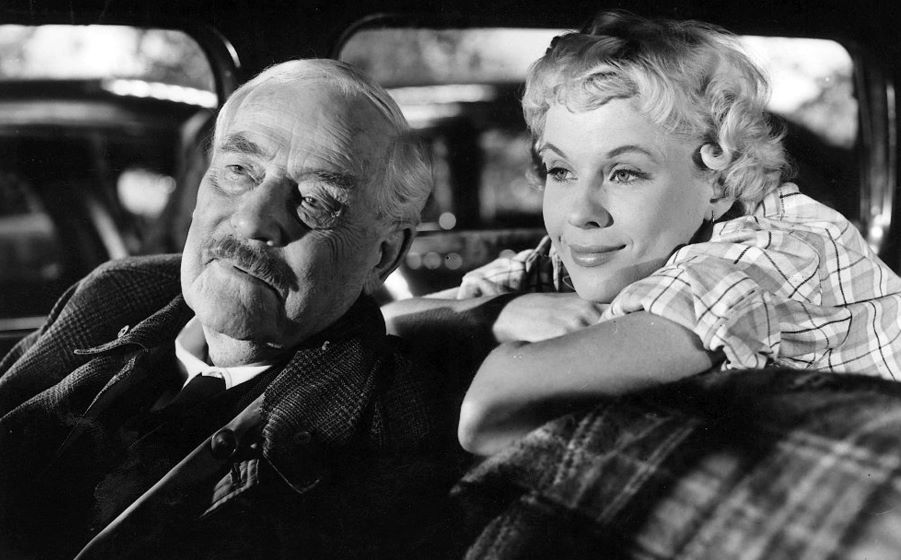
An Ingmar Bergman comedy? Surely a contradiction in terms, right? Like Da Vinci spraypainting graffiti or Austen writing a jingle. The Swedish master is near synonymous with glacial, Scandi-misery, not material that will be transformed into a Sondheim musical. But yet: Smiles of a Summer Night was the big smash-hit that guaranteed Bergman lifetime artistic independence (he followed it with the one-two punch of The Seventh Seal and Wild Strawberries that made him untouchable as Sweden’s premiere Artist). A Bergman comedy was never going to be a Ray Cooney farce, and while there are pratfalls and farce here, this film is an exploration of manners with more than hint of Shaw and Wilde, mixed with echoes of filmic greats like Ophüls and Renoir.

Set in turn-of-the-last-century Sweden, the film follows the romantic and sexual entanglements of a series of would-be couples. Fredrik Egerman (Gunnar Björnstrand) is a respected middle-aged solicitor, who hasn’t consummated his two-year marriage with 19-year old Anne (Ulla Jacobssen). This is partly due to her anxiety about sex. But really both of them are in love with someone else. Fredrik with his old mistress, celebrated actress Desirée Armfeldt (Eva Dahlbeck). Anne with Fredrik’s young son Henrik (Björn Bjelfvenstam) who is also in love with her. Henrik is flirting with house maid Petra (Harriet Andersson), who doesn’t seem averse to a relationship with any member of the Egerman family. Desirée is having an affair with Count Malcolm (Jarl Kulle), whose wife Charlotte (Margit Carlqvist) is considering infidelities of her own just to get his attention.

All of these potential couples merge, swop and work out their feelings overnight at the country house of Desirée’s mother (Naima Wifstrand) during one of the longest days of the year, where the sun hardly sets and people traditionally stay up until dawn. There is more than a touch of the theatrical about all of this – particularly with Bergman’s arch, intelligent dialogue – with the country house as a setting beautifully formal and strangely other-wordly. You can sense the theatrical influences here – Bergman had just directed a production of The Merry Widow – with the characters riffing with Wildean wit and insight, in typically Shavian set-ups.

What we get is a high comedy of manners, that’s also coated in a rich, insightful poetry that gives it a great deal of meaning. There is farce here – including a room with a switch that drags a bed from a neighbouring room (with occupant!) into it. There are several funny lines – many from Jarl Kulle’s hilarious heartless count, who doesn’t care who flirts with his wife until someone actually takes him at his word. There are pratfalls – Henrik has a superbly bleak bit of pure farce near the end that tips into erotic joy (“If the world is full of sin, then I want to sin”). The pompous Fredrik is constantly humiliated, from falling in a puddle to being thrown out of Desirée’s apartment in nothing but a borrowed nightshirt and a pair of slippers. There is no end of sexual suggestiveness, from Harriet Andersson’s gorgeously flirtatious maid (“Hurrah for vice!”) to hints about Mrs Armfeldt’s past (“I was given this estate for promising not to write my memoirs”).

Being Bergman though, this is the sort of romantic comedy that ends with a duelling game of Russian roulette and where we learn as much about human nature as we enjoy the scripted bon mots. Namely, that people – especially men – never seem to know what they want. Fredrik spends a huge chunk of the film persuading himself he is deeply in lust with Anne – although its pretty clear that he’s barely interested. Marriage and relationships in this case are gilded cages that lock people into things they barely want. They don’t even lend themselves to communication – the Malcolm’s marriage doesn’t seem to be based on any communication at all.

So, no wonder it needs a bit of Midsummer Night’s Dream style madness to try and sort it all out. Before that short night, the characters all down a particularly intoxicating wine that they are warned will bring down all their restraining impulses (whether that’s true or not, it certainly does). It’s part of a plot by Desirée – a superb Eva Dahlbeck, serene and glamourous, but also a battle-axe force-of-nature who knows exactly what she wants and how to get it – to resolve all complications for the (her) best, carried out in partnership with Caroline, a woman she’s far to savvy to let something petty like sleeping with her husband get in the way of useful friendship.

Contrasted with all these slightly restrained middle-class people who struggle to understand or express their real feelings, or (like the Egermans) seem to feel a slight guilt at sex anyway, we have the more earthy and free Petra, radiantly played by Harriet Andersson. Andersson gives Petra a flirtatiousness that sees her go from unbuttoning her top to attempt to seduce Henrik, to rolling in a bed with Anna. While the upper classes engage in a formal dance, she seizes life and opportunities – and ends up well-matched with the equally down-to-earth chauffeur Frid (an exuberant Åke Fridell), who like her doesn’t muck around when there is a chance to grab a bit of joy.

Not like the Egermans. Fredrik – a beautifully reserved Gunnar Björnstrand – should want Anna, but all the starring at her photos in the world won’t stop him muttering Desirée’s name while he sleeps. Not that it will allow him to try and rekindle his past relationship with her. Anna (a luminous Ulla Jacobsson), nervous about sex or rather nervous about her feelings with Hendrik, channels her feelings into jealous criticisms of his clothing after catching him naively succumbing to Petra’s flirting. Henrik (Björn Bjelfvenstam, very funny in his bemused wetness) is so inept in his romance of either woman, he barely seems to know what he wants.

Perhaps Desirée recognises all this is a bit of prime, Theatrical nonsense and tries to solve it all accordingly. After all her whole life is the theatre – from treading the boards, to singing and dancing while walking late at night with Fredrik. And it was for Bergman – that and film, which is why perhaps the film has echoes of Jean Renoir’s Le Regle de Jue with its country house romantic intrigues and Max Ophüls partner swopping La Ronde. And Smiles of a Summer Night is a beautifully mounted film, shot with a luscious, poetic beauty by Gunnar Fischer.

The whole film is a complex dance – you can see why it was ripe for Sondheim – that also explores profoundly the romantic and gender clashes between men and women. Men who are in a position to take what they want, but have no idea what that is. Women who know far more, but must be smart about how to achieve their goal – or like Petra willing to embrace a wild abandon to live in the moment. It may be a theatrical, drawing-room, sex comedy of sorts: but it’s also a film about humanity and people’s fates, all under the eyes the suggestively supernatural power of a smiling summer night. Perhaps its not such a contradiction of Bergman terms after all.

Calm with Horses (2020)

Calm with Horses (2020)

Irish gangsters manipulate a violent but needy boxer in this well-made debut

Director: Nick Rowland

Cast: Cosmo Jarvis (Arm), Barry Keoghan (Dymphna), Niamh Algar (Ursula), Ned Dennehy (Paudi), Kiljan Moroney (Jack), David Wilmot (Hector), Anthony Welsh (Rob), Simone Kirby (Jules)

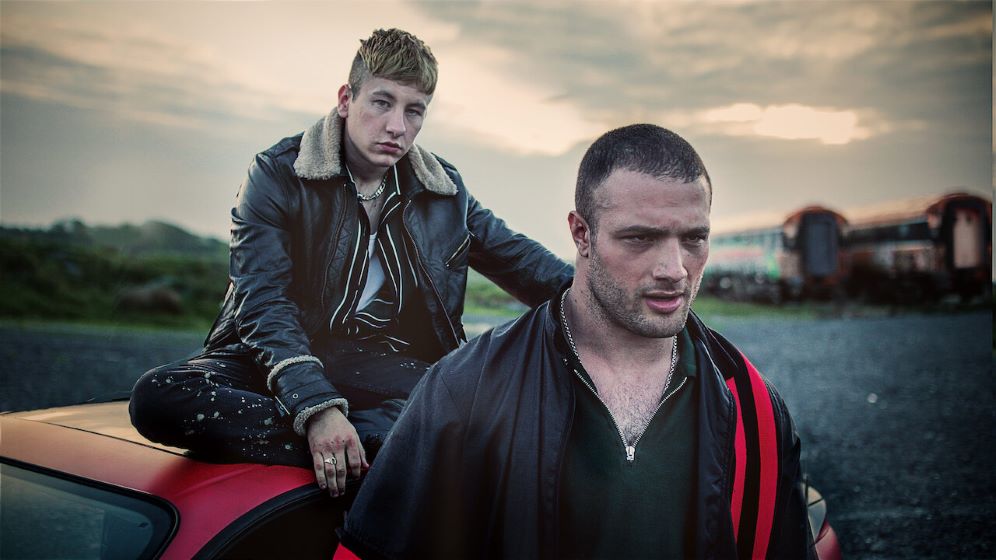
In rural Ireland a former boxer, Arm (Cosmo Jarvis), has found a new outlet for violence as an gang enforcer. But Arm is, at heart, a gentle soul, and his desire to belong and be part of a “family” is effectively exploited by the gang, especially his weaselly, bullying boss Dymphana (Barry Keoghan) who treats him like an affectionate pet-dog. His ex, Ursula (Niamh Algar), mother to his autistic son Jack, wants him to change his ways or stay out of their lives. But can Arm change?

Rowland’s film has a deliberately seedy quality to it, shot with a grimy intensity and crawling along on its belly among the mud and filth of Irish crime gangs. It’s a thrilling expose though of how crime takes and takes and is never satisfied. It’s turned Arm into a shell, throwing him the odd bone of inclusive comfort, then ordering him out like a rabid dog to hand out another beating to anyone who has crossed the family.

The main target is a man the heads of the family suspect of raping their teenage niece – although whether this was genuine sexual assault or simply a question of perverse family pride is left open. Arm opens the film by handing out a vicious beating – albeit one where he carefully lays out the ground rules with his victim before going about it with a punch-clock sense of duty. It’s what Arm is used for – a not that bright, piece of muscle who, despite his intimidating presence, will do (almost) anything for anyone who makes him feel wanted.

Even if the main person who does is as a dastardly as Dymphana. Keoghan is very good as a snide, insidious small-time crook, who openly calls Arm his dog and fills his head with prejudices and suspicions designed to keep him in his place. If he’s the dark angel, then Ursula is the good one: Algar equally brilliant as a decent, kind, supportive person who has come to the end of her tether with a man who she now feels is a danger to the fragile temperament of her autistic son.

It’s the fate of this son that will penetrate through the dead exterior shell that surrounds Arm, and make him start to question his own life. There is more than a hint that the fragile, timid, surly Arm – beautifully played, with a haunting gentleness under the violent exterior by Cosmo Jarvis – suffers from a similar condition to his son. Like him, he finds rage he can’t control bubbling up inside him (Arm is hopelessly ill prepared for helping his son during Jack’s emotional outbursts). He at times lacks an emotional intelligence to understand how people are treating him and why. It’s something Ursula knows and recognises – and why she gives him as many chances as she does.

Like his son, Arm finds himself calmed by engagement with animals (the title comes from Jack’s therapy sessions, horse riding). He also, buried somewhere in him, has a strong sense of right and wrong and eventually finds the courage to question his orders, as he begins to understand he really belongs not with them but with his ‘true’ family. His motivations shift from simply pleasing his masters to finding the money Ursula needs to move to Cork and place Jack in a special-needs-school, a need for his son that he slowly learns to place above his own wants and desires.

Eventually this explodes into scenes of retributive violence, shot by Rowland with an immersive intensity (there are some particularly uniquely filmed country-lane car-chase scenes, with the camera mounted on the car at an unusual angle). The violence that has lurked only just beneath the surface of the crime family, bubbles savagely to the top as it’s made clear that even the slightest deviation from what the family wants or expects from its enforcer will never be tolerated.

At times, Calm with Horses is a little too reminiscent of other crime dramas: for all its intelligent and skilful construction and playing, there isn’t a lot that feels really original here. Its influences are plain, but what it has is an intelligent empathy for its characters, and their situations, that constantly rewards you. At times, these characters surprise you with how far they will go: at others they disappoint you with their selfishness. But, thanks to the acting and direction, they always feel real.

Calm with Horses is an impressive debut, confident and exciting. Jarvis is superb as an inarticulate, unaware gentle-ish giant, with Keoghan and Algar outstanding in support (both were BAFTA nominated). It’s grimy, matching the dangerous world its set in, but it also has flashes of hope and understanding in it, little moments of calmness that pepper the darkness. It’s a fine crime drama.

Kramer vs Kramer (1979)

Kramer vs Kramer (1979)

Father and son post divorce are explored in this Best Picture winning look at the state of marriage in the 1970s
Director: Robert BentonCast: Dustin Hoffman (Ted Kramer), Meryl Streep (Joanna Kramer), Justin Henry (Billy Kramer), Jane Alexander (Margaret Phelps), Howard Duff (John Shaunessy), George Coe (Jim O’Connor), JoBeth Williams (Phyllis Bernard), Howland Chamberlain (Judge Chamberlain)

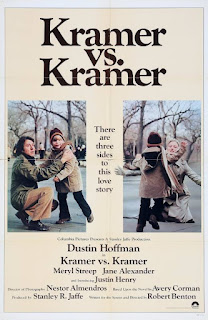
Kramer vs Kramer is a near perfect example of how time changes the perception of a film. On its release, it was the smash-hit of the year, scooping five Oscars. It took a sympathetic look at divorce and explored the then unthinkable idea that a single father could find fulfilment in taking on the woman’s role of caring for a child. Today, it’s more likely to be seen as a thinly veiled attack on feminism and a promotional video for Fathers4Justice. But a film can be a warm celebration of a father building a relationship with his child and an implicit criticism of women who want it all.

The film opens with Joanna Kramer (Meryl Streep) tucking her 7-year-old son Billy (Justin Henry) into bed, telling him she loves him, and then walking out of her New York apartment for good. She tells husband Ted (Dustin Hoffman) – a workaholic advertising executive – she is deeply depressed and has to find what she wants from her life. Ted, a loving but distracted father, has no idea either how to raise his son or run a household. At first, he resents Billy for distracting him from his career, just as Billy resents him for being unable to care for him as Joanna could. Eventually though, Ted and Billy build a loving relationship, with Ted placing Billy’s needs first. At which point Joanna returns and demands custody, a clash that will lead to the courts.

Benton’s film, adapted from a successful novel, is shot with a chamber-piece richness by Nestor Almendros and signposts its art-house credentials with a Vivaldi string score. It’s superbly acted. Hoffman (winning for Best Actor) is hugely committed, running a gamut of emotions from anger and despair to a joyful devotion for his son. Streep won Best Supporting Actress as the deeply-torn and conflicted Joanna. Hoffman and Benton draw superbly natural work from Justin Henry as Billy, an unaffected, completely unmannered performance. Benton marshals these three actors through a series of simply shot but often surprisingly affecting scenes, alternating between raw hurt, anger and tender forgiveness.

But this is a film that needs a sister film. Specifically, one that shows events from Joanna’s perspective. Although the film – at Streep’s insistence – tries to avoid demonising her feminist desire for more in her life than cooking and cleaning, it still gives short shrift to her departure. With the film’s focus on the heart-warming relationship between father and son, it’s very hard not to implicitly see Joanna as first a selfish abandoner and then a hypocritical antagonist trying to steal Billy. There is little attempt to not stigmatise Joanna as, on some level, a bad parent.

For all the film opens with a long hard look at Joanna’s face, struggling with the conflict between her depression and leaving her beloved son, there is no real effort to explain or understand what motivates Joanna to do the things she does. There are some half-hearted justifications very late in the film, during its courtroom sequences – but these only dip lightly into any turmoil Joanna must have been feeling. Worst of all, it’s all presented as something Ted has to learn to “forgive” rather than understanding it was a crisis he played a role in causing.

The film’s main focus is on Ted learning to become a father. Ted is a classic workaholic dad of the 1970s. He stays late at the office boozing with his boss, has literally no idea about Billy’s everyday schedule and is so inept at home that cooking French toast is completely beyond him. He has no idea about how to enforce rules with Billy, alternating between showering him with ice cream to keep him quiet and then vainly trying to re-enforce rules. (In a great scene, Billy slowly and deliberately sees how far he can push these rules as he first refuses dinner, fetches ice cream from the freezer and then starts eating it, all while Ted lamely states “Don’t you dare do that” – it ends of course with mutual screams of “I hate you”.)

What Ted does is learn to become a parent. Or rather, learn how to become a 1970s mother – since it’s a joke made time again that he is the only man dropping his son off at school, taking him to the park or attending his school play. Benton’s film takes some decent pot shots at the poisonous masculine world of work, as Ted eventually loses his job for letting his single-minded focus shift towards his son – his boss offers no sympathy at all for a man whose mistakes are due to his distraction by “woman’s work”. And the Ted at the start of the film would have agreed.

The relationship between Hoffman and Henry is beautifully played, a gently paced but very naturally flourishing of love and acceptance between two people who have had their lives shattered in different ways. The Ted we met at the start could never have run several blocks to the emergency ward, carrying an injured Billy (shot with a one-take urgency by Benton) – and then point-blank refused the doctor’s suggestion he needn’t bother staying with his son while the wound is stitched up. That Ted wouldn’t have taught Billy to ride a bike or helped him learn his lines for the Halloween play. For all its dated attitudes at times, the film deserves praise for the way it stressed that men could – and should – be this involved in the lives of their children.

It should be noted that Hoffman, at the height of his method dickishness, smashed a glass in this scene without warning Streep he was going to do it – her shock was real. Hoffman also made Henry cry for camera at one point by telling him, when filming was done, he would never see any of his new ‘friends’ on the set again. You see now why he was perfect for Tootsie?

But it’s not perfect. The final act, with the return of Joanna, sees both parents gearing up for a paternity battle– and having watched Ted and Billy spend nearly an hour and 20 minutes build a heart-warming relationship, we know where our sympathies lie. Even at the time, lawyers denounced the viciousness and one-sided result of this court case, which seems inexplicable given these two parents live only a short-distance apart with similar salaries. Not that it matters as the film ends with a puff-piece Hollywood fiction moment, as Joanna bravely sacrifices her custody because she recognises she can’t take Billy from his home.

Of course, what the film doesn’t do is acknowledge that Joanna spent essentially seven years doing the sort of all-consuming parenting Ted has only just discovered in the last 18 months. Neither does it do much to avoid suggesting Ted taking these tasks on is an astonishing act of character, just as Joanna abandoning them is an act of calculated selfishness. That’s not to attack the obvious love Ted discovers for his son. He even – eventually – confesses to his son that Joanna’s leaving was his fault for taking her for granted. But the film is so taken-up with the (admittedly beautifully done) relationship between father and son, that it neglects any exploration of the wife and mother beyond her (twice) being a cataclysmic event in their lives.

But it’s a film of its time. And in trying to at least show a divorce where no one was too much at fault and stressing a father could be as much of a parent as a mother, it was trying to do a good thing – even if it sometimes looks like an elderly relative who clumsily says something offensive while trying hard to be open-minded. The three leads are superb and the film has some genuinely heart-warming moments. It looks more and more flawed at times today, but this was trying to do something very daring. And nothing dates worse than daring.

The Diary of Anne Frank (1959)

The Diary of Anne Frank (1959)

Reverent adaptation of the most famous diary ever written, that drains it of any sense of life or drama

Director: George Stevens

Cast: Millie Perkins (Anne Frank), Joseph Schildkaut (Otto Frank), Shelley Winters (Petronella Van Daan), Richard Beymer (Peter Van Daan), Gusti Huber (Edith Frank), Lou Jacobi (Hans Van Daan), Diane Baker (Margot Frank), Ed Wynn (Albert Dussell), Douglas Spencer (Kraler), Dodie Heath (Miep Gies)

Few personal stories have had such a huge impact on so many people’s lives than Anne Frank’s diary. This literary marvel, written by a teenager who mixed profound insight with teenage obsessions, was a world-wide sensation when it was published after the war. The diary covers the over two years Anne, her family and their friends spent in hiding in a secret annexe in her father’s warehouse in Amsterdam. For Jews hiding from the barbaric persecution of the Nazi occupying forces, every day was a struggle between trying to lead as normal a life as possible and the terror of discovery and deportation to a concentration camp. Of course, we know, tragically, they were discovered – and only Anne’s father Otto survived the war.

Otto discovered the diary when he returned to Amsterdam after the liberation of Auschwitz. Moved by the diary’s mix of maturity and youth, Otto had it published first for friends and then more widely. At various points, parts of the diary were edited to remove more “personal” content (Anne wrote freely at points on her growing sexuality and was sometimes less than kind to the other occupants of the annexe). More modern editions have embraced a less edited, fuller diary that really allows us to see what a brilliant, challenging, sometimes judgemental, fully rounded teenager Anne was. The Diary of Anne Frank hails from an era that framed a more sanitised diary. The worst you can say for it is that I think there is a good chance the real Anne Frank would have found it a bit dull.

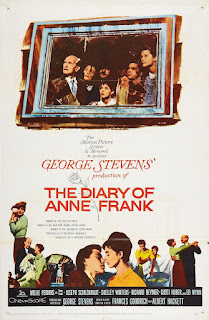
Adapted from a Pulitzer Prize winning play by Frances Goodrich and Albert Hackett, George Steven’s film is reverent, noble and very worthy. It also frequently lacks any pace or life, and is so concerned with being life-affirming that it filters out nearly all sense of tension or conflict that these eight people felt (which they often did living, as they did, in a few small rooms for over two years, with very little food). The film also centres a romantic relationship between Anne and Peter – one that, according to Anne’s own diary, was already coming to an end at their discovery (in reality, she felt they had little in common other than living in the annexe together).

But Stevens’ film is so concerned with framing someone as fascinating as Anne as a secular saint that it removes much of the vibrancy that gives the diary such impact. It also doesn’t help that Stevens shoots the film in a luscious black-and-white, in detailed sets – but also in the widest possible cinemascope. This does allow for some lovely shots – an image of Anne and Peter kissing in a monochrome shadow, before a door opens to bathe them in light is striking – but it sacrifices the most essential fact of the setting: its cramped smallness.

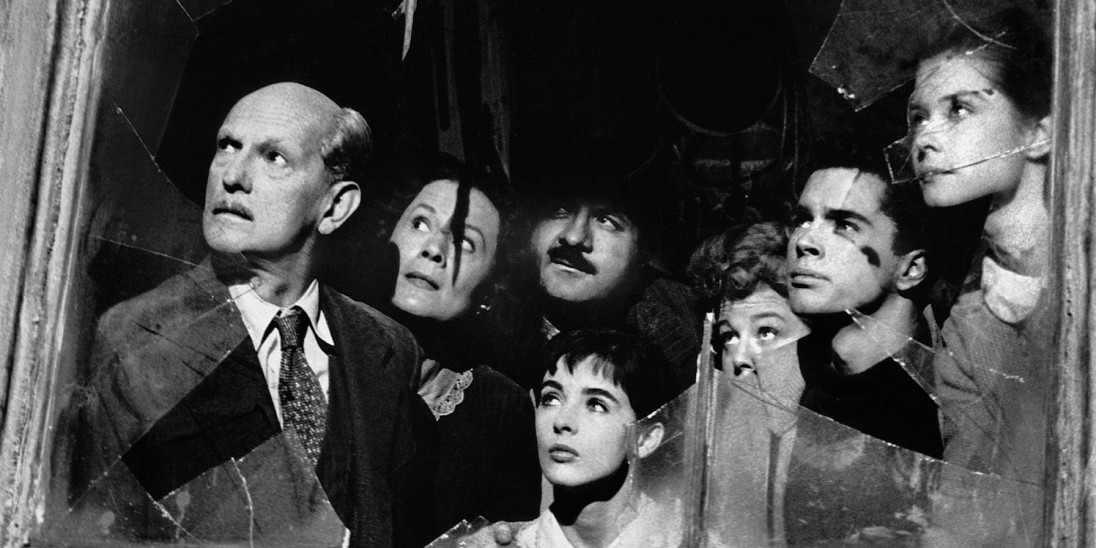
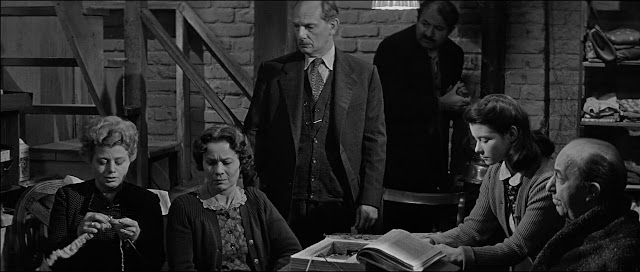
The widescreen frequently makes the annexe seem larger than it is

Who decided that a location defined by its claustrophobia and smallness was best captured in super-widescreen, I don’t know. But the wide angles make the annexe look a heck of a lot larger than it actually is (I’ve been there, I know it was more cramped than this!) and Stevens frequently frames the whole cast in shots which makes the annexe look positively cavernous.

The lack of claustrophobia has a serious impact on the story’s sense of drama. It also helps to filter out the tension. The script removes, or minimises, most of the key personal tensions in the annexe. We have moments of disagreement, but generally the inhabitants are shown to get on extremely well, with Anne herself practically perfect. This doesn’t really square with the diary, which is pretty open in Anne’s difficult relationship with her mother (with whom she felt no affinity), the clashes with the Van Daans and Mr Dussell (not their real names – Dussell basically translates as idiot, which gives a better impression of Anne’s difficult relationship with this unwanted roommate) or her later arguments with her father. Instead, things are smoothed out and nothing that could detract for a moment from the optimistic and hopeful message of the film is allowed.

The film also replicates several changes that the play made for dramatic effect. This most especially affects the character of Dussell (real name Fritz Pfeffer). In real life a respected dentist and pillar of the Jewish community, Dussell/Pfeffer here is a complacent, panicking imbecile, utterly ignorant of the Jewish faith and claims to have lived his whole life in Amsterdam with no idea he was a Jew. The real-life Pfeffer had in fact fled Germany to escape Nazi persecution. Played with a self-satisfied whininess by Ed Wynn (a famous TV comic, Oscar-nominated here for showing he could do drama), Dussell/Pfeffer is a joke. Pfeffer’s family cut ties with the Franks after the play was released.

Wynn’s nomination reflects how the broader performances in this film gained the most attention. Shelley Winters won an Oscar for her role as the blowsy Mrs van Daan – both van Daans are larger-than-life and obsessed with their status. More restrained and effective performances come from Gusti Huber as Anne’s shy and nervous mother and above all by Joseph Schildkraut as her wisely patient father. Richard Beymer gives an effective performance as a young Peter, straining against the leash of being stuck in a sort of suspended childhood.

As Anne, Millie Perkins looks the part in many ways – apart from the fact she is clearly too old. But there is something a little neutered and frankly a little too perfect about her performance. Her voice has a flat American twang to it that makes much of her voiceover a little wearing to listen to, especially as the tweeness is dialled up. I’m not sure she has the presence for the role – although she is not helped by the sanitised, earnest script.

Criticising The Diary of Anne Frank feels almost sacrilegious, like criticising the lives of the real people who went through something unimaginable to try and survive in a world of horror. But Stevens’ film is straining so hard to be reverent – and shaves the edges of its characters so much – that it turns them and their story into something much more easily digestible than it should be. It becomes a feelgood story, rather than something vibrant and alive. And that vibrancy is what has made Anne Frank live for so long after her murder. To create a film that captures so little of that, instead turning her into a conventional romantic heroine, just feels like it misses what made her unique.

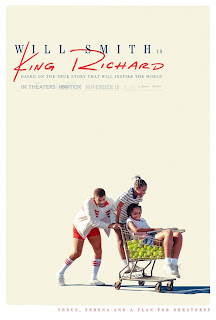
King Richard (2021)

King Richard (2021)

Richard Williams creates two of the greatest tennis stars ever in this easy-viewing star vehicle

Director: Reinaldo Marcus Green

Cast: Will Smith (Richard Williams), Aunjanue Ellis-Taylor (Oracene “Brandy” Price), Saniyya Sidney (Venus Williams), Demi Singleton (Serena Williams), Jon Bernthal (Rick Macci), Tony Goldwyn (Paul Cohen), Mikayla LaShae Bartholomew (Tunde Price), Danielle Lawson (Isha Price), Layla Crawford (Lyndrea Price)

Sports movies have a very reliable formula. There’s the initial promise, early success, adversity, obstacles, a moment of doubt, a renewal of commitment and a final success. I think it’s fair to say that King Richard pretty much hits all the beats you expect. In fact, its pretty much exactly the film you expect it to be when it starts and doubles down hard on the charisma and charm of its star.

King Richard tells the story of how the Williams Sisters, Venus (Saniyya Sidney) and Serena (Demi Singleton), took their very first steps towards dominating the world of tennis, as told through the eyes of their father Richard (Will Smith). Richard Williams had been determined from almost the moment his children were born, that he would never stop working (and push them) to build lives that would take them away from the working-class ghetto he grew up in. Teaching himself tennis coaching, from the moment they can hold a racket the girls are coached. But, being working class and black in a white-middle-class sport, Richard must work night-and-day to win professional coaching and playing opportunities for his daughters. Not to mention, struggling to ensure that they don’t forget their roots or get chewed up and spat out by the sport.

First and foremost, King Richard is a showpiece for Will Smith. The part fits him like a glove: Williams a larger-than-life, force-of-“Will” role that feels about 2/3rds Williams and 1/3rd Smith. With Williams fast-talking patter, never-give-up determination and absolute commitment to protecting his loved ones, the role plays to all Smith’s strengths. Smith gives a quintessential movie-star performance, which to-be-honest often feels like a Will Smith personality role (the modern equivalent of a Cary Grant performance), but is very entertaining because few people are as good at crafting their personae to benefit a movie as Smith is. Smith is heartfelt, earnest, loveable, sometimes slapable (Note: I wrote that before Smith’s slap-heard-around-the-world was forever attached to his Oscar-winning performance), but always a charming guy you root for.

Which is odd, as Richard Williams is a man with a mixed reputation. He was a demanding, argumentative, often controlling presence who irritated and alienated far more people on the tour than he befriended. Some saw him as a self-promoter, others as a man at times causing problems for his daughter’s careers. King Richard doesn’t shy away from showing these qualities – the awkwardness, the temper, the selfishness, the arrogance – but presents them all in the best possible light. The film is purest hagiography and Richard Williams is always vindicated in all his calls.

Awkwardly the film is also determined to give him all the credit for the Williams’ sisters success. Now there is merit in this – and the script was developed with the sister’s input, so it feels a bit presumptuous to get angry on their behalf. The sisters would never have become what they are if their father had not put rackets in their hands so young and invested hours in training them. Similarly, they would not have been as fully-rounded people without his constant mantra about family, humility and hard work. But also, they did have quite a bit of talent themselves – and certainly they profited from lessons they picked up from the other coaches they worked with.

However, one of the points King Richard is gently making – and it is gently made, as if the film was worried its crowd-pleasing potential might have been affected if it banged this drum too hard – is that Williams had to be a domineering figure because he was fighting against a racial divide in the sport. He feels out of place in the tennis country clubs because he is. No one else on the junior tour is anything other than white and well off. Every coach and trainer is applying methods that have worked for affluent middle-class athletes, without considering any adjustment might be needed for two young women coming from a totally different background.

You can argue the hagiography is partially a course correction from years of the only black father and coach on the tour being denounced as uppity, loud-mouthed, self-obsessed and intrusive. Its still made clear he shares these traits with many other tour parents, but adding to it a massive dose of supportive parenting. There are moments when the film addresses how Williams’ obsession that he knows best might just be starting to run the risk of alienating his daughters: in particular Aunjanue Ellis-Taylor delivers a blistering late speech (which probably got her an Oscar nomination by itself, so compellingly is it performed) where she lays out in no-uncertain-terms Williams many character flaws and damaging behaviours. (Coincidentally the film’s most compelling dramatic scene).

Maybe a bit of hagiography is what we need from a film designed to be an uplifting, triumph against the odds and celebration of one man’s fatherly love and devotion to give his daughters a chance to change their stars. The film is professionally directed by Green and some of the titbits of the sisters early training (throwing American footballs to build service strength among others) is fascinating.

The film is probably at least twenty minutes too long and starts at some points to repeat the same beats again and again. It doesn’t really do anything new and is exactly the sort of film you could predict it being. But it has some good performances, Smith is at the top of his (Oscar-winning) game, and it is an enjoyable, if predictable, feel-good watch.

Almost Famous (2000)

Almost Famous (2000)

Cameron Crowe turns his youth into a hip coming-of-age film with just enough sting among the sentiment

Director: Cameron Crowe

Cast: Patrick Fugit (William Miller), Billy Crudup (Russell Hammond), Frances McDormand (Elaine Miller), Kate Hudson (Penny Lane), Jason Lee (Jeff Bebe), Zooey Deschanel (Anita Miller), Anna Paquin (Polexia Aphodisia), Fairuza Balk (Sapphire), Noah Taylor (Dick Roswell), Philip Seymour Hoffman (Lester Bangs), Terry Chen (Ben Fong-Torres), Jay Baruchel (Vic Munoz), Jimmy Fallon (Dennis Hope), Rainn Wilson (David Felton)

Cameron Crowe fictionalises his teenage years in the warm, affectionate Almost Famous, an endearing, heartfelt riff on the golden years of Rock ‘n’ Roll, when it felt like music could change the world and making the front cover of Rolling Stone was the greatest thing ever. Patrick Fugit plays William Miller (the Crowe substitute), a precocious 15-year-old would-be-music journalist recruited by Rolling Stone to write an article on Stillwater, an up-and-coming new band. Miller adores the music scene and is soon smitten with the lifestyle, Stillwater’s charismatic guitarist Russell Hammond (Billy Crudup) and most of all “Band Aid” (muse not groupie) Penny Lane (Kate Hudson).

Crowe’s film is a glorious reconstruction of the rock and roll scene of the early 70s – and I can imagine anyone with fond memories of it will find much to love here. It’s not just the fashions and hairstyles, but the glorious capturing of a mood. The whole film is a celebration of a time that felt freer and more idealistic, where the actions and words of a rock band could feel like the most important, beautiful thing in the world. The film is not just nostalgia but also a celebration of a mood of hopefulness that embodied an era.

It’s also a coming-of-age story, as a boy-becomes-a-man. Patrick Fugit is very endearing as a kid no one can quite believe is 15, even though every moment seems to hammer home his fresh-faced innocence. But then it’s not a complete surprise since, thanks to his strong-willed mother having moved him up a class at school and led him to believe he is older than he is. Nevertheless, this is the sort of trip that shapes someone, finding friendship, love, belonging, betrayal, righteous anger and acceptance along the way. All of this is backdropped by the shift of rock and roll becoming something corporations used to make a lot of money.

Stillwater are just on the cusp of this, still clinging to the fun of bussing from gig-to-gig, enjoying the mood, the songs and (of course) the girls. The film is also a celebration in a way of their coming-of-age, the tour starting in a ramshackle bus and ending on a sleek private jet, with accommodation switching from the bus to plush hotels. And along the way, they are trying to work out what they hell they are doing as much as William is. Perhaps that’s why the film feels like it captures the era so well – wasn’t everyone flailing around in the 70s trying to work out if they belonged to the hedonism of the 60s or what would become the Reagonism of the 80s?

But it’s still rock ‘n’ roll, best embodied by Billy Crudup’s charismatic turn as Band icon Russell Hammond. Crudup is all grungy magnetism and shuffling emotional gentleness under the surface of rock star swagger. Not that it stops him from moments of egotism, selfishness and pomposity. You can see why tensions are sometimes high in the band, with the rest of its members often seen as jut Russell’s support group (a band t-shirt causes fury when it shows Russell in the foreground with the other four as shadowy outlines behind him). Russell takes William under his wing, perhaps because he recognises the youth and fragility in William. Or maybe he just likes the hero-worship.

Because one of the dangers of getting close to these stars is getting sucked into hero worship. William is after all a journalist who needs to maintain objectivity. He’s even warned about it by his mentor, fabled music writer Lester Bangs (Philip Seymour Hoffman in a charismatic cameo) that the biggest danger is succumbing to the charms of the celebrity: these are after all, people who have made it their mission in life to be liked. They’re going to be good at it.

Getting in their airspace can be a dangerous place, as discovered by leading Band Aid Penny Lane, played with a luminous, radiant warmth by Kate Hudson. Penny is a devoted fan, enraptured with being part of the scene and with her self-proclaimed role as muse to the artists. Based on a personal friend of Crowe’s – and, one supposes, his real-life first love – it’s Penny who draws William into this life, looks out for him, cares for him (a favour he is to return in kind). She starts an affair with Russell – but is banished when Russell’s girlfriend rejoins the tour, jokingly traded in a card game with another band for a crate of beer (a reveal Hudson plays with a beautiful mix of devastation and valiant nonchalance). It’s not that Russell’s a bad guy, more that he can’t cope with complexities.

So, you can see why William’s Mum – played with a larger-than-life mix of bullish determination, smothering love and control-freak determination by Frances McDormand – is so worried about him. It’s a sign of the film’s overall warmth (and Crowe’s well-adjusted personality!) that McDormand’s character is treated with the same affection and admiration as everyone else and the love between mother and son is never in doubt. She is responsible for some of the film’s highlights, not least a phone call to Russell where her natural authority quickly reduces him to the overgrown schoolboy he is at heart.

And Almost Famous is a very funny film, riffing off various true life rock-and-roll road trip stories, from raucous parties to accidental electrocutions, like a slightly straighter version of Spinal Tap. It’s capped by a hilarious near-disaster plane flight, where the end seems in sight, leading to a series of ‘confessions’ that become more and more heated and factious as they go on. It’s a film that shows some of the warts of the characters – just as William’s article eventually will for Stillwater – but also their many, many beauty spots. People make mistakes and hurt each other, but life goes on – and we take the punches, but they don’t define us.

Perhaps that’s a big part of growing up: and it’s a growing-of-age film for three characters: William, Penny and Russell. All three of these characters find themselves drawn together, all of them spiritually so close. They hurt each other, betray each other, but they all love each other. It’s a hopeful message, a glorious celebration of a time and era.

The Turning Point (1977)

The Turning Point (1977)

Two women struggle to have it all in a film that wouldn’t have looked out of place in the 1940s

Director: Herbert Ross

Cast: Shirley MacLaine (DeeDee Rodgers), Anne Bancroft (Emma Jacklin), Tom Skerritt (Wayne Rodgers), Leslie Browne (Emilia Rodgers), Mikhail Baryshnikov (Yuri Kopeikine), Martha Scott (Adelaide), James Mitchell (Michael Cooke), Alexandra Danilova (Madame Dakharova), Anthony Zerbe (Joe “Rosie” Rosenberg), Lisa Lucas (Janina Rodgers), Antoinette Sibley (Sevilla Haslem)

The demands of ballet are unlike any other artform there is. Complete physical and emotional commitment is needed to master it – so that means you got to make choices. The Turning Point is all about those choices. You might even call them ‘turning points’. DeeDee (Shirley MacLaine) and Emma (Anne Bancroft) were two young ballerinas who took radically different paths: DeeDee had a child with fellow dancer Wayne (Tom Skerritt) and left the profession behind; Emma remained with the company to become its prima ballerina. Now DeeDee’s teenage daughter Emilia (Leslie Browne) has joined the company: will she become the new prima ballerina? Or will she decide to focus on a relationship with playboy dancer Yuri (Mikhail Baryshnikov)? Will Emma and DeeDee resolve the tensions between them – and the conflict from their shared parental interest in Emilia?

The Turning Point was a big hit in 1977. That, and the fact that it was about (and featured a lot of) an artform as graceful as ballet seems to have convinced the Academy it merited a haul of eleven Oscar nominations. Come awards night, the film set a record for most unsuccessful nominations, converting none of them into Oscars. Perhaps that’s because, on closer inspection, The Turning Point is a fairly run-of-the-mill soap opera, that mixes in various clichés from backstage, traditional ‘women’s pictures’ and family drama to come up with a plotline that’s eventually very familiar.

For all its positioning as a female-led drama, it essentially boils down to the same old patterns that for decades such films have circled. Turns out women can’t have it all: you can have that successful career, but forever sacrifice the joy of being a mother or you can settle down and have the family but face a life of career unfulfillment. Twas ever thus, ‘tis one or t’other. Essentially the film boils down into a soapy drama about resentments and illicit backstage affairs and little more than that. It doesn’t even really double down on the fun this sort of set-up could provide, instead framing the whole thing as a very serious drama.

But then, the film was an autobiographical affair for those involved. Emma is based on Nora Kaye, who was married to the director Herbert Ross. DeeDee is based on Kaye’s childhood friend Isabel Mirrow Brown, who made the exact same choice as DeeDee, marrying a fellow dancer (just like Tom Skerritt’s character). Her daughter (and Kaye’s goddaughter) was Leslie Browne, who here plays a fictionalised version of herself based on her own experience of starting her ballet career. Characters based on Jerome Robbins, Lucia Chase and other leading figures from ballet and theatre appear. Only Mikhail Baryshnikov’s Yuri is purely fictional (although the character has more than few similarities with Baryshnikov himself, being a Soviet defector).

It does give an additional layer of interest to the film. Ross also mixes in a host of extended ballet sequences which showcase actual professional ballet dancers, with snippets from Swan Lake, Cinderella and The Nutcracker among others. The dancing is breath-takingly good. Not least from Baryshnikov and Browne, who are given multiple opportunities to showcase their skills. Baryshnikov in particular is at the height of his powers, a graceful artiste who moves with an astonishing finesse. Both landed Oscar nominations, one suspects largely on the basis of their dancing.

The acting is left to MacLaine and Bancroft as the leading ladies. There is something a little perverse that MacLaine, the former dancer, doesn’t so much as trot a step, while Bancroft (totally unexperienced) struts parts of Anna Karenina. However, the two actresses rip into these thinly written parts, giving them a lot more force than the film deserves. MacLaine balances motherly pride with bubbling feelings of something uncomfortably close to envy for her daughter’s success, spending time in New York trying to recapture some of her past (including a brief fling with Anthony Zerbe’s lecherous choreographer). Bancroft balances coming to terms with the end of her career as a ballerina with a growing regret that she has been left without a family. She becomes increasingly close to Emilia, mentoring her, dressing her and coaching her through a performance after relationship problems lead to Emilia getting roundly pissed in a bar before the show.

Needless to say, this unspoken squabble for ownership over Emilia – not helped by Emilia’s fury over her mother’s infidelity – only exacerbates tensions between the two women. It builds towards the film’s true climax (but unfortunately not its actual climax, as fifteen minutes remain for Emilia to be coached for her star-making performance) as the two women down drinks and exchange angry words and slaps, leading to a full blown cat fight outside the theatre. The fight later descends into cathartic giggling – and pity the two actresses who filmed it in ballroom dresses in what looks like a gale – but is acted with a great deal of attack by both, who bounce off each other (literally) hugely effectively.

But the scene is also a further confirmation that what we are really watching is a sort of high-brow family soap, that uses ballet as a backdrop for family feuds, scuffles, sexual escapades and tear-filled reunions. And it boils down to that struggle between career and family, the sort of struggle Bette Davis and Joan Crawford films were dealing with in the 1940s. Which is possibly another reason so many took to The Turning Point: even in 1977 it was an old-fashioned piece of entertainment, that did very little new.

That carries across to its whole execution: Ross competently directs the film (this was his annus mirabilis as he directed two Best Picture nominees, this and The Goodbye Girl) but really it gets all the force it has (and more than it perhaps deserves) from the two leads and a fine supporting cast (Tom Skerritt is very good as DeeDee’s laid-back, understanding father who perhaps masks secrets of his own). It’s a soap opera, solid but not spectacular, that really outside its showcase of ballet, doesn’t stand out from several other films of the same genre.

The Sound of Music (1965)

The Sound of Music (1965)

It’s the classic, feel-good film that seems to divide people than few others

Director: Robert Wise

Cast: Julie Andrews (Maria von Trapp), Christopher Plummer (Captain van Trapp), Eleanor Parker (Baroness Elsa von Schraeder), Richard Haydn (Max Detweiler), Peggy Wood (Mother Abbess), Charmian Carr (Liesl), Nicholas Hammond (Friedrich), Heather Menzies (Louisa), Duane Chase (Kurt), Angela Cartwright (Brigitta), Debbie Turner (Marta), Kym Karath (Gretl), Daniel Truhitte (Rolfe)

Has there been any film in history that has aroused feelings as strong as this one? Busloads of tourists conduct pilgrimages to Salzburg to follow in its footsteps – it’s a bigger draw than Mozart. Sing-along performances are attended by people in costume who know every nuance of Do-Re-Mi. On the other side, those who loath this musical, do so with the burning heat of a thousand suns, practically cheering the Nazis on or choking back vomit at the opening note of Edelweiss. It was ever thus: The Sound of Music was slaughtered by critics – Pauline Kael called it “the sugar-coated lie people seem to want to eat” – but became a box-office phenomenon, one of the most popular films ever and gilded with Oscars aplenty.

It’s loosely based on the real-life experiences of the von Trapp family. Maria (Julie Andrews), a young novice, arrives at the home of the widowed Captain von Trapp (Christopher Plummer) to serve as nurse for his seven (count em!) children. Von Trapp runs his house (literally) with military precision, but Maria introduces some fun into the children’s life. And, to his surprise, the Captain’s life as he finds himself drawn towards the wholesome and sweet Maria instead of his initial intended, the Baroness von Schraeder (Eleanor Parker). Marriage is inevitable – but then the family finds itself in a terrible position as the Anschluss weds Austria to Germany and the Captain is ordered to take up office in the Nazi navy. Will he do so – or will the family escape over those hills?

You would probably be fair to call The Sound of Music one of the most manipulative films of all time. But then aren’t films supposed to be about manipulating our emotions for effect? On that score you could possibly call it the greatest film ever made. I won’t, but there is a sentimental, feel-good charm to The Sound of Music that – in small doses (and some people watch this multiple times a year – once every few years is surely enough!) – can really hit the spot in the way few other films can. Sure, it tugs on your heart strings with never a trace of subtlety, but basically it’s heart is very much in the right place. It’s a kind, gentle music that, for all its treacle, is a tribute to warmth, love and family. Perhaps that’s why it’s been so embraced by so many.

Even the cast were aware it could all tip over the edge into outright sentimentality. Julie Andrews was worried it might be a little too similar to Mary Poppins (she was right in a way – Poppins is a darker film, but the success of this cemented Andrews in people’s mind as the World’s nanny). Most famously Christopher Plummer overcame huge uncertainty to star, partly to practise his singing for a Broadway musical (as it happened he got dubbed), partly on the promise he could add a tougher edge (no sign that happened). Plummer’s hate-tolerate relationship with the film is famous (he called it The Sound of Mucus) and at several points in it he is all too obviously only just avoiding sinking his head into his hands, but he even he eventually acknowledged any film that moved people as much as this, must have done something very right indeed.

It’s that emotional investment people make in this film that lifts it eventually above criticism. It’s a long film, with a slender plot. But it mines this plot for every single touch of emotional investment. It’s the ultimate triumph of one of Hollywood’s most reliable middle-brow directors, Robert Wise. Taking over from William Wyler (who just couldn’t get interested and left to make the almost diametrically opposite The Collector), Wise successfully keeps the momentum flowing and shoots the film in an economical way that lets the songs do their work. He still finds room for classic shots: that helicopter shot sweeping into Julie Andrews running up the hills is just about perfect (Andrews was literally blown over every time by the helicopter, explaining the sudden jump cut edit for her famous twirl and burst into song). Wise’s editing skills really come into play with Do-Re-Mi that cuts the song across several locations and he makes excellent use of a number of Salzburg locations (for which the tourist board thanks him).

A major part of the film’s success though must surely be directly connected to Julie Andrews. This is a career – perhaps even a life – defining performance. And even the most cynical watcher can’t help but admit Andrews is a superb, gifted performer. Her singing is beautiful, and very, very few performers could have managed to make Maria charming, sweet and someone who want to hug, rather than twee or slappable. Andrews makes you really invest in every single event in the film: she’s hugely endearing (from singing in those hills, to her little stumble of excitement as she runs from the Abbey to take up a job at the von Trapps), she’s completely unaffected and when she’s hurt (by her seemingly hopeless love for the Captain) you just want to give her a hug.

No wonder the children love her. Who wouldn’t? Sure, the film’s weakest beat might well be its romance between Andrews and Plummer (for which Plummer is mostly to blame), but it captures a wonderful sense of family loyalty and protection. Everyone, at some point, is a sucker for stories where sad and lonely children are introduced to a life where they can mess around and have fun – and get that emotional investment the Captain has (accidentally) denied them. After spending the first two hours of the film getting to know this family and seeing it come together, we feel even more intently their fear and panic at being forced into goose-stepping line with Hitler’s war machine.

The film’s final sequence around the Abbey is also surprisingly tense: the family sheltering behind tombs and trusting in the half-truths of the Nuns and the wavering loyalties of wannabe SA officer Rolfe to make their escape. Wise’s films successfully communicates the stakes. It also mixes in some comedy even here: the final lines going to the Nuns confessing their sins of sabotaging those Nazi cars. All this before we go back to where we started – Maria walking the hills, full of music, this time accompanied by a beloved new family.

It’s that desire to be part of a loving family that perhaps explains why The Sound of Music has been so popular – and why so many people turn to it for comfort time and again. With its heart-warming songs and themes, it’s a warm comfort blanket that makes people feel part of its loving family. You can’t argue against it being manipulative – but that’s the nature of films, and manipulation as effective and good-natured as this is a sort-of triumph of film-making art.

Being the Ricardos (2021)

Being the Ricardos (2021)

I Love Lucy is bought to life in this behind-the-scenes drama that bites off more than it can chew

Director: Aaron Sorkin

Cast: Nicole Kidman (Lucille Ball), Javier Bardem (Desi Arnaz), JK Simmons (William Frawley), Nina Arianda (Vivian Vance), Tony Hale (Jess Oppenheimer), Alia Shawkat (Madelyn Pugh), Jake Lacy (Bob Carroll), Clark Gregg (Howard Wenke), John Rubenstein (Older Jess Oppenheimer), Linda Lavin (Older Madelyn Pugh), Ronny Cox (Older Bob Carroll)

A film about I Love Lucy is always going to lack cultural cache outside of the US: it would be the same if a British film about Dad’s Army or Hancock’s Half Hour played there. Without a legacy of growing up on endless re-runs, I think a lot of British audiences (like me) will be left playing catch-up working out who the stars are and what the show is about.

Sorkin’s Being the Ricardos follows one week in the making of I Love Lucy in 1952. It’s a big week. There are rumours of infidelity (from him) in the lives of the married co-stars Lucille Ball (Nicole Kidman) and Desi Arnaz (Javier Bardem). On top of that, the media is running stories that Ball is a card-carrying communist (not completely true). And finally, she’s pregnant, something the network can’t imagine would be acceptable to include in a family show. All these problems come to a head as that week’s show is finalised, rehearsed and shot.

Sorkin’s film is by far and away at its best when dealing with the backstage mechanics behind bringing a TV show to the screen. Which perhaps isn’t a surprise, as that is obviously material he’s very familiar with. The film is fascinating at showing the technical side of things like rehearsals, and it’s very illuminating on the dedicated perfectionism Ball bought to making the comedy work. We see every single gag being worked on over and over to mine the maximum number of laughs from it. There are long back and forth conversations on timing, positioning and nuances of line delivery.

There are similarly fascinating ideas during scenes in the writers’ room. A huge board maps out the details of future episodes. The writers – a neatly squabbling but fundamentally loyal Alia Shawkat and Jake Lacy, headed up by executive producer Tony Hale – are constantly pushed to fine-tune their ideas, while passionately defending many of their own jokes to the sceptical stars.

A sequence essentially showing Ball and the writers spit-balling ideas that will develop into future set-pieces is particularly well done. Sorkin also comes up with a neat visual concept showing how Ball considers the impact of the gags: events from the show play out in black-and-white then switch to colour as the action pauses and Ball considers what to do next to get the most laughs. It’s all part of the film’s primary strength: a fascinating look at the energy and passion required to produce a half-hour sitcom, be it arguing over camera placement to a sleepless and worried Ball calling her co-stars to the studio in the wee small hours to fine-tune a pratfall.

Where the film is less certain is all the other stuff it tries to cover. Being the Ricardos is almost the dictionary definition of a film biting off more than it can chew. It tries to cover: the making of a TV show, McCarthyism, a biography of the marriage of the two stars, the sexism of network TV, racial unease at the Cuban Arnaz playing Ball’s husband, the sexual prudishness of the 1950s, and expectations around gender roles. On top of which, Sorkin’s film trumpets continuously that this was the “most difficult week ever”. It’s an onslaught of stakes the film finds hard to deliver on.

For starters, most of the action focuses on the mechanics of making the show – mechanics that surely would be the same every week. The communist plotline is introduced then largely dropped for most of the film until the final rousing hurrah. McCarthyism is barely tackled, other than a new perspective from Arnaz, who remembers being forcibly driven from Cuba by Communists. Awkward flashbacks fill in some of the backstory around Lucille and Desi’s meeting but end up feeling like superfluous additional information that adds nothing to anything other than the runtime.

Tensions in their marriage bubble away before finally coming to a head, as if Sorkin didn’t want to spoil the rat-a-tat dialogue with some deeper content. The film is very good at showing what a great team they made: Ball’s creativity and comic genius matched with Arnaz’s business-sense and ability to plan every aspect of the show’s technical and financial set-up. But again, more could have been made of this – too often it’s an idea crowded in amongst others, with a tone that can’t decide how it feels about Arnaz’s possible betrayal or Ball’s fixation on it.

More could have been made about the prudish and sexist struggles Ball and Arnaz went through to get her pregnancy integrated in the show. It’s a fascinating realisation that the implication that a happily married couple must have had sex to produce a baby was anathema to TV networks in the 50s. A film that focused on the battle to get this integrated into the show – and the impact that doing so had on America and television – would not only have been more focused, it would also have played into the film’s real strengths: the mechanics of actually making television. As it is, this sense of the struggle Ball had to get due recognition in a male-dominated industry is lost.

As the two stars Nicole Kidman (under layers of latex to transform her facial features into Ball’s) and Bardem are very good, Kidman in particular brilliantly conveying Ball’s comedic genius as well as her self-doubt and insecurity, expressing itself in worries about her marriage to making sure her female co-star looks less attractive than her on the screen. Kidman pounces on Sorkin’s fast-paced dialogue and provides much of the film’s drive and focus. There are also neat supporting turns by JK Simmons and especially Nina Arianda as their co-stars.

In the end though, yet again, it feels like Sorkin the writer is ill-served by Sorkin the director. While the film is more sharply directed than his others, it lacks focus, discipline and drive, like Sorkin can’t bear the idea of cutting some of his own words and ideas so tries to include them all. It ends up meaning nearly all of them lack the impact they should have.

Another Year (2010)

Another Year header
Ruth Sheen and Jim Broadbent are either a blissfully happy and kind or rather smug couple in Another Year

Director: Mike Leigh

Cast: Jim Broadbent (Tom Hepple), Ruth Sheen (Gerri Hepple), Lesley Manville (Mary Smith), Peter Wight (Ken), Oliver Maltman (Joe Hepple), David Bradley (Ronnie Hepple), Karina Fernandez (Katie), Martin Savage (Carl Hepple), Michele Austin (Tanya), Phil Davis (Jack), Imelda Staunton (Janet)

Tom (Jim Broadbent) and Gerri (Ruth Sheen) are a blissfully content middle-class London couple. He’s a successful geologist, she’s an attentive NHS counsellor. They divide their time between work, their allotment and socialising with friends. But many of their friends are disaster zones. Gerri’s work colleague Mary (Lesley Manville) is a divorcee who falls over herself to tell people how happy she is, but is clearly depressed with a drink problem. Similarly, Tom’s old uni friend Ken (Peter Wight) is a lonely alcoholic, seriously overweight and equally depressed.

The fascinating question at the heart of Mike Leigh’s heart-felt and beautiful film is: are Tom and Gerri a sweetly loving couple who go out of their way to support friends – or are they a desperately smug pair, facilitating those around them in self-destructive patterns? It’s hard to say either way: and that’s the beauty of Leigh’s honest, subtle character study which presents a single year in the lives of these characters.

It’s also, of course, superbly acted by the cast – all of them regulars in the work of Leigh. Broadbent and Sheen are brilliant as a couple completely content and happy in themselves and confident that they essentially have life sussed. They are kind, considerate and supportive of everyone. But how much is this genuine and how much is it performative? They fuss and smile to each other around the depressed and fragile Mary – but do nothing to help her change and improve her life, and merrily continue to fill the glasses of both her and the even more alcohol ravaged Ken.

When Tom’s sister-in-law dies, they rush to support his quiet, reserved brother Ronnie (David Bradley). They arrange every detail of the funeral and do everything they can to remove any burden from him. Tom is furious at the selfish and uncaring attitude of Ronnie’s son Carl (a grimly chippy Martin Savage) who seems convinced he is somehow being cheated by them. They bring Ronnie back to stay with them for a few weeks – but frequently leave him alone or allow him to sit watching their own insular conversations. Sure, they give him a home and support, but do they really care or are they going through the motions of people who want to believe they really care?

Wouldn’t a real friend of Ken, tell the obviously over-weight, permanently drunk, desperately self-loathing man that he has serious problems and help him change his life, rather than refill his glass at every opportunity? Or is it a sign of Tom and Gerri’s decency that they don’t see it as their place to tell other people to live their lives? In addition, Tom sticks loyally by Ken in a way very few people would – its clear during a golf game with Ken, Tom, son Joe (Oliver Maltman) and pal Jack (Phil Davis) no-one else wants Ken there – and gives him more warmth and attention than you suspect anyone else ever has. Does it just not occur to him a real friend would help Ken change his life?

Above all, we see the frantic desperation and all-consuming anxiety, fear and neediness of Mary, played with a heartfelt and deeply moving frankness by a never-better Lesley Manville. Mary is a very sweet woman, who has lost her place in the world and clings to the idea – now long since departed from reality – that she is a young glamour puss, rather than a desperate, divorcee in her fifties. Tom and Gerri support Mary, making her a part of their lives. She is a frequent overnight guest in their house, has known Joe since he was little and relies on Gerri utterly for friendship.

But there is also a slight air of judgement with their treatment of Mary. Does having this all-too-obviously tragic case, this failure who is utterly emotionally dependent on them, make them feel better about themselves? What have they done over the years, for all those sympathetic ears and shoulders to cry on, to help Mary deal with the root cause of problems? While they are willing to listen at great length to her (often tedious and repetitive) conversation, they never once really step into help her effect real change.

Events bubble up as the lonely Mary begins to fixate on a fantasy of her forming a relationship with Joe. It’s implied everyone is aware of this, but politely do their best to hope the situation will go away. Manville is of course brilliant in playing the tragically self-deluded hope under this longing for a never-will-be relationship – particularly as she never once looks down on Mary, but plays with a real empathetic warmth, that helps us feel an immense sorrow for this woman, while still acknowledging she can be deeply frustrating.

And Mary perhaps has more warmth, and ability to connect naturally with people, than Tom and Gerri. This is suggested during a wonderful late scene with Ronnie (a brilliantly quiet David Bradley), where in a long conversation she forms more of a bond of him than we’ve seen Tom and Gerri, for all their patience, ever form. It’s impossible not to relate to Mary as she’s so clearly such a vulnerable person, desperate for love and human connection. Seeing her slow-motion collapse across the film is heart-rending. For all her flaws, she’s someone you are desperate to see happy.

Mike Leigh is able to capture all this in his beautifully observant film, perfectly placed, low-key but deeply affecting. There are never obvious beats and he is willing to show the positives as well as the flaws in every character. He never tips the deck either for or against Tom and Gerri, allowing us to judge them by their actions: they could be warm, friendly, open-house people who stick loyally to troubled friends most people would drop immediately; or they could be subconsciously using these tragic cases to feel even more blissfully happy with their own perfect lives. Leigh never tips it either way, and the breathtakingly emotional performances and beautifully played and written scenes mean that, even though the film is short on plot, it feels rich in character and emotion. It ends with a beautiful held long shot on Mary that, like the rest of this film, is deeply moving but also leaves you with more questions than answers. A triumph.