Category: Films about business

The Devil Wears Prada (2006)

Meryl Streep on demonic good form in The Devil Wears Prada

Director: David Frankel

Cast: Meryl Streep (Miranda Priestly), Anne Hathaway (Andrea Sachs), Emily Blunt (Emily Charlton), Stanley Tucci (Nigel Kipling), Simon Baker (Christian Thompson), Adrian Grenier (Nate Cooper)

Miranda Priestly (Meryl Streep) is the lord of all she surveys. Ruling the fashion industry from the editorial office of her magazine Runaway, she can make or break careers with a pursed lip or a raised eyebrow. And, while barely raising her voice beyond a whisper, she expects total obedience and deference in the office, with her assistants little better than personal slaves. It’s a tough world for wannabe journalist Andrea (Anne Hathaway), hoping for a big break from her connection with Miranda. Andrea looks down on the world of fashion, and longs for a serious journalism career – but will her ideals survive the temptations on offer… 

The Devil Wears Prada is your pretty standard morality tale of the moth brought too close to the flame: the hero struggling to resist the temptation to jack in their principles and dreams in order to win the praise of a domineering bully and secure riches and fame. We’ve seen it all before, and to be honest TDWP doesn’t really do anything different from this formula, other than introduce it into the world of fashion and making both the tempter and tempted a woman.

And it works where it does because it has some pretty impressive women in these roles. None less than Meryl Streep, who seizes on the role with a quiet relish and has the confidence to underplay scenes that lesser actresses would tear into as if their only dinner that day was the scenery. What’s notable about Streep’s Miranda is that she is so calm, so quiet, so assured, so unflustered that she only needs the slightest gestures and hints to break people around her. It’s the ultimate confidence that comes from supreme power – she knows she never needs to raise her voice, that people will fall silent to listen to her. Streep also mines her considerable comic talent to lace her many moments of cruelty and selfishness with an arch, dry humour.

It’s no wonder poor Andrea has such a rough time in this film. Only in Hollywoodland could Anne Hathaway be considered a dumpy frump, but the styling of her as a someone with no sense of fashion whatsoever (at least initially) does at least make her stand out from the rest. Andrea’s plotline follows what so many other “moth to the flame” plots have followed, moving from snide indifference to her job to all consuming obsession as she begins to parrot the same values and opinions of her master. She even has a partner (usually the woman’s role, so very nice to see it reversed) who complains about her not being at home enough.

The film avoids cheap shots at fashion as well which is refreshing, stressing at every point that it is a world of legitimate art and expertise and has made an important contribution to the culture and society of the 20th century. No wonder so many fashion famous faces cameo. Andrea’s scornful disregard for fashion is punctured early on as being an inverted snobbery and part of her desire to project an image of herself. 

The real issues here are workplace bullying – although the film never really delves into it that much and is eager to leave no real resolution. Emily Blunt – who is extremely good, with more than a hint of desperation and depression under her cool, arch, British exterior – as Andrea’s fellow assistant shows early on how environments like this chew people up and force them to become sharks or die. It’s a suggestion the film is not keen on exploring in real depth though, preferring a far lighter, more traditional story as we wonder whether Andrea will be seduced by the darkness or will return to her roots of integrity and journalism (one guess which way she goes).

Even at the end though, Andrea is still desperate in some way for Miranda’s approval and to be acknowledged in some way by her. It’s a feeling that the film shares. It wants Miranda to turn to it and praise it, it’s scared of really calling her out on her behaviour, instead wanting to cut her as much slack as possible. It wants to see her triumph and, even at the end, to take a wry pleasure from Andrea forging her own life. It’s as besotted with her as the characters are, and for all it shows that Andrea doesn’t do well from spending time with her, it still seems to want to show that under it all “she is human”. It dodges the bullet of actually dealing with bullies and monsters, and instead takes the line of saying “yeah sure she was bad, but she had great style so you can’t not like her.” Which means, in a way, it follows the same line that in real life allows charismatic geniuses in the workplace to continue behaving any way they like.

Which isn’t to say this isn’t a fun film with decent performances and lots of good jokes. Streep gives Miranda a huge degree of depth – we have moments of her loneliness and isolation from her family – but it’s a film that could have done more to show the negatives of how working lifestyles like these affect people. I guess that would have made it less fun though.

Moneyball (2011)

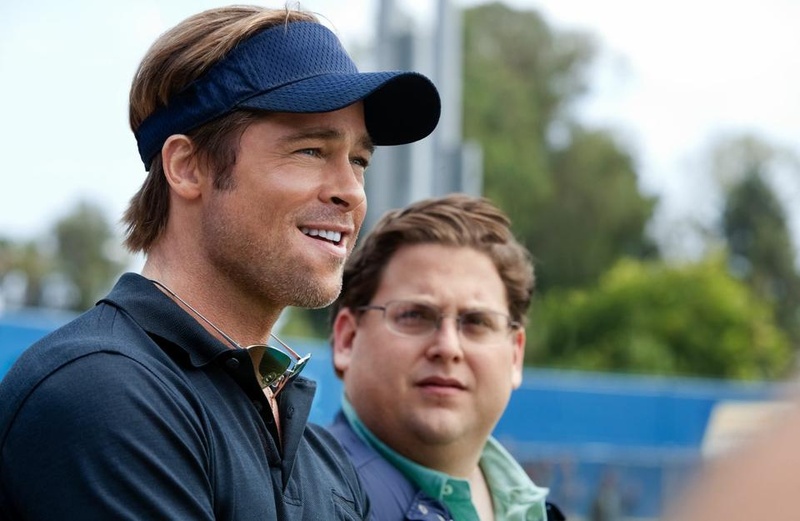
Brad Pitt and Jonah Hill take on maths and baseball (in that order) in Moneyball

Director: Bennett Miller

Cast: Brad Pitt (Billy Beane), Jonah Hill (Peter Brand), Philip Seymour Hoffman (Art Howe), Robin Wright (Sharon), Chris Pratt (Scott Hatteberg), Stephen Bishop (David Justice), Reed Diamond (Mark Shapiro), Brent Jennings (Ron Washington)

Chances are, if I tell you this is a film (a) about baseball and (b) also about sabermetric economics, I’ll lose a lot of you before a single second of the film has rolled. Which would be a shame in this case, as Moneyball is an entertaining, rather affecting yarn that manages to turn subjects that really feel like they should be impossibly dull into a sprightly against-the-odds drama.

In 2002, Oakland A’s general manager Billy Beane (Brad Pitt) has a problem. The As are struggling to pull together a competitive team for the new season, with their best players having been cherry picked away by the larger (and crucially richer) teams, and the money to buy replacements proving incredibly sparse. But after a chance meeting at the Cleveland Indians with young Harvard economics graduate Peter Brand (Jonah Hill), Beane stumbles across another way of building a team. Realising that if he tries to compete on finances with the bigger teams he will always lose, Beane is persuaded by Brand to research player statistics to unearth players undervalued by the big teams. By focusing on specific playing statistics – crucially their on-base percentage – rather than more showy skills, Beane starts to build a successful team, despite the push-back from the more conservative scouts and coaches at the club.

Yes it’s the backroom side of sports, the boardroom politics and business dealings, that come to the fore in this film. But rather than bore, it actually zings along very effectively due, in no small part, to some cracking trademark rat-a-tat dialogue from Aaron Sorkin (polishing a script by Steven Zallian), which elevates conversations about percentages and statistics into something so entertaining you don’t even notice you barely see any actual playing of baseball. 

But then the film comes into shape because who hasn’t wanted to be the visionary, to be the one who tells a stuffy room of old-timers that they are out of date and hell fire I don’t care what you say we’re going to do it the new way or be damned? Based on Michael Lewis’ book, written in heavy collaboration with Billy Beane, the film may well (as some have claimed) play up the conservative prejudices of the follow-your-gut scout and coaches (in particular its portrayal of coach Art Howe as some sort of lumbering dinosaur) but it does make for some damn fine scenes.

And there is a point in there that these coaches feel – perhaps slightly justifiably – that their experience is being disregarded in favour of burying your nose into an online almanac. Crucially, they are proved right (although the film plays it down) when they identify one of the Beane’s signings in advance as a party-hard troublemaker. The film also shows that, while numbers help recruit the players, what actually makes them perform is Beane’s reluctantly taking on the mantle of man-management: talking to the players, explaining what he is doing and motivating them personally. While it’s a film about pushing the boundaries, it also takes moments to show that we can’t junk everything that’s past to build our future.

Moneyball largely manages to make scenes like this dramatic, which is pretty damn good going

A lot of this comes out of Beane’s own personality. It’s a gift of a part for Brad Pitt, who is excellent, mining the deep vein of loneliness and isolation in Beane, whose past is littered with regrets and mistakes. His own baseball career flamed out after early promise, due to his inability to adapt to a higher level of play (Brand wins Beane’s trust by telling him that, based on statistics, he would have picked him very late in the draft not first). It’s an experience that gives Beane a ready-made scepticism for “gut instinct”, but also explains his own unwillingness to get to know the players who (if he needs to) he’ll need to trade in an instant for the good of the club.

Pitt gives Beane this inner sadness, but also a level of warmth fired by competitive zeal. He’s unable to watch the games (so driven is he to win) and he treats his negotiations with other teams and managers with the sort of no-holds barred testosterone that you’d expect he played with. He’s a passionate man who loses his temper and has no time for fools. But he has a deep love for his daughter (of course!), keeps on good terms with his ex-wife and understands deep down that making life decisions is based on a lot more than money.

This also adds a level of bravery to his decision to fly in the face of decades of baseball knowledge – get this wrong and his head will be on the block. This brings added tensions to heated discussions with scouts, frenzied phone calls to secure at the right price the most statistically advantageous players, and clashes with coaches about how to pick a team that has been selected for very specific skills. It adds a human element and guts to the drama.

With super dialogue, a fine performance from Brad Pitt and some good supporting work from Jonah Hill as the (semi-fictionalised) numbers-guy slowly building in confidence, Moneyball has more than enough to recommend it. Sure not much concession is made to baseball muggles, but there’s more than enough heart and drama here to overcome the lack of explanation of how baseball works and what these percentages actually mean – the fact is it works.

Blue Collar (1978)

Yaphet Kotto, Harvey Keitel and Richard Pryor are working joes who want to stick it to the man in Blue Collar

Director: Paul Schrader

Cast: Richard Pryor (Zeke Brown), Harvey Keitel (Jerry Bartowski), Yaphet Kotto (Smokey James), Ed Begley Jnr (Bobby Joe), Harry Bellaver (Eddie Johnson), George Memmoli (Jenkins), Lane Smith (Calrence Hill), Cliff DeYoung (John Burrows), Lucy Saroyan (Arlene Bartowski), Chip Fields (Caroline Brown)

America doesn’t really have a director like Ken Loach. It’s one of the points raised on Indicator’s excellent (and essential) blu-ray release of Paul Schrader’s near Marxist drama about blue-collar car workers in Detriot. There aren’t many (or indeed nearly any) American films I can think of that take the stance of the working man like this one – or as angry, pissed off, furious and, in the end, as lacking in hope as this one. Which makes it sound like the sort of film you’d run a mile from actually seeing. Well you’d be wrong: this is a blistering, intelligent, witty drama crammed with brilliant scenes and great performances. On so many levels it’s something really quite special. It’s a shame no one saw it (I blame the publicity campaign – I mean look at that rubbish poster that basically suggests you are in for Pryor stand up routine).

In a car factory in Detriot, our heroes work in varying jobs on the production line. All of them are unhappy with their lot and feel they get precious little support (or concern) from the union that runs the shop floor. Zeke (Richard Pryor) is furious at the lack of equality and opportunity, as well as defrauding the inland revenue with a (literally) childish scheme to try and make ends meet. Jerry (Harvey Keitel) is drifting through his life, unable to afford the dentistry bills to give his daughter the braces she needs. “Smokey” (Yaphet Kotto) is an angry proto-anarchist who just wants to stick it to the man. When the three of them realise there is a safe (probably) full of cash in the union office, they decide to steal it. However, rather than cash, they find the safe full of accountancy records of the union’s dodgy money laundering arrangements with organised crime. The men decide to offer to sell it back to the union – and open up for themselves a world of trouble…

Blue Collar is a hard to categorise film. It’s a brilliant hotch-potch of several genres. It opens like a workers film, crammed with an angry wit (the opening half hour is very funny) with several scenes that acutely skewer the petty clashes of working life as well as the corner-cutting financial desperation of men trying to make ends meet. The opening scenes have the edge of a raw black comedy to them, mixed with observational realism. Then the film subtly changes over, becoming first through near-caper (the hilariously bungled attempt to steal the safe), into politics as the union and the men begin to shift alliances, into a straight classic 1970s conspiracy thriller (complete with late car chase and an outre death for one of the characters) before finally wheeling back round into a tub-thumbing condemnation of the “divide and conquer” plans of the ruling classes. 

That’s a lot for any one film to try and squeeze into a less-than-two-hour runtime, but Schrader manages it with aplomb, juggling this mix of styles and genres with such effective skill that you almost don’t even notice as the film grows increasingly darker and more dangerous as it progresses. The eye it has for the rhythms of factory life seems perfectly judged, and the mixture of hacks, place men, agitators and uncaring union men feels absolutely perfect. It also brilliantly captures, in his dialogue, the natural force (and crudeness!) of working men’s conversation, with a brilliant ear for the semi-articulate astuteness and poetry it can reveal. 

Schrader builds the pressures up in the film subtly and brilliantly, so that it seems both sudden and perfectly natural as the three men begin to buckle and turn on each other. This is where the Marxist message of the film starts to come in: even when working men have the whip-hand, their superiors will find a way to make them turn on each other, to make them unable to throw off the shackles that bind them as they are unable to work together. On top of this Schrader throws in a brilliant analysis of everyday racism and racial tension (all the union reps and their foremen are of course white), and there is an unspoken edge of racial divide in every conversation – indeed racism is just one of many weapons, the film argues, used to turn working men against each other. This really comes out in the film’s final scene, where two characters who had only warmth and affection for each other at the start are driven to turn on each other with an onslaught of racist fury.

Of course that clash probably carries a lot of its force from the fact that the three leads couldn’t stand each other on set. Pryor, Keitel and Kotto were each told that they were effectively playing the lead in the film and were unaware until signing on of the presence of the other actors. This billing tension was fuelled by their incompatible working methods: in particular Keitel, a theatre trained actor, preferred multiple rehearsals before takes while Pryor, a stand up comedian, preferred minimal or no rehearsal – and usually peaked on the second or third take. Throw in the drugs (that Pryor certainly was indulging in) on set and the three actors reached the point where they could barely stand to be in the same room together (one of the film’s best sequences, a single shot where they sit on the sofa for a long take and plan their next move, was only filmed because the three actors arrived separately, didn’t speak until the camera rolled, and then immediately left).

Did this edgy fury boil over into their performances and give them an extra fire? Certainly I don’t think any of them were better than they were here. Kotto has such an electric, bubbling fury to him, an anarchist’s delight at danger, that he feels like a force of nature. Keitel hadn’t been so gentle, reserved and bemused by the world for years, as an oppressed everyman. But the real electricity comes from Richard Pryor is a goddamn revelation as Zeke. What Schrader did so brilliantly here was to capture all the fire, energy and angry of a typical Pryor stand-up performance and channel it into a dramatic structure. An early Zeke rant against the unions is essentially a Pryor stand-up performance, and Pryor’s whole performance buzzes with an improvisational energy.

Zeke is the film’s key character. At first he seems the weakest and most desperate of the three men, the one most likely to fall into the role of victim. But as the events take hold of the three men, his character deepens and develops to reveal a shrewdness, a realism and even a coldness that the other men don’t possess. Unlike them, he sees events not as a chance to make a quick buck but as a genuine moment to change his life for the long term. And, underneath this, an understanding that as a black man opportunities for him are going to be few and far between. An electric confrontation between him and Jerry late in the film on Zeke’s porch hums with his fury driven realpolitik, Zeke’s understanding that opportunities are there to be seized and that sometimes the price paid is high.

Blue Collar gave Schrader a break-down when he made it. But its’ a masterpiece of political cinema, largely because it never really feels like a political film. Instead it feels above all like a domestic drama of friendship marred that explodes into a thriller., But it’s the understanding of the social situation of these men, of the reasons behind their actions and the intelligent analysis behind it, that makes it really work. It also gives you characters who feel real and in whom you invest, blessed as well (for all their clashes) with three career-best performances from the leads. It’s a brilliant film and in a just world should be seen as a landmark piece of film making.

The China Syndrome (1979)

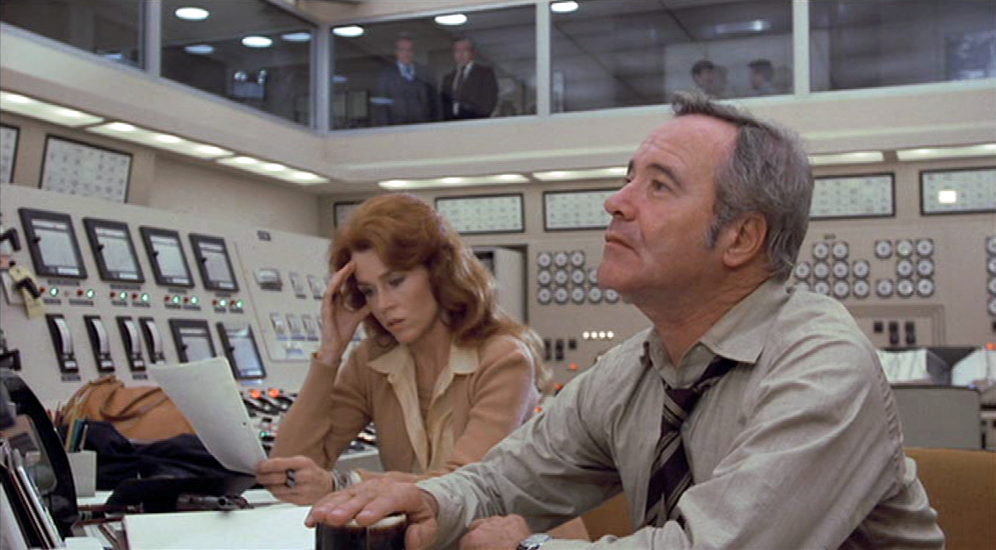
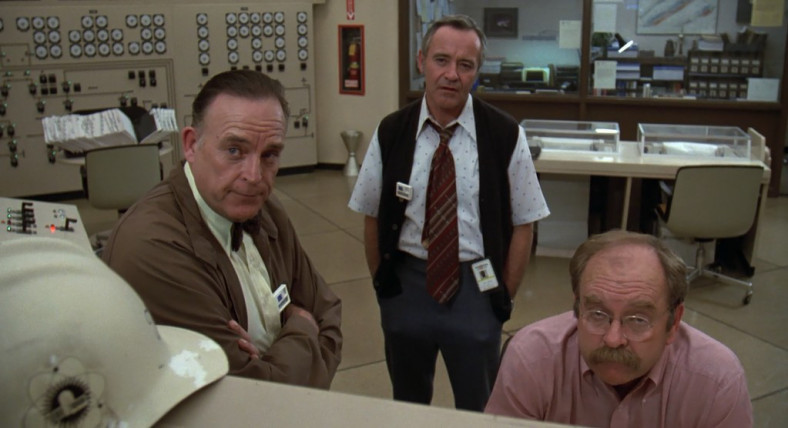
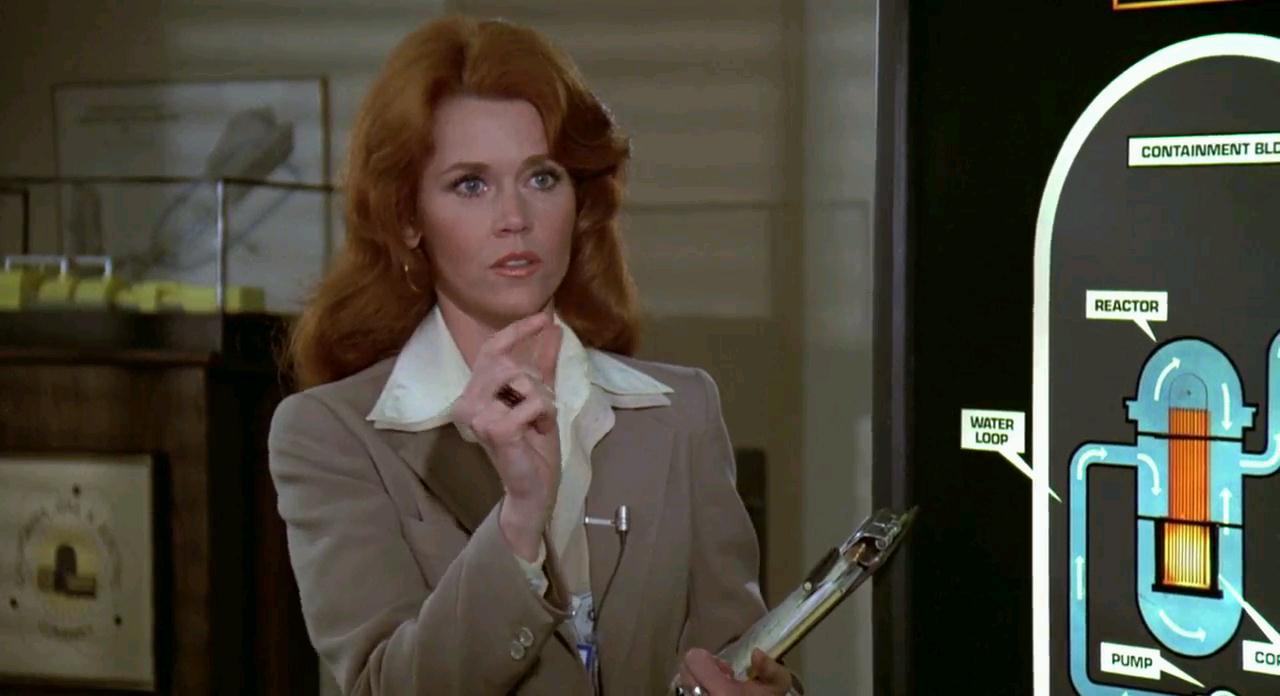
Jane Fonda and Jack Lemmon struggle against Big Business interests in the Nuclear Industry in The China Syndrome

Director: James Bridges

Cast: Jane Fonda (Kimberly Wells), Jack Lemmon (Jack Godell), Michael Douglas (Richard Adams), Scott Brady (Herman DeYoung), Wilford Brimley (Ted Spindler), James Hampton (Bill Gibson), Peter Donat (Dan Jacovich), Richard Herd (Evan McCormack), Daniel Valdez (Hector Salas)

Do we really trust nuclear power? There is something about the dangerous possibilities of splitting the atom that alarms people even today. For all that burning coal wrecks our atmosphere, people would still rather that than live downwind of a station powered on substances that could obliterate everything within a five mile radius if something went wrong. The China Syndrome is about exactly that, an accident at nuclear power plant that could spell disaster for California.

Kimberly Wells (Jane Fonda) is a roving reporter for a Californian news channel, who (thanks to her sexist bosses) is constantly relegated to ludicrous puff pieces (“Today a hot air balloon landed in downtown LA!”). Sent to a nuclear power plant, she stumbles upon the real news story she has waited her whole career for when she and camera-man Richard Adams (Michael Douglas) secretly film a near catastrophic incident. Investigations try to brush the event under the carpet, but shift supervisor Jack Godell (Jack Lemmon) knows corner-cutting and cost-saving is putting the whole of LA at risk – and, much against his inclination, he needs to speak out. 

The China Syndrome comes very much from that burst of 1970s conspiracy thriller films where shady big-business types are willing to throw almost anything under the bus in order to make a big bonus. It’s a film that takes a pop not only at the heartless bastards running a shoddy nuclear power plant (who couldn’t care less if the reactor is poorly welded together, so long as the money keeps rolling in) but also the hypocritical cowards running the media. The heads of the news channel kowtow swiftly to big business and are staggering in their sexism and race-to-the-bottom news coverage.

This film is as much about this brainless conformism as it is the dangers of nuclear power. The film is full of people who don’t want to rock the boat: half the people working at the plant would rather turn a blind eye to problems than pay the personal price of exposing them – even Jack Lemmon’s manager is the most reluctant whistleblower you’ll see in the movies. Fonda’s journalist may not be happy with her role as airhead eye-candy, but she will play the game in order to get ahead in the industry the role – and many of her media comrades seem almost totally lacking in any journalistic instincts. The film is bookended by inane TV coverage and advertising, a condemnation of an America that doesn’t ask questions and is sleepwalking towards catastrophe.

This catastrophe is, of course, extremely close – the power plant nearly goes into meltdown because a single dial gets stuck on a high reading, leading the control room to believe the nuclear rods are about to get flooded rather than nearly being exposed. Bridges mines a heck of a lot of tension from this crisis – told entirely from the perspective of the control room – as workers react with both stressed fear and a practised professionalism to a crisis that could become a disaster. Its part of a film where regular joes are generally professional and good at their jobs, but are let down and betrayed by the culture encouraged by the higher-ups.

Some of these themes, however, get a bit muddied in the film’s middle third, which gets bogged down way too much in nuclear theory, committee meetings, slow explanations of different types of weld, and dry lectures on the functioning of nuclear energy. While it is admirable that the film has no score, you can’t help but feel that a little music here to add some drama to Lemmon looking at x-rays or Fonda staring at diagrams could have helped pump up the tension. 

But it all gets paid off by the sudden (and surprising) shift to action and drama in the film’s final third, kickstarted by a surprisingly gripping car chase between Jack Lemmon’s quiet station manager and some shady goons hired by the company. Suddenly the film is powering through a tense series of set pieces that both feel like a different movie, while still a natural progression of the stakes.

Bridges directs the film very well. Each scene is calmly and coolly assembled, and he has a great eye and ear for technology and the noises and motions of machinery, which dominate the film – even if the film is rather in love with these background sounds, which risk taking over the soundtrack. It’s all part of stressing the cold mechanicalism and lack of humanity throughout both these industries. Sometimes the foot comes off the gas a little too much – you could probably trim at least 15 minutes – but when it comes to the moments of tension he directs with sharp snappiness.

The acting is also sublime. Jane Fonda is extremely good as Kimberly Wells. Initially she seems as light and superficial as the stories she is forced to cover, but Fonda paints a clever picture of a woman squeezed into playing a role, but yearning for (and capable of) so much more, who when she finds her moment shows levels of determination and cunning you would never have expected. For all her desire to become a ‘proper’ journalist though, Wells is savvy enough to make sure she is being filmed from her good side… Fonda makes her a careerist who uncovers a sense of moral purpose. She also manages to bring real emotion to the role, making Kimberly Wells a character we swiftly connect with.

The movie however is stolen away by Jack Lemmon, brilliantly low-key and everyday as the shift manager who becomes an overwhelmingly reluctant whistleblower. Lemmon’s performance is a perfect study in smallness, of a quiet dignity. He’s got no desire to rock the boat, quietly stating that the “plant is his whole life” – but when stirred, his professional pride transforms into determination to do the right thing, even while his lack of magnetism makes him unpersuasive and hard to take seriously. It’s a terrific performance of low-key tragedy, with Lemmon building the tension with small flashes of resentment, fear, determination and disillusionment flashing across his face. It’s a great reminder of what a marvellous dramatic actor Lemmon was.

Expertly produced by Michael Douglas (who does sterling work in the third-banana role as the camera man overflowing with conviction), The China Syndrome may at times be dry, but it makes up for that with its moments of high drama and moral conviction. By and large it avoids hectoring and lecturing the audience (when not teaching us about nuclear power), and lets its points be soft-sold rather than banged home. With some terrific performances, it’s a film that still feels relevant today, and is a great example of the 1970s conspiracy thriller genre.

The Long Good Friday (1980)

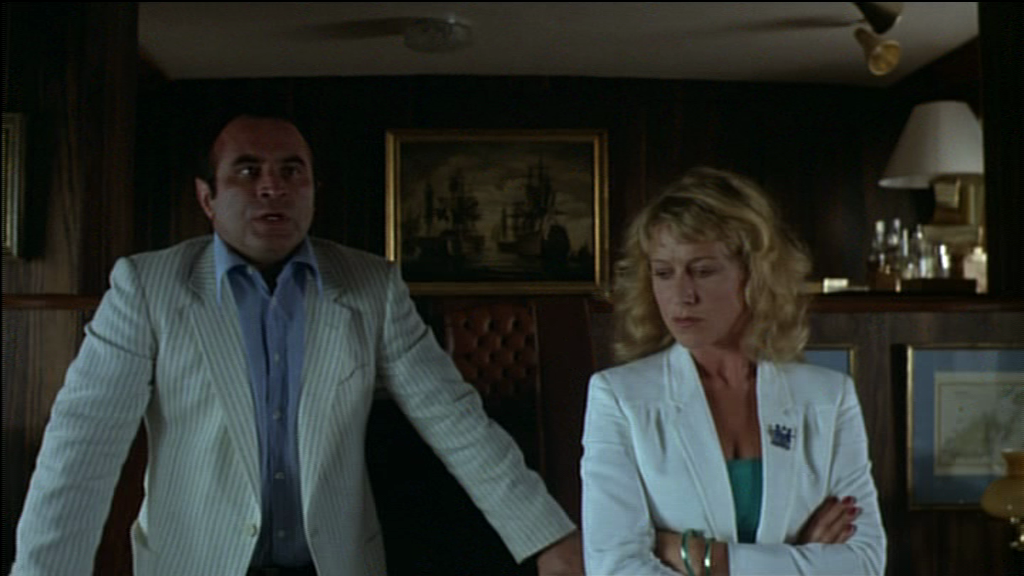
Bob Hoskins rules London – but for how long? – in classic Brit gangster masterpiece The Long Good Friday

Director: John Mackenzie

Cast: Bob Hoskins (Harold Shand), Helen Mirren (Victoria), Derek Thompson (Jeff), Bryan Marshall (Harris), PH Moriarty (Razors), Dave King (Parky), Eddie Constantine (Charlie), Paul Freeman (Colin), Stephen Davies (Tony), Paul Barber (Errol), Pierce Brosnan (Irishman)

The Long Good Friday nearly turned into a one-hour TV special starring a dubbed Bob Hoskins. The fact that it didn’t – and that today it can stand as one of the greatest British films ever made – is thanks to George Harrison’s Handmade Films, which bought the rights and saved the film. Thank God they did, as this is brilliant: thrilling, dangerous, intense but witty, strangely tender, satirical and smart. Fantastically made and wonderfully acted, it’s not just a great gangster film, it’s a great film.
Harold Shand (Bob Hoskins) is the undisputed gangland boss of London, desperate to turn legitimate. He has a plan for development of London’s dockside into a paradise of office blocks and apartments. All he needs is a big investor to support his “corporation” to make the final push. On an Easter weekend he prepares to greet an American investor from a similar “company” to his own. But as Shand prepares for this life-changing weekend, his business is hit by a wave of killings and bombings that seem targeted at shattering his organisation. What’s behind this? Who is “having a go”? And how does this link with a mysterious money shipment we witnessed at the start of the film? Shand’s going to find out – and has to do so without his investors getting cold feet.

The Long Good Friday is a well-written, brilliantly structured mystery mixed with some brutal gangland violence. Mackenzie’s film is lean and mean but laced with dry, biting humour. Everything in the film works perfectly, and it really understands the veneer of culture, class and decency that gangsters like Shand like to put over their crime dealings.

Not that Shand isn’t a decent bloke of course. Bob Hoskins is simply superb as Shand, a likeable, strangely decent guy at first, who seems to somehow shrink and twist as the film progresses and he is less and less able to control the anger he keeps bottled up. Shand clearly cares deeply for those around him, but he’s also clearly stubborn and convinced of his own superiority. Hoskins brings the part a humane gravitas, a force of nature fury that burns through the film. And when confronted with opponents he can’t understand, he still tries to use the rules of gangland to take them on.

Of course these rules are completely unsuited for his IRA opponents. Despite the advice of his pet policeman Parky, Shand is confident that he can deal with these bomb-toting fanatics. Even worse, he thinks that they are basically playing by the same rules that powered his own rise to the top of the gangster tree. Part of the tragedy of the part is seeing someone who essentially appears relatively likeable at the start of the film fall back on the violence and rage that powered his assent to the very top. Needless to say the IRA aren’t intimidated by cockney thugs, and have no intention of letting Shand get away with his attempts to strike back. 

Here is a film brave enough to not only show the IRA at its centre, but to make them as effective and ruthless as this. Not even our geezer gangsters can take them on, and the poor plods seem petrified as soon as they rear their head. Could there be a more cutting criticism of Britain’s policy in Ireland? Terrorism has hardly gone away since – you imagine Shand being equally outmatched by Al-Qaida.

As well as a gripping gangster film, The Long Good Friday is a prescient and intelligent criticism of Thatcherism. Shand is actually pretty much spot-on with his vision of London being redeveloped into a political and economic power-house, one of the major cities of Europe. Many of the locations the film uses would be unrecognisible today, as they are all sites of offices and apartments. Shand has a 1980s swagger to him, a barrow-boy made good who likes to think of himself as a visionary businessman. He’s desperate to grab for himself a bit of the new money he senses could be washing around Thatcher’s Britain. So the film makes a nice satire of the “loadsamoney” generation, as well as of the gangster world of the East End. Shand’s yacht and flat are the quintessential yuppie pads, and Shand’s motivation is raking the cash in.

British hubris actually seems to lie at the heart of the whole film. Shand’s swagger and super-confident, “Britain reborn” attitudes are all based in his firm belief that Britain has its own special destiny. Of course, as events begin to hit home, this sense of British pride (represented by Shand’s determination to reshape London into a city of glass and office complexes) begins to shrivel under the weight of events. Shand is reduced to angrily denouncing everyone from the Irish to his potential American partners to the other nations of Europe.

(In fact it’s interesting watching the film in the light of Brexit – Shand would on the surface seem to be the poster boy for a certain type of UKIPer, but he’s actually passionately excited about the opportunities the Union presents, and the centrality of London to that world. He’d almost certainly loath Farage.)

All this thematic content – and this is a hugely British film, instantly recognisable to anyone who has grown up here – gets swept up in this brilliant gangster flick. The acting is sublime. Helen Mirren is a stand-out as a woman who is a very equal partner in Shand’s business empire, just as smart and just as ruthless. Derek Thompson (him off Casualty!) is good as a slightly sleazy major-domo, as is PH Moriarty as a gangland heavy (he certainly looks the part!). Future stars like Kevin McNally, Paul Freeman, Dexter Fletcher (as a kid) and most notably Pierce Brosnan (in his first acting job as a handsome IRA hitman) fill out the cast.

Brilliantly acted, tightly directed and full of great cultural and political depth, with terrific pace, scintillating action, engrossing tension, a deceptively simple story and a great script: The Long Good Friday surely stands as a landmark British film. And it has one of the finest final sequences you’ll see, which considering it revolves solely around Hoskins sitting in a car is saying something.

Up in the Air (2009)


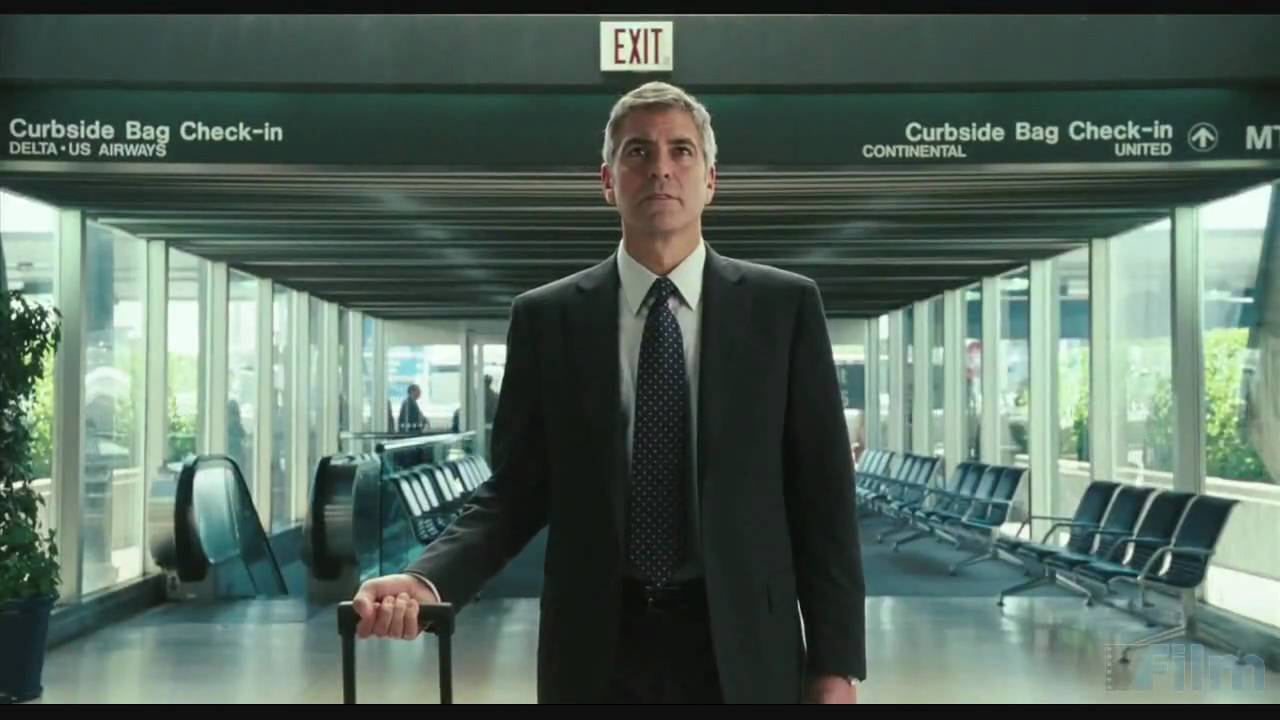
George Clooney about to head Up in the Air in Reitman’s brilliant bitter-sweet comedy

Director: Jason Reitman

Cast: George Clooney (Ryan Bingham), Anna Kendrick (Natalie Keener), Vera Farmiga (Alex Goran), Jason Bateman (Craig Gregory), Amy Morton (Kara Bingham), Melanie Lynskey (Julie Bingham), Danny McBride (Jim Miller), Zach Galifianakis (Steve), JK Simmons (Bob), Sam Elliott (Marnard Finch), Tamala Jones (Karen Barnes)

One of the worst days in your life can be the day you lose your job. The uncertainty, the insecurity, the sudden feeling of no longer knowing what the future holds – it hurts. Imagine, however, if you were the other side of the equation. What if it was your job to actually tell other people they no longer had a job?

Ryan Bingham (George Clooney) works for a Human Resources consultancy company who specialises in firing people for companies. Ryan spends his life flying from company to company across America, fires thousands of people a year, and gives motivational speeches promoting his ideology of no relationships with people or possessions. His relationships are on-the-road flirtations, in particular with one of his female counterparts Alex Goran (Vera Farmiga). However, Ryan’s world is facing threat: his company has hired young, ambitious Natalie Keener (Anna Kendrick), and wants to introduce a video conferencing system to conduct firings remotely. Ryan argues Natalie knows nothing about the ‘human element’ of his job, and she joins him on the road to find out more.

Up in the Air is a marvellous, perfectly formed, small-scale film: thought-provoking, endearing, with plenty of laughs as well as an air of bittersweet sadness. It manages to focus on all its issues and themes equally without short-changing any of them, and leaves you feeling rewarded and rich at its end. There are moments in there that will make you cry, make you laugh but also make you a little angry. Reitman never insults your intelligence though: he presents things as they are and trusts you to make the judgements you want to make. It’s quite simply wonderful, a little masterpiece of cinema. 

It’s also a wonderful film of its time, which very deliberately doesn’t shy away from the brutality of the economic climate so much of its plot focuses on. Reitman used a series of talking heads of real people who really had gone through meetings exactly like this, and their emotional, very real reactions to losing their jobs gives the picture a profound depth. 

Up in the Air doesn’t take the easy route of condemning Ryan’s work. Sure our sympathies are naturally with those losing their jobs, but Ryan isn’t a heartless shark. He genuinely feels he is there to support people: his principal objection to the video conferencing is it removes the human element from an extremely difficult moment in people’s lives. He has platitudes, and smooth professionalism, but also a brilliant understanding of people and he gets so close to appearing that he cares deeply about people’s lives (even if he can’t remember them days later) it’s as near as damn it to counting. Watch the scene where he fires JK Simmons’ character – he’s read Simmons’ CV, gently questions why Simmons is working anyway at a company he hates and encourages him to follow his dream of becoming a chef. Sure it’s about defusing a situation – but to Ryan it’s also about helping a person see possible future steps, if only for a moment.

It’s such a brilliant snapshot of how Ryan can analyse in seconds what might encourage a person to find greater depth in their lives, that you forget for a moment that Ryan prides himself on having nothing. His flat is a facelessly cold place, which looks less welcoming (and cheaper and colder) than the hotel rooms he stays in. He’s never happier than when in a VIP lounge. He proudly lives out of a suitcase perfectly sized to avoid checking bags. His motivational career stresses the aim of getting everything that matters to you in the world into a backpack. He has no friends, he’s a stranger to his family, no fixed abode (he spends over 320 days a year travelling). He shares a few painful minutes with people and then never sees them again. 

This might just be the part Clooney was born to play: his handsome, slightly smug grin, his studied chuckles, his slight air of blankness behind his good looks are perfect for Ryan’s surface, but Clooney’s great gift as an actor is the emotional weight and depth he is able to show beneath this veneer as soon as it is scratched. He’s a marvellous physical actor – watch his growing flirtatious ease with Alex turn into a comfy affection. He understands the psychology of Ryan completely and never judges him: he can see why Ryan does what he does, and why it works for him. His performance gives Ryan the dignity of his convictions, doesn’t present with any inch of satire Ryan’s feeling that his job is partly about helping people. Even the slightest touch of distance from the part would have shattered the film’s delicate equilibrium – Clooney doesn’t do it for a second.

Of course, drama means Ryan is thrown into situations that challenge this way of thinking, not least his relationship with Alex (essentially the female version of himself). Vera Farmiga is outstanding as a woman with a very male outlook on the world. Perhaps because they share so much, their relationship grows from a sexually charged flirtation (a brilliantly shot and edited sequence in a VIP lounge) into one that increasingly becomes more and more tender. The film dangles before us and Ryan the option for a new way of life – but it doesn’t lie to us about the nature of either of these people. The relationship doesn’t develop the way we expect – and in fact it becomes a commentary in its own way on the very same future prospects Ryan spends his life selling the people he fires, that despair is a gateway to future opportunity.

Anna Kendrick’s Natalie comes at the world of firing from our ruthless modern age – how can we do this faster, quicker and cheaper? Let’s put together a framework for all conversations, let’s do it remotely, let’s use as many buzzwords and platitudes as we can. While Ryan’s work (to him) is all about not forgetting you need to guide an actual human being through without them getting angry or upset, for Anna it’s a simple progression from A to B. Kendrick’s wonderful performance is all about unpeeling these layers. As she finds out first-hand what the job involves, so we discover she is a far more sensitive, “normal” person than we expect, someone who can’t see the logic behind Ryan’s world-view.

And the film asks Ryan to look at the logic of this world view as well. Everything he expresses at the start of the film comes under fire. Change threatens to make him as redundant as the people he fires. His growing closeness to Alex challenge his ideas about commitment (“we fall in love with pricks and are then surprised when they are pricks” Alex comments, something the film explores late on). The impending marriage of his sister – and the realisation of the complete lack of presence he has in his family’s lives – makes him start to think about the strength of his rootless existence.

But the film doesn’t hammer these points home, it juggles them all perfectly within its framework of looking at corporate America today. In a world where people are increasingly becoming faceless numbers on a spreadsheet, is it surprising so many need a faceless man to do the firing for them? Travel has made the world smaller, but also our lives smaller – like Ryan we can be everywhere and nowhere. Up in the Air is a sad and tender film, but one which leaves a kernel of hope somewhere – there are moments that make you think there are opportunities for change and rebirth. Sure it might be pulling the same trick Ryan does, but if so that’s smart – and shows what a good trick it is. Up in the Air is a hell of a movie, and Reitman is one hell of a director.

The International (2009)


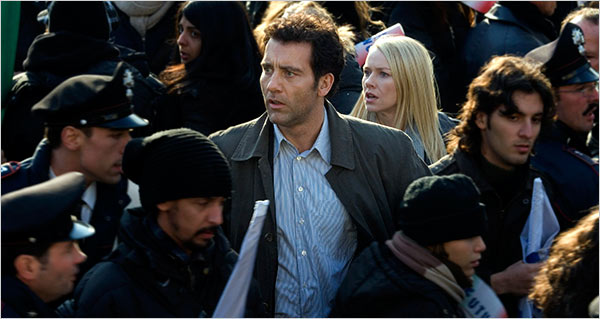
Clive Owen and Naomi Watts are lost in the high-pressure world of big finance in The International

Director: Tom Twyker

Cast: Clive Owen (Louis Salinger), Naomi Watts (Eleanor Whitman), Armin Mueller-Stahl (Wilhelm Wexler), Ulrich Thomsen (Jonas Skarssen), Brian F. O’Byrne (The Consultant), James Rebhorn (New York DA), Michel Voletti (Viktor Haas), Patrick Baladi (Martin White), Jay Villiers (Francis Ehames), Fabrice Scott (Nicolai Yeshinski), Haluk Bilginer (Ahmet Sunay), Luca Barbareschi (Umberto Calvini), Alessandro Fabrizi (Inspector Alberto Cerutti), Felix Solix (Detective Iggy Ornelas), Jack McGee (Detective Bernie Ward), Ben Whishaw (Rene Antall), Lucian Msamati (General Motomba)

Welcome to another of my unlikely pleasures. I remember seeing The International because we took a punt on it with an Orange Wednesday 2-for-1. I had no real expectations, but I was totally wrapped up in it. It has an old-school 1970s Hollywood-conspiracy-thriller feel. I keep waiting for it to be rediscovered (I’m waiting in vain it seems). But it’s a wonderful, tense little thriller which – by focusing on the shady, morally corrupt dealings of private banks – always seems relevant. Throw in alongside that a truly stand-out action set-piece at the centre of the film and you have a much overlooked pleasure.

Louis Salinger (Clive Owen) is a scruffy Interpol agent, with a reputation for getting too involved in his cases. Working with Assistant New York DA Eleanor Whitman (Naomi Watts), Salinger is investing possible illegal arms deals involving private investment bank IBBC. After their inside contact and Whitman’s fellow DA are both murdered in quick succession, Salinger takes the battle directly to IBBC. But the bank, chaired by ruthlessly blank businessman Jonas Skarsson (Ulrich Thomsen), is prepared to go to increasingly violent lengths to protect its interests, with assassinations arranged by its in-house security expert ex-Stasi agent Wilhelm Wexler (Armin Mueller-Stahl) and carried out by his mysterious Consultant (Brian F. O’Byrne).

Tom Twyker shoots the film in cool grays and drained out colours, giving it a very cold palette fitting for its exploration of the ruthless viciousness of big business. Twyker uses the cold, modern architecture of the various businesses the film is set in to great effect, making a wonderful, imposing backdrop. The camera constantly allows this domineering modern architecture to fill the frame, and mixes it up with some well-chosen aerial shots that reduces the action to cogs in a machine. It’s a very distinctive visual film – and it’s not until it finishes that you realise (apart from blood) you’ve really seen a red, a green or a purple in the whole film. There’s no jittery editing or hand-held camerawork – it’s got a smooth old-school cinematic quality to it.

The plot is a chilling conspiracy thriller, that (within the confines of a Hollywood action thriller) gets really in-deep into the workings of big finance. Critics accused it of being a light-weight Jason Bourne but really it’s more of a colder Parallax View. It largely eschews action in favour of paranoia, investigation and simmering tension. It’s a well-constructed journey down the rabbit hole, as Salinger gets both closer towards answers, and further away from bringing anyone to justice. 

Clive Owen’s rumpled performance is perfect. Far from being a “Bond audition”, Salinger is an outsider, a man who lives for his job, who wears his heart on his sleeve, and spends large chunks of the film either terrified or out-of-his-depth. Practically the first thing that happens to him is being knocked out by the wing-mirror of a truck. His grubby, unshaven scruffiness doesn’t recover from that. Owen gives the performance both a moral conviction and a slight air of desperation and bewilderment, as if he can’t quite understand why others aren’t as wrapped up in his case as he is.

He’s part of a great cast of actors – the film is full of unusual choices and rewarding cameos. Armin Mueller-Stahl mastered playing these world-weary ex-spies years ago, but delivers here. Broadway star Brian F O’Byrne is great, as a ruthlessly efficient hitman. Ulrich Thomsen is rather good as the blank businessman and family man, who seems to see no moral issues in the conduct of his bank’s business. Interesting actors like Patrick Baladi, James Rebhorn, Luca Barbaeschi, Haluk Bilginer and Lucian Msamati round out the cast with terrific cameos – there is always a unique actor and dynamic performance around every corner.

The plot of the film doesn’t unfold the way you expect it to – and mixes hope with a nihilistic powerlessness. Twyker’s directing is professional and he adds a lot of intelligence to a standard Hollywood set-up. He also throws in a few moments where the film pauses to reassess things we’ve seen before or to allow Salinger to puzzle out another crucial clue.

And it’s fitting for a film so in love with overwhelming power of modernist architecture that its most explosive sequence takes place in New York’s Guggenheim museum. This is a gut-wrenchingly exciting, destructive gun battle that serves as the pivot point. Brilliantly shot and edited, and perfectly built towards, it explodes into the film and grabs your attention. Owen again is perfect for this sequence – determined, but terrified and completely out of his depth – and Twyker’s use of the Guggenheim is masterful. Honestly it’s one of the best shoot-out scenes I’ve ever seen in a movie: five minutes of brilliance. You’d remember the film for that scene alone, if for nothing else.

Okay it’s not a perfect film by any stretch. Poor Naomi Watts has a thankless, ill-formed part. I’m pleased the film doesn’t include any romantic connection between the two characters at all, but (despite her work on the case) Whitman seems more a plot device than a character. The script largely fails to serve up too many memorable lines – and its main strengths are to present familiar actions and events in a fresh manner. Some have found the plot momentum to often flag – and there is something to that – and the overall schemes of the bank are not always completely clear.

But, nevertheless, I really like The International. It’s got a classic old-school feel to it. Its views on the immorality of big business feel very true, as does its presentation of the villain as basically a monolithic institution – the actual guys running the bank seem irrelevant, it’s just the ongoing nature of business. And in this world of corporations, where destroying a few men don’t admit to a hill of beans, how can truth and justice ever win out? Even if it had nothing else, tackling that idea makes The International feel like something new and worth revisiting. Well that, and that Guggenheim gun fight…

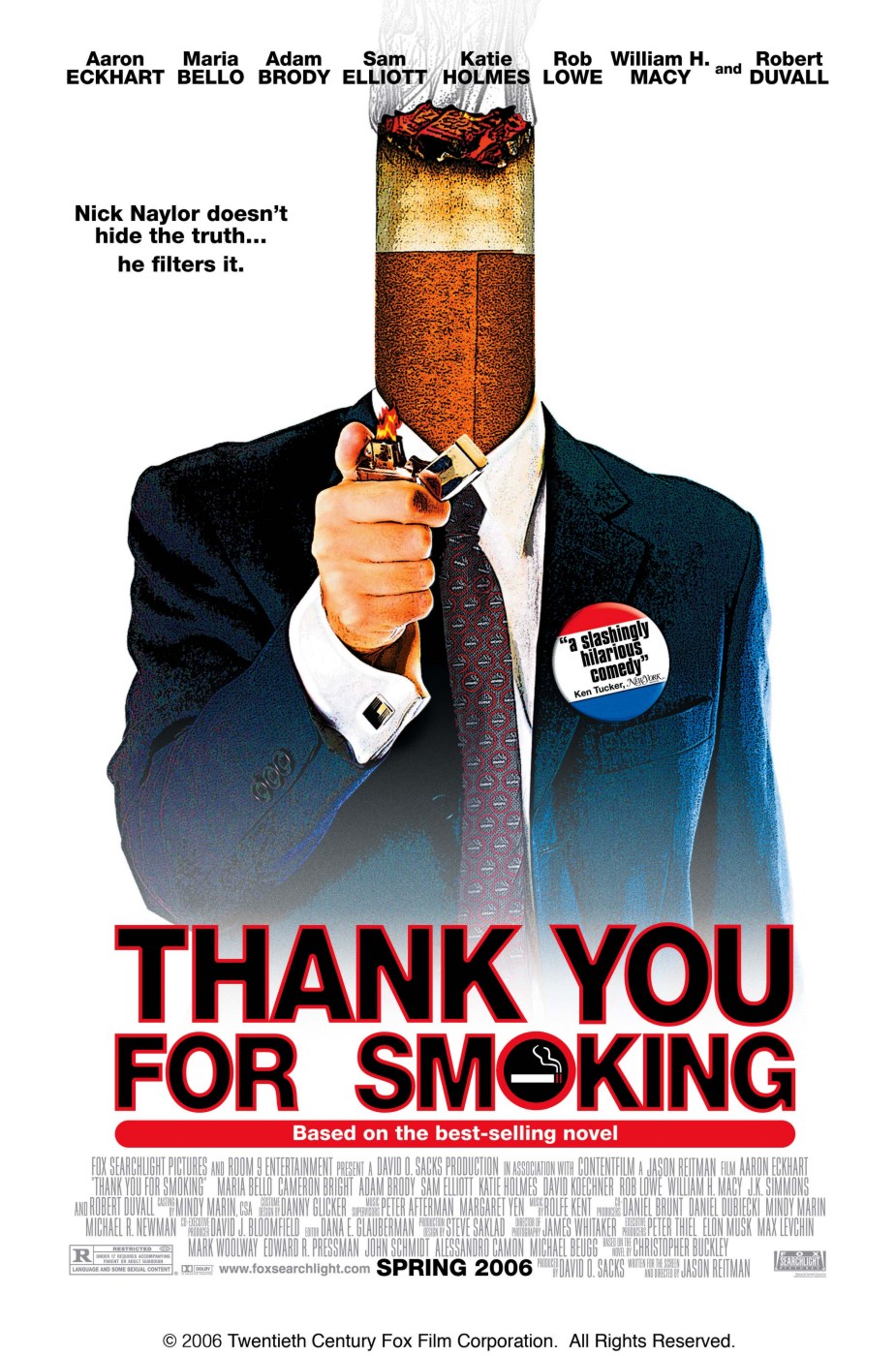
Thank You For Smoking (2006)


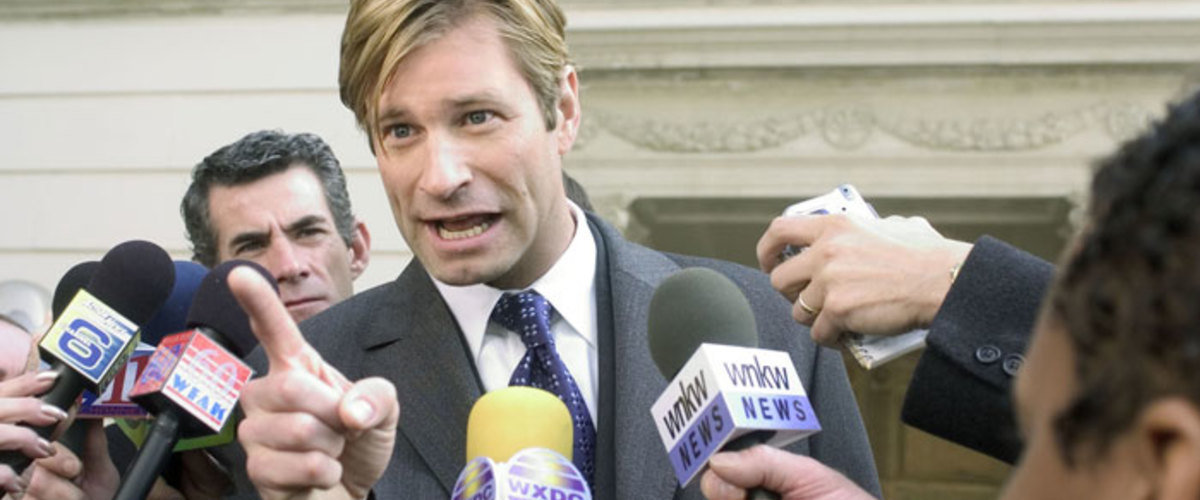
Aaron Eckhart does the big spin on Thank You For Smoking

Director: Jason Reitman

Cast: Aaron Eckhart (Nick Naylor), Cameron Bright (Joey Naylor), Katie Holmes (Heather Holloway), Maria Bello (Polly Bailey), David Koechner (Bobby Jay Bliss), William H. Macy (Senator Ortolan Finistirre), Robert Duvall (The Captain), J.K. Simmons (BR), Kim Dickens (Jill Naylor), Rob Lowe (Jeff Megall), Sam Elliott (Lorne Lutch)

Lobbyists: paid smooth talkers, whose goal is to win influence for often unattractive industries. Not a popular profession. Thank You For Smoking follows a few weeks in the life of Nick Naylor (Aaron Eckhart), a lobbyist for the tobacco industry. With senate hearings underway to place a skull-and-crossbones picture on every pack of cigarettes sold, Naylor has a host of pressures to deal with, not least rebuilding a relationship with his young son (Cameron Bright).

Thank You For Smoking is a smart and amusing satire on a pretty simple target. It’s a great showpiece for the skills of Jason Reitman, who directs his sharply written script with wit and verve. Reitman crafts a satire that’s never too heavy-handed, a well-balanced film that’s about morality and freedom of choice, without banging the righteous drum to death. He’s also got a keen eye for the quick and effective gag, meaning the film moves swiftly from punchline to punchline.

It helps a great deal that Aaron Eckhart is terrific in the lead role: handsome, cocky, charming but with a strange vulnerability. Nick Naylor a fascinating character: while he does adjust his views on issues, he is never humbled by events, and there is no “road to Damascus” moment where he denounces his career. He’s totally confident in his skin, who has come to terms with his role and doesn’t care what people think of him. And you’ve got to respect a man so skilled that he gets a 20 year-old dying of cancer from smoking to shake his hand on live television.

Similarly, the film avoids an open condemnation of smoking (it doesn’t even feature a single character smoking). If anything, the real targets for its criticism are anti-smoking campaigners (William H Macy’s sanctimonious senator is skin-crawling and unbelievably smug and petty), and the opportunistic recipients of lobbying. The film makes clear smoking is a bad habit, but also pushes the right we have to choose – if we want to poison ourselves, we should do so! I’m not sure if Reitman is willing to admit an argument like this is partially an abuse of ill-informed free speech, but at least he hopes we are smart enough to make up our own minds. It’s all part of the careful discussion of lobbying – what kind of person can be swayed by a professional counter-argument man?

There are several other terrific performances. Simmons is hilarious as Naylor’s aggressively vocal boss. Rob Lowe offers a brilliant self-parody as a smoothly empty Hollywood super-agent obsessed with Japanese culture. Maria Bello and David Koechner are both sharply witty as Naylor’s fellow lobbyists for alcohol and firearms respectively. The scenes between the three of these “Merchants of Death” (or “The MOD Squad” as they call themselves) offer a sharply funny commentary on the action throughout.

If the film has a problem though, it’s that it never feels like it develops into being much more than a framework for some good jokes. There is a thinly veiled morality tale here, but the film never really feels like it makes a point or a conclusion. Sure there are tonnes of excellent jokes and laugh-out-loud moments, but is it much more than a series of skilled sketches? Eckhart is of course brilliant in each of these, but there is often a sense of watching a series of misconnected events. Characters drop in and swiftly out of the movie. There is no overarching plot, as such.

The film largely dodges any real narrative conclusion. This is of course part of the smartness of its design – it’s not trying to make moral points, or hector us on health – but it also makes the film feel slightly empty, narratively adrift. Little changes for the characters from the start to the end of the story. Of course, the film is not so crude as to make its hero learn “a lesson”, but it also means Naylor is a more difficult character to sustain interest in over a period of time: complete lack of self-doubt does not tend to make great drama.

It’s very funny, smart, well written and acted. However, while brave enough to avoid predictability, it’s also inconsistent enough to not have a real shape. Some moments – in particular the relationship between Naylor and his son – lean heavily on cliché. Some of its more unusual moments – especially a sequence where Naylor is kidnapped by anti-smoking campaigners – fall the wrong side of surreal. But for all that it’s an imperfect film, it is certainly funny enough to justify itself and features a superb performance of alpha-male arrogance from Aaron Eckhart (I’ve asked this elsewhere, but how unlucky is this guy to not be a bigger star?). I guarantee you’ll laugh several times when you watch this – and if nothing else you’ll have a think about lobbying.

The Founder (2016)


Michael Keaton accepts the praise as Founder of the McDonalds Business Empire

Director: John Lee Hancock

Cast: Michael Keaton (Ray Kroc), Nick Offerman (Richard McDonald), John Carroll Lynch (Maurice McDonald), Linda Cardellini (Joan Smith), B.J. Novak (Harry J. Sonneborn), Laura Dern (Ethel Kroc), Justin Randell Brooke (Fred Turner), Kate Kneeland (June Martino), Patrick Wilson (Rollie Smith)

McDonalds. The Golden Arches are ubiquitous, not just in America but across the whole world. But how did this happen? How did a small business – just one stand in a small town in America – suddenly become a global monolith?

Ray Kroc (Michael Keaton) is a luckless travelling salesman, selling supplies to drive-in diners. In California he encounters a diner the likes of which he has never seen before: a walk-up restaurant serving high quality food in disposable packaging, instantly. The business is McDonalds, run by brothers Dick (Nick Offernan) and Maurice (John Carroll Lynch). Kroc instantly recognises the potential of the business, and strikes a deal to franchise the formula across America, although the McDonald brothers will maintain control over all changes. Kroc, however, has the drive and ambition the McDonald brothers lack – and he slowly begins to stretch and expand the deal, taking on more and more power. Eventually he will become “The Founder” of the business that bears his original partners’ names.

What’s interesting about The Founder is that it has a certain element of wanting to have its cake and eat it. It’s simultaneously a semi-celebration of American entrepreneurship and a condemnation of big business crushing the little guy. This sounds like it should make for a confusing film but actually it kinda works. It fits the complex world of major business successes – someone like Kroc had the skills and the ruthlessness to actually make McDonalds into a global super-company in a way the McDonald brothers never did. At the same time, Kroc is clearly incapable of creating anything himself (even most of his business-building ideas come from other people) and the McDonald brothers have the real “American” entrepreneurial invention to create something new.

So the film becomes an engaging story of how businesses grow and develop, which largely manages to remove Hollywood sentiment from the equation. Kroc isn’t exactly a hero – he’s selfish, ruthless and places himself first constantly – but he’s not exactly a villain either. He’s a downtrodden striver, who has too continually push to be accepted by those who look down on him. He has a sense of loyalty and love for his brand – even while he begins to shut the McDonald brothers out of their own business. Similarly the McDonald brothers have a homespun honesty to them, but they are also naïve and unrealistic in their demands and desires for the business.

The film relies a lot for its success on Keaton’s slightly tragic desperation in the lead role, his yearning to improve and better himself. The first half of the movie shows his charm but also demonstrates his business acumen, his genius in recognising that what the McDonald brothers have invented could work on a huge scale. He’s hard-working and initially luckless, and the snobbish knock-backs he receives from banks and investors when peddling an idea get us on his side – after all we know it’ll be worth billions. It’s a Capraesque spin: he’s the little guy bucking against the system who becomes the very monolithic monsterous system himself. We can’t even be certain where we see the flip.

What becomes clear is that Kroc himself is somehow empty, somehow slightly devoid of depth, a man able to move smoothly from concept to concept with no lingering sense of guilt. He discards the McDonald brothers (after copyrighting their name) with as much calmness as he drops his wife (Laura Dern, in a thankless part as The Loyal Wife). Despite this though, the film never brings itself to condemn Kroc. It’s a little in love with the chutzpah of Kroc’s success and his persistent positivism, while seeing those he has had to drop on the way as tragic victims of the monolithic American business success Kroc has created.

We are invited to have similar sympathetic feelings about the hapless McDonald brothers: innocents in a world of business, able to create something that can change the world but hopelessly incapable of translating it into the type of scale that it could achieve. The film doesn’t forget that the McDonald brothers are the victims here, and Offerman and Lynch are both superb as two brothers with a deep personal bond and a love for their business and each other. But it also partly follows Kroc’s line – these two do not have the vision and ambition to take their idea to the next level. They are innovators but they are small-scale ones. The film daringly doesn’t just take their side as the little guys crushed by the system; it also allows itself to consider if they to a certain extent failed themselves. They never learn either, accepting Kroc’s handshake agreement for future royalties at the end of the film, an agreement we are all too aware even when it is happening will probably never be met.

The film has a certain love for the Americana of McDonalds and fast food joints, and it’s both an advert for the triumph of the business (the customers are all uniformly happy, and the ordinary employees in Kroc’s empire are all wonderfully warm) and a sad testament to the small businessman being swept aside by the big company. It’s quite a feat for the film to manage both at the same time and remain coherent. It’s both an advert for and attack on McDonalds, but it holds both these ideas simultaneously at the same time really well. Well worth a watch.