Category: Films about obsession

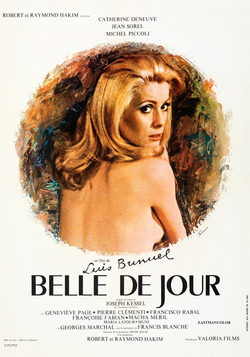
Belle du Jour (1967)

Belle du Jour (1967)

Buñuel’s sensual mix of fantasy and reality, asks intriguing and searching questions with ambiguous answers

Director: Luis Buñuel

Cast: Catherine Deneuve (Séverine “Belle de Jour” Serizy), Jean Sorel (Pierre Serizy), Michel Piccoli (Henri Husson), Geneviève Page (Madame Anaïs), Pierre Clémenti (Marcel), Francisco Rabal (Hyppolite), Françoise Fabian (Charlotte), Macha Méril (Renée), Maria Latour (Mathilde), Marguerite Muni (Pallas), Francis Blanche (Monsieur Adolphe), François Maistre (The professor), Georges Marchal (Duke)

Desire can be a scary thing; a deep dive into the things that excite and titillate us can be deeply unnerving. That’s the heart of Buñuel’s compellingly intriguing Belle de Jour, where dreams and fantasy merge with confused and repressed desires struggling to find an outlet. It makes for a fascinating, unsettling and erotic film, powered by a fearlessly superb performance by Deneuve. Buñuel’s film avoids judgement, frequently inverting lazy moral judgements in a film that flirts with playfulness and dark dangers.

Séverine (Catherine Deneuve) is happily married to Pierre (Jean Sorel) but seems unable to find any sexual satisfaction with him. Sleeping in separate beds, the couple are supportive and loving but chaste. Séverine’s fantasy life though is awash with day-dreams of erotic, sadomasochistic desires in which she is degraded and humiliated, scenarios clearly alien in her marriage. Séverine finds an outlet for her desires by taking an afternoon job as a prostitute in Madame Anaïs (Geneviève Page) high-class brothel, where she can experience an erotic thrill in debasement that she barely understands herself. But can her secret survive the probing of sinister Husson (a brilliantly creepy Michel Piccoli) or her confused fascination with gangster Marcel (Pierre Clémenti).

Belle de Jour explores the dark desires many of us hold but never acknowledge – either to the world at large or to ourselves. It’s told with Buñuel’s masterful control, moves with smooth narrative economy and throws our expectations off kilter with carefully controlled switches from reality to fantasy. Buñuel’s unsettling opening shows Séverine and Pierre riding in a carriage through a tree lined country lane, their conversation tinged with hostility. We wonder what film it might be – we probably don’t expect Pierre to order the carriage to stop, demand the drivers drag Séverine from it, take her into the woods, flog her bare back and then allows one of his burly men to have his way with her. Just as we don’t expect the look of pleasure on Séverine’s face.

Fantasies like this re-occur time-and-time again throughout the film, as Séverine’s only way of truly explore sexual fantasies her husband is (presumably) unable to fulfil. In her fantasies she is abused, tied up, has mud flung at her and services men in the full knowledge of her husband. Buñuel presents this, as you might expect (for a man whose foot fetish has become something of a running joke) with a striking lack of judgement or moral ticking off. Instead, it feels more like Séverine is a woman trapped between two stools of seemingly knowing what she might want, but struggling to find the sexual and emotional confidence to acknowledge it. None of this, in any case, has any impact on her love for her husband or the importance she places on their marriage.

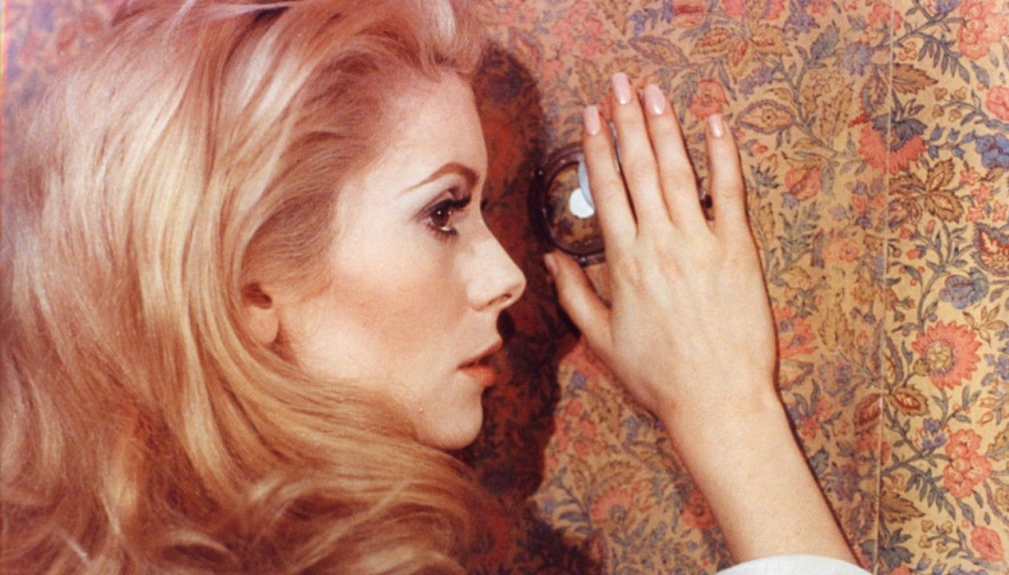
Buñuel captures this brilliantly with her hesitancy to follow through on her desire to knock on the door of hostess Madame Anaïs (an excellent Geneviève Page). We watch Séverine dawdle outside the apartment block, doubling back, staring blankly at shop windows and waiting until she cannot be seen and then shuffling up the stairs and back-and-forth outside the door. Buñuel repeats the trick later (with a shot focused on her feet) as she hesitates about whether to push her way through the door again next week.

In the bedroom, Séverine frequently feels awkward and uncertain (even a little embarrassed), which is striking until you realise this is less of the fear factor and more a kink one. She’s fails utterly with the Professor (François Maistre), a client who desires to be punished, a lust completely counter to her own desires. However, she ends a session with a burly Japanese customer, whose physicality terrifies the other girls (he also carries with him a mysterious buzzing box – Buñuel joked he was asked more about the content of this box than anything else in his films), exhausted but with a look of reclining, feline satisfaction on her that we don’t see before or since.

Buñuel’s film slips and slides ever more intriguingly into oblique uncertainty as Séverine explores the further reaches of her sensuality. A fascinating sequence tips uncertainly between dream and reality. Séverine encounters a mysterious nobleman (an austere Georges Marchal) during a casual café pick-up. But his coach drivers are the same as those from her earlier dream (tellingly, Buñuel also makes a Hitchcockian cameo as a café customer –tipping the wink this might not be reality). At the Duke’s home, Séverine lies in a coffin (in another dream call back, the butler is ordered to keep the cats out, the same bizarre cry Séverine made during her woodside thrashing) while the Duke masturbates under the coffin before flinging her out of the house like trash. Fantasy or reality? Is exposure to wider sexual desires expanding Séverine own dreams?

How much has she told Pierre about what happens in these dreams? It’s hard to believe Jean Sorel’s straight-shooting doctor would be as blasé as he appears about a recurring fantasy of his wife on a carriage ride followed of sexual humiliation. Did she just tell him about the first part? Séverine seems determined to shelter Pierre from her desires, part of compartmentalising her inner and outer lives. You could argue the general autonomy and respect he gives her not only powers her love for him, but also runs so counter to her inclinations that she finds it represses all desire for him.

Belle du Jour sees no contradiction between a desire for casual, need-filling sex with strangers and a loving marriage. You could argue Buñuel’s film suggests Séverine’s problems only start when she finds emotional bonds blurring in a fascination with Pierre Clémenti’s brutal, scarred gangster Marcel, who arrives like the violent embodiment of her dreams and who she longs to see again and again. Only when genuine feelings start to intrude, does what she is doing even begin to feel like any sort of betrayal. Buñuel presents Marcel as a destructive raging id, impulsively violent. But he also plays with our expectations of moral punishment for Séverine, throwing in a moment of Pierre studying an abandoned wheelchair with such jarring foreboding it’s easy to see it as a subtle joke on our expectations for Séverine’s expected narrative punishment.

The ending tips back into fantasy, presenting us with a choice of how much we choose to believe is real or not. While Séverine fears Pierre’s discovery of her secret, you can also imagine the shame and humiliation she would feel would also satisfy many of her deeper fantasies, with her fantasies of Pierre routinely berating her as a slut. Buñuel’s brilliant merging of fantasy and reality, with audio and visual hints and call backs that intrude into and loop back over both worlds is brilliantly suggestive.

Belle de Jour also owes a huge part of its success to the sensitive, non-judgemental performance of Catherine Deneuve which is brilliantly subtle and ambiguous, never presenting us with a constantly shifting range of possibilities about Séverine’s emotions. Deneuve is compellingly sympathetic and frustrating in equal measure, perfectly attuning herself to Buñuel’s complex canvas. That is a picture of puzzles and possibilities, that asks us to take deep and unsettling looks at ourselves and our own desires. Buñuel’s gift here is to take what could be red-light zone smut and turn it into something profoundly, challengingly opaque and intriguing.

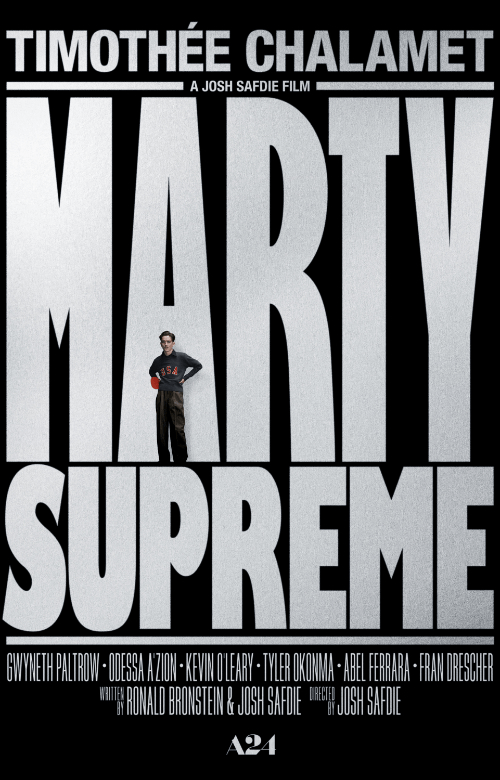
Marty Supreme (2025)

Marty Supreme (2025)

Tension and anxiety overwhelm a dark caper film that’s easier to respect than enjoy

Director: Josh Safdie

Cast: Timothée Chalamet (Marty Mauser), Gwyneth Paltrow (Kay Stone), Odessa A’zion (Rachel Mizler), Kevin O’Leary (Milton Rockwell), Tyler Okonma (Wally), Abel Ferrara (Ezra Mishkin), Fran Drescher (Rebecca Mauser), Luke Manley (Dion Galanis), John Catsimatidis (Christopher Galanis), Géza Röhrig (Bela Kletzki)

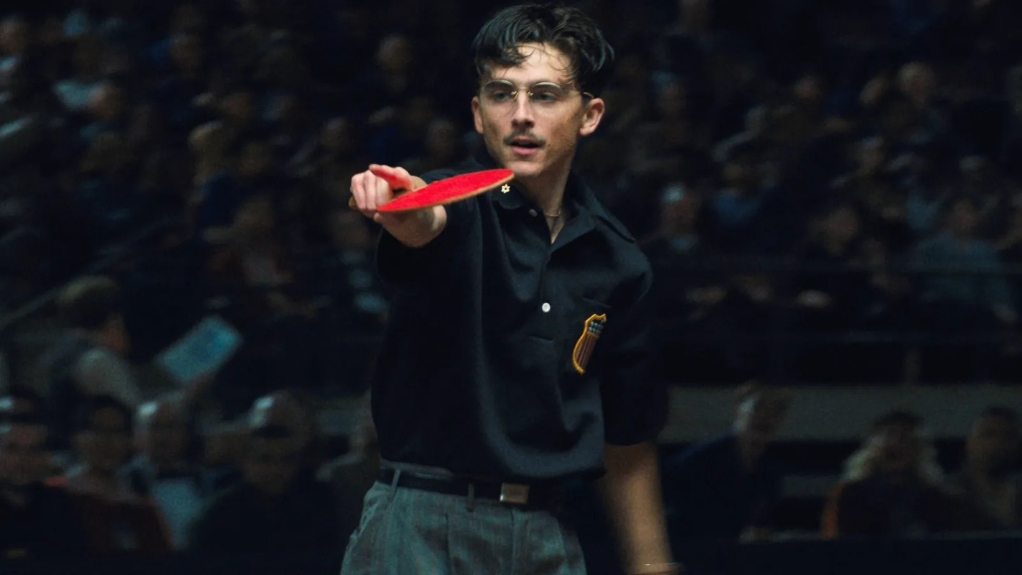
It’s 1952 and Marty Mauser (Timothée Chalamet) is in the gutter aiming for the stars. A prodigiously talented table tennis player, he’s convinced it’s his destiny to become the world champion and face of the sport. To achieve this, he’ll go to any lengths lying, cheating and stealing. Marty relies on his relentless charisma to rope people in to support his increasingly risky scams and ploys. Among these are Rachel (Odessa A’zion), the married childhood friend he has got pregnant and Kay Stone (Gwyneth Paltrow) a retired Hollywood star, married to ruthless billionaire Milton Rockwell (Kevin O’Leary).

Marty Supreme initially feels like it’s going to be a plucky underdog sports movie, with triumph due to defeat over adversity. What it actually turns out to be is something far closer to Safdie’s Uncut Gems, an immersive, sometimes hard to watch study in a man almost unaware of how frantically (and self-destructively) he is trying to keep lots of balls in the air. The bulk of the film focuses on Marty going to increasingly desperate lengths to secure the funding to get to the Tokyo World Championships. This picaresque journey sails into a swamp of stress and tension, involving gangsters with missing dogs, gun-toting New Jersey rednecks, sporting jocks furious at being hustled at table tennis, corrupt policemen in Central Park and constant parade of dangers, humiliations and threats with the odd spark of jet-black humour.

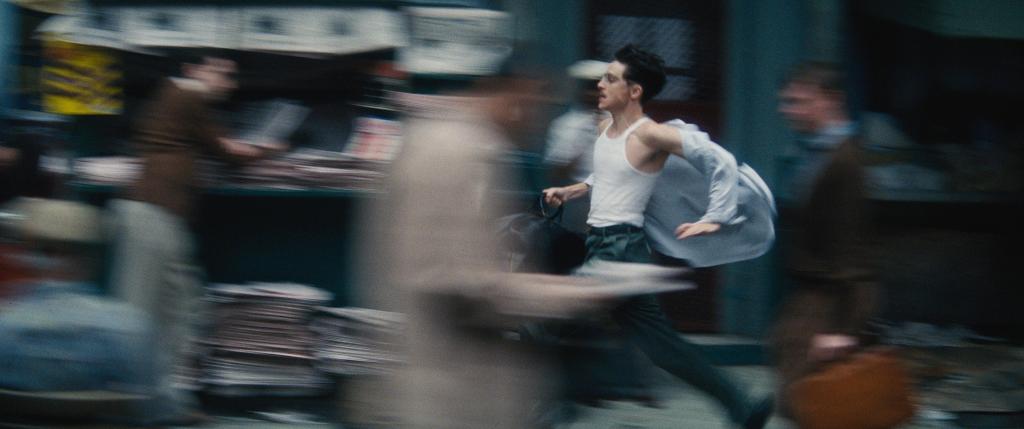
This is shot with a close-focused, shaky-cam series of close-ups, jerkily edited that practically spreads the stress of the on-screen desperation and disguised fear to the audience. The dialogue is frequently a parade of shouting, as the furiously deceived or exploited scream in between the never-ending stream of bare-faced, confidently delivered lies from Marty. And at its heart is charismatic dreamer Marty, who believes rules don’t apply to him and whose chaotic impulse control constantly pushes things further than can safely go, leading to him constantly seizing failure from success. Go into this expecting a lot of fun and laughs and you are probably in for a disappointment: go on expecting to be put through the wringer, and you will be better prepared!

Marty is a not a million miles from a Trump or Boris: a man of charisma and persuasion able to influence people to things, despite his shameless track record of instinctive lies and selfishness. Chalamet gives an extraordinary, screen-burningly vivid performance creating a man of total and complete certainty that he has a special destiny and therefore the normal rules of life do not apply to him, making him completely comfortable with routinely using and then abandoning the people around him. The fact he does this but still makes it constantly understandable why so many people keep coming back to Marty (despite being constantly stung) is a tribute to his soulfulness.

Beyond his in-the-moment confidence, Marty is a desperate, almost-principle-free force-of-nature, constantly re-spinning himself and his actions to new circumstances or audiences. Outrages become triumphs, lovers become sisters, compromises become commitments… Nothing is as it seems. His ego is also stunning: he demands tournament organisers put him up in the Ritz (where he eventually abuses the free bar), seduces Paltrow’s movie star largely it seems out of wanting to be seen as an equal and throws a colossal temper tantrum when outmatched at a tournament.

He’s constantly reinventing himself. Ideas he rejects as ridiculous or humiliating – a tour as half-time entertainment for the Harlem GlobeTrotters or an exhibition match with his Japanese rival – are later repackaged by him as his own flashes of inspiration when he eventually decides to do them. He genuinely can’t understand why others don’t see his greatness, or why the table tennis authorities can’t see his grandstanding and temper on court might be the best thing to grow the sport in the American market.

Marty believes he has all the tools for success, but his vaulting ambition and relentless energy is constantly undermined by his recklessness and tendency to act and, most especially, speak before he thinks constantly blows him up. He frequently turns on would-be supporters and friends with spontaneous abuse or smart-arse comments. He isn’t cruel (he says “I love you” persistently after various rude comments), but the damage is done. Over the course of film he’ll make a shockingly off-colour Holocaust joke (even he clocks the reaction, nervously saying it’s okay he’s Jewish), mocks Rockwell’s loss of his son fighting the same Japanese he’s now doing business with and bluntly tells Rachel she can’t understand him because she is not special (like he is).

Marty is, however, a phenomenally gifted table tennis player. Marty Supreme’s shooting of the sport is electrically fast (Chalamet trained for months to master the fast-pace, wildly aggressive style Marty plays with) and its staging of the matches is a surprisingly relaxing and entertaining. Especially when compared to the nerve-shredding anxiety-inducing terror of Marty’s less than successful hustling and scam career. Chalamet’s injects subtle panic and desperation under his relentless confidence.

Confidence is secretly what is lacking from retired Hollywood star Kay Stone, played with a wearily amused energy by Gwyneth Paltrow, both flattered and intrigued by the much younger Marty’s interest (you can see In Paltrow’s face the enjoyment behind her surface exasperation), This helps spark a desire to kickstart her career with a Broadway play – an awful looking Tennesse Wiliams pastiche, co-starring a self-important Brando-style method actor she despises (and Marty humiliates, to her delight). Her desire to be loved again is clear. There is a lovely shot where an entrance applause sees her turn away from the audience and her face to break into a radiant grin. It’s the same buzz of feeling desired and loved that keeps her connected to the disastrous Marty.

It’s also an escape from a life comes under the domineering control of her husband, pen-magnate Milton Rockwell (a reptilian and superbly vile Kevin O’Leary). Rockwell’s selfishness and manipulation of people is far more ruthless than Marty’s naïve, childish self-focus. It’s one of a host of great supporting turns. Odessa A’zion gives Rachel a scammers natural instinct (pregnancy and all) under her genuine devotion to Marty. A’zion is terrific, genuinely confused about her own feelings for Marty, anxious but determined and as prone to self-destructive gambits as he is. Tyler Okonma is similarly excellent as his best friend constantly dragged into Marty’s dangerous, half-baked crazy schemes at high risk to himself.

Marty Supreme throws all this towards with a relentless cavalcade of energy which is often easier to respect than to really enjoy. It’s such an anxiety inducing film, both in its plot and the shooting style, that it can leave you feeling genuinely uncomfortable in your chair. Does it offer any hope for Marty? It’s ending can suggest a level of personal growth: but seeing as we have witnessed throughout the film flashes of instinctive decency from Marty that have been cast aside for his own ambitions, I wouldn’t be confident. But that discomfort is probably right for a film that’s almost trying to make you feel sweaty and uncomfortable in your chair.

Frankenstein (2025)

Frankenstein (2025)

Del Toro’s dream project makes it to the screen in a lavish gothic spectacular

Director: Guillermo del Toro

Cast: Oscar Isaac (Baron Victor Frankenstein), Jacob Elordi (The Creature), Mia Goth (Elizabeth Harlander), Felix Kammerer (William Frankenstein), Lars Mikkelsen (Captain Anderson), Christoph Waltz (Henrich Harlander), David Bradley (Blind Man), Charles Dance (Baron Leopold Frankenstein), Ralph Ineson (Professor Krempe)

When he was a kid del Toro fell in love with James Whale’s Frankenstein. It was his dream project to create his own version of Mary Shelley’s classic. Year of dreaming pay off in this visually gorgeous, and emotionally engaging film – even if it’s also a little overlong and overindulgent. Del Toro throws everything into Frankenstein, creating a grand Gothic epic whose sympathies firmly lie with the abused Creature.

You must be familiar with the plot: in eighteenth century Germany, Frankenstein (Oscar Isaac), driven by never-really-resolved anger over his mother’s death, dreams of conquering death. With the funding of arms dealer Harlander (Christoph Waltz), who is also uncle to the woman he loves: Elizabeth (Mia Goth) who happens to be fiancée to his younger brother William (Felix Kammerer). On a stormy night, he gives life to the Creature (Jacob Elordi) but quickly rejects him. The Creature tries to find a place in the world, only to discover the world is full of prejudice and violence towards him and the Creature’s resentment against his thoughtless creator grows.

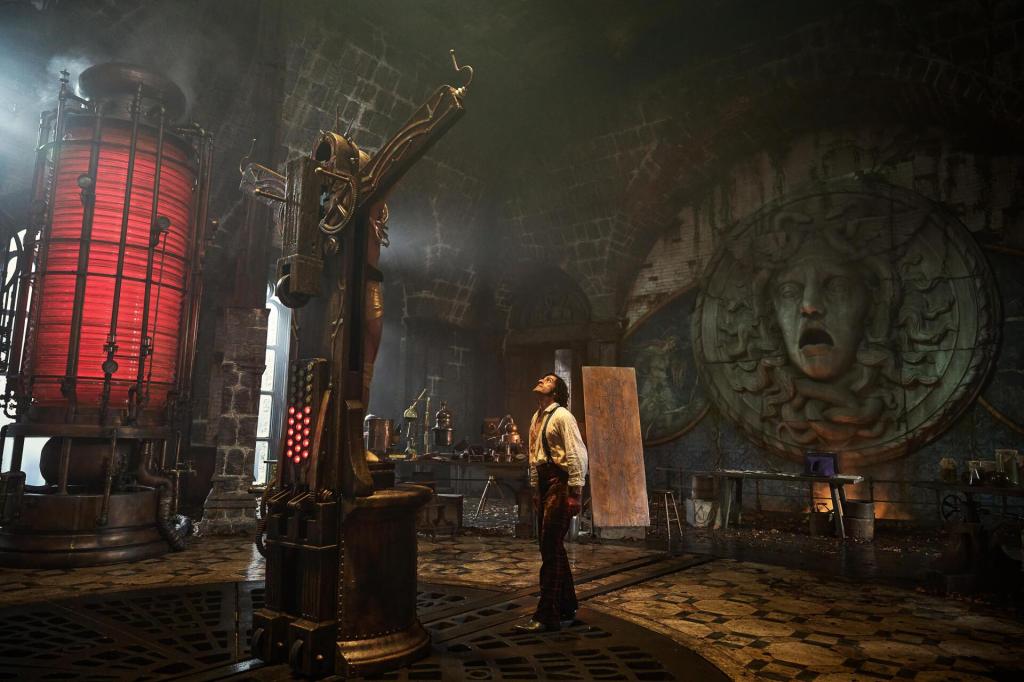
Del Toro’s film looks absolutely stunning, a sumptuously designed Gothic melodrama with extraordinary sets, grand costumes and beautiful cinematography (the Polar-set framing device is particularly striking, covered in lusciously contrasting blues and greens). There are striking echoes of the visual intensity of Pan’s Labyrinth, with Frankenstein’s lab turned into a mix of laboratory and classic temple, including a giant Medusa sculpture. The birthing sequence is a grandiose, operatically Gothic thing of beauty, a version of Whale’s film dialled gloriously up to eleven.

Del Toro’s film goes back to the novel in some ways (in themes and its Polar framing device), but in many ways it’s more of a complex, emotional reimagining of Whale’s film. Isaac’s Frankenstein, an egotist in need of an audience feels very similar to Colin Clive. Whale’s key motif, the Creature’s romantic yearning for the sun, becomes thematically central here. As there, Frankenstein conducts his experiments in a colossal Gothic tower, keeps the Creature chained and makes vague attempts to rear it and takes no responsibility for his actions or the deaths connected to it (in fact Isaacs’s Frankenstein lies and lies in a weasily attempt to protect his reputation). Waltz’s arms dealer funder of Frankenstein’s insanity feels like a version of Pretorious from Bride of Frankenstein, while del Toro goes even further than that film in deepening the bond between the Creature and the Blind Man.

Del Toro also doubles down on Whale’s implicit sympathy for the Creature. Here re-imagined as possessing near super-human strength and durability (his violent responses to being attacked being partially a result of his own strength being uncontrollably great), his child-like vulnerability is as dialled up as his actual physical invulnerability. The Creature feels, first and foremost, like a thought experiment by Frankenstein – and the fact this experiment has effectively rendered the Creature immortal and capable of a Wolverine-like cellular regeneration, condemned to walk the Earth forever alone only heightens the creator’s myopic selfishness.

One of del Toro’s key themes is terrible parenting. Much as he loathed his domineering, brutal father (Charles Dance, in a role perfectly crafted for his austere distance) who caned his face (his hands are too precious) when he flunked remembering anatomy facts, Frankenstein ends up echoing his father’s approach. When the creature constantly fails to say anything other than ‘Victor’, he too reaches for a cane to beat learning into him. Like his father, he resents the creature for being a bad reflection on him. He is, effectively, a dead-beat Dad, casually fathering a child which he has no idea how to treat, who falls back on cruelty.

There can be few Frankenstein’s on film less sympathetic than the version played here by an impressively egotistical Oscar Isaac. He’s full of preening self-importance and self-justification, obsessed with his task but giving no thought to its consequences. Twice he reanimates corpses then callously switches them off without a second thought. Giving birth to Frankenstein – just like in Whale’s film – after an initial interest (that is really self-congratulatory pride) his reaction is to chain him up in the basement and lose patience at him. With his constant milk-drinking there is a sense he’s a little boy who never grew up, and to him love is founded on possession: first of his mother, then his brother, then Elizabeth, all of whom at various points he wants to keep to himself – while his anger at the Creature is rooted in his failing to meet Victor’s expectations.

Frankenstein is at heart an angry mother’s boy, resenting his father for ‘taking’ his mother away from him (del Toro even has him wrapped in his mother’s distinctive red when he wakes to discover the Creature lives). There is more than an echo in that in his love for Elizabeth, the fiancée of his younger brother (who he also subconsciously resents for both ‘killing’ his mother in childbirth and for having the sort of relationship with his father Victor never had). These Freudian feelings are subtly enforced by Mia Goth playing both roles (it’s so subtly done I missed it first time round). Victor’s love for Elizabeth is just as possessive and selfish as that for his mother – and in the same ways his contempt for the Creature is for ‘failing’ him.

By contrast with this monster, the Creature is presented overwhelmingly sympathetically. Played with an outstanding physical and emotional commitment by Jacobi Elordi, he’s framed as a child stumbling towards a painful adolescence. Freshly born, he waddles like a toddler, stares in fascination at leaves floating on a stream and painfully forms the word ‘Victor’. Of course, it never occurs to his creator that this is the equivalent of “mama”. Only Elizabeth, who feels an immediate affinity with the sensitive soul, understands this. Only she tries to speak to him – or asks what his name is.

The poor Creature escapes into a world he quickly full of senseless, prejudiced violence. He bonds with a stag – only for the creature to be shot in front of him by hunters (who instantly turn their guns onto him). In conversation, Elordi presents a man who is sensitive, kind and gentle but capable of anger and fury. Del Toro crafts a tender relationship between the Creature and David Bradley’s Blind Man (the only person, other than Elizabeth, to look past his appearance). The film’s second act, focusing on the Creature’s emotionally painful interaction with the world is its strongest – not least because you feel throughout del Toro’s deep bond with him.

After all this, it’s surprising that Frankenstein ends on a note of hope. Del Toro’s film isn’t always quite nimble enough for this: some of its more optimistic moments can feel as if they have emerged a little thin air (or from the optimistic wishes of the director). In particular, Elizabeth’s bond with the Creature feels so swiftly sketched out it failed to completely convince (more time on this and less time on Waltz’ creepy arms dealer would have been welcome). But this feels like a passionate, committed and perhaps above all beautiful to-look-at piece of work with a real emotional heart. This easily lifts it into the upper echelons of Frankenstein adaptations.

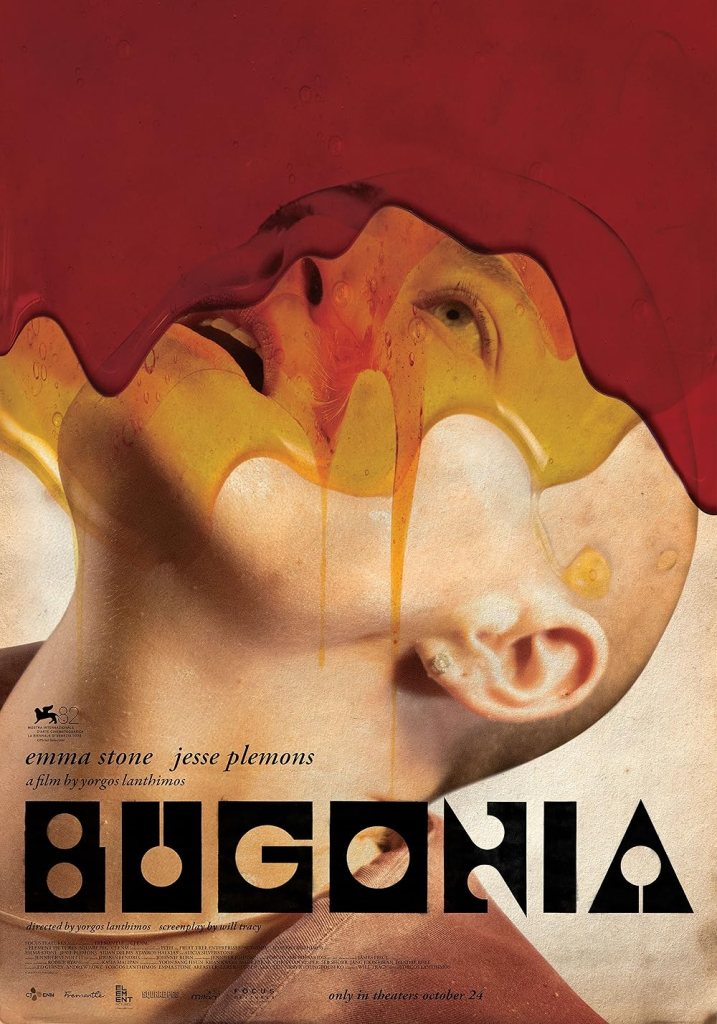
Bugonia (2025)

Bugonia (2025)

Satire, kidnap drama, politics and more combine in Lanthimos’ partially successful thriller

Director: Yorgos Lanthimos

Cast: Emma Stone (Michelle Fuller), Jesse Plemons (Teddy Gatz), Aidan Delbris (Don), Stavros Halkias (Casey), Alicia Silverstone (Sandy Gatz)

The world sometimes feels like its racing towards hell in a handcart And those on the bottom surely can’t help but look at the super-rich and wonder what on Earth do I have in common with them? But some, maybe particularly beaten down by life, may conclude something different: I’ve got nothing in common with the super-rich, because they are literally not of this Earth. That they are mysterious aliens who walk among us, planning to wipe us out. Bugonia takes a deep dive into the troubled, damaged psyche that can embrace the worm-hole of conspiracy theory, as well as the uncaring platitudes of the mega-companies that (maybe) rule the world.

Michelle Fuller (Emma Stone) is the CEO of Auxolith, an all-powerful pharmaceutical company that operates (at times) right on the fringes of legal. She becomes the target of beaten-down beekeeper Teddy Gatz (Jesse Plemons) and his loyal learning-disabled cousin Don (Aidan Delbris). Teddy is certain Michelle is from the planet Andromeda, that she can contact her mothership through her hair and that her mission is to wipe out mankind. Locking her in the basement of his farm-house, they enter into a mix of interrogation, battle of wills and wits and fluctuating power balances. Is Teddy deranged, vulnerable or misguided? Is Michelle scared victim, arch-manipulator or heartless CEO?

All this plays out, often in tight close-up, in Lanthimos’ jet-black comedy, which is two parts social satire to one part blisteringly nihilistic view of humanity and our future. As Burgonia’s carefully oscillates from one side to another, its political views and stances can be hard-to-perceive, but it certainly suggests Lanthimos has hardly the highest hopes for future. This helps make the film fresh, engaging and challenging. It’s constant cuts from one ‘side’ to the other, also means these two rivals rarely share the same frame, visually imposing their distance and rivalry – Lanthimos even uses non-complementary framing to place them awkwardly together, two people with no common ground.

While Teddy nominally holds the cards as the kidnapper, he’s so clearly such a weak, scared, vulnerable character (often framed weakly within the film) it’s hard not to feel sorry for him. Similarly, Michelle may go through some truly ghastly treatment as Teddy tries to unmask her ‘secret identity’, but remains such a forceful, dominant character (“I’m a winner and you are a fucking loser” she rants at Teddy at one point), framed with such utter assurance, her bland corporate indifference to others and willingness to manipulate the fault-lines in her kidnappers relationships (especially the gentle, child-like Don) never make her feel like a victim but just as dangerous as Teddy.

Teddy’s crazy, flat-Earth-mindset (and Lanthimos punctures each chapter with a view of an increasingly flat Earth, which is at first a darkly comic hat tip and then takes on a second chilling meaning late on) ranting and raving is presented as both darkly funny and also unsettling in how he can use it to justify any violence. Sure, it’s funny that he shaves Michelle’s head and covers her with cream to ‘weaken her influence’, or with gentle earnestness stresses he leads the human resistance to Andromeda (membership currently two). Slightly less funny that he insists he and Don chemically castrate themselves so as not to be seduced, or that pumps Michelle full of over 400 volts to try and unmark her (all while insisting her is a humanitarian, but as an alien Michelle technically has no human rights).

But then Michelle’s corporate coldness is rarely absent. She may remember all her staff’s name with a practised efficiency, but there is a degree of empathy missing in her, replaced with pragmatic hardness. As it becomes clear Teddy’s selection of her is (perhaps) more connected to her drugs companies treatment of his mother (Alicia Silverstone), her blasé assurances that everything was done legally and lack of any real guilt speaks volumes.

Lanthimos always keeps us guessing with Michelle: at moments she will switch from fear and vulnerability, to suddenly snapping back with utter authority, absorbing all the power in the room from the frequently hapless Teddy. Teddy in fact increasingly resembles a lost little boy (he even cycles through town with the relentless pedal-turning speed of a toddler), way-out-of-his-depth and at times all but deferring to Michelle’s advice about her own kidnapping.

Bugonia becomes a dance, not only between truth and fiction, but between two strikingly very different people, one so accustomed to power than even when in a nominally powerless situation they don’t feel anything but a winner, the other a desperate, scraggy haired loser who seems unable to really process what he should do to win a hand where he seems to hold all the aces. To make it work you need two electric actors: Lanthimos has this in spades with two trusted collaborators.

Stone’s ability to switch between corporate fear, desperate negotiation and earnest insincerity are as striking as her ability to keep her character so utterly, eventually terrifyingly, unknowable. In every second of Bugonia you can never be certain exactly what sort of person Stone is playing, her sociopathic assurance both understandable in the situation but also deeply unsettling. Plemons’ gives Teddy a child-like earnestness and desire to do the right thing that underpins his unhinged, ludicrous conspiracy theories, making him someone we both pity and understand is capable of doing terrible things for reasons he can justify to himself. Credit also goes to Aidan Delbris’ affecting performance as the gentle, easily-led Don.

Bugonia may well over-play its hands at points. It’s hard not to expect some sort of twist coming our way – I’m not sure how many people will be surprised by how the film plays out. It’s nihilistic ending feels a little too hard-edged and pointed for a film that hasn’t, until that point, embraced that level of flat-out cynicism. A clumsy introduction of a cop with a shady past is thrown in merely (it seems) to give us another reason to feel sorry for Teddy. Lanthimos’ at points engages, not always successfully, in a level of body horror that wouldn’t feel out of place in the excesses of Cronenberg. But then there are moments of real wit: the paralleled cuts of both Teddy/Don and Michelle going through their fitness regimes, a painfully uncomfortable bolognaise meal that tips into a full-out barney between the two stars, it’s unsettling near-finale in Michelle’s office and the playful realisation that much of the truth was there from the start, but hidden.

Bugonia might be a little too scatter-gun and self-consciously crazy to be a really effective satire, but with two terrific performances and an unsettlingly tense shooting style from Lanthimos (with echoes of everything from Dreyer to Hitchcock) there is enough of interest there to keep your mind bubbling even after it’s hard-hittingly sour ending.

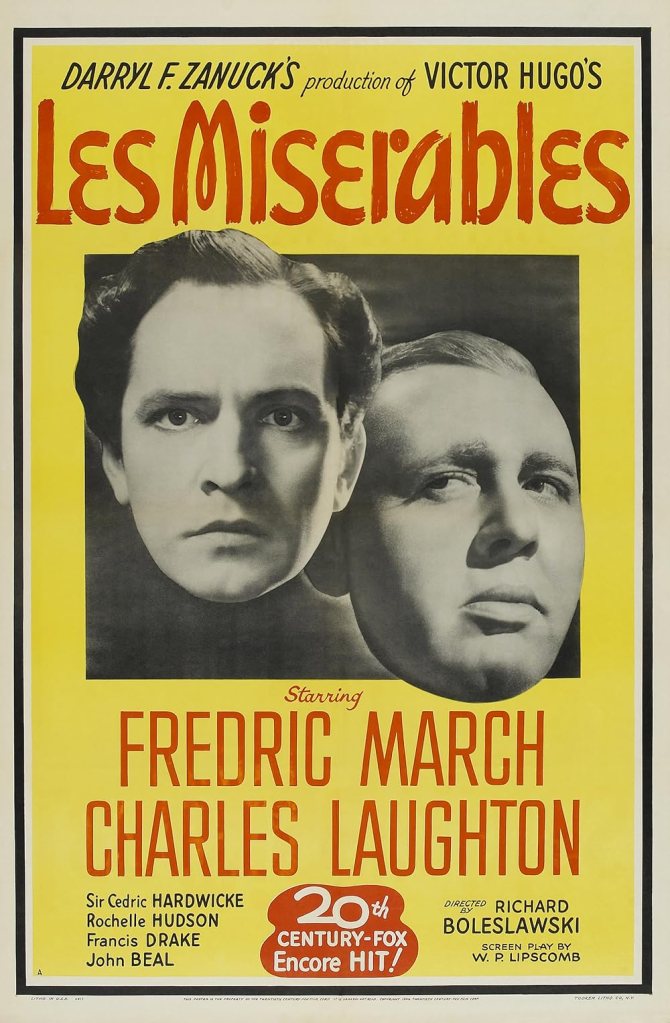
Les Misérables (1935)

Les Misérables (1935)

Odd choices are made in this Hugo adaptation, despite good photography and performances

Director: Richard Boleslawski

Cast: Fredric March (Jean Valjean), Charles Laughton (Inspector Javert), Cedric Hardwicke (Bishop Myriel), Rochelle Hudson (Cosette), Marilyn Knowlden (Young Cosette), Florence Eldridge (Fantine), John Beal (Marius), Frances Drake (Éponine), John Carradine (Enjolras)

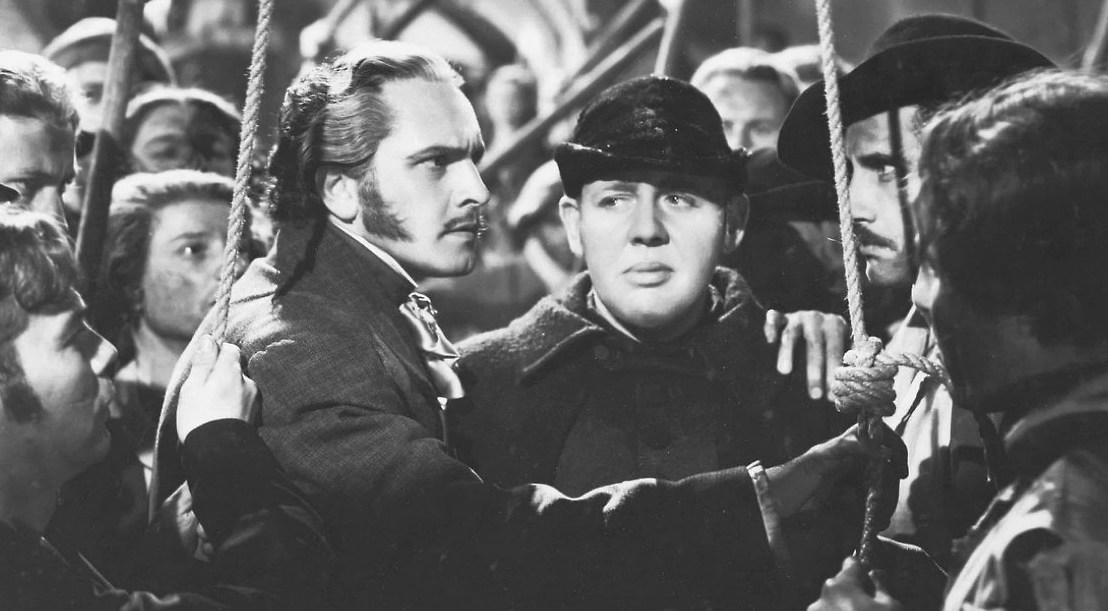
There isn’t a more famous loaf of bread in literature, than that stolen by Jean Valjean to feed his starving family. There’s something quite sweet about the fact that Richard Boleslawski’s film of Hugo’s doorstop gives that loaf its moment in the sun, as its half-eaten remains are produced as evidence in Valjean’s trial. It’s an unintentionally funny moment, but feels right in a sometimes blunt film, that at times makes odd decisions for those of us so familiar now with the plot’s ins-and-outs and the moral up-righteousness of its lead character after forty years of the musical. Boleslawski’s version is an odd mix, part psychological drama, part atmospheric thriller, part thuddingly obvious soap where a loaf of bread needs to be literally seen. Parts of it work extremely well, other parts weigh the film down like the chains on its galley slaves.

The film is overwhelmingly focused on the clash between Valjean (Fredric March) and Javert (Charles Laughton). One a good man who wrestles with temptation, but follows the sprit of justice. The other a rigid fanatic, who sees the letter of the law as gospel and the rights and wrongs of a situation an irrelevance. First meeting when Valjean serves a decade as a slave at the oars in the galleys, their paths recross after a released Valjean has a road-to-Damascus moment after the intervention of a noble priest (Cedric Hardwicke). Reinventing himself as ‘Monsieur Madeleine”, he becomes mayor of a small town and protector of Fantine (Florence Eldredge) and her daughter Cosette (Rochelle Hudson). But he cannot escape the pursuit of Javert which carries him into hiding for years in Paris, where a now grown-up Cosette falls in love with reforming student Marius (John Beal), leaving Valjean with one last dangerous choice.

Les Misérables restructures the novel into three acts, each presenting Valjean with a moral quandary. As such, Fredric March’s impressive performance must be unique among Valjean’s: this version is forever tempted with greed, anger and his own desires, constantly struggling to overcome his baser feelings. March is very good at bringing to life this conflict, just as he sells the sense of awakening purpose Valjean feels washing over him after the Bishop’s intervention prevents him from being returned to prison. It’s a muscular, agonised performance of a man constantly striving, even in the face of his resentment, to live up to his adopted moral principles. So, much as Valjean would like to let another man be accidentally condemned for his crimes, or to keep Cosette to himself or pull a trigger on Javert (March’s skilfully communicating the deep internal conflict each time) he’ll still (however reluctantly) find himself doing the right thing.

He contrasts excellently, with Laughton’s rigid, well-spoken, self-loathing Javert who has absorbed his moral code so completely, its left no room for any other form of principle or emotional judgement. Introduced, lips quivering, as he explains being denied promotion due to his convict father, Laughton’s Javert has channelled that resentment to worshipping the penal code as God. As he repeats, several times, good or bad is irrelevant, it’s just about the law. Of course, Laughton’s performance bubbles with repressed frustration, his pursuit of Valjean clearly motivated by far more personal feelings of anger and envy than he is willing to admit. Valjean is a spoke in his wheel of justice, a factor that makes no sense to him.

Boleslawski’s film is at its best when these two face off. It’s also at its most stylistic for these sequences. Les Misérables is awash with Gregg Toland’s atmospheric, mist-filled photography and expertly uses his expressionistic shadows. It’s depiction of a Parisian uprising, just like it’s introduction of a fast-paced horse chase between Valjean and Javert, are snappily edited and throw in a parade of dynamic Dutch and high angles. At the end of each act, Christian imagery is well used (in two cases, shrines to Mary and Jesus) to add emotional heft. A pursuit through grime and mist-filled sewers near the film’s close has a Fritz Lang atmospheric strength (did Carol Reed watch this before The Third Man?) as well as the film’s most effective use of music to build atmosphere as Valjean desperately submerges himself and Marius to hide.

There is effective stuff in Les Misérables. So, you try your best to forgive the fact it’s full of extremely on-the-nose, obvious touches. The introduction of the bread at the trial is not an end of its obviousness: for starters, the galley’s were prison hulks, not actual ships rowed around by convicts (where do they imagine these enormous hulks are going?). Truncating so much of the book down – and focusing overwhelmingly on its two leads – means many other parts of the story are short-changed or make little impact or sense (the hilariously watered down Parisian revolutionaries don’t turn up until the final 40 minutes). Florence Eldridge’s Fantine (all references to her prostitution are of course cut) does almost nothing but die – although not before the film gives her a (unique) ludicrously sentimental reunion scene with her daughter (played by a highly irritating precocious film-school brat before she grows up into Rochelle Hudson). Clearly the actual tragedy here (a mother never sees her daughter again) was considered too much.

Then there are the strange mis-readings and mis-interpretations. I can understand why Marius and his law students are re-imagined, by conservative Hollywood, into legal reformers rather than idealisitic revolutionaries (Marius even denounces the very idea of overthrowing the government as terrible). Here they want only penal reform – although of course, while ensuring the guilty are harshly punished – and chat like champagne socialists. It’s a bit of a mystery why this call for slow-paced, moderate social reform erupts into throwing up barricades, but clearly audiences at the time couldn’t be expected to get on board with anti-Monarchist cells. They’d probably agree with Eponine (interpreted here as a sort of femme fatale and Marius’ secretary) that it’s all a silly, slightly disreputable, waste of time.

However, even more strange, is the inexplicable interpretation of Valjean’s desire to keep Cosette to himself not due to being a protective father-figure investing everything in his life into his daughter, but instead an unpleasant sexual desire to make Cosette his wife. Even leaving aside this utter perversion of the novel, since we’ve seen Valjean raise her from the age of about 6 it’s hard not to feel a bit of bile forming in your throat at the stench of grooming this gives the relationship. It’s almost as if Hollywood could only imagine a man going to great lengths to protect a woman if he wanted to eventually get in her pants.

It’s odd reinventions like this that don’t quite work even within the world presented by the adaptation, let alone compared to the original source, that weighs the film down too much. They are blotches in the streamlining of a huge novel. But when the film focuses on an increasingly personal clash between two men, both well played by March and Fredric, and its atmospheric visuals, it works much better.

The Dresser (1983)

The Dresser (1983)

One of the best films about the magic and trauma of theatre, with two powerhouse lead performances

Director: Peter Yates

Cast: Albert Finney (Sir), Tom Courtenay (Norman), Edward Fox (Oxenby), Zena Walker (Her Ladyship), Eileen Atkins (Madge), Michael Gough (Frank Carrington), Lockwood West (Geoffrey Thornton), Cathryn Harrison (Irene), Betty Marsden (Violet Manning), Shelia Reid (Lydia Gibson), Donald Eccles (Godstone), Llewellyn Rees (Brown)

For centuries British theatre was run by Actor-Managers. Stars with complete control of their companies, where they (and their wives) played the best roles – sometimes years past the point where it was still suitable – until the next generation emerged to build their own companies. The Dresser shows this world’s dying days, at the height of the war, when Sir (Albert Finney) a legendary actor is shepherding an aged company around the provinces to perform, while his health and mental sharpness teeter, Lear-like, on the edge of the abyss.

If Sir is Lear, his Fool is Norman (Tom Courtenay) his dresser. A waspishly camp man whose entire life revolves around every inch of Sir’s whims, shepherding, coaxing and bullying the man onto the stage, somewhere between a valet, son and nursemaid. Sir remains a force-of-nature, toweringly bombastic egotist and man of magnetic charisma, with an all-consuming, obsessive love for the theatre. The Dresser takes place in January 1942 in Bradford, largely during a performance of King Lear which Sir’s declining health has placed on a knife-edge. Can Norman hold Sir together to give life to Shakespeare’s greatest tragedy for the 227th time?

The Dresser is based on Ronald Harwood’s play, which was semi-based on Harwood’s experiences as dresser then business manager to Donald Wolfit, one of the final breed of the old-school actor-managers Sir represents. (Harwood hastened to add, neither he nor Wolfit were portraits of Norman or Sir). While it’s a sometimes acidic look at the backstage politics and egos of touring theatre, it also richly celebrates the power of theatre and the momentary (and the film is unsentimental enough to show it is momentary) sense of family that can develop in theatre, that can end with that final curtain. In other words, The Dresser understands the brief, bright flame of theatre can be – and what a transformative feeling and dizzy drug it can be.

Both Sir and Norman are addicted to the grease-paint, their whole lives revolving around theatre and that elusive search for perfection. Even if Sir’s health is failing and sanity is crumbling – pre-show, Norman finds him raging in the streets of Bradford like Lear in the storm, only barely aware of who he is – ‘Dr Greasepaint’ can still briefly restore him to the man he was, spouting Shakespeare, bemoaning and relishing the huge weight of bringing art to life night-after-night. Norman is equally consumed by theatre: he can barely speak to others (such as train manager or a baker) without his conversation being littered with impenetrable theatre-speak. He’s as well-versed in Shakespeare as Sir is and flings himself into his backstage tasks with the same gusto Sir tackles a soliloquy.

These two have a symbiotic relationship: Sir for the support and dedication Norman exerts to get him on stage, Norman for the glorious world (and purpose) Sir gives him access to. Yates uses mirrors, framing and shared reflections to frequently frame these characters together, visually linking them in a Bergmanesque way as elements of the same personality. But, the relationship is never as straightforward as that, complicated by underlying feelings on both sides. Norman’s homosexuality – over-looked in a world where such feelings are a crime (another member of the company has recently been fired for what sounds like cottaging) – complicates his obsession with Sir, while Sir’s affection for Norman always has the hint of a Lord’s affection for his valet: a man he will confide in, but would never imagine inviting to dinner.

This complex interplay of both characters urgently needing the other, but with an underlying imbalance in their level of true emotional engagement is a subtle dance brilliantly handled throughout Yates’ and Harwood’s film: so much so, it is a surprise to many audiences that Sir utterly fails to mention Norman at all in his draft autobiography even though it’s about as likely as Churchill name-checking his butler in his. Sir and Norman may be partners in the same task – creating theatre – but Norman’s mistake is to see himself as an equal, something Sir never truly believes he is.

There is, however, no doubt about the partnership between the two actors. Tom Courtenay, who had played Norman on stage, is extraordinary. With his flamboyant hands and a voice divided between camp, whiny and ingratiating, constantly reaching for the bottle to power through the stress, Norman is as loyal, dutiful and comforting and he can be waspish, bitter, selfish, possessive and cruel. Courtenay can switch from coaxing Sir like a recalcitrant child, to throwing a potential rival for Sir’s attention to the wall and threatening all manner of damnation. It’s an astonishingly multi-layered performance, with Courtenay shrewd and brave enough to avoid making Norman a fully sympathetic figure but someone so soaking in desperation that even at his most self-pitying you feel for his desolation and emptiness.

Alongside him, Albert Finney is imperiously brilliant as Sir (playing a role almost 25 years older than him). Finney’s Sir is magnetic (they may grumble about him, but in person the company treat him with awe) and charismatic (his booming voice carries such power, it can even stop a departing train). But he’s also selfish, cruel, childish and intensely vulnerable. He’s got all the egotism of the actor (“The footlights are mine and mine alone. You must find what light you can.”), the productions revolve around him (he even continues to direct mid-performance, muttering instructions from Othello’s death bed). But he’s teetering, his mind crumbling, constantly looking to Norman for assurance, Finney living Sir’s fear at the approaching undiscovered country.

Both actors are extraordinary in a play that understands the addictive power of theatre. The Dresser avoids the trap of making Sir an Old Ham: in fact, the production we see (for all its old fashioned air) contains a performance of real power from Sir, rousing himself to touch something transcendent. Of all his 227 Lear’s this might be finest. Cynical technicians and wounded pilots weep openly. Thornton (Lockwood West), an ageing second-rate actor hastily promoted to Fool, talks of how the part has made him hungry for more. Oxenby (a marvellously louche Edward Fox), the youngest company member, clearly is ready for the new era (he carries a script full of bad language he longs to stage) but even he (after an initial point-blank refusal) throws himself into the backstage effort to create the storm. For all the rivalries, when the play is on, everyone briefly feels part of the same team working towards the same goal.

It’s a film with a melancholic feeling of an era coming to a close. It’s also one that punctures the character’s illusions. Sir is a star, but there are greater stars (with real knighthoods) in London; Norman may feel like his relationship with Sir is special, but Sir’s relationship with Madge (a brilliant Eileen Atkins, unflappably loyal and deeply pained under her professionalism) predates his and is more genuine. But it’s also one that understands the transformative power of live theatre. With stunning performances by Finney and Courtenay, backed by a marvellous, faultless cast it’s one of the finest films about theatre ever made.

The Paper Chase (1973)

The Paper Chase (1973)

Overlong, shallow mentor-mentee film that never gets anywhere near finding enough depth or humour

Director: James Bridges

Cast: Timothy Bottoms (Hart), Lindsay Wagner (Susan Fields), John Houseman (Professor Charles W Kingsfield Jnr), Graham Beckel (Ford), James Naughton (Brooks), Edward Herrmann (Anderson), Craig Richard Nelson (Bell), David Clennon (Toombs)

It’s a tale as old as time: the ambitious youngster and the domineering mentor they both loath and love. The Paper Chase rolls through this familiar set-up, based on a novel by law professor John Jay Osborn (descendant of that John Jay) who might well have seen a bit of himself in his novel’s stern mentor. That mentor is Professor Charles Kingsfield (John Houseman), an imperiously patrician professor of contract law at Harvard. Kingsfield is a demanding teacher, treating his class with arch disdain, demanding the best from them. Among his class is Hart (Timothy Bottoms), a fiercely hard-working ambitious young man who finds himself not only increasingly admiring Kingsfield but also (unknowingly at first) in an on-again-off-again relationship with Kingsfield’s daughter Susan (Lindsay Wagner).

This forms the meat of James Bridges’ dry, only fitfully engaging Harvard-set film which ambles gently from largely predictable plot-beat to plot-beat. After an initially promising start it swiftly outstays its welcome. The Paper Chase is frequently far-too sombre, slow-paced and unenlightening film which frequently flatters to deceive either as a character study, an insight into the dynamics of the mentor-pupil relationship, a love story or a comedy. It bears considerable, highly unfavourable, comparison with the more modern Whiplash which takes essentially the same set-up (an ambitious student desperate to impress a domineering mentor he loathes and loves) but uncovers far more psychological depth and insight.

The Paper Chase’s main claim to fame is John Houseman’s Oscar-winning performance. Despite his veteran Hollywood status as producer and screenwriter, Houseman was effectively a newcomer with only a brief performance in conspiracy thriller Seven Days in May prior to this. Houseman took on a part turned down by a host of leading actors (James Mason was the original choice, but scheduling ruled him out). He had the advantage of years of experience as an acting coach at the Juilliard School – his students reflecting Kingsfield was not a radical departure from Houseman’s own teaching style – and having a legendary standing in American Theatre not a million miles away from Kingsfield’s standing in the law.

It’s a smooth, eye-catching performance but neither the role (nor Houseman’s performance) are particularly complex, mostly requiring an ability to confidently roll out arch syllables and raise sceptical eyebrows. It’s funny, but a surface delight, the film continuously avoiding any attempt to delve into the character. Does he brutally push his students to prepare them for a brutal profession? To separate the wheat from the chaff? Because he’s a bully? Who really knows. When a student in his class, struggling to keep up, attempts suicide, Kingsfield barely reacts. He’s a stone-eyed enigma to the end, the character all front and no depth. It’s hard not to think Houseman couldn’t have played it standing on his head (he wrote later, he almost felt ashamed about winning an Oscar for what he considered a ten-day vacation from his teaching).

There is a chance for uncovering real psychological interest in Bottom’s role. Unfortunately, Bottoms lacks Houseman’s charisma, making Hart an unengaging, frequently uninteresting character, who it becomes fundamentally hard to care about – a death knell in a film about Hart’s ability to grow up and not depend on the approval and praise of others. Trapped in The Paper Chase is an interesting tale of a man latching onto a father figure – a father figure who tries to teach him that looking for others for approval is a fool’s errand by treating him with disdain throughout. Such a tale never comes into focus.

Neither does the film’s chronicle of the relationship between Hart and Susan – engagingly played by Lindsay Wagner – burst into the sort of witty interplay the script is straining at. Instead it increasingly drags, not helped by the underplaying of both actors. The barrage of bust-ups and disagreements between them keeps promising to burst into life like an updated Hepburn-Tracy vehicle. Instead, it meanders almost pointlessly, neither making interesting points about Hart’s obsession with proving his worth or Susan’s desire herself to defy her father.

A far more interesting film would have delved more into exactly what attracts Hart to Susan. Surely it can’t be a coincidence that Hart feels an intense attraction to the daughter of the law professor he is obsessed with impressing? Are Hart’s feelings sparked by a subconscious awareness from their first meeting of the similarities between Susan and Kingsfield? Freud would go to town on Hart’s continuing desire to both seduce Susan in the bedroom and Kingsfield in the classroom. It could be rich material for the film, but The Paper Chase seems utterly unaware of this engaging subtext, settling instead for the blandly predictable.

Similarly, the film has no interest in exploring any of the interesting questions around teachers like Kingsfield, who rely essentially on intimidation and academic hazing to motivate students, ruthlessly accepting the collateral damage of drop-outs like a badge of pride. Never once does The Paper Chase pause to question the merits or failings of this system or the type of people it produces or behaviours it encourages. The suicide attempt of a classmate at the pressure applied by Kingsfield, doesn’t stop the rest of the cast giving him a round of applause at the end of the semester. Never does it seem to make up its mind whether Hart’s perverse hero-worship of Kingsfield (who effects to have no idea who he is) is Stockholm syndrome or a vindication of Kingsfield’s methods by transforming a potentially mediocre lawyer into A-Grade material.

In fact as the credits rolled on The Paper Chase I was left wondering what on earth I was supposed to take out of this. Does Hart learn to care or not care about what Kingsfield thought of him? Was Kingsfield a heartless law robot or a great teacher or something in between? Sure, it culminates with Hart throwing away his final exam mark sight unseen – but the film is careful to make sure we the audience have seen he’s (of course) aced the class. It’s a sign the film was as blindly in love with Kingsfield as Hart was, vindicating all his methods (deliberate or otherwise). The Paper Chase is slow, unenlightening, nowhere near funny or dramatic enough to sustain interest for a class let alone a whole semester.

Nosferatu (2024)

Nosferatu (2024)

Eggers’ wonderfully atmospheric remake is creepy, haunting and quite extraordinary

Director: Robert Eggers

Cast: Bill Skarsgård (Count Orlock), Lily-Rose Depp (Ellen Hutter), Nicholas Hoult (Thomas Hutter), Aaron Taylor-Johnson (Friedrich Harding), Willem Dafoe (Professor Albin Eberhart von Franz), Emma Corrin (Anna Harding), Ralph Ineson (Dr Wilhelm Sievers), Simon McBurney (Herr Knock)

Robert Eggers dreamed so long of his own version of FW Murnau’s seminal vampire film (and Bram Stoker copyright infringement) Nosferatu, it was originally announced as his second film. We had to wait a bit longer, but it was well worth it. Eggers’ experience helped him create a film infinitely richer than I suspect he would have made ten years earlier. Nosferatu is an astonishing, darkly gothic, richly rewarding film, glorious to look at and a fiercely sharp exploration of the subtexts of both sources. It can never match the original’s seminal impact, but celebrates and elaborates it.

The story hasn’t changed dramatically from the one Murnau ripped off from Stoker. In Wisborg, junior solicitor Thomas Hutter (Nicholas Hoult) leaves his beloved wife Ellen (Lily-Rose Depp) for Transylvania and a lucrative land deal with the mysterious Orlock (Bill Skarsgård) that could lead to a comfortable life for him and his new wife. Unfortunately, there are three things he doesn’t know: firstly, the Orlock is a ravenously cruel vampire, with extraordinary supernatural powers; second his employer Knock (Simon McBurney) is an occultist worshiper of Orlock; thirdly, Orlock has used his mental powers for years to terrorise and groom Ellen from afar and Hutter’s presence is the final step in his scheme to control her. It won’t be long until a deadly curse plagues Wisborg.

Egger’s dark (but extremely beautiful) gothic film drips with atmosphere, gloomy shadows rolling over its elaborate sets, the drained out night-time shots reminiscent of the tinted black-and-white beauty of the original. The entire film is soaked in love for silent-era horror, with homages to Murnau, Dreyer, Sjöström and so many others I couldn’t begin to spot them all – though I loved Orlock’s gigantic shadowy hand creeping Murnau’s Faustus-like over Wisborg. The film drowns in folk horror, from its snow-capped Transylvanian countryside dripping in unspeakable hidden evils to the unreadable motives of a mysterious Transylvanian village.

At its heart is an exploration of the sexual undertones of the vampire legend. Orlock’s assaults leave his victims are overwhelmingly sexual, with Orlock’s body thrusting forward while he drains the blood of his groaning victims. That’s not to mention Orlock’s revolting sexual manipulation of Ellen. Nosferatu leans heavily into Stoker’s dark sexual awakening subtext. Orlock’s psychological manipulation has left Ellen traumatised, torn between dark sexual desires and romance with Hutter. Nosferatu opens with a dark (dream?) sequence, as Ellen rises with sensual sighs from sleep, drawn towards Orlock’s seductive shadow in sheet curtains, before joining him outside for something that looks an awful lot like sex before Eggers cuts with a jump scare shot, our first glimpse of Orlock.

This is an Orlock radically different from Max Schreck’s original. While he shares his long nails and angular posture, here he is no-more-or-less than a decayed, rotting corpse. His body is covered in sores of decayed skin, with everything (including his penis) halfway to the compost heap, his bony legs and hips positively skeletal. There are homages to his Vlad the Impaler roots, from his fur-lined uniform coat (that like the rest of him has seen better days) to his surprisingly well-groomed moustache. But there isn’t a trace of the handsomeness of so many Draculas – this Orlock is possibly even more repulsive to look at than the rat-faced monstrosity of the original.

Skarsgård’s make Orlock a truly ruthless figure, delighting in his natural cruelty. With Hutter his looming, shadowy menace offers not a jot of home comforts, working to terrify a man who he sees as a perverse romantic rival. (His hallucinatory blood-sucking assault on Hutter is filmed in a manner reminiscent of rape). Throughout, he treats almost everyone he encounters with contempt and lofty disgust and takes a sadistic delight in torturing Ellen’s friend Emma Harding’s family, culminating in a truly shocking scene of grizzly horror. While the original Orlock was almost feral, like his rats, this one is a monstrous decayed sorcerer with a never-ending hunger and sadistic desire to play with his food.

He also has something the original never had: a voice. Skarsgård spent weeks in training to develop this (digitally unaltered) vocal range, a rolling bass-rumble which wraps itself around a raft of Dacian dialogue. Eggers’ gives him immense supernatural skills, in a film dripping with occult magic. Simon McBurney’s Knock (a remarkable performance) is a lunatic drowning in it: covered with dark markings, biting the heads of pigeons and communicating with Orlock by sitting naked in a Pentecostal star. His brain has been flushed out by Orlock’s mental power (who treats him like dirt) and the vampire’s hypnotic voice overwhelms the senses: just a few sentences drains Hutter of willpower (Nicholas Hoult’s fear is so palpable here you could almost touch it). Orlock’s malign influence can twist people or make them suddenly ‘wake’ with no idea of where they’ve been.

The power of his influence twists and distorts emotionally and physically. Lily-Rose Depp captures all this in a remarkable physical and vocal performance, as Ellen falls victim to Orlock’s mental manipulations. Depp throws herself into the most violent fits since Linda Blair: her body spasming, her voice distorted into an Orlock-mirroring gurgle, her eyes rolling back, her inhibitions falling away and blood weeping from deeply disgusting places, especially her eyes. Depp’s performance is extraordinarily committed, her fear and self-disgust at her manipulated sexuality (eekily from childhood) by the Count as tender as he hatred of him is sharp and all-consuming.

It’s never clear how far the vampire wants to screw Ellen, and how far he wants to consume her (Eggers even suggests, towards the end, that Orlock may even welcome his own destruction – perhaps the rapacious hunger is too much?). What is different from the original is Orlock and the plague he brings with him are different. While the original was a destructive force of dark nature, this Orlock is focused exclusively on punishing Ellen, with a literal plague striking down Wisborg.

In the face of this beast, the powers of science and reason are powerless (as Aaron Taylor-Johnson’s delicately performed Harding discovers, refusing to believe until its far too late). Like Murnau’s original, the powers of science and reason (such a key weapon against the vampire in Stoker) are useless. Even rationalist Dr Sievers (a fine performance by Ralph Ineson, channeling Peter Cushing and Michael Hordern) – a man so calm even the insanity of Knock can’t flap him – chucks in the towel and calls in Willem Dafoe’s barnstorming Professor von Franz (here considerably more effective than his counterpart), a scientist turned alchemist with deep occult knowledge.

But it can’t change the fact this is not a war between two sides, but a deeply personal struggle between Orlock and Ellen, with Hutter torn between them. Eggers’ focus on this personal story at the heart of a dark twisted legend adds a genuine freshness – and makes a superb counter-balance to the lashings of gothic horror the film soaks in. It makes for a superb remake that contrasts and comments on the original while telling its own story of dark, corrupted manipulation. Eggers’ direction is faultless in its atmospheric unease and there are superb performances from Skarsgård, Depp, Hoult and the rest. It’s a powerful work, overflowing with silent horror atmosphere while also feeling very modern that has the potential to haunt our nightmares as much as the original.

Frankenstein (1931)

Frankenstein (1931)

Iconic monster film, dark expressionist nightmare that totally reinvented the novel’s public image

Director: James Whale

Cast: Colin Clive (Henry Frankenstein), Mae Clarke (Elizabeth Lavenza), John Boles (Victor Moritz), Boris Karloff (The Monster), Edward van Sloan (Dr Waldman), Frederick Kerr (Baron Frankenstein), Dwight Frye (Fritz), Lionel Belmore (The Burgomaster), Marilyn Harris (Maria)

Has any film shaped the popular idea of a book more than Frankenstein? Ask anyone to describe the monster or the book itself, and you’ll not have to wait too long until you start to hear about bolts in the neck, thunder-struck gothic castles, hunchbacked assistants and labs stuffed with bizarre electrical equipment. Of course, none of that is actually in Mary Shelley’s The Post Modern Prometheus. But it is a key part of James Whale’s creative vision in this Hollywood hit. In fact, so much of a hit that it and its army of sequels led to whole generations convinced Frankenstein was the name of the monster, not his creator.

Frankenstein in fact bears almost no similarity to the original novel at all, checking off a few plot points and duplicating some character names. Other than that, it’s very much its own thing, a big expressionistic nightmare, with everything dialled up as high as those lightening-catching electrical machines can cope with. Henry Frankenstein (Colin Clive) – you’ll note the film even changes his name to the more relatable Henry, with Victor given to his dull-as-dish-water pal Moritz (John Boles) – won’t settle down and marry fiancée Elizabeth (Mae Clarke). Instead, he dreams of creating life, to become like God! And to follow that dream, he’ll dig up bodies, steal laboratory brain specimens from his mentor Dr Waldmann (Edward van Sloan) and stitch them together into a creature (Boris Karloff). But then misunderstandings and ill treatment leads to a series of terrible events.

James Whale’s film is a triumph of atmosphere; its images and visual creativity so haunting it’s not a surprise it effectively overwhelmed the novel. Inspired by German expressionist cinema – you can see the fingerprints of Cabinet of Dr Caligari and Fritz Lang all over it – Whale sets this monster tale in a world of towering, angular buildings, looming shadows and vast steampunk (long before it came into fashion) labs in damp-lined medieval castles. There is a strange timeless quality to Frankenstein: it opens with a shadow-laden graveyard dug up by Henry and his assistant Fritz (Dwight Frye), but the village feels like it is set in almost any time from the late nineteenth to early twentieth century (the costumes in particular are a real hodgepodge). Perhaps this was part of Whale’s intention, to create a timeless metaphor for man’s reach exceeding what’s sensible, to disastrous consequences?

It’s also interesting that, for all the warning of the terrors to come the film opens with from Edward van Sloan (who also portrays Waldmann), we actually end up siding with the creature. A lot of this is due to Boris Karloff’s excellent performance. Without a word of dialogue, Karloff makes this lumbering result of stitched together bits and pieces, into something vulnerable, frightened and child-like, whose violent acts only emerge from tragic misunderstandings or gross provocations. Karloff’s physicality is frequently gentle and timid, the few strangled sounds he makes sound almost scared, and his awkward stumbling resembles a deadly, confused toddler. He needs parenting, not chasing down by a mob.

The film’s key moment is Frankenstein introducing the creature to the daylight – the camera following those towering vertical lines of the set up to into a skylight, with the enchanted creature reaching his arms up to try and touch this magic ball of light. Then Frankenstein smugly slaps it shut and Fritz shoves a torch into the poor creature’s face. The monster may be introduced with all the elements of dread – Whale’s classic introduction a series of striking cuts that pull us closer and closer to the reveal of his restitched head – but it doesn’t take long before you feel really sorry for it. Even if it does have a ‘criminal mind’ stitched into it (a development so out of tone with the treatment of the monster, it feels like a fig leaf to reassure the producers it must be the baddie).

Not least because Frankenstein himself is hardly that sympathetic. Colin Clive – a long-term collaborator with Whale – grabs this larger-than-life part and runs with it, oscillating from scenery-chewing self-aggrandizement (his celebratory screaming has rightly passed into cinematic legend) to self-pitying excuses. It’s telling he never takes a jot of responsibility for either creating the monster, or for his inattention and poor treatment of it directly causing the tragedy it unleashes. Unlike his book counterpart, his arrogance requires witnesses – Elizabeth, Victor and Waldmann – to his experiments, entirely due to his arrogant fury at Waldmann’s questioning his sanity. His first solution, as soon as the creature becomes challenging, is to euthanise it and he never confesses to the lynch mob that take on the creature in the film’s final act that he is its creator.

The lynch mob is responding to the creature’s accidental drowning of a small girl. Again, this killing stems from a misunderstanding. Young Marie – the only person in the film who doesn’t react with horror when she sees the creature, suggesting she instead sees a kindred spirit – invites the delighted creature to join her in a game, tossing flowers into the river. Clapping his hands in delight, the creature joins in for a scene directed with bucolic beauty by Whale – right up until the flowers run out and the creature tosses Marie in instead, only to find she doesn’t float artistically.

As the creature flees in confused panic, Whale cuts to the raucous wedding celebrations in the Frankenstein village, which comes to a crashing close as Marie’s father walks with her body through the crowd, that turns from joy to shock around him. It’s one of several striking moments of fluidic camera work in Frankenstein, Whale employing a tracking shot that follows and partially rotates around the father, while keeping him tightly central in the frame as he walks through the crowds. There are similar moments of dynamic camerawork throughout the film, Whale using every opportunity to make this gothic nightmare world as immersive as possible.

The hyper reality of Frankenstein means it doesn’t really matter that much of the skylines are all too clearly cloth (I like to think Whale deliberately kept the multiple points where the cloth has bunched up in shot to stress the artificiality), since everything about this is dialled up to eleven, from performances, to setting to the grandly staged windmill-finale, hugely impressive in its flame-licked excitement. In fact, it’s all so overblown and gothic, in its set design, shooting and performance that the most grounded, human thing in it is Karloff’s beautifully played creature himself. That feels like no accident and makes Frankenstein a surprisingly subversive film. And also perhaps, even though it strips the creature of much that makes him a character in the novel, made him a modern icon.

The Substance (2024)

The Substance (2024)

Twisted body horror isn’t quite the feminist statement it thinks it is, but still a unique film

Director: Coralie Fargeat

Cast: Demi Moore (Elizabeth Sparkle), Margaret Qualley (Sue), Dennis Quaid (Harvey), Edward Hamilton (Fred), Gore Abrams (Oliver), Oscar Lesage (Troy), Christian Erickson (Man at diner)

Getting old in Hollywood is not kind. Particularly for women. Elizabeth Sparkle (Demi Moore), a big star of the 90s, now eeks out a living as exercise queen for a daytime TV show. But TV exec Harvey (Dennis Quaid) decides people don’t want to watch a woman in her 50s and unceremoniously gives her the boot. Fearing a life of lonely irrelevance, miles from the limelight, Elizabeth accepts an invitation to try ‘The Substance’. This black-market drug creates a ‘younger, more beautiful, more perfect’ version of you – birthed from your spine. Taking the drug, Elizabeth spawns Sue (Margaret Qualley), a 20s version of herself who promptly lands her old job on the exercise show.

The two must swop places every week, one living their life (either in obscurity or vicariously enjoying much-lusted after career success) the other lying comatose on the bathroom floor. At first the balance works, but they soon grow to resent each other: Sue despises Elizabeth’s self-loathing bitterness while Elizabeth becomes consumed with envy at Sue’s hedonistic success. Quickly the balanced life between the two collapses, leading to inevitable disaster.

The Substance is one of those films you can pretty much guarantee people will remember about 2024. Pretty much everything in it is dialled up to eleven, a crazy mix of The Picture of Dorian Gray and Cronenberg-body horror (particularly The Fly) by way of David Lynch. Fargeat shoots it with a deliberate grindhouse intensity, revelling in the vast amounts of icky body horror, gallons of blood and guts, often filmed in a mix of dream-like drifting and trashy exploitation.

It’s a sharply directed, extremely intense film from Coralie Fargeat (who also scripts), punchy, vicious and darkly hilarious. It’s also been shot to be almost as uncomfortable to watch as possible. The camerawork is frequently disjointed, full of disconcerting jerky close-up. Nightmare Lynch-style dream horror images pop-up, along with haunting Mulholland Dr style floating heads and Kubrickian homages. Every moment of body horror is accompanied with revolting, squelching sound-effects. You’ve rarely seen anything as intensely, bizarrely OTT as this, the film carefully designed to get audiences either screaming “fucking hell!” or hiding their eyes behind their popcorn.

The film’s most successful moments are these moments of shocking body horror. Created from a host of ingenious practical effects (The Substance surely is destined for a make-up Oscar), the film superbly creates everything from green-fluid soaked birthing scenes to the grim disintegration of various body parts that slowly ages Demi Moore into a wizened babushka to the final hellish Elephant Man by way of the The Fly inspired ending. It’s superbly done, deeply unsettling, but blackly entertaining in its extremity. And The Substance is incredibly extreme, pulling absolutely no punches in this blood-soaked, Angela Carteresque fairy-tale horror.

Fargeat draws an extremely committed performances from Demi Moore, given the sort of acting challenge she never got when she was the biggest star in Hollywood, playing a woman so consumed with ingrained self-loathing and disgust (having so completely swallowed the ideology that your personal value is directly connected to your appearance) that she would rather live as a recluse in the shadow of another version of herself than build a new life. There is an extraordinary scene where a panic stricken Elizabeth prepares for a date with an old schoolfriend (possibly her last chance at a normal life) but is so consumed by self-loathing and doubt about her appearance (painfully ironic, since she of course looks great) that she goes through multiple attempts at make-up up in the movie, each time rubbing it off with such increasing fury that by the end she’s virtually sand-papering her face as if trying to erase herself from existence.

Just as fine is Margaret Qualley as the ‘perfect’ version of Elizabeth, but who has just the same self-loathing and insecurity as the original. It’s a similarly committed performance by Qualley, a carefully studied, surprisingly vulnerable performance while also being ruthlessly ambitious and self-indulgent, which embraces the hyper-sexualised expectations of young women in Hollywood. Dennis Quaid also throws in a fun cameo as a lasciviously camp, OTT executive full of ruthless, heartless bonhomie who sees women only as window-dressing for perverts. After all it’s an industry that forgets: from the opening montage of Elizabeth’s Hollywood star going from eagerly photographed to forgotten, through to the insultingly trivial gift stuffed in her hands as she is dismissed.

But The Substance’s satire is often rather forced and obvious (right down to Quaid’s exec being called Harvey). It feels like it misses a trick by having its only female character being a woman who has so swallowed the ageist views of Hollywood, she literally can’t imagine questioning it. So much so, her clone equally embraces life as a sex object. While The Substance invites us to understand the poison of this world independently, there is virtually no commentary on the unjust sexism within the film. In fact, The Substance so echoes the leering camera angles and pervy shots of the worst kinds of sexist cinema that sometimes it’s a bit hard to see it as satire and (as the camera stares at Qualley’s butt or down her top) more as just reality.

At no point do Elizabeth or Sue make any form of realisation about how they have been indoctrinated to only understand themselves as being worth something so long as they look like a pin-up. While The Picture of Dorian Gray understood the temptations of a selfish hedonism even when we know its wrong and The Fly was all about the damaging impact of ambition, for all its pointed smirking fun The Substance is at heart more of a pulpy gore-show revelling in extreme than a sort of social satire.

In fact the more you watch The Substance the more you think it’s real inspiration is Whatever Happened to Baby Jane and the ‘hag-horror’ of the 60s. A star name of yesteryear, takes on a role that riffs on their loss of youth and beauty, throwing them into an ever more twisted tale of obsession and revenge. You could argue The Substance trusts us to see for ourselves that all this rampant sexism is wrong: but you could also quite happily watch the film and assume it was Elizabeth’s vanity that caused all the problems, not the system that inoculated it in her.

There is another version of The Substance that could match its pulpy love of horror thrills with a bit more of an insightful commentary on gender politics. But the fact the film ends in an explosion of blood that makes The Shining look positively restrained (a sequence that goes on too long in an overlong film), you suspect its real heart is actually in creating shocking images rather than really exploring the issues it wants you to think it is addressing.