Category: Films about obsession

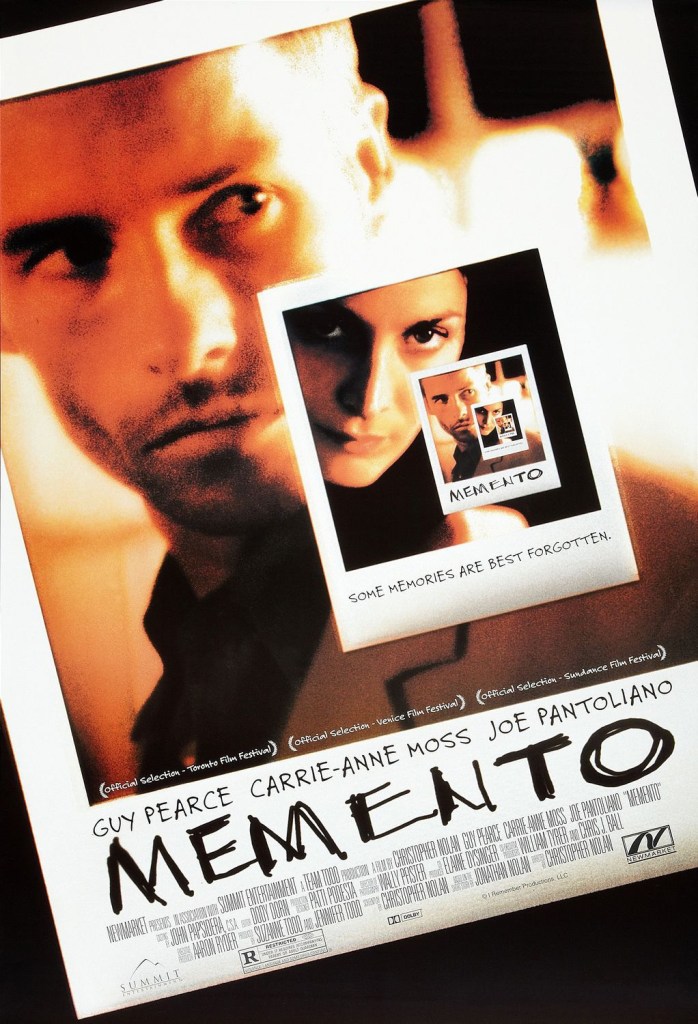
Memento (2000)

Memento (2000)

Nolan’s Hollywood debut is still a mesmerising, inventive and inspiring noir thriller

Director: Christopher Nolan

Cast: Guy Pearce (Leonard Shelby), Carrie-Anne Moss (Natalie), Joe Pantoliano (Teddy), Mark Boone Jnr (Burt), Jorja Fox (Catherine Shelby), Stephen Tobolowsky (Sammy Jankis), Harriet Sansom Harris (Mrs Jankis), Callum Keith Reinne (Dodd)

Memento is a twisty-turny thriller of man who can’t remember anything that has just happened to him. But it’s also a tragedy of a man who actually can never forget. Leonard Shelby (Guy Pearce) has anterograde amnesia, a condition that prevents him forging new memories. Every few minutes or so, his memory resets and he forgets what just happened to him. But he can never forget what happened to him immediately before his condition: the murder of his wife by a mysterious assailant. Effectively, Leonard lives forever in that last moment he remembers: it has always just happened, and has shaped his life into a relentless search for revenge.

It’s a realisation I made after a watching again Christopher Nolan’s sophomore calling-card, surely one of the most complete artistic statements of intent Hollywood has seen this century. You can see the roots of all that was to come here, from Batman to Oppenheimer, via Tenet, Inception and Interstellar. Memento is a gripping thriller and also a playful and intriguing dance with narrative conventions, largely told backwards (each seven minute or so section in colour occurs after the scene that preceded it) but also featuring a black-and-white parallel narrative that takes place (it is revealed) chronologically, that eventually links up with the other narrative (the film, effectively, ending somewhere in the middle of the story).

Far from a stunt, this is ingenious, exciting story-telling from Nolan, superbly recreating some idea of what it might be like to never remember why you are somewhere, where you have been or whether you have ever met the person you are talking to before or not. You could say the story, once rearranged in chronological order, is simple – but everything is easy to follow with a map.

Memento’s structure reflects part of Leonard’s perspective, forcing you constantly to watch the film in the moment and never be able to apply your wider knowledge of the narrative. No matter how familiar I become with the film, I find I inevitably become as confused and lost as Leonard is, your mind struggling to reorder and reinterpret “later” scenes as you discover the “earlier” ones, the whole film fracturing into mini-arcs (the chase where a bemused Leonard doesn’t know at first whether he’s chaser or chase; the bar conversation that starts in the middle; the mysterious woman who appears in a bathroom, and so on).

Even more ingeniously, we realise Leonard is essentially ‘re-born’ with every cut-to-black. He will never feel anger towards someone who wronged him minutes earlier or fondness towards someone who was kind to him. The Leonard dead-set on a goal one minute will cease to exist the next, with only any notes remaining to guide him. Essentially, Leonard is constantly handing over to himself: even he knows this: that decisions he makes in a moment effectively carry no implications, because he won’t remember them. He will never feel guilt, or regret, shame, pride and delight.

Leonard prides himself on making his life work through a rigorous system of mental conditioning. His short-term memory may be destroyed, but his ability to “learn” has not. He talks proudly of his system: carefully written notes, annotated polaroids of key people, places and objects, certain things always kept in certain places and, of course, a body littered with tattoos of crucial facts about his wife’s murder. What’s ingenious about Nolan’s film is that, like Leonard, we never know the context of any of this. When Leonard makes a note, what prompted him to do it? Like him we don’t know.

That lack of context exposes, over the course of the film, the nonsense of Leonard’s system. Trusting notes – particularly written by himself – implicitly from moment-to-moment, leaves him wide open to manipulation. If he has a polaroid of an object with the note “This belongs to you”, he will assume it is true. If someone produces evidence of a friendship or mutual interest, he will believe it. Even more chillingly, we discover Leonard himself is more than capable of leaving himself breadcrumbs he knows his future selves can (and will) misinterpret. After all he’ll never remember the deception and will never waver in the belief that he would never deceive himself.

Like Leonard we can never know the truth about the people he talks to. Should we listen to the message “don’t believe his lies” about the ingratiating weaselly Teddy – especially since the film “begins” with Leonard shooting him in the head as the killer of his wife. Or is Teddy, played with a perfectly smarmy, smart-alecky wit by Joe Pantoliano, the friend he claims to be? Does Natalie, the quiet but helpful woman who has also lost someone (memorably played with a beautifully balanced mix of the austere and tender by Carrie Anne-Moss), deserve the absolute trust Leonard accords her based on his annotated polaroids? After all, the manager of the hotel he’s staying at (a marvellously droll cameo from Mark Boone Jnr) cheerfully confesses to ripping him off, since he knows Leonard won’t remember it next time they speak.

What becomes clear is that Leonard, for all his surface assurance and confidence is a raw emotional mess, utterly lost in the world he inhabits and trapped forever in an emotional state of raw grief and fury, his politeness a ‘learned’ habit as much as his mantras and endlessly repeated stories. Guy Pearce gives a fantastic performance of a character both deeply vulnerable but carrying reserves of bitterness that are intensely dangerous when unleashed. Pearce’s empathetic performance, low-key and underplayed throughout, helps us build a deep connection with Leonard, making the audience want him to succeed, while never hiding the possibility of danger in a man who knows nothing about the world around him other it has deeply wronged him.

It’s that hidden emotional state Nolan’s twisting film hides in plain sight throughout. After all, we know Leonard is capable of acts of violent rage – its literally the first thing we see him do. Opening the film with a shot of a Polaroid developing, played in reverse (so the image gets fainter), Nolan even shows us at the start that the facts will become less clear as the film progresses. Despite both these things, it’s frequently shocking how what we think of Leonard and those around him changes.

It’s told with a superb streak of film noir, but also a dark wit (after all, a guy who you can be as blatant false to you as you like because he’ll act like your friend five minutes later, is inherently funny) that means sucker-punch moments when we make crucial discoveries about objects, characters and even the story of Sammy Jankis (a similarly afflicted man, investigated by pre-accident Leonard in his old life as insurance claims investigator) land with a real wallop.

Memento is truly unique, a near unrepeatable trick expertly pulled off by a director who even in his second film was able to present a complex, multi-layered narrative with the assurance of a veteran. What’s interesting about Memento is that, away from the mechanics of how it is told, there is very little self-conscious flash or bombast about it. It uses flair when it serves the story, but otherwise lets events speak for itself. And it unfolds like an onion, each layer rewatch revealing a fresh new layer that shocks the senses. Superbly acted and brilliantly made, it’s a modern noir masterpiece.

Saltburn (2023)

Saltburn (2023)

Dreadfully pleased with itself and full of shallow insights and stunt clickbait moments

Director: Emerald Fennell

Cast: Barry Keoghan (Oliver Quick), Jacob Elordi (Felix Catton), Rosamund Pike (Lady Elspeth Catton), Richard E Grant (Sir James Catton), Alison Oliver (Venetia Catton), Archie Madekwe (Farleigh Stuart), Carey Mulligan (“Poor Dear” Pamela), Paul Rhys (Duncan), Ewan Mitchell (Michael Gavey), Sadie Soverell (Annabel), Reece Shearsmith (Professor Ware), Dorothy Atkinson (Paula Quick)

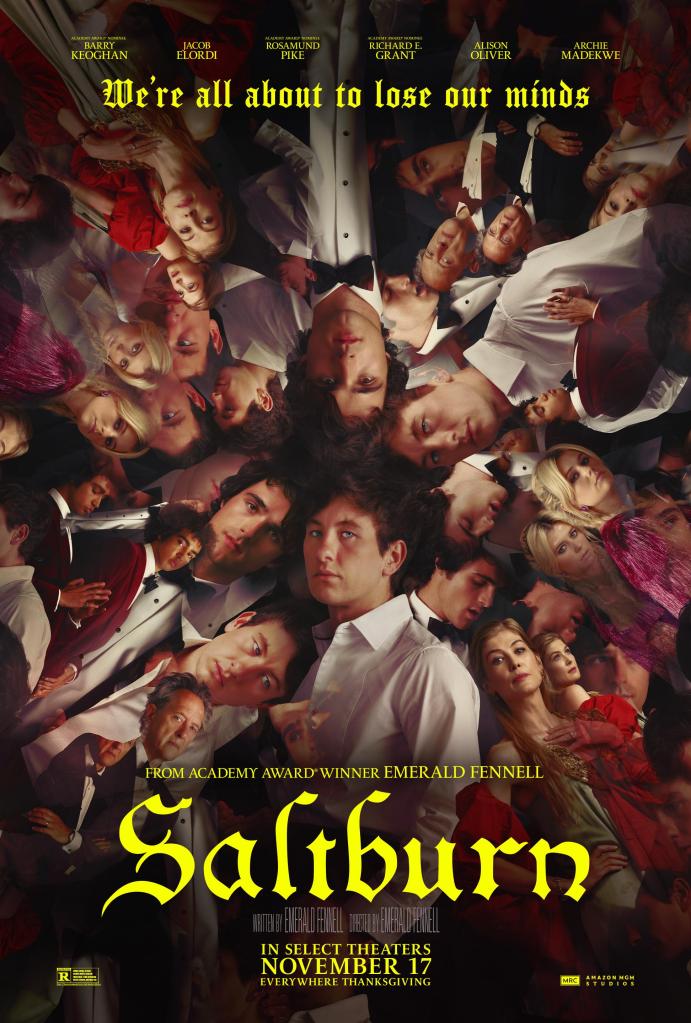
Promising Young Woman was a thought-provoking, very accomplished debut. It’s odd that Emerald Fennell’s sophomore effort plays more like a first film: try-hard, style-over-substance, very pleased with itself and its punky attempts to shock. Crammed full of moments designed to be snipped out and talked about – in a “you will not fuckin’ believe what just happened” way – Saltburn is a fairly trivial remix of ideas much, much better explored elsewhere, predictable from its opening minutes.

It’s 2006 and Oliver Quick (Barry Keoghan) is a scholarship student at Oxford University, socially awkward and very conscious of his Liverpudlian roots, struggling to fit in among the wealthy set that dominates his college. At the centre is Felix Catton (Jacob Elordi), fundamentally decent but blithely unaware of his privilege, who takes a shine to Oliver with his shyness, troubled working-class background and grief at the recent death of his alcoholic father. Felix invites Oliver to spend the summer at Saltburn, his luxurious family seat. There Oliver is welcomed – or does he inveigle his way? – into the lives of the Cattons, from seducing Felix’s sister Venetia (Alison Oliver) to charming his parents Sir James (Richard E Grant) and Lady Elspeth (Rosamund Pike). But is Oliver all he appears to be?

The answer, of course, is no. Which shouldn’t surprise anyone who has ever really encountered any form of unreliable narrator before. Fennell opens the film with a clearly older, well-dressed Oliver recounting the film’s story to an unseen person. It’s not much of a deduction from this alone, that Oliver is at best not to be trusted, is definitely potentially dangerous and is probably a lot worse. All that, inevitably plays out, in a film that so nakedly rips off Brideshead Revisited (or Recycled) and The Talented Mr Ripley that Oliver might as well be called Ripley Ryder.

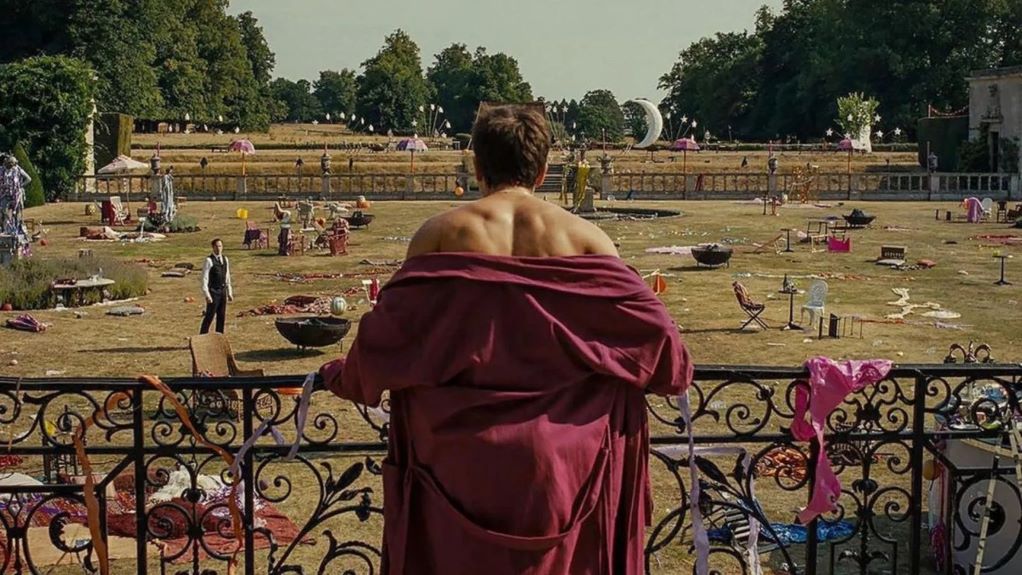
“Ryder” would at least have been a witty name for a character who spends most of the film putting his (apparently) well developed manhood to effective use in manipulating and controlling people. Saltburn assembles a series of “shocking” moments of sexual weirdness from stalker-like sociopath Oliver – so much so, that the moments he merely wanders (or dances) around in the buff feel almost normal. Surely there was more than half an eye on hashtags when the film presents scenes like Oliver drinking spunky bathwater, performing oral sex on a woman during her period or dry humping then wanking over a grave. It’s not big and it’s not clever.

“Not clever” also sums up the film’s inane social commentary. Set in 2006, it seems to take place in a version of Oxford that probably hasn’t existed since 1956. Having been in a state-school kid at Oxbridge at this time, its vision of a university 98% populated by poshos jeering at working-class kids with the wrong sort of tux just isn’t true (in fact there were more state school students than private school kids at Oxford that year). In this fantasy, all the students are either from Old Etonians or maladjusted weirdos from state schools. It’s hard not to think this is Emerald Fennell (a woman so posh, her 18th birthday party was featured in Tatler) guiltily looking back at how her “set” at Oxford might have behaved to the less privileged students.

It boils down to a view of Oxford as an elitist social club laughing openly at anyone who can’t trace their descendants back to the House of Lords, where tutors are entranced by the idea that a place like “Liverpool” exists and snort at the working class student for being a clumsy try-hard by actually reading the books on the reading list with student life flying by in a series of hedonistic raves, hosted by the rich and famous. Maybe I was just in the wrong circles back in the day.

This portrait of Oxford as a play pen for the super elite is as damaging (it’s exactly the sort of false image that stops deserving people from wanting to go) as it is lazy, tired and false. But then, Saltburn compounds its boringly seen-it-all-before social commentary by trudging off down other, all-too-familiar paths as it turns its fire on those with their nose pressed up against the window of privilege. The film’s vilest member of the elite, Farleigh, is himself an interloper, turned aggressive gate-keeper. And, as is not a surprise, Oliver’s roots turn out to be far more comfortable than he is letting on. Oliver is a Charles Ryder who yearns for Brideshead so much, he starts destroying the Marchmain family to get it. Because, in his eyes, as an aspirant middle-class type he appreciates it more.

On top of this is layered a clumsy, Ripley-esque madness to Oliver, who can’t decide himself whether he is infatuated with the charming Felix (very well, and sympathetically, played by Jacob Elordi) or just wants to suck his soul dry. Barry Keoghan plays this Highsmith-styled sociopath with just enough flash and sexual confusion – and he does manage to successfully turn on a sixpence from wide-eyed wonder, to vicious anger. But the character again feels like a remix of something done better elsewhere, trading emotional depth for cartoonish bombast and clumsy on-the-nose point scoring.

The on-the-nose-ness runs through the whole film. It’s a film screaming to be taken seriously, from its 4:3 framing, to its jarringly satirical music choices, arty Gothic fonts, visual quotes from Kubrick and look-at-me love of tricksy camera shots (some of these, I will admit, are gorgeously done, even if the film frequently lingers on them so we can “see the work”). But it makes very little sense. How does Oliver manage to exert an influence, so profound and complete, over Felix’s parents? Why does the wool fall from everyone’s eyes one-at-a-time in quick succession? Does Saltburn feel sorry for the generous but emotionally dysfunctional Cattons or does it feel they deserve their fate?

Because so many of these ideas are so half-heartedly explored, it becomes a collection of scenes designed to shock, tricksy directorial decisions, some flashy performances (Rosamund Pike can certainly wittily deliver a slew of lines dripping with blithely unaware privilege) and twists that will only surprise those who have never seen a story about an outsider before. Jacob Elordi emerges best, creating a character of surprisingly revealed emotional depth, but most of the rest of Saltburn settles for flash and instant gratification. To use its own terms of reference, it’s as satisfying as premature ejaculation: fun for an all-too-brief second, then a crushing, shameful disappointment.

The Testament of Dr Mabuse (1933)

The Testament of Dr Mabuse (1933)

Lang’s masterful mix of gangster thriller and supernatural psychological drama is superb

Director: Fritz Lang

Cast: Rudolf Klein-Rogge (Dr Mabuse), Otto Wernicke (Inspector Lohmann), Oskar Beregi Snr (Professor Baum), Gustav Diessl (Thomas Kent), Wera Liessem (Lilli), Karl Meixner (Hofmeister), AE Licho (Dr Hauser), Theo Lingen (Karetzky), Klaus Pohl (Muller), Theodor Loos (Dr Kraum)

Did Fritz Lang invent the concept of the cinematic universe? Or after completing M, did he just wonder what it would be like if his detective Lohmann (Otto Wernicke) took on the dastardly criminal mastermind Dr Mabuse (Rudolf Klein-Rogge) from his earlier epic crime drama. Either way, the hero and the villain from those two very different films face-off in The Testament of Dr Mabuse, a pacey crime melodrama spliced with a spooky ghost story, that rattles its way through a scintillating story tinged with the whiff of the dread of Nazism.

It’s eleven years after Mabuse’s reign of terror ended with him catatonic and under arrest. In a psychiatric hospital under Professor Baum (Oskar Beregi Snr), who sees him as a fascinating case study of deluded genius, Mabuse has not spoken in years instead filling his days with endlessly scribbling a series of blueprints and schemes for the criminal underworld, focused on destabilising the country and corrupting the currency. But, despite being under lock and key, a secret society of criminals is carrying out Mabuse’s scribbles, seemingly under the guidance of the man himself. Can death, when it comes, really take Mabuse? Or are Lohmann’s suspicions that the dread hand of the Great Unknown still controls events, even from beyond the grave, correct?

Lang’s gangster film throws together some of the best elements of all his German films. This is a pulpy gangster thriller, full of action, shoot-outs and explosions mixed with the unsettling double exposure appearance of ghosts and shady, unknown powers manipulating events. It’s Scarface meets A Christmas Carol, with Mabuse as a dreadful Marley’s Ghost causing devastation and chaos even after death. The Testament of Dr Mabuse sees realism meet thriller meet supernatural powers, but brilliantly combines all three up into a propulsive thriller.

And it’s a film, more than any of Lang’s others, about the malign influence of Fascism. For what is Mabuse’s dogmatic lust for chaos and destruction, but a terrible prophecy of the horrors Hitler would unleash. Mabuse, like the Fuhrer, is interested only in destruction wanting to pull the world down to rule over the ashes, to reforge the remains into his ideal vision of reality. His paranoid ramblings – and the spectral, transparent (brilliant use of double exposure at the technical possibilities of cinema, as always from Lang) presence he becomes parroting the same mantra of the nobility of destruction – are about leading the country into a morass of destruction. No wonder The Testament of Dr Mabuse was almost immediately spiked by Goebbels. Hitler’s magnetic powers of persuasion and control were surely the real-world apotheosis of Mabuse’s skills.

Mabuse’s powers are so great that even death can’t slow him down. Today it doesn’t take long to figure out exactly who the real mastermind – or after-death puppet of Mabuse’s – might be. As wardens in the hospital say, even in silence the fixed, controlling glare of Mabuse is enough to bend minds to his will. The rantings of his testament – Mabuse’s Mein Kampf – merely add to the force of his stare. Even the echo of Mabuse’s name will turn former police detective Hofmeister into a gibbering wreck. His power is absolute.

No wonder he appears after death, disfigured post-autopsy, his eyes bulging, to continue to direct his puppets, his ghostly form directing their actions. It’s a wonderful visual expression of the hypnotic control Mabuse had over his victims, that they continue to see his controlling, ranting form – across a desk or guiding them down corridors – even after they’ve gone. Mabuse’s ghostly form will literally emerge out of the body of his underling, crossing to sit opposite him and pour more instructions in his ear.

Ordering his underlings from behind a curtain that hides his true face, Mabuse’s commands are absolute and its threats always delivered. The gang, each a series of cells who work together only when instructed, are nearly all brain-washed fanatics, accepting orders without question. Much like Hitler, Mabuse’s followers cover a vast range, not just common criminals, or trigger-happy loons but also the middle-class and professional, in thrall to the words of a mad man promising a new dawn (sound familiar?) Much like in Mabuse’s hey-day, any deviation from absolute loyalty is met with swift, fatal punishment. What chance does Thomas Kent (Gustav Diessl – a spitting image for the young George Sanders) have when he decides the gang life is too risky for his girlfriend?

Up against this, Lang places his hero from M and his accustomed detailed fascination with the mechanics of investigation. The Testament of Dr Mabuse mixes this analysis of things like the forensic translation of scratches on a windowpane, with this outré pulpy set-up of Wizard of Oz-like criminal masterminds. The world of Lohmann is one of order and methodical investigation, grounded in realism and detail. It’s an adjustment for Lohmann who, in M, was more the jovial face of a failing institution – here he’s the last bastion of reasonable authority.

The Testament of Dr Mabuse is full of shrewd political observations – but it’s also a supremely entertaining film. Few directors were as good at crime drama set-ups than Lang. The film’s opening sequence, showing Hofmeister tracking the gang through a warehouse, is a masterclass of the tension of imminent discovery, then of explosive (literally) violence during a chase. A gorgeously inventive bomb sequence – where a flooded room is the best chance of safety – is another masterpiece of slow burn tension, while the insidious threat of Mabuse’s voice creates a miasma of terror.

That sequence plays beautifully into Lang’s increasing comfort with, and mastery of, sound. The film opens with a pounding heart-beat on the soundtrack as freelance investigator Hofmeister hides in the factory where Mabuse’s men assemble their latest schemes, capturing the fear as he constantly ducks and hides to (unsuccessfully) avoid detection. The sound of machinery grows to overwhelm the film and, as Hofmeister flees, his barracked by the sounds of engines and rolling oil-filled barrels that burst into flames. Sound skilfully stresses mood and bridges scenes, controlling mood and atmosphere and adding to the air of distrust and disturbance.

The technique shines out of several stunning set-pieces. A traffic light assassination – another masterpiece of sound – is a brilliant piece of gangster-ish business, the gangsters using a crescendo of car horns to cover a fatal shot. Watching its slow build-up and the carefully paced release of information to the audience (the presence of the killers, the gun, the tension of the wait) you can see why Lang often felt Hitchcock got a lot of credit for things he had invented.

Fast-paced and thrilling, it’s a perfect extension of both Lang’s previous films, a brilliantly unsettling and disturbing drama wrapped up in a gangster package. It’s supernatural touches are just the right side of psychological drama, a portrait of obsession and a fractured mind. A perfect expression of Lang’s mastery of mixing the high and low brow into an engaging, thought-provoking and thrilling package.

Serpico (1973)

Serpico (1973)

Pacino is sensational in this sensational and gripping anti corruption thriller

Director: Sidney Lumet

Cast: Al Pacino (Frank Serpico), John Randolph (Captain Sidney Green), Jack Kehoe (Tom Keough), Biff McGuire (Captain McClain), Barbara Ede-Young (Laurie), Cornelia Sharpe (Leslie), Tony Roberts (Detective Bob Blair), John Medici (Pasquale), Allan Rich (DA Tauber)

Frank Serpico (Al Pacino) is a newly graduated cop in the NYPD. Passionate about changing the world, Serpico wants to clean up the streets – but not at any cost. The aggressive tactics and jobsworth disinterest of many of his colleagues infuriate him while his bohemian style and view that the way to be really effective as an undercover cop is to look like the people he investigates alienates other cops. As Serpico’s experience grows, he discovers the NYPD is overflowing with corruption and on-the-take cops, hoovering up cash and protection money and turning blind eyes. But when Serpico decides to do something about it, he puts himself in the firing line. Literally.

Serpico captures the anti-authoritarian fury of 70s cinema. Who can you trust when your suspicions of those who are supposed to enforce the law are right – they are as dirty, if not more so, than the criminals? Serpico mixes police thriller with paranoid conspiracy thriller, rotoscope filming placing everything in chilling focus, the grimy streets of New York a world where injustice is rampant and the powers-that-be will do anything to maintain the corrupt status quo.

Pacino grips the role of Serpico with the sort of fire-breathing force that made him a phenomenon in the 70s. Pacino transformed himself for the part, prowling the roughest neighbourhoods of New York for research and burying himself under a mountain of shaggy hair. Serpico was shot in reverse, so Pacino could progressively shave off parts of his mountain of hair, starting his work with the jaded, disillusioned Serpico and stripping back into the fresh-faced rookie (there is a neat joke in the fact that the naïve young Serpico looks the spitting image of Michael Corleone).

It’s a performance of bubbling, dizzying intensity, that dominates the film (Pacino is in nearly every scene), with Pacino slowly more and more coiling up with wild, frustrated tension. Edgy, fidgety but searingly naturalistic, Pacino gives this larger-than-life figure a searing sense of moral certainty and rigid principles, a man who slowly realises the world is not what he thought and increasingly furious at its essential shittiness. What Pacino understands is that Serpico doesn’t want to be a crusading whistle blower – he just wants to be a cop, but won’t sit back and watch his colleagues laughing with crooks. It’s a stunning, passionate, technically and emotional superb performance, from an actor at the pinnacle of his powers.

Serpico is a chilling exploration of police corruption. It’s casual, everyday and all evasive. From the free sandwiches handed out by café owners (“If I pay can I get what I want?” Serpico asks and is promptly told to shut up) to the casual brutality handed out to suspects. For a man like Serpico who wants to change the world, it’s a nightmare, even before a stuffed brown envelope is dropped into his hand and he’s urged to take it and shut up. It sits alongside crippling indifference: he can’t even arrest two rapists he spots on the street because the detective running the case is on leave (“They’re here now!” he screams down the phone before taking matters into his own hands.)

All this and more makes Serpico stick out to other cops. In an NYPD still overwhelmingly made-up of white, middle-class besuited guys (the collection of potential undercover cops in a training lecture are hilariously uniform in more ways than one) he’s a bohemian. Interested in the arts, reading books, listening to classical music and watching ballet. In his spare time he dates actresses and hangs out with arty types. He’s a world away from the cops, who view him with mistrust and a potential threat in more ways than one (a fellow cop, disgusted at overhearing Serpico talk ballet, accuses him of soliciting in the department bathroom and won’t be shaken in his belief).

So, he’s in huge danger when he eventually decides he can’t close his eyes to his army of colleagues on the take, but must do something about it. He’s already been warned that the answer “I don’t know” to the question if he would always vouch for any cop is the wrong answer. In a world where Lumet makes clear cops see as sharply divided between themselves and everyone else, where taking some extra payments is a perk of the job, someone like Serpico won’t be tolerated.

Inevitably the system turns on the whistle-blower. Serpico’s fellow cops close ranks, his superiors fob him off or treat him with suspicion. His colleagues move swiftly from offering to hold his cut in trust, to asking why he just doesn’t donate it to charity to finally loathing him. Eventually he’s an isolated, despised figure, padded down for wires, routinely ignored in the precinct and unable to trust anyone (rightly so, since the film opens at the end with Serpico shot after a raid, possibly by a cop, before flashing back to his graduation). And the ‘outside bodies’ he brings in? They move like slugs and Serpico’s disgust at their focus on scalps and not systemic change just re-enforces his isolation.

Serpico was shot quick and dirty on the streets of New York (Lumet shot in 51 days with editor Dede Allen editing each scene as it was finished). Lumet’s immersive camera throws the viewer straight into the gritty world of New York in the 70s, and the city has rarely ever felt more like a wretched hive of scum and villainy. It’s dirty and filthy with danger on every corner. There is virtually no sense of community or public duty and everyone, cops and robbers, are solely out for what they can get. It’s a brutal, terrifying world where injustice and violence are just part of the rations.

Wonderfully directed by Lumet, it’s powered by a tour-de-force performance of sheer, dynamite genius from Pacino in one of his greatest (and most overlooked) roles. Serpico is a searing indictment of a world that creates a friendly atmosphere for corruption and wickedness and where doing the right thing leaves you victimised, isolated and in a hospital bed with a bullet in your cheek.

Othello (1952)

Othello (1952)

Welles distinctive Shakespeare epic is a masterpiece of turning the Bard into film

Director: Orson Welles

Cast: Orson Welles (Othello), Michéal Mac Liammóir (Iago), Robert Coote (Roderigo), Suzanne Cloultier (Desdemona), Hilton Edwards (Brabantio), Nicholas Bruce (Ludovico), Michael Laurence (Cassio), Fay Compton (Emilia)

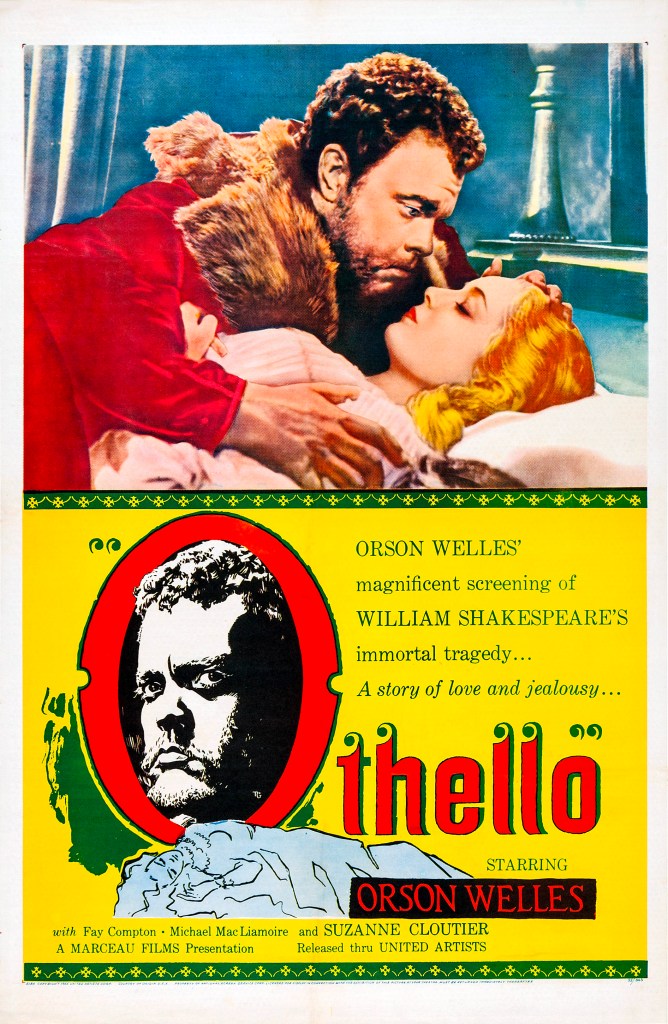
In the early 1950s Orson Welles was in the wilderness. After the implosion of his career in Hollywood, he was grifting a living in Europe, juggling multiple ventures and paying for things (or not) with cheques from quick film cameos. But the fire was still there. Welles wanted a project which he would have complete control over. Shakespeare was the ideal collaborator: both free and dead, here was a man who offered an ocean of ideas and not a word of criticism, who would make no demands he re-cut the picture. A marriage of convenience but it led to cinematic triumph.

Othello would be an Welles production from top-to-bottom. Largely self-funded, a few investors chucked in liras for a share of profits (you can imagine Welles as Shakespeare in Love’s Fennyman grinning that was fine because “there never are any”) it became a labour of love over years. Welles begged, borrowed and flat-out stole film stock and camera equipment from assorted productions, kept costumes from for-the-money roles he did to keep the operation flowing (famously his Othello coat was a costume which he’d requested a fur-lining added to, that went unseen in the film it was made for but came rolling out in Othello). Actors were summoned, sometimes months apart, to shoot. Scenes would start filming in one location and finish filming months later somewhere completely different. Welles sat in the middle holding the entire film in his head.

It’s extraordinary that Othello is even coherent. The fact that it’s also a masterpiece of film Shakespeare is a miracle. But, cut loose from the bonds of Hollywood studio execs and not giving a damn about the bills (he had the cheek of genius so never picked up a tab) allowed Welles the scope to experiment and do things “his way”. Othello is the most purely “Welles film” since Citizen Kane, and a tour-de-force of cinematic inventiveness with poverty and lack of resources drawing the best out of a director who marshalled all his gifts of editing and lighting to make resourceful use of limited resources. It’s guerrilla film-making that looks like an epic.

What you could argue Othello is not is a truly original look at Shakespeare’s play – or really an actor’s piece. Welles’ passions for Shakespeare always felt as much about having a grand canvas of poetic language to impose his own vision on, cutting and changing as needed. Thematically, Othello is pretty much what you would expect. Welles’ Othello is the noble Moor pushed into a spiral of jealousy. Michéal Mac Liammóir’s (the finest performance) Iago is a dastardly liar, with faint hints of sexually motived envy. Desdemona is as pure as the driven snow, Emilia a faithful servant, Rodrigo a simpering idiot, Cassio a pretty boy. Our sympathies lie firmly where Shakespeare would expect.

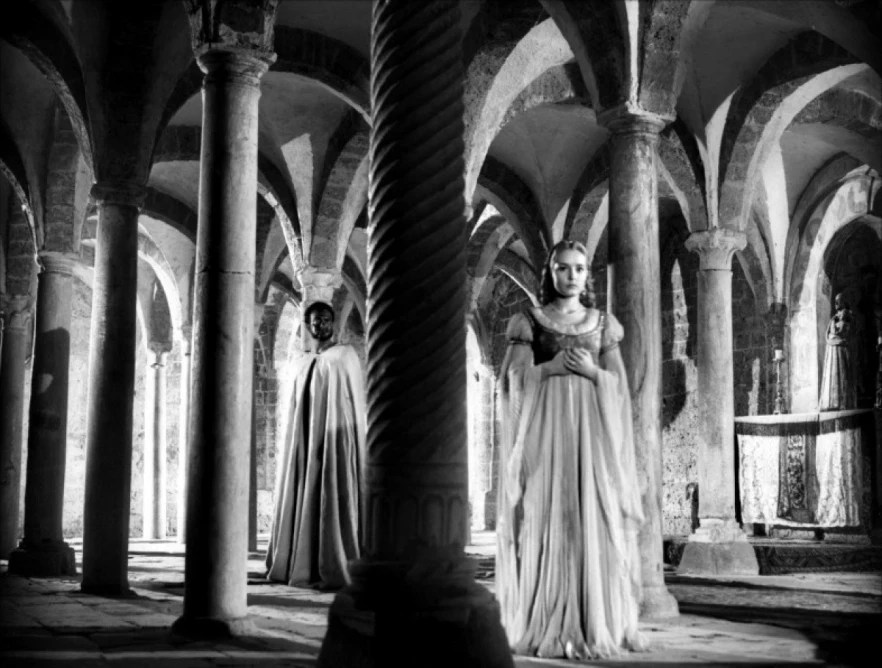
Everything that is unique about the film lies in its telling. Othello is a breath-takingly beautiful film, which uses its locations to astonishing effect. Column lined castle rooms and towering walls create caverns of light and shadow. Welles uses the fixed points of columns to add a dizzying level of speed to camera movements that see these columns whip past the frame. The shadows of grills are frequently cast across faces and light creates looming shadows across the floor. Welles plays into this with the creation of light pools, concentrating it on single fixed points, often faces, with the surroundings bathed in black. The film presents real locations in defiantly expressionistic ways, giving each of them an elemental power that heightens the tragedy.

It’s a film made up of stunning set-pieces. It’s opening funeral cortege – like Citizen Kane, Othello starts at the end with Othello and Desdemona dead and Iago in chains – follows a march over city walls, playing out in striking shadow against the brightness of the sun, with booming, Gothic music giving the sequence an imposing sense of inevitability. Iago is paraded by a mob and placed in a cage, lifted above the city wall (this same cage frequently appears throughout the movie – including, once, having Iago walk nonchalantly under it – as a grim reminder of where this is heading). It’s a perfect marriage of sound and music, disguising the small scale with cinematic force.

Taking advantage of limitations time-and-again makes Othello great. Another striking sequence was born from necessity. With most of the costumes impounded for non-payment of shipping bills, the attempted murder of Cassio is re-staged in a Turkish bath (who needs costumes when we have towels!) a decision that turns the sequence into a masterpiece of light through steam, increased by the frenetic energy Welles shoots the sequence with culminating in its Lang-inspired super-imposing as Iago thrusts his sword down into the floorboards to dispatch Rodrigo.

Othello is frequently filled with imaginative camera angles. Often characters observe others from great heights – twice through sky lights, starring down at conflicts, murders and suicides. Iago and Rodrigo spy on Othello’s gondola romance with Desdemona from a distant bridge. The ramparts of Cyprus provide towering angles, over soldiers or wave-crashed rocks below. The camera also takes a number of low-angle positions, making characters (often Othello) tower over us. Clever angles and perspective work create whole ships out of sheets of fabric and basic models.

It’s also a triumph of editing. Welles assembled the film from a never-ending supply of fragments. Frequently actors appear with their backs to the camera while we hear them speak – as Welles said, a sure sign the actual actor wasn’t there. Like few other films, Othello feels like a film excavated from its shooting. It’s a film almost constantly in motion, rarely stopping to focus on an actor delivering a line (Othello’s first speech, parts of Iago’s speeches and Emilia’s speech to Desdemona being the main moments the film focuses on actor’s delivery – no doubt connected to those three actors being the ones Welles trusted).

Away from that, the camera often fast cuts and delivers scenes in motion, with actors speaking off camera as we focus on the events around them. This means the dialogue is repeatedly chopped, changed and trimmed to meet the needs of the scene. It helps make the film even more pacey and frighteningly interior – conversations become snatched and fast, words flung from angles we cannot see, ramping up the paranoia. Large chunks of it is redubbed by Welles himself – a light version of his distinctive tones clearly emerges from Robert Coote’s mouth and Michael Laurence’s Cassio has a familiar cadence. In some cuts, Welles also replaced Suzanne Cloultier’s voice with Gudron Ure (with whom he played the role on stage).

If there is a major flaw in Othello it’s probably the acting, frequently looking under rehearsed, with Welles himself a leading culprit. His Othello is underpowered and feels under-defined. There is little sense of an interior to his mind and Welles’ surprisingly somnolent delivery tends to crush much of the emotion. It’s hard not to think Welles was so focused on juggling every other factor, that he compromised on his acting. Only Mac Liammóir, Compton and Edwards look truly comfortable with their roles – and even they offer traditional readings.

But Othello is about turning Shakespeare to cinema and if Shakespeare himself is slightly sacrificed in the push, it doesn’t detract from the stunning theatrical beauty we get instead. Othello becomes a lean, pacey thriller, crammed with stunning imagery and imaginative flourishes (Rodrigo’s faithful dog, following sadly after his master, is a gorgeously little playful touch). It’s a film where light and shadow are major plays, where footsteps in subterranean water pools create ripples of motion and echoes of noise, that shows the greatness that can be born from necessity. It’s one of the greatest Shakespeare films.

Napoleon (2023)

Napoleon (2023)

Scott’s epic of the most famous Frenchman of all time looks good but is empty at heart

Director: Ridley Scott

Cast: Joaquin Phoenix (Napoleon Bonaparte), Vanessa Kirby (Josephine Bonaparte), Tahar Rahim (Paul Barras), Ben Miles (Caulaincourt), Ludivine Sagnier (Thérésa Cabarrus), Matthew Needham (Lucien Bonaparte), Sinéad Cusack (Letizia Bonaparte), Édouard Philipponnat (Alexander I), Ian McNeice (Louis XVIII), Rupert Everett (Arthur Wellesley, Duke of Wellington), Paul Rhys (Talleyrand), Catherine Walker (Marie-Antoinette), Mark Bonnar (Jean-Andoche Junot)

Is Bonaparte cinema’s White Whale? Filmmakers have often tried and failed to bring this epic life – who else so dominated their era that’s its literally named after them? – to the screen. Abel Gance’s silent epic could only squeeze his early years into five-hours and the planned five sequels never materialised. Famously, Kubrick spent decades planning a Napoleon film (he had a veritable library of Napoleonic research) but could never deliver. Napoleon has popped up in films as wide ranging as Time Bandits and Waterloo, but the definitive film has never been made. Is Scott’s Napoleon it?

Napoleon takes a rather old-fashioned approach to the biopic. The fashion now is to focus on a single event that becomes a window into its subject’s life. Napoleon, in its two and a half hours, takes a far more cradle (or revolution) to grave approach. We join Napoleon Bonaparte (Joaquin Phoenix) as an anonymous artillery captain and leave him (via 13 Vendémiaire, Egypt, the 18 Brumaire coup, self-coronation, Austerlitz, Borodino, Moscow, St Elba, Waterloo and Helena) dying in exile. It’s as swift and pacey a run-down of his life and times as it sounds like, with the film’s main focus being on his complex, love-loath relationship with Josephine (Vanessa Kirby).

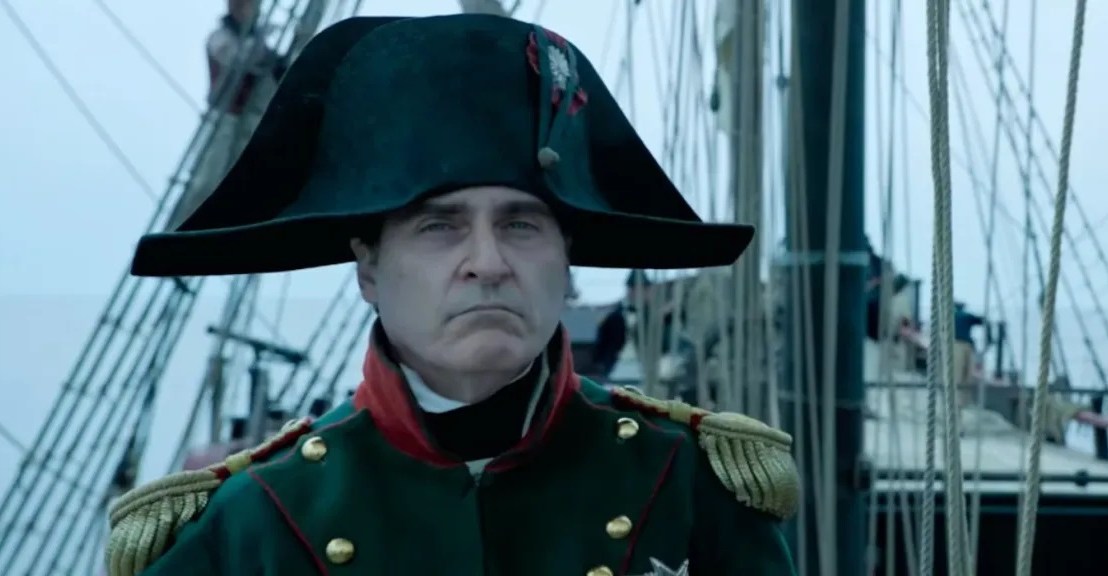
Scott’s film is a visual treat – don’t those uniform’s look gorgeous! – and it works best as a coffee-table book of the life-and-times of one of History’s most controversial figures. What it doesn’t work as is as film where you feel you gain any real understanding of what motivated Napoleon or where the charismatic energy that made millions of soldiers flock to him time-and-time again came from. Scott’s Napoleon emerges as a maladjusted, emotionally-stunted oddball, apt to glower and sulk who is never the master of events or people. It’s a revisionist view that doesn’t ring true.

It’s not helped by a surprisingly low-key performance by Joaquin Phoenix, bulked up and lumbering, playing up the “Corsican Brute” angle that so alienated the Emperors he negotiated with. Phoenix’s performance is all pout and emotionally inarticulate self-pity, with small flashes of domineering force that come across as childish sulks. But it’s never the performance of a man who looks like he could motivate a nation to march with him into a mincer (several times!). Nor a performance that brings a sense of the fierce-ambition of a man who wanted to control and reshape the world. It focuses instead on one small aspect of his personality and misses vast swathes of his rich, autodidact personality.

It doesn’t help that filtering Napoleon’s life through his relationship with his wife feels like a gossipy approach used because tackling Napoleon’s complex attitudes towards his Corsican ancestry, contradictory interests in instituting democratic systems in a dictatorship and desire to bring peace to Europe via a series of destructive wars would be too tricky. Instead, we get a Napoleon who plans his movements and campaigns to compensate for his sexual inadequacy at being cuckolded by his wife, rushes back from Egypt to confront his cheating wife and seemingly escapes from exile because he’s pissed at his wife flirting with the Tsar. It’s not helped that the most interesting mechanism in their relationship – she was older and more experienced than him, with two children already – is compromised by Vanessa Kirby clearly being far younger than Phoenix.

Saying that Kirby is good in the film, conveying a complex set of emotions towards a husband who sometimes amuses her but, just as often, repels her with his bullying possessiveness (not to mention his militaristic sexual technique). Napoleon uses their relationship as a constant frame to interpret events, not only as motivation but also as a narrative device, letters between them constantly updating us on events off-screen. But the film only lightly sketches what drew them together in the first place (basically his attraction and her use of her sexuality to win protection) and the film ends up stuck in the same cycle of fall-out followed by Napoleon’s desperation to possess her again.

The time given to sketching out the broad strokes of this relationship means we never get a sense of history behind events or where the qualities, that made Napoleon the guy who governed most of Europe, came from. Scott’s film is (which, with its stressing of the deaths caused in his wars, settles for an anti-Napoleon stance) plays up his negative qualities and gifts him few positive ones. Phoenix’ performance is almost perversely anti-charismatic: he never laughs, is constantly shown as a pompous windbag who only children are wowed by, loses all his raconteur charm and is frequently victim to events – be that panicking at his attempted coup (where he’s bailed out by his brother) or only at Austerlitz looking like he has any particular military skill.

Still the film bowls along, too fast to ever really engage with events. A host of strong British Actors pop-up (their character names and functions plastered on the screen), but their appearances and dialogue are often so truncated it’s hard to really understand why they are there. Julian Rhind-Tutt’s Sieyes pops up to announce he plans to seize power with Napoleon and is never heard of again. Ben Miles and Paul Rhys rush through exposition as Caulaincourt and Talleyrand. A host of actors playing Generals stand in the background and snatch lines when they can. There are a few inadvertently comic casting choices – I did snigger when former News Quiz host Miles Jupp pops up as Francis I.

This historical gallop means years frequently pass between scenes and we often get very little idea why developments are taking place: for example, Napoleon seems to become Emperor on the basis of a half-muttered suggestion from Talleyrand. Conquests of whole countries are skipped over in seconds. Josephine’s offspring appear as children and are next seen as adults. Other than them, no one ages at any point over the film’s near 20 year span, with Phoenix and Kirby in particular looking little different at the end as they did at the start. (The film also rewrites heavily the comparative ages of its two leads – Josephine was in fact several years older, partly why conceiving an heir became such a problem.)

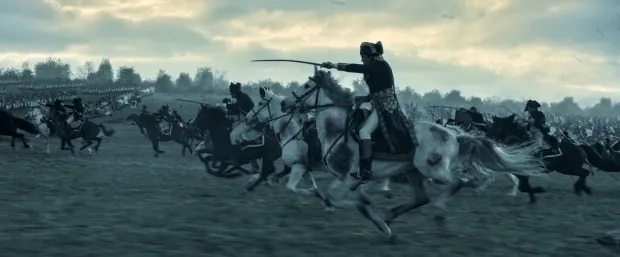
The battles are impressive though – even though they take up not quite as much screen time as you might think. The campaign in Egypt boils down to essentially a single cannon ball pot-shot at the Great Pyramid (never happened of course). Borodino is a cavalry charge. Austerlitz and Waterloo are the only battles that get real screen time, with both offering remixes of the actual history (Waterloo, incidentally, looks less impressive and smaller in scope than the Bondarchuk film managed). The photography is beautiful (as it is throughout) and the film doesn’t flinch on showing the impact of bullets and cannon balls. But it has no interest in understanding Napoleon’s actual strengths as a general (essentially, skilful movement of forces from a distance) substituting them with him leading not one but two cavalry charges – a suicidal risk he never took.

“At least it looks good” pretty much sums up the strengths and weaknesses of Napoleon. It’s enjoyable enough and buffs might enjoy the odd Historical Easter Eggs, but it never gets to the heart of understanding its subject and settles for a ticking off events and personalities rather than placing them into an informative context. You’d come out of this wondering how this guy got to where he was – and that makes you feel the film has failed to answer its implicit question in the tag line “He came from nothing. He conquered everything.” How, eh? How?

Caché (2005)

Caché (2005)

Haneke’s fascinating puzzle is a profound and challenging modern masterpiece

Director: Michael Haneke

Cast: Daniel Auteuil (Georges Laurent), Juliette Binoche (Anne Laurent), Maurice Bénichou (Majid), Lester Makedonsky (Pierrot Laurent), Walid Afkir (Majid’s son), Annie Girardot (Georges’s mother), Daniel Duval (Pierre), Bernard Le Coq (Georges’s boss), Nathalie Richard (Mathilde)

Is any film more aptly named than Caché? Haneke’s film keeps its cards so close to its chest, it’s entirely possible revelations remain hidden within it in plain sight. Caché famously ends with a final shot where a possibly crucial meeting between two people we’ve no reason to suspect know each other plays out in the frame so subtly many viewers miss it. It shows how Haneke’s work rewards careful, patient viewing (and Caché is partially about the power of watching and being watched), but also how unknowable the past can be. It’s a chilling and engrossing film that fascinates but never fully reveals itself.

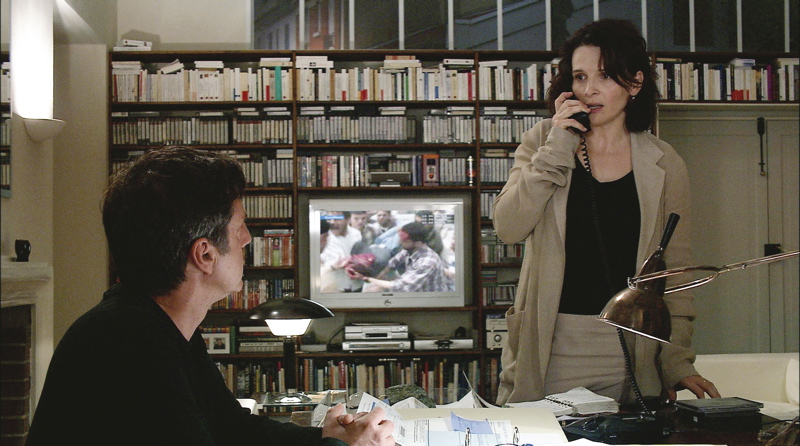
Georges Laurent (Daniel Auteuil) lives a life of success. A wealthy background, host of a successful TV literary debate show and living in an affluent suburb of Paris, he’s married to publisher Anne (Juliette Binoche) and father to young champion swimmer Pierrot (Lester Makedonsky). But there’s a serpent in his Garden of Eden. Georges and Anne are plagued by a stream of videos arriving at their house. These show long, static shots of their home and are accompanied by crude, graphic drawings. Someone is watching their house and the dread that this could escalate at any time is consuming them. But does Georges know more – do the messages chime with guilty memories in his past?

Haneke’s film is a multi-layered masterpiece, a haunting exploration (free of clear answers) into the things we prefer to forget, the hidden horrors we supress. It’s a film all about the shame and guilt buried amongst the everyday. Haneke even shoots the film on hi-definition video so that the surveillance footage of Georges and his home visually merges with the ‘real’ images of the couple. Within that, Caché starts to unpack the hinterland we hold as individuals (and, quite possibly as entire nations) of the guilts of our past that keep bubbling to the surface to bite us.

Caché is shot through with Haneke’s genius for menace and veiled threat. Can you imagine anything creepier than a camera set up outside your home, filming everything you do – but never knowing where it is? It’s an invasion of privacy that is insidious and covered in the additional menace that, at any time, it could escalate to something worse. The creeping, invasive tyranny of surveillance is in every inch of Caché, its omnipresence giving every interaction the feeling of being watched (something Haneke plays up – watch a man watching Anne when she sits in a café with a friend).

So gradually the book-lined world of the Laurents becomes a base under siege, a feeling amplified by Haneke’s mix of smooth camera movements adrift from establishing shots: constantly the camera glides through a space where we feel we neither truly understand the geography or are confident about the time. It’s accentuated by the window-free room the Laurents largely inhabit. In fact, their whole home feels window free, with curtains frequently drawn and rooms plunged into darkness, the family throwing up a shield to protect them from the outside world.

Or is it to cut them off from the unpleasant facts of life? It becomes clear Georges has built a world around himself, where he is the hero and all traces of the unpleasant or disreputable in his past have been dismissed to the dark recesses of memory, never to be accessed. Played with a bull-headed arrogance by Daniel Auteuil, under his assurance Georges is prickly and accusatory, liable to lash out verbally (and perhaps physically, considering the threat he carries in two key scenes). Auteuil masters in the little moments of startled panic and stress that cross Georges’ face, a man so used to a world that matches his needs, that anything questioning that is met with rejection.

It’s why he lies to Anne about his growing suspicions about the source of the tapes. The cartoons hint at a series of (deeply shameful) interactions, when he was a child in the 60s, with a young Algerian boy, Majid, who his parents considered adopting after the death of Majid’s parents. It was Georges lies that forced this boy out of his perfect farm-house into the cold-arms of the unfeeling French orphanage system. This is the original sin of Georges’ life, arguably the foundation of his success – a guilty secret that so haunts and disgusts him, even the slightest mention of it brings out the muscular aggression he otherwise keeps below the surface.

Of course, it’s hard not to see an echo of France’s colonial past. One of the things that works so well with Caché, is that this subtext is there without Haneke ever stressing it. Just as Georges’ lies forced Majid into a life of depression and misery, so France’s treatment of Algeria is the terrible shame the nation would rather forget. Majid’s parents died in a famously brutal stamping out of an Algerian protest in Paris in October 1961 (the deaths of over 200 people at the hands of French government forces only came to light decades later). The anger many show when presented with inconvenient, horrible past deeds (both personal and national), only feels more relevant today with our culture battles over history.

Georges sees himself as a victim of a vicious campaign. But, when Georges meets Majid, played with startling vulnerability by Maurice Bénichou, he seems light years away from the sort of man who could possibly be capable of such a campaign. Indeed, when a video of Georges encounter with Majid is widely shared, it is Georges (as even he admits) who appears the bully and aggressor. Majid has been demonised in Georges’ memory – in his nightmare he becomes an axe-wielding monster-child – but he’s an innocent, who had everything taken from him in a micro-colonialist coup carried out by a 6-year-old Georges. A coup the adult Georges has let himself forget, making him little different from France itself. (We are reminded the cycle continues, with constant background news footage of Iraq, ignored by the Laurents.)

The mistakes repeat themselves, but they don’t trouble the complacent middle-classes who benefit from them. Georges will even use his influence to have Majid and his son bundled into a police van. Of course it leads to an outburst that will shake this world up. Haneke’s films have always been realistic when it comes to the visceral horror of violence, and Caché contains an act of such shocking violence that it will leave the viewer as speechless and distressed as the witnesses.

And still the question hangs: who? It could be anyone. At one-point Georges storms out of his front door to confront the mystery video-sender, only to return to find a video wedged in the door. It’s literally impossible for this video to be placed without him seeing it done. Haneke is so uninterested in the whodunnit part that, perhaps, he’s implying the perpetrator is the director himself, using the mechanics of film-making to entrap the guilty parties. It fits with the coldly intellectual steel-trap part of Haneke’s mind, the part that uses films (like Funny Games) to tell off and preach. What other director would be more likely to set himself up as unseen antagonist in the film?

And does Georges learn anything? He will continue to confront characters who challenge his world view and dispatch (like nations) his guilt to the recesses of memory. His begrudging peace with his wife – a superbly restrained Juliette Binoche, increasingly resentful at her husband’s secrets – seems built on the shaky ground of their continuing mutual comfort. And suspicions linger over his son, an increasingly hostile figure who (just perhaps) is learning more about the flaws of his parents than they would be comfortable with.

Of course, this might all be open to interpretation from multiple angles. After all the film is called Caché. Haneke has hidden enough subtle implications in it that it can reward analysis from multiple angles. Shot with his characteristic discipline that suggests a dark, creeping fear behind every corner, it’s a masterclass in suggestion and paranoia. Brilliantly unsettling and constantly reworking itself before your eyes, it’s a masterpiece.

The Killer (2023)

The Killer (2023)

Fincher’s lean, spare film is a perfectly constructed thriller and an intriguing character study

Director: David Fincher

Cast: Michael Fassbender (The Killer), Tilda Swinton (The Expert), Charles Parnell (The Lawyer), Arliss Howard (The Client), Kerry O’Malley (Dolores), Sophie Charlotte (Magdala), Emiliano Pernia (Marcus), Gabriel Polanco (Leo), Sala Baker (The Brute)

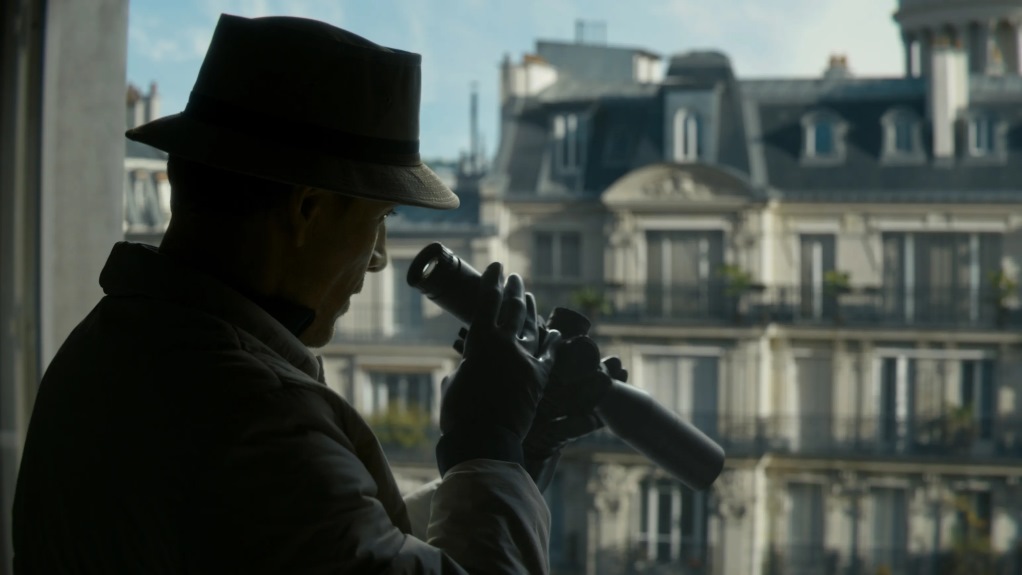
A man sits in monastic silence, starring out of a window at the best hotel in Paris that money can buy. He moves only to sleep, exercise with a monotonous rigour and consume a carefully calculated daily calorie amount from McDonalds. He wears gloves all the time, never moves from the sheeting he lays across surfaces and sometimes assembles and reassembles his rifle. He’s a nameless hitman for hire (Michael Fassbender) and a freak accident on this job will shatter his world of pristine order and leave him hunted by his employers and on a campaign of revenge to guarantee his safety.

The Killer is a lean, slimmed-down thriller full of Fincher’s love for procedure and detail, that delights in every beat of its detailed look at how a professional killer might go about his daily business. Be it lock-ups crammed with mountains of equipment, from guns to false number plates and endless zip-bound folders of fake IDs (all using character names from 70s and 80s TV shows) to the practised ease with which he penetrates even the the highest security building with an Amazon purchased card copier and light-fingered pick-pocketing. All of it assembled with Fincher’s pin-point precision and clockwork eye for detail.

On the surface, you might expect The Killer to be a sort of twist on Le Samouri, Melville’s look at a zen-like hitman. The Killer seems to fit much of the bill. Embodied with an athletic suppleness by Fassbender (his body seems to be almost elastic in the parade of physical stretches and exercises he performs, not to mention the fingertip press-ups he relentlessly pumps his whipper-thin body through). But Fincher gives us a seemingly never-ending insight into the Killer’s inner-mind, via a prolonged (near continuous) monologue of his inner thoughts, ideologies and mantras that dominate much of the film (the first twenty minutes plays out in near on-screen silence, just watching Fassbender and listening to his voiceover).

What’s fascinating is this interior monologue is only a shade away from a stream of corporate middle-management think. (It’s even implied the Killer was originally recruited while training as a lawyer). There are mantras with the air of an assassin’s version of positive thinking (“Stick to your plan. Anticipate, don’t improvise. Trust no one. Never yield an advantage. Fight only the battle you’re paid to fight.”) and passive-aggressive demands to hit a personal standard (“Forbid empathy. Empathy is weakness. Weakness is vulnerability.”). Far from the glamour of an unknowable force acting to a mystical code, this Killer sounds alarmingly similar to a self-doubting white-collar worker using Sun Tze to plan out his pitch meetings.

Beneath the sheen of Fincher’s beautifully dark film, is the suggestion we are watching a character study of a man perhaps only partially aware that his life, and his inner picture of who he is, is falling apart. For starters, despite his mantra of perfection and continued assurance of ‘every detail covered’ and ‘every angle anticipated’, our Killer makes a host of errors. Almost everything we see him do goes wrong in some-way: from that initial hit that takes out the wrong target, to stabbings that leave victims bleeding out faster than he intended, doses of knock-out drunks that are incorrectly calculated, house invasions that fail to surprise the victim… The mantra is clearly an ideal not quite a reality and the Killer’s greatest strength actually turns out to be his ability to improvise in unexpected circumstances.

In addition, for all he maintains he acts only professionally and things are never personal, the entire film chronicles a campaign of revenge in which he takes out a host of targets for personal reasons. The idea of the killer as a man separate from connections is already shattered from his obvious distress, returning to his home in the Dominican Republic after his botched hit, to find his girlfriend seriously assaulted and hospitalised. Michael Fassbender’s mastery of micro-features throughout the film, suggests waves of doubt and insecurity flooding behind the eyes of a man who has tried to master himself as an unfeeling violent limb of faceless masters.

As such, The Killer is a sort of pilgrim’s progress of a man discovering small, unexpected elements of himself while as impassively as possible knocking off anyone he considers a threat (effectively anyone who might know where he lives). No attempt is made in this to make the Killer entirely sympathetic – he ruthlessly kills at least one completely innocent person, and doesn’t hesitate to murder those he has identified, no matter how much he might sympathise with them.

But the monastic chill he aspires to is cracking. You can see it in his conversation with “The Expert” played with a mix of relish and resignation by Tilda Swinton. A professional killer like him, the Expert has not let this stand in the way of “a normal” life outside her trade. She’s married, is a popular regular at a posh restaurant and has achieved a level of compartmentalism the Killer can only dream of. Is the envy and self-doubt in his eyes as he listens to her emotionally articulate reflection on the life they have chosen?

Fincher’s film quietly explores this alongside some skilfully assembled sequences. In many ways the film mirrors its lead character: limber, dedicated, obsessive, executing its sequences with clockwork exactitude and following a fit-bit like a metronome. But it’s also a dark character study of a man (perhaps) realising how empty he has made himself, drowning out doubts with the music of The Smiths. Fassbender is the perfect actor for this, few matching his skill to be both blank and overflowing with suppressed emotion at the same time.

It makes The Killer a fascinating film, a Fincher film that feels at first like a minor work but offers more and more depths for reflection. On one level an auteur John Wick, which brilliantly outlines each trick of its expert lead character. On another level, a sort of dark character study of a man in the midst of an epic breakdown, falling back on mantras and mottos, processing his doubts and guilt through the only thing he really knows how to do: kill people.

Murphy’s War (1971)

Murphy’s War (1971)

This heavy-handed anti-war Don Quixote story is far from a success

Director: Peter Yates

Cast: Peter O’Toole (Murphy), Siân Phillips (Dr Hayden), Phillipe Noiret (Louis Brezan), Horst Janson (Captain Lauchs), John Hallam (Lt Ellis)

In the dying days of World War Two, the merchant ship Mount Kyle is sunk in the Venezuelan Orinoco by a German U-Boat. Surviving the machine-gunning murder of the crew is Irish engineer Murphy (Peter O’Toole), who is treated at a Quaker mission by Dr Hayden (Siân Phillips). Murphy at first seems happy to be out of the war: but that changes, after the murder of fellow survivor Lt Ellis (John Hallam) by u-Boat captain Lauchs (Horst Janson), hunting the survivors. Murphy, assisted by Frenchman Louis (Phillipe Noiret), decides to take revenge, kitting out a crashed bi-plane to launch a series of increasingly obsessive attacks on the u-Boat with Murphy succumbing to a vendetta.

Peter Yates takes an action-adventure novel and adjusts into an anti-war epic that becomes increasingly shrill as it reaches its nihilistic ending. This shift led to several clashes between Yates and the film’s producer Michael Deeley, who was looking for a box-office hit with a charismatic star. While Yates’ film is complex in its eventual structure, the overall impact of the film is confused and blunted, its sympathies mixed and logic often flawed. It has its moments but doesn’t quite work.

As part of its anti-war set-up, Yates believed it was essential to humanise the German sailors (after all, he wanted the viewer to feel unease at Murphy’s destructive crusade). Unfortunately, creates a dissonance in the film. The first thing the German sailors do is ruthlessly machine-gun the Mount Kyle’s sailors as they tumble into burning waters. Graphically shown is every beat of the fear, as charred machine-gunned bodies fill the frame while the Germans show not a moment of regret (indeed we next see them celebrating the Captain’s award of an iron cross). The captain murders Lt Ellis with a face filled with regret, but his execution involves bullets causing Ellis’ body to jerk in its graphic death throws. How are we supposed to sympathise with them after that?

The focusing on such brutality fits the anti-war hell the film wants to lay out. But it fatally undermines the film’s aim to sure Murphy’s campaign to destroy the u-Boat as an obsessive and destructive campaign. With no reason given for the brutal war crimes committed by the u-Boat (for good measure they also machine gun the Quaker settlement, killing many of the villagers), its hard not to feel that actually Murphy has a point and that these guys deserve punishment. Would a throwaway line about a secret German mission or a need to hide have hurt the film?

The film can’t have it both ways. It can’t luxuriate in the destruction and murder war soldiers commit and then ask us to sympathise with these same soldiers when their death is threatened by another obsessive soldier on a quest for revenge. In a better developed film this sort of clash of sympathies might feel more natural. Instead, the Germans are either monstrous or sympathetic depending on the needs of the scene while Murphy himself makes an awkward shift late on from a guy with righteous anger into a destructive figure we are invited to condemn.

This is a particular shame as there is a lot in Murphy’s War to admire. Yates directs with an assurance and sense of epic scale. The Venezuelan scenery is shot with a real beauty by Douglas Slocombe and the film is edited with a professional excellence by future-Bond-director John Glen. The film’s first half hits a “boy’s own adventure” tone very effectively – making the later shift into 70’s anti-establishment nihilism more awkward – with inventive sequences as Murphy, McGiver-like, reassembles the downed biplane and jerry-rigs some home-made bombs.

A big part of any success is the charismatic performance of Peter O’Toole, who tears into the role of this Irish rebel with relish. Mixing insouciant wit with a bitter irony that slowly gives away to a sociopathic gleam as obsession takes hold, this is an excellent performance. O’Toole manages to make a character who is, in many ways, slightly incoherent work effectively. After all this rebel we hear condemning war with counter-culture cool, who fights to the bitter end; a guy who expresses indifference for his colleagues but goes to unimaginable lengths to avenge them. These contradictions don’t feel naturally developed, but ideas that are put in place to ease the plot.

Saying that, the film has some interesting beats as Murphy collapses more and more into Don Quixote like obsession, tilting at his underwater windmill. (Yates clearly had a passion for this angle as he would make two attempts to make a film of Don Quixote before finally making a TV version in 2000). O’Toole is perfect for this increasing severing from reality and as his Sancho Panza, Phillipe Noiret contributes a warm, humane performance as reluctant Louis, who silently acquiesces in a campaign he clearly feels is misguided and delusional. Equally good is Siân Phillips, balancing exasperation and affection for Murphy, finally unable to brake through his walls of aggression.

There are good ideas and moments in Murphy’s War but its poor-plotting (its story is also strikingly slight, with the preparation of the biplane and its test flight filling an elongated stretch of the film) and jumbled mix of adventure and anti-war sentiments eventually fatally undermine its effectiveness. Despite fine work from Yates and a charismatic and highly watchable performance from O’Toole it’s, at-best, an interesting failure.

M (1931)

M (1931)

Lang’s masterpiece, a thrilling and complex crime drama that explores the horrors of crime and mob justice

Director: Fritz Lang

Cast: Peter Lorre (Hans Breckett), Gustaf Gründgens (Safecracker), Otto Wernicke (Inspector Lohmann), Ellen Widmann (Mother Beckmann), Inge Landgut (Elsie Beckmann), Theodor Loos (Inspector Groeber), Friedrich Gnaß (Franz, the burglar), Fritz Odemar (Cheater), Paul Kemp (Pickpocket), Theo Lingen (Conman), Rudolf Blümner (Beckert’s defender)

A murderer prowls Berlin’s streets. For weeks children have been murdered and the citizens are at fever pitch. The police are desperately trying every weapon in their investigative arsenal. The heightened police presence on the streets hampers the lives of regular criminals: they too decide to take matters into their own hands, pooling their resources to catch the killer. And the killer himself? Not a mastermind, but a peculiar, timid man (Peter Lorre), a slave to uncontrollable impulses.

All this forms Fritz Lang’s masterpiece, his first sound film and one of the greatest German films of all time. A rich, psychologically detailed procedural thriller it is a stunning indictment of mob violence, a detailed look at the flawed assumptions of the official forces and an unflinching look at the horrific personal impact of crime. Lang’s film is extraordinary, a brilliant mix of impressionistic insight and documentary realism covered in an all-revealing social tapestry. It’s gripping and extraordinary.

Lang’s film was heavily inspired by real-life cases, most notably Peter Kürten (“the Vampire of Dusseldorf”) and the structure of the Weimar police department. Just like the real Berlin, his fictional one has a criminal underworld governed by a sort of German mafia, the Ringvereine, who a bizarre social set of rules among criminals. M tied into debates around the death penalty: was it right to take a life, even for unspeakable crimes? Is a life in a psychiatric prison fair for the murderer of several children? M is fascinating as it provides enough ambiguity to support either side (Goebbels claimed, when watching it, that it was a sure sign that Lang would become “one of us”).

This stems from Lang’s superbly detailed, anthropological filming style, which throws the viewer into the centre of a world that feels extremely real. Streets are lined with beggars and an array of adverts, posters and political messages. The camera prowls down streets and over tenement blocks, catching shadows and gets lost in cigarette smoke. It captures every detail of the Berlin police department: forensic labs that breakdown fingerprints, annotated maps, criminal psychologists pontificating on the intellectual make-up of the killer based on his handwritten notes to newspapers. Detective Lohmann (an increasingly harried Otto Wernicke) puffs cigars, pulls together facts and fails to make any real progress, looking increasingly buffeted by events rather than controlling them.

It’s one of the film’s subtle criticisms of the political situation at its time. The official forces have every resource going, but seem powerless. Instead, Lang contrasts them ever more closely with the criminal underworld or use brute, uncontrolled, unordered force to tackle the problem. Is it my imagination, or is there the stench of Nazism in this group? Their nameless leader (Gustaf Gründgens) strides, with a leather-clad firmness, emotionlessly forward, fixated on the end result – despite, with at least three murders on his score card, arguably not being that different from the man he’s chasing killer. He instructs the criminals to effectively throw a dictatorial cordon around the city, their solution being stamping out freedom and taking unilateral action.

Lang’s film is sharply critical of the kneejerk horrors of this mob justice. Crowds are whipped up by press coverage (which they excitedly read, the papers hitting the streets with a special edition after every murder) into a mob desperate to lash out, crowding around posters offering rewards for catching the killer. A man giving the time to a child in the street is nearly lynched, a raised camera angle reducing him to a tiny figure compared to his aggressor towering over him. A group of people playing cards in a bar descend into blows after one accuses the other of behaving suspiciously. The criminal put together a show trial (with a token, powerless defence counsel) where the killer is allowed a few brief words before his pre-ordained lynching (no legality with Nazism).

Again, it’s hard not to consider the growth of street violence in Germany in 1931, an atmosphere where justice was slowly dying as the Nazi party argued people had the right to take violent action against those who they see as enemies of the state. The criminal organisation here are worryingly efficient and organised. Lang brilliantly intercuts between two meetings, both in smoke-filled rooms, as the police and the criminals plan their operations. Sentences started in one location are finished in another. Complementary camera angles echo each other. In the police meeting there are also calls for unilateral action. Lang criticises the authorities who are active but ineffective (and some sympathetic to the criminal’s viewpoint), as much as the brutal mob justice of the criminals.

And the killer himself? Brilliantly played by Peter Lorre (who resembles a perpetually frightened paedophilic toad), Hans Breckett is weak, feeble, as scared of himself as he is of others, unable to understand or control his urges. He is driven by a whistling tune of In the Hall of the Mountain King for Grieg (a whistling that he sometimes produces, at others seems to hear around him) and consumes the things he desires – be they apples, drinks or children – with an impulsive immediacy. His letters to the papers suggest he is desperate to be seen. But when he is, chased by the crowds, he’s weak, terrified and utterly unimposing, trembling amongst the flotsam of a factory almost indistinguishable from the debris around him. At his trial he attempts to vindicate himself with a whining desperation. But, as Lang quietly suggests, do we have the right to kill him?

After all, Breckett is almost certainly a war veteran. He shares that with several other characters – as we are reminded by beggars with wooden limbs. Maybe his split personality – perhaps that’s why he stares with curiosity at his own face in the mirror, as if he doesn’t recognise himself – is a relic of a conflict where men were encouraged to kill, then returned back into society where expected to do the opposite. Perhaps the same feelings also lie behind the ease so many people have with mob justice – and also those in the criminal jury who show some sympathy for Breckett’s forbidden urges.

As well as balancing these complex ideas, Lang’s film is also a masterpiece of visual and aural technique. A child’s death is suggested by a newly orphaned ball rolling into frame. A gorgeous hand-held camera shot wanders through the beggar’s bar, where beggars gather used cigars, rescued sandwich fillings and sign up to be the criminal’s eyes on the street. Sound transitions between scenes are handled with an extraordinary confidence. The silence of armies of policeman walking through the streets turning into burst of noise as they move through raids. The Grieg leitmotif is used to brilliant effect.

Lang’s film though never forgets the victims. we start and end with the parents. The mother of the film’s first victim, Elsie Beckmann, waits with increasing panic in her apartment, each knock of the door promising her daughter’s return but disappointing (we’ve already seen Elsie disappear, hand-in-hand, with Breckett’s whistling shadow). It’s to her the film returns to her at the end, her tear-stained face telling us no sentence will bring back the dead. Appearing over a wordless scene of Beckett’s actual trial (the result of which we never discover), its Lang’s subtle reminder that mob justice brings only false satisfaction, that killing never heals the wounds of loss and our effort would be better directed to protection rather than revenge. It’s a message that feels particularly poignant in a German film made in the final years before Nazism would lead the country into devastation.

Filled with stunning film-making confidence, mixing documentary realism and brilliantly confident visual and audio mastery, Lang’s M could be argued to be one of the greatest film noir detective dramas ever made – and also a brilliantly insightful look at human and social nature. M is a masterpiece, as gripping and relevant today as it was Lang filmed it.