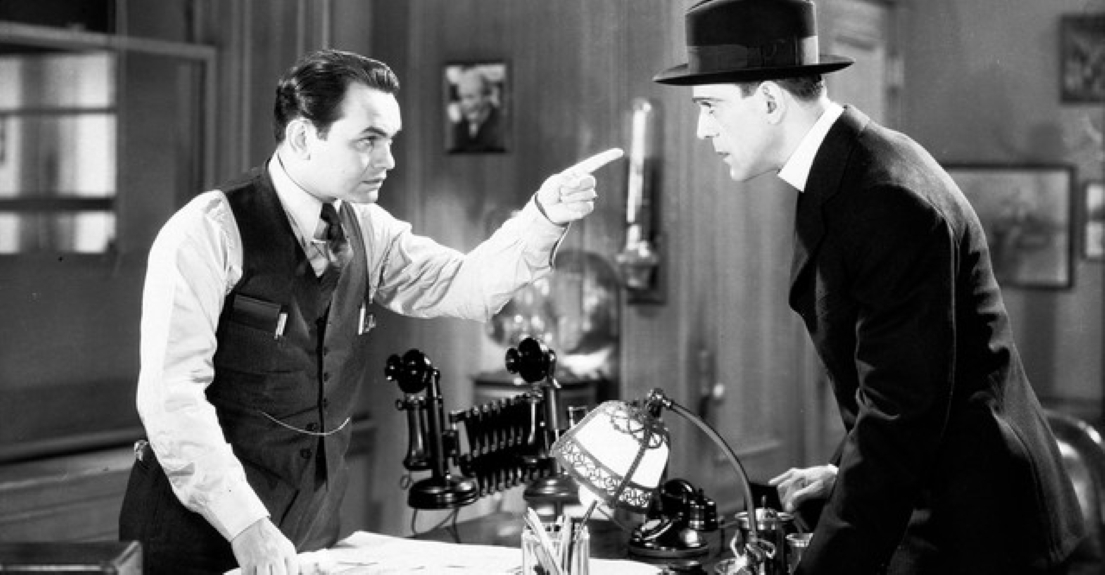
Category: Journalism film

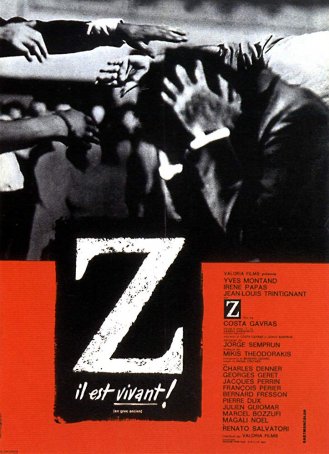
Z (1969)

Z (1969)

Costa-Gravas thrilling conspiracy thriller is possibly one of the finest political films ever made

Director: Costa-Gravas

Cast: Jean-Louis Trintignant (Examining Magistrate), Yves Montand (Deputy), Irene Papas (Helene, the Deputy’s wife), Pierre Dux (General), Jacques Perrin (Photojournalist), Charles Denner (Manuel), François Périer (Public Prosecutor), Georges Géret (Nick), Bernard Fresson (Matt), Marcel Bozzuffi (Vago), Julian Guiomar (The Colonel), Gérard Darrieu (Barone), Jean Bouise (Georges Pirou), Jean-Pierre Miquel (Pierre)

Costa-Gravas Z is an explosive political thriller, ripping a lightly fictionalised story from the Greek headlines (the opening credits playfully state ‘any resemblance to real people is ‘purely intentional!’) and turning it into a compellingly angry, cold-eyed look at political repression. It was based on the state-backed murder of Greek politician Grigoris Lambrakis in 1963 and the investigation by magistrate Christos Sartzetakis which briefly looked like it might expose repressive military forces but actually kick-started a 1967 military junta counter coup in Greece. Z takes this as inspiration for a truly universal story that continues to feel like ‘it could happen here’.

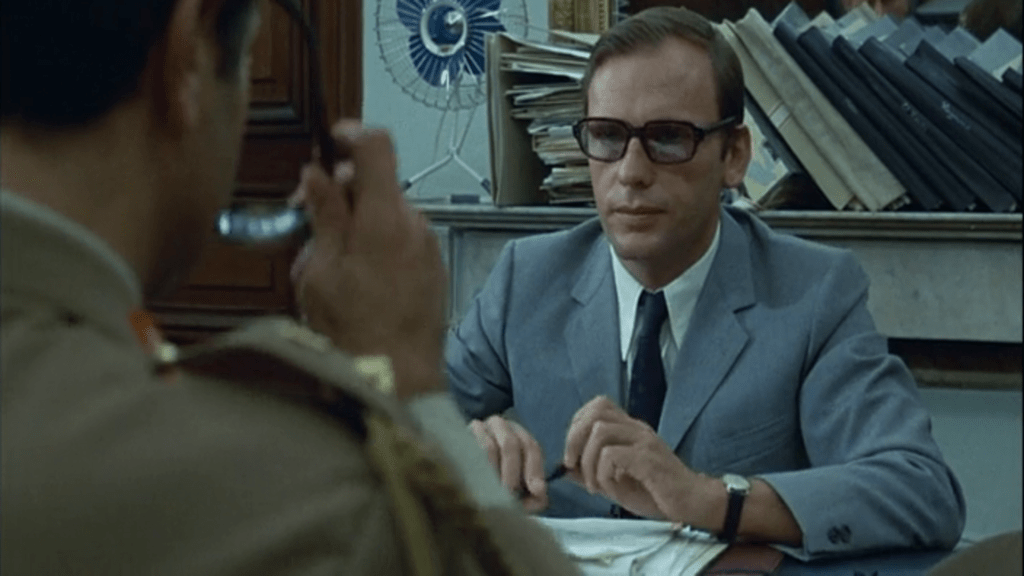
Lambrakis becomes The Deputy, played with great charm and determined charisma by Yves Montand. After death threats, he is murdered after a political rally by two thugs in a hit-and-run, in a public square, surrounded by police officers and a legion of witnesses. The police, represented by the virulent anti-communist General (Pierre Dux) declare it a tragic accident. They firmly expect our Sartzetakis-figure (Jean-Louis Trintignant, putting his enigmatic unreadability to extraordinarily good-use), son of a war hero, to back-up their bullshit. But he didn’t get the memo, conducting a genuine investigation which reveals the extensive links between the military and police and far-right organisations, how they planned the hit and did everything to ensure its success. But will this investigation lead to real change?

Costa-Gravas’ film is a hard-boiled conspiracy thriller with echoes of The Battle of Algiers’ primal urgency and immediacy. It’s committed to throwing you into the middle of the turmoil, with fast-cutting, hand-held camerawork, tracking shots through crowds and shots which zero in on the faces of victims and perpetrators alike. The film’s influence on directors like Oliver Stone is palpable. But, unlike Stone’s work, Z wears its moral outrage carefully: it presents events with a journalistic matter-of-factness, trusting us to recognise the corrupt horror of over-mighty governments. The resolute professionalism of Trintignant’s magistrate helps enormously here – heroism in this world is being honest and doing your job.

What Costa-Gravas film reveals is that these authorities believe they can act with utter impunity, convinced they will never be questioned by anyone, other than their liberal targets. Z opens with a darkly comic scene that outlines this thinking: during a lecture, the pompous General outlines (to a military audience shown impassively watching in a series of quick reaction cuts) his theory of ‘ideological mildew’ attacking the ‘tree of liberty’, using a tortured pesticide metaphor to suggest it is their duty to kill the mildew (liberals and socialists). This tyrannical view is parroted by people who are neither lip-smacking villains or fiendishly clever – they just have absolute, fixed certainty.

Z makes clear that such men, placed in position of authority, will attempt to shape events with a breath-taking arrogance. The assassination plot is shockingly clumsy and obvious and cover-up so full of transparent bare-faced lies, you’d need to be impossibly arrogant to even consider you could get away with it. Copious evidence shows meetings between senior officers and members of the right-wing CROC group. It’s claimed the Deputy’s fatal head-wound came from hitting the pavement, even though this is ruled impossible by both an autopsy and hundreds of witnesses. The General claims not to know the driver who ‘rushed’ the wounded Deputy to hospital (stopping at every opportunity), even though the man is his personal chauffeur. Everyone repeats the same tortured, unusual phrases – from the head of police to the thugs themselves.

It doesn’t stop there. Once it becomes clear Trintignant’s magistrate is genuinely investigating – that he has his own mind and opinions – the clumsy cover up turns aggressive. Blame is put on the Deputies own supporters (the word ‘false-flag operation’ didn’t exist then, but the idea is seized on); his lawyer is almost killed in a park hit-and-run in front of dozens of witnesses; a witness who can testify to the plans of the hitmen is pressured, told he has epilepsy, framed as a radical (he’s clearly not) and then nearly assassinated by one of the hit-men (put up in the same military hospital with a pretend broken leg), who flees the scene and in front of his doctors, while giggling at his cheek.

Some of this is in fact blackly funny. It perhaps almost would be, if it wasn’t for Z’s moral indignation. Even without murder, this is a repressive, corrupt regime: the Deputy’s team have innumerable petty obstacles placed in their way for their rally, their supporters are openly attacked by bused in protestors mixed with baton-wielding under-cover officers. Costa-Gravas doesn’t show the Deputy as a saint – flashbacks reveal he is an adulterer – but it does make clear his bravery (confronting and cowing crowds of anti-liberal rioters, utterly unrestrained by the police), leadership and the fear he overcomes. It also shows, especially in Irene Papas’ emotionally underplayed but quietly devastating performance, the raw grief of those who love him. His closest colleagues weep at news of his death, the post-death slandering of him all-the-more disgusting.

Z presents its evidence with an increasingly overwhelming force. The magistrate corrects (for a long time) any use of the word murder for ‘accident’ – by the time he himself says ‘murder’ it’s almost easy for us to miss it, so natural has the conclusion become. Pressure is, of course, applied to him: senior officers bluster about metaphorical eggs and omelettes; his bosses suggest he charge only the hit-men and (for good measure) charge the Deputy’s people for disrupting the peace by holding the rally in the first place. Plenty of ordinary people know exactly what’s going on, but don’t want to take risks: a newspaper editor reports what he’s told to, the Deputy’s doctor regrets not joining his lonely ‘march for peace’ but, well, you know how it is…

Given the blatant criminality of the police and the army – and the sadistic arrogance of hit-man Vago (an uncomfortable beat in Z is the whiff of homophobia in the depiction of Vago as a predatory homosexual and pederast) – it’s truly triumphant to see them bought to book. Despite their bombast (each officer states he will have no choice but to take his life to avoid the shame, something of course none of them do), each flees the building railing at the press. (The General, an antisemite among everything else, even roars ‘Dreyfus was guilty!’ when a journalist compares the affair to that).

But it’s short-lived. Perhaps Irene Papas’ Helene knows it will be when she responds to news of the arrest with a quiet middle-distance stare. Z closes with a dark coda that could almost be funny if it wasn’t horrifying. A photojournalist (played by producer Jacques Perrin) who we have followed uncovering the plot, reports the aftermath: initial resignations followed by slap-on-the-wrist sentences for the hit-men, charges dropped for the officers and a coup d’etat (at this point a cut removes Perrin) which sees the arrest or ‘accidental’ death of all the Deputy’s supporters, a junta government and bans of everything from authors, mini-skirts, modern mathematics and, above all, the letter Z, as zi has been taken by protestors as the badge ‘He Lives’.

It would be funny. It almost is funny. If it wasn’t part of a system that crushes freedom with violence and murder. Costa-Gravas’ brilliant, engrossing and perfectly judged film shows how terrifyingly swiftly it can happen, how freedoms and justice can be strangled before our very eyes. Watching it today, you can’t imagine a time when it won’t be coldly, chillingly, terrifyingly relevant.

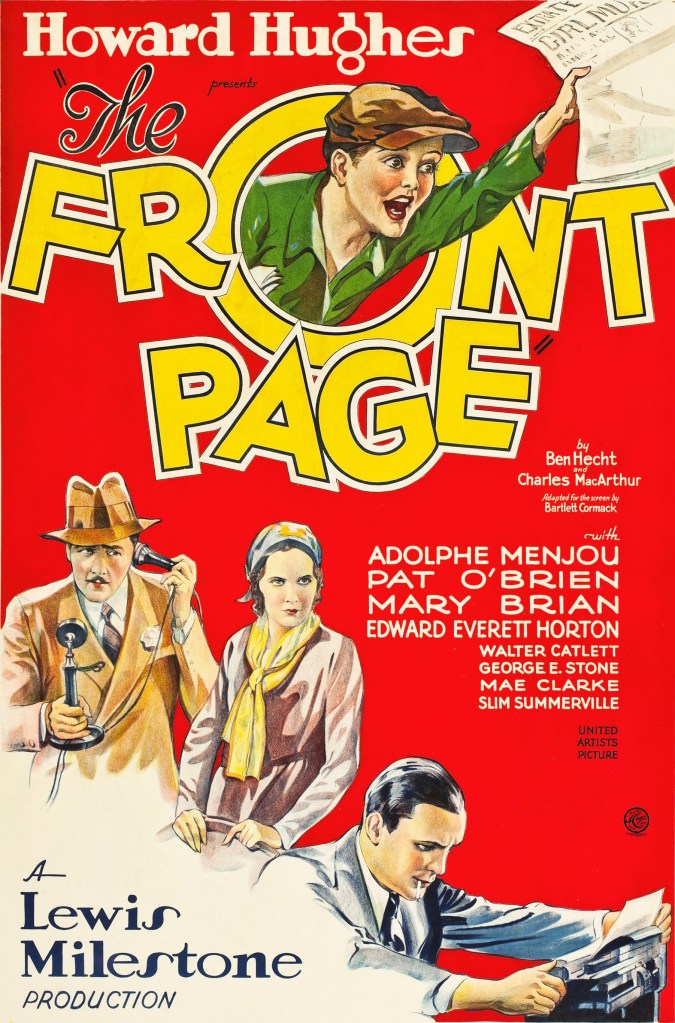
The Front Page (1931)

The Front Page (1931)

Original and (perhaps) best version of the pioneering cynical journalism story

Director: Lewis Milestone

Cast: Adolphe Menjou (Walter Burns), Pat O’Brien (Hildy Johnson), Mary Brian (Peggy Grant), Edward Everett Horton (Roy Bensinger), Walter Catlett (Jimmy Murphy), George E. Stone (Earl Williams), Mae Clarke (Molly Malloy), Slim Summerville (Irving Pincus), Matt Moore (Ernie Kruger), Frank McHugh (McCue), Clarence Wilson (Sheriff Pinky Hartman), Fred Howard (Schwartz)

Unscrupulous newspaper men fling fast-paced banter at each other, caring less about the truth and far more about how the copy sells. In many ways the deeply cynical The Front Page hasn’t really aged at all. Probably why it keeps coming back round again-and-again, in different forms for different eras (most famously of course, spiced up with a gender-swopped Hildy as the screwball romance His Girl Friday). I’ll make a confession – not a surprise for those who know my heretical views on His Girl Friday – it’s never been my favourite play and I’ve never found it as funny as others. But, despite my doubts, it’s hard to deny the flair and energy of Milestone’s early talkie.

Star-reported “Hildy” Johnson (Pat O’Brien) has decided the time is right to give up the newsprint game and find happiness with sweetheart Peggy Grant (Mary Brian). But his ruthless editor Walter Burns (Adolphe Menjou) doesn’t want to hear it from his star reporter. Burns is determined to drag Hildy back into the game, and the press-stopping story of an anarchist who escapes hours before his scheduled execution is just the thing to tempt Hildy away from those wedding bells.

And so we get the ultimate cynical press story, adapted from a play that practically invented the image of the newspaper man as a heartless adrenalin junkie more interested in the scoop than the truth. The Front Page is all about the process of collecting the news, and how easily and casually this can be spun into what an audience wants. If the truth does out eventually, it barely happens as a result of the journalists. In fact, our heroes largely end up pushing it because it will get them out of a tight spot and shift a hell of a lot of copies tomorrow morning.

Milestone’s film for years existed as only a bastardised version of the international print: made up of Milestone’s third choice takes and angles with re-edited lines. Restored into his original vision, it’s striking how dynamic and cinematic The Front Page is. While His Girl Friday has it beat on pace (giving us the same story and almost the same amount of dialogue in twelve fewer minutes), arguably Milestone’s film has the edge on cinematic technique. Milestone uses dynamic camera angles and set-ups to inject pace, from the long tracking shot of Burns prowling his newsprint rooms to the rotating camera that roves around the film’s primary location, the courthouse press-room.

It uses fast-cuts and zooms to great effect: the opening shot of a sack of flour, crash zooms out to reveal it’s being used to test a gallows; the ‘yo-yo’ effect as the camera bounces rapidly up-and-down to take us from one reporter’s face to another during a harried reporting scene. Milestone makes large chunks of otherwise single-location farce, come to life through witty angles and blocking, knowing when and when-not to include an actor in the frame to make a joke work. It’s fast-cutting gives it an early screwball style that further accelerates its sense of momentum. It’s a very astutely, very skilfully directed movie that feels several years ahead of its time, and certainly a whole other level above some of the stilted play adaptations Hollywood was churning out.

Even though the script has never been my favourite, it also picks up a lot of screwball dynamism (and healthy dose of pre-Wilder cynicism) in its bones. It’s chorus of newspapermen, all corrupted to various degrees, are finely delineated, each with their own clear characteristics. From Frank McHugh’s shallow cough to Fred Howard’s banjo, via Edward Everett Horton’s prissy germaphobia and half-hearted attempts at woeful poetry, they each have complementary personalities that helps the comedy spark even more. That’s even without their utter disinterest in the personal lives and tragedies of those they are reporting on, or their shameless gilding of the facts of every story (a lovely audio montage sees them all reporting wildly different versions of an arrest).

The Front Page has a strong performance from Adolphe Menjou as the debonair Burns, here embodied by Menjou as a heartlessly ambitious Mephistopheles-type, constantly throwing titbits of temptation in the way of Hildy. Milestone even films him with a Devilish-Murnau strength, popping up seemingly everywhere he needs to be at any moment in time. Add in Menjou’s suave delight in some ruthlessly amoral lines and you have a genuinely spot-on piece of casting. This is less of the case for Pat O’Brien, the sort of actor more familiar as the best friend to a real star, here showing he doesn’t quite have the charisma to carry a dynamic part like Hildy (in fact, O’Brien would have been perfect casting for the male-version of Peggy: dependable, sturdy, dull).

Nevertheless, he and Menjou bounce off each other well in a film that has more than a little homoerotic energy in it (surely the idea for the gender reverse spun from this!) Even Peggy points out Hildy seems as least as excited as the thought of inconveniencing Burns as he does in marrying her (“you’re going to marry me to spite Mr Burns?”). Hildy isn’t just a man fighting against his urge to report on any events happening around him (a potential fire sees him bemoaning he doesn’t have a camera to hand). There is a life and energy to him when riffing ideas with Burns, that he just doesn’t have with anyone else. The two of them burst into life like naughty kids in each other’s company, in a way they just don’t with anyone else.

Hildy may end the film heading into the sunset, but you suspect Burns’ scheme to bring him back (a witty typewriter ping covers a sensor banned piece of naughty language as Burns calls Hildy an SOB on the phone to an underling) is going to succeed with very little hinderance. Because these guys are made for each other and, just like the rest of the cast, they need the buzz of being in the room where it happens far more than the dull dependency of a job in advertising for Peggy’s Dad’s firm.

That The Front Page does very well and while I’m still not an admirer of a play I found overly cynical and glib, Milestone’s dynamically staged version of it may (ironically) be the best of many committed to the screen.

September 5 (2024)

September 5 (2024)

Well-made reconstruction of a seminal moment, that avoids all the awkward questions it raises

Director: Tim Fehlbaum

Cast: Peter Sarsgaard (Roone Arledge), John Magaro (Geoffrey Mason), Ben Chaplin (Marvin Bader), Leonie Benesch (Marianne Gebhardt), Zinedine Soualem (Jacques Lesgards), Georgina Rich (Gladys Deist), Corey Johnson (Hank Hanson), Marcus Rutherford (Carter Jeffrey), Daniel Adeosun (Gary Slaughter), Benjamin Walker (Peter Jennings)

There is only one thing we really remember about the 1972 Munich Olympics. This celebration of sport, meant to mark Germany’s re-emergence from the shadow of the Holocaust, saw 11 members of the Israeli Olympics team taken hostage and murdered by Black September, a Palestinian terrorist group. The entire kidnapping played out on international TV, the inadequacy of the German police response cripplingly obvious to millions of viewers around the world. September 5 focuses on the ABC Sports team that switched from covering Mark Spitz to one of the first primetime terrorist acts.

Journalists in films tend to either be heroic strivers after truth or scum-bag bin-searchers. September 5 is very much in the first camp, chronicling with documentary precision the professionalism and dedication involved in bringing this story to the world. The story is as terribly involving as the dreadful events it covers on fuzzy long-distance footage. But September 5 struggles when it tries to capture why it’s telling a story that has already been expertly told before (not least in Kevin MacDonald’s superb Oscar-winning documentary One Day in September). What point is September 5 trying to make, either about media or terrorism? It’s not clear to me.

Fehlbaum’s film is as expertly assembled as the swiftly cut-together sports action the team excelled at. The production and sound design faultlessly bring to life the atmosphere of a claustrophobic TV control room. It has a loving eye for the detail of how 70s television was made – you’ve got to admire the practical details of how live coverage was water-marked, clunky cameras were wheeled into position, squabbles were carried out over limited satellite windows and on-the-hoof re-wiring was made to hook up journalists on phones for live broadcast. A parade of strong actors deliver clipped professionalism and anxious strain – Sarsgaard, Magaro, Chaplin and Benesch are all great.

But it fumbles when it addresses the moral issues. Fundamentally, September 5 doesn’t know how to handle the complex ethical balance journalism straddles, between covering events like this and giving the terrorists exactly what they want. After all, as it’s pointed out, there’s a reason Black September targeted the most public event in the world (and why they made demands they surely knew Israel would never accept). They wanted mass coverage: and ABC gave it to them. By September 6, the whole world knew what Palestine was: it’s striking how many of the ABC crew are unfamiliar not only with the sort of fundamentals even a child today knows about the Middle East conflict but how some of them even have to double-check what exactly the word “terrorism” means.

On top of that, the extended media coverage, in some ways, even helped the terrorists. Not least their ability to switch on the TVs in their captured rooms in the Olympic Village and watch live footage of the Munich police’s ham-fisted preparations to storm the building. There is chilling realisation in the control room that the terrorists are also watching their coverage, but the debate about what to do in response to this is light. In fact, much of the conclusion is that the inept German police (who eventually burst into the control room, pointing machine guns wildly, demanding the feed is cut) are really to blame since they forgot to cut the building’s power.

Either way, September 5 doesn’t question the fact that the ABC team encouraged journalist Peter Jennings to remain hidden in the village so he could carry on phoning in live updates, or that they forged an ID for a junior member of the team so could pass as a US athlete and smuggle camera footage in and out of the park. Or that they tune into a police scanner to follow and report on the Munich police’s plans. It also skirts questions of ratings – a clear motivation to keep the cameras rolling – and how this meant ABC had an awkward intention overlap with Black September.

There is no question though that the crew care deeply about the athlete’s fate. Ben Chaplin’s character (an American Jew, who lost family in the Holocaust) goes farthest in constantly reminding the team they are covering the fates of real people here, urging restraint in the coverage. September 5 skirts overt commentary on the Middle East, but raises interesting questions over the characters’ (all of them old enough to remember World War Two) perceptions of Germany and the lingering guilt of that nation (very well captured by Leonie Benesch’s awkward translator).

But when given (false) confirmation that the attempt to free the hostages at the airport has succeeded, it’s the temptation of a scoop that sends the news out on the air. (This moment of mistaken celebration allows September 5 to squeeze in its moments of congratulation for the team’s excellent job before the tragic ending.) Sure, the characters look sickened when they realise their mistake – but does the fact they were given false information really matter more than the fact their motivation was because they wanted to break the story first?

September 5 never really explores these moral questions. It settles for stating them – as Benesch’s character does, describing how she and other reporters hustled at the airport for a scoop, while people literally died a few kms away. It ends with a confusing series of captions, stating this was the first time a terrorist attack was broadcast live and 900 million people watched. It’s hard to escape the feeling that the 900 million figure is being used to celebrate the coverage, rather than reflecting on the fact it taught terrorist groups large scale actions capture attention.

September 5 is on the brink of making a more interesting point, that this was a turning point where getting the story out was more important than the implications of telling the story: that transmitting sensitive information or being too quick to broadcast major headlines was the first stride on a slippery slope that led to the generally awful state of the media today. It’s not a point September 5 is interested in making.

Don’t get me wrong. The Black September attack was an atrocity and ABC’s coverage of its was expert journalism. But you can also argue it shows how journalists can disconnect what they are doing from its real-world impact. But September 5 is silent on how Black September’s success in turning their cause into international news. Or that, thanks it changed the playbooks of terrorist organisations all over the world. None of these interesting, but challenging, ideas get any airtime in this well-made reconstruction.

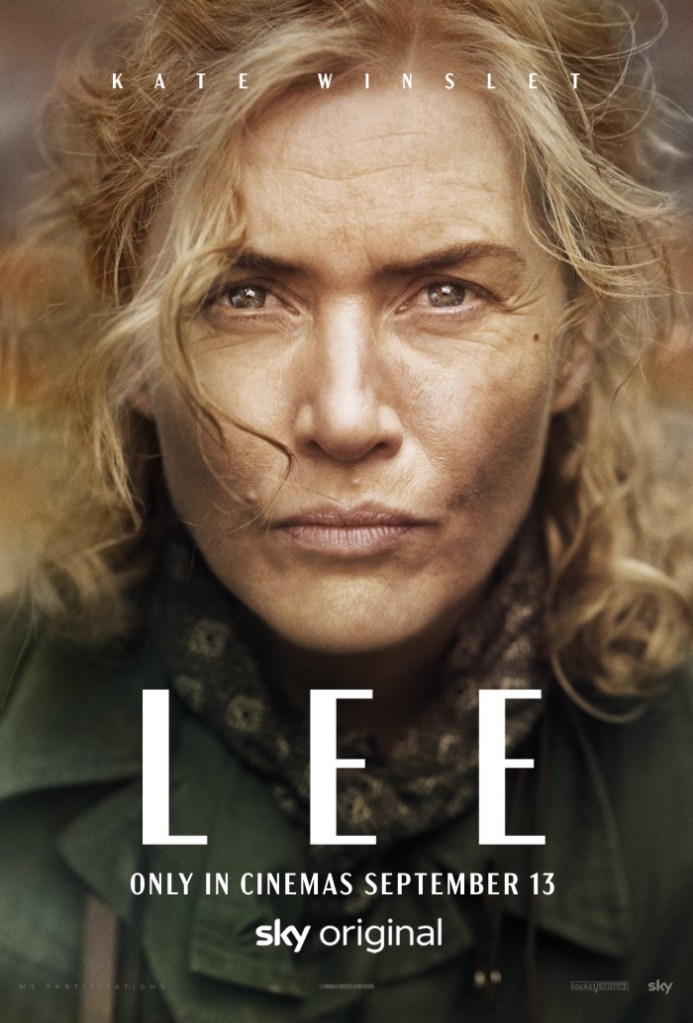
Lee (2024)

Lee (2024)

Kate Winslet plays with passion in an otherwise rather safe and traditional biopic

Director: Ellen Kuras

Cast: Kate Winslet (Lee Miller), Marion Cotillard (Solange d’Ayen), Andrea Riseborough (Audrey Withers), Andy Samberg (David Scherman), Noémie Merlant (Nusch Éluard), Josh O’Connor (Interviewer), Alexander Skarsgård (Roland Penrose), Arinzé Kene (Major Jonesy), Vincent Colombe (Paul Éluard), Patrick Mille (Jean D’Ayen), Samuel Barnett (Cecil Beaton), Zita Hanrot (Ady Fidelin)

“War? That’s no place for a woman!” That’s the message photographer Lee Miller (Kate Winslet) received when she applied to head to the Western Front for Vogue in World War Two. An experienced artist and photographer, with a strongly independent mindset, Miller wasn’t taking no for an answer: her stunning images of the horrors of war and the Holocaust would become a vital historical record.

That’s the key message of this well-meaning, rather earnest, slightly old-fashioned film, a callback to hagiographic biopics of yesteryear. It’s told through a framing device of an older Lee being interviewed in the 70s. The interviewer is played, in a thankless role, by Josh O’Connor (the character’s identity is a late act reveal that most viewers will probably guess early) and his dialogue is awash with either the sort of “and then you married and left France and moved back to London where you became the first woman photographer hired by Vogue” narration that links time-jumped scenes together, or blunt statements about Lee’s emotional state (“you must have been very frustrated”) that Winslet is definitely skilled enough to do with her face alone.

This was a passion project for Winslet, who spent a decade bringing it to the screen and which she bailed it out during a funding wobble, and she is the main reason to watch Lee. This strong-willed, take-no-nonsense bohemian turned hardened professional is a gift for Winslet, but she also gives Miller a strong streak of inner doubt and fear. Under her force-of-nature exterior, there is a strong streak of vulnerability in Miller, her life marked by past trauma. Winslet lets this rawness out at key moments, bringing great depth and shade to a character who could otherwise be blunt and difficult, and the film works best when it gives her free reign.

It’s unflinching but also tasteful in its depiction of war. Experienced cinematographer and first-time film director Ellen Kuras shoots its grimy, hand-held immediacy with an intensity that makes a lot of the film’s limited budget. Lee’s dirt and dust-sprayed combat scenes – with Miller dodging explosions and bullets to get into position to get the perfect shot – are tensely assembled and make a punchy impact. But Lee also knows when not to show us things, and its visual restraint when Miller and colleague David Scherman (Andy Samberg) photograph the horrific aftermath of Buchenwald and Dachau is admirable, the camera focusing on the characters’ stunned faces as they capture the terrible moments, with the horrific reality just out of focus.

There are some fine moments in Lee, which makes it more of a shame that so much of it feels safe, predictable and unchallenging. Lee focuses on Lee Miller as an artist and downplays her daring, unconventional life. Tellingly it’s adapted from a biographer by her son, titled The Lives of Lee Miller, which chronicles her life of constant reinvention. This is after all a woman who maintained a relationship with her Egyptian husband in the 30s, after meeting her second husband Roland who himself remained married for several years (they only married in 1947). She was a model, a surrealist artist, photographic pioneer, ahead of her time. That’s rinsed out to make her more conventional.

In the film, she and husband Penrose (a generously low-key performance from Alexander Skarsgård) have an uncomplicated meet-cute in a French villa owned by a friend (an extended cameo by Marion Cottillard) – admittedly it as at an outdoor picnic where Lee and others sunbathe topless – before settling into a life of middle-class suburbia (right down to Lee cooking meals for Roland when he returns from work). Hints that she has a consensual affair with Scherman linger, but the film seems prissily determined to reposition Lee as a far more conventional person than she really was. It’s a conservative attitude that comes from a good place – focusing on the work not the gossip – but it also makes her feel less unique or challenging than she was.

With the work as its focus, it’s surprising Lee doesn’t make more of the extensive collection of masterpiece photos Miller took. Although an inevitable credits montage shows how some of these were re-created for the film, actually including the images in the film itself might have carried more power and placed Miller’s work more prominently at its heart.

Lee also fumbles slightly with its final revelation of Miller’s past trauma. Shocking as this is, attempting to suggest what happened to Lee in her teens is on the same scale as the Holocaust or that she has a unique understanding of an act of ethnic genocide because she suffered in the past stinks. It’s especially notable since Lee does an excellent job of showing the quiet distress the Jewish Scherman feels as he realises only an accident of geography saved his life. Andy Samberg, in his first dramatic role, is extremely good in a role that clearly carries a very personal feeling for him.

Lee has things going for it, not least Winslet’s barn-stormingly committed and passionate performance. But in the end, it turns its lead character into someone who feels less provocative and revolutionary than she was. Its safely traditional structure and narrative approach turn her into a “role model” and make Lee the sort of middle-brow biopics Hollywood churned out in the 80s. It’s solid, interesting but essentially safe and forgettable.

The Critic (2023)

The Critic (2023)

McKellen’s familiar star turn is the only life in an otherwise unremarkable film

Director: Anand Tucker

Cast: Ian McKellen (Jimmy Erskine), Gemma Arterton (Nina Land), Mark Strong (David Brooke), Lesley Manville (Annabel Lord), Romola Garai (Cora Wyler), Ben Barnes (Stephen Wyley), Alfred Enoch (Tom Tunner), Nikesh Patel (Ferdy Harwood), Claire Skinner (Mary Brooke), Ron Cook (Hugh Morris)

The murky streets of 1930s West End London are the kingdom of Daily Chronicle theatre critic Jimmy Erskine (Ian McKellen), famous for his poison-inked, vitriolic reviews of the many shows that fall beneath his high standards. But the times they are-a-changing, not least at the Chronicle where the former owner (a Rothermere-like bully who loved Jimmy’s take-no-prisoners prose bullying) is replaced by his son David Brooke (Mark Strong), a softly-spoken liberal who wants to take the paper in a new direction. With the arrogant Erskine on a knife-edge (not helped by his risk-taking penchant for rough-trade sex encounters with gentlemen in the park), Brooke is about to unknowingly discover how far the famed critic will go to cling onto his job and reputation – and how easily he will embroil an ambitious young actress, Nina Land (Gemma Arterton), in his schemes.

The Critic starts far more interestingly when it ends. It’s easy criticism, but you can well imagine it falling foul of Erskine’s fury if he had seen it unfold before him in a West End theatre on a Tuesday night. Despite the best efforts of all involved, it all too quickly becomes the sort of routine revenge-murder-conspiracy potboiler that relies a little too much on contrivance and coincidence, the stench of familiarity all over it. Atmospheric as it is – set in a dimly-lit, fog-bound London and in the plush retiring rooms of the rich and famous – and well-selected as its selection of faux theatrical memorabilia that litters Erskine’s home is, the actual story becomes all too predictable.

The main thing it has going for it is a fine performance by Ian McKellen, even if the part plays so neatly to his strengths you feel he could play it standing on his head. McKellen has long mastered mixing the twinkle of the bon vivant with the vicious, cold-eyed cruelty of the sociopath, even having recently done the same thing in The Good Liar. Erskine is selfish, demanding, cruel with a self-destructive streak (both financially – living a ruinous life well beyond his means – and his frequent drunken pride and stubbornness). He bitterly believes himself to deserve acclaim and standing (denied to his failed acting career) and treats almost everyone around him with contempt hidden behind a raised eyebrow or pursed lip. His primary motivation, to the very end, is that his theatrical writing should become a collected volume in every home cementing him as a sort of Wildean wit.

The Critic toys with a more interesting view of Erskine as not entirely unsympathetic. His homosexuality – and the abuse and persecution it has bought him – shows him fall foul of encounters with the police and sees him challenging preening National Front blackshirts. He’s disgusted by Fascism and despises racism, promoting his young Black lover, secretary and amanuensis Tom Tunner (a fine performance of mixed loyalty and Stockholm-syndrome-like support from Alfred Enoch). He’s genuinely touched when Nina Lane – who has lambasted for years in print – tells him his writing made her want to act. But these shades of grey get largely ditched for as the film focuses on darkening his shadow as the plot descends into conspiracy, blackmail and murder.

McKellen does provide the film’s best entertainment. He knows how to deliver a line, how a splutter can communicate outrage, how an intake of breath can communicate fury, how the eyes can turn any smile insincere. He’s long since mastered Iagos and if The Critic doesn’t ask him to do anything he hasn’t done before, he can still do it like an absolute pro. There are other decent performances. Mark Strong plays against type as a man as (surprisingly) decent and kind as he seems. Gemma Arterton expertly plays both “bad” and “good” acting as would-be theatrical giant Nina Lane, while mixing desperation and self-loathing in her off-stage persona. On the other hand, the film wastes Romola Garai as Brooke’s Nazi-sympathising daughter and Lesley Manville as Nina’s chatterbox mother.

The Critic builds up a contrived (and inadvertently creepy) plotline that links both Brooke and Nina – most convenient for Erskine’s improvised blackmail scheme – and that melodrama eventually suppresses The Critic’s more interesting moments. A film that looked at Erskine’s character having been formed in a world where his sexuality was a persecuted crime might have made for a more intriguing storyline. Or which explored how Erskine settled for being court jester to powerful, clubbing homophobes – so much so he actively resents the more liberal Brooke. Or looked at the creeping onset of fascist sympathy in the upper classes. Or one which took a more expanded look at Tom’s struggles in a defiantly non-diverse 30s London (instead the significance of Tom’s skin colour fluctuates according to plot requirements and its awkward uniqueness is undermined by the fact the theatre director is played by Nikesh Patel). It avoids all this for all too familiar tropes.

In most ways The Critic has its moments but fundamentally fails to deliver. And, perhaps worst of all, it does so in a way that doesn’t even really raise the critical heckles. Instead, you’re overwhelming feeling when this sub-Christie drama comes to its close is that it was okay. The sort of film Jimmy Erskine would have dismissed in a few short sentences.

Civil War (2024)

Civil War (2024)

An eye-catching concept disguises a film more about journalistic ethics than politics

Director: Alex Garland

Cast: Kirsten Dunst (Lee Smith), Wagner Moura (Joel), Cailee Spaeny (Jessie Cullen), Stephen McKinley Henderson (Sammy), Nick Offerman (President of the United States), Sonoya Mizuno (Anya), Jefferson White (Dave), Nelson Lee (Tony), Evan Lai (Bohai), Jesse Plemons (Militant)

A third-term President (Nick Offerman) speaks to an America torn apart by Civil War. It’s an attention-grabbing opening but actually, in many ways, politics is not the primary focus of Civil War. Rather than a state-of-the-nation piece, Garland’s punchy work is a study of journalism ethics. Should journalists have any moral restraint around the news they report? Civil War covers the final days of its fictional civil war, as four journalists – celebrated photo-journalist Lee Smith (Kirsten Dunst) and her reporter colleague Joel (Wagner Moura), veteran correspondent Sammy (Stephen McKinley Henderson) and would-be war photography who idealises Lee, Jessie (Cailee Spaeny) – travel to Washington in the hopes of capturing the photo (and interview) with the President before his defeat.

Perhaps worried about accusations of political bias, Civil War keeps the causes of its war – and, often, even which sides we are interacting with at any given moment – deliberately vague. There is a throwaway reference to Lee having gained fame for a photo of “the Antifa massacre”, phrasing which doesn’t tell us if Antifa were victims or perpetrators. California and Texas – unlikely bedfellows to say the least – have allied to form the Western Federation. We learn nothing about the President, other than casual name-checks comparing him to Gaddafi (he does vaguely resemble vocally, in his brief appearances, Trump). But so universal are the politics of Civil War it could, without changing a thing (other than wifi access) be as easily set in the time of Clinton or Reagan as Trump and Biden.

Instead, Garland’s point seems to be more if there was a civil war in the Land of the Free, the chaos we could expect to see would be no different than the chaos that has occurred in any number of other locations. On their journey, the journalists encounter UN-run refugee camps, lynch mobs, summary executions, street-by-street fighting, mass graves of civilians and a collapse of anything resembling normal life. We’ve seen the same sort of images countless times on TV, and it matters not a jot that the backdrop now are the streets of DC rather than, say, Mogadishu.

Instead, Civil War becomes the sort of ethical discussion you could imagine in a journalism school seminar. Lee is plagued with troubling memories of conflicts passed, where we see her photographing at intimate range, war crimes, atrocities and shootings without a flicker of emotion. It doesn’t take long for the viewer to find this passive observation of death uncomfortable. It’s something I already felt, watching Lee in the film’s opening photograph a riot over a water truck, camera clicking mere centimetres from civilians laid low by truncheons. When an explosion occurs, her first instinct (after pushing Jessie down to avoid the blast) is to reach for her camera, not to help.

Although showing journalists as brave – putting themselves in harm’s way to bring the readers and viewers at home the truth – Civil War subtly questions the profession of war reporter, people often excitedly pounding the streets alongside killers. Lee’s mentoring of Jessie seems focused less on camera skills, and more on drilling into her the need to disconnect with the world around her. To see herself an observer, whose duty is to record events not to intercede. This boils down to a central idea that Civil War will repeat: if I was killed, Jessie asks, would Lee take the photo? This question becomes the dark heart of Civil War.

We increasingly realise many of the journalists are adrenalin junkies, hooked on the buzz from following in soldier immediate footsteps. “What a rush!” screams Joel after they drive away from a battle that ended with a series of summary executions. Many of the journalists don’t consider they hold any moral connection at all for what happens in front of them. It never occurs to them to attempt to prevent an act of violence or argue against something they see. You start to get the chilling feeling that some of them would as unprotestingly followed the Wehrmacht through the Eastern Front and recorded mass executions with the same emotional disconnection.

The journalists also have a cast-iron belief in their own inviolability, believing the simple waving of their press badge will be guarantee them safety. This delusion is seriously shaken by an encounter with a terrifying, mass-grave filling soldier played by a dead-eyed chill by Jesse Plemons. Even in the tragic aftermath of this, Joel’s grief at the loss of friends and colleagues is also tinged with regret that their potential missing of a crucial story means it was also all for nothing.

Only Lee – an excellently subtle performance by Kirsten Dunst, with the flowering of doubt and regret behind her eyes growing in every scene – shows any growing sense of the ghastly moral compromises (and even collaboration with the grisly things they witness) the journalists have made. It makes an excellent contrast with the increasingly gung-ho and risk-taking Jessie (an equally fine Cailee Spaeny), who becomes as hooked on the adrenalin rush of combat as Joel is.

Garland explores all this rather well under his flashy eye-catching concept. The film is shot with a grimy, visceral intensity – punctuated frequently with black-and-white freeze frames showing Lee and Jessie’s photos, which reaches a heart-wrenching climax for one pivotal scene. Interestingly it’s the dialogue and plotting that sometimes lets Civil War down: its character arcs verge on the predictable and the characters have a tendency to fill themselves in on events with on-the-nose journalism speak.

Civil War culminates in a well-staged gun battle towards the White House in Washington that, like much of Civil War’s America-based concept is about the shock of seeing these things “happening here” rather than in a land far away “of which we know nothing”. But this teasing of a political comment disguises the film’s real intent, a careful study of the moral complexities of reporting horrors rather than stopping them, of becoming so deadened to violence a friend’s death becomes a photo op. Civil War might be one of the most subtle questioning of journalistic ethics ever made, presenting it not as an unquestionably noble profession but one of moral compromise and dark excitement-by-proxy at death and slaughter.

The Insider (1999)

The Insider (1999)

Mann’s finest film is a chilling breakdown of the insidious strength of corporations

Director: Michael Mann

Cast: Al Pacino (Lowell Bergman), Russell Crowe (Dr Jeffrey Wigand), Christopher Plummer (Mike Wallace), Diane Venora (Liane Wigand), Philip Baker Hall (Don Hewitt), Lindsay Crouse (Sharon Tiller), Debi Mazar (Debbie De Luca), Stephen Tobolowsky (Eric Kluster), Colm Feore (Richard Scruggs), Bruce McGill (Ron Motley), Gina Gershon (Helen Caperelli), Michael Gambon (Thomas Sandefur), Rip Torn (John Scanlon), Cliff Curtis (Sheikh Fadlallah)

For decades we persuaded ourselves smoking was problem-free. Then, when we finally decided sucking tar into your lungs several times a day probably didn’t go hand-in-hand with good health, Big Tobacco bent over backwards to argue they didn’t believe for one minute nicotine was actually addictive. This lie – they were improving the hit to increase the customer base – was blown upon by corporate whistle blower, and former B&W employee, Dr Jeffrey Wigand (Russell Crowe).

But the battle over the reporting of the story also exposed the fault-lines in corporate-owned media companies, as Wigand’s 60 Minutes interview was canned by a CBS network terrified of legal action imperilling a corporate sale, much to the fury of crusading producer Lowell Bergman (Al Pacino) who spent months bringing Wigand in only to see him brushed aside. The Insider charts these two stories merging into each other: the deadly campaign of intimidation and smears against Wigand, segueing into the caving of CBS in the face of legal threats with Bergman left furious, betrayed and turning his campaigning fire against his own employers.

This all comes grippingly to life in Michael Mann’s superb slice of All the President’s Men inspired-reportage, turning this 1996 TV-and-business scandal into a sleek, intelligent thriller that takes a chilling look at how corporate America rigs the game in its own favour with impunity. The Insider is as rightfully furious at the dirty-tricks and menace of the tobacco companies, as it is at the subtly insidious way corporate interests pollutes news reporting. It does this while also presenting its two heroes as flawed men with more in common than they might think: competitive alpha males, both prone to taking rash, destructive actions in fits of head-strong self-righteousness, caring about their own moral code over the needs of others.

The Insider splits into two clear acts: the agonising decision of Wigand to blow the whistle on corporate malfeasance, in the face of immense personal and professional pressure and Bergman’s subsequent struggle to deliver on his word and get Wigand’s confession on air. The first half offers the more traditional heroics – and the more overt hero-and-villain structure, but increasingly I find the second half, of news shows being dictated to by their paymasters more-and-more unsettlingly prescient, becoming increasingly relevant the older the film gets.

But that first half makes for a compellingly tense pressure-cooker view. It’s powered by an excellent performance by Russell Crowe (effortlessly convincing as someone twenty years older, and collecting his first Oscar nomination). Crowe makes Wigand principled but prickly, brave but confrontational and at times frustratingly self-righteous. His moral qualms are finally sharpened into action his fury at the blunt-intimidation from B&W’s sinisterly avuncular CEO (a masterful cameo from Michael Gambon – one of the great single-scene performances in movies) and its implication that he cannot trusted to stick to his NDA. Wigand barely involves his wife (a tightly-wound Diane Venora) in his decisions, only mentioning his dismissal in passing and deciding to appear on 60 minutes (a decision that will shatter their lives) unilaterally.

But Wigand also has higher motives. He wants to be able to look his daughters in the eye, having sold-out to burnish the dirty-deeds of B&W with his scientific skills. He’s rightly affronted by the lies Big Tobacco has sold the public and undergoes enormous sacrifices (financial, marital, professional, legal, death threats and a public smear campaign) to see things through. Mann’s cool mix of starkness and shadows, full of drained out colours and greys, is perfect for a world where Wigand is shadowed by strangers at a driving range, receives bullets in his mailbox and searches late at night for who has left footprints in his garden. Crowe superbly conveys a man acting out of an increasing sense of moral imperative, struggling desperately to hold himself together under immense pressure.

This section of the film – especially with its clear antagonist – plays as a superb personal and political thriller, Mann expertly conveying lurking menace. In 1999 the second half of the film, the struggle to actually broadcast Wigand’s interview, was often seen as slightly underwhelming. But actually it shows a different type of danger: less overt and heavy-handed corporate power with its legal injunctions and bullying FBI guys hoping for a cushy retirement job with the corporation, more how these corporate masters assert control in quiet, less direct ways to decide what we hear or see.

Our journalists have no fear when confronting criminals or terrorists – The Insider’s prologue establishes this with Bergman and host Mike Wallace not flinching in the face of gun-toting Hezbollah fighters guarding the Sheikh they have arranged to interview. But they face far greater threats to their integrity when confronted with lawyers and corporate directors (effectively embodied by Gina Gershon and Stephen Tobolowsky as uncaring suits) whose threats are indirect and insidious. Wigand’s interview could imperil the sale of CBS and the bonus of the corporate suits, and in that scenario journalist principles can go hang. Christopher Plummer is, by the way, superb as the charismatic Wallace, who caves to pressure then convinces himself he hasn’t, a super-star of the airwaves who loses part of his wider integrity trying to protect his position.

And doesn’t the idea that corporations can squeeze the life out of journalistic stories feel even more chilling today? After all, virtually every single news outlet out there is owned by a major business, all with their own agendas. Can we really believe they’ve not all made calls on gets reported, based on what their shareholders might think? Mann’s film skilfully – and rather chillingly – shows how quickly they can re-work the agenda. It leaves Lowell Bergman raging (as only Al Pacino can) against the betrayal of trust he’s being forced to make towards Wigand.

Crowe’s pressure-cooker performance stole many of the headlines on release but The Insider also benefits from an excellent Pacino performance. Utterly committed to his principles and – just like Wigand – utterly unwilling to compromise them even an inch, no matter the cost, Bergman will pick up the windmill-tilting banner, and charge with it at his own paymasters. No one can rip through speeches quite like Pacino, but he gives Bergman a real genuineness, grounded in a fundamental decency, whose righteous anger is underpinned with world-weary disbelief that it’s come to this.

It grounds an excellently studied breakdown of a journalistic turf war. The Insider plays like All the President’s Men, if Woodward and Bernstein had been spiked after they nailed the story. Mann demonstrates the influence in The Insider’s crisply immersive photography that employs depth of frame and gyroscopic deep-focus, as well as in the crisp editing and the film’s mesmerising emersion in the complex details of building a story. Combine that with a gripping conspiracy thriller on the machinations of ruthless corporations and The Insider makes for a compelling film.

Scoop (2024)

Scoop (2024)

Interview dramatisation which mostly fails to turn news into drama, making empty points

Director: Philip Martin

Cast: Gillian Anderson (Emily Maitlis), Keeley Hawes (Amanda Thirsk), Billie Piper (Sam McAlister), Rufus Sewell (Prince Andrew), Romola Garai (Esme Wren), Richard Goulding (Stewart MacLean), Amanda Redman (Netta McAlister), Connor Swindells (Jae Donnelly), Lia Williams (Fran Unsworth), Charity Wakefield (Princess Beatrice)

It was one of those interviews that shook the world – largely because it was such car-crash TV. Prince Andrew (played, under layers of effective make-up, by Rufus Sewell) desperately wanted to distance himself from the Jeffrey Epstein scandal and BBC’s Newsnight was seen as the most appropriate outlet for a reputation-restoring chat with a proper journalist, Emily Maitlis (Gillian Anderson). The interview was booked by producer Sam McAlister (Billie Piper) – whose book Scoops inspired this – and advocated for by Andrew’s senior advisor Amanda Thirsk (Keeley Hawes). The revelation of Andrew’s priceless mix of out-of-touch privilege and shallow dimness, combined with his inability to understand the impact on anyone but himself, consigned him to royal oblivion.

Scoop tries its best to turn the behind-the-scenes story into drama – but, to be honest, it comes across as a hugely underwhelming Frost/Nixon-lite. It’s hard not to feel an episode of Netflix’s The Crown would have dealt with this with more depth and interest than this manages. Scoop commits the cardinal sin of any “plucked-from-the-TV-headlines” biopic: all its most interesting parts are pitch-perfect recreations of an interview you can watch at your leisure on YouTube. Once you’ve got over how well Anderson and Sewell have captured their subjects, that’s basically it.

That’s Scoop all over. It’s a film that’s all flash and no substance. Martin and screenwriter Peter Moffat work overtime to suggest that this interview was a seismic piece of journalism, a sort of David-v-Goliath reveal. It ends with the Newsnight team giving themselves a self-congratulatory round-of-applause for “having given a voice to the victims” – a bit rich considering neither the interview or this film gives them much more than a second or two. Maitlis and co are shown to be trembling with nerves before interviewing this Royal Spare who no-one ever took particularly seriously (as McAlister bluntly tells him at one point), something which feels a bit odd since we are repeatedly told Maitlis has quizzed Bill Clinton among a score of other names.

There is a Spotlight-ish attempt to show the Newsnight team verifying some facts before the interview takes place – Scoop is one of the few films you’ll see where a paparazzi photographer, played as a cheeky wideboy by Connor Swindells, presented as a noble crusader for the truth – but it never rings true. No real facts about the Andrew-Epstein case were either unknown, in dispute or revealed during the interview. Andrew wasn’t even undone because of “gotcha” questions: it was because he performed so catastrophically badly, painting himself as the “real victim” and revealing he existed in a reality no ordinary person could begin to recognise.

There is very little drama in Scoop. Based on McAlister’s book, Scoop is duty-bound to place her as centrally as possible. Problem is the slogging hard-work of building trust over time to land big interviews is quite undramatic. Instead, the film boils McAlister’s work down into a chance email, a pub chat and a bit of Hollywoodish-straight-talking from McAlister during a meeting with the prince. This sells her skills short. In fact, unlike Frost/Nixon which got chunks of drama out of the will-they-won’t-they dance to set-up the interview, Scoop gives the impression everyone wanted it to happen. In fact, it makes it look so straight-forward, you end up thinking McAllister’s bitter colleague might be right – how highly skilled is her job?

The desire to centralise McAllister creates further problems: their nominal lead’s key involvement ends before the stuff the film is really interested in (the interview) even begins prepping. Scoop falls back on plucky outsider to keep her involved, retrofitting McAllister (a producer with nine year’s experience with world leaders) into a working-class outsider, who needs to force herself into “the room where it happens”. Problem is as soon as she’s in the room, McAlister has nothing to say or do (one suspects the whispered legal battles connected with a rival mini-series on the same subject stopped the writing of any McAllister-ish insight here, for fear it would be promptly denied by the Maitlis-backed rival production).

McAlister becomes a side-bar, a largely silent background character in her own story. Not quite the message that the film wants to promote on female empowerment (even if her bosses are all women). There are similar odd notes in here. Amanda Thisk’s colleague, an aggressive male we are clearly not meant to sympathise with, resigns when the interview is agreed saying it’s a terrible idea. Scoop paints him as a chauvinist bully, furious at being over-ruled by a woman – problem is he’s right. The most effective moment on this subject is arguably more about privilege in general, as Andrew demeans a female cleaner for incorrectly sorting his teddy bear collection. As mentioned the actual victims remain voiceless and nameless on the margins, barely meriting even a post-credits mention.

Perhaps the real problem with Scoop is it wants to be an All the President’s Men style journalism film but the interview was really a soapish showbiz story. There is not investigation, no wrongs bought to light. There is no gladiatorial duel (compare to Frost/Nixon). Andrew essentially commits reputational suicide in front of his stunned opponents, when confronted with fairly routine, fact-based questions. It’s not like toppling someone really important – and the film is so careful about legal implications it avoids putting any stance on what Andrew may or may not have done, knowingly or otherwise.

What the film doesn’t want to say is that Newsnight landed a big hit by giving us exactly the sort of easy-to-digest, car-crash, celeb news it’s staff start the film scorning. Now a film embracing that would be interesting! In the film McAlister says they need to rejuvenate the programme, to stop talking in an echo-chamber to the Metropolitan elite on subjects like Brexit but focus on the things people really care about and challenge its viewers with positions that differ from their own. Was this story about Prince Andrew in any way at all an answer to that challenge? No. Did it change the world? No. Did it really deserve a film – and that rival three-part series? Scoop never suggests it does.

All the President’s Men (1976)

All the President’s Men (1976)

The greatest film about journalism ever made? This dense, detailed conspiracy thriller is a marvel.

Director: Alan J Pakula

Cast: Robert Redford (Bob Woodward), Dustin Hoffman (Carl Bernstein), Jason Robards (Ben Bradlee), Jack Warden (Harry M Rosenfeld), Martin Balsam (Howard Simons), Hal Holbrook (“Deep Throat”), Jane Alexander (The Bookkeeper), Stephen Collins (Hugh W Sloan Jnr), Ned Beatty (Martin Dardis), Meredith Baxter (Deborah Murrah Sloan), Penny Fuller (Sally Aiken)

If anything, even remotely, dodgy happens in politics than, quick as a flash, you can bet the suffix “gate” is added to it. It all stems from Watergate, the Washington building that was the location of the most disastrous attempted burglary in political history. Agents from the Committee to Re-Elect the President (CREEP to you and me) broke into the Democratic office on a dirty tricks mission. They got caught, Nixon and his cronies decided to cover it up and obstruct justice – and when the story broke, it broke Nixon and his Presidency as well.

All the President’s Men covers the early days of how that story was broken by two junior reporters on the Washington Post: Bob Woodward (Robert Redford) and Carl Bernstein (Dustin Hoffman). Involved in the case from the night of the break-in, the film (adapted from the book by ‘Wood-stein’) covers their pain-staking investigation to work out what lies behind this burglary and, if there is a conspiracy of silence, how far up the chain of the Presidency it reaches. As well as winning the trust of sources, they must also persuade editor Ben Bradlee (Jason Robards) their reporting is rigorous and worth placing the full might of the paper behind them.

Produced by Redford, All the President’s Men is grounded in realism and the painstaking, methodical series of telephone calls, knocked doors, flicked reference books and sleepless sorting of facts and theories that lies behind investigative reporting. While never once slacking on the patience-defying, unglamourous, exhausting work, All the President’s Men may just have inspired more journalists to choose their career than any other film. This is journalism in all its freedom-of-speech, speaking-truth-to-power might and with Woodward and Bernstein already the most famous journalists alive, their glamour could only be doubled by being played by Redford and Hoffman.

The main obstacle All the President’s Men faced during its development was, how do you make the most famous political scandal in history suspenseful? After all (particularly in 1976) everyone watching the film knew more than the characters at every single step. The solution was fascinating. Not only does the film only focus on the second half of Woodward and Bernstein’s book – culminating in one of their biggest blunders – but the film would try and match the same confusion the journalists felt. All the President’s Men takes an already dense conspiracy – with a plethora of names and uncertain links – and works hard to make it more obtuse and obscure at every turn. Just like the journalists, mist surrounds us. Leads peter out. The focus shifts from scene-to-scene, from people to money. Nothing has been simplified or stream-lined. Instead, the film brilliantly captures the confusion the reports felt, making each revelation a beam of light.

It should, therefore, make the film disengaging and alienating. It’s quite the opposite. Alan J Pakula was already a master of 1970s American paranoia noir, and All the President’s Men is awash of the tension of questions answered and threats and dangers left hanging. There are shadowy implications throughout of dark forces at work, blocking our heroes. Potential witnesses seem terrified – in particular a CREEP book-keeper (a superb, Oscar-nominated, cameo of suppressed fear and nervy strength of purpose by Jane Alexander) who sits rigidly still, willing herself to share revelations.

Pakula’s film is tightly paced and frequently jumps over what could be otherwise clumsy narrative structures – the journalists frequently jump from A to C with the film avoiding functional scenes showing how they passed through B. With its quiet air of looming, indefinable menace – Gordon Willis’ photography makes for a superb mix of light and shade – All the President’s Men makes the unspooling of this conspiracy into pre-tension filled cinema.

It’s also a triumph of sound-mixing and editing. Sound levels drop in and out on key conversations – sometimes phrases are deliberately missed, at other times background sound drops out to sharply narrow our focus. The office of the Washington Post is a hive of background noise. Bernstein talks to a source and literally has to shout over a passing plane. The film sets its sound stall out with an opening eighteen seconds of grayish silent screen – until a crash like a gunshot reveals we have been starring at paper in a typewriter, the keys hammering letters in with earth-shattering impact.

It’s attention to journalistic detail is stunning. The offices of the Washington Post were recreated in detail, shot by Gordon Willis with a low-ceilinged brightness that contrasts completely with almost every other location in the film (in particular the car park, laid out with pillars that echo the office, where Woodward meets with shady informer “Deep Throat” it’s darkness where secrets are hid the polar opposite of a newsroom where secrets are revealed). In gripping single-takes, we watch Woodward conduct phone calls juggling sources (Redford even flubs a line at one point but works it seamlessly into the take) or Bernstein desperately track down sources for last-minute confirmations.

Willis uses a split dopter to brilliant effect. Effectively, this splits the lens in two – one half becomes a close-up, the other long-distance focus. It makes the screen a deeply unsettling mix of blur and crystal-clear clarity. So, while Woodward sits at his desk, we see blurred distance immediately around him – but on the other side of the screen far away other journalists clearly. Not only does this brilliantly create a sense of the endless bustle of the newsroom (also helped by the sound designs superb mix of typewriters and office noise) but also adds a visual metaphor of misty confusion that literally envelops our heroes.

All the President’s Men is a resolutely unflashy film for all of this. Its brilliance is all in its mastery of small details. It means more attention-grabbing shots – like the aerial shot of a circular library – carry even greater impact. The lack of flash also carries across to its stars, who have arguably never been better. Initially presented in two-shot exchanges (particularly in their first encounter over Bernstein rewriting Woodward’s text without his agreement), the two increasingly share the frame. Redford and Hoffman even learned each other’s lines so they could complete each other’s sentences – they almost become one character (‘Woodstein’).

The two actors were also wonderful contrasts, reflecting the two men they played. Redford, who worked hard to keep the project grounded, has a WASPY boy-scout decency and a relaxed unfussy star delivery, Hoffman the twitchy fiddling of the working-class reporter made good. Both actors have rarely been better. Equally good is the Oscar winning Robards who perfectly captures Bradlee’s avuncular professionalism while Holbrook is superbly enigmatic as the shadowy ‘Deep Throat’.

All the President’s Men demands attention like few other films – but it’s deliberately dense plot exactly matches the mystifying journey of the journalists themselves. It also turns journalism itself into a cause for typewriter knights (you could argue the downside of its legacy is journalism focused on ‘gotcha’ rather than informing). Pakula’s marvel is crammed with stunning sound and visual design and a lingering sense of paranoic fear. The film wants us to be as uncertain about what is happening as the characters – but in doing so it makes the greatest argument in favour of the power of journalism ever made by cinema.

Under Fire (1983)

Under Fire (1983)

Well-filmed but politically naive Nicaraguan revolution film that pulls its punches and settles for melodrama

Director: Roger Spottiswoode

Cast: Nick Nolte (Russell Price), Gene Hackman (Alex Grazier), Joanna Cassidy (Claire Stryder), Ed Harris (Oates), Jean-Louis Trintignant (Marcel Jazy), Richard Masur (Hub Kittle), René Enríquez (President Anastasio Somoza Debayle), Hamilton Camp (Regis)

In 1979 Nicaragua was torn apart by revolution as the regime of right-wing President Somaza was challenged – and eventually overthrown – by the Sandinata National Liberation Front (FSLN), a coalition of left-wing revolutionaries. The US largely threw in its lot with the Somaza government until its appalling human rights record – and the outrage at the murder of journalist Bill Stewart, which was caught on camera – led to it withdrawing aid and the collapse of the regime. Not that it led to peace in the country, as Raegan’s government promptly began supporting the right-wing Contra rebels (but that’s another story).

A version of this is bought to the screen in Roger Spottiswoode’s earnest but slightly naïve film which tries to walk the walk but largely pulls its punches. Here Bill Stewart is translated into Alex Grazier (Gene Hackman) whose journalist ex-wife Claire Stryder (Joanna Cassidy) is in love with his best friend war photographer Russell Price (Nick Nolte). Price and Stryder are embedded in Nicaragua and find their sympathies growing for the left-wing revolutionaries – and their hackles rising at some of the actions of their country.

That “some” is the key here. For all Under Fire would like to be a firebrand political film – a sort of Battle of Algiers by way of All the President’s Men – it’s a film that continually pulls its punches. When compared to the brutal honesty Missing (a year earlier) looked at America’s bungled, self-serving and short-sighted foreign policy in Latin America, bashing any communist leaning revolutionary, even if meant propping up blood-soaked dictators, Under Fire looks very tame indeed.

Only the barest information and context is given to American policy. The only two villainous representatives of American policy we see are carefully distanced from the government. Oates, played with empathy-free gusto by Ed Harris, is a mercenary as happy driving trucks as he is executing POWs. The CIA’s man-on-the-ground is not even American – instead he’s a supercilious, lecherous Frenchman played with awkwardness by Jean-Louis Trintignant. Trintignant gets the closest anyone gets to a political speech, pointing out today’s sympathetic left-wing revolutionaries are tomorrow’s Stalinist purgers. But he’s always a degree separate from official American policy.

Instead, America remains the innocent here. The implication is the true decision makers don’t realise what’s going on, on the ground. It’s only the murder of Alex – and the smuggling out of Russell’s photos showing his execution – that leads to America having its eyes opened and withdrawing its support. This neatly lets everyone off the hook. Neither does the film dare suggest the hypocrisy of a country pouring money and arms into the bloody Somaza regime for years, only stirring when one innocent American journalist is killed. Not once does the film challenge the unpleasant truths that lie behind a statement made by a Nicaraguan: “if we had killed an American journalist years ago perhaps you might have done something”.

Instead, the film settles for a slightly naïve romance of the largely decent, young and sympathetic rebels vs brutish Government soldiers. The rebels are all plucky kids – like the young man and would-be baseball player Russell and Claire follow through a street battle in Leon (naturally, he’s shot by Oates, in the back of all places). Either that or decent, wise figures who would never consider sullying their hands the way the government forces do. It all feels a long way from the mutual brutalities of Pontecorvo’s Battle of Algiers or the (admittedly spittle-mouthed) fury of Oliver Stone’s Salvador.

After a while you start to feel Nicaragua is really a backdrop for a half-hearted romance between two journalists who re-discover their idealism under fire. The sense that the film could be set anywhere really is backed up by it’s opening in the Chad civil war, which is explored in fifteen minutes in the same cursory depth as the Nicaragua revolution. It’s all exotic backdrop for a drama about whether Russell and Claire can get over the guilt of sort-of betraying Alex (although Claire and Alex are already separated by the time they get it-on) and convert their affair into something more meaningful.

Truth be told all three journalists are thin characters, invested with more depth than they deserve by three very strong actors. Nolte is at his gravelly best, scruffy but impassioned, righteous anger bubbling not far under the surface. Cassidy turns a character that could have easily been “the woman” into a dedicated, intelligent and inspiring professional. Hackman finds beats of self-doubt and sadness in an anchorman worried he’s left what he’s loved (personally and professionally) behind.

Spottiswoode films with sweep and energy – helped by a very good score by Jerry Goldsmith and some impressive recreations (sanitised as they are) of street clashes in Nicaragua. But the story never takes flight and its political edge gets far too blunted. Even the murder of Alex is turned into melodrama, the focus quickly shifting to a wild chase for Russell to smuggle his film out of the country to end the Somaza government claims that the killers were the rebels not his soldiers.

It’s where the film goes wrong, settling for melodrama and romance where it should be angry. In the end it’s a romantic film, where American policy is misguided for the right reason and good triumphs. The cheering crowds that end the film ring especially hollow considering the continued violence that plagued the country throughout most of the 80s. It’s a solid thriller, but a flawed film.